Mechanic Resume Example (with Expert Advice and Tips)
Introduction
Let's step into this scene - you've spent years getting your hands dirty, learning the intricate dance between metal and machine, building expertise that goes far beyond what any classroom could teach. Maybe you started tinkering in your garage as a teenager, or perhaps you went through formal training at a technical school. Either way, you're now ready to land that mechanic position, whether it's at a dealership, an independent shop, or a fleet maintenance facility. The challenge?
Translating all that hands-on expertise into a document that speaks to hiring managers who might spend less than 30 seconds scanning your resume.
As a mechanic, you're part technician, part detective, and part customer service representative - you diagnose mysterious noises, solve complex electrical puzzles, and explain intricate repairs to customers who think their car runs on hopes and regular unleaded. Your resume needs to capture this multifaceted expertise while speaking directly to shop managers who care about efficiency rates, comeback percentages, and whether you can handle the latest diagnostic equipment. The good news? We're about to walk you through every single element of crafting a mechanic resume that gets you noticed, from that crucial first professional summary all the way through to selecting references who'll vouch for your ability to turn wrenches and profits alike.
Throughout this guide, we'll start by nailing down the perfect resume format - specifically, why the reverse-chronological format works best for showcasing your progression from lube tech to master technician. You'll learn how to transform your work experience from a boring list of oil changes into compelling evidence of your diagnostic prowess and business impact. We'll dive deep into presenting your technical skills (beyond just "brake repair"), highlighting certifications that matter, and crafting education sections that balance formal training with real-world experience. Plus, we'll cover the often-overlooked elements like awards that actually matter in the mechanic world, cover letter strategies that set you apart from the stack, and how to handle references when your best supervisor works for a competing shop.
Whether you're a seasoned technician with decades under the hood or a recent technical school graduate with grease still under your fingernails from your internship, this guide addresses the specific challenges you face. We'll tackle everything from highlighting your ASE certifications and manufacturer training to showing you understand the business side of running a profitable service bay. By the time you finish reading, you'll have a complete blueprint for a resume that proves you're not just another parts-changer, but a skilled professional who can diagnose problems, satisfy customers, and keep the service bays humming with profitable efficiency.
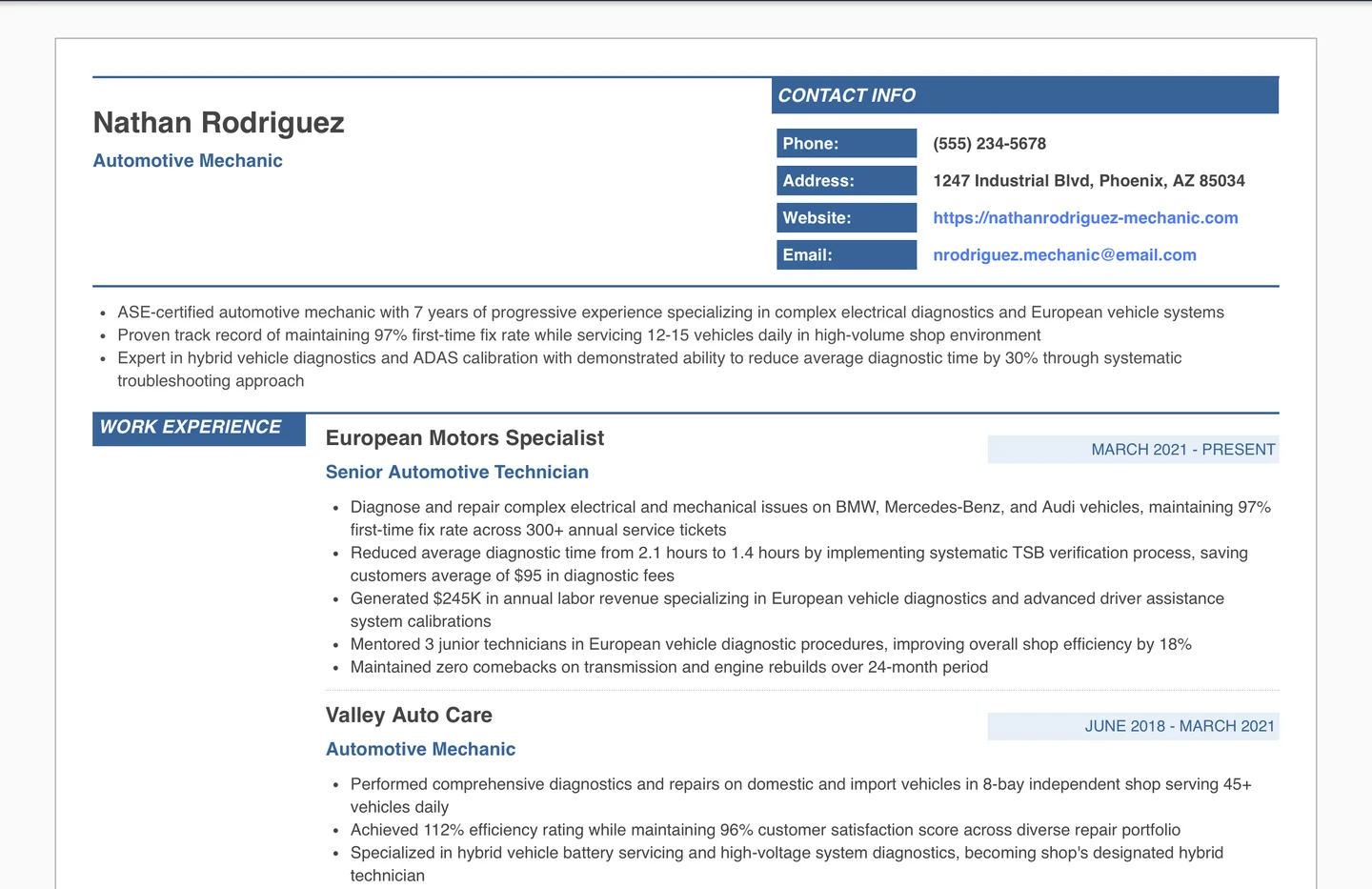
The Ultimate Mechanic Resume Example/Sample
https://www.resumonk.com/mechanicMechanicResume Format to Follow for Mechanic Resume
The reverse-chronological format is your best friend here.
Why? Because shop managers and service directors want to see your progression in the field - they want to know if you've grown from changing oil to diagnosing complex electrical issues, from working on basic sedans to handling diesel engines or luxury vehicles. This format puts your most recent (and typically most advanced) experience front and center.
Structure Your Mechanic Resume Like a Service Manual
Start with a strong professional summary - think of it as your diagnostic report.
In 2-3 lines, capture your specializations, years of experience, and what makes you the mechanic who gets called when others can't figure out that mysterious engine noise. Follow this with your work experience section (the meat of your resume), then your technical skills, certifications, and finally your education.
For mechanics in the UK, remember that MOT testing authorization is often a critical qualification that should appear prominently. In Canada, Red Seal certification deserves prime real estate on your resume. US mechanics should highlight ASE certifications early and often, while Australian mechanics need to emphasize their Certificate III in Light or Heavy Vehicle Mechanical Technology.
Keep It Clean and Scannable
Just like a well-organized toolbox, your resume needs clear sections and logical flow.
Use consistent formatting throughout - if you bold job titles, bold all of them. If you use bullet points for one role, use them for all roles.
White space is your friend; cramming everything together makes your resume as hard to read as a worn-out service manual.
Work Experience on Mechanic Resume
Your work experience section is where the rubber meets the road.
This is where you transform "I fixed cars" into compelling evidence that you're the diagnostic wizard and efficiency champion that every shop needs. The key lies in understanding that hiring managers aren't just looking for someone who can turn a wrench - they're looking for problem-solvers who can handle customer concerns, work efficiently to maximize shop productivity, and adapt to new vehicle technologies.
Quantify Your Impact in the Shop
Numbers speak louder than generic descriptions.
How many vehicles did you service per day? What was your comeback rate? Did you help increase shop efficiency or customer satisfaction scores? Every mechanic fixes cars, but not every mechanic can show measurable impact on shop operations.
Let's look at how to transform a bland work experience entry into something that catches a service manager's eye:
❌ Don't write vague, task-based descriptions:
Automotive Mechanic | Joe's Auto Repair | 2021-2023
- Fixed various car problems
- Performed oil changes and tire rotations
- Helped customers with their vehicles
✅ Do write specific, achievement-focused descriptions:
Automotive Mechanic | Joe's Auto Repair | 2021-2023
- Diagnosed and repaired complex electrical and mechanical issues on 15+ vehicles daily, maintaining a 98% first-time fix rate
- Reduced average diagnostic time by 25% through systematic troubleshooting approach, increasing shop throughput by 3 vehicles per day
- Specialized in European vehicle diagnostics, becoming the go-to technician for BMW and Mercedes-Benz repairs, generating $180K in annual labor revenue
Show Your Technical Evolution
Your career progression tells a story.
Maybe you started as a lube technician and worked your way up to master technician. Perhaps you specialized in transmissions or became the shop's hybrid vehicle expert. Each role should show growth - new skills acquired, additional responsibilities taken on, or specializations developed.
Include Relevant Context
The type of shop matters.
Working at a high-volume quick-lube center requires different skills than working at a luxury dealership or a diesel repair facility. Mention the types of vehicles you worked on, the volume of work, and any specialized equipment or diagnostic systems you used. If you worked on fleet vehicles, mention the size of the fleet. If you worked at a dealership, specify the brand.
Skills to Show on Mechanic Resume
Here's where many mechanics stumble - they list "brake repair" and "oil changes" and call it a day.
But modern mechanics are part technician, part computer programmer, and part detective. Your skills section needs to reflect this complexity while remaining scannable and relevant to the specific position you're targeting.
Technical Skills - Beyond the Basics
Yes, you can change brakes and replace alternators, but what diagnostic equipment can you operate?
Are you proficient with specific scan tools like Snap-on MODIS or Bosch KTS? Can you read wiring diagrams? Do you have experience with ADAS calibration? Modern vehicles are computers on wheels, and your resume needs to show you're keeping pace with technology.
Organize your technical skills strategically. Group them by category - diagnostic capabilities, repair specializations, and equipment proficiency. This makes it easier for hiring managers to quickly assess your capabilities.
❌ Don't create a random list of generic skills:
Skills: Oil changes, tire rotation, customer service, brake repair,
engine repair, teamwork, computer skills
✅ Do organize skills strategically and specifically:
Diagnostic Expertise:
• Advanced electrical diagnostics using oscilloscopes and multimeters
• OBD-II scanner proficiency (Snap-on SOLUS, Autel MaxiSys)
• Diesel engine diagnostics including injector testing and DPF servicing

Repair Specializations:
• Transmission rebuilding (automatic and manual)
• A/C system evacuation, recovery, and recharging (EPA 609 certified)
• Hybrid vehicle battery servicing and high-voltage system safety

Technical Proficiencies:
• Mitchell 1 and AllData navigation
• Hunter alignment system operation
• ADAS calibration procedures for radar and camera systems
Don't Forget the Soft Skills That Matter
While technical skills get you in the door, soft skills keep you employed and promoted.
Can you explain complex repairs to customers who think their car runs on magic? Can you work efficiently under pressure when the shop is backed up? Can you mentor junior technicians?
These skills matter, especially if you're aiming for lead technician or shop foreman positions.
Certifications as Skills Currency
The certifications you list aren't just pieces of paper - they're proof of your expertise.
ASE certifications should be listed with their specific designations (A1-A9, L1, etc.). Include expiration dates if they're current. Manufacturer-specific training (Ford ASSET, Toyota T-TEN, GM ASEP) shows specialized knowledge that can command higher pay.
Don't forget safety certifications like EPA 609 for A/C work or state inspection licenses.
Specific Considerations and Tips for Mechanic Resume
Now for the insider knowledge - the things that separate a mechanic resume that gets filed away from one that gets you called in for an interview. These are the nuances that most generic resume advice misses but that shop managers and service directors specifically look for.
Address the Comeback Rate Question Before It's Asked
Every service manager's nightmare is the comeback - a vehicle returning with the same problem you supposedly fixed.
If you have a low comeback rate, shout it from the rooftops. Include it in your professional summary or as a key achievement.
This single metric can be more valuable than years of experience because it directly impacts shop reputation and profitability.
Highlight Your Diagnostic Process, Not Just Results
Anyone can replace parts until something works (the expensive way). Great mechanics have a systematic diagnostic approach that saves time and money. Describe how you approach problems - do you start with the simplest solutions? Do you use technical service bulletins? Do you have a mental flowchart for common issues?
This shows you're thinking about efficiency and cost-effectiveness, not just fixing cars.
For example, instead of just listing "engine diagnostics," explain your approach:
Developed systematic diagnostic approach reducing average troubleshooting
time from 1.5 hours to 45 minutes by implementing TSB checks before
component testing, saving customers an average of $130 in diagnostic fees
Show You Understand the Business Side
Mechanics who understand that shops need to make money to stay open are more valuable than those who just turn wrenches.
Have you helped improve shop efficiency? Suggested profitable service recommendations? Maintained high labor productivity rates?
Including these business-minded achievements shows you're ready for more responsibility.
Emphasize Continuous Learning
The automotive industry evolves rapidly - electric vehicles, advanced driver assistance systems, new refrigerants, changing emission standards. Show that you're not stuck in the past. List recent training, even if it's YouTube University or online courses. Mention if you stay current with industry publications or forums.
This is especially critical if you're an experienced mechanic competing with younger technicians who grew up with modern vehicle technology.
Handle Employment Gaps Strategically
Maybe you took time off for injury (occupational hazard in this field), started your own mobile mechanic business that didn't pan out, or dealt with family matters. Brief gaps aren't deal-breakers in the trades, but be prepared to address them.
If you did any relevant work during the gap - even helping friends with their vehicles or taking online training - mention it.
Tailor for Shop Type
A resume for a dealership position should emphasize warranty work experience, manufacturer training, and ability to meet flat-rate times.
For independent shops, highlight your versatility across makes and models. For fleet positions, emphasize preventive maintenance programs and experience with record-keeping systems. Government positions might require specific clearances or civil service exam scores - include these prominently if you have them.
The Tool Question
In many regions, mechanics are expected to provide their own tools. If you have a comprehensive tool collection (especially specialized tools), mention it briefly.
You don't need an inventory, but stating "Maintain complete professional tool set including specialized European diagnostic equipment valued at $XX,000" shows you're serious about the profession and won't be borrowing tools constantly.
Remember, your resume is your first repair job for a potential employer - diagnose what they need, present your qualifications clearly, and demonstrate that hiring you is the fix for their staffing problems. Get these elements right, and you'll have service managers calling you faster than a customer with a check engine light.
Education to List on Mechanic Resume
Imagine this - you've spent years getting your hands dirty, learning the intricate dance between metal and machine, perhaps starting as that kid who took apart the family toaster just to see how it worked. Now you're ready to take your mechanical expertise to the next level, whether that's your first professional role or a step up to a better shop.
The education section of your resume might feel like a formality, especially when your real education happened under the hood, but here's the thing - it's your chance to show you've got both the theoretical knowledge and the practical chops.
The Foundation - Your Technical Education
As a mechanic, your educational background typically falls into a few distinct camps. Maybe you went the traditional route through a technical college or community college automotive program. Perhaps you completed a manufacturer-specific training program at a dealership. Or you might have learned through a formal apprenticeship program.
Whatever path you took, the key is presenting it in a way that shows you didn't just show up - you absorbed the knowledge and can apply it.
Start with your most recent or most relevant education first. For mechanics, this usually means your technical training takes precedence over your high school diploma, even if high school came later chronologically.
Think of it this way - when a service manager is scanning your resume, they want to know if you understand diagnostic systems, not if you aced English Literature.
Structuring Your Education Section
The sweet spot for listing your education combines clarity with relevant detail. You want to include your certification or degree, the institution, graduation date (or expected graduation), and any standout achievements that relate directly to your mechanical abilities.
❌ Don't write vaguely:
Community College
Automotive Technology
Graduated 2022
✅ Do include specific, relevant details:
Associate of Applied Science in Automotive Technology
Lincoln Technical Institute, Denver, CO
Graduated: May 2022
• ASE Student Certification in Brakes and Suspension
• Dean's List: Fall 2021, Spring 2022
• Specialized coursework in hybrid vehicle systems and diagnostics
Certifications - Your Technical Credentials
Here's where mechanics have a unique advantage.
Your ASE certifications, manufacturer training certificates, and specialized credentials often matter more than formal degrees. These belong in your education section if you don't have many, or in a separate certifications section if you've accumulated several. Remember, each certification tells a story about your expertise - A1 through A9 ASE certifications each represent mastery of different systems.
For recent graduates or those still in training programs, don't hesitate to include expected certification dates. Employers understand that certification exams have schedules, and showing you're on track demonstrates commitment.
❌ Don't bury important certifications:
Various automotive certifications obtained
✅ Do specify each certification clearly:
1. ASE Certifications:
• A4 Suspension and Steering - Certified June 2023
• A5 Brakes - Certified June 2023
• A6 Electrical/Electronic Systems - In Progress (Exam scheduled March 2024)

2. Ford STST Certification - Completed August 2022
3. EPA Section 609 Certification - Current
When You're Self-Taught or Experience-Heavy
Maybe you learned in your uncle's garage, built your skills through YouTube University, or jumped straight into working at a shop after high school.
That's completely valid in the mechanic world, where skills often speak louder than degrees. In this case, keep your education section brief but don't omit it entirely. List your high school diploma and any relevant training courses, workshops, or manufacturer training you've completed.
The key is showing you're committed to continuous learning - because automotive technology never stops evolving.
Awards and Publications on Mechanic Resume
Let's be real for a moment - when you think "mechanic," you probably don't immediately think "awards and publications."
You're not writing research papers on quantum mechanics; you're diagnosing why Mrs. Johnson's Camry makes that weird clicking noise when she turns left. But here's what many mechanics miss - this section is your opportunity to stand out from the stack of resumes that all list the same certifications and experience.
It's where you prove you're not just competent; you're exceptional.
Awards That Matter in the Mechanic World
The awards that carry weight for mechanics aren't academic honors (though those count too) - they're recognition of your technical excellence, customer service skills, and reliability. Think about it from an employer's perspective.
They're not just hiring someone who can turn a wrench; they're hiring someone who shows up on time, solves problems efficiently, and keeps customers coming back.
Employee of the Month might sound cliché in other fields, but in a shop environment where reliability and teamwork matter, it shows you're the person others can count on. Productivity awards demonstrate efficiency - crucial when shops bill by the book hour.
Customer satisfaction recognitions prove you can explain a serpentine belt replacement to someone who thinks their car runs on magic and gasoline.
❌ Don't list awards without context:
Awards:
• Employee of the Month
• Top Technician Award
• Perfect Attendance
✅ Do provide meaningful detail:
Professional Recognition:
• Top Productivity Technician, Bob's Auto Repair (2023) - Achieved 115% efficiency rating while maintaining zero comebacks
• Employee of the Quarter, Midas Denver (Q2 2022) - Recognized for mentoring two junior technicians and improving shop workflow
• Customer Service Excellence Award (2023) - Maintained 98% customer satisfaction score across 200+ service tickets
Technical Competitions and Achievements
Did you compete in SkillsUSA during technical school? Place in a diagnostic competition? Win a manufacturer's technical challenge? These achievements are gold for your resume because they demonstrate not just competence, but excellence under pressure.
They show you can think on your feet when faced with unusual problems - exactly what happens daily in a real shop.
Even informal achievements count. If you diagnosed a problem that three other shops missed, that's worth mentioning. If you developed a new procedure that reduced repair time, that's innovation. The automotive world respects problem-solvers and innovators, not just parts-changers.
Publications and Knowledge Sharing
Now, about publications - no, we're not expecting you to have articles in the Journal of Automotive Engineering.
But today's mechanics often share knowledge in other ways. Do you run a YouTube channel explaining common repairs? Write technical posts on automotive forums? Contribute to your shop's blog or social media with maintenance tips? These all count as publications in the modern sense.
❌ Don't overlook modern forms of publication:
No publications
✅ Do include relevant knowledge-sharing activities:
Technical Knowledge Sharing:
• Contributing writer, Shop Newsletter - Monthly articles on seasonal maintenance (2022-present)
• Technical forum moderator, MechanicAdvice subreddit - 500+ answered technical questions, "Top Contributor" badge
• Created training videos for shop's apprentice program on brake system diagnostics (viewed 1,000+ times internally)
Regional Differences in Recognition
In the USA and Canada, customer service awards and productivity metrics carry significant weight.
UK employers often value City & Guilds achievements and IMI awards highly. Australian shops respect VACC training recognitions and state-based automotive excellence awards. Tailor your awards section to what matters in your local market while keeping universal achievements like technical competition wins prominent regardless of location.
Listing References for Mechanic Resume
You've torqued every bolt to spec, diagnosed that mysterious rattle, and earned the trust of customers who barely know what an alternator does.
Now comes a part of the job application that feels oddly personal for a profession built on technical skill - providing references. Here's the thing though: in the mechanic world, references carry more weight than you might think. When you're going to be working on machines that can kill people if repaired incorrectly, trust isn't just nice to have - it's essential.
Why References Matter More for Mechanics
Unlike office jobs where a bad hire might mean missed deadlines, a mechanic who cuts corners or lacks integrity could cost lives, lawsuits, and livelihoods. Shop owners know that technical skills can be taught, but integrity and work ethic can't.
Your references are their window into whether you're someone who'll admit when you're stumped by a problem, who won't pad repair estimates, and who treats every car like it belongs to their own mother.
Think about it from the shop owner's perspective - they're potentially giving you access to customer vehicles worth tens of thousands of dollars, expensive diagnostic equipment, and their shop's reputation. They need to know you're someone who won't "borrow" tools, won't take shortcuts on safety, and won't badmouth the shop to customers when you're having a bad day.
Choosing the Right References
The best references for mechanics follow a hierarchy. Your previous shop supervisor or service manager sits at the top - they've seen you work under pressure, handle difficult diagnoses, and interact with customers. Next comes a senior technician or mentor who can speak to your technical growth and learning ability.
Don't overlook parts suppliers or tool vendors you've worked with regularly - they can vouch for your professionalism and knowledge in ways others can't.
❌ Don't list references without context:
References:
John Smith - 555-0123
Mary Johnson - 555-0456
Bob Williams - 555-0789
✅ Do provide clear, professional reference listings:
Professional References:

1. Michael Rodriguez - Service Manager, Premier Auto Care, Denver, CO
- Phone: (303) 555-0123
- Email: [email protected]
- Relationship: Direct supervisor for 3 years

2. Jennifer Park - Master Technician/Shop Foreman, Express Automotive, Aurora, CO
- Phone: (720) 555-0456
- Email: [email protected]
- Relationship: Mentor and senior colleague, worked together on diagnostic team

3. Thomas Anderson - Regional Parts Manager, NAPA Auto Parts
- Phone: (303) 555-0789
- Email: [email protected]
- Relationship: Primary parts supplier contact, 5-year professional relationship
Preparing Your References
Before you list anyone as a reference, have an actual conversation with them. Not just a text saying "hey, can you be my reference?" but a real discussion about the position you're applying for. Tell them about the shop - is it a dealership focusing on warranty work or an independent specialising in performance modifications?
This helps them tailor their recommendation to what matters most.
Give your references a heads-up about specific accomplishments they might mention. Remind your former service manager about the time you increased shop efficiency by reorganising the tool crib. Refresh your mentor's memory about when you diagnosed that bizarre EVAP system issue. The more specific examples they can provide, the stronger their recommendation.
The Reference Sheet Strategy
Unlike many professions, mechanics often benefit from having their references ready to provide immediately. Why? Because shop managers often make quick hiring decisions - they need someone in that empty bay generating revenue ASAP.
Having a professional reference sheet ready shows you're prepared and serious about the position.
Include a brief note about how each reference knows you and what aspect of your work they can best speak to. This helps the hiring manager know whom to call for specific questions. If they want to know about your diagnostic skills, they'll call your technical mentor. Questions about reliability and customer service? That's your former service manager's territory.
International Considerations
In the UK and Australia, written references (or "referees" as they're called) are often expected upfront, sometimes even character references along with professional ones. US and Canadian employers typically prefer to make phone contact with references and might view written references with suspicion.
German and European shops might expect detailed written recommendations focusing heavily on technical competencies and certifications.
When References Are Complicated
Maybe you're leaving your first shop on less-than-ideal terms, or your previous employer has a policy against providing references. This isn't uncommon in the automotive world where shops compete for good technicians. In these cases, cultivate references from other professional relationships - technical school instructors, certification program trainers, or even satisfied customers who own businesses themselves.
A reference from a fleet manager whose vehicles you've maintained can be particularly powerful.
Remember, the goal isn't just to prove you can fix cars - any certified mechanic can claim that. Your references should paint a picture of someone who shows up every day ready to work, treats customers fairly, helps teammates when needed, and takes pride in doing the job right the first time.
In an industry where comeback repairs eat into everyone's profit and reputation, that reliability is worth its weight in gold.
Cover Letter Tips for Mechanic Resume
Here's a truth that might surprise you - many mechanics skip writing a cover letter entirely, figuring their certifications and experience speak for themselves. They're leaving money on the table. Think about it this way: you're not just a pair of skilled hands; you're a problem solver, a customer communicator, and potentially the person who keeps someone's family safely on the road.
Your cover letter is where you transform from a list of qualifications into a real person who understands both carburetors and customer service.
Why Mechanics Need Cover Letters More Than They Think
The automotive repair industry has evolved. Shop owners aren't just looking for someone who can diagnose a P0420 code; they want someone who can explain to Mrs. Garcia why her catalytic converter needs replacing without making her feel like she's being taken for a ride. They need technicians who understand that every car rolling into the bay represents someone's livelihood, their way to work, their freedom.
Your cover letter proves you get this bigger picture.
Moreover, with shops ranging from dealerships to independent garages, from quick-lube centers to specialty performance shops, your cover letter helps you stand out as someone who specifically wants to work at their shop, not just any shop with an open bay.
Opening Strong - Hook Them With Relevance
Forget the generic "I am writing to apply for the mechanic position" opener. You're competing with people who might have similar certifications, so you need to immediately show why you're different.
Start with something specific about their shop, a particular challenge you're equipped to solve, or a connection to their specialty.
❌ Don't open with a generic statement:
Dear Hiring Manager,

I am interested in the mechanic position at your shop. I have five years of experience and all my ASE certifications. I am a hard worker and team player.
✅ Do open with specific, engaging content:
Dear Mr. Thompson,

When I saw Johnson's European Auto is expanding its BMW diagnostic capabilities, I knew my three years specializing in BMW electronic systems at Munich Motors, combined with my recent BMW ISTA/D certification, could help your shop capture more of the growing luxury import market in downtown Portland.
The Body - Telling Your Technical Story
The middle of your cover letter should tell a story that your resume can't. Maybe it's about the time you diagnosed an intermittent electrical issue that had stumped three other shops. Perhaps it's about how you reduced comeback rates by implementing a personal double-check system.
Or it could be about how you helped convert a frustrated customer into the shop's biggest advocate through patient explanation and honest service.
Remember to connect your experience to their specific needs. If they mention they're a high-volume shop, talk about your efficiency metrics. If they emphasize customer service, share your approach to client communication. If they're known for complex diagnostics, highlight your problem-solving methodology.
❌ Don't just repeat your resume:
I have experience with brake repair, oil changes, and tire rotation. I am ASE certified in brakes and suspension. I worked at three different shops.
✅ Do tell a compelling professional story:
During my time at City Auto Repair, I became known as the "electrical detective" after successfully diagnosing a Chrysler Town & Country with an intermittent starting issue that had visited four shops over six months. By methodically testing each component in the starting circuit under various temperature conditions, I discovered a hairline crack in the ignition switch that only separated when the interior reached specific temperatures. This systematic approach to difficult diagnoses would serve your customers well, especially given your reputation for solving problems others can't.
Closing With Confidence and Action
Your closing paragraph should do three things: reinforce your fit for the position, express genuine enthusiasm for the opportunity, and include a clear call to action. Don't just say you're "looking forward to hearing from them" - suggest a concrete next step.
Adapting for Different Shop Types
Dealership applications require more formal language and emphasis on manufacturer training and adherence to procedures.
Independent shops appreciate versatility and creative problem-solving. Quick-service chains want speed and efficiency metrics. Specialty shops (performance, restoration, diesel) need to see deep, specific expertise. Your cover letter tone and content should match the shop's culture.
For UK positions, maintain a more formal tone throughout and reference specific NVQ levels or City & Guilds qualifications. Australian employers appreciate directness and practical examples. Canadian shops often value bilingual abilities if you have them. US employers typically respond well to quantifiable achievements and customer service emphasis.
Key Takeaways
- Use reverse-chronological format to showcase your progression from entry-level to experienced technician, putting your most advanced experience front and center
- Quantify your shop impact with specific metrics like vehicles serviced per day, comeback rates, efficiency percentages, and revenue generated
- Organize technical skills strategically by grouping them into categories like diagnostic expertise, repair specializations, and equipment proficiency rather than creating random lists
- Highlight relevant certifications prominently - ASE certifications with specific designations, manufacturer training, and safety credentials like EPA 609
- Address the business side by showing how you've improved shop efficiency, reduced diagnostic time, or contributed to customer satisfaction
- Emphasize continuous learning through recent training, technical competitions, or staying current with evolving automotive technology
- Tailor your resume for shop type - dealerships want warranty work experience, independents value versatility, fleet positions need preventive maintenance focus
- Don't skip the cover letter - use it to tell a specific story about your problem-solving abilities and show you understand both the technical and customer service aspects
- Prepare references strategically with context about your relationship and what aspects of your work they can speak to best
Creating a mechanic resume that captures your technical expertise while demonstrating your value to a shop's bottom line doesn't have to feel like diagnosing an intermittent electrical fault. With Resumonk, you can build a professional mechanic resume that showcases your certifications, quantifies your shop achievements, and highlights your diagnostic capabilities - all while maintaining clean, professional formatting that makes it easy for service managers to see why you're the technician they need. Our AI-powered suggestions help you articulate your technical accomplishments in ways that resonate with employers, while our professionally designed templates ensure your resume looks as polished as a freshly detailed engine bay.
Ready to build a mechanic resume that shifts your career into high gear?
Start crafting your professional mechanic resume with Resumonk's intelligent resume builder and land that position at the shop where your skills will be valued.
Get started with Resumonk today and show employers you're the diagnostic expert and efficiency champion they've been searching for.
More Manufacturing & Production resume examples
- Maintenance Supervisor resume example
- Machine Operator resume example
- Manufacturing Engineer resume example
- Quality Engineer resume example
See all Manufacturing & Production resume examples, or browse every category.
Resume writing tips
Let's step into this scene - you've spent years getting your hands dirty, learning the intricate dance between metal and machine, building expertise that goes far beyond what any classroom could teach. Maybe you started tinkering in your garage as a teenager, or perhaps you went through formal training at a technical school. Either way, you're now ready to land that mechanic position, whether it's at a dealership, an independent shop, or a fleet maintenance facility. The challenge?
Translating all that hands-on expertise into a document that speaks to hiring managers who might spend less than 30 seconds scanning your resume.
As a mechanic, you're part technician, part detective, and part customer service representative - you diagnose mysterious noises, solve complex electrical puzzles, and explain intricate repairs to customers who think their car runs on hopes and regular unleaded. Your resume needs to capture this multifaceted expertise while speaking directly to shop managers who care about efficiency rates, comeback percentages, and whether you can handle the latest diagnostic equipment. The good news? We're about to walk you through every single element of crafting a mechanic resume that gets you noticed, from that crucial first professional summary all the way through to selecting references who'll vouch for your ability to turn wrenches and profits alike.
Throughout this guide, we'll start by nailing down the perfect resume format - specifically, why the reverse-chronological format works best for showcasing your progression from lube tech to master technician. You'll learn how to transform your work experience from a boring list of oil changes into compelling evidence of your diagnostic prowess and business impact. We'll dive deep into presenting your technical skills (beyond just "brake repair"), highlighting certifications that matter, and crafting education sections that balance formal training with real-world experience. Plus, we'll cover the often-overlooked elements like awards that actually matter in the mechanic world, cover letter strategies that set you apart from the stack, and how to handle references when your best supervisor works for a competing shop.
Whether you're a seasoned technician with decades under the hood or a recent technical school graduate with grease still under your fingernails from your internship, this guide addresses the specific challenges you face. We'll tackle everything from highlighting your ASE certifications and manufacturer training to showing you understand the business side of running a profitable service bay. By the time you finish reading, you'll have a complete blueprint for a resume that proves you're not just another parts-changer, but a skilled professional who can diagnose problems, satisfy customers, and keep the service bays humming with profitable efficiency.
The Ultimate Mechanic Resume Example/Sample
https://www.resumonk.com/mechanicMechanicResume Format to Follow for Mechanic Resume
The reverse-chronological format is your best friend here.
Why? Because shop managers and service directors want to see your progression in the field - they want to know if you've grown from changing oil to diagnosing complex electrical issues, from working on basic sedans to handling diesel engines or luxury vehicles. This format puts your most recent (and typically most advanced) experience front and center.
Structure Your Mechanic Resume Like a Service Manual
Start with a strong professional summary - think of it as your diagnostic report.
In 2-3 lines, capture your specializations, years of experience, and what makes you the mechanic who gets called when others can't figure out that mysterious engine noise. Follow this with your work experience section (the meat of your resume), then your technical skills, certifications, and finally your education.
For mechanics in the UK, remember that MOT testing authorization is often a critical qualification that should appear prominently. In Canada, Red Seal certification deserves prime real estate on your resume. US mechanics should highlight ASE certifications early and often, while Australian mechanics need to emphasize their Certificate III in Light or Heavy Vehicle Mechanical Technology.
Keep It Clean and Scannable
Just like a well-organized toolbox, your resume needs clear sections and logical flow.
Use consistent formatting throughout - if you bold job titles, bold all of them. If you use bullet points for one role, use them for all roles.
White space is your friend; cramming everything together makes your resume as hard to read as a worn-out service manual.
Work Experience on Mechanic Resume
Your work experience section is where the rubber meets the road.
This is where you transform "I fixed cars" into compelling evidence that you're the diagnostic wizard and efficiency champion that every shop needs. The key lies in understanding that hiring managers aren't just looking for someone who can turn a wrench - they're looking for problem-solvers who can handle customer concerns, work efficiently to maximize shop productivity, and adapt to new vehicle technologies.
Quantify Your Impact in the Shop
Numbers speak louder than generic descriptions.
How many vehicles did you service per day? What was your comeback rate? Did you help increase shop efficiency or customer satisfaction scores? Every mechanic fixes cars, but not every mechanic can show measurable impact on shop operations.
Let's look at how to transform a bland work experience entry into something that catches a service manager's eye:
❌ Don't write vague, task-based descriptions:
Automotive Mechanic | Joe's Auto Repair | 2021-2023
- Fixed various car problems
- Performed oil changes and tire rotations
- Helped customers with their vehicles
✅ Do write specific, achievement-focused descriptions:
Automotive Mechanic | Joe's Auto Repair | 2021-2023
- Diagnosed and repaired complex electrical and mechanical issues on 15+ vehicles daily, maintaining a 98% first-time fix rate
- Reduced average diagnostic time by 25% through systematic troubleshooting approach, increasing shop throughput by 3 vehicles per day
- Specialized in European vehicle diagnostics, becoming the go-to technician for BMW and Mercedes-Benz repairs, generating $180K in annual labor revenue
Show Your Technical Evolution
Your career progression tells a story.
Maybe you started as a lube technician and worked your way up to master technician. Perhaps you specialized in transmissions or became the shop's hybrid vehicle expert. Each role should show growth - new skills acquired, additional responsibilities taken on, or specializations developed.
Include Relevant Context
The type of shop matters.
Working at a high-volume quick-lube center requires different skills than working at a luxury dealership or a diesel repair facility. Mention the types of vehicles you worked on, the volume of work, and any specialized equipment or diagnostic systems you used. If you worked on fleet vehicles, mention the size of the fleet. If you worked at a dealership, specify the brand.
Skills to Show on Mechanic Resume
Here's where many mechanics stumble - they list "brake repair" and "oil changes" and call it a day.
But modern mechanics are part technician, part computer programmer, and part detective. Your skills section needs to reflect this complexity while remaining scannable and relevant to the specific position you're targeting.
Technical Skills - Beyond the Basics
Yes, you can change brakes and replace alternators, but what diagnostic equipment can you operate?
Are you proficient with specific scan tools like Snap-on MODIS or Bosch KTS? Can you read wiring diagrams? Do you have experience with ADAS calibration? Modern vehicles are computers on wheels, and your resume needs to show you're keeping pace with technology.
Organize your technical skills strategically. Group them by category - diagnostic capabilities, repair specializations, and equipment proficiency. This makes it easier for hiring managers to quickly assess your capabilities.
❌ Don't create a random list of generic skills:
Skills: Oil changes, tire rotation, customer service, brake repair,
engine repair, teamwork, computer skills
✅ Do organize skills strategically and specifically:
Diagnostic Expertise:
• Advanced electrical diagnostics using oscilloscopes and multimeters
• OBD-II scanner proficiency (Snap-on SOLUS, Autel MaxiSys)
• Diesel engine diagnostics including injector testing and DPF servicing

Repair Specializations:
• Transmission rebuilding (automatic and manual)
• A/C system evacuation, recovery, and recharging (EPA 609 certified)
• Hybrid vehicle battery servicing and high-voltage system safety

Technical Proficiencies:
• Mitchell 1 and AllData navigation
• Hunter alignment system operation
• ADAS calibration procedures for radar and camera systems
Don't Forget the Soft Skills That Matter
While technical skills get you in the door, soft skills keep you employed and promoted.
Can you explain complex repairs to customers who think their car runs on magic? Can you work efficiently under pressure when the shop is backed up? Can you mentor junior technicians?
These skills matter, especially if you're aiming for lead technician or shop foreman positions.
Certifications as Skills Currency
The certifications you list aren't just pieces of paper - they're proof of your expertise.
ASE certifications should be listed with their specific designations (A1-A9, L1, etc.). Include expiration dates if they're current. Manufacturer-specific training (Ford ASSET, Toyota T-TEN, GM ASEP) shows specialized knowledge that can command higher pay.
Don't forget safety certifications like EPA 609 for A/C work or state inspection licenses.
Specific Considerations and Tips for Mechanic Resume
Now for the insider knowledge - the things that separate a mechanic resume that gets filed away from one that gets you called in for an interview. These are the nuances that most generic resume advice misses but that shop managers and service directors specifically look for.
Address the Comeback Rate Question Before It's Asked
Every service manager's nightmare is the comeback - a vehicle returning with the same problem you supposedly fixed.
If you have a low comeback rate, shout it from the rooftops. Include it in your professional summary or as a key achievement.
This single metric can be more valuable than years of experience because it directly impacts shop reputation and profitability.
Highlight Your Diagnostic Process, Not Just Results
Anyone can replace parts until something works (the expensive way). Great mechanics have a systematic diagnostic approach that saves time and money. Describe how you approach problems - do you start with the simplest solutions? Do you use technical service bulletins? Do you have a mental flowchart for common issues?
This shows you're thinking about efficiency and cost-effectiveness, not just fixing cars.
For example, instead of just listing "engine diagnostics," explain your approach:
Developed systematic diagnostic approach reducing average troubleshooting
time from 1.5 hours to 45 minutes by implementing TSB checks before
component testing, saving customers an average of $130 in diagnostic fees
Show You Understand the Business Side
Mechanics who understand that shops need to make money to stay open are more valuable than those who just turn wrenches.
Have you helped improve shop efficiency? Suggested profitable service recommendations? Maintained high labor productivity rates?
Including these business-minded achievements shows you're ready for more responsibility.
Emphasize Continuous Learning
The automotive industry evolves rapidly - electric vehicles, advanced driver assistance systems, new refrigerants, changing emission standards. Show that you're not stuck in the past. List recent training, even if it's YouTube University or online courses. Mention if you stay current with industry publications or forums.
This is especially critical if you're an experienced mechanic competing with younger technicians who grew up with modern vehicle technology.
Handle Employment Gaps Strategically
Maybe you took time off for injury (occupational hazard in this field), started your own mobile mechanic business that didn't pan out, or dealt with family matters. Brief gaps aren't deal-breakers in the trades, but be prepared to address them.
If you did any relevant work during the gap - even helping friends with their vehicles or taking online training - mention it.
Tailor for Shop Type
A resume for a dealership position should emphasize warranty work experience, manufacturer training, and ability to meet flat-rate times.
For independent shops, highlight your versatility across makes and models. For fleet positions, emphasize preventive maintenance programs and experience with record-keeping systems. Government positions might require specific clearances or civil service exam scores - include these prominently if you have them.
The Tool Question
In many regions, mechanics are expected to provide their own tools. If you have a comprehensive tool collection (especially specialized tools), mention it briefly.
You don't need an inventory, but stating "Maintain complete professional tool set including specialized European diagnostic equipment valued at $XX,000" shows you're serious about the profession and won't be borrowing tools constantly.
Remember, your resume is your first repair job for a potential employer - diagnose what they need, present your qualifications clearly, and demonstrate that hiring you is the fix for their staffing problems. Get these elements right, and you'll have service managers calling you faster than a customer with a check engine light.
Education to List on Mechanic Resume
Imagine this - you've spent years getting your hands dirty, learning the intricate dance between metal and machine, perhaps starting as that kid who took apart the family toaster just to see how it worked. Now you're ready to take your mechanical expertise to the next level, whether that's your first professional role or a step up to a better shop.
The education section of your resume might feel like a formality, especially when your real education happened under the hood, but here's the thing - it's your chance to show you've got both the theoretical knowledge and the practical chops.
The Foundation - Your Technical Education
As a mechanic, your educational background typically falls into a few distinct camps. Maybe you went the traditional route through a technical college or community college automotive program. Perhaps you completed a manufacturer-specific training program at a dealership. Or you might have learned through a formal apprenticeship program.
Whatever path you took, the key is presenting it in a way that shows you didn't just show up - you absorbed the knowledge and can apply it.
Start with your most recent or most relevant education first. For mechanics, this usually means your technical training takes precedence over your high school diploma, even if high school came later chronologically.
Think of it this way - when a service manager is scanning your resume, they want to know if you understand diagnostic systems, not if you aced English Literature.
Structuring Your Education Section
The sweet spot for listing your education combines clarity with relevant detail. You want to include your certification or degree, the institution, graduation date (or expected graduation), and any standout achievements that relate directly to your mechanical abilities.
❌ Don't write vaguely:
Community College
Automotive Technology
Graduated 2022
✅ Do include specific, relevant details:
Associate of Applied Science in Automotive Technology
Lincoln Technical Institute, Denver, CO
Graduated: May 2022
• ASE Student Certification in Brakes and Suspension
• Dean's List: Fall 2021, Spring 2022
• Specialized coursework in hybrid vehicle systems and diagnostics
Certifications - Your Technical Credentials
Here's where mechanics have a unique advantage.
Your ASE certifications, manufacturer training certificates, and specialized credentials often matter more than formal degrees. These belong in your education section if you don't have many, or in a separate certifications section if you've accumulated several. Remember, each certification tells a story about your expertise - A1 through A9 ASE certifications each represent mastery of different systems.
For recent graduates or those still in training programs, don't hesitate to include expected certification dates. Employers understand that certification exams have schedules, and showing you're on track demonstrates commitment.
❌ Don't bury important certifications:
Various automotive certifications obtained
✅ Do specify each certification clearly:
1. ASE Certifications:
• A4 Suspension and Steering - Certified June 2023
• A5 Brakes - Certified June 2023
• A6 Electrical/Electronic Systems - In Progress (Exam scheduled March 2024)

2. Ford STST Certification - Completed August 2022
3. EPA Section 609 Certification - Current
When You're Self-Taught or Experience-Heavy
Maybe you learned in your uncle's garage, built your skills through YouTube University, or jumped straight into working at a shop after high school.
That's completely valid in the mechanic world, where skills often speak louder than degrees. In this case, keep your education section brief but don't omit it entirely. List your high school diploma and any relevant training courses, workshops, or manufacturer training you've completed.
The key is showing you're committed to continuous learning - because automotive technology never stops evolving.
Awards and Publications on Mechanic Resume
Let's be real for a moment - when you think "mechanic," you probably don't immediately think "awards and publications."
You're not writing research papers on quantum mechanics; you're diagnosing why Mrs. Johnson's Camry makes that weird clicking noise when she turns left. But here's what many mechanics miss - this section is your opportunity to stand out from the stack of resumes that all list the same certifications and experience.
It's where you prove you're not just competent; you're exceptional.
Awards That Matter in the Mechanic World
The awards that carry weight for mechanics aren't academic honors (though those count too) - they're recognition of your technical excellence, customer service skills, and reliability. Think about it from an employer's perspective.
They're not just hiring someone who can turn a wrench; they're hiring someone who shows up on time, solves problems efficiently, and keeps customers coming back.
Employee of the Month might sound cliché in other fields, but in a shop environment where reliability and teamwork matter, it shows you're the person others can count on. Productivity awards demonstrate efficiency - crucial when shops bill by the book hour.
Customer satisfaction recognitions prove you can explain a serpentine belt replacement to someone who thinks their car runs on magic and gasoline.
❌ Don't list awards without context:
Awards:
• Employee of the Month
• Top Technician Award
• Perfect Attendance
✅ Do provide meaningful detail:
Professional Recognition:
• Top Productivity Technician, Bob's Auto Repair (2023) - Achieved 115% efficiency rating while maintaining zero comebacks
• Employee of the Quarter, Midas Denver (Q2 2022) - Recognized for mentoring two junior technicians and improving shop workflow
• Customer Service Excellence Award (2023) - Maintained 98% customer satisfaction score across 200+ service tickets
Technical Competitions and Achievements
Did you compete in SkillsUSA during technical school? Place in a diagnostic competition? Win a manufacturer's technical challenge? These achievements are gold for your resume because they demonstrate not just competence, but excellence under pressure.
They show you can think on your feet when faced with unusual problems - exactly what happens daily in a real shop.
Even informal achievements count. If you diagnosed a problem that three other shops missed, that's worth mentioning. If you developed a new procedure that reduced repair time, that's innovation. The automotive world respects problem-solvers and innovators, not just parts-changers.
Publications and Knowledge Sharing
Now, about publications - no, we're not expecting you to have articles in the Journal of Automotive Engineering.
But today's mechanics often share knowledge in other ways. Do you run a YouTube channel explaining common repairs? Write technical posts on automotive forums? Contribute to your shop's blog or social media with maintenance tips? These all count as publications in the modern sense.
❌ Don't overlook modern forms of publication:
No publications
✅ Do include relevant knowledge-sharing activities:
Technical Knowledge Sharing:
• Contributing writer, Shop Newsletter - Monthly articles on seasonal maintenance (2022-present)
• Technical forum moderator, MechanicAdvice subreddit - 500+ answered technical questions, "Top Contributor" badge
• Created training videos for shop's apprentice program on brake system diagnostics (viewed 1,000+ times internally)
Regional Differences in Recognition
In the USA and Canada, customer service awards and productivity metrics carry significant weight.
UK employers often value City & Guilds achievements and IMI awards highly. Australian shops respect VACC training recognitions and state-based automotive excellence awards. Tailor your awards section to what matters in your local market while keeping universal achievements like technical competition wins prominent regardless of location.
Listing References for Mechanic Resume
You've torqued every bolt to spec, diagnosed that mysterious rattle, and earned the trust of customers who barely know what an alternator does.
Now comes a part of the job application that feels oddly personal for a profession built on technical skill - providing references. Here's the thing though: in the mechanic world, references carry more weight than you might think. When you're going to be working on machines that can kill people if repaired incorrectly, trust isn't just nice to have - it's essential.
Why References Matter More for Mechanics
Unlike office jobs where a bad hire might mean missed deadlines, a mechanic who cuts corners or lacks integrity could cost lives, lawsuits, and livelihoods. Shop owners know that technical skills can be taught, but integrity and work ethic can't.
Your references are their window into whether you're someone who'll admit when you're stumped by a problem, who won't pad repair estimates, and who treats every car like it belongs to their own mother.
Think about it from the shop owner's perspective - they're potentially giving you access to customer vehicles worth tens of thousands of dollars, expensive diagnostic equipment, and their shop's reputation. They need to know you're someone who won't "borrow" tools, won't take shortcuts on safety, and won't badmouth the shop to customers when you're having a bad day.
Choosing the Right References
The best references for mechanics follow a hierarchy. Your previous shop supervisor or service manager sits at the top - they've seen you work under pressure, handle difficult diagnoses, and interact with customers. Next comes a senior technician or mentor who can speak to your technical growth and learning ability.
Don't overlook parts suppliers or tool vendors you've worked with regularly - they can vouch for your professionalism and knowledge in ways others can't.
❌ Don't list references without context:
References:
John Smith - 555-0123
Mary Johnson - 555-0456
Bob Williams - 555-0789
✅ Do provide clear, professional reference listings:
Professional References:

1. Michael Rodriguez - Service Manager, Premier Auto Care, Denver, CO
- Phone: (303) 555-0123
- Email: [email protected]
- Relationship: Direct supervisor for 3 years

2. Jennifer Park - Master Technician/Shop Foreman, Express Automotive, Aurora, CO
- Phone: (720) 555-0456
- Email: [email protected]
- Relationship: Mentor and senior colleague, worked together on diagnostic team

3. Thomas Anderson - Regional Parts Manager, NAPA Auto Parts
- Phone: (303) 555-0789
- Email: [email protected]
- Relationship: Primary parts supplier contact, 5-year professional relationship
Preparing Your References
Before you list anyone as a reference, have an actual conversation with them. Not just a text saying "hey, can you be my reference?" but a real discussion about the position you're applying for. Tell them about the shop - is it a dealership focusing on warranty work or an independent specialising in performance modifications?
This helps them tailor their recommendation to what matters most.
Give your references a heads-up about specific accomplishments they might mention. Remind your former service manager about the time you increased shop efficiency by reorganising the tool crib. Refresh your mentor's memory about when you diagnosed that bizarre EVAP system issue. The more specific examples they can provide, the stronger their recommendation.
The Reference Sheet Strategy
Unlike many professions, mechanics often benefit from having their references ready to provide immediately. Why? Because shop managers often make quick hiring decisions - they need someone in that empty bay generating revenue ASAP.
Having a professional reference sheet ready shows you're prepared and serious about the position.
Include a brief note about how each reference knows you and what aspect of your work they can best speak to. This helps the hiring manager know whom to call for specific questions. If they want to know about your diagnostic skills, they'll call your technical mentor. Questions about reliability and customer service? That's your former service manager's territory.
International Considerations
In the UK and Australia, written references (or "referees" as they're called) are often expected upfront, sometimes even character references along with professional ones. US and Canadian employers typically prefer to make phone contact with references and might view written references with suspicion.
German and European shops might expect detailed written recommendations focusing heavily on technical competencies and certifications.
When References Are Complicated
Maybe you're leaving your first shop on less-than-ideal terms, or your previous employer has a policy against providing references. This isn't uncommon in the automotive world where shops compete for good technicians. In these cases, cultivate references from other professional relationships - technical school instructors, certification program trainers, or even satisfied customers who own businesses themselves.
A reference from a fleet manager whose vehicles you've maintained can be particularly powerful.
Remember, the goal isn't just to prove you can fix cars - any certified mechanic can claim that. Your references should paint a picture of someone who shows up every day ready to work, treats customers fairly, helps teammates when needed, and takes pride in doing the job right the first time.
In an industry where comeback repairs eat into everyone's profit and reputation, that reliability is worth its weight in gold.
Cover Letter Tips for Mechanic Resume
Here's a truth that might surprise you - many mechanics skip writing a cover letter entirely, figuring their certifications and experience speak for themselves. They're leaving money on the table. Think about it this way: you're not just a pair of skilled hands; you're a problem solver, a customer communicator, and potentially the person who keeps someone's family safely on the road.
Your cover letter is where you transform from a list of qualifications into a real person who understands both carburetors and customer service.
Why Mechanics Need Cover Letters More Than They Think
The automotive repair industry has evolved. Shop owners aren't just looking for someone who can diagnose a P0420 code; they want someone who can explain to Mrs. Garcia why her catalytic converter needs replacing without making her feel like she's being taken for a ride. They need technicians who understand that every car rolling into the bay represents someone's livelihood, their way to work, their freedom.
Your cover letter proves you get this bigger picture.
Moreover, with shops ranging from dealerships to independent garages, from quick-lube centers to specialty performance shops, your cover letter helps you stand out as someone who specifically wants to work at their shop, not just any shop with an open bay.
Opening Strong - Hook Them With Relevance
Forget the generic "I am writing to apply for the mechanic position" opener. You're competing with people who might have similar certifications, so you need to immediately show why you're different.
Start with something specific about their shop, a particular challenge you're equipped to solve, or a connection to their specialty.
❌ Don't open with a generic statement:
Dear Hiring Manager,

I am interested in the mechanic position at your shop. I have five years of experience and all my ASE certifications. I am a hard worker and team player.
✅ Do open with specific, engaging content:
Dear Mr. Thompson,

When I saw Johnson's European Auto is expanding its BMW diagnostic capabilities, I knew my three years specializing in BMW electronic systems at Munich Motors, combined with my recent BMW ISTA/D certification, could help your shop capture more of the growing luxury import market in downtown Portland.
The Body - Telling Your Technical Story
The middle of your cover letter should tell a story that your resume can't. Maybe it's about the time you diagnosed an intermittent electrical issue that had stumped three other shops. Perhaps it's about how you reduced comeback rates by implementing a personal double-check system.
Or it could be about how you helped convert a frustrated customer into the shop's biggest advocate through patient explanation and honest service.
Remember to connect your experience to their specific needs. If they mention they're a high-volume shop, talk about your efficiency metrics. If they emphasize customer service, share your approach to client communication. If they're known for complex diagnostics, highlight your problem-solving methodology.
❌ Don't just repeat your resume:
I have experience with brake repair, oil changes, and tire rotation. I am ASE certified in brakes and suspension. I worked at three different shops.
✅ Do tell a compelling professional story:
During my time at City Auto Repair, I became known as the "electrical detective" after successfully diagnosing a Chrysler Town & Country with an intermittent starting issue that had visited four shops over six months. By methodically testing each component in the starting circuit under various temperature conditions, I discovered a hairline crack in the ignition switch that only separated when the interior reached specific temperatures. This systematic approach to difficult diagnoses would serve your customers well, especially given your reputation for solving problems others can't.
Closing With Confidence and Action
Your closing paragraph should do three things: reinforce your fit for the position, express genuine enthusiasm for the opportunity, and include a clear call to action. Don't just say you're "looking forward to hearing from them" - suggest a concrete next step.
Adapting for Different Shop Types
Dealership applications require more formal language and emphasis on manufacturer training and adherence to procedures.
Independent shops appreciate versatility and creative problem-solving. Quick-service chains want speed and efficiency metrics. Specialty shops (performance, restoration, diesel) need to see deep, specific expertise. Your cover letter tone and content should match the shop's culture.
For UK positions, maintain a more formal tone throughout and reference specific NVQ levels or City & Guilds qualifications. Australian employers appreciate directness and practical examples. Canadian shops often value bilingual abilities if you have them. US employers typically respond well to quantifiable achievements and customer service emphasis.
Key Takeaways
- Use reverse-chronological format to showcase your progression from entry-level to experienced technician, putting your most advanced experience front and center
- Quantify your shop impact with specific metrics like vehicles serviced per day, comeback rates, efficiency percentages, and revenue generated
- Organize technical skills strategically by grouping them into categories like diagnostic expertise, repair specializations, and equipment proficiency rather than creating random lists
- Highlight relevant certifications prominently - ASE certifications with specific designations, manufacturer training, and safety credentials like EPA 609
- Address the business side by showing how you've improved shop efficiency, reduced diagnostic time, or contributed to customer satisfaction
- Emphasize continuous learning through recent training, technical competitions, or staying current with evolving automotive technology
- Tailor your resume for shop type - dealerships want warranty work experience, independents value versatility, fleet positions need preventive maintenance focus
- Don't skip the cover letter - use it to tell a specific story about your problem-solving abilities and show you understand both the technical and customer service aspects
- Prepare references strategically with context about your relationship and what aspects of your work they can speak to best
Creating a mechanic resume that captures your technical expertise while demonstrating your value to a shop's bottom line doesn't have to feel like diagnosing an intermittent electrical fault. With Resumonk, you can build a professional mechanic resume that showcases your certifications, quantifies your shop achievements, and highlights your diagnostic capabilities - all while maintaining clean, professional formatting that makes it easy for service managers to see why you're the technician they need. Our AI-powered suggestions help you articulate your technical accomplishments in ways that resonate with employers, while our professionally designed templates ensure your resume looks as polished as a freshly detailed engine bay.
Ready to build a mechanic resume that shifts your career into high gear?
Start crafting your professional mechanic resume with Resumonk's intelligent resume builder and land that position at the shop where your skills will be valued.
Get started with Resumonk today and show employers you're the diagnostic expert and efficiency champion they've been searching for.
More Manufacturing & Production resume examples
- Maintenance Supervisor resume example
- Machine Operator resume example
- Manufacturing Engineer resume example
- Quality Engineer resume example
See all Manufacturing & Production resume examples, or browse every category.
Resume writing tips