Math Tutor Resume Example (with Tips and Best Practices)
Introduction
Now, let's visualize a scenario - you're sitting at your desk, perhaps with a cup of coffee that's gone cold while you were solving quadratic equations for your latest student, and you're thinking about expanding your tutoring practice. Maybe you're a recent graduate with a mathematics degree, or perhaps you're a teacher looking for supplementary income, or even a professional who's discovered a passion for helping others understand the beauty of numbers.
Whatever brought you here, you need a resume that speaks the universal language of competence and care that math tutoring demands.
Let's be clear about what being a Math Tutor means in today's educational landscape. This is typically an entry-level educational support role where you work directly with students - helping them conquer everything from basic algebra fears to calculus confusion. You might find yourself in a bustling learning center, conducting intimate one-on-one sessions in a student's home, or connecting through a screen to help someone three time zones away finally understand trigonometry. The beauty of this role is its flexibility and immediate impact - you're not just teaching formulas; you're rebuilding confidence one problem set at a time.
This guide will walk you through creating a Math Tutor resume that transforms your mathematical knowledge and teaching potential into a compelling professional narrative. We'll start by exploring the optimal resume format - the reverse-chronological structure that best showcases your recent tutoring wins and educational achievements. From there, we'll dive deep into crafting each section: how to write work experience that quantifies your impact on student success, which skills to highlight (both mathematical and pedagogical), and how to present your education in a way that proves you're not just someone who understands math, but someone who can make others understand it too.
We'll also address the unique challenges you might face - perhaps you're transitioning from classroom teaching, or you're a current college student with informal tutoring experience, or maybe you're a career changer from engineering or finance. We'll show you how to frame each of these backgrounds as an asset. You'll learn how to handle the awards and publications section even if your achievements are more "helped roommate pass calculus" than "published in Mathematical Review," and we'll guide you through writing a cover letter that captures your passion for mathematical education. Finally, we'll help you choose and prepare references who can vouch for your ability to transform mathematical anxiety into algebraic confidence.
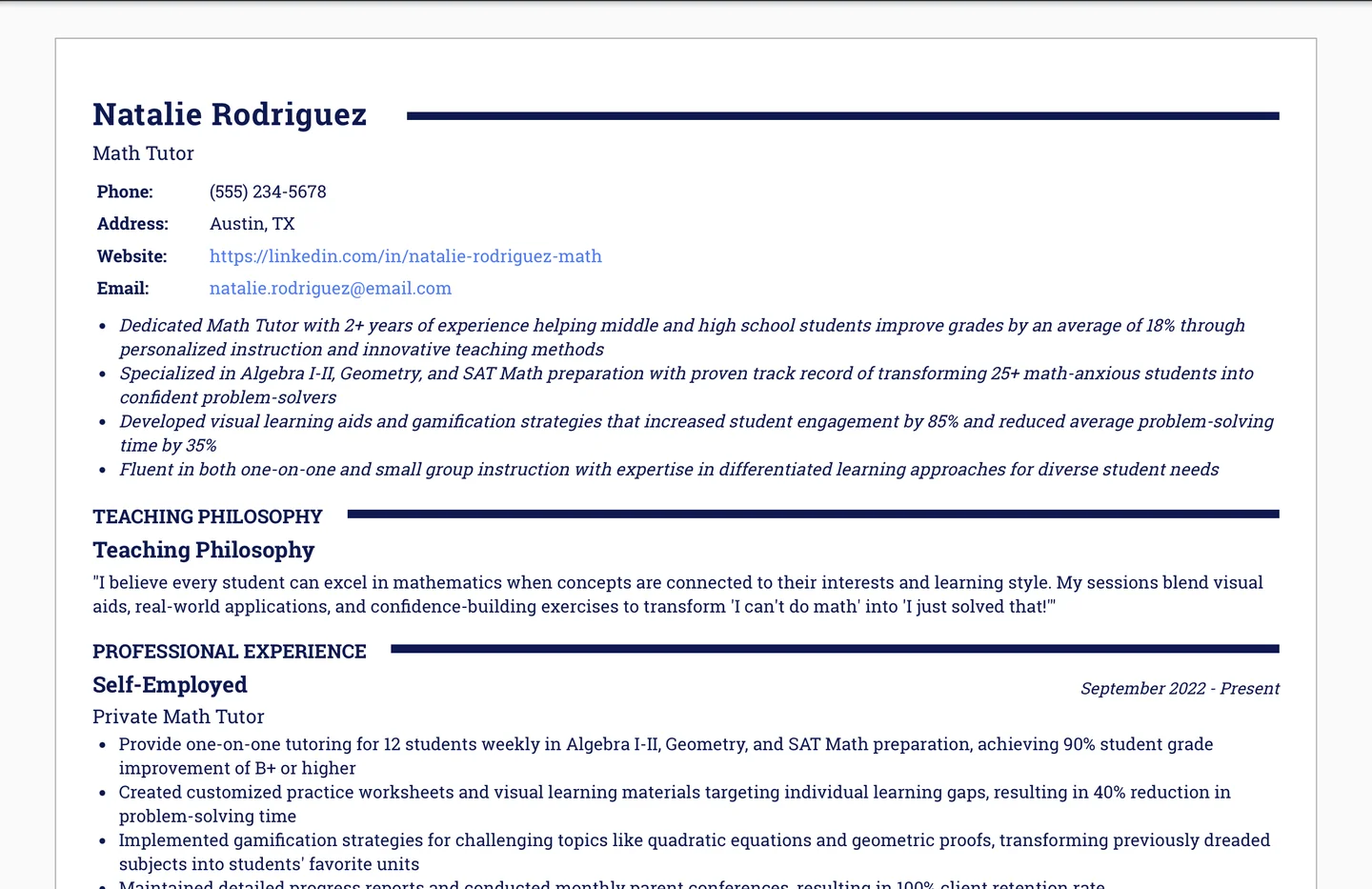
The Best Math Tutor Resume Example/Sample
https://www.resumonk.com/math-tutorMath TutorResume Format for Math Tutor Resume
For a Math Tutor resume, the reverse-chronological format stands as your most strategic choice. This format places your most recent tutoring experience at the forefront, which matters immensely in education where current methodologies and recent student success stories carry the most weight.
Think of it like solving a math problem - you want to show your work in the clearest, most logical progression possible.
Structure Your Math Tutor Resume Like a Well-Organized Lesson Plan
Your resume should begin with a compelling summary or objective statement that immediately establishes your mathematical expertise and teaching philosophy. This isn't the place for generic statements about being a "dedicated professional" - instead, think of it as your elevator pitch to a parent who's desperately seeking help for their struggling child.
❌ Don't write a vague opening:
Experienced professional seeking tutoring opportunities to help students.
✅ Do write with specificity and impact:
Patient Math Tutor with 3+ years helping high school students improve grades by an average of 15%, specializing in Algebra II and Pre-Calculus. Developed personalized learning strategies that transformed 20+ math-anxious students into confident problem-solvers.
Essential Sections to Include
After your header and summary, organize your resume with these critical sections in this order - Professional Experience (or Tutoring Experience), Education, Skills, and Certifications. If you're new to tutoring but have relevant academic achievements or teaching assistant experience, you might consider placing Education before Experience.
Remember, you're telling the story of why you're the perfect person to unlock mathematical understanding in someone's mind.
For those transitioning from classroom teaching to private tutoring, or vice versa, consider creating a hybrid section called "Teaching and Tutoring Experience" to seamlessly blend both types of roles. This approach particularly resonates in the UK and Australia, where private tutoring often complements formal teaching careers.
Work Experience on Math Tutor Resume
Your work experience section is where the abstract becomes concrete, where x equals your actual impact on real students' lives. Whether you've been tutoring through established companies like Kumon or Sylvan, working independently, or volunteering at community centers, each experience needs to demonstrate not just what you did, but how you transformed mathematical confusion into clarity.
Crafting Impact-Driven Experience Descriptions
Start each position with your role title, the organization or "Self-Employed" if applicable, location, and dates.
Then comes the crucial part - your bullet points. These aren't just task lists; they're success stories waiting to be told.
Each bullet should follow a pattern of action, method, and result whenever possible.
❌ Don't list duties without context:
• Tutored students in math
• Helped with homework
• Explained math concepts
✅ Do showcase your methodology and impact:
• Guided 15 middle school students through pre-algebra concepts using visual learning techniques, resulting in 90% achieving B+ or higher grades
• Developed customized practice worksheets targeting individual learning gaps, reducing average problem-solving time by 40%
• Implemented gamification strategies for fraction lessons, transforming a previously dreaded topic into students' favorite unit
Addressing Different Tutoring Contexts
If you've tutored in various settings - one-on-one, small groups, online platforms, or test prep centers - make sure to highlight this versatility. Online tutoring experience has become particularly valuable post-2020, and mentioning your comfort with digital whiteboards, screen sharing, and virtual engagement techniques can set you apart.
For those with limited formal tutoring experience, don't overlook informal helping. That time you spent explaining calculus to your entire dorm floor before finals? That counts.
Frame it professionally:
Peer Mathematics Mentor | State University | 2022-2023
• Organized weekly study sessions for 20+ engineering students struggling with Calculus I and II
• Created step-by-step solution guides that became unofficial supplementary materials shared among 100+ students
Quantifying the Unquantifiable
In mathematics, we love precision, and your resume should reflect that.
Instead of saying you "improved student performance," specify that you "elevated average test scores from 72% to 88% over one semester." Track your wins - the number of students, grade improvements, standardized test score increases, and even softer metrics like "reduced math anxiety in 8 out of 10 students based on self-reported confidence surveys."
Skills to Show on Math Tutor Resume
The skills section of your Math Tutor resume is where you prove you're not just someone who understands mathematics, but someone who can translate that understanding into accessible knowledge for others. It's the difference between knowing how to solve a differential equation and knowing how to help a frustrated teenager see why derivatives actually make sense in the real world.
Technical Mathematical Competencies
Begin with your mathematical expertise areas, but be specific about grade levels and topics. "Mathematics" is too broad; "AP Calculus AB/BC, SAT Math Prep, Common Core Algebra I-II" tells a precise story.
Include any specialized areas like competition math (AMC, MATHCOUNTS), standardized test prep (SAT, ACT, GRE), or specific curricula you're familiar with (IB Mathematics, A-Levels for UK positions).
Mathematical Expertise:
• AP Calculus AB/BC and Statistics
• Algebra I, II, and Pre-Calculus
• SAT/ACT Math Test Preparation
• Competition Mathematics (AMC 10/12, AIME)
• Common Core Standards Grades 6-12
Pedagogical and Soft Skills
This is where you demonstrate that you're not just a mathematician but an educator. Include teaching methodologies you employ, learning style adaptations you're comfortable with, and the soft skills that make you effective.
Remember, parents aren't just hiring someone who knows math - they're hiring someone who can connect with their child.
❌ Don't use generic soft skills:
• Good communication
• Patient
• Organized
✅ Do provide context and specificity:
• Differentiated instruction for visual, auditory, and kinesthetic learners
• Patience with math-anxious students and learning differences (ADHD, dyscalculia)
• Progress tracking and detailed session reports for parents
• Socratic questioning techniques to develop problem-solving independence
Technology and Tools Proficiency
In today's tutoring landscape, especially with the rise of online tutoring, technological competence matters. List specific platforms you're comfortable with - Zoom, Google Meet, digital whiteboards (Jamboard, BitPaper), graphing calculators (TI-84, Desmos), and any educational software (Khan Academy, IXL, Photomath for explanation verification).
For Canadian and Australian markets particularly, mentioning familiarity with local educational platforms and curriculum management systems can give you an edge, as these countries have specific provincial or state-based educational technologies.
Specific Considerations and Tips for Math Tutor Resume
Now we arrive at the nuances that separate a Math Tutor resume from any other educational resume - the subtle details that whisper to hiring managers or parents, "This person genuinely understands what it takes to make math click for students."
The Philosophy Statement Advantage
Unlike many other positions, Math Tutor resumes benefit enormously from a brief teaching philosophy woven into your summary or as a separate small section.
Mathematics carries unique emotional baggage for many students - math anxiety is real, and parents seeking tutors often have children who've developed negative associations with the subject. Address this head-on:
Teaching Approach: "I believe every student can excel in mathematics when concepts are connected to their interests and learning style. My sessions blend visual aids, real-world applications, and confidence-building exercises to transform 'I can't do math' into 'I just solved that!'"
The Parent Communication Factor
Here's something unique to tutoring resumes - you're often being evaluated not just as an educator but as someone parents will trust with their investment in their child's education.
Include subtle indicators of your professionalism in parent relations. Mention if you provide progress reports, maintain communication logs, or have experience conducting parent conferences. This is particularly important in the United States where parent involvement in supplementary education is notably high.
Addressing the Elephant in the Room - Why Tutoring?
If you're a certified teacher moving to tutoring, or an engineer becoming a tutor, address the transition strategically. Frame it as an intentional choice to provide personalized education rather than a fallback option:
Career Note: "Transitioned from classroom teaching to focus on individualized instruction, where I can adapt pace and methods to each student's unique learning journey."
The Portfolio Mention
Unlike traditional resumes, Math Tutor resumes can benefit from mentioning a portfolio of resources you've created.
Don't attach it, but mention its existence:
Additional Resources: Portfolio of 50+ original practice problems and visual learning aids available upon request
Geographic and Cultural Considerations
In the UK, emphasize familiarity with GCSE and A-Level specifications. In Canada, mention specific provincial curricula. In Australia, highlight experience with NAPLAN preparation or HSC mathematics.
American tutors should reference state standards and specific standardized tests relevant to their region.
The Availability Declaration
Unlike most professional resumes, tutoring resumes benefit from a subtle indication of your availability - are you available for summer intensive programs?
Evening sessions? Weekend test prep?
This practical information, placed near the end of your resume, can be the deciding factor for busy parents trying to match schedules:
Availability: Weekday evenings (4-8 PM), Saturday mornings, and intensive summer programs
Remember, your Math Tutor resume isn't just a document - it's a promise that you can take someone's mathematical struggle and transform it into understanding and confidence. Every section should reinforce that you're not just someone who knows math, but someone who knows how to teach it, adapt it, and make it accessible to minds that learn in wonderfully different ways.
Education Section for Math Tutor Resume - Making Your Academic Background Count
Let's be clear about what being a Math Tutor means.
This is typically an entry-level educational support role where you work directly with students, either one-on-one or in small groups, helping them grasp mathematical concepts. You might work in a learning center, offer private tutoring sessions, or support students through an educational institution. The key here is that your education section needs to demonstrate both your mathematical competence and your potential to teach.
Degree Details That Matter Most
Your degree doesn't have to be in Mathematics or Education to land a tutoring position, but how you present it makes all the difference. If you studied Engineering, Physics, Statistics, or even Economics, you've got relevant mathematical foundations.
The trick is highlighting the mathematical components of your education that directly relate to what you'll be teaching.
When listing your degree, always start with the most recent education first (reverse-chronological order). Include your graduation date or expected graduation date, especially if you're a recent graduate or current student - many tutoring positions actively seek current university students who can relate to their peers.
❌ Don't write vaguely about your education:
Bachelor of Science in Engineering
State University, 2023
✅ Do highlight relevant mathematical coursework and achievements:
Bachelor of Science in Mechanical Engineering
State University, May 2023
GPA: 3.7/4.0
Relevant Coursework: Calculus I-III, Linear Algebra, Differential Equations, Statistics
Mathematics Department Award for Excellence in Applied Mathematics (2022)
Making Non-Traditional Educational Paths Work
Perhaps you're a career changer who worked in finance and now wants to help students understand mathematics.
Or maybe you're a current college student looking to tutor high school students. Your educational background still matters, but you'll need to be strategic about what you emphasize.
For current students, include your expected graduation date and current GPA if it's strong (generally 3.5 or above). Mention any mathematics-related honors societies like Pi Mu Epsilon or Kappa Mu Epsilon. If you're in your junior or senior year, you've likely taken enough advanced math courses to tutor effectively - list them.
Certifications and Additional Training
While not always required for entry-level Math Tutor positions, any tutoring certifications or teaching credentials should be prominently displayed in your education section. This might include CRLA (College Reading and Learning Association) certification, completion of tutor training programs, or even online certifications in mathematics education.
❌ Don't bury important certifications:
Various online courses completed
✅ Do specify relevant certifications with details:
Certified Level II Tutor - College Reading and Learning Association (CRLA)
Completed 20 hours of tutor training, May 2023

Mathematics Teaching Certificate - Online Teaching Academy
40-hour comprehensive program covering pedagogy and mathematics instruction, 2023
Awards and Publications on Your Math Tutor Resume - Standing Out in the Numbers Game
You might be thinking, "I'm applying for an entry-level tutoring position, not a professorship - do awards and publications even matter?"
Here's the thing - in the world of mathematics tutoring, any evidence that you've excelled in math or communicated mathematical concepts effectively is pure gold. These achievements show you don't just understand math; you excel at it and can potentially help others do the same.
Academic Awards That Resonate with Employers
Remember that math competition you won in high school? That Dean's List recognition? That "Most Improved in Calculus" award that showed your journey from struggling to succeeding? These all tell a story about your relationship with mathematics that goes beyond grades.
For Math Tutor positions, awards demonstrate not just competence but passion and persistence - qualities essential for helping struggling students.
When listing awards, be specific about what they represent. A generic "Academic Excellence Award" becomes much more powerful when you specify it was for "Outstanding Performance in Advanced Mathematics Courses." Include the year and the awarding institution. If you received multiple awards, prioritize those most relevant to mathematics and teaching.
❌ Don't list awards without context:
Honor Roll - 2022
Math Award - 2021
✅ Do provide meaningful details about your achievements:
Dean's List - Fall 2022, Spring 2023
University of Example, recognized for maintaining GPA above 3.75

First Place, Regional Mathematics Competition
Competed against 200+ students in calculus and linear algebra problems, March 2022

Mathematics Department Peer Tutor Award
Recognized for helping 30+ students improve their grades by at least one letter grade, 2023
Publications and Presentations - Yes, They Count Even at Entry Level
Now, you're probably not publishing in peer-reviewed mathematics journals as you apply for tutoring positions. But "publications" in this context can include much more. Did you write a particularly insightful paper on mathematical concepts for a class? Create study guides that your classmates found helpful? Develop problem sets for a professor?
These demonstrate your ability to communicate mathematical concepts in writing - a crucial skill for any tutor.
If you've presented at any level - even undergraduate research symposiums or math club meetings - include these. They show you can explain complex concepts to an audience, exactly what you'll be doing as a tutor.
Making the Most of Limited Experience
If you don't have formal awards or publications, think creatively. Did you create a popular YouTube video explaining a difficult concept? Start a study group that helped classmates pass a notoriously difficult course? Develop a new method for solving certain types of problems that your professor adopted?
These achievements, while unconventional, demonstrate exactly the kind of innovative thinking and communication skills that make great tutors.
❌ Don't overlook informal achievements:
No publications or awards
✅ Do highlight relevant informal accomplishments:
Creator, "Calculus Made Simple" Study Guide Series
Developed comprehensive study materials used by 50+ students, shared via university learning portal, 2023

Presenter, "Breaking Down Derivatives"
Mathematics Club workshop for struggling calculus students, attended by 25 students, October 2022
Listing References for Your Math Tutor Resume - Your Mathematical Champions
You've solved for X countless times, but now you need to solve for R - References.
As someone applying for a Math Tutor position, your references serve as proof that you don't just know mathematics, but that you can effectively share that knowledge with others. These are the people who will vouch for your patience when a student doesn't understand derivatives the fifth time around, and your creativity when traditional explanations just aren't clicking.
Who Makes the Best References for Aspiring Math Tutors
The ideal references for a Math Tutor position aren't necessarily your highest-ranking connections - they're the people who have witnessed your ability to explain, teach, or help others with mathematical concepts.
Your Calculus professor who noticed how you helped classmates during office hours carries more weight than the Dean who barely knows you. That supervisor from your retail job who saw you train new employees demonstrates your teaching ability, even if it wasn't math-related.
Priority should go to academic references who can speak to both your mathematical knowledge and your interpersonal skills. This might include professors whose classes you excelled in, teaching assistants you worked alongside, or academic advisors who've observed your dedication. If you've done any informal tutoring, the faculty member who recommended students to you is golden.
How to Present Your References - Format Matters
Most entry-level Math Tutor positions will ask for references either on a separate page or upon request.
Unless specifically asked to include them on your resume, create a separate references page that matches your resume's formatting. This shows attention to detail - a crucial quality for someone who'll be checking students' work for small errors.
❌ Don't list references without context:
Dr. Smith - [email protected] - 555-0123
✅ Do provide complete, professional reference listings:
Dr. Sarah Smith
Professor of Mathematics, State University
Email: [email protected]
Phone: (555) 123-4567
Relationship: Calculus I-III Professor, supervised my peer tutoring in Math Lab (2022-2023)
The "Available Upon Request" Debate
In the United States and Canada, "References available upon request" is becoming outdated - employers assume you have references.
Simply omit any mention if not including them. However, in the UK and Australia, this phrase is still commonly used and expected on CVs. The key is researching the specific organization's preferences and following their application instructions precisely.
Preparing Your References for Success
Here's what many applicants forget - your references need to know they're your references! Before listing anyone, ask permission and brief them on the position. Send them the job posting and remind them of specific examples that demonstrate your tutoring potential.
If Professor Johnson is your reference, remind her about that time you created a study guide that helped half the class finally understand integration by parts.
For Math Tutor positions specifically, prep your references to speak about your ability to break down complex concepts, your patience with struggling students, and any innovative teaching methods you've used. If you helped classmates improve their grades, give your references those specific numbers to mention.
What If You Have Limited Academic References?
Maybe you graduated years ago and lost touch with professors, or perhaps you're changing careers entirely. Your references can still work for you. A supervisor who can speak to your patience, communication skills, and reliability is valuable. A colleague who witnessed you training others or explaining technical concepts adds credibility.
Even a parent from your neighborhood who you've helped with their child's homework can serve as a character reference for private tutoring positions.
❌ Don't make excuses for non-academic references:
John Davis (not academic but knows me well)
✅ Do position all references professionally:
John Davis
Senior Manager, TechCorp Solutions
Email: [email protected]
Phone: (555) 987-6543
Relationship: Direct supervisor who observed my training of 10+ new employees and creation
of technical documentation for non-technical staff (2021-2023)
The Follow-Through - After They've Been Contacted
Once a potential employer contacts your references, your relationship with these references matters even more. Send a thank-you note regardless of whether you get the position. If you do land the job, let them know - they invested their credibility in you and deserve to know the outcome.
This maintains the relationship for future opportunities and shows the professionalism that will serve you well as you build your tutoring career.
Cover Letter Tips for Your Math Tutor Resume - Making Your Passion Add Up
Come, let's visualize this - you're sitting across from a struggling algebra student who just told you they "hate math" and "will never get it."
As a Math Tutor, this is your moment to shine, to turn frustration into understanding. You need a cover letter that convinces the hiring manager that you're the person who can create these breakthrough moments. Unlike your resume which lists your qualifications, your cover letter tells the story of why you want to help students conquer their math anxiety and how you plan to do it.
Opening with Impact - Your Mathematical Origin Story
Skip the generic "I am writing to apply for the Math Tutor position" opening. Instead, start with a moment that captures why you're passionate about mathematics education. Maybe you struggled with geometry until a patient tutor helped everything click. Perhaps you discovered the beauty of mathematics through a particularly engaging professor. Or maybe you've always been the person friends turned to for homework help.
This personal touch immediately sets you apart from applicants who are just looking for any job.
Your opening paragraph should connect your personal experience with the specific tutoring position. If you're applying to a community college tutoring center, emphasize your understanding of diverse student needs. For a private tutoring company, highlight your ability to adapt to individual learning styles.
For K-12 positions, stress your patience and ability to make math fun.
❌ Don't write a generic, disconnected opening:
Dear Hiring Manager,

I am interested in the Math Tutor position at your learning center. I am good at math and want to help students. I have a degree in Engineering and got good grades.
✅ Do create a compelling, specific introduction:
Dear Ms. Johnson,

When I helped my roommate transform her failing Calculus grade into a B+ last semester, I discovered my true calling - making mathematics accessible to students who believe they're "not math people."
Your posting for a Math Tutor at Lincoln Learning Center particularly excites me because of your commitment to serving first-generation college students, a population I'm passionate about supporting as a first-generation graduate myself.
The Body - Proving You Can Teach, Not Just Do
Here's where many Math Tutor applicants stumble. They spend paragraphs proving they understand mathematics but forget to demonstrate they can teach it.
Your cover letter body should balance three elements - your mathematical knowledge, your teaching ability (formal or informal), and your understanding of common student challenges.
Use specific examples rather than general statements. Instead of saying you're patient, describe a time you spent three hours helping someone finally understand limits. Rather than claiming you make math fun, explain the game you created to teach factoring.
These concrete examples make your abilities tangible and memorable.
Addressing the Elephant in the Room - Limited Formal Experience
If you're new to formal tutoring, your cover letter is where you reframe informal teaching experience as relevant preparation.
That time you led study groups? That's experience managing different learning styles. Your role explaining technical concepts to non-technical colleagues? That's translating complex ideas into understandable terms.
Even helping younger siblings with homework demonstrates patience and adaptability.
❌ Don't apologize for lack of experience:
Although I have never been a professional tutor, I think I could learn quickly. I don't have teaching experience but I'm willing to try hard.
✅ Do reframe your experience positively:
While pursuing my Mathematics degree, I've gained extensive informal tutoring experience through leading weekly study groups for Calculus II, where I helped classmates improve their exam scores by an average of 15%. This experience taught me to quickly identify where students' understanding breaks down and develop multiple explanations for the same concept.
Regional Considerations and Closing Strong
If you're applying in the UK, emphasize your understanding of GCSE and A-Level mathematics curricula. For Canadian positions, familiarity with provincial curricula matters.
US positions often value experience with standardized test prep (SAT, ACT), while Australian employers might look for familiarity with NAPLAN preparation.
Your closing paragraph should reiterate your enthusiasm while proposing next steps. Express genuine excitement about the specific organization and role, and indicate your availability for interviews or teaching demonstrations. Many tutoring positions include a demo lesson as part of the interview process - showing you're prepared for this demonstrates professionalism.
Key Takeaways
- Use reverse-chronological format to showcase your most recent and relevant tutoring experience first, treating your resume like a well-organized lesson plan
- Quantify your impact with specific numbers - grade improvements, number of students helped, test score increases, and even soft metrics like "reduced math anxiety in 8 out of 10 students"
- Balance mathematical expertise with teaching ability by listing specific topics you can tutor (AP Calculus, SAT Math, Algebra I-II) alongside pedagogical skills like differentiated instruction and learning style adaptation
- Include informal teaching experience strategically - frame study group leadership, peer mentoring, and homework help as legitimate tutoring experience
- Customize for your geographic market by mentioning relevant curricula (GCSE for UK, provincial standards for Canada, Common Core for US, HSC for Australia)
- Add unique tutoring-specific elements like a brief teaching philosophy, availability statement, and mention of any resource portfolios you've created
- Craft a compelling cover letter that tells your mathematical origin story and demonstrates not just that you know math, but that you can make others love learning it
- Choose references strategically - prioritize those who've witnessed your teaching ability over high-ranking contacts who barely know your work
Creating an outstanding Math Tutor resume doesn't require complex formulas - it just needs thoughtful presentation of your unique ability to transform mathematical confusion into clarity. Whether you're a recent graduate eager to share your knowledge, a career professional looking to give back through education, or a current student wanting to help peers succeed, your resume should tell the story of someone who doesn't just solve problems, but helps others discover they can solve them too.
Ready to build your Math Tutor resume with confidence? Resumonk makes it simple with intelligent AI recommendations that help you articulate your tutoring impact, beautiful templates that organize your experience clearly, and expert guidance tailored specifically for education professionals. Our platform understands the unique needs of Math Tutor resumes - from highlighting your specific mathematical competencies to showcasing your teaching philosophy in a way that resonates with both learning centers and private clients.
Start creating your professional Math Tutor resume today!
Successfully land tutoring positions with Resumonk's expertly designed resume tools. Transform your passion for mathematics into a compelling resume that opens doors.
Create Your Math Tutor Resume with Resumonk →
More Education resume examples
- Camp Counselor resume example
- School Counselor resume example
- Librarian resume example
- Paraprofessional resume example
See all Education resume examples, or browse every category.
Resume writing tips
Now, let's visualize a scenario - you're sitting at your desk, perhaps with a cup of coffee that's gone cold while you were solving quadratic equations for your latest student, and you're thinking about expanding your tutoring practice. Maybe you're a recent graduate with a mathematics degree, or perhaps you're a teacher looking for supplementary income, or even a professional who's discovered a passion for helping others understand the beauty of numbers.
Whatever brought you here, you need a resume that speaks the universal language of competence and care that math tutoring demands.
Let's be clear about what being a Math Tutor means in today's educational landscape. This is typically an entry-level educational support role where you work directly with students - helping them conquer everything from basic algebra fears to calculus confusion. You might find yourself in a bustling learning center, conducting intimate one-on-one sessions in a student's home, or connecting through a screen to help someone three time zones away finally understand trigonometry. The beauty of this role is its flexibility and immediate impact - you're not just teaching formulas; you're rebuilding confidence one problem set at a time.
This guide will walk you through creating a Math Tutor resume that transforms your mathematical knowledge and teaching potential into a compelling professional narrative. We'll start by exploring the optimal resume format - the reverse-chronological structure that best showcases your recent tutoring wins and educational achievements. From there, we'll dive deep into crafting each section: how to write work experience that quantifies your impact on student success, which skills to highlight (both mathematical and pedagogical), and how to present your education in a way that proves you're not just someone who understands math, but someone who can make others understand it too.
We'll also address the unique challenges you might face - perhaps you're transitioning from classroom teaching, or you're a current college student with informal tutoring experience, or maybe you're a career changer from engineering or finance. We'll show you how to frame each of these backgrounds as an asset. You'll learn how to handle the awards and publications section even if your achievements are more "helped roommate pass calculus" than "published in Mathematical Review," and we'll guide you through writing a cover letter that captures your passion for mathematical education. Finally, we'll help you choose and prepare references who can vouch for your ability to transform mathematical anxiety into algebraic confidence.
The Best Math Tutor Resume Example/Sample
https://www.resumonk.com/math-tutorMath TutorResume Format for Math Tutor Resume
For a Math Tutor resume, the reverse-chronological format stands as your most strategic choice. This format places your most recent tutoring experience at the forefront, which matters immensely in education where current methodologies and recent student success stories carry the most weight.
Think of it like solving a math problem - you want to show your work in the clearest, most logical progression possible.
Structure Your Math Tutor Resume Like a Well-Organized Lesson Plan
Your resume should begin with a compelling summary or objective statement that immediately establishes your mathematical expertise and teaching philosophy. This isn't the place for generic statements about being a "dedicated professional" - instead, think of it as your elevator pitch to a parent who's desperately seeking help for their struggling child.
❌ Don't write a vague opening:
Experienced professional seeking tutoring opportunities to help students.
✅ Do write with specificity and impact:
Patient Math Tutor with 3+ years helping high school students improve grades by an average of 15%, specializing in Algebra II and Pre-Calculus. Developed personalized learning strategies that transformed 20+ math-anxious students into confident problem-solvers.
Essential Sections to Include
After your header and summary, organize your resume with these critical sections in this order - Professional Experience (or Tutoring Experience), Education, Skills, and Certifications. If you're new to tutoring but have relevant academic achievements or teaching assistant experience, you might consider placing Education before Experience.
Remember, you're telling the story of why you're the perfect person to unlock mathematical understanding in someone's mind.
For those transitioning from classroom teaching to private tutoring, or vice versa, consider creating a hybrid section called "Teaching and Tutoring Experience" to seamlessly blend both types of roles. This approach particularly resonates in the UK and Australia, where private tutoring often complements formal teaching careers.
Work Experience on Math Tutor Resume
Your work experience section is where the abstract becomes concrete, where x equals your actual impact on real students' lives. Whether you've been tutoring through established companies like Kumon or Sylvan, working independently, or volunteering at community centers, each experience needs to demonstrate not just what you did, but how you transformed mathematical confusion into clarity.
Crafting Impact-Driven Experience Descriptions
Start each position with your role title, the organization or "Self-Employed" if applicable, location, and dates.
Then comes the crucial part - your bullet points. These aren't just task lists; they're success stories waiting to be told.
Each bullet should follow a pattern of action, method, and result whenever possible.
❌ Don't list duties without context:
• Tutored students in math
• Helped with homework
• Explained math concepts
✅ Do showcase your methodology and impact:
• Guided 15 middle school students through pre-algebra concepts using visual learning techniques, resulting in 90% achieving B+ or higher grades
• Developed customized practice worksheets targeting individual learning gaps, reducing average problem-solving time by 40%
• Implemented gamification strategies for fraction lessons, transforming a previously dreaded topic into students' favorite unit
Addressing Different Tutoring Contexts
If you've tutored in various settings - one-on-one, small groups, online platforms, or test prep centers - make sure to highlight this versatility. Online tutoring experience has become particularly valuable post-2020, and mentioning your comfort with digital whiteboards, screen sharing, and virtual engagement techniques can set you apart.
For those with limited formal tutoring experience, don't overlook informal helping. That time you spent explaining calculus to your entire dorm floor before finals? That counts.
Frame it professionally:
Peer Mathematics Mentor | State University | 2022-2023
• Organized weekly study sessions for 20+ engineering students struggling with Calculus I and II
• Created step-by-step solution guides that became unofficial supplementary materials shared among 100+ students
Quantifying the Unquantifiable
In mathematics, we love precision, and your resume should reflect that.
Instead of saying you "improved student performance," specify that you "elevated average test scores from 72% to 88% over one semester." Track your wins - the number of students, grade improvements, standardized test score increases, and even softer metrics like "reduced math anxiety in 8 out of 10 students based on self-reported confidence surveys."
Skills to Show on Math Tutor Resume
The skills section of your Math Tutor resume is where you prove you're not just someone who understands mathematics, but someone who can translate that understanding into accessible knowledge for others. It's the difference between knowing how to solve a differential equation and knowing how to help a frustrated teenager see why derivatives actually make sense in the real world.
Technical Mathematical Competencies
Begin with your mathematical expertise areas, but be specific about grade levels and topics. "Mathematics" is too broad; "AP Calculus AB/BC, SAT Math Prep, Common Core Algebra I-II" tells a precise story.
Include any specialized areas like competition math (AMC, MATHCOUNTS), standardized test prep (SAT, ACT, GRE), or specific curricula you're familiar with (IB Mathematics, A-Levels for UK positions).
Mathematical Expertise:
• AP Calculus AB/BC and Statistics
• Algebra I, II, and Pre-Calculus
• SAT/ACT Math Test Preparation
• Competition Mathematics (AMC 10/12, AIME)
• Common Core Standards Grades 6-12
Pedagogical and Soft Skills
This is where you demonstrate that you're not just a mathematician but an educator. Include teaching methodologies you employ, learning style adaptations you're comfortable with, and the soft skills that make you effective.
Remember, parents aren't just hiring someone who knows math - they're hiring someone who can connect with their child.
❌ Don't use generic soft skills:
• Good communication
• Patient
• Organized
✅ Do provide context and specificity:
• Differentiated instruction for visual, auditory, and kinesthetic learners
• Patience with math-anxious students and learning differences (ADHD, dyscalculia)
• Progress tracking and detailed session reports for parents
• Socratic questioning techniques to develop problem-solving independence
Technology and Tools Proficiency
In today's tutoring landscape, especially with the rise of online tutoring, technological competence matters. List specific platforms you're comfortable with - Zoom, Google Meet, digital whiteboards (Jamboard, BitPaper), graphing calculators (TI-84, Desmos), and any educational software (Khan Academy, IXL, Photomath for explanation verification).
For Canadian and Australian markets particularly, mentioning familiarity with local educational platforms and curriculum management systems can give you an edge, as these countries have specific provincial or state-based educational technologies.
Specific Considerations and Tips for Math Tutor Resume
Now we arrive at the nuances that separate a Math Tutor resume from any other educational resume - the subtle details that whisper to hiring managers or parents, "This person genuinely understands what it takes to make math click for students."
The Philosophy Statement Advantage
Unlike many other positions, Math Tutor resumes benefit enormously from a brief teaching philosophy woven into your summary or as a separate small section.
Mathematics carries unique emotional baggage for many students - math anxiety is real, and parents seeking tutors often have children who've developed negative associations with the subject. Address this head-on:
Teaching Approach: "I believe every student can excel in mathematics when concepts are connected to their interests and learning style. My sessions blend visual aids, real-world applications, and confidence-building exercises to transform 'I can't do math' into 'I just solved that!'"
The Parent Communication Factor
Here's something unique to tutoring resumes - you're often being evaluated not just as an educator but as someone parents will trust with their investment in their child's education.
Include subtle indicators of your professionalism in parent relations. Mention if you provide progress reports, maintain communication logs, or have experience conducting parent conferences. This is particularly important in the United States where parent involvement in supplementary education is notably high.
Addressing the Elephant in the Room - Why Tutoring?
If you're a certified teacher moving to tutoring, or an engineer becoming a tutor, address the transition strategically. Frame it as an intentional choice to provide personalized education rather than a fallback option:
Career Note: "Transitioned from classroom teaching to focus on individualized instruction, where I can adapt pace and methods to each student's unique learning journey."
The Portfolio Mention
Unlike traditional resumes, Math Tutor resumes can benefit from mentioning a portfolio of resources you've created.
Don't attach it, but mention its existence:
Additional Resources: Portfolio of 50+ original practice problems and visual learning aids available upon request
Geographic and Cultural Considerations
In the UK, emphasize familiarity with GCSE and A-Level specifications. In Canada, mention specific provincial curricula. In Australia, highlight experience with NAPLAN preparation or HSC mathematics.
American tutors should reference state standards and specific standardized tests relevant to their region.
The Availability Declaration
Unlike most professional resumes, tutoring resumes benefit from a subtle indication of your availability - are you available for summer intensive programs?
Evening sessions? Weekend test prep?
This practical information, placed near the end of your resume, can be the deciding factor for busy parents trying to match schedules:
Availability: Weekday evenings (4-8 PM), Saturday mornings, and intensive summer programs
Remember, your Math Tutor resume isn't just a document - it's a promise that you can take someone's mathematical struggle and transform it into understanding and confidence. Every section should reinforce that you're not just someone who knows math, but someone who knows how to teach it, adapt it, and make it accessible to minds that learn in wonderfully different ways.
Education Section for Math Tutor Resume - Making Your Academic Background Count
Let's be clear about what being a Math Tutor means.
This is typically an entry-level educational support role where you work directly with students, either one-on-one or in small groups, helping them grasp mathematical concepts. You might work in a learning center, offer private tutoring sessions, or support students through an educational institution. The key here is that your education section needs to demonstrate both your mathematical competence and your potential to teach.
Degree Details That Matter Most
Your degree doesn't have to be in Mathematics or Education to land a tutoring position, but how you present it makes all the difference. If you studied Engineering, Physics, Statistics, or even Economics, you've got relevant mathematical foundations.
The trick is highlighting the mathematical components of your education that directly relate to what you'll be teaching.
When listing your degree, always start with the most recent education first (reverse-chronological order). Include your graduation date or expected graduation date, especially if you're a recent graduate or current student - many tutoring positions actively seek current university students who can relate to their peers.
❌ Don't write vaguely about your education:
Bachelor of Science in Engineering
State University, 2023
✅ Do highlight relevant mathematical coursework and achievements:
Bachelor of Science in Mechanical Engineering
State University, May 2023
GPA: 3.7/4.0
Relevant Coursework: Calculus I-III, Linear Algebra, Differential Equations, Statistics
Mathematics Department Award for Excellence in Applied Mathematics (2022)
Making Non-Traditional Educational Paths Work
Perhaps you're a career changer who worked in finance and now wants to help students understand mathematics.
Or maybe you're a current college student looking to tutor high school students. Your educational background still matters, but you'll need to be strategic about what you emphasize.
For current students, include your expected graduation date and current GPA if it's strong (generally 3.5 or above). Mention any mathematics-related honors societies like Pi Mu Epsilon or Kappa Mu Epsilon. If you're in your junior or senior year, you've likely taken enough advanced math courses to tutor effectively - list them.
Certifications and Additional Training
While not always required for entry-level Math Tutor positions, any tutoring certifications or teaching credentials should be prominently displayed in your education section. This might include CRLA (College Reading and Learning Association) certification, completion of tutor training programs, or even online certifications in mathematics education.
❌ Don't bury important certifications:
Various online courses completed
✅ Do specify relevant certifications with details:
Certified Level II Tutor - College Reading and Learning Association (CRLA)
Completed 20 hours of tutor training, May 2023

Mathematics Teaching Certificate - Online Teaching Academy
40-hour comprehensive program covering pedagogy and mathematics instruction, 2023
Awards and Publications on Your Math Tutor Resume - Standing Out in the Numbers Game
You might be thinking, "I'm applying for an entry-level tutoring position, not a professorship - do awards and publications even matter?"
Here's the thing - in the world of mathematics tutoring, any evidence that you've excelled in math or communicated mathematical concepts effectively is pure gold. These achievements show you don't just understand math; you excel at it and can potentially help others do the same.
Academic Awards That Resonate with Employers
Remember that math competition you won in high school? That Dean's List recognition? That "Most Improved in Calculus" award that showed your journey from struggling to succeeding? These all tell a story about your relationship with mathematics that goes beyond grades.
For Math Tutor positions, awards demonstrate not just competence but passion and persistence - qualities essential for helping struggling students.
When listing awards, be specific about what they represent. A generic "Academic Excellence Award" becomes much more powerful when you specify it was for "Outstanding Performance in Advanced Mathematics Courses." Include the year and the awarding institution. If you received multiple awards, prioritize those most relevant to mathematics and teaching.
❌ Don't list awards without context:
Honor Roll - 2022
Math Award - 2021
✅ Do provide meaningful details about your achievements:
Dean's List - Fall 2022, Spring 2023
University of Example, recognized for maintaining GPA above 3.75

First Place, Regional Mathematics Competition
Competed against 200+ students in calculus and linear algebra problems, March 2022

Mathematics Department Peer Tutor Award
Recognized for helping 30+ students improve their grades by at least one letter grade, 2023
Publications and Presentations - Yes, They Count Even at Entry Level
Now, you're probably not publishing in peer-reviewed mathematics journals as you apply for tutoring positions. But "publications" in this context can include much more. Did you write a particularly insightful paper on mathematical concepts for a class? Create study guides that your classmates found helpful? Develop problem sets for a professor?
These demonstrate your ability to communicate mathematical concepts in writing - a crucial skill for any tutor.
If you've presented at any level - even undergraduate research symposiums or math club meetings - include these. They show you can explain complex concepts to an audience, exactly what you'll be doing as a tutor.
Making the Most of Limited Experience
If you don't have formal awards or publications, think creatively. Did you create a popular YouTube video explaining a difficult concept? Start a study group that helped classmates pass a notoriously difficult course? Develop a new method for solving certain types of problems that your professor adopted?
These achievements, while unconventional, demonstrate exactly the kind of innovative thinking and communication skills that make great tutors.
❌ Don't overlook informal achievements:
No publications or awards
✅ Do highlight relevant informal accomplishments:
Creator, "Calculus Made Simple" Study Guide Series
Developed comprehensive study materials used by 50+ students, shared via university learning portal, 2023

Presenter, "Breaking Down Derivatives"
Mathematics Club workshop for struggling calculus students, attended by 25 students, October 2022
Listing References for Your Math Tutor Resume - Your Mathematical Champions
You've solved for X countless times, but now you need to solve for R - References.
As someone applying for a Math Tutor position, your references serve as proof that you don't just know mathematics, but that you can effectively share that knowledge with others. These are the people who will vouch for your patience when a student doesn't understand derivatives the fifth time around, and your creativity when traditional explanations just aren't clicking.
Who Makes the Best References for Aspiring Math Tutors
The ideal references for a Math Tutor position aren't necessarily your highest-ranking connections - they're the people who have witnessed your ability to explain, teach, or help others with mathematical concepts.
Your Calculus professor who noticed how you helped classmates during office hours carries more weight than the Dean who barely knows you. That supervisor from your retail job who saw you train new employees demonstrates your teaching ability, even if it wasn't math-related.
Priority should go to academic references who can speak to both your mathematical knowledge and your interpersonal skills. This might include professors whose classes you excelled in, teaching assistants you worked alongside, or academic advisors who've observed your dedication. If you've done any informal tutoring, the faculty member who recommended students to you is golden.
How to Present Your References - Format Matters
Most entry-level Math Tutor positions will ask for references either on a separate page or upon request.
Unless specifically asked to include them on your resume, create a separate references page that matches your resume's formatting. This shows attention to detail - a crucial quality for someone who'll be checking students' work for small errors.
❌ Don't list references without context:
Dr. Smith - [email protected] - 555-0123
✅ Do provide complete, professional reference listings:
Dr. Sarah Smith
Professor of Mathematics, State University
Email: [email protected]
Phone: (555) 123-4567
Relationship: Calculus I-III Professor, supervised my peer tutoring in Math Lab (2022-2023)
The "Available Upon Request" Debate
In the United States and Canada, "References available upon request" is becoming outdated - employers assume you have references.
Simply omit any mention if not including them. However, in the UK and Australia, this phrase is still commonly used and expected on CVs. The key is researching the specific organization's preferences and following their application instructions precisely.
Preparing Your References for Success
Here's what many applicants forget - your references need to know they're your references! Before listing anyone, ask permission and brief them on the position. Send them the job posting and remind them of specific examples that demonstrate your tutoring potential.
If Professor Johnson is your reference, remind her about that time you created a study guide that helped half the class finally understand integration by parts.
For Math Tutor positions specifically, prep your references to speak about your ability to break down complex concepts, your patience with struggling students, and any innovative teaching methods you've used. If you helped classmates improve their grades, give your references those specific numbers to mention.
What If You Have Limited Academic References?
Maybe you graduated years ago and lost touch with professors, or perhaps you're changing careers entirely. Your references can still work for you. A supervisor who can speak to your patience, communication skills, and reliability is valuable. A colleague who witnessed you training others or explaining technical concepts adds credibility.
Even a parent from your neighborhood who you've helped with their child's homework can serve as a character reference for private tutoring positions.
❌ Don't make excuses for non-academic references:
John Davis (not academic but knows me well)
✅ Do position all references professionally:
John Davis
Senior Manager, TechCorp Solutions
Email: [email protected]
Phone: (555) 987-6543
Relationship: Direct supervisor who observed my training of 10+ new employees and creation
of technical documentation for non-technical staff (2021-2023)
The Follow-Through - After They've Been Contacted
Once a potential employer contacts your references, your relationship with these references matters even more. Send a thank-you note regardless of whether you get the position. If you do land the job, let them know - they invested their credibility in you and deserve to know the outcome.
This maintains the relationship for future opportunities and shows the professionalism that will serve you well as you build your tutoring career.
Cover Letter Tips for Your Math Tutor Resume - Making Your Passion Add Up
Come, let's visualize this - you're sitting across from a struggling algebra student who just told you they "hate math" and "will never get it."
As a Math Tutor, this is your moment to shine, to turn frustration into understanding. You need a cover letter that convinces the hiring manager that you're the person who can create these breakthrough moments. Unlike your resume which lists your qualifications, your cover letter tells the story of why you want to help students conquer their math anxiety and how you plan to do it.
Opening with Impact - Your Mathematical Origin Story
Skip the generic "I am writing to apply for the Math Tutor position" opening. Instead, start with a moment that captures why you're passionate about mathematics education. Maybe you struggled with geometry until a patient tutor helped everything click. Perhaps you discovered the beauty of mathematics through a particularly engaging professor. Or maybe you've always been the person friends turned to for homework help.
This personal touch immediately sets you apart from applicants who are just looking for any job.
Your opening paragraph should connect your personal experience with the specific tutoring position. If you're applying to a community college tutoring center, emphasize your understanding of diverse student needs. For a private tutoring company, highlight your ability to adapt to individual learning styles.
For K-12 positions, stress your patience and ability to make math fun.
❌ Don't write a generic, disconnected opening:
Dear Hiring Manager,

I am interested in the Math Tutor position at your learning center. I am good at math and want to help students. I have a degree in Engineering and got good grades.
✅ Do create a compelling, specific introduction:
Dear Ms. Johnson,

When I helped my roommate transform her failing Calculus grade into a B+ last semester, I discovered my true calling - making mathematics accessible to students who believe they're "not math people."
Your posting for a Math Tutor at Lincoln Learning Center particularly excites me because of your commitment to serving first-generation college students, a population I'm passionate about supporting as a first-generation graduate myself.
The Body - Proving You Can Teach, Not Just Do
Here's where many Math Tutor applicants stumble. They spend paragraphs proving they understand mathematics but forget to demonstrate they can teach it.
Your cover letter body should balance three elements - your mathematical knowledge, your teaching ability (formal or informal), and your understanding of common student challenges.
Use specific examples rather than general statements. Instead of saying you're patient, describe a time you spent three hours helping someone finally understand limits. Rather than claiming you make math fun, explain the game you created to teach factoring.
These concrete examples make your abilities tangible and memorable.
Addressing the Elephant in the Room - Limited Formal Experience
If you're new to formal tutoring, your cover letter is where you reframe informal teaching experience as relevant preparation.
That time you led study groups? That's experience managing different learning styles. Your role explaining technical concepts to non-technical colleagues? That's translating complex ideas into understandable terms.
Even helping younger siblings with homework demonstrates patience and adaptability.
❌ Don't apologize for lack of experience:
Although I have never been a professional tutor, I think I could learn quickly. I don't have teaching experience but I'm willing to try hard.
✅ Do reframe your experience positively:
While pursuing my Mathematics degree, I've gained extensive informal tutoring experience through leading weekly study groups for Calculus II, where I helped classmates improve their exam scores by an average of 15%. This experience taught me to quickly identify where students' understanding breaks down and develop multiple explanations for the same concept.
Regional Considerations and Closing Strong
If you're applying in the UK, emphasize your understanding of GCSE and A-Level mathematics curricula. For Canadian positions, familiarity with provincial curricula matters.
US positions often value experience with standardized test prep (SAT, ACT), while Australian employers might look for familiarity with NAPLAN preparation.
Your closing paragraph should reiterate your enthusiasm while proposing next steps. Express genuine excitement about the specific organization and role, and indicate your availability for interviews or teaching demonstrations. Many tutoring positions include a demo lesson as part of the interview process - showing you're prepared for this demonstrates professionalism.
Key Takeaways
- Use reverse-chronological format to showcase your most recent and relevant tutoring experience first, treating your resume like a well-organized lesson plan
- Quantify your impact with specific numbers - grade improvements, number of students helped, test score increases, and even soft metrics like "reduced math anxiety in 8 out of 10 students"
- Balance mathematical expertise with teaching ability by listing specific topics you can tutor (AP Calculus, SAT Math, Algebra I-II) alongside pedagogical skills like differentiated instruction and learning style adaptation
- Include informal teaching experience strategically - frame study group leadership, peer mentoring, and homework help as legitimate tutoring experience
- Customize for your geographic market by mentioning relevant curricula (GCSE for UK, provincial standards for Canada, Common Core for US, HSC for Australia)
- Add unique tutoring-specific elements like a brief teaching philosophy, availability statement, and mention of any resource portfolios you've created
- Craft a compelling cover letter that tells your mathematical origin story and demonstrates not just that you know math, but that you can make others love learning it
- Choose references strategically - prioritize those who've witnessed your teaching ability over high-ranking contacts who barely know your work
Creating an outstanding Math Tutor resume doesn't require complex formulas - it just needs thoughtful presentation of your unique ability to transform mathematical confusion into clarity. Whether you're a recent graduate eager to share your knowledge, a career professional looking to give back through education, or a current student wanting to help peers succeed, your resume should tell the story of someone who doesn't just solve problems, but helps others discover they can solve them too.
Ready to build your Math Tutor resume with confidence? Resumonk makes it simple with intelligent AI recommendations that help you articulate your tutoring impact, beautiful templates that organize your experience clearly, and expert guidance tailored specifically for education professionals. Our platform understands the unique needs of Math Tutor resumes - from highlighting your specific mathematical competencies to showcasing your teaching philosophy in a way that resonates with both learning centers and private clients.
Start creating your professional Math Tutor resume today!
Successfully land tutoring positions with Resumonk's expertly designed resume tools. Transform your passion for mathematics into a compelling resume that opens doors.
Create Your Math Tutor Resume with Resumonk →
More Education resume examples
- Camp Counselor resume example
- School Counselor resume example
- Librarian resume example
- Paraprofessional resume example
See all Education resume examples, or browse every category.
Resume writing tips