Manufacturing Engineer Resume Example, Guide and Tips
Introduction
Picture yourself standing at the crossroads of innovation and practicality, where elegant engineering theory meets the controlled chaos of the production floor.
As a Manufacturing Engineer, you've spent countless hours perfecting the delicate art of making things work - not just in theory, but in the real world where machines break down at the worst possible moment, suppliers deliver materials with unexpected variations, and that "simple" process improvement somehow needs to satisfy quality, production, finance, and safety all at the same time. Now you're ready to take that expertise to a new opportunity, but here's the challenge - how do you capture the complexity of what you do in a two-page document that someone will scan in 30 seconds?
The truth is, Manufacturing Engineers face a unique resume challenge. You're not designers showing off CAD portfolios, nor are you pure production managers with straightforward metrics. You live in the space between - the translator who speaks fluent engineering to the design team and practical operations to the floor supervisor. You're the person who can calculate theoretical cycle times in the morning and troubleshoot a stubborn CNC machine in the afternoon. Your resume needs to reflect this duality while speaking to hiring managers who might come from either side of this divide.
Whether you're fresh out of university with your mechanical engineering degree and a head full of lean principles, or you're a seasoned engineer who's survived multiple product launches and factory expansions, the search intent behind "Manufacturing Engineer Resume Example" is clear - you need a roadmap. You need to know how to structure your experience so that reverse-chronological format works in your favor, showcasing your most recent and relevant achievements first. You need to understand how to quantify improvements in ways that make CFOs smile and plant managers take notice.
In this comprehensive guide, we'll walk you through every element of crafting the perfect Manufacturing Engineer resume. We'll start with choosing the right format that highlights your technical evolution, then dive deep into articulating your work experience with the precision of a well-calibrated measurement system. You'll learn how to present your unique blend of technical and soft skills, navigate the specific considerations that make manufacturing engineering resumes different - from handling proprietary information to balancing hands-on experience with strategic thinking. We'll cover education, certifications, awards, and even those often-overlooked elements like references and cover letters that can make the difference between landing an interview and landing in the rejection pile. By the end, you'll have everything you need to create a resume that demonstrates not just what you've done, but the value you'll bring to your next manufacturing challenge.
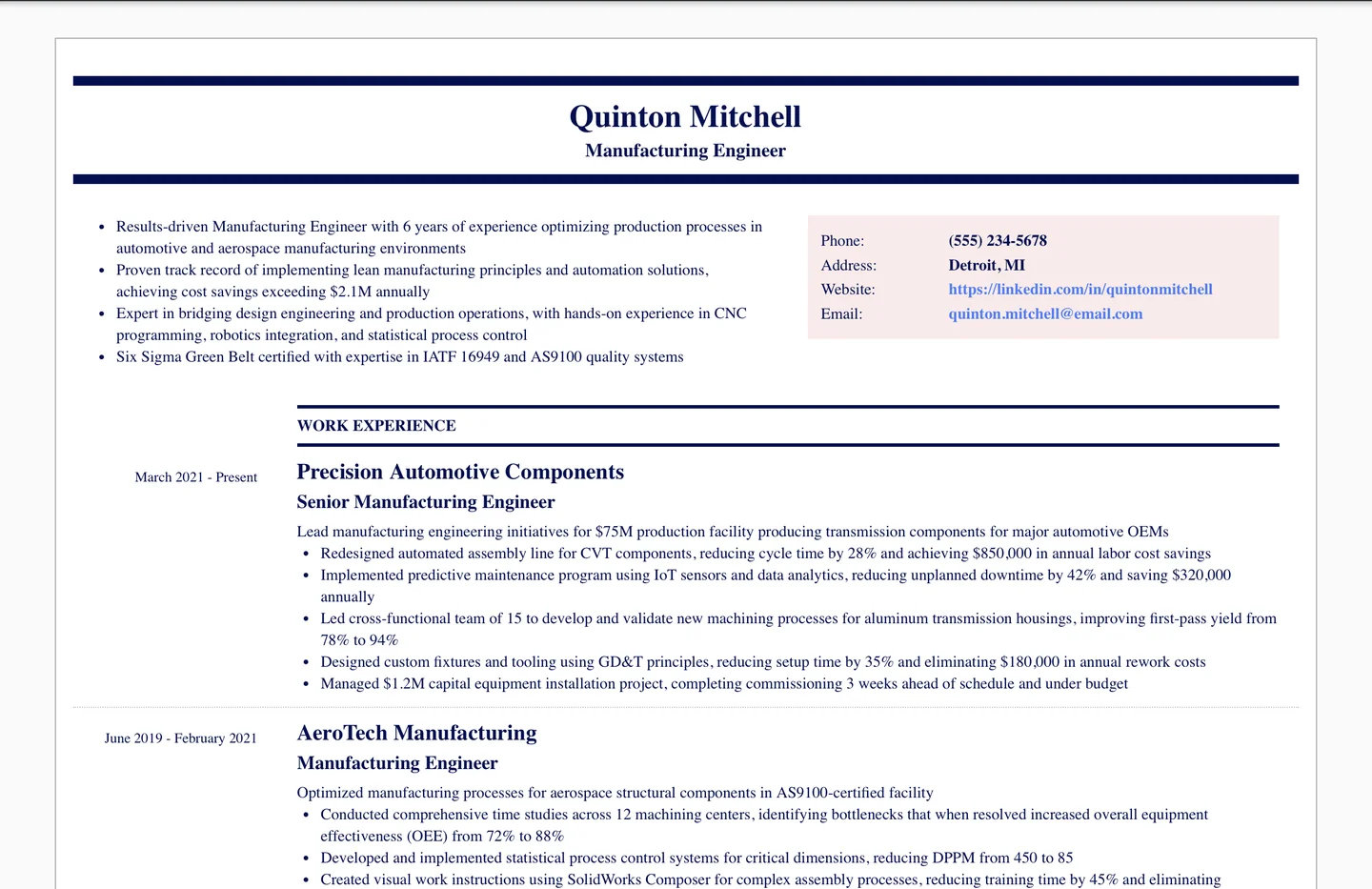
The Ultimate Manufacturing Engineer Resume Example/Sample
https://www.resumonk.com/manufacturing-engineerManufacturing EngineerResume Format to Follow for Manufacturing Engineer Resume
The reverse-chronological format is your best friend here. Why? Because in manufacturing, your recent experience with current technologies and methodologies matters immensely. That Six Sigma project you led last year using Industry 4.0 principles?
Far more relevant than the internship from five years ago, even if both taught you valuable lessons.
Structure Your Manufacturing Engineer Resume Like a Well-Designed Process
Start with a professional summary that functions like your executive dashboard - three to four lines that capture your core competencies and biggest wins. Think of it as your elevator pitch to the VP of Operations who just asked what you bring to the table.
Your work experience section should follow immediately after, presented in reverse-chronological order. Each role should showcase your progression from perhaps a junior engineer working on discrete projects to someone who now owns entire production lines or facility improvements.
Remember, manufacturing engineering roles vary widely - from entry-level positions focused on time studies and basic process improvements to senior roles managing multi-million dollar capital projects.
The Technical Documentation Approach
Manufacturing engineers live in a world of specifications, tolerances, and measurable outcomes.
Your resume should reflect this precision. Use the combination format if you're transitioning from a pure technical role (like a design engineer) into manufacturing engineering, as it allows you to highlight transferable skills while maintaining that crucial chronological work history.
Keep your sections clean and scannable - just like a well-organized P&ID diagram. After your experience, include your education (that mechanical or industrial engineering degree), followed by technical skills, and finally, relevant certifications. In the UK and European markets, you might include a brief section on major projects, while US employers often prefer these integrated into your work experience descriptions.
Work Experience on Manufacturing Engineer Resume
Here's the thing about being a Manufacturing Engineer - you're not just someone who understands how things are made; you're the person who makes them better, faster, and more cost-effective. Your work experience section needs to tell this story with the same precision you'd use when calculating cycle time reductions.
Quantify Your Impact Like a True Engineer
Every bullet point under your work experience should answer the critical question - "So what?"
You implemented a new assembly process? Great, but what really matters is how that process improved efficiency, reduced defects, or saved money.
❌ Don't write vague descriptions that could apply to any engineer:
• Improved manufacturing processes
• Worked with production team
• Implemented lean manufacturing principles
✅ Do write specific, quantified achievements that showcase your impact:
• Redesigned injection molding process for automotive components, reducing cycle time by 23% and saving $340,000 annually
• Led cross-functional team of 12 to implement cellular manufacturing layout, improving throughput by 45% within 6 months
• Developed and validated new assembly fixtures using GD&T principles, reducing defect rate from 3.2% to 0.8%
Show Your Evolution Through Progressive Responsibility
Manufacturing engineering careers typically follow a clear progression - from analyzing individual processes to owning entire production systems. Your resume should reflect this journey.
Start each position with a brief context-setting statement that explains your scope of responsibility, then dive into your accomplishments.
For entry-level positions, focus on technical contributions and learning achievements. As you move to more recent roles, shift toward leadership, strategic thinking, and business impact. Canadian employers particularly value this demonstration of growth, while Australian companies often look for evidence of cross-functional collaboration.
Bridge the Technical-Business Gap
Remember, you're likely being hired not just for your technical skills but for your ability to translate engineering improvements into business value. Each role should demonstrate both your technical prowess and your understanding of business metrics.
❌ Don't focus solely on technical tasks:
Manufacturing Engineer | ABC Corporation | 2020-2023
• Conducted time studies
• Created work instructions
• Performed root cause analysis
✅ Do connect technical work to business outcomes:
Manufacturing Engineer | ABC Corporation | 2020-2023
Managed process optimization for $50M production line manufacturing medical devices
• Conducted comprehensive time studies across 15 workstations, identifying bottlenecks that when resolved increased overall equipment effectiveness (OEE) from 68% to 84%
• Developed visual work instructions using SolidWorks Composer, reducing training time by 40% and eliminating $200K in annual rework costs
• Led 8D root cause analysis for critical quality issue, implementing permanent corrective actions that restored customer satisfaction scores to 98%
Skills to Show on Manufacturing Engineer Resume
Walk into any manufacturing facility, and you'll quickly realize that being a Manufacturing Engineer requires a unique blend of hard technical skills and soft interpersonal abilities.
You need to speak CAD with the design team in the morning, discuss statistical process control with quality in the afternoon, and explain cost implications to finance before the day ends. Your skills section is where you prove you have this versatility.
Technical Skills - Your Engineering Toolkit
Manufacturing engineering sits at the intersection of multiple technical domains.
You're not just listing software proficiencies; you're showcasing your ability to leverage technology for process improvement. Group your technical skills logically - CAD/CAM software, ERP systems, statistical analysis tools, and manufacturing-specific technologies.
Think about the job posting you're targeting. If they're implementing a new MES system and you have experience with Wonderware or Ignition, that's gold. If they mention lean manufacturing, your Six Sigma Green Belt certification suddenly becomes crucial. The key is relevance and specificity.
❌ Don't use generic skill lists:
Technical Skills:
• CAD software
• Microsoft Office
• Problem solving
• Lean manufacturing
✅ Do provide specific, relevant technical competencies:
Technical Skills:
• CAD/CAM: SolidWorks, AutoCAD, Mastercam, CATIA V5
• Simulation & Analysis: Arena, Minitab, ANSYS, Process Simulate
• ERP/MES Systems: SAP PP/QM modules, Oracle Manufacturing, Epicor
• Lean/Six Sigma: Value Stream Mapping, DMAIC, Kaizen, 5S implementation
• Manufacturing Technologies: CNC programming, Robotics (FANUC, ABB), PLC basics
The Often-Overlooked Soft Skills
Here's what many Manufacturing Engineers miss - your technical skills get you in the door, but your soft skills determine your success. You're constantly working with operators who have decades of practical experience, executives who want bottom-line results, and suppliers who need clear specifications.
This requires a specific set of interpersonal abilities.
Don't just list "communication skills." Instead, weave evidence of these soft skills throughout your resume. Show how you've led cross-functional teams, trained operators on new equipment, or presented cost-saving initiatives to senior management.
In the UK market particularly, employers value engineers who can work effectively across organizational levels.
Industry-Specific Expertise
Manufacturing engineering varies dramatically between industries.
Aerospace manufacturing requires AS9100 knowledge and strict documentation. Automotive focuses on IATF 16949 and high-volume production. Medical device manufacturing demands FDA validation expertise. Your skills section should reflect your industry expertise clearly.
Industry-Specific Qualifications:
• ISO 9001:2015 certified lead auditor
• GMP/GDP compliance in pharmaceutical manufacturing
• IATF 16949 core tools (APQP, PPAP, FMEA, MSA, SPC)
• IPC-A-610 certification for electronics assembly
Specific Considerations and Tips for Manufacturing Engineer Resume
Let's talk about what makes a Manufacturing Engineer resume different from any other engineering resume.
You've probably noticed that your role sits in a unique position - you're not quite design, not quite production, not quite quality, but somehow responsible for making all these departments work together harmoniously. This complexity is exactly what your resume needs to capture.
The Portfolio Problem and How to Solve It
Unlike software engineers who can link to GitHub or designers who showcase portfolios, your best work often involves proprietary processes, confidential cost savings, or improvements to equipment that can't be photographed. This creates a unique challenge - how do you prove your capabilities without revealing trade secrets?
The solution lies in strategic sanitization. Focus on percentages and relative improvements rather than absolute numbers when dealing with sensitive information. Describe the methodology and approach rather than the specific technical details. For instance, instead of detailing the exact process changes you made to a proprietary pharmaceutical manufacturing line, focus on the validation approach, the cross-functional coordination required, and the regulatory hurdles you navigated.
Address the Hands-On Versus Strategic Balance
Manufacturing Engineers face a peculiar career challenge - companies want someone strategic enough to design improvements but hands-on enough to implement them on the floor. Your resume needs to demonstrate both capabilities.
Include examples where you've gotten your hands dirty troubleshooting equipment alongside maintenance techs, but also highlight instances where you've developed long-term capacity planning models or capital investment proposals.
❌ Don't position yourself as only theoretical or only hands-on:
• Developed theoretical models for production optimization
• Worked on shop floor daily
✅ Do show your range from strategic to tactical:
• Designed and personally commissioned automated inspection system, from initial ROI analysis ($2.3M investment) through hands-on PLC programming and operator training
• Spent 60% of time on production floor identifying improvement opportunities, resulting in 5 implemented kaizen events with combined annual savings of $450K
Navigate the Certification Maze Intelligently
The manufacturing world loves certifications - Six Sigma, Lean, PMP, CQE, CMfgE - the alphabet soup can be overwhelming. Here's the insider truth: more isn't always better. List certifications that directly align with your target role and industry. Applying to a traditional automotive manufacturer? That Six Sigma Black Belt is crucial. Targeting a startup developing new manufacturing processes?
Your hands-on experience might matter more than certifications.
For US positions, actively maintained certifications should include expiration dates. In European markets, include the certifying body.
Australian employers often value government-recognized vocational qualifications alongside traditional certifications.
The Geography Factor
Manufacturing engineering roles can be surprisingly location-specific.
A resume for a Manufacturing Engineer position in Detroit's automotive corridor will look different from one targeting semiconductor manufacturing in Phoenix or pharmaceutical manufacturing in New Jersey. Research your target geography's industrial focus and adjust your emphasis accordingly.
Remember, many manufacturing facilities are in smaller cities or rural areas. If you're willing to relocate, make this clear in your resume header or cover letter. Companies often struggle to attract engineering talent to these locations and view flexibility as a major advantage.
Handle the Automation Elephant in the Room
Every Manufacturing Engineer today faces questions about automation, Industry 4.0, and the future of manufacturing. Your resume should proactively address your relationship with these trends. Include any experience with collaborative robots, IoT implementation, or data analytics for manufacturing.
Even if your experience is primarily with traditional manufacturing, demonstrate your awareness and enthusiasm for emerging technologies.
Professional Development & Industry Engagement:
• Completed online certification in "Industrial IoT and Digital Manufacturing" - MIT (2023)
• Implemented pilot smart sensor project for predictive maintenance, reducing unplanned downtime by 18%
• Active member of SME (Society of Manufacturing Engineers), regularly attending workshops on advanced manufacturing
Finally, remember that Manufacturing Engineering is about making things better. Every line of your resume should reinforce this central theme - you're not just an engineer who works in manufacturing; you're the engineer who makes manufacturing work better.
Education to List on Manufacturing Engineer Resume
You've spent years mastering the intricate dance between theoretical engineering principles and hands-on manufacturing processes. Maybe you started tinkering with machines in your garage, or perhaps you discovered your passion during that first factory tour in college.
Either way, as a Manufacturing Engineer, your educational background tells a story that goes beyond just degrees - it's about demonstrating your ability to bridge the gap between design concepts and production reality.
Core Educational Requirements
Manufacturing Engineering sits at a fascinating intersection. Unlike pure design engineers who might never set foot on a factory floor, you're expected to understand both the elegance of engineering theory and the messiness of actual production. This dual nature should shine through in how you present your education. Most Manufacturing Engineer positions require at least a Bachelor's degree in Manufacturing Engineering, Mechanical Engineering, Industrial Engineering, or a related field.
But here's where it gets interesting - the way you present this education can set you apart from the hundreds of other applicants with similar degrees.
Start with your highest degree and work backwards in reverse-chronological order. Include your graduation date (or expected graduation date if you're still studying), but here's a pro tip - if you graduated more than 10 years ago, the month becomes less relevant. Focus on what matters to manufacturing - your practical projects, relevant coursework, and any hands-on experience gained during your studies.
Highlighting Relevant Coursework and Projects
Remember that group project where you had to optimize a production line simulation?
Or that course on Six Sigma methodologies that finally made lean manufacturing click for you? These details matter immensely for Manufacturing Engineer roles.
Unlike software engineers who can showcase GitHub repositories, your academic projects often represent your most tangible evidence of manufacturing expertise.
❌ Don't write vaguely about your education:
Bachelor of Science in Mechanical Engineering
State University, 2020
GPA: 3.5
✅ Do include specific manufacturing-relevant details:
Bachelor of Science in Mechanical Engineering
State University, May 2020
GPA: 3.5/4.0
Relevant Coursework: Manufacturing Processes, CAD/CAM, Quality Control, Production Planning
Senior Capstone: Designed automated inspection system reducing defect detection time by 40%
Certifications and Continuous Learning
Manufacturing is evolving rapidly with Industry 4.0, and your education section should reflect your commitment to staying current. Professional certifications like Six Sigma Green Belt, Certified Manufacturing Engineer (CMfgE), or specific software certifications (think SolidWorks, AutoCAD, or SAP) deserve prominent placement. These aren't just alphabet soup after your name - they represent real skills that translate directly to the factory floor.
If you're early in your career and your GPA is above 3.3, include it. If you're a seasoned professional, that GPA from 15 years ago matters far less than your recent Lean Manufacturing certification. The key is understanding what stage of your career you're at and adjusting accordingly.
Awards and Publications on Manufacturing Engineer Resume
Let's be honest - you probably didn't go into manufacturing engineering to win popularity contests or write academic papers. You chose this field because you love solving real problems and seeing tangible products roll off production lines. But here's the thing - those process improvements you implemented, that innovative fixture design that saved your company thousands, or that white paper you wrote on reducing cycle time?
These achievements deserve spotlight treatment on your resume.
Identifying Relevant Awards
Manufacturing Engineers often underestimate their achievements.
That "Employee of the Month" award you received for implementing a new quality control process? That's gold. The recognition from your plant manager for achieving zero safety incidents? Absolutely include it. Awards in manufacturing often come in different flavors than in other industries - they might be team-based, focused on continuous improvement, or tied to specific metrics like OEE (Overall Equipment Effectiveness) improvements.
When listing awards, context is everything. A Manufacturing Engineer's awards often relate to measurable improvements - cost savings, efficiency gains, quality improvements, or safety achievements. Don't just list the award name; explain briefly what you did to earn it.
❌ Don't list awards without context:
Excellence Award - ABC Manufacturing, 2022
Team Player Award - 2021
✅ Do provide meaningful context:
Manufacturing Excellence Award - ABC Manufacturing, 2022
 Recognized for implementing automated quality inspection system, reducing defects by 35%

Continuous Improvement Champion - 2021
 Led cross-functional team in kaizen event, achieving $150K annual cost savings
Publications and Technical Contributions
You might be thinking, "I'm not an academic - why would I have publications?" But modern Manufacturing Engineers often contribute to trade magazines, internal company newsletters, or industry conferences. That presentation you gave at the local SME (Society of Manufacturing Engineers) chapter meeting? That counts. The case study you wrote about implementing predictive maintenance?
Definitely include it.
Publications for Manufacturing Engineers often appear in places like Modern Machine Shop, Manufacturing Engineering Magazine, or industry-specific journals. Even internal company documentation - if it demonstrates your expertise in areas like lean manufacturing, automation, or process optimization - can be valuable to mention.
Professional Recognition and Certifications as Awards
In manufacturing, certifications often carry more weight than traditional awards.
Achieving Six Sigma Black Belt certification, becoming a Certified Manufacturing Technologist (CMfgT), or earning specialized training in robotics or automation represents significant professional achievement. These belong in your awards section if they represent exceptional accomplishment beyond basic job requirements.
Remember to tailor your awards and publications to the specific Manufacturing Engineer role you're targeting. If the position focuses on quality, emphasize quality-related achievements. If it's about automation and Industry 4.0, highlight relevant technical contributions in those areas.
Listing References for Manufacturing Engineer Resume
You've optimized production lines, reduced waste, improved quality metrics - but can someone vouch for it? In manufacturing, where one engineer's mistake can shut down an entire production line or cost hundreds of thousands in recalls, references carry exceptional weight.
The people who've seen you troubleshoot a crisis at 2 AM or watched you calmly manage a supplier quality issue - these are the voices that can make your application stand out.
Choosing the Right References
Manufacturing Engineering is inherently collaborative.
You work with production supervisors, quality managers, maintenance teams, and often directly with operators on the floor. This gives you a rich pool of potential references, but choosing the right ones requires strategy. Your ideal reference list should include someone who's seen your technical skills in action (perhaps a senior engineer or engineering manager), someone who can speak to your cross-functional collaboration (like a production manager or quality supervisor), and ideally, someone from the business side who understands the financial impact of your improvements.
Avoid listing references who only know you superficially. That VP who you presented to once isn't as valuable as the production supervisor who watched you redesign their entire workflow.
In manufacturing, credibility comes from those who've been in the trenches with you.
Preparing Your References
Manufacturing moves fast, and your references are likely juggling multiple priorities.
When you ask someone to be a reference, provide them with context about the position you're applying for. Is it focused on automation? Remind them about that robotic cell you programmed. Is it heavy on lean manufacturing? Refresh their memory about the value stream mapping exercise you led.
❌ Don't list references without proper preparation:
References available upon request
✅ Do create a separate, well-formatted reference sheet:
PROFESSIONAL REFERENCES

1. John Martinez
Production Manager, ABC Manufacturing
Relationship: Direct supervisor for 3 years
Phone: (555) 123-4567
Email: [email protected]
Context: Supervised my work on lean transformation project that achieved 25% efficiency gain

2. Sarah Chen, CMfgE
Senior Manufacturing Engineer, XYZ Corporation
Relationship: Project team lead and mentor
Phone: (555) 234-5678
Email: [email protected]
Context: Led joint automation project reducing labor costs by $300K annually
International and Regional Considerations
Reference expectations vary significantly by region.
In the United States and Canada, references are typically provided separately and only when requested. In the UK, you might include "References available upon request" at the bottom of your CV. Some European countries expect references listed directly on the CV. For Manufacturing Engineers working with global companies or applying internationally, understanding these nuances is crucial.
In highly regulated industries like aerospace or medical device manufacturing, references might need to verify specific competencies or training. Be prepared for more detailed reference checks, and ensure your references can speak to your understanding of relevant quality systems and regulatory requirements.
Managing Reference Timing
Manufacturing hiring often moves quickly - when a production line needs an engineer, they need one now. Keep your references informed about your job search status. Nothing undermines your candidacy faster than a reference who's surprised by a call or, worse, unreachable during a critical decision period.
For Manufacturing Engineers, where technical competence and reliability are paramount, having responsive, well-prepared references can be the difference between landing the role and losing out to another qualified candidate.
Remember, your references are doing you a favor. After they've provided a reference, regardless of the outcome, follow up with a thank you note and let them know the result.
Manufacturing is a smaller world than you might think, and maintaining these professional relationships benefits everyone in the long run.
Cover Letter Tips for Manufacturing Engineer Resume
Let's step into this scene - you're a hiring manager at a manufacturing facility.
It's 6 AM, you've got production issues from the night shift to review, and a stack of resumes for that Manufacturing Engineer position. Most candidates have similar degrees, comparable years of experience, and the requisite technical skills. Then you open a cover letter that immediately demonstrates understanding of your specific manufacturing challenges. That's the power of a well-crafted cover letter for Manufacturing Engineers - it's your chance to show you understand not just engineering, but the unique pressures and opportunities of their specific manufacturing environment.
Understanding the Manufacturing Context
Manufacturing Engineers operate in diverse environments - from traditional assembly lines to cutting-edge smart factories.
Your cover letter needs to demonstrate that you understand their specific context. Are they struggling with quality issues? Lead with your experience in implementing statistical process control. Are they transitioning to automation? Open with your robotics integration project.
The biggest mistake Manufacturing Engineers make in cover letters is being too generic. You're not just an engineer - you're someone who understands the delicate balance between cost, quality, and delivery time.
Your cover letter should reflect this understanding from the very first paragraph.
❌ Don't write generic openings:
Dear Hiring Manager,
I am writing to apply for the Manufacturing Engineer position at your company.
I have 5 years of experience in manufacturing.
✅ Do demonstrate specific understanding:
Dear Ms. Johnson,
Your recent expansion into aerospace component manufacturing presents unique challenges in maintaining tight tolerances while scaling production. Having led similar transitions in precision manufacturing environments, I understand the critical balance between implementing robust quality systems and maintaining production efficiency.
Showcasing Problem-Solving Abilities
Manufacturing is fundamentally about solving problems - machines break down, suppliers deliver late, quality issues emerge, costs spiral.
Your cover letter should tell a brief story of a significant problem you solved. Make it relevant to their industry if possible. Use the STAR method (Situation, Task, Action, Result) but keep it concise - this isn't the place for a novel.
Include specific metrics whenever possible. Manufacturing lives and dies by metrics - OEE, first-pass yield, cycle time, DPPM (Defective Parts Per Million).
When you mention reducing setup time by 30% or improving first-pass yield from 85% to 97%, you're speaking their language.
Addressing Industry-Specific Requirements
Different manufacturing sectors have unique requirements.
Automotive manufacturing might prioritize IATF 16949 knowledge, medical device manufacturing requires understanding of FDA regulations and ISO 13485, while aerospace needs AS9100 familiarity. Your cover letter should acknowledge these specific requirements and demonstrate your readiness to work within these frameworks.
For entry-level Manufacturing Engineer positions, emphasize your hands-on experience from internships, co-ops, or university projects. For senior positions, focus on your leadership in continuous improvement initiatives and cross-functional project management.
Always close your cover letter with enthusiasm for their specific manufacturing challenges and a clear call to action.
Key Takeaways
- Use reverse-chronological format to showcase your most recent and relevant manufacturing experience first - your work with current technologies and methodologies matters more than older experience
- Quantify everything like the engineer you are - don't just say you improved processes, specify that you reduced cycle time by 23% and saved $340,000 annually
- Balance technical depth with business impact - connect your engineering improvements to bottom-line results like cost savings, quality improvements, and efficiency gains
- Tailor your technical skills section strategically - group skills logically (CAD/CAM, ERP systems, lean methodologies) and align them with the specific job requirements
- Show both hands-on and strategic capabilities - demonstrate you can troubleshoot equipment on the floor AND develop long-term capacity planning models
- Handle proprietary information carefully - focus on percentages and methodologies rather than revealing trade secrets or confidential data
- Include industry-specific certifications and standards - whether it's Six Sigma, ISO 9001, or IATF 16949, show you understand the regulatory landscape of your target industry
- Craft a targeted cover letter that demonstrates understanding of their specific manufacturing challenges - generic applications get lost in the pile
- Prepare your references strategically - choose people who've seen you solve real manufacturing problems, not just senior executives who barely know your work
Creating a Manufacturing Engineer resume that truly captures your value isn't just about listing your experience - it's about telling the story of how you make manufacturing better, faster, and more efficient. On Resumonk, you can build this story with confidence, using professionally designed templates that understand the unique needs of technical professionals. Our AI-powered recommendations help you optimize your content for manufacturing roles, ensuring you include the right keywords and metrics that catch a hiring manager's attention. Whether you're targeting automotive, aerospace, medical device, or any other manufacturing sector, Resumonk's tools adapt to your specific needs, helping you create a resume that bridges the gap between technical excellence and business impact.
Ready to engineer your perfect resume?
Start building your Manufacturing Engineer resume on Resumonk today. With industry-specific templates, intelligent content suggestions, and formatting that showcases your technical expertise, you'll have a professional resume ready in minutes, not hours.
Get started with Resumonk now →
More Manufacturing & Production resume examples
- Maintenance Supervisor resume example
- Machine Operator resume example
- Mechanic resume example
- Quality Engineer resume example
See all Manufacturing & Production resume examples, or browse every category.
Resume writing tips
Picture yourself standing at the crossroads of innovation and practicality, where elegant engineering theory meets the controlled chaos of the production floor.
As a Manufacturing Engineer, you've spent countless hours perfecting the delicate art of making things work - not just in theory, but in the real world where machines break down at the worst possible moment, suppliers deliver materials with unexpected variations, and that "simple" process improvement somehow needs to satisfy quality, production, finance, and safety all at the same time. Now you're ready to take that expertise to a new opportunity, but here's the challenge - how do you capture the complexity of what you do in a two-page document that someone will scan in 30 seconds?
The truth is, Manufacturing Engineers face a unique resume challenge. You're not designers showing off CAD portfolios, nor are you pure production managers with straightforward metrics. You live in the space between - the translator who speaks fluent engineering to the design team and practical operations to the floor supervisor. You're the person who can calculate theoretical cycle times in the morning and troubleshoot a stubborn CNC machine in the afternoon. Your resume needs to reflect this duality while speaking to hiring managers who might come from either side of this divide.
Whether you're fresh out of university with your mechanical engineering degree and a head full of lean principles, or you're a seasoned engineer who's survived multiple product launches and factory expansions, the search intent behind "Manufacturing Engineer Resume Example" is clear - you need a roadmap. You need to know how to structure your experience so that reverse-chronological format works in your favor, showcasing your most recent and relevant achievements first. You need to understand how to quantify improvements in ways that make CFOs smile and plant managers take notice.
In this comprehensive guide, we'll walk you through every element of crafting the perfect Manufacturing Engineer resume. We'll start with choosing the right format that highlights your technical evolution, then dive deep into articulating your work experience with the precision of a well-calibrated measurement system. You'll learn how to present your unique blend of technical and soft skills, navigate the specific considerations that make manufacturing engineering resumes different - from handling proprietary information to balancing hands-on experience with strategic thinking. We'll cover education, certifications, awards, and even those often-overlooked elements like references and cover letters that can make the difference between landing an interview and landing in the rejection pile. By the end, you'll have everything you need to create a resume that demonstrates not just what you've done, but the value you'll bring to your next manufacturing challenge.
The Ultimate Manufacturing Engineer Resume Example/Sample
https://www.resumonk.com/manufacturing-engineerManufacturing EngineerResume Format to Follow for Manufacturing Engineer Resume
The reverse-chronological format is your best friend here. Why? Because in manufacturing, your recent experience with current technologies and methodologies matters immensely. That Six Sigma project you led last year using Industry 4.0 principles?
Far more relevant than the internship from five years ago, even if both taught you valuable lessons.
Structure Your Manufacturing Engineer Resume Like a Well-Designed Process
Start with a professional summary that functions like your executive dashboard - three to four lines that capture your core competencies and biggest wins. Think of it as your elevator pitch to the VP of Operations who just asked what you bring to the table.
Your work experience section should follow immediately after, presented in reverse-chronological order. Each role should showcase your progression from perhaps a junior engineer working on discrete projects to someone who now owns entire production lines or facility improvements.
Remember, manufacturing engineering roles vary widely - from entry-level positions focused on time studies and basic process improvements to senior roles managing multi-million dollar capital projects.
The Technical Documentation Approach
Manufacturing engineers live in a world of specifications, tolerances, and measurable outcomes.
Your resume should reflect this precision. Use the combination format if you're transitioning from a pure technical role (like a design engineer) into manufacturing engineering, as it allows you to highlight transferable skills while maintaining that crucial chronological work history.
Keep your sections clean and scannable - just like a well-organized P&ID diagram. After your experience, include your education (that mechanical or industrial engineering degree), followed by technical skills, and finally, relevant certifications. In the UK and European markets, you might include a brief section on major projects, while US employers often prefer these integrated into your work experience descriptions.
Work Experience on Manufacturing Engineer Resume
Here's the thing about being a Manufacturing Engineer - you're not just someone who understands how things are made; you're the person who makes them better, faster, and more cost-effective. Your work experience section needs to tell this story with the same precision you'd use when calculating cycle time reductions.
Quantify Your Impact Like a True Engineer
Every bullet point under your work experience should answer the critical question - "So what?"
You implemented a new assembly process? Great, but what really matters is how that process improved efficiency, reduced defects, or saved money.
❌ Don't write vague descriptions that could apply to any engineer:
• Improved manufacturing processes
• Worked with production team
• Implemented lean manufacturing principles
✅ Do write specific, quantified achievements that showcase your impact:
• Redesigned injection molding process for automotive components, reducing cycle time by 23% and saving $340,000 annually
• Led cross-functional team of 12 to implement cellular manufacturing layout, improving throughput by 45% within 6 months
• Developed and validated new assembly fixtures using GD&T principles, reducing defect rate from 3.2% to 0.8%
Show Your Evolution Through Progressive Responsibility
Manufacturing engineering careers typically follow a clear progression - from analyzing individual processes to owning entire production systems. Your resume should reflect this journey.
Start each position with a brief context-setting statement that explains your scope of responsibility, then dive into your accomplishments.
For entry-level positions, focus on technical contributions and learning achievements. As you move to more recent roles, shift toward leadership, strategic thinking, and business impact. Canadian employers particularly value this demonstration of growth, while Australian companies often look for evidence of cross-functional collaboration.
Bridge the Technical-Business Gap
Remember, you're likely being hired not just for your technical skills but for your ability to translate engineering improvements into business value. Each role should demonstrate both your technical prowess and your understanding of business metrics.
❌ Don't focus solely on technical tasks:
Manufacturing Engineer | ABC Corporation | 2020-2023
• Conducted time studies
• Created work instructions
• Performed root cause analysis
✅ Do connect technical work to business outcomes:
Manufacturing Engineer | ABC Corporation | 2020-2023
Managed process optimization for $50M production line manufacturing medical devices
• Conducted comprehensive time studies across 15 workstations, identifying bottlenecks that when resolved increased overall equipment effectiveness (OEE) from 68% to 84%
• Developed visual work instructions using SolidWorks Composer, reducing training time by 40% and eliminating $200K in annual rework costs
• Led 8D root cause analysis for critical quality issue, implementing permanent corrective actions that restored customer satisfaction scores to 98%
Skills to Show on Manufacturing Engineer Resume
Walk into any manufacturing facility, and you'll quickly realize that being a Manufacturing Engineer requires a unique blend of hard technical skills and soft interpersonal abilities.
You need to speak CAD with the design team in the morning, discuss statistical process control with quality in the afternoon, and explain cost implications to finance before the day ends. Your skills section is where you prove you have this versatility.
Technical Skills - Your Engineering Toolkit
Manufacturing engineering sits at the intersection of multiple technical domains.
You're not just listing software proficiencies; you're showcasing your ability to leverage technology for process improvement. Group your technical skills logically - CAD/CAM software, ERP systems, statistical analysis tools, and manufacturing-specific technologies.
Think about the job posting you're targeting. If they're implementing a new MES system and you have experience with Wonderware or Ignition, that's gold. If they mention lean manufacturing, your Six Sigma Green Belt certification suddenly becomes crucial. The key is relevance and specificity.
❌ Don't use generic skill lists:
Technical Skills:
• CAD software
• Microsoft Office
• Problem solving
• Lean manufacturing
✅ Do provide specific, relevant technical competencies:
Technical Skills:
• CAD/CAM: SolidWorks, AutoCAD, Mastercam, CATIA V5
• Simulation & Analysis: Arena, Minitab, ANSYS, Process Simulate
• ERP/MES Systems: SAP PP/QM modules, Oracle Manufacturing, Epicor
• Lean/Six Sigma: Value Stream Mapping, DMAIC, Kaizen, 5S implementation
• Manufacturing Technologies: CNC programming, Robotics (FANUC, ABB), PLC basics
The Often-Overlooked Soft Skills
Here's what many Manufacturing Engineers miss - your technical skills get you in the door, but your soft skills determine your success. You're constantly working with operators who have decades of practical experience, executives who want bottom-line results, and suppliers who need clear specifications.
This requires a specific set of interpersonal abilities.
Don't just list "communication skills." Instead, weave evidence of these soft skills throughout your resume. Show how you've led cross-functional teams, trained operators on new equipment, or presented cost-saving initiatives to senior management.
In the UK market particularly, employers value engineers who can work effectively across organizational levels.
Industry-Specific Expertise
Manufacturing engineering varies dramatically between industries.
Aerospace manufacturing requires AS9100 knowledge and strict documentation. Automotive focuses on IATF 16949 and high-volume production. Medical device manufacturing demands FDA validation expertise. Your skills section should reflect your industry expertise clearly.
Industry-Specific Qualifications:
• ISO 9001:2015 certified lead auditor
• GMP/GDP compliance in pharmaceutical manufacturing
• IATF 16949 core tools (APQP, PPAP, FMEA, MSA, SPC)
• IPC-A-610 certification for electronics assembly
Specific Considerations and Tips for Manufacturing Engineer Resume
Let's talk about what makes a Manufacturing Engineer resume different from any other engineering resume.
You've probably noticed that your role sits in a unique position - you're not quite design, not quite production, not quite quality, but somehow responsible for making all these departments work together harmoniously. This complexity is exactly what your resume needs to capture.
The Portfolio Problem and How to Solve It
Unlike software engineers who can link to GitHub or designers who showcase portfolios, your best work often involves proprietary processes, confidential cost savings, or improvements to equipment that can't be photographed. This creates a unique challenge - how do you prove your capabilities without revealing trade secrets?
The solution lies in strategic sanitization. Focus on percentages and relative improvements rather than absolute numbers when dealing with sensitive information. Describe the methodology and approach rather than the specific technical details. For instance, instead of detailing the exact process changes you made to a proprietary pharmaceutical manufacturing line, focus on the validation approach, the cross-functional coordination required, and the regulatory hurdles you navigated.
Address the Hands-On Versus Strategic Balance
Manufacturing Engineers face a peculiar career challenge - companies want someone strategic enough to design improvements but hands-on enough to implement them on the floor. Your resume needs to demonstrate both capabilities.
Include examples where you've gotten your hands dirty troubleshooting equipment alongside maintenance techs, but also highlight instances where you've developed long-term capacity planning models or capital investment proposals.
❌ Don't position yourself as only theoretical or only hands-on:
• Developed theoretical models for production optimization
• Worked on shop floor daily
✅ Do show your range from strategic to tactical:
• Designed and personally commissioned automated inspection system, from initial ROI analysis ($2.3M investment) through hands-on PLC programming and operator training
• Spent 60% of time on production floor identifying improvement opportunities, resulting in 5 implemented kaizen events with combined annual savings of $450K
Navigate the Certification Maze Intelligently
The manufacturing world loves certifications - Six Sigma, Lean, PMP, CQE, CMfgE - the alphabet soup can be overwhelming. Here's the insider truth: more isn't always better. List certifications that directly align with your target role and industry. Applying to a traditional automotive manufacturer? That Six Sigma Black Belt is crucial. Targeting a startup developing new manufacturing processes?
Your hands-on experience might matter more than certifications.
For US positions, actively maintained certifications should include expiration dates. In European markets, include the certifying body.
Australian employers often value government-recognized vocational qualifications alongside traditional certifications.
The Geography Factor
Manufacturing engineering roles can be surprisingly location-specific.
A resume for a Manufacturing Engineer position in Detroit's automotive corridor will look different from one targeting semiconductor manufacturing in Phoenix or pharmaceutical manufacturing in New Jersey. Research your target geography's industrial focus and adjust your emphasis accordingly.
Remember, many manufacturing facilities are in smaller cities or rural areas. If you're willing to relocate, make this clear in your resume header or cover letter. Companies often struggle to attract engineering talent to these locations and view flexibility as a major advantage.
Handle the Automation Elephant in the Room
Every Manufacturing Engineer today faces questions about automation, Industry 4.0, and the future of manufacturing. Your resume should proactively address your relationship with these trends. Include any experience with collaborative robots, IoT implementation, or data analytics for manufacturing.
Even if your experience is primarily with traditional manufacturing, demonstrate your awareness and enthusiasm for emerging technologies.
Professional Development & Industry Engagement:
• Completed online certification in "Industrial IoT and Digital Manufacturing" - MIT (2023)
• Implemented pilot smart sensor project for predictive maintenance, reducing unplanned downtime by 18%
• Active member of SME (Society of Manufacturing Engineers), regularly attending workshops on advanced manufacturing
Finally, remember that Manufacturing Engineering is about making things better. Every line of your resume should reinforce this central theme - you're not just an engineer who works in manufacturing; you're the engineer who makes manufacturing work better.
Education to List on Manufacturing Engineer Resume
You've spent years mastering the intricate dance between theoretical engineering principles and hands-on manufacturing processes. Maybe you started tinkering with machines in your garage, or perhaps you discovered your passion during that first factory tour in college.
Either way, as a Manufacturing Engineer, your educational background tells a story that goes beyond just degrees - it's about demonstrating your ability to bridge the gap between design concepts and production reality.
Core Educational Requirements
Manufacturing Engineering sits at a fascinating intersection. Unlike pure design engineers who might never set foot on a factory floor, you're expected to understand both the elegance of engineering theory and the messiness of actual production. This dual nature should shine through in how you present your education. Most Manufacturing Engineer positions require at least a Bachelor's degree in Manufacturing Engineering, Mechanical Engineering, Industrial Engineering, or a related field.
But here's where it gets interesting - the way you present this education can set you apart from the hundreds of other applicants with similar degrees.
Start with your highest degree and work backwards in reverse-chronological order. Include your graduation date (or expected graduation date if you're still studying), but here's a pro tip - if you graduated more than 10 years ago, the month becomes less relevant. Focus on what matters to manufacturing - your practical projects, relevant coursework, and any hands-on experience gained during your studies.
Highlighting Relevant Coursework and Projects
Remember that group project where you had to optimize a production line simulation?
Or that course on Six Sigma methodologies that finally made lean manufacturing click for you? These details matter immensely for Manufacturing Engineer roles.
Unlike software engineers who can showcase GitHub repositories, your academic projects often represent your most tangible evidence of manufacturing expertise.
❌ Don't write vaguely about your education:
Bachelor of Science in Mechanical Engineering
State University, 2020
GPA: 3.5
✅ Do include specific manufacturing-relevant details:
Bachelor of Science in Mechanical Engineering
State University, May 2020
GPA: 3.5/4.0
Relevant Coursework: Manufacturing Processes, CAD/CAM, Quality Control, Production Planning
Senior Capstone: Designed automated inspection system reducing defect detection time by 40%
Certifications and Continuous Learning
Manufacturing is evolving rapidly with Industry 4.0, and your education section should reflect your commitment to staying current. Professional certifications like Six Sigma Green Belt, Certified Manufacturing Engineer (CMfgE), or specific software certifications (think SolidWorks, AutoCAD, or SAP) deserve prominent placement. These aren't just alphabet soup after your name - they represent real skills that translate directly to the factory floor.
If you're early in your career and your GPA is above 3.3, include it. If you're a seasoned professional, that GPA from 15 years ago matters far less than your recent Lean Manufacturing certification. The key is understanding what stage of your career you're at and adjusting accordingly.
Awards and Publications on Manufacturing Engineer Resume
Let's be honest - you probably didn't go into manufacturing engineering to win popularity contests or write academic papers. You chose this field because you love solving real problems and seeing tangible products roll off production lines. But here's the thing - those process improvements you implemented, that innovative fixture design that saved your company thousands, or that white paper you wrote on reducing cycle time?
These achievements deserve spotlight treatment on your resume.
Identifying Relevant Awards
Manufacturing Engineers often underestimate their achievements.
That "Employee of the Month" award you received for implementing a new quality control process? That's gold. The recognition from your plant manager for achieving zero safety incidents? Absolutely include it. Awards in manufacturing often come in different flavors than in other industries - they might be team-based, focused on continuous improvement, or tied to specific metrics like OEE (Overall Equipment Effectiveness) improvements.
When listing awards, context is everything. A Manufacturing Engineer's awards often relate to measurable improvements - cost savings, efficiency gains, quality improvements, or safety achievements. Don't just list the award name; explain briefly what you did to earn it.
❌ Don't list awards without context:
Excellence Award - ABC Manufacturing, 2022
Team Player Award - 2021
✅ Do provide meaningful context:
Manufacturing Excellence Award - ABC Manufacturing, 2022
 Recognized for implementing automated quality inspection system, reducing defects by 35%

Continuous Improvement Champion - 2021
 Led cross-functional team in kaizen event, achieving $150K annual cost savings
Publications and Technical Contributions
You might be thinking, "I'm not an academic - why would I have publications?" But modern Manufacturing Engineers often contribute to trade magazines, internal company newsletters, or industry conferences. That presentation you gave at the local SME (Society of Manufacturing Engineers) chapter meeting? That counts. The case study you wrote about implementing predictive maintenance?
Definitely include it.
Publications for Manufacturing Engineers often appear in places like Modern Machine Shop, Manufacturing Engineering Magazine, or industry-specific journals. Even internal company documentation - if it demonstrates your expertise in areas like lean manufacturing, automation, or process optimization - can be valuable to mention.
Professional Recognition and Certifications as Awards
In manufacturing, certifications often carry more weight than traditional awards.
Achieving Six Sigma Black Belt certification, becoming a Certified Manufacturing Technologist (CMfgT), or earning specialized training in robotics or automation represents significant professional achievement. These belong in your awards section if they represent exceptional accomplishment beyond basic job requirements.
Remember to tailor your awards and publications to the specific Manufacturing Engineer role you're targeting. If the position focuses on quality, emphasize quality-related achievements. If it's about automation and Industry 4.0, highlight relevant technical contributions in those areas.
Listing References for Manufacturing Engineer Resume
You've optimized production lines, reduced waste, improved quality metrics - but can someone vouch for it? In manufacturing, where one engineer's mistake can shut down an entire production line or cost hundreds of thousands in recalls, references carry exceptional weight.
The people who've seen you troubleshoot a crisis at 2 AM or watched you calmly manage a supplier quality issue - these are the voices that can make your application stand out.
Choosing the Right References
Manufacturing Engineering is inherently collaborative.
You work with production supervisors, quality managers, maintenance teams, and often directly with operators on the floor. This gives you a rich pool of potential references, but choosing the right ones requires strategy. Your ideal reference list should include someone who's seen your technical skills in action (perhaps a senior engineer or engineering manager), someone who can speak to your cross-functional collaboration (like a production manager or quality supervisor), and ideally, someone from the business side who understands the financial impact of your improvements.
Avoid listing references who only know you superficially. That VP who you presented to once isn't as valuable as the production supervisor who watched you redesign their entire workflow.
In manufacturing, credibility comes from those who've been in the trenches with you.
Preparing Your References
Manufacturing moves fast, and your references are likely juggling multiple priorities.
When you ask someone to be a reference, provide them with context about the position you're applying for. Is it focused on automation? Remind them about that robotic cell you programmed. Is it heavy on lean manufacturing? Refresh their memory about the value stream mapping exercise you led.
❌ Don't list references without proper preparation:
References available upon request
✅ Do create a separate, well-formatted reference sheet:
PROFESSIONAL REFERENCES

1. John Martinez
Production Manager, ABC Manufacturing
Relationship: Direct supervisor for 3 years
Phone: (555) 123-4567
Email: [email protected]
Context: Supervised my work on lean transformation project that achieved 25% efficiency gain

2. Sarah Chen, CMfgE
Senior Manufacturing Engineer, XYZ Corporation
Relationship: Project team lead and mentor
Phone: (555) 234-5678
Email: [email protected]
Context: Led joint automation project reducing labor costs by $300K annually
International and Regional Considerations
Reference expectations vary significantly by region.
In the United States and Canada, references are typically provided separately and only when requested. In the UK, you might include "References available upon request" at the bottom of your CV. Some European countries expect references listed directly on the CV. For Manufacturing Engineers working with global companies or applying internationally, understanding these nuances is crucial.
In highly regulated industries like aerospace or medical device manufacturing, references might need to verify specific competencies or training. Be prepared for more detailed reference checks, and ensure your references can speak to your understanding of relevant quality systems and regulatory requirements.
Managing Reference Timing
Manufacturing hiring often moves quickly - when a production line needs an engineer, they need one now. Keep your references informed about your job search status. Nothing undermines your candidacy faster than a reference who's surprised by a call or, worse, unreachable during a critical decision period.
For Manufacturing Engineers, where technical competence and reliability are paramount, having responsive, well-prepared references can be the difference between landing the role and losing out to another qualified candidate.
Remember, your references are doing you a favor. After they've provided a reference, regardless of the outcome, follow up with a thank you note and let them know the result.
Manufacturing is a smaller world than you might think, and maintaining these professional relationships benefits everyone in the long run.
Cover Letter Tips for Manufacturing Engineer Resume
Let's step into this scene - you're a hiring manager at a manufacturing facility.
It's 6 AM, you've got production issues from the night shift to review, and a stack of resumes for that Manufacturing Engineer position. Most candidates have similar degrees, comparable years of experience, and the requisite technical skills. Then you open a cover letter that immediately demonstrates understanding of your specific manufacturing challenges. That's the power of a well-crafted cover letter for Manufacturing Engineers - it's your chance to show you understand not just engineering, but the unique pressures and opportunities of their specific manufacturing environment.
Understanding the Manufacturing Context
Manufacturing Engineers operate in diverse environments - from traditional assembly lines to cutting-edge smart factories.
Your cover letter needs to demonstrate that you understand their specific context. Are they struggling with quality issues? Lead with your experience in implementing statistical process control. Are they transitioning to automation? Open with your robotics integration project.
The biggest mistake Manufacturing Engineers make in cover letters is being too generic. You're not just an engineer - you're someone who understands the delicate balance between cost, quality, and delivery time.
Your cover letter should reflect this understanding from the very first paragraph.
❌ Don't write generic openings:
Dear Hiring Manager,
I am writing to apply for the Manufacturing Engineer position at your company.
I have 5 years of experience in manufacturing.
✅ Do demonstrate specific understanding:
Dear Ms. Johnson,
Your recent expansion into aerospace component manufacturing presents unique challenges in maintaining tight tolerances while scaling production. Having led similar transitions in precision manufacturing environments, I understand the critical balance between implementing robust quality systems and maintaining production efficiency.
Showcasing Problem-Solving Abilities
Manufacturing is fundamentally about solving problems - machines break down, suppliers deliver late, quality issues emerge, costs spiral.
Your cover letter should tell a brief story of a significant problem you solved. Make it relevant to their industry if possible. Use the STAR method (Situation, Task, Action, Result) but keep it concise - this isn't the place for a novel.
Include specific metrics whenever possible. Manufacturing lives and dies by metrics - OEE, first-pass yield, cycle time, DPPM (Defective Parts Per Million).
When you mention reducing setup time by 30% or improving first-pass yield from 85% to 97%, you're speaking their language.
Addressing Industry-Specific Requirements
Different manufacturing sectors have unique requirements.
Automotive manufacturing might prioritize IATF 16949 knowledge, medical device manufacturing requires understanding of FDA regulations and ISO 13485, while aerospace needs AS9100 familiarity. Your cover letter should acknowledge these specific requirements and demonstrate your readiness to work within these frameworks.
For entry-level Manufacturing Engineer positions, emphasize your hands-on experience from internships, co-ops, or university projects. For senior positions, focus on your leadership in continuous improvement initiatives and cross-functional project management.
Always close your cover letter with enthusiasm for their specific manufacturing challenges and a clear call to action.
Key Takeaways
- Use reverse-chronological format to showcase your most recent and relevant manufacturing experience first - your work with current technologies and methodologies matters more than older experience
- Quantify everything like the engineer you are - don't just say you improved processes, specify that you reduced cycle time by 23% and saved $340,000 annually
- Balance technical depth with business impact - connect your engineering improvements to bottom-line results like cost savings, quality improvements, and efficiency gains
- Tailor your technical skills section strategically - group skills logically (CAD/CAM, ERP systems, lean methodologies) and align them with the specific job requirements
- Show both hands-on and strategic capabilities - demonstrate you can troubleshoot equipment on the floor AND develop long-term capacity planning models
- Handle proprietary information carefully - focus on percentages and methodologies rather than revealing trade secrets or confidential data
- Include industry-specific certifications and standards - whether it's Six Sigma, ISO 9001, or IATF 16949, show you understand the regulatory landscape of your target industry
- Craft a targeted cover letter that demonstrates understanding of their specific manufacturing challenges - generic applications get lost in the pile
- Prepare your references strategically - choose people who've seen you solve real manufacturing problems, not just senior executives who barely know your work
Creating a Manufacturing Engineer resume that truly captures your value isn't just about listing your experience - it's about telling the story of how you make manufacturing better, faster, and more efficient. On Resumonk, you can build this story with confidence, using professionally designed templates that understand the unique needs of technical professionals. Our AI-powered recommendations help you optimize your content for manufacturing roles, ensuring you include the right keywords and metrics that catch a hiring manager's attention. Whether you're targeting automotive, aerospace, medical device, or any other manufacturing sector, Resumonk's tools adapt to your specific needs, helping you create a resume that bridges the gap between technical excellence and business impact.
Ready to engineer your perfect resume?
Start building your Manufacturing Engineer resume on Resumonk today. With industry-specific templates, intelligent content suggestions, and formatting that showcases your technical expertise, you'll have a professional resume ready in minutes, not hours.
Get started with Resumonk now →
More Manufacturing & Production resume examples
- Maintenance Supervisor resume example
- Machine Operator resume example
- Mechanic resume example
- Quality Engineer resume example
See all Manufacturing & Production resume examples, or browse every category.
Resume writing tips