Machine Operator Resume Example (with Tips and Best Practices)
Introduction
You've been working the floor for years now, maybe starting right after high school when everyone else was heading to college, or perhaps you found your way here after realizing that office life wasn't for you - that you needed something real, something tangible, where you could see the actual products of your labor rolling off the line at the end of each shift.
Your hands know the rhythm of the machines, the subtle vibrations that signal when something's about to go wrong, the sweet spot where efficiency meets quality. But now, staring at that blank resume template, those calloused hands that can operate a CNC mill with surgical precision suddenly feel clumsy trying to translate years of experience into words that will catch a hiring manager's attention.
The truth about being a Machine Operator - and let's be clear, we're talking about the entry-level manufacturing role where you're the backbone of production, not managing anyone but responsible for keeping those expensive machines humming - is that your value isn't always obvious on paper. You're not closing million-dollar deals or launching marketing campaigns that everyone can immediately understand. You're maintaining 99% uptime on equipment worth more than most people's houses, catching defects that could cost thousands in recalls, and somehow managing to stay alert and precise through rotating shifts that would break most nine-to-fivers. This guide gets that, and more importantly, it's going to show you exactly how to make sure potential employers get it too.
We're going to walk through everything - starting with choosing the right resume format (spoiler alert: reverse-chronological is your friend), then diving deep into how to write a professional summary that doesn't sound like every other Machine Operator out there. We'll tackle the challenge of describing your work experience in a way that speaks to both the HR coordinator who's never touched a lathe and the plant manager who could operate one blindfolded. You'll learn which skills to highlight, from the specific machines you've mastered to those "soft skills" that actually matter on a production floor.
But we're not stopping at the basics. We'll cover the special considerations that Machine Operators face - how to address that employment gap when the plant closed, what to do if you've only worked night shifts, how to show you're physically capable without sounding like you're bragging about bench pressing. We'll talk about education (yes, that forklift certification matters more than you think), those safety awards that seem routine to you but are gold to employers, and even how to write a cover letter that doesn't feel like you're just repeating your resume. By the time we reach our key takeaways, you'll have everything you need to create a Machine Operator resume that gets you in the door at that better-paying position with the day shift you've been dreaming about.
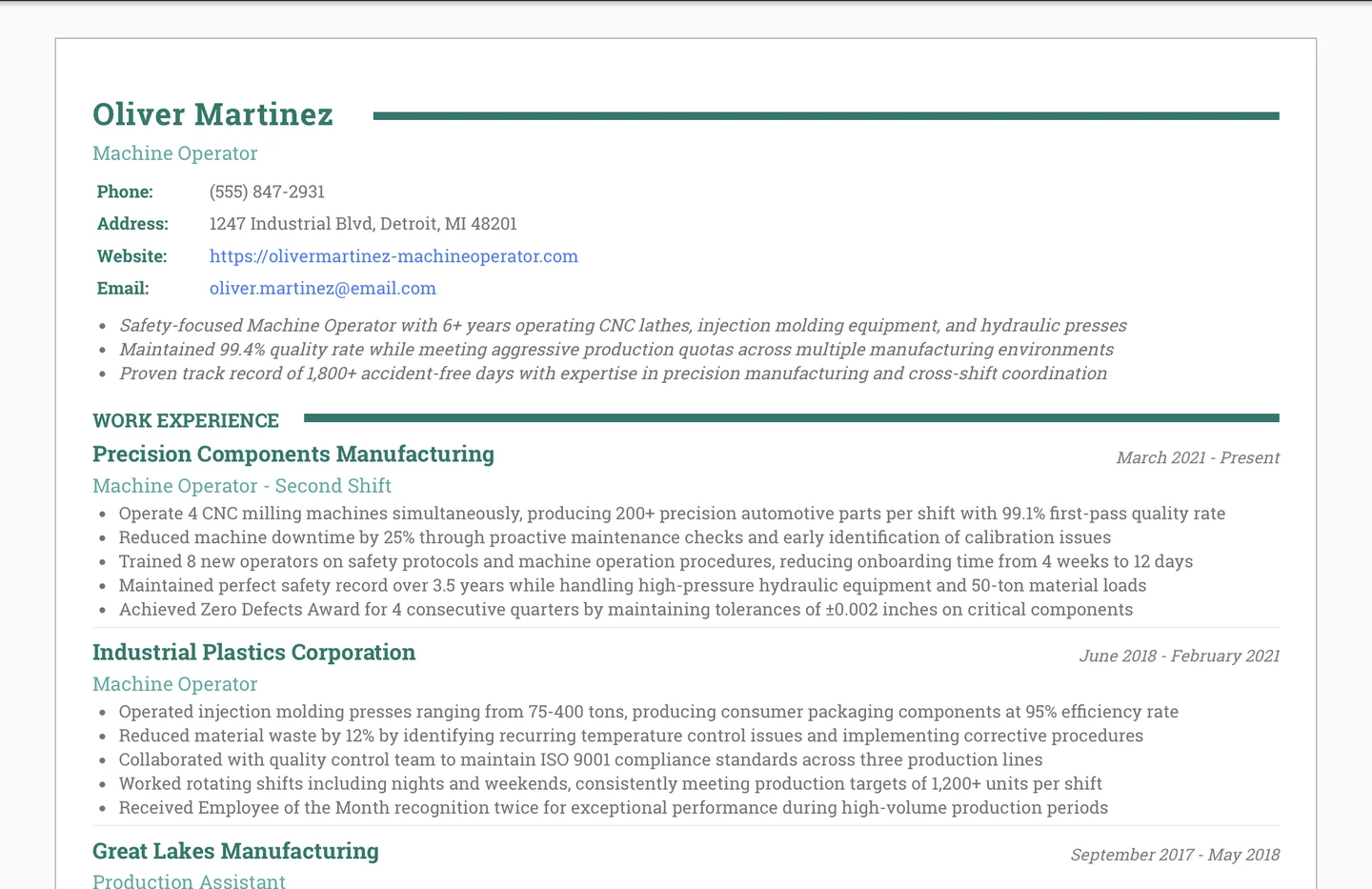
The Best Machine Operator Resume Example/Sample
https://www.resumonk.com/machine-operatorMachine OperatorResume Format to Follow for Machine Operator Resume
The reverse-chronological format is your best friend here.
Why? Because hiring managers in manufacturing and production facilities want to see your most recent experience with machinery first - they need to know you're currently sharp with safety protocols and haven't been away from the shop floor for too long.
Structure Your Machine Operator Resume Like a Production Line
Start with your contact information and a brief professional summary (2-3 lines maximum) that immediately tells them you're a skilled machine operator.
Think of it as your "quality stamp" right at the top. Follow this with your work experience section, starting from your most recent position and working backwards. Your education and certifications come next, followed by your technical skills section.
Here's the reality - you're not applying for a desk job where fancy formatting might catch an eye. Production supervisors and plant managers are practical people who appreciate clarity and efficiency, just like a well-maintained machine. Keep your resume to one page if you have under 10 years of experience, two pages maximum if you're a seasoned operator.
The Professional Summary That Works
Your summary shouldn't read like a machine manual. It should quickly convey your value as an operator who can keep production moving.
❌ Don't write vague, generic statements:
Hardworking individual seeking machine operator position. Good with machines and following instructions.
✅ Do write specific, value-driven summaries:
Safety-focused Machine Operator with 5+ years operating CNC lathes and injection molding equipment. Maintained 99.2% quality rate while meeting aggressive production quotas at ABC Manufacturing.
Notice how the second example immediately tells the reader what machines you can operate and backs it up with a concrete achievement? That's what gets you past the first glance.
Work Experience on Machine Operator Resume
You know that feeling when you're explaining to someone what you actually do all day, and their eyes glaze over when you mention "operating a horizontal boring mill" or "maintaining tolerances of ±0.001 inches"? Your resume needs to bridge that gap between technical expertise and business impact. The person reading your resume might be an HR coordinator who's never set foot on a production floor, or it could be a seasoned plant manager who knows every machine by its sound.
Quantify Your Machine Operation Experience
Every shift you've worked has data behind it - production numbers, uptime percentages, safety records, quality metrics. These numbers are gold on your resume because they translate your daily grind into language that management understands: efficiency and profit.
When describing your work experience, start each bullet point with an action verb and include the specific machinery you operated. Don't just list duties; show how you contributed to the operation's success.
❌ Don't write job descriptions that could apply to anyone:
Machine Operator - XYZ Manufacturing (2019-2023)
• Operated machines
• Followed safety procedures
• Worked in team environment
• Met production goals
✅ Do write achievement-focused descriptions:
Machine Operator - XYZ Manufacturing (2019-2023)
• Operated 3 CNC milling machines simultaneously, producing 150+ precision parts per shift with 98.5% first-pass quality rate
• Reduced machine downtime by 20% through proactive maintenance checks and early problem identification
• Trained 6 new operators on safety protocols and machine operation, reducing onboarding time from 3 weeks to 10 days
• Maintained perfect safety record over 4 years while handling hydraulic press equipment
Addressing Different Types of Machine Operation Experience
Maybe you've jumped between industries - from food processing to automotive parts, or from textiles to plastic injection molding.
Each industry has its quirks, but the fundamental skills transfer. When listing diverse experience, emphasize the common threads: your ability to learn new equipment quickly, your commitment to safety, and your reliability in meeting production targets.
For those coming from temporary or contract positions (common in manufacturing), don't hide it. List these roles clearly, as many employers value operators who've adapted to different environments.
Handling Employment Gaps
Manufacturing went through rough patches - maybe you were laid off during a downturn or your plant closed. Address significant gaps briefly in your cover letter, but on your resume, focus on any relevant activities during downtime, such as obtaining certifications, taking technical courses, or even maintaining equipment in a different capacity.
Skills to Show on Machine Operator Resume
Here's something every machine operator knows but rarely articulates well - operating machinery is both an art and a science. You're part engineer, part craftsman, part quality control inspector, and part maintenance tech. But when you're staring at that skills section on your resume, you might default to writing "machine operation" and calling it a day.
That's like a chef writing "cooking" on their resume.
Technical Skills - The Foundation
List specific machines you can operate, not generic categories.
Employers often search for operators who already know their specific equipment - it saves training time and reduces risk. Include model numbers if you know them, especially for CNC equipment or specialized machinery.
Technical Skills:
• CNC Operation: Haas VF-2, Mazak Quick Turn 250
• Injection Molding: 50-500 ton presses
• Precision Measuring: Calipers, micrometers, CMM operation
• Forklift Operation (Certified)
• Blueprint Reading & GD&T interpretation
• ISO 9001 compliance procedures
The Overlooked Soft Skills
You might roll your eyes at "soft skills," but think about your best day versus your worst day as an operator.
The difference often isn't the machinery - it's communication with your shift supervisor, problem-solving when materials run low, or staying focused during a 12-hour shift. These skills matter immensely but need to be presented correctly.
❌ Don't list generic soft skills:
• Team player
• Good communication
• Problem solver
✅ Do provide context for soft skills:
• Cross-shift communication to ensure smooth production handoffs
• Mechanical troubleshooting to minimize downtime
• Quality mindset with attention to specifications and tolerances
Certifications and Continuous Learning
That forklift certification you got three years ago?
The OSHA 10-hour course? The Lean Manufacturing workshop your employer made everyone attend? These all belong on your resume. They show you're serious about safety and efficiency - two things every employer values.
For different regions, certification importance varies. In the USA, OSHA certifications carry significant weight. In Canada, provincial safety certificates matter. In the UK, NVQs in Performing Manufacturing Operations are valuable. In Australia, Certificate III in Engineering - Mechanical Trade could set you apart.
Specific Considerations and Tips for Machine Operator Resume
Let's talk about what nobody else mentions when you're crafting a machine operator resume.
You're not competing against software developers who can showcase GitHub portfolios or salespeople with revenue numbers. You're in a unique position where your value is measured in reliability, precision, and the ability to keep expensive equipment running smoothly.
The Safety Record - Your Hidden Ace
Every day you go home with all your fingers and toes is an achievement in a job where one moment of inattention around a 20-ton press could be catastrophic. If you have a perfect or near-perfect safety record, that's not just a line item - it's a headline.
Lead with safety in your summary, reinforce it in your experience, and quantify it whenever possible.
Professional Summary:
Machine Operator with 2,500+ days accident-free while operating high-speed packaging equipment...
This immediately tells an employer you're not going to be a liability - you're not going to damage their equipment, hurt yourself or others, or drive up their insurance premiums.
The Geography Factor
Machine operators often live in specific industrial corridors, and relocating isn't always feasible or desired.
Be strategic about this. If you're applying locally, mention your proximity to the facility if it's advantageous (shows reliability for shift work). If you're willing to relocate, state it clearly at the top of your resume. Many good positions go unfilled because employers assume local candidates only.
Addressing the Physical Requirements
Unlike office jobs, machine operation has physical demands. Without overdoing it, subtly indicate your capability throughout your resume. Mention if you've consistently worked 12-hour shifts, handled 50-pound material changes, or operated in extreme temperature conditions.
This isn't about proving you're Superman; it's about showing you understand and can handle the job's realities.
The Shift Flexibility Advantage
If you've worked nights, weekends, or rotating shifts, that flexibility is golden. Many facilities struggle to staff second and third shifts.
Your willingness and proven ability to work these schedules can be your ticket to employment.
❌ Don't hide your shift experience:
Machine Operator (2020-2023)
✅ Do highlight shift flexibility:
Machine Operator - Second Shift/Weekend Coverage (2020-2023)
Breaking Through the Experience Paradox
Here's the cruel irony many face - every job wants experience with specific machines, but how do you get that experience if nobody will hire you? If you're in this boat, focus on transferable skills and learning ability. Did you master a complex machine quickly in a previous role? Mention the learning curve you conquered. Have you operated similar equipment?
Draw the parallel explicitly.
For career changers or those entering machine operation from related fields (like assembly, quality control, or maintenance), create a bridge in your resume. Show how your warehouse experience with equipment handling translates to machine operation.
Demonstrate how your time in quality control gave you an eye for specifications that would make you a better operator.
The Small Shop vs. Big Factory Consideration
If you're moving from a small job shop where you wore many hats to a large production facility (or vice versa), address this transition.
Small shop experience often means versatility - you've probably set up your own jobs, performed basic maintenance, and handled quality checks. Large facility experience typically means you can handle high-volume production pressure and work within strict protocols.
Both are valuable; just frame your experience to match where you're applying.
Education to List on Machine Operator Resume
Let's face it - you've probably been told a thousand times that education matters, but as someone looking to land a Machine Operator position, you're likely wondering if that high school diploma or technical certificate really makes a difference when you're competing for a role that's fundamentally about hands-on skill and mechanical aptitude. The truth is, while Machine Operators are entry-level manufacturing positions that don't always require advanced degrees, how you present your educational background can be the difference between landing an interview and getting lost in the pile.
The Educational Reality for Machine Operators
Most Machine Operator positions require a high school diploma or GED as the baseline, but here's where it gets interesting - the manufacturing industry has evolved significantly.
Modern machinery often involves computerized controls, precision measurements, and quality standards that weren't part of the job twenty years ago. This means your education section needs to reflect not just formal schooling, but any technical training that shows you understand the contemporary manufacturing environment.
Structuring Your Education Section
When listing your education, think reverse-chronological order - your most recent educational achievement goes first. But here's the catch - if you completed vocational training six months ago but graduated high school five years ago, that vocational training takes priority. Why?
Because recent, relevant education shows you're actively developing skills for the role.
Here's how to effectively present different educational scenarios:
❌ Don't write vaguely about your education:
High School Graduate
Some technical courses
✅ Do provide specific, relevant details:
Technical Certificate in Industrial Maintenance
Riverside Community College, Riverside, CA
Completed: March 2024
Relevant Coursework: CNC Operations, Blueprint Reading, Quality Control Systems

High School Diploma
Jefferson High School, Riverside, CA
Graduated: June 2019
Making Non-Traditional Education Count
Maybe you didn't follow the traditional path - perhaps you got your GED while already working in warehouses, or you learned machine operation through military service. These experiences are gold for Machine Operator positions.
The key is presenting them in a way that highlights their relevance to manufacturing work.
For instance, if you completed manufacturer-specific training programs (like Haas CNC certification or OSHA safety training), these belong in your education section, especially if your formal education is limited. These certifications show initiative and job-ready skills that many employers value more than a generic degree.
❌ Don't hide valuable training in other sections:
High School Diploma - 2018
✅ Do showcase all relevant educational experiences:
OSHA 10-Hour General Industry Safety Certification
Online Training Institute, Completed August 2024

Forklift Operation Certification
ABC Training Center, Phoenix, AZ, July 2024

High School Diploma
Central High School, Phoenix, AZ, 2018
Geographic Considerations
In the United States, listing your GPA is only recommended if it's above 3.5 and you graduated within the last two years. In the UK, including your GCSE results can be beneficial if they include subjects like Design Technology or Engineering.
Canadian employers often look for provincial trade certifications, while Australian employers value VET (Vocational Education and Training) qualifications highly - make sure these are prominently featured if you have them.
Awards and Publications on Machine Operator Resume
You might be thinking - "Awards? Publications? I'm applying to operate machinery, not win a Nobel Prize." But hold that thought. The manufacturing floor has its own ecosystem of recognition, and those safety awards, productivity achievements, and even that article you helped write for the company newsletter about improving workflow efficiency all matter more than you realize. These accomplishments separate you from the dozens of other applicants who can simply "operate machinery."
Understanding What Counts as an Award
In the world of machine operation, awards aren't just formal certificates handed out at annual galas. They include safety recognition, perfect attendance acknowledgments, employee of the month selections, and productivity bonuses.
Each of these tells a story about your reliability, dedication, and ability to exceed baseline expectations - qualities that matter immensely when employers are trusting you with expensive equipment and tight production deadlines.
Think about it from the hiring manager's perspective - they're looking at two candidates with similar experience. One lists their job duties; the other mentions they received the "Zero Defects Award" for three consecutive quarters. Who would you call first?
How to Present Awards Effectively
The trick is to provide context that makes the award meaningful to someone who wasn't there when you received it. Simply listing "Employee of the Month" doesn't tell the full story.
❌ Don't list awards without context:
Safety Award - 2023
Employee of the Month - June 2024
✅ Do provide meaningful details:
Safety Excellence Award - ABC Manufacturing, 2023
Recognized for 500+ consecutive days without safety incidents while operating injection molding equipment

Employee of the Month - XYZ Industries, June 2024
Selected from 50+ floor operators for maintaining 99.8% quality rate during high-volume production period
The Surprising Relevance of Publications
Now, about publications - you're probably not writing peer-reviewed journals about thermoplastic properties, but you might have contributed to internal documentation, safety manuals, or process improvement guides.
Maybe you helped create a training checklist for new operators, or you documented a more efficient method for machine changeovers. These contributions demonstrate communication skills and technical understanding that elevate you beyond someone who just follows instructions.
If you've contributed to any written materials in your workplace, even informally, consider how to frame them professionally. That PowerPoint presentation you created about reducing material waste? That's a publication worth mentioning.
❌ Don't dismiss informal contributions:
(Nothing listed because "I haven't published anything")
✅ Do recognize all forms of professional contribution:
"Reducing Changeover Time on Model X500 Press" - Internal Process Documentation, 2024
Co-authored standard operating procedure adopted across three production shifts, reducing changeover time by 15 minutes

"New Operator Safety Checklist" - Training Materials Contributor, 2023
Developed comprehensive safety checklist now used in onboarding program for all machine operators
Creating an Awards Section When You Have None
If you genuinely have no awards or publications yet, don't force it - instead, focus on measurable achievements within your experience section.
However, consider pursuing readily available recognitions like OSHA safety certificates or contributing to your current workplace's documentation efforts. Even volunteer work awards from community organizations can demonstrate reliability and commitment.
Listing References for Machine Operator Resume
You've just finished a grueling 12-hour shift, your supervisor pulls you aside and says, "Hey, great work on keeping that line running during the motor issue." You thank them, clock out, and head home. What you might not realize is that supervisor just became your most valuable career asset - not because of that compliment, but because they've seen firsthand how you handle pressure, solve problems, and maintain quality when things go sideways. That's the kind of reference that gets you hired as a Machine Operator, not your neighbor who thinks you're "really responsible."
Who Makes the Best References for Machine Operators
The manufacturing floor has a clear hierarchy, and understanding it helps you choose references strategically. Your direct supervisor or shift leader is gold - they've seen you operate equipment, handle materials, and interact with the team. The quality control inspector who's checked your output hundreds of times knows your attention to detail better than anyone. That maintenance technician you always coordinate well with during changeovers?
They can speak to your communication skills and technical understanding.
Avoid the temptation to list the plant manager you've spoken to twice or the HR representative who hired you but never sees your actual work. Employers want to hear from people who've watched you operate machinery, not people with impressive titles who barely know you.
The Reference List Format That Works
In most cases, especially in the United States and Canada, you won't include references directly on your resume - instead, you'll have them ready on a separate document that matches your resume's formatting. However, some online applications and smaller manufacturers might ask for them upfront.
❌ Don't provide minimal information:
John Smith - Former Supervisor
Phone: 555-0123
✅ Do provide complete, professional details:
John Smith
Production Supervisor - Second Shift
ABC Manufacturing Corporation
Phone: (555) 123-4567
Email: [email protected]
Professional Relationship: Direct supervisor for 2 years (2022-2024)
Preparing Your References for Success
Here's something most Machine Operator candidates don't do but should - actually talk to your references before listing them.
Not just asking permission, but having a real conversation about what positions you're applying for and what skills you'd like them to emphasize. If you're applying for a position that requires experience with computerized equipment, make sure your reference knows to mention your quick adaptation to the new digital inventory system last year.
Send your references the job posting and your updated resume. Your former shift leader might not remember that you were the one who suggested the new loading sequence that improved efficiency by 12%, but a quick reminder ensures they'll mention it when called.
International Differences in Reference Practices
If you're applying in the UK, be prepared for employers to ask for references earlier in the process, sometimes even before the interview.
Australian employers often want written references you can submit with your application. In some European countries, you might need official letters of recommendation from previous employers.
Understanding these regional differences prevents awkward delays in your application process.
When References Might Be Complicated
Maybe you left your last position on less-than-ideal terms, or your previous company has a policy against providing references beyond confirming employment dates.
This is more common than you think in manufacturing, where high turnover and strict corporate policies can make reference-gathering challenging. In these cases, consider coworkers who've been promoted to leadership roles, vendors or contractors you worked with regularly, or supervisors from temporary staffing agencies if you've done contract work.
The key is being proactive and creative while maintaining professionalism. That team lead who left six months before you did and is now at another company?
They might be your best reference, as they can speak honestly about your abilities without corporate restrictions.
Cover Letter Tips for Machine Operator Resume
Picture this - you're scrolling through job boards at 11 PM after a long shift, and you see the perfect Machine Operator position. The pay is better, the location is closer to home, and they're offering the shift schedule you've been dreaming about. You upload your resume and then you see it - the optional cover letter field. Your finger hovers over the "Skip" button because honestly, what are you supposed to say that isn't already on your resume?
Here's the thing - that cover letter is your chance to explain why you're not just another pair of hands on the production floor, but someone who understands what makes a manufacturing operation run smoothly.
Why Machine Operators Need Cover Letters
Manufacturing managers receive dozens of resumes that all look remarkably similar - same certifications, similar experience levels, comparable skills.
Your cover letter is where you get to explain the story behind those bullet points. It's where you can address that gap in employment when you were caring for a family member, or explain how your experience operating completely different machinery has given you a unique perspective on problem-solving.
More importantly, a cover letter shows you can communicate in writing - a skill that's increasingly valuable as machine operators are expected to document issues, complete digital reports, and sometimes train newer team members.
Structure That Works for Machine Operators
Your opening paragraph needs to grab attention without being gimmicky. Skip the generic "I am writing to apply for..." and instead start with something specific about why this particular position caught your eye.
❌ Don't open with tired clichés:
Dear Hiring Manager,

I am writing to express my interest in the Machine Operator position at your company.
I have experience operating machines and am a hard worker.
✅ Do open with specific enthusiasm:
Dear Ms. Johnson,

Your posting for a Machine Operator specializing in precision metal fabrication immediately caught my attention - not just because I have three years of experience operating CNC lathes, but because your emphasis on cross-training operators aligns perfectly with my goal of becoming proficient across multiple machine types.
The Body - Telling Your Professional Story
The middle section should expand on one or two key achievements that directly relate to what the employer needs.
Maybe you've never operated their specific brand of equipment, but you learned three different machine types in your last role. That adaptability is your story. Perhaps you've worked in food manufacturing and they're in automotive - but your experience with strict quality standards and clean room protocols translates directly.
Remember to use specific numbers and examples. Saying you're "detail-oriented" means nothing. Saying you maintained a 99.7% quality pass rate while operating at 120% of standard production speed tells a story.
❌ Don't make vague claims:
I am very reliable and good at following instructions. I work well in teams and can handle pressure. I believe I would be a good fit for your company.
✅ Do provide concrete examples:
During my time at ABC Plastics, I reduced material waste by 8% by identifying a recurring calibration issue that others had overlooked. This attention to detail, combined with my ability to train four new operators while maintaining my own production quotas, demonstrates the kind of value I can bring to your production floor from day one.
Closing With Confidence
Your closing paragraph should be brief but assertive. Express enthusiasm for the specific company (mention something you learned from research - maybe they just landed a big contract or opened a new facility), and clearly state your availability for an interview.
For Machine Operators, mentioning your flexibility with shifts, willingness to work overtime, or ability to start immediately can be powerful closing points - these are practical concerns that hiring managers think about constantly.
Key Takeaways
After working through this comprehensive guide, you're now equipped with the knowledge to create a Machine Operator resume that stands out from the stack. Here are the essential points to remember as you craft your resume:
- Use reverse-chronological format - Your most recent machine operation experience should come first, showing employers you're currently active and sharp with safety protocols
- Quantify everything possible - Transform "operated machines" into "operated 3 CNC mills simultaneously, producing 150+ parts per shift with 98.5% quality rate"
- Lead with safety - Your accident-free record isn't just a statistic; it's proof you won't be a liability with expensive equipment
- List specific equipment models - "Haas VF-2" tells more than "CNC machine" - employers often search for operators who already know their machinery
- Include all certifications - OSHA training, forklift licenses, and manufacturer-specific certifications belong prominently on your resume
- Address shift flexibility - Your willingness to work nights, weekends, or rotating shifts can be your competitive advantage
- Don't overlook "informal" achievements - That safety checklist you created or the training you provided to new operators are resume-worthy accomplishments
- Prepare strong references - Your shift supervisor who's seen you handle equipment failures is more valuable than the plant manager you barely know
- Write a targeted cover letter - Use it to explain the story behind your experience, especially if you're changing industries or have employment gaps
- Keep it practical and clear - Production managers appreciate efficiency in resumes just like they do on the floor - one page for under 10 years experience, two maximum for veterans
Creating a professional Machine Operator resume doesn't have to be as complex as calibrating a precision instrument. With Resumonk, you can build your resume with the same efficiency you bring to the production floor. Our AI-powered suggestions help you identify the most impactful way to describe your machine operation experience, while our professionally designed templates ensure your resume looks as polished as the parts you produce. Whether you're operating CNC equipment, injection molding machines, or industrial presses, Resumonk's tools are specifically designed to help manufacturing professionals like you translate hands-on expertise into compelling resumes that get interviews.
Ready to build your Machine Operator resume?
Join thousands of manufacturing professionals who've successfully landed their next position using Resumonk. Our templates are designed to highlight your technical skills, safety record, and production achievements in a format that manufacturing employers recognize and respect.
Start Building Your Machine Operator Resume Now →
More Manufacturing & Production resume examples
- Maintenance Supervisor resume example
- Mechanic resume example
- Manufacturing Engineer resume example
- Quality Engineer resume example
See all Manufacturing & Production resume examples, or browse every category.
Resume writing tips
You've been working the floor for years now, maybe starting right after high school when everyone else was heading to college, or perhaps you found your way here after realizing that office life wasn't for you - that you needed something real, something tangible, where you could see the actual products of your labor rolling off the line at the end of each shift.
Your hands know the rhythm of the machines, the subtle vibrations that signal when something's about to go wrong, the sweet spot where efficiency meets quality. But now, staring at that blank resume template, those calloused hands that can operate a CNC mill with surgical precision suddenly feel clumsy trying to translate years of experience into words that will catch a hiring manager's attention.
The truth about being a Machine Operator - and let's be clear, we're talking about the entry-level manufacturing role where you're the backbone of production, not managing anyone but responsible for keeping those expensive machines humming - is that your value isn't always obvious on paper. You're not closing million-dollar deals or launching marketing campaigns that everyone can immediately understand. You're maintaining 99% uptime on equipment worth more than most people's houses, catching defects that could cost thousands in recalls, and somehow managing to stay alert and precise through rotating shifts that would break most nine-to-fivers. This guide gets that, and more importantly, it's going to show you exactly how to make sure potential employers get it too.
We're going to walk through everything - starting with choosing the right resume format (spoiler alert: reverse-chronological is your friend), then diving deep into how to write a professional summary that doesn't sound like every other Machine Operator out there. We'll tackle the challenge of describing your work experience in a way that speaks to both the HR coordinator who's never touched a lathe and the plant manager who could operate one blindfolded. You'll learn which skills to highlight, from the specific machines you've mastered to those "soft skills" that actually matter on a production floor.
But we're not stopping at the basics. We'll cover the special considerations that Machine Operators face - how to address that employment gap when the plant closed, what to do if you've only worked night shifts, how to show you're physically capable without sounding like you're bragging about bench pressing. We'll talk about education (yes, that forklift certification matters more than you think), those safety awards that seem routine to you but are gold to employers, and even how to write a cover letter that doesn't feel like you're just repeating your resume. By the time we reach our key takeaways, you'll have everything you need to create a Machine Operator resume that gets you in the door at that better-paying position with the day shift you've been dreaming about.
The Best Machine Operator Resume Example/Sample
https://www.resumonk.com/machine-operatorMachine OperatorResume Format to Follow for Machine Operator Resume
The reverse-chronological format is your best friend here.
Why? Because hiring managers in manufacturing and production facilities want to see your most recent experience with machinery first - they need to know you're currently sharp with safety protocols and haven't been away from the shop floor for too long.
Structure Your Machine Operator Resume Like a Production Line
Start with your contact information and a brief professional summary (2-3 lines maximum) that immediately tells them you're a skilled machine operator.
Think of it as your "quality stamp" right at the top. Follow this with your work experience section, starting from your most recent position and working backwards. Your education and certifications come next, followed by your technical skills section.
Here's the reality - you're not applying for a desk job where fancy formatting might catch an eye. Production supervisors and plant managers are practical people who appreciate clarity and efficiency, just like a well-maintained machine. Keep your resume to one page if you have under 10 years of experience, two pages maximum if you're a seasoned operator.
The Professional Summary That Works
Your summary shouldn't read like a machine manual. It should quickly convey your value as an operator who can keep production moving.
❌ Don't write vague, generic statements:
Hardworking individual seeking machine operator position. Good with machines and following instructions.
✅ Do write specific, value-driven summaries:
Safety-focused Machine Operator with 5+ years operating CNC lathes and injection molding equipment. Maintained 99.2% quality rate while meeting aggressive production quotas at ABC Manufacturing.
Notice how the second example immediately tells the reader what machines you can operate and backs it up with a concrete achievement? That's what gets you past the first glance.
Work Experience on Machine Operator Resume
You know that feeling when you're explaining to someone what you actually do all day, and their eyes glaze over when you mention "operating a horizontal boring mill" or "maintaining tolerances of ±0.001 inches"? Your resume needs to bridge that gap between technical expertise and business impact. The person reading your resume might be an HR coordinator who's never set foot on a production floor, or it could be a seasoned plant manager who knows every machine by its sound.
Quantify Your Machine Operation Experience
Every shift you've worked has data behind it - production numbers, uptime percentages, safety records, quality metrics. These numbers are gold on your resume because they translate your daily grind into language that management understands: efficiency and profit.
When describing your work experience, start each bullet point with an action verb and include the specific machinery you operated. Don't just list duties; show how you contributed to the operation's success.
❌ Don't write job descriptions that could apply to anyone:
Machine Operator - XYZ Manufacturing (2019-2023)
• Operated machines
• Followed safety procedures
• Worked in team environment
• Met production goals
✅ Do write achievement-focused descriptions:
Machine Operator - XYZ Manufacturing (2019-2023)
• Operated 3 CNC milling machines simultaneously, producing 150+ precision parts per shift with 98.5% first-pass quality rate
• Reduced machine downtime by 20% through proactive maintenance checks and early problem identification
• Trained 6 new operators on safety protocols and machine operation, reducing onboarding time from 3 weeks to 10 days
• Maintained perfect safety record over 4 years while handling hydraulic press equipment
Addressing Different Types of Machine Operation Experience
Maybe you've jumped between industries - from food processing to automotive parts, or from textiles to plastic injection molding.
Each industry has its quirks, but the fundamental skills transfer. When listing diverse experience, emphasize the common threads: your ability to learn new equipment quickly, your commitment to safety, and your reliability in meeting production targets.
For those coming from temporary or contract positions (common in manufacturing), don't hide it. List these roles clearly, as many employers value operators who've adapted to different environments.
Handling Employment Gaps
Manufacturing went through rough patches - maybe you were laid off during a downturn or your plant closed. Address significant gaps briefly in your cover letter, but on your resume, focus on any relevant activities during downtime, such as obtaining certifications, taking technical courses, or even maintaining equipment in a different capacity.
Skills to Show on Machine Operator Resume
Here's something every machine operator knows but rarely articulates well - operating machinery is both an art and a science. You're part engineer, part craftsman, part quality control inspector, and part maintenance tech. But when you're staring at that skills section on your resume, you might default to writing "machine operation" and calling it a day.
That's like a chef writing "cooking" on their resume.
Technical Skills - The Foundation
List specific machines you can operate, not generic categories.
Employers often search for operators who already know their specific equipment - it saves training time and reduces risk. Include model numbers if you know them, especially for CNC equipment or specialized machinery.
Technical Skills:
• CNC Operation: Haas VF-2, Mazak Quick Turn 250
• Injection Molding: 50-500 ton presses
• Precision Measuring: Calipers, micrometers, CMM operation
• Forklift Operation (Certified)
• Blueprint Reading & GD&T interpretation
• ISO 9001 compliance procedures
The Overlooked Soft Skills
You might roll your eyes at "soft skills," but think about your best day versus your worst day as an operator.
The difference often isn't the machinery - it's communication with your shift supervisor, problem-solving when materials run low, or staying focused during a 12-hour shift. These skills matter immensely but need to be presented correctly.
❌ Don't list generic soft skills:
• Team player
• Good communication
• Problem solver
✅ Do provide context for soft skills:
• Cross-shift communication to ensure smooth production handoffs
• Mechanical troubleshooting to minimize downtime
• Quality mindset with attention to specifications and tolerances
Certifications and Continuous Learning
That forklift certification you got three years ago?
The OSHA 10-hour course? The Lean Manufacturing workshop your employer made everyone attend? These all belong on your resume. They show you're serious about safety and efficiency - two things every employer values.
For different regions, certification importance varies. In the USA, OSHA certifications carry significant weight. In Canada, provincial safety certificates matter. In the UK, NVQs in Performing Manufacturing Operations are valuable. In Australia, Certificate III in Engineering - Mechanical Trade could set you apart.
Specific Considerations and Tips for Machine Operator Resume
Let's talk about what nobody else mentions when you're crafting a machine operator resume.
You're not competing against software developers who can showcase GitHub portfolios or salespeople with revenue numbers. You're in a unique position where your value is measured in reliability, precision, and the ability to keep expensive equipment running smoothly.
The Safety Record - Your Hidden Ace
Every day you go home with all your fingers and toes is an achievement in a job where one moment of inattention around a 20-ton press could be catastrophic. If you have a perfect or near-perfect safety record, that's not just a line item - it's a headline.
Lead with safety in your summary, reinforce it in your experience, and quantify it whenever possible.
Professional Summary:
Machine Operator with 2,500+ days accident-free while operating high-speed packaging equipment...
This immediately tells an employer you're not going to be a liability - you're not going to damage their equipment, hurt yourself or others, or drive up their insurance premiums.
The Geography Factor
Machine operators often live in specific industrial corridors, and relocating isn't always feasible or desired.
Be strategic about this. If you're applying locally, mention your proximity to the facility if it's advantageous (shows reliability for shift work). If you're willing to relocate, state it clearly at the top of your resume. Many good positions go unfilled because employers assume local candidates only.
Addressing the Physical Requirements
Unlike office jobs, machine operation has physical demands. Without overdoing it, subtly indicate your capability throughout your resume. Mention if you've consistently worked 12-hour shifts, handled 50-pound material changes, or operated in extreme temperature conditions.
This isn't about proving you're Superman; it's about showing you understand and can handle the job's realities.
The Shift Flexibility Advantage
If you've worked nights, weekends, or rotating shifts, that flexibility is golden. Many facilities struggle to staff second and third shifts.
Your willingness and proven ability to work these schedules can be your ticket to employment.
❌ Don't hide your shift experience:
Machine Operator (2020-2023)
✅ Do highlight shift flexibility:
Machine Operator - Second Shift/Weekend Coverage (2020-2023)
Breaking Through the Experience Paradox
Here's the cruel irony many face - every job wants experience with specific machines, but how do you get that experience if nobody will hire you? If you're in this boat, focus on transferable skills and learning ability. Did you master a complex machine quickly in a previous role? Mention the learning curve you conquered. Have you operated similar equipment?
Draw the parallel explicitly.
For career changers or those entering machine operation from related fields (like assembly, quality control, or maintenance), create a bridge in your resume. Show how your warehouse experience with equipment handling translates to machine operation.
Demonstrate how your time in quality control gave you an eye for specifications that would make you a better operator.
The Small Shop vs. Big Factory Consideration
If you're moving from a small job shop where you wore many hats to a large production facility (or vice versa), address this transition.
Small shop experience often means versatility - you've probably set up your own jobs, performed basic maintenance, and handled quality checks. Large facility experience typically means you can handle high-volume production pressure and work within strict protocols.
Both are valuable; just frame your experience to match where you're applying.
Education to List on Machine Operator Resume
Let's face it - you've probably been told a thousand times that education matters, but as someone looking to land a Machine Operator position, you're likely wondering if that high school diploma or technical certificate really makes a difference when you're competing for a role that's fundamentally about hands-on skill and mechanical aptitude. The truth is, while Machine Operators are entry-level manufacturing positions that don't always require advanced degrees, how you present your educational background can be the difference between landing an interview and getting lost in the pile.
The Educational Reality for Machine Operators
Most Machine Operator positions require a high school diploma or GED as the baseline, but here's where it gets interesting - the manufacturing industry has evolved significantly.
Modern machinery often involves computerized controls, precision measurements, and quality standards that weren't part of the job twenty years ago. This means your education section needs to reflect not just formal schooling, but any technical training that shows you understand the contemporary manufacturing environment.
Structuring Your Education Section
When listing your education, think reverse-chronological order - your most recent educational achievement goes first. But here's the catch - if you completed vocational training six months ago but graduated high school five years ago, that vocational training takes priority. Why?
Because recent, relevant education shows you're actively developing skills for the role.
Here's how to effectively present different educational scenarios:
❌ Don't write vaguely about your education:
High School Graduate
Some technical courses
✅ Do provide specific, relevant details:
Technical Certificate in Industrial Maintenance
Riverside Community College, Riverside, CA
Completed: March 2024
Relevant Coursework: CNC Operations, Blueprint Reading, Quality Control Systems

High School Diploma
Jefferson High School, Riverside, CA
Graduated: June 2019
Making Non-Traditional Education Count
Maybe you didn't follow the traditional path - perhaps you got your GED while already working in warehouses, or you learned machine operation through military service. These experiences are gold for Machine Operator positions.
The key is presenting them in a way that highlights their relevance to manufacturing work.
For instance, if you completed manufacturer-specific training programs (like Haas CNC certification or OSHA safety training), these belong in your education section, especially if your formal education is limited. These certifications show initiative and job-ready skills that many employers value more than a generic degree.
❌ Don't hide valuable training in other sections:
High School Diploma - 2018
✅ Do showcase all relevant educational experiences:
OSHA 10-Hour General Industry Safety Certification
Online Training Institute, Completed August 2024

Forklift Operation Certification
ABC Training Center, Phoenix, AZ, July 2024

High School Diploma
Central High School, Phoenix, AZ, 2018
Geographic Considerations
In the United States, listing your GPA is only recommended if it's above 3.5 and you graduated within the last two years. In the UK, including your GCSE results can be beneficial if they include subjects like Design Technology or Engineering.
Canadian employers often look for provincial trade certifications, while Australian employers value VET (Vocational Education and Training) qualifications highly - make sure these are prominently featured if you have them.
Awards and Publications on Machine Operator Resume
You might be thinking - "Awards? Publications? I'm applying to operate machinery, not win a Nobel Prize." But hold that thought. The manufacturing floor has its own ecosystem of recognition, and those safety awards, productivity achievements, and even that article you helped write for the company newsletter about improving workflow efficiency all matter more than you realize. These accomplishments separate you from the dozens of other applicants who can simply "operate machinery."
Understanding What Counts as an Award
In the world of machine operation, awards aren't just formal certificates handed out at annual galas. They include safety recognition, perfect attendance acknowledgments, employee of the month selections, and productivity bonuses.
Each of these tells a story about your reliability, dedication, and ability to exceed baseline expectations - qualities that matter immensely when employers are trusting you with expensive equipment and tight production deadlines.
Think about it from the hiring manager's perspective - they're looking at two candidates with similar experience. One lists their job duties; the other mentions they received the "Zero Defects Award" for three consecutive quarters. Who would you call first?
How to Present Awards Effectively
The trick is to provide context that makes the award meaningful to someone who wasn't there when you received it. Simply listing "Employee of the Month" doesn't tell the full story.
❌ Don't list awards without context:
Safety Award - 2023
Employee of the Month - June 2024
✅ Do provide meaningful details:
Safety Excellence Award - ABC Manufacturing, 2023
Recognized for 500+ consecutive days without safety incidents while operating injection molding equipment

Employee of the Month - XYZ Industries, June 2024
Selected from 50+ floor operators for maintaining 99.8% quality rate during high-volume production period
The Surprising Relevance of Publications
Now, about publications - you're probably not writing peer-reviewed journals about thermoplastic properties, but you might have contributed to internal documentation, safety manuals, or process improvement guides.
Maybe you helped create a training checklist for new operators, or you documented a more efficient method for machine changeovers. These contributions demonstrate communication skills and technical understanding that elevate you beyond someone who just follows instructions.
If you've contributed to any written materials in your workplace, even informally, consider how to frame them professionally. That PowerPoint presentation you created about reducing material waste? That's a publication worth mentioning.
❌ Don't dismiss informal contributions:
(Nothing listed because "I haven't published anything")
✅ Do recognize all forms of professional contribution:
"Reducing Changeover Time on Model X500 Press" - Internal Process Documentation, 2024
Co-authored standard operating procedure adopted across three production shifts, reducing changeover time by 15 minutes

"New Operator Safety Checklist" - Training Materials Contributor, 2023
Developed comprehensive safety checklist now used in onboarding program for all machine operators
Creating an Awards Section When You Have None
If you genuinely have no awards or publications yet, don't force it - instead, focus on measurable achievements within your experience section.
However, consider pursuing readily available recognitions like OSHA safety certificates or contributing to your current workplace's documentation efforts. Even volunteer work awards from community organizations can demonstrate reliability and commitment.
Listing References for Machine Operator Resume
You've just finished a grueling 12-hour shift, your supervisor pulls you aside and says, "Hey, great work on keeping that line running during the motor issue." You thank them, clock out, and head home. What you might not realize is that supervisor just became your most valuable career asset - not because of that compliment, but because they've seen firsthand how you handle pressure, solve problems, and maintain quality when things go sideways. That's the kind of reference that gets you hired as a Machine Operator, not your neighbor who thinks you're "really responsible."
Who Makes the Best References for Machine Operators
The manufacturing floor has a clear hierarchy, and understanding it helps you choose references strategically. Your direct supervisor or shift leader is gold - they've seen you operate equipment, handle materials, and interact with the team. The quality control inspector who's checked your output hundreds of times knows your attention to detail better than anyone. That maintenance technician you always coordinate well with during changeovers?
They can speak to your communication skills and technical understanding.
Avoid the temptation to list the plant manager you've spoken to twice or the HR representative who hired you but never sees your actual work. Employers want to hear from people who've watched you operate machinery, not people with impressive titles who barely know you.
The Reference List Format That Works
In most cases, especially in the United States and Canada, you won't include references directly on your resume - instead, you'll have them ready on a separate document that matches your resume's formatting. However, some online applications and smaller manufacturers might ask for them upfront.
❌ Don't provide minimal information:
John Smith - Former Supervisor
Phone: 555-0123
✅ Do provide complete, professional details:
John Smith
Production Supervisor - Second Shift
ABC Manufacturing Corporation
Phone: (555) 123-4567
Email: [email protected]
Professional Relationship: Direct supervisor for 2 years (2022-2024)
Preparing Your References for Success
Here's something most Machine Operator candidates don't do but should - actually talk to your references before listing them.
Not just asking permission, but having a real conversation about what positions you're applying for and what skills you'd like them to emphasize. If you're applying for a position that requires experience with computerized equipment, make sure your reference knows to mention your quick adaptation to the new digital inventory system last year.
Send your references the job posting and your updated resume. Your former shift leader might not remember that you were the one who suggested the new loading sequence that improved efficiency by 12%, but a quick reminder ensures they'll mention it when called.
International Differences in Reference Practices
If you're applying in the UK, be prepared for employers to ask for references earlier in the process, sometimes even before the interview.
Australian employers often want written references you can submit with your application. In some European countries, you might need official letters of recommendation from previous employers.
Understanding these regional differences prevents awkward delays in your application process.
When References Might Be Complicated
Maybe you left your last position on less-than-ideal terms, or your previous company has a policy against providing references beyond confirming employment dates.
This is more common than you think in manufacturing, where high turnover and strict corporate policies can make reference-gathering challenging. In these cases, consider coworkers who've been promoted to leadership roles, vendors or contractors you worked with regularly, or supervisors from temporary staffing agencies if you've done contract work.
The key is being proactive and creative while maintaining professionalism. That team lead who left six months before you did and is now at another company?
They might be your best reference, as they can speak honestly about your abilities without corporate restrictions.
Cover Letter Tips for Machine Operator Resume
Picture this - you're scrolling through job boards at 11 PM after a long shift, and you see the perfect Machine Operator position. The pay is better, the location is closer to home, and they're offering the shift schedule you've been dreaming about. You upload your resume and then you see it - the optional cover letter field. Your finger hovers over the "Skip" button because honestly, what are you supposed to say that isn't already on your resume?
Here's the thing - that cover letter is your chance to explain why you're not just another pair of hands on the production floor, but someone who understands what makes a manufacturing operation run smoothly.
Why Machine Operators Need Cover Letters
Manufacturing managers receive dozens of resumes that all look remarkably similar - same certifications, similar experience levels, comparable skills.
Your cover letter is where you get to explain the story behind those bullet points. It's where you can address that gap in employment when you were caring for a family member, or explain how your experience operating completely different machinery has given you a unique perspective on problem-solving.
More importantly, a cover letter shows you can communicate in writing - a skill that's increasingly valuable as machine operators are expected to document issues, complete digital reports, and sometimes train newer team members.
Structure That Works for Machine Operators
Your opening paragraph needs to grab attention without being gimmicky. Skip the generic "I am writing to apply for..." and instead start with something specific about why this particular position caught your eye.
❌ Don't open with tired clichés:
Dear Hiring Manager,

I am writing to express my interest in the Machine Operator position at your company.
I have experience operating machines and am a hard worker.
✅ Do open with specific enthusiasm:
Dear Ms. Johnson,

Your posting for a Machine Operator specializing in precision metal fabrication immediately caught my attention - not just because I have three years of experience operating CNC lathes, but because your emphasis on cross-training operators aligns perfectly with my goal of becoming proficient across multiple machine types.
The Body - Telling Your Professional Story
The middle section should expand on one or two key achievements that directly relate to what the employer needs.
Maybe you've never operated their specific brand of equipment, but you learned three different machine types in your last role. That adaptability is your story. Perhaps you've worked in food manufacturing and they're in automotive - but your experience with strict quality standards and clean room protocols translates directly.
Remember to use specific numbers and examples. Saying you're "detail-oriented" means nothing. Saying you maintained a 99.7% quality pass rate while operating at 120% of standard production speed tells a story.
❌ Don't make vague claims:
I am very reliable and good at following instructions. I work well in teams and can handle pressure. I believe I would be a good fit for your company.
✅ Do provide concrete examples:
During my time at ABC Plastics, I reduced material waste by 8% by identifying a recurring calibration issue that others had overlooked. This attention to detail, combined with my ability to train four new operators while maintaining my own production quotas, demonstrates the kind of value I can bring to your production floor from day one.
Closing With Confidence
Your closing paragraph should be brief but assertive. Express enthusiasm for the specific company (mention something you learned from research - maybe they just landed a big contract or opened a new facility), and clearly state your availability for an interview.
For Machine Operators, mentioning your flexibility with shifts, willingness to work overtime, or ability to start immediately can be powerful closing points - these are practical concerns that hiring managers think about constantly.
Key Takeaways
After working through this comprehensive guide, you're now equipped with the knowledge to create a Machine Operator resume that stands out from the stack. Here are the essential points to remember as you craft your resume:
- Use reverse-chronological format - Your most recent machine operation experience should come first, showing employers you're currently active and sharp with safety protocols
- Quantify everything possible - Transform "operated machines" into "operated 3 CNC mills simultaneously, producing 150+ parts per shift with 98.5% quality rate"
- Lead with safety - Your accident-free record isn't just a statistic; it's proof you won't be a liability with expensive equipment
- List specific equipment models - "Haas VF-2" tells more than "CNC machine" - employers often search for operators who already know their machinery
- Include all certifications - OSHA training, forklift licenses, and manufacturer-specific certifications belong prominently on your resume
- Address shift flexibility - Your willingness to work nights, weekends, or rotating shifts can be your competitive advantage
- Don't overlook "informal" achievements - That safety checklist you created or the training you provided to new operators are resume-worthy accomplishments
- Prepare strong references - Your shift supervisor who's seen you handle equipment failures is more valuable than the plant manager you barely know
- Write a targeted cover letter - Use it to explain the story behind your experience, especially if you're changing industries or have employment gaps
- Keep it practical and clear - Production managers appreciate efficiency in resumes just like they do on the floor - one page for under 10 years experience, two maximum for veterans
Creating a professional Machine Operator resume doesn't have to be as complex as calibrating a precision instrument. With Resumonk, you can build your resume with the same efficiency you bring to the production floor. Our AI-powered suggestions help you identify the most impactful way to describe your machine operation experience, while our professionally designed templates ensure your resume looks as polished as the parts you produce. Whether you're operating CNC equipment, injection molding machines, or industrial presses, Resumonk's tools are specifically designed to help manufacturing professionals like you translate hands-on expertise into compelling resumes that get interviews.
Ready to build your Machine Operator resume?
Join thousands of manufacturing professionals who've successfully landed their next position using Resumonk. Our templates are designed to highlight your technical skills, safety record, and production achievements in a format that manufacturing employers recognize and respect.
Start Building Your Machine Operator Resume Now →
More Manufacturing & Production resume examples
- Maintenance Supervisor resume example
- Mechanic resume example
- Manufacturing Engineer resume example
- Quality Engineer resume example
See all Manufacturing & Production resume examples, or browse every category.
Resume writing tips