Loss Prevention Resume Example (with Expert Advice and Tips)
Introduction
You know that moment when you're walking through a store and spot someone acting just a little too interested in not looking interested? That subtle shift of merchandise into a bag, the nervous glance toward the exit, the practiced casual walk that's anything but casual - you've always noticed these things. Maybe you're the retail veteran who's tired of watching inventory walk out the door unpaid, or perhaps you're fresh from military service where situational awareness meant survival, and now you want to apply those skills to protecting civilian assets.
Either way, you're ready to make the leap into professional Loss Prevention, starting with that Loss Prevention Executive role that, despite its executive title, represents your entry point into this fascinating world of retail security and asset protection.
The path to becoming a Loss Prevention Executive isn't always straightforward - and that's actually what makes your unique background valuable. Whether you've been folding clothes at Gap while mentally cataloging suspicious behaviors, standing post in the military where observation meant everything, or studying criminal justice while working campus security, you bring a perspective that matters. But here's the challenge - you need a resume that transforms your diverse experience into a compelling narrative that speaks directly to loss prevention hiring managers who see dozens of applications from people claiming they have "good observation skills" and can "handle difficult situations."
This comprehensive guide walks you through every element of crafting a Loss Prevention Executive resume that gets noticed. We'll start with choosing the right format that showcases your most relevant experience, then dive deep into writing work experience descriptions that quantify your impact on business operations. You'll learn which skills to highlight - from technical proficiencies with CCTV systems to the soft skills that help you de-escalate tense situations. We'll cover how to present your education and certifications strategically, handle the unique challenges of discussing confidential investigations on your resume, and even tackle those tricky situations like career changes or gaps in employment.
By the time you finish reading this guide, you'll know exactly how to position yourself as the observant, trustworthy, and business-minded professional that retailers desperately need on their front lines. You'll understand how to write a cover letter that demonstrates your grasp of loss prevention's role in the bigger business picture, how to prepare your references for those thorough background checks, and most importantly, how to present yourself as someone who can protect profits while maintaining the positive shopping environment that keeps honest customers coming back. Let's turn your keen eye for detail and natural vigilance into a resume that opens doors to your loss prevention career.
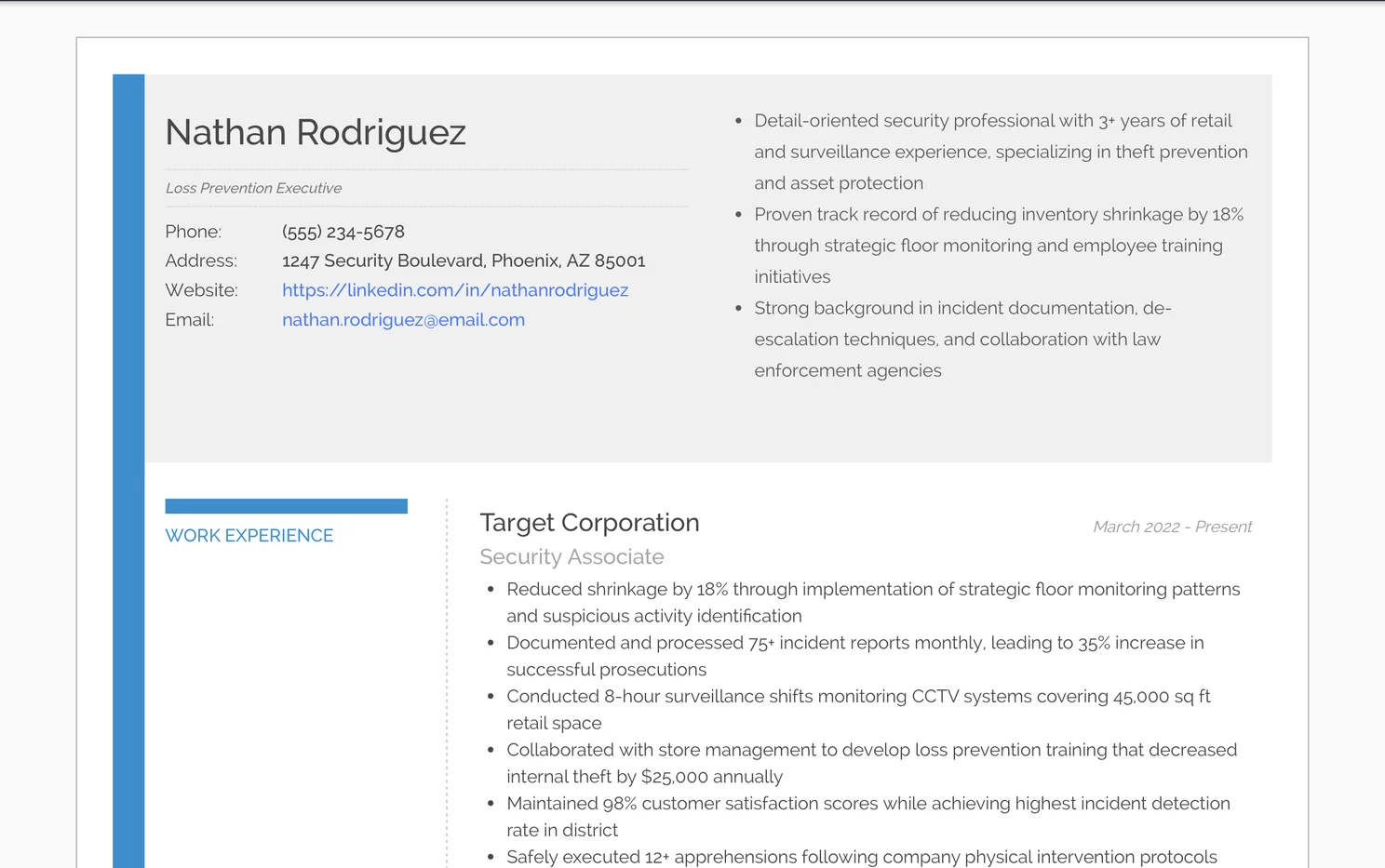
The Ultimate Loss Prevention Resume Example/Sample
https://www.resumonk.com/loss-prevention-resumeLoss PreventionResume Format for Loss Prevention Executive Resume
The reverse-chronological format is your best friend here. Why? Because hiring managers in retail and corporate security want to see your most recent experience first - they need to know if you've been keeping up with the latest theft trends, technology, and prevention techniques.
This format showcases your progression from perhaps a security guard role, retail associate position, or military service into the specialized world of loss prevention.
Structure Your Loss Prevention Resume Like a Security Protocol
Start with a professional summary that immediately establishes your credibility.
Think of it as your first impression when approaching a potential shoplifter - confident, professional, and purposeful. Your summary should be 2-3 lines that capture your experience level, key strengths, and what you bring to the table.
Follow this with your work experience section (we'll dive deep into this later), then your skills section highlighting both your technical abilities and soft skills. Education comes next - and here's where it gets interesting for Loss Prevention roles. Whether you have a high school diploma, criminal justice degree, or military training, each has its place and value. Finally, include any certifications like Security Guard License, Loss Prevention Certification, or First Aid/CPR training.
Regional Formatting Considerations
If you're applying in the United States, keep your resume to one page if you have less than 5 years of experience, two pages maximum for seasoned professionals. Canadian employers expect similar length but appreciate more detail about bilingual abilities if applicable.
In the UK, what they call a CV can be slightly longer, and Australian employers particularly value any experience with their specific retail legislation and security licensing requirements.
Work Experience on Loss Prevention Executive Resume
Your work experience section is where you transform from just another person in a uniform to a strategic asset protecting company profits. Maybe you're coming from a retail background where you noticed things others didn't, or from a security role where you're ready to specialize.
This section needs to tell that story while proving you can handle the unique challenges of loss prevention.
Quantify Your Impact Like Inventory Shrinkage
Loss prevention is all about the numbers - shrinkage rates, recovery values, incident reductions.
Your experience descriptions should reflect this data-driven reality. Instead of just listing duties, show how you affected the bottom line.
❌ Don't write vague descriptions without impact:
Monitored store floor for suspicious activity
Wrote reports about incidents
Worked with store management
✅ Do write specific, quantified achievements:
Reduced shrinkage by 23% through implementation of strategic floor monitoring patterns
Documented and processed 150+ incident reports monthly, leading to 40% increase in prosecutions
Collaborated with store management to develop loss prevention training that decreased internal theft by $50,000 annually
Translate Your Background Into Loss Prevention Language
Coming from the military?
Your force protection experience translates directly to asset protection. Retail background? Your customer service skills become "customer approach techniques" for recovery. Security guard experience? Your access control becomes "entry/exit monitoring for merchandise protection."
Each bullet point under your roles should follow the CAR format - Context, Action, Result. This works perfectly for loss prevention because every incident you handle has these three elements. You noticed something (context), you responded appropriately (action), and you achieved an outcome (result).
Show Your Evolution in Loss Prevention
Even if you're applying for an entry-level Loss Prevention Executive role, show how your previous experiences built toward this moment. Maybe as a cashier, you identified counterfeit bills. As a stock associate, you noticed inventory discrepancies.
These experiences matter because they show you have the observational skills and integrity that form the foundation of loss prevention work.
Skills to Include on Loss Prevention Executive Resume
Here's where you get to showcase that unique cocktail of abilities that makes a great Loss Prevention Executive - part detective, part diplomat, part data analyst.
You're not just muscle standing by the door (though physical fitness certainly helps). You're a multi-faceted professional who can spot a concealment technique from across the store floor, write a report that holds up in court, and calm an agitated situation without it escalating.
Technical Skills That Set You Apart
Start with the hardware and software that are your daily tools.
CCTV systems aren't just cameras to you - you know the difference between PTZ and fixed cameras, understand blind spots, and can review footage efficiently. Electronic Article Surveillance (EAS) systems, exception-based reporting software, and case management systems should all find their home here.
❌ Don't list generic technical skills:
Computer skills
Camera systems
Security equipment
✅ Do specify your technical proficiencies:
CCTV operation and analysis (Milestone, Genetec systems)
Exception-based reporting software (LPM, XBR Analytics)
EAS systems management (Checkpoint, Sensormatic)
Incident reporting databases and case management software
Soft Skills With Hard Evidence
Your soft skills need to reflect the reality of loss prevention work - where you might go from writing a detailed report to physically apprehending a shoplifter to testifying in court, all in the same week. Communication isn't just "good communication skills" - it's "de-escalation techniques," "interview and interrogation skills," and "court testimony preparation."
Observation skills deserve special attention. This isn't just about having good eyes - it's about pattern recognition, behavioral analysis, and maintaining vigilance during long shifts. Pair these soft skills with brief context when possible.
Certifications and Specialized Training
Loss Prevention Qualified (LPQ) or Loss Prevention Certified (LPC)?
Wicklander-Zulawski interview techniques? These aren't just letters after your name - they're proof you've invested in professional development specific to loss prevention. List them prominently, including expiration dates where relevant.
State-specific security licenses, first aid certifications, and any specialized retail security training all belong here.
Specific Considerations and Tips for Loss Prevention Executive Resume
Now let's talk about the elephant in the store - the unique challenges and considerations that only Loss Prevention professionals face when crafting their resumes. You're applying for a role where trustworthiness is paramount, yet you need to discuss your experience with theft and dishonesty daily.
You need to show you're approachable enough for customer service yet authoritative enough to deter criminal behavior.
Address the Physical Requirements Tactfully
Loss prevention often requires physical capabilities - standing for long periods, pursuing suspects, restraining individuals safely.
Without making it the focus, weave in mentions of your physical readiness. Perhaps you mention "conducted 8-hour floor surveillance shifts" or "safely executed 30+ apprehensions following company physical intervention protocols." This shows you understand and can meet the physical demands without making your resume read like a fitness profile.
Navigate the Confidentiality Tightrope
You've likely been involved in internal investigations, employee theft cases, or ongoing criminal prosecutions. While you want to showcase this experience, you must be careful about confidentiality. Use phrases like "conducted confidential internal investigations resulting in successful case resolutions" rather than specific details about cases or individuals.
Show that you understand discretion is part of the job.
❌ Don't reveal sensitive information:
Investigated Manager John Smith for stealing $10,000 from safe
Caught employees taking merchandise from Aisle 5 storage room
✅ Do maintain professional discretion:
Led internal investigations resulting in recovery of $50,000+ in assets
Identified and addressed systematic inventory control weaknesses
Showcase Your Dual Nature - Approachable Yet Authoritative
Loss Prevention Executives must master the art of being simultaneously approachable to honest customers and intimidating to potential thieves. Your resume should reflect this duality. Include examples of positive customer interactions alongside your apprehension statistics. Maybe you "maintained 95% customer satisfaction scores while achieving highest apprehension rate in district" or "developed customer-friendly approach techniques that increased voluntary merchandise recovery by 40%."
Emphasize Your Understanding of Legal Boundaries
One bad apprehension can cost a company millions in lawsuits. Show that you understand the legal framework within which you operate. Mention your knowledge of local merchant privilege laws, citizens arrest statutes, and company liability concerns. If you've testified in court successfully or have a perfect record of lawful apprehensions, these details matter immensely.
This isn't just about catching bad guys - it's about protecting your employer from legal risk while reducing losses.
Remember, your Loss Prevention Executive resume isn't just a list of jobs and skills - it's a carefully crafted document that proves you can protect assets, people, and profits while navigating the complex legal and interpersonal dynamics of modern retail security. Every word should reinforce that you're the observant, reliable, and professional guardian that employers need at their front lines.
Education to List on Loss Prevention Executive Resume
As a Loss Prevention Executive (and yes, despite that fancy "executive" word, we both know this is your entry point into the asset protection world), your education tells a story about your analytical capabilities and attention to detail. Hiring managers want to see that you can think critically about security protocols, understand basic business operations, and most importantly, that you can learn their specific systems quickly.
The Hierarchy of Educational Relevance
The degree you list doesn't need to be in criminal justice to land this role - though it certainly doesn't hurt. What matters more is how you present what you've learned. Place your education section after your experience if you've been working for more than two years.
If you're fresh out of college or recently certified, lead with it.
Start with your highest level of education and work backward. Include your degree, institution, graduation date (or expected date), and location. But here's where most candidates stop, missing a golden opportunity to showcase relevant coursework that directly applies to loss prevention.
Making Your Education Work for You
Think about it - every business course you took taught you about inventory management, every psychology class helped you understand behavior patterns, and that statistics course? Perfect for analyzing shrinkage data.
Don't just list your degree like it's a participation trophy.
❌ Don't write a generic education entry:
Bachelor of Arts in Business Administration
State University, 2023
✅ Do include relevant details that connect to loss prevention:
Bachelor of Arts in Business Administration
State University, City, State | May 2023
Relevant Coursework: Business Law, Retail Management, Statistical Analysis, Consumer Behavior
Senior Project: "Reducing Retail Shrinkage Through Employee Training Programs" - analyzed 50+ case studies
Certifications That Actually Matter
In the loss prevention world, certifications can sometimes speak louder than degrees.
The Loss Prevention Foundation's LPQualified and LPCertified credentials are industry gold standards. If you have them, list them prominently. Working on them? Still mention it with "In Progress" and an expected completion date.
Security guard licenses, first aid certifications, and any specialized training in surveillance systems or interview techniques should all find their home in this section. Remember, many states require specific licensing for loss prevention work, so if you have that Illinois PERC card or California Guard Card, it belongs here.
❌ Don't bury important certifications in random order:
CPR Certified
Bachelor's Degree
Loss Prevention Qualified
✅ Do organize strategically with most relevant first:
Loss Prevention Qualified (LPQ) | Loss Prevention Foundation | 2024
State Security License #12345 | Valid through 2025
B.S. Criminal Justice | University Name | 2023
CPR/First Aid Certified | American Red Cross | 2024
Awards and Publications on Loss Prevention Executive Resume
The awards section of your resume is where you differentiate yourself from the dozens of other entry-level candidates who all have similar education and minimal experience. This is your chance to show that you're not just qualified - you're exceptional.
What Counts as an Award in Loss Prevention
Think broader than traditional academic honors. Did you help reduce shrinkage at your previous retail job? That's award-worthy. Were you recognized for de-escalating a difficult situation? Perfect for this role.
Even being trusted with keys or cash handling responsibilities shows that management saw you as reliable and trustworthy - core qualities for loss prevention.
Academic awards still matter, especially those demonstrating analytical skills or leadership. Dean's List shows consistency and dedication. Leadership positions in criminal justice clubs or business organizations demonstrate your ability to coordinate with teams - essential when you're working with store management and law enforcement.
❌ Don't list awards without context:
Employee of the Month - June 2023
Dean's List
Safety Award
✅ Do provide context that relates to loss prevention skills:
Employee of the Month | Target Store #1234 | June 2023
- Recognized for identifying and reporting suspicious activity that prevented a $2,000 theft

Academic Excellence Dean's List | 3 semesters | 2022-2023
- Maintained 3.7 GPA while working 30+ hours in retail security

Workplace Safety Champion Award | Walmart | 2023
- Zero safety incidents during 18-month tenure, trained 15+ associates on emergency procedures
The Surprising Value of Publications and Projects
Now, you might be thinking, "Publications?
I'm applying for an entry-level loss prevention job, not submitting to academic journals." But hear me out. That research paper you wrote on organized retail crime? That's a publication. The training manual you helped create at your last job? That counts too.
Many Loss Prevention Executive roles involve writing incident reports, creating training materials, and analyzing data trends. Showing that you can communicate complex ideas clearly through writing sets you apart from candidates who can only observe and report.
If you've contributed to any security blogs, written for your school newspaper about campus safety, or even maintained a professional LinkedIn presence with articles about retail trends, these demonstrate your understanding of the industry beyond the basic job requirements.
✅ Do highlight relevant written work:
Research & Publications:
"The Psychology of Shoplifting: Understanding Motivations to Prevent Losses"
- Senior thesis examining behavioral patterns in retail theft (2023)

"5 Ways Retailers Can Reduce Internal Theft"
- Article published on LinkedIn, 500+ views (2024)

Contributing Author: Store #456 Loss Prevention Training Manual
- Developed sections on customer service approach to loss prevention (2023)
Listing References for Loss Prevention Executive Resume
When a company hires you as a Loss Prevention Executive, they're giving you access to their security systems, their investigative processes, and sensitive information about internal theft.
They need to know you're not just competent - you're trustworthy. Your references are the people who vouch for your integrity when you're not in the room.
Who Makes the Cut
Forget the old rule about needing three professional references.
For loss prevention roles, quality beats quantity every time. Your ideal reference is someone who can speak to your integrity, observational skills, and ability to handle sensitive situations. This might be the retail manager who trusted you with investigating inventory discrepancies, the professor who supervised your criminal justice internship, or even the security supervisor from your part-time job at the campus library.
Avoid listing family friends, no matter how impressive their titles. Also, that cool assistant manager who let you leave early every Friday? Maybe not your best choice. You want references who witnessed you handling responsibility, maintaining confidentiality, or dealing with difficult situations professionally.
The Strategy of "References Available Upon Request"
Here's where opinions divide.
Old-school advice says to write "References available upon request" at the bottom of your resume. Modern thinking suggests having a separate reference sheet ready to go. For Loss Prevention Executive positions, lean toward being proactive.
Create a separate reference document formatted to match your resume, and bring it to interviews even if not requested.
❌ Don't list references directly on your resume:
References:
John Smith - 555-1234
Jane Doe - 555-5678
Bob Johnson - 555-9012
✅ Do create a separate, professional reference sheet:
REFERENCES FOR [YOUR NAME]

Michael Thompson
Store Manager, Target Store #1234
Phone: (555) 123-4567
Email: [email protected]
Relationship: Direct Supervisor, 2022-2024
Can speak to: Integrity in handling cash, observation skills, incident reporting

Professor Sarah Martinez
Criminal Justice Department, State University
Phone: (555) 987-6543
Email: [email protected]
Relationship: Academic Advisor and Internship Supervisor, 2021-2023
Can speak to: Research abilities, understanding of legal procedures, report writing
Preparing Your References for Success
Don't let your references get ambushed by a phone call. When you're applying for Loss Prevention Executive positions, reach out to your references with specific information. Tell them about the role, the company, and what aspects of your experience might be most relevant. If the job posting emphasizes surveillance skills, remind your reference about that time you noticed the pattern in refund fraud.
If it focuses on report writing, mention the incident reports you wrote that helped prosecute a case.
Remember that in loss prevention, background checks go deeper than typical retail positions. Your references might be asked about your financial responsibility, any history of policy violations, or how you handle confidential information. Make sure your references are prepared for these questions and comfortable providing honest, positive responses.
International Considerations
Reference expectations vary significantly by country. In the United States, employers typically check references after extending a conditional offer. Canadian employers often request references earlier in the process, and may expect both professional and character references. In the UK, references are usually written rather than verbal, and employers are legally limited in what they can say.
Australian employers frequently conduct thorough reference checks and may require references from your most recent employer, even if that relationship didn't end well.
For any location, if you're new to the country or returning after time abroad, be prepared to explain any gaps in local references. International experience can actually be an asset in loss prevention, especially for companies with global operations or diverse customer bases.
When References Aren't Perfect
Maybe you left your last retail job under less-than-ideal circumstances, or your previous supervisor has moved on and you've lost touch.
Don't panic. Focus on references who can speak to your character and potential. A professor who saw you lead group projects, a volunteer coordinator who witnessed your dedication, or even a longtime colleague (properly positioned as such) can work. The key is being upfront about the relationship and ensuring they can speak professionally about your qualifications.
If asked for a reference from a particular employer and you know it won't be glowing, be prepared with a brief, professional explanation. "While my direct supervisor from that role is no longer with the company, I can provide you with contact information for a colleague who worked closely with me on loss prevention initiatives" shows professionalism and problem-solving ability.
Cover Letter Tips for Loss Prevention Executive Resume
Your cover letter for a Loss Prevention Executive position needs to strike a delicate balance. You're not applying to be a security guard who stands by the door, nor are you gunning for a regional loss prevention manager role (yet).
You're positioning yourself as someone ready to learn the complexities of retail asset protection while bringing fresh energy and perspective to the team.
The Opening That Gets Attention
Skip the generic "I am writing to apply for the Loss Prevention Executive position" opening.
The hiring manager knows why you're writing. Instead, lead with something that shows you understand their specific challenges. Research the company's recent news - did they just expand to new locations? Are they dealing with organized retail crime in their market?
Show that you're already thinking like a loss prevention professional.
❌ Don't open with a generic statement:
Dear Hiring Manager,
I am interested in the Loss Prevention Executive position at your company.
I have a degree in criminal justice and am excited about this opportunity.
✅ Do open with specific insights:
Dear [Specific Name if Available],
While researching Macy's recent initiatives to combat organized retail crime in the Northeast region, I was impressed by your team's collaborative approach with local law enforcement. As someone who has witnessed firsthand the impact of shrinkage on store operations during my time at Target, I'm eager to contribute to your loss prevention team's innovative strategies.
The Body - Telling Your Story
The middle section of your cover letter should connect your experience to their needs, even if that experience isn't directly in loss prevention. Were you the shift supervisor who noticed inventory discrepancies? The sales associate who developed a better way to tag high-theft items?
These experiences matter more than you think.
Address the elephant in the room if you're career-changing. Maybe you spent three years in customer service and are now moving into loss prevention. Frame this as an advantage - you understand the customer experience and can implement loss prevention strategies that don't alienate legitimate shoppers.
For recent graduates, focus on relevant coursework, internships, or even personal experiences that demonstrate your observational skills and integrity. That semester you spent as a resident advisor dealing with policy violations? That's relevant experience in investigation and report writing.
Regional Differences Matter
In the United States, keep your cover letter to one page and focus on specific achievements. Canadian employers often appreciate a slightly more detailed approach, especially regarding any bilingual abilities or knowledge of provincial regulations. UK positions might be listed as "Store Detective" or "Retail Security Officer" - adjust your terminology accordingly.
Australian employers particularly value any experience with CCTV systems or crowd control, given the unique challenges of their retail environment.
The Closing That Prompts Action
End your cover letter by reiterating your understanding of the role's importance to the business.
Loss Prevention Executives directly impact profitability - make it clear you understand this responsibility. Include your availability for interviews and any scheduling considerations, such as willingness to work nights, weekends, or holidays - standard requirements in retail loss prevention.
✅ Do close with confidence and specificity:
I'm excited about the opportunity to contribute to [Company Name]'s asset protection goals while developing my skills under your team's mentorship. I'm available for all shifts, including nights and weekends, and can start within two weeks' notice. I look forward to discussing how my combination of retail experience and security education can help reduce shrinkage at your [specific location/region] stores.
Key Takeaways
After diving deep into the world of Loss Prevention Executive resumes, let's crystallize the essential points that will transform your application from another PDF in the pile to your ticket to an interview:
- Use reverse-chronological format to showcase your most recent and relevant experience first - loss prevention managers need to see you're current with today's theft trends and prevention technologies
- Quantify everything possible - shrinkage percentages, dollar amounts recovered, number of incidents handled, prosecution rates - because loss prevention is fundamentally about protecting the bottom line
- Translate your background strategically - military experience becomes "force protection," retail work becomes "asset familiarity," and customer service becomes "approach and recovery techniques"
- Balance technical and soft skills - list specific systems (CCTV, EAS, reporting software) alongside crucial abilities like de-escalation, report writing, and behavioral observation
- Maintain confidentiality even on your resume - describe investigations and internal cases without revealing sensitive information, showing you understand discretion
- Highlight relevant education and certifications - Loss Prevention Qualified (LPQ), security licenses, and even relevant coursework matter more than just having any degree
- Address physical requirements subtly - weave in mentions of long surveillance shifts and safe apprehensions without making your resume a fitness profile
- Prepare references thoroughly - they'll face deeper questioning about your integrity and trustworthiness than typical retail positions require
- Write a cover letter that shows business acumen - demonstrate you understand loss prevention's role in profitability, not just catching shoplifters
- Customize for your region - understand whether you're applying in the US, Canada, UK, or Australia, as expectations and terminology vary
Creating a compelling Loss Prevention Executive resume doesn't have to be a solo surveillance operation. With Resumonk, you can build a professional resume that captures all these crucial elements while maintaining the polished appearance that security-conscious employers expect. Our AI-powered recommendations help you craft achievement-focused bullet points that quantify your impact, while our professionally designed templates ensure your resume looks as sharp as your observation skills. Whether you're transitioning from retail, military, or recent graduation, Resumonk's intuitive platform guides you through creating a resume that positions you as the vigilant professional ready to protect assets and profits.
Ready to catch the attention of loss prevention hiring managers?
Start crafting your Loss Prevention Executive resume with Resumonk's specialized templates and expert guidance. Your career in asset protection begins with a resume that proves you're observant, trustworthy, and business-minded.
→ Create Your Loss Prevention Resume with Resumonk Today
More Public Safety & Security resume examples
- Security Officer resume example
- Correctional Officer resume example
- Lifeguard resume example
- EMT resume example
See all Public Safety & Security resume examples, or browse every category.
Resume writing tips
You know that moment when you're walking through a store and spot someone acting just a little too interested in not looking interested? That subtle shift of merchandise into a bag, the nervous glance toward the exit, the practiced casual walk that's anything but casual - you've always noticed these things. Maybe you're the retail veteran who's tired of watching inventory walk out the door unpaid, or perhaps you're fresh from military service where situational awareness meant survival, and now you want to apply those skills to protecting civilian assets.
Either way, you're ready to make the leap into professional Loss Prevention, starting with that Loss Prevention Executive role that, despite its executive title, represents your entry point into this fascinating world of retail security and asset protection.
The path to becoming a Loss Prevention Executive isn't always straightforward - and that's actually what makes your unique background valuable. Whether you've been folding clothes at Gap while mentally cataloging suspicious behaviors, standing post in the military where observation meant everything, or studying criminal justice while working campus security, you bring a perspective that matters. But here's the challenge - you need a resume that transforms your diverse experience into a compelling narrative that speaks directly to loss prevention hiring managers who see dozens of applications from people claiming they have "good observation skills" and can "handle difficult situations."
This comprehensive guide walks you through every element of crafting a Loss Prevention Executive resume that gets noticed. We'll start with choosing the right format that showcases your most relevant experience, then dive deep into writing work experience descriptions that quantify your impact on business operations. You'll learn which skills to highlight - from technical proficiencies with CCTV systems to the soft skills that help you de-escalate tense situations. We'll cover how to present your education and certifications strategically, handle the unique challenges of discussing confidential investigations on your resume, and even tackle those tricky situations like career changes or gaps in employment.
By the time you finish reading this guide, you'll know exactly how to position yourself as the observant, trustworthy, and business-minded professional that retailers desperately need on their front lines. You'll understand how to write a cover letter that demonstrates your grasp of loss prevention's role in the bigger business picture, how to prepare your references for those thorough background checks, and most importantly, how to present yourself as someone who can protect profits while maintaining the positive shopping environment that keeps honest customers coming back. Let's turn your keen eye for detail and natural vigilance into a resume that opens doors to your loss prevention career.
The Ultimate Loss Prevention Resume Example/Sample
https://www.resumonk.com/loss-prevention-resumeLoss PreventionResume Format for Loss Prevention Executive Resume
The reverse-chronological format is your best friend here. Why? Because hiring managers in retail and corporate security want to see your most recent experience first - they need to know if you've been keeping up with the latest theft trends, technology, and prevention techniques.
This format showcases your progression from perhaps a security guard role, retail associate position, or military service into the specialized world of loss prevention.
Structure Your Loss Prevention Resume Like a Security Protocol
Start with a professional summary that immediately establishes your credibility.
Think of it as your first impression when approaching a potential shoplifter - confident, professional, and purposeful. Your summary should be 2-3 lines that capture your experience level, key strengths, and what you bring to the table.
Follow this with your work experience section (we'll dive deep into this later), then your skills section highlighting both your technical abilities and soft skills. Education comes next - and here's where it gets interesting for Loss Prevention roles. Whether you have a high school diploma, criminal justice degree, or military training, each has its place and value. Finally, include any certifications like Security Guard License, Loss Prevention Certification, or First Aid/CPR training.
Regional Formatting Considerations
If you're applying in the United States, keep your resume to one page if you have less than 5 years of experience, two pages maximum for seasoned professionals. Canadian employers expect similar length but appreciate more detail about bilingual abilities if applicable.
In the UK, what they call a CV can be slightly longer, and Australian employers particularly value any experience with their specific retail legislation and security licensing requirements.
Work Experience on Loss Prevention Executive Resume
Your work experience section is where you transform from just another person in a uniform to a strategic asset protecting company profits. Maybe you're coming from a retail background where you noticed things others didn't, or from a security role where you're ready to specialize.
This section needs to tell that story while proving you can handle the unique challenges of loss prevention.
Quantify Your Impact Like Inventory Shrinkage
Loss prevention is all about the numbers - shrinkage rates, recovery values, incident reductions.
Your experience descriptions should reflect this data-driven reality. Instead of just listing duties, show how you affected the bottom line.
❌ Don't write vague descriptions without impact:
Monitored store floor for suspicious activity
Wrote reports about incidents
Worked with store management
✅ Do write specific, quantified achievements:
Reduced shrinkage by 23% through implementation of strategic floor monitoring patterns
Documented and processed 150+ incident reports monthly, leading to 40% increase in prosecutions
Collaborated with store management to develop loss prevention training that decreased internal theft by $50,000 annually
Translate Your Background Into Loss Prevention Language
Coming from the military?
Your force protection experience translates directly to asset protection. Retail background? Your customer service skills become "customer approach techniques" for recovery. Security guard experience? Your access control becomes "entry/exit monitoring for merchandise protection."
Each bullet point under your roles should follow the CAR format - Context, Action, Result. This works perfectly for loss prevention because every incident you handle has these three elements. You noticed something (context), you responded appropriately (action), and you achieved an outcome (result).
Show Your Evolution in Loss Prevention
Even if you're applying for an entry-level Loss Prevention Executive role, show how your previous experiences built toward this moment. Maybe as a cashier, you identified counterfeit bills. As a stock associate, you noticed inventory discrepancies.
These experiences matter because they show you have the observational skills and integrity that form the foundation of loss prevention work.
Skills to Include on Loss Prevention Executive Resume
Here's where you get to showcase that unique cocktail of abilities that makes a great Loss Prevention Executive - part detective, part diplomat, part data analyst.
You're not just muscle standing by the door (though physical fitness certainly helps). You're a multi-faceted professional who can spot a concealment technique from across the store floor, write a report that holds up in court, and calm an agitated situation without it escalating.
Technical Skills That Set You Apart
Start with the hardware and software that are your daily tools.
CCTV systems aren't just cameras to you - you know the difference between PTZ and fixed cameras, understand blind spots, and can review footage efficiently. Electronic Article Surveillance (EAS) systems, exception-based reporting software, and case management systems should all find their home here.
❌ Don't list generic technical skills:
Computer skills
Camera systems
Security equipment
✅ Do specify your technical proficiencies:
CCTV operation and analysis (Milestone, Genetec systems)
Exception-based reporting software (LPM, XBR Analytics)
EAS systems management (Checkpoint, Sensormatic)
Incident reporting databases and case management software
Soft Skills With Hard Evidence
Your soft skills need to reflect the reality of loss prevention work - where you might go from writing a detailed report to physically apprehending a shoplifter to testifying in court, all in the same week. Communication isn't just "good communication skills" - it's "de-escalation techniques," "interview and interrogation skills," and "court testimony preparation."
Observation skills deserve special attention. This isn't just about having good eyes - it's about pattern recognition, behavioral analysis, and maintaining vigilance during long shifts. Pair these soft skills with brief context when possible.
Certifications and Specialized Training
Loss Prevention Qualified (LPQ) or Loss Prevention Certified (LPC)?
Wicklander-Zulawski interview techniques? These aren't just letters after your name - they're proof you've invested in professional development specific to loss prevention. List them prominently, including expiration dates where relevant.
State-specific security licenses, first aid certifications, and any specialized retail security training all belong here.
Specific Considerations and Tips for Loss Prevention Executive Resume
Now let's talk about the elephant in the store - the unique challenges and considerations that only Loss Prevention professionals face when crafting their resumes. You're applying for a role where trustworthiness is paramount, yet you need to discuss your experience with theft and dishonesty daily.
You need to show you're approachable enough for customer service yet authoritative enough to deter criminal behavior.
Address the Physical Requirements Tactfully
Loss prevention often requires physical capabilities - standing for long periods, pursuing suspects, restraining individuals safely.
Without making it the focus, weave in mentions of your physical readiness. Perhaps you mention "conducted 8-hour floor surveillance shifts" or "safely executed 30+ apprehensions following company physical intervention protocols." This shows you understand and can meet the physical demands without making your resume read like a fitness profile.
Navigate the Confidentiality Tightrope
You've likely been involved in internal investigations, employee theft cases, or ongoing criminal prosecutions. While you want to showcase this experience, you must be careful about confidentiality. Use phrases like "conducted confidential internal investigations resulting in successful case resolutions" rather than specific details about cases or individuals.
Show that you understand discretion is part of the job.
❌ Don't reveal sensitive information:
Investigated Manager John Smith for stealing $10,000 from safe
Caught employees taking merchandise from Aisle 5 storage room
✅ Do maintain professional discretion:
Led internal investigations resulting in recovery of $50,000+ in assets
Identified and addressed systematic inventory control weaknesses
Showcase Your Dual Nature - Approachable Yet Authoritative
Loss Prevention Executives must master the art of being simultaneously approachable to honest customers and intimidating to potential thieves. Your resume should reflect this duality. Include examples of positive customer interactions alongside your apprehension statistics. Maybe you "maintained 95% customer satisfaction scores while achieving highest apprehension rate in district" or "developed customer-friendly approach techniques that increased voluntary merchandise recovery by 40%."
Emphasize Your Understanding of Legal Boundaries
One bad apprehension can cost a company millions in lawsuits. Show that you understand the legal framework within which you operate. Mention your knowledge of local merchant privilege laws, citizens arrest statutes, and company liability concerns. If you've testified in court successfully or have a perfect record of lawful apprehensions, these details matter immensely.
This isn't just about catching bad guys - it's about protecting your employer from legal risk while reducing losses.
Remember, your Loss Prevention Executive resume isn't just a list of jobs and skills - it's a carefully crafted document that proves you can protect assets, people, and profits while navigating the complex legal and interpersonal dynamics of modern retail security. Every word should reinforce that you're the observant, reliable, and professional guardian that employers need at their front lines.
Education to List on Loss Prevention Executive Resume
As a Loss Prevention Executive (and yes, despite that fancy "executive" word, we both know this is your entry point into the asset protection world), your education tells a story about your analytical capabilities and attention to detail. Hiring managers want to see that you can think critically about security protocols, understand basic business operations, and most importantly, that you can learn their specific systems quickly.
The Hierarchy of Educational Relevance
The degree you list doesn't need to be in criminal justice to land this role - though it certainly doesn't hurt. What matters more is how you present what you've learned. Place your education section after your experience if you've been working for more than two years.
If you're fresh out of college or recently certified, lead with it.
Start with your highest level of education and work backward. Include your degree, institution, graduation date (or expected date), and location. But here's where most candidates stop, missing a golden opportunity to showcase relevant coursework that directly applies to loss prevention.
Making Your Education Work for You
Think about it - every business course you took taught you about inventory management, every psychology class helped you understand behavior patterns, and that statistics course? Perfect for analyzing shrinkage data.
Don't just list your degree like it's a participation trophy.
❌ Don't write a generic education entry:
Bachelor of Arts in Business Administration
State University, 2023
✅ Do include relevant details that connect to loss prevention:
Bachelor of Arts in Business Administration
State University, City, State | May 2023
Relevant Coursework: Business Law, Retail Management, Statistical Analysis, Consumer Behavior
Senior Project: "Reducing Retail Shrinkage Through Employee Training Programs" - analyzed 50+ case studies
Certifications That Actually Matter
In the loss prevention world, certifications can sometimes speak louder than degrees.
The Loss Prevention Foundation's LPQualified and LPCertified credentials are industry gold standards. If you have them, list them prominently. Working on them? Still mention it with "In Progress" and an expected completion date.
Security guard licenses, first aid certifications, and any specialized training in surveillance systems or interview techniques should all find their home in this section. Remember, many states require specific licensing for loss prevention work, so if you have that Illinois PERC card or California Guard Card, it belongs here.
❌ Don't bury important certifications in random order:
CPR Certified
Bachelor's Degree
Loss Prevention Qualified
✅ Do organize strategically with most relevant first:
Loss Prevention Qualified (LPQ) | Loss Prevention Foundation | 2024
State Security License #12345 | Valid through 2025
B.S. Criminal Justice | University Name | 2023
CPR/First Aid Certified | American Red Cross | 2024
Awards and Publications on Loss Prevention Executive Resume
The awards section of your resume is where you differentiate yourself from the dozens of other entry-level candidates who all have similar education and minimal experience. This is your chance to show that you're not just qualified - you're exceptional.
What Counts as an Award in Loss Prevention
Think broader than traditional academic honors. Did you help reduce shrinkage at your previous retail job? That's award-worthy. Were you recognized for de-escalating a difficult situation? Perfect for this role.
Even being trusted with keys or cash handling responsibilities shows that management saw you as reliable and trustworthy - core qualities for loss prevention.
Academic awards still matter, especially those demonstrating analytical skills or leadership. Dean's List shows consistency and dedication. Leadership positions in criminal justice clubs or business organizations demonstrate your ability to coordinate with teams - essential when you're working with store management and law enforcement.
❌ Don't list awards without context:
Employee of the Month - June 2023
Dean's List
Safety Award
✅ Do provide context that relates to loss prevention skills:
Employee of the Month | Target Store #1234 | June 2023
- Recognized for identifying and reporting suspicious activity that prevented a $2,000 theft

Academic Excellence Dean's List | 3 semesters | 2022-2023
- Maintained 3.7 GPA while working 30+ hours in retail security

Workplace Safety Champion Award | Walmart | 2023
- Zero safety incidents during 18-month tenure, trained 15+ associates on emergency procedures
The Surprising Value of Publications and Projects
Now, you might be thinking, "Publications?
I'm applying for an entry-level loss prevention job, not submitting to academic journals." But hear me out. That research paper you wrote on organized retail crime? That's a publication. The training manual you helped create at your last job? That counts too.
Many Loss Prevention Executive roles involve writing incident reports, creating training materials, and analyzing data trends. Showing that you can communicate complex ideas clearly through writing sets you apart from candidates who can only observe and report.
If you've contributed to any security blogs, written for your school newspaper about campus safety, or even maintained a professional LinkedIn presence with articles about retail trends, these demonstrate your understanding of the industry beyond the basic job requirements.
✅ Do highlight relevant written work:
Research & Publications:
"The Psychology of Shoplifting: Understanding Motivations to Prevent Losses"
- Senior thesis examining behavioral patterns in retail theft (2023)

"5 Ways Retailers Can Reduce Internal Theft"
- Article published on LinkedIn, 500+ views (2024)

Contributing Author: Store #456 Loss Prevention Training Manual
- Developed sections on customer service approach to loss prevention (2023)
Listing References for Loss Prevention Executive Resume
When a company hires you as a Loss Prevention Executive, they're giving you access to their security systems, their investigative processes, and sensitive information about internal theft.
They need to know you're not just competent - you're trustworthy. Your references are the people who vouch for your integrity when you're not in the room.
Who Makes the Cut
Forget the old rule about needing three professional references.
For loss prevention roles, quality beats quantity every time. Your ideal reference is someone who can speak to your integrity, observational skills, and ability to handle sensitive situations. This might be the retail manager who trusted you with investigating inventory discrepancies, the professor who supervised your criminal justice internship, or even the security supervisor from your part-time job at the campus library.
Avoid listing family friends, no matter how impressive their titles. Also, that cool assistant manager who let you leave early every Friday? Maybe not your best choice. You want references who witnessed you handling responsibility, maintaining confidentiality, or dealing with difficult situations professionally.
The Strategy of "References Available Upon Request"
Here's where opinions divide.
Old-school advice says to write "References available upon request" at the bottom of your resume. Modern thinking suggests having a separate reference sheet ready to go. For Loss Prevention Executive positions, lean toward being proactive.
Create a separate reference document formatted to match your resume, and bring it to interviews even if not requested.
❌ Don't list references directly on your resume:
References:
John Smith - 555-1234
Jane Doe - 555-5678
Bob Johnson - 555-9012
✅ Do create a separate, professional reference sheet:
REFERENCES FOR [YOUR NAME]

Michael Thompson
Store Manager, Target Store #1234
Phone: (555) 123-4567
Email: [email protected]
Relationship: Direct Supervisor, 2022-2024
Can speak to: Integrity in handling cash, observation skills, incident reporting

Professor Sarah Martinez
Criminal Justice Department, State University
Phone: (555) 987-6543
Email: [email protected]
Relationship: Academic Advisor and Internship Supervisor, 2021-2023
Can speak to: Research abilities, understanding of legal procedures, report writing
Preparing Your References for Success
Don't let your references get ambushed by a phone call. When you're applying for Loss Prevention Executive positions, reach out to your references with specific information. Tell them about the role, the company, and what aspects of your experience might be most relevant. If the job posting emphasizes surveillance skills, remind your reference about that time you noticed the pattern in refund fraud.
If it focuses on report writing, mention the incident reports you wrote that helped prosecute a case.
Remember that in loss prevention, background checks go deeper than typical retail positions. Your references might be asked about your financial responsibility, any history of policy violations, or how you handle confidential information. Make sure your references are prepared for these questions and comfortable providing honest, positive responses.
International Considerations
Reference expectations vary significantly by country. In the United States, employers typically check references after extending a conditional offer. Canadian employers often request references earlier in the process, and may expect both professional and character references. In the UK, references are usually written rather than verbal, and employers are legally limited in what they can say.
Australian employers frequently conduct thorough reference checks and may require references from your most recent employer, even if that relationship didn't end well.
For any location, if you're new to the country or returning after time abroad, be prepared to explain any gaps in local references. International experience can actually be an asset in loss prevention, especially for companies with global operations or diverse customer bases.
When References Aren't Perfect
Maybe you left your last retail job under less-than-ideal circumstances, or your previous supervisor has moved on and you've lost touch.
Don't panic. Focus on references who can speak to your character and potential. A professor who saw you lead group projects, a volunteer coordinator who witnessed your dedication, or even a longtime colleague (properly positioned as such) can work. The key is being upfront about the relationship and ensuring they can speak professionally about your qualifications.
If asked for a reference from a particular employer and you know it won't be glowing, be prepared with a brief, professional explanation. "While my direct supervisor from that role is no longer with the company, I can provide you with contact information for a colleague who worked closely with me on loss prevention initiatives" shows professionalism and problem-solving ability.
Cover Letter Tips for Loss Prevention Executive Resume
Your cover letter for a Loss Prevention Executive position needs to strike a delicate balance. You're not applying to be a security guard who stands by the door, nor are you gunning for a regional loss prevention manager role (yet).
You're positioning yourself as someone ready to learn the complexities of retail asset protection while bringing fresh energy and perspective to the team.
The Opening That Gets Attention
Skip the generic "I am writing to apply for the Loss Prevention Executive position" opening.
The hiring manager knows why you're writing. Instead, lead with something that shows you understand their specific challenges. Research the company's recent news - did they just expand to new locations? Are they dealing with organized retail crime in their market?
Show that you're already thinking like a loss prevention professional.
❌ Don't open with a generic statement:
Dear Hiring Manager,
I am interested in the Loss Prevention Executive position at your company.
I have a degree in criminal justice and am excited about this opportunity.
✅ Do open with specific insights:
Dear [Specific Name if Available],
While researching Macy's recent initiatives to combat organized retail crime in the Northeast region, I was impressed by your team's collaborative approach with local law enforcement. As someone who has witnessed firsthand the impact of shrinkage on store operations during my time at Target, I'm eager to contribute to your loss prevention team's innovative strategies.
The Body - Telling Your Story
The middle section of your cover letter should connect your experience to their needs, even if that experience isn't directly in loss prevention. Were you the shift supervisor who noticed inventory discrepancies? The sales associate who developed a better way to tag high-theft items?
These experiences matter more than you think.
Address the elephant in the room if you're career-changing. Maybe you spent three years in customer service and are now moving into loss prevention. Frame this as an advantage - you understand the customer experience and can implement loss prevention strategies that don't alienate legitimate shoppers.
For recent graduates, focus on relevant coursework, internships, or even personal experiences that demonstrate your observational skills and integrity. That semester you spent as a resident advisor dealing with policy violations? That's relevant experience in investigation and report writing.
Regional Differences Matter
In the United States, keep your cover letter to one page and focus on specific achievements. Canadian employers often appreciate a slightly more detailed approach, especially regarding any bilingual abilities or knowledge of provincial regulations. UK positions might be listed as "Store Detective" or "Retail Security Officer" - adjust your terminology accordingly.
Australian employers particularly value any experience with CCTV systems or crowd control, given the unique challenges of their retail environment.
The Closing That Prompts Action
End your cover letter by reiterating your understanding of the role's importance to the business.
Loss Prevention Executives directly impact profitability - make it clear you understand this responsibility. Include your availability for interviews and any scheduling considerations, such as willingness to work nights, weekends, or holidays - standard requirements in retail loss prevention.
✅ Do close with confidence and specificity:
I'm excited about the opportunity to contribute to [Company Name]'s asset protection goals while developing my skills under your team's mentorship. I'm available for all shifts, including nights and weekends, and can start within two weeks' notice. I look forward to discussing how my combination of retail experience and security education can help reduce shrinkage at your [specific location/region] stores.
Key Takeaways
After diving deep into the world of Loss Prevention Executive resumes, let's crystallize the essential points that will transform your application from another PDF in the pile to your ticket to an interview:
- Use reverse-chronological format to showcase your most recent and relevant experience first - loss prevention managers need to see you're current with today's theft trends and prevention technologies
- Quantify everything possible - shrinkage percentages, dollar amounts recovered, number of incidents handled, prosecution rates - because loss prevention is fundamentally about protecting the bottom line
- Translate your background strategically - military experience becomes "force protection," retail work becomes "asset familiarity," and customer service becomes "approach and recovery techniques"
- Balance technical and soft skills - list specific systems (CCTV, EAS, reporting software) alongside crucial abilities like de-escalation, report writing, and behavioral observation
- Maintain confidentiality even on your resume - describe investigations and internal cases without revealing sensitive information, showing you understand discretion
- Highlight relevant education and certifications - Loss Prevention Qualified (LPQ), security licenses, and even relevant coursework matter more than just having any degree
- Address physical requirements subtly - weave in mentions of long surveillance shifts and safe apprehensions without making your resume a fitness profile
- Prepare references thoroughly - they'll face deeper questioning about your integrity and trustworthiness than typical retail positions require
- Write a cover letter that shows business acumen - demonstrate you understand loss prevention's role in profitability, not just catching shoplifters
- Customize for your region - understand whether you're applying in the US, Canada, UK, or Australia, as expectations and terminology vary
Creating a compelling Loss Prevention Executive resume doesn't have to be a solo surveillance operation. With Resumonk, you can build a professional resume that captures all these crucial elements while maintaining the polished appearance that security-conscious employers expect. Our AI-powered recommendations help you craft achievement-focused bullet points that quantify your impact, while our professionally designed templates ensure your resume looks as sharp as your observation skills. Whether you're transitioning from retail, military, or recent graduation, Resumonk's intuitive platform guides you through creating a resume that positions you as the vigilant professional ready to protect assets and profits.
Ready to catch the attention of loss prevention hiring managers?
Start crafting your Loss Prevention Executive resume with Resumonk's specialized templates and expert guidance. Your career in asset protection begins with a resume that proves you're observant, trustworthy, and business-minded.
→ Create Your Loss Prevention Resume with Resumonk Today
More Public Safety & Security resume examples
- Security Officer resume example
- Correctional Officer resume example
- Lifeguard resume example
- EMT resume example
See all Public Safety & Security resume examples, or browse every category.
Resume writing tips