Line Cook Resume Example, Guide and Tips
Introduction
The dinner rush hits like a tidal wave - tickets streaming from the printer, six pans dancing on your burners, the expeditor calling for those two ribeyes that need to hit the pass in thirty seconds, and somehow, in this beautiful chaos, you're in your element. You're a line cook, and while others might see a stressful job in a hot kitchen, you see a craft that demands precision, speed, and an almost zen-like focus.
Now you're ready for your next kitchen adventure, and you need a resume that captures not just what you do, but the controlled intensity with which you do it.
Landing your next line cook position isn't about fancy culinary degrees or name-dropping celebrity chefs - it's about proving you can handle the pressure when Saturday night service goes sideways and still put out consistent, quality plates. Whether you're moving up from prep cook, transitioning from dishwasher to the hot line, fresh out of culinary school, or a seasoned veteran looking for a kitchen that matches your ambitions, crafting the right resume can mean the difference between another dead-end grill position and finally working under a chef who'll push you to grow.
In this comprehensive guide, we'll walk you through every element of creating a standout line cook resume. We'll start with choosing the perfect resume format - the reverse-chronological structure that shows hiring chefs you're currently battle-tested and kitchen-ready. Then we'll dive deep into crafting your work experience section with specific metrics that prove you can handle 200-cover nights, showcase the technical skills that separate you from home cooks, and navigate the unique considerations of kitchen life, from explaining job changes to highlighting certifications that actually matter.
We'll also cover how to present your education (whether it's culinary school or the school of hard knocks), leverage any awards or recognition you've earned, write a cover letter that cuts through the noise, and strategically list references who've actually seen you work through a nightmare service. By the end, you'll have everything you need to create a resume that speaks directly to head chefs and kitchen managers - one that shows you're not just another cook, but a reliable professional ready to hold down any station they throw at you.
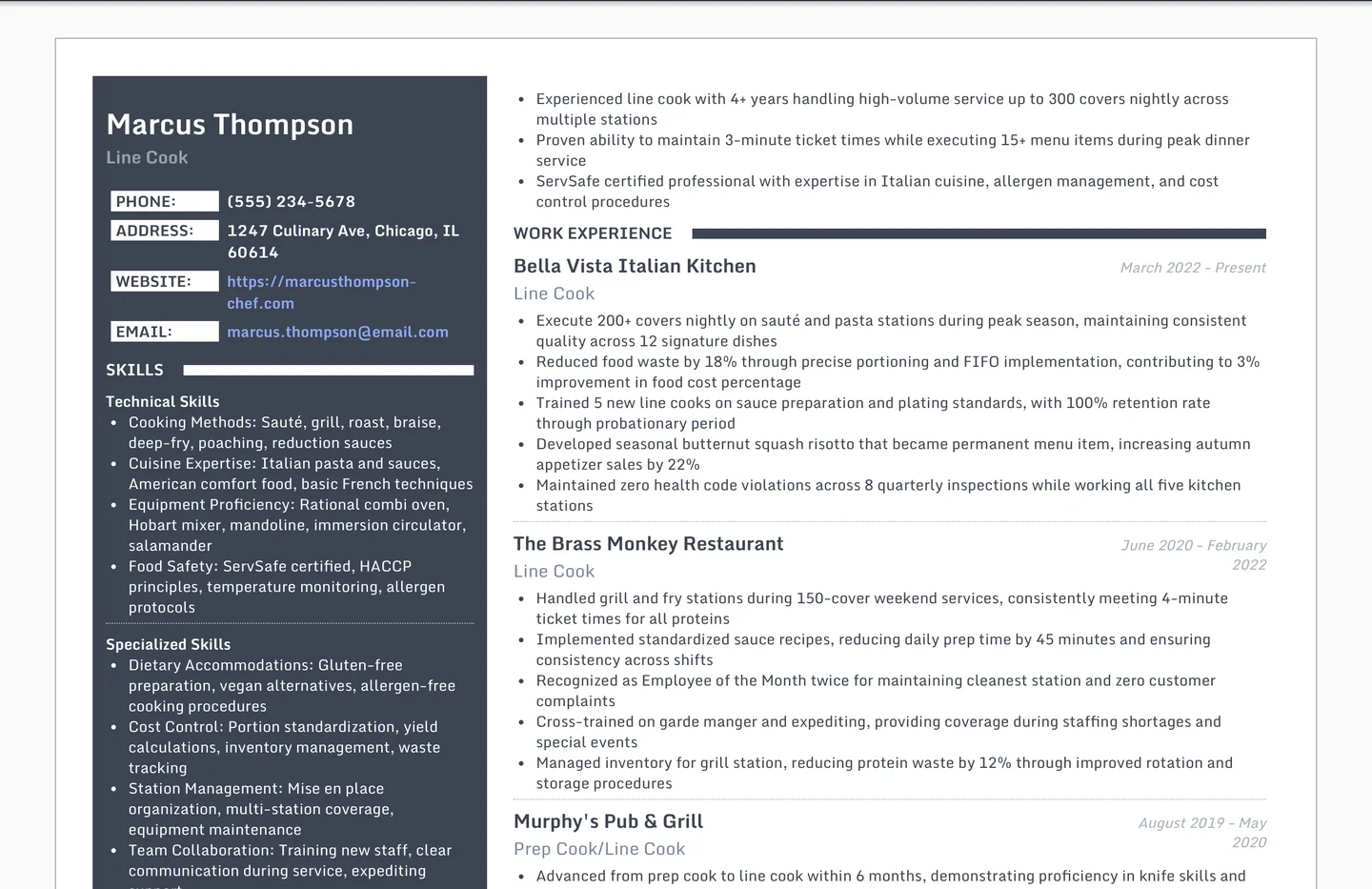
The Ultimate Line Cook Resume Example/Sample
https://www.resumonk.com/line-cookLine CookResume Format to Follow for Line Cook Resume
The reverse-chronological format is your best friend here. Why? Because kitchen managers and head chefs want to see your most recent kitchen experience first - they need to know if you've been actively working the line, not whether you helped out at your uncle's restaurant five years ago.
Your recent experience shows whether you're currently sharp with your knife skills, up-to-date with food safety protocols, and battle-tested in high-volume service.
Structure Your Line Cook Resume Like a Perfect Mise en Place
Start with your contact information at the top, followed by a brief professional summary (2-3 lines maximum). Then dive straight into your work experience section - this is your main course. Education comes after, followed by skills and certifications.
Think of it like plating a dish - the protein (work experience) takes center stage, with your garnishes (education, certifications) complementing but not overwhelming the plate.
For those of you transitioning from dishwasher or prep cook positions, or even from culinary school straight to the line, the reverse-chronological format still works beautifully. It shows your progression through the kitchen hierarchy - every chef respects someone who's worked their way up from the dish pit.
Keep It to One Page - Just Like a Clean Station
Unless you've been cooking professionally for over a decade or have worked in Michelin-starred establishments, keep your resume to a single page.
Kitchen managers are reviewing resumes between prep and service - they don't have time for a novel. Every line on your resume should earn its place, just like every tool on your station.
If you're applying in different regions, note that UK and Australian kitchens might expect a slightly longer CV format (up to 2 pages), while Canadian and US kitchens strongly prefer the concise one-page approach. The kitchen culture might vary, but efficiency is universal.
Work Experience on Line Cook Resume
Your work experience section is where you prove you can handle the heat - literally.
But here's where many line cooks stumble. They list their duties like they're reading from a job posting, forgetting that every kitchen manager already knows what a line cook does. What they don't know is what makes YOU different from the fifty other resumes on their desk.
Quantify Your Kitchen Performance
Numbers speak louder than adjectives in the kitchen world. How many covers did you handle on a typical Friday night? What was your station's food cost percentage?
How many menu items were you responsible for?
❌ Don't write vague descriptions:
Line Cook - Mario's Italian Restaurant
• Prepared food items
• Worked various stations
• Helped during busy periods
✅ Do include specific metrics and achievements:
Line Cook - Mario's Italian Restaurant
• Executed 150+ covers nightly on sauté station during peak season
• Maintained consistent 3-minute ticket times for pasta dishes across 8-hour shifts
• Reduced food waste by 15% through precise portioning and FIFO implementation
• Trained 4 new prep cooks on knife skills and station setup
Show Your Range and Adaptability
Kitchen life means being thrown into different stations, covering for sick colleagues, and sometimes completely changing your prep list an hour before service. Your resume should reflect this adaptability. Mention the different stations you've mastered - grill, sauté, fry, cold prep.
Each station requires different skills, and versatility makes you valuable.
For those coming from chain restaurants or high-volume establishments, don't be shy about those numbers. Handling 300 covers at an Olive Garden requires serious organizational skills and stamina. Fine dining experience isn't the only path to being a great line cook.
Highlight Special Projects and Menu Contributions
Did you help develop a special that became a menu staple?
Were you the go-to person for sauce preparation? Did you streamline prep procedures? These contributions show initiative beyond just following recipes.
❌ Don't undersell your contributions:
• Assisted with menu items
✅ Do showcase your creative input:
• Developed seasonal butternut squash risotto that increased autumn sales by 20%
• Standardized sauce recipes, reducing prep time by 30 minutes daily
Skills to Show on Line Cook Resume
The skills section of your resume is like your knife roll - it needs to contain the essential tools, be well-organized, and immediately show you're prepared for service. But here's the thing about listing skills as a line cook - everyone can claim they have "knife skills" or can "work under pressure."
The key is being specific enough that a chef can visualize you on their line.
Technical Skills - The Foundation of Your Craft
Start with the concrete, technical skills that you can demonstrate within five minutes of walking into any kitchen. These are your fundamental techniques and knowledge areas that separate you from someone who just cooks at home.
Group your technical skills logically. Instead of a random list, organize them by category - cooking techniques, cuisine types, equipment proficiency.
This shows you think systematically, a crucial trait for line work.
❌ Don't list generic skills:
Skills:
• Cooking
• Food preparation
• Kitchen equipment
• Teamwork
• Fast-paced environment
✅ Do be specific and organized:
Technical Skills:
Cooking Methods: Sauté, grill, roast, braise, deep-fry, sous vide
Cuisine Expertise: Italian pasta/sauces, Asian stir-fry, French mother sauces
Equipment: Rational combi oven, Hobart mixer, immersion circulator, mandoline
Food Safety: ServSafe certified, HACCP principles, allergen management
The Soft Skills That Keep Service Running Smooth
While your technical skills get you in the door, your soft skills determine whether you'll survive a Saturday night rush. But instead of just listing "communication" or "time management," connect these skills to specific kitchen scenarios.
Think about what makes a line cook easy to work with during service. Are you the person who always calls out "Behind!" and "Hot pan!"? Do you automatically jump in to help when another station gets slammed? Can you take criticism from the chef without taking it personally? These behaviors translate into specific soft skills that matter.
Specialized Knowledge That Sets You Apart
This is where you can really differentiate yourself. Maybe you're the line cook who actually understands gluten-free cooking beyond just avoiding wheat. Perhaps you've mastered the art of accommodating allergies without slowing down service.
Or you might be that rare cook who can actually fix the temperamental salamander when it stops working mid-service.
Specialized Skills:
• Dietary Accommodations: Celiac-safe preparation, vegan protein alternatives
• Cost Control: Portion standardization, yield testing, inventory management
• Special Techniques: Charcuterie production, fermentation, molecular gastronomy basics
Specific Considerations and Tips for Line Cook Resume
Now let's talk about the details that separate a line cook's resume from every other food service resume that lands on the chef's desk.
You're not a server who occasionally runs food, you're not a prep cook who dreams of working the line, and you're definitely not a culinary student who's only cooked in a classroom.
You're a line cook - someone who stands in the trenches every night, turning raw ingredients into perfectly executed dishes while the kitchen burns around you.
Address the Elephant in the Kitchen - Job Hopping
The restaurant industry has insane turnover, and everyone knows it. If you've worked at four restaurants in two years, that's not necessarily a red flag like it would be in corporate America. But you need to frame it correctly. Maybe you were seeking diverse culinary experiences, learning different cuisines, or following seasonal work.
Don't apologize for it, but don't ignore it either.
If you left positions for legitimate reasons - restaurant closure, seeking growth opportunities, relocating - briefly mention it in your cover letter or be prepared to address it in the interview. What matters is showing that you're now looking for stability and growth.
The Portfolio Paradox
Unlike chefs de partie or sous chefs who might include photos of their plated dishes, as a line cook, you're typically executing someone else's vision.
But that doesn't mean you can't showcase excellence. If you've consistently nailed the chef's most challenging dish, if you've maintained the cleanest station, or if you've been specifically requested for special events - these achievements matter more than artistic food photography.
Consider creating a simple one-page addendum with a few action shots from service (if permitted by previous employers) showing your mise en place, your organization during rush, or even just your perfectly brunoise'd vegetables. It's not about artistic presentation - it's about demonstrating professional execution.
Certifications and Training - More Than Just ServSafe
While ServSafe certification is basically mandatory, don't stop there.
List any additional training that shows initiative. Did you complete an online course on fermentation during lockdown? Have you attended a workshop on whole animal butchery? Did you get forklift certified to help with deliveries?
These show you're invested in growing beyond just your station.
❌ Don't just list the bare minimum:
Certifications:
• Food Handler's License
✅ Do showcase your commitment to professional development:
Certifications & Training:
• ServSafe Food Protection Manager (2024-2026)
• Allergen Awareness Certification - National Restaurant Association
• WSET Level 1 Wine Certificate - for improved food pairing knowledge
• Basic Life Support (BLS) Certification - American Red Cross
The Reference Strategy for Kitchen Warriors
In the kitchen world, references carry enormous weight.
A single text from a respected chef can get you hired faster than the perfect resume. Build your reference list strategically - include the sous chef who saw you handle a 20-top allergen nightmare, the executive chef who watched you train three successful line cooks, or the kitchen manager who relied on you to open the kitchen every Sunday.
Don't just list "References available upon request." In the tight-knit culinary community, proactively mention if you've worked under any well-known chefs or in highly regarded establishments. If Chef Thompson from that farm-to-table place everyone respects is willing to vouch for you, that's resume gold.
Availability and Flexibility - The Unspoken Requirements
Every line cook knows that "open availability" is often an unwritten job requirement. If you have any restrictions, be strategic about when to mention them. If you're available for all dinner services but can't work Sunday brunch, save that for the interview unless the job posting specifically mentions those shifts.
However, if you're that unicorn who actually wants to work Friday and Saturday nights, definitely mention that in your cover letter or professional summary.
Remember, your resume is your mise en place for job hunting. Every element should be precisely where it needs to be, clean, organized, and ready for scrutiny. You wouldn't send out a dish without tasting it, so don't send out your resume without having another cook - preferably one who's moved up to sous or chef - review it first. The kitchen is about execution, and your resume should reflect the same attention to detail you bring to every plate that leaves your station.
Education to List on Line Cook Resume
Let's be real - you didn't get into cooking because you loved sitting in classrooms.
Maybe you discovered your passion while helping your grandmother prepare Sunday dinners, or perhaps you fell in love with the adrenaline rush of a busy kitchen during your first restaurant job. But here's the thing about education on your line cook resume - it matters more than you might think, even if your formal education seems worlds away from the sauté station you're manning.
The Reality of Education Requirements for Line Cooks
Most line cook positions require a high school diploma or equivalent, and that's perfectly fine. The kitchen is one of those beautiful places where your knife skills matter infinitely more than your SAT scores.
However, the way you present your education can still make a difference between landing that position at the trendy gastropub downtown versus continuing to scroll through job listings.
How to List Your Culinary Education
If you attended culinary school, congratulations - you've got a golden ticket worth showcasing.
List it prominently, but remember that hiring chefs care more about what you learned than where you learned it. They want to know if you understand mother sauces, not just that you attended Le Cordon Bleu.
❌ Don't write vaguely about your culinary education:
Culinary Arts Diploma
Johnson & Wales University, 2022
✅ Do include relevant coursework and practical skills:
Culinary Arts Diploma | Johnson & Wales University | 2022
Relevant Coursework: Classical French Techniques, Garde Manger, Cost Control, Menu Development
Hands-on Training: 200+ hours in student-run restaurant, specializing in Mediterranean cuisine
Making Non-Culinary Education Work for You
Maybe you have a degree in English Literature or dropped out of engineering school to pursue your culinary dreams.
Don't hide this - it shows you're well-rounded and brings unique perspectives to the kitchen. That psychology degree? It helps you stay calm during the dinner rush. That business coursework?
You understand food costs better than most.
Certifications That Actually Matter
In the culinary world, certain certifications carry real weight. Your ServSafe Food Handler certification isn't just a piece of paper - it's proof you won't give anyone food poisoning.
List these certifications in your education section, especially if your formal education is limited.
❌ Don't bury important certifications:
High School Diploma, 2019
Various certifications
✅ Do highlight relevant certifications prominently:
ServSafe Food Handler Certification | National Restaurant Association | 2023
Allergen Awareness Certification | State Health Department | 2023
High School Diploma | Lincoln High School | 2019
For those in the UK, include your Food Hygiene Certificate Level 2, while Canadian line cooks should list their Food Handler Certification from their province. Australian cooks need to showcase their Food Safety Supervisor certificate if they have one.
Awards and Publications on Line Cook Resume
You're probably thinking, "Publications? I'm applying to cook on the line, not write for Food & Wine magazine."
But hold on - this section isn't just for celebrity chefs with cookbook deals.
Every recognition you've received in the kitchen tells a story about your dedication to the craft, and yes, even that "Employee of the Month" certificate from your last restaurant job counts.
Kitchen Awards That Make Hiring Chefs Take Notice
The culinary world loves competition.
Whether you placed third in your culinary school's knife skills competition or won a local chili cook-off, these achievements show you can perform under pressure - exactly what every head chef needs during a Saturday night rush. These awards demonstrate that you don't just show up and cook; you excel at it.
Think about any recognition you've received. Did your station consistently receive compliments during health inspections? Were you the go-to person for special dietary preparations? Did you help your restaurant earn any awards while you were there? All of these matter.
❌ Don't list awards without context:
Best Appetizer - Local Food Festival 2022
Employee of the Month
✅ Do provide context that shows your contribution:
Best Appetizer Award | Springfield Food Festival 2022
- Created Asian-fusion spring rolls that sold 500+ units in one day
- Recipe later added to restaurant's permanent menu, increasing appetizer sales by 15%

Employee of the Month | The Brass Monkey Restaurant | March & July 2023
- Recognized for maintaining zero food waste on garde manger station
- Praised for training three new line cooks while maintaining station efficiency
When Publications Actually Apply to Line Cooks
Now, about listing publications - you might not have written a cookbook, but have you contributed a recipe to your restaurant's blog? Did the local newspaper feature your signature dish? Maybe you maintain an Instagram account where you document your culinary experiments.
In today's digital age, any content creation around food can be relevant, especially if you're applying to restaurants that value social media presence.
Creating Your Own Recognition
If you're early in your career without formal awards, create your own metrics of success.
Did you master all five stations in record time? Did you receive written compliments from customers? Were you trusted to run the kitchen when the sous chef called in sick? These are achievements worth noting.
Remember, smaller establishments rarely give formal awards, but informal recognition counts too. That head chef who always put you on grill during busy nights?
That's trust earned through proven performance - frame it that way.
Listing References for Line Cook Resume
Your references are your kitchen credibility witnesses - the people who've seen you not just cook, but survive the chaos of a Friday night service when the walk-in cooler breaks, half the prep isn't done, and a party of twenty just walked in without a reservation. These aren't just names and numbers; they're your professional validators who can vouch that you won't disappear mid-shift when things get tough.
Who Makes the Best References for Line Cooks
Forget your high school English teacher or your best friend's mom who loves your pasta. Your references need to be people who've seen you work in a professional kitchen. The ideal reference is someone who's supervised you directly - your last head chef, sous chef, or kitchen manager.
They've watched you handle pressure, work as part of a brigade, and maintain standards even when you're fifteen tickets deep.
If you're new to professional kitchens, your references might include the chef-instructor from culinary school who oversaw your practical training, the restaurant manager from your server position who watched you help in the kitchen during rushes, or even the catering company owner who hired you for weekend events. The key is they've seen you work with food in a professional capacity.
How to List Your References Strategically
The old "References available upon request" line? That's like telling a head chef you'll share your knife skills "when asked." Instead, if the application requests references, include them.
Format them professionally but efficiently - remember, chefs are practical people who appreciate clarity.
❌ Don't list references without context:
John Smith - 555-0123
Jane Doe - 555-0456
✅ Do provide complete, professional reference listings:
Chef Marcus Rodriguez
Executive Chef | The Copper Kettle Restaurant
Phone: 555-0123 | Email: [email protected]
Relationship: Direct Supervisor (2021-2023)

Sarah Chen
Kitchen Manager | Blue Mountain Resort
Phone: 555-0456 | Email: [email protected]
Relationship: Supervised my work across three stations (2020-2021)
Preparing Your References for Success
Here's what many line cooks don't realize - you need to prep your references like you'd prep your mise en place.
Before listing someone, reach out and ask permission. Let them know what positions you're applying for and what skills you'd like them to emphasize. Maybe you want Chef Rodriguez to mention your sauce work, while Sarah Chen can speak to your ability to train new cooks.
Regional Differences in Reference Expectations
Reference customs vary by location.
In the United States, it's common to provide references only when requested. In the UK, you typically need two references, and one should be your most recent employer. Australian employers often check references before interviews, so ensure your references are ready to respond quickly.
Canadian employers might ask for reference letters in addition to contact information, especially in Quebec.
When Your References Aren't Ideal
Maybe you left your last kitchen on bad terms, or your previous head chef is impossible to reach.
This happens in the restaurant industry more than anyone admits. Build alternative references - the senior line cook who trained you, the expeditor who worked closely with you, or the supplier representative who saw your receiving and inventory skills. Sometimes a strong reference from a peer who's now a sous chef elsewhere carries more weight than a lukewarm reference from a disengaged executive chef.
Remember, in the kitchen world, reputation travels fast. That chef you're listing as a reference might know the chef you're applying to work under - they might have staged together, worked at the same restaurant years ago, or simply know each other from the local food scene. This can work in your favor if you've consistently shown up, worked clean, and maintained good relationships. Your references aren't just vouching for your knife skills; they're confirming you're someone worth spending 50+ hours a week alongside in a hot, cramped, stressful environment.
Cover Letter Tips for Line Cook Resume
Let's step into this scene - it's 2 AM, the head chef just finished a grueling 14-hour shift, and they're scrolling through applications while nursing a beer.
Your resume shows you can work a grill station, but so can the other 20 applicants. A cover letter that sets you apart? That's where you convince them you're the one who won't crack when twelve steaks hit the grill at once and the expeditor is screaming for those medium-rares that were supposed to be out five minutes ago.
Why Line Cooks Need Cover Letters (Yes, Really)
The kitchen hierarchy might seem like it's all about skills and speed, but head chefs are building teams, not just filling positions. They want someone who understands their restaurant's vibe, whether it's fine dining precision or casual comfort food with love.
Your cover letter shows you've done your homework and understand what you're walking into.
Opening with Kitchen Credibility
Skip the generic introductions. Head chefs have no time for fluff. Start with something that immediately establishes you as someone who understands kitchen life. Mention that you've worked a Mother's Day brunch service, survived Restaurant Week, or handled a 300-cover Friday night.
This instantly separates you from culinary school graduates who've never experienced real kitchen warfare.
❌ Don't open with generic statements:
"I am writing to apply for the Line Cook position at your establishment. I have always been passionate about cooking and believe I would be a great addition to your team."
✅ Do open with specific kitchen experience:
"After manning the grill station through two Restaurant Weeks at The Grove, where we served 400+ covers nightly, I'm ready to bring that same intensity and precision to your kitchen at Bistro Modern."
Demonstrating You've Researched Their Kitchen
Every restaurant has its own personality. Maybe they're known for their from-scratch pasta, their locally-sourced ingredients, or their innovative take on traditional comfort food. Show you understand what makes them special. Mention a dish from their menu and why it excites you.
This proves you're not mass-applying to every Craigslist ad - you specifically want to work in their kitchen.
Addressing the Reality of Kitchen Life
Be honest about your understanding of what this job entails. Line cooking isn't glamorous - it's burns, cuts, aching feet, and constant pressure. Acknowledge this reality while expressing why you thrive in it.
Maybe you love the immediacy of the feedback, the camaraderie of a well-functioning brigade, or the satisfaction of perfectly executing 50 identical plates.
If you're applying in different regions, adjust your terminology. UK kitchens might appreciate references to "sections" rather than "stations," while Australian kitchens often value mentions of "dietary requirements handling" given their strict allergen laws. Canadian applications should emphasize your ability to work in both English and French if applicable.
Closing with Availability and Flexibility
End with practicality. Can you work nights, weekends, and holidays? Are you available for a stage (trial shift)? Can you start immediately? These details matter more than eloquent sign-offs.
Head chefs need someone reliable who can start soon, not someone who writes pretty prose but can't work Saturdays.
Key Takeaways
- Use reverse-chronological format - Start with your most recent kitchen experience to show you're currently sharp and actively working in professional kitchens
- Quantify your kitchen performance - Include specific metrics like covers handled, ticket times, food cost percentages, and number of stations mastered
- Organize skills strategically - Group technical skills by category (cooking methods, cuisines, equipment) and connect soft skills to specific kitchen scenarios
- Keep it to one page - Unless you have 10+ years of experience or worked in prestigious establishments, maintain a concise single-page format
- Highlight versatility - List all stations you can work, special dietary accommodations you handle, and any cross-training that makes you valuable during staffing crunches
- Include relevant certifications prominently - ServSafe, allergen awareness, and other food safety certifications should be clearly visible
- Address job changes honestly - Frame restaurant transitions as seeking growth and diverse culinary experiences rather than job-hopping
- Make education work for you - Whether culinary school or self-taught, focus on practical skills and relevant training over degrees
- List references strategically - Include kitchen supervisors who've seen you handle pressure and can vouch for your reliability during service
- Customize for each kitchen - Research the restaurant's style and mention specific menu items or techniques that align with their concept
Ready to transform your kitchen experience into a compelling line cook resume? Resumonk makes it simple to create a professional, well-organized resume that captures your culinary skills and work ethic. Our AI-powered recommendations help you articulate your kitchen achievements in ways that resonate with head chefs, while our clean, readable templates ensure your experience is presented as precisely as your mise en place. Whether you're highlighting your station versatility or showcasing those lightning-fast ticket times, Resumonk helps you build a resume that gets you noticed in the competitive culinary world.
Ready to create your standout line cook resume?
Start building your professional kitchen resume today with Resumonk's intuitive resume builder and land your next position on the line.
Get started with Resumonk now →
More Restaurant & Hospitality resume examples
- McDonald's Crew Member resume example
- Barista resume example
- Chef resume example
- Restaurant Server resume example
See all Restaurant & Hospitality resume examples, or browse every category.
Resume writing tips
The dinner rush hits like a tidal wave - tickets streaming from the printer, six pans dancing on your burners, the expeditor calling for those two ribeyes that need to hit the pass in thirty seconds, and somehow, in this beautiful chaos, you're in your element. You're a line cook, and while others might see a stressful job in a hot kitchen, you see a craft that demands precision, speed, and an almost zen-like focus.
Now you're ready for your next kitchen adventure, and you need a resume that captures not just what you do, but the controlled intensity with which you do it.
Landing your next line cook position isn't about fancy culinary degrees or name-dropping celebrity chefs - it's about proving you can handle the pressure when Saturday night service goes sideways and still put out consistent, quality plates. Whether you're moving up from prep cook, transitioning from dishwasher to the hot line, fresh out of culinary school, or a seasoned veteran looking for a kitchen that matches your ambitions, crafting the right resume can mean the difference between another dead-end grill position and finally working under a chef who'll push you to grow.
In this comprehensive guide, we'll walk you through every element of creating a standout line cook resume. We'll start with choosing the perfect resume format - the reverse-chronological structure that shows hiring chefs you're currently battle-tested and kitchen-ready. Then we'll dive deep into crafting your work experience section with specific metrics that prove you can handle 200-cover nights, showcase the technical skills that separate you from home cooks, and navigate the unique considerations of kitchen life, from explaining job changes to highlighting certifications that actually matter.
We'll also cover how to present your education (whether it's culinary school or the school of hard knocks), leverage any awards or recognition you've earned, write a cover letter that cuts through the noise, and strategically list references who've actually seen you work through a nightmare service. By the end, you'll have everything you need to create a resume that speaks directly to head chefs and kitchen managers - one that shows you're not just another cook, but a reliable professional ready to hold down any station they throw at you.
The Ultimate Line Cook Resume Example/Sample
https://www.resumonk.com/line-cookLine CookResume Format to Follow for Line Cook Resume
The reverse-chronological format is your best friend here. Why? Because kitchen managers and head chefs want to see your most recent kitchen experience first - they need to know if you've been actively working the line, not whether you helped out at your uncle's restaurant five years ago.
Your recent experience shows whether you're currently sharp with your knife skills, up-to-date with food safety protocols, and battle-tested in high-volume service.
Structure Your Line Cook Resume Like a Perfect Mise en Place
Start with your contact information at the top, followed by a brief professional summary (2-3 lines maximum). Then dive straight into your work experience section - this is your main course. Education comes after, followed by skills and certifications.
Think of it like plating a dish - the protein (work experience) takes center stage, with your garnishes (education, certifications) complementing but not overwhelming the plate.
For those of you transitioning from dishwasher or prep cook positions, or even from culinary school straight to the line, the reverse-chronological format still works beautifully. It shows your progression through the kitchen hierarchy - every chef respects someone who's worked their way up from the dish pit.
Keep It to One Page - Just Like a Clean Station
Unless you've been cooking professionally for over a decade or have worked in Michelin-starred establishments, keep your resume to a single page.
Kitchen managers are reviewing resumes between prep and service - they don't have time for a novel. Every line on your resume should earn its place, just like every tool on your station.
If you're applying in different regions, note that UK and Australian kitchens might expect a slightly longer CV format (up to 2 pages), while Canadian and US kitchens strongly prefer the concise one-page approach. The kitchen culture might vary, but efficiency is universal.
Work Experience on Line Cook Resume
Your work experience section is where you prove you can handle the heat - literally.
But here's where many line cooks stumble. They list their duties like they're reading from a job posting, forgetting that every kitchen manager already knows what a line cook does. What they don't know is what makes YOU different from the fifty other resumes on their desk.
Quantify Your Kitchen Performance
Numbers speak louder than adjectives in the kitchen world. How many covers did you handle on a typical Friday night? What was your station's food cost percentage?
How many menu items were you responsible for?
❌ Don't write vague descriptions:
Line Cook - Mario's Italian Restaurant
• Prepared food items
• Worked various stations
• Helped during busy periods
✅ Do include specific metrics and achievements:
Line Cook - Mario's Italian Restaurant
• Executed 150+ covers nightly on sauté station during peak season
• Maintained consistent 3-minute ticket times for pasta dishes across 8-hour shifts
• Reduced food waste by 15% through precise portioning and FIFO implementation
• Trained 4 new prep cooks on knife skills and station setup
Show Your Range and Adaptability
Kitchen life means being thrown into different stations, covering for sick colleagues, and sometimes completely changing your prep list an hour before service. Your resume should reflect this adaptability. Mention the different stations you've mastered - grill, sauté, fry, cold prep.
Each station requires different skills, and versatility makes you valuable.
For those coming from chain restaurants or high-volume establishments, don't be shy about those numbers. Handling 300 covers at an Olive Garden requires serious organizational skills and stamina. Fine dining experience isn't the only path to being a great line cook.
Highlight Special Projects and Menu Contributions
Did you help develop a special that became a menu staple?
Were you the go-to person for sauce preparation? Did you streamline prep procedures? These contributions show initiative beyond just following recipes.
❌ Don't undersell your contributions:
• Assisted with menu items
✅ Do showcase your creative input:
• Developed seasonal butternut squash risotto that increased autumn sales by 20%
• Standardized sauce recipes, reducing prep time by 30 minutes daily
Skills to Show on Line Cook Resume
The skills section of your resume is like your knife roll - it needs to contain the essential tools, be well-organized, and immediately show you're prepared for service. But here's the thing about listing skills as a line cook - everyone can claim they have "knife skills" or can "work under pressure."
The key is being specific enough that a chef can visualize you on their line.
Technical Skills - The Foundation of Your Craft
Start with the concrete, technical skills that you can demonstrate within five minutes of walking into any kitchen. These are your fundamental techniques and knowledge areas that separate you from someone who just cooks at home.
Group your technical skills logically. Instead of a random list, organize them by category - cooking techniques, cuisine types, equipment proficiency.
This shows you think systematically, a crucial trait for line work.
❌ Don't list generic skills:
Skills:
• Cooking
• Food preparation
• Kitchen equipment
• Teamwork
• Fast-paced environment
✅ Do be specific and organized:
Technical Skills:
Cooking Methods: Sauté, grill, roast, braise, deep-fry, sous vide
Cuisine Expertise: Italian pasta/sauces, Asian stir-fry, French mother sauces
Equipment: Rational combi oven, Hobart mixer, immersion circulator, mandoline
Food Safety: ServSafe certified, HACCP principles, allergen management
The Soft Skills That Keep Service Running Smooth
While your technical skills get you in the door, your soft skills determine whether you'll survive a Saturday night rush. But instead of just listing "communication" or "time management," connect these skills to specific kitchen scenarios.
Think about what makes a line cook easy to work with during service. Are you the person who always calls out "Behind!" and "Hot pan!"? Do you automatically jump in to help when another station gets slammed? Can you take criticism from the chef without taking it personally? These behaviors translate into specific soft skills that matter.
Specialized Knowledge That Sets You Apart
This is where you can really differentiate yourself. Maybe you're the line cook who actually understands gluten-free cooking beyond just avoiding wheat. Perhaps you've mastered the art of accommodating allergies without slowing down service.
Or you might be that rare cook who can actually fix the temperamental salamander when it stops working mid-service.
Specialized Skills:
• Dietary Accommodations: Celiac-safe preparation, vegan protein alternatives
• Cost Control: Portion standardization, yield testing, inventory management
• Special Techniques: Charcuterie production, fermentation, molecular gastronomy basics
Specific Considerations and Tips for Line Cook Resume
Now let's talk about the details that separate a line cook's resume from every other food service resume that lands on the chef's desk.
You're not a server who occasionally runs food, you're not a prep cook who dreams of working the line, and you're definitely not a culinary student who's only cooked in a classroom.
You're a line cook - someone who stands in the trenches every night, turning raw ingredients into perfectly executed dishes while the kitchen burns around you.
Address the Elephant in the Kitchen - Job Hopping
The restaurant industry has insane turnover, and everyone knows it. If you've worked at four restaurants in two years, that's not necessarily a red flag like it would be in corporate America. But you need to frame it correctly. Maybe you were seeking diverse culinary experiences, learning different cuisines, or following seasonal work.
Don't apologize for it, but don't ignore it either.
If you left positions for legitimate reasons - restaurant closure, seeking growth opportunities, relocating - briefly mention it in your cover letter or be prepared to address it in the interview. What matters is showing that you're now looking for stability and growth.
The Portfolio Paradox
Unlike chefs de partie or sous chefs who might include photos of their plated dishes, as a line cook, you're typically executing someone else's vision.
But that doesn't mean you can't showcase excellence. If you've consistently nailed the chef's most challenging dish, if you've maintained the cleanest station, or if you've been specifically requested for special events - these achievements matter more than artistic food photography.
Consider creating a simple one-page addendum with a few action shots from service (if permitted by previous employers) showing your mise en place, your organization during rush, or even just your perfectly brunoise'd vegetables. It's not about artistic presentation - it's about demonstrating professional execution.
Certifications and Training - More Than Just ServSafe
While ServSafe certification is basically mandatory, don't stop there.
List any additional training that shows initiative. Did you complete an online course on fermentation during lockdown? Have you attended a workshop on whole animal butchery? Did you get forklift certified to help with deliveries?
These show you're invested in growing beyond just your station.
❌ Don't just list the bare minimum:
Certifications:
• Food Handler's License
✅ Do showcase your commitment to professional development:
Certifications & Training:
• ServSafe Food Protection Manager (2024-2026)
• Allergen Awareness Certification - National Restaurant Association
• WSET Level 1 Wine Certificate - for improved food pairing knowledge
• Basic Life Support (BLS) Certification - American Red Cross
The Reference Strategy for Kitchen Warriors
In the kitchen world, references carry enormous weight.
A single text from a respected chef can get you hired faster than the perfect resume. Build your reference list strategically - include the sous chef who saw you handle a 20-top allergen nightmare, the executive chef who watched you train three successful line cooks, or the kitchen manager who relied on you to open the kitchen every Sunday.
Don't just list "References available upon request." In the tight-knit culinary community, proactively mention if you've worked under any well-known chefs or in highly regarded establishments. If Chef Thompson from that farm-to-table place everyone respects is willing to vouch for you, that's resume gold.
Availability and Flexibility - The Unspoken Requirements
Every line cook knows that "open availability" is often an unwritten job requirement. If you have any restrictions, be strategic about when to mention them. If you're available for all dinner services but can't work Sunday brunch, save that for the interview unless the job posting specifically mentions those shifts.
However, if you're that unicorn who actually wants to work Friday and Saturday nights, definitely mention that in your cover letter or professional summary.
Remember, your resume is your mise en place for job hunting. Every element should be precisely where it needs to be, clean, organized, and ready for scrutiny. You wouldn't send out a dish without tasting it, so don't send out your resume without having another cook - preferably one who's moved up to sous or chef - review it first. The kitchen is about execution, and your resume should reflect the same attention to detail you bring to every plate that leaves your station.
Education to List on Line Cook Resume
Let's be real - you didn't get into cooking because you loved sitting in classrooms.
Maybe you discovered your passion while helping your grandmother prepare Sunday dinners, or perhaps you fell in love with the adrenaline rush of a busy kitchen during your first restaurant job. But here's the thing about education on your line cook resume - it matters more than you might think, even if your formal education seems worlds away from the sauté station you're manning.
The Reality of Education Requirements for Line Cooks
Most line cook positions require a high school diploma or equivalent, and that's perfectly fine. The kitchen is one of those beautiful places where your knife skills matter infinitely more than your SAT scores.
However, the way you present your education can still make a difference between landing that position at the trendy gastropub downtown versus continuing to scroll through job listings.
How to List Your Culinary Education
If you attended culinary school, congratulations - you've got a golden ticket worth showcasing.
List it prominently, but remember that hiring chefs care more about what you learned than where you learned it. They want to know if you understand mother sauces, not just that you attended Le Cordon Bleu.
❌ Don't write vaguely about your culinary education:
Culinary Arts Diploma
Johnson & Wales University, 2022
✅ Do include relevant coursework and practical skills:
Culinary Arts Diploma | Johnson & Wales University | 2022
Relevant Coursework: Classical French Techniques, Garde Manger, Cost Control, Menu Development
Hands-on Training: 200+ hours in student-run restaurant, specializing in Mediterranean cuisine
Making Non-Culinary Education Work for You
Maybe you have a degree in English Literature or dropped out of engineering school to pursue your culinary dreams.
Don't hide this - it shows you're well-rounded and brings unique perspectives to the kitchen. That psychology degree? It helps you stay calm during the dinner rush. That business coursework?
You understand food costs better than most.
Certifications That Actually Matter
In the culinary world, certain certifications carry real weight. Your ServSafe Food Handler certification isn't just a piece of paper - it's proof you won't give anyone food poisoning.
List these certifications in your education section, especially if your formal education is limited.
❌ Don't bury important certifications:
High School Diploma, 2019
Various certifications
✅ Do highlight relevant certifications prominently:
ServSafe Food Handler Certification | National Restaurant Association | 2023
Allergen Awareness Certification | State Health Department | 2023
High School Diploma | Lincoln High School | 2019
For those in the UK, include your Food Hygiene Certificate Level 2, while Canadian line cooks should list their Food Handler Certification from their province. Australian cooks need to showcase their Food Safety Supervisor certificate if they have one.
Awards and Publications on Line Cook Resume
You're probably thinking, "Publications? I'm applying to cook on the line, not write for Food & Wine magazine."
But hold on - this section isn't just for celebrity chefs with cookbook deals.
Every recognition you've received in the kitchen tells a story about your dedication to the craft, and yes, even that "Employee of the Month" certificate from your last restaurant job counts.
Kitchen Awards That Make Hiring Chefs Take Notice
The culinary world loves competition.
Whether you placed third in your culinary school's knife skills competition or won a local chili cook-off, these achievements show you can perform under pressure - exactly what every head chef needs during a Saturday night rush. These awards demonstrate that you don't just show up and cook; you excel at it.
Think about any recognition you've received. Did your station consistently receive compliments during health inspections? Were you the go-to person for special dietary preparations? Did you help your restaurant earn any awards while you were there? All of these matter.
❌ Don't list awards without context:
Best Appetizer - Local Food Festival 2022
Employee of the Month
✅ Do provide context that shows your contribution:
Best Appetizer Award | Springfield Food Festival 2022
- Created Asian-fusion spring rolls that sold 500+ units in one day
- Recipe later added to restaurant's permanent menu, increasing appetizer sales by 15%

Employee of the Month | The Brass Monkey Restaurant | March & July 2023
- Recognized for maintaining zero food waste on garde manger station
- Praised for training three new line cooks while maintaining station efficiency
When Publications Actually Apply to Line Cooks
Now, about listing publications - you might not have written a cookbook, but have you contributed a recipe to your restaurant's blog? Did the local newspaper feature your signature dish? Maybe you maintain an Instagram account where you document your culinary experiments.
In today's digital age, any content creation around food can be relevant, especially if you're applying to restaurants that value social media presence.
Creating Your Own Recognition
If you're early in your career without formal awards, create your own metrics of success.
Did you master all five stations in record time? Did you receive written compliments from customers? Were you trusted to run the kitchen when the sous chef called in sick? These are achievements worth noting.
Remember, smaller establishments rarely give formal awards, but informal recognition counts too. That head chef who always put you on grill during busy nights?
That's trust earned through proven performance - frame it that way.
Listing References for Line Cook Resume
Your references are your kitchen credibility witnesses - the people who've seen you not just cook, but survive the chaos of a Friday night service when the walk-in cooler breaks, half the prep isn't done, and a party of twenty just walked in without a reservation. These aren't just names and numbers; they're your professional validators who can vouch that you won't disappear mid-shift when things get tough.
Who Makes the Best References for Line Cooks
Forget your high school English teacher or your best friend's mom who loves your pasta. Your references need to be people who've seen you work in a professional kitchen. The ideal reference is someone who's supervised you directly - your last head chef, sous chef, or kitchen manager.
They've watched you handle pressure, work as part of a brigade, and maintain standards even when you're fifteen tickets deep.
If you're new to professional kitchens, your references might include the chef-instructor from culinary school who oversaw your practical training, the restaurant manager from your server position who watched you help in the kitchen during rushes, or even the catering company owner who hired you for weekend events. The key is they've seen you work with food in a professional capacity.
How to List Your References Strategically
The old "References available upon request" line? That's like telling a head chef you'll share your knife skills "when asked." Instead, if the application requests references, include them.
Format them professionally but efficiently - remember, chefs are practical people who appreciate clarity.
❌ Don't list references without context:
John Smith - 555-0123
Jane Doe - 555-0456
✅ Do provide complete, professional reference listings:
Chef Marcus Rodriguez
Executive Chef | The Copper Kettle Restaurant
Phone: 555-0123 | Email: [email protected]
Relationship: Direct Supervisor (2021-2023)

Sarah Chen
Kitchen Manager | Blue Mountain Resort
Phone: 555-0456 | Email: [email protected]
Relationship: Supervised my work across three stations (2020-2021)
Preparing Your References for Success
Here's what many line cooks don't realize - you need to prep your references like you'd prep your mise en place.
Before listing someone, reach out and ask permission. Let them know what positions you're applying for and what skills you'd like them to emphasize. Maybe you want Chef Rodriguez to mention your sauce work, while Sarah Chen can speak to your ability to train new cooks.
Regional Differences in Reference Expectations
Reference customs vary by location.
In the United States, it's common to provide references only when requested. In the UK, you typically need two references, and one should be your most recent employer. Australian employers often check references before interviews, so ensure your references are ready to respond quickly.
Canadian employers might ask for reference letters in addition to contact information, especially in Quebec.
When Your References Aren't Ideal
Maybe you left your last kitchen on bad terms, or your previous head chef is impossible to reach.
This happens in the restaurant industry more than anyone admits. Build alternative references - the senior line cook who trained you, the expeditor who worked closely with you, or the supplier representative who saw your receiving and inventory skills. Sometimes a strong reference from a peer who's now a sous chef elsewhere carries more weight than a lukewarm reference from a disengaged executive chef.
Remember, in the kitchen world, reputation travels fast. That chef you're listing as a reference might know the chef you're applying to work under - they might have staged together, worked at the same restaurant years ago, or simply know each other from the local food scene. This can work in your favor if you've consistently shown up, worked clean, and maintained good relationships. Your references aren't just vouching for your knife skills; they're confirming you're someone worth spending 50+ hours a week alongside in a hot, cramped, stressful environment.
Cover Letter Tips for Line Cook Resume
Let's step into this scene - it's 2 AM, the head chef just finished a grueling 14-hour shift, and they're scrolling through applications while nursing a beer.
Your resume shows you can work a grill station, but so can the other 20 applicants. A cover letter that sets you apart? That's where you convince them you're the one who won't crack when twelve steaks hit the grill at once and the expeditor is screaming for those medium-rares that were supposed to be out five minutes ago.
Why Line Cooks Need Cover Letters (Yes, Really)
The kitchen hierarchy might seem like it's all about skills and speed, but head chefs are building teams, not just filling positions. They want someone who understands their restaurant's vibe, whether it's fine dining precision or casual comfort food with love.
Your cover letter shows you've done your homework and understand what you're walking into.
Opening with Kitchen Credibility
Skip the generic introductions. Head chefs have no time for fluff. Start with something that immediately establishes you as someone who understands kitchen life. Mention that you've worked a Mother's Day brunch service, survived Restaurant Week, or handled a 300-cover Friday night.
This instantly separates you from culinary school graduates who've never experienced real kitchen warfare.
❌ Don't open with generic statements:
"I am writing to apply for the Line Cook position at your establishment. I have always been passionate about cooking and believe I would be a great addition to your team."
✅ Do open with specific kitchen experience:
"After manning the grill station through two Restaurant Weeks at The Grove, where we served 400+ covers nightly, I'm ready to bring that same intensity and precision to your kitchen at Bistro Modern."
Demonstrating You've Researched Their Kitchen
Every restaurant has its own personality. Maybe they're known for their from-scratch pasta, their locally-sourced ingredients, or their innovative take on traditional comfort food. Show you understand what makes them special. Mention a dish from their menu and why it excites you.
This proves you're not mass-applying to every Craigslist ad - you specifically want to work in their kitchen.
Addressing the Reality of Kitchen Life
Be honest about your understanding of what this job entails. Line cooking isn't glamorous - it's burns, cuts, aching feet, and constant pressure. Acknowledge this reality while expressing why you thrive in it.
Maybe you love the immediacy of the feedback, the camaraderie of a well-functioning brigade, or the satisfaction of perfectly executing 50 identical plates.
If you're applying in different regions, adjust your terminology. UK kitchens might appreciate references to "sections" rather than "stations," while Australian kitchens often value mentions of "dietary requirements handling" given their strict allergen laws. Canadian applications should emphasize your ability to work in both English and French if applicable.
Closing with Availability and Flexibility
End with practicality. Can you work nights, weekends, and holidays? Are you available for a stage (trial shift)? Can you start immediately? These details matter more than eloquent sign-offs.
Head chefs need someone reliable who can start soon, not someone who writes pretty prose but can't work Saturdays.
Key Takeaways
- Use reverse-chronological format - Start with your most recent kitchen experience to show you're currently sharp and actively working in professional kitchens
- Quantify your kitchen performance - Include specific metrics like covers handled, ticket times, food cost percentages, and number of stations mastered
- Organize skills strategically - Group technical skills by category (cooking methods, cuisines, equipment) and connect soft skills to specific kitchen scenarios
- Keep it to one page - Unless you have 10+ years of experience or worked in prestigious establishments, maintain a concise single-page format
- Highlight versatility - List all stations you can work, special dietary accommodations you handle, and any cross-training that makes you valuable during staffing crunches
- Include relevant certifications prominently - ServSafe, allergen awareness, and other food safety certifications should be clearly visible
- Address job changes honestly - Frame restaurant transitions as seeking growth and diverse culinary experiences rather than job-hopping
- Make education work for you - Whether culinary school or self-taught, focus on practical skills and relevant training over degrees
- List references strategically - Include kitchen supervisors who've seen you handle pressure and can vouch for your reliability during service
- Customize for each kitchen - Research the restaurant's style and mention specific menu items or techniques that align with their concept
Ready to transform your kitchen experience into a compelling line cook resume? Resumonk makes it simple to create a professional, well-organized resume that captures your culinary skills and work ethic. Our AI-powered recommendations help you articulate your kitchen achievements in ways that resonate with head chefs, while our clean, readable templates ensure your experience is presented as precisely as your mise en place. Whether you're highlighting your station versatility or showcasing those lightning-fast ticket times, Resumonk helps you build a resume that gets you noticed in the competitive culinary world.
Ready to create your standout line cook resume?
Start building your professional kitchen resume today with Resumonk's intuitive resume builder and land your next position on the line.
Get started with Resumonk now →
More Restaurant & Hospitality resume examples
- McDonald's Crew Member resume example
- Barista resume example
- Chef resume example
- Restaurant Server resume example
See all Restaurant & Hospitality resume examples, or browse every category.
Resume writing tips