Lifeguard Resume Example (with Tips and Best Practices)
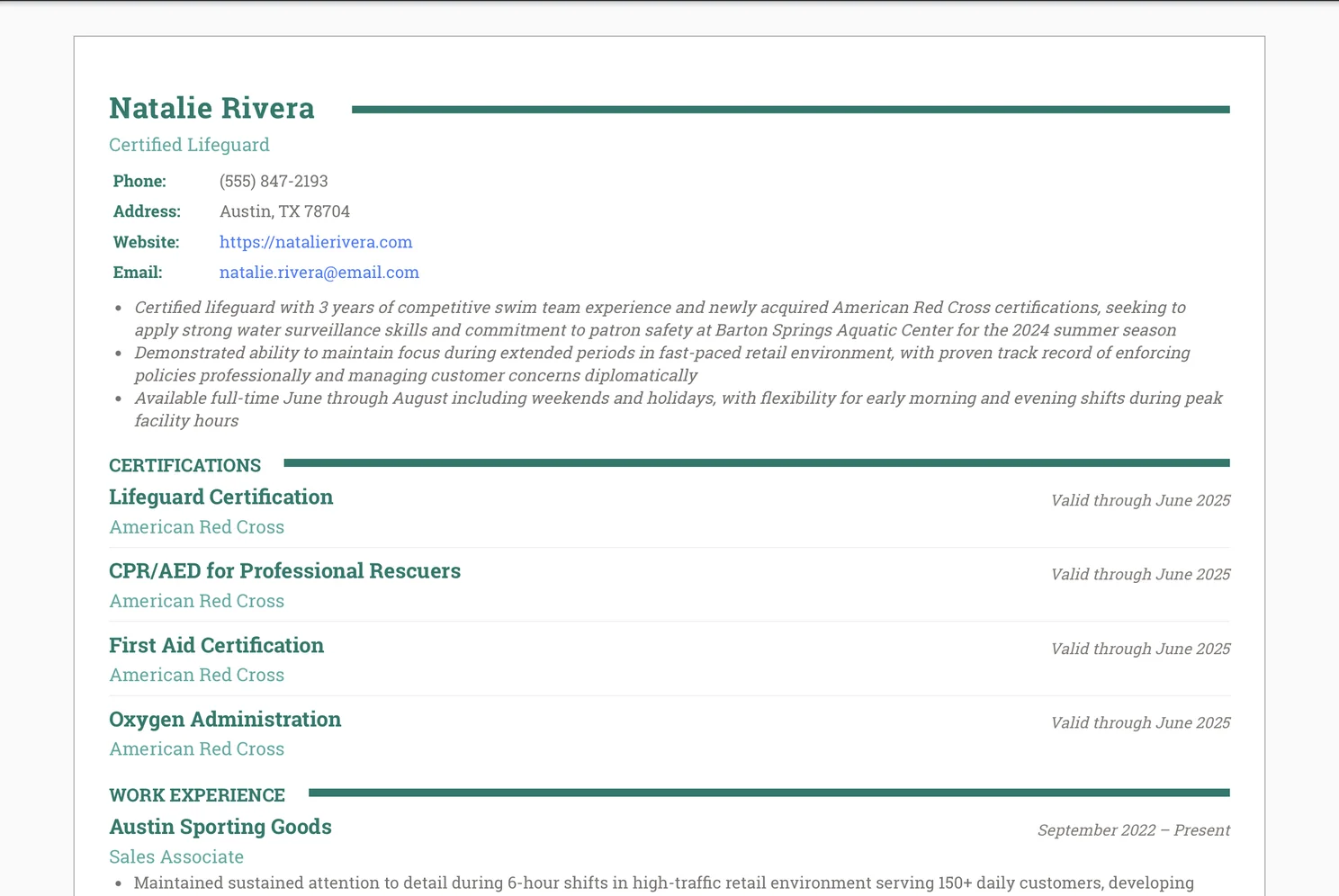
Introduction
You're staring at a blank document, cursor blinking, trying to figure out how to turn "I can swim well and I'm CPR certified" into something that convinces an aquatics director to trust you with the safety of everyone at their facility. It's a strange challenge, isn't it? You're applying for a position that's fundamentally about vigilance, physical capability, and split-second decision-making under pressure, yet somehow you need to convey all of that through bullet points on a page. If you're a high school student applying for your first real job, this might feel especially overwhelming. If you're a returning lifeguard trying to move from one facility to another, you're wondering how to make your experience stand out when "watched people swim" describes basically everyone who's ever done this work.
Either way, you're here because you need to see what a strong lifeguard resume actually looks like and understand how to build one that gets you the interview.
Here's what you need to know right up front. Lifeguarding is an entry-level position in most contexts, but it's not a casual one. You're not applying to stock shelves or answer phones. You're asking to be responsible for preventing drownings, responding to medical emergencies, and maintaining order in an environment where things can go wrong very quickly. The person reading your resume knows this. They're not looking for elaborate career narratives or creative formatting. They're scanning for current certifications, relevant experience, and evidence that you understand the seriousness of what you're signing up for. Your resume needs to communicate competence, reliability, and readiness, all while fitting on a single page that someone can review in under a minute during a busy hiring season.
This guide walks you through everything you need to create a lifeguard resume that actually works. We'll start with the format you should use (spoiler alert - it's reverse-chronological, and we'll explain exactly why). Then we'll dig into how to present your work experience in a way that goes beyond generic duty lists and actually demonstrates your impact, even if you only worked one summer. We'll cover the skills section and how to balance your technical certifications with the interpersonal abilities that prevent emergencies before they happen. You'll see how to handle your education section when you're still in high school or when your degree has nothing to do with aquatics. We'll address the specific considerations that matter for lifeguard applications - how to talk about rescue experience professionally, how to handle seasonal employment gaps, how to tailor your resume to different facility types, and how to present yourself whether you're sixteen and applying for your first job or thirty and changing careers.
We'll also cover the supporting elements that strengthen your application - when and how to write a cover letter that shows you understand what the job actually requires, how to prepare your references so they're ready when facilities call, and how to present any awards or recognition you've received in ways that matter to hiring managers. By the end, you'll have a clear picture of what belongs on your lifeguard resume, what to emphasize based on your specific situation, and how to avoid the common mistakes that make applications blend into the pile rather than rise to the top. Whether you're applying to a calm community pool, a chaotic water park, an ocean beach, or an elite country club, you'll know how to position yourself as someone who takes water safety seriously and can be trusted with the responsibility that comes with the whistle and rescue tube.
The Ultimate Lifeguard Resume Example/Sample
https://www.resumonk.com/lifeguardLifeguardResume Format to Follow for Your Lifeguard Resume
When you're applying for a lifeguard position, you're entering a field where your ability to respond quickly, demonstrate proven certifications, and show reliable work history matters far more than elaborate career narratives.
Think about what the aquatics director or pool manager is doing when they're looking at your resume - they're scanning for certifications first, then looking for where you've worked, and finally checking if you have the right mix of vigilance and people skills. This isn't a role where creative resume formats help you; it's one where clarity and quick information retrieval win every time.
The Reverse-Chronological Format Is Your Best Friend
For lifeguard positions, the reverse-chronological resume format is unquestionably the way to go.
This format lists your most recent experience first and works backward through your history. Why does this matter for you? Because hiring managers at pools, beaches, water parks, and recreation centers need to see immediately that your certifications are current and that you have recent, relevant experience. If you worked as a lifeguard last summer, that's infinitely more relevant than your high school volunteer work from three years ago, and the reverse-chronological format puts that front and center.
This format works particularly well if you're a returning lifeguard who has worked multiple seasons, if you're moving from one aquatic facility to another, or if you're a first-time applicant who has recently completed lifeguard training. The structure is straightforward: contact information at the top, followed by a brief summary or objective (optional but useful for entry-level candidates), then your certifications, work experience, education, and skills. Notice that certifications often come before or alongside your work experience section for lifeguard roles - this isn't standard across all industries, but it's critical here because an expired CPR certification means you literally cannot do the job.
When Alternative Formats Might Apply
There are limited scenarios where you might consider a functional or combination resume format. If you're a career-changer who has extensive experience in emergency response, healthcare, or athletics but limited pool-specific experience, a combination format could help you highlight transferable skills while still showing your work history. However, even in these cases, you'll want to be cautious. Most aquatics facilities hire lifeguards who can demonstrate they know pool operations, not theoretically transferable skills.
The hiring manager needs to trust you with lives, and the fastest way to build that trust is showing them you've already done this work before.
If you're a student applying for your first lifeguard position and your only work experience is in retail or food service, don't panic about the format. The reverse-chronological format still works. You'll simply emphasize your newly acquired certifications, any volunteer work with children or in aquatic settings, and relevant skills from your other jobs like customer service, attention to detail, and working in fast-paced environments.
The structure remains the same; you're adapting the content to match your situation.
Length and Structure Considerations
Your lifeguard resume should be one page. Full stop. Even if you've been a head lifeguard or aquatics supervisor for years, the nature of this role doesn't require the extensive documentation that other positions might. Hiring managers are reviewing dozens of applications for seasonal positions or part-time roles, and they need to assess your qualifications quickly.
A concise, well-organized single page demonstrates that you understand the role and can communicate efficiently - both important traits for someone who might need to give clear instructions during an emergency.
Keep your margins reasonable (around 0.5 to 1 inch), use clear section headings, and ensure there's enough white space that the document doesn't feel cramped. Remember that the person reading this might be doing so by the pool office between shifts or during a busy hiring season when they're processing many applications.
Make their job easier by being scannable and organized.
Showcasing Work Experience on Your Lifeguard Resume
Your work experience section is where you prove you can actually do this job.
But here's the thing about lifeguard experience - it can feel repetitive to write about because the core responsibilities are fairly standard across facilities. You watched the water, you enforced rules, you maintained cleanliness, and hopefully, you responded to emergencies. Every lifeguard does these things. So how do you make your experience stand out when the job itself is relatively uniform? The answer lies in being specific about your environment, quantifying your impact, and highlighting the moments that required judgment and skill.
Structuring Each Work Experience Entry
Start with the basics: job title, facility name, location (city and state/province), and dates of employment.
For lifeguards, it's perfectly acceptable to list seasonal work with date ranges like "May 2023 - August 2023" rather than worrying about the gaps during the school year. Hiring managers in aquatics expect seasonal patterns.
Under each position, use bullet points to describe your responsibilities and achievements. This is where most lifeguard resumes go wrong.
They list generic duties that could apply to any lifeguard anywhere, missing the opportunity to show what made their contribution valuable.
Moving Beyond Generic Duty Lists
The weakest lifeguard resumes read like job descriptions.
The strongest ones read like performance records. Let's look at the difference:
❌ Don't write generic duties without context:
Monitored swimmers and enforced pool rules
Performed rescues when necessary
Cleaned pool area
✅ Do provide specific context and measurable details:
Maintained surveillance over 200+ daily visitors at high-traffic community pool, preventing incidents through proactive rule enforcement and swimmer education
Executed 3 water rescues and 12+ first aid interventions during summer 2023 season, with all individuals receiving appropriate care
Conducted daily chemical testing and maintained pool chemistry within optimal ranges, contributing to zero health code violations during employment period
Notice the difference? The second version tells the hiring manager about the scale of your responsibility, the volume of people you managed, and your actual track record. It transforms "I did the job" into "I did the job well, and here's the evidence."
Highlighting Different Facility Types and Responsibilities
Not all lifeguard positions are created equal, and your resume should reflect the specific challenges of your environment. A beach lifeguard deals with rip currents, marine life, and unpredictable conditions. A water park lifeguard manages high-speed attractions and large crowds. A country club lifeguard might have more direct interaction with members and their children. A YMCA lifeguard often assists with swim lessons and youth programs.
Make sure your bullet points reflect these distinctions.
If you worked at a beach, mention your experience with ocean conditions, your training in scanning techniques for open water, and any rescues involving environmental factors. If you worked at a water park, emphasize crowd management, attraction-specific safety protocols, and your ability to maintain vigilance during high-volume periods.
If you worked at a residential community pool, highlight your relationship-building with regular patrons and your ability to enforce rules diplomatically with residents.
Addressing Progressions and Additional Responsibilities
If you've been promoted or taken on additional responsibilities, make sure these are clear in your resume.
Did you start as a lifeguard and become a head lifeguard or shift supervisor? Did you train new lifeguards? Were you responsible for opening or closing procedures? Did you handle cash for swim lesson registrations or guest passes? These additional duties show reliability, trust, and leadership - qualities that hiring managers value.
❌ Don't bury progression in generic descriptions:
Lifeguard/Head Lifeguard
Worked at pool for three summers, eventually becoming head lifeguard
Responsible for all normal lifeguard duties
✅ Do clearly delineate progression and added responsibilities:
Head Lifeguard (Summer 2023)
Led team of 8 lifeguards across daily shifts, creating rotation schedules and conducting in-service training sessions
Managed emergency response protocol, serving as incident commander for 2 major medical situations
Performed supervisory duties including staff evaluation, conflict resolution, and communication with facility management
Lifeguard (Summers 2021-2022)
Provided water surveillance for lap swimmers and recreational users at municipal aquatic center
Completed 15+ hours of continuing education annually, maintaining current certifications in CPR, First Aid, and AED use
What to Do If You Have Limited Lifeguard Experience
If you're applying for your first lifeguard position, you obviously won't have lifeguard experience to list.
This is completely normal and expected. Instead, focus on relevant experience from other contexts. Did you work in customer service? That's relevant for managing pool patrons and enforcing rules tactfully. Did you play competitive sports? That shows you understand athletic environments and water comfort. Did you volunteer with children's programs? That's valuable for family-friendly pool environments. Did you work in any role that required vigilance and attention to detail, like security, retail loss prevention, or childcare? Draw those connections explicitly.
❌ Don't leave experience unconnected to the lifeguard role:
Cashier, Local Grocery Store
Scanned items and handled customer transactions
Stocked shelves and maintained clean work area
✅ Do draw explicit connections to lifeguard-relevant skills:
Cashier, Local Grocery Store
- Maintained focus during 6-hour shifts in fast-paced environment, developing sustained attention skills applicable to water surveillance
- Resolved customer concerns professionally, demonstrating communication abilities essential for enforcing pool safety rules
- Worked reliably across varied schedules including weekends and holidays, showing availability for peak aquatic facility hours
Essential Skills to Highlight on Your Lifeguard Resume
Skills sections on resumes can feel like an afterthought - a place to dump a list of buzzwords and hope something sticks. But for a lifeguard resume, your skills section serves a very specific purpose. It's where you demonstrate that you have the technical certifications, physical capabilities, interpersonal abilities, and judgment required to keep people safe in and around water.
The hiring manager needs to see at a glance that you're not just interested in sitting by a pool; you're prepared to prevent, recognize, and respond to aquatic emergencies.
Certifications Come First
Technically, certifications might deserve their own section on your resume (and many lifeguard resumes do structure it this way), but they're so fundamental to your skill set that they warrant discussion here.
Your current certifications are non-negotiable requirements, not nice-to-have additions. Without them, you cannot legally work as a lifeguard. List them prominently with the certifying organization and expiration date.
✅ Format certifications clearly with all necessary details:
Certifications:
Lifeguard Certification - American Red Cross (Expires: May 2025)
CPR/AED for Professional Rescuers - American Red Cross (Expires: May 2025)
First Aid - American Red Cross (Expires: May 2025)
Oxygen Administration - American Red Cross (Expires: May 2025)
If you're in the process of obtaining certifications, you can note this, but be honest about your timeline. Some facilities will hire you contingent on completing certification, but many won't consider you until you're fully certified. If you hold additional relevant certifications - Water Safety Instructor (WSI), Lifeguard Instructor, Certified Pool Operator (CPO), or specialized certifications for waterfront or water park environments - these strengthen your application significantly.
Technical and Physical Skills
Lifeguarding requires specific physical competencies that not every applicant possesses. While your certifications prove you passed the minimum requirements, your skills section can elaborate on your capabilities. Can you swim extended distances? Are you comfortable with deep water rescues? Do you have experience with various rescue equipment like rescue tubes, backboards, or rescue boards?
Have you used AEDs in real situations, not just training?
These technical skills also extend to pool operations if you have that experience. Chemical testing and balance, pool filtration systems, facility maintenance, and understanding health code compliance are all valuable skills that distinguish you from candidates who can only perform the surveillance function.
✅ Be specific about technical capabilities:
- Strong swimmer with endurance for extended surveillance periods and rapid emergency response
- Proficient in rescue tube and backboard techniques across various water depths and conditions
- Experienced with pool chemical testing, chlorine/pH adjustment, and maintenance of safe water quality
- Knowledgeable in pool equipment operation including filtration systems, pump rooms, and cleaning equipment
Interpersonal and Judgment Skills
Here's what many lifeguard applicants miss - this job isn't only about physical capability and emergency response. Much of lifeguarding is about prevention, which requires communication, authority, and judgment. You need to tell a group of teenagers to stop running without escalating the situation. You need to inform a parent that their child isn't ready for the deep end without offending them. You need to decide when someone's rough play crosses the line into dangerous behavior.
You need to remain calm when someone is panicking.
These interpersonal skills are harder to quantify but essential to include. Use your skills section to highlight abilities like:
- Clear communication in high-stress situations
- Conflict resolution and de-escalation techniques
- Ability to enforce rules with diplomacy and consistency
- Strong observational skills and situational awareness
- Team collaboration during emergencies and daily operations
- Patience and professionalism with diverse populations including children, elderly, and individuals with disabilities
Balancing Hard Skills and Soft Skills
Your skills section should include both technical competencies and interpersonal abilities.
A common approach is to create two subsections or to integrate them into a single list that flows logically. The key is ensuring that someone scanning your resume quickly sees both your emergency response capabilities and your day-to-day operational strengths.
❌ Don't create a vague list of generic skills:
Skills:
Good swimmer
Responsible
Hard worker
Team player
CPR certified
✅ Do provide a comprehensive, specific skills inventory:
Core Competencies:
- Emergency Response: Water rescue, CPR/AED, First Aid, oxygen administration, spinal injury management
- Surveillance & Prevention: Continuous scanning techniques, hazard identification, proactive rule enforcement
- Technical: Pool chemistry testing, equipment maintenance, facility safety inspections
- Communication: Clear instruction delivery, conflict de-escalation, emergency coordination with EMS
- Physical: Strong swimming endurance, comfort in varied water conditions, ability to perform physically demanding rescues
Skills That Set You Apart
If you have skills beyond the standard lifeguard competencies, include them. Bilingual abilities are incredibly valuable in many communities. Teaching experience (swimming instruction, swim team coaching, water aerobics) shows you can do more than guard. Supervisory or scheduling experience demonstrates leadership potential.
Even skills from outside aquatics can be relevant - if you're trained in crisis counseling, behavioral management, or have medical training beyond standard first aid, these distinguish you from other candidates.
Think about what the facility needs beyond basic surveillance. A residential community might value someone who can also teach swim lessons. A municipal pool might need someone who can help with special events. A beach might value someone with boating or paddleboard experience. A water park might need someone comfortable with height and speed.
Tailor your skills section to match not just the baseline role requirements, but the specific context of where you're applying.
Specific Considerations and Tips for Your Lifeguard Resume
Now that we've covered the fundamental structure of your resume, let's talk about the nuances that specifically apply to lifeguard applications - the things that might not be obvious if you're new to aquatic employment or transitioning from other types of work. These considerations can make the difference between a resume that gets filed away and one that leads to an interview.
The Seasonality Factor and Employment Gaps
Lifeguarding is inherently seasonal for most facilities, and hiring managers know this. You don't need to apologize for or explain gaps between summer seasons if you're a student. However, you should be strategic about how you present year-round availability if you have it, or how you demonstrate consistency if you've worked multiple seasons at the same facility.
If you're applying for a year-round position at an indoor facility, make sure your resume doesn't accidentally signal that you're only available for summer work.
If you've worked at the same facility across multiple summers, consider whether to list these as separate entries or as one entry with a date range like "Summers 2021-2023." Both approaches work, but consolidating can save space and show loyalty, while separating allows you to show progression if your responsibilities increased each season.
Addressing Rescue Experience Thoughtfully
This is a delicate balance.
On one hand, actual rescue experience demonstrates that you can perform under pressure and handle real emergencies - exactly what hiring managers want to know. On the other hand, you don't want to present a facility as dangerous or yourself as someone who frequently encounters emergencies due to inattention (which would raise red flags about your preventive surveillance skills).
The solution is to be factual and professional. If you performed rescues, mention them with appropriate context. Note the number and types of incidents, but frame them within the broader context of your surveillance work. A rescue performed successfully is a demonstration of competence. Multiple rescues at a high-traffic facility show you work in a demanding environment and handle it well. The key is avoiding sensationalism while still getting credit for your emergency response experience.
✅ Frame emergency response professionally:
Responded to 4 water emergencies during 2023 season, including 2 active drowning rescues and 2 distressed swimmer assists, successfully managing each situation with appropriate protocols and follow-up care
This phrasing shows competence without dwelling on drama. It demonstrates that you recognize different levels of emergency, that you respond appropriately, and that you follow through with proper procedures.
References and Background Checks
While this isn't unique to lifeguarding, it's worth noting that aquatic facilities take background checks and references very seriously. You're working with children and in a safety-critical role. Many facilities require fingerprinting, criminal background checks, and reference checks as standard hiring procedures.
Be prepared for this by having professional references ready (previous supervisors, coaches, teachers, or community leaders - not friends or family) who can speak to your reliability, judgment, and character.
You don't need to list references directly on your resume (the line "References available upon request" is optional and somewhat outdated), but have them prepared in a separate document. More importantly, make sure your resume doesn't contain anything that would raise concerns in a background-check context.
Be honest about employment dates and responsibilities.
Tailoring to Facility Types
A resume for a calm country club pool should be slightly different from one for a wave pool at a water park, which should differ from one for ocean beach lifeguarding.
While your core qualifications remain the same, emphasize different aspects of your experience and skills based on where you're applying. Research the facility. If it's family-oriented, emphasize your patience with children and parents. If it's a competitive swim venue, highlight any swim team or competitive swimming background. If it's a rowdy water park, emphasize crowd management and your ability to enforce rules consistently in high-volume environments.
This doesn't mean creating entirely different resumes for each application, but it does mean adjusting your summary statement and potentially reordering bullet points to lead with the most relevant experience for each specific facility.
The Age and Experience Balance
Many lifeguards are teenagers or young adults in their first or second jobs. If this is you, don't try to hide your age or pad your experience artificially. Hiring managers expect younger applicants for these positions. What they're looking for is maturity, responsibility, and seriousness about the role. If you're a high school student with limited work experience, your resume might be shorter, but it should still be professional and well-organized.
Include relevant coursework if applicable (like if you took a health or anatomy class), include volunteer work, include sports or activities that demonstrate reliability and teamwork.
Conversely, if you're an older applicant or someone with extensive professional experience in other fields, don't let your resume be overwhelming. A 40-year-old career changer doesn't need to include their entire corporate career history when applying for a lifeguard position. Focus on the most relevant recent experience and skills that transfer to aquatics.
Your maturity and life experience are assets, but the hiring manager still needs to see that you understand this is a specific role with specific requirements.
Including Education Appropriately
For most lifeguard positions, extensive education details aren't necessary.
If you're a current high school student, list your school and expected graduation year. If you're in college, list your institution, major, and expected graduation year. If you've already completed your education, a simple line with your degree and institution is sufficient. You don't need to include GPA unless it's exceptional and you're a current student with limited work experience who needs to demonstrate competence through academic achievement.
If you've taken relevant coursework (kinesiology, exercise science, recreation management, emergency medical services), you can mention this briefly, especially if you lack extensive work experience. But remember that for lifeguarding, your certifications and demonstrated skills matter more than your academic credentials.
The Summary Statement: To Include or Not?
A summary or objective statement at the top of your resume is optional for lifeguard positions. If you're a first-time applicant, a brief objective statement can frame your application and show enthusiasm for the role. If you're an experienced lifeguard, a summary can quickly establish your qualifications and differentiate you from entry-level candidates.
However, if these statements aren't adding real value, skip them and let your certifications and experience speak for themselves.
❌ Don't write vague, generic objective statements:
Objective: To obtain a lifeguard position where I can use my skills and gain experience in a professional environment.
✅ Do write specific, value-focused statements:
Recently certified lifeguard with strong swimming background from 8 years of competitive swim team experience, seeking to apply vigilance, physical stamina, and commitment to water safety at Riverside Community Pool's 2024 summer season.
Or for experienced candidates:
Experienced lifeguard with 4 seasons of high-volume water park surveillance, Head Lifeguard leadership experience, and perfect safety record across 400+ shifts. Seeking to contribute emergency response expertise and staff training capabilities to Splash Zone Water Park.
Availability and Scheduling
While you wouldn't typically include detailed scheduling information on the resume itself, be prepared to address availability clearly in your cover letter or application. Many aquatic facilities need specific coverage (early mornings, evenings, weekends), and being upfront about your availability helps match you to appropriate positions. If you have complete flexibility, that's a selling point. If you have constraints but can still cover peak times, that's usually workable.
What frustrates hiring managers is discovering scheduling conflicts late in the process, so clarity is appreciated.
Professionalism in Contact Information
This might seem basic, but it matters particularly for lifeguard applications where many candidates are young and might not have experience with professional correspondence.
Your email address should be professional - ideally some variation of your name, not a nickname or joke address. Your voicemail should be set up and professional. You might be comfortable texting with friends, but hiring managers might call, so be prepared for professional phone contact. These small details signal that you take the opportunity seriously.
Finally, proofread ruthlessly. A resume with typos suggests carelessness, which is exactly what you cannot afford to convey when applying for a safety-critical position. You're asking to be trusted with people's lives - demonstrate through your application materials that you pay attention to details, follow through completely, and take your responsibilities seriously.
That mindset, conveyed through a clean, well-organized, thoughtfully crafted resume, is what will move your application from the pile to the interview.
Education to List on a Lifeguard Resume
Most lifeguard applicants are high school students, recent graduates, college students looking for summer work, or young adults seeking flexible employment. This means your education section might feel thin compared to someone with multiple degrees, and that's completely fine.
What hiring managers at aquatic facilities, recreation centers, and beaches actually want to see is that you have the basic educational foundation and, more importantly, the right certifications.
High School Education: How to Present It
If you're currently in high school or recently graduated, list your high school with your expected or actual graduation date. Keep it simple and straightforward. There's no need to overthink this part. Include your GPA if it's 3.0 or above, as it shows responsibility and consistency, traits that matter when you're responsible for people's safety.
❌ Don't write it like this:
Education
High School Student
✅ Do write it this way:
Lincoln High School, San Diego, CA
High School Diploma | Expected May 2024
GPA: 3.6/4.0
College Education: Current Students and Graduates
If you're in college or have completed a degree, list it in reverse-chronological order. Even if your major is Medieval Literature or Mechanical Engineering, it still belongs on your resume because it demonstrates your ability to commit to long-term goals and manage responsibilities. However, don't expect your degree to carry the weight here.
A lifeguard position cares more about your CPR certification than your coursework in Organic Chemistry.
❌ Don't burden your resume with excessive detail:
University of Florida, Gainesville, FL
Bachelor of Arts in Communications | 2022-Present
Relevant Coursework: Public Speaking, Interpersonal Communication, Media Studies, Communication Theory, Advanced Writing
Dean's List: Fall 2022, Spring 2023
Member of Communications Club
✅ Do keep it focused and clean:
University of Florida, Gainesville, FL
Bachelor of Arts in Communications | Expected May 2025
GPA: 3.4/4.0
The Certifications Section: Where the Real Action Happens
Now we get to what actually matters.
Your lifeguard certifications aren't just nice-to-haves; they're the entire reason you're qualified for this job. These should be listed either as a separate "Certifications" section immediately after your education, or even before it, depending on what stage you're at in your educational journey. If you're in high school, putting certifications first makes sense. If you have a college degree, the traditional order works fine.
List every relevant certification with the issuing organization and the expiration date. This is critical because expired certifications are worthless in this field, and hiring managers need to know your credentials are current. American Red Cross and Ellis & Associates are the most common certifying bodies in the United States, while the Royal Life Saving Society is prevalent in Canada, the UK, and Australia.
✅ Here's how to format your certifications properly:
Certifications
1. Lifeguard Certification | American Red Cross | Valid through August 2025
2. CPR/AED for Professional Rescuers | American Red Cross | Valid through August 2025
3. First Aid Certification | American Red Cross | Valid through August 2025
4. Oxygen Administration | American Red Cross | Valid through August 2025
Special Training and Additional Qualifications
If you've completed specialized training beyond basic lifeguarding—such as waterfront lifeguarding, waterpark lifeguarding, or lifeguard instructor certifications—these deserve prominent placement. They differentiate you from candidates with only basic credentials. Similarly, if you've taken courses in child safety, pool operations, or swim instruction, mention them.
These additions show initiative and a deeper commitment to aquatic safety.
For candidates in the UK, Canada, or Australia, make sure you're using the terminology and certification bodies relevant to your region. In Canada, the Lifesaving Society certifications (National Lifeguard Service, Standard First Aid) are standard.
In the UK and Australia, you'd reference Royal Life Saving Society qualifications or Surf Life Saving Australia credentials if applying for beach positions.
When Education Feels Incomplete
Maybe you didn't finish high school in the traditional way, or you're working on your GED.
That's nothing to hide or feel awkward about. Simply list what you have. If you're currently pursuing your GED, you can write "GED in Progress | Expected completion June 2024." Lifeguard positions are accessible to people from many educational backgrounds because the job is fundamentally about your training, maturity, and ability to respond in emergencies, not about where you went to school.
Awards and Publications on a Lifeguard Resume
Let's be honest: you're probably not publishing peer-reviewed articles on hydrodynamic rescue techniques or winning the Nobel Prize for Pool Safety.
Lifeguarding is a practical, hands-on role, and the awards and publications section on most lifeguard resumes will either be very short or nonexistent. And that's perfectly okay. This isn't a research position or an executive role where your thought leadership matters. But if you do have relevant recognition or achievements, there's absolutely a place for them, and knowing how to present them effectively can give you an edge.
What Counts as an Award for a Lifeguard Resume?
When we talk about awards in this context, we're looking at recognition that demonstrates excellence, reliability, or leadership in safety, athletics, customer service, or community involvement. Did you receive Employee of the Month at your pool? That belongs here. Were you recognized by your school for perfect attendance? That shows dependability. Did you earn an athletic award for swimming, water polo, or diving?
That's directly relevant because it proves your comfort and competence in the water.
Think about awards broadly. Academic honors like Honor Roll or Dean's List demonstrate conscientiousness. Community service awards show you care about helping others, which aligns perfectly with lifeguarding's service orientation. Even scouting achievements like reaching Eagle Scout or Gold Award indicate leadership and commitment, qualities that matter when you're responsible for patron safety.
❌ Don't list irrelevant or trivial awards:
Awards
- 2nd Place, Middle School Spelling Bee (2018)
- Participant Ribbon, Community Fun Run (2019)
- Honorable Mention, Art Class (2020)
✅ Do focus on meaningful recognition:
Awards & Recognition
- Employee of the Month, Riverside Aquatic Center (June 2023)
- Varsity Swimming Team Captain, Lincoln High School (2023-2024)
- Presidential Volunteer Service Award, Gold Level (2023)
- Honor Roll, All Semesters (2020-2024)
Lifeguard-Specific Recognition
If you've been recognized specifically for your work as a lifeguard—whether that's for a rescue you performed, for exceptional attendance, for leadership among your guard team, or for going above and beyond in your duties—that needs to be front and center.
These are the awards that directly speak to your competence in the role you're applying for. A "Lifeguard of the Year" award or recognition for a successful rescue carries infinitely more weight than your participation in student government.
✅ Example of lifeguard-specific recognition:
Professional Recognition
- Lifeguard of the Summer, Clearwater Beach Municipal Pool (2023)
- Recognized for successful rescue and emergency response, preventing potential drowning incident (July 2023)
- Perfect Attendance Award, City Recreation Department (2022, 2023)
What About Publications?
Unless you're applying for an aquatics director position or some specialized role that involves research or program development, you almost certainly don't have publications relevant to a lifeguard position, and that's completely expected. Publications in this context would mean articles you've written for trade magazines, contributions to safety manuals, blog posts about water safety for a recognized organization, or similar formal writing.
If you did write something—say, an article for your school newspaper about water safety, or a blog post for your local recreation department about sun protection—you can include it. But don't force this section into existence if you have nothing to put there. Most lifeguard resumes won't have a publications component, and hiring managers won't be looking for one.
If you do have something legitimate to include, format it properly with the title, publication, and date:
Publications
- "Water Safety Tips for Families," Riverside Recreation Department Blog, June 2023
- "My Experience as a Teen Lifeguard," Lincoln High School Newspaper, September 2023
When to Skip This Section Entirely
If you don't have awards or publications that are relevant and meaningful, don't create this section just to have it. A resume is not a form where you need to fill in every possible field. It's better to have a strong skills section, a detailed experience section, and a robust certifications section than to pad your resume with a thin awards section that lists your middle school perfect attendance certificate.
Focus your space on what actually matters: your certifications, your experience, and your ability to keep people safe.
Listing References for Lifeguard Resume
References can feel like one of those resume elements that exists in a weird gray area.
Do you list them directly on your resume? On a separate page? Do you bring them to the interview? Do you just write "References available upon request" and call it done? For lifeguard positions, where you're often young and applying for your first or second real job, the reference question can feel especially murky. Let's clear that up.
The Basic Rule: Prepare Them, But Don't Put Them on Your Resume
In most cases, you should not list your actual references directly on your lifeguard resume. Your resume real estate is valuable, and contact information for three people takes up space better used for your certifications, skills, and experience.
Instead, prepare a separate references document that you can provide when requested, and have it ready to go at all times during your job search.
The one exception: if the job posting specifically requests that you include references with your application, then obviously do that. But even then, consider putting them on a separate page with the same header formatting as your resume to keep everything looking cohesive and professional.
Who Should Be Your References?
For a lifeguard position, you want references who can speak to your reliability, maturity, work ethic, ability to follow instructions, and competence in high-pressure or safety-related situations.
Ideally, you want a mix of professional and educational references. If you've had previous jobs, former supervisors are gold. If you're applying for your first position, teachers, coaches, scout leaders, volunteer coordinators, or family friends who've employed you for babysitting or yard work can all serve as references.
What you're looking for is someone who can credibly tell a hiring manager: "Yes, this person shows up on time, follows through on commitments, stays calm under pressure, and takes responsibility seriously." Those are the qualities that matter for lifeguarding.
❌ Don't list friends, peers, or relatives:
References
- Jake Martinez, Best Friend, (555) 123-4567
- Sarah Williams, Cousin, (555) 234-5678
- Uncle Mike, Family Member, (555) 345-6789
✅ Do list people who supervised you professionally or knew you in a formal capacity:
References

1. Jennifer Martinez, Manager, Riverside Café
- Phone: (555) 123-4567 | Email: [email protected]
- Supervised my work as a server for 18 months

2. David Chen, Varsity Swim Coach, Lincoln High School
- Phone: (555) 234-5678 | Email: [email protected]
- Coached me for three years; can speak to my discipline and teamwork

3. Rebecca Thompson, Volunteer Coordinator, City Community Center
- Phone: (555) 345-6789 | Email: [email protected]
- Supervised my volunteer work teaching children's swim lessons
How to Format Your References Document
Create a separate document titled "References" with the same header as your resume, including your name and contact information at the top. This makes it look professional and ensures that if the pages get separated, they can still identify whose references these are.
For each reference, include their full name, their professional title or relationship to you, their organization or affiliation, their phone number, their email address, and optionally a brief note about your relationship or what they can speak to. List three to four references—three is standard, four gives them options if someone is unreachable.
✅ Proper formatting for a references page:
REFERENCES
1. Maria Gonzales, Store Manager, Riverside Sports & Recreation
- Phone: (555) 111-2222 | Email: [email protected]
- Relationship: Supervised my work as a sales associate for one year; can speak to customer service skills and reliability
2. Dr. Patricia O'Neill, Biology Teacher, Lincoln High School
- Phone: (555) 333-4444 | Email: [email protected]
- Relationship: Taught me for two years; can speak to my responsibility and ability to follow detailed instructions
3. Marcus Williams, Head Lifeguard, Clearwater Beach Municipal Pool
- Phone: (555) 555-6666 | Email: [email protected]
- Relationship: Supervised my lifeguard training and certification process; can speak to my swimming ability and safety awareness
Always Ask Permission First
This should go without saying, but never list someone as a reference without asking them first.
Reach out to each person, explain that you're applying for lifeguard positions, ask if they'd be willing to serve as a reference, and give them context about what you'd like them to emphasize. Most people are happy to help, but they deserve advance warning rather than getting a surprise call from a potential employer.
When you ask, you might say something like: "I'm applying for a lifeguard position at Riverside Pool, and I was hoping you'd be willing to serve as a reference. They'll likely ask about my reliability and ability to handle responsibility. Would you be comfortable speaking to those qualities based on our time working together at the café?"
This gives your reference a heads-up about what to expect and what to emphasize.
Keeping Your References Updated
Before you start your job search, reach out to your references to confirm their current contact information and let them know you'll be applying for positions. If you get an interview, give them another heads-up that they might be contacted soon. If you accept a position, let them know and thank them for their support.
Maintaining these relationships professionally reflects well on you and ensures your references remain willing to help you in future job searches.
Special Considerations for Regional Differences
In the United States, the standard practice is to prepare references separately and provide them when requested.
In the UK, references are often expected earlier in the process, and some applications may specifically request referee details upfront. In Canada and Australia, practices are similar to the US, with references typically provided upon request rather than included with initial applications.
Always follow the specific instructions in the job posting for your region.
When Lifeguard References Really Matter
References become especially important if you're applying for a head lifeguard, lifeguard supervisor, or aquatics instructor role. In these cases, having a reference who can speak to your leadership, teaching ability, or advanced water safety skills becomes crucial.
If you're moving into these higher-responsibility positions, consider whether you have references who can address these specific competencies, and if not, think about how you can gain experience that would give you access to such references.
Cover Letter Tips for Lifeguard Resume
So you've got your resume together, your certifications are current, and you're ready to apply. Now comes the question that makes everyone pause: do you actually need a cover letter for a lifeguard position? The answer is maybe, but when done right, it can absolutely help you stand out. Let's think about this from the hiring manager's perspective. They're sorting through dozens of applications from teenagers and young adults, most of whom have similar certifications and limited work experience.
Your cover letter is your chance to show personality, demonstrate genuine interest, and explain why you'd be a reliable, engaged member of their team.
When a Cover Letter Actually Matters
If you're applying to a community pool through an online form that doesn't offer space for a cover letter, you probably don't need to force one in. But if the application specifically requests one, or if you're emailing your resume directly to a facility manager or recreation director, absolutely include a cover letter.
It shows professionalism and effort, two qualities that matter enormously when you're trying to prove you're mature enough to handle life-or-death responsibilities.
The cover letter is especially valuable if you're a younger applicant with minimal work experience, if you're applying somewhere competitive like a popular beach or resort, or if you're trying to move into a head lifeguard or supervisor position. It gives you space to tell your story in a way the bullet points on your resume simply can't.
Opening Strong: Make It Personal and Specific
Don't open with "To Whom It May Concern" or "Dear Hiring Manager" if you can possibly avoid it.
Do five minutes of research to find the name of the aquatics director, recreation supervisor, or facility manager. Check the facility's website, call and ask, or look on LinkedIn. Addressing your letter to a real person immediately sets you apart from applicants who used a generic template.
Your opening paragraph should state the position you're applying for and give a compelling reason why you're interested in this specific facility. Don't just say you "love swimming" or "enjoy working with people." That's what everyone says. Be specific about what drew you to this particular position.
❌ Don't write a generic opening:
Dear Hiring Manager,
I am writing to apply for the lifeguard position. I am certified in lifeguarding and CPR. I think I would be a good lifeguard because I like swimming and being outside.
✅ Do write something specific and engaging:
Dear Ms. Rodriguez,
I'm writing to apply for the lifeguard position at Riverside Community Pool for the 2024 summer season. As a local resident who learned to swim in your facility as a child, I've watched your lifeguard team create a safe, welcoming environment for families, and I'm eager to contribute to that mission as a newly certified American Red Cross lifeguard.
The Middle: Prove You Understand What the Job Actually Requires
This is where you demonstrate that you get what lifeguarding is really about. It's not a pool-side tanning session. It's constant vigilance, communication with teammates, enforcement of rules even when patrons push back, quick decision-making under pressure, and the physical and mental stamina to stay alert during long shifts in the sun.
Use your middle paragraphs to show you understand these realities and that you have qualities or experiences that prepare you for them.
Maybe you played competitive sports, which taught you focus and teamwork. Maybe you babysat regularly, which developed your ability to stay calm when managing children. Maybe you worked retail and learned to handle difficult customer situations professionally. Connect your background to the specific demands of lifeguarding, and support your claims with brief examples.
✅ Here's how to make meaningful connections:
- During my three years on the varsity swim team, I developed the endurance and water confidence essential for effective lifeguarding. More importantly, I learned to stay focused during long practices and to support my teammates under pressure—skills that translate directly to maintaining vigilance during shifts and coordinating with other guards during emergency responses.

- Through my part-time position at Riverside Café, I've become comfortable enforcing policies and handling situations where customers initially resist rules. I understand that lifeguarding requires the same professional firmness, whether I'm asking children to walk on the deck or adults to follow pool capacity rules.
Address Your Availability Clearly
Aquatic facilities need to know when you can work. Summer-only availability? Willing to work weekends and holidays? Available year-round? This belongs in your cover letter.
Being upfront about your availability shows respect for the hiring manager's time and helps them immediately assess whether you're a fit for their staffing needs.
I am available to work full-time from June 1st through August 20th, including weekends and holidays. I understand that peak times require maximum staff coverage, and I'm prepared to work the early morning, evening, and weekend shifts that are often needed most.
Closing With Confidence
End your cover letter by reiterating your enthusiasm and making it easy for them to take the next step.
Thank them for their consideration, express your interest in an interview, and provide your contact information even though it's on your resume. Keep it brief and professional.
✅ A strong closing looks like this:
Thank you for considering my application. I'd welcome the opportunity to discuss how my certifications, swimming background, and commitment to safety can contribute to Riverside Community Pool's reputation for excellence. I'm available for an interview at your convenience and can be reached at (555) 123-4567 or [email protected].

Sincerely,
Jordan Williams
What to Avoid in Your Lifeguard Cover Letter
Don't make it too long. This is an entry-level position; one page is plenty. Don't repeat your resume verbatim—use this space to add context and personality. Don't be overly casual even if the workplace has a relaxed vibe; maintain professional language throughout. And absolutely don't include anything that suggests you see this as an easy job where you'll just sit in the sun.
Hiring managers want people who understand the responsibility they're taking on.
Key Takeaways
Creating an effective lifeguard resume comes down to presenting your certifications, experience, and readiness for responsibility in a clear, professional format that hiring managers can assess quickly. Here are the essential points to remember as you build your own resume:
- Use the reverse-chronological format - List your most recent experience first and work backward. This format puts your current certifications and relevant recent experience front and center, which is exactly what aquatics directors need to see immediately.
- Certifications are non-negotiable - Your current Lifeguard, CPR/AED, and First Aid certifications must be prominently displayed with issuing organization and expiration dates. These aren't nice-to-have credentials; they're legal requirements for the job.
- Quantify your experience whenever possible - Instead of "monitored swimmers," write "maintained surveillance over 200+ daily visitors at high-traffic municipal pool." Specific numbers and context transform generic duties into evidence of real capability.
- Tailor content to facility type - A beach lifeguard resume should emphasize open water experience and environmental challenges. A water park resume should highlight crowd management and high-volume surveillance. Match your experience to where you're applying.
- Show progression and additional responsibilities - If you've moved from lifeguard to head lifeguard, trained new staff, or taken on opening/closing duties, make these advances clear. They demonstrate reliability and leadership potential.
- Keep it to one page - Even experienced lifeguards should maintain a concise, scannable resume. Hiring managers are reviewing many applications for seasonal or part-time positions and need to assess qualifications quickly.
- Address rescue experience professionally - If you've performed actual rescues, include them with appropriate context and numbers, but frame them as demonstrations of competence rather than dramatic stories.
- Connect non-lifeguard experience to relevant skills - If you're a first-time applicant, draw explicit connections between your retail, food service, or other work and the skills lifeguarding requires like customer service, attention to detail, and working in fast-paced environments.
- Balance technical and interpersonal skills - Your skills section should show both your emergency response capabilities (water rescue, CPR, First Aid) and your prevention abilities (surveillance, communication, conflict de-escalation).
- Prepare references separately - Don't list references on your resume itself. Create a separate document with professional references who can speak to your reliability, maturity, and ability to handle responsibility.
- Proofread ruthlessly - Typos and careless errors suggest inattention to detail, exactly what you cannot afford to convey when applying for a safety-critical position.
Creating your lifeguard resume doesn't have to be a struggle against a blank page. With Resumonk, you can build a professional, well-organized resume using beautifully designed templates that are specifically structured for clarity and impact. Our platform offers AI-powered recommendations that help you articulate your experience effectively, whether you're describing your first summer as a lifeguard or your progression to head guard. You'll get guidance on bullet point phrasing, help making your certifications prominent, and suggestions for tailoring content to specific facility types. The templates are clean, scannable, and designed to help hiring managers quickly find what they need to know about your qualifications, all while giving you the flexibility to create a resume that represents your unique background and strengths.
Ready to create your lifeguard resume?
Start building a professional, compelling resume today with Resumonk's intuitive tools and expert guidance. Whether you're applying for your first position or your fifth season, we'll help you present your qualifications with confidence.
Get started now and take the first step toward your next lifeguarding opportunity.
More Public Safety & Security resume examples
- Loss Prevention resume example
- Security Officer resume example
- Correctional Officer resume example
- EMT resume example
See all Public Safety & Security resume examples, or browse every category.
Resume writing tips
You're staring at a blank document, cursor blinking, trying to figure out how to turn "I can swim well and I'm CPR certified" into something that convinces an aquatics director to trust you with the safety of everyone at their facility. It's a strange challenge, isn't it? You're applying for a position that's fundamentally about vigilance, physical capability, and split-second decision-making under pressure, yet somehow you need to convey all of that through bullet points on a page. If you're a high school student applying for your first real job, this might feel especially overwhelming. If you're a returning lifeguard trying to move from one facility to another, you're wondering how to make your experience stand out when "watched people swim" describes basically everyone who's ever done this work.
Either way, you're here because you need to see what a strong lifeguard resume actually looks like and understand how to build one that gets you the interview.
Here's what you need to know right up front. Lifeguarding is an entry-level position in most contexts, but it's not a casual one. You're not applying to stock shelves or answer phones. You're asking to be responsible for preventing drownings, responding to medical emergencies, and maintaining order in an environment where things can go wrong very quickly. The person reading your resume knows this. They're not looking for elaborate career narratives or creative formatting. They're scanning for current certifications, relevant experience, and evidence that you understand the seriousness of what you're signing up for. Your resume needs to communicate competence, reliability, and readiness, all while fitting on a single page that someone can review in under a minute during a busy hiring season.
This guide walks you through everything you need to create a lifeguard resume that actually works. We'll start with the format you should use (spoiler alert - it's reverse-chronological, and we'll explain exactly why). Then we'll dig into how to present your work experience in a way that goes beyond generic duty lists and actually demonstrates your impact, even if you only worked one summer. We'll cover the skills section and how to balance your technical certifications with the interpersonal abilities that prevent emergencies before they happen. You'll see how to handle your education section when you're still in high school or when your degree has nothing to do with aquatics. We'll address the specific considerations that matter for lifeguard applications - how to talk about rescue experience professionally, how to handle seasonal employment gaps, how to tailor your resume to different facility types, and how to present yourself whether you're sixteen and applying for your first job or thirty and changing careers.
We'll also cover the supporting elements that strengthen your application - when and how to write a cover letter that shows you understand what the job actually requires, how to prepare your references so they're ready when facilities call, and how to present any awards or recognition you've received in ways that matter to hiring managers. By the end, you'll have a clear picture of what belongs on your lifeguard resume, what to emphasize based on your specific situation, and how to avoid the common mistakes that make applications blend into the pile rather than rise to the top. Whether you're applying to a calm community pool, a chaotic water park, an ocean beach, or an elite country club, you'll know how to position yourself as someone who takes water safety seriously and can be trusted with the responsibility that comes with the whistle and rescue tube.
The Ultimate Lifeguard Resume Example/Sample
https://www.resumonk.com/lifeguardLifeguardResume Format to Follow for Your Lifeguard Resume
When you're applying for a lifeguard position, you're entering a field where your ability to respond quickly, demonstrate proven certifications, and show reliable work history matters far more than elaborate career narratives.
Think about what the aquatics director or pool manager is doing when they're looking at your resume - they're scanning for certifications first, then looking for where you've worked, and finally checking if you have the right mix of vigilance and people skills. This isn't a role where creative resume formats help you; it's one where clarity and quick information retrieval win every time.
The Reverse-Chronological Format Is Your Best Friend
For lifeguard positions, the reverse-chronological resume format is unquestionably the way to go.
This format lists your most recent experience first and works backward through your history. Why does this matter for you? Because hiring managers at pools, beaches, water parks, and recreation centers need to see immediately that your certifications are current and that you have recent, relevant experience. If you worked as a lifeguard last summer, that's infinitely more relevant than your high school volunteer work from three years ago, and the reverse-chronological format puts that front and center.
This format works particularly well if you're a returning lifeguard who has worked multiple seasons, if you're moving from one aquatic facility to another, or if you're a first-time applicant who has recently completed lifeguard training. The structure is straightforward: contact information at the top, followed by a brief summary or objective (optional but useful for entry-level candidates), then your certifications, work experience, education, and skills. Notice that certifications often come before or alongside your work experience section for lifeguard roles - this isn't standard across all industries, but it's critical here because an expired CPR certification means you literally cannot do the job.
When Alternative Formats Might Apply
There are limited scenarios where you might consider a functional or combination resume format. If you're a career-changer who has extensive experience in emergency response, healthcare, or athletics but limited pool-specific experience, a combination format could help you highlight transferable skills while still showing your work history. However, even in these cases, you'll want to be cautious. Most aquatics facilities hire lifeguards who can demonstrate they know pool operations, not theoretically transferable skills.
The hiring manager needs to trust you with lives, and the fastest way to build that trust is showing them you've already done this work before.
If you're a student applying for your first lifeguard position and your only work experience is in retail or food service, don't panic about the format. The reverse-chronological format still works. You'll simply emphasize your newly acquired certifications, any volunteer work with children or in aquatic settings, and relevant skills from your other jobs like customer service, attention to detail, and working in fast-paced environments.
The structure remains the same; you're adapting the content to match your situation.
Length and Structure Considerations
Your lifeguard resume should be one page. Full stop. Even if you've been a head lifeguard or aquatics supervisor for years, the nature of this role doesn't require the extensive documentation that other positions might. Hiring managers are reviewing dozens of applications for seasonal positions or part-time roles, and they need to assess your qualifications quickly.
A concise, well-organized single page demonstrates that you understand the role and can communicate efficiently - both important traits for someone who might need to give clear instructions during an emergency.
Keep your margins reasonable (around 0.5 to 1 inch), use clear section headings, and ensure there's enough white space that the document doesn't feel cramped. Remember that the person reading this might be doing so by the pool office between shifts or during a busy hiring season when they're processing many applications.
Make their job easier by being scannable and organized.
Showcasing Work Experience on Your Lifeguard Resume
Your work experience section is where you prove you can actually do this job.
But here's the thing about lifeguard experience - it can feel repetitive to write about because the core responsibilities are fairly standard across facilities. You watched the water, you enforced rules, you maintained cleanliness, and hopefully, you responded to emergencies. Every lifeguard does these things. So how do you make your experience stand out when the job itself is relatively uniform? The answer lies in being specific about your environment, quantifying your impact, and highlighting the moments that required judgment and skill.
Structuring Each Work Experience Entry
Start with the basics: job title, facility name, location (city and state/province), and dates of employment.
For lifeguards, it's perfectly acceptable to list seasonal work with date ranges like "May 2023 - August 2023" rather than worrying about the gaps during the school year. Hiring managers in aquatics expect seasonal patterns.
Under each position, use bullet points to describe your responsibilities and achievements. This is where most lifeguard resumes go wrong.
They list generic duties that could apply to any lifeguard anywhere, missing the opportunity to show what made their contribution valuable.
Moving Beyond Generic Duty Lists
The weakest lifeguard resumes read like job descriptions.
The strongest ones read like performance records. Let's look at the difference:
❌ Don't write generic duties without context:
Monitored swimmers and enforced pool rules
Performed rescues when necessary
Cleaned pool area
✅ Do provide specific context and measurable details:
Maintained surveillance over 200+ daily visitors at high-traffic community pool, preventing incidents through proactive rule enforcement and swimmer education
Executed 3 water rescues and 12+ first aid interventions during summer 2023 season, with all individuals receiving appropriate care
Conducted daily chemical testing and maintained pool chemistry within optimal ranges, contributing to zero health code violations during employment period
Notice the difference? The second version tells the hiring manager about the scale of your responsibility, the volume of people you managed, and your actual track record. It transforms "I did the job" into "I did the job well, and here's the evidence."
Highlighting Different Facility Types and Responsibilities
Not all lifeguard positions are created equal, and your resume should reflect the specific challenges of your environment. A beach lifeguard deals with rip currents, marine life, and unpredictable conditions. A water park lifeguard manages high-speed attractions and large crowds. A country club lifeguard might have more direct interaction with members and their children. A YMCA lifeguard often assists with swim lessons and youth programs.
Make sure your bullet points reflect these distinctions.
If you worked at a beach, mention your experience with ocean conditions, your training in scanning techniques for open water, and any rescues involving environmental factors. If you worked at a water park, emphasize crowd management, attraction-specific safety protocols, and your ability to maintain vigilance during high-volume periods.
If you worked at a residential community pool, highlight your relationship-building with regular patrons and your ability to enforce rules diplomatically with residents.
Addressing Progressions and Additional Responsibilities
If you've been promoted or taken on additional responsibilities, make sure these are clear in your resume.
Did you start as a lifeguard and become a head lifeguard or shift supervisor? Did you train new lifeguards? Were you responsible for opening or closing procedures? Did you handle cash for swim lesson registrations or guest passes? These additional duties show reliability, trust, and leadership - qualities that hiring managers value.
❌ Don't bury progression in generic descriptions:
Lifeguard/Head Lifeguard
Worked at pool for three summers, eventually becoming head lifeguard
Responsible for all normal lifeguard duties
✅ Do clearly delineate progression and added responsibilities:
Head Lifeguard (Summer 2023)
Led team of 8 lifeguards across daily shifts, creating rotation schedules and conducting in-service training sessions
Managed emergency response protocol, serving as incident commander for 2 major medical situations
Performed supervisory duties including staff evaluation, conflict resolution, and communication with facility management
Lifeguard (Summers 2021-2022)
Provided water surveillance for lap swimmers and recreational users at municipal aquatic center
Completed 15+ hours of continuing education annually, maintaining current certifications in CPR, First Aid, and AED use
What to Do If You Have Limited Lifeguard Experience
If you're applying for your first lifeguard position, you obviously won't have lifeguard experience to list.
This is completely normal and expected. Instead, focus on relevant experience from other contexts. Did you work in customer service? That's relevant for managing pool patrons and enforcing rules tactfully. Did you play competitive sports? That shows you understand athletic environments and water comfort. Did you volunteer with children's programs? That's valuable for family-friendly pool environments. Did you work in any role that required vigilance and attention to detail, like security, retail loss prevention, or childcare? Draw those connections explicitly.
❌ Don't leave experience unconnected to the lifeguard role:
Cashier, Local Grocery Store
Scanned items and handled customer transactions
Stocked shelves and maintained clean work area
✅ Do draw explicit connections to lifeguard-relevant skills:
Cashier, Local Grocery Store
- Maintained focus during 6-hour shifts in fast-paced environment, developing sustained attention skills applicable to water surveillance
- Resolved customer concerns professionally, demonstrating communication abilities essential for enforcing pool safety rules
- Worked reliably across varied schedules including weekends and holidays, showing availability for peak aquatic facility hours
Essential Skills to Highlight on Your Lifeguard Resume
Skills sections on resumes can feel like an afterthought - a place to dump a list of buzzwords and hope something sticks. But for a lifeguard resume, your skills section serves a very specific purpose. It's where you demonstrate that you have the technical certifications, physical capabilities, interpersonal abilities, and judgment required to keep people safe in and around water.
The hiring manager needs to see at a glance that you're not just interested in sitting by a pool; you're prepared to prevent, recognize, and respond to aquatic emergencies.
Certifications Come First
Technically, certifications might deserve their own section on your resume (and many lifeguard resumes do structure it this way), but they're so fundamental to your skill set that they warrant discussion here.
Your current certifications are non-negotiable requirements, not nice-to-have additions. Without them, you cannot legally work as a lifeguard. List them prominently with the certifying organization and expiration date.
✅ Format certifications clearly with all necessary details:
Certifications:
Lifeguard Certification - American Red Cross (Expires: May 2025)
CPR/AED for Professional Rescuers - American Red Cross (Expires: May 2025)
First Aid - American Red Cross (Expires: May 2025)
Oxygen Administration - American Red Cross (Expires: May 2025)
If you're in the process of obtaining certifications, you can note this, but be honest about your timeline. Some facilities will hire you contingent on completing certification, but many won't consider you until you're fully certified. If you hold additional relevant certifications - Water Safety Instructor (WSI), Lifeguard Instructor, Certified Pool Operator (CPO), or specialized certifications for waterfront or water park environments - these strengthen your application significantly.
Technical and Physical Skills
Lifeguarding requires specific physical competencies that not every applicant possesses. While your certifications prove you passed the minimum requirements, your skills section can elaborate on your capabilities. Can you swim extended distances? Are you comfortable with deep water rescues? Do you have experience with various rescue equipment like rescue tubes, backboards, or rescue boards?
Have you used AEDs in real situations, not just training?
These technical skills also extend to pool operations if you have that experience. Chemical testing and balance, pool filtration systems, facility maintenance, and understanding health code compliance are all valuable skills that distinguish you from candidates who can only perform the surveillance function.
✅ Be specific about technical capabilities:
- Strong swimmer with endurance for extended surveillance periods and rapid emergency response
- Proficient in rescue tube and backboard techniques across various water depths and conditions
- Experienced with pool chemical testing, chlorine/pH adjustment, and maintenance of safe water quality
- Knowledgeable in pool equipment operation including filtration systems, pump rooms, and cleaning equipment
Interpersonal and Judgment Skills
Here's what many lifeguard applicants miss - this job isn't only about physical capability and emergency response. Much of lifeguarding is about prevention, which requires communication, authority, and judgment. You need to tell a group of teenagers to stop running without escalating the situation. You need to inform a parent that their child isn't ready for the deep end without offending them. You need to decide when someone's rough play crosses the line into dangerous behavior.
You need to remain calm when someone is panicking.
These interpersonal skills are harder to quantify but essential to include. Use your skills section to highlight abilities like:
- Clear communication in high-stress situations
- Conflict resolution and de-escalation techniques
- Ability to enforce rules with diplomacy and consistency
- Strong observational skills and situational awareness
- Team collaboration during emergencies and daily operations
- Patience and professionalism with diverse populations including children, elderly, and individuals with disabilities
Balancing Hard Skills and Soft Skills
Your skills section should include both technical competencies and interpersonal abilities.
A common approach is to create two subsections or to integrate them into a single list that flows logically. The key is ensuring that someone scanning your resume quickly sees both your emergency response capabilities and your day-to-day operational strengths.
❌ Don't create a vague list of generic skills:
Skills:
Good swimmer
Responsible
Hard worker
Team player
CPR certified
✅ Do provide a comprehensive, specific skills inventory:
Core Competencies:
- Emergency Response: Water rescue, CPR/AED, First Aid, oxygen administration, spinal injury management
- Surveillance & Prevention: Continuous scanning techniques, hazard identification, proactive rule enforcement
- Technical: Pool chemistry testing, equipment maintenance, facility safety inspections
- Communication: Clear instruction delivery, conflict de-escalation, emergency coordination with EMS
- Physical: Strong swimming endurance, comfort in varied water conditions, ability to perform physically demanding rescues
Skills That Set You Apart
If you have skills beyond the standard lifeguard competencies, include them. Bilingual abilities are incredibly valuable in many communities. Teaching experience (swimming instruction, swim team coaching, water aerobics) shows you can do more than guard. Supervisory or scheduling experience demonstrates leadership potential.
Even skills from outside aquatics can be relevant - if you're trained in crisis counseling, behavioral management, or have medical training beyond standard first aid, these distinguish you from other candidates.
Think about what the facility needs beyond basic surveillance. A residential community might value someone who can also teach swim lessons. A municipal pool might need someone who can help with special events. A beach might value someone with boating or paddleboard experience. A water park might need someone comfortable with height and speed.
Tailor your skills section to match not just the baseline role requirements, but the specific context of where you're applying.
Specific Considerations and Tips for Your Lifeguard Resume
Now that we've covered the fundamental structure of your resume, let's talk about the nuances that specifically apply to lifeguard applications - the things that might not be obvious if you're new to aquatic employment or transitioning from other types of work. These considerations can make the difference between a resume that gets filed away and one that leads to an interview.
The Seasonality Factor and Employment Gaps
Lifeguarding is inherently seasonal for most facilities, and hiring managers know this. You don't need to apologize for or explain gaps between summer seasons if you're a student. However, you should be strategic about how you present year-round availability if you have it, or how you demonstrate consistency if you've worked multiple seasons at the same facility.
If you're applying for a year-round position at an indoor facility, make sure your resume doesn't accidentally signal that you're only available for summer work.
If you've worked at the same facility across multiple summers, consider whether to list these as separate entries or as one entry with a date range like "Summers 2021-2023." Both approaches work, but consolidating can save space and show loyalty, while separating allows you to show progression if your responsibilities increased each season.
Addressing Rescue Experience Thoughtfully
This is a delicate balance.
On one hand, actual rescue experience demonstrates that you can perform under pressure and handle real emergencies - exactly what hiring managers want to know. On the other hand, you don't want to present a facility as dangerous or yourself as someone who frequently encounters emergencies due to inattention (which would raise red flags about your preventive surveillance skills).
The solution is to be factual and professional. If you performed rescues, mention them with appropriate context. Note the number and types of incidents, but frame them within the broader context of your surveillance work. A rescue performed successfully is a demonstration of competence. Multiple rescues at a high-traffic facility show you work in a demanding environment and handle it well. The key is avoiding sensationalism while still getting credit for your emergency response experience.
✅ Frame emergency response professionally:
Responded to 4 water emergencies during 2023 season, including 2 active drowning rescues and 2 distressed swimmer assists, successfully managing each situation with appropriate protocols and follow-up care
This phrasing shows competence without dwelling on drama. It demonstrates that you recognize different levels of emergency, that you respond appropriately, and that you follow through with proper procedures.
References and Background Checks
While this isn't unique to lifeguarding, it's worth noting that aquatic facilities take background checks and references very seriously. You're working with children and in a safety-critical role. Many facilities require fingerprinting, criminal background checks, and reference checks as standard hiring procedures.
Be prepared for this by having professional references ready (previous supervisors, coaches, teachers, or community leaders - not friends or family) who can speak to your reliability, judgment, and character.
You don't need to list references directly on your resume (the line "References available upon request" is optional and somewhat outdated), but have them prepared in a separate document. More importantly, make sure your resume doesn't contain anything that would raise concerns in a background-check context.
Be honest about employment dates and responsibilities.
Tailoring to Facility Types
A resume for a calm country club pool should be slightly different from one for a wave pool at a water park, which should differ from one for ocean beach lifeguarding.
While your core qualifications remain the same, emphasize different aspects of your experience and skills based on where you're applying. Research the facility. If it's family-oriented, emphasize your patience with children and parents. If it's a competitive swim venue, highlight any swim team or competitive swimming background. If it's a rowdy water park, emphasize crowd management and your ability to enforce rules consistently in high-volume environments.
This doesn't mean creating entirely different resumes for each application, but it does mean adjusting your summary statement and potentially reordering bullet points to lead with the most relevant experience for each specific facility.
The Age and Experience Balance
Many lifeguards are teenagers or young adults in their first or second jobs. If this is you, don't try to hide your age or pad your experience artificially. Hiring managers expect younger applicants for these positions. What they're looking for is maturity, responsibility, and seriousness about the role. If you're a high school student with limited work experience, your resume might be shorter, but it should still be professional and well-organized.
Include relevant coursework if applicable (like if you took a health or anatomy class), include volunteer work, include sports or activities that demonstrate reliability and teamwork.
Conversely, if you're an older applicant or someone with extensive professional experience in other fields, don't let your resume be overwhelming. A 40-year-old career changer doesn't need to include their entire corporate career history when applying for a lifeguard position. Focus on the most relevant recent experience and skills that transfer to aquatics.
Your maturity and life experience are assets, but the hiring manager still needs to see that you understand this is a specific role with specific requirements.
Including Education Appropriately
For most lifeguard positions, extensive education details aren't necessary.
If you're a current high school student, list your school and expected graduation year. If you're in college, list your institution, major, and expected graduation year. If you've already completed your education, a simple line with your degree and institution is sufficient. You don't need to include GPA unless it's exceptional and you're a current student with limited work experience who needs to demonstrate competence through academic achievement.
If you've taken relevant coursework (kinesiology, exercise science, recreation management, emergency medical services), you can mention this briefly, especially if you lack extensive work experience. But remember that for lifeguarding, your certifications and demonstrated skills matter more than your academic credentials.
The Summary Statement: To Include or Not?
A summary or objective statement at the top of your resume is optional for lifeguard positions. If you're a first-time applicant, a brief objective statement can frame your application and show enthusiasm for the role. If you're an experienced lifeguard, a summary can quickly establish your qualifications and differentiate you from entry-level candidates.
However, if these statements aren't adding real value, skip them and let your certifications and experience speak for themselves.
❌ Don't write vague, generic objective statements:
Objective: To obtain a lifeguard position where I can use my skills and gain experience in a professional environment.
✅ Do write specific, value-focused statements:
Recently certified lifeguard with strong swimming background from 8 years of competitive swim team experience, seeking to apply vigilance, physical stamina, and commitment to water safety at Riverside Community Pool's 2024 summer season.
Or for experienced candidates:
Experienced lifeguard with 4 seasons of high-volume water park surveillance, Head Lifeguard leadership experience, and perfect safety record across 400+ shifts. Seeking to contribute emergency response expertise and staff training capabilities to Splash Zone Water Park.
Availability and Scheduling
While you wouldn't typically include detailed scheduling information on the resume itself, be prepared to address availability clearly in your cover letter or application. Many aquatic facilities need specific coverage (early mornings, evenings, weekends), and being upfront about your availability helps match you to appropriate positions. If you have complete flexibility, that's a selling point. If you have constraints but can still cover peak times, that's usually workable.
What frustrates hiring managers is discovering scheduling conflicts late in the process, so clarity is appreciated.
Professionalism in Contact Information
This might seem basic, but it matters particularly for lifeguard applications where many candidates are young and might not have experience with professional correspondence.
Your email address should be professional - ideally some variation of your name, not a nickname or joke address. Your voicemail should be set up and professional. You might be comfortable texting with friends, but hiring managers might call, so be prepared for professional phone contact. These small details signal that you take the opportunity seriously.
Finally, proofread ruthlessly. A resume with typos suggests carelessness, which is exactly what you cannot afford to convey when applying for a safety-critical position. You're asking to be trusted with people's lives - demonstrate through your application materials that you pay attention to details, follow through completely, and take your responsibilities seriously.
That mindset, conveyed through a clean, well-organized, thoughtfully crafted resume, is what will move your application from the pile to the interview.
Education to List on a Lifeguard Resume
Most lifeguard applicants are high school students, recent graduates, college students looking for summer work, or young adults seeking flexible employment. This means your education section might feel thin compared to someone with multiple degrees, and that's completely fine.
What hiring managers at aquatic facilities, recreation centers, and beaches actually want to see is that you have the basic educational foundation and, more importantly, the right certifications.
High School Education: How to Present It
If you're currently in high school or recently graduated, list your high school with your expected or actual graduation date. Keep it simple and straightforward. There's no need to overthink this part. Include your GPA if it's 3.0 or above, as it shows responsibility and consistency, traits that matter when you're responsible for people's safety.
❌ Don't write it like this:
Education
High School Student
✅ Do write it this way:
Lincoln High School, San Diego, CA
High School Diploma | Expected May 2024
GPA: 3.6/4.0
College Education: Current Students and Graduates
If you're in college or have completed a degree, list it in reverse-chronological order. Even if your major is Medieval Literature or Mechanical Engineering, it still belongs on your resume because it demonstrates your ability to commit to long-term goals and manage responsibilities. However, don't expect your degree to carry the weight here.
A lifeguard position cares more about your CPR certification than your coursework in Organic Chemistry.
❌ Don't burden your resume with excessive detail:
University of Florida, Gainesville, FL
Bachelor of Arts in Communications | 2022-Present
Relevant Coursework: Public Speaking, Interpersonal Communication, Media Studies, Communication Theory, Advanced Writing
Dean's List: Fall 2022, Spring 2023
Member of Communications Club
✅ Do keep it focused and clean:
University of Florida, Gainesville, FL
Bachelor of Arts in Communications | Expected May 2025
GPA: 3.4/4.0
The Certifications Section: Where the Real Action Happens
Now we get to what actually matters.
Your lifeguard certifications aren't just nice-to-haves; they're the entire reason you're qualified for this job. These should be listed either as a separate "Certifications" section immediately after your education, or even before it, depending on what stage you're at in your educational journey. If you're in high school, putting certifications first makes sense. If you have a college degree, the traditional order works fine.
List every relevant certification with the issuing organization and the expiration date. This is critical because expired certifications are worthless in this field, and hiring managers need to know your credentials are current. American Red Cross and Ellis & Associates are the most common certifying bodies in the United States, while the Royal Life Saving Society is prevalent in Canada, the UK, and Australia.
✅ Here's how to format your certifications properly:
Certifications
1. Lifeguard Certification | American Red Cross | Valid through August 2025
2. CPR/AED for Professional Rescuers | American Red Cross | Valid through August 2025
3. First Aid Certification | American Red Cross | Valid through August 2025
4. Oxygen Administration | American Red Cross | Valid through August 2025
Special Training and Additional Qualifications
If you've completed specialized training beyond basic lifeguarding—such as waterfront lifeguarding, waterpark lifeguarding, or lifeguard instructor certifications—these deserve prominent placement. They differentiate you from candidates with only basic credentials. Similarly, if you've taken courses in child safety, pool operations, or swim instruction, mention them.
These additions show initiative and a deeper commitment to aquatic safety.
For candidates in the UK, Canada, or Australia, make sure you're using the terminology and certification bodies relevant to your region. In Canada, the Lifesaving Society certifications (National Lifeguard Service, Standard First Aid) are standard.
In the UK and Australia, you'd reference Royal Life Saving Society qualifications or Surf Life Saving Australia credentials if applying for beach positions.
When Education Feels Incomplete
Maybe you didn't finish high school in the traditional way, or you're working on your GED.
That's nothing to hide or feel awkward about. Simply list what you have. If you're currently pursuing your GED, you can write "GED in Progress | Expected completion June 2024." Lifeguard positions are accessible to people from many educational backgrounds because the job is fundamentally about your training, maturity, and ability to respond in emergencies, not about where you went to school.
Awards and Publications on a Lifeguard Resume
Let's be honest: you're probably not publishing peer-reviewed articles on hydrodynamic rescue techniques or winning the Nobel Prize for Pool Safety.
Lifeguarding is a practical, hands-on role, and the awards and publications section on most lifeguard resumes will either be very short or nonexistent. And that's perfectly okay. This isn't a research position or an executive role where your thought leadership matters. But if you do have relevant recognition or achievements, there's absolutely a place for them, and knowing how to present them effectively can give you an edge.
What Counts as an Award for a Lifeguard Resume?
When we talk about awards in this context, we're looking at recognition that demonstrates excellence, reliability, or leadership in safety, athletics, customer service, or community involvement. Did you receive Employee of the Month at your pool? That belongs here. Were you recognized by your school for perfect attendance? That shows dependability. Did you earn an athletic award for swimming, water polo, or diving?
That's directly relevant because it proves your comfort and competence in the water.
Think about awards broadly. Academic honors like Honor Roll or Dean's List demonstrate conscientiousness. Community service awards show you care about helping others, which aligns perfectly with lifeguarding's service orientation. Even scouting achievements like reaching Eagle Scout or Gold Award indicate leadership and commitment, qualities that matter when you're responsible for patron safety.
❌ Don't list irrelevant or trivial awards:
Awards
- 2nd Place, Middle School Spelling Bee (2018)
- Participant Ribbon, Community Fun Run (2019)
- Honorable Mention, Art Class (2020)
✅ Do focus on meaningful recognition:
Awards & Recognition
- Employee of the Month, Riverside Aquatic Center (June 2023)
- Varsity Swimming Team Captain, Lincoln High School (2023-2024)
- Presidential Volunteer Service Award, Gold Level (2023)
- Honor Roll, All Semesters (2020-2024)
Lifeguard-Specific Recognition
If you've been recognized specifically for your work as a lifeguard—whether that's for a rescue you performed, for exceptional attendance, for leadership among your guard team, or for going above and beyond in your duties—that needs to be front and center.
These are the awards that directly speak to your competence in the role you're applying for. A "Lifeguard of the Year" award or recognition for a successful rescue carries infinitely more weight than your participation in student government.
✅ Example of lifeguard-specific recognition:
Professional Recognition
- Lifeguard of the Summer, Clearwater Beach Municipal Pool (2023)
- Recognized for successful rescue and emergency response, preventing potential drowning incident (July 2023)
- Perfect Attendance Award, City Recreation Department (2022, 2023)
What About Publications?
Unless you're applying for an aquatics director position or some specialized role that involves research or program development, you almost certainly don't have publications relevant to a lifeguard position, and that's completely expected. Publications in this context would mean articles you've written for trade magazines, contributions to safety manuals, blog posts about water safety for a recognized organization, or similar formal writing.
If you did write something—say, an article for your school newspaper about water safety, or a blog post for your local recreation department about sun protection—you can include it. But don't force this section into existence if you have nothing to put there. Most lifeguard resumes won't have a publications component, and hiring managers won't be looking for one.
If you do have something legitimate to include, format it properly with the title, publication, and date:
Publications
- "Water Safety Tips for Families," Riverside Recreation Department Blog, June 2023
- "My Experience as a Teen Lifeguard," Lincoln High School Newspaper, September 2023
When to Skip This Section Entirely
If you don't have awards or publications that are relevant and meaningful, don't create this section just to have it. A resume is not a form where you need to fill in every possible field. It's better to have a strong skills section, a detailed experience section, and a robust certifications section than to pad your resume with a thin awards section that lists your middle school perfect attendance certificate.
Focus your space on what actually matters: your certifications, your experience, and your ability to keep people safe.
Listing References for Lifeguard Resume
References can feel like one of those resume elements that exists in a weird gray area.
Do you list them directly on your resume? On a separate page? Do you bring them to the interview? Do you just write "References available upon request" and call it done? For lifeguard positions, where you're often young and applying for your first or second real job, the reference question can feel especially murky. Let's clear that up.
The Basic Rule: Prepare Them, But Don't Put Them on Your Resume
In most cases, you should not list your actual references directly on your lifeguard resume. Your resume real estate is valuable, and contact information for three people takes up space better used for your certifications, skills, and experience.
Instead, prepare a separate references document that you can provide when requested, and have it ready to go at all times during your job search.
The one exception: if the job posting specifically requests that you include references with your application, then obviously do that. But even then, consider putting them on a separate page with the same header formatting as your resume to keep everything looking cohesive and professional.
Who Should Be Your References?
For a lifeguard position, you want references who can speak to your reliability, maturity, work ethic, ability to follow instructions, and competence in high-pressure or safety-related situations.
Ideally, you want a mix of professional and educational references. If you've had previous jobs, former supervisors are gold. If you're applying for your first position, teachers, coaches, scout leaders, volunteer coordinators, or family friends who've employed you for babysitting or yard work can all serve as references.
What you're looking for is someone who can credibly tell a hiring manager: "Yes, this person shows up on time, follows through on commitments, stays calm under pressure, and takes responsibility seriously." Those are the qualities that matter for lifeguarding.
❌ Don't list friends, peers, or relatives:
References
- Jake Martinez, Best Friend, (555) 123-4567
- Sarah Williams, Cousin, (555) 234-5678
- Uncle Mike, Family Member, (555) 345-6789
✅ Do list people who supervised you professionally or knew you in a formal capacity:
References

1. Jennifer Martinez, Manager, Riverside Café
- Phone: (555) 123-4567 | Email: [email protected]
- Supervised my work as a server for 18 months

2. David Chen, Varsity Swim Coach, Lincoln High School
- Phone: (555) 234-5678 | Email: [email protected]
- Coached me for three years; can speak to my discipline and teamwork

3. Rebecca Thompson, Volunteer Coordinator, City Community Center
- Phone: (555) 345-6789 | Email: [email protected]
- Supervised my volunteer work teaching children's swim lessons
How to Format Your References Document
Create a separate document titled "References" with the same header as your resume, including your name and contact information at the top. This makes it look professional and ensures that if the pages get separated, they can still identify whose references these are.
For each reference, include their full name, their professional title or relationship to you, their organization or affiliation, their phone number, their email address, and optionally a brief note about your relationship or what they can speak to. List three to four references—three is standard, four gives them options if someone is unreachable.
✅ Proper formatting for a references page:
REFERENCES
1. Maria Gonzales, Store Manager, Riverside Sports & Recreation
- Phone: (555) 111-2222 | Email: [email protected]
- Relationship: Supervised my work as a sales associate for one year; can speak to customer service skills and reliability
2. Dr. Patricia O'Neill, Biology Teacher, Lincoln High School
- Phone: (555) 333-4444 | Email: [email protected]
- Relationship: Taught me for two years; can speak to my responsibility and ability to follow detailed instructions
3. Marcus Williams, Head Lifeguard, Clearwater Beach Municipal Pool
- Phone: (555) 555-6666 | Email: [email protected]
- Relationship: Supervised my lifeguard training and certification process; can speak to my swimming ability and safety awareness
Always Ask Permission First
This should go without saying, but never list someone as a reference without asking them first.
Reach out to each person, explain that you're applying for lifeguard positions, ask if they'd be willing to serve as a reference, and give them context about what you'd like them to emphasize. Most people are happy to help, but they deserve advance warning rather than getting a surprise call from a potential employer.
When you ask, you might say something like: "I'm applying for a lifeguard position at Riverside Pool, and I was hoping you'd be willing to serve as a reference. They'll likely ask about my reliability and ability to handle responsibility. Would you be comfortable speaking to those qualities based on our time working together at the café?"
This gives your reference a heads-up about what to expect and what to emphasize.
Keeping Your References Updated
Before you start your job search, reach out to your references to confirm their current contact information and let them know you'll be applying for positions. If you get an interview, give them another heads-up that they might be contacted soon. If you accept a position, let them know and thank them for their support.
Maintaining these relationships professionally reflects well on you and ensures your references remain willing to help you in future job searches.
Special Considerations for Regional Differences
In the United States, the standard practice is to prepare references separately and provide them when requested.
In the UK, references are often expected earlier in the process, and some applications may specifically request referee details upfront. In Canada and Australia, practices are similar to the US, with references typically provided upon request rather than included with initial applications.
Always follow the specific instructions in the job posting for your region.
When Lifeguard References Really Matter
References become especially important if you're applying for a head lifeguard, lifeguard supervisor, or aquatics instructor role. In these cases, having a reference who can speak to your leadership, teaching ability, or advanced water safety skills becomes crucial.
If you're moving into these higher-responsibility positions, consider whether you have references who can address these specific competencies, and if not, think about how you can gain experience that would give you access to such references.
Cover Letter Tips for Lifeguard Resume
So you've got your resume together, your certifications are current, and you're ready to apply. Now comes the question that makes everyone pause: do you actually need a cover letter for a lifeguard position? The answer is maybe, but when done right, it can absolutely help you stand out. Let's think about this from the hiring manager's perspective. They're sorting through dozens of applications from teenagers and young adults, most of whom have similar certifications and limited work experience.
Your cover letter is your chance to show personality, demonstrate genuine interest, and explain why you'd be a reliable, engaged member of their team.
When a Cover Letter Actually Matters
If you're applying to a community pool through an online form that doesn't offer space for a cover letter, you probably don't need to force one in. But if the application specifically requests one, or if you're emailing your resume directly to a facility manager or recreation director, absolutely include a cover letter.
It shows professionalism and effort, two qualities that matter enormously when you're trying to prove you're mature enough to handle life-or-death responsibilities.
The cover letter is especially valuable if you're a younger applicant with minimal work experience, if you're applying somewhere competitive like a popular beach or resort, or if you're trying to move into a head lifeguard or supervisor position. It gives you space to tell your story in a way the bullet points on your resume simply can't.
Opening Strong: Make It Personal and Specific
Don't open with "To Whom It May Concern" or "Dear Hiring Manager" if you can possibly avoid it.
Do five minutes of research to find the name of the aquatics director, recreation supervisor, or facility manager. Check the facility's website, call and ask, or look on LinkedIn. Addressing your letter to a real person immediately sets you apart from applicants who used a generic template.
Your opening paragraph should state the position you're applying for and give a compelling reason why you're interested in this specific facility. Don't just say you "love swimming" or "enjoy working with people." That's what everyone says. Be specific about what drew you to this particular position.
❌ Don't write a generic opening:
Dear Hiring Manager,
I am writing to apply for the lifeguard position. I am certified in lifeguarding and CPR. I think I would be a good lifeguard because I like swimming and being outside.
✅ Do write something specific and engaging:
Dear Ms. Rodriguez,
I'm writing to apply for the lifeguard position at Riverside Community Pool for the 2024 summer season. As a local resident who learned to swim in your facility as a child, I've watched your lifeguard team create a safe, welcoming environment for families, and I'm eager to contribute to that mission as a newly certified American Red Cross lifeguard.
The Middle: Prove You Understand What the Job Actually Requires
This is where you demonstrate that you get what lifeguarding is really about. It's not a pool-side tanning session. It's constant vigilance, communication with teammates, enforcement of rules even when patrons push back, quick decision-making under pressure, and the physical and mental stamina to stay alert during long shifts in the sun.
Use your middle paragraphs to show you understand these realities and that you have qualities or experiences that prepare you for them.
Maybe you played competitive sports, which taught you focus and teamwork. Maybe you babysat regularly, which developed your ability to stay calm when managing children. Maybe you worked retail and learned to handle difficult customer situations professionally. Connect your background to the specific demands of lifeguarding, and support your claims with brief examples.
✅ Here's how to make meaningful connections:
- During my three years on the varsity swim team, I developed the endurance and water confidence essential for effective lifeguarding. More importantly, I learned to stay focused during long practices and to support my teammates under pressure—skills that translate directly to maintaining vigilance during shifts and coordinating with other guards during emergency responses.

- Through my part-time position at Riverside Café, I've become comfortable enforcing policies and handling situations where customers initially resist rules. I understand that lifeguarding requires the same professional firmness, whether I'm asking children to walk on the deck or adults to follow pool capacity rules.
Address Your Availability Clearly
Aquatic facilities need to know when you can work. Summer-only availability? Willing to work weekends and holidays? Available year-round? This belongs in your cover letter.
Being upfront about your availability shows respect for the hiring manager's time and helps them immediately assess whether you're a fit for their staffing needs.
I am available to work full-time from June 1st through August 20th, including weekends and holidays. I understand that peak times require maximum staff coverage, and I'm prepared to work the early morning, evening, and weekend shifts that are often needed most.
Closing With Confidence
End your cover letter by reiterating your enthusiasm and making it easy for them to take the next step.
Thank them for their consideration, express your interest in an interview, and provide your contact information even though it's on your resume. Keep it brief and professional.
✅ A strong closing looks like this:
Thank you for considering my application. I'd welcome the opportunity to discuss how my certifications, swimming background, and commitment to safety can contribute to Riverside Community Pool's reputation for excellence. I'm available for an interview at your convenience and can be reached at (555) 123-4567 or [email protected].

Sincerely,
Jordan Williams
What to Avoid in Your Lifeguard Cover Letter
Don't make it too long. This is an entry-level position; one page is plenty. Don't repeat your resume verbatim—use this space to add context and personality. Don't be overly casual even if the workplace has a relaxed vibe; maintain professional language throughout. And absolutely don't include anything that suggests you see this as an easy job where you'll just sit in the sun.
Hiring managers want people who understand the responsibility they're taking on.
Key Takeaways
Creating an effective lifeguard resume comes down to presenting your certifications, experience, and readiness for responsibility in a clear, professional format that hiring managers can assess quickly. Here are the essential points to remember as you build your own resume:
- Use the reverse-chronological format - List your most recent experience first and work backward. This format puts your current certifications and relevant recent experience front and center, which is exactly what aquatics directors need to see immediately.
- Certifications are non-negotiable - Your current Lifeguard, CPR/AED, and First Aid certifications must be prominently displayed with issuing organization and expiration dates. These aren't nice-to-have credentials; they're legal requirements for the job.
- Quantify your experience whenever possible - Instead of "monitored swimmers," write "maintained surveillance over 200+ daily visitors at high-traffic municipal pool." Specific numbers and context transform generic duties into evidence of real capability.
- Tailor content to facility type - A beach lifeguard resume should emphasize open water experience and environmental challenges. A water park resume should highlight crowd management and high-volume surveillance. Match your experience to where you're applying.
- Show progression and additional responsibilities - If you've moved from lifeguard to head lifeguard, trained new staff, or taken on opening/closing duties, make these advances clear. They demonstrate reliability and leadership potential.
- Keep it to one page - Even experienced lifeguards should maintain a concise, scannable resume. Hiring managers are reviewing many applications for seasonal or part-time positions and need to assess qualifications quickly.
- Address rescue experience professionally - If you've performed actual rescues, include them with appropriate context and numbers, but frame them as demonstrations of competence rather than dramatic stories.
- Connect non-lifeguard experience to relevant skills - If you're a first-time applicant, draw explicit connections between your retail, food service, or other work and the skills lifeguarding requires like customer service, attention to detail, and working in fast-paced environments.
- Balance technical and interpersonal skills - Your skills section should show both your emergency response capabilities (water rescue, CPR, First Aid) and your prevention abilities (surveillance, communication, conflict de-escalation).
- Prepare references separately - Don't list references on your resume itself. Create a separate document with professional references who can speak to your reliability, maturity, and ability to handle responsibility.
- Proofread ruthlessly - Typos and careless errors suggest inattention to detail, exactly what you cannot afford to convey when applying for a safety-critical position.
Creating your lifeguard resume doesn't have to be a struggle against a blank page. With Resumonk, you can build a professional, well-organized resume using beautifully designed templates that are specifically structured for clarity and impact. Our platform offers AI-powered recommendations that help you articulate your experience effectively, whether you're describing your first summer as a lifeguard or your progression to head guard. You'll get guidance on bullet point phrasing, help making your certifications prominent, and suggestions for tailoring content to specific facility types. The templates are clean, scannable, and designed to help hiring managers quickly find what they need to know about your qualifications, all while giving you the flexibility to create a resume that represents your unique background and strengths.
Ready to create your lifeguard resume?
Start building a professional, compelling resume today with Resumonk's intuitive tools and expert guidance. Whether you're applying for your first position or your fifth season, we'll help you present your qualifications with confidence.
Get started now and take the first step toward your next lifeguarding opportunity.
More Public Safety & Security resume examples
- Loss Prevention resume example
- Security Officer resume example
- Correctional Officer resume example
- EMT resume example
See all Public Safety & Security resume examples, or browse every category.
Resume writing tips