Life Coach Resume Example (with Expert Advice and Tips)
Introduction
You've been the person everyone comes to for advice.
The one who somehow helps friends see their blind spots, untangle their career confusion, or finally take that leap they've been contemplating for years. Maybe you've been doing this informally in your HR role, helping employees navigate more than just benefits packages. Or perhaps you're that teacher who spent as much time life coaching students as teaching curriculum. Now you're ready to make it official - to transform your natural gift for guidance into your professional identity as a Life Coach.
But here's where you hit that familiar wall. How do you capture the essence of transformation on a piece of paper? How do you translate those breakthrough moments, those tearful thank-yous, those "you changed my life" messages into bullet points that a hiring manager or potential client will actually read? You're staring at that blank document, knowing you have the skills, the certifications, maybe even years of informal coaching experience, but wondering how to make it all come together in a way that says "Yes, I'm the Life Coach you need."
That's exactly why we've crafted this comprehensive guide. We'll walk you through every element of creating a Life Coach resume that doesn't just list your qualifications but demonstrates your ability to create change. Starting with the optimal resume format that builds trust through structure, we'll explore how to present your work experience as a transformation story - whether you're coming from corporate, education, psychology, or any other field. You'll discover which skills to highlight from your coaching toolkit, how to handle the unique considerations that Life Coach resumes require (like establishing credibility in an unregulated field), and how to present your education and certifications in a way that builds immediate confidence.
We'll also tackle the often-overlooked elements that can set you apart - how awards and publications build your authority, crafting a cover letter that serves as your first coaching session, and selecting references who can speak to your transformative impact. By the end of this guide, you'll have everything you need to create a resume that doesn't just get you in the door, but starts building that crucial coach-client relationship from the very first glance. Whether you're applying to established wellness companies, starting your own practice, or joining coaching organizations, this guide addresses the specific needs and circumstances you'll face as a Life Coach entering or advancing in this deeply rewarding field.
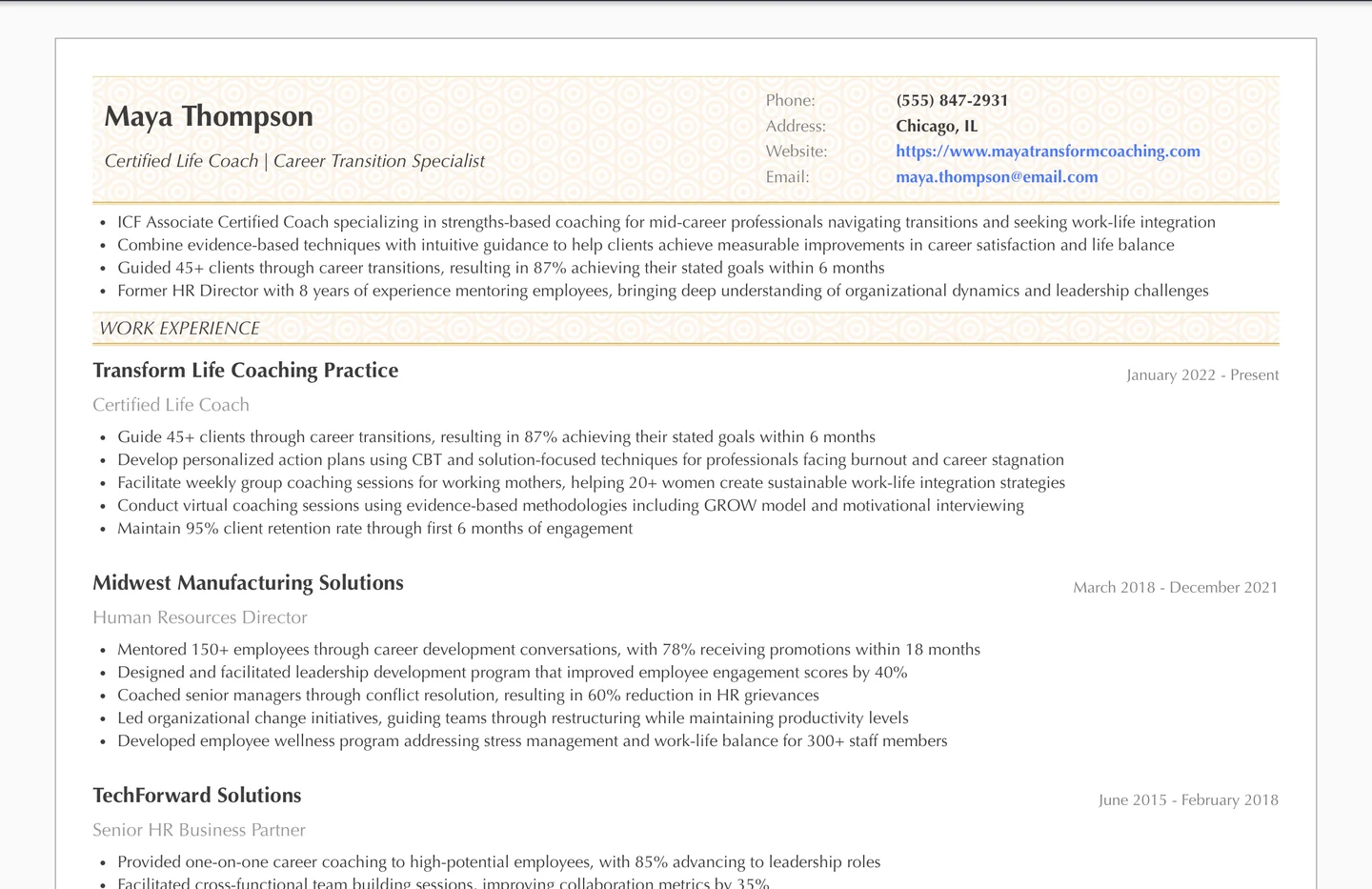
The Ultimate Life Coach Resume Example/Sample
https://www.resumonk.com/life-coachLife CoachResume Format for Life Coach Resume - Building Trust Through Structure
As a Life Coach, you're likely coming from one of several backgrounds - perhaps you've been in HR, psychology, teaching, or even corporate management. Maybe you've been coaching informally for years and are now making it official. Whatever your path, the reverse-chronological format is your strongest ally here. Why?
Because your journey to becoming a Life Coach is part of your credibility story.
The Psychology Behind Your Resume Structure
The reverse-chronological format works brilliantly for Life Coaches because it immediately showcases your most recent and relevant experience. If you've just completed your ICF certification or launched your coaching practice, that needs to be front and center.
Your potential clients or employers want to see your current mindset and capabilities, not what you were doing five years ago (unless it directly strengthens your coaching narrative).
Think about structuring your resume with these essential sections in this order - Contact Information with your coaching credentials prominently displayed, a compelling Professional Summary that captures your coaching philosophy, your Work Experience showing your coaching journey, relevant Certifications and Training, Skills that demonstrate both hard and soft capabilities, and Education. If you have testimonials or measurable client success stories, consider adding a brief Achievements or Client Impact section.
Making Your Format Work Harder
Here's where many aspiring Life Coaches stumble - they treat their resume like a traditional corporate document. Instead, your format should breathe with the same energy you bring to your coaching sessions. Use clean, readable sections with plenty of white space.
This isn't about being fancy; it's about creating a document that feels approachable and professional simultaneously.
Remember that in the UK and Australia, you might be creating a CV rather than a resume, which allows for slightly more detail about your coaching philosophy and approach. In the USA and Canada, keep it concise - two pages maximum unless you have extensive relevant experience.
The key difference is that UK/Australian documents can include a brief personal statement about your coaching approach, while North American resumes should weave this into your professional summary.
Work Experience on Life Coach Resume - Your Transformation Story
Your work experience section is where the rubber meets the road.
Unlike traditional careers where job titles tell the whole story, Life Coaching experience needs context. You might have been coaching for years without the official title, or you're transitioning from a related field. Either way, this section needs to translate your diverse experiences into a coherent coaching narrative.
Crafting Your Coaching Journey
Start with your most recent role and work backward, but here's the twist - frame everything through a coaching lens.
If you were a Human Resources Manager who informally mentored employees, that's coaching experience. If you were a teacher who helped students navigate personal challenges alongside academics, that's coaching. The art lies in the translation.
When describing each role, lead with impact rather than duties. Life Coaching is fundamentally about transformation, so your work experience should showcase transformations you've facilitated.
Use strong action verbs that resonate with coaching - guided, facilitated, empowered, transformed, developed.
❌ Don't write vague descriptions that could apply to anyone:
Life Coach | Self-Employed | 2022-Present
- Conducted coaching sessions with clients
- Helped people with their problems
- Used various coaching techniques
✅ Do write specific, impact-focused descriptions:
Certified Life Coach | Transform Coaching Practice | 2022-Present
- Guided 45+ clients through career transitions, resulting in 87% achieving their stated goals within 6 months
- Developed personalized action plans using CBT and solution-focused techniques for professionals facing burnout
- Facilitated weekly group coaching sessions for working mothers, helping 20+ women create sustainable work-life integration strategies
Bridging Non-Coaching Experience
Many Life Coaches don't start their careers in coaching, and that's actually a strength. Your previous experience adds depth to your coaching practice. The trick is showing how your past roles prepared you for coaching. Were you a project manager? You understand goal-setting and milestone tracking. Were you in sales?
You know how to build rapport and understand client needs.
For each non-coaching role, include at least one bullet point that demonstrates coaching-relevant skills. Focus on mentoring, training, conflict resolution, or any situation where you helped others overcome challenges.
This creates a throughline that shows coaching has always been part of your professional DNA, even before it became your official title.
Skills to Include on Life Coach Resume - Your Coaching Toolkit
Here's something most Life Coach candidates don't realize - your skills section isn't just a keyword dump. It's a carefully curated showcase of your coaching arsenal.
Think of it as opening your coaching toolkit and showing exactly what tools you'll bring to help clients transform their lives.
The Balance of Hard and Soft Skills
Life Coaching uniquely requires a blend of concrete certifications and intangible interpersonal abilities. Your hard skills might include specific coaching methodologies like GROW model, NLP techniques, or Cognitive Behavioral Coaching.
These show you're not just winging it - you have formal training and structured approaches.
But here's where it gets interesting. Your soft skills are equally crucial, perhaps even more so. Active listening isn't just a nice-to-have; it's fundamental to your practice. Emotional intelligence, empathy, and intuition are the invisible forces that make coaching work. The challenge is presenting these in a way that feels substantial, not fluffy.
❌ Don't list generic skills without context:
Skills:
- Good listener
- Helpful
- People person
- Communication
✅ Do present skills that demonstrate professional coaching competence:
Core Coaching Competencies:
- Active Listening & Powerful Questioning
- Goal Setting & Action Planning (SMART methodology)
- Emotional Intelligence & Empathy Mapping
- Conflict Resolution & Behavioral Change Techniques

Technical Skills:
- ICF Core Competency Framework
- Solution-Focused Brief Therapy (SFBT)
- Motivational Interviewing
- Virtual Coaching Platforms (Zoom, CoachAccountable)
Industry-Specific Skill Variations
Your skill set might vary depending on your coaching niche. Executive coaches need business acumen and leadership development skills. Wellness coaches should highlight health and nutrition knowledge. Career coaches benefit from showcasing resume writing, interview preparation, and industry knowledge.
Tailor your skills to match your target coaching area while maintaining core coaching competencies.
Don't forget the business side of coaching. Skills like client acquisition, program development, workshop facilitation, and even basic business management are valuable.
Many Life Coaches are solopreneurs, so showing you can run the business side of coaching is just as important as the coaching itself.
Specific Considerations and Tips for Life Coach Resume
Now let's talk about what makes a Life Coach resume truly different from every other professional document out there.
You're not just listing qualifications - you're demonstrating your ability to create transformation before you've even met your client or employer. This requires some unique considerations that other professions simply don't face.
The Credibility Challenge
Life Coaching faces a unique perception challenge - anyone can call themselves a Life Coach. This means your resume needs to work overtime to establish credibility. Unlike therapists or counselors who have mandatory licensing, your credibility comes from certifications (ICF, CLC, etc.), testimonials, and measurable results. Don't be shy about including client success metrics, even if they feel like bragging.
Numbers like "helped 30 clients achieve work-life balance, with 90% reporting reduced stress levels" aren't boasting - they're proof of competence.
Consider adding a brief section for client testimonials or success stories if you have particularly powerful ones. Keep them short - one or two sentences maximum - but let them speak to specific transformations.
This is unique to coaching resumes and can be your secret weapon.
The Philosophy Balance
Here's something specific to Life Coach resumes - you need to hint at your coaching philosophy without turning your resume into a manifesto. Your approach to coaching (whether you're solution-focused, strengths-based, or holistic) should subtly weave through your descriptions.
This helps potential clients or employers understand if you're a good fit for their needs or organizational culture.
❌ Don't write philosophical statements that lack professional grounding:
Professional Summary:
I believe everyone has unlimited potential within them waiting to
be unlocked through the power of positive thinking and manifesting
their dreams into reality.
✅ Do integrate your philosophy with professional credentials:
Professional Summary:
ICF-certified Life Coach specializing in strengths-based coaching
for mid-career professionals. Combine evidence-based techniques with
intuitive guidance to help clients navigate transitions, achieving
measurable improvements in career satisfaction and life balance.
The Niche Navigation
Life Coaching is incredibly broad, and being a generalist can actually work against you. Your resume should clearly indicate your niche without closing too many doors. If you specialize in divorce coaching, career transitions, or executive performance, make it clear. But also show enough versatility to handle related challenges.
This is a delicate balance unique to coaching resumes.
The Digital Presence Integration
More than most professions, Life Coaches need to show they're accessible and modern in their approach. Include links to your professional website, LinkedIn profile, or even a booking calendar if appropriate. If you've written articles, conducted webinars, or have a podcast, mention these briefly.
Digital presence isn't just nice to have for coaches - it's often how clients find and vet you before making contact.
Remember that in different countries, expectations vary. In the USA, including a professional headshot is generally avoided, while in many European countries, it's expected. In the UK and Australia, personal details are minimal, while some other markets expect more comprehensive contact information.
Research your specific market's expectations.
The Continuous Learning Element
Finally, Life Coaching is a field where continuous learning isn't just professional development - it's an ethical requirement.
Your resume should show ongoing education, whether through formal certifications, workshops, or supervision hours. This demonstrates commitment to your craft and acknowledgment that coaching skills require constant refinement.
List recent trainings even if they seem minor - they show you're actively growing rather than resting on past credentials.
Education to List on Life Coach Resume
Now, let's imagine a scene - you're sitting across from a potential client who asks, "So, what qualifies you to guide me through life's challenges?"
Your education section needs to answer this question before it's even asked. As someone transitioning into life coaching, whether from psychology, human resources, teaching, or even corporate management, you understand that trust is your currency. Your educational background is the foundation of that trust.
The Core Educational Requirements
Unlike therapists or counselors who need specific licenses, life coaches operate in a wonderfully diverse educational landscape.
You might have a Bachelor's in Psychology, Business Administration, or even Fine Arts - and that's perfectly valid. What matters is how you frame your educational journey to showcase your understanding of human behavior, personal development, and goal achievement.
Start with your highest degree and work backwards. If you have a bachelor's degree, list it prominently. But here's where it gets interesting - your coaching certifications often carry more weight than traditional degrees in this field.
Prioritizing Coaching Certifications
The International Coach Federation (ICF) certification or similar credentials should sit right at the top of your education section, even above your university degree. Why?
Because clients specifically look for these certifications as proof of your commitment to professional coaching standards.
❌ Don't list your education like this:
B.A. Psychology - State University, 2018
Life Coach Certification - Online Academy, 2023
✅ Do structure it with impact:
ICF Associate Certified Coach (ACC) - International Coach Federation, 2023
• 100+ coaching hours completed
• Specialized in executive and career transition coaching

B.A. Psychology - State University, 2018
• Magna Cum Laude
• Focus: Behavioral Psychology and Human Development
Relevant Coursework and Training
Remember those weekend workshops on mindfulness? That online course on emotional intelligence? These belong here. Life coaching clients want to know you're constantly evolving and learning.
Include specialized training that directly relates to your coaching niche - whether it's wellness coaching, business coaching, or relationship coaching.
For those of you coming from non-traditional backgrounds (and honestly, that's many successful coaches), highlight transferable educational experiences. That MBA you earned while climbing the corporate ladder? Frame it as understanding organizational dynamics and leadership challenges. Your teaching degree? That's expertise in learning styles and motivational techniques.
International Considerations
If you're coaching in the UK, mentioning any training from the European Mentoring and Coaching Council (EMCC) carries significant weight. Australian coaches should highlight any International Coach Federation Australasia credentials.
Canadian coaches benefit from including both ICF and any provincial coaching association memberships in their education section.
Awards and Publications on Life Coach Resume
You know that moment when a potential client googles your name? They're looking for social proof - evidence that you're not just another person with opinions about life.
Your awards and publications section transforms you from someone who talks about transformation to someone who's recognized for creating it.
Why Awards Matter More Than You Think
As a life coach, you're selling an intangible service.
Unlike a surgeon who can point to successful operations or an architect with standing buildings, your work lives in the transformed lives of your clients. Awards serve as third-party validation of your impact. That "Coach of the Year" recognition from your local business association? That's gold.
Even awards from your previous career matter - they show excellence and dedication, traits every client wants in their coach.
Strategic Award Placement
List awards that demonstrate your ability to inspire, lead, and create positive change. These might include coaching-specific honors, but don't overlook recognition from your pre-coaching life that shows relevant skills.
❌ Don't minimize your achievements:
Various awards and recognitions (2019-2023)
✅ Do showcase specific impact:
Outstanding New Coach Award - ICF Chicago Chapter, 2023
• Recognized for innovative approach to career transition coaching
• Selected from 50+ nominees

Employee Development Champion - Previous Employer Corp, 2021
• Awarded for mentoring program that improved retention by 40%
Publications That Build Authority
Here's the thing about publications as a life coach - you don't need to be published in academic journals. Your Medium article that went viral about overcoming imposter syndrome? List it. Your guest post on a wellness blog about work-life balance? Include it. That e-book you self-published about finding purpose?
Absolutely mention it.
Think about publications broadly. Maybe you've been featured in a local newspaper talking about stress management, or you wrote a chapter in a collaborative book about entrepreneurship. These all count.
Even your consistently published LinkedIn articles about personal development show thought leadership.
Creating Your Publication List
Format your publications to emphasize reach and relevance rather than academic prestige. Include the publication name, date, and if impressive, mention readership numbers or engagement metrics.
"Breaking Through Career Ceiling: A 5-Step Framework" - LinkedIn Articles, March 2023
• 15,000+ views, featured in LinkedIn Career Development Newsletter

Contributing Author - "Voices of Transformation: 20 Coaches Share Their Methods"
• Published by Coaching Press, January 2023
• Chapter: "The Mirror Method: Helping Clients See Their True Potential"
Listing References for Life Coach Resume
References in life coaching aren't just about verifying employment - they're testimonials to your ability to transform lives. You're probably thinking about which former supervisor to list, but pause for a moment.
Your references section is actually a powerful opportunity to showcase the diverse impact you've had across different contexts and relationships.
Who Makes the Best References for Life Coaches
Traditional thinking says list three professional references, but life coaching calls for a more nuanced approach. Your ideal reference list might include a former client (with permission, of course), a mentor or supervising coach who can speak to your development, and yes, perhaps that colleague or supervisor who watched you naturally coach others even before you formally entered the field.
Consider including someone who has observed your coaching in action - maybe the organizer of a workshop where you presented, or a fellow coach from your certification program. These references can speak specifically to your coaching presence, your ability to hold space for clients, and your professional ethics.
Structuring Your References Section
Gone are the days of "References available upon request." In life coaching, where trust is everything, being upfront about who will vouch for you shows confidence and transparency.
❌ Don't list references without context:
John Smith
Manager at ABC Company
(555) 123-4567
✅ Do provide meaningful context:
Sarah Mitchell, PCC
Senior Executive Coach, Leadership Dynamics Institute
Relationship: ICF Mentor Coach during ACC certification (2022-2023)
Email: [email protected] | Phone: (555) 123-4567
"Sarah supervised 40+ hours of my coaching sessions and can speak to my ethical
standards and coaching competencies."
The Client Reference Dilemma
Including client references can be tricky due to confidentiality, but when done right, they're incredibly powerful.
If you have permission from a former client who experienced significant transformation, their reference can be worth more than any supervisor's recommendation. Frame it professionally while maintaining appropriate boundaries.
Michael Chen
CEO, Innovation Startups Inc.
Relationship: Executive Coaching Client (6-month engagement, 2023)
Email: [email protected]
"Michael can discuss the impact of our coaching engagement on his leadership
effectiveness and company culture transformation."
International Reference Considerations
If you're coaching internationally or applying to global organizations, consider including references from different countries or cultural backgrounds.
This demonstrates your ability to coach across cultural boundaries. In the UK and Australia, it's common to include two professional and one character reference. In Canada, three professional references remain standard.
The US market is more flexible - quality matters more than quantity.
Preparing Your References
Remember, your references are essentially co-coaches in your job search journey. Brief them on the positions you're applying for and remind them of specific achievements or transformations they witnessed. Send them your updated resume and a brief note about what aspects of your coaching they might emphasize.
This isn't manipulation - it's ensuring your references can speak confidently and specifically about your capabilities.
One final thought - as a life coach, you understand the importance of reciprocity and gratitude. Always thank your references, keep them updated on your job search progress, and offer to reciprocate the favor.
Building and maintaining these professional relationships reflects the very essence of what makes a great life coach - the ability to create meaningful, mutually beneficial connections.
Cover Letter Tips for Life Coach Resume
Your cover letter is your first coaching session with your potential employer or client.
Think about it - you're essentially demonstrating your ability to connect, understand needs, and offer solutions, all within a single page. As someone drawn to life coaching, you already understand the power of authentic connection. Your cover letter is where that authenticity shines.
Opening with Empathy and Understanding
Skip the generic "I am writing to apply for..." opening.
You're a life coach - you know better than anyone that connection starts with understanding. Begin by acknowledging the organization's mission or the specific challenges they're facing. Show them you've done your homework and understand what keeps them up at night.
❌ Don't start with yourself:
"I am an experienced professional with a passion for helping others and would like to apply for your Life Coach position."
✅ Do start with them:
"Your recent blog post about supporting employees through post-pandemic burnout resonated deeply with me. Having guided 50+ professionals through similar transitions, I understand the delicate balance between organizational goals and individual well-being that your wellness program seeks to achieve."
Storytelling Your Transformation Journey
Every life coach has a story - that pivotal moment when you realized your calling.
Maybe you were the go-to person in your office for advice, or perhaps you experienced your own transformation through coaching. Your cover letter should weave this narrative naturally, showing rather than telling why you're meant for this role.
Be specific about your impact. Instead of saying you're "passionate about helping people," share a brief story about a client who went from contemplating career change to launching their dream business within six months of working with you.
Numbers and outcomes matter, but the human element matters more.
Demonstrating Your Coaching Philosophy
Your potential employer or client wants to understand your approach.
Are you direct and action-oriented? Gentle and exploratory? Your cover letter's tone and content should reflect your coaching style. If you specialize in accountability coaching, your letter should be crisp and results-focused.
If you're a wellness coach, your language might be more nurturing and holistic.
Regional Differences in Cover Letters
In the United States, feel free to be more personal and enthusiastic in your cover letter - Americans appreciate passion and energy. UK cover letters should maintain more professional distance while still showing personality. Australian employers value directness and humor, so don't be afraid to show some personality.
Canadian cover letters strike a balance - professional but warm, detailed but not overwhelming.
The Call to Action That Coaches
End your cover letter like you'd end a coaching session - with clear next steps and enthusiasm for the journey ahead. Express genuine excitement about contributing to their mission and suggest a specific way you could add value immediately.
"I would love to discuss how my experience in transitioning 100+ executives through career pivots could support your expanding executive coaching division. I'm particularly interested in sharing my framework for helping leaders navigate identity shifts during role transitions -
something I believe could enhance your current program offerings."
Key Takeaways
After diving deep into the art and science of crafting your Life Coach resume, let's crystallize the essential elements that will transform your application from just another document into a powerful representation of your coaching potential:
- Use reverse-chronological format to showcase your most recent coaching experience and certifications first, building immediate credibility with your current capabilities
- Frame all experience through a coaching lens - translate your HR, teaching, management, or other backgrounds by highlighting mentoring, guidance, and transformation aspects
- Lead with impact over duties in your work experience, using specific metrics like "guided 45+ clients with 87% achieving goals within 6 months"
- Balance hard skills (certifications, methodologies) with soft skills (emotional intelligence, active listening) in a way that demonstrates professional competence
- Establish credibility proactively through ICF or other recognized certifications, client success metrics, and testimonials to overcome the "anyone can be a coach" perception
- Integrate your coaching philosophy subtly throughout your resume without turning it into a manifesto - let it shine through your descriptions and achievements
- Prioritize coaching certifications over traditional degrees in your education section, listing ICF or equivalent credentials before your bachelor's or master's degree
- Include diverse references who can speak to different aspects of your coaching ability - mentors, clients (with permission), and colleagues who've witnessed your natural coaching abilities
- Showcase thought leadership through publications, blog posts, or speaking engagements, even if they're not in academic journals
- Tailor to your coaching niche while maintaining versatility - clearly indicate if you specialize in executive, wellness, career, or relationship coaching
Creating a compelling Life Coach resume doesn't have to be a solitary journey. With Resumonk, you can build a professional, impactful resume that captures your unique coaching journey and philosophy. Our AI-powered recommendations understand the nuances of coaching roles, helping you articulate your transformative impact in ways that resonate with potential clients and employers. From beautifully designed templates that reflect the professionalism and approachability essential to coaching, to intelligent suggestions for highlighting your certifications and client successes, Resumonk transforms resume creation from a daunting task into an empowering process - much like the transformation you provide to your clients.
Ready to create a Life Coach resume that truly represents your transformative potential?
Use Resumonk to articulate your unique value and land your dream coaching positions. Start crafting your professional story today.
Create Your Life Coach Resume with Resumonk →
More Social Service resume examples
See all Social Service resume examples, or browse every category.
Resume writing tips
You've been the person everyone comes to for advice.
The one who somehow helps friends see their blind spots, untangle their career confusion, or finally take that leap they've been contemplating for years. Maybe you've been doing this informally in your HR role, helping employees navigate more than just benefits packages. Or perhaps you're that teacher who spent as much time life coaching students as teaching curriculum. Now you're ready to make it official - to transform your natural gift for guidance into your professional identity as a Life Coach.
But here's where you hit that familiar wall. How do you capture the essence of transformation on a piece of paper? How do you translate those breakthrough moments, those tearful thank-yous, those "you changed my life" messages into bullet points that a hiring manager or potential client will actually read? You're staring at that blank document, knowing you have the skills, the certifications, maybe even years of informal coaching experience, but wondering how to make it all come together in a way that says "Yes, I'm the Life Coach you need."
That's exactly why we've crafted this comprehensive guide. We'll walk you through every element of creating a Life Coach resume that doesn't just list your qualifications but demonstrates your ability to create change. Starting with the optimal resume format that builds trust through structure, we'll explore how to present your work experience as a transformation story - whether you're coming from corporate, education, psychology, or any other field. You'll discover which skills to highlight from your coaching toolkit, how to handle the unique considerations that Life Coach resumes require (like establishing credibility in an unregulated field), and how to present your education and certifications in a way that builds immediate confidence.
We'll also tackle the often-overlooked elements that can set you apart - how awards and publications build your authority, crafting a cover letter that serves as your first coaching session, and selecting references who can speak to your transformative impact. By the end of this guide, you'll have everything you need to create a resume that doesn't just get you in the door, but starts building that crucial coach-client relationship from the very first glance. Whether you're applying to established wellness companies, starting your own practice, or joining coaching organizations, this guide addresses the specific needs and circumstances you'll face as a Life Coach entering or advancing in this deeply rewarding field.
The Ultimate Life Coach Resume Example/Sample
https://www.resumonk.com/life-coachLife CoachResume Format for Life Coach Resume - Building Trust Through Structure
As a Life Coach, you're likely coming from one of several backgrounds - perhaps you've been in HR, psychology, teaching, or even corporate management. Maybe you've been coaching informally for years and are now making it official. Whatever your path, the reverse-chronological format is your strongest ally here. Why?
Because your journey to becoming a Life Coach is part of your credibility story.
The Psychology Behind Your Resume Structure
The reverse-chronological format works brilliantly for Life Coaches because it immediately showcases your most recent and relevant experience. If you've just completed your ICF certification or launched your coaching practice, that needs to be front and center.
Your potential clients or employers want to see your current mindset and capabilities, not what you were doing five years ago (unless it directly strengthens your coaching narrative).
Think about structuring your resume with these essential sections in this order - Contact Information with your coaching credentials prominently displayed, a compelling Professional Summary that captures your coaching philosophy, your Work Experience showing your coaching journey, relevant Certifications and Training, Skills that demonstrate both hard and soft capabilities, and Education. If you have testimonials or measurable client success stories, consider adding a brief Achievements or Client Impact section.
Making Your Format Work Harder
Here's where many aspiring Life Coaches stumble - they treat their resume like a traditional corporate document. Instead, your format should breathe with the same energy you bring to your coaching sessions. Use clean, readable sections with plenty of white space.
This isn't about being fancy; it's about creating a document that feels approachable and professional simultaneously.
Remember that in the UK and Australia, you might be creating a CV rather than a resume, which allows for slightly more detail about your coaching philosophy and approach. In the USA and Canada, keep it concise - two pages maximum unless you have extensive relevant experience.
The key difference is that UK/Australian documents can include a brief personal statement about your coaching approach, while North American resumes should weave this into your professional summary.
Work Experience on Life Coach Resume - Your Transformation Story
Your work experience section is where the rubber meets the road.
Unlike traditional careers where job titles tell the whole story, Life Coaching experience needs context. You might have been coaching for years without the official title, or you're transitioning from a related field. Either way, this section needs to translate your diverse experiences into a coherent coaching narrative.
Crafting Your Coaching Journey
Start with your most recent role and work backward, but here's the twist - frame everything through a coaching lens.
If you were a Human Resources Manager who informally mentored employees, that's coaching experience. If you were a teacher who helped students navigate personal challenges alongside academics, that's coaching. The art lies in the translation.
When describing each role, lead with impact rather than duties. Life Coaching is fundamentally about transformation, so your work experience should showcase transformations you've facilitated.
Use strong action verbs that resonate with coaching - guided, facilitated, empowered, transformed, developed.
❌ Don't write vague descriptions that could apply to anyone:
Life Coach | Self-Employed | 2022-Present
- Conducted coaching sessions with clients
- Helped people with their problems
- Used various coaching techniques
✅ Do write specific, impact-focused descriptions:
Certified Life Coach | Transform Coaching Practice | 2022-Present
- Guided 45+ clients through career transitions, resulting in 87% achieving their stated goals within 6 months
- Developed personalized action plans using CBT and solution-focused techniques for professionals facing burnout
- Facilitated weekly group coaching sessions for working mothers, helping 20+ women create sustainable work-life integration strategies
Bridging Non-Coaching Experience
Many Life Coaches don't start their careers in coaching, and that's actually a strength. Your previous experience adds depth to your coaching practice. The trick is showing how your past roles prepared you for coaching. Were you a project manager? You understand goal-setting and milestone tracking. Were you in sales?
You know how to build rapport and understand client needs.
For each non-coaching role, include at least one bullet point that demonstrates coaching-relevant skills. Focus on mentoring, training, conflict resolution, or any situation where you helped others overcome challenges.
This creates a throughline that shows coaching has always been part of your professional DNA, even before it became your official title.
Skills to Include on Life Coach Resume - Your Coaching Toolkit
Here's something most Life Coach candidates don't realize - your skills section isn't just a keyword dump. It's a carefully curated showcase of your coaching arsenal.
Think of it as opening your coaching toolkit and showing exactly what tools you'll bring to help clients transform their lives.
The Balance of Hard and Soft Skills
Life Coaching uniquely requires a blend of concrete certifications and intangible interpersonal abilities. Your hard skills might include specific coaching methodologies like GROW model, NLP techniques, or Cognitive Behavioral Coaching.
These show you're not just winging it - you have formal training and structured approaches.
But here's where it gets interesting. Your soft skills are equally crucial, perhaps even more so. Active listening isn't just a nice-to-have; it's fundamental to your practice. Emotional intelligence, empathy, and intuition are the invisible forces that make coaching work. The challenge is presenting these in a way that feels substantial, not fluffy.
❌ Don't list generic skills without context:
Skills:
- Good listener
- Helpful
- People person
- Communication
✅ Do present skills that demonstrate professional coaching competence:
Core Coaching Competencies:
- Active Listening & Powerful Questioning
- Goal Setting & Action Planning (SMART methodology)
- Emotional Intelligence & Empathy Mapping
- Conflict Resolution & Behavioral Change Techniques

Technical Skills:
- ICF Core Competency Framework
- Solution-Focused Brief Therapy (SFBT)
- Motivational Interviewing
- Virtual Coaching Platforms (Zoom, CoachAccountable)
Industry-Specific Skill Variations
Your skill set might vary depending on your coaching niche. Executive coaches need business acumen and leadership development skills. Wellness coaches should highlight health and nutrition knowledge. Career coaches benefit from showcasing resume writing, interview preparation, and industry knowledge.
Tailor your skills to match your target coaching area while maintaining core coaching competencies.
Don't forget the business side of coaching. Skills like client acquisition, program development, workshop facilitation, and even basic business management are valuable.
Many Life Coaches are solopreneurs, so showing you can run the business side of coaching is just as important as the coaching itself.
Specific Considerations and Tips for Life Coach Resume
Now let's talk about what makes a Life Coach resume truly different from every other professional document out there.
You're not just listing qualifications - you're demonstrating your ability to create transformation before you've even met your client or employer. This requires some unique considerations that other professions simply don't face.
The Credibility Challenge
Life Coaching faces a unique perception challenge - anyone can call themselves a Life Coach. This means your resume needs to work overtime to establish credibility. Unlike therapists or counselors who have mandatory licensing, your credibility comes from certifications (ICF, CLC, etc.), testimonials, and measurable results. Don't be shy about including client success metrics, even if they feel like bragging.
Numbers like "helped 30 clients achieve work-life balance, with 90% reporting reduced stress levels" aren't boasting - they're proof of competence.
Consider adding a brief section for client testimonials or success stories if you have particularly powerful ones. Keep them short - one or two sentences maximum - but let them speak to specific transformations.
This is unique to coaching resumes and can be your secret weapon.
The Philosophy Balance
Here's something specific to Life Coach resumes - you need to hint at your coaching philosophy without turning your resume into a manifesto. Your approach to coaching (whether you're solution-focused, strengths-based, or holistic) should subtly weave through your descriptions.
This helps potential clients or employers understand if you're a good fit for their needs or organizational culture.
❌ Don't write philosophical statements that lack professional grounding:
Professional Summary:
I believe everyone has unlimited potential within them waiting to
be unlocked through the power of positive thinking and manifesting
their dreams into reality.
✅ Do integrate your philosophy with professional credentials:
Professional Summary:
ICF-certified Life Coach specializing in strengths-based coaching
for mid-career professionals. Combine evidence-based techniques with
intuitive guidance to help clients navigate transitions, achieving
measurable improvements in career satisfaction and life balance.
The Niche Navigation
Life Coaching is incredibly broad, and being a generalist can actually work against you. Your resume should clearly indicate your niche without closing too many doors. If you specialize in divorce coaching, career transitions, or executive performance, make it clear. But also show enough versatility to handle related challenges.
This is a delicate balance unique to coaching resumes.
The Digital Presence Integration
More than most professions, Life Coaches need to show they're accessible and modern in their approach. Include links to your professional website, LinkedIn profile, or even a booking calendar if appropriate. If you've written articles, conducted webinars, or have a podcast, mention these briefly.
Digital presence isn't just nice to have for coaches - it's often how clients find and vet you before making contact.
Remember that in different countries, expectations vary. In the USA, including a professional headshot is generally avoided, while in many European countries, it's expected. In the UK and Australia, personal details are minimal, while some other markets expect more comprehensive contact information.
Research your specific market's expectations.
The Continuous Learning Element
Finally, Life Coaching is a field where continuous learning isn't just professional development - it's an ethical requirement.
Your resume should show ongoing education, whether through formal certifications, workshops, or supervision hours. This demonstrates commitment to your craft and acknowledgment that coaching skills require constant refinement.
List recent trainings even if they seem minor - they show you're actively growing rather than resting on past credentials.
Education to List on Life Coach Resume
Now, let's imagine a scene - you're sitting across from a potential client who asks, "So, what qualifies you to guide me through life's challenges?"
Your education section needs to answer this question before it's even asked. As someone transitioning into life coaching, whether from psychology, human resources, teaching, or even corporate management, you understand that trust is your currency. Your educational background is the foundation of that trust.
The Core Educational Requirements
Unlike therapists or counselors who need specific licenses, life coaches operate in a wonderfully diverse educational landscape.
You might have a Bachelor's in Psychology, Business Administration, or even Fine Arts - and that's perfectly valid. What matters is how you frame your educational journey to showcase your understanding of human behavior, personal development, and goal achievement.
Start with your highest degree and work backwards. If you have a bachelor's degree, list it prominently. But here's where it gets interesting - your coaching certifications often carry more weight than traditional degrees in this field.
Prioritizing Coaching Certifications
The International Coach Federation (ICF) certification or similar credentials should sit right at the top of your education section, even above your university degree. Why?
Because clients specifically look for these certifications as proof of your commitment to professional coaching standards.
❌ Don't list your education like this:
B.A. Psychology - State University, 2018
Life Coach Certification - Online Academy, 2023
✅ Do structure it with impact:
ICF Associate Certified Coach (ACC) - International Coach Federation, 2023
• 100+ coaching hours completed
• Specialized in executive and career transition coaching

B.A. Psychology - State University, 2018
• Magna Cum Laude
• Focus: Behavioral Psychology and Human Development
Relevant Coursework and Training
Remember those weekend workshops on mindfulness? That online course on emotional intelligence? These belong here. Life coaching clients want to know you're constantly evolving and learning.
Include specialized training that directly relates to your coaching niche - whether it's wellness coaching, business coaching, or relationship coaching.
For those of you coming from non-traditional backgrounds (and honestly, that's many successful coaches), highlight transferable educational experiences. That MBA you earned while climbing the corporate ladder? Frame it as understanding organizational dynamics and leadership challenges. Your teaching degree? That's expertise in learning styles and motivational techniques.
International Considerations
If you're coaching in the UK, mentioning any training from the European Mentoring and Coaching Council (EMCC) carries significant weight. Australian coaches should highlight any International Coach Federation Australasia credentials.
Canadian coaches benefit from including both ICF and any provincial coaching association memberships in their education section.
Awards and Publications on Life Coach Resume
You know that moment when a potential client googles your name? They're looking for social proof - evidence that you're not just another person with opinions about life.
Your awards and publications section transforms you from someone who talks about transformation to someone who's recognized for creating it.
Why Awards Matter More Than You Think
As a life coach, you're selling an intangible service.
Unlike a surgeon who can point to successful operations or an architect with standing buildings, your work lives in the transformed lives of your clients. Awards serve as third-party validation of your impact. That "Coach of the Year" recognition from your local business association? That's gold.
Even awards from your previous career matter - they show excellence and dedication, traits every client wants in their coach.
Strategic Award Placement
List awards that demonstrate your ability to inspire, lead, and create positive change. These might include coaching-specific honors, but don't overlook recognition from your pre-coaching life that shows relevant skills.
❌ Don't minimize your achievements:
Various awards and recognitions (2019-2023)
✅ Do showcase specific impact:
Outstanding New Coach Award - ICF Chicago Chapter, 2023
• Recognized for innovative approach to career transition coaching
• Selected from 50+ nominees

Employee Development Champion - Previous Employer Corp, 2021
• Awarded for mentoring program that improved retention by 40%
Publications That Build Authority
Here's the thing about publications as a life coach - you don't need to be published in academic journals. Your Medium article that went viral about overcoming imposter syndrome? List it. Your guest post on a wellness blog about work-life balance? Include it. That e-book you self-published about finding purpose?
Absolutely mention it.
Think about publications broadly. Maybe you've been featured in a local newspaper talking about stress management, or you wrote a chapter in a collaborative book about entrepreneurship. These all count.
Even your consistently published LinkedIn articles about personal development show thought leadership.
Creating Your Publication List
Format your publications to emphasize reach and relevance rather than academic prestige. Include the publication name, date, and if impressive, mention readership numbers or engagement metrics.
"Breaking Through Career Ceiling: A 5-Step Framework" - LinkedIn Articles, March 2023
• 15,000+ views, featured in LinkedIn Career Development Newsletter

Contributing Author - "Voices of Transformation: 20 Coaches Share Their Methods"
• Published by Coaching Press, January 2023
• Chapter: "The Mirror Method: Helping Clients See Their True Potential"
Listing References for Life Coach Resume
References in life coaching aren't just about verifying employment - they're testimonials to your ability to transform lives. You're probably thinking about which former supervisor to list, but pause for a moment.
Your references section is actually a powerful opportunity to showcase the diverse impact you've had across different contexts and relationships.
Who Makes the Best References for Life Coaches
Traditional thinking says list three professional references, but life coaching calls for a more nuanced approach. Your ideal reference list might include a former client (with permission, of course), a mentor or supervising coach who can speak to your development, and yes, perhaps that colleague or supervisor who watched you naturally coach others even before you formally entered the field.
Consider including someone who has observed your coaching in action - maybe the organizer of a workshop where you presented, or a fellow coach from your certification program. These references can speak specifically to your coaching presence, your ability to hold space for clients, and your professional ethics.
Structuring Your References Section
Gone are the days of "References available upon request." In life coaching, where trust is everything, being upfront about who will vouch for you shows confidence and transparency.
❌ Don't list references without context:
John Smith
Manager at ABC Company
(555) 123-4567
✅ Do provide meaningful context:
Sarah Mitchell, PCC
Senior Executive Coach, Leadership Dynamics Institute
Relationship: ICF Mentor Coach during ACC certification (2022-2023)
Email: [email protected] | Phone: (555) 123-4567
"Sarah supervised 40+ hours of my coaching sessions and can speak to my ethical
standards and coaching competencies."
The Client Reference Dilemma
Including client references can be tricky due to confidentiality, but when done right, they're incredibly powerful.
If you have permission from a former client who experienced significant transformation, their reference can be worth more than any supervisor's recommendation. Frame it professionally while maintaining appropriate boundaries.
Michael Chen
CEO, Innovation Startups Inc.
Relationship: Executive Coaching Client (6-month engagement, 2023)
Email: [email protected]
"Michael can discuss the impact of our coaching engagement on his leadership
effectiveness and company culture transformation."
International Reference Considerations
If you're coaching internationally or applying to global organizations, consider including references from different countries or cultural backgrounds.
This demonstrates your ability to coach across cultural boundaries. In the UK and Australia, it's common to include two professional and one character reference. In Canada, three professional references remain standard.
The US market is more flexible - quality matters more than quantity.
Preparing Your References
Remember, your references are essentially co-coaches in your job search journey. Brief them on the positions you're applying for and remind them of specific achievements or transformations they witnessed. Send them your updated resume and a brief note about what aspects of your coaching they might emphasize.
This isn't manipulation - it's ensuring your references can speak confidently and specifically about your capabilities.
One final thought - as a life coach, you understand the importance of reciprocity and gratitude. Always thank your references, keep them updated on your job search progress, and offer to reciprocate the favor.
Building and maintaining these professional relationships reflects the very essence of what makes a great life coach - the ability to create meaningful, mutually beneficial connections.
Cover Letter Tips for Life Coach Resume
Your cover letter is your first coaching session with your potential employer or client.
Think about it - you're essentially demonstrating your ability to connect, understand needs, and offer solutions, all within a single page. As someone drawn to life coaching, you already understand the power of authentic connection. Your cover letter is where that authenticity shines.
Opening with Empathy and Understanding
Skip the generic "I am writing to apply for..." opening.
You're a life coach - you know better than anyone that connection starts with understanding. Begin by acknowledging the organization's mission or the specific challenges they're facing. Show them you've done your homework and understand what keeps them up at night.
❌ Don't start with yourself:
"I am an experienced professional with a passion for helping others and would like to apply for your Life Coach position."
✅ Do start with them:
"Your recent blog post about supporting employees through post-pandemic burnout resonated deeply with me. Having guided 50+ professionals through similar transitions, I understand the delicate balance between organizational goals and individual well-being that your wellness program seeks to achieve."
Storytelling Your Transformation Journey
Every life coach has a story - that pivotal moment when you realized your calling.
Maybe you were the go-to person in your office for advice, or perhaps you experienced your own transformation through coaching. Your cover letter should weave this narrative naturally, showing rather than telling why you're meant for this role.
Be specific about your impact. Instead of saying you're "passionate about helping people," share a brief story about a client who went from contemplating career change to launching their dream business within six months of working with you.
Numbers and outcomes matter, but the human element matters more.
Demonstrating Your Coaching Philosophy
Your potential employer or client wants to understand your approach.
Are you direct and action-oriented? Gentle and exploratory? Your cover letter's tone and content should reflect your coaching style. If you specialize in accountability coaching, your letter should be crisp and results-focused.
If you're a wellness coach, your language might be more nurturing and holistic.
Regional Differences in Cover Letters
In the United States, feel free to be more personal and enthusiastic in your cover letter - Americans appreciate passion and energy. UK cover letters should maintain more professional distance while still showing personality. Australian employers value directness and humor, so don't be afraid to show some personality.
Canadian cover letters strike a balance - professional but warm, detailed but not overwhelming.
The Call to Action That Coaches
End your cover letter like you'd end a coaching session - with clear next steps and enthusiasm for the journey ahead. Express genuine excitement about contributing to their mission and suggest a specific way you could add value immediately.
"I would love to discuss how my experience in transitioning 100+ executives through career pivots could support your expanding executive coaching division. I'm particularly interested in sharing my framework for helping leaders navigate identity shifts during role transitions -
something I believe could enhance your current program offerings."
Key Takeaways
After diving deep into the art and science of crafting your Life Coach resume, let's crystallize the essential elements that will transform your application from just another document into a powerful representation of your coaching potential:
- Use reverse-chronological format to showcase your most recent coaching experience and certifications first, building immediate credibility with your current capabilities
- Frame all experience through a coaching lens - translate your HR, teaching, management, or other backgrounds by highlighting mentoring, guidance, and transformation aspects
- Lead with impact over duties in your work experience, using specific metrics like "guided 45+ clients with 87% achieving goals within 6 months"
- Balance hard skills (certifications, methodologies) with soft skills (emotional intelligence, active listening) in a way that demonstrates professional competence
- Establish credibility proactively through ICF or other recognized certifications, client success metrics, and testimonials to overcome the "anyone can be a coach" perception
- Integrate your coaching philosophy subtly throughout your resume without turning it into a manifesto - let it shine through your descriptions and achievements
- Prioritize coaching certifications over traditional degrees in your education section, listing ICF or equivalent credentials before your bachelor's or master's degree
- Include diverse references who can speak to different aspects of your coaching ability - mentors, clients (with permission), and colleagues who've witnessed your natural coaching abilities
- Showcase thought leadership through publications, blog posts, or speaking engagements, even if they're not in academic journals
- Tailor to your coaching niche while maintaining versatility - clearly indicate if you specialize in executive, wellness, career, or relationship coaching
Creating a compelling Life Coach resume doesn't have to be a solitary journey. With Resumonk, you can build a professional, impactful resume that captures your unique coaching journey and philosophy. Our AI-powered recommendations understand the nuances of coaching roles, helping you articulate your transformative impact in ways that resonate with potential clients and employers. From beautifully designed templates that reflect the professionalism and approachability essential to coaching, to intelligent suggestions for highlighting your certifications and client successes, Resumonk transforms resume creation from a daunting task into an empowering process - much like the transformation you provide to your clients.
Ready to create a Life Coach resume that truly represents your transformative potential?
Use Resumonk to articulate your unique value and land your dream coaching positions. Start crafting your professional story today.
Create Your Life Coach Resume with Resumonk →
More Social Service resume examples
See all Social Service resume examples, or browse every category.
Resume writing tips