Landscaper Resume Example (with Tips and Best Practices)
Introduction
The sun hasn't even cracked the horizon yet, but you're already loading equipment into the truck, mentally mapping out the day's route through a dozen properties.
Your hands know the weight of a bag of fertilizer like an old friend, and you can spot crabgrass infiltrating a lawn from across the street. You've built a career turning patches of earth into living art, transforming neglected yards into neighborhood showpieces, one blade of grass at a time. But now, facing that blank resume template, you're wondering how to capture the essence of what you do - the early mornings, the satisfied clients, the perfect edge lines that would make any property owner proud - in a document that does justice to your craft.
Here's what most people don't understand about landscaping - it's not just about making things look pretty. You're part horticulturist, part artist, part equipment operator, and part customer service expert. You diagnose plant diseases, calculate drainage grades, manage seasonal transitions, and somehow make it all happen while racing against weather forecasts and daylight hours. Your resume needs to reflect this complexity while remaining clear and compelling to employers who might be reviewing it between job sites or after a long day in the field.
This guide will walk you through creating a landscaper resume that actually works. We'll start with the optimal resume format - the reverse-chronological structure that showcases your career progression from that first summer pushing a mower to your current expertise in hardscaping or irrigation systems. Then we'll dig into crafting a work experience section that quantifies your achievements (yes, "maintained lawns" can become "managed 30+ residential properties with 95% client retention"), building a skills section that balances technical expertise with essential soft skills, and addressing unique considerations like seasonal work patterns and regional specializations.
We'll also cover the education and certifications that elevate you from "person with a mower" to certified professional, how to leverage any awards or recognition you've earned (including that "Best Lawn on the Block" your work earned for the Johnsons), and the often-overlooked importance of references in an industry built on trust and reputation. By the time you finish reading, you'll have everything you need to create a resume that captures both the science and artistry of professional landscaping, whether you're targeting a position with a high-end residential service, a commercial property management company, or looking to advance into crew leadership roles.
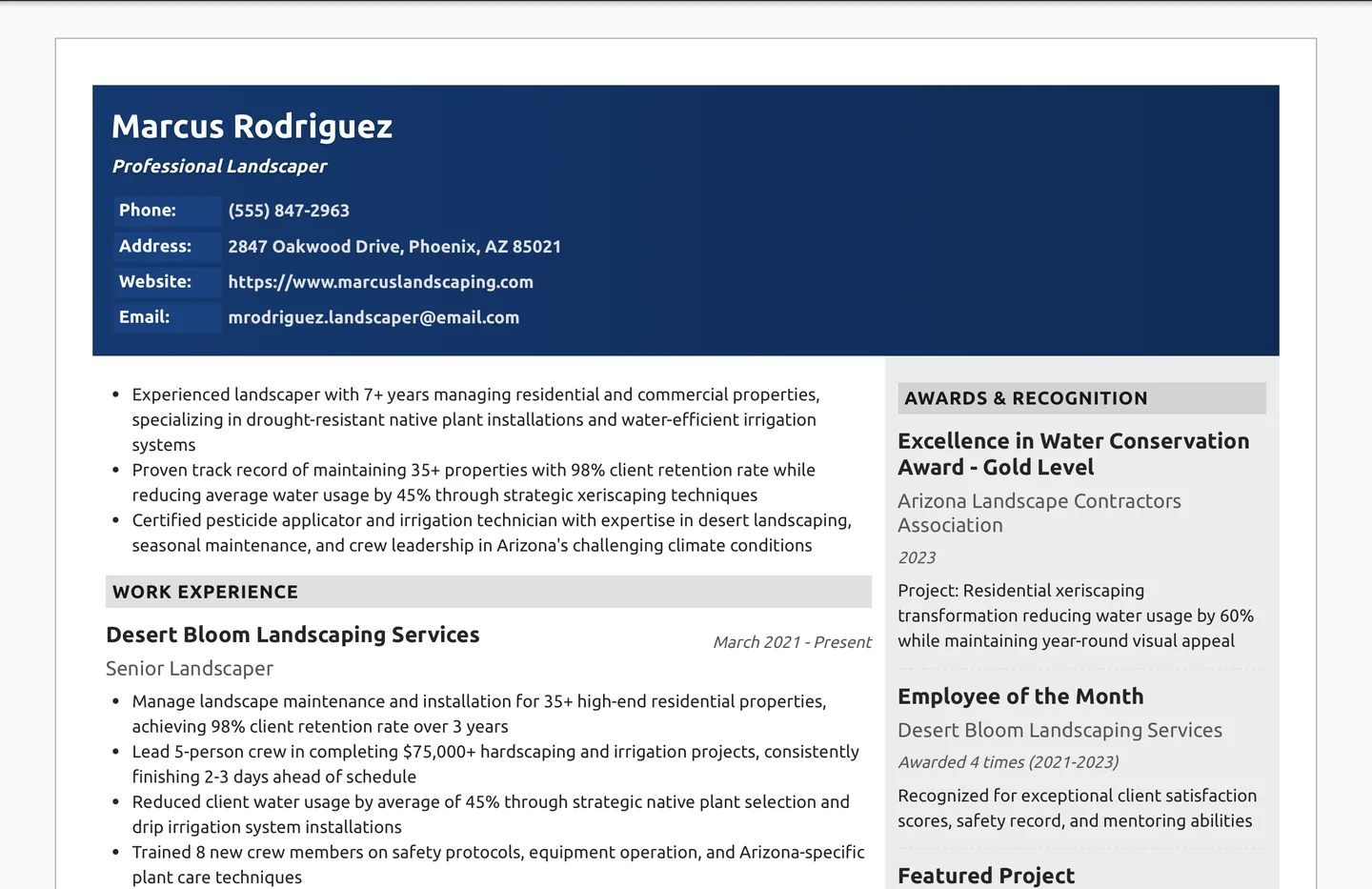
The Ultimate Landscaper Resume Example/Sample
https://www.resumonk.com/landscaperLandscaperResume Format to Follow for Landscaper Resume
For landscapers, the reverse-chronological format stands as your strongest ally.
This format places your most recent landscaping positions at the top, cascading down through your career history like water through a well-designed irrigation system. Why does this work particularly well for landscaping roles? Because property owners and landscaping companies want to see your progression - from perhaps starting as a lawn care assistant to handling complex hardscaping projects or managing seasonal plant installations.
The Structure That Works
Your landscaper resume should flow in this order - contact information, professional summary (2-3 lines maximum), work experience, skills, and education/certifications. The beauty of this structure lies in its immediacy.
A hiring manager at a landscaping company or a property management firm needs to quickly assess whether you can handle their specific needs, whether that's residential lawn maintenance, commercial property beautification, or specialized services like xeriscaping.
Unlike office jobs where creativity in format might earn points, landscaping employers appreciate straightforward presentation. They're looking at your resume between site visits, possibly with dirt-covered gloves freshly removed, needing to make quick decisions about who can join their crew next Monday.
Regional Variations to Consider
If you're applying in the USA or Canada, keep your resume to one page if you have less than 10 years of experience, two pages maximum for veteran landscapers. UK and Australian landscapers often work with slightly longer formats - up to two pages even for mid-level experience - as employers there expect more detailed project descriptions.
Canadian resumes particularly benefit from highlighting any French-English bilingual abilities, especially in Quebec and New Brunswick markets where you might need to communicate with diverse clientele.
Remember that landscaping is inherently local - a resume for a landscaper position in Arizona will emphasize drought-resistant planting and desert landscaping, while one for the Pacific Northwest should highlight experience with rain gardens and native forest management. Your format should allow these regional specializations to shine through clearly in your experience section.
Work Experience on Landscaper Resume
The morning dew hasn't dried yet, and you're already calculating how many cubic yards of mulch you'll need for the Johnson property while simultaneously planning the crew's route for the day's five residential jobs.
This is the reality of landscaping work - constant problem-solving, physical implementation, and client satisfaction all rolled into one. Yet when landscapers write their work experience, they often reduce this complexity to "Maintained lawns and gardens."
Let's fix that disconnect.
Quantifying the Unquantifiable Beauty
Your work experience section needs to bridge the gap between the tangible results clients see and the business metrics employers care about. Start each position with your job title, company name, location, and dates of employment.
Then comes the crucial part - your accomplishments written as action-oriented bullet points.
Instead of listing duties, showcase your impact. Every property you've transformed, every season you've managed, every client you've retained - these are your professional victories.
❌ Don't write vague descriptions:
• Performed landscaping duties
• Planted flowers and trimmed bushes
• Worked with team members
✅ Do write specific, impactful statements:
• Managed landscape maintenance for 25+ residential properties, achieving 95% client retention rate over 2 years
• Installed and maintained seasonal flower displays across 10,000 sq ft of commercial beds, reducing replanting needs by 30%
• Led 4-person crew in completing $50,000 hardscaping project 3 days ahead of schedule
Capturing Seasonal Variations and Special Projects
Landscaping work varies dramatically by season, and your resume should reflect this versatility. When describing your experience, weave in the full spectrum of your capabilities - from spring installations to fall cleanups, from snow removal (in applicable climates) to drought management.
For positions where you've advanced or taken on additional responsibilities, show that progression within the role description. Perhaps you started operating only push mowers but graduated to zero-turn mowers and eventually to designing irrigation systems. This growth story matters more than you might think.
❌ Don't undersell your progression:
Landscape Laborer - Green Thumb Landscaping (2019-2023)
• Operated various equipment
• Assisted with landscaping projects
✅ Do showcase your development:
Landscape Laborer - Green Thumb Landscaping (2019-2023)
• Progressed from basic mowing to operating specialized equipment including skid steers and trenchers
• Developed expertise in irrigation installation, completing 15+ system installations independently by year 3
• Trained 5 new crew members on safety protocols and equipment operation
Highlighting Leadership Without the Title
Many landscapers lead without formal titles - you might be the go-to person for rose care, the unofficial crew coordinator on large projects, or the client relationship expert who handles complaints. These informal leadership roles deserve prominent placement in your experience section.
Skills to Show on Landscaper Resume
There's a moment every landscaper knows - when a client points to a struggling plant and asks "What's wrong with it?"
Your brain instantly catalogs possibilities - overwatering, nitrogen deficiency, pest damage, wrong hardiness zone - while your hands are already reaching for the right solution. This blend of knowledge and practical skill defines professional landscaping, yet too many resumes list only "lawn mowing" and "planting" as skills.
Technical Skills That Make You Stand Out
Your skills section should read like a toolkit that solves problems. Start with the equipment and techniques that set you apart from someone with just a mower and good intentions.
Organize your technical skills by category to make them easily scannable.
Equipment operation forms your foundation - but be specific about your capabilities. There's a world of difference between pushing a lawn mower and operating a commercial-grade zero-turn mower on steep slopes. Include specialized equipment like aerators, dethatchers, stump grinders, and any heavy machinery certifications you hold.
❌ Don't use generic skill lists:
Skills:
• Lawn care
• Gardening
• Equipment operation
• Team player
✅ Do provide specific, valuable skills:
Equipment & Tools:
• Commercial zero-turn mowers (Toro, Exmark)
• Skid steer operation with multiple attachments
• Chainsaw operation (OSHA certified)
• Irrigation system installation and repair

Horticultural Expertise:
• Plant identification (200+ species in regional zones)
• Integrated Pest Management (IPM) techniques
• Soil analysis and amendment
• Native plant landscaping and xeriscaping
The Soft Skills That Seal the Deal
Landscaping happens in people's personal spaces - their homes, their businesses, the places where they live and work. The ability to work professionally while someone's dog barks at you through the window, or to explain why that beautiful but invasive plant needs to go, these interpersonal skills matter immensely.
Include soft skills that directly relate to landscaping success. Client communication becomes crucial when you're explaining why a lawn needs aeration or why certain plants won't thrive in their desired location.
Physical stamina and weather resilience aren't just nice-to-haves - they're essential when you're working through a humid summer day or racing to complete installations before the first frost.
Certifications and Specialized Knowledge
In the skills section, any certifications should be prominently featured.
Pesticide applicator licenses, ISA Certified Arborist credentials, landscape design certificates, or irrigation technician certifications immediately elevate your resume above others. If you're certified in specific regional programs - like California's Water Efficient Landscaper certification or Florida's Best Management Practices certification - these belong front and center.
Don't forget to include any specialized knowledge areas. Perhaps you're the crew's expert on Japanese garden techniques, or you've mastered the art of creating pollinator-friendly landscapes. These specializations can be the difference between landing a generic maintenance job and securing a position with a high-end residential service or botanical garden.
Specific Considerations and Tips for Landscaper Resume
The dirt under your fingernails tells a story, but your resume can't rely on such tangible evidence of hard work.
As a landscaper, you face unique challenges when translating your physical craft into written form. You're competing not just with other landscapers, but with the stereotype that landscaping is "just cutting grass" - a misconception held by those who've never diagnosed a fungal infection by touch or calculated the precise grade needed for proper drainage.
Addressing the Seasonality Question
If you're in a climate with distinct seasons, employers will wonder what you do during the off-season. Address this head-on in your resume. Whether you transition to snow removal, pursue continuing education, work on equipment maintenance, or take on indoor plant care contracts, show that you're a year-round professional.
This is particularly crucial in regions like the Northeast USA or Canada where winter can mean four months of no traditional landscaping work.
❌ Don't leave gaps unexplained:
Landscaper - May 2022 to October 2022
Landscaper - April 2023 to November 2023
✅ Do show year-round value:
Landscaper - Premier Grounds Services - Year-round position
May-October: Landscape installation and maintenance
November-April: Snow removal operations, equipment maintenance, and greenhouse work
The Portfolio Mention Strategy
Unlike many professions, your best work as a landscaper is visual.
While the resume itself should remain text-based, include a line mentioning that a portfolio is available. This could be a simple website, an Instagram account dedicated to your work, or a PDF document with before-and-after photos. Property managers and homeowners respond powerfully to visual evidence of transformation.
Place this mention strategically - either in your contact information as "Portfolio: [website]" or as the final line of your professional summary. Never attach photos directly to the resume unless specifically requested, but make it effortless for interested employers to see your work.
The Small Business Consideration
Many landscapers run side businesses or have attempted self-employment.
If this is you, present it strategically. A failed landscaping business isn't a failure on your resume - it's entrepreneurial experience. You understand pricing, client acquisition, scheduling, and the full scope of business operations. Frame any self-employment period as a positive, highlighting the business acumen you gained.
Owner/Operator - [Your Name] Landscaping Services (2020-2022)
• Managed all aspects of residential landscaping business serving 30+ regular clients
• Developed pricing strategies resulting in 25% profit margins while maintaining competitive rates
• Chose to return to team environment for expanded project opportunities
Physical Requirements and Safety Focus
Landscaping is physically demanding, and employers need to know you understand this. Without explicitly stating "I can lift 50 pounds," weave evidence of your physical capability and safety consciousness throughout your resume.
Mention any safety training, workers' compensation claim-free periods, or specific physical achievements relevant to the work.
For instance, mentioning that you've completed OSHA safety training, maintained a zero-incident record, or successfully managed jobs requiring extensive manual labor subtly confirms your physical readiness while emphasizing professionalism.
Regional Plant Knowledge and Climate Adaptability
Your resume should reflect deep local knowledge.
A landscaper in Phoenix mentioning expertise in Kentucky bluegrass raises red flags. Instead, showcase your understanding of regional conditions. In drought-prone areas, emphasize water conservation techniques. In tropical climates, highlight hurricane cleanup and recovery experience. In northern regions, discuss winter protection methods for sensitive plants.
This regional expertise extends beyond plants to local regulations. If you know your city's water restrictions, native plant ordinances, or pesticide application laws, these details position you as a professional who won't create liability issues for employers.
The Language of Landscaping
Finally, use industry terminology correctly but accessibly.
You know the difference between mulch and compost, between pruning and shearing, between aeration and dethatching. Use these terms precisely in your resume, but remember that HR departments might conduct initial screenings. Balance technical accuracy with clarity - write "installed drainage systems to prevent erosion" rather than just "French drain installation," unless applying to a highly technical position.
Remember, your landscaper resume isn't just a list of jobs you've held - it's the story of how you've mastered the art of shaping the natural world to human needs while respecting its inherent requirements. Every line should reinforce that you're not just someone who works outdoors, but a professional who understands plants, soil, weather, equipment, and most importantly, how to create and maintain beautiful, functional spaces that enhance people's lives.
Education to List on Landscaper Resume
Here's the thing: education on your landscaper resume matters more than you might think. Not because hiring managers expect you to have a PhD in grass science (though if you do, that's impressive), but because it shows your commitment to professional development and helps distinguish you from the guy who just owns a lawnmower and calls himself a landscaper.
What Education Should You Include?
Start with your highest level of formal education, even if it's just high school.
Many landscaping positions require at least a high school diploma or GED, especially if you're applying to established companies or municipal positions. List it in reverse-chronological order, starting with your most recent educational achievement.
If you have any landscaping-specific education - whether it's a certificate from a community college, a horticulture degree, or landscape design coursework - this becomes your crown jewel. These programs show you understand plant biology, soil science, irrigation systems, and landscape design principles.
You're not just someone who can push a mower; you're a trained professional who understands the science behind the beauty.
Certifications and Training Programs
The landscaping industry values certifications heavily. Pesticide applicator licenses, irrigation technician certifications, arborist credentials - these aren't just fancy pieces of paper. They're legal requirements for many landscaping tasks and show you can be trusted with chemicals, equipment, and client properties.
Include these prominently in your education section.
Here's how to list your education effectively:
❌ Don't write vaguely about your education:
High School - Graduated
Some landscaping courses
✅ Do provide specific details that add value:
Certificate in Landscape Design and Maintenance
Green Valley Community College, Phoenix, AZ
Completed: May 2023
Relevant Coursework: Plant Identification, Soil Science, Irrigation Systems, Landscape Construction

Certified Pesticide Applicator License
Arizona Department of Agriculture, License #12345
Valid through: December 2025
Ongoing Professional Development
The landscaping field constantly evolves - new sustainable practices, water conservation techniques, native plant movements, and organic lawn care methods emerge regularly. Including recent workshops, seminars, or online courses shows you're keeping up with industry trends. Maybe you attended a workshop on xeriscaping techniques or completed an online course on sustainable landscape practices.
These demonstrate your commitment to staying current.
Remember, if you're applying for positions in different regions, education requirements may vary. In California, water conservation knowledge is crucial. In Florida, understanding tropical plants and hurricane-resistant landscaping matters. In Canada, knowledge of cold-hardy plants and winter maintenance techniques is valuable.
Tailor your education section to highlight region-specific knowledge when applicable.
Awards and Publications on Landscaper Resume
Awards and publications serve as third-party validation of your skills.
They're proof that someone else - whether it's your employer, a professional organization, or a media outlet - recognized your work as exceptional. In an industry where your portfolio might be scattered across different neighborhoods and your best work might be behind private gates, these recognitions become portable evidence of your expertise.
Types of Awards Worth Listing
Professional landscaping associations often host competitions and give awards for design excellence, sustainable practices, or innovative solutions. If you've won or even been nominated for such awards, they belong on your resume.
Similarly, employer recognitions - whether for safety records, customer satisfaction, productivity, or teamwork - demonstrate your value as an employee.
Don't overlook community recognition either. Did a client nominate your work for a local beautification award? Did the city recognize a public space you helped transform? These awards show your work's impact extends beyond individual properties to entire communities.
How to Present Awards Effectively
❌ Don't list awards without context:
Best Landscape Award - 2023
Employee of the Month
✅ Do provide meaningful details:
Excellence in Residential Design Award - Gold Level
National Association of Landscape Professionals, 2023
Project: Native Plant Garden Transformation, reducing water usage by 60%

Employee of the Month - Green Thumb Landscaping
Awarded 3 times in 2023 (March, July, November)
Recognized for exceptional client satisfaction scores and mentoring new team members
Publications and Media Features
Publications in landscaping don't always mean academic papers. If your work has been featured in "Better Homes and Gardens," a local lifestyle blog, or even your company's social media showcase, these are publications worth mentioning.
They demonstrate that your work is visually appealing and noteworthy enough to be shared publicly.
Maybe you wrote a guest blog post about seasonal lawn care for a local gardening website, or perhaps you were interviewed about drought-resistant landscaping techniques for a community newsletter. These show you're not just a practitioner but also someone who can communicate expertise - a valuable skill if you're aiming for positions that involve client consultation or team leadership.
Even if you haven't been published yet, consider this: many landscapers are now building their reputation through before-and-after posts on social media platforms. If you've built a following or had posts go viral showing your transformation projects, this modern form of "publication" can be worth mentioning, especially for companies that value digital marketing savvy.
Listing References for Landscaper Resume
Think about it from an employer's perspective. They're about to trust you with expensive equipment, client properties worth hundreds of thousands of dollars, and their company's reputation. When Mrs. Henderson calls to rave about how you saved her century-old oak tree, or when your previous supervisor confirms you never had a single customer complaint in three years, these testimonials become powerful assets in your job search.
Who Makes the Best References for Landscapers
Your reference list should tell a complete story about your capabilities.
Include a mix of supervisors who can speak to your technical skills and work ethic, clients who can attest to your professionalism and results, and potentially colleagues who can verify your teamwork and reliability. If you've worked with suppliers or equipment rental companies regularly, they can also serve as references for your professionalism and business relationships.
Property managers make excellent references for landscapers because they see your work regularly and understand the business side of landscaping - staying within budget, meeting deadlines, and handling unexpected issues. If you've maintained HOA properties, board members who've observed your work over seasons can provide valuable long-term perspectives on your consistency and reliability.
How to Format Your References
❌ Don't provide minimal information:
John Smith - Former Boss - 555-0123
Jane Doe - Client - 555-0456
✅ Do give complete, professional details:
1. Michael Thompson
- Position: Landscape Operations Manager
- Company: Premier Outdoor Services
- Relationship: Direct Supervisor (2021-2023)
- Phone: (555) 123-4567
- Email: [email protected]
- Can speak to: Team leadership, equipment operation, commercial property maintenance

2. Sarah Williams
- Position: Homeowner / Client
- Relationship: Designed and maintained residential property (2020-present)
- Phone: (555) 234-5678
- Email: [email protected]
- Can speak to: Custom garden design, problem-solving, client communication, seasonal maintenance
Preparing Your References
Before listing someone as a reference, have a conversation with them.
Remind them of specific projects you completed together or challenges you overcame. If you're applying for a position that requires specific skills - like organic lawn care or irrigation installation - make sure your references know to highlight your experience in these areas. Send them the job description so they understand what qualities to emphasize.
Consider creating a separate reference sheet rather than including references directly on your resume. This gives you more control over when employers contact your references and allows you to tailor your reference list to specific positions.
For instance, if applying for a golf course maintenance position, you'd want to prioritize references who can speak to your precision and attention to detail rather than your creative design skills.
International Differences in References
Reference expectations vary by country.
In the United States, it's standard to provide references upon request, giving you time to notify your references after an employer shows interest. In Canada, employers often expect references to be readily available, so have your list prepared. In the UK, employers typically contact references only after making a job offer, and they expect at least one reference from your current or most recent employer. In Australia, written reference letters are more common and valued alongside contact information.
Remember that in landscaping, your best reference might be your work itself. If possible, create a portfolio showing before-and-after photos of your projects, and make sure your references are prepared to discuss specific examples. When a reference can say, "Yes, that Japanese garden at the corner of Main and Oak - that was all their design and installation," it creates a tangible connection between your application and the real world results of your expertise.
Cover Letter Tips for Landscaper Resume
That's the power of a well-crafted cover letter for a landscaper position. It's your chance to show personality, demonstrate specific knowledge about the company, and explain why you're not just looking for any landscaping job - you want THIS landscaping job.
Why Landscapers Need Cover Letters
Many landscapers skip cover letters, thinking their hands-on skills speak for themselves. This is exactly why writing one gives you an advantage. While others let their basic qualifications do the talking, you can use your cover letter to tell the story behind your experience. Maybe you transformed your own property from a barren lot to a neighborhood showcase, sparking your passion for landscaping. Perhaps you've specialized in creating pollinator gardens because you're passionate about environmental conservation.
These narratives don't fit neatly into resume bullet points but can be compelling in a cover letter.
Structuring Your Landscaper Cover Letter
Start strong by mentioning the specific position and where you found it. But don't stop there - show you've done your homework. If you're applying to a company that specializes in sustainable landscaping, mention their recent award-winning xeriscaping project.
If they're known for high-end residential work, reference their reputation for attention to detail.
❌ Don't write generic openings:
Dear Hiring Manager,

I am writing to apply for the landscaper position at your company.
I have 5 years of experience in landscaping and am looking for a new opportunity.
✅ Do personalize and show enthusiasm:
Dear Mr. Johnson,

When I saw Green Earth Landscaping's opening for a landscaper specializing in native plant installations, I immediately recognized the perfect match for my skills and passion.
Your recent transformation of the Riverside Community Garden, using exclusively drought-
tolerant native species, represents exactly the kind of sustainable landscaping I've dedicated my career to mastering.
Highlighting Relevant Achievements
Use your cover letter to elaborate on achievements that might need context.
If your resume mentions you reduced water usage by 40% at previous properties, your cover letter can explain how you achieved this through smart irrigation planning and plant selection. If you've retained 95% of your assigned clients, explain that this was due to your proactive communication and ability to anticipate seasonal maintenance needs.
Address any potential concerns preemptively. If you're transitioning from residential to commercial landscaping, explain how your attention to detail in high-end homes prepares you for the visibility and standards of commercial properties.
If you're new to the area, mention your research into local climate conditions and native plant species.
Regional Considerations for Cover Letters
Different regions value different skills. In the UK, emphasize your knowledge of traditional garden styles and year-round maintenance in a maritime climate. In Australia, focus on water-wise gardening and experience with native Australian plants. In the northern United States or Canada, highlight your expertise in seasonal transitions and snow removal.
In the southern United States, discuss your experience with heat-tolerant plants and year-round growing seasons.
Close your cover letter with specific next steps. Express enthusiasm about discussing how your skills align with their needs, and mention your flexibility for an interview.
Remember, landscaping companies often start early - showing you understand their schedule by mentioning your availability for early morning meetings demonstrates industry awareness.
Key Takeaways
After working through this comprehensive guide, here are the essential points every landscaper should remember when crafting their resume:
- Use reverse-chronological format - Start with your most recent position and work backward, allowing employers to quickly see your career progression and current skill level.
- Quantify your achievements - Transform vague duties into specific accomplishments. Instead of "maintained properties," write "managed 25+ residential properties with 95% client retention rate."
- Showcase seasonal versatility - Address the full scope of your year-round value, including winter services, equipment maintenance, or specialized seasonal expertise.
- Include relevant certifications prominently - Pesticide applicator licenses, irrigation certifications, and safety training immediately distinguish you as a trained professional.
- Demonstrate regional expertise - Highlight knowledge specific to your area's climate, native plants, and local regulations to show you're ready to work effectively from day one.
- Balance technical and soft skills - List specific equipment operation capabilities alongside crucial interpersonal skills like client communication and team collaboration.
- Mention portfolio availability - Include a line about your visual portfolio (website or social media) to let employers see the tangible results of your work.
- Prepare strong references - Choose references who can speak to different aspects of your work - supervisors for technical skills, clients for professionalism, and colleagues for teamwork.
- Address employment gaps strategically - Frame seasonal work patterns, self-employment periods, or career transitions as valuable experiences that enhanced your skills.
- Use industry terminology correctly - Demonstrate professional knowledge through precise language while keeping your resume accessible to HR professionals who may conduct initial screenings.
Creating your professional landscaper resume doesn't have to feel like trying to grow roses in hardpan clay. With Resumonk, you can build a polished, professional resume that captures all your landscaping expertise while maintaining the clean, organized look that employers expect. Our AI-powered suggestions help you articulate your achievements in compelling ways, while our professionally designed templates ensure your resume looks as well-groomed as the properties you maintain. Whether you're detailing your experience with native plant installations or highlighting your commercial property management skills, Resumonk makes it simple to create a resume that truly represents your professional capabilities.
Ready to cultivate your perfect landscaper resume?
Let Resumonk help you grow your career with professional templates and intelligent recommendations designed specifically for landscaping professionals.
Start building your resume today →
More Construction resume examples
- Welder resume example
- HVAC Technician resume example
- Construction Project Manager resume example
- Carpenter resume example
See all Construction resume examples, or browse every category.
Resume writing tips
The sun hasn't even cracked the horizon yet, but you're already loading equipment into the truck, mentally mapping out the day's route through a dozen properties.
Your hands know the weight of a bag of fertilizer like an old friend, and you can spot crabgrass infiltrating a lawn from across the street. You've built a career turning patches of earth into living art, transforming neglected yards into neighborhood showpieces, one blade of grass at a time. But now, facing that blank resume template, you're wondering how to capture the essence of what you do - the early mornings, the satisfied clients, the perfect edge lines that would make any property owner proud - in a document that does justice to your craft.
Here's what most people don't understand about landscaping - it's not just about making things look pretty. You're part horticulturist, part artist, part equipment operator, and part customer service expert. You diagnose plant diseases, calculate drainage grades, manage seasonal transitions, and somehow make it all happen while racing against weather forecasts and daylight hours. Your resume needs to reflect this complexity while remaining clear and compelling to employers who might be reviewing it between job sites or after a long day in the field.
This guide will walk you through creating a landscaper resume that actually works. We'll start with the optimal resume format - the reverse-chronological structure that showcases your career progression from that first summer pushing a mower to your current expertise in hardscaping or irrigation systems. Then we'll dig into crafting a work experience section that quantifies your achievements (yes, "maintained lawns" can become "managed 30+ residential properties with 95% client retention"), building a skills section that balances technical expertise with essential soft skills, and addressing unique considerations like seasonal work patterns and regional specializations.
We'll also cover the education and certifications that elevate you from "person with a mower" to certified professional, how to leverage any awards or recognition you've earned (including that "Best Lawn on the Block" your work earned for the Johnsons), and the often-overlooked importance of references in an industry built on trust and reputation. By the time you finish reading, you'll have everything you need to create a resume that captures both the science and artistry of professional landscaping, whether you're targeting a position with a high-end residential service, a commercial property management company, or looking to advance into crew leadership roles.
The Ultimate Landscaper Resume Example/Sample
https://www.resumonk.com/landscaperLandscaperResume Format to Follow for Landscaper Resume
For landscapers, the reverse-chronological format stands as your strongest ally.
This format places your most recent landscaping positions at the top, cascading down through your career history like water through a well-designed irrigation system. Why does this work particularly well for landscaping roles? Because property owners and landscaping companies want to see your progression - from perhaps starting as a lawn care assistant to handling complex hardscaping projects or managing seasonal plant installations.
The Structure That Works
Your landscaper resume should flow in this order - contact information, professional summary (2-3 lines maximum), work experience, skills, and education/certifications. The beauty of this structure lies in its immediacy.
A hiring manager at a landscaping company or a property management firm needs to quickly assess whether you can handle their specific needs, whether that's residential lawn maintenance, commercial property beautification, or specialized services like xeriscaping.
Unlike office jobs where creativity in format might earn points, landscaping employers appreciate straightforward presentation. They're looking at your resume between site visits, possibly with dirt-covered gloves freshly removed, needing to make quick decisions about who can join their crew next Monday.
Regional Variations to Consider
If you're applying in the USA or Canada, keep your resume to one page if you have less than 10 years of experience, two pages maximum for veteran landscapers. UK and Australian landscapers often work with slightly longer formats - up to two pages even for mid-level experience - as employers there expect more detailed project descriptions.
Canadian resumes particularly benefit from highlighting any French-English bilingual abilities, especially in Quebec and New Brunswick markets where you might need to communicate with diverse clientele.
Remember that landscaping is inherently local - a resume for a landscaper position in Arizona will emphasize drought-resistant planting and desert landscaping, while one for the Pacific Northwest should highlight experience with rain gardens and native forest management. Your format should allow these regional specializations to shine through clearly in your experience section.
Work Experience on Landscaper Resume
The morning dew hasn't dried yet, and you're already calculating how many cubic yards of mulch you'll need for the Johnson property while simultaneously planning the crew's route for the day's five residential jobs.
This is the reality of landscaping work - constant problem-solving, physical implementation, and client satisfaction all rolled into one. Yet when landscapers write their work experience, they often reduce this complexity to "Maintained lawns and gardens."
Let's fix that disconnect.
Quantifying the Unquantifiable Beauty
Your work experience section needs to bridge the gap between the tangible results clients see and the business metrics employers care about. Start each position with your job title, company name, location, and dates of employment.
Then comes the crucial part - your accomplishments written as action-oriented bullet points.
Instead of listing duties, showcase your impact. Every property you've transformed, every season you've managed, every client you've retained - these are your professional victories.
❌ Don't write vague descriptions:
• Performed landscaping duties
• Planted flowers and trimmed bushes
• Worked with team members
✅ Do write specific, impactful statements:
• Managed landscape maintenance for 25+ residential properties, achieving 95% client retention rate over 2 years
• Installed and maintained seasonal flower displays across 10,000 sq ft of commercial beds, reducing replanting needs by 30%
• Led 4-person crew in completing $50,000 hardscaping project 3 days ahead of schedule
Capturing Seasonal Variations and Special Projects
Landscaping work varies dramatically by season, and your resume should reflect this versatility. When describing your experience, weave in the full spectrum of your capabilities - from spring installations to fall cleanups, from snow removal (in applicable climates) to drought management.
For positions where you've advanced or taken on additional responsibilities, show that progression within the role description. Perhaps you started operating only push mowers but graduated to zero-turn mowers and eventually to designing irrigation systems. This growth story matters more than you might think.
❌ Don't undersell your progression:
Landscape Laborer - Green Thumb Landscaping (2019-2023)
• Operated various equipment
• Assisted with landscaping projects
✅ Do showcase your development:
Landscape Laborer - Green Thumb Landscaping (2019-2023)
• Progressed from basic mowing to operating specialized equipment including skid steers and trenchers
• Developed expertise in irrigation installation, completing 15+ system installations independently by year 3
• Trained 5 new crew members on safety protocols and equipment operation
Highlighting Leadership Without the Title
Many landscapers lead without formal titles - you might be the go-to person for rose care, the unofficial crew coordinator on large projects, or the client relationship expert who handles complaints. These informal leadership roles deserve prominent placement in your experience section.
Skills to Show on Landscaper Resume
There's a moment every landscaper knows - when a client points to a struggling plant and asks "What's wrong with it?"
Your brain instantly catalogs possibilities - overwatering, nitrogen deficiency, pest damage, wrong hardiness zone - while your hands are already reaching for the right solution. This blend of knowledge and practical skill defines professional landscaping, yet too many resumes list only "lawn mowing" and "planting" as skills.
Technical Skills That Make You Stand Out
Your skills section should read like a toolkit that solves problems. Start with the equipment and techniques that set you apart from someone with just a mower and good intentions.
Organize your technical skills by category to make them easily scannable.
Equipment operation forms your foundation - but be specific about your capabilities. There's a world of difference between pushing a lawn mower and operating a commercial-grade zero-turn mower on steep slopes. Include specialized equipment like aerators, dethatchers, stump grinders, and any heavy machinery certifications you hold.
❌ Don't use generic skill lists:
Skills:
• Lawn care
• Gardening
• Equipment operation
• Team player
✅ Do provide specific, valuable skills:
Equipment & Tools:
• Commercial zero-turn mowers (Toro, Exmark)
• Skid steer operation with multiple attachments
• Chainsaw operation (OSHA certified)
• Irrigation system installation and repair

Horticultural Expertise:
• Plant identification (200+ species in regional zones)
• Integrated Pest Management (IPM) techniques
• Soil analysis and amendment
• Native plant landscaping and xeriscaping
The Soft Skills That Seal the Deal
Landscaping happens in people's personal spaces - their homes, their businesses, the places where they live and work. The ability to work professionally while someone's dog barks at you through the window, or to explain why that beautiful but invasive plant needs to go, these interpersonal skills matter immensely.
Include soft skills that directly relate to landscaping success. Client communication becomes crucial when you're explaining why a lawn needs aeration or why certain plants won't thrive in their desired location.
Physical stamina and weather resilience aren't just nice-to-haves - they're essential when you're working through a humid summer day or racing to complete installations before the first frost.
Certifications and Specialized Knowledge
In the skills section, any certifications should be prominently featured.
Pesticide applicator licenses, ISA Certified Arborist credentials, landscape design certificates, or irrigation technician certifications immediately elevate your resume above others. If you're certified in specific regional programs - like California's Water Efficient Landscaper certification or Florida's Best Management Practices certification - these belong front and center.
Don't forget to include any specialized knowledge areas. Perhaps you're the crew's expert on Japanese garden techniques, or you've mastered the art of creating pollinator-friendly landscapes. These specializations can be the difference between landing a generic maintenance job and securing a position with a high-end residential service or botanical garden.
Specific Considerations and Tips for Landscaper Resume
The dirt under your fingernails tells a story, but your resume can't rely on such tangible evidence of hard work.
As a landscaper, you face unique challenges when translating your physical craft into written form. You're competing not just with other landscapers, but with the stereotype that landscaping is "just cutting grass" - a misconception held by those who've never diagnosed a fungal infection by touch or calculated the precise grade needed for proper drainage.
Addressing the Seasonality Question
If you're in a climate with distinct seasons, employers will wonder what you do during the off-season. Address this head-on in your resume. Whether you transition to snow removal, pursue continuing education, work on equipment maintenance, or take on indoor plant care contracts, show that you're a year-round professional.
This is particularly crucial in regions like the Northeast USA or Canada where winter can mean four months of no traditional landscaping work.
❌ Don't leave gaps unexplained:
Landscaper - May 2022 to October 2022
Landscaper - April 2023 to November 2023
✅ Do show year-round value:
Landscaper - Premier Grounds Services - Year-round position
May-October: Landscape installation and maintenance
November-April: Snow removal operations, equipment maintenance, and greenhouse work
The Portfolio Mention Strategy
Unlike many professions, your best work as a landscaper is visual.
While the resume itself should remain text-based, include a line mentioning that a portfolio is available. This could be a simple website, an Instagram account dedicated to your work, or a PDF document with before-and-after photos. Property managers and homeowners respond powerfully to visual evidence of transformation.
Place this mention strategically - either in your contact information as "Portfolio: [website]" or as the final line of your professional summary. Never attach photos directly to the resume unless specifically requested, but make it effortless for interested employers to see your work.
The Small Business Consideration
Many landscapers run side businesses or have attempted self-employment.
If this is you, present it strategically. A failed landscaping business isn't a failure on your resume - it's entrepreneurial experience. You understand pricing, client acquisition, scheduling, and the full scope of business operations. Frame any self-employment period as a positive, highlighting the business acumen you gained.
Owner/Operator - [Your Name] Landscaping Services (2020-2022)
• Managed all aspects of residential landscaping business serving 30+ regular clients
• Developed pricing strategies resulting in 25% profit margins while maintaining competitive rates
• Chose to return to team environment for expanded project opportunities
Physical Requirements and Safety Focus
Landscaping is physically demanding, and employers need to know you understand this. Without explicitly stating "I can lift 50 pounds," weave evidence of your physical capability and safety consciousness throughout your resume.
Mention any safety training, workers' compensation claim-free periods, or specific physical achievements relevant to the work.
For instance, mentioning that you've completed OSHA safety training, maintained a zero-incident record, or successfully managed jobs requiring extensive manual labor subtly confirms your physical readiness while emphasizing professionalism.
Regional Plant Knowledge and Climate Adaptability
Your resume should reflect deep local knowledge.
A landscaper in Phoenix mentioning expertise in Kentucky bluegrass raises red flags. Instead, showcase your understanding of regional conditions. In drought-prone areas, emphasize water conservation techniques. In tropical climates, highlight hurricane cleanup and recovery experience. In northern regions, discuss winter protection methods for sensitive plants.
This regional expertise extends beyond plants to local regulations. If you know your city's water restrictions, native plant ordinances, or pesticide application laws, these details position you as a professional who won't create liability issues for employers.
The Language of Landscaping
Finally, use industry terminology correctly but accessibly.
You know the difference between mulch and compost, between pruning and shearing, between aeration and dethatching. Use these terms precisely in your resume, but remember that HR departments might conduct initial screenings. Balance technical accuracy with clarity - write "installed drainage systems to prevent erosion" rather than just "French drain installation," unless applying to a highly technical position.
Remember, your landscaper resume isn't just a list of jobs you've held - it's the story of how you've mastered the art of shaping the natural world to human needs while respecting its inherent requirements. Every line should reinforce that you're not just someone who works outdoors, but a professional who understands plants, soil, weather, equipment, and most importantly, how to create and maintain beautiful, functional spaces that enhance people's lives.
Education to List on Landscaper Resume
Here's the thing: education on your landscaper resume matters more than you might think. Not because hiring managers expect you to have a PhD in grass science (though if you do, that's impressive), but because it shows your commitment to professional development and helps distinguish you from the guy who just owns a lawnmower and calls himself a landscaper.
What Education Should You Include?
Start with your highest level of formal education, even if it's just high school.
Many landscaping positions require at least a high school diploma or GED, especially if you're applying to established companies or municipal positions. List it in reverse-chronological order, starting with your most recent educational achievement.
If you have any landscaping-specific education - whether it's a certificate from a community college, a horticulture degree, or landscape design coursework - this becomes your crown jewel. These programs show you understand plant biology, soil science, irrigation systems, and landscape design principles.
You're not just someone who can push a mower; you're a trained professional who understands the science behind the beauty.
Certifications and Training Programs
The landscaping industry values certifications heavily. Pesticide applicator licenses, irrigation technician certifications, arborist credentials - these aren't just fancy pieces of paper. They're legal requirements for many landscaping tasks and show you can be trusted with chemicals, equipment, and client properties.
Include these prominently in your education section.
Here's how to list your education effectively:
❌ Don't write vaguely about your education:
High School - Graduated
Some landscaping courses
✅ Do provide specific details that add value:
Certificate in Landscape Design and Maintenance
Green Valley Community College, Phoenix, AZ
Completed: May 2023
Relevant Coursework: Plant Identification, Soil Science, Irrigation Systems, Landscape Construction

Certified Pesticide Applicator License
Arizona Department of Agriculture, License #12345
Valid through: December 2025
Ongoing Professional Development
The landscaping field constantly evolves - new sustainable practices, water conservation techniques, native plant movements, and organic lawn care methods emerge regularly. Including recent workshops, seminars, or online courses shows you're keeping up with industry trends. Maybe you attended a workshop on xeriscaping techniques or completed an online course on sustainable landscape practices.
These demonstrate your commitment to staying current.
Remember, if you're applying for positions in different regions, education requirements may vary. In California, water conservation knowledge is crucial. In Florida, understanding tropical plants and hurricane-resistant landscaping matters. In Canada, knowledge of cold-hardy plants and winter maintenance techniques is valuable.
Tailor your education section to highlight region-specific knowledge when applicable.
Awards and Publications on Landscaper Resume
Awards and publications serve as third-party validation of your skills.
They're proof that someone else - whether it's your employer, a professional organization, or a media outlet - recognized your work as exceptional. In an industry where your portfolio might be scattered across different neighborhoods and your best work might be behind private gates, these recognitions become portable evidence of your expertise.
Types of Awards Worth Listing
Professional landscaping associations often host competitions and give awards for design excellence, sustainable practices, or innovative solutions. If you've won or even been nominated for such awards, they belong on your resume.
Similarly, employer recognitions - whether for safety records, customer satisfaction, productivity, or teamwork - demonstrate your value as an employee.
Don't overlook community recognition either. Did a client nominate your work for a local beautification award? Did the city recognize a public space you helped transform? These awards show your work's impact extends beyond individual properties to entire communities.
How to Present Awards Effectively
❌ Don't list awards without context:
Best Landscape Award - 2023
Employee of the Month
✅ Do provide meaningful details:
Excellence in Residential Design Award - Gold Level
National Association of Landscape Professionals, 2023
Project: Native Plant Garden Transformation, reducing water usage by 60%

Employee of the Month - Green Thumb Landscaping
Awarded 3 times in 2023 (March, July, November)
Recognized for exceptional client satisfaction scores and mentoring new team members
Publications and Media Features
Publications in landscaping don't always mean academic papers. If your work has been featured in "Better Homes and Gardens," a local lifestyle blog, or even your company's social media showcase, these are publications worth mentioning.
They demonstrate that your work is visually appealing and noteworthy enough to be shared publicly.
Maybe you wrote a guest blog post about seasonal lawn care for a local gardening website, or perhaps you were interviewed about drought-resistant landscaping techniques for a community newsletter. These show you're not just a practitioner but also someone who can communicate expertise - a valuable skill if you're aiming for positions that involve client consultation or team leadership.
Even if you haven't been published yet, consider this: many landscapers are now building their reputation through before-and-after posts on social media platforms. If you've built a following or had posts go viral showing your transformation projects, this modern form of "publication" can be worth mentioning, especially for companies that value digital marketing savvy.
Listing References for Landscaper Resume
Think about it from an employer's perspective. They're about to trust you with expensive equipment, client properties worth hundreds of thousands of dollars, and their company's reputation. When Mrs. Henderson calls to rave about how you saved her century-old oak tree, or when your previous supervisor confirms you never had a single customer complaint in three years, these testimonials become powerful assets in your job search.
Who Makes the Best References for Landscapers
Your reference list should tell a complete story about your capabilities.
Include a mix of supervisors who can speak to your technical skills and work ethic, clients who can attest to your professionalism and results, and potentially colleagues who can verify your teamwork and reliability. If you've worked with suppliers or equipment rental companies regularly, they can also serve as references for your professionalism and business relationships.
Property managers make excellent references for landscapers because they see your work regularly and understand the business side of landscaping - staying within budget, meeting deadlines, and handling unexpected issues. If you've maintained HOA properties, board members who've observed your work over seasons can provide valuable long-term perspectives on your consistency and reliability.
How to Format Your References
❌ Don't provide minimal information:
John Smith - Former Boss - 555-0123
Jane Doe - Client - 555-0456
✅ Do give complete, professional details:
1. Michael Thompson
- Position: Landscape Operations Manager
- Company: Premier Outdoor Services
- Relationship: Direct Supervisor (2021-2023)
- Phone: (555) 123-4567
- Email: [email protected]
- Can speak to: Team leadership, equipment operation, commercial property maintenance

2. Sarah Williams
- Position: Homeowner / Client
- Relationship: Designed and maintained residential property (2020-present)
- Phone: (555) 234-5678
- Email: [email protected]
- Can speak to: Custom garden design, problem-solving, client communication, seasonal maintenance
Preparing Your References
Before listing someone as a reference, have a conversation with them.
Remind them of specific projects you completed together or challenges you overcame. If you're applying for a position that requires specific skills - like organic lawn care or irrigation installation - make sure your references know to highlight your experience in these areas. Send them the job description so they understand what qualities to emphasize.
Consider creating a separate reference sheet rather than including references directly on your resume. This gives you more control over when employers contact your references and allows you to tailor your reference list to specific positions.
For instance, if applying for a golf course maintenance position, you'd want to prioritize references who can speak to your precision and attention to detail rather than your creative design skills.
International Differences in References
Reference expectations vary by country.
In the United States, it's standard to provide references upon request, giving you time to notify your references after an employer shows interest. In Canada, employers often expect references to be readily available, so have your list prepared. In the UK, employers typically contact references only after making a job offer, and they expect at least one reference from your current or most recent employer. In Australia, written reference letters are more common and valued alongside contact information.
Remember that in landscaping, your best reference might be your work itself. If possible, create a portfolio showing before-and-after photos of your projects, and make sure your references are prepared to discuss specific examples. When a reference can say, "Yes, that Japanese garden at the corner of Main and Oak - that was all their design and installation," it creates a tangible connection between your application and the real world results of your expertise.
Cover Letter Tips for Landscaper Resume
That's the power of a well-crafted cover letter for a landscaper position. It's your chance to show personality, demonstrate specific knowledge about the company, and explain why you're not just looking for any landscaping job - you want THIS landscaping job.
Why Landscapers Need Cover Letters
Many landscapers skip cover letters, thinking their hands-on skills speak for themselves. This is exactly why writing one gives you an advantage. While others let their basic qualifications do the talking, you can use your cover letter to tell the story behind your experience. Maybe you transformed your own property from a barren lot to a neighborhood showcase, sparking your passion for landscaping. Perhaps you've specialized in creating pollinator gardens because you're passionate about environmental conservation.
These narratives don't fit neatly into resume bullet points but can be compelling in a cover letter.
Structuring Your Landscaper Cover Letter
Start strong by mentioning the specific position and where you found it. But don't stop there - show you've done your homework. If you're applying to a company that specializes in sustainable landscaping, mention their recent award-winning xeriscaping project.
If they're known for high-end residential work, reference their reputation for attention to detail.
❌ Don't write generic openings:
Dear Hiring Manager,

I am writing to apply for the landscaper position at your company.
I have 5 years of experience in landscaping and am looking for a new opportunity.
✅ Do personalize and show enthusiasm:
Dear Mr. Johnson,

When I saw Green Earth Landscaping's opening for a landscaper specializing in native plant installations, I immediately recognized the perfect match for my skills and passion.
Your recent transformation of the Riverside Community Garden, using exclusively drought-
tolerant native species, represents exactly the kind of sustainable landscaping I've dedicated my career to mastering.
Highlighting Relevant Achievements
Use your cover letter to elaborate on achievements that might need context.
If your resume mentions you reduced water usage by 40% at previous properties, your cover letter can explain how you achieved this through smart irrigation planning and plant selection. If you've retained 95% of your assigned clients, explain that this was due to your proactive communication and ability to anticipate seasonal maintenance needs.
Address any potential concerns preemptively. If you're transitioning from residential to commercial landscaping, explain how your attention to detail in high-end homes prepares you for the visibility and standards of commercial properties.
If you're new to the area, mention your research into local climate conditions and native plant species.
Regional Considerations for Cover Letters
Different regions value different skills. In the UK, emphasize your knowledge of traditional garden styles and year-round maintenance in a maritime climate. In Australia, focus on water-wise gardening and experience with native Australian plants. In the northern United States or Canada, highlight your expertise in seasonal transitions and snow removal.
In the southern United States, discuss your experience with heat-tolerant plants and year-round growing seasons.
Close your cover letter with specific next steps. Express enthusiasm about discussing how your skills align with their needs, and mention your flexibility for an interview.
Remember, landscaping companies often start early - showing you understand their schedule by mentioning your availability for early morning meetings demonstrates industry awareness.
Key Takeaways
After working through this comprehensive guide, here are the essential points every landscaper should remember when crafting their resume:
- Use reverse-chronological format - Start with your most recent position and work backward, allowing employers to quickly see your career progression and current skill level.
- Quantify your achievements - Transform vague duties into specific accomplishments. Instead of "maintained properties," write "managed 25+ residential properties with 95% client retention rate."
- Showcase seasonal versatility - Address the full scope of your year-round value, including winter services, equipment maintenance, or specialized seasonal expertise.
- Include relevant certifications prominently - Pesticide applicator licenses, irrigation certifications, and safety training immediately distinguish you as a trained professional.
- Demonstrate regional expertise - Highlight knowledge specific to your area's climate, native plants, and local regulations to show you're ready to work effectively from day one.
- Balance technical and soft skills - List specific equipment operation capabilities alongside crucial interpersonal skills like client communication and team collaboration.
- Mention portfolio availability - Include a line about your visual portfolio (website or social media) to let employers see the tangible results of your work.
- Prepare strong references - Choose references who can speak to different aspects of your work - supervisors for technical skills, clients for professionalism, and colleagues for teamwork.
- Address employment gaps strategically - Frame seasonal work patterns, self-employment periods, or career transitions as valuable experiences that enhanced your skills.
- Use industry terminology correctly - Demonstrate professional knowledge through precise language while keeping your resume accessible to HR professionals who may conduct initial screenings.
Creating your professional landscaper resume doesn't have to feel like trying to grow roses in hardpan clay. With Resumonk, you can build a polished, professional resume that captures all your landscaping expertise while maintaining the clean, organized look that employers expect. Our AI-powered suggestions help you articulate your achievements in compelling ways, while our professionally designed templates ensure your resume looks as well-groomed as the properties you maintain. Whether you're detailing your experience with native plant installations or highlighting your commercial property management skills, Resumonk makes it simple to create a resume that truly represents your professional capabilities.
Ready to cultivate your perfect landscaper resume?
Let Resumonk help you grow your career with professional templates and intelligent recommendations designed specifically for landscaping professionals.
Start building your resume today →
More Construction resume examples
- Welder resume example
- HVAC Technician resume example
- Construction Project Manager resume example
- Carpenter resume example
See all Construction resume examples, or browse every category.
Resume writing tips