IT Director Resume Example, Guide and Tips
Introduction
You're standing at the threshold of a significant career transition.
For years, you've been the person others turned to when systems crashed at midnight, when budgets needed stretching, when teams needed building. You've evolved from writing code to writing strategies, from debugging applications to debugging organizational processes. Now, as you eye that IT Director position, you're not just looking for another job - you're ready to shape how an entire organization leverages technology to win in the marketplace.
The IT Director role represents a unique intersection in the technology leadership hierarchy. Unlike a CTO who might focus purely on innovation, or a CIO who operates at the highest strategic level, an IT Director serves as the crucial bridge between executive vision and operational excellence. You're expected to speak fluently in both boardroom strategy and server room reality. Your resume needs to reflect this duality - proving you can think like an executive while maintaining the technical credibility to lead sophisticated technology teams.
This comprehensive guide will walk you through every element of crafting a compelling IT Director resume. We'll start by exploring the optimal resume format that showcases your progression from technical contributor to strategic leader. Then we'll dive deep into articulating your work experience in a way that emphasizes business impact over technical tasks. You'll learn how to balance technical skills with leadership capabilities, incorporate the right educational credentials and certifications, and leverage awards and publications to establish thought leadership. We'll also cover crucial elements like crafting a board-ready professional summary, addressing unique circumstances like industry transitions, and even preparing references who can validate your director-level capabilities.
Whether you're a seasoned IT Manager ready for the next step, transitioning from a senior architect role into leadership, or returning to corporate leadership after a consulting stint, this guide addresses your specific situation. We understand that your path to IT Director might not be linear - perhaps you've built your career in healthcare IT and are now eyeing fintech opportunities, or you've excelled in mid-size companies and are ready for enterprise scale. Each scenario requires subtle adjustments to how you present your experience, and we'll cover these nuances throughout.
By the end of this guide, you'll have a clear blueprint for creating an IT Director resume that doesn't just list your achievements but tells the story of a technology leader ready to drive business transformation. Let's begin building your case for why you're the IT Director who can turn technology investments into competitive advantages.
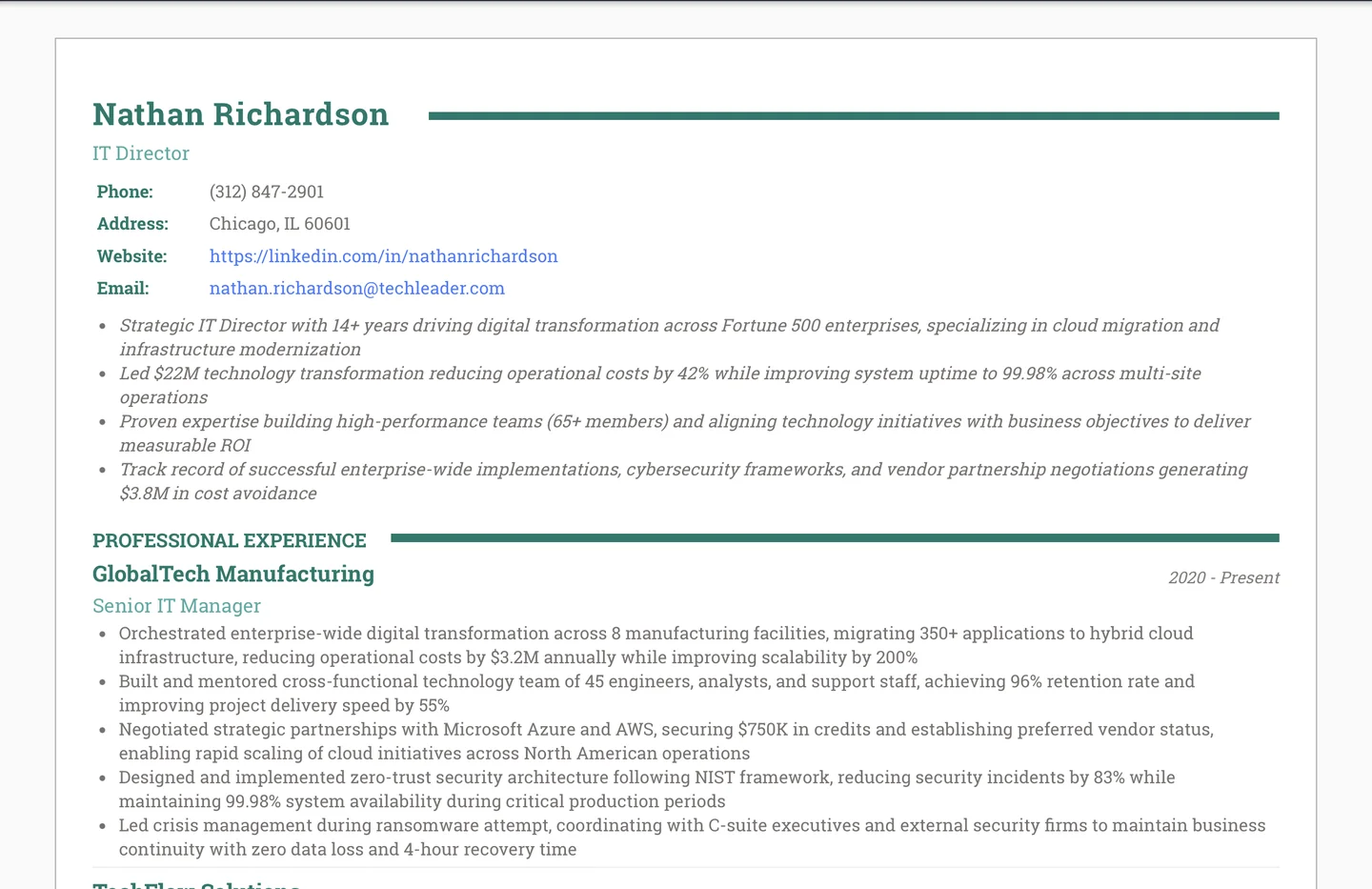
The Ultimate IT Director Resume Example/Sample
https://www.resumonk.com/it-directorIT DirectorResume Format for IT Director - Choosing Your Strategic Blueprint
For an IT Director resume, the reverse-chronological format stands as your most powerful ally.
Why? Because executive leadership roles in technology demand proven progression. Hiring committees want to trace your journey from tactical execution to strategic vision. They need to see how you've evolved from managing systems to managing people, from controlling budgets to creating them.
The Architecture of Your IT Director Resume
Start with a compelling Professional Summary - not an objective statement.
You're not trying to break into IT; you're demonstrating readiness to lead it. Your summary should read like an executive briefing, capturing your leadership philosophy and quantifiable achievements in 3-4 powerful lines.
PROFESSIONAL SUMMARY
Strategic IT Director with 12+ years driving digital transformation across Fortune 500 enterprises. Led $15M infrastructure modernization reducing operational costs by 35% while improving system uptime to 99.97%. Proven expertise building high-performance teams (50+ members) and aligning technology initiatives with business objectives. Track record of successful cloud migrations, cybersecurity implementations, and enterprise-wide system integrations.
Structuring Your Professional Journey
Following your summary, your Professional Experience section becomes the centerpiece. Each role should tell a story of increasing responsibility and impact. Remember, IT Directors aren't just senior technicians - they're business leaders who happen to speak technology.
Your format should reflect this evolution.
For professionals with extensive experience, consider a hybrid approach. After your reverse-chronological work history, add a "Key Projects & Initiatives" section highlighting transformational work that might get buried in job descriptions. This works particularly well if you've led enterprise-wide implementations or digital transformations that spanned multiple roles.
Regional Formatting Considerations
In the United States, keep your IT Director resume to two pages maximum - executive brevity matters.
UK recruiters often appreciate a slightly more detailed approach, allowing up to three pages for senior positions. Canadian formats tend to mirror US preferences, while Australian IT Director resumes can include a brief "Technical Competencies" table showcasing your understanding of current technologies without overwhelming the business focus.
The key difference? US resumes emphasize quantifiable business impact first, technical achievements second.
European markets often appreciate more detail about the technical complexity you've managed, while still maintaining that executive perspective.
Work Experience on IT Director Resume - Demonstrating Strategic Leadership
Remember that morning when you realized you'd stopped thinking about individual servers and started thinking about service availability? That mental shift from technical details to business outcomes - that's exactly what your work experience section needs to capture.
IT Directors occupy a unique space where technical credibility meets business acumen, and your experience descriptions must reflect both dimensions.
Writing Impact-Driven Experience Descriptions
Each position on your resume should follow a clear narrative arc - context, action, and measurable result. But here's where many IT professionals stumble when applying for Director roles: they list what they managed instead of what they achieved.
Managing a team of 20 developers is a responsibility; transforming that team to deliver projects 40% faster is an achievement.
❌ Don't write generic responsibility statements:
IT Manager - TechCorp Solutions (2019-2023)
• Managed IT department budget and resources
• Oversaw infrastructure and application development teams
• Responsible for vendor relationships and contract negotiations
• Implemented new technologies and systems
✅ Do write strategic achievement statements:
IT Manager - TechCorp Solutions (2019-2023)
- Orchestrated digital transformation initiative across 5 business units, migrating 200+ applications, reducing  costs by $2.3M annually
- Built and mentored cross-functional team of 25 engineers and analysts, achieving 94% retention rate
- Negotiated strategic partnerships with Microsoft and AWS, securing $500K in credits and establishing preferred vendor status
- Designed and implemented zero-trust security architecture, reducing security incidents by 78% while maintaining 99.98% system availability
The Progression Story - Showing Your Leadership Evolution
Your work experience should tell a compelling story of growth.
Early roles might emphasize technical excellence and project delivery. Mid-level positions should showcase team building and process improvement. Your most recent roles must demonstrate strategic thinking, stakeholder management, and business transformation.
Think about it this way - when you were a senior developer or systems architect, you solved technical problems. As a team lead or IT Manager, you solved people and process problems. As an IT Director, you'll solve business problems using technology as your tool.
Your experience descriptions should mirror this evolution.
Quantifying Your Strategic Impact
IT Directors live in the world of metrics, but not the ones you might think. While system uptime and response times matter, what really catches attention are business metrics - revenue enabled, costs reduced, time-to-market improved, risk mitigated. Every bullet point should answer the unspoken question - "So what did this mean for the business?"
Consider incorporating these types of metrics in your experience descriptions - budget sizes managed, team sizes led, number of concurrent projects overseen, percentage improvements in efficiency, cost savings achieved, revenue protected through security measures, and time reductions in critical business processes. These numbers transform technical achievements into business victories.
Skills to Showcase on IT Director Resume - Balancing Technical Depth with Leadership Breadth
There was probably a time when you could list every programming language you knew, every certification you held, every tool you'd mastered.
Those days are behind you now. As an IT Director candidate, your skills section isn't a technical inventory - it's a strategic capability statement. The paradox? You need to prove technical credibility without drowning in technical details.
The Three Pillars of IT Director Skills
Your skills should cluster around three critical areas - strategic leadership, technical oversight, and business acumen.
Unlike your earlier career where technical skills dominated, the IT Director role demands a careful balance. Too technical, and you look like a senior engineer overreaching. Too business-focused, and you lose credibility with the technical teams you'll lead.
Start with leadership and strategic skills. These aren't soft skills - they're your primary tools now. Include capabilities like strategic planning, digital transformation, change management, stakeholder engagement, and budget management.
These signal your readiness to operate at the executive level.
❌ Don't list skills like a technical specialist: SKILLS
Python, Java, C++, SQL, MongoDB, Redis, Docker, Kubernetes, Jenkins, Git, Linux Administration, Windows Server, Active Directory, TCP/IP, DNS, DHCP
✅ Do organize skills strategically:
STRATEGIC LEADERSHIP
Digital Transformation | IT Governance | Strategic Planning | Change Management | Stakeholder Engagement | Executive Presentations | Board Reporting
TECHNICAL OVERSIGHT
Enterprise Architecture | Cloud Strategy (AWS, Azure, GCP) | Cybersecurity Frameworks | DevOps Transformation | Data Governance | Infrastructure Modernization
BUSINESS ACUMEN
P&L Management | Vendor Negotiations | Risk Management | Compliance (SOC2, GDPR, HIPAA) | Business Process Optimization | ROI Analysis | Cost Optimization
The Technical Credibility Balance
Here's what keeps many IT professionals up at night when applying for Director roles - how technical should you appear?
The answer lies in demonstrating architectural understanding rather than implementation expertise. You don't need to code anymore, but you need to understand modern development practices. You won't configure firewalls, but you must comprehend security architectures.
Frame your technical skills at the strategic level. Instead of listing "Python programming," mention "Modern development practices oversight." Rather than "Kubernetes administration," include "Container orchestration strategy."
This subtle shift communicates that you understand the technology deeply enough to make strategic decisions about it.
Industry-Specific Skill Considerations
The IT Director role varies significantly across industries. Financial services demand deep understanding of regulatory compliance and risk management. Healthcare requires knowledge of HIPAA, interoperability standards, and clinical systems. Retail focuses on omnichannel experiences and e-commerce platforms.
Tailor your skills section to reflect the unique demands of your target industry.
Don't forget emerging technologies. While you won't implement AI models yourself, including "AI/ML Strategy" or "Digital Innovation" shows you're thinking ahead.
The best IT Directors aren't just managing today's technology - they're preparing their organizations for tomorrow's opportunities.
Specific Considerations and Tips for IT Director Resume - The Strategic Differentiators
You know that moment in your career when you realized the best technical solution wasn't always the right business solution? When you had to tell your team that the elegant microservices architecture they designed would have to wait because the business needed a quick fix for a revenue-blocking issue?
That business-first mindset shift - that's what separates IT Directors from senior technical contributors, and your resume needs to scream this understanding from every line.
The Board-Ready Professional Summary
Unlike other IT roles where your summary might highlight technical expertise, your IT Director summary should read like an executive briefing.
Imagine you have 30 seconds in an elevator with the CEO - what would you say? Your summary should answer three questions immediately: What business value have you delivered? What scale have you operated at? What's your leadership philosophy?
Consider including a "Leadership Philosophy" statement within your summary. This isn't common for technical roles, but for IT Directors, it signals executive maturity. Something like "Believes in servant leadership and building technology strategies that enable business innovation while maintaining operational excellence" can set you apart from technically-focused candidates.
The Advisory Board and Speaking Engagement Edge
Here's something most IT Director candidates overlook - your influence beyond your day job. Have you spoken at industry conferences? Served on technology advisory boards? Published thought leadership pieces? These activities demonstrate that you're not just consuming technology trends - you're shaping them.
Create a "Thought Leadership" or "Industry Engagement" section if you have such experiences.
INDUSTRY ENGAGEMENT
• Keynote Speaker - CloudNext Conference 2023: "Building Resilient Digital Ecosystems"
• Advisory Board Member - TechForward Nonprofit (2021-Present)
• Published Contributor - CIO Magazine: "The Human Side of Digital Transformation" (March 2023)
• Executive Mentor - Women in Technology Program, mentoring 5 emerging IT leaders
The Vendor Relationship Narrative
Your resume should subtly communicate your ability to navigate the complex world of enterprise vendor relationships.
This isn't about name-dropping vendors, but about demonstrating strategic partnership capabilities. When describing achievements, weave in how you've leveraged vendor relationships to drive value. "Negotiated enterprise agreement with Microsoft" becomes "Structured strategic Microsoft partnership resulting in $2M cost avoidance and accelerated Azure adoption across 15 business units."
The Crisis Leadership Proof Point
Every IT Director will face crisis moments - major outages, security breaches, failed implementations.
How you've handled these defines your leadership caliber. Include at least one example of crisis management, but frame it strategically. Focus on your communication with stakeholders, your decision-making under pressure, and most importantly, how you turned crisis into opportunity for improvement.
The Cultural Transformation Angle
Technical transformation without cultural transformation fails.
IT Directors who understand this succeed. Your resume should include examples of how you've driven cultural change - perhaps you've transformed a reactive IT department into a proactive business partner, or evolved a waterfall organization to embrace agile methodologies. These cultural achievements often matter more than technical ones at the Director level.
Remember to address the geographic nuances of IT Director roles. In Silicon Valley, emphasize innovation and disruption. In financial hubs like New York or London, stress risk management and compliance. In growing tech markets like Austin or Toronto, highlight your ability to scale rapidly. Your resume isn't just about your past - it's about fitting into your future organization's specific context.
The Board-Level Communication Readiness
Finally, remember that IT Directors often present to boards and executive committees. Your resume itself should demonstrate this communication ability. Use business language first, technical language second. Replace "implemented Kubernetes" with "modernized application deployment infrastructure." Transform "managed Active Directory" into "ensured identity and access governance."
Every word should prove you can translate between the server room and the board room.
The most successful IT Director resumes don't just list achievements - they tell the story of a technology leader who thinks like a business executive. Your resume should leave readers thinking not "this person knows technology" but rather "this person knows how to use technology to drive our business forward."
Education to List on IT Director Resume
You've climbed the technology ladder for years. From debugging code at 2 AM to architecting enterprise solutions, from managing small dev teams to overseeing entire IT departments - your journey to IT Director has been anything but linear. Now, as you craft your resume for that coveted IT Director position, you might wonder how much your education from a decade (or two) ago really matters.
Spoiler alert - it still does, but not in the way you might think.
The Strategic Placement of Your Degrees
Unlike entry-level positions where education takes center stage, your IT Director resume should position education strategically after your professional experience.
By this point in your career, your battle-tested leadership experience and technical achievements speak louder than your GPA from 15 years ago. Think of your education section as the foundation that supports your towering career achievements - essential, but not the first thing people notice about the building.
What Educational Credentials Matter Most
IT Directors typically come from diverse educational backgrounds, and hiring committees know this. While a Bachelor's degree in Computer Science, Information Technology, or Engineering provides a solid foundation, many successful IT Directors hold degrees in Business Administration, Mathematics, or even liberal arts.
What matters is how you frame your education in context with your career trajectory.
Start with your highest degree and work backwards. If you earned an MBA after years in technical roles, that's gold - it shows you deliberately developed business acumen to complement your technical expertise. Here's how to present different educational scenarios:
❌ Don't write vaguely about your degree:
 MBA - State University, 2015
Bachelor of Science - Tech College, 2005
✅ Do provide context that reinforces your Director-level capabilities:
Master of Business Administration (MBA)- Technology Management Focus
State University, 2015
• Capstone Project: Digital Transformation Strategy for Fortune 500 Manufacturing Firm
Bachelor of Science in Computer Science
Tech College, 2005
• Minor in Business Administration
Certifications - Your Continuous Learning Story
Here's where IT Directors can really shine.
Your certifications tell the story of how you've kept pace with technology while developing leadership skills. Include high-level certifications that demonstrate both technical currency and strategic thinking. ITIL Expert, PMP, CISSP, or cloud architecture certifications from AWS, Azure, or Google Cloud show you understand both the technical and business implications of technology decisions.
List certifications separately from degrees, prioritizing those most relevant to the specific IT Director role. If you're applying to a company undergoing cloud transformation, your AWS Solutions Architect certification might be more valuable than your decade-old CCNA.
Executive Education Programs
Many IT Directors enhance their credentials through executive education programs at prestigious institutions.
These aren't degrees, but they carry weight. If you've completed programs at Wharton Executive Education, MIT Sloan, or similar institutions, include them. They signal that you're thinking at the strategic level expected of directors.
❌ Don't bury executive education in miscellaneous training:
Various leadership workshops and training programs
✅ Do highlight prestigious executive programs:
Executive Leadership Program
Stanford Graduate School of Business, 2022
• Focus: Leading Digital Innovation and Organizational Change
Remember, in the UK and Europe, professional qualifications like PRINCE2 or TOGAF might carry more weight than in the US. In Canada and Australia, highlighting any local technology governance or compliance certifications can set you apart.
The key is understanding what educational credentials resonate in your target market and positioning them accordingly.
Awards and Publications on IT Director Resume
Imagine this - you're in the final round for an IT Director position, competing against two other candidates with similar experience.
What tips the scale? Often, it's the candidate who can demonstrate thought leadership and peer recognition through awards and publications. These achievements transform you from someone who simply manages IT to someone who shapes the conversation around technology strategy.
Awards That Amplify Your Director Credentials
Not all awards are created equal when you're gunning for an IT Director role.
The "Employee of the Month" recognition from five years ago? Leave it off. The "CIO 100 Award" for leading a digital transformation initiative? That's your headline act. IT Directors need to showcase awards that demonstrate leadership impact, innovation at scale, and business value delivery.
Industry recognition carries particular weight. Awards from organizations like the Society for Information Management (SIM), technology vendor partner awards, or regional technology leadership recognitions show that your peers and the broader industry acknowledge your contributions. Internal company awards matter too, especially those tied to significant business outcomes - cost savings, revenue generation, or successful enterprise-wide implementations.
❌ Don't list awards without context:
 • Excellence Award - 2021
• Best Project Award - 2020
• Recognition Certificate - 2019
✅ Do provide meaningful context that reinforces director-level impact:
• Technology Leader of the Year - TechExec Awards 2021 - Recognized for leading $15M ERP transformation reducing operational costs by 30%
• Innovation Excellence Award - Company Name, 2020 - Awarded for implementing AI-driven IT service management, improving ticket resolution by 60%
Publications That Position You as a Thought Leader
You've probably consumed countless articles about cloud migration, cybersecurity strategies, and digital transformation. But have you contributed to the conversation?
Publications - whether peer-reviewed articles, industry magazine features, or well-regarded blog posts - position you as someone who doesn't just implement strategies but helps define them.
IT Directors who publish demonstrate several crucial qualities. First, they show deep expertise that others value. Second, they prove communication skills essential for translating technical concepts to business stakeholders.
Third, they indicate a commitment to advancing the profession beyond their immediate role.
How to Present Your Published Work
When listing publications, prioritize based on relevance and prestige. An article in CIO Magazine or Harvard Business Review carries more weight than a vendor blog post, though both have value.
Technical papers in IEEE journals show depth, while business-focused articles in MIT Sloan Management Review demonstrate the business acumen expected of directors.
❌ Don't minimize your thought leadership:
Wrote some articles about IT management
✅ Do showcase the breadth and impact of your publications:
Selected Publications:
• "Bridging the IT-Business Divide Through Agile Governance" - CIO Magazine, March 2023
• "Zero-Trust Architecture: A Practical Implementation Guide" - InfoSec Quarterly, Q4 2022
• "The Hidden ROI of Technical Debt Reduction" - Co-author, IEEE Technology Management Review, 2022
Speaking Engagements and Panel Participation
While not traditional publications, speaking engagements at major conferences deserve mention in this section. IT Directors often serve as keynote speakers, panelists, or workshop leaders at events like Gartner Symposium, AWS re:Invent, or industry-specific technology conferences.
These appearances validate your expertise and show you're comfortable representing organizations at the highest levels.
The key is selectivity. Include speaking engagements at recognized industry events, not every webinar you've ever delivered. Focus on those where you addressed strategic topics relevant to IT leadership - digital transformation, IT governance, technology team development, or emerging technology adoption strategies.
For international considerations, remember that publication preferences vary. In the UK, contributions to BCS (The Chartered Institute for IT) publications carry weight. In Australia and Canada, local technology leadership publications and conferences matter. Always research which publications and awards resonate most in your target geography and industry.
Listing References for IT Director Resume
You've navigated countless vendor negotiations, reference checks for your own hires, and probably served as a reference yourself dozens of times.
Now, as you prepare your IT Director application, you're facing a familiar process from the other side. But here's what many director-level candidates overlook - at this level, references aren't just confirming your employment dates or technical skills. They're validating your ability to operate at the intersection of technology leadership and business strategy.
The Strategic Selection of Your Reference Portfolio
Choosing references for an IT Director role requires the same strategic thinking you'd apply to selecting vendors for a critical project.
You need a balanced portfolio that speaks to different aspects of your leadership. The CEO who watched you transform IT from a cost center to a business enabler? Essential. The CFO who partnered with you on technology investments? Invaluable. The peer director from Sales or Operations who can attest to your collaborative leadership? Critical.
Your reference list should tell a complete story. Include at least one superior (ideally C-level), one peer at director level or above, and potentially one high-performing direct report who's now in senior management themselves. This shows you can manage up, across, and down - all essential for IT Director success.
❌ Don't list references without context:
References:
John Smith - 555-0100
Jane Doe - 555-0200
Bob Johnson - 555-0300
✅ Do provide strategic context for each reference:
References:
Sarah Mitchell - Chief Executive Officer, TechCorp Industries
612-555-0100 | [email protected]
Relationship: Direct supervisor during $30M digital transformation (2020-2023)
Robert Chen - Chief Financial Officer, GlobalTech Solutions
415-555-0200 | [email protected]
• Relationship: Executive partner on IT investment strategy and cost optimization initiatives
Maria Rodriguez - VP of Operations, TechCorp Industries
612-555-0300 | [email protected]
• Relationship: Peer executive partner on enterprise-wide system implementation
The "References Upon Request" Debate
At the IT Director level, the old "References Available Upon Request" line is understood but increasingly outdated.
You're applying for a role where relationships and trust matter immensely. Having your references ready signals confidence and preparation. However, there's a strategic consideration here - if you're confidentially exploring opportunities while employed, you might need to protect your references until later in the process.
A sophisticated approach? Prepare a separate reference sheet that you can provide when requested, rather than including it with your initial application.
This gives you control over when your references might be contacted while showing you're fully prepared for due diligence.
Preparing Your References for Director-Level Conversations
Here's what separates director-level candidates from the pack - they prepare their references for success. Before listing anyone, have a strategic conversation with each reference. Brief them on the role, the company's challenges, and the key messages you'd like reinforced.
This isn't coaching them to lie; it's ensuring they understand the context and can speak to relevant achievements.
Send each reference a brief email with bullet points about the role and specific projects or achievements you'd like them to potentially discuss. A CEO reference might focus on your business acumen and strategic thinking, while a CFO reference might emphasize your fiscal responsibility and ROI focus. This preparation shows the same attention to detail you'd bring to any critical IT Director initiative.
International References and Cultural Considerations
If you're applying internationally or have international experience, leverage it through your references.
A reference from your time leading IT for the APAC region adds credibility for roles requiring global perspective. However, be mindful of time zones and communication preferences. Provide multiple contact methods and note the best times to reach international references.
In the UK and Europe, written references (actual letters) still carry weight alongside verbal checks. In the US and Canada, phone conversations remain the gold standard. Australian employers often prefer a mix. Adapt your reference strategy to regional expectations while maintaining the high-level professional approach expected of IT Director candidates.
Managing Currently Employed References
Many of your best references might be people you currently work with - a delicate situation when job searching confidentially.
Consider having one or two trusted references from previous roles who can speak first, buying time before current employer references become necessary. You might also include a note indicating that current employer references are available upon reaching the final stage of selection, a completely reasonable request at the director level.
Remember, at the IT Director level, the technology community is surprisingly small. Your references might know the hiring committee personally.
This network effect can work in your favor if managed properly, turning your reference check into a warm endorsement from a trusted colleague rather than a cold verification call.
Cover Letter Tips for IT Director Resume
Let's be honest - after years of managing IT departments, wrestling with budget constraints, and translating tech-speak to C-suite executives, writing about yourself feels oddly challenging. You're used to letting dashboards and KPIs tell your story. But here's the thing about writing IT Director cover letters - they're not about proving you can manage servers or implement ITIL frameworks. The hiring committee already assumes you can do that.
Your cover letter needs to answer a different question entirely - can you be the bridge between technology possibilities and business realities?
Opening With Strategic Vision, Not Technical Credentials
Forget the standard "I am writing to apply for the IT Director position" opening.
By the time someone reaches director level, they need to command attention from the first sentence. Your opening should immediately position you as someone who thinks in business outcomes, not just technology solutions.
Start with a strategic observation about their industry, a recent challenge they've faced (perhaps gleaned from their annual report or recent press releases), or a transformation opportunity specific to their business. This shows you've done your homework and are already thinking like their IT Director, not just another applicant.
❌ Don't open with generic statements:
 Dear Hiring Manager,
I am excited to apply for the IT Director position at your company. With 15 years of IT experience, I believe I would be a great fit for this role.
✅ Do open with strategic insight:
 Dear Ms. Johnson,
Your recent expansion into Asian markets presents unique IT infrastructure challenges that mirror those I successfully navigated while scaling TechCorp's operations across 12 countries. The key wasn't just implementing technology - it was creating an IT strategy that balanced global standardization with local market flexibility.
The Three-Paragraph Power Structure
IT Directors deal with executive attention spans daily, so your cover letter should reflect that understanding. After your opening hook, structure your letter in three powerful paragraphs that tell a complete story.
The first paragraph should establish your current strategic level and a marquee achievement that aligns with their needs. Maybe you transformed a reactive IT department into a strategic business partner, or perhaps you led a cloud migration that cut costs while improving agility. Choose the achievement that best mirrors their current challenges.
The second paragraph shifts from past to future. This is where you demonstrate understanding of their specific situation. Reference their recent merger, their digital transformation initiative, their move to cloud-first architecture - whatever strategic initiative they're undertaking. Then, briefly outline how your experience positions you to lead this charge. Don't get tactical here - stay at the strategic level appropriate for a director role.
Your final paragraph should create urgency and next steps. Express genuine enthusiasm for their specific mission (not just the role), and suggest a concrete discussion topic for the interview.
This shows you're already thinking about their challenges and positions the interview as a strategic discussion between peers, not an interrogation.
Addressing the Elephant in the Room
Every IT Director candidate has something that might raise eyebrows - maybe you're transitioning from a much smaller company, shifting industries, or returning after a consulting stint. Don't ignore these potential concerns; address them as strengths.
If you're moving from a 200-person company to a 5,000-person enterprise, frame it as bringing startup agility to enterprise scale. Coming from a different industry? Position it as bringing fresh perspectives and proven practices from other sectors. The key is acknowledging the difference while explaining why it's actually an advantage.
❌ Don't ignore obvious transitions:
Although I've worked in healthcare IT, I'm confident I can adapt to financial services.
✅ Do reframe differences as advantages:
My decade in healthcare IT, where system failures literally impact lives, has instilled a risk management rigor and reliability mindset that translates powerfully to financial services, where system uptime and data integrity are equally mission-critical.
Regional Nuances and Closing Strategies
Cover letter conventions vary globally.
In the US, confidence and direct value propositions resonate. In the UK, a slightly more reserved tone with emphasis on collaborative leadership works better. Canadian employers appreciate references to bilingual capabilities or experience with privacy regulations like PIPEDA. Australian companies often value Asia-Pacific experience and cultural awareness.
Regardless of geography, close with confidence and clarity. Skip the "thank you for considering my application" - they should be thanking you for considering their opportunity. Instead, end with a forward-looking statement that assumes progression to the next stage while remaining professional.
Key Takeaways
- Lead with Strategic Impact: Your resume must emphasize business outcomes over technical achievements. Every bullet point should answer "what did this mean for the business?" rather than just describing what you did.
- Use Reverse-Chronological Format: This format best showcases your progression from technical roles to leadership positions, allowing hiring committees to trace your evolution into executive thinking.
- Balance Technical Credibility with Business Acumen: Frame technical skills at the strategic level - discuss "cloud strategy" rather than "AWS administration" to show you think architecturally, not operationally.
- Quantify Everything: Include metrics that matter to executives - budget sizes managed, cost savings achieved, team sizes led, percentage improvements in efficiency, and revenue protected or enabled.
- Showcase Thought Leadership: Include speaking engagements, publications, and industry awards that position you as someone who shapes technology strategy, not just implements it.
- Craft an Executive-Level Summary: Your professional summary should read like a briefing to the board - highlighting your leadership philosophy, scale of operations, and transformational achievements.
- Address Industry and Geographic Nuances: Tailor your resume to specific industry requirements (compliance in finance, innovation in tech) and regional preferences (two pages in the US, potentially three in the UK).
- Demonstrate Crisis Leadership: Include at least one example of managing through a technology crisis, focusing on stakeholder communication and turning challenges into improvement opportunities.
- Position Education Strategically: Place education after experience, highlighting advanced degrees like MBAs and executive education programs that show deliberate development of business acumen.
- Prepare References Strategically: Select references who can speak to different aspects of your leadership - managing up, across, and down - and brief them on the specific role and key messages to reinforce.
Ready to transform your extensive IT leadership experience into a compelling IT Director resume? Resumonk makes this transformation seamless. Our platform understands the unique requirements of executive technology roles, helping you articulate your strategic vision while maintaining technical credibility. With AI-powered suggestions tailored specifically for IT Director positions, you'll receive guidance on quantifying your achievements, positioning your leadership experience, and crafting impactful bullet points that resonate with executive hiring committees.
Our professionally designed templates are optimized for director-level positions, ensuring your resume projects the executive presence expected at this level. Whether you need to highlight your digital transformation successes, showcase your P&L management experience, or demonstrate your ability to align technology with business strategy, Resumonk's intelligent recommendations will help you present your qualifications in the most compelling way possible.
Ready to craft your IT Director resume with confidence?
Start your journey with Resumonk today and leverage our specialized tools designed for technology leaders. Our platform will help you create a resume that positions you not just as an IT manager, but as a strategic technology executive ready to drive business transformation.
Explore Resumonk's professional features and begin building your IT Director resume →
More Information Technology (IT) resume examples
- Technical Support resume example
- IT Project Manager resume example
- Entry Level Help Desk resume example
- AWS resume example
See all Information Technology (IT) resume examples, or browse every category.
Resume writing tips
You're standing at the threshold of a significant career transition.
For years, you've been the person others turned to when systems crashed at midnight, when budgets needed stretching, when teams needed building. You've evolved from writing code to writing strategies, from debugging applications to debugging organizational processes. Now, as you eye that IT Director position, you're not just looking for another job - you're ready to shape how an entire organization leverages technology to win in the marketplace.
The IT Director role represents a unique intersection in the technology leadership hierarchy. Unlike a CTO who might focus purely on innovation, or a CIO who operates at the highest strategic level, an IT Director serves as the crucial bridge between executive vision and operational excellence. You're expected to speak fluently in both boardroom strategy and server room reality. Your resume needs to reflect this duality - proving you can think like an executive while maintaining the technical credibility to lead sophisticated technology teams.
This comprehensive guide will walk you through every element of crafting a compelling IT Director resume. We'll start by exploring the optimal resume format that showcases your progression from technical contributor to strategic leader. Then we'll dive deep into articulating your work experience in a way that emphasizes business impact over technical tasks. You'll learn how to balance technical skills with leadership capabilities, incorporate the right educational credentials and certifications, and leverage awards and publications to establish thought leadership. We'll also cover crucial elements like crafting a board-ready professional summary, addressing unique circumstances like industry transitions, and even preparing references who can validate your director-level capabilities.
Whether you're a seasoned IT Manager ready for the next step, transitioning from a senior architect role into leadership, or returning to corporate leadership after a consulting stint, this guide addresses your specific situation. We understand that your path to IT Director might not be linear - perhaps you've built your career in healthcare IT and are now eyeing fintech opportunities, or you've excelled in mid-size companies and are ready for enterprise scale. Each scenario requires subtle adjustments to how you present your experience, and we'll cover these nuances throughout.
By the end of this guide, you'll have a clear blueprint for creating an IT Director resume that doesn't just list your achievements but tells the story of a technology leader ready to drive business transformation. Let's begin building your case for why you're the IT Director who can turn technology investments into competitive advantages.
The Ultimate IT Director Resume Example/Sample
https://www.resumonk.com/it-directorIT DirectorResume Format for IT Director - Choosing Your Strategic Blueprint
For an IT Director resume, the reverse-chronological format stands as your most powerful ally.
Why? Because executive leadership roles in technology demand proven progression. Hiring committees want to trace your journey from tactical execution to strategic vision. They need to see how you've evolved from managing systems to managing people, from controlling budgets to creating them.
The Architecture of Your IT Director Resume
Start with a compelling Professional Summary - not an objective statement.
You're not trying to break into IT; you're demonstrating readiness to lead it. Your summary should read like an executive briefing, capturing your leadership philosophy and quantifiable achievements in 3-4 powerful lines.
PROFESSIONAL SUMMARY
Strategic IT Director with 12+ years driving digital transformation across Fortune 500 enterprises. Led $15M infrastructure modernization reducing operational costs by 35% while improving system uptime to 99.97%. Proven expertise building high-performance teams (50+ members) and aligning technology initiatives with business objectives. Track record of successful cloud migrations, cybersecurity implementations, and enterprise-wide system integrations.
Structuring Your Professional Journey
Following your summary, your Professional Experience section becomes the centerpiece. Each role should tell a story of increasing responsibility and impact. Remember, IT Directors aren't just senior technicians - they're business leaders who happen to speak technology.
Your format should reflect this evolution.
For professionals with extensive experience, consider a hybrid approach. After your reverse-chronological work history, add a "Key Projects & Initiatives" section highlighting transformational work that might get buried in job descriptions. This works particularly well if you've led enterprise-wide implementations or digital transformations that spanned multiple roles.
Regional Formatting Considerations
In the United States, keep your IT Director resume to two pages maximum - executive brevity matters.
UK recruiters often appreciate a slightly more detailed approach, allowing up to three pages for senior positions. Canadian formats tend to mirror US preferences, while Australian IT Director resumes can include a brief "Technical Competencies" table showcasing your understanding of current technologies without overwhelming the business focus.
The key difference? US resumes emphasize quantifiable business impact first, technical achievements second.
European markets often appreciate more detail about the technical complexity you've managed, while still maintaining that executive perspective.
Work Experience on IT Director Resume - Demonstrating Strategic Leadership
Remember that morning when you realized you'd stopped thinking about individual servers and started thinking about service availability? That mental shift from technical details to business outcomes - that's exactly what your work experience section needs to capture.
IT Directors occupy a unique space where technical credibility meets business acumen, and your experience descriptions must reflect both dimensions.
Writing Impact-Driven Experience Descriptions
Each position on your resume should follow a clear narrative arc - context, action, and measurable result. But here's where many IT professionals stumble when applying for Director roles: they list what they managed instead of what they achieved.
Managing a team of 20 developers is a responsibility; transforming that team to deliver projects 40% faster is an achievement.
❌ Don't write generic responsibility statements:
IT Manager - TechCorp Solutions (2019-2023)
• Managed IT department budget and resources
• Oversaw infrastructure and application development teams
• Responsible for vendor relationships and contract negotiations
• Implemented new technologies and systems
✅ Do write strategic achievement statements:
IT Manager - TechCorp Solutions (2019-2023)
- Orchestrated digital transformation initiative across 5 business units, migrating 200+ applications, reducing  costs by $2.3M annually
- Built and mentored cross-functional team of 25 engineers and analysts, achieving 94% retention rate
- Negotiated strategic partnerships with Microsoft and AWS, securing $500K in credits and establishing preferred vendor status
- Designed and implemented zero-trust security architecture, reducing security incidents by 78% while maintaining 99.98% system availability
The Progression Story - Showing Your Leadership Evolution
Your work experience should tell a compelling story of growth.
Early roles might emphasize technical excellence and project delivery. Mid-level positions should showcase team building and process improvement. Your most recent roles must demonstrate strategic thinking, stakeholder management, and business transformation.
Think about it this way - when you were a senior developer or systems architect, you solved technical problems. As a team lead or IT Manager, you solved people and process problems. As an IT Director, you'll solve business problems using technology as your tool.
Your experience descriptions should mirror this evolution.
Quantifying Your Strategic Impact
IT Directors live in the world of metrics, but not the ones you might think. While system uptime and response times matter, what really catches attention are business metrics - revenue enabled, costs reduced, time-to-market improved, risk mitigated. Every bullet point should answer the unspoken question - "So what did this mean for the business?"
Consider incorporating these types of metrics in your experience descriptions - budget sizes managed, team sizes led, number of concurrent projects overseen, percentage improvements in efficiency, cost savings achieved, revenue protected through security measures, and time reductions in critical business processes. These numbers transform technical achievements into business victories.
Skills to Showcase on IT Director Resume - Balancing Technical Depth with Leadership Breadth
There was probably a time when you could list every programming language you knew, every certification you held, every tool you'd mastered.
Those days are behind you now. As an IT Director candidate, your skills section isn't a technical inventory - it's a strategic capability statement. The paradox? You need to prove technical credibility without drowning in technical details.
The Three Pillars of IT Director Skills
Your skills should cluster around three critical areas - strategic leadership, technical oversight, and business acumen.
Unlike your earlier career where technical skills dominated, the IT Director role demands a careful balance. Too technical, and you look like a senior engineer overreaching. Too business-focused, and you lose credibility with the technical teams you'll lead.
Start with leadership and strategic skills. These aren't soft skills - they're your primary tools now. Include capabilities like strategic planning, digital transformation, change management, stakeholder engagement, and budget management.
These signal your readiness to operate at the executive level.
❌ Don't list skills like a technical specialist: SKILLS
Python, Java, C++, SQL, MongoDB, Redis, Docker, Kubernetes, Jenkins, Git, Linux Administration, Windows Server, Active Directory, TCP/IP, DNS, DHCP
✅ Do organize skills strategically:
STRATEGIC LEADERSHIP
Digital Transformation | IT Governance | Strategic Planning | Change Management | Stakeholder Engagement | Executive Presentations | Board Reporting
TECHNICAL OVERSIGHT
Enterprise Architecture | Cloud Strategy (AWS, Azure, GCP) | Cybersecurity Frameworks | DevOps Transformation | Data Governance | Infrastructure Modernization
BUSINESS ACUMEN
P&L Management | Vendor Negotiations | Risk Management | Compliance (SOC2, GDPR, HIPAA) | Business Process Optimization | ROI Analysis | Cost Optimization
The Technical Credibility Balance
Here's what keeps many IT professionals up at night when applying for Director roles - how technical should you appear?
The answer lies in demonstrating architectural understanding rather than implementation expertise. You don't need to code anymore, but you need to understand modern development practices. You won't configure firewalls, but you must comprehend security architectures.
Frame your technical skills at the strategic level. Instead of listing "Python programming," mention "Modern development practices oversight." Rather than "Kubernetes administration," include "Container orchestration strategy."
This subtle shift communicates that you understand the technology deeply enough to make strategic decisions about it.
Industry-Specific Skill Considerations
The IT Director role varies significantly across industries. Financial services demand deep understanding of regulatory compliance and risk management. Healthcare requires knowledge of HIPAA, interoperability standards, and clinical systems. Retail focuses on omnichannel experiences and e-commerce platforms.
Tailor your skills section to reflect the unique demands of your target industry.
Don't forget emerging technologies. While you won't implement AI models yourself, including "AI/ML Strategy" or "Digital Innovation" shows you're thinking ahead.
The best IT Directors aren't just managing today's technology - they're preparing their organizations for tomorrow's opportunities.
Specific Considerations and Tips for IT Director Resume - The Strategic Differentiators
You know that moment in your career when you realized the best technical solution wasn't always the right business solution? When you had to tell your team that the elegant microservices architecture they designed would have to wait because the business needed a quick fix for a revenue-blocking issue?
That business-first mindset shift - that's what separates IT Directors from senior technical contributors, and your resume needs to scream this understanding from every line.
The Board-Ready Professional Summary
Unlike other IT roles where your summary might highlight technical expertise, your IT Director summary should read like an executive briefing.
Imagine you have 30 seconds in an elevator with the CEO - what would you say? Your summary should answer three questions immediately: What business value have you delivered? What scale have you operated at? What's your leadership philosophy?
Consider including a "Leadership Philosophy" statement within your summary. This isn't common for technical roles, but for IT Directors, it signals executive maturity. Something like "Believes in servant leadership and building technology strategies that enable business innovation while maintaining operational excellence" can set you apart from technically-focused candidates.
The Advisory Board and Speaking Engagement Edge
Here's something most IT Director candidates overlook - your influence beyond your day job. Have you spoken at industry conferences? Served on technology advisory boards? Published thought leadership pieces? These activities demonstrate that you're not just consuming technology trends - you're shaping them.
Create a "Thought Leadership" or "Industry Engagement" section if you have such experiences.
INDUSTRY ENGAGEMENT
• Keynote Speaker - CloudNext Conference 2023: "Building Resilient Digital Ecosystems"
• Advisory Board Member - TechForward Nonprofit (2021-Present)
• Published Contributor - CIO Magazine: "The Human Side of Digital Transformation" (March 2023)
• Executive Mentor - Women in Technology Program, mentoring 5 emerging IT leaders
The Vendor Relationship Narrative
Your resume should subtly communicate your ability to navigate the complex world of enterprise vendor relationships.
This isn't about name-dropping vendors, but about demonstrating strategic partnership capabilities. When describing achievements, weave in how you've leveraged vendor relationships to drive value. "Negotiated enterprise agreement with Microsoft" becomes "Structured strategic Microsoft partnership resulting in $2M cost avoidance and accelerated Azure adoption across 15 business units."
The Crisis Leadership Proof Point
Every IT Director will face crisis moments - major outages, security breaches, failed implementations.
How you've handled these defines your leadership caliber. Include at least one example of crisis management, but frame it strategically. Focus on your communication with stakeholders, your decision-making under pressure, and most importantly, how you turned crisis into opportunity for improvement.
The Cultural Transformation Angle
Technical transformation without cultural transformation fails.
IT Directors who understand this succeed. Your resume should include examples of how you've driven cultural change - perhaps you've transformed a reactive IT department into a proactive business partner, or evolved a waterfall organization to embrace agile methodologies. These cultural achievements often matter more than technical ones at the Director level.
Remember to address the geographic nuances of IT Director roles. In Silicon Valley, emphasize innovation and disruption. In financial hubs like New York or London, stress risk management and compliance. In growing tech markets like Austin or Toronto, highlight your ability to scale rapidly. Your resume isn't just about your past - it's about fitting into your future organization's specific context.
The Board-Level Communication Readiness
Finally, remember that IT Directors often present to boards and executive committees. Your resume itself should demonstrate this communication ability. Use business language first, technical language second. Replace "implemented Kubernetes" with "modernized application deployment infrastructure." Transform "managed Active Directory" into "ensured identity and access governance."
Every word should prove you can translate between the server room and the board room.
The most successful IT Director resumes don't just list achievements - they tell the story of a technology leader who thinks like a business executive. Your resume should leave readers thinking not "this person knows technology" but rather "this person knows how to use technology to drive our business forward."
Education to List on IT Director Resume
You've climbed the technology ladder for years. From debugging code at 2 AM to architecting enterprise solutions, from managing small dev teams to overseeing entire IT departments - your journey to IT Director has been anything but linear. Now, as you craft your resume for that coveted IT Director position, you might wonder how much your education from a decade (or two) ago really matters.
Spoiler alert - it still does, but not in the way you might think.
The Strategic Placement of Your Degrees
Unlike entry-level positions where education takes center stage, your IT Director resume should position education strategically after your professional experience.
By this point in your career, your battle-tested leadership experience and technical achievements speak louder than your GPA from 15 years ago. Think of your education section as the foundation that supports your towering career achievements - essential, but not the first thing people notice about the building.
What Educational Credentials Matter Most
IT Directors typically come from diverse educational backgrounds, and hiring committees know this. While a Bachelor's degree in Computer Science, Information Technology, or Engineering provides a solid foundation, many successful IT Directors hold degrees in Business Administration, Mathematics, or even liberal arts.
What matters is how you frame your education in context with your career trajectory.
Start with your highest degree and work backwards. If you earned an MBA after years in technical roles, that's gold - it shows you deliberately developed business acumen to complement your technical expertise. Here's how to present different educational scenarios:
❌ Don't write vaguely about your degree:
 MBA - State University, 2015
Bachelor of Science - Tech College, 2005
✅ Do provide context that reinforces your Director-level capabilities:
Master of Business Administration (MBA)- Technology Management Focus
State University, 2015
• Capstone Project: Digital Transformation Strategy for Fortune 500 Manufacturing Firm
Bachelor of Science in Computer Science
Tech College, 2005
• Minor in Business Administration
Certifications - Your Continuous Learning Story
Here's where IT Directors can really shine.
Your certifications tell the story of how you've kept pace with technology while developing leadership skills. Include high-level certifications that demonstrate both technical currency and strategic thinking. ITIL Expert, PMP, CISSP, or cloud architecture certifications from AWS, Azure, or Google Cloud show you understand both the technical and business implications of technology decisions.
List certifications separately from degrees, prioritizing those most relevant to the specific IT Director role. If you're applying to a company undergoing cloud transformation, your AWS Solutions Architect certification might be more valuable than your decade-old CCNA.
Executive Education Programs
Many IT Directors enhance their credentials through executive education programs at prestigious institutions.
These aren't degrees, but they carry weight. If you've completed programs at Wharton Executive Education, MIT Sloan, or similar institutions, include them. They signal that you're thinking at the strategic level expected of directors.
❌ Don't bury executive education in miscellaneous training:
Various leadership workshops and training programs
✅ Do highlight prestigious executive programs:
Executive Leadership Program
Stanford Graduate School of Business, 2022
• Focus: Leading Digital Innovation and Organizational Change
Remember, in the UK and Europe, professional qualifications like PRINCE2 or TOGAF might carry more weight than in the US. In Canada and Australia, highlighting any local technology governance or compliance certifications can set you apart.
The key is understanding what educational credentials resonate in your target market and positioning them accordingly.
Awards and Publications on IT Director Resume
Imagine this - you're in the final round for an IT Director position, competing against two other candidates with similar experience.
What tips the scale? Often, it's the candidate who can demonstrate thought leadership and peer recognition through awards and publications. These achievements transform you from someone who simply manages IT to someone who shapes the conversation around technology strategy.
Awards That Amplify Your Director Credentials
Not all awards are created equal when you're gunning for an IT Director role.
The "Employee of the Month" recognition from five years ago? Leave it off. The "CIO 100 Award" for leading a digital transformation initiative? That's your headline act. IT Directors need to showcase awards that demonstrate leadership impact, innovation at scale, and business value delivery.
Industry recognition carries particular weight. Awards from organizations like the Society for Information Management (SIM), technology vendor partner awards, or regional technology leadership recognitions show that your peers and the broader industry acknowledge your contributions. Internal company awards matter too, especially those tied to significant business outcomes - cost savings, revenue generation, or successful enterprise-wide implementations.
❌ Don't list awards without context:
 • Excellence Award - 2021
• Best Project Award - 2020
• Recognition Certificate - 2019
✅ Do provide meaningful context that reinforces director-level impact:
• Technology Leader of the Year - TechExec Awards 2021 - Recognized for leading $15M ERP transformation reducing operational costs by 30%
• Innovation Excellence Award - Company Name, 2020 - Awarded for implementing AI-driven IT service management, improving ticket resolution by 60%
Publications That Position You as a Thought Leader
You've probably consumed countless articles about cloud migration, cybersecurity strategies, and digital transformation. But have you contributed to the conversation?
Publications - whether peer-reviewed articles, industry magazine features, or well-regarded blog posts - position you as someone who doesn't just implement strategies but helps define them.
IT Directors who publish demonstrate several crucial qualities. First, they show deep expertise that others value. Second, they prove communication skills essential for translating technical concepts to business stakeholders.
Third, they indicate a commitment to advancing the profession beyond their immediate role.
How to Present Your Published Work
When listing publications, prioritize based on relevance and prestige. An article in CIO Magazine or Harvard Business Review carries more weight than a vendor blog post, though both have value.
Technical papers in IEEE journals show depth, while business-focused articles in MIT Sloan Management Review demonstrate the business acumen expected of directors.
❌ Don't minimize your thought leadership:
Wrote some articles about IT management
✅ Do showcase the breadth and impact of your publications:
Selected Publications:
• "Bridging the IT-Business Divide Through Agile Governance" - CIO Magazine, March 2023
• "Zero-Trust Architecture: A Practical Implementation Guide" - InfoSec Quarterly, Q4 2022
• "The Hidden ROI of Technical Debt Reduction" - Co-author, IEEE Technology Management Review, 2022
Speaking Engagements and Panel Participation
While not traditional publications, speaking engagements at major conferences deserve mention in this section. IT Directors often serve as keynote speakers, panelists, or workshop leaders at events like Gartner Symposium, AWS re:Invent, or industry-specific technology conferences.
These appearances validate your expertise and show you're comfortable representing organizations at the highest levels.
The key is selectivity. Include speaking engagements at recognized industry events, not every webinar you've ever delivered. Focus on those where you addressed strategic topics relevant to IT leadership - digital transformation, IT governance, technology team development, or emerging technology adoption strategies.
For international considerations, remember that publication preferences vary. In the UK, contributions to BCS (The Chartered Institute for IT) publications carry weight. In Australia and Canada, local technology leadership publications and conferences matter. Always research which publications and awards resonate most in your target geography and industry.
Listing References for IT Director Resume
You've navigated countless vendor negotiations, reference checks for your own hires, and probably served as a reference yourself dozens of times.
Now, as you prepare your IT Director application, you're facing a familiar process from the other side. But here's what many director-level candidates overlook - at this level, references aren't just confirming your employment dates or technical skills. They're validating your ability to operate at the intersection of technology leadership and business strategy.
The Strategic Selection of Your Reference Portfolio
Choosing references for an IT Director role requires the same strategic thinking you'd apply to selecting vendors for a critical project.
You need a balanced portfolio that speaks to different aspects of your leadership. The CEO who watched you transform IT from a cost center to a business enabler? Essential. The CFO who partnered with you on technology investments? Invaluable. The peer director from Sales or Operations who can attest to your collaborative leadership? Critical.
Your reference list should tell a complete story. Include at least one superior (ideally C-level), one peer at director level or above, and potentially one high-performing direct report who's now in senior management themselves. This shows you can manage up, across, and down - all essential for IT Director success.
❌ Don't list references without context:
References:
John Smith - 555-0100
Jane Doe - 555-0200
Bob Johnson - 555-0300
✅ Do provide strategic context for each reference:
References:
Sarah Mitchell - Chief Executive Officer, TechCorp Industries
612-555-0100 | [email protected]
Relationship: Direct supervisor during $30M digital transformation (2020-2023)
Robert Chen - Chief Financial Officer, GlobalTech Solutions
415-555-0200 | [email protected]
• Relationship: Executive partner on IT investment strategy and cost optimization initiatives
Maria Rodriguez - VP of Operations, TechCorp Industries
612-555-0300 | [email protected]
• Relationship: Peer executive partner on enterprise-wide system implementation
The "References Upon Request" Debate
At the IT Director level, the old "References Available Upon Request" line is understood but increasingly outdated.
You're applying for a role where relationships and trust matter immensely. Having your references ready signals confidence and preparation. However, there's a strategic consideration here - if you're confidentially exploring opportunities while employed, you might need to protect your references until later in the process.
A sophisticated approach? Prepare a separate reference sheet that you can provide when requested, rather than including it with your initial application.
This gives you control over when your references might be contacted while showing you're fully prepared for due diligence.
Preparing Your References for Director-Level Conversations
Here's what separates director-level candidates from the pack - they prepare their references for success. Before listing anyone, have a strategic conversation with each reference. Brief them on the role, the company's challenges, and the key messages you'd like reinforced.
This isn't coaching them to lie; it's ensuring they understand the context and can speak to relevant achievements.
Send each reference a brief email with bullet points about the role and specific projects or achievements you'd like them to potentially discuss. A CEO reference might focus on your business acumen and strategic thinking, while a CFO reference might emphasize your fiscal responsibility and ROI focus. This preparation shows the same attention to detail you'd bring to any critical IT Director initiative.
International References and Cultural Considerations
If you're applying internationally or have international experience, leverage it through your references.
A reference from your time leading IT for the APAC region adds credibility for roles requiring global perspective. However, be mindful of time zones and communication preferences. Provide multiple contact methods and note the best times to reach international references.
In the UK and Europe, written references (actual letters) still carry weight alongside verbal checks. In the US and Canada, phone conversations remain the gold standard. Australian employers often prefer a mix. Adapt your reference strategy to regional expectations while maintaining the high-level professional approach expected of IT Director candidates.
Managing Currently Employed References
Many of your best references might be people you currently work with - a delicate situation when job searching confidentially.
Consider having one or two trusted references from previous roles who can speak first, buying time before current employer references become necessary. You might also include a note indicating that current employer references are available upon reaching the final stage of selection, a completely reasonable request at the director level.
Remember, at the IT Director level, the technology community is surprisingly small. Your references might know the hiring committee personally.
This network effect can work in your favor if managed properly, turning your reference check into a warm endorsement from a trusted colleague rather than a cold verification call.
Cover Letter Tips for IT Director Resume
Let's be honest - after years of managing IT departments, wrestling with budget constraints, and translating tech-speak to C-suite executives, writing about yourself feels oddly challenging. You're used to letting dashboards and KPIs tell your story. But here's the thing about writing IT Director cover letters - they're not about proving you can manage servers or implement ITIL frameworks. The hiring committee already assumes you can do that.
Your cover letter needs to answer a different question entirely - can you be the bridge between technology possibilities and business realities?
Opening With Strategic Vision, Not Technical Credentials
Forget the standard "I am writing to apply for the IT Director position" opening.
By the time someone reaches director level, they need to command attention from the first sentence. Your opening should immediately position you as someone who thinks in business outcomes, not just technology solutions.
Start with a strategic observation about their industry, a recent challenge they've faced (perhaps gleaned from their annual report or recent press releases), or a transformation opportunity specific to their business. This shows you've done your homework and are already thinking like their IT Director, not just another applicant.
❌ Don't open with generic statements:
 Dear Hiring Manager,
I am excited to apply for the IT Director position at your company. With 15 years of IT experience, I believe I would be a great fit for this role.
✅ Do open with strategic insight:
 Dear Ms. Johnson,
Your recent expansion into Asian markets presents unique IT infrastructure challenges that mirror those I successfully navigated while scaling TechCorp's operations across 12 countries. The key wasn't just implementing technology - it was creating an IT strategy that balanced global standardization with local market flexibility.
The Three-Paragraph Power Structure
IT Directors deal with executive attention spans daily, so your cover letter should reflect that understanding. After your opening hook, structure your letter in three powerful paragraphs that tell a complete story.
The first paragraph should establish your current strategic level and a marquee achievement that aligns with their needs. Maybe you transformed a reactive IT department into a strategic business partner, or perhaps you led a cloud migration that cut costs while improving agility. Choose the achievement that best mirrors their current challenges.
The second paragraph shifts from past to future. This is where you demonstrate understanding of their specific situation. Reference their recent merger, their digital transformation initiative, their move to cloud-first architecture - whatever strategic initiative they're undertaking. Then, briefly outline how your experience positions you to lead this charge. Don't get tactical here - stay at the strategic level appropriate for a director role.
Your final paragraph should create urgency and next steps. Express genuine enthusiasm for their specific mission (not just the role), and suggest a concrete discussion topic for the interview.
This shows you're already thinking about their challenges and positions the interview as a strategic discussion between peers, not an interrogation.
Addressing the Elephant in the Room
Every IT Director candidate has something that might raise eyebrows - maybe you're transitioning from a much smaller company, shifting industries, or returning after a consulting stint. Don't ignore these potential concerns; address them as strengths.
If you're moving from a 200-person company to a 5,000-person enterprise, frame it as bringing startup agility to enterprise scale. Coming from a different industry? Position it as bringing fresh perspectives and proven practices from other sectors. The key is acknowledging the difference while explaining why it's actually an advantage.
❌ Don't ignore obvious transitions:
Although I've worked in healthcare IT, I'm confident I can adapt to financial services.
✅ Do reframe differences as advantages:
My decade in healthcare IT, where system failures literally impact lives, has instilled a risk management rigor and reliability mindset that translates powerfully to financial services, where system uptime and data integrity are equally mission-critical.
Regional Nuances and Closing Strategies
Cover letter conventions vary globally.
In the US, confidence and direct value propositions resonate. In the UK, a slightly more reserved tone with emphasis on collaborative leadership works better. Canadian employers appreciate references to bilingual capabilities or experience with privacy regulations like PIPEDA. Australian companies often value Asia-Pacific experience and cultural awareness.
Regardless of geography, close with confidence and clarity. Skip the "thank you for considering my application" - they should be thanking you for considering their opportunity. Instead, end with a forward-looking statement that assumes progression to the next stage while remaining professional.
Key Takeaways
- Lead with Strategic Impact: Your resume must emphasize business outcomes over technical achievements. Every bullet point should answer "what did this mean for the business?" rather than just describing what you did.
- Use Reverse-Chronological Format: This format best showcases your progression from technical roles to leadership positions, allowing hiring committees to trace your evolution into executive thinking.
- Balance Technical Credibility with Business Acumen: Frame technical skills at the strategic level - discuss "cloud strategy" rather than "AWS administration" to show you think architecturally, not operationally.
- Quantify Everything: Include metrics that matter to executives - budget sizes managed, cost savings achieved, team sizes led, percentage improvements in efficiency, and revenue protected or enabled.
- Showcase Thought Leadership: Include speaking engagements, publications, and industry awards that position you as someone who shapes technology strategy, not just implements it.
- Craft an Executive-Level Summary: Your professional summary should read like a briefing to the board - highlighting your leadership philosophy, scale of operations, and transformational achievements.
- Address Industry and Geographic Nuances: Tailor your resume to specific industry requirements (compliance in finance, innovation in tech) and regional preferences (two pages in the US, potentially three in the UK).
- Demonstrate Crisis Leadership: Include at least one example of managing through a technology crisis, focusing on stakeholder communication and turning challenges into improvement opportunities.
- Position Education Strategically: Place education after experience, highlighting advanced degrees like MBAs and executive education programs that show deliberate development of business acumen.
- Prepare References Strategically: Select references who can speak to different aspects of your leadership - managing up, across, and down - and brief them on the specific role and key messages to reinforce.
Ready to transform your extensive IT leadership experience into a compelling IT Director resume? Resumonk makes this transformation seamless. Our platform understands the unique requirements of executive technology roles, helping you articulate your strategic vision while maintaining technical credibility. With AI-powered suggestions tailored specifically for IT Director positions, you'll receive guidance on quantifying your achievements, positioning your leadership experience, and crafting impactful bullet points that resonate with executive hiring committees.
Our professionally designed templates are optimized for director-level positions, ensuring your resume projects the executive presence expected at this level. Whether you need to highlight your digital transformation successes, showcase your P&L management experience, or demonstrate your ability to align technology with business strategy, Resumonk's intelligent recommendations will help you present your qualifications in the most compelling way possible.
Ready to craft your IT Director resume with confidence?
Start your journey with Resumonk today and leverage our specialized tools designed for technology leaders. Our platform will help you create a resume that positions you not just as an IT manager, but as a strategic technology executive ready to drive business transformation.
Explore Resumonk's professional features and begin building your IT Director resume →
More Information Technology (IT) resume examples
- Technical Support resume example
- IT Project Manager resume example
- Entry Level Help Desk resume example
- AWS resume example
See all Information Technology (IT) resume examples, or browse every category.
Resume writing tips