Instructional Designer Resume Example, Guide and Tips
Introduction
You're sitting at your desk, surrounded by sticky notes with learning objectives, half-finished storyboards scattered across your monitor, and that Articulate Storyline project you've been tweaking for the third time today because the SME just remembered "one more critical detail."
As an Instructional Designer, you live in this unique space where pedagogy meets pixels, where you transform mind-numbing compliance requirements into somehow-engaging learning experiences, and where you're simultaneously part educator, part tech wizard, and part mind reader trying to figure out what stakeholders really want when they say "make it more interactive."
The challenge you're facing right now - turning your multifaceted expertise into a resume that actually captures what you do - feels like trying to explain color to someone who's never seen it. How do you convey that you don't just "create training materials" but rather architect entire learning ecosystems? How do you show that your work lives in that invisible space between confusion and comprehension, between a new hire's first day and their moment of productivity?
This comprehensive guide will walk you through every element of crafting an instructional designer resume that actually resonates with hiring managers. We'll start with choosing the right resume format that showcases your journey into ID (whether you came from teaching, graphic design, or fell into it sideways like many of us did). Then we'll dive deep into articulating your work experience with the kind of specificity and metrics that make hiring managers take notice, followed by strategically organizing your unique blend of technical and pedagogical skills. We'll tackle those ID-specific challenges like portfolio limitations and measurement difficulties, navigate the education and certification landscape, and show you how to leverage awards and publications you might not even realize are resume gold.
By the time you finish reading this guide, you'll know exactly how to structure your resume for maximum impact, which experiences to highlight based on your target role (corporate vs. academic), and how to handle those tricky situations like career transitions or gaps in traditional ID experience. We'll even cover the often-overlooked elements like cover letter strategies that demonstrate your instructional design thinking and reference management that sets you up for success. Whether you're an entry-level ID trying to break into the field or a seasoned professional looking to level up, this guide will help you create a resume that doesn't just list your qualifications - it teaches hiring managers why you're the learning architect they need.
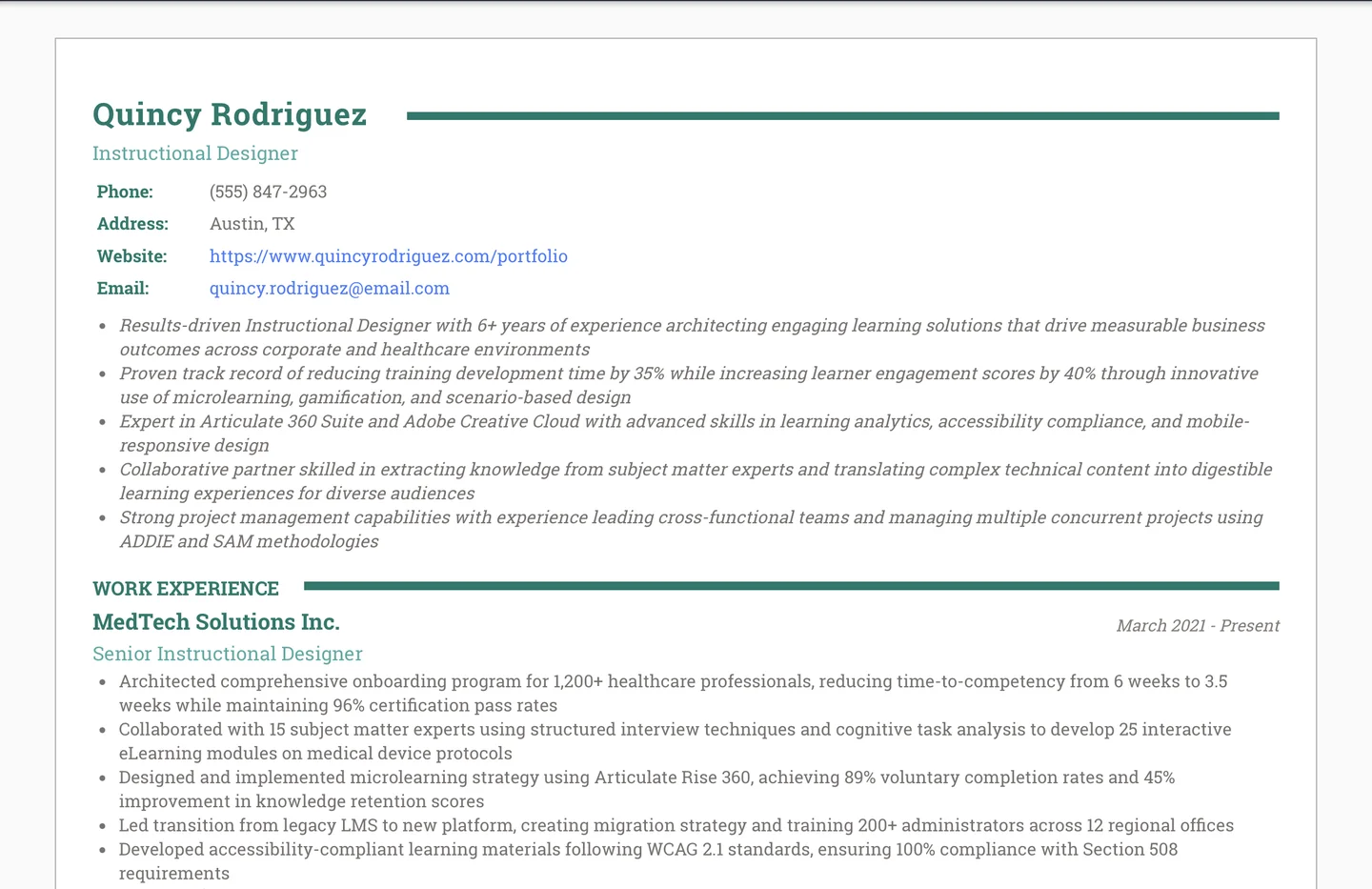
The Best Instructional Designer Resume Example/Sample
https://www.resumonk.com/instructional-designerInstructional DesignerResume Format for Instructional Designer Resume
The reverse-chronological format is your best friend here, and there's a beautiful reason why. Your journey into instructional design probably wasn't linear - maybe you were a teacher who discovered Articulate Storyline, or a graphic designer who fell in love with learning theory, or perhaps you came straight from your Master's in Educational Technology.
The reverse-chronological format lets you showcase your most recent (and likely most sophisticated) instructional design work first, where you've finally merged all those disparate skills into something coherent.
Structure Your Instructional Designer Resume Like a Learning Module
Think of your resume as a micro-learning experience about you.
Start with your Professional Summary - this is your learning objective, telling the hiring manager exactly what they'll gain by "completing" your resume. Follow this with your Work Experience section (your main content), then Skills (your assessment criteria), Education (your theoretical foundation), and finally, any Certifications or Portfolio links (your supplementary resources).
Here's where it gets interesting for Instructional Designers specifically - you absolutely need a Portfolio or Projects section, even if it's just a single line with a hyperlink. Unlike other professionals who might get away with just describing their work, you create tangible learning experiences that need to be seen, clicked through, and experienced.
The Hybrid Touch for Career Changers
If you're transitioning from teaching, corporate training, or graphic design into instructional design, consider adding a subtle functional element to your reverse-chronological format. Create a brief "Core Competencies" section right after your summary that groups your transferable skills into instructional design categories.
❌ Don't structure your competencies randomly:
Core Competencies: Teaching, Photoshop, Curriculum Development,
Microsoft Office, Learning Theories, Video Editing
✅ Do organize them into instructional design frameworks:
Core Competencies:
Learning Design: Curriculum Development | Adult Learning Theory | Assessment Design
Technology: Articulate 360 | Adobe Creative Suite | Camtasia
Project Management: ADDIE | SAM | Agile for Learning Development
Work Experience on Instructional Designer Resume
Your work experience section is where the magic happens - or where it falls flat.
You've spent months creating that compliance training that somehow made HIPAA regulations engaging, but writing "Created training materials" makes you sound like you were photocopying handouts. The challenge isn't just listing what you did; it's translating the invisible art of learning design into visible, measurable achievements that a hiring manager (who might not fully understand what instructional design entails) can appreciate.
Quantify the Unquantifiable Learning Impact
Every instructional designer has stared at their resume thinking, "How do I measure whether people actually learned something?" You're not selling widgets; you're facilitating cognitive change. But here's the secret - businesses don't care about cognitive change; they care about business outcomes.
Your job is to connect those dots.
Start each bullet point with an action verb that captures the strategic nature of your work. "Designed" is fine, but "Architected" or "Engineered" better captures the systematic thinking you bring.
Then, immediately follow with the scope and scale of your work.
❌ Don't write vague descriptions:
• Designed eLearning courses for employees
• Worked with SMEs to create content
• Used Articulate Storyline for course development
✅ Do include context, methodology, and outcomes:
- Architected 15 self-paced eLearning modules for 2,000+ global sales team members, reducing onboarding time from 3 weeks to 8 days while maintaining 95% assessment pass rates
- Collaborated with 12 subject matter experts using structured interview techniques and cognitive task analysis to extract tacit knowledge, transforming it into 30 microlearning assets
- Developed interactive scenarios in Articulate Storyline 360 using branching logic and gamification, increasing voluntary course completion rates by 40%
Show Your Process, Not Just Your Products
Instructional design is as much about process as it is about deliverables.
Hiring managers want to know you can navigate the messy reality of stakeholder management, SME availability, and shifting project requirements. Include bullets that demonstrate your ability to manage the entire learning development lifecycle.
For entry-level positions or those transitioning into instructional design, focus on transferable experiences. That time you created training materials as a teacher? That's instructional design. That peer mentoring program you developed? That's needs analysis and curriculum development.
The Portfolio Connection
Unlike most professions, your work experience descriptions should directly reference your portfolio pieces when possible. Add subtle callouts that encourage the reader to see your work in action.
✅ Effective portfolio integration:
- Transformed complex financial regulations into an award-winning interactive learning experience using storytelling and scenario-based learning
- Portfolio: ["Making Compliance Memorable" project]
Skills to Include on Instructional Designer Resume
Here's the thing about being an Instructional Designer - you're essentially a Swiss Army knife that got a graduate degree.
One day you're deep in learning theory, debating the merits of constructivism versus behaviorism, and the next you're troubleshooting JavaScript in a Storyline course while simultaneously conducting a needs analysis via Zoom. Your skills section needs to reflect this beautiful chaos without looking like you raided a software manual and a pedagogy textbook.
The Technical-Pedagogical Balance
Your skills section should read like a carefully curated playlist, not a random shuffle.
Organize your skills into categories that make sense to both HR professionals and learning leaders. Remember, your resume might be first reviewed by someone who thinks "ADDIE" is a nickname, then by someone who can debate the finer points of Gagne's Nine Events of Instruction.
Start with your authoring tools and technical skills - these are your table stakes. Every employer expects proficiency in at least one major authoring platform.
But don't just list them; indicate your proficiency level through context.
❌ Don't create a grocery list:
Skills: Articulate Storyline, Adobe Captivate, Camtasia, PowerPoint,
ADDIE, Adult Learning, Microsoft Office, HTML, CSS, Video Editing
✅ Do organize strategically with proficiency indicators:
eLearning Development Tools:
• Articulate 360 Suite (Expert - 50+ courses developed)
• Adobe Captivate (Advanced - Responsive design specialist)
• Camtasia & Vyond (Intermediate - Video-based learning)

Learning Design Methodologies:
• ADDIE & SAM Models - 4 years application in corporate settings
• Bloom's Taxonomy & Gagne's Nine Events - Curriculum architecture
• Microlearning & Mobile Learning - Just-in-time training design

Technical Skills:
• Basic HTML/CSS for course customization
• Learning Analytics - Google Analytics, xAPI/Tin Can
• Accessibility Standards - WCAG 2.1, Section 508 compliance
The Hidden Skills That Matter
Instructional design requires numerous soft skills that often go unmentioned but are absolutely critical.
You're part therapist (calming anxious SMEs), part detective (extracting knowledge from experts who don't know what they know), and part diplomat (navigating stakeholder politics). Include these strategically.
Project management capabilities deserve special attention. Whether you formally use Agile, waterfall, or what I like to call "organized chaos," employers need to know you can juggle multiple projects without dropping the ball.
Include any project management methodologies or tools you use.
Industry-Specific Considerations
If you're targeting specific industries, tailor your skills accordingly. Healthcare instructional designers should emphasize compliance training and regulatory knowledge. Those in tech should highlight their ability to create technical training and work in agile environments.
K-12 or higher education roles require emphasis on pedagogical theories and assessment design.
For those in the UK, include skills related to apprenticeship standards if relevant. Canadian instructional designers should be familiar with provincial education standards if working in academic settings.
Australian professionals might emphasize vocational education and training (VET) sector knowledge.
Specific Considerations and Tips for Instructional Designer Resume
Let's address the elephant in the eLearning room - you're applying for a job where your primary skill is making complex information digestible and engaging, yet most instructional designer resumes read like technical manuals written by robots who learned English from tax forms. The irony isn't lost on anyone, especially not the hiring manager who's wondering why someone who claims to be an expert in engagement just put them to sleep.
The Portfolio Paradox
Unlike developers who can share their code on GitHub or designers who have Behance, your best work might be locked behind corporate firewalls, protected by NDAs, or so specific to a company's internal processes that sharing it would be meaningless. This creates a unique challenge - how do you prove you can design learning when you can't show the learning you've designed?
The solution is strategic portfolio pieces. Create sanitized versions of your corporate work, develop passion projects that demonstrate your skills, or build mini-courses specifically for your portfolio.
Include a line in your resume addressing this directly.
✅ Address portfolio limitations professionally:
Portfolio: www.yourname.com/portfolio
Note: Due to NDAs, proprietary content has been modified to demonstrate
design approach while protecting client confidentiality. Happy to discuss
specific methodologies in detail during interview.
The Measurement Challenge
Here's something unique to instructional design - the success of your work often isn't visible until months after implementation, and even then, it's nearly impossible to isolate your training as the sole variable for improvement.
A salesperson can point to deals closed; you're pointing to... what exactly? People remembering stuff?
Focus on leading indicators and process improvements rather than just learning outcomes. Did you reduce development time? Increase stakeholder satisfaction? Improve review cycles?
These are tangible wins that resonate with hiring managers who understand project economics.
The Academic Versus Corporate Divide
Instructional design exists in two parallel universes that occasionally acknowledge each other's existence.
There's the academic world, where you're designing for semester-long engagement and deep learning, and the corporate world, where you need someone to understand new software in 15 minutes during their lunch break. Your resume needs to clearly signal which universe you inhabit - or better yet, that you're comfortable traveling between both.
If you're moving from academic to corporate, emphasize efficiency, business acumen, and your ability to work within constraints. If you're going the other direction, highlight your understanding of pedagogical theory and assessment design.
The Tool Trap
Every job posting lists different required software, and you've probably had that moment of panic seeing "Must have 5 years experience in [Software that was released 2 years ago]."
Here's the truth - tools are just tools. What matters is your ability to think systematically about learning design.
Include a line in your summary or cover letter that addresses this.
✅ Demonstrate tool flexibility:
"Proficient in Articulate 360 and Adobe Captivate, with proven ability to
quickly master new authoring tools - transitioned entire team from Lectora
to Storyline in 3 weeks while maintaining development deadlines"
The Remote Revolution Consideration
Post-2020, instructional design has become increasingly remote-friendly, but you need to explicitly demonstrate your ability to work in distributed teams.
Include examples of virtual collaboration, asynchronous communication skills, and your home studio setup if relevant. Mention time zones you've worked across and virtual facilitation skills.
The Continuous Learning Imperative
Nothing undermines your credibility faster than an instructional designer who hasn't learned anything new recently. Include recent certifications, courses, or conference attendance.
If you're creating learning experiences about emerging technologies or methodologies, you better be learning about them yourself.
Remember, your resume is essentially a learning object about you. It should demonstrate not just your knowledge of instructional design principles, but your ability to apply them. Make it scannable, chunk information appropriately, and for the love of Kirkpatrick, make sure it achieves its learning objective - getting you an interview.
Education Requirements for Instructional Designer Resume
Here's the thing about Instructional Design - it's one of those fields where your education tells a story, but it's not always the story you'd expect. Unlike becoming a doctor or lawyer, there's no single educational path that screams "I'm an Instructional Designer!"
Some of you have degrees in Education, others in Psychology, and we've even seen successful IDs with backgrounds in Engineering or Liberal Arts.
The key is knowing how to frame what you've got.
Core Educational Credentials to Highlight
For entry-level and mid-level Instructional Designer positions, employers typically look for a bachelor's degree at minimum, though they're surprisingly flexible about the field. What matters more is how you connect your educational background to the skills they need. If you have a Master's in Instructional Design, Educational Technology, or Learning Sciences - fantastic, lead with that.
But if your degree is in something else, don't panic.
The secret sauce is in the details. When listing your education, don't just state the degree - highlight relevant coursework, projects, or thesis work that relates to instructional design principles. Remember, you're competing with candidates who might have more traditional backgrounds, so make every educational bullet point count.
❌ Don't write education entries that are too generic:
Master of Arts in English Literature
State University, 2019
✅ Do include relevant details that connect to instructional design:
Master of Arts in English Literature
State University, 2019
• Thesis: "Digital Storytelling Techniques in Online Learning Environments"
• Relevant Coursework: Rhetoric and Composition, Digital Media Studies, Educational Psychology
• GPA: 3.8/4.0
Certifications That Actually Matter
Now, let's talk about the elephant in the room - certifications.
The Instructional Design world is flooded with them, and you're probably wondering which ones are worth your time and resume space. The truth is, certifications can be game-changers, especially if your formal education isn't directly in ID.
Industry-recognized certifications like the ATD's CPLP (Certified Professional in Learning and Performance) or specific software certifications in Articulate 360, Adobe Captivate, or Camtasia show you're serious about the craft. List these prominently, especially if you're newer to the field. Place them right after your formal education, not buried at the bottom of your resume.
Formatting Your Education Section
The reverse-chronological format works best here - start with your most recent educational achievement. If you completed your degree more than 10 years ago and have substantial work experience, you can move the education section below your professional experience.
However, if you're fresh out of a relevant graduate program or recently completed a significant certification, keep education near the top.
For those of you with international education, remember that terminology varies. In the US, include your GPA if it's 3.5 or above. In the UK, include your classification (First Class Honours, 2:1, etc.). Canadian applicants should note if they graduated with distinction or honours.
Australian candidates should include their WAM or GPA if it's particularly strong.
Showcasing Awards and Publications on Your Instructional Designer Resume
The thing about Instructional Design is that it sits at this fascinating intersection of creativity, technology, and education. Your awards and publications demonstrate that you're not just following templates - you're pushing boundaries and contributing to the field's evolution. Whether you've won a Brandon Hall Excellence Award or simply received recognition from your department for redesigning the onboarding program, these achievements set you apart from the crowd of candidates who can "create engaging learning experiences."
Which Awards Actually Impress Hiring Managers
Not all awards are created equal in the eyes of hiring managers. Industry-specific recognitions like the eLearning Guild's DemoFest winner, ATD Excellence in Practice Awards, or even regional ISPI chapter awards carry serious weight.
But here's what many candidates miss - internal company awards for innovation, efficiency improvements, or cross-functional collaboration are equally valuable because they show real-world impact.
The key is in how you present them. Don't just list the award name - provide context about what you achieved and why it mattered. Hiring managers want to understand the scope and impact of your work.
❌ Don't list awards without context:
Excellence in Training Award - ABC Corporation, 2022
✅ Do provide meaningful details:
Excellence in Training Award - ABC Corporation, 2022
Recognized for designing a microlearning series that reduced new employee time-to-productivity
by 25% and achieved 94% completion rate across 500+ learners
Making Your Publications Work for You
Publications in Instructional Design don't always mean peer-reviewed academic journals (though those are great if you have them). Blog posts on eLearning Industry, articles in Training Magazine, white papers for your company, or even well-documented case studies on your LinkedIn can demonstrate thought leadership.
The modern ID field values practical insights as much as theoretical contributions.
When listing publications, focus on those that showcase your expertise in areas relevant to your target role. Applying for a position focused on compliance training? Highlight that article you wrote about making regulatory training engaging. Going for a role in a tech company? That blog post about rapid prototyping for software training is perfect.
Strategic Placement on Your Resume
If you have multiple impressive awards or publications (3 or more), create a dedicated section titled "Awards & Publications" or "Recognition & Thought Leadership."
Place this after your professional experience but before education if these achievements are recent and relevant. If you only have one or two, integrate them into your professional experience section under the relevant role.
For academic positions or research-focused ID roles, consider separating awards and publications into two distinct sections, with publications getting more detailed treatment. For corporate roles, combining them shows you're accomplished without appearing overly academic.
Strategic Reference Management for Instructional Designer Resumes
Here's what makes references particularly crucial for Instructional Designers - our work is often behind the scenes.
While salespeople have quotas and developers have shipped products, our impact shows up in improved performance metrics, satisfied learners, and successfully adopted systems. Your references are the people who can vouch for these less tangible but equally important outcomes.
Choosing Your ID Reference Dream Team
The best references for Instructional Designers aren't always your direct supervisors. Think strategically about who can speak to different aspects of your work.
Your ideal reference portfolio might include a subject matter expert who can attest to how brilliantly you translated complex technical content, a project manager who witnessed your ability to deliver under tight deadlines, or even a learner who became a power user thanks to your training.
Consider including at least one reference who can speak to your technical skills (like that IT manager who was impressed by your LMS administration abilities) and one who can address your consultative skills (perhaps the department head whose team's performance improved after your training intervention). This combination shows you're both technically capable and business-savvy.
The Reference List Format That Works
Gone are the days of "References available upon request" taking up valuable resume space.
In most cases, you shouldn't include references directly on your resume unless specifically requested. Instead, prepare a separate, professionally formatted reference document that matches your resume's design.
❌ Don't provide minimal information:
John Smith
Manager at ABC Company
[email protected]
✅ Do provide comprehensive, relevant details:
John Smith
Director of Learning & Development, ABC Company
Email: [email protected] | Phone: (555) 123-4567
LinkedIn: linkedin.com/in/johnsmith
Relationship: Direct supervisor for 3 years (2020-2023)

John supervised my work on the company-wide digital transformation training initiative,
where I designed 15+ eLearning modules that achieved 92% completion rates across
2,000 employees. He can speak to my instructional design methodology, stakeholder
management skills, and ability to deliver projects on time and under budget.
Regional Differences in Reference Protocols
Reference expectations vary significantly by country, and as an ID who might work for global companies, you need to be aware of these differences. In the United States, references are typically contacted after interviews, and it's standard to provide 3-4 professional references.
Canadian employers often request references earlier in the process and may ask for a mix of professional and character references.
In the UK, references are usually checked after a job offer is made, and employers often want one reference from your current or most recent employer. Australian employers frequently request written references upfront and may ask for more than three. Always clarify expectations early in the process to avoid awkward situations.
Preparing Your References for Success
Your references are essentially your brand ambassadors, so set them up for success.
When you're job hunting, reach out to your potential references early - not when you're desperate. Share the job description, remind them of specific projects you worked on together, and even provide bullet points of key accomplishments they might mention.
For Instructional Designer roles, coach your references on what matters most. Help them understand that mentioning your ability to reduce training time by 30% is more impactful than saying you're "good with technology." Suggest they prepare examples of how you handled challenging SMEs, managed multiple projects, or innovated with limited resources - the real-world challenges every ID faces.
Finally, remember that references are a two-way street. Just as you've probably been asked to be a reference for colleagues, maintain those relationships even when you're not job hunting. The ID community is surprisingly small, and the SME you worked with today might be the hiring manager you need a reference from tomorrow.
Cover Letter Strategies for Instructional Designer Positions
Cover letters do matter. And for Instructional Designers, the cover letter might be even more critical than for other roles. Why? Because Instructional Design is fundamentally about communication, storytelling, and understanding your audience's needs. Your cover letter is a live demonstration of these skills.
It's your chance to show - not just tell - that you can analyze a need (the job requirements), design a solution (yourself as the candidate), and deliver it in an engaging way (your cover letter).
The Opening Hook - Your Learning Objective
Think of your cover letter opening like the first screen of an eLearning module.
You need to capture attention immediately and establish relevance. Skip the generic "I am writing to apply for..." and instead start with a specific connection to the company's learning challenges or recent initiatives.
Research the company's recent training initiatives, learning technology stack, or industry challenges. Did they recently implement a new LMS? Are they scaling rapidly and need standardized onboarding?
Use this intelligence to craft an opening that shows you understand their world.
❌ Don't start with generic statements:
Dear Hiring Manager,

I am writing to express my interest in the Instructional Designer position at your company.
I have five years of experience in instructional design.
✅ Do demonstrate immediate relevance:
Dear Sarah Thompson,

When I read that TechCorp is transitioning 5,000 employees to a hybrid work model, I immediately thought about the virtual collaboration training I designed at GlobalTech that increased cross-team productivity by 30%. Your posting for an Instructional Designer suggests you're facing similar challenges in creating engaging remote learning experiences.
The Body - Your Content Chunking
Just like you wouldn't create a 30-minute video lecture without breaks, don't write walls of text in your cover letter.
Use the body to tell 2-3 specific stories that demonstrate your ID capabilities. Each story should follow a simple structure - challenge, your approach, and the measurable outcome.
Choose stories that mirror the challenges mentioned in the job posting. If they emphasize rapid development, share your experience creating a compliance course in two weeks using rapid prototyping. If they mention stakeholder management, describe how you aligned five department heads on a unified training approach.
The Technical Bridge Paragraph
Instructional Designers often struggle with how to address technical requirements in cover letters. Should you list every authoring tool you know? The answer is no - but you should strategically mention the technologies that matter most for this role.
Weave them naturally into your accomplishments rather than creating a boring list.
For example, instead of writing "I am proficient in Articulate Storyline," try "Using Articulate Storyline's advanced variables and triggers, I created an adaptive learning path that adjusted difficulty based on learner performance, resulting in a 40% improvement in assessment scores."
The Closing - Your Call to Action
Your closing should do more than request an interview. Offer something tangible - perhaps you'd like to discuss how your experience with microlearning could support their mobile workforce initiative, or share ideas about gamifying their sales training.
Show that you're already thinking about their challenges and eager to contribute solutions.
Remember to customize each cover letter. Yes, it's time-consuming, but as an ID, you know the importance of tailoring content to your audience. Use the company's terminology - if they call it "talent development" instead of "training," mirror their language. If they emphasize innovation, use words like "pioneered" and "transformed" rather than "managed" and "maintained."
Key Takeaways
After diving deep into the art and science of crafting an Instructional Designer resume, here are the essential points to keep with you as you build yours:
- Use reverse-chronological format as your foundation - It best showcases your evolution as an ID, with flexibility to add functional elements if you're transitioning from another field
- Quantify your impact through business outcomes - Connect learning improvements to measurable results like reduced onboarding time, increased completion rates, or improved performance metrics
- Organize skills strategically - Group them into categories (eLearning tools, methodologies, technical skills) with proficiency indicators rather than creating a random list
- Address the portfolio paradox head-on - Include a portfolio link with a note about NDA limitations if needed, and create sanitized versions or passion projects to demonstrate your capabilities
- Frame your education story effectively - Highlight relevant coursework, projects, and thesis work that connects to ID, regardless of your degree field
- Leverage awards and publications - Include context about what you achieved and why it mattered, not just award names
- Write each bullet point as a mini case study - Include context, methodology, and outcomes rather than vague task descriptions
- Demonstrate tool flexibility over tool mastery - Show your ability to quickly adapt to new authoring tools rather than claiming expertise in everything
- Integrate portfolio references naturally - Connect your work experience descriptions to specific portfolio pieces when possible
- Prepare references strategically - Choose people who can speak to different aspects of your ID work and coach them on what matters most for ID roles
Creating your Instructional Designer resume on Resumonk transforms this complex process into something manageable and even enjoyable. Our AI-powered recommendations understand the unique challenges of ID resumes - from articulating invisible learning outcomes to balancing technical and pedagogical expertise. With professionally designed templates that follow instructional design principles of clarity and visual hierarchy, your resume will practice what you preach about good design. The platform helps you organize your diverse skill set, format your educational journey effectively, and ensure every section works together to tell your professional story.
Ready to design your career-changing resume?
Stop struggling with format and focus on what you do best - creating impactful learning experiences. Resumonk's intelligent resume builder understands the unique needs of candidates and helps you craft a resume that demonstrates your expertise in action.
Start Building Your Instructional Designer Resume →
More Education resume examples
- Camp Counselor resume example
- School Counselor resume example
- Librarian resume example
- Paraprofessional resume example
See all Education resume examples, or browse every category.
Resume writing tips
You're sitting at your desk, surrounded by sticky notes with learning objectives, half-finished storyboards scattered across your monitor, and that Articulate Storyline project you've been tweaking for the third time today because the SME just remembered "one more critical detail."
As an Instructional Designer, you live in this unique space where pedagogy meets pixels, where you transform mind-numbing compliance requirements into somehow-engaging learning experiences, and where you're simultaneously part educator, part tech wizard, and part mind reader trying to figure out what stakeholders really want when they say "make it more interactive."
The challenge you're facing right now - turning your multifaceted expertise into a resume that actually captures what you do - feels like trying to explain color to someone who's never seen it. How do you convey that you don't just "create training materials" but rather architect entire learning ecosystems? How do you show that your work lives in that invisible space between confusion and comprehension, between a new hire's first day and their moment of productivity?
This comprehensive guide will walk you through every element of crafting an instructional designer resume that actually resonates with hiring managers. We'll start with choosing the right resume format that showcases your journey into ID (whether you came from teaching, graphic design, or fell into it sideways like many of us did). Then we'll dive deep into articulating your work experience with the kind of specificity and metrics that make hiring managers take notice, followed by strategically organizing your unique blend of technical and pedagogical skills. We'll tackle those ID-specific challenges like portfolio limitations and measurement difficulties, navigate the education and certification landscape, and show you how to leverage awards and publications you might not even realize are resume gold.
By the time you finish reading this guide, you'll know exactly how to structure your resume for maximum impact, which experiences to highlight based on your target role (corporate vs. academic), and how to handle those tricky situations like career transitions or gaps in traditional ID experience. We'll even cover the often-overlooked elements like cover letter strategies that demonstrate your instructional design thinking and reference management that sets you up for success. Whether you're an entry-level ID trying to break into the field or a seasoned professional looking to level up, this guide will help you create a resume that doesn't just list your qualifications - it teaches hiring managers why you're the learning architect they need.
The Best Instructional Designer Resume Example/Sample
https://www.resumonk.com/instructional-designerInstructional DesignerResume Format for Instructional Designer Resume
The reverse-chronological format is your best friend here, and there's a beautiful reason why. Your journey into instructional design probably wasn't linear - maybe you were a teacher who discovered Articulate Storyline, or a graphic designer who fell in love with learning theory, or perhaps you came straight from your Master's in Educational Technology.
The reverse-chronological format lets you showcase your most recent (and likely most sophisticated) instructional design work first, where you've finally merged all those disparate skills into something coherent.
Structure Your Instructional Designer Resume Like a Learning Module
Think of your resume as a micro-learning experience about you.
Start with your Professional Summary - this is your learning objective, telling the hiring manager exactly what they'll gain by "completing" your resume. Follow this with your Work Experience section (your main content), then Skills (your assessment criteria), Education (your theoretical foundation), and finally, any Certifications or Portfolio links (your supplementary resources).
Here's where it gets interesting for Instructional Designers specifically - you absolutely need a Portfolio or Projects section, even if it's just a single line with a hyperlink. Unlike other professionals who might get away with just describing their work, you create tangible learning experiences that need to be seen, clicked through, and experienced.
The Hybrid Touch for Career Changers
If you're transitioning from teaching, corporate training, or graphic design into instructional design, consider adding a subtle functional element to your reverse-chronological format. Create a brief "Core Competencies" section right after your summary that groups your transferable skills into instructional design categories.
❌ Don't structure your competencies randomly:
Core Competencies: Teaching, Photoshop, Curriculum Development,
Microsoft Office, Learning Theories, Video Editing
✅ Do organize them into instructional design frameworks:
Core Competencies:
Learning Design: Curriculum Development | Adult Learning Theory | Assessment Design
Technology: Articulate 360 | Adobe Creative Suite | Camtasia
Project Management: ADDIE | SAM | Agile for Learning Development
Work Experience on Instructional Designer Resume
Your work experience section is where the magic happens - or where it falls flat.
You've spent months creating that compliance training that somehow made HIPAA regulations engaging, but writing "Created training materials" makes you sound like you were photocopying handouts. The challenge isn't just listing what you did; it's translating the invisible art of learning design into visible, measurable achievements that a hiring manager (who might not fully understand what instructional design entails) can appreciate.
Quantify the Unquantifiable Learning Impact
Every instructional designer has stared at their resume thinking, "How do I measure whether people actually learned something?" You're not selling widgets; you're facilitating cognitive change. But here's the secret - businesses don't care about cognitive change; they care about business outcomes.
Your job is to connect those dots.
Start each bullet point with an action verb that captures the strategic nature of your work. "Designed" is fine, but "Architected" or "Engineered" better captures the systematic thinking you bring.
Then, immediately follow with the scope and scale of your work.
❌ Don't write vague descriptions:
• Designed eLearning courses for employees
• Worked with SMEs to create content
• Used Articulate Storyline for course development
✅ Do include context, methodology, and outcomes:
- Architected 15 self-paced eLearning modules for 2,000+ global sales team members, reducing onboarding time from 3 weeks to 8 days while maintaining 95% assessment pass rates
- Collaborated with 12 subject matter experts using structured interview techniques and cognitive task analysis to extract tacit knowledge, transforming it into 30 microlearning assets
- Developed interactive scenarios in Articulate Storyline 360 using branching logic and gamification, increasing voluntary course completion rates by 40%
Show Your Process, Not Just Your Products
Instructional design is as much about process as it is about deliverables.
Hiring managers want to know you can navigate the messy reality of stakeholder management, SME availability, and shifting project requirements. Include bullets that demonstrate your ability to manage the entire learning development lifecycle.
For entry-level positions or those transitioning into instructional design, focus on transferable experiences. That time you created training materials as a teacher? That's instructional design. That peer mentoring program you developed? That's needs analysis and curriculum development.
The Portfolio Connection
Unlike most professions, your work experience descriptions should directly reference your portfolio pieces when possible. Add subtle callouts that encourage the reader to see your work in action.
✅ Effective portfolio integration:
- Transformed complex financial regulations into an award-winning interactive learning experience using storytelling and scenario-based learning
- Portfolio: ["Making Compliance Memorable" project]
Skills to Include on Instructional Designer Resume
Here's the thing about being an Instructional Designer - you're essentially a Swiss Army knife that got a graduate degree.
One day you're deep in learning theory, debating the merits of constructivism versus behaviorism, and the next you're troubleshooting JavaScript in a Storyline course while simultaneously conducting a needs analysis via Zoom. Your skills section needs to reflect this beautiful chaos without looking like you raided a software manual and a pedagogy textbook.
The Technical-Pedagogical Balance
Your skills section should read like a carefully curated playlist, not a random shuffle.
Organize your skills into categories that make sense to both HR professionals and learning leaders. Remember, your resume might be first reviewed by someone who thinks "ADDIE" is a nickname, then by someone who can debate the finer points of Gagne's Nine Events of Instruction.
Start with your authoring tools and technical skills - these are your table stakes. Every employer expects proficiency in at least one major authoring platform.
But don't just list them; indicate your proficiency level through context.
❌ Don't create a grocery list:
Skills: Articulate Storyline, Adobe Captivate, Camtasia, PowerPoint,
ADDIE, Adult Learning, Microsoft Office, HTML, CSS, Video Editing
✅ Do organize strategically with proficiency indicators:
eLearning Development Tools:
• Articulate 360 Suite (Expert - 50+ courses developed)
• Adobe Captivate (Advanced - Responsive design specialist)
• Camtasia & Vyond (Intermediate - Video-based learning)

Learning Design Methodologies:
• ADDIE & SAM Models - 4 years application in corporate settings
• Bloom's Taxonomy & Gagne's Nine Events - Curriculum architecture
• Microlearning & Mobile Learning - Just-in-time training design

Technical Skills:
• Basic HTML/CSS for course customization
• Learning Analytics - Google Analytics, xAPI/Tin Can
• Accessibility Standards - WCAG 2.1, Section 508 compliance
The Hidden Skills That Matter
Instructional design requires numerous soft skills that often go unmentioned but are absolutely critical.
You're part therapist (calming anxious SMEs), part detective (extracting knowledge from experts who don't know what they know), and part diplomat (navigating stakeholder politics). Include these strategically.
Project management capabilities deserve special attention. Whether you formally use Agile, waterfall, or what I like to call "organized chaos," employers need to know you can juggle multiple projects without dropping the ball.
Include any project management methodologies or tools you use.
Industry-Specific Considerations
If you're targeting specific industries, tailor your skills accordingly. Healthcare instructional designers should emphasize compliance training and regulatory knowledge. Those in tech should highlight their ability to create technical training and work in agile environments.
K-12 or higher education roles require emphasis on pedagogical theories and assessment design.
For those in the UK, include skills related to apprenticeship standards if relevant. Canadian instructional designers should be familiar with provincial education standards if working in academic settings.
Australian professionals might emphasize vocational education and training (VET) sector knowledge.
Specific Considerations and Tips for Instructional Designer Resume
Let's address the elephant in the eLearning room - you're applying for a job where your primary skill is making complex information digestible and engaging, yet most instructional designer resumes read like technical manuals written by robots who learned English from tax forms. The irony isn't lost on anyone, especially not the hiring manager who's wondering why someone who claims to be an expert in engagement just put them to sleep.
The Portfolio Paradox
Unlike developers who can share their code on GitHub or designers who have Behance, your best work might be locked behind corporate firewalls, protected by NDAs, or so specific to a company's internal processes that sharing it would be meaningless. This creates a unique challenge - how do you prove you can design learning when you can't show the learning you've designed?
The solution is strategic portfolio pieces. Create sanitized versions of your corporate work, develop passion projects that demonstrate your skills, or build mini-courses specifically for your portfolio.
Include a line in your resume addressing this directly.
✅ Address portfolio limitations professionally:
Portfolio: www.yourname.com/portfolio
Note: Due to NDAs, proprietary content has been modified to demonstrate
design approach while protecting client confidentiality. Happy to discuss
specific methodologies in detail during interview.
The Measurement Challenge
Here's something unique to instructional design - the success of your work often isn't visible until months after implementation, and even then, it's nearly impossible to isolate your training as the sole variable for improvement.
A salesperson can point to deals closed; you're pointing to... what exactly? People remembering stuff?
Focus on leading indicators and process improvements rather than just learning outcomes. Did you reduce development time? Increase stakeholder satisfaction? Improve review cycles?
These are tangible wins that resonate with hiring managers who understand project economics.
The Academic Versus Corporate Divide
Instructional design exists in two parallel universes that occasionally acknowledge each other's existence.
There's the academic world, where you're designing for semester-long engagement and deep learning, and the corporate world, where you need someone to understand new software in 15 minutes during their lunch break. Your resume needs to clearly signal which universe you inhabit - or better yet, that you're comfortable traveling between both.
If you're moving from academic to corporate, emphasize efficiency, business acumen, and your ability to work within constraints. If you're going the other direction, highlight your understanding of pedagogical theory and assessment design.
The Tool Trap
Every job posting lists different required software, and you've probably had that moment of panic seeing "Must have 5 years experience in [Software that was released 2 years ago]."
Here's the truth - tools are just tools. What matters is your ability to think systematically about learning design.
Include a line in your summary or cover letter that addresses this.
✅ Demonstrate tool flexibility:
"Proficient in Articulate 360 and Adobe Captivate, with proven ability to
quickly master new authoring tools - transitioned entire team from Lectora
to Storyline in 3 weeks while maintaining development deadlines"
The Remote Revolution Consideration
Post-2020, instructional design has become increasingly remote-friendly, but you need to explicitly demonstrate your ability to work in distributed teams.
Include examples of virtual collaboration, asynchronous communication skills, and your home studio setup if relevant. Mention time zones you've worked across and virtual facilitation skills.
The Continuous Learning Imperative
Nothing undermines your credibility faster than an instructional designer who hasn't learned anything new recently. Include recent certifications, courses, or conference attendance.
If you're creating learning experiences about emerging technologies or methodologies, you better be learning about them yourself.
Remember, your resume is essentially a learning object about you. It should demonstrate not just your knowledge of instructional design principles, but your ability to apply them. Make it scannable, chunk information appropriately, and for the love of Kirkpatrick, make sure it achieves its learning objective - getting you an interview.
Education Requirements for Instructional Designer Resume
Here's the thing about Instructional Design - it's one of those fields where your education tells a story, but it's not always the story you'd expect. Unlike becoming a doctor or lawyer, there's no single educational path that screams "I'm an Instructional Designer!"
Some of you have degrees in Education, others in Psychology, and we've even seen successful IDs with backgrounds in Engineering or Liberal Arts.
The key is knowing how to frame what you've got.
Core Educational Credentials to Highlight
For entry-level and mid-level Instructional Designer positions, employers typically look for a bachelor's degree at minimum, though they're surprisingly flexible about the field. What matters more is how you connect your educational background to the skills they need. If you have a Master's in Instructional Design, Educational Technology, or Learning Sciences - fantastic, lead with that.
But if your degree is in something else, don't panic.
The secret sauce is in the details. When listing your education, don't just state the degree - highlight relevant coursework, projects, or thesis work that relates to instructional design principles. Remember, you're competing with candidates who might have more traditional backgrounds, so make every educational bullet point count.
❌ Don't write education entries that are too generic:
Master of Arts in English Literature
State University, 2019
✅ Do include relevant details that connect to instructional design:
Master of Arts in English Literature
State University, 2019
• Thesis: "Digital Storytelling Techniques in Online Learning Environments"
• Relevant Coursework: Rhetoric and Composition, Digital Media Studies, Educational Psychology
• GPA: 3.8/4.0
Certifications That Actually Matter
Now, let's talk about the elephant in the room - certifications.
The Instructional Design world is flooded with them, and you're probably wondering which ones are worth your time and resume space. The truth is, certifications can be game-changers, especially if your formal education isn't directly in ID.
Industry-recognized certifications like the ATD's CPLP (Certified Professional in Learning and Performance) or specific software certifications in Articulate 360, Adobe Captivate, or Camtasia show you're serious about the craft. List these prominently, especially if you're newer to the field. Place them right after your formal education, not buried at the bottom of your resume.
Formatting Your Education Section
The reverse-chronological format works best here - start with your most recent educational achievement. If you completed your degree more than 10 years ago and have substantial work experience, you can move the education section below your professional experience.
However, if you're fresh out of a relevant graduate program or recently completed a significant certification, keep education near the top.
For those of you with international education, remember that terminology varies. In the US, include your GPA if it's 3.5 or above. In the UK, include your classification (First Class Honours, 2:1, etc.). Canadian applicants should note if they graduated with distinction or honours.
Australian candidates should include their WAM or GPA if it's particularly strong.
Showcasing Awards and Publications on Your Instructional Designer Resume
The thing about Instructional Design is that it sits at this fascinating intersection of creativity, technology, and education. Your awards and publications demonstrate that you're not just following templates - you're pushing boundaries and contributing to the field's evolution. Whether you've won a Brandon Hall Excellence Award or simply received recognition from your department for redesigning the onboarding program, these achievements set you apart from the crowd of candidates who can "create engaging learning experiences."
Which Awards Actually Impress Hiring Managers
Not all awards are created equal in the eyes of hiring managers. Industry-specific recognitions like the eLearning Guild's DemoFest winner, ATD Excellence in Practice Awards, or even regional ISPI chapter awards carry serious weight.
But here's what many candidates miss - internal company awards for innovation, efficiency improvements, or cross-functional collaboration are equally valuable because they show real-world impact.
The key is in how you present them. Don't just list the award name - provide context about what you achieved and why it mattered. Hiring managers want to understand the scope and impact of your work.
❌ Don't list awards without context:
Excellence in Training Award - ABC Corporation, 2022
✅ Do provide meaningful details:
Excellence in Training Award - ABC Corporation, 2022
Recognized for designing a microlearning series that reduced new employee time-to-productivity
by 25% and achieved 94% completion rate across 500+ learners
Making Your Publications Work for You
Publications in Instructional Design don't always mean peer-reviewed academic journals (though those are great if you have them). Blog posts on eLearning Industry, articles in Training Magazine, white papers for your company, or even well-documented case studies on your LinkedIn can demonstrate thought leadership.
The modern ID field values practical insights as much as theoretical contributions.
When listing publications, focus on those that showcase your expertise in areas relevant to your target role. Applying for a position focused on compliance training? Highlight that article you wrote about making regulatory training engaging. Going for a role in a tech company? That blog post about rapid prototyping for software training is perfect.
Strategic Placement on Your Resume
If you have multiple impressive awards or publications (3 or more), create a dedicated section titled "Awards & Publications" or "Recognition & Thought Leadership."
Place this after your professional experience but before education if these achievements are recent and relevant. If you only have one or two, integrate them into your professional experience section under the relevant role.
For academic positions or research-focused ID roles, consider separating awards and publications into two distinct sections, with publications getting more detailed treatment. For corporate roles, combining them shows you're accomplished without appearing overly academic.
Strategic Reference Management for Instructional Designer Resumes
Here's what makes references particularly crucial for Instructional Designers - our work is often behind the scenes.
While salespeople have quotas and developers have shipped products, our impact shows up in improved performance metrics, satisfied learners, and successfully adopted systems. Your references are the people who can vouch for these less tangible but equally important outcomes.
Choosing Your ID Reference Dream Team
The best references for Instructional Designers aren't always your direct supervisors. Think strategically about who can speak to different aspects of your work.
Your ideal reference portfolio might include a subject matter expert who can attest to how brilliantly you translated complex technical content, a project manager who witnessed your ability to deliver under tight deadlines, or even a learner who became a power user thanks to your training.
Consider including at least one reference who can speak to your technical skills (like that IT manager who was impressed by your LMS administration abilities) and one who can address your consultative skills (perhaps the department head whose team's performance improved after your training intervention). This combination shows you're both technically capable and business-savvy.
The Reference List Format That Works
Gone are the days of "References available upon request" taking up valuable resume space.
In most cases, you shouldn't include references directly on your resume unless specifically requested. Instead, prepare a separate, professionally formatted reference document that matches your resume's design.
❌ Don't provide minimal information:
John Smith
Manager at ABC Company
[email protected]
✅ Do provide comprehensive, relevant details:
John Smith
Director of Learning & Development, ABC Company
Email: [email protected] | Phone: (555) 123-4567
LinkedIn: linkedin.com/in/johnsmith
Relationship: Direct supervisor for 3 years (2020-2023)

John supervised my work on the company-wide digital transformation training initiative,
where I designed 15+ eLearning modules that achieved 92% completion rates across
2,000 employees. He can speak to my instructional design methodology, stakeholder
management skills, and ability to deliver projects on time and under budget.
Regional Differences in Reference Protocols
Reference expectations vary significantly by country, and as an ID who might work for global companies, you need to be aware of these differences. In the United States, references are typically contacted after interviews, and it's standard to provide 3-4 professional references.
Canadian employers often request references earlier in the process and may ask for a mix of professional and character references.
In the UK, references are usually checked after a job offer is made, and employers often want one reference from your current or most recent employer. Australian employers frequently request written references upfront and may ask for more than three. Always clarify expectations early in the process to avoid awkward situations.
Preparing Your References for Success
Your references are essentially your brand ambassadors, so set them up for success.
When you're job hunting, reach out to your potential references early - not when you're desperate. Share the job description, remind them of specific projects you worked on together, and even provide bullet points of key accomplishments they might mention.
For Instructional Designer roles, coach your references on what matters most. Help them understand that mentioning your ability to reduce training time by 30% is more impactful than saying you're "good with technology." Suggest they prepare examples of how you handled challenging SMEs, managed multiple projects, or innovated with limited resources - the real-world challenges every ID faces.
Finally, remember that references are a two-way street. Just as you've probably been asked to be a reference for colleagues, maintain those relationships even when you're not job hunting. The ID community is surprisingly small, and the SME you worked with today might be the hiring manager you need a reference from tomorrow.
Cover Letter Strategies for Instructional Designer Positions
Cover letters do matter. And for Instructional Designers, the cover letter might be even more critical than for other roles. Why? Because Instructional Design is fundamentally about communication, storytelling, and understanding your audience's needs. Your cover letter is a live demonstration of these skills.
It's your chance to show - not just tell - that you can analyze a need (the job requirements), design a solution (yourself as the candidate), and deliver it in an engaging way (your cover letter).
The Opening Hook - Your Learning Objective
Think of your cover letter opening like the first screen of an eLearning module.
You need to capture attention immediately and establish relevance. Skip the generic "I am writing to apply for..." and instead start with a specific connection to the company's learning challenges or recent initiatives.
Research the company's recent training initiatives, learning technology stack, or industry challenges. Did they recently implement a new LMS? Are they scaling rapidly and need standardized onboarding?
Use this intelligence to craft an opening that shows you understand their world.
❌ Don't start with generic statements:
Dear Hiring Manager,

I am writing to express my interest in the Instructional Designer position at your company.
I have five years of experience in instructional design.
✅ Do demonstrate immediate relevance:
Dear Sarah Thompson,

When I read that TechCorp is transitioning 5,000 employees to a hybrid work model, I immediately thought about the virtual collaboration training I designed at GlobalTech that increased cross-team productivity by 30%. Your posting for an Instructional Designer suggests you're facing similar challenges in creating engaging remote learning experiences.
The Body - Your Content Chunking
Just like you wouldn't create a 30-minute video lecture without breaks, don't write walls of text in your cover letter.
Use the body to tell 2-3 specific stories that demonstrate your ID capabilities. Each story should follow a simple structure - challenge, your approach, and the measurable outcome.
Choose stories that mirror the challenges mentioned in the job posting. If they emphasize rapid development, share your experience creating a compliance course in two weeks using rapid prototyping. If they mention stakeholder management, describe how you aligned five department heads on a unified training approach.
The Technical Bridge Paragraph
Instructional Designers often struggle with how to address technical requirements in cover letters. Should you list every authoring tool you know? The answer is no - but you should strategically mention the technologies that matter most for this role.
Weave them naturally into your accomplishments rather than creating a boring list.
For example, instead of writing "I am proficient in Articulate Storyline," try "Using Articulate Storyline's advanced variables and triggers, I created an adaptive learning path that adjusted difficulty based on learner performance, resulting in a 40% improvement in assessment scores."
The Closing - Your Call to Action
Your closing should do more than request an interview. Offer something tangible - perhaps you'd like to discuss how your experience with microlearning could support their mobile workforce initiative, or share ideas about gamifying their sales training.
Show that you're already thinking about their challenges and eager to contribute solutions.
Remember to customize each cover letter. Yes, it's time-consuming, but as an ID, you know the importance of tailoring content to your audience. Use the company's terminology - if they call it "talent development" instead of "training," mirror their language. If they emphasize innovation, use words like "pioneered" and "transformed" rather than "managed" and "maintained."
Key Takeaways
After diving deep into the art and science of crafting an Instructional Designer resume, here are the essential points to keep with you as you build yours:
- Use reverse-chronological format as your foundation - It best showcases your evolution as an ID, with flexibility to add functional elements if you're transitioning from another field
- Quantify your impact through business outcomes - Connect learning improvements to measurable results like reduced onboarding time, increased completion rates, or improved performance metrics
- Organize skills strategically - Group them into categories (eLearning tools, methodologies, technical skills) with proficiency indicators rather than creating a random list
- Address the portfolio paradox head-on - Include a portfolio link with a note about NDA limitations if needed, and create sanitized versions or passion projects to demonstrate your capabilities
- Frame your education story effectively - Highlight relevant coursework, projects, and thesis work that connects to ID, regardless of your degree field
- Leverage awards and publications - Include context about what you achieved and why it mattered, not just award names
- Write each bullet point as a mini case study - Include context, methodology, and outcomes rather than vague task descriptions
- Demonstrate tool flexibility over tool mastery - Show your ability to quickly adapt to new authoring tools rather than claiming expertise in everything
- Integrate portfolio references naturally - Connect your work experience descriptions to specific portfolio pieces when possible
- Prepare references strategically - Choose people who can speak to different aspects of your ID work and coach them on what matters most for ID roles
Creating your Instructional Designer resume on Resumonk transforms this complex process into something manageable and even enjoyable. Our AI-powered recommendations understand the unique challenges of ID resumes - from articulating invisible learning outcomes to balancing technical and pedagogical expertise. With professionally designed templates that follow instructional design principles of clarity and visual hierarchy, your resume will practice what you preach about good design. The platform helps you organize your diverse skill set, format your educational journey effectively, and ensure every section works together to tell your professional story.
Ready to design your career-changing resume?
Stop struggling with format and focus on what you do best - creating impactful learning experiences. Resumonk's intelligent resume builder understands the unique needs of candidates and helps you craft a resume that demonstrates your expertise in action.
Start Building Your Instructional Designer Resume →
More Education resume examples
- Camp Counselor resume example
- School Counselor resume example
- Librarian resume example
- Paraprofessional resume example
See all Education resume examples, or browse every category.
Resume writing tips