Hospital Housekeeping Resume Example (with Expert Advice and Tips)
Introduction
Picture yourself at 5 AM, pulling on those non-slip shoes you bought specifically for this moment, knowing that in an hour you'll be walking through those automatic hospital doors not as a patient or visitor, but as someone essential to the healing process. You're applying for hospital housekeeping positions, and right now, staring at that blank resume template, you might be wondering how to convey that you're ready for work that's physically demanding, emotionally complex, and more critical to public health than most people realize.
You've probably cleaned before - maybe offices after everyone's gone home, restaurant kitchens during the closing rush, or your own home while caring for family members - but you know instinctively that hospital housekeeping is different, and your resume needs to reflect that understanding.
The truth is, you're not just applying to clean buildings; you're applying to maintain environments where premature babies take their first breaths, where surgeons perform miracles, and where families say their final goodbyes. Your future supervisors need to know you can handle the weight of that responsibility while maintaining the stamina to push industrial floor cleaners for eight hours straight. They need to see that you understand the difference between regular cleaning and terminal disinfection, that you can work around grieving families with compassion, and that you'll show up for your shift even when it's Christmas morning and everyone else is home opening presents.
This guide walks you through everything you'll need to craft that perfect hospital housekeeping resume, starting with choosing the right format that mirrors the systematic approach hospitals love. We'll show you how to write work experience entries that transform your previous jobs - even if they weren't in healthcare - into relevant qualifications, and how to list skills that prove you understand both the technical and human sides of hospital work. You'll learn what certifications actually matter (and which ones are just nice to have), how to address common concerns like gaps in employment or lack of healthcare experience, and even regional differences that might affect your application depending on whether you're applying to hospitals in California versus Ontario.
We'll also tackle the often-overlooked sections that can make or break your application - from crafting a cover letter that shows you understand the emotional realities of hospital work, to choosing references who can vouch for your reliability when the housekeeping supervisor is desperately trying to cover weekend shifts. Every section of this guide is designed specifically for someone in your position, someone ready to take on work that's challenging but meaningful, someone who understands that maintaining a sterile operating room or a comforting patient room is a form of caregiving in itself. Let's build you a resume that gets you through those hospital doors.
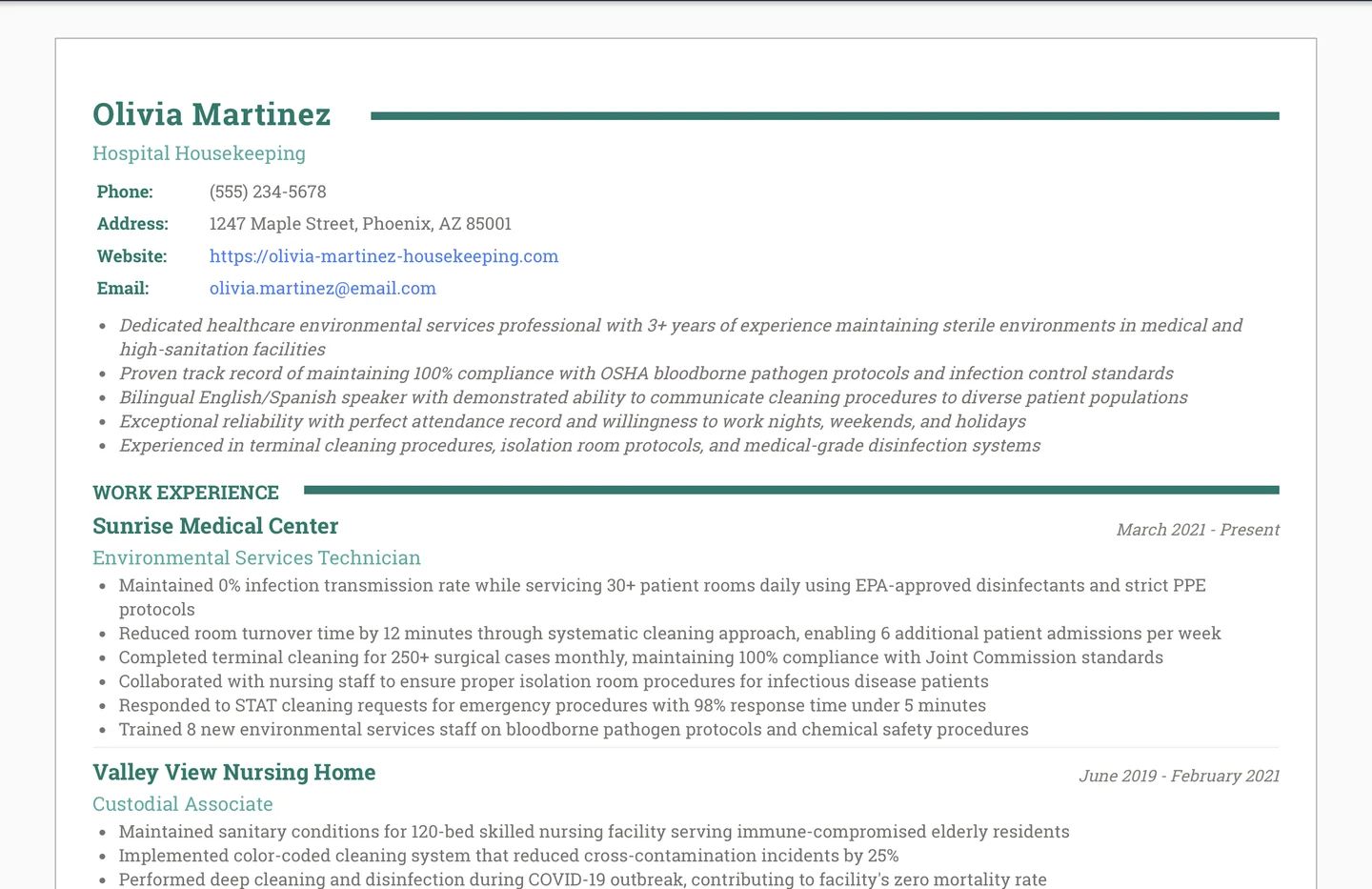
The Ultimate Hospital Housekeeping Resume Example/Sample
https://www.resumonk.com/hospital-housekeepingHospital HousekeepingBest Resume Format for Hospital Housekeeping Positions
The reverse-chronological format is your best friend here, and there's a compelling reason why.
Hospital administrators and housekeeping supervisors are drowning in applications, often reviewing dozens while managing staff schedules and compliance reports. They need to see immediately that you understand the unique demands of healthcare cleaning - the difference between terminal cleaning and routine maintenance, the critical nature of isolation room protocols, and why a missed spot in an OR isn't just untidy, it's potentially life-threatening.
Structure Your Hospital Housekeeping Resume Like a Cleaning Protocol
Start with your contact information and a brief professional summary that immediately signals you understand healthcare isn't just another cleaning gig.
Follow this with your work experience in reverse-chronological order, then your skills section highlighting both technical competencies and soft skills crucial for hospital environments. Education and certifications come next - and yes, even if you only have a high school diploma, it matters in healthcare settings.
The one-page rule applies firmly here unless you have over 10 years of specialized healthcare housekeeping experience. Hospital hiring managers appreciate efficiency - the same quality they'll expect when you're turning over 30 patient rooms in a shift. Use clear section headers, consistent formatting, and plenty of white space. Think of your resume layout like a freshly cleaned patient room - everything in its place, nothing superfluous, immediately presentable.
Why This Format Works in Healthcare Settings
Hospitals operate on protocols and procedures, and your reverse-chronological resume mirrors this systematic approach. It shows progression, demonstrates stability (crucial in an industry with high turnover), and allows hiring managers to quickly verify you have experience with healthcare-specific requirements like OSHA bloodborne pathogen standards, HIPAA compliance during room cleaning, and experience with hospital-grade disinfectants that would make regular commercial cleaners run for the hills.
Writing Work Experience for Your Hospital Housekeeping Resume
Your work experience section is where you transform from "person who cleans" to "healthcare environmental services professional."
This distinction matters immensely because while your cousin might clean office buildings for the same hourly rate, they've never had to sanitize a room where someone with C. diff was treated, or ensure an operating room meets surgical sterility standards.
Quantify Your Healthcare Cleaning Impact
Every hospital tracks infection rates obsessively - it affects their funding, reputation, and accreditation. Your experience section should reflect this metrics-driven environment.
Instead of listing duties, showcase your contribution to these critical outcomes.
❌ Don't write vague descriptions that could apply to any cleaning job:
• Cleaned patient rooms
• Mopped floors and emptied trash
• Followed cleaning procedures
✅ Do write specific, healthcare-focused achievements:
Environmental Services Technician | St. Mary's Medical Center | 2021-2023
• Maintained 0% infection transmission rate while servicing 25+ isolation rooms daily using EPA-approved disinfectants and strict PPE protocols
• Reduced room turnover time by 15 minutes through systematic cleaning approach, enabling 8 additional patient admissions per week
• Completed terminal cleaning for 300+ OR cases monthly, maintaining 100% compliance with Joint Commission standards
Highlight Your Understanding of Healthcare Hierarchy
Hospital housekeeping means navigating complex medical environments where you're simultaneously invisible and essential.
You've learned when to clean around a grieving family, how to work efficiently while nurses conduct rounds, and why you absolutely cannot enter certain areas without proper clearance. This situational awareness is gold on your resume.
Include experiences that show you understand the healthcare ecosystem - collaborating with nursing staff for discharge cleaning, responding to STAT cleaning requests for emergency procedures, or participating in infection control committees. These details signal you're not just someone with a mop; you're a healthcare team member who happens to specialize in environmental services.
Address the Reality of Entry-Level Progression
If you're new to hospital housekeeping, perhaps transitioning from retail, food service, or home healthcare, frame your experience through a healthcare lens.
That time you maintained food safety standards at McDonald's? That's understanding contamination prevention. Your experience caring for an elderly relative?
That's familiarity with medical vulnerability and hygiene needs.
Essential Skills for Your Hospital Housekeeping Resume
The skills section of your hospital housekeeping resume needs to walk a delicate line - technical enough to show you can handle specialized equipment and chemicals, yet human enough to demonstrate you can work in spaces where people are experiencing their worst days. This isn't office cleaning where the biggest concern is someone's coffee mug; this is maintaining environments where immune-compromised children receive chemotherapy.
Technical Skills That Set You Apart
Hospital housekeeping requires knowledge that would make a chemistry student's head spin. You're not just using "cleaning products" - you're selecting between quaternary ammonium compounds and phenolics based on pathogen types.
You understand dwell times, dilution ratios, and why using the wrong disinfectant in the wrong place could literally kill someone.
✅ Do list specific healthcare cleaning competencies:
Technical Skills:
• Bloodborne pathogen cleanup and disposal procedures
• Terminal cleaning protocols for operating rooms and isolation units
• OSHA Hazard Communication Standard compliance
• Proper use of UV-C disinfection equipment
• Knowledge of CDC guidelines for environmental infection control
• Electronic bed tracking systems (Teletracking, TrueCare)
Soft Skills That Matter in Healthcare
Here's what they don't tell you in housekeeping training - you'll witness more human drama in a month than most people see in a lifetime. You'll clean rooms where babies were born and where grandparents took their last breath, sometimes on the same shift. The soft skills that matter here go beyond "attention to detail."
Cultural sensitivity becomes crucial when you're cleaning around religious artifacts families bring for healing. Emotional resilience matters when you're sanitizing a pediatric ICU room after a tragic outcome. Discretion is essential when you overhear confidential medical information while cleaning. These aren't just buzzwords; they're survival skills in hospital environments.
❌ Don't list generic soft skills:
• Team player
• Good communication
• Hard working
✅ Do specify healthcare-relevant interpersonal skills:
• Compassionate interaction with patients and families during vulnerable moments
• Cultural sensitivity in diverse healthcare settings
• Ability to maintain composure in medical emergencies
• HIPAA-compliant discretion and confidentiality
Certifications That Open Doors
While not always required, listing certain certifications can elevate your resume from the maybe pile to the interview pile. Include any healthcare-specific training - Certified Healthcare Environmental Services Technician (CHEST), OSHA Bloodborne Pathogen Certification, or even basic CPR/First Aid.
In hospitals, these show initiative and understanding that you're working in a medical environment, not just a building that happens to have beds.
Specific Considerations and Tips for Hospital Housekeeping Resumes
Now let's address the elephant in the sterile room - the unique challenges and opportunities that come with positioning yourself for hospital housekeeping roles. This isn't just about making your resume pretty; it's about understanding the specific anxieties of hospital hiring managers and addressing them preemptively.
Address the Reliability Question Without Being Asked
Hospital housekeeping has a turnover rate that would make fast-food restaurants blush.
Hiring managers are haunted by memories of no-shows, last-minute quits, and people who couldn't handle finding their first deceased patient. Your resume needs to subtly scream "I will actually show up and stick around."
Include perfect attendance awards, long tenure at previous positions, or completion of difficult training programs.
If you've worked nights, weekends, or holidays before, mention it - hospitals never close.
Navigate the Background Check Reality
Hospitals conduct background checks that make FBI clearance look casual. They're letting you into rooms with controlled substances, expensive equipment, and vulnerable people.
If you have a record, address it in your cover letter, not your resume, but ensure your resume emphasizes trustworthiness through other means - volunteer work, professional references from healthcare settings, or security clearances from other jobs.
Language Abilities Are Gold in Healthcare Settings
If you speak Spanish, Mandarin, Arabic, or any other language besides English, this isn't just a nice-to-have - it's a superpower in hospitals.
You'll be the one who can explain to the worried abuela why you need to clean around her grandson's ventilator, or understand when a patient is trying to tell you they spilled something hazardous. List these prominently, especially languages common in your hospital's service area.
Additional Skills:
• Bilingual English/Spanish - able to communicate cleaning procedures to patients and families
• Medical terminology comprehension in Spanish for safety communications
Show You Understand the Physical Demands
Hospital housekeeping is physically brutal - you're pushing heavy equipment, standing for entire shifts, and constantly bending, reaching, and lifting. If you've done physical work before, even if it wasn't cleaning, mention it. That warehouse job where you walked 20,000 steps daily? Relevant. Your experience as a home health aide lifting patients? Absolutely include it.
Hospitals need to know you won't file a workers' comp claim your first week.
Regional Differences Matter More Than You Think
In the UK, you're applying for "domestic services" positions and need to understand NHS protocols and CQC standards. Canadian hospitals want to see understanding of provincial health regulations, and bilingual abilities might be mandatory in certain regions. Australian hospitals often require understanding of AS/NZS 4187 standards for cleaning and disinfection. US hospitals vary by state - California has strict environmental regulations, while Joint Commission accreditation requirements are universal.
Tailor your resume's language and certifications accordingly.
The Unspoken Career Path Consideration
Here's something rarely discussed - hospital housekeeping can be a stepping stone to other healthcare careers. Many nurses, surgical techs, and even physicians started by cleaning hospitals while attending school. If you have any healthcare career aspirations, subtly indicate this through relevant coursework, volunteer work, or professional development activities.
Hospitals love promoting from within, and showing you're in this for more than just a paycheck makes you a better investment.
Remember, your hospital housekeeping resume isn't just a list of where you've cleaned - it's your professional story of maintaining the critical environments where healing happens. Every perfectly sanitized surface you've left behind has contributed to someone's recovery, prevented an infection, or provided dignity in someone's final moments.
Your resume should reflect the importance of this work, even if the job title doesn't.
Education Requirements for Hospital Housekeeping Resume
Most hospital housekeeping positions require a high school diploma or GED equivalent.
If you're reading this and thinking "Well, I don't have that," don't close this tab just yet. Many hospitals offer on-the-job training programs, and some are even willing to help you get your GED while you work. The healthcare industry understands that good, reliable workers come from all backgrounds.
Basic Education Listing
When listing your education for a hospital housekeeping position, keep it straightforward. Hiring managers spend about six seconds scanning your resume initially - they're looking for that high school credential, any relevant certifications, and then they're moving on.
Don't overthink this section.
❌ Don't write it like this:
Education:
Studied at Lincoln High School
Various online courses
✅ Do write it like this:
Education:
Lincoln High School, Chicago, IL
High School Diploma, May 2022
Relevant Coursework: Biology, Health Sciences
Certifications That Actually Matter
Now here's where you can really stand out.
While your competition is listing their high school diploma and calling it a day, you can showcase certifications that demonstrate you understand the unique demands of hospital cleaning. These aren't mandatory for most positions, but they show initiative - and in a field where many applicants have similar backgrounds, initiative speaks volumes.
Consider including certifications like OSHA Bloodborne Pathogens training, Basic Life Support (BLS), or any infection control courses you've completed. Even a food handler's certificate shows you understand contamination prevention. Got a certification from an online platform about workplace safety? Include it. Completed a free course on chemical handling? That belongs here too.
❌ Don't bury important certifications:
Education:
High School Diploma - 2020
Some certificates
✅ Do highlight relevant training:
Education & Certifications:
Roosevelt High School - High School Diploma, 2020

Certifications:
• OSHA Bloodborne Pathogens Certification - 2023
• Basic Chemical Safety Training, Coursera - 2023
• Infection Control Basics, Local Community College - 2022
International Considerations
If you're applying in the UK, you'll list your GCSEs or equivalent qualifications. Canadian hospitals often value bilingual abilities, so if you've completed any French language courses, include them. Australian employers particularly appreciate TAFE certifications in cleaning operations.
In the US, any state-specific health and safety training should be prominently featured.
Remember, hospital housekeeping isn't just about pushing a mop - it's about maintaining sterile environments where vulnerable people heal. Your education section should reflect that you understand this responsibility, even if your formal education is limited.
Awards and Recognition on Your Hospital Housekeeping Resume
The truth about hospital housekeeping is that it's physically demanding, often thankless work that happens behind the scenes. When someone takes the time to recognize your efforts in this field, it means you've done something genuinely exceptional. Maybe you've never received a formal award - that's perfectly fine. But have you been employee of the month at your retail job? Did your manager at the restaurant write you a glowing recommendation?
These translate directly to the reliability and work ethic hospitals desperately need.
What Counts as an Award
Think beyond traditional trophies and certificates.
In the housekeeping world, recognition often comes in different forms. Perfect attendance over six months is an achievement worth noting. Being selected to train new employees shows leadership potential. Even a heartfelt thank-you note from a patient's family that your supervisor shared with the team - that's recognition that matters in healthcare.
❌ Don't dismiss informal recognition:
Awards:
None
✅ Do include all meaningful recognition:
Recognition & Achievements:
• Perfect Attendance Award - ABC Cleaning Services (2022-2023)
• Employee of the Month - Quick-Stop Convenience Store (March 2022)
• Selected to train 5 new team members on safety protocols (2023)
• Commended by supervisor for maintaining 100% compliance during health inspection
Publications and Training Materials
Now, "publications" might seem like a stretch for a housekeeping position, but hear me out.
Have you created a cleaning checklist that your team adopted? Did you develop a better system for organizing supply closets that your supervisor implemented department-wide? These are exactly the kinds of practical innovations hospitals value.
If you've contributed to any workplace safety newsletters, participated in creating training materials, or even just suggested improvements that were documented and implemented - these show you're not just following procedures, you're thinking about how to improve them. In hospital settings where protocols can literally save lives, this mindset is gold.
❌ Don't overlook your contributions:
Publications: N/A
✅ Do highlight any documented contributions:
Workplace Contributions:
• Developed color-coded cleaning system adopted by entire night shift team (2023)
• Contributed safety tips to monthly employee newsletter (3 articles, 2022)
• Created bilingual cleaning checkpoint cards for diverse staff (2023)
Making Awards Relevant to Healthcare
The key is translating your achievements into healthcare language.
Your "Customer Service Excellence" award from retail? That's about patient and visitor satisfaction in hospital terms. Your recognition for reducing workplace accidents? That's infection control and patient safety.
Frame everything through the lens of how it relates to maintaining a safe, clean healthcare environment.
Professional References for Hospital Housekeeping Applications
The good news? You don't need former CEOs vouching for you. Hospitals are looking for references who can speak to exactly three things - your reliability, your integrity, and your ability to follow procedures. That shift supervisor from your fast-food job who watched you show up on time for two years straight? They're perfect. Your neighbor whose house you've cleaned every week without ever missing a day?
Even better.
Choosing the Right References
Prioritize references who can speak to your consistency and trustworthiness over those with impressive titles.
A part-time manager who worked directly with you beats a district manager who barely knows your name. If you've done any volunteer work - especially in healthcare settings like vaccination clinics or blood drives - those coordinators make excellent references.
Avoid family members unless they were genuinely your employer (and even then, tread carefully). Also skip friends unless they were your actual supervisor. Hospitals will see through these immediately, and it suggests you couldn't find anyone else to vouch for you professionally.
❌ Don't list references like this:
References:
Available upon request
✅ Do provide complete, professional references:
Professional References:

Maria Rodriguez - Shift Supervisor
McDonald's (State Street Location)
Phone: (555) 123-4567
Email: [email protected]
Relationship: Direct supervisor for 2 years
Can verify: Perfect attendance, training abilities, chemical safety compliance

Rev. James Thompson - Volunteer Coordinator
First Baptist Church Community Kitchen
Phone: (555) 234-5678
Email: [email protected]
Relationship: Supervised my volunteer work (2021-present)
Can verify: Reliability, working with vulnerable populations, following health codes
Preparing Your References
Before listing anyone, call them.
Not text, not email - actually call. Let them know you're applying for hospital housekeeping positions and explain why this matters to you. Give them a heads up about what the hospital might ask - things like whether you're comfortable around sick people, if you can handle strict protocols, and whether you've ever had issues with attendance or reliability.
Send your references a quick email after your conversation summarizing key points they might mention. Remind them of specific examples - that time you deep-cleaned the entire restaurant during a surprise health inspection, or when you covered three extra shifts during the flu season without complaint.
These concrete examples help your references paint a vivid picture of your work ethic.
International Reference Considerations
In the UK and Australia, written references are often expected alongside contact information. In Canada, bilingual references can be particularly valuable in diverse urban hospitals.
American hospitals typically want three references and will actually call them, while some European hospitals might request reference letters upfront.
Remember, for hospital housekeeping positions, character references can sometimes carry as much weight as professional ones. A pastor, community leader, or long-term volunteer coordinator who can speak to your integrity and reliability might be exactly what sets your application apart. These positions require trust above all else - your references are essentially vouching that you can be trusted in rooms with unconscious patients, around expensive medical equipment, and with access to restricted areas.
Choose people who can confidently make that case.
Cover Letter Strategies for Hospital Housekeeping Positions
Your cover letter for a hospital housekeeping position isn't about impressing anyone with fancy words - it's about conveying three critical things.
First, that you understand this isn't just cleaning, it's infection prevention in a medical setting. Second, that you're reliable enough to show up for every shift, because when you don't, nurses have to stop saving lives to empty trash cans. Third, that you can handle the emotional weight of working around sick people without letting it affect your performance.
Opening Your Cover Letter
Skip the generic openings about seeing their job posting.
Hospital HR departments are drowning in applications. Instead, open with why healthcare specifically. Maybe you've had a family member in the hospital and saw firsthand how cleanliness impacted their recovery.
Maybe you're drawn to work that directly contributes to healing, even if you're not providing medical care yourself.
❌ Don't open with generic statements:
Dear Hiring Manager,
I am writing to apply for the Hospital Housekeeping position I saw posted online.
I have experience in cleaning and am looking for a job.
✅ Do open with genuine connection:
Dear Housekeeping Department Manager,
When my grandmother spent three weeks in ICU last year, I watched how the housekeeping staff's meticulous work gave our family peace of mind during the hardest time of our lives. I want to provide that same comfort to other families at St. Mary's Hospital.
Addressing the Realities
Hospital housekeeping involves exposure to bodily fluids, chemical disinfectants, and emotionally charged situations. Your cover letter should subtly indicate you understand and accept these realities. Mention any relevant experience - maybe you've cleaned veterinary clinics, worked in food service during a health inspection, or cared for an elderly relative.
These experiences show you won't be shocked by the demands of hospital work.
Don't pretend the job is glamorous, but do express genuine enthusiasm for the unique aspects of hospital work. The fact that you'll be working nights, weekends, and holidays? Frame it as reliability. The physical demands? Present yourself as someone who prefers active work to sitting at a desk.
Regional Differences in Cover Letters
In the United States, keep your cover letter to one page and focus on your work ethic. Canadian hospitals often appreciate when you mention any French language skills, even basic ones. UK hospitals (NHS particularly) value understanding of their public healthcare mission - mentioning your support for universal healthcare resonates.
Australian employers appreciate directness, so be straightforward about your capabilities and availability.
❌ Don't ignore the healthcare context:
I am a hard worker and can clean anything. I need a job with good benefits.
✅ Do demonstrate understanding:
Having worked night shifts at a 24-hour facility, I understand the importance of maintaining consistent cleaning standards when staffing is minimal. I'm comfortable working independently and take pride in knowing my attention to detail in following sanitization protocols directly impacts patient recovery rates.
Key Takeaways
After walking through every aspect of creating your hospital housekeeping resume, let's crystallize the most critical points you need to remember. These aren't just resume tips - they're your roadmap to presenting yourself as the reliable, capable healthcare environmental services professional that hospitals desperately need.
- Use reverse-chronological format to mirror hospitals' systematic approach and quickly show your most recent, relevant experience first
- Quantify your impact with healthcare-specific metrics - infection rates, room turnover times, compliance percentages - not just general cleaning duties
- Highlight healthcare-specific knowledge like bloodborne pathogen protocols, isolation room procedures, and understanding of medical-grade disinfectants
- Include both technical skills and healthcare-appropriate soft skills - cultural sensitivity, emotional resilience, and HIPAA-compliant discretion matter as much as knowing proper chemical dilution ratios
- List relevant certifications prominently - OSHA Bloodborne Pathogens, BLS, or even food handler's licenses show you understand contamination prevention
- Address reliability concerns preemptively through perfect attendance records, long tenure at previous positions, and willingness to work nights/weekends/holidays
- Include language abilities - being bilingual is a superpower in diverse hospital settings
- Don't skip the cover letter - use it to show you understand this isn't just cleaning, but infection prevention in vulnerable populations
- Choose references who can speak to your reliability and integrity over impressive titles - hospitals actually call references for these positions
- Frame all experience through a healthcare lens - your retail customer service becomes patient satisfaction, your food service experience becomes understanding of contamination control
Creating your hospital housekeeping resume on Resumonk takes all these considerations and streamlines them into a polished, professional document. Our AI-powered recommendations understand the unique requirements of healthcare environmental services positions, suggesting powerful action verbs and achievement statements specifically tailored to hospital settings. With professionally designed templates that maintain the clean, organized appearance hospitals expect, you can focus on your content while we handle the formatting. The platform helps you emphasize the metrics that matter in healthcare, properly organize your certifications and training, and ensures your resume presents you as the dedicated healthcare professional you're ready to become.
Ready to create your hospital housekeeping resume?
Successfully land your position using Resumonk's specialized templates and intelligent suggestions. Start building your professional resume today and take the first step toward your essential role in healthcare.
Start Creating Your Hospital Housekeeping Resume →
More Healthcare Support resume examples
- Phlebotomist resume example
- Medical Assistant resume example
- Caregiver resume example
- Radiology Technician resume example
See all Healthcare Support resume examples, or browse every category.
Resume writing tips
Picture yourself at 5 AM, pulling on those non-slip shoes you bought specifically for this moment, knowing that in an hour you'll be walking through those automatic hospital doors not as a patient or visitor, but as someone essential to the healing process. You're applying for hospital housekeeping positions, and right now, staring at that blank resume template, you might be wondering how to convey that you're ready for work that's physically demanding, emotionally complex, and more critical to public health than most people realize.
You've probably cleaned before - maybe offices after everyone's gone home, restaurant kitchens during the closing rush, or your own home while caring for family members - but you know instinctively that hospital housekeeping is different, and your resume needs to reflect that understanding.
The truth is, you're not just applying to clean buildings; you're applying to maintain environments where premature babies take their first breaths, where surgeons perform miracles, and where families say their final goodbyes. Your future supervisors need to know you can handle the weight of that responsibility while maintaining the stamina to push industrial floor cleaners for eight hours straight. They need to see that you understand the difference between regular cleaning and terminal disinfection, that you can work around grieving families with compassion, and that you'll show up for your shift even when it's Christmas morning and everyone else is home opening presents.
This guide walks you through everything you'll need to craft that perfect hospital housekeeping resume, starting with choosing the right format that mirrors the systematic approach hospitals love. We'll show you how to write work experience entries that transform your previous jobs - even if they weren't in healthcare - into relevant qualifications, and how to list skills that prove you understand both the technical and human sides of hospital work. You'll learn what certifications actually matter (and which ones are just nice to have), how to address common concerns like gaps in employment or lack of healthcare experience, and even regional differences that might affect your application depending on whether you're applying to hospitals in California versus Ontario.
We'll also tackle the often-overlooked sections that can make or break your application - from crafting a cover letter that shows you understand the emotional realities of hospital work, to choosing references who can vouch for your reliability when the housekeeping supervisor is desperately trying to cover weekend shifts. Every section of this guide is designed specifically for someone in your position, someone ready to take on work that's challenging but meaningful, someone who understands that maintaining a sterile operating room or a comforting patient room is a form of caregiving in itself. Let's build you a resume that gets you through those hospital doors.
The Ultimate Hospital Housekeeping Resume Example/Sample
https://www.resumonk.com/hospital-housekeepingHospital HousekeepingBest Resume Format for Hospital Housekeeping Positions
The reverse-chronological format is your best friend here, and there's a compelling reason why.
Hospital administrators and housekeeping supervisors are drowning in applications, often reviewing dozens while managing staff schedules and compliance reports. They need to see immediately that you understand the unique demands of healthcare cleaning - the difference between terminal cleaning and routine maintenance, the critical nature of isolation room protocols, and why a missed spot in an OR isn't just untidy, it's potentially life-threatening.
Structure Your Hospital Housekeeping Resume Like a Cleaning Protocol
Start with your contact information and a brief professional summary that immediately signals you understand healthcare isn't just another cleaning gig.
Follow this with your work experience in reverse-chronological order, then your skills section highlighting both technical competencies and soft skills crucial for hospital environments. Education and certifications come next - and yes, even if you only have a high school diploma, it matters in healthcare settings.
The one-page rule applies firmly here unless you have over 10 years of specialized healthcare housekeeping experience. Hospital hiring managers appreciate efficiency - the same quality they'll expect when you're turning over 30 patient rooms in a shift. Use clear section headers, consistent formatting, and plenty of white space. Think of your resume layout like a freshly cleaned patient room - everything in its place, nothing superfluous, immediately presentable.
Why This Format Works in Healthcare Settings
Hospitals operate on protocols and procedures, and your reverse-chronological resume mirrors this systematic approach. It shows progression, demonstrates stability (crucial in an industry with high turnover), and allows hiring managers to quickly verify you have experience with healthcare-specific requirements like OSHA bloodborne pathogen standards, HIPAA compliance during room cleaning, and experience with hospital-grade disinfectants that would make regular commercial cleaners run for the hills.
Writing Work Experience for Your Hospital Housekeeping Resume
Your work experience section is where you transform from "person who cleans" to "healthcare environmental services professional."
This distinction matters immensely because while your cousin might clean office buildings for the same hourly rate, they've never had to sanitize a room where someone with C. diff was treated, or ensure an operating room meets surgical sterility standards.
Quantify Your Healthcare Cleaning Impact
Every hospital tracks infection rates obsessively - it affects their funding, reputation, and accreditation. Your experience section should reflect this metrics-driven environment.
Instead of listing duties, showcase your contribution to these critical outcomes.
❌ Don't write vague descriptions that could apply to any cleaning job:
• Cleaned patient rooms
• Mopped floors and emptied trash
• Followed cleaning procedures
✅ Do write specific, healthcare-focused achievements:
Environmental Services Technician | St. Mary's Medical Center | 2021-2023
• Maintained 0% infection transmission rate while servicing 25+ isolation rooms daily using EPA-approved disinfectants and strict PPE protocols
• Reduced room turnover time by 15 minutes through systematic cleaning approach, enabling 8 additional patient admissions per week
• Completed terminal cleaning for 300+ OR cases monthly, maintaining 100% compliance with Joint Commission standards
Highlight Your Understanding of Healthcare Hierarchy
Hospital housekeeping means navigating complex medical environments where you're simultaneously invisible and essential.
You've learned when to clean around a grieving family, how to work efficiently while nurses conduct rounds, and why you absolutely cannot enter certain areas without proper clearance. This situational awareness is gold on your resume.
Include experiences that show you understand the healthcare ecosystem - collaborating with nursing staff for discharge cleaning, responding to STAT cleaning requests for emergency procedures, or participating in infection control committees. These details signal you're not just someone with a mop; you're a healthcare team member who happens to specialize in environmental services.
Address the Reality of Entry-Level Progression
If you're new to hospital housekeeping, perhaps transitioning from retail, food service, or home healthcare, frame your experience through a healthcare lens.
That time you maintained food safety standards at McDonald's? That's understanding contamination prevention. Your experience caring for an elderly relative?
That's familiarity with medical vulnerability and hygiene needs.
Essential Skills for Your Hospital Housekeeping Resume
The skills section of your hospital housekeeping resume needs to walk a delicate line - technical enough to show you can handle specialized equipment and chemicals, yet human enough to demonstrate you can work in spaces where people are experiencing their worst days. This isn't office cleaning where the biggest concern is someone's coffee mug; this is maintaining environments where immune-compromised children receive chemotherapy.
Technical Skills That Set You Apart
Hospital housekeeping requires knowledge that would make a chemistry student's head spin. You're not just using "cleaning products" - you're selecting between quaternary ammonium compounds and phenolics based on pathogen types.
You understand dwell times, dilution ratios, and why using the wrong disinfectant in the wrong place could literally kill someone.
✅ Do list specific healthcare cleaning competencies:
Technical Skills:
• Bloodborne pathogen cleanup and disposal procedures
• Terminal cleaning protocols for operating rooms and isolation units
• OSHA Hazard Communication Standard compliance
• Proper use of UV-C disinfection equipment
• Knowledge of CDC guidelines for environmental infection control
• Electronic bed tracking systems (Teletracking, TrueCare)
Soft Skills That Matter in Healthcare
Here's what they don't tell you in housekeeping training - you'll witness more human drama in a month than most people see in a lifetime. You'll clean rooms where babies were born and where grandparents took their last breath, sometimes on the same shift. The soft skills that matter here go beyond "attention to detail."
Cultural sensitivity becomes crucial when you're cleaning around religious artifacts families bring for healing. Emotional resilience matters when you're sanitizing a pediatric ICU room after a tragic outcome. Discretion is essential when you overhear confidential medical information while cleaning. These aren't just buzzwords; they're survival skills in hospital environments.
❌ Don't list generic soft skills:
• Team player
• Good communication
• Hard working
✅ Do specify healthcare-relevant interpersonal skills:
• Compassionate interaction with patients and families during vulnerable moments
• Cultural sensitivity in diverse healthcare settings
• Ability to maintain composure in medical emergencies
• HIPAA-compliant discretion and confidentiality
Certifications That Open Doors
While not always required, listing certain certifications can elevate your resume from the maybe pile to the interview pile. Include any healthcare-specific training - Certified Healthcare Environmental Services Technician (CHEST), OSHA Bloodborne Pathogen Certification, or even basic CPR/First Aid.
In hospitals, these show initiative and understanding that you're working in a medical environment, not just a building that happens to have beds.
Specific Considerations and Tips for Hospital Housekeeping Resumes
Now let's address the elephant in the sterile room - the unique challenges and opportunities that come with positioning yourself for hospital housekeeping roles. This isn't just about making your resume pretty; it's about understanding the specific anxieties of hospital hiring managers and addressing them preemptively.
Address the Reliability Question Without Being Asked
Hospital housekeeping has a turnover rate that would make fast-food restaurants blush.
Hiring managers are haunted by memories of no-shows, last-minute quits, and people who couldn't handle finding their first deceased patient. Your resume needs to subtly scream "I will actually show up and stick around."
Include perfect attendance awards, long tenure at previous positions, or completion of difficult training programs.
If you've worked nights, weekends, or holidays before, mention it - hospitals never close.
Navigate the Background Check Reality
Hospitals conduct background checks that make FBI clearance look casual. They're letting you into rooms with controlled substances, expensive equipment, and vulnerable people.
If you have a record, address it in your cover letter, not your resume, but ensure your resume emphasizes trustworthiness through other means - volunteer work, professional references from healthcare settings, or security clearances from other jobs.
Language Abilities Are Gold in Healthcare Settings
If you speak Spanish, Mandarin, Arabic, or any other language besides English, this isn't just a nice-to-have - it's a superpower in hospitals.
You'll be the one who can explain to the worried abuela why you need to clean around her grandson's ventilator, or understand when a patient is trying to tell you they spilled something hazardous. List these prominently, especially languages common in your hospital's service area.
Additional Skills:
• Bilingual English/Spanish - able to communicate cleaning procedures to patients and families
• Medical terminology comprehension in Spanish for safety communications
Show You Understand the Physical Demands
Hospital housekeeping is physically brutal - you're pushing heavy equipment, standing for entire shifts, and constantly bending, reaching, and lifting. If you've done physical work before, even if it wasn't cleaning, mention it. That warehouse job where you walked 20,000 steps daily? Relevant. Your experience as a home health aide lifting patients? Absolutely include it.
Hospitals need to know you won't file a workers' comp claim your first week.
Regional Differences Matter More Than You Think
In the UK, you're applying for "domestic services" positions and need to understand NHS protocols and CQC standards. Canadian hospitals want to see understanding of provincial health regulations, and bilingual abilities might be mandatory in certain regions. Australian hospitals often require understanding of AS/NZS 4187 standards for cleaning and disinfection. US hospitals vary by state - California has strict environmental regulations, while Joint Commission accreditation requirements are universal.
Tailor your resume's language and certifications accordingly.
The Unspoken Career Path Consideration
Here's something rarely discussed - hospital housekeeping can be a stepping stone to other healthcare careers. Many nurses, surgical techs, and even physicians started by cleaning hospitals while attending school. If you have any healthcare career aspirations, subtly indicate this through relevant coursework, volunteer work, or professional development activities.
Hospitals love promoting from within, and showing you're in this for more than just a paycheck makes you a better investment.
Remember, your hospital housekeeping resume isn't just a list of where you've cleaned - it's your professional story of maintaining the critical environments where healing happens. Every perfectly sanitized surface you've left behind has contributed to someone's recovery, prevented an infection, or provided dignity in someone's final moments.
Your resume should reflect the importance of this work, even if the job title doesn't.
Education Requirements for Hospital Housekeeping Resume
Most hospital housekeeping positions require a high school diploma or GED equivalent.
If you're reading this and thinking "Well, I don't have that," don't close this tab just yet. Many hospitals offer on-the-job training programs, and some are even willing to help you get your GED while you work. The healthcare industry understands that good, reliable workers come from all backgrounds.
Basic Education Listing
When listing your education for a hospital housekeeping position, keep it straightforward. Hiring managers spend about six seconds scanning your resume initially - they're looking for that high school credential, any relevant certifications, and then they're moving on.
Don't overthink this section.
❌ Don't write it like this:
Education:
Studied at Lincoln High School
Various online courses
✅ Do write it like this:
Education:
Lincoln High School, Chicago, IL
High School Diploma, May 2022
Relevant Coursework: Biology, Health Sciences
Certifications That Actually Matter
Now here's where you can really stand out.
While your competition is listing their high school diploma and calling it a day, you can showcase certifications that demonstrate you understand the unique demands of hospital cleaning. These aren't mandatory for most positions, but they show initiative - and in a field where many applicants have similar backgrounds, initiative speaks volumes.
Consider including certifications like OSHA Bloodborne Pathogens training, Basic Life Support (BLS), or any infection control courses you've completed. Even a food handler's certificate shows you understand contamination prevention. Got a certification from an online platform about workplace safety? Include it. Completed a free course on chemical handling? That belongs here too.
❌ Don't bury important certifications:
Education:
High School Diploma - 2020
Some certificates
✅ Do highlight relevant training:
Education & Certifications:
Roosevelt High School - High School Diploma, 2020

Certifications:
• OSHA Bloodborne Pathogens Certification - 2023
• Basic Chemical Safety Training, Coursera - 2023
• Infection Control Basics, Local Community College - 2022
International Considerations
If you're applying in the UK, you'll list your GCSEs or equivalent qualifications. Canadian hospitals often value bilingual abilities, so if you've completed any French language courses, include them. Australian employers particularly appreciate TAFE certifications in cleaning operations.
In the US, any state-specific health and safety training should be prominently featured.
Remember, hospital housekeeping isn't just about pushing a mop - it's about maintaining sterile environments where vulnerable people heal. Your education section should reflect that you understand this responsibility, even if your formal education is limited.
Awards and Recognition on Your Hospital Housekeeping Resume
The truth about hospital housekeeping is that it's physically demanding, often thankless work that happens behind the scenes. When someone takes the time to recognize your efforts in this field, it means you've done something genuinely exceptional. Maybe you've never received a formal award - that's perfectly fine. But have you been employee of the month at your retail job? Did your manager at the restaurant write you a glowing recommendation?
These translate directly to the reliability and work ethic hospitals desperately need.
What Counts as an Award
Think beyond traditional trophies and certificates.
In the housekeeping world, recognition often comes in different forms. Perfect attendance over six months is an achievement worth noting. Being selected to train new employees shows leadership potential. Even a heartfelt thank-you note from a patient's family that your supervisor shared with the team - that's recognition that matters in healthcare.
❌ Don't dismiss informal recognition:
Awards:
None
✅ Do include all meaningful recognition:
Recognition & Achievements:
• Perfect Attendance Award - ABC Cleaning Services (2022-2023)
• Employee of the Month - Quick-Stop Convenience Store (March 2022)
• Selected to train 5 new team members on safety protocols (2023)
• Commended by supervisor for maintaining 100% compliance during health inspection
Publications and Training Materials
Now, "publications" might seem like a stretch for a housekeeping position, but hear me out.
Have you created a cleaning checklist that your team adopted? Did you develop a better system for organizing supply closets that your supervisor implemented department-wide? These are exactly the kinds of practical innovations hospitals value.
If you've contributed to any workplace safety newsletters, participated in creating training materials, or even just suggested improvements that were documented and implemented - these show you're not just following procedures, you're thinking about how to improve them. In hospital settings where protocols can literally save lives, this mindset is gold.
❌ Don't overlook your contributions:
Publications: N/A
✅ Do highlight any documented contributions:
Workplace Contributions:
• Developed color-coded cleaning system adopted by entire night shift team (2023)
• Contributed safety tips to monthly employee newsletter (3 articles, 2022)
• Created bilingual cleaning checkpoint cards for diverse staff (2023)
Making Awards Relevant to Healthcare
The key is translating your achievements into healthcare language.
Your "Customer Service Excellence" award from retail? That's about patient and visitor satisfaction in hospital terms. Your recognition for reducing workplace accidents? That's infection control and patient safety.
Frame everything through the lens of how it relates to maintaining a safe, clean healthcare environment.
Professional References for Hospital Housekeeping Applications
The good news? You don't need former CEOs vouching for you. Hospitals are looking for references who can speak to exactly three things - your reliability, your integrity, and your ability to follow procedures. That shift supervisor from your fast-food job who watched you show up on time for two years straight? They're perfect. Your neighbor whose house you've cleaned every week without ever missing a day?
Even better.
Choosing the Right References
Prioritize references who can speak to your consistency and trustworthiness over those with impressive titles.
A part-time manager who worked directly with you beats a district manager who barely knows your name. If you've done any volunteer work - especially in healthcare settings like vaccination clinics or blood drives - those coordinators make excellent references.
Avoid family members unless they were genuinely your employer (and even then, tread carefully). Also skip friends unless they were your actual supervisor. Hospitals will see through these immediately, and it suggests you couldn't find anyone else to vouch for you professionally.
❌ Don't list references like this:
References:
Available upon request
✅ Do provide complete, professional references:
Professional References:

Maria Rodriguez - Shift Supervisor
McDonald's (State Street Location)
Phone: (555) 123-4567
Email: [email protected]
Relationship: Direct supervisor for 2 years
Can verify: Perfect attendance, training abilities, chemical safety compliance

Rev. James Thompson - Volunteer Coordinator
First Baptist Church Community Kitchen
Phone: (555) 234-5678
Email: [email protected]
Relationship: Supervised my volunteer work (2021-present)
Can verify: Reliability, working with vulnerable populations, following health codes
Preparing Your References
Before listing anyone, call them.
Not text, not email - actually call. Let them know you're applying for hospital housekeeping positions and explain why this matters to you. Give them a heads up about what the hospital might ask - things like whether you're comfortable around sick people, if you can handle strict protocols, and whether you've ever had issues with attendance or reliability.
Send your references a quick email after your conversation summarizing key points they might mention. Remind them of specific examples - that time you deep-cleaned the entire restaurant during a surprise health inspection, or when you covered three extra shifts during the flu season without complaint.
These concrete examples help your references paint a vivid picture of your work ethic.
International Reference Considerations
In the UK and Australia, written references are often expected alongside contact information. In Canada, bilingual references can be particularly valuable in diverse urban hospitals.
American hospitals typically want three references and will actually call them, while some European hospitals might request reference letters upfront.
Remember, for hospital housekeeping positions, character references can sometimes carry as much weight as professional ones. A pastor, community leader, or long-term volunteer coordinator who can speak to your integrity and reliability might be exactly what sets your application apart. These positions require trust above all else - your references are essentially vouching that you can be trusted in rooms with unconscious patients, around expensive medical equipment, and with access to restricted areas.
Choose people who can confidently make that case.
Cover Letter Strategies for Hospital Housekeeping Positions
Your cover letter for a hospital housekeeping position isn't about impressing anyone with fancy words - it's about conveying three critical things.
First, that you understand this isn't just cleaning, it's infection prevention in a medical setting. Second, that you're reliable enough to show up for every shift, because when you don't, nurses have to stop saving lives to empty trash cans. Third, that you can handle the emotional weight of working around sick people without letting it affect your performance.
Opening Your Cover Letter
Skip the generic openings about seeing their job posting.
Hospital HR departments are drowning in applications. Instead, open with why healthcare specifically. Maybe you've had a family member in the hospital and saw firsthand how cleanliness impacted their recovery.
Maybe you're drawn to work that directly contributes to healing, even if you're not providing medical care yourself.
❌ Don't open with generic statements:
Dear Hiring Manager,
I am writing to apply for the Hospital Housekeeping position I saw posted online.
I have experience in cleaning and am looking for a job.
✅ Do open with genuine connection:
Dear Housekeeping Department Manager,
When my grandmother spent three weeks in ICU last year, I watched how the housekeeping staff's meticulous work gave our family peace of mind during the hardest time of our lives. I want to provide that same comfort to other families at St. Mary's Hospital.
Addressing the Realities
Hospital housekeeping involves exposure to bodily fluids, chemical disinfectants, and emotionally charged situations. Your cover letter should subtly indicate you understand and accept these realities. Mention any relevant experience - maybe you've cleaned veterinary clinics, worked in food service during a health inspection, or cared for an elderly relative.
These experiences show you won't be shocked by the demands of hospital work.
Don't pretend the job is glamorous, but do express genuine enthusiasm for the unique aspects of hospital work. The fact that you'll be working nights, weekends, and holidays? Frame it as reliability. The physical demands? Present yourself as someone who prefers active work to sitting at a desk.
Regional Differences in Cover Letters
In the United States, keep your cover letter to one page and focus on your work ethic. Canadian hospitals often appreciate when you mention any French language skills, even basic ones. UK hospitals (NHS particularly) value understanding of their public healthcare mission - mentioning your support for universal healthcare resonates.
Australian employers appreciate directness, so be straightforward about your capabilities and availability.
❌ Don't ignore the healthcare context:
I am a hard worker and can clean anything. I need a job with good benefits.
✅ Do demonstrate understanding:
Having worked night shifts at a 24-hour facility, I understand the importance of maintaining consistent cleaning standards when staffing is minimal. I'm comfortable working independently and take pride in knowing my attention to detail in following sanitization protocols directly impacts patient recovery rates.
Key Takeaways
After walking through every aspect of creating your hospital housekeeping resume, let's crystallize the most critical points you need to remember. These aren't just resume tips - they're your roadmap to presenting yourself as the reliable, capable healthcare environmental services professional that hospitals desperately need.
- Use reverse-chronological format to mirror hospitals' systematic approach and quickly show your most recent, relevant experience first
- Quantify your impact with healthcare-specific metrics - infection rates, room turnover times, compliance percentages - not just general cleaning duties
- Highlight healthcare-specific knowledge like bloodborne pathogen protocols, isolation room procedures, and understanding of medical-grade disinfectants
- Include both technical skills and healthcare-appropriate soft skills - cultural sensitivity, emotional resilience, and HIPAA-compliant discretion matter as much as knowing proper chemical dilution ratios
- List relevant certifications prominently - OSHA Bloodborne Pathogens, BLS, or even food handler's licenses show you understand contamination prevention
- Address reliability concerns preemptively through perfect attendance records, long tenure at previous positions, and willingness to work nights/weekends/holidays
- Include language abilities - being bilingual is a superpower in diverse hospital settings
- Don't skip the cover letter - use it to show you understand this isn't just cleaning, but infection prevention in vulnerable populations
- Choose references who can speak to your reliability and integrity over impressive titles - hospitals actually call references for these positions
- Frame all experience through a healthcare lens - your retail customer service becomes patient satisfaction, your food service experience becomes understanding of contamination control
Creating your hospital housekeeping resume on Resumonk takes all these considerations and streamlines them into a polished, professional document. Our AI-powered recommendations understand the unique requirements of healthcare environmental services positions, suggesting powerful action verbs and achievement statements specifically tailored to hospital settings. With professionally designed templates that maintain the clean, organized appearance hospitals expect, you can focus on your content while we handle the formatting. The platform helps you emphasize the metrics that matter in healthcare, properly organize your certifications and training, and ensures your resume presents you as the dedicated healthcare professional you're ready to become.
Ready to create your hospital housekeeping resume?
Successfully land your position using Resumonk's specialized templates and intelligent suggestions. Start building your professional resume today and take the first step toward your essential role in healthcare.
Start Creating Your Hospital Housekeeping Resume →
More Healthcare Support resume examples
- Phlebotomist resume example
- Medical Assistant resume example
- Caregiver resume example
- Radiology Technician resume example
See all Healthcare Support resume examples, or browse every category.
Resume writing tips