Home Health Aide Resume Example, Guide and Tips
Introduction
You're scrolling through job postings at 11 PM, maybe after a long shift at the restaurant or retail store, and you keep coming back to those Home Health Aide positions. Something about this work calls to you - perhaps it's the memory of helping your grandmother through her final years, or that feeling you got when you assisted an elderly customer at work and their face lit up with gratitude. You know you have the compassion, the patience, and the genuine desire to help people maintain dignity and independence in their own homes.
But now you're staring at that blank resume template, wondering how to translate your caring heart and willing hands into the professional document that will get you through the door.
Being a Home Health Aide isn't just another healthcare job - it's an entry point into a field where you become a lifeline for someone who might otherwise lose their independence. You're not looking to climb corporate ladders or manage teams; you're seeking meaningful work where every day, you help someone eat their breakfast, remember their medications, or simply have a conversation that brightens their isolated world. This role sits at the foundation of healthcare, requiring no advanced degrees but demanding something perhaps more valuable - the ability to provide compassionate, reliable care when families can't be there themselves.
The resume you're about to create needs to speak to hiring managers who've seen it all - candidates who looked perfect on paper but couldn't handle the intimate nature of personal care, those who had all the certifications but lacked the emotional stamina for working with dementia patients, and others who simply didn't show up when the weather got bad. Your resume needs to demonstrate not just that you can do this work, but that you understand what you're signing up for and you're ready for both its challenges and its profound rewards.
In this comprehensive guide, we'll walk you through everything from choosing the right resume format that highlights your caregiving potential (even if you're coming from an entirely different field), to crafting work experience descriptions that translate your restaurant, retail, or family caregiving background into relevant healthcare experience. We'll show you exactly which skills to emphasize, how to present your Home Health Aide certification and training prominently, and even how to address those unique considerations like transportation reliability and comfort with pets that make or break applications in home care. You'll learn how to structure your education section when your certification matters more than any degree, how to present achievements in a field where recognition comes in thank-you cards rather than trophies, and strategies for cover letters that convey the warmth and reliability families desperately seek.
Whether you're fresh from your certification program, transitioning from another service industry, or returning to work after raising your own family, this guide will help you create a Home Health Aide resume that gets you noticed for all the right reasons. Let's transform your compassion and dedication into a professional document that opens doors to a career where you truly make a difference, one client at a time.
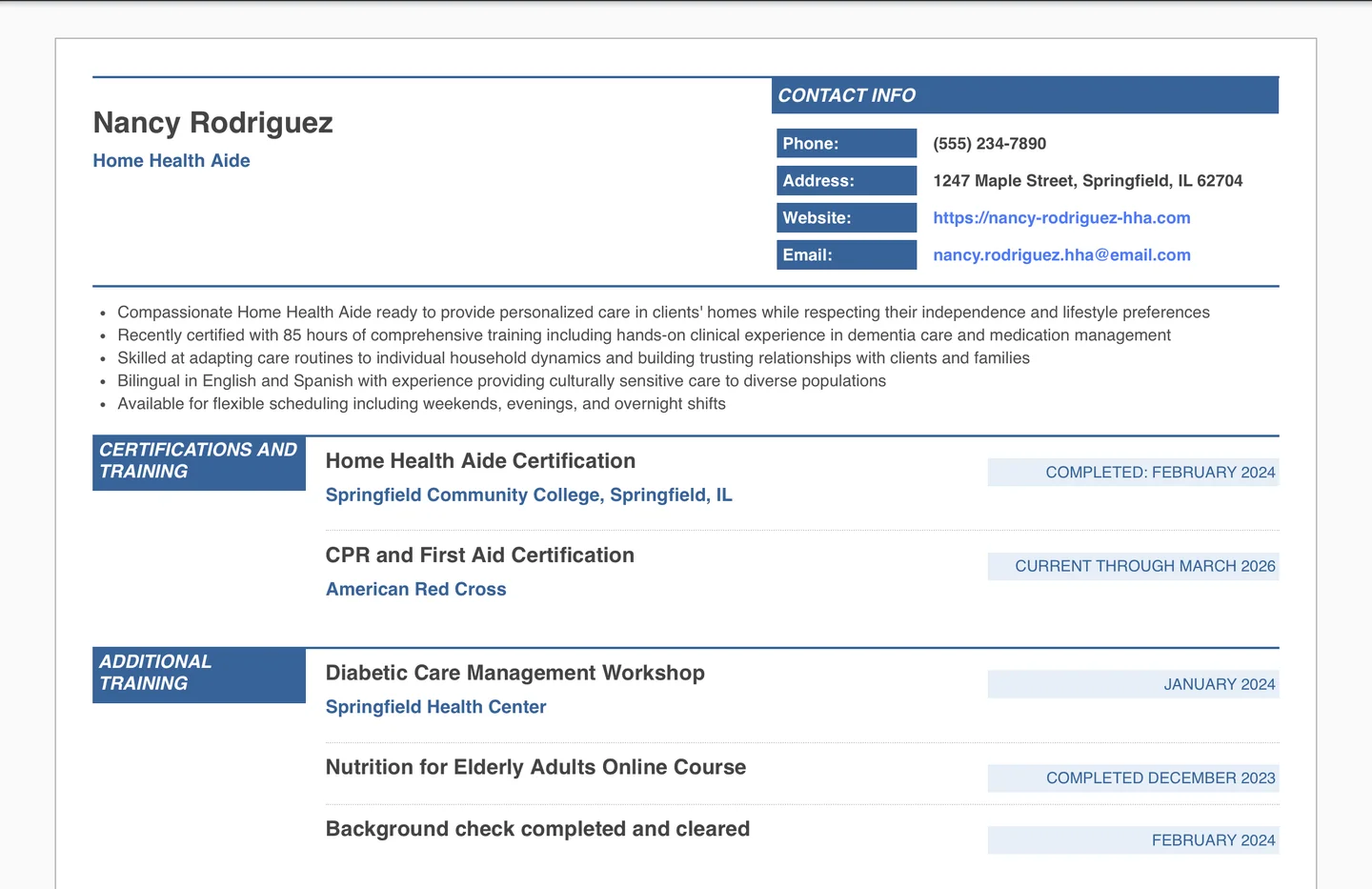
The Best Home Health Aide Resume Example/Sample
https://www.resumonk.com/home-health-aideHome Health AideResume Format for Home Health Aide Resume
Come, let's visualize this - you've just finished your CNA certification, or maybe you're transitioning from retail or food service into healthcare. You're sitting at your computer, staring at that blank document, wondering how to translate your compassion and caregiving abilities into a resume that will land you that Home Health Aide position.
The format you choose isn't just about looking professional; it's about telling your story in a way that makes sense to the hiring manager who's likely reviewing dozens of applications for entry-level healthcare positions.
Why Reverse-Chronological Works Best
For Home Health Aide positions, the reverse-chronological format is your strongest ally.
This format places your most recent experience at the top, which is crucial because healthcare employers want to see your current skills and recent training first. Whether you've been helping your grandmother with daily activities or just completed your state certification program, this format lets you lead with your freshest, most relevant experience.
The beauty of this format for Home Health Aides is that it naturally highlights your progression into healthcare. Maybe you started as a volunteer at a local nursing home, then got your certification, and recently completed an internship.
This upward trajectory tells a compelling story about your commitment to caregiving.
Essential Sections to Include
Your Home Health Aide resume should follow this structure - Contact Information, Professional Summary, Certifications and Training, Work Experience, Skills, and Education.
The placement of certifications before work experience is intentional here. Unlike office jobs where experience might trump everything, in home healthcare, your certifications are your golden ticket. Your CPR certification, your state HHA license, your First Aid training - these need to be front and center because they're often mandatory requirements that employers scan for immediately.
For those transitioning from other fields, don't panic about not having direct home health experience. The reverse-chronological format still works because you can frame your previous roles through a caregiving lens. That customer service job where you helped elderly customers? That's relevant. The time you managed medication schedules for a family member?
That counts too.
Work Experience on Home Health Aide Resume
Here's where many aspiring Home Health Aides stumble - they think because they're applying for an entry-level position, their work experience doesn't matter much.
Wrong. Every hiring manager knows that being a Home Health Aide requires a unique blend of physical stamina, emotional intelligence, and practical skills that you've likely developed in unexpected places.
Translating Non-Healthcare Experience
The secret to writing compelling work experience for a Home Health Aide resume lies in understanding what the job actually entails - you're not just a caregiver, you're a companion, a light housekeeper, a meal preparer, a medication reminder, and sometimes the only social interaction your client has all day. This means your experience as a restaurant server demonstrates your ability to multitask and maintain composure under pressure.
Your retail experience shows you can stand for long periods and handle difficult personalities with grace.
When describing your experience, focus on the human element and practical skills. Quantify where possible, but remember that in home healthcare, quality matters as much as quantity.
❌ Don't write vaguely about unrelated tasks:
Restaurant Server | Mario's Italian Kitchen | 2022-2024
- Served food to customers
- Cleaned tables
- Handled cash register
✅ Do translate your experience into caregiving-relevant skills:
Restaurant Server | Mario's Italian Kitchen | 2022-2024
- Assisted elderly and mobility-impaired guests with special dietary needs and seating arrangements
- Maintained strict sanitation protocols, ensuring clean and safe environment for 50+ daily customers
- Developed patience and communication skills while serving clients with various cognitive abilities
Highlighting Direct Care Experience
If you do have direct caregiving experience - whether paid or unpaid - this is where you shine. Maybe you cared for a family member with Alzheimer's, or volunteered at a senior center.
These experiences are gold, but they need to be presented professionally, even if they were informal arrangements.
Remember to include specific tasks that Home Health Aides typically perform. Employers want to see that you understand the physical and emotional demands of the job. Mention assistance with ADLs (Activities of Daily Living), medication reminders, meal preparation, light housekeeping, and companionship activities.
❌ Don't undervalue informal caregiving:
Helped take care of grandmother
✅ Do present it professionally with specific details:
Family Caregiver | Private Residence | 2021-2023
- Provided daily care for grandmother with moderate dementia, including assistance with bathing, dressing, and grooming
- Managed medication schedule and accompanied to medical appointments
- Prepared nutritious meals following diabetic diet restrictions
- Implemented memory exercises and engagement activities to maintain cognitive function
Skills to Include on Home Health Aide Resume
Think of your skills section as a quick-reference guide for employers.
They're scanning for specific competencies that tell them you can handle both the technical and emotional demands of home healthcare. As someone entering this field, you might be surprised at how many relevant skills you already possess - it's just a matter of presenting them in healthcare language.
Technical Skills That Matter
Start with the non-negotiables - the technical skills that every Home Health Aide needs. These include vital signs monitoring, infection control procedures, proper body mechanics for transfers, and basic medical terminology. If you've recently completed your training, these skills are fresh in your mind. List them clearly and specifically.
Don't just write "patient care" - that's too vague for a role where specificity can mean the difference between proper and improper care.
But here's where it gets interesting - technical skills for Home Health Aides also include things like meal preparation for special diets, operation of home medical equipment like glucometers or blood pressure monitors, and documentation skills for maintaining care logs. These might seem basic, but they're essential for the job and show you understand the full scope of home healthcare responsibilities.
Soft Skills - Your Secret Weapon
The soft skills section is where many Home Health Aide candidates can really differentiate themselves. This job isn't just about medical tasks - it's about being a trusted presence in someone's most vulnerable moments.
Patience isn't just nice to have; it's essential when you're helping someone with dementia remember how to button their shirt for the fifth time that morning.
❌ Don't list generic soft skills without context:
Skills:
- Good communication
- Team player
- Hardworking
- Friendly
✅ Do provide specific, relevant skills that show understanding of the role:
Skills:
Technical Skills:
- Vital signs monitoring and documentation
- Safe transfer and positioning techniques
- Medication reminder systems
- Diabetic meal preparation
- Hoyer lift operation
- HIPAA compliance

Interpersonal Skills:
- Dementia and Alzheimer's communication techniques
- Cultural sensitivity in diverse households
- Active listening for non-verbal pain indicators
- Boundary setting while maintaining warmth
- Crisis de-escalation
For different regions, note that UK employers might look for NVQ qualifications in Health and Social Care, while Canadian employers often require specific provincial certifications. Australian employers might prioritize Certificate III in Individual Support. Make sure your skills section reflects the terminology and requirements specific to your location.
Specific Considerations and Tips for Home Health Aide Resume
Now for the insider knowledge - the things that only someone who truly understands home healthcare would know to include on their resume. You're not applying to work in a hospital where you're part of a large team. You're applying to be welcomed into someone's home, often as their primary caregiver during your shift.
This unique dynamic requires special consideration in how you present yourself on paper.
Address the Trust Factor
Home Health Aide positions are unique because families are literally trusting you with their loved ones in their most private space. Your resume needs to subtly address this trust factor. Include any background checks you've already completed, any bonding or insurance you carry, and definitely mention if you're a non-smoker (many clients specifically request this).
If you have reliable transportation and a clean driving record, say so - you might need to drive clients to appointments or run errands.
Consider adding a brief mention of your comfort level with pets, as many elderly clients have companions they refuse to part with. One candidate might write "Comfortable providing care in homes with pets including dogs and cats" - this simple line has eliminated them from homes with severe allergies while making them perfect for the client with three cats who's been through five aides who were allergic.
Demonstrate Understanding of Home vs. Facility Care
Here's something most people don't realize - working as a Home Health Aide is vastly different from working in a facility.
In someone's home, you're adapting to their routines, their preferences, their way of organizing their medicine cabinet. Your resume should reflect this adaptability. Instead of just listing "medication management," specify "Adapted to various client medication organization systems while maintaining accurate documentation."
❌ Don't write as if you're applying for institutional care:
Professional Summary:
Dedicated healthcare worker seeking position to provide care to patients in need.
Experience following protocols and maintaining schedules.
✅ Do show you understand the home care environment:
Professional Summary:
Compassionate Home Health Aide ready to provide personalized care in clients' homes while
respecting their independence and lifestyle preferences. Skilled at adapting care routines
to individual household dynamics and building trusting relationships with clients and families.
The Availability and Schedule Flexibility Factor
Unlike hospital shifts, home healthcare often requires flexibility - clients might need morning care, evening care, or weekend coverage. If you have specific availability that matches common needs, mention it strategically. For instance, if you're available for overnight shifts, that's a huge selling point as these positions are often hardest to fill.
Similarly, if you're open to live-in positions or can commit to consistent long-term assignments with the same client, these are major advantages.
Geographic and Cultural Considerations
Home Health Aides often work within specific communities or neighborhoods.
If you live in the area where you're applying, mention it - agencies love aides who won't struggle with long commutes during bad weather. If you speak languages besides English, list them prominently. In diverse communities, being able to communicate in a client's native language isn't just helpful - it's often essential for proper care and emotional support.
Additionally, understand that in some regions, male Home Health Aides are in particularly high demand for male clients who prefer same-gender care. If you're a male entering this female-dominated field, don't be discouraged - instead, recognize this as a potential advantage and ensure your resume reflects your professionalism and understanding of appropriate boundaries.
Education Requirements and Listing for Home Health Aide Resume
Home Health Aides typically come from diverse educational backgrounds. Maybe you're fresh out of high school, looking for meaningful work that makes a real difference. Perhaps you're transitioning from retail or food service, seeking something more fulfilling. Or you might be returning to the workforce after raising your own family, bringing that invaluable caregiving experience with you.
Whatever your story, there's a right way to present your educational background that makes hiring managers take notice.
The Educational Foundation That Matters
For Home Health Aide positions, employers typically require a high school diploma or GED as the baseline.
But what they're really looking for is evidence that you've pursued relevant training. Most states require Home Health Aides to complete a state-approved training program - usually around 75 hours of classroom and practical training. This isn't medical school, but it's crucial preparation for the real challenges you'll face in clients' homes.
When listing your education, start with your most recent and relevant training first. This means your Home Health Aide certification program should take center stage, not that bachelor's degree in art history from ten years ago (though that can still be mentioned).
How to Structure Your Education Section
The golden rule here is relevance over prestige.
Your Home Health Aide certification from a community college matters more than an unrelated degree from a prestigious university. Here's how to make your education section work hard for you:
❌ Don't list education like this:
Bachelor of Arts, University of State, 2015
High School Diploma, Central High School, 2011
Home Health Aide Certificate, Community College, 2023
✅ Do structure it with relevance in mind:
Home Health Aide Certification Program
ABC Community College, City, State
Completed: March 2023
- 85 hours of training including clinical practice
- CPR and First Aid certified
- Specialized training in dementia care

High School Diploma
Central High School, City, State
Graduated: 2011
Including Additional Training and Certifications
In the world of home health care, every additional certification is like adding another tool to your caregiving toolkit.
Did you complete online courses in nutrition for elderly adults? Add it. Took a weekend workshop on safe patient transfer techniques? That belongs here too. These show initiative and genuine interest in professional development - qualities that set apart great Home Health Aides from merely adequate ones.
Remember to include expiration dates for certifications that require renewal, like CPR or First Aid. Nothing undermines your credibility faster than listing an expired certification. If something is about to expire, either renew it before applying or note the renewal date.
For those in different regions, requirements vary significantly. In the UK, you'll want to highlight your Care Certificate completion. Australian applicants should emphasize their Certificate III in Individual Support. Canadian Home Support Workers need to showcase provincial certifications. Always research your local requirements and lead with what matters most in your area.
Awards and Recognition on Your Home Health Aide Resume
The home health care industry doesn't typically hand out fancy trophies or publish groundbreaking research papers.
Your "publications" might be a mention in the agency newsletter about going above and beyond for a client. Your awards might be completing a challenging assignment with a difficult client when three other aides had requested transfers. These achievements matter because they demonstrate the soft skills that can't be taught in any certification program.
What Counts as Recognition in Home Health Care
Think beyond traditional awards. In your world, recognition comes in many forms. Maybe you received a commendation letter from a client's family after providing end-of-life care with exceptional dignity and compassion. Perhaps your supervisor noted your perfect attendance during a particularly challenging flu season.
Or maybe you were selected to train new aides because of your patient teaching style and thorough knowledge of procedures.
Professional development achievements also belong here. Completing additional training on your own time, earning specialized certifications in areas like Alzheimer's care, or participating in company wellness initiatives all demonstrate your commitment to excellence in caregiving.
How to Present Your Achievements Effectively
The key is translating these accomplishments into language that resonates with hiring managers who see dozens of resumes daily. Be specific about what you achieved and why it mattered.
❌ Don't write vague statements:
Received recognition for good work
Was appreciated by clients
Got positive feedback
✅ Do provide specific, impactful details:
Recognition for Excellence in Patient Care - 2023
Home Care Agency Name
- Maintained 100% client satisfaction rating across 15+ clients
- Received written commendations from 3 families for compassionate end-of-life care

Perfect Attendance Award - 2022
Previous Employer Name
- Zero absences during critical staffing shortage period
- Covered additional shifts to ensure continuity of care for high-need clients
When You Don't Have Formal Awards
New to the field?
Don't panic. You can highlight achievements from your training program, such as perfect scores on practical evaluations or being chosen for special clinical placements. If you're transitioning from another career, think about transferable recognition - that customer service award from your retail job shows you excel at interpersonal interactions, a crucial skill for Home Health Aides.
Remember, in home health care, consistency and reliability are achievements in themselves. If you've maintained long-term relationships with clients, helped someone achieve their mobility goals, or simply been the aide that families request by name - these are your awards, even if they didn't come with certificates.
Professional References for Home Health Aide Positions
Unlike office jobs where references might be a formality checked after the job offer, home care agencies often call references early in the process. One stellar reference from a previous client's family member can override concerns about limited experience. Conversely, a lukewarm reference from a supervisor who hints at reliability issues?
That's usually a dealbreaker.
Choosing the Right Mix of References
The ideal reference list for a Home Health Aide includes a combination of professional supervisors and direct testimony to your caregiving abilities.
Your immediate supervisor from your most recent caregiving role should top the list - they can speak to your punctuality, following care plans, and handling emergencies. But don't stop there.
Consider including a nurse or therapist you've worked alongside who can attest to your ability to follow medical instructions and communicate about client changes. If you've maintained long-term client relationships, a family member who's witnessed your care firsthand makes a powerful reference.
Just remember to always ask permission first - never surprise someone with a reference call.
Preparing Your References for Success
Your references want to help you, but they're busy people. Make their job easier by giving them a heads up about the position you're applying for and what qualities the employer values.
Remind them of specific situations where you excelled - the time you noticed early signs of a UTI that prevented hospitalization, or how you gained the trust of a client who had refused three previous aides.
❌ Don't list references like this:
References available upon request

OR

John Smith - 555-1234
Jane Doe - 555-5678
Bob Johnson - 555-9012
✅ Do provide complete, professional reference listings:
Maria Rodriguez, RN
Clinical Supervisor - Comfort Care Home Health
Phone: (555) 234-5678
Email: [email protected]
Relationship: Direct supervisor for 2 years
May contact: Yes

Thomas Chen
Son of former client, Mrs. Lily Chen
Phone: (555) 345-6789
Email: [email protected]
Relationship: Family member of client I cared for 18 months
May contact: Yes
When Your References Are Limited
New to the field?
Your references from your Home Health Aide training program matter immensely. Your clinical instructor who observed you during hands-on training can speak to your gentleness with transfers, your patience during feeding assistance, and your professional demeanor during personal care tasks. The program coordinator can confirm your attendance, your enthusiasm during classes, and your performance on evaluations.
Career changers should think creatively about transferable references. That customer you helped daily at the pharmacy who can speak to your patience and kindness? They might make a great character reference. The supervisor from your restaurant job who watched you handle difficult customers with grace? They can vouch for skills that translate directly to managing challenging client behaviors.
Managing Reference Checks in Different Regions
In the UK and Australia, expect more formal reference requirements, often requiring written references on company letterhead. Canadian employers might request references from your clinical placement supervisors specifically. In the US, verbal reference checks are more common, but some states require additional background check authorizations.
Always clarify the reference process during your application to avoid delays.
Remember, in home health care, your references are more than just employment verification - they're testimonials to your ability to be trusted with society's most vulnerable members. Choose them wisely, prepare them thoroughly, and they'll help open doors to a rewarding career where you truly make a difference every single day.
Cover Letter Strategies for Home Health Aide Applications
Your cover letter isn't just a formality in the home health care world - it's your chance to show the human behind the qualifications. Unlike applying for a corporate position where cover letters might feel like rehearsed scripts, Home Health Aide cover letters need to convey genuine warmth and understanding of what it means to be invited into someone's most vulnerable moments.
Understanding Your Audience
The person reading your cover letter is likely a care coordinator or agency manager who's dealt with high turnover, no-shows, and aides who looked great on paper but couldn't handle the reality of personal care tasks. They're looking for signs that you understand this isn't just about medical tasks - it's about being a lifeline for someone who might see no one else all day.
They need to know you won't quit when faced with challenging behaviors from a dementia patient or uncomfortable living conditions in a client's home.
Your cover letter should address their unspoken concerns while highlighting what makes you different from the aide who lasted two weeks before deciding this wasn't for them.
Structure That Tells Your Story
Start with why you're drawn to home health care specifically - not healthcare in general, but the unique challenge of providing care in someone's personal space.
Maybe you cared for a grandparent and discovered your calling. Perhaps you've always been the person friends turn to in crisis. Make it personal but professional.
❌ Don't write generic openings:
"I am writing to apply for the Home Health Aide position at your company.
I have all the required certifications and am available to start immediately."
✅ Do create engaging, specific introductions:
"When my neighbor Margaret could no longer manage her diabetes medications alone,
I became her unofficial daily visitor - checking her blood sugar, organizing pills, and most importantly, being someone she could trust. That experience showed me my calling as a Home Health Aide, where technical skills meet human connection."
Addressing the Realities of the Role
Be honest about understanding the challenges. Mention your comfort with personal care tasks, your reliability in all weather conditions, your ability to work independently without constant supervision.
If you have a reliable vehicle and clean driving record, highlight this - transportation issues cause more missed shifts than almost anything else in home care.
Include specific examples of relevant skills. If you've dealt with challenging behaviors calmly, managed household tasks efficiently, or communicated effectively with family members during stressful situations, these stories belong in your cover letter.
Remember, families are entrusting you with their loved ones - they need to know you're up for the responsibility.
Regional Differences in Cover Letter Expectations
In the United States, keep your cover letter to one page and focus on your state certification and any specialized training.
UK applications often expect more detail about your understanding of safeguarding and person-centered care principles. Australian employers appreciate mentions of cultural sensitivity and experience with diverse populations.
Canadian agencies often look for bilingual abilities, especially in French-speaking regions.
Key Takeaways
After diving deep into crafting the perfect Home Health Aide resume, here are the essential points to remember as you create your own:
- Use reverse-chronological format to showcase your most recent and relevant experience first, especially your fresh certification and training
- Place certifications prominently before work experience - your HHA certification, CPR, and First Aid credentials are often mandatory requirements employers scan for first
- Translate all experience through a caregiving lens - your retail, food service, or family caregiving experience demonstrates relevant skills like patience, multitasking, and handling challenging personalities
- Be specific with technical skills like vital signs monitoring, transfer techniques, and medication management rather than using vague terms like "patient care"
- Address the trust factor directly by mentioning background checks, reliable transportation, non-smoking status, and comfort with pets when applicable
- Show understanding of home care uniqueness by emphasizing adaptability to different household routines rather than institutional protocols
- List education with relevance over prestige - your HHA certification from community college matters more than unrelated degrees from prestigious universities
- Include all additional training like dementia care, nutrition for elderly, or safe transfer workshops to show commitment to professional development
- Present achievements meaningfully - perfect attendance, client satisfaction, and family commendations are your awards in this field
- Choose references strategically - combine professional supervisors with client family members who can vouch for your character and caregiving abilities
- Write cover letters that address unspoken concerns about reliability, comfort with personal care tasks, and understanding of the role's challenges
- Mention availability advantages like willingness for overnight shifts, weekend coverage, or live-in positions if applicable
Creating your Home Health Aide resume on Resumonk takes the guesswork out of formatting and presentation. Our platform understands the unique needs of healthcare resumes, offering templates that naturally highlight your certifications and training while maintaining the professional appearance healthcare employers expect. The AI-powered suggestions help you describe your caregiving experience in language that resonates with hiring managers, transforming your compassionate nature and practical skills into compelling resume content. Whether you're translating restaurant experience into healthcare-relevant skills or presenting informal family caregiving professionally, Resumonk's intuitive builder ensures your dedication to helping others shines through in every section.
Ready to create a Home Health Aide resume that opens doors to meaningful caregiving opportunities?
Start building your professional resume with Resumonk's specialized templates and expert guidance. Your journey to making a real difference in people's lives begins with a resume that tells your unique caregiving story.
Get started with Resumonk today and transform your compassion into a rewarding career.
More Healthcare Support resume examples
- Phlebotomist resume example
- Medical Assistant resume example
- Caregiver resume example
- Radiology Technician resume example
See all Healthcare Support resume examples, or browse every category.
Resume writing tips
You're scrolling through job postings at 11 PM, maybe after a long shift at the restaurant or retail store, and you keep coming back to those Home Health Aide positions. Something about this work calls to you - perhaps it's the memory of helping your grandmother through her final years, or that feeling you got when you assisted an elderly customer at work and their face lit up with gratitude. You know you have the compassion, the patience, and the genuine desire to help people maintain dignity and independence in their own homes.
But now you're staring at that blank resume template, wondering how to translate your caring heart and willing hands into the professional document that will get you through the door.
Being a Home Health Aide isn't just another healthcare job - it's an entry point into a field where you become a lifeline for someone who might otherwise lose their independence. You're not looking to climb corporate ladders or manage teams; you're seeking meaningful work where every day, you help someone eat their breakfast, remember their medications, or simply have a conversation that brightens their isolated world. This role sits at the foundation of healthcare, requiring no advanced degrees but demanding something perhaps more valuable - the ability to provide compassionate, reliable care when families can't be there themselves.
The resume you're about to create needs to speak to hiring managers who've seen it all - candidates who looked perfect on paper but couldn't handle the intimate nature of personal care, those who had all the certifications but lacked the emotional stamina for working with dementia patients, and others who simply didn't show up when the weather got bad. Your resume needs to demonstrate not just that you can do this work, but that you understand what you're signing up for and you're ready for both its challenges and its profound rewards.
In this comprehensive guide, we'll walk you through everything from choosing the right resume format that highlights your caregiving potential (even if you're coming from an entirely different field), to crafting work experience descriptions that translate your restaurant, retail, or family caregiving background into relevant healthcare experience. We'll show you exactly which skills to emphasize, how to present your Home Health Aide certification and training prominently, and even how to address those unique considerations like transportation reliability and comfort with pets that make or break applications in home care. You'll learn how to structure your education section when your certification matters more than any degree, how to present achievements in a field where recognition comes in thank-you cards rather than trophies, and strategies for cover letters that convey the warmth and reliability families desperately seek.
Whether you're fresh from your certification program, transitioning from another service industry, or returning to work after raising your own family, this guide will help you create a Home Health Aide resume that gets you noticed for all the right reasons. Let's transform your compassion and dedication into a professional document that opens doors to a career where you truly make a difference, one client at a time.
The Best Home Health Aide Resume Example/Sample
https://www.resumonk.com/home-health-aideHome Health AideResume Format for Home Health Aide Resume
Come, let's visualize this - you've just finished your CNA certification, or maybe you're transitioning from retail or food service into healthcare. You're sitting at your computer, staring at that blank document, wondering how to translate your compassion and caregiving abilities into a resume that will land you that Home Health Aide position.
The format you choose isn't just about looking professional; it's about telling your story in a way that makes sense to the hiring manager who's likely reviewing dozens of applications for entry-level healthcare positions.
Why Reverse-Chronological Works Best
For Home Health Aide positions, the reverse-chronological format is your strongest ally.
This format places your most recent experience at the top, which is crucial because healthcare employers want to see your current skills and recent training first. Whether you've been helping your grandmother with daily activities or just completed your state certification program, this format lets you lead with your freshest, most relevant experience.
The beauty of this format for Home Health Aides is that it naturally highlights your progression into healthcare. Maybe you started as a volunteer at a local nursing home, then got your certification, and recently completed an internship.
This upward trajectory tells a compelling story about your commitment to caregiving.
Essential Sections to Include
Your Home Health Aide resume should follow this structure - Contact Information, Professional Summary, Certifications and Training, Work Experience, Skills, and Education.
The placement of certifications before work experience is intentional here. Unlike office jobs where experience might trump everything, in home healthcare, your certifications are your golden ticket. Your CPR certification, your state HHA license, your First Aid training - these need to be front and center because they're often mandatory requirements that employers scan for immediately.
For those transitioning from other fields, don't panic about not having direct home health experience. The reverse-chronological format still works because you can frame your previous roles through a caregiving lens. That customer service job where you helped elderly customers? That's relevant. The time you managed medication schedules for a family member?
That counts too.
Work Experience on Home Health Aide Resume
Here's where many aspiring Home Health Aides stumble - they think because they're applying for an entry-level position, their work experience doesn't matter much.
Wrong. Every hiring manager knows that being a Home Health Aide requires a unique blend of physical stamina, emotional intelligence, and practical skills that you've likely developed in unexpected places.
Translating Non-Healthcare Experience
The secret to writing compelling work experience for a Home Health Aide resume lies in understanding what the job actually entails - you're not just a caregiver, you're a companion, a light housekeeper, a meal preparer, a medication reminder, and sometimes the only social interaction your client has all day. This means your experience as a restaurant server demonstrates your ability to multitask and maintain composure under pressure.
Your retail experience shows you can stand for long periods and handle difficult personalities with grace.
When describing your experience, focus on the human element and practical skills. Quantify where possible, but remember that in home healthcare, quality matters as much as quantity.
❌ Don't write vaguely about unrelated tasks:
Restaurant Server | Mario's Italian Kitchen | 2022-2024
- Served food to customers
- Cleaned tables
- Handled cash register
✅ Do translate your experience into caregiving-relevant skills:
Restaurant Server | Mario's Italian Kitchen | 2022-2024
- Assisted elderly and mobility-impaired guests with special dietary needs and seating arrangements
- Maintained strict sanitation protocols, ensuring clean and safe environment for 50+ daily customers
- Developed patience and communication skills while serving clients with various cognitive abilities
Highlighting Direct Care Experience
If you do have direct caregiving experience - whether paid or unpaid - this is where you shine. Maybe you cared for a family member with Alzheimer's, or volunteered at a senior center.
These experiences are gold, but they need to be presented professionally, even if they were informal arrangements.
Remember to include specific tasks that Home Health Aides typically perform. Employers want to see that you understand the physical and emotional demands of the job. Mention assistance with ADLs (Activities of Daily Living), medication reminders, meal preparation, light housekeeping, and companionship activities.
❌ Don't undervalue informal caregiving:
Helped take care of grandmother
✅ Do present it professionally with specific details:
Family Caregiver | Private Residence | 2021-2023
- Provided daily care for grandmother with moderate dementia, including assistance with bathing, dressing, and grooming
- Managed medication schedule and accompanied to medical appointments
- Prepared nutritious meals following diabetic diet restrictions
- Implemented memory exercises and engagement activities to maintain cognitive function
Skills to Include on Home Health Aide Resume
Think of your skills section as a quick-reference guide for employers.
They're scanning for specific competencies that tell them you can handle both the technical and emotional demands of home healthcare. As someone entering this field, you might be surprised at how many relevant skills you already possess - it's just a matter of presenting them in healthcare language.
Technical Skills That Matter
Start with the non-negotiables - the technical skills that every Home Health Aide needs. These include vital signs monitoring, infection control procedures, proper body mechanics for transfers, and basic medical terminology. If you've recently completed your training, these skills are fresh in your mind. List them clearly and specifically.
Don't just write "patient care" - that's too vague for a role where specificity can mean the difference between proper and improper care.
But here's where it gets interesting - technical skills for Home Health Aides also include things like meal preparation for special diets, operation of home medical equipment like glucometers or blood pressure monitors, and documentation skills for maintaining care logs. These might seem basic, but they're essential for the job and show you understand the full scope of home healthcare responsibilities.
Soft Skills - Your Secret Weapon
The soft skills section is where many Home Health Aide candidates can really differentiate themselves. This job isn't just about medical tasks - it's about being a trusted presence in someone's most vulnerable moments.
Patience isn't just nice to have; it's essential when you're helping someone with dementia remember how to button their shirt for the fifth time that morning.
❌ Don't list generic soft skills without context:
Skills:
- Good communication
- Team player
- Hardworking
- Friendly
✅ Do provide specific, relevant skills that show understanding of the role:
Skills:
Technical Skills:
- Vital signs monitoring and documentation
- Safe transfer and positioning techniques
- Medication reminder systems
- Diabetic meal preparation
- Hoyer lift operation
- HIPAA compliance

Interpersonal Skills:
- Dementia and Alzheimer's communication techniques
- Cultural sensitivity in diverse households
- Active listening for non-verbal pain indicators
- Boundary setting while maintaining warmth
- Crisis de-escalation
For different regions, note that UK employers might look for NVQ qualifications in Health and Social Care, while Canadian employers often require specific provincial certifications. Australian employers might prioritize Certificate III in Individual Support. Make sure your skills section reflects the terminology and requirements specific to your location.
Specific Considerations and Tips for Home Health Aide Resume
Now for the insider knowledge - the things that only someone who truly understands home healthcare would know to include on their resume. You're not applying to work in a hospital where you're part of a large team. You're applying to be welcomed into someone's home, often as their primary caregiver during your shift.
This unique dynamic requires special consideration in how you present yourself on paper.
Address the Trust Factor
Home Health Aide positions are unique because families are literally trusting you with their loved ones in their most private space. Your resume needs to subtly address this trust factor. Include any background checks you've already completed, any bonding or insurance you carry, and definitely mention if you're a non-smoker (many clients specifically request this).
If you have reliable transportation and a clean driving record, say so - you might need to drive clients to appointments or run errands.
Consider adding a brief mention of your comfort level with pets, as many elderly clients have companions they refuse to part with. One candidate might write "Comfortable providing care in homes with pets including dogs and cats" - this simple line has eliminated them from homes with severe allergies while making them perfect for the client with three cats who's been through five aides who were allergic.
Demonstrate Understanding of Home vs. Facility Care
Here's something most people don't realize - working as a Home Health Aide is vastly different from working in a facility.
In someone's home, you're adapting to their routines, their preferences, their way of organizing their medicine cabinet. Your resume should reflect this adaptability. Instead of just listing "medication management," specify "Adapted to various client medication organization systems while maintaining accurate documentation."
❌ Don't write as if you're applying for institutional care:
Professional Summary:
Dedicated healthcare worker seeking position to provide care to patients in need.
Experience following protocols and maintaining schedules.
✅ Do show you understand the home care environment:
Professional Summary:
Compassionate Home Health Aide ready to provide personalized care in clients' homes while
respecting their independence and lifestyle preferences. Skilled at adapting care routines
to individual household dynamics and building trusting relationships with clients and families.
The Availability and Schedule Flexibility Factor
Unlike hospital shifts, home healthcare often requires flexibility - clients might need morning care, evening care, or weekend coverage. If you have specific availability that matches common needs, mention it strategically. For instance, if you're available for overnight shifts, that's a huge selling point as these positions are often hardest to fill.
Similarly, if you're open to live-in positions or can commit to consistent long-term assignments with the same client, these are major advantages.
Geographic and Cultural Considerations
Home Health Aides often work within specific communities or neighborhoods.
If you live in the area where you're applying, mention it - agencies love aides who won't struggle with long commutes during bad weather. If you speak languages besides English, list them prominently. In diverse communities, being able to communicate in a client's native language isn't just helpful - it's often essential for proper care and emotional support.
Additionally, understand that in some regions, male Home Health Aides are in particularly high demand for male clients who prefer same-gender care. If you're a male entering this female-dominated field, don't be discouraged - instead, recognize this as a potential advantage and ensure your resume reflects your professionalism and understanding of appropriate boundaries.
Education Requirements and Listing for Home Health Aide Resume
Home Health Aides typically come from diverse educational backgrounds. Maybe you're fresh out of high school, looking for meaningful work that makes a real difference. Perhaps you're transitioning from retail or food service, seeking something more fulfilling. Or you might be returning to the workforce after raising your own family, bringing that invaluable caregiving experience with you.
Whatever your story, there's a right way to present your educational background that makes hiring managers take notice.
The Educational Foundation That Matters
For Home Health Aide positions, employers typically require a high school diploma or GED as the baseline.
But what they're really looking for is evidence that you've pursued relevant training. Most states require Home Health Aides to complete a state-approved training program - usually around 75 hours of classroom and practical training. This isn't medical school, but it's crucial preparation for the real challenges you'll face in clients' homes.
When listing your education, start with your most recent and relevant training first. This means your Home Health Aide certification program should take center stage, not that bachelor's degree in art history from ten years ago (though that can still be mentioned).
How to Structure Your Education Section
The golden rule here is relevance over prestige.
Your Home Health Aide certification from a community college matters more than an unrelated degree from a prestigious university. Here's how to make your education section work hard for you:
❌ Don't list education like this:
Bachelor of Arts, University of State, 2015
High School Diploma, Central High School, 2011
Home Health Aide Certificate, Community College, 2023
✅ Do structure it with relevance in mind:
Home Health Aide Certification Program
ABC Community College, City, State
Completed: March 2023
- 85 hours of training including clinical practice
- CPR and First Aid certified
- Specialized training in dementia care

High School Diploma
Central High School, City, State
Graduated: 2011
Including Additional Training and Certifications
In the world of home health care, every additional certification is like adding another tool to your caregiving toolkit.
Did you complete online courses in nutrition for elderly adults? Add it. Took a weekend workshop on safe patient transfer techniques? That belongs here too. These show initiative and genuine interest in professional development - qualities that set apart great Home Health Aides from merely adequate ones.
Remember to include expiration dates for certifications that require renewal, like CPR or First Aid. Nothing undermines your credibility faster than listing an expired certification. If something is about to expire, either renew it before applying or note the renewal date.
For those in different regions, requirements vary significantly. In the UK, you'll want to highlight your Care Certificate completion. Australian applicants should emphasize their Certificate III in Individual Support. Canadian Home Support Workers need to showcase provincial certifications. Always research your local requirements and lead with what matters most in your area.
Awards and Recognition on Your Home Health Aide Resume
The home health care industry doesn't typically hand out fancy trophies or publish groundbreaking research papers.
Your "publications" might be a mention in the agency newsletter about going above and beyond for a client. Your awards might be completing a challenging assignment with a difficult client when three other aides had requested transfers. These achievements matter because they demonstrate the soft skills that can't be taught in any certification program.
What Counts as Recognition in Home Health Care
Think beyond traditional awards. In your world, recognition comes in many forms. Maybe you received a commendation letter from a client's family after providing end-of-life care with exceptional dignity and compassion. Perhaps your supervisor noted your perfect attendance during a particularly challenging flu season.
Or maybe you were selected to train new aides because of your patient teaching style and thorough knowledge of procedures.
Professional development achievements also belong here. Completing additional training on your own time, earning specialized certifications in areas like Alzheimer's care, or participating in company wellness initiatives all demonstrate your commitment to excellence in caregiving.
How to Present Your Achievements Effectively
The key is translating these accomplishments into language that resonates with hiring managers who see dozens of resumes daily. Be specific about what you achieved and why it mattered.
❌ Don't write vague statements:
Received recognition for good work
Was appreciated by clients
Got positive feedback
✅ Do provide specific, impactful details:
Recognition for Excellence in Patient Care - 2023
Home Care Agency Name
- Maintained 100% client satisfaction rating across 15+ clients
- Received written commendations from 3 families for compassionate end-of-life care

Perfect Attendance Award - 2022
Previous Employer Name
- Zero absences during critical staffing shortage period
- Covered additional shifts to ensure continuity of care for high-need clients
When You Don't Have Formal Awards
New to the field?
Don't panic. You can highlight achievements from your training program, such as perfect scores on practical evaluations or being chosen for special clinical placements. If you're transitioning from another career, think about transferable recognition - that customer service award from your retail job shows you excel at interpersonal interactions, a crucial skill for Home Health Aides.
Remember, in home health care, consistency and reliability are achievements in themselves. If you've maintained long-term relationships with clients, helped someone achieve their mobility goals, or simply been the aide that families request by name - these are your awards, even if they didn't come with certificates.
Professional References for Home Health Aide Positions
Unlike office jobs where references might be a formality checked after the job offer, home care agencies often call references early in the process. One stellar reference from a previous client's family member can override concerns about limited experience. Conversely, a lukewarm reference from a supervisor who hints at reliability issues?
That's usually a dealbreaker.
Choosing the Right Mix of References
The ideal reference list for a Home Health Aide includes a combination of professional supervisors and direct testimony to your caregiving abilities.
Your immediate supervisor from your most recent caregiving role should top the list - they can speak to your punctuality, following care plans, and handling emergencies. But don't stop there.
Consider including a nurse or therapist you've worked alongside who can attest to your ability to follow medical instructions and communicate about client changes. If you've maintained long-term client relationships, a family member who's witnessed your care firsthand makes a powerful reference.
Just remember to always ask permission first - never surprise someone with a reference call.
Preparing Your References for Success
Your references want to help you, but they're busy people. Make their job easier by giving them a heads up about the position you're applying for and what qualities the employer values.
Remind them of specific situations where you excelled - the time you noticed early signs of a UTI that prevented hospitalization, or how you gained the trust of a client who had refused three previous aides.
❌ Don't list references like this:
References available upon request

OR

John Smith - 555-1234
Jane Doe - 555-5678
Bob Johnson - 555-9012
✅ Do provide complete, professional reference listings:
Maria Rodriguez, RN
Clinical Supervisor - Comfort Care Home Health
Phone: (555) 234-5678
Email: [email protected]
Relationship: Direct supervisor for 2 years
May contact: Yes

Thomas Chen
Son of former client, Mrs. Lily Chen
Phone: (555) 345-6789
Email: [email protected]
Relationship: Family member of client I cared for 18 months
May contact: Yes
When Your References Are Limited
New to the field?
Your references from your Home Health Aide training program matter immensely. Your clinical instructor who observed you during hands-on training can speak to your gentleness with transfers, your patience during feeding assistance, and your professional demeanor during personal care tasks. The program coordinator can confirm your attendance, your enthusiasm during classes, and your performance on evaluations.
Career changers should think creatively about transferable references. That customer you helped daily at the pharmacy who can speak to your patience and kindness? They might make a great character reference. The supervisor from your restaurant job who watched you handle difficult customers with grace? They can vouch for skills that translate directly to managing challenging client behaviors.
Managing Reference Checks in Different Regions
In the UK and Australia, expect more formal reference requirements, often requiring written references on company letterhead. Canadian employers might request references from your clinical placement supervisors specifically. In the US, verbal reference checks are more common, but some states require additional background check authorizations.
Always clarify the reference process during your application to avoid delays.
Remember, in home health care, your references are more than just employment verification - they're testimonials to your ability to be trusted with society's most vulnerable members. Choose them wisely, prepare them thoroughly, and they'll help open doors to a rewarding career where you truly make a difference every single day.
Cover Letter Strategies for Home Health Aide Applications
Your cover letter isn't just a formality in the home health care world - it's your chance to show the human behind the qualifications. Unlike applying for a corporate position where cover letters might feel like rehearsed scripts, Home Health Aide cover letters need to convey genuine warmth and understanding of what it means to be invited into someone's most vulnerable moments.
Understanding Your Audience
The person reading your cover letter is likely a care coordinator or agency manager who's dealt with high turnover, no-shows, and aides who looked great on paper but couldn't handle the reality of personal care tasks. They're looking for signs that you understand this isn't just about medical tasks - it's about being a lifeline for someone who might see no one else all day.
They need to know you won't quit when faced with challenging behaviors from a dementia patient or uncomfortable living conditions in a client's home.
Your cover letter should address their unspoken concerns while highlighting what makes you different from the aide who lasted two weeks before deciding this wasn't for them.
Structure That Tells Your Story
Start with why you're drawn to home health care specifically - not healthcare in general, but the unique challenge of providing care in someone's personal space.
Maybe you cared for a grandparent and discovered your calling. Perhaps you've always been the person friends turn to in crisis. Make it personal but professional.
❌ Don't write generic openings:
"I am writing to apply for the Home Health Aide position at your company.
I have all the required certifications and am available to start immediately."
✅ Do create engaging, specific introductions:
"When my neighbor Margaret could no longer manage her diabetes medications alone,
I became her unofficial daily visitor - checking her blood sugar, organizing pills, and most importantly, being someone she could trust. That experience showed me my calling as a Home Health Aide, where technical skills meet human connection."
Addressing the Realities of the Role
Be honest about understanding the challenges. Mention your comfort with personal care tasks, your reliability in all weather conditions, your ability to work independently without constant supervision.
If you have a reliable vehicle and clean driving record, highlight this - transportation issues cause more missed shifts than almost anything else in home care.
Include specific examples of relevant skills. If you've dealt with challenging behaviors calmly, managed household tasks efficiently, or communicated effectively with family members during stressful situations, these stories belong in your cover letter.
Remember, families are entrusting you with their loved ones - they need to know you're up for the responsibility.
Regional Differences in Cover Letter Expectations
In the United States, keep your cover letter to one page and focus on your state certification and any specialized training.
UK applications often expect more detail about your understanding of safeguarding and person-centered care principles. Australian employers appreciate mentions of cultural sensitivity and experience with diverse populations.
Canadian agencies often look for bilingual abilities, especially in French-speaking regions.
Key Takeaways
After diving deep into crafting the perfect Home Health Aide resume, here are the essential points to remember as you create your own:
- Use reverse-chronological format to showcase your most recent and relevant experience first, especially your fresh certification and training
- Place certifications prominently before work experience - your HHA certification, CPR, and First Aid credentials are often mandatory requirements employers scan for first
- Translate all experience through a caregiving lens - your retail, food service, or family caregiving experience demonstrates relevant skills like patience, multitasking, and handling challenging personalities
- Be specific with technical skills like vital signs monitoring, transfer techniques, and medication management rather than using vague terms like "patient care"
- Address the trust factor directly by mentioning background checks, reliable transportation, non-smoking status, and comfort with pets when applicable
- Show understanding of home care uniqueness by emphasizing adaptability to different household routines rather than institutional protocols
- List education with relevance over prestige - your HHA certification from community college matters more than unrelated degrees from prestigious universities
- Include all additional training like dementia care, nutrition for elderly, or safe transfer workshops to show commitment to professional development
- Present achievements meaningfully - perfect attendance, client satisfaction, and family commendations are your awards in this field
- Choose references strategically - combine professional supervisors with client family members who can vouch for your character and caregiving abilities
- Write cover letters that address unspoken concerns about reliability, comfort with personal care tasks, and understanding of the role's challenges
- Mention availability advantages like willingness for overnight shifts, weekend coverage, or live-in positions if applicable
Creating your Home Health Aide resume on Resumonk takes the guesswork out of formatting and presentation. Our platform understands the unique needs of healthcare resumes, offering templates that naturally highlight your certifications and training while maintaining the professional appearance healthcare employers expect. The AI-powered suggestions help you describe your caregiving experience in language that resonates with hiring managers, transforming your compassionate nature and practical skills into compelling resume content. Whether you're translating restaurant experience into healthcare-relevant skills or presenting informal family caregiving professionally, Resumonk's intuitive builder ensures your dedication to helping others shines through in every section.
Ready to create a Home Health Aide resume that opens doors to meaningful caregiving opportunities?
Start building your professional resume with Resumonk's specialized templates and expert guidance. Your journey to making a real difference in people's lives begins with a resume that tells your unique caregiving story.
Get started with Resumonk today and transform your compassion into a rewarding career.
More Healthcare Support resume examples
- Phlebotomist resume example
- Medical Assistant resume example
- Caregiver resume example
- Radiology Technician resume example
See all Healthcare Support resume examples, or browse every category.
Resume writing tips