Health Coach Resume Example (with Expert Advice and Tips)
Introduction
Envision this moment - you've just spent the last hour scrolling through health coach job postings, each one asking for that perfect blend of wellness expertise, coaching credentials, and that special something that says "I can actually help people change their lives."
Maybe you're transitioning from nursing, where you've watched patients struggle with the same lifestyle issues visit after visit. Or perhaps you're that personal trainer whose clients keep asking for nutrition and stress management advice that goes beyond the gym floor. You might even be pivoting from corporate life, where you became the unofficial wellness guru after your own health transformation inspired half the office to start packing salads for lunch.
The path to becoming a Health Coach rarely follows a straight line, and that's exactly what makes this field so beautifully complex. Unlike traditional healthcare roles with rigid educational pathways, health coaching welcomes diverse backgrounds - from psychology graduates who understand behavior change to former teachers who know how to break down complex information into actionable steps. But this diversity also creates a unique challenge - how do you craft a resume that captures your unique journey while meeting the professional standards of an evolving industry?
You're not just looking for any health coach resume template. You need something that speaks to the reality of this profession - one foot in the wellness world, the other in healthcare, with your arms stretched wide enough to embrace everything from corporate wellness programs to one-on-one transformation journeys. Your resume needs to convey scientific credibility without losing the human touch that makes great coaches truly transformative.
In this comprehensive guide, we'll walk you through every element of crafting a standout Health Coach resume. We'll start with choosing the right format that showcases your journey effectively, then dive deep into presenting your work experience in ways that highlight transformation over tasks. You'll learn how to strategically list your certifications and education to build immediate credibility, position your diverse skills for maximum impact, and navigate the unique considerations of health coaching - from scope of practice awareness to the delicate balance of professional and approachable. We'll explore how to leverage awards and publications you might not even realize you have, craft a cover letter that creates instant connection, and select references who can speak to your ability to facilitate real change. By the end, you'll have everything you need to create a resume that doesn't just list your qualifications - it tells the story of a professional ready to guide others toward their healthiest, most vibrant lives.
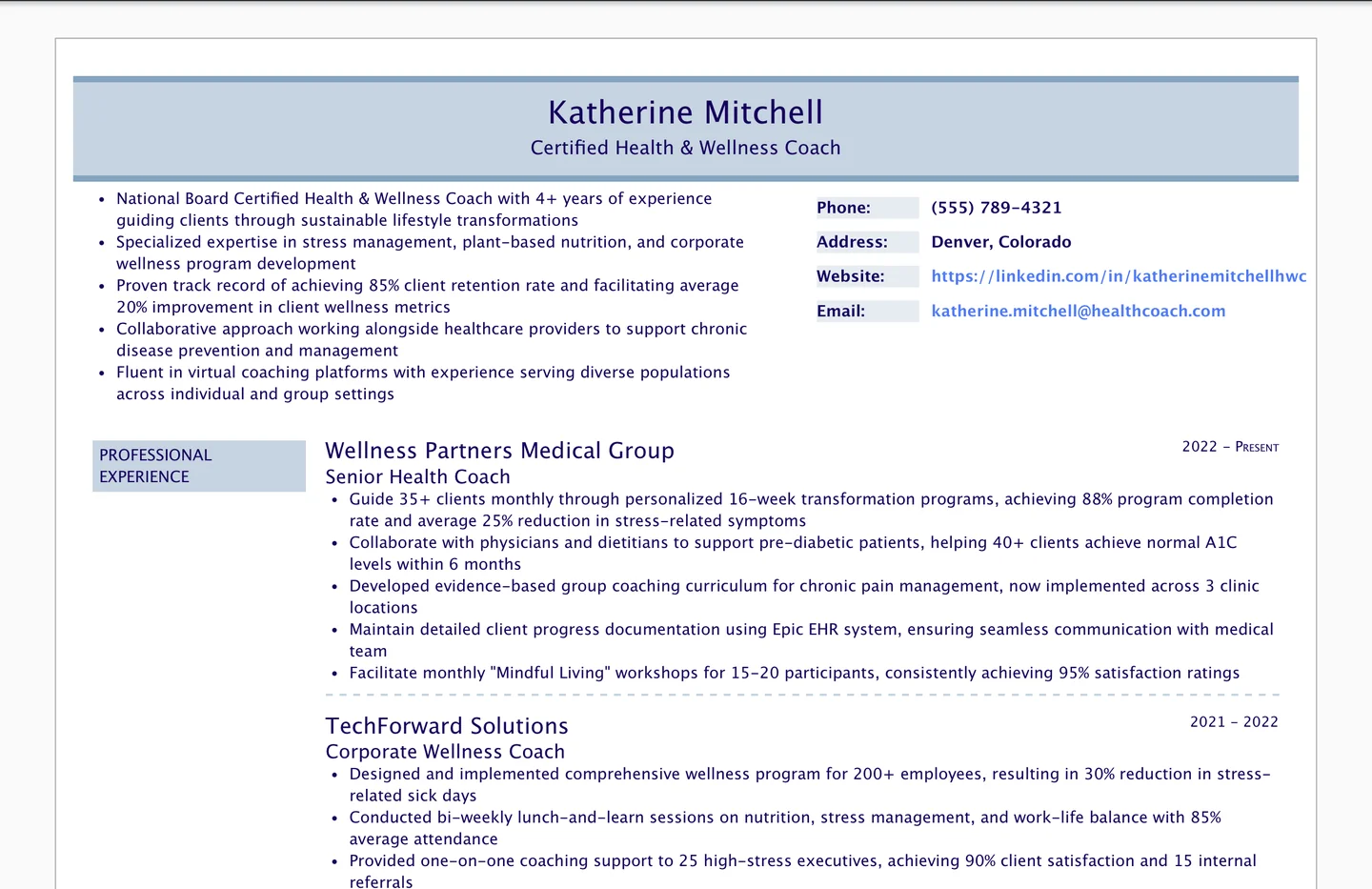
The Best Health Coach Resume Example/Sample
https://www.resumonk.com/health-coachHealth CoachResume Format to Follow for Health Coach Resume
For Health Coaches, the reverse-chronological format stands as your strongest ally.
This format places your most recent experience at the top, cascading down to earlier roles. Why does this matter for you specifically? Because health coaching is a field where your recent certifications, training, and client success stories carry more weight than what you did five years ago. The wellness industry evolves rapidly - that nutrition trend from 2019 might already be outdated, and hiring managers know this.
Structure Your Health Coach Resume Like a Wellness Plan
Think of your resume structure like a client's wellness assessment - you need to present the most vital signs first. Start with a compelling professional summary that immediately communicates your coaching philosophy and specialty areas. Are you focused on weight management? Chronic disease prevention? Corporate wellness programs?
This needs to shine through in those first 3-4 lines.
After your summary, move directly into your professional experience. But here's where Health Coach resumes differ from traditional healthcare roles - you're not just listing clinical duties. You're showcasing transformation stories, client retention rates, and program development skills.
Follow this with your education and certifications section, then skills, and finally any additional relevant sections like volunteer wellness work or speaking engagements.
The Combination Format Alternative
Now, if you're making a career pivot - say from teaching or sales into health coaching - consider a combination format. This hybrid approach lets you lead with a robust skills section that highlights your transferable abilities before diving into your work history. Perhaps you spent years in HR developing employee wellness initiatives, or you were a restaurant manager who implemented healthy menu options.
These stories matter, but they need the right framing.
Remember that Health Coach positions exist across various settings - corporate wellness programs, private practice, fitness centers, healthcare facilities, and virtual platforms. Each setting values slightly different format emphases.
Corporate roles lean toward traditional reverse-chronological formats, while entrepreneurial or private practice positions might appreciate a more creative combination approach that highlights your unique methodology.
Work Experience on Health Coach Resume
Your work experience section is where the rubber meets the road - or perhaps more aptly, where the quinoa meets the bowl. As a Health Coach, you're not performing surgeries or prescribing medications.
You're facilitating behavior change, and that's a nuanced skill that requires careful articulation on your resume.
Quantifying the Intangible Impact
The challenge many Health Coaches face is translating soft skills into hard metrics.
You know you've changed lives, but how do you convey that to a hiring manager scanning dozens of resumes? The answer lies in strategic quantification and outcome-focused descriptions.
Instead of listing duties, focus on achievements and transformations. Every bullet point should tell a mini success story. Consider the difference between these approaches:
❌ Don't write vague responsibility statements:
• Conducted health coaching sessions with clients
• Created wellness plans
• Provided nutritional guidance
✅ Do write specific, outcome-driven achievements:
• Guided 45+ clients through personalized 12-week transformation programs, achieving
 an average 15% reduction in reported stress levels and 82% program completion rate
• Developed comprehensive wellness protocols that increased client retention by 30%
 over 6 months
• Implemented evidence-based nutritional strategies helping 25 pre-diabetic clients
 achieve normal A1C levels within 90 days
Highlighting Different Types of Coaching Experience
Your experience might span various formats - one-on-one coaching, group sessions, corporate workshops, or virtual consultations. Each deserves its own strategic presentation. For individual coaching roles, emphasize personalization and long-term client relationships.
For group or corporate settings, highlight your ability to scale impact and manage diverse wellness needs simultaneously.
If you've worked in clinical settings alongside healthcare providers, emphasize your collaborative skills and understanding of medical terminology. If your background is in fitness or yoga instruction, showcase how you've integrated movement coaching with broader lifestyle modifications. The key is showing progression and expanding scope of practice over time.
Addressing Career Transitions
Many Health Coaches come from adjacent fields - nursing, psychology, fitness, nutrition, or even completely unrelated industries.
When listing non-coaching roles, extract the relevant threads. That retail management position? You developed customer service excellence and learned to read people's unspoken needs. Your teaching background?
You mastered the art of breaking down complex concepts into digestible action steps.
Skills to Show on Health Coach Resume
The skills section of a Health Coach resume is like a well-stocked supplement shelf - you need the right combination of essentials and specialties.
But unlike supplements, more isn't always better. Strategic selection based on your target role makes all the difference.
Core Coaching Competencies
Start with the foundational skills every Health Coach needs. These include motivational interviewing, behavior change techniques, active listening, and goal-setting strategies. But don't just list them like ingredients on a label. Group them logically and consider the specific terminology your target employer uses. A hospital system might look for "patient education" while a corporate wellness company seeks "employee engagement strategies."
Your technical skills matter too. Today's Health Coaches need to be comfortable with various platforms and tools. Include your proficiency with:
❌ Don't use generic tech descriptions:
• Computer skills
• Social media
• Online coaching
✅ Do specify relevant platforms and purposes:
• Virtual coaching platforms (Zoom, Practice Better, Healthie)
• Client tracking systems and EHR software
• Content creation tools for educational materials
• Wellness app integration (MyFitnessPal, Fitbit dashboard)
Specialized Knowledge Areas
Your unique knowledge base sets you apart from other Health Coaches.
Maybe you've developed expertise in gut health, hormone balance, or plant-based nutrition. Perhaps you're trained in specific methodologies like Functional Medicine coaching or Ayurvedic principles. These specializations should feature prominently, especially if they align with your target employer's focus.
Consider the setting you're targeting. Healthcare facilities value coaches who understand medical terminology and can work within clinical guidelines. Wellness centers might prioritize holistic modalities and mind-body approaches.
Corporate settings often seek coaches skilled in stress management, productivity optimization, and workplace wellness program design.
Soft Skills That Sell
While every resume claims "excellent communication skills," Health Coaches need to be more specific. Cultural sensitivity becomes crucial when discussing dietary changes with diverse populations. Empathy without enabling requires professional boundaries.
The ability to maintain client confidentiality while collaborating with healthcare teams demands diplomatic communication.
Remember to include business-related skills if you've managed your own practice or hope to. Budget management, marketing, program development, and partnership building are valuable additions that show you understand the business side of wellness.
Specific Considerations and Tips for Health Coach Resume
Here's something most Health Coach resume guides won't tell you - the wellness industry has trust issues.
With countless "coaches" emerging from weekend certifications and Instagram influencer culture, legitimate Health Coaches must work harder to establish credibility. Your resume needs to radiate professionalism while maintaining the warmth and approachability essential to coaching success.
Certification Hierarchy and Presentation
Not all health coaching certifications carry equal weight, and how you present them matters immensely. Lead with your most prestigious or relevant certification. If you're certified by the National Board for Health and Wellness Coaching (NBHWC), that goes first - it's the gold standard that many employers specifically seek.
Follow with specialized training that supports your niche.
But here's the nuance - avoid certification overload. That collection of 15 online course completions might actually dilute your credibility.
Choose quality over quantity:
❌ Don't list every workshop you've ever attended:
Certifications:
• Health Coach Certificate (Weekend Workshop)
• Nutrition Basics Online Course (8 hours)
• Wellness Coaching Fundamentals
• 25+ various health and wellness courses
✅ Do prioritize recognized, substantial certifications:
Certifications:
• National Board Certified Health & Wellness Coach (NBC-HWC), 2023
• Institute for Integrative Nutrition Health Coach Certification, 2022
• Motivational Interviewing for Healthcare Professionals, MINT Certified, 2023
Navigating Scope of Practice on Your Resume
This is critical - Health Coaches must carefully navigate scope of practice boundaries, and your resume should reflect this understanding. Never imply you diagnose, treat, or prescribe. Instead, use appropriate terminology like "guided," "supported," "educated," and "empowered."
This isn't just semantic gymnastics - it demonstrates professional awareness that employers value and regulatory bodies require.
For different regions, understand the variations. In the United States, Health Coaches in clinical settings often work under different titles and restrictions than those in private practice. Canadian Health Coaches might emphasize their alignment with provincial health initiatives. UK-based coaches often highlight their understanding of NHS prevention strategies.
Australian Health Coaches frequently reference their work within the chronic disease management framework.
The Portfolio Question
Unlike designers or writers, Health Coaches can't exactly showcase client transformations in a traditional portfolio due to confidentiality.
However, you can create supporting materials that demonstrate your expertise. Consider mentioning (either on your resume or in a linked professional website) anonymous case studies, published articles, workshop curricula you've developed, or testimonials with permission.
These additions prove you're not just certified - you're actively practicing and succeeding.
Remote Coaching Readiness
The pandemic transformed health coaching, and remote capabilities are now often required rather than optional. If you've successfully transitioned clients to virtual coaching, maintained engagement through digital platforms, or developed online group programs, these achievements deserve prominent placement.
Show you're not just comfortable with technology but that you've leveraged it to enhance client outcomes.
Finally, remember that Health Coach positions often involve multiple stakeholders. You might report to a clinical director while collaborating with physicians, working alongside dietitians, and serving clients directly. Your resume should reflect this 360-degree professional capability. Use examples that show you can speak the language of healthcare administrators in the morning and connect with struggling clients in the afternoon - because that's exactly what the job demands.
Education Requirements and Listing Tips for Health Coach Resume
Health Coaching sits at a unique intersection - it's not quite medical, not purely fitness, but something wonderfully holistic.
Unlike registered dietitians or licensed therapists, Health Coaches work as supportive mentors, helping clients create sustainable lifestyle changes. This means your education section needs to showcase not just what you learned, but how diverse your learning journey has been.
Essential Certifications to Highlight
The backbone of your education section should be your health coaching certification.
The industry recognizes several major players - the Institute for Integrative Nutrition (IIN), National Board for Health & Wellness Coaching (NBHWC), ACE Health Coach Certification, and AFPA. These aren't just letters after your name; they're your professional foundation.
When listing your certification, don't just state it exists. Show its relevance:
❌ Don't write vaguely:
Certified Health Coach - 2023
Institute for Integrative Nutrition
✅ Do write with specificity:
Certified Integrative Health Coach - Institute for Integrative Nutrition (2023)
• 12-month program covering 100+ dietary theories and coaching techniques
• Specialized modules: Gut Health, Emotional Eating, Business Development
• Completed 6 practice clients with documented success stories
Structuring Your Educational Background
Here's where it gets interesting. Many successful Health Coaches come from diverse backgrounds - nursing, corporate wellness, fitness training, or even completely unrelated fields like marketing or teaching. Your traditional degree might seem disconnected, but it's actually your secret weapon. That psychology degree? Perfect for behavior change coaching. That business background?
Invaluable for helping clients set actionable goals.
List your education in reverse-chronological order, but connect the dots for employers. If you have a Bachelor's in Communications, for instance, highlight relevant coursework or projects that relate to health coaching:
Bachelor of Arts in Communications - State University (2019)
• Relevant Coursework: Interpersonal Communication, Psychology of Persuasion
• Senior Thesis: "Digital Wellness: Communicating Health in the Social Media Age"
• Dean's List: 3 semesters
Continuing Education and Specialized Training
The wellness industry evolves faster than a HIIT workout, and your education section should reflect your commitment to staying current. Weekend workshops, online micro-credentials, specialty certifications - these all matter. Think about what your ideal clients struggle with most. Are they busy professionals? Maybe that stress management certification deserves top billing. Working with new moms?
That prenatal nutrition course becomes crucial.
Create a subsection for ongoing education that shows you're not just certified, but constantly curious:
Additional Training & Certifications:
• Plant-Based Nutrition Certificate - Cornell University Online (2024)
• Motivational Interviewing for Health Professionals - 16-hour intensive (2023)
• Trauma-Informed Coaching Practices - Wellness Institute (2023)
• First Aid/CPR Certified - American Red Cross (Current through 2025)
Remember, in the UK and Australia, you might encounter different certification bodies like the UK Health Coaches Association or the Health Coaches Australia Association. In Canada, the Canadian School of Natural Nutrition holds significant weight. Tailor your education section to reflect the standards recognized in your target market.
Showcasing Awards and Publications on Your Health Coach Resume
The health coaching industry is still relatively young compared to traditional healthcare roles, which means awards and publications work differently here. You're not competing for the Nobel Prize in Medicine, but you might have won your gym's "Transformation Coach of the Year" or been featured in a local wellness magazine.
These matter more than you think.
Types of Awards That Resonate
Health coaching awards come in various flavors, and each tells a different story about your capabilities.
Professional recognition from your certification body shows you excel among peers. Client success awards demonstrate real-world impact. Community wellness awards highlight your broader influence beyond one-on-one coaching.
When listing awards, context is everything. Don't assume the reader knows what "IIN Honor Graduate" means:
❌ Don't list awards without context:
Awards:
• Top Graduate Award - 2023
• Excellence in Coaching
• Best Wellness Blog
✅ Do provide meaningful details:
Professional Recognition:
• IIN Honor Graduate Award (2023) - Top 5% of 1,200 graduates
 Recognized for exceptional client case studies and peer coaching feedback
• Community Wellness Champion - City Health Department (2024)
 Led free monthly workshops reaching 500+ underserved community members
• "Rising Star Health Coach" - National Wellness Association (2023)
 Selected from 200+ nominees for innovative group coaching programs
Publications That Build Credibility
Now, about publications - you don't need to be published in peer-reviewed journals to have valuable writing credentials.
That blog post about meal prepping that went viral? That counts. Your monthly newsletter with 500 engaged subscribers? Absolutely relevant. The key is presenting these accomplishments in a way that demonstrates your expertise and reach.
Think about publications broadly. Maybe you've contributed recipes to a local hospital's diabetes education program, or written guest posts for wellness websites. Perhaps you've created downloadable guides that hundreds of people have used. These are all publications that matter:
Publications & Content Creation:
• "5-Day Reset: A Beginner's Guide to Whole Food Eating" - Self-published guide
 Downloaded 1,000+ times, featured in Wellness Today newsletter
• Contributing Writer - HealthyLiving.com (2023-present)
 Monthly articles on habit formation and nutritional psychology
 Average readership: 5,000 per article
• Co-author: "Corporate Wellness Playbook" - ABC Company internal publication
 Developed 12-week employee wellness program adopted company-wide
When You Don't Have Traditional Awards or Publications
Here's a secret - most new Health Coaches don't have a trophy shelf or a bibliography, and that's perfectly fine. What you might have instead are transformative client testimonials, successful program completions, or community impact metrics. If you helped 20 clients collectively lose 300 pounds, that's an achievement worth highlighting.
If your workplace wellness lunch-and-learn series had perfect attendance for six months straight, that's publication-worthy impact.
Create your own category that reflects your unique contributions:
Program Development & Impact:
• Created "Mindful Eating Mondays" program - Local Community Center
 12-week curriculum now used by 5 centers citywide
• Developed accountability system achieving 85% client goal completion rate
 Compared to industry average of 60%
For those in Australia and the UK, consider including recognition from bodies like Complementary Medicine Australia or the Complementary and Natural Healthcare Council. These regional validations carry weight in their respective markets.
Strategic Reference Selection for Your Health Coach Resume
The health coaching world operates on trust and transformation, which means your references carry more weight than in many other fields. A glowing reference from a client whose life you changed can be more powerful than one from a CEO who barely knew your name.
The key is knowing who to ask, how to prepare them, and when to present them.
Choosing Your Reference Portfolio
Think of your references like a coaching program - you need variety to address different aspects of wellness. Your ideal reference list includes someone who can speak to your coaching skills, someone who's experienced your expertise firsthand, and someone who knows your professional development journey.
For health coaches, this might look like a certification program instructor who saw you excel, a healthcare provider you've collaborated with, and yes, potentially a former client who experienced significant transformation. The key is ensuring each reference tells a different part of your story:
Professional References:

1. Dr. Jennifer Chen, MD - Integrative Medicine Physician
Collaborative Wellness Center
[email protected] | (555) 234-5678
Relationship: Collaborated on patient wellness plans for 2 years

2. Michael Torres - Director, Corporate Wellness
TechForward Company
[email protected] | (555) 345-6789
Relationship: Supervised my employee wellness program development

3. Sandra Williams - Former Client turned Wellness Advocate
[email protected] | (555) 456-7890
Relationship: Coached through 50-pound weight loss and lifestyle transformation
Preparing Your References for Success
Here's what many Health Coaches don't realize - your references want to help you, but they might not know how to articulate what makes you special in this field. They need guidance.
When you ask someone to be a reference, provide them with context about the role and what aspects of your work together are most relevant.
Create a brief "reference prep sheet" for each person. This isn't cheating; it's being professional and respectful of their time:
❌ Don't send vague requests:
"Hi Dr. Chen, Can you be a reference for me? Thanks!"
✅ Do provide helpful context:
"Dr. Chen, I'm applying for a Health Coach role with a cardiac rehabilitation
program. They're particularly interested in coaches who can work collaboratively
with medical teams. Could you speak to our work together on the diabetes
prevention program, especially how I translated medical recommendations into
actionable lifestyle changes for patients?"
Navigating Client References Professionally
Using clients as references requires extra finesse. You've held space for their vulnerabilities, celebrated their victories, and maintained professional boundaries.
Asking them to be a reference can feel awkward, but when done right, it's actually empowering for them - they get to pay forward the transformation they've experienced.
Choose clients who've completed their program, achieved sustainable results, and expressed gratitude for your support. Always maintain confidentiality about their health details in your resume, but let them share their story freely if contacted:
Note: Client reference available with signed consent form
Can speak to: Coaching methodology, communication style, program customization
Cannot disclose: Specific health conditions or medical information
International and Industry-Specific Considerations
Different regions have different reference expectations.
In the United States, three references are standard, and they're usually provided upon request. In the UK, two references suffice, typically including your current or most recent employer. Australia often expects written reference letters upfront. Canada falls somewhere in between, with references provided after initial screening.
For health coaching specifically, consider including a reference from someone in a complementary field - a yoga instructor you've partnered with, a mental health counselor you've coordinated care with, or a fitness professional you've collaborated with. This shows your ability to work within the broader wellness ecosystem.
If you're new to health coaching but have relevant experience, your references should bridge that gap. A former colleague who can speak to your natural coaching ability in team settings, a supervisor who witnessed your health transformation journey, or a community leader who's seen you organize wellness initiatives - these references can validate your career transition.
References Available Upon Request
- Includes healthcare collaborators, program supervisors, and client testimonials
- Written recommendations and LinkedIn endorsements available for review
Remember, in health coaching, your references aren't just confirming employment dates - they're validating your ability to facilitate transformation. Choose and prepare them accordingly, and they become powerful advocates for your next opportunity to change lives.
Writing a Compelling Cover Letter for Your Health Coach Resume
The traditional cover letter advice says "be professional, be concise, be formal." But health coaching isn't traditional healthcare. You're applying to be someone who meets clients where they are, who speaks their language, who makes wellness accessible.
Your cover letter should reflect that same approachable expertise.
Opening with Authentic Connection
Skip the "I am writing to apply for the position of Health Coach" opener. Everyone writes that. Instead, start with why this specific role, at this specific organization, calls to you. Maybe their corporate wellness program aligns with your belief that workplace health drives community health.
Maybe their focus on preventive care matches your philosophy perfectly.
❌ Don't open generically:
Dear Hiring Manager,

I am excited to apply for the Health Coach position at your company.
I am a certified Health Coach with experience in wellness coaching.
✅ Do open with specific connection:
Dear Sarah Martinez,

When I read that Wellness Works prioritizes culturally responsive coaching for diverse communities, I immediately thought of Maria - my first client who taught me that wellness looks different in every family's kitchen. Your mission to make health coaching accessible regardless of background aligns perfectly with why I
transitioned from teaching to health coaching three years ago.
Storytelling Your Qualifications
Here's where health coaching cover letters get interesting.
You're not performing surgery or prescribing medication. You're facilitating transformation, and that requires a different kind of proof. Share a brief client success story (maintaining confidentiality, of course). Describe a program you developed. Explain how your unique background - maybe you were a chef, a personal trainer, or a stressed-out executive - gives you insights other coaches might miss.
Your middle paragraph shouldn't read like a resume recap. It should paint a picture of you in action:
In my current role at Community Health Partners, I've discovered that the most powerful tool isn't my nutrition knowledge - it's my ability to help clients find their own "why." Last month, a client who'd tried every diet finally succeeded when we stopped talking about calories and started talking about having energy to play with her grandchildren. This approach has helped me maintain an 80%
client retention rate and generate 15 referrals in the past quarter alone.
Addressing the Elephant in the Room
Maybe you're new to health coaching. Maybe you're switching from a completely different industry. Maybe you're applying in a new country with different wellness approaches. Address these potential concerns head-on, but frame them as strengths. Your corporate background means you understand stressed executives.
Your recent certification means you bring fresh perspectives and updated knowledge.
If you're new to the field, focus on transferable skills and relevant life experience:
While I recently completed my Health Coach certification, my decade in human resources taught me to recognize burnout before it happens and create sustainable support systems. I've already applied these skills with six practice clients, helping busy professionals integrate wellness into their existing routines rather than adding another task to their overwhelming to-do lists.
The Close That Compels Action
Your closing paragraph should do more than request an interview.
It should give them a glimpse of what you'd bring to their team. Mention a specific program you'd love to develop, a population you're passionate about serving, or a metric you'd be excited to improve.
I'm particularly excited about your upcoming expansion into virtual coaching for rural communities. Having grown up in a small town where the nearest nutritionist was two hours away, I understand the unique challenges and opportunities of remote wellness support. I'd love to discuss how my experience with online group coaching and digital community building could support this initiative.
For positions in Canada, consider mentioning familiarity with provincial health initiatives. UK applications benefit from understanding NHS prevention programs. Australian roles often value understanding of Aboriginal and Torres Strait Islander health perspectives.
These regional touches show you've done your homework.
Key Takeaways
After diving deep into the nuances of crafting your Health Coach resume, let's distill everything into actionable takeaways you can implement immediately:
- Choose the reverse-chronological format for most health coaching positions, as it highlights your recent certifications and relevant experience - but consider a combination format if you're transitioning from another field and need to emphasize transferable skills first
- Transform vague duties into quantified achievements by focusing on client outcomes, retention rates, and program success metrics rather than just listing coaching responsibilities
- Lead with your most prestigious certification (especially NBHWC if you have it) and avoid overwhelming readers with every weekend workshop - quality trumps quantity in establishing credibility
- Respect scope of practice boundaries in your language, using terms like "guided," "supported," and "educated" rather than anything that implies diagnosing or prescribing
- Strategically group your skills into core coaching competencies, specialized knowledge areas, and technical proficiencies - avoiding generic lists in favor of specific, relevant capabilities
- Connect your educational background to coaching, even if your degree seems unrelated - that psychology major or business background has valuable applications in health coaching
- Include non-traditional publications and awards like successful client testimonials, community wellness recognitions, or that viral blog post about meal prep - these build trust in a field where credibility matters
- Craft a cover letter that tells a story rather than repeating your resume, opening with authentic connection to the organization and sharing brief transformation stories that showcase your coaching approach
- Select diverse references who can speak to different aspects of your coaching ability - from healthcare collaborators to transformed clients (with appropriate consent and confidentiality measures)
- Highlight virtual coaching capabilities and technological proficiency, as remote wellness support has become essential rather than optional in today's health coaching landscape
Creating your Health Coach resume on Resumonk transforms this entire process from overwhelming to empowering. Our platform understands the unique needs of wellness professionals like you - from showcasing client transformations within privacy boundaries to highlighting diverse certifications in a clean, professional format. With AI-powered suggestions tailored specifically to health coaching roles, you'll find the right words to articulate that delicate balance between scientific knowledge and compassionate support. Our templates are designed to let your expertise shine through while maintaining the approachable professionalism that makes great Health Coaches stand out.
Ready to create a Health Coach resume that captures both your expertise and your passion for transformation?
Start building your professional story with Resumonk's intelligent resume builder, designed specifically for wellness professionals like you.
Choose your template and begin crafting your standout Health Coach resume today →
More Healthcare Support resume examples
- Phlebotomist resume example
- Medical Assistant resume example
- Caregiver resume example
- Radiology Technician resume example
See all Healthcare Support resume examples, or browse every category.
Resume writing tips
Envision this moment - you've just spent the last hour scrolling through health coach job postings, each one asking for that perfect blend of wellness expertise, coaching credentials, and that special something that says "I can actually help people change their lives."
Maybe you're transitioning from nursing, where you've watched patients struggle with the same lifestyle issues visit after visit. Or perhaps you're that personal trainer whose clients keep asking for nutrition and stress management advice that goes beyond the gym floor. You might even be pivoting from corporate life, where you became the unofficial wellness guru after your own health transformation inspired half the office to start packing salads for lunch.
The path to becoming a Health Coach rarely follows a straight line, and that's exactly what makes this field so beautifully complex. Unlike traditional healthcare roles with rigid educational pathways, health coaching welcomes diverse backgrounds - from psychology graduates who understand behavior change to former teachers who know how to break down complex information into actionable steps. But this diversity also creates a unique challenge - how do you craft a resume that captures your unique journey while meeting the professional standards of an evolving industry?
You're not just looking for any health coach resume template. You need something that speaks to the reality of this profession - one foot in the wellness world, the other in healthcare, with your arms stretched wide enough to embrace everything from corporate wellness programs to one-on-one transformation journeys. Your resume needs to convey scientific credibility without losing the human touch that makes great coaches truly transformative.
In this comprehensive guide, we'll walk you through every element of crafting a standout Health Coach resume. We'll start with choosing the right format that showcases your journey effectively, then dive deep into presenting your work experience in ways that highlight transformation over tasks. You'll learn how to strategically list your certifications and education to build immediate credibility, position your diverse skills for maximum impact, and navigate the unique considerations of health coaching - from scope of practice awareness to the delicate balance of professional and approachable. We'll explore how to leverage awards and publications you might not even realize you have, craft a cover letter that creates instant connection, and select references who can speak to your ability to facilitate real change. By the end, you'll have everything you need to create a resume that doesn't just list your qualifications - it tells the story of a professional ready to guide others toward their healthiest, most vibrant lives.
The Best Health Coach Resume Example/Sample
https://www.resumonk.com/health-coachHealth CoachResume Format to Follow for Health Coach Resume
For Health Coaches, the reverse-chronological format stands as your strongest ally.
This format places your most recent experience at the top, cascading down to earlier roles. Why does this matter for you specifically? Because health coaching is a field where your recent certifications, training, and client success stories carry more weight than what you did five years ago. The wellness industry evolves rapidly - that nutrition trend from 2019 might already be outdated, and hiring managers know this.
Structure Your Health Coach Resume Like a Wellness Plan
Think of your resume structure like a client's wellness assessment - you need to present the most vital signs first. Start with a compelling professional summary that immediately communicates your coaching philosophy and specialty areas. Are you focused on weight management? Chronic disease prevention? Corporate wellness programs?
This needs to shine through in those first 3-4 lines.
After your summary, move directly into your professional experience. But here's where Health Coach resumes differ from traditional healthcare roles - you're not just listing clinical duties. You're showcasing transformation stories, client retention rates, and program development skills.
Follow this with your education and certifications section, then skills, and finally any additional relevant sections like volunteer wellness work or speaking engagements.
The Combination Format Alternative
Now, if you're making a career pivot - say from teaching or sales into health coaching - consider a combination format. This hybrid approach lets you lead with a robust skills section that highlights your transferable abilities before diving into your work history. Perhaps you spent years in HR developing employee wellness initiatives, or you were a restaurant manager who implemented healthy menu options.
These stories matter, but they need the right framing.
Remember that Health Coach positions exist across various settings - corporate wellness programs, private practice, fitness centers, healthcare facilities, and virtual platforms. Each setting values slightly different format emphases.
Corporate roles lean toward traditional reverse-chronological formats, while entrepreneurial or private practice positions might appreciate a more creative combination approach that highlights your unique methodology.
Work Experience on Health Coach Resume
Your work experience section is where the rubber meets the road - or perhaps more aptly, where the quinoa meets the bowl. As a Health Coach, you're not performing surgeries or prescribing medications.
You're facilitating behavior change, and that's a nuanced skill that requires careful articulation on your resume.
Quantifying the Intangible Impact
The challenge many Health Coaches face is translating soft skills into hard metrics.
You know you've changed lives, but how do you convey that to a hiring manager scanning dozens of resumes? The answer lies in strategic quantification and outcome-focused descriptions.
Instead of listing duties, focus on achievements and transformations. Every bullet point should tell a mini success story. Consider the difference between these approaches:
❌ Don't write vague responsibility statements:
• Conducted health coaching sessions with clients
• Created wellness plans
• Provided nutritional guidance
✅ Do write specific, outcome-driven achievements:
• Guided 45+ clients through personalized 12-week transformation programs, achieving
 an average 15% reduction in reported stress levels and 82% program completion rate
• Developed comprehensive wellness protocols that increased client retention by 30%
 over 6 months
• Implemented evidence-based nutritional strategies helping 25 pre-diabetic clients
 achieve normal A1C levels within 90 days
Highlighting Different Types of Coaching Experience
Your experience might span various formats - one-on-one coaching, group sessions, corporate workshops, or virtual consultations. Each deserves its own strategic presentation. For individual coaching roles, emphasize personalization and long-term client relationships.
For group or corporate settings, highlight your ability to scale impact and manage diverse wellness needs simultaneously.
If you've worked in clinical settings alongside healthcare providers, emphasize your collaborative skills and understanding of medical terminology. If your background is in fitness or yoga instruction, showcase how you've integrated movement coaching with broader lifestyle modifications. The key is showing progression and expanding scope of practice over time.
Addressing Career Transitions
Many Health Coaches come from adjacent fields - nursing, psychology, fitness, nutrition, or even completely unrelated industries.
When listing non-coaching roles, extract the relevant threads. That retail management position? You developed customer service excellence and learned to read people's unspoken needs. Your teaching background?
You mastered the art of breaking down complex concepts into digestible action steps.
Skills to Show on Health Coach Resume
The skills section of a Health Coach resume is like a well-stocked supplement shelf - you need the right combination of essentials and specialties.
But unlike supplements, more isn't always better. Strategic selection based on your target role makes all the difference.
Core Coaching Competencies
Start with the foundational skills every Health Coach needs. These include motivational interviewing, behavior change techniques, active listening, and goal-setting strategies. But don't just list them like ingredients on a label. Group them logically and consider the specific terminology your target employer uses. A hospital system might look for "patient education" while a corporate wellness company seeks "employee engagement strategies."
Your technical skills matter too. Today's Health Coaches need to be comfortable with various platforms and tools. Include your proficiency with:
❌ Don't use generic tech descriptions:
• Computer skills
• Social media
• Online coaching
✅ Do specify relevant platforms and purposes:
• Virtual coaching platforms (Zoom, Practice Better, Healthie)
• Client tracking systems and EHR software
• Content creation tools for educational materials
• Wellness app integration (MyFitnessPal, Fitbit dashboard)
Specialized Knowledge Areas
Your unique knowledge base sets you apart from other Health Coaches.
Maybe you've developed expertise in gut health, hormone balance, or plant-based nutrition. Perhaps you're trained in specific methodologies like Functional Medicine coaching or Ayurvedic principles. These specializations should feature prominently, especially if they align with your target employer's focus.
Consider the setting you're targeting. Healthcare facilities value coaches who understand medical terminology and can work within clinical guidelines. Wellness centers might prioritize holistic modalities and mind-body approaches.
Corporate settings often seek coaches skilled in stress management, productivity optimization, and workplace wellness program design.
Soft Skills That Sell
While every resume claims "excellent communication skills," Health Coaches need to be more specific. Cultural sensitivity becomes crucial when discussing dietary changes with diverse populations. Empathy without enabling requires professional boundaries.
The ability to maintain client confidentiality while collaborating with healthcare teams demands diplomatic communication.
Remember to include business-related skills if you've managed your own practice or hope to. Budget management, marketing, program development, and partnership building are valuable additions that show you understand the business side of wellness.
Specific Considerations and Tips for Health Coach Resume
Here's something most Health Coach resume guides won't tell you - the wellness industry has trust issues.
With countless "coaches" emerging from weekend certifications and Instagram influencer culture, legitimate Health Coaches must work harder to establish credibility. Your resume needs to radiate professionalism while maintaining the warmth and approachability essential to coaching success.
Certification Hierarchy and Presentation
Not all health coaching certifications carry equal weight, and how you present them matters immensely. Lead with your most prestigious or relevant certification. If you're certified by the National Board for Health and Wellness Coaching (NBHWC), that goes first - it's the gold standard that many employers specifically seek.
Follow with specialized training that supports your niche.
But here's the nuance - avoid certification overload. That collection of 15 online course completions might actually dilute your credibility.
Choose quality over quantity:
❌ Don't list every workshop you've ever attended:
Certifications:
• Health Coach Certificate (Weekend Workshop)
• Nutrition Basics Online Course (8 hours)
• Wellness Coaching Fundamentals
• 25+ various health and wellness courses
✅ Do prioritize recognized, substantial certifications:
Certifications:
• National Board Certified Health & Wellness Coach (NBC-HWC), 2023
• Institute for Integrative Nutrition Health Coach Certification, 2022
• Motivational Interviewing for Healthcare Professionals, MINT Certified, 2023
Navigating Scope of Practice on Your Resume
This is critical - Health Coaches must carefully navigate scope of practice boundaries, and your resume should reflect this understanding. Never imply you diagnose, treat, or prescribe. Instead, use appropriate terminology like "guided," "supported," "educated," and "empowered."
This isn't just semantic gymnastics - it demonstrates professional awareness that employers value and regulatory bodies require.
For different regions, understand the variations. In the United States, Health Coaches in clinical settings often work under different titles and restrictions than those in private practice. Canadian Health Coaches might emphasize their alignment with provincial health initiatives. UK-based coaches often highlight their understanding of NHS prevention strategies.
Australian Health Coaches frequently reference their work within the chronic disease management framework.
The Portfolio Question
Unlike designers or writers, Health Coaches can't exactly showcase client transformations in a traditional portfolio due to confidentiality.
However, you can create supporting materials that demonstrate your expertise. Consider mentioning (either on your resume or in a linked professional website) anonymous case studies, published articles, workshop curricula you've developed, or testimonials with permission.
These additions prove you're not just certified - you're actively practicing and succeeding.
Remote Coaching Readiness
The pandemic transformed health coaching, and remote capabilities are now often required rather than optional. If you've successfully transitioned clients to virtual coaching, maintained engagement through digital platforms, or developed online group programs, these achievements deserve prominent placement.
Show you're not just comfortable with technology but that you've leveraged it to enhance client outcomes.
Finally, remember that Health Coach positions often involve multiple stakeholders. You might report to a clinical director while collaborating with physicians, working alongside dietitians, and serving clients directly. Your resume should reflect this 360-degree professional capability. Use examples that show you can speak the language of healthcare administrators in the morning and connect with struggling clients in the afternoon - because that's exactly what the job demands.
Education Requirements and Listing Tips for Health Coach Resume
Health Coaching sits at a unique intersection - it's not quite medical, not purely fitness, but something wonderfully holistic.
Unlike registered dietitians or licensed therapists, Health Coaches work as supportive mentors, helping clients create sustainable lifestyle changes. This means your education section needs to showcase not just what you learned, but how diverse your learning journey has been.
Essential Certifications to Highlight
The backbone of your education section should be your health coaching certification.
The industry recognizes several major players - the Institute for Integrative Nutrition (IIN), National Board for Health & Wellness Coaching (NBHWC), ACE Health Coach Certification, and AFPA. These aren't just letters after your name; they're your professional foundation.
When listing your certification, don't just state it exists. Show its relevance:
❌ Don't write vaguely:
Certified Health Coach - 2023
Institute for Integrative Nutrition
✅ Do write with specificity:
Certified Integrative Health Coach - Institute for Integrative Nutrition (2023)
• 12-month program covering 100+ dietary theories and coaching techniques
• Specialized modules: Gut Health, Emotional Eating, Business Development
• Completed 6 practice clients with documented success stories
Structuring Your Educational Background
Here's where it gets interesting. Many successful Health Coaches come from diverse backgrounds - nursing, corporate wellness, fitness training, or even completely unrelated fields like marketing or teaching. Your traditional degree might seem disconnected, but it's actually your secret weapon. That psychology degree? Perfect for behavior change coaching. That business background?
Invaluable for helping clients set actionable goals.
List your education in reverse-chronological order, but connect the dots for employers. If you have a Bachelor's in Communications, for instance, highlight relevant coursework or projects that relate to health coaching:
Bachelor of Arts in Communications - State University (2019)
• Relevant Coursework: Interpersonal Communication, Psychology of Persuasion
• Senior Thesis: "Digital Wellness: Communicating Health in the Social Media Age"
• Dean's List: 3 semesters
Continuing Education and Specialized Training
The wellness industry evolves faster than a HIIT workout, and your education section should reflect your commitment to staying current. Weekend workshops, online micro-credentials, specialty certifications - these all matter. Think about what your ideal clients struggle with most. Are they busy professionals? Maybe that stress management certification deserves top billing. Working with new moms?
That prenatal nutrition course becomes crucial.
Create a subsection for ongoing education that shows you're not just certified, but constantly curious:
Additional Training & Certifications:
• Plant-Based Nutrition Certificate - Cornell University Online (2024)
• Motivational Interviewing for Health Professionals - 16-hour intensive (2023)
• Trauma-Informed Coaching Practices - Wellness Institute (2023)
• First Aid/CPR Certified - American Red Cross (Current through 2025)
Remember, in the UK and Australia, you might encounter different certification bodies like the UK Health Coaches Association or the Health Coaches Australia Association. In Canada, the Canadian School of Natural Nutrition holds significant weight. Tailor your education section to reflect the standards recognized in your target market.
Showcasing Awards and Publications on Your Health Coach Resume
The health coaching industry is still relatively young compared to traditional healthcare roles, which means awards and publications work differently here. You're not competing for the Nobel Prize in Medicine, but you might have won your gym's "Transformation Coach of the Year" or been featured in a local wellness magazine.
These matter more than you think.
Types of Awards That Resonate
Health coaching awards come in various flavors, and each tells a different story about your capabilities.
Professional recognition from your certification body shows you excel among peers. Client success awards demonstrate real-world impact. Community wellness awards highlight your broader influence beyond one-on-one coaching.
When listing awards, context is everything. Don't assume the reader knows what "IIN Honor Graduate" means:
❌ Don't list awards without context:
Awards:
• Top Graduate Award - 2023
• Excellence in Coaching
• Best Wellness Blog
✅ Do provide meaningful details:
Professional Recognition:
• IIN Honor Graduate Award (2023) - Top 5% of 1,200 graduates
 Recognized for exceptional client case studies and peer coaching feedback
• Community Wellness Champion - City Health Department (2024)
 Led free monthly workshops reaching 500+ underserved community members
• "Rising Star Health Coach" - National Wellness Association (2023)
 Selected from 200+ nominees for innovative group coaching programs
Publications That Build Credibility
Now, about publications - you don't need to be published in peer-reviewed journals to have valuable writing credentials.
That blog post about meal prepping that went viral? That counts. Your monthly newsletter with 500 engaged subscribers? Absolutely relevant. The key is presenting these accomplishments in a way that demonstrates your expertise and reach.
Think about publications broadly. Maybe you've contributed recipes to a local hospital's diabetes education program, or written guest posts for wellness websites. Perhaps you've created downloadable guides that hundreds of people have used. These are all publications that matter:
Publications & Content Creation:
• "5-Day Reset: A Beginner's Guide to Whole Food Eating" - Self-published guide
 Downloaded 1,000+ times, featured in Wellness Today newsletter
• Contributing Writer - HealthyLiving.com (2023-present)
 Monthly articles on habit formation and nutritional psychology
 Average readership: 5,000 per article
• Co-author: "Corporate Wellness Playbook" - ABC Company internal publication
 Developed 12-week employee wellness program adopted company-wide
When You Don't Have Traditional Awards or Publications
Here's a secret - most new Health Coaches don't have a trophy shelf or a bibliography, and that's perfectly fine. What you might have instead are transformative client testimonials, successful program completions, or community impact metrics. If you helped 20 clients collectively lose 300 pounds, that's an achievement worth highlighting.
If your workplace wellness lunch-and-learn series had perfect attendance for six months straight, that's publication-worthy impact.
Create your own category that reflects your unique contributions:
Program Development & Impact:
• Created "Mindful Eating Mondays" program - Local Community Center
 12-week curriculum now used by 5 centers citywide
• Developed accountability system achieving 85% client goal completion rate
 Compared to industry average of 60%
For those in Australia and the UK, consider including recognition from bodies like Complementary Medicine Australia or the Complementary and Natural Healthcare Council. These regional validations carry weight in their respective markets.
Strategic Reference Selection for Your Health Coach Resume
The health coaching world operates on trust and transformation, which means your references carry more weight than in many other fields. A glowing reference from a client whose life you changed can be more powerful than one from a CEO who barely knew your name.
The key is knowing who to ask, how to prepare them, and when to present them.
Choosing Your Reference Portfolio
Think of your references like a coaching program - you need variety to address different aspects of wellness. Your ideal reference list includes someone who can speak to your coaching skills, someone who's experienced your expertise firsthand, and someone who knows your professional development journey.
For health coaches, this might look like a certification program instructor who saw you excel, a healthcare provider you've collaborated with, and yes, potentially a former client who experienced significant transformation. The key is ensuring each reference tells a different part of your story:
Professional References:

1. Dr. Jennifer Chen, MD - Integrative Medicine Physician
Collaborative Wellness Center
[email protected] | (555) 234-5678
Relationship: Collaborated on patient wellness plans for 2 years

2. Michael Torres - Director, Corporate Wellness
TechForward Company
[email protected] | (555) 345-6789
Relationship: Supervised my employee wellness program development

3. Sandra Williams - Former Client turned Wellness Advocate
[email protected] | (555) 456-7890
Relationship: Coached through 50-pound weight loss and lifestyle transformation
Preparing Your References for Success
Here's what many Health Coaches don't realize - your references want to help you, but they might not know how to articulate what makes you special in this field. They need guidance.
When you ask someone to be a reference, provide them with context about the role and what aspects of your work together are most relevant.
Create a brief "reference prep sheet" for each person. This isn't cheating; it's being professional and respectful of their time:
❌ Don't send vague requests:
"Hi Dr. Chen, Can you be a reference for me? Thanks!"
✅ Do provide helpful context:
"Dr. Chen, I'm applying for a Health Coach role with a cardiac rehabilitation
program. They're particularly interested in coaches who can work collaboratively
with medical teams. Could you speak to our work together on the diabetes
prevention program, especially how I translated medical recommendations into
actionable lifestyle changes for patients?"
Navigating Client References Professionally
Using clients as references requires extra finesse. You've held space for their vulnerabilities, celebrated their victories, and maintained professional boundaries.
Asking them to be a reference can feel awkward, but when done right, it's actually empowering for them - they get to pay forward the transformation they've experienced.
Choose clients who've completed their program, achieved sustainable results, and expressed gratitude for your support. Always maintain confidentiality about their health details in your resume, but let them share their story freely if contacted:
Note: Client reference available with signed consent form
Can speak to: Coaching methodology, communication style, program customization
Cannot disclose: Specific health conditions or medical information
International and Industry-Specific Considerations
Different regions have different reference expectations.
In the United States, three references are standard, and they're usually provided upon request. In the UK, two references suffice, typically including your current or most recent employer. Australia often expects written reference letters upfront. Canada falls somewhere in between, with references provided after initial screening.
For health coaching specifically, consider including a reference from someone in a complementary field - a yoga instructor you've partnered with, a mental health counselor you've coordinated care with, or a fitness professional you've collaborated with. This shows your ability to work within the broader wellness ecosystem.
If you're new to health coaching but have relevant experience, your references should bridge that gap. A former colleague who can speak to your natural coaching ability in team settings, a supervisor who witnessed your health transformation journey, or a community leader who's seen you organize wellness initiatives - these references can validate your career transition.
References Available Upon Request
- Includes healthcare collaborators, program supervisors, and client testimonials
- Written recommendations and LinkedIn endorsements available for review
Remember, in health coaching, your references aren't just confirming employment dates - they're validating your ability to facilitate transformation. Choose and prepare them accordingly, and they become powerful advocates for your next opportunity to change lives.
Writing a Compelling Cover Letter for Your Health Coach Resume
The traditional cover letter advice says "be professional, be concise, be formal." But health coaching isn't traditional healthcare. You're applying to be someone who meets clients where they are, who speaks their language, who makes wellness accessible.
Your cover letter should reflect that same approachable expertise.
Opening with Authentic Connection
Skip the "I am writing to apply for the position of Health Coach" opener. Everyone writes that. Instead, start with why this specific role, at this specific organization, calls to you. Maybe their corporate wellness program aligns with your belief that workplace health drives community health.
Maybe their focus on preventive care matches your philosophy perfectly.
❌ Don't open generically:
Dear Hiring Manager,

I am excited to apply for the Health Coach position at your company.
I am a certified Health Coach with experience in wellness coaching.
✅ Do open with specific connection:
Dear Sarah Martinez,

When I read that Wellness Works prioritizes culturally responsive coaching for diverse communities, I immediately thought of Maria - my first client who taught me that wellness looks different in every family's kitchen. Your mission to make health coaching accessible regardless of background aligns perfectly with why I
transitioned from teaching to health coaching three years ago.
Storytelling Your Qualifications
Here's where health coaching cover letters get interesting.
You're not performing surgery or prescribing medication. You're facilitating transformation, and that requires a different kind of proof. Share a brief client success story (maintaining confidentiality, of course). Describe a program you developed. Explain how your unique background - maybe you were a chef, a personal trainer, or a stressed-out executive - gives you insights other coaches might miss.
Your middle paragraph shouldn't read like a resume recap. It should paint a picture of you in action:
In my current role at Community Health Partners, I've discovered that the most powerful tool isn't my nutrition knowledge - it's my ability to help clients find their own "why." Last month, a client who'd tried every diet finally succeeded when we stopped talking about calories and started talking about having energy to play with her grandchildren. This approach has helped me maintain an 80%
client retention rate and generate 15 referrals in the past quarter alone.
Addressing the Elephant in the Room
Maybe you're new to health coaching. Maybe you're switching from a completely different industry. Maybe you're applying in a new country with different wellness approaches. Address these potential concerns head-on, but frame them as strengths. Your corporate background means you understand stressed executives.
Your recent certification means you bring fresh perspectives and updated knowledge.
If you're new to the field, focus on transferable skills and relevant life experience:
While I recently completed my Health Coach certification, my decade in human resources taught me to recognize burnout before it happens and create sustainable support systems. I've already applied these skills with six practice clients, helping busy professionals integrate wellness into their existing routines rather than adding another task to their overwhelming to-do lists.
The Close That Compels Action
Your closing paragraph should do more than request an interview.
It should give them a glimpse of what you'd bring to their team. Mention a specific program you'd love to develop, a population you're passionate about serving, or a metric you'd be excited to improve.
I'm particularly excited about your upcoming expansion into virtual coaching for rural communities. Having grown up in a small town where the nearest nutritionist was two hours away, I understand the unique challenges and opportunities of remote wellness support. I'd love to discuss how my experience with online group coaching and digital community building could support this initiative.
For positions in Canada, consider mentioning familiarity with provincial health initiatives. UK applications benefit from understanding NHS prevention programs. Australian roles often value understanding of Aboriginal and Torres Strait Islander health perspectives.
These regional touches show you've done your homework.
Key Takeaways
After diving deep into the nuances of crafting your Health Coach resume, let's distill everything into actionable takeaways you can implement immediately:
- Choose the reverse-chronological format for most health coaching positions, as it highlights your recent certifications and relevant experience - but consider a combination format if you're transitioning from another field and need to emphasize transferable skills first
- Transform vague duties into quantified achievements by focusing on client outcomes, retention rates, and program success metrics rather than just listing coaching responsibilities
- Lead with your most prestigious certification (especially NBHWC if you have it) and avoid overwhelming readers with every weekend workshop - quality trumps quantity in establishing credibility
- Respect scope of practice boundaries in your language, using terms like "guided," "supported," and "educated" rather than anything that implies diagnosing or prescribing
- Strategically group your skills into core coaching competencies, specialized knowledge areas, and technical proficiencies - avoiding generic lists in favor of specific, relevant capabilities
- Connect your educational background to coaching, even if your degree seems unrelated - that psychology major or business background has valuable applications in health coaching
- Include non-traditional publications and awards like successful client testimonials, community wellness recognitions, or that viral blog post about meal prep - these build trust in a field where credibility matters
- Craft a cover letter that tells a story rather than repeating your resume, opening with authentic connection to the organization and sharing brief transformation stories that showcase your coaching approach
- Select diverse references who can speak to different aspects of your coaching ability - from healthcare collaborators to transformed clients (with appropriate consent and confidentiality measures)
- Highlight virtual coaching capabilities and technological proficiency, as remote wellness support has become essential rather than optional in today's health coaching landscape
Creating your Health Coach resume on Resumonk transforms this entire process from overwhelming to empowering. Our platform understands the unique needs of wellness professionals like you - from showcasing client transformations within privacy boundaries to highlighting diverse certifications in a clean, professional format. With AI-powered suggestions tailored specifically to health coaching roles, you'll find the right words to articulate that delicate balance between scientific knowledge and compassionate support. Our templates are designed to let your expertise shine through while maintaining the approachable professionalism that makes great Health Coaches stand out.
Ready to create a Health Coach resume that captures both your expertise and your passion for transformation?
Start building your professional story with Resumonk's intelligent resume builder, designed specifically for wellness professionals like you.
Choose your template and begin crafting your standout Health Coach resume today →
More Healthcare Support resume examples
- Phlebotomist resume example
- Medical Assistant resume example
- Caregiver resume example
- Radiology Technician resume example
See all Healthcare Support resume examples, or browse every category.
Resume writing tips