Game Designer Resume Example (with Tips and Best Practices)
Introduction
You're staring at a blank document, cursor blinking mockingly as you try to figure out how to compress years of game jams, late-night level design sessions, and that brilliant mechanic you prototyped last week into a single page.
The job posting for Game Designer at that studio you've been following since high school sits in another tab, and you know - you just know - you'd be perfect for it. But how do you translate the language of game loops and player motivation into resume-speak that gets you past the first boss battle of job hunting?
Here's the thing about being a Game Designer - you're not a senior creative director calling the shots on the next AAA blockbuster (yet), and you're not a fresh graduate with nothing but dreams and a few Unity tutorials under your belt. You're in that sweet spot where you understand what makes games tick, have some projects to show for it, but need to prove you can level up from hobbyist to professional. Whether you've been modding Skyrim for years, shipping mobile games at a small studio, or transitioning from QA testing with a notebook full of design improvements, this guide speaks directly to you.
We're about to walk through everything that makes a Game Designer resume not just good, but impossible to ignore. We'll start with choosing the right format that showcases your journey - why reverse-chronological works best and how to structure your resume like a well-crafted tutorial. Then we'll dive deep into presenting your work experience, even if your official title was never "Game Designer." We'll decode which skills actually matter (spoiler: knowing every game engine isn't as important as understanding player psychology), and explore the specific considerations unique to game design resumes - from the portfolio problem to regional differences in what studios expect.
Along the way, we'll cover how to present your education (yes, that psychology degree is actually perfect), showcase your game jam victories and design blog posts like the achievements they are, craft a cover letter that reads like compelling game narrative, and manage references in an industry where everyone knows everyone. By the end, you'll have every tool needed to create a resume that demonstrates not just your passion for games, but your ability to craft experiences that players remember. Ready? Let's press start.
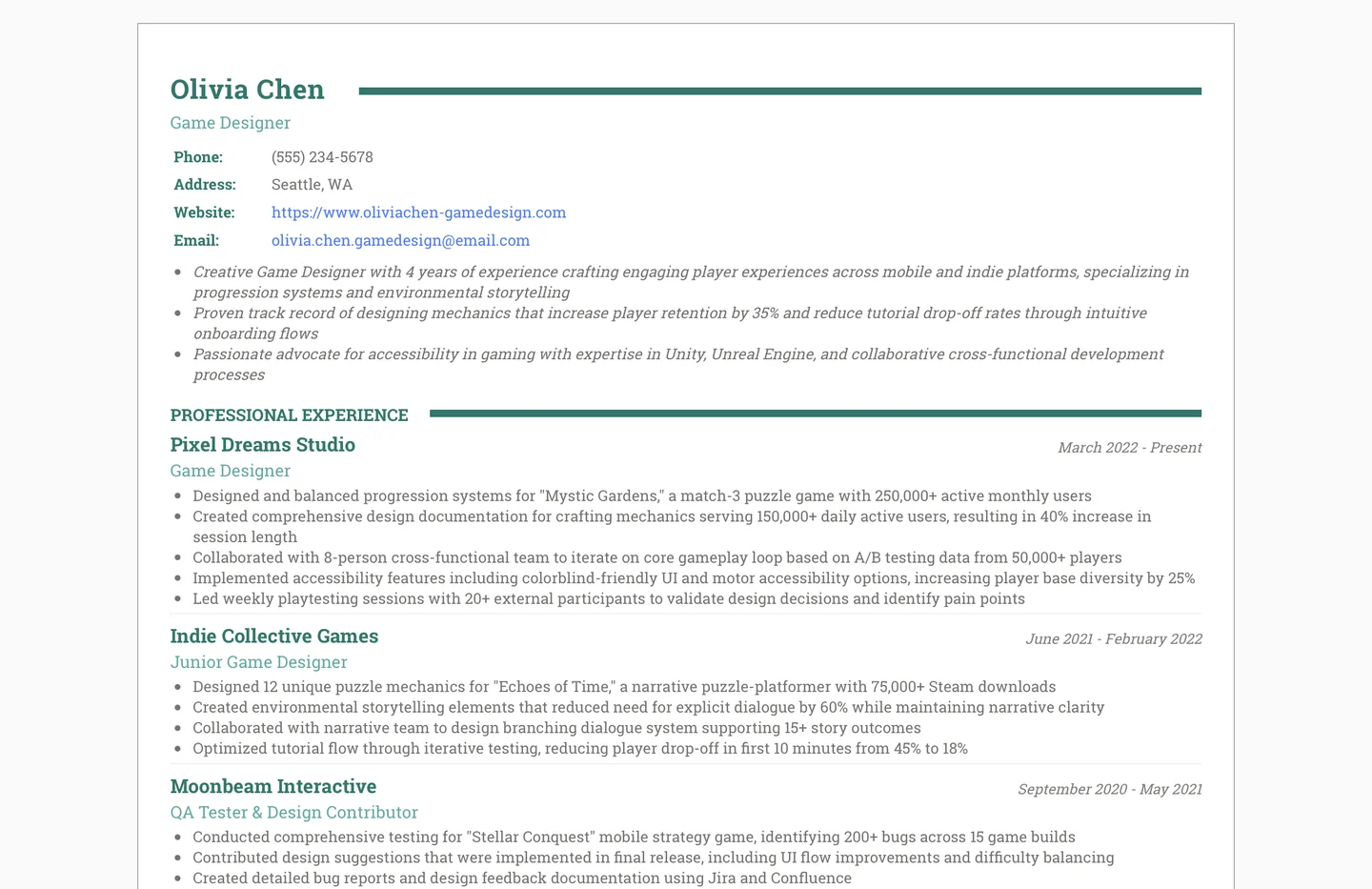
The Ultimate Game Designer Resume Example/Sample
https://www.resumonk.com/game-designer-resumeGame DesignerResume Format for Game Designer Resume
For Game Designers, the reverse-chronological format reigns supreme. Why? Because in this industry, your most recent work often showcases your most refined skills and understanding of current gaming trends.
The games industry moves at lightning speed - what was revolutionary three years ago might be standard practice today.
Structure Your Game Designer Resume Like a Well-Designed Level
Think of your resume as a game level - it needs a clear beginning, engaging middle, and satisfying conclusion.
Start with your contact information and a compelling summary that captures your design philosophy in 2-3 sentences. Follow this with your professional experience in reverse-chronological order, then your education, skills, and finally, a projects section if space permits.
Here's the crucial part - unlike traditional resumes, Game Designer resumes benefit from a slightly more creative approach to formatting. While you shouldn't go overboard with graphics (save that for your portfolio), using subtle design elements like clean section dividers or a touch of color can demonstrate your aesthetic sensibility.
The One-Page vs. Two-Page Debate
As an entry-level to mid-level Game Designer, stick to one page unless you have extensive shipped titles.
Senior designers with 7+ years of experience and multiple AAA titles can extend to two pages. Remember, your resume is the tutorial level - your portfolio is where you showcase the full game.
Work Experience on Game Designer Resume
Your work experience section is where the magic happens. This is where you transform from "person who plays games" to "professional who creates engaging player experiences."
Every Game Designer's journey is unique - some come from QA testing, others from programming, and many from completely unrelated fields armed with nothing but passion and a killer portfolio.
Crafting Your Experience Narrative
When describing your game design experience, focus on the problems you solved, not just the tasks you performed.
Game design is fundamentally about creating solutions to engagement challenges. Did you redesign a tutorial that reduced player drop-off by 30%? Did you create a progression system that increased daily active users? These are the stories that make hiring managers lean forward.
Here's how to structure each work experience entry:
❌ Don't write vague descriptions:
Game Designer - XYZ Studios (2022-2023)
- Designed game levels
- Worked with team on game features
- Participated in meetings
✅ Do write specific, impact-driven descriptions:
Game Designer - XYZ Studios (2022-2023)
- Designed and balanced 15 multiplayer maps for FPS title, resulting in 25% increase in match completion rates
- Created comprehensive design documentation for crafting system serving 100,000+ daily active users
- Collaborated with 12-person cross-functional team to iterate on core gameplay loop based on user testing data
Handling Non-Traditional Game Design Experience
Many aspiring Game Designers don't have formal game design titles in their work history.
That's perfectly normal! The key is translating your experience into game design language. Were you a teacher who created engaging lesson plans? That's experience in player onboarding and difficulty curves. Did you work in retail and redesign the store layout? That's level design and user flow optimization.
For indie developers and hobbyists, treat your personal projects as professional experience if they're substantial:
✅ Do format personal projects professionally:
Lead Game Designer - [Your Indie Game Title] (2021-2023)
- Sole designer for puzzle platformer with 10,000+ downloads on itch.io
- Implemented 50 unique puzzles with progressively complex mechanics
- Managed community feedback and released 3 major updates based on player data
Skills to Show on Game Designer Resume
The skills section of a Game Designer resume is like your character's ability tree - it needs to show both breadth and specialization. The game industry values T-shaped professionals: those with broad knowledge across many areas but deep expertise in specific domains.
Technical Skills - Your Hard Skills Arsenal
Game Designers sit at the intersection of art and technology.
While you don't need to be a programmer, familiarity with game engines and design tools is essential. List your proficiencies clearly:
✅ Do organize skills by category:
Game Engines: Unity, Unreal Engine 4/5, GameMaker Studio
Design Tools: Figma, Miro, Lucidchart, Adobe Creative Suite
Scripting: Blueprint Visual Scripting, C# basics, Lua
Documentation: Confluence, Google Workspace, Microsoft Office
Avoid listing every piece of software you've ever opened. If you've only followed a Unity tutorial once, that doesn't make you Unity-proficient.
Be honest about your skill levels - the industry is small, and misrepresentation will catch up with you.
Design Skills - Your Core Competencies
This is where you showcase your understanding of game design principles. Think beyond generic terms and get specific about your expertise:
❌ Don't use vague design terms:
Skills: Game Design, Level Design, Creative Thinking, Problem Solving
✅ Do specify your design expertise:
Design Specialties:
- Systems Design (progression, economy balancing, monetization)
- Level Design (environmental storytelling, player guidance, difficulty pacing)
- UX/UI Design (menu flow, HUD optimization, accessibility features)
- Narrative Design (branching dialogue, environmental narrative, character development)
Soft Skills - The Multiplayer Components
Game development is intensely collaborative. Your ability to work with artists, programmers, producers, and stakeholders is just as important as your design chops.
Weave these soft skills into your experience descriptions rather than listing them separately - show, don't tell.
Specific Considerations and Tips for Game Designer Resume
Now for the insider knowledge - the cheat codes that separate good Game Designer resumes from great ones. The games industry has its own culture and expectations that differ significantly from other creative fields.
The Portfolio Problem
Your resume must acknowledge your portfolio without relying on it. Include a portfolio link prominently (under your contact info), but ensure your resume stands alone. Many hiring managers skim resumes during commutes or between meetings when they can't access external links.
Your resume should tell enough of your story to earn that portfolio click.
Include a "Selected Projects" or "Shipped Titles" section if you have released games:
✅ Do highlight shipped titles with context:
Shipped Titles:
"Cosmic Conquest" (2023) - Mobile Strategy Game - 500K+ downloads
- Lead Designer for PvP battle system and matchmaking algorithms
- Featured in App Store's "Best New Games" category
Understanding Your Audience
Game Designer resumes often go through multiple readers - HR recruiters, design leads, and creative directors. The HR recruiter might not know what "implemented procedural generation using Perlin noise" means, but they understand "created system that automatically generated unique levels, reducing content creation time by 60%."
Write for both audiences by leading with impact and following with technical details. Use industry terminology accurately - nothing betrays inexperience faster than misusing terms like "gameplay loop" or "game feel."
Regional and Studio-Specific Considerations
The games industry varies significantly by region and studio type:
For US studios: Emphasize shipped titles and quantifiable metrics. American studios often value commercial success and player engagement numbers.
For European studios: Include more detail about your design philosophy and creative process. European studios often value innovation and artistic vision alongside commercial viability.
For Mobile/F2P studios: Highlight any experience with monetization, retention mechanics, and live operations. Understanding of analytics and A/B testing is crucial.
For Indie studios: Emphasize versatility and willingness to wear multiple hats. Show passion projects and game jam participation.
The Passion Project Paradox
Every Game Designer has passion projects, but knowing which ones to include is an art. Include projects that demonstrate skills relevant to your target role. Applying for a narrative design position? That interactive fiction you created is gold. Targeting systems design?
Your game economy spreadsheets are more relevant than your pixel art experiments.
Avoiding Common Game Designer Resume Pitfalls
Never claim sole credit for collaborative work - the games industry is small, and people talk.
Instead of "Designed the combat system," write "Collaborated with combat team to design and iterate on melee combat mechanics." This shows both your contribution and your understanding of team dynamics.
Avoid listing every game you've ever played in a "Favorite Games" section. If you include game references, make them meaningful: "Drew inspiration from 'Celeste's' assist options to design accessibility features for platforming sections."
Remember, your Game Designer resume is your first design challenge for any potential employer. It should demonstrate clarity, user understanding, and the ability to convey complex information elegantly - all essential game design skills.
Make every word count, just as you would make every mechanic meaningful in your games.
Education to List on Game Designer Resume
Here's the thing - as a Game Designer (an entry-level to mid-level creative role in the gaming industry), your education tells a unique story about how you approach the art and science of creating engaging player experiences. Unlike programmers who might lean heavily on their CS degrees, or artists who showcase their BFA credentials, game designers often come from wonderfully diverse educational backgrounds.
The Core Educational Paths
Game Designers typically emerge from three main educational tributaries. First, there are the specialized game design programs - think DigiPen, Full Sail, or USC's Interactive Media program. Then there are the traditional computer science folks who discovered they loved crafting mechanics more than debugging code.
Finally, there are the wild cards - psychology majors who understand player motivation, English majors who excel at narrative design, or even architecture students who bring spatial reasoning to level design.
How to Structure Your Education Section
The beauty of being a Game Designer is that almost any educational background can be relevant if you frame it correctly. Start with your most recent and relevant education, working backwards.
List your degree, institution, graduation date (or expected date), and - here's the crucial part - relevant coursework or projects that directly connect to game design.
❌ Don't write your education like this:
Bachelor of Arts in Psychology
State University, 2022
✅ Do enhance it with game design relevance:
Bachelor of Arts in Psychology
State University, May 2022
Relevant Coursework: Human-Computer Interaction, Cognitive Psychology, Statistical Analysis
Thesis: "Player Motivation Patterns in Roguelike Games" - Analyzed 500+ player surveys
When Your Degree Isn't Obviously Game-Related
Let's say you studied English Literature. You might think hiring managers will scratch their heads, but narrative design is a crucial aspect of game development. The key is building those bridges for them.
Include projects, coursework, or extracurricular activities that demonstrate your transition into game design thinking.
For instance, a Business major might highlight courses in consumer behavior and project management - both invaluable for understanding player retention and managing game development timelines. An Art History major could emphasize their understanding of visual composition and cultural storytelling - perfect for environmental narrative design.
Certifications and Continued Learning
The game industry moves fast - new engines, design philosophies, and platforms emerge constantly. Show that you're keeping pace by including relevant certifications and online courses. Unity Certified User? Completed Will Wright's MasterClass? Finished that GDC Vault series on level design?
These all belong in your education section, especially if your formal degree is from a few years back.
❌ Don't list certifications without context:
Unity Certification
Coursera Game Design Certificate
✅ Do provide specifics that show depth:
Unity Certified User: Programmer, 2023
- Scored 95% on gameplay programming assessment

Game Design Specialization - California Institute of the Arts via Coursera, 2023
- Completed 5-course series including "Game Design Document: Define Your Game"
- Final Project: Designed complete GDD for puzzle-platformer "Echoes of Time"
Awards and Publications on Game Designer Resume
You know that moment when your game jam project gets showcased, or when your design analysis blog post goes viral on r/gamedesign? These aren't just feel-good moments - they're resume gold.
But here's where many aspiring Game Designers stumble: they either hide these achievements or don't know how to present them professionally.
Why Awards Matter More Than You Think
In an industry where shipped titles might be limited (especially early in your career), awards and recognition serve as third-party validation of your design chops. That "Best Gameplay" award from your local game jam? It shows you can execute under pressure. That honorable mention in the IGF Student Showcase?
It proves your work stands out among hundreds of submissions.
Game design awards come in many flavors - game jam victories, student showcases, indie game festivals, or even internal hackathon recognition if you're transitioning from another tech role. Each tells a story about your ability to create compelling experiences that resonate with players and peers.
Publications That Showcase Your Design Thinking
Now, publications in game design don't always mean academic papers (though if you've written those, absolutely include them). The game design community thrives on shared knowledge - blog posts, design breakdowns, postmortems, and even well-crafted Reddit posts can demonstrate your analytical thinking and communication skills.
Maybe you wrote a detailed analysis of "Hades'" progression system on Medium that got 10K views. Perhaps you contributed to Gamasutra (now Game Developer) with a piece on accessibility in puzzle games. Or you maintain a YouTube channel breaking down level design in classic Nintendo games. These all count as publications in the modern sense.
How to List Them Effectively
The trick is presenting these achievements in a way that immediately communicates their relevance and impact. Always include the what, where, when, and - crucially - the why it matters.
❌ Don't undersell your achievements:
Won game jam
Wrote some articles about games
✅ Do provide context and impact:
Best Innovation Award - Global Game Jam Seattle, 2023
- Led 4-person team to create "Reverb," a sound-based puzzle game in 48 hours
- Competed against 50+ teams; game featured on GGJ homepage

"Breaking Down Breath of the Wild's Tutorial Island" - Personal Blog, 2022
- 15,000+ views, featured in Game Design Weekly newsletter
- Analyzed onboarding techniques applicable to open-world design
Creating a Hierarchy of Achievements
Not all awards are created equal, and that's okay. List your most impressive or relevant achievements first.
An IGF nomination probably outweighs a campus game jam win, but if that campus jam led to actual game development opportunities or showcased a specific skill the job requires, lead with what sells your story best.
For publications, prioritize those that demonstrate the specific type of game design the role requires. Applying for a narrative design position? That blog series on branching dialogue systems goes first. Gunning for a systems design role? Your white paper on balancing multiplayer economies takes precedence.
Listing References for Game Designer Resume
Remember that professor who praised your innovative approach to quest design? Or that lead designer from your internship who said you had "natural instincts" for player psychology? These people are more than just nice memories - they're potential keys to your next role.
But in the fast-moving, highly networked world of game development, managing references requires special consideration.
Why References Hit Different in Game Design
The game industry is surprisingly small.
Designers hop between studios, form indie collectives, and maintain connections across companies. Your references don't just vouch for your skills - they often have direct connections to the studio you're applying to. That programmer you worked with on a game jam might now be at your dream studio. That indie developer whose Discord you moderate might have gone to GDC with the hiring manager.
Unlike other industries where references feel like a formality, game studios often genuinely call them, especially for design roles. Why? Because design skills are notoriously hard to evaluate from a portfolio alone. They want to know: Can you take feedback? How do you handle crunch?
Do you champion your ideas without being precious about them?
Who Makes the Best References
Your reference lineup should tell a complete story about your design capabilities. Ideally, include someone who's seen your creative process (a professor or mentor), someone who's witnessed your collaboration skills (a team lead or fellow designer), and someone who can speak to your technical implementation abilities (a programmer or producer you've worked with).
For entry-level Game Designers, don't overlook non-traditional references. That YouTuber whose channel you helped design gameplay segments for? Valid. The board game cafe owner who watched you playtest dozens of iterations? Absolutely. The computer science TA who saw you turn programming assignments into mini-games? Perfect.
The Art of Reference Management
Here's what many designers get wrong - they list references without preparing them.
Before adding someone to your reference list, have a conversation. Remind them of specific projects you worked on together, share the job description, and highlight what aspects of your work you hope they'll emphasize.
❌ Don't list references like this:
John Smith - Professor
Email: [email protected]
✅ Do provide context that helps the hiring manager:
Dr. John Smith
Associate Professor, Interactive Media - State University
Email: [email protected] | Phone: (555) 123-4567
Relationship: Supervised my senior capstone project "Neural Paths" (puzzle game exploring memory)
The "References Available Upon Request" Debate
Old-school advice says to write "References available upon request" and save space. But in game design, where networking is everything, consider including them if you have strong ones.
Many designers create a separate references document with more detail about each person and their connection to your work.
If you're applying in different regions, note that expectations vary. US studios rarely expect references on the initial resume. UK studios sometimes want them upfront. Australian studios often fall somewhere in between.
When in doubt, follow the application instructions, but have a polished references document ready to go.
Maintaining Your Reference Network
Your references are part of your professional network - treat them as such.
Send updates when you ship a game, share articles they might find interesting, and thank them when they provide references. The game industry thrives on relationships, and today's reference might be tomorrow's collaborator on an indie project or the person who recommends you for your dream job at Nintendo.
Remember, every game designer started somewhere, and most remember the struggle. Don't be shy about asking for references from people who've seen your potential, even if you haven't shipped a AAA title yet.
Your passion, creativity, and dedication to the craft matter just as much as your resume bullets.
Cover Letter Tips for Game Designer Resume
Let's be honest - you'd rather be prototyping a new mechanic than writing a cover letter.
But here's a secret from someone who's been on both sides of the hiring screen: game studios actually read cover letters, especially for design positions. Why? Because game design is fundamentally about communication, and your cover letter is the first design challenge you're presenting to them.
Your Cover Letter Is Your First Design Document
Think of your cover letter as a one-page design document where the game is "Why You Should Hire Me." Just like a good game tutorial, it needs to quickly establish the core mechanics (your skills), demonstrate the unique features (your experiences), and leave them wanting to play more (interview you).
The best Game Designer cover letters don't just list qualifications - they demonstrate design thinking in action. Show how you approach problems, how you consider player experience, and how you iterate based on feedback. These meta-skills are what separate designers from people who just play a lot of games.
The Three-Pillar Structure
Every compelling game has core pillars, and so should your cover letter. Here's a structure that works:
Pillar 1: The Hook (First Paragraph) - Just like a game's opening moments, you need to grab attention immediately. Reference a specific game or feature from the studio that genuinely excited you as both a player and designer. Explain why their approach to design resonates with your philosophy.
Pillar 2: The Gameplay Loop (Middle Paragraphs) - This is where you demonstrate your design process through specific examples. Don't just say you're good at level design - describe how you iterated on a particular challenge, what metrics you used to measure success, and how player feedback shaped your decisions.
Pillar 3: The Call to Adventure (Closing) - End with forward momentum. Mention a specific challenge the studio might be facing (based on their recent releases or job posting) and hint at how your experience positions you to tackle it.
Studio-Specific Customization
Generic cover letters are like asset flips - everyone can spot them a mile away.
Research the studio's design philosophy. Are they known for emergent gameplay like Arkane? Emphasize your systems thinking. Do they craft emotional narratives like Naughty Dog? Highlight your understanding of pacing and character development.
❌ Don't write generic statements:
I am passionate about games and would love to work at your studio. I have played games my whole life and think I would be a great addition to your team.
✅ Do demonstrate specific knowledge and thinking:
Your approach to environmental storytelling in "Hollow Knight" - particularly how the City of Tears conveys isolation through vertical level design - aligns perfectly with my focus on using space as narrative. In my recent project "Echoes," I
experimented with similar techniques, using ascending platforming sections to represent the protagonist's growing confidence.
Regional Differences in Cover Letters
If you're applying internationally, know your audience. US studios often appreciate enthusiasm and personality. UK studios tend to prefer a slightly more formal approach but still value creativity. Canadian studios often emphasize team collaboration and cultural fit.
Japanese studios (if they accept Western applications) typically expect more formal, respectful language and clear acknowledgment of their game hierarchy.
Key Takeaways
After diving deep into the craft of creating a standout Game Designer resume, here are the essential points to remember as you build yours:
- Use reverse-chronological format - Your most recent work showcases your current skills and understanding of modern gaming trends
- Frame experience through impact - Focus on problems solved and player outcomes, not just tasks performed (reduced player drop-off by 30%, not just "designed levels")
- Translate non-traditional experience - Teaching becomes player onboarding expertise, retail layout becomes level flow design
- Balance technical and design skills - Show proficiency in game engines and tools, but emphasize your design thinking and specializations
- Include metrics and specifics - "Designed 15 multiplayer maps" beats "designed game levels" every time
- Customize for studio types - Mobile studios want retention metrics, indie studios want versatility, AAA studios want shipped titles
- Education tells your unique story - Any degree can be relevant when framed through a game design lens
- Showcase achievements beyond work - Game jam awards, design blog posts, and community contributions all demonstrate your expertise
- Write cover letters that demonstrate design thinking - Show your process and problem-solving approach, not just enthusiasm
- Prepare your references - Brief them on the role and remind them of specific projects you want highlighted
Creating a Game Designer resume on Resumonk transforms this process from daunting to delightful. Our platform understands the unique needs of creative professionals in gaming - from elegantly showcasing your shipped titles to highlighting those crucial game jam victories. With AI-powered suggestions tailored specifically for game industry roles, you'll find the right words to describe your design philosophy and technical skills. Our templates strike that perfect balance between creative flair and professional polish that game studios expect.
Ready to craft a Game Designer resume that gets you past the application boss battle?
Join thousands of game industry professionals who've leveled up their careers with Resumonk. Start building your perfectly balanced resume today - unlock all features and templates here.
More Design resume examples
See all Design resume examples, or browse every category.
Resume writing tips
You're staring at a blank document, cursor blinking mockingly as you try to figure out how to compress years of game jams, late-night level design sessions, and that brilliant mechanic you prototyped last week into a single page.
The job posting for Game Designer at that studio you've been following since high school sits in another tab, and you know - you just know - you'd be perfect for it. But how do you translate the language of game loops and player motivation into resume-speak that gets you past the first boss battle of job hunting?
Here's the thing about being a Game Designer - you're not a senior creative director calling the shots on the next AAA blockbuster (yet), and you're not a fresh graduate with nothing but dreams and a few Unity tutorials under your belt. You're in that sweet spot where you understand what makes games tick, have some projects to show for it, but need to prove you can level up from hobbyist to professional. Whether you've been modding Skyrim for years, shipping mobile games at a small studio, or transitioning from QA testing with a notebook full of design improvements, this guide speaks directly to you.
We're about to walk through everything that makes a Game Designer resume not just good, but impossible to ignore. We'll start with choosing the right format that showcases your journey - why reverse-chronological works best and how to structure your resume like a well-crafted tutorial. Then we'll dive deep into presenting your work experience, even if your official title was never "Game Designer." We'll decode which skills actually matter (spoiler: knowing every game engine isn't as important as understanding player psychology), and explore the specific considerations unique to game design resumes - from the portfolio problem to regional differences in what studios expect.
Along the way, we'll cover how to present your education (yes, that psychology degree is actually perfect), showcase your game jam victories and design blog posts like the achievements they are, craft a cover letter that reads like compelling game narrative, and manage references in an industry where everyone knows everyone. By the end, you'll have every tool needed to create a resume that demonstrates not just your passion for games, but your ability to craft experiences that players remember. Ready? Let's press start.
The Ultimate Game Designer Resume Example/Sample
https://www.resumonk.com/game-designer-resumeGame DesignerResume Format for Game Designer Resume
For Game Designers, the reverse-chronological format reigns supreme. Why? Because in this industry, your most recent work often showcases your most refined skills and understanding of current gaming trends.
The games industry moves at lightning speed - what was revolutionary three years ago might be standard practice today.
Structure Your Game Designer Resume Like a Well-Designed Level
Think of your resume as a game level - it needs a clear beginning, engaging middle, and satisfying conclusion.
Start with your contact information and a compelling summary that captures your design philosophy in 2-3 sentences. Follow this with your professional experience in reverse-chronological order, then your education, skills, and finally, a projects section if space permits.
Here's the crucial part - unlike traditional resumes, Game Designer resumes benefit from a slightly more creative approach to formatting. While you shouldn't go overboard with graphics (save that for your portfolio), using subtle design elements like clean section dividers or a touch of color can demonstrate your aesthetic sensibility.
The One-Page vs. Two-Page Debate
As an entry-level to mid-level Game Designer, stick to one page unless you have extensive shipped titles.
Senior designers with 7+ years of experience and multiple AAA titles can extend to two pages. Remember, your resume is the tutorial level - your portfolio is where you showcase the full game.
Work Experience on Game Designer Resume
Your work experience section is where the magic happens. This is where you transform from "person who plays games" to "professional who creates engaging player experiences."
Every Game Designer's journey is unique - some come from QA testing, others from programming, and many from completely unrelated fields armed with nothing but passion and a killer portfolio.
Crafting Your Experience Narrative
When describing your game design experience, focus on the problems you solved, not just the tasks you performed.
Game design is fundamentally about creating solutions to engagement challenges. Did you redesign a tutorial that reduced player drop-off by 30%? Did you create a progression system that increased daily active users? These are the stories that make hiring managers lean forward.
Here's how to structure each work experience entry:
❌ Don't write vague descriptions:
Game Designer - XYZ Studios (2022-2023)
- Designed game levels
- Worked with team on game features
- Participated in meetings
✅ Do write specific, impact-driven descriptions:
Game Designer - XYZ Studios (2022-2023)
- Designed and balanced 15 multiplayer maps for FPS title, resulting in 25% increase in match completion rates
- Created comprehensive design documentation for crafting system serving 100,000+ daily active users
- Collaborated with 12-person cross-functional team to iterate on core gameplay loop based on user testing data
Handling Non-Traditional Game Design Experience
Many aspiring Game Designers don't have formal game design titles in their work history.
That's perfectly normal! The key is translating your experience into game design language. Were you a teacher who created engaging lesson plans? That's experience in player onboarding and difficulty curves. Did you work in retail and redesign the store layout? That's level design and user flow optimization.
For indie developers and hobbyists, treat your personal projects as professional experience if they're substantial:
✅ Do format personal projects professionally:
Lead Game Designer - [Your Indie Game Title] (2021-2023)
- Sole designer for puzzle platformer with 10,000+ downloads on itch.io
- Implemented 50 unique puzzles with progressively complex mechanics
- Managed community feedback and released 3 major updates based on player data
Skills to Show on Game Designer Resume
The skills section of a Game Designer resume is like your character's ability tree - it needs to show both breadth and specialization. The game industry values T-shaped professionals: those with broad knowledge across many areas but deep expertise in specific domains.
Technical Skills - Your Hard Skills Arsenal
Game Designers sit at the intersection of art and technology.
While you don't need to be a programmer, familiarity with game engines and design tools is essential. List your proficiencies clearly:
✅ Do organize skills by category:
Game Engines: Unity, Unreal Engine 4/5, GameMaker Studio
Design Tools: Figma, Miro, Lucidchart, Adobe Creative Suite
Scripting: Blueprint Visual Scripting, C# basics, Lua
Documentation: Confluence, Google Workspace, Microsoft Office
Avoid listing every piece of software you've ever opened. If you've only followed a Unity tutorial once, that doesn't make you Unity-proficient.
Be honest about your skill levels - the industry is small, and misrepresentation will catch up with you.
Design Skills - Your Core Competencies
This is where you showcase your understanding of game design principles. Think beyond generic terms and get specific about your expertise:
❌ Don't use vague design terms:
Skills: Game Design, Level Design, Creative Thinking, Problem Solving
✅ Do specify your design expertise:
Design Specialties:
- Systems Design (progression, economy balancing, monetization)
- Level Design (environmental storytelling, player guidance, difficulty pacing)
- UX/UI Design (menu flow, HUD optimization, accessibility features)
- Narrative Design (branching dialogue, environmental narrative, character development)
Soft Skills - The Multiplayer Components
Game development is intensely collaborative. Your ability to work with artists, programmers, producers, and stakeholders is just as important as your design chops.
Weave these soft skills into your experience descriptions rather than listing them separately - show, don't tell.
Specific Considerations and Tips for Game Designer Resume
Now for the insider knowledge - the cheat codes that separate good Game Designer resumes from great ones. The games industry has its own culture and expectations that differ significantly from other creative fields.
The Portfolio Problem
Your resume must acknowledge your portfolio without relying on it. Include a portfolio link prominently (under your contact info), but ensure your resume stands alone. Many hiring managers skim resumes during commutes or between meetings when they can't access external links.
Your resume should tell enough of your story to earn that portfolio click.
Include a "Selected Projects" or "Shipped Titles" section if you have released games:
✅ Do highlight shipped titles with context:
Shipped Titles:
"Cosmic Conquest" (2023) - Mobile Strategy Game - 500K+ downloads
- Lead Designer for PvP battle system and matchmaking algorithms
- Featured in App Store's "Best New Games" category
Understanding Your Audience
Game Designer resumes often go through multiple readers - HR recruiters, design leads, and creative directors. The HR recruiter might not know what "implemented procedural generation using Perlin noise" means, but they understand "created system that automatically generated unique levels, reducing content creation time by 60%."
Write for both audiences by leading with impact and following with technical details. Use industry terminology accurately - nothing betrays inexperience faster than misusing terms like "gameplay loop" or "game feel."
Regional and Studio-Specific Considerations
The games industry varies significantly by region and studio type:
For US studios: Emphasize shipped titles and quantifiable metrics. American studios often value commercial success and player engagement numbers.
For European studios: Include more detail about your design philosophy and creative process. European studios often value innovation and artistic vision alongside commercial viability.
For Mobile/F2P studios: Highlight any experience with monetization, retention mechanics, and live operations. Understanding of analytics and A/B testing is crucial.
For Indie studios: Emphasize versatility and willingness to wear multiple hats. Show passion projects and game jam participation.
The Passion Project Paradox
Every Game Designer has passion projects, but knowing which ones to include is an art. Include projects that demonstrate skills relevant to your target role. Applying for a narrative design position? That interactive fiction you created is gold. Targeting systems design?
Your game economy spreadsheets are more relevant than your pixel art experiments.
Avoiding Common Game Designer Resume Pitfalls
Never claim sole credit for collaborative work - the games industry is small, and people talk.
Instead of "Designed the combat system," write "Collaborated with combat team to design and iterate on melee combat mechanics." This shows both your contribution and your understanding of team dynamics.
Avoid listing every game you've ever played in a "Favorite Games" section. If you include game references, make them meaningful: "Drew inspiration from 'Celeste's' assist options to design accessibility features for platforming sections."
Remember, your Game Designer resume is your first design challenge for any potential employer. It should demonstrate clarity, user understanding, and the ability to convey complex information elegantly - all essential game design skills.
Make every word count, just as you would make every mechanic meaningful in your games.
Education to List on Game Designer Resume
Here's the thing - as a Game Designer (an entry-level to mid-level creative role in the gaming industry), your education tells a unique story about how you approach the art and science of creating engaging player experiences. Unlike programmers who might lean heavily on their CS degrees, or artists who showcase their BFA credentials, game designers often come from wonderfully diverse educational backgrounds.
The Core Educational Paths
Game Designers typically emerge from three main educational tributaries. First, there are the specialized game design programs - think DigiPen, Full Sail, or USC's Interactive Media program. Then there are the traditional computer science folks who discovered they loved crafting mechanics more than debugging code.
Finally, there are the wild cards - psychology majors who understand player motivation, English majors who excel at narrative design, or even architecture students who bring spatial reasoning to level design.
How to Structure Your Education Section
The beauty of being a Game Designer is that almost any educational background can be relevant if you frame it correctly. Start with your most recent and relevant education, working backwards.
List your degree, institution, graduation date (or expected date), and - here's the crucial part - relevant coursework or projects that directly connect to game design.
❌ Don't write your education like this:
Bachelor of Arts in Psychology
State University, 2022
✅ Do enhance it with game design relevance:
Bachelor of Arts in Psychology
State University, May 2022
Relevant Coursework: Human-Computer Interaction, Cognitive Psychology, Statistical Analysis
Thesis: "Player Motivation Patterns in Roguelike Games" - Analyzed 500+ player surveys
When Your Degree Isn't Obviously Game-Related
Let's say you studied English Literature. You might think hiring managers will scratch their heads, but narrative design is a crucial aspect of game development. The key is building those bridges for them.
Include projects, coursework, or extracurricular activities that demonstrate your transition into game design thinking.
For instance, a Business major might highlight courses in consumer behavior and project management - both invaluable for understanding player retention and managing game development timelines. An Art History major could emphasize their understanding of visual composition and cultural storytelling - perfect for environmental narrative design.
Certifications and Continued Learning
The game industry moves fast - new engines, design philosophies, and platforms emerge constantly. Show that you're keeping pace by including relevant certifications and online courses. Unity Certified User? Completed Will Wright's MasterClass? Finished that GDC Vault series on level design?
These all belong in your education section, especially if your formal degree is from a few years back.
❌ Don't list certifications without context:
Unity Certification
Coursera Game Design Certificate
✅ Do provide specifics that show depth:
Unity Certified User: Programmer, 2023
- Scored 95% on gameplay programming assessment

Game Design Specialization - California Institute of the Arts via Coursera, 2023
- Completed 5-course series including "Game Design Document: Define Your Game"
- Final Project: Designed complete GDD for puzzle-platformer "Echoes of Time"
Awards and Publications on Game Designer Resume
You know that moment when your game jam project gets showcased, or when your design analysis blog post goes viral on r/gamedesign? These aren't just feel-good moments - they're resume gold.
But here's where many aspiring Game Designers stumble: they either hide these achievements or don't know how to present them professionally.
Why Awards Matter More Than You Think
In an industry where shipped titles might be limited (especially early in your career), awards and recognition serve as third-party validation of your design chops. That "Best Gameplay" award from your local game jam? It shows you can execute under pressure. That honorable mention in the IGF Student Showcase?
It proves your work stands out among hundreds of submissions.
Game design awards come in many flavors - game jam victories, student showcases, indie game festivals, or even internal hackathon recognition if you're transitioning from another tech role. Each tells a story about your ability to create compelling experiences that resonate with players and peers.
Publications That Showcase Your Design Thinking
Now, publications in game design don't always mean academic papers (though if you've written those, absolutely include them). The game design community thrives on shared knowledge - blog posts, design breakdowns, postmortems, and even well-crafted Reddit posts can demonstrate your analytical thinking and communication skills.
Maybe you wrote a detailed analysis of "Hades'" progression system on Medium that got 10K views. Perhaps you contributed to Gamasutra (now Game Developer) with a piece on accessibility in puzzle games. Or you maintain a YouTube channel breaking down level design in classic Nintendo games. These all count as publications in the modern sense.
How to List Them Effectively
The trick is presenting these achievements in a way that immediately communicates their relevance and impact. Always include the what, where, when, and - crucially - the why it matters.
❌ Don't undersell your achievements:
Won game jam
Wrote some articles about games
✅ Do provide context and impact:
Best Innovation Award - Global Game Jam Seattle, 2023
- Led 4-person team to create "Reverb," a sound-based puzzle game in 48 hours
- Competed against 50+ teams; game featured on GGJ homepage

"Breaking Down Breath of the Wild's Tutorial Island" - Personal Blog, 2022
- 15,000+ views, featured in Game Design Weekly newsletter
- Analyzed onboarding techniques applicable to open-world design
Creating a Hierarchy of Achievements
Not all awards are created equal, and that's okay. List your most impressive or relevant achievements first.
An IGF nomination probably outweighs a campus game jam win, but if that campus jam led to actual game development opportunities or showcased a specific skill the job requires, lead with what sells your story best.
For publications, prioritize those that demonstrate the specific type of game design the role requires. Applying for a narrative design position? That blog series on branching dialogue systems goes first. Gunning for a systems design role? Your white paper on balancing multiplayer economies takes precedence.
Listing References for Game Designer Resume
Remember that professor who praised your innovative approach to quest design? Or that lead designer from your internship who said you had "natural instincts" for player psychology? These people are more than just nice memories - they're potential keys to your next role.
But in the fast-moving, highly networked world of game development, managing references requires special consideration.
Why References Hit Different in Game Design
The game industry is surprisingly small.
Designers hop between studios, form indie collectives, and maintain connections across companies. Your references don't just vouch for your skills - they often have direct connections to the studio you're applying to. That programmer you worked with on a game jam might now be at your dream studio. That indie developer whose Discord you moderate might have gone to GDC with the hiring manager.
Unlike other industries where references feel like a formality, game studios often genuinely call them, especially for design roles. Why? Because design skills are notoriously hard to evaluate from a portfolio alone. They want to know: Can you take feedback? How do you handle crunch?
Do you champion your ideas without being precious about them?
Who Makes the Best References
Your reference lineup should tell a complete story about your design capabilities. Ideally, include someone who's seen your creative process (a professor or mentor), someone who's witnessed your collaboration skills (a team lead or fellow designer), and someone who can speak to your technical implementation abilities (a programmer or producer you've worked with).
For entry-level Game Designers, don't overlook non-traditional references. That YouTuber whose channel you helped design gameplay segments for? Valid. The board game cafe owner who watched you playtest dozens of iterations? Absolutely. The computer science TA who saw you turn programming assignments into mini-games? Perfect.
The Art of Reference Management
Here's what many designers get wrong - they list references without preparing them.
Before adding someone to your reference list, have a conversation. Remind them of specific projects you worked on together, share the job description, and highlight what aspects of your work you hope they'll emphasize.
❌ Don't list references like this:
John Smith - Professor
Email: [email protected]
✅ Do provide context that helps the hiring manager:
Dr. John Smith
Associate Professor, Interactive Media - State University
Email: [email protected] | Phone: (555) 123-4567
Relationship: Supervised my senior capstone project "Neural Paths" (puzzle game exploring memory)
The "References Available Upon Request" Debate
Old-school advice says to write "References available upon request" and save space. But in game design, where networking is everything, consider including them if you have strong ones.
Many designers create a separate references document with more detail about each person and their connection to your work.
If you're applying in different regions, note that expectations vary. US studios rarely expect references on the initial resume. UK studios sometimes want them upfront. Australian studios often fall somewhere in between.
When in doubt, follow the application instructions, but have a polished references document ready to go.
Maintaining Your Reference Network
Your references are part of your professional network - treat them as such.
Send updates when you ship a game, share articles they might find interesting, and thank them when they provide references. The game industry thrives on relationships, and today's reference might be tomorrow's collaborator on an indie project or the person who recommends you for your dream job at Nintendo.
Remember, every game designer started somewhere, and most remember the struggle. Don't be shy about asking for references from people who've seen your potential, even if you haven't shipped a AAA title yet.
Your passion, creativity, and dedication to the craft matter just as much as your resume bullets.
Cover Letter Tips for Game Designer Resume
Let's be honest - you'd rather be prototyping a new mechanic than writing a cover letter.
But here's a secret from someone who's been on both sides of the hiring screen: game studios actually read cover letters, especially for design positions. Why? Because game design is fundamentally about communication, and your cover letter is the first design challenge you're presenting to them.
Your Cover Letter Is Your First Design Document
Think of your cover letter as a one-page design document where the game is "Why You Should Hire Me." Just like a good game tutorial, it needs to quickly establish the core mechanics (your skills), demonstrate the unique features (your experiences), and leave them wanting to play more (interview you).
The best Game Designer cover letters don't just list qualifications - they demonstrate design thinking in action. Show how you approach problems, how you consider player experience, and how you iterate based on feedback. These meta-skills are what separate designers from people who just play a lot of games.
The Three-Pillar Structure
Every compelling game has core pillars, and so should your cover letter. Here's a structure that works:
Pillar 1: The Hook (First Paragraph) - Just like a game's opening moments, you need to grab attention immediately. Reference a specific game or feature from the studio that genuinely excited you as both a player and designer. Explain why their approach to design resonates with your philosophy.
Pillar 2: The Gameplay Loop (Middle Paragraphs) - This is where you demonstrate your design process through specific examples. Don't just say you're good at level design - describe how you iterated on a particular challenge, what metrics you used to measure success, and how player feedback shaped your decisions.
Pillar 3: The Call to Adventure (Closing) - End with forward momentum. Mention a specific challenge the studio might be facing (based on their recent releases or job posting) and hint at how your experience positions you to tackle it.
Studio-Specific Customization
Generic cover letters are like asset flips - everyone can spot them a mile away.
Research the studio's design philosophy. Are they known for emergent gameplay like Arkane? Emphasize your systems thinking. Do they craft emotional narratives like Naughty Dog? Highlight your understanding of pacing and character development.
❌ Don't write generic statements:
I am passionate about games and would love to work at your studio. I have played games my whole life and think I would be a great addition to your team.
✅ Do demonstrate specific knowledge and thinking:
Your approach to environmental storytelling in "Hollow Knight" - particularly how the City of Tears conveys isolation through vertical level design - aligns perfectly with my focus on using space as narrative. In my recent project "Echoes," I
experimented with similar techniques, using ascending platforming sections to represent the protagonist's growing confidence.
Regional Differences in Cover Letters
If you're applying internationally, know your audience. US studios often appreciate enthusiasm and personality. UK studios tend to prefer a slightly more formal approach but still value creativity. Canadian studios often emphasize team collaboration and cultural fit.
Japanese studios (if they accept Western applications) typically expect more formal, respectful language and clear acknowledgment of their game hierarchy.
Key Takeaways
After diving deep into the craft of creating a standout Game Designer resume, here are the essential points to remember as you build yours:
- Use reverse-chronological format - Your most recent work showcases your current skills and understanding of modern gaming trends
- Frame experience through impact - Focus on problems solved and player outcomes, not just tasks performed (reduced player drop-off by 30%, not just "designed levels")
- Translate non-traditional experience - Teaching becomes player onboarding expertise, retail layout becomes level flow design
- Balance technical and design skills - Show proficiency in game engines and tools, but emphasize your design thinking and specializations
- Include metrics and specifics - "Designed 15 multiplayer maps" beats "designed game levels" every time
- Customize for studio types - Mobile studios want retention metrics, indie studios want versatility, AAA studios want shipped titles
- Education tells your unique story - Any degree can be relevant when framed through a game design lens
- Showcase achievements beyond work - Game jam awards, design blog posts, and community contributions all demonstrate your expertise
- Write cover letters that demonstrate design thinking - Show your process and problem-solving approach, not just enthusiasm
- Prepare your references - Brief them on the role and remind them of specific projects you want highlighted
Creating a Game Designer resume on Resumonk transforms this process from daunting to delightful. Our platform understands the unique needs of creative professionals in gaming - from elegantly showcasing your shipped titles to highlighting those crucial game jam victories. With AI-powered suggestions tailored specifically for game industry roles, you'll find the right words to describe your design philosophy and technical skills. Our templates strike that perfect balance between creative flair and professional polish that game studios expect.
Ready to craft a Game Designer resume that gets you past the application boss battle?
Join thousands of game industry professionals who've leveled up their careers with Resumonk. Start building your perfectly balanced resume today - unlock all features and templates here.
More Design resume examples
See all Design resume examples, or browse every category.
Resume writing tips