Forklift Operator Resume Example (with Expert Advice and Tips)
Introduction
You've just clocked out from another shift, your steel-toes are dusty from warehouse floors, and you're scrolling through job listings on your phone, wondering how to translate years of navigating narrow aisles and stacking pallets into a resume that gets noticed. Maybe you're that person who can thread a forklift through a gap with inches to spare, who knows exactly how to balance a wobbly load, who's never had a safety incident in five years - but somehow putting that expertise on paper feels harder than parallel parking a reach truck in a crowded dock.
As a forklift operator, you're literally the person who keeps commerce moving. Every online order, every store shelf, every construction site - they all depend on people like you who can safely and efficiently move thousands of pounds of materials every single day. Yet when it comes to writing your resume, you might feel like you're stuck in neutral. The good news? Creating a powerful forklift operator resume isn't about fancy words or creative formatting - it's about strategically presenting your very real skills and experience in a way that makes warehouse managers want to hire you immediately.
This comprehensive guide walks you through every element of crafting your perfect forklift operator resume. We'll start with choosing the right resume format that highlights your certifications and recent experience, then dive deep into writing compelling work experience descriptions that go beyond "operated forklift." You'll learn how to showcase your equipment expertise and safety record in the skills section, navigate the sometimes-tricky education requirements, and even handle special circumstances like seasonal work or career transitions. We'll cover everything from maximizing the impact of safety awards to writing a cover letter that actually gets read, plus regional differences if you're applying in the UK, Australia, or Canada versus the USA.
Whether you're a seasoned operator with years of experience on every type of lift truck imaginable, or you're fresh out of certification training looking for your first operator position, this guide provides the exact blueprint you need. By the time you finish reading, you'll have a clear roadmap to create a resume that not only passes the initial screening but makes hiring managers eager to see you demonstrate those skills in their warehouse.
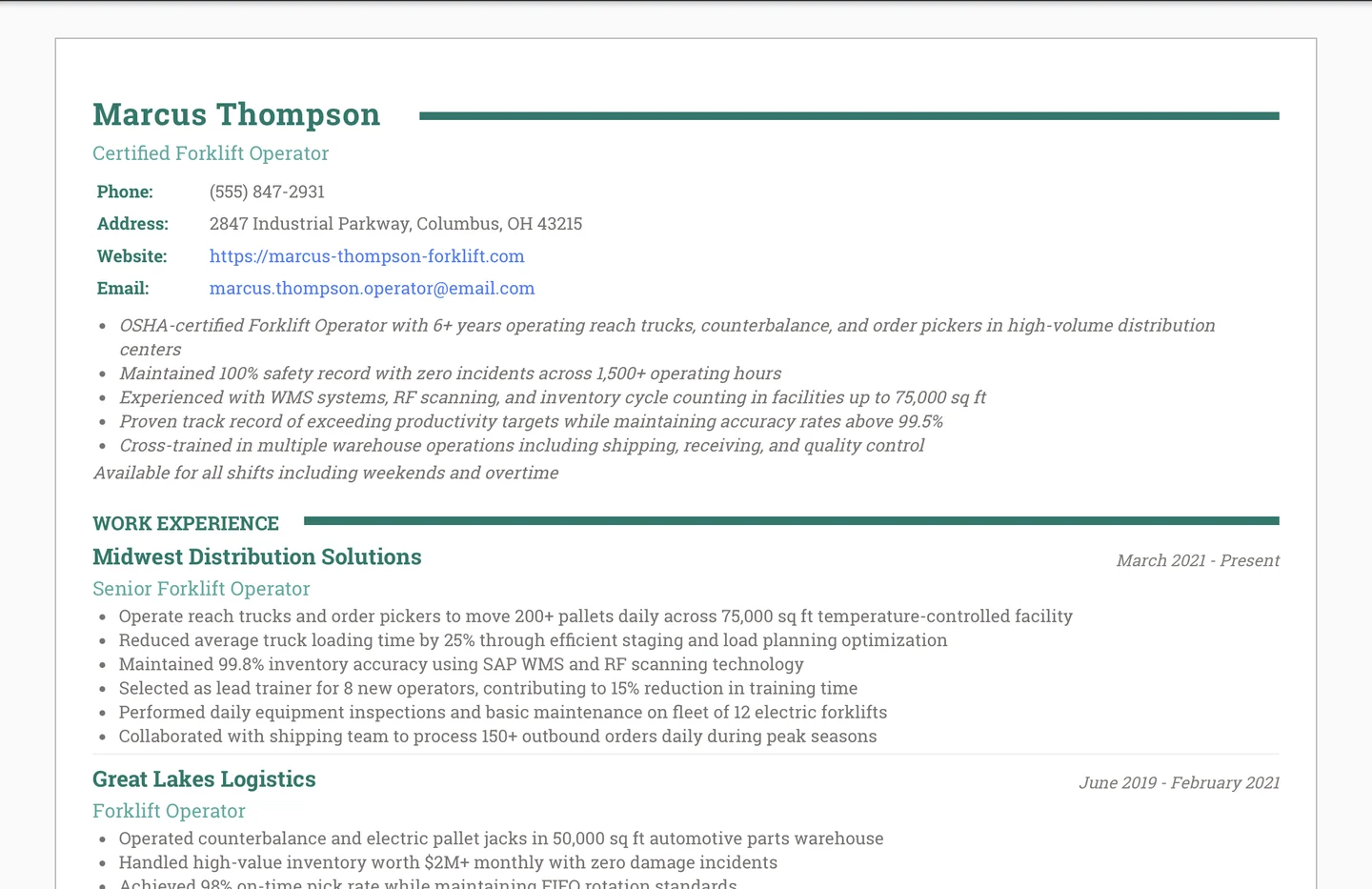
The Ultimate Forklift Operator Resume Example/Sample
https://www.resumonk.com/forklift-operatorForklift OperatorChoosing the Right Resume Format for Your Forklift Operator Application
The reverse-chronological format stands as your best ally here. Why? Because warehouse managers and logistics supervisors want to see your most recent experience with equipment first. They're looking for current certifications, recent safety records, and fresh experience with the latest warehouse management systems.
This format places your most recent forklift operating experience at the top, where hiring managers' eyes naturally gravitate.
Structure That Works in Warehouses
Start with a brief professional summary that immediately establishes your certification status and years of experience.
Unlike office jobs where personality might shine through, warehouse employers need to know within seconds that you're qualified to operate their equipment safely. Follow this with your work experience section, then certifications, skills, and education - in that exact order.
For those transitioning from other manual labor roles or entering the field fresh with certification, a combination format can work wonders. This allows you to highlight your forklift certification and relevant transferable skills at the top, even if your actual operating experience is limited.
❌ Don't write a vague opening that wastes valuable space:
Hardworking individual seeking employment in a warehouse setting where I can utilize my skills and grow professionally.
✅ Do lead with concrete qualifications:
Certified Forklift Operator with 3+ years operating reach trucks and order pickers in high-volume distribution centers. Current OSHA certification with zero safety incidents.
Regional Variations to Consider
In the USA and Canada, keep your resume to one page unless you have over 10 years of specialized experience.
UK employers often expect a two-page CV format with more detail about your work history. Australian employers particularly value detailed safety training records, so ensure these feature prominently.
Remember that terminology varies too - what Americans call a "forklift operator" might be listed as "fork truck driver" in UK job postings.
Crafting Your Work Experience as a Forklift Operator
Your work experience section isn't just a list of places where you've driven a forklift - it's your opportunity to demonstrate that you understand the bigger picture of warehouse operations. Every hiring manager has seen hundreds of resumes that say "operated forklift to move materials."
But you know there's so much more to it than that.
You're tracking inventory, coordinating with dock workers, maintaining equipment, and often racing against delivery deadlines.
Quantify Your Material Handling Impact
The secret to standing out lies in numbers and specifics. How many pallets did you move per shift? What was the value of inventory you handled? Did you help reduce loading times or improve warehouse efficiency? These metrics transform you from just another operator into a measurable asset.
Remember, warehouse managers live and breathe KPIs - speak their language.
❌ Don't use generic descriptions:
Forklift Operator
ABC Warehouse - 2021-2023
- Operated forklift to move products
- Loaded and unloaded trucks
- Followed safety procedures
✅ Do provide specific, quantified achievements:
Forklift Operator
ABC Distribution Center - 2021-2023
- Operated reach trucks and pallet jacks to move 150+ pallets daily across 50,000 sq ft facility
- Reduced average truck loading time by 20% through efficient staging and organization
- Maintained 100% accuracy in inventory placement over 24 months using WMS scanning
Highlighting Different Equipment and Environments
Not all forklift experience is created equal. Operating a stand-up reach truck in a frozen food warehouse requires different skills than driving a sit-down counterbalance forklift in a lumberyard. Make these distinctions clear.
If you've worked in temperature-controlled environments, with hazardous materials, or in facilities with unique challenges like narrow aisles or high-rack storage, these details matter immensely to employers looking for specific experience.
For those with limited direct forklift experience, focus on related accomplishments. Did you excel in shipping and receiving? Were you the go-to person for inventory counts?
These adjacent experiences show you understand warehouse flow and can likely transition smoothly into an operator role.
Demonstrating Safety Leadership
Safety isn't just a buzzword in warehouse environments - it's everything.
Every day you operated equipment without an incident is an achievement worth noting. If you've participated in safety committees, trained new operators, or contributed to improving safety protocols, these experiences elevate you from operator to safety-conscious team member. Employers spend thousands on workers' compensation claims; showing you're a safe bet literally saves them money.
Essential Skills to Highlight on Your Forklift Operator Resume
Here's what most people get wrong about the skills section - they think it's just about listing equipment types.
But you know better. You know that being a successful forklift operator requires a unique blend of technical prowess, physical capabilities, and soft skills that keep the warehouse running smoothly. Your skills section needs to paint a complete picture of you as a well-rounded warehouse professional.
Technical Skills That Matter Most
Start with your equipment expertise, but be specific.
Instead of just "forklift operation," break it down by equipment type - counterbalance, reach truck, order picker, pallet jack, cherry picker. Include your experience with warehouse management systems (WMS), RF scanners, and inventory software. These technical skills show you can integrate into modern warehouse operations immediately.
Don't forget about maintenance capabilities. Can you perform daily equipment inspections? Basic troubleshooting? Battery changing and charging for electric lifts? These skills show you're not just a driver but someone who understands and cares for the equipment.
❌ Don't list vague, overused skills:
Skills:
- Forklift operation
- Team player
- Hard worker
- Punctual
✅ Do showcase specific, relevant capabilities:
Technical Skills:
- Equipment: Reach trucks (Crown, Raymond), Order pickers, Electric pallet jacks, Propane counterbalance
- Systems: SAP WMS, RF scanning, Inventory cycle counting
- Certifications: OSHA Forklift Certified (2023), Hazmat Handling, First Aid/CPR

Operational Skills:
- Load planning and weight distribution
- Cross-docking operations
- Battery maintenance and changing
- Daily equipment inspection protocols
Physical and Mental Attributes
The physical demands of forklift operation are real, and employers need to know you can handle them.
Include skills like "ability to lift 50+ lbs," "comfortable working in varying temperatures," or "excellent depth perception and spatial awareness."
These aren't just filler - they're legitimate requirements that not everyone can meet.
Mental acuity matters too. Attention to detail prevents costly inventory errors. Multi-tasking ability helps when you're simultaneously operating equipment, checking pick lists, and communicating with team members. Problem-solving skills come into play when you need to figure out how to safely move an awkwardly shaped load or navigate a crowded dock area.
Industry-Specific Expertise
Different industries have unique requirements. Food distribution requires understanding of FIFO (First In, First Out) principles and possibly HACCP knowledge. Construction supply warehouses need operators who understand different material grades and handling requirements. Pharmaceutical or chemical warehouses demand strict adherence to handling protocols.
Tailor your skills to match the industry you're targeting.
Specific Considerations and Tips for Your Forklift Operator Resume
Let's address the elephant in the warehouse - many forklift operators undervalue their expertise because they see it as "just driving."
This mindset kills resumes. You're not just moving boxes; you're a crucial link in supply chains worth millions. Your resume needs to reflect this reality. Here are the insider strategies that separate successful forklift operator resumes from the pile of rejections.
Certification Placement Strategy
Your forklift certification isn't just another line item - it's your license to operate, literally. Create a dedicated "Certifications" section immediately after your work experience. Include certification numbers, issuing organizations, and expiration dates. If you're certified on multiple equipment types, list each one separately. Expired certifications? Still include them with a note that you're ready to recertify.
Many employers will pay for recertification if they like you.
For those holding specialized certifications like aerial lift operation, confined space entry, or hazardous material handling, these deserve prominent placement. They open doors to higher-paying positions and show you're serious about professional development.
The Seasonality Factor
Many forklift operators work seasonal positions during peak times - and that's perfectly fine.
However, gaps in employment can raise questions if not properly addressed. Instead of trying to hide seasonal work, embrace it. Phrase it as "Seasonal Forklift Operator - Peak Season 2022" and highlight the intense pace and volume you handled.
Employers understand seasonality in logistics; what they want to see is that you thrived under pressure.
❌ Don't try to hide employment gaps:
Forklift Operator
Various Warehouses - 2020-2023
✅ Do be transparent about seasonal work:
Peak Season Forklift Operator
Amazon Fulfillment Center - November 2022-January 2023
- Selected for extended season based on performance
- Handled 200+ picks per shift during holiday rush
The Technology Transition
Warehouses are becoming increasingly automated, and smart forklift operators are adapting.
If you've worked with automated guided vehicles (AGVs), voice-picking systems, or warehouse robots, these experiences set you apart. Even if your experience is primarily with traditional equipment, showing openness to technology - maybe you've used warehouse apps or digital inspection checklists - demonstrates adaptability.
Geographic Flexibility and Shift Availability
Unlike office workers who might work remotely, your job requires physical presence.
Make your availability crystal clear. Can you work nights? Weekends? Overtime during peak seasons? Are you willing to commute to industrial areas often located outside city centers? A simple line in your summary like "Available for all shifts including weekends and overtime" can be the difference between getting called and being passed over.
The Reference Strategy
In the warehouse world, references carry extra weight because safety records and reliability can be verified.
While you don't need to list references on your resume, having a separate reference sheet ready with supervisors who can vouch for your safety record, attendance, and productivity metrics gives you an edge. Mention "Professional references available upon request" at the bottom of your resume to signal you're prepared.
Breaking Through the Experience Barrier
New operators face the classic catch-22 - need experience to get hired, need to get hired to gain experience.
If this is you, emphasize your certification training hours, any hands-on practice during certification, and transferable skills from other roles. Worked in shipping and receiving? You understand warehouse flow. Delivery driver? You know how important proper loading is. Manufacturing experience? You understand production deadlines and quality standards.
Remember, every expert forklift operator started as a beginner. What matters is showing you understand the responsibility that comes with operating equipment that can literally lift tons and that you're committed to doing it safely and efficiently.
Education to List on Forklift Operator Resume
Most forklift operators come from wonderfully diverse educational backgrounds.
Maybe you finished high school and jumped straight into warehouse work. Perhaps you have some community college under your belt, or you might even be that philosophy major who realized theoretical debates don't pay the bills quite like operating a 5,000-pound machine does. The beautiful thing about applying for forklift operator positions is that employers care more about your ability to safely navigate tight warehouse aisles than your ability to navigate academic corridors.
The Basics - What Education Actually Matters
For forklift operator positions, your education section should be brief but strategic. Start with your highest level of education, even if it's just a high school diploma or GED.
This shows you have the basic literacy and numeracy skills needed to read safety manuals, understand load charts, and complete daily inspection logs.
❌ Don't write vague educational entries:
Education: High School
✅ Do include specific details that show completion:
Lincoln High School, Detroit, MI
High School Diploma - 2019
Certifications - Your Real Educational Gold
Here's where things get spicy for forklift operators.
Your forklift certification is technically education, and it's the most important educational credential you can list. OSHA requires forklift operators to be certified, so this isn't just a nice-to-have - it's your golden ticket.
List your forklift certifications prominently, including the type of equipment you're certified on.
EDUCATION & CERTIFICATIONS

Certified Forklift Operator - 2023
OSHA-Compliant Training Program, ABC Logistics Training Center
- Certified on: Counterbalance, Reach Trucks, Order Pickers
- Safety score: 98%

Madison Technical College, Madison, WI
Certificate in Warehouse Operations - 2022
Relevant Coursework: Inventory Management, Safety Procedures, Supply Chain Basics

West Valley High School, Phoenix, AZ
High School Diploma - 2020
When College Doesn't Relate - Making It Work Anyway
Maybe you spent two years studying liberal arts before realizing the warehouse life chose you. Don't hide it, but don't oversell it either. Even unrelated education shows commitment, learning ability, and basic communication skills that every employer values.
The key is keeping it concise and not letting it overshadow your more relevant qualifications.
Awards and Publications on Forklift Operator Resume
The truth is, most forklift operators won't have traditional publications to list, and that's absolutely fine. But awards? Those are more common than you think in the warehouse world. Every distribution center has its Employee of the Month, its Safety Star, its Perfect Attendance champion.
These recognitions matter because they tell a story about who you are when you show up to work every day.
Safety Awards - Your Badge of Honor
In the world of forklift operation, safety awards are like Olympic medals. They show you're not just someone who can drive a forklift - you're someone who can drive it without turning the warehouse into a demolition derby.
If you've received any safety-related recognition, this absolutely belongs on your resume.
❌ Don't undersell your safety achievements:
Got a safety award once
✅ Do provide context and impact:
AWARDS & RECOGNITION

Safety Excellence Award - XYZ Distribution, 2023
- Recognized for 500+ days without safety incidents
- Maintained perfect equipment inspection record

Zero Accident Recognition - ABC Warehousing, 2022
- Part of team achieving 365 days accident-free
- Selected to train new operators on safety protocols
Performance and Productivity Awards
Warehouses run on metrics - picks per hour, accuracy rates, on-time shipments. If you've been recognized for crushing these numbers, that's resume gold. Maybe you were the fastest order picker three months running, or perhaps you had the best accuracy rate in your shift.
These aren't just awards - they're proof you can handle the pressure and pace of modern warehouse operations.
The Publications Exception
Okay, so you probably haven't written a peer-reviewed paper on optimal forklift turning radii. But if you've contributed to company newsletters about safety, created training materials, or even written up new procedures that got adopted, these count as publications in the industrial world. Did you help create a safety manual? Write a best practices guide for your team?
These demonstrate leadership and expertise beyond just operating equipment.
CONTRIBUTIONS & RECOGNITION

"Forklift Safety Best Practices Guide" - 2023
Co-authored department safety manual adopted company-wide at Regional Logistics Corp

Employee Spotlight Feature - Company Newsletter, March 2022
Featured for innovation in warehouse organization system that improved pick rates by 15%
Listing References for Forklift Operator Resume
Here's what makes references tricky for forklift operators - your best references might be shift supervisors who work nights, warehouse managers who barely check email, or that lead operator who trained you but only goes by "Big Mike" and you're not even sure of his last name. The informal nature of warehouse relationships can make formal reference gathering feel like trying to enforce a dress code at a loading dock.
Who Makes the Best References
Your immediate supervisor is gold, but let's be realistic - if you're currently employed, you might not want your boss knowing you're job hunting.
Former supervisors are perfect. That operations manager from your last job who always praised your punctuality? Perfect. The safety coordinator who noted your perfect inspection records? Even better.
Avoid listing "personal references" unless specifically requested - Uncle Jerry saying you're a good person doesn't carry weight in the warehouse world.
The Reference Format That Works
In the United States and Canada, references are typically provided on a separate page or upon request. In the UK and Australia, it's more common to include them directly on your CV.
Regardless of location, always ask permission before listing someone as a reference.
❌ Don't provide vague reference information:
References:
John - Former supervisor - 555-0123
Sarah from ABC Company
Available upon request
✅ Do provide complete, professional reference details:
PROFESSIONAL REFERENCES

Michael Thompson
Warehouse Operations Manager - Regional Distribution Corp
Relationship: Direct Supervisor (2021-2023)
Phone: (555) 123-4567
Email: [email protected]

Jennifer Rodriguez
Safety Coordinator - Logistics Solutions Inc
Relationship: Safety Training Supervisor (2020-2021)
Phone: (555) 234-5678
Email: [email protected]
Preparing Your References for Success
Here's a secret - your references probably don't remember every amazing thing you did. Before you list them, reach out with a quick reminder of your accomplishments under their supervision. "Hey Mike, remember when I reorganized the entire freezer section's layout and improved pick times by 20%?"
Give them ammunition to sing your praises.
When References Might Be Complicated
Maybe your last job ended badly when you reported safety violations.
Perhaps your previous company went under. Or maybe you're entering the field fresh from training. In these cases, consider training instructors, certification program coordinators, or even supervisors from non-warehouse jobs who can speak to your reliability and work ethic. A retail manager confirming you never missed a shift in two years says something valuable about your character.
Remember, in the warehouse world, reputation travels through loading docks faster than gossip through a break room. The person checking your references might know them from previous jobs, industry associations, or that one time they both attended a forklift rodeo (yes, that's a real thing).
Choose references who will genuinely advocate for you, not just confirm you worked there.
Cover Letter Tips for Forklift Operator Resume
Think about it from the warehouse manager's perspective.
They're probably sitting in a cramped office overlooking the warehouse floor, their desk covered in safety violation reports and productivity spreadsheets, trying to figure out which applicant won't call in sick every Monday or accidentally drive through the loading dock door. Your cover letter needs to whisper sweet reassurances into their worried ears.
The Opening - Don't Start with "I Am Writing to Apply"
Every hiring manager has read "I am writing to apply for the forklift operator position" approximately 847 times. Instead, start with something that shows you understand what this job actually entails.
Reference something specific about their operation if you can find it - maybe they're a 24-hour facility, or they specialize in cold storage, or they're known for their fast-paced environment.
❌ Don't use generic openings:
Dear Hiring Manager,
I am writing to apply for the Forklift Operator position at your company.
I have experience operating forklifts and am looking for a new opportunity.
✅ Do show immediate understanding and enthusiasm:
Dear Warehouse Operations Manager,
After driving past your distribution center during morning shifts and seeing the coordinated ballet of forklifts moving products through your cross-dock operation,
I knew this was where I wanted to contribute my five years of accident-free operating experience.
The Middle - Stories Beat Statistics
Sure, mention that you can move 50 pallets per hour, but also tell them about the time you noticed a damaged rack before it became a safety hazard, or how you reorganized the battery charging rotation to reduce equipment downtime. These stories stick in a manager's mind far longer than numbers.
Address the Elephant in the Warehouse
If you're changing careers, have gaps in employment, or are new to forklift operation, the cover letter is where you address this head-on.
Maybe you spent five years in retail and developed incredible attention to detail and customer urgency. Perhaps you took time off for family but maintained your certification and are ready to return with renewed focus.
Own your story.
The Close - Make It Easy for Them
End with your availability for interviews and shifts.
Can you start immediately? Are you available for night shifts? Weekends? In the UK and Australia, it's common to mention your right to work status. In Canada, noting your comfort with both English and French (if applicable) can be advantageous. Make it clear you're ready to show up and start contributing.
I'm available for interviews any day this week and can start immediately upon hire.
With my current forklift certification valid through 2025 and flexibility for any shift schedule, I'm ready to join your team and maintain your high safety and productivity standards.
Key Takeaways
After navigating through the complete guide to building your forklift operator resume, here are the essential points to remember as you craft your own:
- Use reverse-chronological format - Place your most recent forklift experience first, as employers want to see current certifications and fresh experience with modern warehouse systems
- Quantify everything - Transform "operated forklift" into "moved 150+ pallets daily across 50,000 sq ft facility" to speak the language of metrics-driven warehouse managers
- Lead with certifications - Your OSHA certification and equipment-specific qualifications should appear prominently, including certification numbers and expiration dates
- Highlight safety record - Every day without an incident is an achievement; emphasize your accident-free record and any safety recognitions or training roles
- Specify equipment types - Don't just say "forklift" - list whether you operate reach trucks, order pickers, counterbalance, or specialized equipment
- Include technology skills - Mention experience with WMS, RF scanners, and inventory systems to show you're ready for modern warehouse operations
- Address employment gaps honestly - Embrace seasonal work patterns and be transparent about your availability for shifts, overtime, and peak seasons
- Tailor to the industry - Adjust your skills and experience descriptions based on whether you're applying to food distribution, construction supply, or general warehousing
- Keep education brief but strategic - Focus on your forklift certification and relevant training rather than unrelated educational background
- Prepare strong references - Line up supervisors who can verify your safety record, attendance, and productivity metrics
Now that you understand exactly what makes a forklift operator resume stand out from the stack, it's time to put this knowledge into action. Resumonk makes creating your professional forklift operator resume straightforward and effective. Our platform offers AI-powered suggestions specifically tailored to warehouse and logistics roles, helping you craft descriptions that resonate with hiring managers. With professionally designed templates that organize your certifications, experience, and skills in the most impactful way, you can focus on what you do best - safely operating equipment - while we handle the formatting and presentation details.
Ready to build your standout forklift operator resume?
Our intuitive platform AI guides you through each section, ensuring your safety record, certifications, and operational expertise shine through.
Start creating your professional forklift operator resume today and drive your career forward with confidence.
More Transportation & Logistics resume examples
- Warehouse Worker resume example
- Truck Driver resume example
- UPS Package Handler resume example
- Flight Attendant resume example
See all Transportation & Logistics resume examples, or browse every category.
Resume writing tips
You've just clocked out from another shift, your steel-toes are dusty from warehouse floors, and you're scrolling through job listings on your phone, wondering how to translate years of navigating narrow aisles and stacking pallets into a resume that gets noticed. Maybe you're that person who can thread a forklift through a gap with inches to spare, who knows exactly how to balance a wobbly load, who's never had a safety incident in five years - but somehow putting that expertise on paper feels harder than parallel parking a reach truck in a crowded dock.
As a forklift operator, you're literally the person who keeps commerce moving. Every online order, every store shelf, every construction site - they all depend on people like you who can safely and efficiently move thousands of pounds of materials every single day. Yet when it comes to writing your resume, you might feel like you're stuck in neutral. The good news? Creating a powerful forklift operator resume isn't about fancy words or creative formatting - it's about strategically presenting your very real skills and experience in a way that makes warehouse managers want to hire you immediately.
This comprehensive guide walks you through every element of crafting your perfect forklift operator resume. We'll start with choosing the right resume format that highlights your certifications and recent experience, then dive deep into writing compelling work experience descriptions that go beyond "operated forklift." You'll learn how to showcase your equipment expertise and safety record in the skills section, navigate the sometimes-tricky education requirements, and even handle special circumstances like seasonal work or career transitions. We'll cover everything from maximizing the impact of safety awards to writing a cover letter that actually gets read, plus regional differences if you're applying in the UK, Australia, or Canada versus the USA.
Whether you're a seasoned operator with years of experience on every type of lift truck imaginable, or you're fresh out of certification training looking for your first operator position, this guide provides the exact blueprint you need. By the time you finish reading, you'll have a clear roadmap to create a resume that not only passes the initial screening but makes hiring managers eager to see you demonstrate those skills in their warehouse.
The Ultimate Forklift Operator Resume Example/Sample
https://www.resumonk.com/forklift-operatorForklift OperatorChoosing the Right Resume Format for Your Forklift Operator Application
The reverse-chronological format stands as your best ally here. Why? Because warehouse managers and logistics supervisors want to see your most recent experience with equipment first. They're looking for current certifications, recent safety records, and fresh experience with the latest warehouse management systems.
This format places your most recent forklift operating experience at the top, where hiring managers' eyes naturally gravitate.
Structure That Works in Warehouses
Start with a brief professional summary that immediately establishes your certification status and years of experience.
Unlike office jobs where personality might shine through, warehouse employers need to know within seconds that you're qualified to operate their equipment safely. Follow this with your work experience section, then certifications, skills, and education - in that exact order.
For those transitioning from other manual labor roles or entering the field fresh with certification, a combination format can work wonders. This allows you to highlight your forklift certification and relevant transferable skills at the top, even if your actual operating experience is limited.
❌ Don't write a vague opening that wastes valuable space:
Hardworking individual seeking employment in a warehouse setting where I can utilize my skills and grow professionally.
✅ Do lead with concrete qualifications:
Certified Forklift Operator with 3+ years operating reach trucks and order pickers in high-volume distribution centers. Current OSHA certification with zero safety incidents.
Regional Variations to Consider
In the USA and Canada, keep your resume to one page unless you have over 10 years of specialized experience.
UK employers often expect a two-page CV format with more detail about your work history. Australian employers particularly value detailed safety training records, so ensure these feature prominently.
Remember that terminology varies too - what Americans call a "forklift operator" might be listed as "fork truck driver" in UK job postings.
Crafting Your Work Experience as a Forklift Operator
Your work experience section isn't just a list of places where you've driven a forklift - it's your opportunity to demonstrate that you understand the bigger picture of warehouse operations. Every hiring manager has seen hundreds of resumes that say "operated forklift to move materials."
But you know there's so much more to it than that.
You're tracking inventory, coordinating with dock workers, maintaining equipment, and often racing against delivery deadlines.
Quantify Your Material Handling Impact
The secret to standing out lies in numbers and specifics. How many pallets did you move per shift? What was the value of inventory you handled? Did you help reduce loading times or improve warehouse efficiency? These metrics transform you from just another operator into a measurable asset.
Remember, warehouse managers live and breathe KPIs - speak their language.
❌ Don't use generic descriptions:
Forklift Operator
ABC Warehouse - 2021-2023
- Operated forklift to move products
- Loaded and unloaded trucks
- Followed safety procedures
✅ Do provide specific, quantified achievements:
Forklift Operator
ABC Distribution Center - 2021-2023
- Operated reach trucks and pallet jacks to move 150+ pallets daily across 50,000 sq ft facility
- Reduced average truck loading time by 20% through efficient staging and organization
- Maintained 100% accuracy in inventory placement over 24 months using WMS scanning
Highlighting Different Equipment and Environments
Not all forklift experience is created equal. Operating a stand-up reach truck in a frozen food warehouse requires different skills than driving a sit-down counterbalance forklift in a lumberyard. Make these distinctions clear.
If you've worked in temperature-controlled environments, with hazardous materials, or in facilities with unique challenges like narrow aisles or high-rack storage, these details matter immensely to employers looking for specific experience.
For those with limited direct forklift experience, focus on related accomplishments. Did you excel in shipping and receiving? Were you the go-to person for inventory counts?
These adjacent experiences show you understand warehouse flow and can likely transition smoothly into an operator role.
Demonstrating Safety Leadership
Safety isn't just a buzzword in warehouse environments - it's everything.
Every day you operated equipment without an incident is an achievement worth noting. If you've participated in safety committees, trained new operators, or contributed to improving safety protocols, these experiences elevate you from operator to safety-conscious team member. Employers spend thousands on workers' compensation claims; showing you're a safe bet literally saves them money.
Essential Skills to Highlight on Your Forklift Operator Resume
Here's what most people get wrong about the skills section - they think it's just about listing equipment types.
But you know better. You know that being a successful forklift operator requires a unique blend of technical prowess, physical capabilities, and soft skills that keep the warehouse running smoothly. Your skills section needs to paint a complete picture of you as a well-rounded warehouse professional.
Technical Skills That Matter Most
Start with your equipment expertise, but be specific.
Instead of just "forklift operation," break it down by equipment type - counterbalance, reach truck, order picker, pallet jack, cherry picker. Include your experience with warehouse management systems (WMS), RF scanners, and inventory software. These technical skills show you can integrate into modern warehouse operations immediately.
Don't forget about maintenance capabilities. Can you perform daily equipment inspections? Basic troubleshooting? Battery changing and charging for electric lifts? These skills show you're not just a driver but someone who understands and cares for the equipment.
❌ Don't list vague, overused skills:
Skills:
- Forklift operation
- Team player
- Hard worker
- Punctual
✅ Do showcase specific, relevant capabilities:
Technical Skills:
- Equipment: Reach trucks (Crown, Raymond), Order pickers, Electric pallet jacks, Propane counterbalance
- Systems: SAP WMS, RF scanning, Inventory cycle counting
- Certifications: OSHA Forklift Certified (2023), Hazmat Handling, First Aid/CPR

Operational Skills:
- Load planning and weight distribution
- Cross-docking operations
- Battery maintenance and changing
- Daily equipment inspection protocols
Physical and Mental Attributes
The physical demands of forklift operation are real, and employers need to know you can handle them.
Include skills like "ability to lift 50+ lbs," "comfortable working in varying temperatures," or "excellent depth perception and spatial awareness."
These aren't just filler - they're legitimate requirements that not everyone can meet.
Mental acuity matters too. Attention to detail prevents costly inventory errors. Multi-tasking ability helps when you're simultaneously operating equipment, checking pick lists, and communicating with team members. Problem-solving skills come into play when you need to figure out how to safely move an awkwardly shaped load or navigate a crowded dock area.
Industry-Specific Expertise
Different industries have unique requirements. Food distribution requires understanding of FIFO (First In, First Out) principles and possibly HACCP knowledge. Construction supply warehouses need operators who understand different material grades and handling requirements. Pharmaceutical or chemical warehouses demand strict adherence to handling protocols.
Tailor your skills to match the industry you're targeting.
Specific Considerations and Tips for Your Forklift Operator Resume
Let's address the elephant in the warehouse - many forklift operators undervalue their expertise because they see it as "just driving."
This mindset kills resumes. You're not just moving boxes; you're a crucial link in supply chains worth millions. Your resume needs to reflect this reality. Here are the insider strategies that separate successful forklift operator resumes from the pile of rejections.
Certification Placement Strategy
Your forklift certification isn't just another line item - it's your license to operate, literally. Create a dedicated "Certifications" section immediately after your work experience. Include certification numbers, issuing organizations, and expiration dates. If you're certified on multiple equipment types, list each one separately. Expired certifications? Still include them with a note that you're ready to recertify.
Many employers will pay for recertification if they like you.
For those holding specialized certifications like aerial lift operation, confined space entry, or hazardous material handling, these deserve prominent placement. They open doors to higher-paying positions and show you're serious about professional development.
The Seasonality Factor
Many forklift operators work seasonal positions during peak times - and that's perfectly fine.
However, gaps in employment can raise questions if not properly addressed. Instead of trying to hide seasonal work, embrace it. Phrase it as "Seasonal Forklift Operator - Peak Season 2022" and highlight the intense pace and volume you handled.
Employers understand seasonality in logistics; what they want to see is that you thrived under pressure.
❌ Don't try to hide employment gaps:
Forklift Operator
Various Warehouses - 2020-2023
✅ Do be transparent about seasonal work:
Peak Season Forklift Operator
Amazon Fulfillment Center - November 2022-January 2023
- Selected for extended season based on performance
- Handled 200+ picks per shift during holiday rush
The Technology Transition
Warehouses are becoming increasingly automated, and smart forklift operators are adapting.
If you've worked with automated guided vehicles (AGVs), voice-picking systems, or warehouse robots, these experiences set you apart. Even if your experience is primarily with traditional equipment, showing openness to technology - maybe you've used warehouse apps or digital inspection checklists - demonstrates adaptability.
Geographic Flexibility and Shift Availability
Unlike office workers who might work remotely, your job requires physical presence.
Make your availability crystal clear. Can you work nights? Weekends? Overtime during peak seasons? Are you willing to commute to industrial areas often located outside city centers? A simple line in your summary like "Available for all shifts including weekends and overtime" can be the difference between getting called and being passed over.
The Reference Strategy
In the warehouse world, references carry extra weight because safety records and reliability can be verified.
While you don't need to list references on your resume, having a separate reference sheet ready with supervisors who can vouch for your safety record, attendance, and productivity metrics gives you an edge. Mention "Professional references available upon request" at the bottom of your resume to signal you're prepared.
Breaking Through the Experience Barrier
New operators face the classic catch-22 - need experience to get hired, need to get hired to gain experience.
If this is you, emphasize your certification training hours, any hands-on practice during certification, and transferable skills from other roles. Worked in shipping and receiving? You understand warehouse flow. Delivery driver? You know how important proper loading is. Manufacturing experience? You understand production deadlines and quality standards.
Remember, every expert forklift operator started as a beginner. What matters is showing you understand the responsibility that comes with operating equipment that can literally lift tons and that you're committed to doing it safely and efficiently.
Education to List on Forklift Operator Resume
Most forklift operators come from wonderfully diverse educational backgrounds.
Maybe you finished high school and jumped straight into warehouse work. Perhaps you have some community college under your belt, or you might even be that philosophy major who realized theoretical debates don't pay the bills quite like operating a 5,000-pound machine does. The beautiful thing about applying for forklift operator positions is that employers care more about your ability to safely navigate tight warehouse aisles than your ability to navigate academic corridors.
The Basics - What Education Actually Matters
For forklift operator positions, your education section should be brief but strategic. Start with your highest level of education, even if it's just a high school diploma or GED.
This shows you have the basic literacy and numeracy skills needed to read safety manuals, understand load charts, and complete daily inspection logs.
❌ Don't write vague educational entries:
Education: High School
✅ Do include specific details that show completion:
Lincoln High School, Detroit, MI
High School Diploma - 2019
Certifications - Your Real Educational Gold
Here's where things get spicy for forklift operators.
Your forklift certification is technically education, and it's the most important educational credential you can list. OSHA requires forklift operators to be certified, so this isn't just a nice-to-have - it's your golden ticket.
List your forklift certifications prominently, including the type of equipment you're certified on.
EDUCATION & CERTIFICATIONS

Certified Forklift Operator - 2023
OSHA-Compliant Training Program, ABC Logistics Training Center
- Certified on: Counterbalance, Reach Trucks, Order Pickers
- Safety score: 98%

Madison Technical College, Madison, WI
Certificate in Warehouse Operations - 2022
Relevant Coursework: Inventory Management, Safety Procedures, Supply Chain Basics

West Valley High School, Phoenix, AZ
High School Diploma - 2020
When College Doesn't Relate - Making It Work Anyway
Maybe you spent two years studying liberal arts before realizing the warehouse life chose you. Don't hide it, but don't oversell it either. Even unrelated education shows commitment, learning ability, and basic communication skills that every employer values.
The key is keeping it concise and not letting it overshadow your more relevant qualifications.
Awards and Publications on Forklift Operator Resume
The truth is, most forklift operators won't have traditional publications to list, and that's absolutely fine. But awards? Those are more common than you think in the warehouse world. Every distribution center has its Employee of the Month, its Safety Star, its Perfect Attendance champion.
These recognitions matter because they tell a story about who you are when you show up to work every day.
Safety Awards - Your Badge of Honor
In the world of forklift operation, safety awards are like Olympic medals. They show you're not just someone who can drive a forklift - you're someone who can drive it without turning the warehouse into a demolition derby.
If you've received any safety-related recognition, this absolutely belongs on your resume.
❌ Don't undersell your safety achievements:
Got a safety award once
✅ Do provide context and impact:
AWARDS & RECOGNITION

Safety Excellence Award - XYZ Distribution, 2023
- Recognized for 500+ days without safety incidents
- Maintained perfect equipment inspection record

Zero Accident Recognition - ABC Warehousing, 2022
- Part of team achieving 365 days accident-free
- Selected to train new operators on safety protocols
Performance and Productivity Awards
Warehouses run on metrics - picks per hour, accuracy rates, on-time shipments. If you've been recognized for crushing these numbers, that's resume gold. Maybe you were the fastest order picker three months running, or perhaps you had the best accuracy rate in your shift.
These aren't just awards - they're proof you can handle the pressure and pace of modern warehouse operations.
The Publications Exception
Okay, so you probably haven't written a peer-reviewed paper on optimal forklift turning radii. But if you've contributed to company newsletters about safety, created training materials, or even written up new procedures that got adopted, these count as publications in the industrial world. Did you help create a safety manual? Write a best practices guide for your team?
These demonstrate leadership and expertise beyond just operating equipment.
CONTRIBUTIONS & RECOGNITION

"Forklift Safety Best Practices Guide" - 2023
Co-authored department safety manual adopted company-wide at Regional Logistics Corp

Employee Spotlight Feature - Company Newsletter, March 2022
Featured for innovation in warehouse organization system that improved pick rates by 15%
Listing References for Forklift Operator Resume
Here's what makes references tricky for forklift operators - your best references might be shift supervisors who work nights, warehouse managers who barely check email, or that lead operator who trained you but only goes by "Big Mike" and you're not even sure of his last name. The informal nature of warehouse relationships can make formal reference gathering feel like trying to enforce a dress code at a loading dock.
Who Makes the Best References
Your immediate supervisor is gold, but let's be realistic - if you're currently employed, you might not want your boss knowing you're job hunting.
Former supervisors are perfect. That operations manager from your last job who always praised your punctuality? Perfect. The safety coordinator who noted your perfect inspection records? Even better.
Avoid listing "personal references" unless specifically requested - Uncle Jerry saying you're a good person doesn't carry weight in the warehouse world.
The Reference Format That Works
In the United States and Canada, references are typically provided on a separate page or upon request. In the UK and Australia, it's more common to include them directly on your CV.
Regardless of location, always ask permission before listing someone as a reference.
❌ Don't provide vague reference information:
References:
John - Former supervisor - 555-0123
Sarah from ABC Company
Available upon request
✅ Do provide complete, professional reference details:
PROFESSIONAL REFERENCES

Michael Thompson
Warehouse Operations Manager - Regional Distribution Corp
Relationship: Direct Supervisor (2021-2023)
Phone: (555) 123-4567
Email: [email protected]

Jennifer Rodriguez
Safety Coordinator - Logistics Solutions Inc
Relationship: Safety Training Supervisor (2020-2021)
Phone: (555) 234-5678
Email: [email protected]
Preparing Your References for Success
Here's a secret - your references probably don't remember every amazing thing you did. Before you list them, reach out with a quick reminder of your accomplishments under their supervision. "Hey Mike, remember when I reorganized the entire freezer section's layout and improved pick times by 20%?"
Give them ammunition to sing your praises.
When References Might Be Complicated
Maybe your last job ended badly when you reported safety violations.
Perhaps your previous company went under. Or maybe you're entering the field fresh from training. In these cases, consider training instructors, certification program coordinators, or even supervisors from non-warehouse jobs who can speak to your reliability and work ethic. A retail manager confirming you never missed a shift in two years says something valuable about your character.
Remember, in the warehouse world, reputation travels through loading docks faster than gossip through a break room. The person checking your references might know them from previous jobs, industry associations, or that one time they both attended a forklift rodeo (yes, that's a real thing).
Choose references who will genuinely advocate for you, not just confirm you worked there.
Cover Letter Tips for Forklift Operator Resume
Think about it from the warehouse manager's perspective.
They're probably sitting in a cramped office overlooking the warehouse floor, their desk covered in safety violation reports and productivity spreadsheets, trying to figure out which applicant won't call in sick every Monday or accidentally drive through the loading dock door. Your cover letter needs to whisper sweet reassurances into their worried ears.
The Opening - Don't Start with "I Am Writing to Apply"
Every hiring manager has read "I am writing to apply for the forklift operator position" approximately 847 times. Instead, start with something that shows you understand what this job actually entails.
Reference something specific about their operation if you can find it - maybe they're a 24-hour facility, or they specialize in cold storage, or they're known for their fast-paced environment.
❌ Don't use generic openings:
Dear Hiring Manager,
I am writing to apply for the Forklift Operator position at your company.
I have experience operating forklifts and am looking for a new opportunity.
✅ Do show immediate understanding and enthusiasm:
Dear Warehouse Operations Manager,
After driving past your distribution center during morning shifts and seeing the coordinated ballet of forklifts moving products through your cross-dock operation,
I knew this was where I wanted to contribute my five years of accident-free operating experience.
The Middle - Stories Beat Statistics
Sure, mention that you can move 50 pallets per hour, but also tell them about the time you noticed a damaged rack before it became a safety hazard, or how you reorganized the battery charging rotation to reduce equipment downtime. These stories stick in a manager's mind far longer than numbers.
Address the Elephant in the Warehouse
If you're changing careers, have gaps in employment, or are new to forklift operation, the cover letter is where you address this head-on.
Maybe you spent five years in retail and developed incredible attention to detail and customer urgency. Perhaps you took time off for family but maintained your certification and are ready to return with renewed focus.
Own your story.
The Close - Make It Easy for Them
End with your availability for interviews and shifts.
Can you start immediately? Are you available for night shifts? Weekends? In the UK and Australia, it's common to mention your right to work status. In Canada, noting your comfort with both English and French (if applicable) can be advantageous. Make it clear you're ready to show up and start contributing.
I'm available for interviews any day this week and can start immediately upon hire.
With my current forklift certification valid through 2025 and flexibility for any shift schedule, I'm ready to join your team and maintain your high safety and productivity standards.
Key Takeaways
After navigating through the complete guide to building your forklift operator resume, here are the essential points to remember as you craft your own:
- Use reverse-chronological format - Place your most recent forklift experience first, as employers want to see current certifications and fresh experience with modern warehouse systems
- Quantify everything - Transform "operated forklift" into "moved 150+ pallets daily across 50,000 sq ft facility" to speak the language of metrics-driven warehouse managers
- Lead with certifications - Your OSHA certification and equipment-specific qualifications should appear prominently, including certification numbers and expiration dates
- Highlight safety record - Every day without an incident is an achievement; emphasize your accident-free record and any safety recognitions or training roles
- Specify equipment types - Don't just say "forklift" - list whether you operate reach trucks, order pickers, counterbalance, or specialized equipment
- Include technology skills - Mention experience with WMS, RF scanners, and inventory systems to show you're ready for modern warehouse operations
- Address employment gaps honestly - Embrace seasonal work patterns and be transparent about your availability for shifts, overtime, and peak seasons
- Tailor to the industry - Adjust your skills and experience descriptions based on whether you're applying to food distribution, construction supply, or general warehousing
- Keep education brief but strategic - Focus on your forklift certification and relevant training rather than unrelated educational background
- Prepare strong references - Line up supervisors who can verify your safety record, attendance, and productivity metrics
Now that you understand exactly what makes a forklift operator resume stand out from the stack, it's time to put this knowledge into action. Resumonk makes creating your professional forklift operator resume straightforward and effective. Our platform offers AI-powered suggestions specifically tailored to warehouse and logistics roles, helping you craft descriptions that resonate with hiring managers. With professionally designed templates that organize your certifications, experience, and skills in the most impactful way, you can focus on what you do best - safely operating equipment - while we handle the formatting and presentation details.
Ready to build your standout forklift operator resume?
Our intuitive platform AI guides you through each section, ensuring your safety record, certifications, and operational expertise shine through.
Start creating your professional forklift operator resume today and drive your career forward with confidence.
More Transportation & Logistics resume examples
- Warehouse Worker resume example
- Truck Driver resume example
- UPS Package Handler resume example
- Flight Attendant resume example
See all Transportation & Logistics resume examples, or browse every category.
Resume writing tips