Financial Advisor Resume Example, Guide and Tips
Introduction
Picture yourself at 7:30 AM, coffee in hand, scanning market updates while mentally preparing for your 9 AM meeting with the Johnsons about their retirement portfolio.
You're not just someone who understands P/E ratios and bond yields - you're the person families trust with their daughter's college fund, their dream home down payment, and their golden years' security. Yet here you are, staring at a blank document, wondering how to capture all of that expertise, trustworthiness, and genuine desire to help people achieve financial freedom into a two-page resume that gets you past the first screening.
Whether you're that bank teller who's spent the last three years watching customers struggle with basic investment decisions and finally earned your Series 7, or the insurance agent who realized your clients need comprehensive wealth planning beyond just protection products, or perhaps the mathematics major who discovered that helping real people build wealth beats theoretical modeling - you're here because you know a Financial Advisor resume needs to be different. It can't just list your licenses and say you're "passionate about finance." It needs to prove you can translate complex financial concepts into life-changing advice while building the kind of trust that makes someone comfortable handing over their life savings.
This guide walks you through every element of crafting that perfect Financial Advisor resume, starting with choosing the right format that showcases your progression (spoiler alert - reverse-chronological works best for this role). We'll dive deep into structuring your work experience to highlight client wins over mundane duties, selecting skills that balance technical expertise with the soft skills that actually close deals, and presenting your education and certifications in a way that builds immediate credibility. You'll learn the subtle art of including Awards and Publications that matter, crafting a cover letter that demonstrates your advisory approach, and selecting references who can vouch for your ability to handle someone's financial future.
We'll also tackle the nuances that make Financial Advisor resumes unique - how to handle the AUM question, navigating compliance landmines when describing past roles, positioning yourself for different types of firms (wirehouses versus RIAs versus banks), and adapting your resume for regional differences from Wall Street to Main Street. By the time you finish reading, you'll understand not just what to write, but why each element matters in an industry where trust, competence, and communication skills determine whether you're managing millions or struggling to build your book.
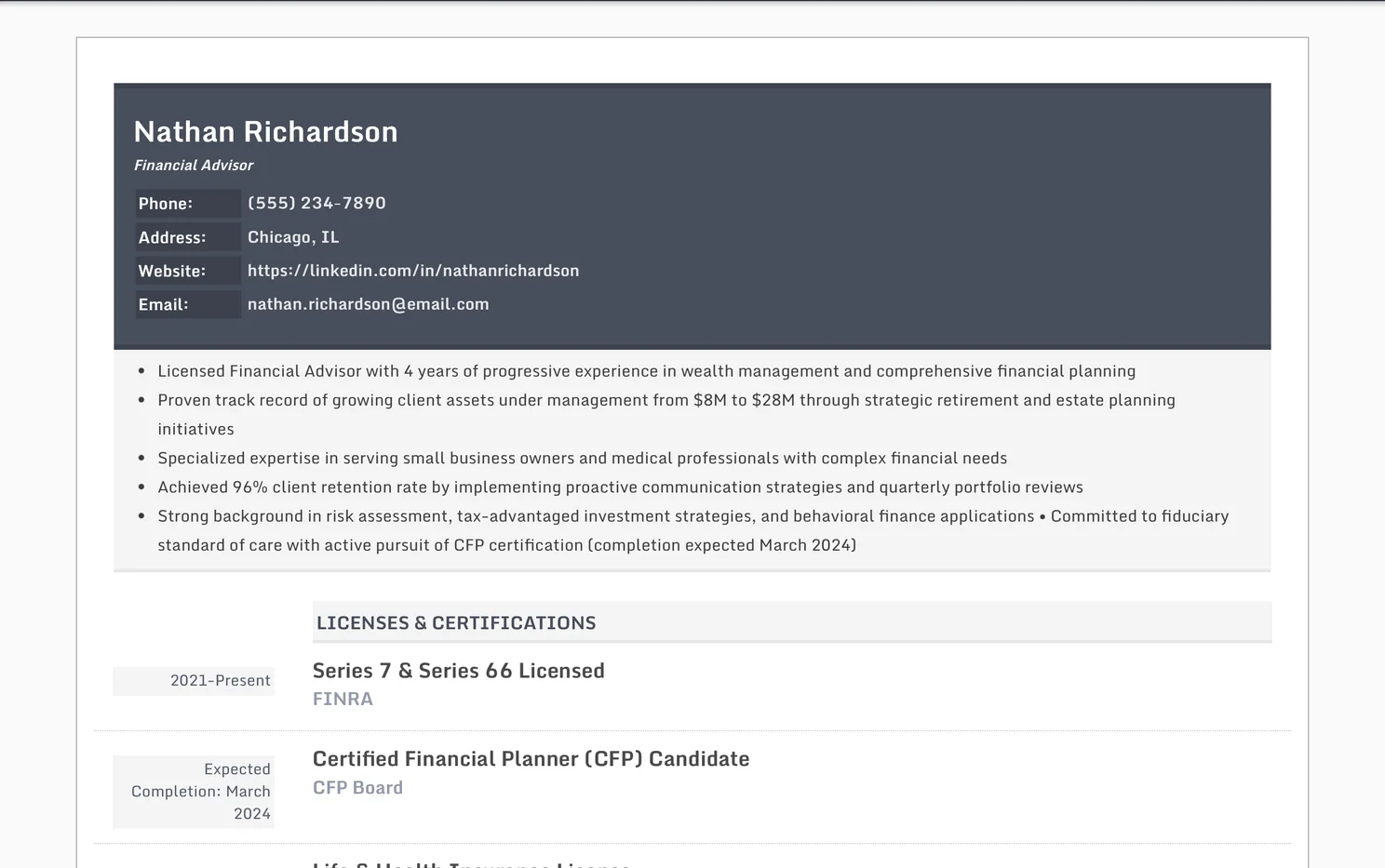
The Best Financial Advisor Resume Example/Sample
https://www.resumonk.com/financial-advisor-resumeFinancial AdvisorResume Format to Follow for Financial Advisor Resume
Let's paint a picture together - you're sitting across from a potential client, explaining complex investment strategies in simple terms, building trust with every word.
That same clarity and professionalism needs to shine through your resume before you ever get that meeting. As someone stepping into the Financial Advisor role, whether you're transitioning from banking, insurance sales, or fresh from your Series 7 exam, your resume format needs to mirror the organized, detail-oriented approach you'll bring to managing client portfolios.
The Reverse-Chronological Format - Your Best Friend
For Financial Advisors, the reverse-chronological format works like compound interest - it builds credibility from your most recent achievements backward. This format immediately showcases your current certifications, recent client wins, and fresh industry knowledge at the top where hiring managers look first.
Think about it - financial services evolve rapidly, and showing you're current with today's market conditions matters more than what you did five years ago.
Your resume should flow in this order - Contact Information, Professional Summary, Licenses & Certifications (yes, before experience for this role), Professional Experience, Education, and finally, relevant Skills. This structure tells your story the way a Financial Advisor would present a portfolio review - most important metrics upfront, supporting details following.
The One-Page vs Two-Page Debate
Entry-level Financial Advisors with under five years of experience should stick to one page. You're likely coming from retail banking, insurance, or straight from college with an internship or two. That's perfectly fine - quality over quantity.
However, if you've been building client books for several years, managed significant AUM (Assets Under Management), or held multiple relevant positions, two pages give you room to quantify your achievements properly.
Remember, in the UK and Australia, CVs tend to run longer with more personal details, while US and Canadian resumes stay concise. UK Financial Advisors often include their FCA registration number prominently, while US advisors lead with FINRA registrations.
Work Experience on Financial Advisor Resume
Your work experience section is where you transform from "someone who worked in finance" to "a trusted advisor who grows wealth." Every Financial Advisor starts somewhere - maybe you were the bank teller who noticed customers needed better investment guidance, or the insurance agent who realized your clients needed comprehensive financial planning beyond just policies.
Structuring Your Financial Advisory Experience
Each role should tell a story of client success and business growth.
Start with your job title, company name, location, and dates. Then comes the magic - your accomplishments written as impact statements, not job descriptions. Financial services hiring managers see hundreds of resumes listing "provided financial advice" or "managed client accounts." They're looking for the advisor who shows HOW they transformed client outcomes.
Here's where many aspiring Financial Advisors stumble. They list duties instead of demonstrating value:
❌ Don't write vague responsibility statements:
• Managed client portfolios
• Sold financial products
• Met with clients regularly
✅ Do write specific, quantified achievements:
• Grew book of business from $12M to $35M AUM within 18 months through strategic retirement planning initiatives
• Achieved 95% client retention rate by implementing quarterly portfolio reviews and proactive market communication
• Generated $450K in new revenue by developing specialized estate planning services for high-net-worth clients
Translating Related Experience
Not everyone comes to Financial Advising through a traditional path. If you're transitioning from retail banking, emphasize your relationship-building and needs assessment skills. Coming from insurance? Highlight your understanding of risk management and long-term financial protection.
Even teachers transitioning to Financial Advising can leverage their ability to explain complex concepts simply - a crucial skill when discussing market volatility with anxious retirees.
For those entry-level positions (yes, even when the job posting says "Financial Advisor Executive" in certain firms, particularly in Asia), focus on any experience with customer service, sales targets, and financial product knowledge. That summer internship at Morgan Stanley? The part-time role at a credit union?
They all count if you frame them correctly.
Skills to Show on Financial Advisor Resume
The skills section of a Financial Advisor resume walks a tightrope between technical expertise and human connection. You're not just a number-cruncher or a salesperson - you're a translator between complex financial markets and individual human dreams.
Whether it's helping a young couple save for their first home or guiding a small business owner toward retirement, your skills need to reflect both dimensions.
Technical Skills That Pay the Bills
Start with the non-negotiables - the technical skills that prove you can actually do the job.
Financial planning software like eMoney, MoneyGuidePro, or NaviPlan should feature prominently. Include your proficiency with CRM systems (Salesforce, Redtail, Wealthbox) because modern advising runs on relationship management. Don't forget portfolio analysis tools, tax planning software, and yes, advanced Excel skills still matter immensely.
But here's what separates good Financial Advisor resumes from great ones - specificity in technical skills:
❌ Don't list generic technical skills:
• Financial planning software
• Microsoft Office
• Investment knowledge
✅ Do specify your technical proficiencies:
• Monte Carlo simulation modeling for retirement income planning
• Tax-loss harvesting strategies using Rebalance Expert
• Estate planning documentation with Vanilla trust structures
The Soft Skills That Build Trust
Financial Advising lives and dies on trust.
Your soft skills section should reflect the emotional intelligence required to guide someone through their financial anxieties. Communication isn't just about talking - it's about translating beta coefficients into "here's how this protects your daughter's college fund." Include relationship building, active listening, and educational presentation skills.
Consider the psychology of your role. You're part therapist when markets crash, part cheerleader when clients doubt their saving ability, and part educator every single day. Skills like "behavioral finance application" or "client psychology in market volatility" show you understand the human side of money management.
Regulatory and Compliance Skills
In the US, your Series 7, 66, or 63 licenses aren't just skills - they're your entry tickets. In the UK, your Level 4 Diploma in Financial Planning or Chartered status carries similar weight. Canadian advisors need their CSC and CPH. Don't bury these in education - feature them prominently in skills when they're current and active.
Include your understanding of fiduciary responsibility, KYC procedures, and relevant regulatory frameworks like FINRA, FCA, or IIROC compliance.
Specific Considerations and Tips for Financial Advisor Resume
Here's what nobody tells you about Financial Advisor resumes - they're being read by two very different audiences. First, the HR manager or recruiting firm that needs to check boxes for licenses and experience. Second, the practice manager or senior advisor who's thinking, "Can I trust this person with my clients when I'm on vacation?"
Your resume needs to speak both languages fluently.
The AUM Question - To Include or Not?
Assets Under Management is the Financial Advisor's scorecard, but revealing it requires strategy.
If you're managing over $50M, absolutely include it - that's proven territory. Under $20M? Focus on growth percentage instead. Grew AUM by 200% sounds more impressive than managing $8M, even though both might represent the same achievement. For entry-level advisors without personal AUM, mention the team or branch AUM you supported.
Regional differences matter here. US advisors typically showcase individual production numbers, while UK advisors often emphasize team-based achievements. Australian advisors should note if they've worked under FASEA's new education standards, while Canadian advisors should highlight any experience with the new Client Focused Reforms.
The Compliance Minefield
Financial services is one of the few industries where what you DON'T say can disqualify you. Never imply you provided services beyond your licensing. If you "assisted" senior advisors with portfolio construction before getting your Series 7, say exactly that - assisted, supported, or analyzed under supervision.
Compliance departments scrutinize Financial Advisor resumes for any hint of overstatement that could create regulatory risk.
❌ Don't overstate your authority level:
• Advised high-net-worth clients on investment strategies (when unlicensed)
• Managed discretionary portfolios
✅ Do accurately represent your role:
• Supported senior advisors in preparing investment proposals for high-net-worth clients
• Analyzed portfolio performance and prepared rebalancing recommendations for advisor review
The Niche Advantage
Generic Financial Advisors struggle. Specialized Financial Advisors thrive. If you've developed expertise in divorce financial planning, mention it prominently. Focus on serving medical professionals? Lead with that.
Even at entry-level, showing interest in a specific niche - through relevant coursework, volunteer work with that demographic, or targeted networking group membership - sets you apart.
The Production vs. Planning Balance
The industry is shifting from product sales to fee-based planning, but different firms value different approaches. Research your target firm's model. Wirehouse positions might emphasize production numbers and new account openings. RIA firms want to see financial planning depth and client retention metrics. Bank-based advisor roles often blend both, plus cross-selling achievements. Tailor your achievements accordingly - the same experience can be framed as "$2M in annuity sales" or "Secured retirement income for 30 families through appropriate annuity strategies."
The Reference Reality
Unlike other industries, Financial Advisor references carry unique weight because of the portable book of business question.
Hiring managers want to know - are clients loyal to you or your firm? Include a line like "References available upon request, including client testimonials where permissible" to signal you understand the delicate nature of client relationships while changing firms.
Never promise what client agreements or non-solicitation clauses won't allow.
Education Requirements and Listing for Financial Advisor Resume
As someone stepping into the Financial Advisor role, you're likely coming from one of several backgrounds - perhaps you studied finance or economics in college, maybe you pivoted from accounting or banking, or you might be that mathematics whiz who realized helping people achieve financial freedom beats solving abstract equations.
Whatever your path, your education section needs to tell a story that says "I have the foundational knowledge to handle your money wisely."
Core Educational Requirements to Highlight
Financial Advisory isn't like other fields where a specific degree is mandatory, but certain educational backgrounds shine brighter than others. Your bachelor's degree in Finance, Economics, Business Administration, Accounting, or even Mathematics should take center stage.
But here's where it gets interesting - the way you present this education can make the difference between looking like just another finance graduate and someone destined to guide financial futures.
When listing your degree, don't just state the obvious. Financial institutions want to see relevant coursework that directly applies to client advisory work. Think about it - your potential employer wants to know if you studied Portfolio Management, not just "Introduction to Business."
❌ Don't write vaguely about your education:
Bachelor of Science in Finance
State University, 2021
GPA: 3.5
✅ Do provide context that relates to financial advisory:
Bachelor of Science in Finance
State University, New York, NY | May 2021
GPA: 3.7/4.0
Relevant Coursework: Investment Analysis, Portfolio Management, Personal Financial Planning,
Risk Management, Estate Planning, Tax Strategy for Individuals
Professional Certifications and Licenses - Your Real Educational Gold
Here's the reality check - in financial advisory, your formal education gets you in the door, but your professional certifications keep you in the room. The Series 7 and Series 66 licenses aren't just nice-to-haves; they're your license to operate. If you have them, they should appear prominently.
If you're pursuing them, mention that too - it shows initiative and understanding of the role's requirements.
The CFP (Certified Financial Planner) certification is like the holy grail for Financial Advisors. Even if you're still working toward it, showing you're on that path demonstrates serious commitment. Remember, clients often specifically seek out CFP professionals, so this isn't just resume decoration - it's a business generator.
LICENSES & CERTIFICATIONS
• Series 7 & Series 66 Licensed | FINRA | 2022
• Certified Financial Planner (CFP) Candidate | Expected Completion: March 2024
• Life & Health Insurance License | State of California | 2021
Educational Placement Strategy for Different Career Stages
If you're fresh out of college with that finance degree still warm from the printer, your education takes a prominent position - right after your summary.
You're essentially saying, "I may not have decades of experience, but I have cutting-edge knowledge and hunger to apply it." However, if you've been in banking for five years and are transitioning to financial advisory, your education supports your experience, not the other way around.
For career changers, consider adding a brief "Continuing Education" subsection. Those weekend courses in Wealth Management or that online certification in Retirement Planning show you're actively pivoting, not just hoping to stumble into financial advisory.
Awards, Achievements and Publications on Financial Advisor Resume
As a Financial Advisor, you're not just competing with other advisors at different firms; you're often competing with robo-advisors, DIY investing apps, and that client's brother-in-law who "knows stocks." Your awards and publications prove you bring something algorithms and amateur hour can't match - recognized expertise and the ability to communicate it.
Academic and Professional Awards That Matter
Not all awards are created equal in the financial advisory world. That "Employee of the Month" parking spot was nice, but what really matters are recognitions that speak to your ability to manage wealth, serve clients, or demonstrate ethical leadership in finance. Dean's List matters if you're entry-level. "Top Producer" or "President's Club" matters if you're experienced.
Ethics awards matter at every level because, let's face it, you're asking people to trust you with their life savings.
❌ Don't list generic or outdated awards:
Perfect Attendance Award - 2019
Best Dressed in Office - 2020
High School Valedictorian - 2015
✅ Do highlight awards relevant to financial advisory and client service:
• Five Star Wealth Manager Award | 2023 | Recognized by clients for exceptional service
• President's Club | Northwestern Mutual | 2022 | Top 10% of advisors nationally
• CFA Institute Research Challenge Winner | Regional Finals | 2021
• Dean's List | All semesters | University of Chicago | 2018-2021
Publications and Thought Leadership
Here's something most new Financial Advisors don't realize - those articles you write for the company newsletter or LinkedIn aren't just marketing fluff. They're proof you can take complex financial concepts and make them digestible for real people.
In a field where explaining compound interest without inducing naptime is a superpower, your published work demonstrates communication skills that directly translate to client success.
Maybe you've written about retirement planning strategies for the local business journal, or perhaps you maintain a blog about millennial investing habits. These publications show you're not just executing trades - you're thinking deeply about financial trends and sharing insights that help people make better decisions.
PUBLICATIONS & THOUGHT LEADERSHIP
• "Roth Conversions in a Rising Tax Environment" | Journal of Financial Planning | March 2023
• "ESG Investing: Beyond the Buzzwords" | Company Newsletter | Monthly column 2022-Present
• Contributing Author | "Millennial Money Moves" Blog | 50+ articles on personal finance
• Quoted Expert | "Retirement Planning in Uncertain Times" | Wall Street Journal | January 2023
Professional Memberships and Industry Recognition
Your membership in the Financial Planning Association (FPA) or National Association of Personal Financial Advisors (NAPFA) isn't just about networking events with mediocre coffee.
These memberships signal you're serious about staying current with industry best practices and ethical standards. If you're actively involved - serving on committees, speaking at events, or mentoring new advisors - that engagement transforms a simple membership line into evidence of industry leadership.
For those in specialized markets, relevant recognitions matter enormously. If you're focusing on physician wealth management, that "Top Advisor for Medical Professionals" recognition from Medical Economics magazine carries more weight than generic industry awards.
Similarly, if you're building expertise in sustainable investing, recognition from ESG-focused organizations resonates with environmentally conscious clients.
Strategic References for Financial Advisor Resume
The financial services industry is surprisingly small when you've been in it long enough.
That senior advisor who mentored you might know the hiring manager from their CFP certification program. Your current branch manager might have worked with your prospective employer at a previous firm. These connections matter, and choosing the right references can open doors that your resume alone cannot.
Selecting References That Reinforce Your Advisory Capabilities
Your reference lineup should tell a story about your capabilities as a Financial Advisor. Ideally, you want a mix that covers different aspects of the role - someone who can speak to your technical knowledge, another who can attest to your client relationship skills, and perhaps a third who can vouch for your ethical standards and professional development.
The gold standard reference is a senior advisor or branch manager who has directly observed your client interactions. They can speak to specifics - how you handled that nervous retiree during the market downturn, or how you built trust with skeptical small business owners.
Next in line might be a compliance officer who can attest to your attention to regulatory details, or a colleague who partnered with you on complex financial plans.
❌ Don't list references without context or relevance:
REFERENCES
John Smith - (555) 123-4567
Jane Doe - [email protected]
Bob Johnson - Available upon request
✅ Do provide strategic references with clear relationships:
PROFESSIONAL REFERENCES

Michael Thompson, CFP®, ChFC
Senior Vice President - Wealth Management | Morgan Advisory Group
Relationship: Direct Supervisor (2021-Present)
(555) 234-5678 | [email protected]

Sarah Chen, CPA
Partner | Chen & Associates Tax Advisory
Relationship: Professional Collaborator on 50+ client tax strategies
(555) 345-6789 | [email protected]

Dr. Robert Williams
Client | Retired Physician
Relationship: Long-term client willing to attest to advisory approach
(555) 456-7890 | [email protected]
The Client Reference - A Powerful Differentiator
Here's something most Financial Advisor candidates don't consider - including a satisfied client as a reference.
Obviously, this requires careful consideration of confidentiality and appropriateness, but a client who's willing to speak about their experience working with you provides unmatched credibility. This is particularly powerful if you're moving to a firm that serves a similar demographic.
When including a client reference, ensure they're prepared for potential contact and understand what aspects of your service they should highlight. A client who can articulate how you helped them navigate a complex financial transition or achieve a significant goal provides third-party validation that no colleague reference can match.
Managing References During Career Transitions
If you're currently employed at another financial firm, reference management becomes delicate.
You can't exactly ask your current manager to be a reference without signaling your intent to leave. This is where strategic relationship building pays off - perhaps a former manager who moved to another firm, a senior advisor who recently retired, or colleagues from professional associations who know your work quality.
For those transitioning into financial advisory from adjacent fields, your references need to bridge that gap. A reference from your banking role should emphasize your client service skills and ability to understand financial needs. Someone from your insurance background might highlight your risk assessment abilities and ethical sales approach.
International and Regional Considerations
Reference expectations vary significantly across regions. In the United States, "References available upon request" is still common, though providing them upfront shows confidence. In the UK, expect to provide at least two references, typically including your current or most recent employer. Canadian employers often want three references and may specifically request one from a direct supervisor.
Australian firms frequently conduct thorough reference checks and appreciate when you provide LinkedIn profiles alongside contact information.
For international moves, consider including a reference who can speak to your ability to adapt to different regulatory environments or serve diverse client bases. If you're applying to a firm with a specific cultural focus - serving the Chinese-American community in San Francisco, for instance - a reference who can speak to your cultural competency and language skills becomes invaluable.
Maintaining Your Reference Network
Your references are more than just names on a list - they're professional advocates who deserve ongoing relationship maintenance.
Keep them updated on your career progress, send holiday greetings, and offer to reciprocate when they need references. Remember, in financial services, today's reference might be tomorrow's referral source for high-net-worth clients or your connection to your next opportunity.
Finally, always notify your references when you've given their information to a potential employer. Brief them on the role, the firm, and what aspects of your experience might be most relevant.
A prepared reference who can speak specifically to why you'd excel at THIS particular Financial Advisor role at THIS specific firm makes a far stronger impression than someone caught off-guard by an unexpected call.
Cover Letter Strategies for Financial Advisor Resume
Your cover letter isn't just a resume narrator - it's your first consultation with your potential employer. Think about it this way: every day as a Financial Advisor, you'll need to quickly establish rapport with clients, understand their unique situations, and articulate how you can help them.
Your cover letter is essentially you demonstrating these exact skills to your future employer.
Opening With Purpose and Connection
The traditional "I am writing to apply for..." opener is like starting a client meeting with "I'm here to sell you financial products." Instead, you want to immediately establish why this specific firm and role align with your professional mission.
Maybe you've been following the firm's innovative approach to fee-only advising, or perhaps you're drawn to their focus on serving small business owners - whatever it is, make that connection clear from the start.
❌ Don't open with generic enthusiasm:
Dear Hiring Manager,
I am excited to apply for the Financial Advisor position at your company.
I have always been passionate about finance and helping people.
✅ Do open with specific connection and value:
Dear Ms. Johnson,
When I read about Wealth Partners' commitment to providing fee-only fiduciary advice to middle-income families - a demographic often overlooked by traditional wealth management firms - I immediately recognized an alignment with my own mission to democratize quality financial planning.
Demonstrating Your Advisory Approach
The body of your cover letter should showcase not just what you've done, but how you think about financial advisory. Employers want to understand your philosophy toward client relationships, your approach to financial planning, and your ability to translate complex financial strategies into actionable advice.
This is where you differentiate yourself from candidates who can merely recite investment principles.
Use specific examples that demonstrate your advisory skills in action. Maybe you helped a young family restructure their debt while building an education fund, or perhaps you guided a small business owner through retirement plan options.
These stories show you understand that financial advising is about people, not just portfolios.
In my current role at Regional Bank, I've developed a consultative approach that begins with understanding each client's unique life goals before discussing any financial products.
For instance, when meeting with a recently divorced teacher worried about retirement,
I first mapped out her complete financial picture, identified that her pension would cover basic expenses, and then created a supplementary investment strategy focused on generating additional income for the lifestyle goals that mattered most to her.
Addressing Career Transitions and Demonstrating Fit
If you're transitioning from banking, insurance sales, or even teaching, your cover letter needs to bridge that gap convincingly.
Don't apologize for your non-traditional path - instead, show how your unique background adds value. That teaching experience? It means you can explain complex concepts clearly. Your insurance background? You understand risk management intimately.
For entry-level candidates, focus on relevant internships, academic projects, or even personal experiences that demonstrate your understanding of financial planning principles. Maybe you helped your family navigate a financial crisis, or perhaps you managed investment funds for a student organization. These experiences, properly framed, show practical application of your knowledge.
Regional Considerations and Closing Strong
If you're applying in different regions, be aware of market nuances. A cover letter for a Financial Advisor role in Silicon Valley might emphasize your understanding of equity compensation and tech industry wealth management, while one for a position in Florida might highlight expertise in retirement planning and estate preservation.
Canadian applications should reference your understanding of RRSPs and TFSAs, while UK positions might require familiarity with ISAs and pension freedoms.
Your closing should reiterate your value proposition and include a clear call to action. Remember, as a Financial Advisor, you'll need to guide clients toward decisions - show you can guide your reader toward the next step too.
I would welcome the opportunity to discuss how my client-centered approach to financial planning and track record of building lasting advisory relationships could contribute to FirstChoice Financial's continued growth. I am available for an interview at your convenience and can be reached at (555) 123-4567 or [email protected].
Key Takeaways
After diving deep into every aspect of creating a compelling Financial Advisor resume, here are the essential points to keep with you as you craft your own:
- Use reverse-chronological format with Licenses & Certifications placed prominently (often before experience) to immediately establish your legal authority to practice
- Quantify everything possible - AUM growth percentages, client retention rates, revenue generated, number of clients served - numbers build credibility in finance
- Frame experience as client outcomes, not job duties - show how you transformed client financial situations rather than listing what you were supposed to do
- Balance technical skills with trust-building soft skills - include specific software/tools alongside relationship management and communication abilities
- Customize for your target firm type - wirehouses want production numbers, RIAs value planning depth, banks appreciate cross-selling achievements
- Be precise with compliance language - never overstate your authority level or imply you provided services beyond your licensing
- Include relevant education details beyond just degree names - highlight coursework directly applicable to financial planning and wealth management
- Feature professional certifications prominently - CFP, ChFC, Series licenses are often more important than your undergraduate degree
- Develop a niche focus even at entry-level - whether it's divorce planning, medical professionals, or sustainable investing, specialization sells
- Choose references strategically - mix supervisors who can attest to technical skills with clients or colleagues who can vouch for your advisory approach
Creating a Financial Advisor resume that opens doors requires more than just listing your qualifications - it demands strategically presenting your unique value proposition in a highly competitive, trust-based industry. That's where Resumonk makes the difference. Our AI-powered recommendations understand the specific requirements of financial services roles, helping you optimize each section while our professionally designed templates ensure your resume looks as polished and trustworthy as you'll be in client meetings. Whether you're transitioning from banking, building on insurance experience, or starting fresh with your newly minted Series 7, Resumonk guides you through creating a resume that speaks to both HR screeners checking boxes and senior advisors looking for their next team member.
Ready to build your Financial Advisor resume with confidence?
Join thousands of financial professionals who've successfully landed their ideal advisory roles using Resumonk's intelligent resume builder, complete with industry-specific templates and expert guidance tailored for Financial Advisors.
Start Building Your Financial Advisor Resume →
More Banking & Finance resume examples
- Bank Teller resume example
- Financial Analyst resume example
- Mortgage Loan Officer resume example
- Banker resume example
See all Banking & Finance resume examples, or browse every category.
Resume writing tips
Picture yourself at 7:30 AM, coffee in hand, scanning market updates while mentally preparing for your 9 AM meeting with the Johnsons about their retirement portfolio.
You're not just someone who understands P/E ratios and bond yields - you're the person families trust with their daughter's college fund, their dream home down payment, and their golden years' security. Yet here you are, staring at a blank document, wondering how to capture all of that expertise, trustworthiness, and genuine desire to help people achieve financial freedom into a two-page resume that gets you past the first screening.
Whether you're that bank teller who's spent the last three years watching customers struggle with basic investment decisions and finally earned your Series 7, or the insurance agent who realized your clients need comprehensive wealth planning beyond just protection products, or perhaps the mathematics major who discovered that helping real people build wealth beats theoretical modeling - you're here because you know a Financial Advisor resume needs to be different. It can't just list your licenses and say you're "passionate about finance." It needs to prove you can translate complex financial concepts into life-changing advice while building the kind of trust that makes someone comfortable handing over their life savings.
This guide walks you through every element of crafting that perfect Financial Advisor resume, starting with choosing the right format that showcases your progression (spoiler alert - reverse-chronological works best for this role). We'll dive deep into structuring your work experience to highlight client wins over mundane duties, selecting skills that balance technical expertise with the soft skills that actually close deals, and presenting your education and certifications in a way that builds immediate credibility. You'll learn the subtle art of including Awards and Publications that matter, crafting a cover letter that demonstrates your advisory approach, and selecting references who can vouch for your ability to handle someone's financial future.
We'll also tackle the nuances that make Financial Advisor resumes unique - how to handle the AUM question, navigating compliance landmines when describing past roles, positioning yourself for different types of firms (wirehouses versus RIAs versus banks), and adapting your resume for regional differences from Wall Street to Main Street. By the time you finish reading, you'll understand not just what to write, but why each element matters in an industry where trust, competence, and communication skills determine whether you're managing millions or struggling to build your book.
The Best Financial Advisor Resume Example/Sample
https://www.resumonk.com/financial-advisor-resumeFinancial AdvisorResume Format to Follow for Financial Advisor Resume
Let's paint a picture together - you're sitting across from a potential client, explaining complex investment strategies in simple terms, building trust with every word.
That same clarity and professionalism needs to shine through your resume before you ever get that meeting. As someone stepping into the Financial Advisor role, whether you're transitioning from banking, insurance sales, or fresh from your Series 7 exam, your resume format needs to mirror the organized, detail-oriented approach you'll bring to managing client portfolios.
The Reverse-Chronological Format - Your Best Friend
For Financial Advisors, the reverse-chronological format works like compound interest - it builds credibility from your most recent achievements backward. This format immediately showcases your current certifications, recent client wins, and fresh industry knowledge at the top where hiring managers look first.
Think about it - financial services evolve rapidly, and showing you're current with today's market conditions matters more than what you did five years ago.
Your resume should flow in this order - Contact Information, Professional Summary, Licenses & Certifications (yes, before experience for this role), Professional Experience, Education, and finally, relevant Skills. This structure tells your story the way a Financial Advisor would present a portfolio review - most important metrics upfront, supporting details following.
The One-Page vs Two-Page Debate
Entry-level Financial Advisors with under five years of experience should stick to one page. You're likely coming from retail banking, insurance, or straight from college with an internship or two. That's perfectly fine - quality over quantity.
However, if you've been building client books for several years, managed significant AUM (Assets Under Management), or held multiple relevant positions, two pages give you room to quantify your achievements properly.
Remember, in the UK and Australia, CVs tend to run longer with more personal details, while US and Canadian resumes stay concise. UK Financial Advisors often include their FCA registration number prominently, while US advisors lead with FINRA registrations.
Work Experience on Financial Advisor Resume
Your work experience section is where you transform from "someone who worked in finance" to "a trusted advisor who grows wealth." Every Financial Advisor starts somewhere - maybe you were the bank teller who noticed customers needed better investment guidance, or the insurance agent who realized your clients needed comprehensive financial planning beyond just policies.
Structuring Your Financial Advisory Experience
Each role should tell a story of client success and business growth.
Start with your job title, company name, location, and dates. Then comes the magic - your accomplishments written as impact statements, not job descriptions. Financial services hiring managers see hundreds of resumes listing "provided financial advice" or "managed client accounts." They're looking for the advisor who shows HOW they transformed client outcomes.
Here's where many aspiring Financial Advisors stumble. They list duties instead of demonstrating value:
❌ Don't write vague responsibility statements:
• Managed client portfolios
• Sold financial products
• Met with clients regularly
✅ Do write specific, quantified achievements:
• Grew book of business from $12M to $35M AUM within 18 months through strategic retirement planning initiatives
• Achieved 95% client retention rate by implementing quarterly portfolio reviews and proactive market communication
• Generated $450K in new revenue by developing specialized estate planning services for high-net-worth clients
Translating Related Experience
Not everyone comes to Financial Advising through a traditional path. If you're transitioning from retail banking, emphasize your relationship-building and needs assessment skills. Coming from insurance? Highlight your understanding of risk management and long-term financial protection.
Even teachers transitioning to Financial Advising can leverage their ability to explain complex concepts simply - a crucial skill when discussing market volatility with anxious retirees.
For those entry-level positions (yes, even when the job posting says "Financial Advisor Executive" in certain firms, particularly in Asia), focus on any experience with customer service, sales targets, and financial product knowledge. That summer internship at Morgan Stanley? The part-time role at a credit union?
They all count if you frame them correctly.
Skills to Show on Financial Advisor Resume
The skills section of a Financial Advisor resume walks a tightrope between technical expertise and human connection. You're not just a number-cruncher or a salesperson - you're a translator between complex financial markets and individual human dreams.
Whether it's helping a young couple save for their first home or guiding a small business owner toward retirement, your skills need to reflect both dimensions.
Technical Skills That Pay the Bills
Start with the non-negotiables - the technical skills that prove you can actually do the job.
Financial planning software like eMoney, MoneyGuidePro, or NaviPlan should feature prominently. Include your proficiency with CRM systems (Salesforce, Redtail, Wealthbox) because modern advising runs on relationship management. Don't forget portfolio analysis tools, tax planning software, and yes, advanced Excel skills still matter immensely.
But here's what separates good Financial Advisor resumes from great ones - specificity in technical skills:
❌ Don't list generic technical skills:
• Financial planning software
• Microsoft Office
• Investment knowledge
✅ Do specify your technical proficiencies:
• Monte Carlo simulation modeling for retirement income planning
• Tax-loss harvesting strategies using Rebalance Expert
• Estate planning documentation with Vanilla trust structures
The Soft Skills That Build Trust
Financial Advising lives and dies on trust.
Your soft skills section should reflect the emotional intelligence required to guide someone through their financial anxieties. Communication isn't just about talking - it's about translating beta coefficients into "here's how this protects your daughter's college fund." Include relationship building, active listening, and educational presentation skills.
Consider the psychology of your role. You're part therapist when markets crash, part cheerleader when clients doubt their saving ability, and part educator every single day. Skills like "behavioral finance application" or "client psychology in market volatility" show you understand the human side of money management.
Regulatory and Compliance Skills
In the US, your Series 7, 66, or 63 licenses aren't just skills - they're your entry tickets. In the UK, your Level 4 Diploma in Financial Planning or Chartered status carries similar weight. Canadian advisors need their CSC and CPH. Don't bury these in education - feature them prominently in skills when they're current and active.
Include your understanding of fiduciary responsibility, KYC procedures, and relevant regulatory frameworks like FINRA, FCA, or IIROC compliance.
Specific Considerations and Tips for Financial Advisor Resume
Here's what nobody tells you about Financial Advisor resumes - they're being read by two very different audiences. First, the HR manager or recruiting firm that needs to check boxes for licenses and experience. Second, the practice manager or senior advisor who's thinking, "Can I trust this person with my clients when I'm on vacation?"
Your resume needs to speak both languages fluently.
The AUM Question - To Include or Not?
Assets Under Management is the Financial Advisor's scorecard, but revealing it requires strategy.
If you're managing over $50M, absolutely include it - that's proven territory. Under $20M? Focus on growth percentage instead. Grew AUM by 200% sounds more impressive than managing $8M, even though both might represent the same achievement. For entry-level advisors without personal AUM, mention the team or branch AUM you supported.
Regional differences matter here. US advisors typically showcase individual production numbers, while UK advisors often emphasize team-based achievements. Australian advisors should note if they've worked under FASEA's new education standards, while Canadian advisors should highlight any experience with the new Client Focused Reforms.
The Compliance Minefield
Financial services is one of the few industries where what you DON'T say can disqualify you. Never imply you provided services beyond your licensing. If you "assisted" senior advisors with portfolio construction before getting your Series 7, say exactly that - assisted, supported, or analyzed under supervision.
Compliance departments scrutinize Financial Advisor resumes for any hint of overstatement that could create regulatory risk.
❌ Don't overstate your authority level:
• Advised high-net-worth clients on investment strategies (when unlicensed)
• Managed discretionary portfolios
✅ Do accurately represent your role:
• Supported senior advisors in preparing investment proposals for high-net-worth clients
• Analyzed portfolio performance and prepared rebalancing recommendations for advisor review
The Niche Advantage
Generic Financial Advisors struggle. Specialized Financial Advisors thrive. If you've developed expertise in divorce financial planning, mention it prominently. Focus on serving medical professionals? Lead with that.
Even at entry-level, showing interest in a specific niche - through relevant coursework, volunteer work with that demographic, or targeted networking group membership - sets you apart.
The Production vs. Planning Balance
The industry is shifting from product sales to fee-based planning, but different firms value different approaches. Research your target firm's model. Wirehouse positions might emphasize production numbers and new account openings. RIA firms want to see financial planning depth and client retention metrics. Bank-based advisor roles often blend both, plus cross-selling achievements. Tailor your achievements accordingly - the same experience can be framed as "$2M in annuity sales" or "Secured retirement income for 30 families through appropriate annuity strategies."
The Reference Reality
Unlike other industries, Financial Advisor references carry unique weight because of the portable book of business question.
Hiring managers want to know - are clients loyal to you or your firm? Include a line like "References available upon request, including client testimonials where permissible" to signal you understand the delicate nature of client relationships while changing firms.
Never promise what client agreements or non-solicitation clauses won't allow.
Education Requirements and Listing for Financial Advisor Resume
As someone stepping into the Financial Advisor role, you're likely coming from one of several backgrounds - perhaps you studied finance or economics in college, maybe you pivoted from accounting or banking, or you might be that mathematics whiz who realized helping people achieve financial freedom beats solving abstract equations.
Whatever your path, your education section needs to tell a story that says "I have the foundational knowledge to handle your money wisely."
Core Educational Requirements to Highlight
Financial Advisory isn't like other fields where a specific degree is mandatory, but certain educational backgrounds shine brighter than others. Your bachelor's degree in Finance, Economics, Business Administration, Accounting, or even Mathematics should take center stage.
But here's where it gets interesting - the way you present this education can make the difference between looking like just another finance graduate and someone destined to guide financial futures.
When listing your degree, don't just state the obvious. Financial institutions want to see relevant coursework that directly applies to client advisory work. Think about it - your potential employer wants to know if you studied Portfolio Management, not just "Introduction to Business."
❌ Don't write vaguely about your education:
Bachelor of Science in Finance
State University, 2021
GPA: 3.5
✅ Do provide context that relates to financial advisory:
Bachelor of Science in Finance
State University, New York, NY | May 2021
GPA: 3.7/4.0
Relevant Coursework: Investment Analysis, Portfolio Management, Personal Financial Planning,
Risk Management, Estate Planning, Tax Strategy for Individuals
Professional Certifications and Licenses - Your Real Educational Gold
Here's the reality check - in financial advisory, your formal education gets you in the door, but your professional certifications keep you in the room. The Series 7 and Series 66 licenses aren't just nice-to-haves; they're your license to operate. If you have them, they should appear prominently.
If you're pursuing them, mention that too - it shows initiative and understanding of the role's requirements.
The CFP (Certified Financial Planner) certification is like the holy grail for Financial Advisors. Even if you're still working toward it, showing you're on that path demonstrates serious commitment. Remember, clients often specifically seek out CFP professionals, so this isn't just resume decoration - it's a business generator.
LICENSES & CERTIFICATIONS
• Series 7 & Series 66 Licensed | FINRA | 2022
• Certified Financial Planner (CFP) Candidate | Expected Completion: March 2024
• Life & Health Insurance License | State of California | 2021
Educational Placement Strategy for Different Career Stages
If you're fresh out of college with that finance degree still warm from the printer, your education takes a prominent position - right after your summary.
You're essentially saying, "I may not have decades of experience, but I have cutting-edge knowledge and hunger to apply it." However, if you've been in banking for five years and are transitioning to financial advisory, your education supports your experience, not the other way around.
For career changers, consider adding a brief "Continuing Education" subsection. Those weekend courses in Wealth Management or that online certification in Retirement Planning show you're actively pivoting, not just hoping to stumble into financial advisory.
Awards, Achievements and Publications on Financial Advisor Resume
As a Financial Advisor, you're not just competing with other advisors at different firms; you're often competing with robo-advisors, DIY investing apps, and that client's brother-in-law who "knows stocks." Your awards and publications prove you bring something algorithms and amateur hour can't match - recognized expertise and the ability to communicate it.
Academic and Professional Awards That Matter
Not all awards are created equal in the financial advisory world. That "Employee of the Month" parking spot was nice, but what really matters are recognitions that speak to your ability to manage wealth, serve clients, or demonstrate ethical leadership in finance. Dean's List matters if you're entry-level. "Top Producer" or "President's Club" matters if you're experienced.
Ethics awards matter at every level because, let's face it, you're asking people to trust you with their life savings.
❌ Don't list generic or outdated awards:
Perfect Attendance Award - 2019
Best Dressed in Office - 2020
High School Valedictorian - 2015
✅ Do highlight awards relevant to financial advisory and client service:
• Five Star Wealth Manager Award | 2023 | Recognized by clients for exceptional service
• President's Club | Northwestern Mutual | 2022 | Top 10% of advisors nationally
• CFA Institute Research Challenge Winner | Regional Finals | 2021
• Dean's List | All semesters | University of Chicago | 2018-2021
Publications and Thought Leadership
Here's something most new Financial Advisors don't realize - those articles you write for the company newsletter or LinkedIn aren't just marketing fluff. They're proof you can take complex financial concepts and make them digestible for real people.
In a field where explaining compound interest without inducing naptime is a superpower, your published work demonstrates communication skills that directly translate to client success.
Maybe you've written about retirement planning strategies for the local business journal, or perhaps you maintain a blog about millennial investing habits. These publications show you're not just executing trades - you're thinking deeply about financial trends and sharing insights that help people make better decisions.
PUBLICATIONS & THOUGHT LEADERSHIP
• "Roth Conversions in a Rising Tax Environment" | Journal of Financial Planning | March 2023
• "ESG Investing: Beyond the Buzzwords" | Company Newsletter | Monthly column 2022-Present
• Contributing Author | "Millennial Money Moves" Blog | 50+ articles on personal finance
• Quoted Expert | "Retirement Planning in Uncertain Times" | Wall Street Journal | January 2023
Professional Memberships and Industry Recognition
Your membership in the Financial Planning Association (FPA) or National Association of Personal Financial Advisors (NAPFA) isn't just about networking events with mediocre coffee.
These memberships signal you're serious about staying current with industry best practices and ethical standards. If you're actively involved - serving on committees, speaking at events, or mentoring new advisors - that engagement transforms a simple membership line into evidence of industry leadership.
For those in specialized markets, relevant recognitions matter enormously. If you're focusing on physician wealth management, that "Top Advisor for Medical Professionals" recognition from Medical Economics magazine carries more weight than generic industry awards.
Similarly, if you're building expertise in sustainable investing, recognition from ESG-focused organizations resonates with environmentally conscious clients.
Strategic References for Financial Advisor Resume
The financial services industry is surprisingly small when you've been in it long enough.
That senior advisor who mentored you might know the hiring manager from their CFP certification program. Your current branch manager might have worked with your prospective employer at a previous firm. These connections matter, and choosing the right references can open doors that your resume alone cannot.
Selecting References That Reinforce Your Advisory Capabilities
Your reference lineup should tell a story about your capabilities as a Financial Advisor. Ideally, you want a mix that covers different aspects of the role - someone who can speak to your technical knowledge, another who can attest to your client relationship skills, and perhaps a third who can vouch for your ethical standards and professional development.
The gold standard reference is a senior advisor or branch manager who has directly observed your client interactions. They can speak to specifics - how you handled that nervous retiree during the market downturn, or how you built trust with skeptical small business owners.
Next in line might be a compliance officer who can attest to your attention to regulatory details, or a colleague who partnered with you on complex financial plans.
❌ Don't list references without context or relevance:
REFERENCES
John Smith - (555) 123-4567
Jane Doe - [email protected]
Bob Johnson - Available upon request
✅ Do provide strategic references with clear relationships:
PROFESSIONAL REFERENCES

Michael Thompson, CFP®, ChFC
Senior Vice President - Wealth Management | Morgan Advisory Group
Relationship: Direct Supervisor (2021-Present)
(555) 234-5678 | [email protected]

Sarah Chen, CPA
Partner | Chen & Associates Tax Advisory
Relationship: Professional Collaborator on 50+ client tax strategies
(555) 345-6789 | [email protected]

Dr. Robert Williams
Client | Retired Physician
Relationship: Long-term client willing to attest to advisory approach
(555) 456-7890 | [email protected]
The Client Reference - A Powerful Differentiator
Here's something most Financial Advisor candidates don't consider - including a satisfied client as a reference.
Obviously, this requires careful consideration of confidentiality and appropriateness, but a client who's willing to speak about their experience working with you provides unmatched credibility. This is particularly powerful if you're moving to a firm that serves a similar demographic.
When including a client reference, ensure they're prepared for potential contact and understand what aspects of your service they should highlight. A client who can articulate how you helped them navigate a complex financial transition or achieve a significant goal provides third-party validation that no colleague reference can match.
Managing References During Career Transitions
If you're currently employed at another financial firm, reference management becomes delicate.
You can't exactly ask your current manager to be a reference without signaling your intent to leave. This is where strategic relationship building pays off - perhaps a former manager who moved to another firm, a senior advisor who recently retired, or colleagues from professional associations who know your work quality.
For those transitioning into financial advisory from adjacent fields, your references need to bridge that gap. A reference from your banking role should emphasize your client service skills and ability to understand financial needs. Someone from your insurance background might highlight your risk assessment abilities and ethical sales approach.
International and Regional Considerations
Reference expectations vary significantly across regions. In the United States, "References available upon request" is still common, though providing them upfront shows confidence. In the UK, expect to provide at least two references, typically including your current or most recent employer. Canadian employers often want three references and may specifically request one from a direct supervisor.
Australian firms frequently conduct thorough reference checks and appreciate when you provide LinkedIn profiles alongside contact information.
For international moves, consider including a reference who can speak to your ability to adapt to different regulatory environments or serve diverse client bases. If you're applying to a firm with a specific cultural focus - serving the Chinese-American community in San Francisco, for instance - a reference who can speak to your cultural competency and language skills becomes invaluable.
Maintaining Your Reference Network
Your references are more than just names on a list - they're professional advocates who deserve ongoing relationship maintenance.
Keep them updated on your career progress, send holiday greetings, and offer to reciprocate when they need references. Remember, in financial services, today's reference might be tomorrow's referral source for high-net-worth clients or your connection to your next opportunity.
Finally, always notify your references when you've given their information to a potential employer. Brief them on the role, the firm, and what aspects of your experience might be most relevant.
A prepared reference who can speak specifically to why you'd excel at THIS particular Financial Advisor role at THIS specific firm makes a far stronger impression than someone caught off-guard by an unexpected call.
Cover Letter Strategies for Financial Advisor Resume
Your cover letter isn't just a resume narrator - it's your first consultation with your potential employer. Think about it this way: every day as a Financial Advisor, you'll need to quickly establish rapport with clients, understand their unique situations, and articulate how you can help them.
Your cover letter is essentially you demonstrating these exact skills to your future employer.
Opening With Purpose and Connection
The traditional "I am writing to apply for..." opener is like starting a client meeting with "I'm here to sell you financial products." Instead, you want to immediately establish why this specific firm and role align with your professional mission.
Maybe you've been following the firm's innovative approach to fee-only advising, or perhaps you're drawn to their focus on serving small business owners - whatever it is, make that connection clear from the start.
❌ Don't open with generic enthusiasm:
Dear Hiring Manager,
I am excited to apply for the Financial Advisor position at your company.
I have always been passionate about finance and helping people.
✅ Do open with specific connection and value:
Dear Ms. Johnson,
When I read about Wealth Partners' commitment to providing fee-only fiduciary advice to middle-income families - a demographic often overlooked by traditional wealth management firms - I immediately recognized an alignment with my own mission to democratize quality financial planning.
Demonstrating Your Advisory Approach
The body of your cover letter should showcase not just what you've done, but how you think about financial advisory. Employers want to understand your philosophy toward client relationships, your approach to financial planning, and your ability to translate complex financial strategies into actionable advice.
This is where you differentiate yourself from candidates who can merely recite investment principles.
Use specific examples that demonstrate your advisory skills in action. Maybe you helped a young family restructure their debt while building an education fund, or perhaps you guided a small business owner through retirement plan options.
These stories show you understand that financial advising is about people, not just portfolios.
In my current role at Regional Bank, I've developed a consultative approach that begins with understanding each client's unique life goals before discussing any financial products.
For instance, when meeting with a recently divorced teacher worried about retirement,
I first mapped out her complete financial picture, identified that her pension would cover basic expenses, and then created a supplementary investment strategy focused on generating additional income for the lifestyle goals that mattered most to her.
Addressing Career Transitions and Demonstrating Fit
If you're transitioning from banking, insurance sales, or even teaching, your cover letter needs to bridge that gap convincingly.
Don't apologize for your non-traditional path - instead, show how your unique background adds value. That teaching experience? It means you can explain complex concepts clearly. Your insurance background? You understand risk management intimately.
For entry-level candidates, focus on relevant internships, academic projects, or even personal experiences that demonstrate your understanding of financial planning principles. Maybe you helped your family navigate a financial crisis, or perhaps you managed investment funds for a student organization. These experiences, properly framed, show practical application of your knowledge.
Regional Considerations and Closing Strong
If you're applying in different regions, be aware of market nuances. A cover letter for a Financial Advisor role in Silicon Valley might emphasize your understanding of equity compensation and tech industry wealth management, while one for a position in Florida might highlight expertise in retirement planning and estate preservation.
Canadian applications should reference your understanding of RRSPs and TFSAs, while UK positions might require familiarity with ISAs and pension freedoms.
Your closing should reiterate your value proposition and include a clear call to action. Remember, as a Financial Advisor, you'll need to guide clients toward decisions - show you can guide your reader toward the next step too.
I would welcome the opportunity to discuss how my client-centered approach to financial planning and track record of building lasting advisory relationships could contribute to FirstChoice Financial's continued growth. I am available for an interview at your convenience and can be reached at (555) 123-4567 or [email protected].
Key Takeaways
After diving deep into every aspect of creating a compelling Financial Advisor resume, here are the essential points to keep with you as you craft your own:
- Use reverse-chronological format with Licenses & Certifications placed prominently (often before experience) to immediately establish your legal authority to practice
- Quantify everything possible - AUM growth percentages, client retention rates, revenue generated, number of clients served - numbers build credibility in finance
- Frame experience as client outcomes, not job duties - show how you transformed client financial situations rather than listing what you were supposed to do
- Balance technical skills with trust-building soft skills - include specific software/tools alongside relationship management and communication abilities
- Customize for your target firm type - wirehouses want production numbers, RIAs value planning depth, banks appreciate cross-selling achievements
- Be precise with compliance language - never overstate your authority level or imply you provided services beyond your licensing
- Include relevant education details beyond just degree names - highlight coursework directly applicable to financial planning and wealth management
- Feature professional certifications prominently - CFP, ChFC, Series licenses are often more important than your undergraduate degree
- Develop a niche focus even at entry-level - whether it's divorce planning, medical professionals, or sustainable investing, specialization sells
- Choose references strategically - mix supervisors who can attest to technical skills with clients or colleagues who can vouch for your advisory approach
Creating a Financial Advisor resume that opens doors requires more than just listing your qualifications - it demands strategically presenting your unique value proposition in a highly competitive, trust-based industry. That's where Resumonk makes the difference. Our AI-powered recommendations understand the specific requirements of financial services roles, helping you optimize each section while our professionally designed templates ensure your resume looks as polished and trustworthy as you'll be in client meetings. Whether you're transitioning from banking, building on insurance experience, or starting fresh with your newly minted Series 7, Resumonk guides you through creating a resume that speaks to both HR screeners checking boxes and senior advisors looking for their next team member.
Ready to build your Financial Advisor resume with confidence?
Join thousands of financial professionals who've successfully landed their ideal advisory roles using Resumonk's intelligent resume builder, complete with industry-specific templates and expert guidance tailored for Financial Advisors.
Start Building Your Financial Advisor Resume →
More Banking & Finance resume examples
- Bank Teller resume example
- Financial Analyst resume example
- Mortgage Loan Officer resume example
- Banker resume example
See all Banking & Finance resume examples, or browse every category.
Resume writing tips