EMT Resume Example (with Expert Advice and Tips)
Introduction
You're staring at a blank document right now, aren't you?
Maybe you just passed your NREMT exam last week and the reality is sinking in that you actually need to apply for jobs. Or maybe you've been certified for a few months, you've sent out a dozen applications to ambulance services and fire departments, and you're not getting callbacks. Either way, you're here because you need to figure out how to translate "I'm a certified EMT who really wants to work in emergency medicine" into a resume that actually gets you an interview.
Here's the thing about writing an EMT resume that nobody tells you during your training: this isn't like applying for corporate jobs where you need to dress up basic tasks with impressive-sounding business language. You're applying for an entry-level position in emergency medical services where the hiring manager has probably run more codes than you've had hot meals, and they can smell BS from three counties away. They don't care about your "synergistic approach to patient-centered care delivery." They want to know if you can handle a 12-hour shift that starts with a bariatric transfer, moves through two chest pain calls and a diabetic emergency, and ends with a pediatric seizure at 3 AM when you're exhausted and your back hurts and your partner is new and nervous. They want to know if you'll show up for your shifts, if you can function in the back of a moving ambulance, and if you understand that this job is equal parts adrenaline, compassion, documentation, and cleaning up bodily fluids.
This guide is going to walk you through exactly how to build an EMT resume that addresses what hiring managers actually care about. We'll start with the resume format that works best for emergency medical services applications and why the reverse-chronological structure is non-negotiable in this field. Then we'll dig into the work experience section, which is tricky when you're newly certified and might only have clinical rotations to talk about, but there are smart ways to present limited experience that demonstrate competence and readiness. We'll cover the skills section, where you need to go beyond listing "CPR certified" and "takes vital signs" to show both technical capabilities and the soft skills that determine whether you'll last in this profession. We'll tackle education and certifications, which for EMT positions aren't just resume sections but legal requirements that need to be crystal clear. And we'll address specific situations you might be facing, whether you're a brand-new graduate with zero paid experience, someone with volunteer fire department background, a career-changer coming from a completely different field, or an EMT returning to the profession after time away.
Throughout this guide, you'll find real examples of what works and what doesn't, formatted exactly as they should appear on your resume. We'll also cover the supporting materials that strengthen your application, including how to write a cover letter that doesn't sound like every other EMT applicant, how to prepare your professional references, and how to present any awards or recognition you've received in a way that's relevant to EMS hiring managers. By the end, you'll have a clear roadmap for creating a resume that accurately represents your qualifications, honestly acknowledges where you are in your career journey, and gives you the best possible shot at landing that first EMT position or making your next career move in emergency medical services.
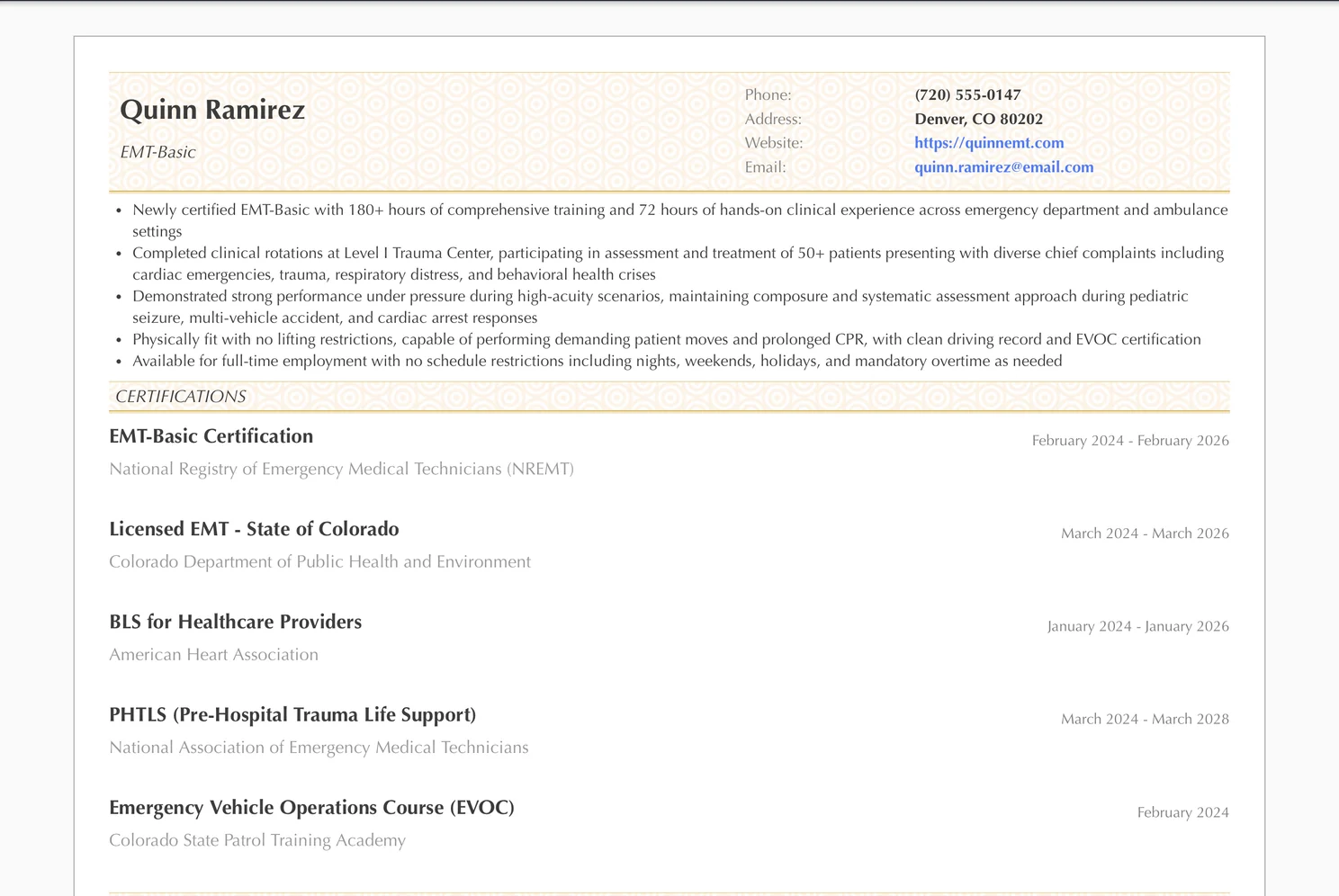
The Best EMT Resume Example/Sample
https://www.resumonk.com/emtEMTResume Format for Your EMT Resume
The reverse-chronological format is your best friend here, and it's not even close. This format lists your most recent experience first and works backward through time, which is exactly what hiring managers in emergency medical services want to see.
They need to know what you've been doing lately, whether you're currently certified, and if your hands-on patient care experience is fresh or if it's been gathering dust while you did something else for the past three years.
Why Reverse-Chronological Works for EMT Applications
Think about what matters in emergency medicine: recency of training, continuity of practice, and progressive responsibility.
A functional resume that groups skills without showing when and where you used them raises red flags. It makes hiring managers wonder what you're hiding. Did your certification lapse? Have you been out of patient care? In a field where muscle memory and current protocols can literally save lives, they need to see an unbroken thread of relevant experience.
Your reverse-chronological resume should open with a clear header containing your contact information, followed immediately by your certifications section. Yes, certifications come before your work experience on an EMT resume, because your NREMT certification, state licensure, CPR/BLS, ACLS, PALS, or other credentials are non-negotiables. A hiring manager needs to see within three seconds that you're legally allowed to practice.
Structuring Your EMT Resume
After your header and certifications, your work experience section takes center stage.
This is where you prove you've done the job, not in theory, but in practice. Following work experience, you'll include your education (which for EMTs is often straightforward but essential), then a skills section that highlights both technical and soft skills relevant to emergency care, and finally any additional relevant sections like volunteer work or professional affiliations.
Keep your resume to one page if you're newly certified or have less than five years of experience. The reality is that most EMT positions, especially EMT-Basic roles, are entry-level positions in the emergency medical services hierarchy. You're not expected to have a decade of varied experience. What matters is that every line on that single page proves you can handle the physical demands, emotional intensity, and technical requirements of the job.
If you're a Paramedic or have extensive experience including specialized certifications like Critical Care or Flight training, a two-page resume becomes acceptable, but even then, be ruthless about relevance.
Work Experience on Your EMT Resume
Each position you list needs to include the job title, employer name, location (city and state), and dates of employment in month and year format. But the real work happens in the bullet points underneath, where you translate your daily grind into evidence of competence.
How to Write About EMT Experience
Start each bullet point with a strong action verb, but choose verbs that reflect the reality of emergency medical work.
You're not "managing" or "leveraging" anything. You're assessing, treating, transporting, coordinating, administering, and documenting. The verbs need to match the work, and the work is hands-on, immediate, and consequential.
Quantify everything you can. How many calls did you run per shift? What was your call volume? How many patients did you assess and treat? What was the geographical coverage area? These numbers matter because they indicate experience level and exposure to diverse situations. An EMT who ran 15 calls per 12-hour shift in an urban 911 system has a different experience base than someone who did four calls per 24-hour shift in a rural setting.
Neither is better, but both need to be clear.
What to Include in Each Bullet Point
Every bullet point should follow a simple formula: action + context + result or scope. Don't just say what you did. Explain the environment, the volume, the complexity, or the outcome. This is how you differentiate yourself from every other EMT-Basic who is submitting a resume that says "Responded to emergency calls and provided patient care."
❌ Don't write vague, generic descriptions:
Responded to 911 emergency calls and provided basic life support
✅ Do write specific, quantified descriptions:
Responded to average of 12-15 911 calls per 12-hour shift, providing BLS assessment and treatment for medical, trauma, and psychiatric emergencies across urban service area covering 45 square miles
❌ Don't list tasks without context:
Performed patient assessments and took vital signs
✅ Do demonstrate clinical competency with specifics:
Conducted comprehensive primary and secondary assessments on average of 60+ patients monthly, including obtaining vital signs, SAMPLE histories, and performing focused physical exams for diverse chief complaints
Addressing Different Types of EMT Experience
If you worked in 911 emergency response, emphasize response times, call types, and your ability to function in high-stress, unpredictable environments. If you worked in interfacility transport (IFT), focus on patient monitoring during transport, communication with receiving facilities, and your experience with different acuity levels and medical equipment.
If you worked special events, highlight mass gathering medicine, triage capabilities, and ability to work autonomously with limited resources.
For those brand new to the field, your clinical rotations and ride time during EMT school count as experience. List them clearly, noting the settings (emergency department, ambulance service), total hours completed, and types of patients encountered. Don't oversell it as equivalent to paid employment, but don't undersell it as irrelevant either.
❌ Don't misrepresent student clinical time:
EMT, City Ambulance Service, Jan 2024 - Feb 2024
✅ Do accurately represent it as valuable training:
EMT Clinical Rotation, City Ambulance Service, Jan 2024 - Feb 2024
Completed 120 hours of supervised field experience, participating in 45+ emergency responses including cardiac emergencies, trauma calls, and respiratory distress cases
The Documentation and Soft Skills Balance
Don't forget that being an EMT isn't only about the adrenaline-filled moments. A significant portion of your job is documentation, equipment maintenance, and communication. Your resume needs to reflect this reality.
Include bullet points about your PCR (Patient Care Report) documentation, your track record with thorough and timely charting, your equipment checks and inventory management, and your communication with dispatch, hospitals, and other first responders.
✅ Do highlight the full scope of EMT responsibilities:
Maintained 98% on-time PCR completion rate with consistent documentation quality, ensuring compliance with state EMS regulations and supporting billing processes
Performed daily equipment checks and maintained ambulance readiness, identifying and reporting maintenance needs to minimize out-of-service time
Communicated patient condition and treatment to receiving emergency department staff, providing clear verbal reports and ensuring continuity of care during handoff
Skills to Show on Your EMT Resume
The skills section of your EMT resume is where you need to walk a fine line.
On one hand, certain skills are assumed—every certified EMT should be able to take blood pressure, apply a tourniquet, or perform CPR. Listing these basic skills takes up space without adding value. On the other hand, you need to demonstrate both technical proficiency and the soft skills that separate adequate EMTs from exceptional ones. The question is how to show depth and breadth without creating a laundry list that says nothing.
Technical Skills That Actually Matter
Focus your technical skills section on what goes beyond baseline EMT-Basic certification. If you're IV-certified as an EMT-Intermediate or AEMT, that's worth listing. If you have specialized training in wilderness medicine, tactical EMS, or pediatric emergency care, include it.
If you're proficient with specific equipment that not all EMTs encounter regularly—mechanical CPR devices like LUCAS, video laryngoscopy, CPAP devices, 12-lead EKG acquisition—these demonstrate expanded capabilities.
Similarly, if you have experience with specific patient care reporting systems (ESO, ImageTrend, ZOLL RescueNet), include them. While the principles of documentation transfer across systems, hiring managers appreciate when they don't have to train you on their software from scratch.
This is especially relevant when applying to larger services or hospital-based EMS systems that use sophisticated electronic charting.
The Soft Skills That Keep You Employed
Here's the truth about EMS: your clinical skills get you hired, but your interpersonal skills determine whether you last. The hiring manager has seen clinically excellent EMTs flame out because they couldn't handle 24-hour shifts with partners they didn't choose, couldn't de-escalate a belligerent patient, or couldn't stay calm when everything went wrong simultaneously.
Your resume needs to address this reality, but not with empty buzzwords.
❌ Don't list soft skills without context:
Skills: Communication, Teamwork, Stress Management, Problem-Solving ✅ Do integrate soft skills into your work experience bullets or provide specific context:
De-escalated hostile situations with intoxicated and psychiatric patients using verbal de-escalation techniques, maintaining scene safety while ensuring patient care
Collaborated with fire department first responders, law enforcement, and air medical crews on complex multi-agency emergency scenes, maintaining clear communication chains
Organizing Your Skills Section
Consider breaking your skills into categories: Clinical Skills, Technical Proficiencies, and Certifications (if not listed separately). This organization helps hiring managers quickly scan for what they need. Under Clinical Skills, you might list patient assessment, airway management, medication administration (if applicable to your certification level), hemorrhage control, spinal immobilization, cardiac emergency management, and any specialized skills.
Under Technical Proficiencies, include equipment you're trained on and documentation systems you know.
✅ Example of organized skills section:
- Clinical Skills: Advanced patient assessment, airway management including BVM and supraglottic airways, IV initiation and medication administration (AEMT), cardiac rhythm interpretation, trauma assessment and management, pediatric emergency care
- Technical Proficiencies: LUCAS mechanical CPR device, CPAP administration, 12-lead EKG acquisition, glucometry, ZOLL X-Series monitor/defibrillator, ImageTrend Elite documentation system
- Additional: Bilingual English/Spanish, valid driver's license with clean record, EVOC certified
The Often-Forgotten Skills
Don't overlook skills that aren't clinical but are absolutely essential for EMT work.
A clean driving record isn't just a nice-to-have; it's often a job requirement. Emergency vehicle operations course (EVOC) certification demonstrates you've been trained to drive an ambulance safely under emergency conditions. Language skills can be invaluable, especially in diverse urban areas. Physical fitness and ability to lift and carry (while not typically listed as a "skill") might be worth mentioning if you've maintained high fitness standards or have no lifting restrictions, since this job is brutally physical.
Specific Considerations and Tips for Your EMT Resume
Let's address the elephant in the room: EMT is widely understood to be one of the most demanding, underpaid entry points into healthcare.
You're signing up for 12-hour or 24-hour shifts, physically exhausting work, emotional trauma exposure, and in many regions, wages that barely crack $35,000 annually. The people hiring you know this. They know you might be using this as a stepping stone to paramedic school, nursing school, PA school, or medical school. They know turnover in EMS is astronomical. Your resume needs to navigate this reality carefully.
Addressing the Career Trajectory Question
If you're genuinely interested in building a career in EMS, make that clear.
Mention your enrollment in paramedic school or plans to pursue critical care certification. Include membership in professional organizations like the National Association of EMTs. Show that you're invested in this field, not just passing through. Hiring managers would rather have someone who's transparent about being in paramedic school than someone who'll quit without notice six months in when they get accepted to a physician assistant program they never mentioned.
However, if you're applying for EMT work while pursuing another healthcare career path, don't lie, but don't lead with it either. Your resume should focus on your qualifications and commitment to performing the EMT role excellently.
Save the "I'm applying to nursing school" conversation for the interview, where you can frame it as part of your commitment to healthcare broadly and explain why EMT experience is valuable preparation.
The Certification Date Reality
Your NREMT certification date tells hiring managers a lot.
If you're newly certified (within the past 3-6 months) and have minimal field experience, your resume strategy needs to compensate by emphasizing your clinical rotation experiences, any volunteer first responder work, relevant prior experience in high-stress customer service or physically demanding jobs, and your enthusiastic commitment to the field. Don't pretend to have more experience than you do, but do highlight every relevant piece of preparation.
If there's a gap between your certification date and your current job search, be prepared to address it. If you've been working in EMS, great—that experience speaks for itself.
If you certified and then did something else for a year, your resume needs to make clear that your certification is current (NREMT requires recertification every two years) and that you've maintained your skills.
The State-by-State Certification Maze
EMS certification is a patchwork of state regulations, and this matters for your resume.
If you're applying across state lines, clearly indicate both your NREMT certification and your state license. Some states recognize NREMT reciprocity easily; others require additional testing or training. If you're willing to obtain certification in the state where you're applying, mention this. For positions in states with expanded EMT scopes of practice (like Texas EMT-Intermediate or Advanced EMT in states that recognize this level), make sure your certification level is crystal clear.
✅ For multi-state applications:
Certifications:
- National Registry of Emergency Medical Technicians (NREMT) - EMT, Valid through March 2026
- Licensed EMT - State of Colorado, Valid through January 2026
- Willing to obtain licensure in Wyoming, Montana, or surrounding states
Addressing Employment Gaps Common in EMS
EMS has notoriously high burnout rates. If you have a gap in your EMS employment history because you needed to step away for mental health reasons, career exploration, or burnout recovery, you don't need to detail this on your resume. However, if the gap is recent and you're returning to EMS, you might briefly address what you did during that time if it's relevant or neutral (took course work, worked in another healthcare setting, personal reasons).
What matters most is demonstrating that your current certification is active and you're ready to work.
The Per Diem and Part-Time Reality
Many EMTs work multiple jobs simultaneously—full-time with one service, per diem with another, and maybe special event coverage on weekends.
This is so common in EMS that it's not a red flag; it's expected. On your resume, be clear about which positions are concurrent. Don't make it look like you job-hop every six months when actually you're holding down three positions at once because that's what it takes to pay rent.
✅ For concurrent positions:
- EMT, City Ambulance Service (Full-time), June 2022 - Present
- EMT, Regional Medical Center (Per Diem), August 2023 - Present
- Special Events EMT, Stadium Medical Services (Seasonal), April 2023 - Present
The Physical Requirements Disclosure
This is nuanced: you don't need to (and shouldn't) disclose disabilities or medical conditions on your resume, as this could open the door to discrimination. However, EMT work has legitimate physical requirements—lifting patients, carrying equipment, performing CPR for extended periods, working in extreme weather conditions. If you have any concerns about meeting these requirements, don't address them on your resume; this is a conversation for after a conditional job offer when accommodations can be discussed formally.
What you should do is ensure your resume reflects your capability by mentioning successful completion of physically demanding training or field work.
Background Checks and Driving Records
EMS employers will run background checks and driving record checks. If you have anything in your history that might raise questions—a DUI, a criminal record, a suspended license period—don't mention it on your resume, but don't be blindsided by it either.
Many EMS services have clear policies (for example, no DUIs within the past five years, no felony convictions), and if you fall outside those parameters, it's worth addressing proactively during the hiring process, not on paper.
The Volunteer Experience Advantage
If you have volunteer first responder experience—volunteer fire department, ski patrol, search and rescue, wilderness first responder work, event medical standby—this deserves prominent placement on your resume.
Volunteer EMS and first responder work demonstrates commitment beyond a paycheck, and it often provides experience in resource-limited environments that builds problem-solving skills and adaptability. Don't bury this in a tiny "Volunteer Work" section at the bottom; integrate it into your experience section or create a "Related Experience" section that gives it proper weight.
The Professional Development Commitment
EMS is a field of continuous learning.
Protocols change, equipment evolves, and best practices are constantly updated by research. If you've taken continuing education courses beyond what's required for recertification, attended EMS conferences, completed specialized training modules, or pursued certifications like PHTLS (Pre-Hospital Trauma Life Support), PEPP (Pediatric Education for Prehospital Professionals), or AMLS (Advanced Medical Life Support), include these. They signal that you're engaged with the profession and committed to being better at the job, not simply maintaining minimum standards.
✅ Example of professional development section:
Professional Development:
- PHTLS (Pre-Hospital Trauma Life Support), Completed May 2023
- PEPP (Pediatric Education for Prehospital Professionals), Completed November 2023
- "Managing Excited Delirium and Behavioral Emergencies" - State EMS Conference, January 2024
- "Rural EMS Operations and Resource Management" - Online continuing education, 8 hours, December 2023
Tailoring to Service Type
Finally, recognize that different EMS services have different cultures and needs. A hospital-based EMS system that does both 911 and interfacility transfers values versatility and clinical charting precision. A fire department-based EMS system values teamwork, physical fitness, and multi-role capability. A private ambulance company running primarily IFT might prioritize customer service skills and efficiency. A rural volunteer service needs people who can function independently with limited backup. Read the job posting carefully and adjust your resume's emphasis accordingly.
The core content stays the same, but what you highlight in your summary or lead bullets can shift to match what that specific employer values most.
Education Requirements for Your EMT Resume
Here's the thing about EMT positions - this is an entry-level emergency medical services role where your education and certifications aren't just important, they're literally the legal requirement for you to do the job.
Unlike some fields where education might take a backseat to experience, your EMT training is the foundation of everything. So let's break down exactly how to present it in a way that gets you that interview with the ambulance service, fire department, or hospital.
Your EMT Certification Comes First
Your National Registry of Emergency Medical Technicians (NREMT) certification or state-specific EMT certification should be the star of your education section. This isn't a college degree where you bury it at the bottom - this is your ticket to ride.
List your certification prominently with the full official title, certifying body, certification number, and critically important, your expiration date.
Most hiring managers in EMS are looking at dozens of applications, and they need to verify immediately that you're legally cleared to work. Make their job easy.
EMT-Basic Certification
National Registry of Emergency Medical Technicians (NREMT)
Certification #: E1234567
Issue Date: March 2024 | Expiration Date: March 2026
Notice how the expiration date is right there? That's intentional.
Many EMT candidates forget this, and it creates unnecessary back-and-forth during the hiring process.
Your EMT Training Program Details
Right after your certification, list the actual training program you completed. This might be from a community college, technical school, fire academy, or hospital-based program. Include the institution name, location, program title, and completion date.
If you're within a year of graduation, you might also include relevant coursework or clinical rotation hours, especially if they're above the minimum required.
✅ Do - Include specific details that demonstrate comprehensive training:
Emergency Medical Technician Program
Austin Community College, Austin, TX
Completed: January 2024
- 180 hours of didactic instruction
- 48 hours of clinical rotations at Dell Seton Medical Center
- 24 hours of ambulance ride-alongs with Austin-Travis County EMS
❌ Don't - Be vague or leave out completion dates:
EMT Training
Community College
Studied emergency medical techniques
CPR and Additional Certifications
Your CPR certification (typically CPR for Healthcare Providers or BLS for Healthcare Providers from the American Heart Association) should be listed in your education section as well. Some EMT candidates create a separate "Certifications" section, which is perfectly fine, but if you're just starting out and your resume is light on experience, keeping everything education-related together creates a stronger visual impact.
Include any additional relevant certifications you've earned: PALS (Pediatric Advanced Life Support), ACLS (Advanced Cardiovascular Life Support), PHTLS (Pre-Hospital Trauma Life Support), or specialty certifications like Hazmat Awareness or Wilderness First Responder if applicable to the positions you're targeting.
1. BLS for Healthcare Providers, American Heart Association
Card #: 123456789 | Expires: November 2025

2. PHTLS Certification, National Association of Emergency Medical Technicians
Completed: February 2024 | Expires: February 2028
High School Diploma or GED
If you're early in your EMT career and don't have additional college education beyond your EMT program, yes, you should include your high school diploma or GED. There's zero shame in this - many excellent EMTs enter the field right after high school, and it shows you meet the baseline educational requirements.
Just keep it brief.
High School Diploma
Central High School, Phoenix, AZ
Graduated: May 2023
If you have an associate's or bachelor's degree in any field, list that instead and you can drop the high school diploma. Even if your degree is in something unrelated like English Literature or Business, it demonstrates educational achievement and maturity.
Ongoing Education and Continuing Medical Education (CME)
Once you're working as an EMT, you'll need continuing education hours to maintain your certification. If you're applying for a new position and have completed relevant continuing education courses beyond your initial training, consider adding a brief mention.
This shows initiative and commitment to staying current, which is huge in emergency medicine where protocols and best practices evolve constantly.
Continuing Medical Education (24 hours completed):
- Advanced Airway Management (8 hours) - 2024
- Pediatric Assessment and Treatment (8 hours) - 2024
- Mass Casualty Incident Response (8 hours) - 2023
What About College Courses in Progress?
Many EMTs work full-time while pursuing additional education - maybe you're working toward your paramedic certification, or you're taking prerequisite courses for nursing or physician assistant programs. If this is you, absolutely include it.
It shows ambition and long-term thinking, and many EMS agencies value employees who are advancing their medical education.
Paramedic Program (In Progress), Northern Virginia Community College, Springfield, VA
- Expected Completion: December 2025
- Completed: Anatomy & Physiology I & II, Advanced Patient Assessment
One word of caution here - some hiring managers worry that candidates in paramedic or nursing programs might leave quickly once they complete their degree. You can address this in your cover letter or interview by emphasizing your commitment to gaining solid EMT experience as a foundation for your long-term healthcare career.
International Candidates and Education Equivalency
If you completed your EMT training outside the United States but have obtained U.S. certification, make this crystal clear on your resume. Include both your original training location and your U.S. certification details.
The same applies for Canadian, UK, or Australian candidates - EMS systems vary significantly by country, so you need to explicitly state that you hold valid credentials for the jurisdiction where you're applying.
1. EMT-Basic Certification
- National Registry of Emergency Medical Technicians (NREMT)
- Certification #: E9876543
- Issue Date: June 2024 | Expiration Date: June 2026

2. Primary Care Paramedic Diploma
- Justice Institute of British Columbia, Vancouver, BC, Canada
- Completed: April 2023
- Credential evaluation completed, eligible for U.S. EMT practice
Awards and Publications on Your EMT Resume
The EMS world values practical excellence, community service, academic achievement in your training program, and contributions to the broader emergency services community. Let's dig into what actually counts and how to present it without looking like you're padding your resume with irrelevant fluff.
Academic Awards from Your EMT Training Program
Did you finish at the top of your EMT class?
Receive recognition for highest practical skills scores? Get honored for perfect attendance or outstanding clinical performance? These absolutely belong on your resume.
EMT training programs are rigorous, and academic excellence in your program signals to employers that you took your education seriously and mastered the material beyond just passing.
✅ Do - Highlight specific, named awards with context:
1. Outstanding Student Award
Austin Community College EMT Program, January 2024
- Recognized for highest combined academic and practical skills scores (97.8% overall)
- Selected by program faculty from cohort of 32 students

2. Clinical Excellence Award
Dell Seton Medical Center, December 2023
- Awarded during clinical rotation for exceptional patient care and professionalism
❌ Don't - Be vague or inflate minor recognition:
Top Student Award
Various awards for being good at EMT stuff
Best EMT Ever (self-nominated)
National Registry Examination Recognition
While passing the NREMT exam is the baseline requirement, if you passed on your first attempt (which only about 70% of candidates do) or scored exceptionally well, you can mention this. The National Registry doesn't release specific scores, but first-time pass rate is a legitimate point of pride that demonstrates competence and preparation.
NREMT Certification Examination - First Attempt Pass
National Registry of Emergency Medical Technicians, March 2024
This is particularly relevant because many hiring managers know that a significant percentage of EMT candidates require multiple attempts, so demonstrating you cleared this hurdle immediately shows strong foundational knowledge.
Volunteer and Community Service Recognition
Many people enter EMS specifically because they want to serve their communities, and often they've been doing volunteer work long before they became certified. If you've received any recognition for volunteer service - whether with a volunteer fire department, community first aid squad, disaster response organization, or even non-medical community service - this matters tremendously in EMS culture.
Emergency services organizations value people who demonstrate commitment to service beyond a paycheck. Awards for volunteer hours, community impact, or sustained volunteer service show character traits that are harder to teach than medical skills.
✅ Do - Include volunteer service awards with specifics:
1. Volunteer Service Award (500+ Hours)
- Westside Volunteer Fire Department, 2023
- Recognized for contributions as probationary member prior to EMT certification
- Participated in 150+ emergency responses as non-certified support personnel

2. President's Volunteer Service Award - Gold Level
- AmeriCorps, 2023
- Completed 250+ hours of community health education and disaster preparedness training
Scholarships Related to Your EMT Education
Receiving a scholarship for your EMT training is definitely worth mentioning.
It demonstrates that someone - a fire department, EMS agency, community organization, or educational institution - saw potential in you and invested in your success. Scholarships are competitive, and noting that you received one adds credibility.
EMS Education Scholarship Recipient
National Association of Emergency Medical Technicians Foundation, 2023
- One of 50 recipients selected nationally from 500+ applicants
- Full tuition scholarship ($3,200 value) for EMT-Basic certification program
Military Service Awards and Commendations
Many EMTs have military backgrounds, and if you received any military awards, commendations, or recognition - particularly if they relate to medical care, emergency response, leadership, or service under challenging conditions - these absolutely belong on your resume. Military service demonstrates discipline, ability to perform under pressure, and experience with command structures, all of which translate directly to EMS work.
✅ Here's a great example of how to incorporate this into your resume:
Navy and Marine Corps Achievement Medal
United States Navy, 2022
- Awarded for exceptional performance as Hospital Corpsman during humanitarian assistance mission
- Provided emergency medical care to 200+ patients in austere environment
Combat Action Ribbon
United States Marine Corps, 2021
- Awarded for active participation in ground combat while serving as combat medic
Military awards carry significant weight in EMS hiring, particularly with fire departments and municipal services where veteran preference points often apply. Don't be modest about your service.
Publications - Do They Even Apply to EMTs?
Here's where we need to be realistic. Most entry-level EMTs have not published articles in the Journal of Emergency Medical Services or Prehospital Emergency Care.
But "publications" in the broader sense can include several things that might actually apply to you: articles in your EMT program's newsletter, blog posts about EMS topics, contributions to your volunteer fire department's community newsletter, or even substantive posts on professional EMS forums or social media platforms that demonstrate your engagement with the field.
If you contributed to any written content about emergency services, health education, or related topics - and it's publicly accessible - you can include it. Just be honest about the venue and don't try to make a blog post sound like peer-reviewed research.
✅ Do - Include legitimate published or public-facing content:
1. "Preparing Your Home for Medical Emergencies: A Guide for Families"
- Community Health Newsletter, Austin-Travis County EMS, June 2024
- Co-authored educational article distributed to 15,000 households
- Covered basic first aid supplies, emergency contact information, and when to call 911

2. Contributor, "EMS Student Experiences" Blog Series
- National Association of Emergency Medical Technicians, 2023-2024
- Published 3 articles about EMT student clinical experiences and training insights
- Articles reached 5,000+ readers and promoted recruitment into EMS field
❌ Don't - Include social media posts or inflate informal writing:
Multiple viral tweets about being an EMT
Posted some stuff on Reddit about ambulance stories
Wrote comments on EMS Facebook groups
Professional Organization Membership Awards
If you've joined professional organizations like the National Association of Emergency Medical Technicians (NAEMT), your state EMS association, or specialty groups, and you've received any recognition through them - scholarship, conference attendance awards, student member of the year, etc. - include these.
They demonstrate professional engagement beyond just showing up for shifts.
Should You Even Include This Section?
Here's the honest answer - if you don't have any awards or publications, don't force it. An empty "Awards and Publications" section on your resume looks worse than no section at all. But if you have even one or two legitimate items to include, create the section.
It humanizes your resume and gives hiring managers additional positive data points about you beyond just your certifications and (likely limited) work experience.
For most entry-level EMTs, this section might contain 1-3 items maximum, and that's perfectly fine. As you progress in your career, you'll accumulate more: Employee of the Month recognition, commendations from supervisors for excellent patient care, awards for difficult saves, preceptor awards when you start training new EMTs, or continuing education achievements. You can update this section as you go.
One final thought - in EMS, "awards" don't have to be formal plaques or certificates. A written commendation in your employee file from a supervisor who noted your exceptional response to a pediatric cardiac arrest, or a thank-you letter from a patient's family that your supervisor placed in your personnel file - these count.
They demonstrate real-world recognition of your capabilities, which is ultimately what employers care about most.
Listing References on Your EMT Resume
EMS agencies are entrusting you with people's lives, access to controlled medications, and operation of emergency vehicles. They can't afford to hire someone who's unreliable, unprofessional, or has undisclosed issues.
References are a critical part of their due diligence, so let's talk about how to approach this section strategically.
Should You Include "References Available Upon Request" on Your Resume?
Let's settle this debate right now: the phrase "References available upon request" on your resume is outdated and unnecessary. Of course your references are available upon request. That's understood. It doesn't add any value, and it takes up space that could be used for something more substantive.
Skip it.
❌ Don't - Waste space with obvious statements:
References available upon request.
However, this doesn't mean you should include your full reference list directly on your resume either. Your resume should focus on your qualifications, and references should be provided separately when requested. Here's the best practice: prepare a separate references document that matches the formatting of your resume, and have it ready to provide when employers ask for it.
Who Should You Ask to Be a Reference for an EMT Position?
This is where you need to think strategically about what EMS hiring managers actually want to verify. They're looking for information about your clinical competence, reliability, ability to work with partners, attitude under stress, and professionalism with patients.
Let's break down the ideal reference choices for a newly certified EMT.
Your EMT Program Instructor or Clinical Coordinator
This is your strongest reference if you're newly certified with no paid EMS experience. Your EMT instructor worked with you extensively during your training, observed your clinical skills during practical sessions, and can speak to your knowledge base, learning ability, and professionalism during clinical rotations. If you excelled in your program, your instructor can provide powerful validation of your capabilities.
When you ask your instructor to be a reference, make sure they're comfortable providing a strong recommendation. If you barely passed the class or had attendance issues, they're not the right choice. You want someone who will enthusiastically vouch for your abilities.
✅ Do - Format references with complete, professional information:
1. John Martinez, NREMT-P, Lead EMT Instructor, Emergency Medical Services Program, Austin Community College
- Phone: (512) 555-0123 | Email: [email protected]
Relationship: EMT Program Instructor (August 2023 - January 2024)
Clinical Preceptor or Hospital Staff from Your Rotations
If you made a strong impression during your clinical rotations, asking a nurse, paramedic, or physician who supervised you to serve as a reference is excellent. They observed you in a real clinical environment, working with actual patients, and can speak to your bedside manner, ability to follow protocols, and how you handle the chaos of emergency medicine. This is particularly valuable because it shows real-world performance, not just classroom competence.
The key here is maintaining those relationships. At the end of your clinical rotation, if you worked well with particular staff members, ask if you can stay in touch and whether they'd be willing to serve as a reference in the future. Get their contact information while you're still in touch, not six months later when you're frantically applying for jobs.
Volunteer Fire Department or EMS Agency Supervisors
If you volunteered with a fire department or EMS agency before or during your EMT certification, supervisors from these organizations make excellent references. They can speak to your reliability (did you actually show up for your scheduled shifts?), your attitude toward learning, your willingness to handle the unglamorous parts of the job, and your ability to work within the culture of emergency services.
Many EMT candidates have volunteer experience that they underestimate. Even if you were just doing station maintenance, riding along, or helping with non-medical tasks as a probationary member, the people who supervised you can still speak to your character and work ethic.
Previous Employers - Even If the Job Wasn't EMS-Related
If you're a career-changer who worked in a different field before becoming an EMT, your previous supervisors can still be valuable references. They can verify your reliability, professionalism, ability to work with colleagues, and general work ethic. While they can't speak to your clinical skills, they can confirm that you're a responsible employee who shows up on time and doesn't create drama - which matters a lot in EMS.
Choose supervisors who will speak positively about you. If you left a previous job on bad terms, that person should not be on your reference list unless the employer specifically requires references from all previous supervisors.
What About Personal References?
Generally, personal references (friends, family members, clergy, community members who know you) are weaker than professional references for EMT positions. Employers know that your friend will say nice things about you. However, if you're very early in your career with limited professional connections, one personal reference who can speak to your character isn't the end of the world. Just make sure the other two references are professional.
❌ Don't - List only personal references or family members:
Sarah Johnson (my mom)
Mike Thompson (my best friend)
Pastor Williams (knows me from church)
How Many References Should You Prepare?
Standard practice is to prepare three professional references.
Some applications will ask for three, some will ask for two, and a few might request more. Have at least three solid references prepared so you can provide them immediately when requested. Don't be the candidate who has to scramble to find references after getting a request, which delays your application and makes you look disorganized.
What Information Should You Include for Each Reference?
For each reference, provide complete and accurate information that makes it easy for the employer to contact them. Include:
- Full name and credentials (if applicable)
- Job title and organization
- Phone number (confirm they're okay with receiving calls at this number)
- Email address (professional email only)
- Your relationship to them and timeframe
✅ Do - Provide complete, properly formatted reference information:
PROFESSIONAL REFERENCES
1. Dr. Jennifer Patel, MD, FACEP
- Emergency Department Attending Physician, Dell Seton Medical Center
- Phone: (512) 555-0187 | Email: [email protected]
- Relationship: Clinical Rotation Supervisor (November - December 2023)
2. Captain Robert Chen, NREMT-P
- EMS Captain, Station 12, Austin Fire Department
- Phone: (512) 555-0198 | Email: [email protected]
- Relationship: Ambulance Ride-Along Supervisor (October 2023)
3. Maria Gonzales, RN, BSN, CEN
- Charge Nurse, Emergency Department, St. David's Medical Center
- Phone: (512) 555-0165 | Email: [email protected]
- Relationship: Clinical Preceptor (December 2023 - January 2024)
Getting Permission from Your References
Never, ever list someone as a reference without asking them first.
This should be obvious, but you'd be surprised how many candidates skip this step. Here's what can go wrong: you list your EMT instructor as a reference, a potential employer calls him, and he has no idea who you are because he taught 200 students last year and you never reached out to ask. Awkward, and damaging to your chances.
When you ask someone to be a reference, do it thoughtfully. Send an email or have a conversation explaining what kind of jobs you're applying for, why you thought they'd be a good reference, and asking if they're comfortable providing a positive recommendation. Give them an easy out if they're not comfortable - you want enthusiastic references, not lukewarm ones.
✅ Do - Ask for permission professionally:
Subject: Reference Request for EMT Job Applications
Hi Captain Chen,
I hope you're doing well. I'm reaching out because I'm now applying for EMT positions after completing my certification in January, and I was hoping you'd be willing to serve as a professional reference for me.
You supervised me during my 24-hour ambulance ride-along with AFD Station 12 last October, and I learned a tremendous amount from that experience. I'd be grateful if you could speak to my professionalism, willingness to learn, and attitude during that rotation.
I understand you're busy, so please let me know if you're comfortable with this. I'm happy to provide any additional information about the positions I'm applying for if that would be helpful.
Thank you for considering this, and thank you again for the excellent learning experience during my ride-along.
Best regards,
[Your name]
[Your contact info]
Preparing Your References for Contact
Once someone agrees to be your reference, keep them in the loop. When you're applying for positions and you know they might be contacted soon, send them a quick heads-up email letting them know which organizations might be calling and what the timeline looks like.
You can even send them a copy of your resume and the job description so they can tailor their comments to what the employer is looking for.
This level of consideration makes your references more effective advocates for you, and it shows respect for their time. People are much more willing to give strong recommendations for candidates who are organized and courteous about the process.
What If You Don't Have Three Strong Professional References?
If you're truly struggling to identify three strong professional references - maybe you're very young, you're making a dramatic career change, or your EMT program was self-paced online instruction with minimal personal interaction - you have a few options. Consider:
- Coaches or advisors from college, athletic programs, or other structured activities where someone supervised your performance
- Supervisors from volunteer work, even if it wasn't EMS-related
- Military supervisors or commanders if you have service experience
- Academic advisors or professors if you have recent college experience
The key is finding people who observed you in some kind of structured environment where your reliability, attitude, and abilities were on display. A reference from your high school guidance counselor who barely remembers you isn't helpful, but a reference from the volunteer coordinator at the animal shelter where you worked every Saturday for two years demonstrates consistency and responsibility.
References and Background Checks - What to Expect
For EMT positions, reference checks are typically just the first step of a more comprehensive background investigation. You should expect potential employers to also conduct criminal background checks, driving record checks, and possibly credit checks depending on the organization.
Some fire departments and municipal services conduct quite extensive background investigations that include interviews with neighbors, previous employers beyond your reference list, and other verification steps.
Be honest about everything on your application. If you have something in your background that might come up - a traffic violation, a misdemeanor from several years ago, a gap in employment - address it proactively rather than hoping it won't be discovered. Honesty about a minor issue is much better than appearing to hide something.
Following Up After Getting the Job
Once you land a job, circle back to your references and thank them for their support.
Let them know you got the position and express appreciation for their help. This is basic courtesy, but it also keeps these relationships warm for the future. You'll likely need references again as you advance in your career, and people who felt appreciated the first time are much more willing to help again.
Subject: Thank You - Got the Job!
Hi Captain Chen,
I wanted to let you know that I was offered and accepted an EMT position with Williamson County EMS! I start orientation on March 1st.
Thank you so much for serving as a reference. I know your recommendation carried weight, and I'm grateful for your support as I start my EMS career.
I hope to cross paths with you on calls in the future. Thanks again!
Best,
[Your name]
These small gestures of professionalism matter in the close-knit EMS community, where reputation and relationships can significantly impact your long-term career trajectory.
Special Considerations for Different Regions
Reference practices are fairly consistent across the United States, Canada, Australia, and the United Kingdom, but there are a few regional variations worth noting.
In the UK, employment references are more commonly required upfront as part of the application process itself, rather than being requested later in the hiring process. In some Canadian provinces, references from specific types of professionals (physicians, paramedics) may carry more weight for EMS positions. Australian services sometimes request statutory declarations from references in addition to phone or email contact.
If you're applying internationally or in a region you're unfamiliar with, research local norms or ask the hiring coordinator what format they prefer.
Cover Letter Tips for Your EMT Resume
Here's the truth - for some high-volume private ambulance companies that hire constantly and process hundreds of applications, your cover letter might get a quick skim at best. But for municipal fire departments, hospital-based EMS systems, and smaller private services, a well-crafted cover letter can be the difference between your resume landing in the "definitely interview" pile versus the "maybe if we don't find anyone better" pile. And since you don't know which situation you're applying into, you should write one.
Let me show you how to write a cover letter that actually works for EMT positions.
Understanding What Hiring Managers Are Actually Looking For
EMS supervisors and hiring managers aren't looking for flowery language or corporate buzzwords. They're trying to answer a few specific questions: Can this person handle the physical and emotional demands of emergency medicine? Will they show up reliably for their shifts (including nights, weekends, and holidays)? Can they work effectively with a partner in high-stress situations?
Do they genuinely want to be here, or are they just killing time until something better comes along?
Your cover letter needs to address these concerns directly. This isn't the place for generic statements about being a "team player" or having "excellent communication skills." EMS managers have read thousands of these letters, and they can spot cookie-cutter content immediately.
Opening Strong - Skip the Generic Introduction
Do not - and I cannot stress this enough - do not open your cover letter with "I am writing to express my interest in the EMT position I saw posted on your website."
Every single cover letter starts this way, and hiring managers' eyes glaze over by the third word. They know why you're writing. You're applying for the job. Get to something interesting immediately.
❌ Don't - Use a generic, obvious opening:
Dear Hiring Manager,
I am writing to express my interest in the Emergency Medical Technician position posted on your website. I recently completed my EMT certification and am excited about this opportunity. I believe I would be a great fit for your team.
✅ Do - Open with something specific and compelling:
Dear Chief Martinez,
When I completed my 24-hour ambulance ride-along with Metro EMS last November, I witnessed your crew respond to a multi-vehicle accident on I-35 during rush hour. Watching your team work through the chaos with calm efficiency while coordinating with fire and police - that was the moment I knew exactly which service I wanted to work for after earning my certification.
Notice the difference? The second version immediately shows that you've done your homework, you've had direct exposure to their organization, and you have a specific, genuine reason for wanting this particular job. It reads like something a real human being would say, not a template filled in with mail merge fields.
Addressing Your EMT Training and Certification
Your cover letter should complement your resume, not repeat it.
Don't just list where you got certified and when. Instead, talk about specific experiences during your training that prepared you for this job. Your clinical rotations, your ride-alongs, challenging scenarios during your practical exams - these concrete examples demonstrate your capabilities far better than stating "I am certified and qualified."
✅ Do - Describe specific training experiences that demonstrate competence:
During my clinical rotation at St. Joseph's Emergency Department, I assisted with 47 patient assessments over six 8-hour shifts. One evening, I was the first to notice a subtle change in respiratory pattern in an elderly patient that led to early identification of a developing pneumothorax. The attending physician used this as a teaching moment for the entire ED staff about the importance of careful ongoing assessment. That experience reinforced something my instructor always emphasized: our job as EMTs isn't to diagnose, but our careful observations and thorough assessments can be life-saving.
This kind of specific storytelling accomplishes multiple things simultaneously. It shows clinical exposure, attention to detail, ability to learn from experience, understanding of scope of practice, and maturity in receiving feedback. That's a lot of ground covered in a short paragraph.
Addressing the Elephant in the Room - Your Lack of Experience
If you're a newly certified EMT with no paid experience, your cover letter needs to address this directly rather than hoping nobody notices. But here's the thing - every single EMT who's ever worked started with zero experience. Hiring managers know this.
What they want to see is that you understand what you're getting into and that you're prepared for the realities of the job.
Talk about experiences that demonstrate relevant qualities, even if they're not from EMS work. Did you work retail or food service where you dealt with difficult customers while maintaining composure? Did you play team sports where you had to perform under pressure? Did you have a job that required physical stamina and working irregular hours?
These transferable skills matter.
✅ Do - Connect non-EMS experience to EMT requirements:
While I don't yet have paid experience as an EMT, I spent three years working overnight shifts as a CNA at Riverside Nursing Home. That job taught me how to stay alert and effective during 12-hour night shifts, how to transfer and move patients safely to protect both them and myself from injury, and how to maintain professionalism and compassion even when I'm tired and someone is yelling at me. I've seen enough confused, agitated patients at 3 AM to know that the behavior isn't personal - it's the disease or the situation, not the person. I believe these experiences have prepared me well for the realities of EMS work.
Demonstrating Understanding of Their Specific Service
This is where most EMT cover letters fail. Candidates write one generic letter and send it to twenty different services without customization. Big mistake. Every EMS organization has a different culture, patient population, call volume, response model, and set of expectations.
Your cover letter needs to show that you understand who they are and why you specifically want to work there.
Research the service you're applying to. What kind of system is it - fire-based EMS, hospital-based, private third-service, volunteer? What's their response area like - urban, suburban, rural? What types of calls do they run most frequently? Do they have any specialty programs or community paramedicine initiatives? Mentioning these specifics shows genuine interest rather than desperate job-hunting.
I'm specifically drawn to Boulder County Ambulance because of your service area's unique challenges. During my EMT program, we studied several cases of wilderness rescue and high-altitude medical emergencies, and I completed an additional 16-hour Wilderness First Responder course specifically because I'm interested in this environment. I understand that your crews regularly respond to hiking and climbing incidents in terrain where traditional ambulance transport isn't immediately available. This combination of technical EMS skills and wilderness medicine is exactly the career direction I want to pursue.
This shows you didn't just apply because they're hiring - you applied because there's a genuine fit between what they need and what you're interested in.
Addressing Schedule Availability and Reliability
Here's something most EMT candidates don't realize is important - schedule availability is huge for EMS employers. They need people who can work nights, weekends, and holidays. They need people who will actually show up for their shifts. If you're applying for a full-time position and you have no conflicts, say so explicitly.
If you're applying for part-time or per-diem work, specify your availability clearly.
I'm available for full-time employment with no schedule restrictions. I understand that EMS operates 24/7/365, and I'm prepared to work nights, weekends, and holidays as needed. I don't have young children at home or other obligations that would limit my availability for shift coverage or mandatory overtime during high-volume periods.
This might seem too direct or overly personal, but EMS supervisors desperately want to know this information upfront. Hiring and training a new EMT is expensive, and if someone quits after two months because they can't handle the schedule, that's a huge problem.
Being explicit about your availability is actually a significant competitive advantage.
Showing Genuine Passion for EMS Work
EMS work is physically demanding, emotionally challenging, and often underappreciated.
The pay for entry-level EMTs is frankly not great in most markets. People who last in this field generally have some kind of genuine calling or deep interest in emergency medicine. Your cover letter should communicate why you actually want to do this work, beyond just needing a job.
Maybe you had a personal experience with EMS that inspired you. Maybe you're using this as a stepping stone toward becoming a paramedic, nurse, or physician and you want to build a strong foundation. Maybe you thrive on unpredictability and variety. Maybe you genuinely find meaning in helping people during the worst moments of their lives. Whatever your reason, be honest about it.
❌ Don't - Use vague, cliché statements about wanting to help people:
I've always wanted to help people and make a difference in my community. I'm passionate about healthcare and excited to begin my career in EMS.
✅ Do - Be specific about your motivation and career direction:
I'm pursuing EMT work as the foundation for a long-term career in emergency medicine. My goal is to work as an EMT for at least two years to build strong assessment and decision-making skills, then advance to paramedic certification while continuing to work. Eventually, I'm interested in becoming a flight paramedic or working in a critical care transport role. I've chosen this career path deliberately, and I'm looking for an organization that values professional development and promotes from within when their people earn advanced certifications.
This level of specificity shows maturity, planning, and genuine commitment. Yes, it also signals that you probably won't stay in an EMT role forever, but that's actually normal and expected. Services want people who are serious about EMS as a career, even if they advance beyond the EMT level.
Closing With a Clear Call to Action
Don't end your cover letter with something passive like "I look forward to hearing from you" or "Thank you for your consideration." These closings are fine but forgettable.
Instead, express genuine enthusiasm and provide a specific next step.
✅ Do - Close with energy and a clear next step:
I'd welcome the opportunity to discuss how my training and work ethic would benefit your team. I'm available for an interview at your convenience and can be reached at (555) 123-4567 or [email protected]. I'll follow up next week to confirm you received my application materials.
Thank you for considering my application. I'm excited about the possibility of joining Richmond Fire & EMS and contributing to your department's reputation for excellent patient care.
Cover Letter Length and Format for EMT Applications
Keep your cover letter to one page, maximum. Three to four substantive paragraphs is ideal. EMS supervisors are busy people who don't have time to read a two-page essay about why you've dreamed of being an EMT since you were five years old.
Get to the point, show your value, and wrap it up.
Format it professionally - standard business letter format with your contact information at the top, the date, the employer's contact information, and a proper salutation. If at all possible, find the actual name of the hiring manager or EMS chief and address your letter to them personally rather than using "Dear Hiring Manager." This requires five minutes of research on the organization's website or a quick phone call, and it demonstrates initiative.
Final Thoughts - Is a Cover Letter Really Necessary?
If the job posting explicitly says "no cover letters," then obviously don't send one.
If the application is through an automated system that doesn't have a field for uploading a cover letter, then focus your energy on a strong resume. But if there's any opportunity to include a cover letter, do it. Many EMT candidates won't bother, which means yours will stand out simply by existing.
And if you follow the advice above - being specific, telling stories, addressing concerns directly, and demonstrating genuine interest - you'll move yourself significantly up the candidate list before the interviews even begin.
Key Takeaways
You've made it through the entire guide, and your head is probably spinning with details about bullet point structure, certification formatting, and the seventeen different ways you could be screwing up your work experience section. Let's bring this back to what actually matters.
Here are the essential points you need to remember as you build your EMT resume:
- Use reverse-chronological format exclusively. EMS hiring managers need to see your most recent experience first, and they need to verify that your certifications are current and your hands-on practice is fresh. Functional resumes raise red flags in emergency services.
- Put your certifications front and center. Your NREMT certification, state licensure, CPR/BLS credentials, and any additional certifications like PALS or ACLS should appear prominently near the top of your resume with clear expiration dates. These aren't nice-to-haves; they're legal requirements for you to practice.
- Quantify your experience everywhere possible. Don't just say you "responded to emergency calls." Specify that you responded to an average of 12-15 calls per 12-hour shift across diverse emergency types. Numbers demonstrate experience level and exposure to varied situations.
- Show the full scope of EMT work, not just the dramatic moments. Include bullet points about your documentation quality, equipment maintenance, communication with receiving facilities, and ability to de-escalate difficult situations. These unglamorous aspects of the job matter tremendously.
- If you're newly certified with limited experience, leverage what you have. Clinical rotations count as experience when presented accurately. Volunteer work matters. Transferable skills from previous jobs in customer service, physically demanding work, or high-stress environments are relevant. Don't oversell, but don't undersell either.
- Skills section should go beyond the obvious basics. Every EMT can take blood pressure. Focus on specialized equipment you're trained on, documentation systems you know, additional certifications beyond baseline EMT-Basic, language skills, and demonstrated soft skills like de-escalation and multi-agency collaboration.
- Keep it to one page if you have less than five years of experience. EMT-Basic is an entry-level position. Hiring managers expect focused, relevant content, not a lengthy career history. If you're a Paramedic with extensive specialized experience, two pages becomes acceptable.
- Tailor your resume to the specific service type. A 911 emergency response system values different things than an interfacility transport company or a fire department-based EMS. Read the job posting carefully and emphasize the aspects of your background that match what that specific employer needs.
- Address common EMS realities honestly. If you're working multiple concurrent positions (which is extremely common in EMS), format them clearly. If you're in paramedic school while working as an EMT, include that information. If you have gaps due to burnout and you're returning to the field, focus on your current readiness and active certification.
- Prepare a strong cover letter even though many candidates won't bother. For municipal services, hospital-based EMS, and smaller organizations, a well-crafted cover letter that demonstrates specific knowledge of their service and genuine interest in their particular operation can significantly boost your chances.
- Have three professional references ready to provide when requested. EMT instructors, clinical preceptors, volunteer service supervisors, or previous employers who can speak to your reliability and work ethic are ideal. Always ask permission before listing someone as a reference.
- Be honest about everything. EMS employers will conduct thorough background checks, verify your certifications, and check your driving record. Attempts to hide gaps, embellish experience, or misrepresent credentials will be discovered and will disqualify you immediately.
Creating your EMT resume doesn't have to be an agonizing process of guessing what hiring managers want to see. With Resumonk, you can build a professional, well-formatted resume that presents your EMT qualifications clearly and effectively. Our platform offers clean templates designed for healthcare professionals, AI-powered suggestions to help you describe your experience in compelling ways, and formatting tools that ensure your certifications, clinical experience, and skills are highlighted appropriately. Whether you're a newly certified EMT crafting your first healthcare resume or an experienced provider looking to move to a new service, Resumonk makes it easy to create a resume that gets results.
Ready to create your EMT resume and start applying for positions?
Get started with Resumonk today and build a resume that helps you land your first role in emergency medical services or advance your EMS career. Our templates and tools are designed to help healthcare professionals like you present their qualifications professionally and effectively.
Start building your resume now.
More Public Safety & Security resume examples
- Loss Prevention resume example
- Security Officer resume example
- Correctional Officer resume example
- Lifeguard resume example
See all Public Safety & Security resume examples, or browse every category.
Resume writing tips
You're staring at a blank document right now, aren't you?
Maybe you just passed your NREMT exam last week and the reality is sinking in that you actually need to apply for jobs. Or maybe you've been certified for a few months, you've sent out a dozen applications to ambulance services and fire departments, and you're not getting callbacks. Either way, you're here because you need to figure out how to translate "I'm a certified EMT who really wants to work in emergency medicine" into a resume that actually gets you an interview.
Here's the thing about writing an EMT resume that nobody tells you during your training: this isn't like applying for corporate jobs where you need to dress up basic tasks with impressive-sounding business language. You're applying for an entry-level position in emergency medical services where the hiring manager has probably run more codes than you've had hot meals, and they can smell BS from three counties away. They don't care about your "synergistic approach to patient-centered care delivery." They want to know if you can handle a 12-hour shift that starts with a bariatric transfer, moves through two chest pain calls and a diabetic emergency, and ends with a pediatric seizure at 3 AM when you're exhausted and your back hurts and your partner is new and nervous. They want to know if you'll show up for your shifts, if you can function in the back of a moving ambulance, and if you understand that this job is equal parts adrenaline, compassion, documentation, and cleaning up bodily fluids.
This guide is going to walk you through exactly how to build an EMT resume that addresses what hiring managers actually care about. We'll start with the resume format that works best for emergency medical services applications and why the reverse-chronological structure is non-negotiable in this field. Then we'll dig into the work experience section, which is tricky when you're newly certified and might only have clinical rotations to talk about, but there are smart ways to present limited experience that demonstrate competence and readiness. We'll cover the skills section, where you need to go beyond listing "CPR certified" and "takes vital signs" to show both technical capabilities and the soft skills that determine whether you'll last in this profession. We'll tackle education and certifications, which for EMT positions aren't just resume sections but legal requirements that need to be crystal clear. And we'll address specific situations you might be facing, whether you're a brand-new graduate with zero paid experience, someone with volunteer fire department background, a career-changer coming from a completely different field, or an EMT returning to the profession after time away.
Throughout this guide, you'll find real examples of what works and what doesn't, formatted exactly as they should appear on your resume. We'll also cover the supporting materials that strengthen your application, including how to write a cover letter that doesn't sound like every other EMT applicant, how to prepare your professional references, and how to present any awards or recognition you've received in a way that's relevant to EMS hiring managers. By the end, you'll have a clear roadmap for creating a resume that accurately represents your qualifications, honestly acknowledges where you are in your career journey, and gives you the best possible shot at landing that first EMT position or making your next career move in emergency medical services.
The Best EMT Resume Example/Sample
https://www.resumonk.com/emtEMTResume Format for Your EMT Resume
The reverse-chronological format is your best friend here, and it's not even close. This format lists your most recent experience first and works backward through time, which is exactly what hiring managers in emergency medical services want to see.
They need to know what you've been doing lately, whether you're currently certified, and if your hands-on patient care experience is fresh or if it's been gathering dust while you did something else for the past three years.
Why Reverse-Chronological Works for EMT Applications
Think about what matters in emergency medicine: recency of training, continuity of practice, and progressive responsibility.
A functional resume that groups skills without showing when and where you used them raises red flags. It makes hiring managers wonder what you're hiding. Did your certification lapse? Have you been out of patient care? In a field where muscle memory and current protocols can literally save lives, they need to see an unbroken thread of relevant experience.
Your reverse-chronological resume should open with a clear header containing your contact information, followed immediately by your certifications section. Yes, certifications come before your work experience on an EMT resume, because your NREMT certification, state licensure, CPR/BLS, ACLS, PALS, or other credentials are non-negotiables. A hiring manager needs to see within three seconds that you're legally allowed to practice.
Structuring Your EMT Resume
After your header and certifications, your work experience section takes center stage.
This is where you prove you've done the job, not in theory, but in practice. Following work experience, you'll include your education (which for EMTs is often straightforward but essential), then a skills section that highlights both technical and soft skills relevant to emergency care, and finally any additional relevant sections like volunteer work or professional affiliations.
Keep your resume to one page if you're newly certified or have less than five years of experience. The reality is that most EMT positions, especially EMT-Basic roles, are entry-level positions in the emergency medical services hierarchy. You're not expected to have a decade of varied experience. What matters is that every line on that single page proves you can handle the physical demands, emotional intensity, and technical requirements of the job.
If you're a Paramedic or have extensive experience including specialized certifications like Critical Care or Flight training, a two-page resume becomes acceptable, but even then, be ruthless about relevance.
Work Experience on Your EMT Resume
Each position you list needs to include the job title, employer name, location (city and state), and dates of employment in month and year format. But the real work happens in the bullet points underneath, where you translate your daily grind into evidence of competence.
How to Write About EMT Experience
Start each bullet point with a strong action verb, but choose verbs that reflect the reality of emergency medical work.
You're not "managing" or "leveraging" anything. You're assessing, treating, transporting, coordinating, administering, and documenting. The verbs need to match the work, and the work is hands-on, immediate, and consequential.
Quantify everything you can. How many calls did you run per shift? What was your call volume? How many patients did you assess and treat? What was the geographical coverage area? These numbers matter because they indicate experience level and exposure to diverse situations. An EMT who ran 15 calls per 12-hour shift in an urban 911 system has a different experience base than someone who did four calls per 24-hour shift in a rural setting.
Neither is better, but both need to be clear.
What to Include in Each Bullet Point
Every bullet point should follow a simple formula: action + context + result or scope. Don't just say what you did. Explain the environment, the volume, the complexity, or the outcome. This is how you differentiate yourself from every other EMT-Basic who is submitting a resume that says "Responded to emergency calls and provided patient care."
❌ Don't write vague, generic descriptions:
Responded to 911 emergency calls and provided basic life support
✅ Do write specific, quantified descriptions:
Responded to average of 12-15 911 calls per 12-hour shift, providing BLS assessment and treatment for medical, trauma, and psychiatric emergencies across urban service area covering 45 square miles
❌ Don't list tasks without context:
Performed patient assessments and took vital signs
✅ Do demonstrate clinical competency with specifics:
Conducted comprehensive primary and secondary assessments on average of 60+ patients monthly, including obtaining vital signs, SAMPLE histories, and performing focused physical exams for diverse chief complaints
Addressing Different Types of EMT Experience
If you worked in 911 emergency response, emphasize response times, call types, and your ability to function in high-stress, unpredictable environments. If you worked in interfacility transport (IFT), focus on patient monitoring during transport, communication with receiving facilities, and your experience with different acuity levels and medical equipment.
If you worked special events, highlight mass gathering medicine, triage capabilities, and ability to work autonomously with limited resources.
For those brand new to the field, your clinical rotations and ride time during EMT school count as experience. List them clearly, noting the settings (emergency department, ambulance service), total hours completed, and types of patients encountered. Don't oversell it as equivalent to paid employment, but don't undersell it as irrelevant either.
❌ Don't misrepresent student clinical time:
EMT, City Ambulance Service, Jan 2024 - Feb 2024
✅ Do accurately represent it as valuable training:
EMT Clinical Rotation, City Ambulance Service, Jan 2024 - Feb 2024
Completed 120 hours of supervised field experience, participating in 45+ emergency responses including cardiac emergencies, trauma calls, and respiratory distress cases
The Documentation and Soft Skills Balance
Don't forget that being an EMT isn't only about the adrenaline-filled moments. A significant portion of your job is documentation, equipment maintenance, and communication. Your resume needs to reflect this reality.
Include bullet points about your PCR (Patient Care Report) documentation, your track record with thorough and timely charting, your equipment checks and inventory management, and your communication with dispatch, hospitals, and other first responders.
✅ Do highlight the full scope of EMT responsibilities:
Maintained 98% on-time PCR completion rate with consistent documentation quality, ensuring compliance with state EMS regulations and supporting billing processes
Performed daily equipment checks and maintained ambulance readiness, identifying and reporting maintenance needs to minimize out-of-service time
Communicated patient condition and treatment to receiving emergency department staff, providing clear verbal reports and ensuring continuity of care during handoff
Skills to Show on Your EMT Resume
The skills section of your EMT resume is where you need to walk a fine line.
On one hand, certain skills are assumed—every certified EMT should be able to take blood pressure, apply a tourniquet, or perform CPR. Listing these basic skills takes up space without adding value. On the other hand, you need to demonstrate both technical proficiency and the soft skills that separate adequate EMTs from exceptional ones. The question is how to show depth and breadth without creating a laundry list that says nothing.
Technical Skills That Actually Matter
Focus your technical skills section on what goes beyond baseline EMT-Basic certification. If you're IV-certified as an EMT-Intermediate or AEMT, that's worth listing. If you have specialized training in wilderness medicine, tactical EMS, or pediatric emergency care, include it.
If you're proficient with specific equipment that not all EMTs encounter regularly—mechanical CPR devices like LUCAS, video laryngoscopy, CPAP devices, 12-lead EKG acquisition—these demonstrate expanded capabilities.
Similarly, if you have experience with specific patient care reporting systems (ESO, ImageTrend, ZOLL RescueNet), include them. While the principles of documentation transfer across systems, hiring managers appreciate when they don't have to train you on their software from scratch.
This is especially relevant when applying to larger services or hospital-based EMS systems that use sophisticated electronic charting.
The Soft Skills That Keep You Employed
Here's the truth about EMS: your clinical skills get you hired, but your interpersonal skills determine whether you last. The hiring manager has seen clinically excellent EMTs flame out because they couldn't handle 24-hour shifts with partners they didn't choose, couldn't de-escalate a belligerent patient, or couldn't stay calm when everything went wrong simultaneously.
Your resume needs to address this reality, but not with empty buzzwords.
❌ Don't list soft skills without context:
Skills: Communication, Teamwork, Stress Management, Problem-Solving ✅ Do integrate soft skills into your work experience bullets or provide specific context:
De-escalated hostile situations with intoxicated and psychiatric patients using verbal de-escalation techniques, maintaining scene safety while ensuring patient care
Collaborated with fire department first responders, law enforcement, and air medical crews on complex multi-agency emergency scenes, maintaining clear communication chains
Organizing Your Skills Section
Consider breaking your skills into categories: Clinical Skills, Technical Proficiencies, and Certifications (if not listed separately). This organization helps hiring managers quickly scan for what they need. Under Clinical Skills, you might list patient assessment, airway management, medication administration (if applicable to your certification level), hemorrhage control, spinal immobilization, cardiac emergency management, and any specialized skills.
Under Technical Proficiencies, include equipment you're trained on and documentation systems you know.
✅ Example of organized skills section:
- Clinical Skills: Advanced patient assessment, airway management including BVM and supraglottic airways, IV initiation and medication administration (AEMT), cardiac rhythm interpretation, trauma assessment and management, pediatric emergency care
- Technical Proficiencies: LUCAS mechanical CPR device, CPAP administration, 12-lead EKG acquisition, glucometry, ZOLL X-Series monitor/defibrillator, ImageTrend Elite documentation system
- Additional: Bilingual English/Spanish, valid driver's license with clean record, EVOC certified
The Often-Forgotten Skills
Don't overlook skills that aren't clinical but are absolutely essential for EMT work.
A clean driving record isn't just a nice-to-have; it's often a job requirement. Emergency vehicle operations course (EVOC) certification demonstrates you've been trained to drive an ambulance safely under emergency conditions. Language skills can be invaluable, especially in diverse urban areas. Physical fitness and ability to lift and carry (while not typically listed as a "skill") might be worth mentioning if you've maintained high fitness standards or have no lifting restrictions, since this job is brutally physical.
Specific Considerations and Tips for Your EMT Resume
Let's address the elephant in the room: EMT is widely understood to be one of the most demanding, underpaid entry points into healthcare.
You're signing up for 12-hour or 24-hour shifts, physically exhausting work, emotional trauma exposure, and in many regions, wages that barely crack $35,000 annually. The people hiring you know this. They know you might be using this as a stepping stone to paramedic school, nursing school, PA school, or medical school. They know turnover in EMS is astronomical. Your resume needs to navigate this reality carefully.
Addressing the Career Trajectory Question
If you're genuinely interested in building a career in EMS, make that clear.
Mention your enrollment in paramedic school or plans to pursue critical care certification. Include membership in professional organizations like the National Association of EMTs. Show that you're invested in this field, not just passing through. Hiring managers would rather have someone who's transparent about being in paramedic school than someone who'll quit without notice six months in when they get accepted to a physician assistant program they never mentioned.
However, if you're applying for EMT work while pursuing another healthcare career path, don't lie, but don't lead with it either. Your resume should focus on your qualifications and commitment to performing the EMT role excellently.
Save the "I'm applying to nursing school" conversation for the interview, where you can frame it as part of your commitment to healthcare broadly and explain why EMT experience is valuable preparation.
The Certification Date Reality
Your NREMT certification date tells hiring managers a lot.
If you're newly certified (within the past 3-6 months) and have minimal field experience, your resume strategy needs to compensate by emphasizing your clinical rotation experiences, any volunteer first responder work, relevant prior experience in high-stress customer service or physically demanding jobs, and your enthusiastic commitment to the field. Don't pretend to have more experience than you do, but do highlight every relevant piece of preparation.
If there's a gap between your certification date and your current job search, be prepared to address it. If you've been working in EMS, great—that experience speaks for itself.
If you certified and then did something else for a year, your resume needs to make clear that your certification is current (NREMT requires recertification every two years) and that you've maintained your skills.
The State-by-State Certification Maze
EMS certification is a patchwork of state regulations, and this matters for your resume.
If you're applying across state lines, clearly indicate both your NREMT certification and your state license. Some states recognize NREMT reciprocity easily; others require additional testing or training. If you're willing to obtain certification in the state where you're applying, mention this. For positions in states with expanded EMT scopes of practice (like Texas EMT-Intermediate or Advanced EMT in states that recognize this level), make sure your certification level is crystal clear.
✅ For multi-state applications:
Certifications:
- National Registry of Emergency Medical Technicians (NREMT) - EMT, Valid through March 2026
- Licensed EMT - State of Colorado, Valid through January 2026
- Willing to obtain licensure in Wyoming, Montana, or surrounding states
Addressing Employment Gaps Common in EMS
EMS has notoriously high burnout rates. If you have a gap in your EMS employment history because you needed to step away for mental health reasons, career exploration, or burnout recovery, you don't need to detail this on your resume. However, if the gap is recent and you're returning to EMS, you might briefly address what you did during that time if it's relevant or neutral (took course work, worked in another healthcare setting, personal reasons).
What matters most is demonstrating that your current certification is active and you're ready to work.
The Per Diem and Part-Time Reality
Many EMTs work multiple jobs simultaneously—full-time with one service, per diem with another, and maybe special event coverage on weekends.
This is so common in EMS that it's not a red flag; it's expected. On your resume, be clear about which positions are concurrent. Don't make it look like you job-hop every six months when actually you're holding down three positions at once because that's what it takes to pay rent.
✅ For concurrent positions:
- EMT, City Ambulance Service (Full-time), June 2022 - Present
- EMT, Regional Medical Center (Per Diem), August 2023 - Present
- Special Events EMT, Stadium Medical Services (Seasonal), April 2023 - Present
The Physical Requirements Disclosure
This is nuanced: you don't need to (and shouldn't) disclose disabilities or medical conditions on your resume, as this could open the door to discrimination. However, EMT work has legitimate physical requirements—lifting patients, carrying equipment, performing CPR for extended periods, working in extreme weather conditions. If you have any concerns about meeting these requirements, don't address them on your resume; this is a conversation for after a conditional job offer when accommodations can be discussed formally.
What you should do is ensure your resume reflects your capability by mentioning successful completion of physically demanding training or field work.
Background Checks and Driving Records
EMS employers will run background checks and driving record checks. If you have anything in your history that might raise questions—a DUI, a criminal record, a suspended license period—don't mention it on your resume, but don't be blindsided by it either.
Many EMS services have clear policies (for example, no DUIs within the past five years, no felony convictions), and if you fall outside those parameters, it's worth addressing proactively during the hiring process, not on paper.
The Volunteer Experience Advantage
If you have volunteer first responder experience—volunteer fire department, ski patrol, search and rescue, wilderness first responder work, event medical standby—this deserves prominent placement on your resume.
Volunteer EMS and first responder work demonstrates commitment beyond a paycheck, and it often provides experience in resource-limited environments that builds problem-solving skills and adaptability. Don't bury this in a tiny "Volunteer Work" section at the bottom; integrate it into your experience section or create a "Related Experience" section that gives it proper weight.
The Professional Development Commitment
EMS is a field of continuous learning.
Protocols change, equipment evolves, and best practices are constantly updated by research. If you've taken continuing education courses beyond what's required for recertification, attended EMS conferences, completed specialized training modules, or pursued certifications like PHTLS (Pre-Hospital Trauma Life Support), PEPP (Pediatric Education for Prehospital Professionals), or AMLS (Advanced Medical Life Support), include these. They signal that you're engaged with the profession and committed to being better at the job, not simply maintaining minimum standards.
✅ Example of professional development section:
Professional Development:
- PHTLS (Pre-Hospital Trauma Life Support), Completed May 2023
- PEPP (Pediatric Education for Prehospital Professionals), Completed November 2023
- "Managing Excited Delirium and Behavioral Emergencies" - State EMS Conference, January 2024
- "Rural EMS Operations and Resource Management" - Online continuing education, 8 hours, December 2023
Tailoring to Service Type
Finally, recognize that different EMS services have different cultures and needs. A hospital-based EMS system that does both 911 and interfacility transfers values versatility and clinical charting precision. A fire department-based EMS system values teamwork, physical fitness, and multi-role capability. A private ambulance company running primarily IFT might prioritize customer service skills and efficiency. A rural volunteer service needs people who can function independently with limited backup. Read the job posting carefully and adjust your resume's emphasis accordingly.
The core content stays the same, but what you highlight in your summary or lead bullets can shift to match what that specific employer values most.
Education Requirements for Your EMT Resume
Here's the thing about EMT positions - this is an entry-level emergency medical services role where your education and certifications aren't just important, they're literally the legal requirement for you to do the job.
Unlike some fields where education might take a backseat to experience, your EMT training is the foundation of everything. So let's break down exactly how to present it in a way that gets you that interview with the ambulance service, fire department, or hospital.
Your EMT Certification Comes First
Your National Registry of Emergency Medical Technicians (NREMT) certification or state-specific EMT certification should be the star of your education section. This isn't a college degree where you bury it at the bottom - this is your ticket to ride.
List your certification prominently with the full official title, certifying body, certification number, and critically important, your expiration date.
Most hiring managers in EMS are looking at dozens of applications, and they need to verify immediately that you're legally cleared to work. Make their job easy.
EMT-Basic Certification
National Registry of Emergency Medical Technicians (NREMT)
Certification #: E1234567
Issue Date: March 2024 | Expiration Date: March 2026
Notice how the expiration date is right there? That's intentional.
Many EMT candidates forget this, and it creates unnecessary back-and-forth during the hiring process.
Your EMT Training Program Details
Right after your certification, list the actual training program you completed. This might be from a community college, technical school, fire academy, or hospital-based program. Include the institution name, location, program title, and completion date.
If you're within a year of graduation, you might also include relevant coursework or clinical rotation hours, especially if they're above the minimum required.
✅ Do - Include specific details that demonstrate comprehensive training:
Emergency Medical Technician Program
Austin Community College, Austin, TX
Completed: January 2024
- 180 hours of didactic instruction
- 48 hours of clinical rotations at Dell Seton Medical Center
- 24 hours of ambulance ride-alongs with Austin-Travis County EMS
❌ Don't - Be vague or leave out completion dates:
EMT Training
Community College
Studied emergency medical techniques
CPR and Additional Certifications
Your CPR certification (typically CPR for Healthcare Providers or BLS for Healthcare Providers from the American Heart Association) should be listed in your education section as well. Some EMT candidates create a separate "Certifications" section, which is perfectly fine, but if you're just starting out and your resume is light on experience, keeping everything education-related together creates a stronger visual impact.
Include any additional relevant certifications you've earned: PALS (Pediatric Advanced Life Support), ACLS (Advanced Cardiovascular Life Support), PHTLS (Pre-Hospital Trauma Life Support), or specialty certifications like Hazmat Awareness or Wilderness First Responder if applicable to the positions you're targeting.
1. BLS for Healthcare Providers, American Heart Association
Card #: 123456789 | Expires: November 2025

2. PHTLS Certification, National Association of Emergency Medical Technicians
Completed: February 2024 | Expires: February 2028
High School Diploma or GED
If you're early in your EMT career and don't have additional college education beyond your EMT program, yes, you should include your high school diploma or GED. There's zero shame in this - many excellent EMTs enter the field right after high school, and it shows you meet the baseline educational requirements.
Just keep it brief.
High School Diploma
Central High School, Phoenix, AZ
Graduated: May 2023
If you have an associate's or bachelor's degree in any field, list that instead and you can drop the high school diploma. Even if your degree is in something unrelated like English Literature or Business, it demonstrates educational achievement and maturity.
Ongoing Education and Continuing Medical Education (CME)
Once you're working as an EMT, you'll need continuing education hours to maintain your certification. If you're applying for a new position and have completed relevant continuing education courses beyond your initial training, consider adding a brief mention.
This shows initiative and commitment to staying current, which is huge in emergency medicine where protocols and best practices evolve constantly.
Continuing Medical Education (24 hours completed):
- Advanced Airway Management (8 hours) - 2024
- Pediatric Assessment and Treatment (8 hours) - 2024
- Mass Casualty Incident Response (8 hours) - 2023
What About College Courses in Progress?
Many EMTs work full-time while pursuing additional education - maybe you're working toward your paramedic certification, or you're taking prerequisite courses for nursing or physician assistant programs. If this is you, absolutely include it.
It shows ambition and long-term thinking, and many EMS agencies value employees who are advancing their medical education.
Paramedic Program (In Progress), Northern Virginia Community College, Springfield, VA
- Expected Completion: December 2025
- Completed: Anatomy & Physiology I & II, Advanced Patient Assessment
One word of caution here - some hiring managers worry that candidates in paramedic or nursing programs might leave quickly once they complete their degree. You can address this in your cover letter or interview by emphasizing your commitment to gaining solid EMT experience as a foundation for your long-term healthcare career.
International Candidates and Education Equivalency
If you completed your EMT training outside the United States but have obtained U.S. certification, make this crystal clear on your resume. Include both your original training location and your U.S. certification details.
The same applies for Canadian, UK, or Australian candidates - EMS systems vary significantly by country, so you need to explicitly state that you hold valid credentials for the jurisdiction where you're applying.
1. EMT-Basic Certification
- National Registry of Emergency Medical Technicians (NREMT)
- Certification #: E9876543
- Issue Date: June 2024 | Expiration Date: June 2026

2. Primary Care Paramedic Diploma
- Justice Institute of British Columbia, Vancouver, BC, Canada
- Completed: April 2023
- Credential evaluation completed, eligible for U.S. EMT practice
Awards and Publications on Your EMT Resume
The EMS world values practical excellence, community service, academic achievement in your training program, and contributions to the broader emergency services community. Let's dig into what actually counts and how to present it without looking like you're padding your resume with irrelevant fluff.
Academic Awards from Your EMT Training Program
Did you finish at the top of your EMT class?
Receive recognition for highest practical skills scores? Get honored for perfect attendance or outstanding clinical performance? These absolutely belong on your resume.
EMT training programs are rigorous, and academic excellence in your program signals to employers that you took your education seriously and mastered the material beyond just passing.
✅ Do - Highlight specific, named awards with context:
1. Outstanding Student Award
Austin Community College EMT Program, January 2024
- Recognized for highest combined academic and practical skills scores (97.8% overall)
- Selected by program faculty from cohort of 32 students

2. Clinical Excellence Award
Dell Seton Medical Center, December 2023
- Awarded during clinical rotation for exceptional patient care and professionalism
❌ Don't - Be vague or inflate minor recognition:
Top Student Award
Various awards for being good at EMT stuff
Best EMT Ever (self-nominated)
National Registry Examination Recognition
While passing the NREMT exam is the baseline requirement, if you passed on your first attempt (which only about 70% of candidates do) or scored exceptionally well, you can mention this. The National Registry doesn't release specific scores, but first-time pass rate is a legitimate point of pride that demonstrates competence and preparation.
NREMT Certification Examination - First Attempt Pass
National Registry of Emergency Medical Technicians, March 2024
This is particularly relevant because many hiring managers know that a significant percentage of EMT candidates require multiple attempts, so demonstrating you cleared this hurdle immediately shows strong foundational knowledge.
Volunteer and Community Service Recognition
Many people enter EMS specifically because they want to serve their communities, and often they've been doing volunteer work long before they became certified. If you've received any recognition for volunteer service - whether with a volunteer fire department, community first aid squad, disaster response organization, or even non-medical community service - this matters tremendously in EMS culture.
Emergency services organizations value people who demonstrate commitment to service beyond a paycheck. Awards for volunteer hours, community impact, or sustained volunteer service show character traits that are harder to teach than medical skills.
✅ Do - Include volunteer service awards with specifics:
1. Volunteer Service Award (500+ Hours)
- Westside Volunteer Fire Department, 2023
- Recognized for contributions as probationary member prior to EMT certification
- Participated in 150+ emergency responses as non-certified support personnel

2. President's Volunteer Service Award - Gold Level
- AmeriCorps, 2023
- Completed 250+ hours of community health education and disaster preparedness training
Scholarships Related to Your EMT Education
Receiving a scholarship for your EMT training is definitely worth mentioning.
It demonstrates that someone - a fire department, EMS agency, community organization, or educational institution - saw potential in you and invested in your success. Scholarships are competitive, and noting that you received one adds credibility.
EMS Education Scholarship Recipient
National Association of Emergency Medical Technicians Foundation, 2023
- One of 50 recipients selected nationally from 500+ applicants
- Full tuition scholarship ($3,200 value) for EMT-Basic certification program
Military Service Awards and Commendations
Many EMTs have military backgrounds, and if you received any military awards, commendations, or recognition - particularly if they relate to medical care, emergency response, leadership, or service under challenging conditions - these absolutely belong on your resume. Military service demonstrates discipline, ability to perform under pressure, and experience with command structures, all of which translate directly to EMS work.
✅ Here's a great example of how to incorporate this into your resume:
Navy and Marine Corps Achievement Medal
United States Navy, 2022
- Awarded for exceptional performance as Hospital Corpsman during humanitarian assistance mission
- Provided emergency medical care to 200+ patients in austere environment
Combat Action Ribbon
United States Marine Corps, 2021
- Awarded for active participation in ground combat while serving as combat medic
Military awards carry significant weight in EMS hiring, particularly with fire departments and municipal services where veteran preference points often apply. Don't be modest about your service.
Publications - Do They Even Apply to EMTs?
Here's where we need to be realistic. Most entry-level EMTs have not published articles in the Journal of Emergency Medical Services or Prehospital Emergency Care.
But "publications" in the broader sense can include several things that might actually apply to you: articles in your EMT program's newsletter, blog posts about EMS topics, contributions to your volunteer fire department's community newsletter, or even substantive posts on professional EMS forums or social media platforms that demonstrate your engagement with the field.
If you contributed to any written content about emergency services, health education, or related topics - and it's publicly accessible - you can include it. Just be honest about the venue and don't try to make a blog post sound like peer-reviewed research.
✅ Do - Include legitimate published or public-facing content:
1. "Preparing Your Home for Medical Emergencies: A Guide for Families"
- Community Health Newsletter, Austin-Travis County EMS, June 2024
- Co-authored educational article distributed to 15,000 households
- Covered basic first aid supplies, emergency contact information, and when to call 911

2. Contributor, "EMS Student Experiences" Blog Series
- National Association of Emergency Medical Technicians, 2023-2024
- Published 3 articles about EMT student clinical experiences and training insights
- Articles reached 5,000+ readers and promoted recruitment into EMS field
❌ Don't - Include social media posts or inflate informal writing:
Multiple viral tweets about being an EMT
Posted some stuff on Reddit about ambulance stories
Wrote comments on EMS Facebook groups
Professional Organization Membership Awards
If you've joined professional organizations like the National Association of Emergency Medical Technicians (NAEMT), your state EMS association, or specialty groups, and you've received any recognition through them - scholarship, conference attendance awards, student member of the year, etc. - include these.
They demonstrate professional engagement beyond just showing up for shifts.
Should You Even Include This Section?
Here's the honest answer - if you don't have any awards or publications, don't force it. An empty "Awards and Publications" section on your resume looks worse than no section at all. But if you have even one or two legitimate items to include, create the section.
It humanizes your resume and gives hiring managers additional positive data points about you beyond just your certifications and (likely limited) work experience.
For most entry-level EMTs, this section might contain 1-3 items maximum, and that's perfectly fine. As you progress in your career, you'll accumulate more: Employee of the Month recognition, commendations from supervisors for excellent patient care, awards for difficult saves, preceptor awards when you start training new EMTs, or continuing education achievements. You can update this section as you go.
One final thought - in EMS, "awards" don't have to be formal plaques or certificates. A written commendation in your employee file from a supervisor who noted your exceptional response to a pediatric cardiac arrest, or a thank-you letter from a patient's family that your supervisor placed in your personnel file - these count.
They demonstrate real-world recognition of your capabilities, which is ultimately what employers care about most.
Listing References on Your EMT Resume
EMS agencies are entrusting you with people's lives, access to controlled medications, and operation of emergency vehicles. They can't afford to hire someone who's unreliable, unprofessional, or has undisclosed issues.
References are a critical part of their due diligence, so let's talk about how to approach this section strategically.
Should You Include "References Available Upon Request" on Your Resume?
Let's settle this debate right now: the phrase "References available upon request" on your resume is outdated and unnecessary. Of course your references are available upon request. That's understood. It doesn't add any value, and it takes up space that could be used for something more substantive.
Skip it.
❌ Don't - Waste space with obvious statements:
References available upon request.
However, this doesn't mean you should include your full reference list directly on your resume either. Your resume should focus on your qualifications, and references should be provided separately when requested. Here's the best practice: prepare a separate references document that matches the formatting of your resume, and have it ready to provide when employers ask for it.
Who Should You Ask to Be a Reference for an EMT Position?
This is where you need to think strategically about what EMS hiring managers actually want to verify. They're looking for information about your clinical competence, reliability, ability to work with partners, attitude under stress, and professionalism with patients.
Let's break down the ideal reference choices for a newly certified EMT.
Your EMT Program Instructor or Clinical Coordinator
This is your strongest reference if you're newly certified with no paid EMS experience. Your EMT instructor worked with you extensively during your training, observed your clinical skills during practical sessions, and can speak to your knowledge base, learning ability, and professionalism during clinical rotations. If you excelled in your program, your instructor can provide powerful validation of your capabilities.
When you ask your instructor to be a reference, make sure they're comfortable providing a strong recommendation. If you barely passed the class or had attendance issues, they're not the right choice. You want someone who will enthusiastically vouch for your abilities.
✅ Do - Format references with complete, professional information:
1. John Martinez, NREMT-P, Lead EMT Instructor, Emergency Medical Services Program, Austin Community College
- Phone: (512) 555-0123 | Email: [email protected]
Relationship: EMT Program Instructor (August 2023 - January 2024)
Clinical Preceptor or Hospital Staff from Your Rotations
If you made a strong impression during your clinical rotations, asking a nurse, paramedic, or physician who supervised you to serve as a reference is excellent. They observed you in a real clinical environment, working with actual patients, and can speak to your bedside manner, ability to follow protocols, and how you handle the chaos of emergency medicine. This is particularly valuable because it shows real-world performance, not just classroom competence.
The key here is maintaining those relationships. At the end of your clinical rotation, if you worked well with particular staff members, ask if you can stay in touch and whether they'd be willing to serve as a reference in the future. Get their contact information while you're still in touch, not six months later when you're frantically applying for jobs.
Volunteer Fire Department or EMS Agency Supervisors
If you volunteered with a fire department or EMS agency before or during your EMT certification, supervisors from these organizations make excellent references. They can speak to your reliability (did you actually show up for your scheduled shifts?), your attitude toward learning, your willingness to handle the unglamorous parts of the job, and your ability to work within the culture of emergency services.
Many EMT candidates have volunteer experience that they underestimate. Even if you were just doing station maintenance, riding along, or helping with non-medical tasks as a probationary member, the people who supervised you can still speak to your character and work ethic.
Previous Employers - Even If the Job Wasn't EMS-Related
If you're a career-changer who worked in a different field before becoming an EMT, your previous supervisors can still be valuable references. They can verify your reliability, professionalism, ability to work with colleagues, and general work ethic. While they can't speak to your clinical skills, they can confirm that you're a responsible employee who shows up on time and doesn't create drama - which matters a lot in EMS.
Choose supervisors who will speak positively about you. If you left a previous job on bad terms, that person should not be on your reference list unless the employer specifically requires references from all previous supervisors.
What About Personal References?
Generally, personal references (friends, family members, clergy, community members who know you) are weaker than professional references for EMT positions. Employers know that your friend will say nice things about you. However, if you're very early in your career with limited professional connections, one personal reference who can speak to your character isn't the end of the world. Just make sure the other two references are professional.
❌ Don't - List only personal references or family members:
Sarah Johnson (my mom)
Mike Thompson (my best friend)
Pastor Williams (knows me from church)
How Many References Should You Prepare?
Standard practice is to prepare three professional references.
Some applications will ask for three, some will ask for two, and a few might request more. Have at least three solid references prepared so you can provide them immediately when requested. Don't be the candidate who has to scramble to find references after getting a request, which delays your application and makes you look disorganized.
What Information Should You Include for Each Reference?
For each reference, provide complete and accurate information that makes it easy for the employer to contact them. Include:
- Full name and credentials (if applicable)
- Job title and organization
- Phone number (confirm they're okay with receiving calls at this number)
- Email address (professional email only)
- Your relationship to them and timeframe
✅ Do - Provide complete, properly formatted reference information:
PROFESSIONAL REFERENCES
1. Dr. Jennifer Patel, MD, FACEP
- Emergency Department Attending Physician, Dell Seton Medical Center
- Phone: (512) 555-0187 | Email: [email protected]
- Relationship: Clinical Rotation Supervisor (November - December 2023)
2. Captain Robert Chen, NREMT-P
- EMS Captain, Station 12, Austin Fire Department
- Phone: (512) 555-0198 | Email: [email protected]
- Relationship: Ambulance Ride-Along Supervisor (October 2023)
3. Maria Gonzales, RN, BSN, CEN
- Charge Nurse, Emergency Department, St. David's Medical Center
- Phone: (512) 555-0165 | Email: [email protected]
- Relationship: Clinical Preceptor (December 2023 - January 2024)
Getting Permission from Your References
Never, ever list someone as a reference without asking them first.
This should be obvious, but you'd be surprised how many candidates skip this step. Here's what can go wrong: you list your EMT instructor as a reference, a potential employer calls him, and he has no idea who you are because he taught 200 students last year and you never reached out to ask. Awkward, and damaging to your chances.
When you ask someone to be a reference, do it thoughtfully. Send an email or have a conversation explaining what kind of jobs you're applying for, why you thought they'd be a good reference, and asking if they're comfortable providing a positive recommendation. Give them an easy out if they're not comfortable - you want enthusiastic references, not lukewarm ones.
✅ Do - Ask for permission professionally:
Subject: Reference Request for EMT Job Applications
Hi Captain Chen,
I hope you're doing well. I'm reaching out because I'm now applying for EMT positions after completing my certification in January, and I was hoping you'd be willing to serve as a professional reference for me.
You supervised me during my 24-hour ambulance ride-along with AFD Station 12 last October, and I learned a tremendous amount from that experience. I'd be grateful if you could speak to my professionalism, willingness to learn, and attitude during that rotation.
I understand you're busy, so please let me know if you're comfortable with this. I'm happy to provide any additional information about the positions I'm applying for if that would be helpful.
Thank you for considering this, and thank you again for the excellent learning experience during my ride-along.
Best regards,
[Your name]
[Your contact info]
Preparing Your References for Contact
Once someone agrees to be your reference, keep them in the loop. When you're applying for positions and you know they might be contacted soon, send them a quick heads-up email letting them know which organizations might be calling and what the timeline looks like.
You can even send them a copy of your resume and the job description so they can tailor their comments to what the employer is looking for.
This level of consideration makes your references more effective advocates for you, and it shows respect for their time. People are much more willing to give strong recommendations for candidates who are organized and courteous about the process.
What If You Don't Have Three Strong Professional References?
If you're truly struggling to identify three strong professional references - maybe you're very young, you're making a dramatic career change, or your EMT program was self-paced online instruction with minimal personal interaction - you have a few options. Consider:
- Coaches or advisors from college, athletic programs, or other structured activities where someone supervised your performance
- Supervisors from volunteer work, even if it wasn't EMS-related
- Military supervisors or commanders if you have service experience
- Academic advisors or professors if you have recent college experience
The key is finding people who observed you in some kind of structured environment where your reliability, attitude, and abilities were on display. A reference from your high school guidance counselor who barely remembers you isn't helpful, but a reference from the volunteer coordinator at the animal shelter where you worked every Saturday for two years demonstrates consistency and responsibility.
References and Background Checks - What to Expect
For EMT positions, reference checks are typically just the first step of a more comprehensive background investigation. You should expect potential employers to also conduct criminal background checks, driving record checks, and possibly credit checks depending on the organization.
Some fire departments and municipal services conduct quite extensive background investigations that include interviews with neighbors, previous employers beyond your reference list, and other verification steps.
Be honest about everything on your application. If you have something in your background that might come up - a traffic violation, a misdemeanor from several years ago, a gap in employment - address it proactively rather than hoping it won't be discovered. Honesty about a minor issue is much better than appearing to hide something.
Following Up After Getting the Job
Once you land a job, circle back to your references and thank them for their support.
Let them know you got the position and express appreciation for their help. This is basic courtesy, but it also keeps these relationships warm for the future. You'll likely need references again as you advance in your career, and people who felt appreciated the first time are much more willing to help again.
Subject: Thank You - Got the Job!
Hi Captain Chen,
I wanted to let you know that I was offered and accepted an EMT position with Williamson County EMS! I start orientation on March 1st.
Thank you so much for serving as a reference. I know your recommendation carried weight, and I'm grateful for your support as I start my EMS career.
I hope to cross paths with you on calls in the future. Thanks again!
Best,
[Your name]
These small gestures of professionalism matter in the close-knit EMS community, where reputation and relationships can significantly impact your long-term career trajectory.
Special Considerations for Different Regions
Reference practices are fairly consistent across the United States, Canada, Australia, and the United Kingdom, but there are a few regional variations worth noting.
In the UK, employment references are more commonly required upfront as part of the application process itself, rather than being requested later in the hiring process. In some Canadian provinces, references from specific types of professionals (physicians, paramedics) may carry more weight for EMS positions. Australian services sometimes request statutory declarations from references in addition to phone or email contact.
If you're applying internationally or in a region you're unfamiliar with, research local norms or ask the hiring coordinator what format they prefer.
Cover Letter Tips for Your EMT Resume
Here's the truth - for some high-volume private ambulance companies that hire constantly and process hundreds of applications, your cover letter might get a quick skim at best. But for municipal fire departments, hospital-based EMS systems, and smaller private services, a well-crafted cover letter can be the difference between your resume landing in the "definitely interview" pile versus the "maybe if we don't find anyone better" pile. And since you don't know which situation you're applying into, you should write one.
Let me show you how to write a cover letter that actually works for EMT positions.
Understanding What Hiring Managers Are Actually Looking For
EMS supervisors and hiring managers aren't looking for flowery language or corporate buzzwords. They're trying to answer a few specific questions: Can this person handle the physical and emotional demands of emergency medicine? Will they show up reliably for their shifts (including nights, weekends, and holidays)? Can they work effectively with a partner in high-stress situations?
Do they genuinely want to be here, or are they just killing time until something better comes along?
Your cover letter needs to address these concerns directly. This isn't the place for generic statements about being a "team player" or having "excellent communication skills." EMS managers have read thousands of these letters, and they can spot cookie-cutter content immediately.
Opening Strong - Skip the Generic Introduction
Do not - and I cannot stress this enough - do not open your cover letter with "I am writing to express my interest in the EMT position I saw posted on your website."
Every single cover letter starts this way, and hiring managers' eyes glaze over by the third word. They know why you're writing. You're applying for the job. Get to something interesting immediately.
❌ Don't - Use a generic, obvious opening:
Dear Hiring Manager,
I am writing to express my interest in the Emergency Medical Technician position posted on your website. I recently completed my EMT certification and am excited about this opportunity. I believe I would be a great fit for your team.
✅ Do - Open with something specific and compelling:
Dear Chief Martinez,
When I completed my 24-hour ambulance ride-along with Metro EMS last November, I witnessed your crew respond to a multi-vehicle accident on I-35 during rush hour. Watching your team work through the chaos with calm efficiency while coordinating with fire and police - that was the moment I knew exactly which service I wanted to work for after earning my certification.
Notice the difference? The second version immediately shows that you've done your homework, you've had direct exposure to their organization, and you have a specific, genuine reason for wanting this particular job. It reads like something a real human being would say, not a template filled in with mail merge fields.
Addressing Your EMT Training and Certification
Your cover letter should complement your resume, not repeat it.
Don't just list where you got certified and when. Instead, talk about specific experiences during your training that prepared you for this job. Your clinical rotations, your ride-alongs, challenging scenarios during your practical exams - these concrete examples demonstrate your capabilities far better than stating "I am certified and qualified."
✅ Do - Describe specific training experiences that demonstrate competence:
During my clinical rotation at St. Joseph's Emergency Department, I assisted with 47 patient assessments over six 8-hour shifts. One evening, I was the first to notice a subtle change in respiratory pattern in an elderly patient that led to early identification of a developing pneumothorax. The attending physician used this as a teaching moment for the entire ED staff about the importance of careful ongoing assessment. That experience reinforced something my instructor always emphasized: our job as EMTs isn't to diagnose, but our careful observations and thorough assessments can be life-saving.
This kind of specific storytelling accomplishes multiple things simultaneously. It shows clinical exposure, attention to detail, ability to learn from experience, understanding of scope of practice, and maturity in receiving feedback. That's a lot of ground covered in a short paragraph.
Addressing the Elephant in the Room - Your Lack of Experience
If you're a newly certified EMT with no paid experience, your cover letter needs to address this directly rather than hoping nobody notices. But here's the thing - every single EMT who's ever worked started with zero experience. Hiring managers know this.
What they want to see is that you understand what you're getting into and that you're prepared for the realities of the job.
Talk about experiences that demonstrate relevant qualities, even if they're not from EMS work. Did you work retail or food service where you dealt with difficult customers while maintaining composure? Did you play team sports where you had to perform under pressure? Did you have a job that required physical stamina and working irregular hours?
These transferable skills matter.
✅ Do - Connect non-EMS experience to EMT requirements:
While I don't yet have paid experience as an EMT, I spent three years working overnight shifts as a CNA at Riverside Nursing Home. That job taught me how to stay alert and effective during 12-hour night shifts, how to transfer and move patients safely to protect both them and myself from injury, and how to maintain professionalism and compassion even when I'm tired and someone is yelling at me. I've seen enough confused, agitated patients at 3 AM to know that the behavior isn't personal - it's the disease or the situation, not the person. I believe these experiences have prepared me well for the realities of EMS work.
Demonstrating Understanding of Their Specific Service
This is where most EMT cover letters fail. Candidates write one generic letter and send it to twenty different services without customization. Big mistake. Every EMS organization has a different culture, patient population, call volume, response model, and set of expectations.
Your cover letter needs to show that you understand who they are and why you specifically want to work there.
Research the service you're applying to. What kind of system is it - fire-based EMS, hospital-based, private third-service, volunteer? What's their response area like - urban, suburban, rural? What types of calls do they run most frequently? Do they have any specialty programs or community paramedicine initiatives? Mentioning these specifics shows genuine interest rather than desperate job-hunting.
I'm specifically drawn to Boulder County Ambulance because of your service area's unique challenges. During my EMT program, we studied several cases of wilderness rescue and high-altitude medical emergencies, and I completed an additional 16-hour Wilderness First Responder course specifically because I'm interested in this environment. I understand that your crews regularly respond to hiking and climbing incidents in terrain where traditional ambulance transport isn't immediately available. This combination of technical EMS skills and wilderness medicine is exactly the career direction I want to pursue.
This shows you didn't just apply because they're hiring - you applied because there's a genuine fit between what they need and what you're interested in.
Addressing Schedule Availability and Reliability
Here's something most EMT candidates don't realize is important - schedule availability is huge for EMS employers. They need people who can work nights, weekends, and holidays. They need people who will actually show up for their shifts. If you're applying for a full-time position and you have no conflicts, say so explicitly.
If you're applying for part-time or per-diem work, specify your availability clearly.
I'm available for full-time employment with no schedule restrictions. I understand that EMS operates 24/7/365, and I'm prepared to work nights, weekends, and holidays as needed. I don't have young children at home or other obligations that would limit my availability for shift coverage or mandatory overtime during high-volume periods.
This might seem too direct or overly personal, but EMS supervisors desperately want to know this information upfront. Hiring and training a new EMT is expensive, and if someone quits after two months because they can't handle the schedule, that's a huge problem.
Being explicit about your availability is actually a significant competitive advantage.
Showing Genuine Passion for EMS Work
EMS work is physically demanding, emotionally challenging, and often underappreciated.
The pay for entry-level EMTs is frankly not great in most markets. People who last in this field generally have some kind of genuine calling or deep interest in emergency medicine. Your cover letter should communicate why you actually want to do this work, beyond just needing a job.
Maybe you had a personal experience with EMS that inspired you. Maybe you're using this as a stepping stone toward becoming a paramedic, nurse, or physician and you want to build a strong foundation. Maybe you thrive on unpredictability and variety. Maybe you genuinely find meaning in helping people during the worst moments of their lives. Whatever your reason, be honest about it.
❌ Don't - Use vague, cliché statements about wanting to help people:
I've always wanted to help people and make a difference in my community. I'm passionate about healthcare and excited to begin my career in EMS.
✅ Do - Be specific about your motivation and career direction:
I'm pursuing EMT work as the foundation for a long-term career in emergency medicine. My goal is to work as an EMT for at least two years to build strong assessment and decision-making skills, then advance to paramedic certification while continuing to work. Eventually, I'm interested in becoming a flight paramedic or working in a critical care transport role. I've chosen this career path deliberately, and I'm looking for an organization that values professional development and promotes from within when their people earn advanced certifications.
This level of specificity shows maturity, planning, and genuine commitment. Yes, it also signals that you probably won't stay in an EMT role forever, but that's actually normal and expected. Services want people who are serious about EMS as a career, even if they advance beyond the EMT level.
Closing With a Clear Call to Action
Don't end your cover letter with something passive like "I look forward to hearing from you" or "Thank you for your consideration." These closings are fine but forgettable.
Instead, express genuine enthusiasm and provide a specific next step.
✅ Do - Close with energy and a clear next step:
I'd welcome the opportunity to discuss how my training and work ethic would benefit your team. I'm available for an interview at your convenience and can be reached at (555) 123-4567 or [email protected]. I'll follow up next week to confirm you received my application materials.
Thank you for considering my application. I'm excited about the possibility of joining Richmond Fire & EMS and contributing to your department's reputation for excellent patient care.
Cover Letter Length and Format for EMT Applications
Keep your cover letter to one page, maximum. Three to four substantive paragraphs is ideal. EMS supervisors are busy people who don't have time to read a two-page essay about why you've dreamed of being an EMT since you were five years old.
Get to the point, show your value, and wrap it up.
Format it professionally - standard business letter format with your contact information at the top, the date, the employer's contact information, and a proper salutation. If at all possible, find the actual name of the hiring manager or EMS chief and address your letter to them personally rather than using "Dear Hiring Manager." This requires five minutes of research on the organization's website or a quick phone call, and it demonstrates initiative.
Final Thoughts - Is a Cover Letter Really Necessary?
If the job posting explicitly says "no cover letters," then obviously don't send one.
If the application is through an automated system that doesn't have a field for uploading a cover letter, then focus your energy on a strong resume. But if there's any opportunity to include a cover letter, do it. Many EMT candidates won't bother, which means yours will stand out simply by existing.
And if you follow the advice above - being specific, telling stories, addressing concerns directly, and demonstrating genuine interest - you'll move yourself significantly up the candidate list before the interviews even begin.
Key Takeaways
You've made it through the entire guide, and your head is probably spinning with details about bullet point structure, certification formatting, and the seventeen different ways you could be screwing up your work experience section. Let's bring this back to what actually matters.
Here are the essential points you need to remember as you build your EMT resume:
- Use reverse-chronological format exclusively. EMS hiring managers need to see your most recent experience first, and they need to verify that your certifications are current and your hands-on practice is fresh. Functional resumes raise red flags in emergency services.
- Put your certifications front and center. Your NREMT certification, state licensure, CPR/BLS credentials, and any additional certifications like PALS or ACLS should appear prominently near the top of your resume with clear expiration dates. These aren't nice-to-haves; they're legal requirements for you to practice.
- Quantify your experience everywhere possible. Don't just say you "responded to emergency calls." Specify that you responded to an average of 12-15 calls per 12-hour shift across diverse emergency types. Numbers demonstrate experience level and exposure to varied situations.
- Show the full scope of EMT work, not just the dramatic moments. Include bullet points about your documentation quality, equipment maintenance, communication with receiving facilities, and ability to de-escalate difficult situations. These unglamorous aspects of the job matter tremendously.
- If you're newly certified with limited experience, leverage what you have. Clinical rotations count as experience when presented accurately. Volunteer work matters. Transferable skills from previous jobs in customer service, physically demanding work, or high-stress environments are relevant. Don't oversell, but don't undersell either.
- Skills section should go beyond the obvious basics. Every EMT can take blood pressure. Focus on specialized equipment you're trained on, documentation systems you know, additional certifications beyond baseline EMT-Basic, language skills, and demonstrated soft skills like de-escalation and multi-agency collaboration.
- Keep it to one page if you have less than five years of experience. EMT-Basic is an entry-level position. Hiring managers expect focused, relevant content, not a lengthy career history. If you're a Paramedic with extensive specialized experience, two pages becomes acceptable.
- Tailor your resume to the specific service type. A 911 emergency response system values different things than an interfacility transport company or a fire department-based EMS. Read the job posting carefully and emphasize the aspects of your background that match what that specific employer needs.
- Address common EMS realities honestly. If you're working multiple concurrent positions (which is extremely common in EMS), format them clearly. If you're in paramedic school while working as an EMT, include that information. If you have gaps due to burnout and you're returning to the field, focus on your current readiness and active certification.
- Prepare a strong cover letter even though many candidates won't bother. For municipal services, hospital-based EMS, and smaller organizations, a well-crafted cover letter that demonstrates specific knowledge of their service and genuine interest in their particular operation can significantly boost your chances.
- Have three professional references ready to provide when requested. EMT instructors, clinical preceptors, volunteer service supervisors, or previous employers who can speak to your reliability and work ethic are ideal. Always ask permission before listing someone as a reference.
- Be honest about everything. EMS employers will conduct thorough background checks, verify your certifications, and check your driving record. Attempts to hide gaps, embellish experience, or misrepresent credentials will be discovered and will disqualify you immediately.
Creating your EMT resume doesn't have to be an agonizing process of guessing what hiring managers want to see. With Resumonk, you can build a professional, well-formatted resume that presents your EMT qualifications clearly and effectively. Our platform offers clean templates designed for healthcare professionals, AI-powered suggestions to help you describe your experience in compelling ways, and formatting tools that ensure your certifications, clinical experience, and skills are highlighted appropriately. Whether you're a newly certified EMT crafting your first healthcare resume or an experienced provider looking to move to a new service, Resumonk makes it easy to create a resume that gets results.
Ready to create your EMT resume and start applying for positions?
Get started with Resumonk today and build a resume that helps you land your first role in emergency medical services or advance your EMS career. Our templates and tools are designed to help healthcare professionals like you present their qualifications professionally and effectively.
Start building your resume now.
More Public Safety & Security resume examples
- Loss Prevention resume example
- Security Officer resume example
- Correctional Officer resume example
- Lifeguard resume example
See all Public Safety & Security resume examples, or browse every category.
Resume writing tips