Correctional Officer Resume Example (with Tips and Best Practices)
Introduction
You're staring at that blank document, knowing you've got what it takes to maintain order in one of society's most challenging environments, but somehow translating your military discipline, security experience, or that criminal justice degree into a resume that catches a warden's attention feels harder than a twelve-hour night shift. Maybe you're transitioning from years of retail management where you've handled more confrontations than you can count, or perhaps you're fresh out of community college with a burning desire to make a difference in corrections - either way, you know this isn't your typical job application.
The correctional officer role sits at a unique intersection of law enforcement, social services, and crisis management. You're not applying to be a police officer patrolling streets, nor are you seeking a desk job reviewing parole applications. You're pursuing a position where every single day, you'll walk through multiple security checkpoints into a facility housing individuals who've lost their freedom, where your ability to maintain professional boundaries while showing appropriate respect could be the difference between a calm shift and a full-scale incident. This reality demands a resume that speaks to both your capacity for maintaining security and your understanding that modern corrections involves more than just locking doors.
Throughout this comprehensive guide, we'll walk you through every element of crafting a correctional officer resume that gets you past the initial screening and into that interview room. We'll start with choosing the right format - spoiler alert, reverse-chronological wins for a reason - then dive deep into presenting your work experience in ways that highlight transferable skills from any background. You'll learn exactly which skills matter most to facilities, how to present your education whether you have a high school diploma or a master's degree, and how to handle those specific considerations like shift work availability and background check readiness that are unique to corrections.
We'll also cover the often-overlooked elements that can set you apart - how military awards translate to civilian corrections, why that volunteer work at the youth center matters more than you think, and how to craft a cover letter that shows you understand the reality of working inside those walls. By the time you finish reading, you'll have everything you need to create a resume that doesn't just list your qualifications, but tells your story as someone ready to take on one of the most demanding yet vital roles in our justice system.
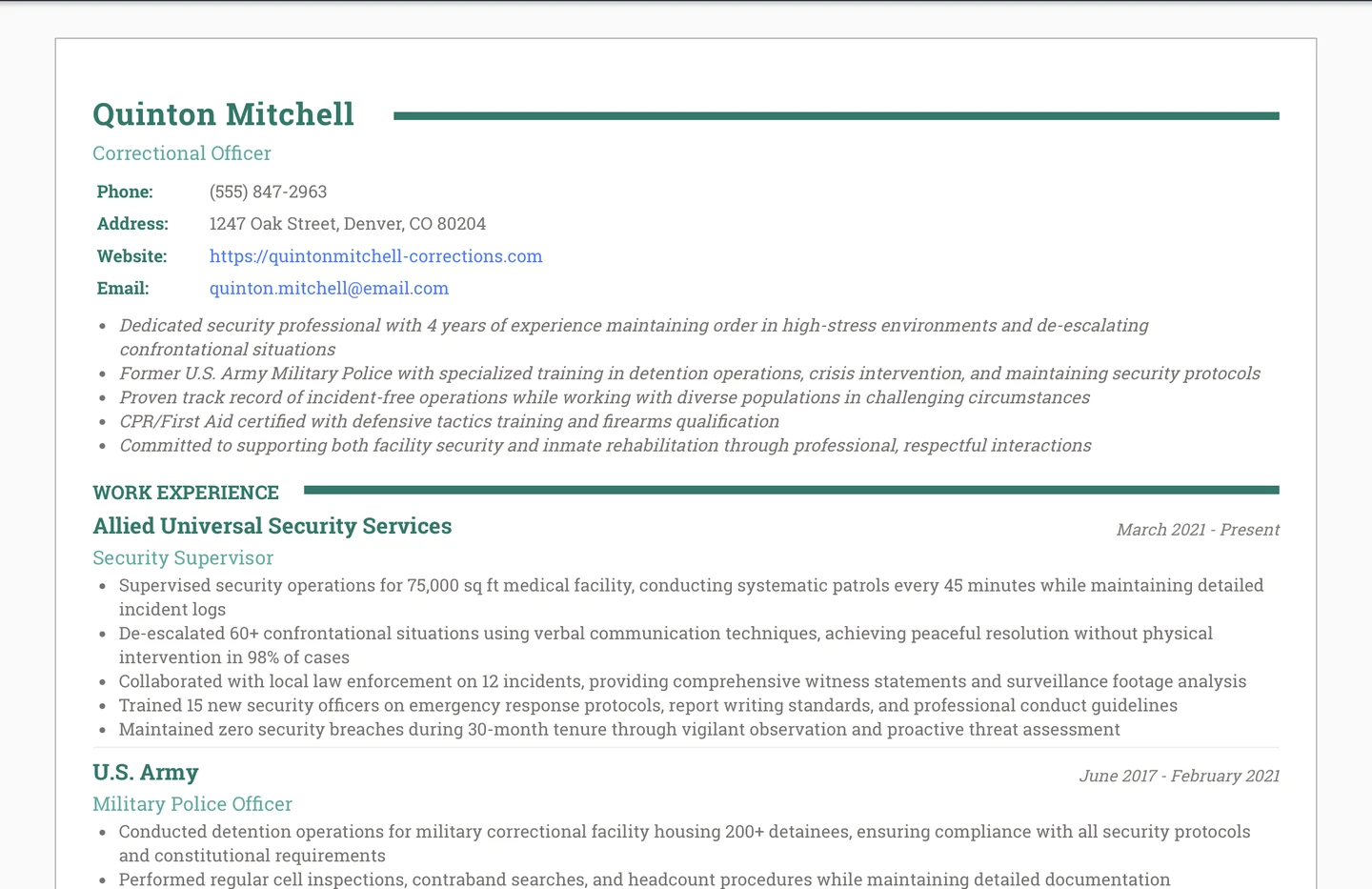
The Ultimate Correctional Officer Resume Example/Sample
https://www.resumonk.com/correctional-officerCorrectional OfficerResume Format for Correctional Officer Resume
The reverse-chronological format stands as your strongest ally here. Why? Because hiring managers at correctional facilities need to see your most recent experience with security protocols, crisis management, or law enforcement training right up front.
They're not interested in your creative side or a functional skills-based narrative - they want a clear, linear progression of your capability to handle high-stress environments.
Structure Your Correctional Officer Resume Like a Security Report
Think of your resume structure like a facility inspection report - clear, organized, and leaving no room for ambiguity.
Start with your contact information and a professional summary that immediately establishes your readiness for the role. This isn't the place for career objectives about personal growth - this is where you state your qualifications in maintaining secure environments.
Your sections should flow in this order - Professional Summary, Work Experience, Education and Training, Certifications, and Skills. Each section builds upon the previous one, creating a comprehensive picture of your preparedness for correctional work.
The One-Page vs. Two-Page Debate
For entry-level correctional officer positions, stick to one page unless you have extensive military or law enforcement background directly relevant to corrections. Remember, the person reading your resume might be reviewing hundreds of applications between shift changes and administrative duties.
Make their job easier by being concise yet comprehensive.
In the UK and Australia, where correctional officers are often called prison officers, the format remains similar, though you might include a brief personal statement instead of a professional summary. Canadian applications often benefit from including bilingual capabilities prominently if you possess them, given the federal requirement for French and English in many facilities.
Work Experience on Correctional Officer Resume
Here's where many applicants stumble - they think their retail management experience or customer service background isn't relevant.
But think about it. That time you de-escalated an angry customer at 11 PM during Black Friday? That's conflict resolution. Those years managing inventory and conducting loss prevention? That's security awareness and attention to detail.
Translating Your Experience into Correctional Context
The key lies in translating your experience through a correctional lens.
Every job you've held has taught you something applicable to maintaining order, following protocols, or managing difficult interpersonal situations. Your task is to extract these transferable moments and present them in language that resonates with correctional facility hiring managers.
When describing each role, lead with action verbs that emphasize security, safety, and order. Structure each bullet point to show the situation, your action, and the result - particularly focusing on maintaining safety and following procedures.
❌ Don't write vague descriptions that could apply to any job:
Security Guard - Mall Security Services (2019-2023)
• Walked around the mall during shifts
• Watched for suspicious activity
• Wrote reports when needed
• Helped lost customers
✅ Do write specific, quantified achievements that demonstrate correctional-relevant skills:
Security Guard - Mall Security Services (2019-2023)
• Monitored 50,000 sq ft retail space, conducting systematic patrols every 30 minutes while maintaining detailed logs
• De-escalated 40+ confrontational situations using verbal communication techniques, achieving resolution without physical intervention in 95% of cases
• Collaborated with local law enforcement on 15 incidents, providing detailed witness statements and surveillance footage
• Trained 8 new security personnel on emergency response protocols and report writing standards
Addressing Employment Gaps or Career Changes
If you're transitioning from an unrelated field, don't hide it - reframe it.
That five years in hospitality? You learned to remain calm under pressure, work irregular shifts, and handle difficult personalities. Your military service? Obviously relevant, but don't assume the connection is automatic - explicitly draw parallels between military discipline and correctional facility operations.
For those with gaps in employment, be prepared to address them honestly. If you took time for education, family care, or personal development, a brief mention in your cover letter suffices.
The resume should focus on your qualifications and readiness to serve.
Skills to Include on Correctional Officer Resume
Standing in a correctional facility requires a unique blend of physical capability, mental resilience, and interpersonal finesse. You're not just listing skills - you're painting a picture of someone who can maintain professional boundaries while showing appropriate empathy, someone who can follow strict protocols while thinking on their feet during emergencies.
Hard Skills - The Non-Negotiables
Correctional facilities need to know you can handle the technical aspects of the job.
This includes proficiency with security equipment, understanding of legal procedures, and ability to maintain accurate documentation. But here's the thing - don't just list these skills like a grocery list. Group them strategically to show you understand their interconnection in daily correctional work.
❌ Don't create a random skill dump:
Skills: CPR certified, Computer skills, Team player, Microsoft Word,
Conflict resolution, Report writing, Good communication
✅ Do organize skills into meaningful categories:
Security & Safety Competencies:
• Defensive tactics and restraint techniques certification
• Crisis intervention and de-escalation training
• First Aid/CPR/AED certified (Current through 2024)
• Proficient in security screening equipment and surveillance systems

Administrative & Communication Skills:
• Incident report writing with attention to legal documentation standards
• Database management for inmate tracking systems
• Bilingual communication (English/Spanish) for diverse population interaction
• Inter-agency coordination and information sharing protocols
Soft Skills - The Difference Makers
While everyone claims to have "good communication skills," you need to be more sophisticated in how you present interpersonal abilities.
Correctional work demands emotional intelligence that goes beyond typical workplace interactions. You're dealing with individuals in crisis, managing group dynamics in confined spaces, and maintaining professional relationships with colleagues in high-stress environments.
Instead of listing generic soft skills, weave them into your experience descriptions. Show how your patience helped during a facility lockdown, or how your observational skills prevented a security incident.
These contextual demonstrations carry more weight than any skills list.
Regional Variations in Skill Requirements
In the United States, emphasize any experience with diverse populations and constitutional law knowledge. UK prison officer applications should highlight rehabilitation-focused skills and understanding of the Prison Service Order guidelines. Australian correctional officer resumes benefit from including cultural awareness training, particularly regarding Indigenous populations.
Canadian applications should note any experience with federal versus provincial correctional systems.
Specific Considerations and Tips for Correctional Officer Resume
Let's address the elephant in the cell block - background checks.
Unlike most jobs where a minor indiscretion might slide under the radar, correctional officer positions involve extensive background investigations. Your resume needs to project integrity from the first word to the last. Any hint of embellishment or dishonesty will not only disqualify you but could flag you in law enforcement databases.
The Physical Requirements Reality Check
While you shouldn't dedicate resume space to listing your bench press numbers, you need to subtly convey physical readiness. Mention participation in physical training programs, completion of tactical courses, or relevant athletic achievements.
If you've maintained certifications requiring physical standards (like military service or firefighting), these serve as proxies for physical capability.
For older applicants concerned about age discrimination, focus on experience and judgment rather than physical prowess. Emphasize your ability to de-escalate situations through communication rather than force - something that comes with maturity and experience.
Navigating the Psychological Evaluation Preparation
Many correctional officer positions require psychological evaluations. While your resume can't directly address this, it should consistently portray emotional stability and professional judgment. Avoid any language suggesting impulsiveness, aggression, or difficulty with authority.
Instead, emphasize measured responses, team collaboration, and respect for chain of command.
❌ Don't use language that suggests aggression or impulsiveness:
• Took charge of chaotic situations and enforced compliance
• Never backed down from confrontations with difficult individuals
• Fought to maintain order during disturbances
✅ Do use language that demonstrates professional restraint:
• Restored order through calm leadership during facility disturbances
• Applied progressive intervention techniques to gain voluntary compliance
• Maintained composure while managing multiple simultaneous incidents
The Rehabilitation vs. Punishment Philosophy Balance
Modern correctional facilities increasingly emphasize rehabilitation alongside security.
Your resume should reflect understanding of both aspects. Include any experience with counseling, mentoring, or educational programs. If you've volunteered with at-risk populations or participated in community outreach, these experiences demonstrate your alignment with contemporary correctional philosophy.
However, don't swing too far toward social work - remember that security remains the primary function. Balance humanitarian interests with clear commitment to maintaining safe, secure facilities.
Addressing the Shift Work Reality
Correctional facilities operate 24/7, and your resume should indicate readiness for this reality.
Mention any experience with rotating shifts, overnight work, or extended hours. If you've worked holidays or weekends consistently, include this. It shows you understand and accept the lifestyle requirements of correctional work.
Finally, remember that correctional officer positions often serve as entry points to broader law enforcement careers. While focusing on the immediate position, subtly indicate your long-term commitment to public service and professional development.
This shows you're not just looking for any job - you're beginning a career in corrections.
Education Requirements and Listing Tips for Correctional Officer Resume
Landing that first correctional officer position feels like standing at the gates of a fortress - you know you have what it takes to maintain order and safety inside, but first, you need to prove you've got the educational foundation to handle this challenging career. Whether you're fresh out of high school, transitioning from military service, or making a career pivot from retail or security work, your education section needs to demonstrate you meet the baseline requirements while showcasing any additional training that sets you apart.
Basic Educational Requirements - Your Entry Ticket
Most correctional facilities require a high school diploma or GED as the minimum educational threshold.
Think of this as your basic admission ticket - without it, the gates simply won't open. But here's where many applicants stumble - they list their high school education like it's an afterthought, missing the opportunity to highlight relevant coursework or achievements that connect to corrections work.
When listing your high school education, focus on elements that demonstrate your readiness for this demanding role. Did you take psychology classes? Were you involved in JROTC?
These details matter more than you might think.
❌ Don't - List your education without any context or relevance:
Central High School
Graduated 2020
✅ Do - Include relevant details that connect to corrections work:
Central High School - Diploma
May 2020 | Springfield, IL
Relevant Coursework: Psychology, Criminal Justice, Conflict Resolution
Activities: JROTC Squad Leader, Wrestling Team Captain
College Education and Criminal Justice Degrees
While many facilities don't require college education for entry-level correctional officer positions, having some college coursework or a degree can fast-track your application to the top of the pile. If you've taken even a semester of criminal justice courses at your local community college, that investment is about to pay dividends.
The key is presenting your education strategically - leading with your highest qualification and working backward in reverse-chronological order.
For those with associate or bachelor's degrees in criminal justice, sociology, psychology, or related fields, you're sitting on gold. These degrees signal to hiring managers that you understand the theoretical frameworks behind rehabilitation and the complex social dynamics within correctional facilities.
❌ Don't - Bury your degree details or make them generic:
Bachelor's Degree - State University
Criminal Justice
2019
✅ Do - Highlight specific aspects of your education relevant to corrections:
Bachelor of Science in Criminal Justice
State University | May 2019 | Chicago, IL
GPA: 3.4/4.0
Relevant Coursework: Correctional Systems, Criminology, Inmate Psychology,
Constitutional Law, Crisis Intervention Techniques
Senior Project: "Reducing Recidivism Through Educational Programs in State Prisons"
Specialized Training and Certifications
This is where you can really differentiate yourself from the stack of applications on the warden's desk. Every certification course you've completed - whether it's CPR/First Aid, crisis intervention training, or substance abuse awareness - demonstrates your commitment to professional development.
Many candidates coming from security, military, or law enforcement backgrounds have accumulated valuable certifications without realizing their worth in corrections.
List these certifications within your education section if you don't have many, or create a separate "Certifications" section if you have several. Remember, correctional facilities value officers who can handle medical emergencies, de-escalate tense situations, and understand the complexities of addiction and mental health.
Academy Training and Ongoing Education
If you've already completed correctional officer academy training in another state or through a previous position, this should be prominently featured.
Each state has different requirements - California requires completion of the STC program, Texas has TDCJ training, while federal positions require FLETC training. Being specific about your completed training shows you understand the professional standards of the field.
✅ Do - List academy and specialized training with specifics:
Correctional Officer Basic Training Academy
Illinois Department of Corrections Training Academy | March 2021
- 240 hours of comprehensive training
- Firearms qualification achieved
- Defensive tactics certification
- Report writing and documentation procedures
For those currently pursuing education, don't hesitate to include it with an expected completion date. This shows initiative and commitment to professional growth - qualities every facility wants in their officers.
Awards, Commendations, and Publications on Your Correctional Officer Resume
Envision this moment - you're sitting across from a hiring panel, and they're looking at fifty resumes from candidates who all meet the basic requirements.
What makes yours different? This is where your awards and recognitions become your secret weapon. Whether you earned them during military service, in your previous security role, or even from volunteer work at the local youth detention center, these accolades tell a story about your character that transcripts and certifications simply cannot.
Military Awards and Their Civilian Translation
For veterans transitioning into corrections - and there are many of you - your military commendations carry serious weight.
But here's the challenge: civilian hiring managers might not immediately understand what an Army Commendation Medal or Navy Achievement Medal represents. Your job is to translate these honors into language that resonates with correctional facility leadership.
Think about what each award represents in terms of correctional work. That Good Conduct Medal? It demonstrates your ability to maintain professional standards under pressure. Your Expert Marksmanship Badge shows precision and discipline with firearms - directly applicable to armed posts in maximum-security facilities.
❌ Don't - List military awards without context:
ARCOM (2x)
AAM
GWOT
✅ Do - Translate military awards for civilian understanding:
Army Commendation Medal (2019, 2021)
- Recognized for maintaining zero security incidents during high-risk detainee operations
- Led team of 12 in establishing new protocols for prisoner transport

Army Achievement Medal (2020)
- Awarded for de-escalating potential riot situation involving 30+ individuals
- Demonstrated exceptional judgment under extreme pressure
Civilian Awards and Recognition
Maybe you don't have military experience, but you've been grinding it out in retail management, security, or emergency services.
That "Employee of the Month" award from your security company isn't just a pat on the back - it's proof you can maintain professionalism during those long overnight shifts. Your perfect attendance record demonstrates reliability, something incredibly valuable in a field where staffing shortages can compromise facility safety.
Even academic honors from years ago can support your application. Dean's List recognition shows discipline and ability to meet high standards.
Leadership awards from college organizations demonstrate your ability to manage group dynamics - a crucial skill when overseeing inmate populations.
Professional Commendations and Letters of Recognition
If you've worked in any capacity within law enforcement, security, or social services, you might have received formal commendations that deserve prominent placement. These could include letters of appreciation from supervisors, certificates for successful crisis interventions, or recognition for maintaining incident-free records.
✅ Do - Quantify and contextualize your achievements:
Letter of Commendation - Regional Security Services (March 2022)
- Recognized for 18 months of incident-free security operations
- Successfully prevented three potential security breaches through vigilant observation
- Trained 15 new security officers in de-escalation techniques
The Question of Publications
Now, publications might seem like an odd consideration for a correctional officer position, but hear me out. If you've written anything related to criminal justice, security procedures, or even leadership development - whether for a college paper, industry newsletter, or online platform - it demonstrates your deep understanding of the field.
This is particularly valuable if you're aiming for federal positions or facilities that emphasize rehabilitation and reform.
However, be selective. That blog post about your favorite workout routine? Skip it. But that article you wrote for your community college newspaper about rehabilitation programs? That's gold. If you contributed to any security manuals, training materials, or policy documents in previous roles, these absolutely count as publications worth mentioning.
❌ Don't - Include irrelevant publications:
"My Thoughts on Fantasy Football" - Personal Blog (2021)
✅ Do - List relevant professional or academic writing:
"Implementing Restorative Justice in County Jails"
- Criminal Justice Student Quarterly, State University (May 2020)
- Analyzed successful rehabilitation programs across three facilities
- Proposed cost-effective implementation strategies for smaller institutions
Remember, in corrections, awards and recognitions serve as third-party validation of your character, judgment, and reliability. In a field where trust is paramount and the stakes are literally life and death, these endorsements can be the difference between landing an interview and landing in the rejection pile.
Strategic Reference Selection for Your Correctional Officer Resume
Here's something they don't tell you in those online application guides - in corrections, your references aren't just confirming your employment dates.
They're vouching for your character, your ability to handle stress, and most critically, your trustworthiness around vulnerable populations. When a facility is literally handing you keys to cells and trusting you with the safety of hundreds of inmates and staff, those reference checks become investigations into whether you're someone they can depend on when things go sideways.
Who Makes the Cut - Selecting Your References
Forget your buddy from high school or your favorite uncle - corrections facilities need professional references who can speak to specific qualities. Your references should be able to address your integrity, judgment under pressure, and ability to maintain composure in hostile situations.
Think supervisors from security roles, military commanders, law enforcement contacts, or even social workers who've seen you handle difficult situations.
The ideal reference can provide specific examples, not just general endorsements. That shift supervisor who watched you de-escalate a situation with an aggressive customer? Perfect. The military sergeant who observed you maintaining professionalism during overseas detention operations? Even better. The volunteer coordinator at the youth center where you mentored at-risk teens?
Absolutely include them.
❌ Don't - List references without context or relationship:
References:
John Smith - (555) 123-4567
Jane Doe - (555) 987-6543
Bob Johnson - (555) 456-7890
✅ Do - Provide clear context and professional relationships:
Professional References:

Captain Michael Torres
Former Commanding Officer, Military Police Unit
Relationship: Direct Supervisor (2018-2021)
Phone: (555) 123-4567
Email: [email protected]
Can speak to: Leadership under pressure, security protocol adherence,
integrity in handling sensitive situations

Sarah Martinez, MSW
Program Director, Second Chance Youth Services
Relationship: Volunteer Supervisor (2020-Present)
Phone: (555) 987-6543
Email: [email protected]
Can speak to: Work with at-risk populations, de-escalation techniques,
maintaining boundaries while showing compassion
Preparing Your References for Success
Your references need to be ready for deeper questioning than typical employment verification. Corrections facilities often ask references about specific scenarios - "How did this person handle conflict?" "Have you ever questioned their judgment?" "Would you trust them with your safety?"
Before listing someone, have an honest conversation about the role you're pursuing and what might be asked.
Send your references a brief summary of the position, highlighting key requirements like maintaining security, writing reports, and working with diverse populations. Remind them of specific situations where you demonstrated relevant skills. That time you caught a security breach others missed? Make sure your reference remembers it. The month you covered extra shifts without complaint during staffing shortages? That reliability matters in corrections.
The Background Investigation Reality
Here's what many applicants don't realize - in corrections, your listed references are just the starting point.
Investigators will ask your references for additional contacts, creating a web of verification. They might call your references' references. This means every professional relationship matters, not just the three or four people you list.
If you're from the UK applying to His Majesty's Prison Service, expect enhanced vetting procedures. Canadian correctional services require reliability status security clearance, meaning references might be contacted multiple times. Australian correctional facilities often require references spanning the past ten years.
U.S. federal positions through the Bureau of Prisons involve the most extensive reference checks, sometimes including polygraph examinations where your references' statements might be verified.
When and How to List References
Unlike many fields where "References available upon request" suffices, corrections applications often require references upfront. Some agencies want them on a separate sheet, others integrated into the application, and some facilities have specific reference forms that need completion.
Always follow the exact requirements - in corrections, following instructions precisely isn't just preferred, it's a job requirement they're already evaluating.
✅ Do - Format references professionally when required on resume:
PROFESSIONAL REFERENCES

Lieutenant James Crawford
Watch Commander, Metro Security Services
Professional Relationship: Direct Supervisor, 2019-2022
Contact: (555) 234-5678 | [email protected]
Authorized to contact: Yes

Dr. Patricia Wong, Ph.D.
Criminal Justice Department Chair, State Community College
Professional Relationship: Academic Advisor and Instructor, 2017-2019
Contact: (555) 345-6789 | [email protected]
Authorized to contact: Yes

Master Sergeant Robert Hayes (Ret.)
Former Operations NCO, Military Corrections Facility
Professional Relationship: Supervisor during Military Police duty, 2015-2018
Contact: (555) 456-7890 | [email protected]
Authorized to contact: Yes
Remember, in corrections, your references serve as character witnesses in what amounts to a trial of your suitability for one of society's most challenging roles. They're not just confirming you showed up to work - they're testifying that you can be trusted with the immense responsibility of maintaining safety and security while treating all individuals with dignity and respect. Choose them wisely, prepare them thoroughly, and ensure they understand the gravity of their endorsement. In this field, a strong reference can open doors, while a lukewarm one can end your application before you ever get to prove yourself.
Cover Letter Strategies for Your Correctional Officer Resume
Walking into a correctional facility for the first time - even just for an interview - can feel intimidating. Those high walls, razor wire, and multiple security checkpoints remind you this isn't your typical workplace. Your cover letter is your chance to demonstrate you understand this reality and, more importantly, that you're ready for it.
Unlike other fields where cover letters might feel like a formality, in corrections, they serve as your first demonstration of written communication skills - something you'll use daily for incident reports, behavioral observations, and shift logs.
Opening Strong - Why Corrections, Why Now?
The biggest mistake aspiring correctional officers make is opening with generic enthusiasm. Hiring managers in corrections have seen hundreds of letters that start with "I am writing to express my interest in the correctional officer position."
Instead, lead with your understanding of what this job really entails and why you're specifically suited for this challenging career path.
Maybe you're transitioning from military service and understand chain of command and security protocols. Perhaps you've worked retail management and developed patience dealing with difficult individuals. Or you might be fresh from college with a criminal justice degree and genuine passion for rehabilitation. Whatever your background, make that connection immediately clear.
❌ Don't - Open with generic statements:
Dear Hiring Manager,

I am writing to apply for the Correctional Officer position at your facility.
I have always wanted to work in law enforcement.
✅ Do - Open with specific understanding and connection:
Dear Captain Rodriguez,

After spending three years managing security at the city's largest homeless shelter,
I've developed the exact combination of vigilance and compassion needed for correctional work. Your facility's emphasis on rehabilitation programs aligns perfectly with my experience in crisis intervention and my belief that every individual deserves the opportunity for positive change.
Addressing the Reality of the Role
Correctional facilities need officers who understand they're not just guards - they're professionals maintaining safety while supporting rehabilitation efforts.
Your cover letter should acknowledge the dual nature of this role. You're there to enforce rules and maintain security, yes, but you're also potentially the most consistent positive influence in an inmate's daily life.
Address specific aspects of correctional work that others might find challenging. Can you handle verbal abuse without taking it personally? Are you comfortable with the routine nature of counts and inspections? Do you understand the importance of treating all inmates with respect while maintaining professional boundaries?
These aren't just nice-to-have qualities - they're essential for facility safety and your own mental health in this career.
Demonstrating Your Understanding of Facility-Specific Needs
Federal facilities operate differently from state prisons, which operate differently from county jails. Maximum security requires different skills than minimum security. Juvenile facilities need officers with different approaches than adult institutions.
Your cover letter should demonstrate you've researched the specific facility and understand its unique challenges.
If you're applying to a women's facility, mention any experience working with female populations or understanding of trauma-informed approaches. Applying to a facility known for its vocational programs? Highlight any teaching or mentoring experience. This specificity shows you're not mass-applying but genuinely interested in this particular position.
✅ Do - Reference specific facility programs or needs:
I was particularly drawn to San Miguel County Detention Center's implementation of the therapeutic community model. My volunteer work with the addiction recovery program at St. Mary's has given me firsthand experience with the challenges and rewards of supporting individuals through behavioral change. I understand that maintaining safety while fostering a therapeutic environment requires exceptional communication skills and emotional intelligence - qualities I've developed through five years in crisis response.
Closing With Confidence and Availability
Your closing paragraph should reinforce your readiness to begin the extensive screening process.
Background checks, psychological evaluations, physical fitness tests - acknowledge you understand and welcome these requirements. If you have specific availability for interviews or start dates, mention them. Many facilities need officers who can work any shift, so if you have that flexibility, state it explicitly.
For different regions, note that Canadian facilities often emphasize bilingual abilities, Australian corrections value cultural awareness given indigenous populations, and UK positions might require specific Home Office clearances. If you have relevant qualifications for your region, your closing is the perfect place to reinforce them.
❌ Don't - Close weakly or vaguely:
I hope to hear from you soon about this opportunity.
✅ Do - Close with confidence and specifics:
I am prepared to begin the comprehensive screening process immediately and can accommodate any shift assignment upon successful completion of training. My current security clearance remains active through 2025, which should expedite the background investigation process. I am available for interviews Monday through Friday and can be reached at (555) 123-4567. Thank you for considering my application to join your correctional team.
Key Takeaways
After working through this comprehensive guide to creating your correctional officer resume, here are the essential points to remember as you craft your application:
- Use reverse-chronological format consistently - Hiring managers need to see your most recent security, military, or relevant experience first, presented in clear, logical progression that demonstrates your readiness for correctional work
- Translate all experience through a correctional lens - Whether you're coming from retail, military, or security work, focus on conflict resolution, adherence to protocols, and maintaining order under pressure rather than listing generic job duties
- Quantify your achievements with specific metrics - Instead of vague descriptions, use numbers like "de-escalated 40+ confrontational situations" or "maintained incident-free record for 18 months"
- Balance security expertise with rehabilitation awareness - Modern corrections values both maintaining order and supporting inmate rehabilitation, so showcase experience with both aspects
- Include all relevant certifications and training - CPR/First Aid, crisis intervention, defensive tactics, and any specialized training should be prominently featured, as these set you apart from basic qualified candidates
- Address shift work flexibility and background check readiness - Explicitly state your availability for any shift and acknowledge your preparedness for extensive screening processes
- Prepare references who understand corrections - Select supervisors and colleagues who can speak specifically to your integrity, judgment under pressure, and ability to maintain professional boundaries
- Tailor your application to specific facility types - Federal, state, county, maximum security, minimum security, juvenile, and women's facilities all have different needs - research and adjust accordingly
Creating a standout correctional officer resume doesn't have to feel like you're locked in solitary with a blank page. With Resumonk's intuitive platform, you can build a professional, compelling resume that captures your unique qualifications for this challenging career. Our AI-powered suggestions help you translate your diverse experience into corrections-relevant language, while our professionally designed templates ensure your application looks as sharp as a freshly pressed uniform. Whether you're transitioning from military service, upgrading from security work, or entering corrections straight from school, Resumonk guides you through each section with targeted recommendations specific to correctional officer positions.
Ready to unlock your career in corrections?
Start building your professional correctional officer resume with Resumonk today. Our specialized templates and AI-driven guidance will help you create an application that opens doors in federal, state, and local correctional facilities.
Start your resume with Resumonk for free →
More Public Safety & Security resume examples
- Loss Prevention resume example
- Security Officer resume example
- Lifeguard resume example
- EMT resume example
See all Public Safety & Security resume examples, or browse every category.
Resume writing tips
You're staring at that blank document, knowing you've got what it takes to maintain order in one of society's most challenging environments, but somehow translating your military discipline, security experience, or that criminal justice degree into a resume that catches a warden's attention feels harder than a twelve-hour night shift. Maybe you're transitioning from years of retail management where you've handled more confrontations than you can count, or perhaps you're fresh out of community college with a burning desire to make a difference in corrections - either way, you know this isn't your typical job application.
The correctional officer role sits at a unique intersection of law enforcement, social services, and crisis management. You're not applying to be a police officer patrolling streets, nor are you seeking a desk job reviewing parole applications. You're pursuing a position where every single day, you'll walk through multiple security checkpoints into a facility housing individuals who've lost their freedom, where your ability to maintain professional boundaries while showing appropriate respect could be the difference between a calm shift and a full-scale incident. This reality demands a resume that speaks to both your capacity for maintaining security and your understanding that modern corrections involves more than just locking doors.
Throughout this comprehensive guide, we'll walk you through every element of crafting a correctional officer resume that gets you past the initial screening and into that interview room. We'll start with choosing the right format - spoiler alert, reverse-chronological wins for a reason - then dive deep into presenting your work experience in ways that highlight transferable skills from any background. You'll learn exactly which skills matter most to facilities, how to present your education whether you have a high school diploma or a master's degree, and how to handle those specific considerations like shift work availability and background check readiness that are unique to corrections.
We'll also cover the often-overlooked elements that can set you apart - how military awards translate to civilian corrections, why that volunteer work at the youth center matters more than you think, and how to craft a cover letter that shows you understand the reality of working inside those walls. By the time you finish reading, you'll have everything you need to create a resume that doesn't just list your qualifications, but tells your story as someone ready to take on one of the most demanding yet vital roles in our justice system.
The Ultimate Correctional Officer Resume Example/Sample
https://www.resumonk.com/correctional-officerCorrectional OfficerResume Format for Correctional Officer Resume
The reverse-chronological format stands as your strongest ally here. Why? Because hiring managers at correctional facilities need to see your most recent experience with security protocols, crisis management, or law enforcement training right up front.
They're not interested in your creative side or a functional skills-based narrative - they want a clear, linear progression of your capability to handle high-stress environments.
Structure Your Correctional Officer Resume Like a Security Report
Think of your resume structure like a facility inspection report - clear, organized, and leaving no room for ambiguity.
Start with your contact information and a professional summary that immediately establishes your readiness for the role. This isn't the place for career objectives about personal growth - this is where you state your qualifications in maintaining secure environments.
Your sections should flow in this order - Professional Summary, Work Experience, Education and Training, Certifications, and Skills. Each section builds upon the previous one, creating a comprehensive picture of your preparedness for correctional work.
The One-Page vs. Two-Page Debate
For entry-level correctional officer positions, stick to one page unless you have extensive military or law enforcement background directly relevant to corrections. Remember, the person reading your resume might be reviewing hundreds of applications between shift changes and administrative duties.
Make their job easier by being concise yet comprehensive.
In the UK and Australia, where correctional officers are often called prison officers, the format remains similar, though you might include a brief personal statement instead of a professional summary. Canadian applications often benefit from including bilingual capabilities prominently if you possess them, given the federal requirement for French and English in many facilities.
Work Experience on Correctional Officer Resume
Here's where many applicants stumble - they think their retail management experience or customer service background isn't relevant.
But think about it. That time you de-escalated an angry customer at 11 PM during Black Friday? That's conflict resolution. Those years managing inventory and conducting loss prevention? That's security awareness and attention to detail.
Translating Your Experience into Correctional Context
The key lies in translating your experience through a correctional lens.
Every job you've held has taught you something applicable to maintaining order, following protocols, or managing difficult interpersonal situations. Your task is to extract these transferable moments and present them in language that resonates with correctional facility hiring managers.
When describing each role, lead with action verbs that emphasize security, safety, and order. Structure each bullet point to show the situation, your action, and the result - particularly focusing on maintaining safety and following procedures.
❌ Don't write vague descriptions that could apply to any job:
Security Guard - Mall Security Services (2019-2023)
• Walked around the mall during shifts
• Watched for suspicious activity
• Wrote reports when needed
• Helped lost customers
✅ Do write specific, quantified achievements that demonstrate correctional-relevant skills:
Security Guard - Mall Security Services (2019-2023)
• Monitored 50,000 sq ft retail space, conducting systematic patrols every 30 minutes while maintaining detailed logs
• De-escalated 40+ confrontational situations using verbal communication techniques, achieving resolution without physical intervention in 95% of cases
• Collaborated with local law enforcement on 15 incidents, providing detailed witness statements and surveillance footage
• Trained 8 new security personnel on emergency response protocols and report writing standards
Addressing Employment Gaps or Career Changes
If you're transitioning from an unrelated field, don't hide it - reframe it.
That five years in hospitality? You learned to remain calm under pressure, work irregular shifts, and handle difficult personalities. Your military service? Obviously relevant, but don't assume the connection is automatic - explicitly draw parallels between military discipline and correctional facility operations.
For those with gaps in employment, be prepared to address them honestly. If you took time for education, family care, or personal development, a brief mention in your cover letter suffices.
The resume should focus on your qualifications and readiness to serve.
Skills to Include on Correctional Officer Resume
Standing in a correctional facility requires a unique blend of physical capability, mental resilience, and interpersonal finesse. You're not just listing skills - you're painting a picture of someone who can maintain professional boundaries while showing appropriate empathy, someone who can follow strict protocols while thinking on their feet during emergencies.
Hard Skills - The Non-Negotiables
Correctional facilities need to know you can handle the technical aspects of the job.
This includes proficiency with security equipment, understanding of legal procedures, and ability to maintain accurate documentation. But here's the thing - don't just list these skills like a grocery list. Group them strategically to show you understand their interconnection in daily correctional work.
❌ Don't create a random skill dump:
Skills: CPR certified, Computer skills, Team player, Microsoft Word,
Conflict resolution, Report writing, Good communication
✅ Do organize skills into meaningful categories:
Security & Safety Competencies:
• Defensive tactics and restraint techniques certification
• Crisis intervention and de-escalation training
• First Aid/CPR/AED certified (Current through 2024)
• Proficient in security screening equipment and surveillance systems

Administrative & Communication Skills:
• Incident report writing with attention to legal documentation standards
• Database management for inmate tracking systems
• Bilingual communication (English/Spanish) for diverse population interaction
• Inter-agency coordination and information sharing protocols
Soft Skills - The Difference Makers
While everyone claims to have "good communication skills," you need to be more sophisticated in how you present interpersonal abilities.
Correctional work demands emotional intelligence that goes beyond typical workplace interactions. You're dealing with individuals in crisis, managing group dynamics in confined spaces, and maintaining professional relationships with colleagues in high-stress environments.
Instead of listing generic soft skills, weave them into your experience descriptions. Show how your patience helped during a facility lockdown, or how your observational skills prevented a security incident.
These contextual demonstrations carry more weight than any skills list.
Regional Variations in Skill Requirements
In the United States, emphasize any experience with diverse populations and constitutional law knowledge. UK prison officer applications should highlight rehabilitation-focused skills and understanding of the Prison Service Order guidelines. Australian correctional officer resumes benefit from including cultural awareness training, particularly regarding Indigenous populations.
Canadian applications should note any experience with federal versus provincial correctional systems.
Specific Considerations and Tips for Correctional Officer Resume
Let's address the elephant in the cell block - background checks.
Unlike most jobs where a minor indiscretion might slide under the radar, correctional officer positions involve extensive background investigations. Your resume needs to project integrity from the first word to the last. Any hint of embellishment or dishonesty will not only disqualify you but could flag you in law enforcement databases.
The Physical Requirements Reality Check
While you shouldn't dedicate resume space to listing your bench press numbers, you need to subtly convey physical readiness. Mention participation in physical training programs, completion of tactical courses, or relevant athletic achievements.
If you've maintained certifications requiring physical standards (like military service or firefighting), these serve as proxies for physical capability.
For older applicants concerned about age discrimination, focus on experience and judgment rather than physical prowess. Emphasize your ability to de-escalate situations through communication rather than force - something that comes with maturity and experience.
Navigating the Psychological Evaluation Preparation
Many correctional officer positions require psychological evaluations. While your resume can't directly address this, it should consistently portray emotional stability and professional judgment. Avoid any language suggesting impulsiveness, aggression, or difficulty with authority.
Instead, emphasize measured responses, team collaboration, and respect for chain of command.
❌ Don't use language that suggests aggression or impulsiveness:
• Took charge of chaotic situations and enforced compliance
• Never backed down from confrontations with difficult individuals
• Fought to maintain order during disturbances
✅ Do use language that demonstrates professional restraint:
• Restored order through calm leadership during facility disturbances
• Applied progressive intervention techniques to gain voluntary compliance
• Maintained composure while managing multiple simultaneous incidents
The Rehabilitation vs. Punishment Philosophy Balance
Modern correctional facilities increasingly emphasize rehabilitation alongside security.
Your resume should reflect understanding of both aspects. Include any experience with counseling, mentoring, or educational programs. If you've volunteered with at-risk populations or participated in community outreach, these experiences demonstrate your alignment with contemporary correctional philosophy.
However, don't swing too far toward social work - remember that security remains the primary function. Balance humanitarian interests with clear commitment to maintaining safe, secure facilities.
Addressing the Shift Work Reality
Correctional facilities operate 24/7, and your resume should indicate readiness for this reality.
Mention any experience with rotating shifts, overnight work, or extended hours. If you've worked holidays or weekends consistently, include this. It shows you understand and accept the lifestyle requirements of correctional work.
Finally, remember that correctional officer positions often serve as entry points to broader law enforcement careers. While focusing on the immediate position, subtly indicate your long-term commitment to public service and professional development.
This shows you're not just looking for any job - you're beginning a career in corrections.
Education Requirements and Listing Tips for Correctional Officer Resume
Landing that first correctional officer position feels like standing at the gates of a fortress - you know you have what it takes to maintain order and safety inside, but first, you need to prove you've got the educational foundation to handle this challenging career. Whether you're fresh out of high school, transitioning from military service, or making a career pivot from retail or security work, your education section needs to demonstrate you meet the baseline requirements while showcasing any additional training that sets you apart.
Basic Educational Requirements - Your Entry Ticket
Most correctional facilities require a high school diploma or GED as the minimum educational threshold.
Think of this as your basic admission ticket - without it, the gates simply won't open. But here's where many applicants stumble - they list their high school education like it's an afterthought, missing the opportunity to highlight relevant coursework or achievements that connect to corrections work.
When listing your high school education, focus on elements that demonstrate your readiness for this demanding role. Did you take psychology classes? Were you involved in JROTC?
These details matter more than you might think.
❌ Don't - List your education without any context or relevance:
Central High School
Graduated 2020
✅ Do - Include relevant details that connect to corrections work:
Central High School - Diploma
May 2020 | Springfield, IL
Relevant Coursework: Psychology, Criminal Justice, Conflict Resolution
Activities: JROTC Squad Leader, Wrestling Team Captain
College Education and Criminal Justice Degrees
While many facilities don't require college education for entry-level correctional officer positions, having some college coursework or a degree can fast-track your application to the top of the pile. If you've taken even a semester of criminal justice courses at your local community college, that investment is about to pay dividends.
The key is presenting your education strategically - leading with your highest qualification and working backward in reverse-chronological order.
For those with associate or bachelor's degrees in criminal justice, sociology, psychology, or related fields, you're sitting on gold. These degrees signal to hiring managers that you understand the theoretical frameworks behind rehabilitation and the complex social dynamics within correctional facilities.
❌ Don't - Bury your degree details or make them generic:
Bachelor's Degree - State University
Criminal Justice
2019
✅ Do - Highlight specific aspects of your education relevant to corrections:
Bachelor of Science in Criminal Justice
State University | May 2019 | Chicago, IL
GPA: 3.4/4.0
Relevant Coursework: Correctional Systems, Criminology, Inmate Psychology,
Constitutional Law, Crisis Intervention Techniques
Senior Project: "Reducing Recidivism Through Educational Programs in State Prisons"
Specialized Training and Certifications
This is where you can really differentiate yourself from the stack of applications on the warden's desk. Every certification course you've completed - whether it's CPR/First Aid, crisis intervention training, or substance abuse awareness - demonstrates your commitment to professional development.
Many candidates coming from security, military, or law enforcement backgrounds have accumulated valuable certifications without realizing their worth in corrections.
List these certifications within your education section if you don't have many, or create a separate "Certifications" section if you have several. Remember, correctional facilities value officers who can handle medical emergencies, de-escalate tense situations, and understand the complexities of addiction and mental health.
Academy Training and Ongoing Education
If you've already completed correctional officer academy training in another state or through a previous position, this should be prominently featured.
Each state has different requirements - California requires completion of the STC program, Texas has TDCJ training, while federal positions require FLETC training. Being specific about your completed training shows you understand the professional standards of the field.
✅ Do - List academy and specialized training with specifics:
Correctional Officer Basic Training Academy
Illinois Department of Corrections Training Academy | March 2021
- 240 hours of comprehensive training
- Firearms qualification achieved
- Defensive tactics certification
- Report writing and documentation procedures
For those currently pursuing education, don't hesitate to include it with an expected completion date. This shows initiative and commitment to professional growth - qualities every facility wants in their officers.
Awards, Commendations, and Publications on Your Correctional Officer Resume
Envision this moment - you're sitting across from a hiring panel, and they're looking at fifty resumes from candidates who all meet the basic requirements.
What makes yours different? This is where your awards and recognitions become your secret weapon. Whether you earned them during military service, in your previous security role, or even from volunteer work at the local youth detention center, these accolades tell a story about your character that transcripts and certifications simply cannot.
Military Awards and Their Civilian Translation
For veterans transitioning into corrections - and there are many of you - your military commendations carry serious weight.
But here's the challenge: civilian hiring managers might not immediately understand what an Army Commendation Medal or Navy Achievement Medal represents. Your job is to translate these honors into language that resonates with correctional facility leadership.
Think about what each award represents in terms of correctional work. That Good Conduct Medal? It demonstrates your ability to maintain professional standards under pressure. Your Expert Marksmanship Badge shows precision and discipline with firearms - directly applicable to armed posts in maximum-security facilities.
❌ Don't - List military awards without context:
ARCOM (2x)
AAM
GWOT
✅ Do - Translate military awards for civilian understanding:
Army Commendation Medal (2019, 2021)
- Recognized for maintaining zero security incidents during high-risk detainee operations
- Led team of 12 in establishing new protocols for prisoner transport

Army Achievement Medal (2020)
- Awarded for de-escalating potential riot situation involving 30+ individuals
- Demonstrated exceptional judgment under extreme pressure
Civilian Awards and Recognition
Maybe you don't have military experience, but you've been grinding it out in retail management, security, or emergency services.
That "Employee of the Month" award from your security company isn't just a pat on the back - it's proof you can maintain professionalism during those long overnight shifts. Your perfect attendance record demonstrates reliability, something incredibly valuable in a field where staffing shortages can compromise facility safety.
Even academic honors from years ago can support your application. Dean's List recognition shows discipline and ability to meet high standards.
Leadership awards from college organizations demonstrate your ability to manage group dynamics - a crucial skill when overseeing inmate populations.
Professional Commendations and Letters of Recognition
If you've worked in any capacity within law enforcement, security, or social services, you might have received formal commendations that deserve prominent placement. These could include letters of appreciation from supervisors, certificates for successful crisis interventions, or recognition for maintaining incident-free records.
✅ Do - Quantify and contextualize your achievements:
Letter of Commendation - Regional Security Services (March 2022)
- Recognized for 18 months of incident-free security operations
- Successfully prevented three potential security breaches through vigilant observation
- Trained 15 new security officers in de-escalation techniques
The Question of Publications
Now, publications might seem like an odd consideration for a correctional officer position, but hear me out. If you've written anything related to criminal justice, security procedures, or even leadership development - whether for a college paper, industry newsletter, or online platform - it demonstrates your deep understanding of the field.
This is particularly valuable if you're aiming for federal positions or facilities that emphasize rehabilitation and reform.
However, be selective. That blog post about your favorite workout routine? Skip it. But that article you wrote for your community college newspaper about rehabilitation programs? That's gold. If you contributed to any security manuals, training materials, or policy documents in previous roles, these absolutely count as publications worth mentioning.
❌ Don't - Include irrelevant publications:
"My Thoughts on Fantasy Football" - Personal Blog (2021)
✅ Do - List relevant professional or academic writing:
"Implementing Restorative Justice in County Jails"
- Criminal Justice Student Quarterly, State University (May 2020)
- Analyzed successful rehabilitation programs across three facilities
- Proposed cost-effective implementation strategies for smaller institutions
Remember, in corrections, awards and recognitions serve as third-party validation of your character, judgment, and reliability. In a field where trust is paramount and the stakes are literally life and death, these endorsements can be the difference between landing an interview and landing in the rejection pile.
Strategic Reference Selection for Your Correctional Officer Resume
Here's something they don't tell you in those online application guides - in corrections, your references aren't just confirming your employment dates.
They're vouching for your character, your ability to handle stress, and most critically, your trustworthiness around vulnerable populations. When a facility is literally handing you keys to cells and trusting you with the safety of hundreds of inmates and staff, those reference checks become investigations into whether you're someone they can depend on when things go sideways.
Who Makes the Cut - Selecting Your References
Forget your buddy from high school or your favorite uncle - corrections facilities need professional references who can speak to specific qualities. Your references should be able to address your integrity, judgment under pressure, and ability to maintain composure in hostile situations.
Think supervisors from security roles, military commanders, law enforcement contacts, or even social workers who've seen you handle difficult situations.
The ideal reference can provide specific examples, not just general endorsements. That shift supervisor who watched you de-escalate a situation with an aggressive customer? Perfect. The military sergeant who observed you maintaining professionalism during overseas detention operations? Even better. The volunteer coordinator at the youth center where you mentored at-risk teens?
Absolutely include them.
❌ Don't - List references without context or relationship:
References:
John Smith - (555) 123-4567
Jane Doe - (555) 987-6543
Bob Johnson - (555) 456-7890
✅ Do - Provide clear context and professional relationships:
Professional References:

Captain Michael Torres
Former Commanding Officer, Military Police Unit
Relationship: Direct Supervisor (2018-2021)
Phone: (555) 123-4567
Email: [email protected]
Can speak to: Leadership under pressure, security protocol adherence,
integrity in handling sensitive situations

Sarah Martinez, MSW
Program Director, Second Chance Youth Services
Relationship: Volunteer Supervisor (2020-Present)
Phone: (555) 987-6543
Email: [email protected]
Can speak to: Work with at-risk populations, de-escalation techniques,
maintaining boundaries while showing compassion
Preparing Your References for Success
Your references need to be ready for deeper questioning than typical employment verification. Corrections facilities often ask references about specific scenarios - "How did this person handle conflict?" "Have you ever questioned their judgment?" "Would you trust them with your safety?"
Before listing someone, have an honest conversation about the role you're pursuing and what might be asked.
Send your references a brief summary of the position, highlighting key requirements like maintaining security, writing reports, and working with diverse populations. Remind them of specific situations where you demonstrated relevant skills. That time you caught a security breach others missed? Make sure your reference remembers it. The month you covered extra shifts without complaint during staffing shortages? That reliability matters in corrections.
The Background Investigation Reality
Here's what many applicants don't realize - in corrections, your listed references are just the starting point.
Investigators will ask your references for additional contacts, creating a web of verification. They might call your references' references. This means every professional relationship matters, not just the three or four people you list.
If you're from the UK applying to His Majesty's Prison Service, expect enhanced vetting procedures. Canadian correctional services require reliability status security clearance, meaning references might be contacted multiple times. Australian correctional facilities often require references spanning the past ten years.
U.S. federal positions through the Bureau of Prisons involve the most extensive reference checks, sometimes including polygraph examinations where your references' statements might be verified.
When and How to List References
Unlike many fields where "References available upon request" suffices, corrections applications often require references upfront. Some agencies want them on a separate sheet, others integrated into the application, and some facilities have specific reference forms that need completion.
Always follow the exact requirements - in corrections, following instructions precisely isn't just preferred, it's a job requirement they're already evaluating.
✅ Do - Format references professionally when required on resume:
PROFESSIONAL REFERENCES

Lieutenant James Crawford
Watch Commander, Metro Security Services
Professional Relationship: Direct Supervisor, 2019-2022
Contact: (555) 234-5678 | [email protected]
Authorized to contact: Yes

Dr. Patricia Wong, Ph.D.
Criminal Justice Department Chair, State Community College
Professional Relationship: Academic Advisor and Instructor, 2017-2019
Contact: (555) 345-6789 | [email protected]
Authorized to contact: Yes

Master Sergeant Robert Hayes (Ret.)
Former Operations NCO, Military Corrections Facility
Professional Relationship: Supervisor during Military Police duty, 2015-2018
Contact: (555) 456-7890 | [email protected]
Authorized to contact: Yes
Remember, in corrections, your references serve as character witnesses in what amounts to a trial of your suitability for one of society's most challenging roles. They're not just confirming you showed up to work - they're testifying that you can be trusted with the immense responsibility of maintaining safety and security while treating all individuals with dignity and respect. Choose them wisely, prepare them thoroughly, and ensure they understand the gravity of their endorsement. In this field, a strong reference can open doors, while a lukewarm one can end your application before you ever get to prove yourself.
Cover Letter Strategies for Your Correctional Officer Resume
Walking into a correctional facility for the first time - even just for an interview - can feel intimidating. Those high walls, razor wire, and multiple security checkpoints remind you this isn't your typical workplace. Your cover letter is your chance to demonstrate you understand this reality and, more importantly, that you're ready for it.
Unlike other fields where cover letters might feel like a formality, in corrections, they serve as your first demonstration of written communication skills - something you'll use daily for incident reports, behavioral observations, and shift logs.
Opening Strong - Why Corrections, Why Now?
The biggest mistake aspiring correctional officers make is opening with generic enthusiasm. Hiring managers in corrections have seen hundreds of letters that start with "I am writing to express my interest in the correctional officer position."
Instead, lead with your understanding of what this job really entails and why you're specifically suited for this challenging career path.
Maybe you're transitioning from military service and understand chain of command and security protocols. Perhaps you've worked retail management and developed patience dealing with difficult individuals. Or you might be fresh from college with a criminal justice degree and genuine passion for rehabilitation. Whatever your background, make that connection immediately clear.
❌ Don't - Open with generic statements:
Dear Hiring Manager,

I am writing to apply for the Correctional Officer position at your facility.
I have always wanted to work in law enforcement.
✅ Do - Open with specific understanding and connection:
Dear Captain Rodriguez,

After spending three years managing security at the city's largest homeless shelter,
I've developed the exact combination of vigilance and compassion needed for correctional work. Your facility's emphasis on rehabilitation programs aligns perfectly with my experience in crisis intervention and my belief that every individual deserves the opportunity for positive change.
Addressing the Reality of the Role
Correctional facilities need officers who understand they're not just guards - they're professionals maintaining safety while supporting rehabilitation efforts.
Your cover letter should acknowledge the dual nature of this role. You're there to enforce rules and maintain security, yes, but you're also potentially the most consistent positive influence in an inmate's daily life.
Address specific aspects of correctional work that others might find challenging. Can you handle verbal abuse without taking it personally? Are you comfortable with the routine nature of counts and inspections? Do you understand the importance of treating all inmates with respect while maintaining professional boundaries?
These aren't just nice-to-have qualities - they're essential for facility safety and your own mental health in this career.
Demonstrating Your Understanding of Facility-Specific Needs
Federal facilities operate differently from state prisons, which operate differently from county jails. Maximum security requires different skills than minimum security. Juvenile facilities need officers with different approaches than adult institutions.
Your cover letter should demonstrate you've researched the specific facility and understand its unique challenges.
If you're applying to a women's facility, mention any experience working with female populations or understanding of trauma-informed approaches. Applying to a facility known for its vocational programs? Highlight any teaching or mentoring experience. This specificity shows you're not mass-applying but genuinely interested in this particular position.
✅ Do - Reference specific facility programs or needs:
I was particularly drawn to San Miguel County Detention Center's implementation of the therapeutic community model. My volunteer work with the addiction recovery program at St. Mary's has given me firsthand experience with the challenges and rewards of supporting individuals through behavioral change. I understand that maintaining safety while fostering a therapeutic environment requires exceptional communication skills and emotional intelligence - qualities I've developed through five years in crisis response.
Closing With Confidence and Availability
Your closing paragraph should reinforce your readiness to begin the extensive screening process.
Background checks, psychological evaluations, physical fitness tests - acknowledge you understand and welcome these requirements. If you have specific availability for interviews or start dates, mention them. Many facilities need officers who can work any shift, so if you have that flexibility, state it explicitly.
For different regions, note that Canadian facilities often emphasize bilingual abilities, Australian corrections value cultural awareness given indigenous populations, and UK positions might require specific Home Office clearances. If you have relevant qualifications for your region, your closing is the perfect place to reinforce them.
❌ Don't - Close weakly or vaguely:
I hope to hear from you soon about this opportunity.
✅ Do - Close with confidence and specifics:
I am prepared to begin the comprehensive screening process immediately and can accommodate any shift assignment upon successful completion of training. My current security clearance remains active through 2025, which should expedite the background investigation process. I am available for interviews Monday through Friday and can be reached at (555) 123-4567. Thank you for considering my application to join your correctional team.
Key Takeaways
After working through this comprehensive guide to creating your correctional officer resume, here are the essential points to remember as you craft your application:
- Use reverse-chronological format consistently - Hiring managers need to see your most recent security, military, or relevant experience first, presented in clear, logical progression that demonstrates your readiness for correctional work
- Translate all experience through a correctional lens - Whether you're coming from retail, military, or security work, focus on conflict resolution, adherence to protocols, and maintaining order under pressure rather than listing generic job duties
- Quantify your achievements with specific metrics - Instead of vague descriptions, use numbers like "de-escalated 40+ confrontational situations" or "maintained incident-free record for 18 months"
- Balance security expertise with rehabilitation awareness - Modern corrections values both maintaining order and supporting inmate rehabilitation, so showcase experience with both aspects
- Include all relevant certifications and training - CPR/First Aid, crisis intervention, defensive tactics, and any specialized training should be prominently featured, as these set you apart from basic qualified candidates
- Address shift work flexibility and background check readiness - Explicitly state your availability for any shift and acknowledge your preparedness for extensive screening processes
- Prepare references who understand corrections - Select supervisors and colleagues who can speak specifically to your integrity, judgment under pressure, and ability to maintain professional boundaries
- Tailor your application to specific facility types - Federal, state, county, maximum security, minimum security, juvenile, and women's facilities all have different needs - research and adjust accordingly
Creating a standout correctional officer resume doesn't have to feel like you're locked in solitary with a blank page. With Resumonk's intuitive platform, you can build a professional, compelling resume that captures your unique qualifications for this challenging career. Our AI-powered suggestions help you translate your diverse experience into corrections-relevant language, while our professionally designed templates ensure your application looks as sharp as a freshly pressed uniform. Whether you're transitioning from military service, upgrading from security work, or entering corrections straight from school, Resumonk guides you through each section with targeted recommendations specific to correctional officer positions.
Ready to unlock your career in corrections?
Start building your professional correctional officer resume with Resumonk today. Our specialized templates and AI-driven guidance will help you create an application that opens doors in federal, state, and local correctional facilities.
Start your resume with Resumonk for free →
More Public Safety & Security resume examples
- Loss Prevention resume example
- Security Officer resume example
- Lifeguard resume example
- EMT resume example
See all Public Safety & Security resume examples, or browse every category.
Resume writing tips