Corporate Executive Resume Example (with Expert Advice and Tips)
Introduction
Let's clear something up first. "Corporate Executive" at the entry level doesn't mean corner office and board meetings.
It means you're the person executing - coordinating schedules, prepping reports, sitting in on strategy sessions, and making sure the actual executives have what they need. One step above administrative, not quite management. The corporate world's Swiss Army knife.
Most candidates get this wrong in one of two directions. They oversell and look delusional, or they undersell and look like they're applying for a receptionist role.
Your resume needs to land right in the middle - showing ambition without overpromising, and showing competence without shrinking yourself.
If you just graduated or you're a year or two into administrative work, your education section might be the strongest part of your resume right now. That's perfectly fine. This guide works with where you actually are.
Here's what we'll cover:
- Formatting with the reverse-chronological structure hiring managers expect
- Turning internships and part-time roles into relevant corporate experience
- Skills that go beyond "proficient in Microsoft Office"
- Leveraging your degree, coursework, and certifications for corporate readiness
- Handling title confusion and confidentiality expectations
- Cover letters that get read and references that speak to your potential.
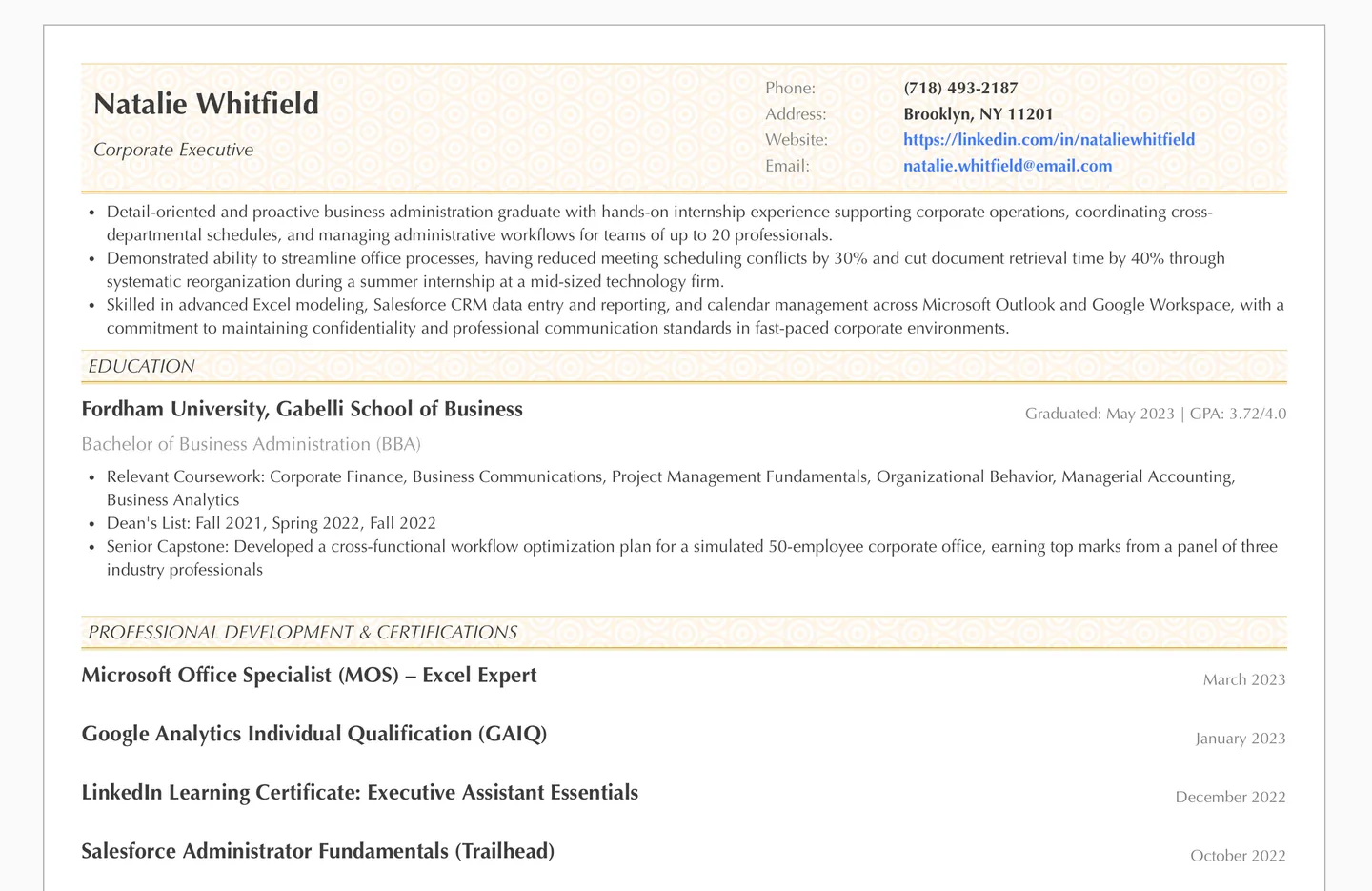
The Ultimate Corporate Executive Resume Example/Sample
https://www.resumonk.com/corporate-executiveCorporate ExecutiveResume Format for Corporate Executive Resume
The reverse-chronological format is your best friend here.
Why? Because hiring managers want to see your progression - they want to trace your journey from wherever you started to where you are now, ready to take on corporate-level execution tasks. This format puts your most recent (and presumably most relevant) experience right at the top, where tired HR eyes will see it first.
Structure Your Corporate Executive Resume Like This
Start with a professional summary that positions you as someone who gets things done, not someone who needs things explained twice. Skip the objective statement - you're not fresh out of college anymore (even if you are, act like you aren't).
Your summary should be 2-3 lines that capture your ability to manage multiple stakeholders, handle confidential information, and drive projects to completion.
Follow this with your work experience section immediately. No detours to education or skills first - corporate environments value proven experience above all else. Each role should showcase your evolution from task-doer to initiative-taker. Then comes your skills section, followed by education. If you have relevant certifications (Project Management, Six Sigma, etc.), create a separate section for those.
Length and Presentation Guidelines
Keep it to one page if you have less than 7 years of experience, two pages maximum if you've been in the corporate world longer.
Corporate executives are expected to be concise communicators - your resume is your first demonstration of this skill. Use clean, professional formatting with consistent spacing and clear section headers. Remember, you might be printing this for old-school executives who still prefer paper, so make sure it looks good in black and white too.
For UK and Canadian applications, you might stretch to two pages more readily, as these markets are generally more accepting of detailed career histories. Australian corporate culture appreciates brevity similar to the US, so stick to the one-page rule when possible.
Work Experience on Corporate Executive Resume
Your work experience section is where you prove you're not just another corporate drone pushing papers. You're showing that you understand the bigger picture while still nailing the details.
Each role you list needs to tell a story of increasing responsibility and impact.
Writing Compelling Bullet Points
Start each bullet point with a strong action verb that shows initiative.
Corporate executives don't just "assist" or "help" - they coordinate, implement, streamline, and optimize. Your bullets should follow a simple formula that shows action, context, and result. The corporate world loves metrics, so quantify everything you can.
❌ Don't write vague, task-based descriptions:
• Helped with various projects in the department
• Attended meetings and took notes
• Worked with different teams
✅ Do write specific, achievement-focused statements:
• Coordinated cross-functional project teams of 15+ members to deliver Q3 market expansion initiative 2 weeks ahead of schedule
• Streamlined executive meeting preparation process, reducing prep time by 40% while improving stakeholder satisfaction scores
• Managed confidential merger documentation for $2.5M acquisition, ensuring 100% compliance with regulatory requirements
Showcasing Progressive Responsibility
Even if your title hasn't changed, your responsibilities probably have.
Show this growth within each role. Maybe you started by organizing meetings, but now you're running them. Perhaps you began by tracking budgets, but now you're helping to set them. This progression shows you're ready for the next level of corporate execution.
For each position, include 4-6 bullet points, with your most impressive achievements first. If you've been in your current role for more than two years, you can include up to 8 bullets to show the depth of your contributions.
Earlier roles can have fewer bullets - 2-3 for positions held more than five years ago.
Handling Different Types of Corporate Experience
If you're coming from a smaller company to a larger corporate environment, emphasize your ability to wear multiple hats and adapt quickly. If you're moving between industries, focus on transferable corporate skills like stakeholder management, process improvement, and cross-functional collaboration.
The key is showing that you understand corporate dynamics regardless of the specific industry.
Skills to Show on Corporate Executive Resume
The skills section of a Corporate Executive resume isn't just a keyword dump - it's a strategic showcase of your technical capabilities and soft skills that make you indispensable in a corporate setting. You're walking a tightrope here, showing you're sophisticated enough to handle complex tools and processes, yet grounded enough to execute daily operations flawlessly.
Technical Skills That Matter
Corporate environments run on specific software ecosystems. You absolutely must show proficiency in the Microsoft Office Suite, but saying "Proficient in MS Office" is like saying you can tie your shoes. Be specific about your advanced capabilities. List the ERP systems you've used (SAP, Oracle, Salesforce), project management tools (Asana, Monday.com, MS Project), and any industry-specific software relevant to your target company.
❌ Don't list generic, outdated skills:
Skills:
• Microsoft Word
• Email
• Internet Research
• Typing 60 WPM
✅ Do showcase specific, relevant expertise:
Technical Proficiencies:
• Advanced Excel (VLOOKUPs, Pivot Tables, Macros for automated reporting)
• Salesforce CRM (opportunity tracking, pipeline management, custom report building)
• SharePoint administration and workflow automation
• Tableau for executive dashboard creation
Soft Skills With Evidence
Here's where many Corporate Executive resumes fail - they list soft skills without context.
"Excellent communication" means nothing without proof. Instead of listing soft skills separately, weave them into your technical skills or create a "Core Competencies" section that combines both. Every soft skill should be something you can back up with a story from your work experience section.
Focus on skills that matter in corporate execution roles like stakeholder management, confidential information handling, cross-cultural communication (especially important for global companies), and change management. These aren't just buzzwords - they're the skills that separate corporate executives who merely process tasks from those who drive initiatives.
Industry and Region-Specific Considerations
For US corporate roles, emphasize compliance knowledge and regulatory understanding relevant to your industry. UK positions often value formal communication skills and diplomatic stakeholder management more highly.
Canadian employers appreciate bilingual capabilities (French/English), while Australian corporate culture values directness and efficiency in execution.
Organize your skills into 2-3 categories maximum. Too many categories make you look scattered, too few make you look one-dimensional. A solid structure might include "Technical Proficiencies" and "Core Competencies," or "Systems & Software" and "Corporate Capabilities."
Specific Considerations and Tips for Corporate Executive Resume
Being a Corporate Executive means you're often the first non-management person external stakeholders meet. You're representing not just yourself but the entire corporate machine behind you. Your resume needs to reflect this unique position - you're not senior management, but you're not entry-level either.
You're the professional who makes things happen.
The Confidentiality Paradox
Here's a challenge unique to Corporate Executive roles - much of your best work might be confidential.
You've probably handled sensitive merger documents, sat in on closed-door strategic sessions, or managed executive communications that you absolutely cannot detail on a resume. The solution? Focus on the process and impact without revealing the content.
Instead of naming specific clients or deals, use descriptive categories. "Managed documentation for Fortune 500 pharmaceutical client acquisition" becomes your way of showing scale without breaking NDAs. "Coordinated confidential C-suite initiative resulting in 30% operational efficiency improvement" tells the story without spilling secrets.
The Title Translation Challenge
Your title might be "Corporate Executive," but in another company, the same role might be called "Business Operations Specialist," "Corporate Services Coordinator," or "Executive Operations Manager." Don't get trapped by titles. In your professional summary or cover letter, make it clear that you understand your role is about execution and operations, not C-suite leadership.
This prevents embarrassing misunderstandings where recruiters think you're overqualified or delusional about your level.
❌ Don't create confusion about your level:
Corporate Executive
Leading strategic initiatives and driving organizational change
✅ Do clarify your operational focus:
Corporate Executive - Operations & Project Coordination
Executing strategic initiatives through cross-functional collaboration and process optimization
The Upward Mobility Signal
Unlike purely administrative roles, Corporate Executive positions are often stepping stones to management.
Your resume should subtly signal that you're on this trajectory without seeming like you'll job-hop the moment a management role opens elsewhere. Include any leadership experience, even informal - "Mentored 3 junior coordinators in corporate processes" or "Led process improvement taskforce while maintaining full executive support duties."
If you've covered for your manager during absences or been given special projects usually reserved for management-level employees, these are gold. They show you're trusted with higher-level responsibilities and ready for the next step when the time is right.
The Geographic and Cultural Nuances
Corporate Executive roles vary significantly by region and company size. In Silicon Valley tech companies, you might emphasize agility and innovation in your approach. For Wall Street firms, precision and compliance are your selling points.
Manufacturing corporations in the Midwest value reliability and process consistency.
If you're applying to multinational corporations, highlight any international experience, even if it's just coordinating with overseas offices via video calls. The ability to work across time zones and cultures is increasingly valuable for corporate executives who support global operations.
Remember, the Corporate Executive role is about being the reliable, capable professional who turns executive vision into operational reality. Your resume should reflect that you're neither trying to be something you're not, nor selling yourself short.
You're the corporate Swiss Army knife - versatile, dependable, and essential to making the corporate machine run smoothly.
Education to List on Corporate Executive Resume
Let's face it - as someone gunning for a Corporate Executive position, you're likely fresh out of college or maybe a year or two into your career journey.
The term "executive" here might sound fancy, but we both know it's essentially an entry-level role where you'll be executing tasks rather than strategizing them. Your education section? That's your heavyweight champion right now, probably the meatiest part of your resume since your work experience might still be finding its legs.
The Strategic Placement of Your Degree
Your bachelor's degree should sit prominently near the top of your resume, right after your contact information and professional summary.
Why? Because as a Corporate Executive applicant, you're competing with dozens of other recent graduates who all have similar internship experiences and part-time gigs. Your education is often the first differentiator that catches a hiring manager's eye.
Think about it - you're applying for roles in corporate settings where they need someone who can handle administrative tasks, coordinate meetings, manage schedules, and support senior management. They want to see that you've got the foundational knowledge to understand business communications, basic financial concepts, and organizational behavior. Your degree proves you've got that baseline.
What to Include and How to Format It
The golden rule for listing education as a Corporate Executive candidate is to include relevant details that showcase your readiness for the corporate world.
Start with your degree type, major, university name, and graduation date. But here's where you can stand out - include your GPA if it's above 3.5, relevant coursework that aligns with corporate operations, and any academic honors.
❌ Don't write vaguely about your education:
Bachelor's Degree
State University
2023
✅ Do provide comprehensive details that sell your capabilities:
Bachelor of Business Administration (BBA)
State University, New York, NY
Graduated: May 2023 | GPA: 3.7/4.0
Relevant Coursework: Corporate Finance, Business Communications,
Project Management, Organizational Psychology
Dean's List: Fall 2021, Spring 2022
Leveraging Additional Certifications
As a Corporate Executive applicant, you might have picked up some certifications along the way - maybe Microsoft Office Specialist, Google Analytics, or even a Project Management basics certificate. These belong in your education section if you're light on work experience.
They show initiative and a commitment to developing skills directly applicable to corporate environments.
Remember, hiring managers for Corporate Executive roles are looking for candidates who can hit the ground running with minimal training. Certifications demonstrate that you've already invested time in learning tools and methodologies used in corporate settings.
❌ Don't bury certifications or list them without context:
Various certificates
✅ Do highlight relevant certifications with completion dates:
Professional Development:
• Microsoft Office Specialist (MOS) - Excel Expert | March 2023
• Google Analytics Individual Qualification | January 2023
• LinkedIn Learning: Executive Assistant Essentials | December 2022
Awards and Publications on Corporate Executive Resume
You might be thinking, "Publications? Awards? I'm applying for an entry-level Corporate Executive role, not a Nobel Prize!" And you're absolutely right to wonder about this.
But here's the thing - awards and publications mean something different for someone at your career stage, and when positioned correctly, they can be the difference between landing an interview and getting lost in the pile.
Redefining 'Awards' for Entry-Level Corporate Roles
Awards for a Corporate Executive candidate aren't necessarily about winning international competitions.
They're about demonstrating excellence, leadership potential, and the ability to go above and beyond - qualities that every corporate employer wants in their executive staff. Think about academic honors, competition wins, recognition for volunteer work, or even employee of the month at your part-time job.
These achievements tell a story about your work ethic and potential. A hiring manager looking for a Corporate Executive wants someone reliable, detail-oriented, and capable of exceeding expectations.
Your awards section proves you've done exactly that in other contexts.
Making Academic and Professional Recognition Work for You
The key is framing your awards in a way that relates to corporate competencies. Did you win a case competition in business school? That shows analytical thinking. Were you recognized for perfect attendance at your internship?
That demonstrates reliability - crucial for a Corporate Executive who might be managing schedules and ensuring smooth operations.
❌ Don't list awards without context or relevance:
• Honor Roll
• Some award in college
• Participated in competitions
✅ Do provide specific, impactful award descriptions:
Academic & Professional Recognition:
• First Place, Regional Business Case Competition (2023)
 - Led team of 4 in developing cost-reduction strategy for Fortune 500 client
• Outstanding Intern Award, ABC Corporation (Summer 2022)
 - Recognized for streamlining filing system, reducing retrieval time by 40%
• President's List, State University (2021-2023)
 - Achieved 4.0 GPA while maintaining part-time employment
The Surprising Value of 'Publications' at Entry Level
Now, about publications - no, we're not expecting you to have peer-reviewed journal articles.
But in today's digital age, publications can include blog posts for your university's business school, articles for the campus newspaper about corporate trends, or even well-researched LinkedIn articles about industry topics. If you've written anything that demonstrates your understanding of business concepts, corporate culture, or industry trends, it counts.
These publications show that you can communicate effectively in writing - a crucial skill for a Corporate Executive who'll be drafting emails, preparing reports, and creating presentations. They also demonstrate your genuine interest in the corporate world beyond just needing a job.
Remember to only include publications if they're relevant and professional. Your personal blog about weekend adventures won't help, but an article you wrote about "Digital Transformation in Small Businesses" for your university's business review absolutely will.
Listing References for Corporate Executive Resume
So you've reached the references section of your resume prep, and you're probably wondering if anyone actually checks these anymore. Spoiler alert - for Corporate Executive positions, they absolutely do. Why? Because you're going to be working closely with senior management, handling sensitive information, and representing the company in various capacities.
Even though it's an entry-level role, trust is paramount, and references are how employers verify that trust.
Who Makes the Cut as a Reference
As someone early in your career applying for Corporate Executive roles, your reference list looks different from a seasoned professional's.
You're not listing CEOs or department heads you've worked under for years. Instead, you're strategically selecting people who can vouch for the specific skills needed in corporate support roles - reliability, discretion, attention to detail, and the ability to work professionally in an office environment.
Your internship supervisor is gold - they've seen you in a corporate setting. That professor who supervised your capstone project? They can speak to your project management and analytical skills. Your part-time job manager who watched you juggle work and school? They're perfect for highlighting your time management abilities. Even volunteer coordinators can be valuable references if they've seen you organize events or manage administrative tasks.
The Art of Reference Formatting
Here's something most Corporate Executive applicants get wrong - they either don't include references at all or they slap them on their resume without strategy. For entry-level corporate roles, having references ready shows you're prepared and professional. Create a separate reference sheet that matches your resume's formatting exactly.
This shows attention to detail - a crucial skill for any Corporate Executive.
❌ Don't list references without context or proper information:
References:
John - 555-0123
My professor - [email protected]
Former boss
✅ Do provide complete, professional reference listings:
Professional References

Dr. Sarah Martinez
Professor of Business Administration
State University School of Business
Email: [email protected]
Phone: (555) 123-4567
Relationship: Faculty advisor for senior capstone project

Michael Chen
Operations Manager
ABC Corporation
Email: [email protected]
Phone: (555) 234-5678
Relationship: Direct supervisor during summer internship (May-August 2023)
The Reference Strategy Most Applicants Miss
Here's where you can really stand out - prepare your references for potential contact. When you're applying for Corporate Executive positions, send your references a quick email with the job description and a reminder of key projects or achievements they might mention.
For example, remind your internship supervisor about that time you reorganized the entire filing system or coordinated a successful 200-person corporate event.
This isn't being manipulative - it's being professional. Your references want to help you, but they might not remember specific details from months or years ago. By refreshing their memory, you're helping them help you more effectively. Plus, giving them a heads-up shows respect for their time and maintains the professional relationship.
International Variations in Reference Protocols
If you're applying in the UK or Australia, "referees" (as they're called there) are typically provided only upon request, and it's common to simply state "References available upon request" at the bottom of your CV.
In Canada, it's similar to the US - having a separate reference sheet ready is standard. Some Canadian employers might specifically request "Canadian references" if you're new to the country, so having at least one local reference can be valuable.
One universal truth across all regions - never list someone as a reference without their explicit permission. As a Corporate Executive, you'll be expected to handle professional protocols correctly, and using someone as a reference without asking is a red flag that suggests you don't understand professional boundaries. Always ask permission, and ideally, ask each time you're actively job hunting, not just once years ago.
Cover Letter Tips for Corporate Executive Resume
Envision this moment - you're one of 150 applicants for a Corporate Executive position at a mid-sized company. Your resume looks pretty similar to everyone else's - recent degree, an internship or two, maybe some retail experience. The hiring manager is glazing over by resume number 47.
Then they open your cover letter, and suddenly, you're not just another applicant - you're a real person with genuine interest in their company and a clear understanding of what being a Corporate Executive actually entails.
Understanding the Corporate Executive Cover Letter Purpose
Your cover letter as a Corporate Executive candidate needs to accomplish something very specific - it must bridge the gap between your limited experience and the employer's needs. Unlike senior-level positions where cover letters highlight achievements, yours needs to demonstrate potential, enthusiasm, and most importantly, that you understand what the day-to-day reality of a Corporate Executive looks like.
Corporate Executives are often the backbone of office operations - scheduling meetings, preparing documents, coordinating between departments, and keeping everything running smoothly. Your cover letter should reflect that you get this and that you're excited about it, not just settling for it while you wait for something "better."
The Three-Paragraph Formula That Works
For Corporate Executive positions, your cover letter should follow a clear structure that respects the reader's time while making your case effectively.
The first paragraph should immediately state the position you're applying for and include a specific detail about the company that shows you've done your homework. The second paragraph connects your experiences and skills to their needs. The third wraps up with enthusiasm and a clear call to action.
❌ Don't write generic, unfocused paragraphs:
"I am writing to apply for your job. I recently graduated and I think I would be good at this position. I have some experience and I'm a hard worker. Please consider me for this role."
✅ Do write specific, targeted content:
"I am writing to express my interest in the Corporate Executive position at TechCorp Solutions, particularly drawn to your company's recent expansion into sustainable technology markets as mentioned in your Q3 report.

My experience as an Administrative Intern at GlobalTech, where I coordinated schedules for a 15-person department and reduced meeting conflicts by 30%
through implementing a new calendar system, has prepared me for the fast-paced environment your job posting describes."
Addressing the Experience Gap Head-On
Let's be honest - as someone applying for a Corporate Executive role, you probably don't have years of corporate experience.
That's okay! Use your cover letter to reframe your experiences in corporate-relevant terms. That summer you spent as a camp counselor? You were managing schedules, coordinating activities, and ensuring smooth operations for 50+ stakeholders (kids and parents). Your role as treasurer for the business club? You managed budgets, organized meetings, and maintained financial records.
The key is to use corporate language to describe these experiences. Don't say you "helped out at events" - say you "coordinated logistics for events with 100+ attendees." Don't say you "answered phones" - say you "managed multi-line phone systems while maintaining professional communication standards."
Regional Differences in Cover Letter Expectations
If you're applying in the UK, keep your cover letter more formal and shorter - typically no more than one page with three to four concise paragraphs.
Australian employers appreciate a bit more personality but still expect professionalism. Canadian employers often value cover letters that emphasize soft skills and cultural fit.
In the USA, you have a bit more flexibility to show personality while maintaining professional standards, and you can extend to a full page if needed.
Key Takeaways
- Use reverse-chronological format exclusively - This format best showcases your progression from student or entry-level roles toward corporate readiness, putting your most recent and relevant experiences where hiring managers will see them first.
- Frame your limited experience in corporate terms - Transform internships, part-time jobs, and volunteer work into relevant experience by using corporate language and focusing on transferable skills like coordination, scheduling, and stakeholder management.
- Be specific about technical skills - Go beyond "MS Office proficiency" and detail your advanced Excel capabilities, CRM experience, and any industry-specific software knowledge that sets you apart from other entry-level candidates.
- Clarify your executive role level - Always make it clear through your professional summary and experience descriptions that you understand "Corporate Executive" is an operational, entry-level position, not a leadership role.
- Quantify everything possible - Use numbers to demonstrate impact, whether it's the number of people you coordinated, percentage improvements you achieved, or budgets you helped manage, even in internships or volunteer roles.
- Keep it to one page if under 7 years experience - Corporate executives are expected to be concise communicators, and your resume is your first demonstration of this crucial skill.
- Position education strategically - With limited work experience, your education section should be prominent and detailed, including relevant coursework, GPA (if above 3.5), and any academic honors that demonstrate excellence.
- Prepare references who understand corporate environments - Choose references who can speak to your reliability, discretion, and ability to work in professional settings, and brief them on the specific positions you're pursuing.
Ready to create your Corporate Executive resume?
Start with our professionally designed templates, get AI-powered content suggestions tailored to Corporate Executive positions, and have your polished resume ready in minutes.
Start building your Corporate Executive resume with Resumonk today and take the first step toward your corporate career.
More Executive resume examples
- Business Owner resume example
- Change Management Executive resume example
- Vice President resume example
- COO resume example
See all Executive resume examples, or browse every category.
Resume writing tips
Let's clear something up first. "Corporate Executive" at the entry level doesn't mean corner office and board meetings.
It means you're the person executing - coordinating schedules, prepping reports, sitting in on strategy sessions, and making sure the actual executives have what they need. One step above administrative, not quite management. The corporate world's Swiss Army knife.
Most candidates get this wrong in one of two directions. They oversell and look delusional, or they undersell and look like they're applying for a receptionist role.
Your resume needs to land right in the middle - showing ambition without overpromising, and showing competence without shrinking yourself.
If you just graduated or you're a year or two into administrative work, your education section might be the strongest part of your resume right now. That's perfectly fine. This guide works with where you actually are.
Here's what we'll cover:
- Formatting with the reverse-chronological structure hiring managers expect
- Turning internships and part-time roles into relevant corporate experience
- Skills that go beyond "proficient in Microsoft Office"
- Leveraging your degree, coursework, and certifications for corporate readiness
- Handling title confusion and confidentiality expectations
- Cover letters that get read and references that speak to your potential.
The Ultimate Corporate Executive Resume Example/Sample
https://www.resumonk.com/corporate-executiveCorporate ExecutiveResume Format for Corporate Executive Resume
The reverse-chronological format is your best friend here.
Why? Because hiring managers want to see your progression - they want to trace your journey from wherever you started to where you are now, ready to take on corporate-level execution tasks. This format puts your most recent (and presumably most relevant) experience right at the top, where tired HR eyes will see it first.
Structure Your Corporate Executive Resume Like This
Start with a professional summary that positions you as someone who gets things done, not someone who needs things explained twice. Skip the objective statement - you're not fresh out of college anymore (even if you are, act like you aren't).
Your summary should be 2-3 lines that capture your ability to manage multiple stakeholders, handle confidential information, and drive projects to completion.
Follow this with your work experience section immediately. No detours to education or skills first - corporate environments value proven experience above all else. Each role should showcase your evolution from task-doer to initiative-taker. Then comes your skills section, followed by education. If you have relevant certifications (Project Management, Six Sigma, etc.), create a separate section for those.
Length and Presentation Guidelines
Keep it to one page if you have less than 7 years of experience, two pages maximum if you've been in the corporate world longer.
Corporate executives are expected to be concise communicators - your resume is your first demonstration of this skill. Use clean, professional formatting with consistent spacing and clear section headers. Remember, you might be printing this for old-school executives who still prefer paper, so make sure it looks good in black and white too.
For UK and Canadian applications, you might stretch to two pages more readily, as these markets are generally more accepting of detailed career histories. Australian corporate culture appreciates brevity similar to the US, so stick to the one-page rule when possible.
Work Experience on Corporate Executive Resume
Your work experience section is where you prove you're not just another corporate drone pushing papers. You're showing that you understand the bigger picture while still nailing the details.
Each role you list needs to tell a story of increasing responsibility and impact.
Writing Compelling Bullet Points
Start each bullet point with a strong action verb that shows initiative.
Corporate executives don't just "assist" or "help" - they coordinate, implement, streamline, and optimize. Your bullets should follow a simple formula that shows action, context, and result. The corporate world loves metrics, so quantify everything you can.
❌ Don't write vague, task-based descriptions:
• Helped with various projects in the department
• Attended meetings and took notes
• Worked with different teams
✅ Do write specific, achievement-focused statements:
• Coordinated cross-functional project teams of 15+ members to deliver Q3 market expansion initiative 2 weeks ahead of schedule
• Streamlined executive meeting preparation process, reducing prep time by 40% while improving stakeholder satisfaction scores
• Managed confidential merger documentation for $2.5M acquisition, ensuring 100% compliance with regulatory requirements
Showcasing Progressive Responsibility
Even if your title hasn't changed, your responsibilities probably have.
Show this growth within each role. Maybe you started by organizing meetings, but now you're running them. Perhaps you began by tracking budgets, but now you're helping to set them. This progression shows you're ready for the next level of corporate execution.
For each position, include 4-6 bullet points, with your most impressive achievements first. If you've been in your current role for more than two years, you can include up to 8 bullets to show the depth of your contributions.
Earlier roles can have fewer bullets - 2-3 for positions held more than five years ago.
Handling Different Types of Corporate Experience
If you're coming from a smaller company to a larger corporate environment, emphasize your ability to wear multiple hats and adapt quickly. If you're moving between industries, focus on transferable corporate skills like stakeholder management, process improvement, and cross-functional collaboration.
The key is showing that you understand corporate dynamics regardless of the specific industry.
Skills to Show on Corporate Executive Resume
The skills section of a Corporate Executive resume isn't just a keyword dump - it's a strategic showcase of your technical capabilities and soft skills that make you indispensable in a corporate setting. You're walking a tightrope here, showing you're sophisticated enough to handle complex tools and processes, yet grounded enough to execute daily operations flawlessly.
Technical Skills That Matter
Corporate environments run on specific software ecosystems. You absolutely must show proficiency in the Microsoft Office Suite, but saying "Proficient in MS Office" is like saying you can tie your shoes. Be specific about your advanced capabilities. List the ERP systems you've used (SAP, Oracle, Salesforce), project management tools (Asana, Monday.com, MS Project), and any industry-specific software relevant to your target company.
❌ Don't list generic, outdated skills:
Skills:
• Microsoft Word
• Email
• Internet Research
• Typing 60 WPM
✅ Do showcase specific, relevant expertise:
Technical Proficiencies:
• Advanced Excel (VLOOKUPs, Pivot Tables, Macros for automated reporting)
• Salesforce CRM (opportunity tracking, pipeline management, custom report building)
• SharePoint administration and workflow automation
• Tableau for executive dashboard creation
Soft Skills With Evidence
Here's where many Corporate Executive resumes fail - they list soft skills without context.
"Excellent communication" means nothing without proof. Instead of listing soft skills separately, weave them into your technical skills or create a "Core Competencies" section that combines both. Every soft skill should be something you can back up with a story from your work experience section.
Focus on skills that matter in corporate execution roles like stakeholder management, confidential information handling, cross-cultural communication (especially important for global companies), and change management. These aren't just buzzwords - they're the skills that separate corporate executives who merely process tasks from those who drive initiatives.
Industry and Region-Specific Considerations
For US corporate roles, emphasize compliance knowledge and regulatory understanding relevant to your industry. UK positions often value formal communication skills and diplomatic stakeholder management more highly.
Canadian employers appreciate bilingual capabilities (French/English), while Australian corporate culture values directness and efficiency in execution.
Organize your skills into 2-3 categories maximum. Too many categories make you look scattered, too few make you look one-dimensional. A solid structure might include "Technical Proficiencies" and "Core Competencies," or "Systems & Software" and "Corporate Capabilities."
Specific Considerations and Tips for Corporate Executive Resume
Being a Corporate Executive means you're often the first non-management person external stakeholders meet. You're representing not just yourself but the entire corporate machine behind you. Your resume needs to reflect this unique position - you're not senior management, but you're not entry-level either.
You're the professional who makes things happen.
The Confidentiality Paradox
Here's a challenge unique to Corporate Executive roles - much of your best work might be confidential.
You've probably handled sensitive merger documents, sat in on closed-door strategic sessions, or managed executive communications that you absolutely cannot detail on a resume. The solution? Focus on the process and impact without revealing the content.
Instead of naming specific clients or deals, use descriptive categories. "Managed documentation for Fortune 500 pharmaceutical client acquisition" becomes your way of showing scale without breaking NDAs. "Coordinated confidential C-suite initiative resulting in 30% operational efficiency improvement" tells the story without spilling secrets.
The Title Translation Challenge
Your title might be "Corporate Executive," but in another company, the same role might be called "Business Operations Specialist," "Corporate Services Coordinator," or "Executive Operations Manager." Don't get trapped by titles. In your professional summary or cover letter, make it clear that you understand your role is about execution and operations, not C-suite leadership.
This prevents embarrassing misunderstandings where recruiters think you're overqualified or delusional about your level.
❌ Don't create confusion about your level:
Corporate Executive
Leading strategic initiatives and driving organizational change
✅ Do clarify your operational focus:
Corporate Executive - Operations & Project Coordination
Executing strategic initiatives through cross-functional collaboration and process optimization
The Upward Mobility Signal
Unlike purely administrative roles, Corporate Executive positions are often stepping stones to management.
Your resume should subtly signal that you're on this trajectory without seeming like you'll job-hop the moment a management role opens elsewhere. Include any leadership experience, even informal - "Mentored 3 junior coordinators in corporate processes" or "Led process improvement taskforce while maintaining full executive support duties."
If you've covered for your manager during absences or been given special projects usually reserved for management-level employees, these are gold. They show you're trusted with higher-level responsibilities and ready for the next step when the time is right.
The Geographic and Cultural Nuances
Corporate Executive roles vary significantly by region and company size. In Silicon Valley tech companies, you might emphasize agility and innovation in your approach. For Wall Street firms, precision and compliance are your selling points.
Manufacturing corporations in the Midwest value reliability and process consistency.
If you're applying to multinational corporations, highlight any international experience, even if it's just coordinating with overseas offices via video calls. The ability to work across time zones and cultures is increasingly valuable for corporate executives who support global operations.
Remember, the Corporate Executive role is about being the reliable, capable professional who turns executive vision into operational reality. Your resume should reflect that you're neither trying to be something you're not, nor selling yourself short.
You're the corporate Swiss Army knife - versatile, dependable, and essential to making the corporate machine run smoothly.
Education to List on Corporate Executive Resume
Let's face it - as someone gunning for a Corporate Executive position, you're likely fresh out of college or maybe a year or two into your career journey.
The term "executive" here might sound fancy, but we both know it's essentially an entry-level role where you'll be executing tasks rather than strategizing them. Your education section? That's your heavyweight champion right now, probably the meatiest part of your resume since your work experience might still be finding its legs.
The Strategic Placement of Your Degree
Your bachelor's degree should sit prominently near the top of your resume, right after your contact information and professional summary.
Why? Because as a Corporate Executive applicant, you're competing with dozens of other recent graduates who all have similar internship experiences and part-time gigs. Your education is often the first differentiator that catches a hiring manager's eye.
Think about it - you're applying for roles in corporate settings where they need someone who can handle administrative tasks, coordinate meetings, manage schedules, and support senior management. They want to see that you've got the foundational knowledge to understand business communications, basic financial concepts, and organizational behavior. Your degree proves you've got that baseline.
What to Include and How to Format It
The golden rule for listing education as a Corporate Executive candidate is to include relevant details that showcase your readiness for the corporate world.
Start with your degree type, major, university name, and graduation date. But here's where you can stand out - include your GPA if it's above 3.5, relevant coursework that aligns with corporate operations, and any academic honors.
❌ Don't write vaguely about your education:
Bachelor's Degree
State University
2023
✅ Do provide comprehensive details that sell your capabilities:
Bachelor of Business Administration (BBA)
State University, New York, NY
Graduated: May 2023 | GPA: 3.7/4.0
Relevant Coursework: Corporate Finance, Business Communications,
Project Management, Organizational Psychology
Dean's List: Fall 2021, Spring 2022
Leveraging Additional Certifications
As a Corporate Executive applicant, you might have picked up some certifications along the way - maybe Microsoft Office Specialist, Google Analytics, or even a Project Management basics certificate. These belong in your education section if you're light on work experience.
They show initiative and a commitment to developing skills directly applicable to corporate environments.
Remember, hiring managers for Corporate Executive roles are looking for candidates who can hit the ground running with minimal training. Certifications demonstrate that you've already invested time in learning tools and methodologies used in corporate settings.
❌ Don't bury certifications or list them without context:
Various certificates
✅ Do highlight relevant certifications with completion dates:
Professional Development:
• Microsoft Office Specialist (MOS) - Excel Expert | March 2023
• Google Analytics Individual Qualification | January 2023
• LinkedIn Learning: Executive Assistant Essentials | December 2022
Awards and Publications on Corporate Executive Resume
You might be thinking, "Publications? Awards? I'm applying for an entry-level Corporate Executive role, not a Nobel Prize!" And you're absolutely right to wonder about this.
But here's the thing - awards and publications mean something different for someone at your career stage, and when positioned correctly, they can be the difference between landing an interview and getting lost in the pile.
Redefining 'Awards' for Entry-Level Corporate Roles
Awards for a Corporate Executive candidate aren't necessarily about winning international competitions.
They're about demonstrating excellence, leadership potential, and the ability to go above and beyond - qualities that every corporate employer wants in their executive staff. Think about academic honors, competition wins, recognition for volunteer work, or even employee of the month at your part-time job.
These achievements tell a story about your work ethic and potential. A hiring manager looking for a Corporate Executive wants someone reliable, detail-oriented, and capable of exceeding expectations.
Your awards section proves you've done exactly that in other contexts.
Making Academic and Professional Recognition Work for You
The key is framing your awards in a way that relates to corporate competencies. Did you win a case competition in business school? That shows analytical thinking. Were you recognized for perfect attendance at your internship?
That demonstrates reliability - crucial for a Corporate Executive who might be managing schedules and ensuring smooth operations.
❌ Don't list awards without context or relevance:
• Honor Roll
• Some award in college
• Participated in competitions
✅ Do provide specific, impactful award descriptions:
Academic & Professional Recognition:
• First Place, Regional Business Case Competition (2023)
 - Led team of 4 in developing cost-reduction strategy for Fortune 500 client
• Outstanding Intern Award, ABC Corporation (Summer 2022)
 - Recognized for streamlining filing system, reducing retrieval time by 40%
• President's List, State University (2021-2023)
 - Achieved 4.0 GPA while maintaining part-time employment
The Surprising Value of 'Publications' at Entry Level
Now, about publications - no, we're not expecting you to have peer-reviewed journal articles.
But in today's digital age, publications can include blog posts for your university's business school, articles for the campus newspaper about corporate trends, or even well-researched LinkedIn articles about industry topics. If you've written anything that demonstrates your understanding of business concepts, corporate culture, or industry trends, it counts.
These publications show that you can communicate effectively in writing - a crucial skill for a Corporate Executive who'll be drafting emails, preparing reports, and creating presentations. They also demonstrate your genuine interest in the corporate world beyond just needing a job.
Remember to only include publications if they're relevant and professional. Your personal blog about weekend adventures won't help, but an article you wrote about "Digital Transformation in Small Businesses" for your university's business review absolutely will.
Listing References for Corporate Executive Resume
So you've reached the references section of your resume prep, and you're probably wondering if anyone actually checks these anymore. Spoiler alert - for Corporate Executive positions, they absolutely do. Why? Because you're going to be working closely with senior management, handling sensitive information, and representing the company in various capacities.
Even though it's an entry-level role, trust is paramount, and references are how employers verify that trust.
Who Makes the Cut as a Reference
As someone early in your career applying for Corporate Executive roles, your reference list looks different from a seasoned professional's.
You're not listing CEOs or department heads you've worked under for years. Instead, you're strategically selecting people who can vouch for the specific skills needed in corporate support roles - reliability, discretion, attention to detail, and the ability to work professionally in an office environment.
Your internship supervisor is gold - they've seen you in a corporate setting. That professor who supervised your capstone project? They can speak to your project management and analytical skills. Your part-time job manager who watched you juggle work and school? They're perfect for highlighting your time management abilities. Even volunteer coordinators can be valuable references if they've seen you organize events or manage administrative tasks.
The Art of Reference Formatting
Here's something most Corporate Executive applicants get wrong - they either don't include references at all or they slap them on their resume without strategy. For entry-level corporate roles, having references ready shows you're prepared and professional. Create a separate reference sheet that matches your resume's formatting exactly.
This shows attention to detail - a crucial skill for any Corporate Executive.
❌ Don't list references without context or proper information:
References:
John - 555-0123
My professor - [email protected]
Former boss
✅ Do provide complete, professional reference listings:
Professional References

Dr. Sarah Martinez
Professor of Business Administration
State University School of Business
Email: [email protected]
Phone: (555) 123-4567
Relationship: Faculty advisor for senior capstone project

Michael Chen
Operations Manager
ABC Corporation
Email: [email protected]
Phone: (555) 234-5678
Relationship: Direct supervisor during summer internship (May-August 2023)
The Reference Strategy Most Applicants Miss
Here's where you can really stand out - prepare your references for potential contact. When you're applying for Corporate Executive positions, send your references a quick email with the job description and a reminder of key projects or achievements they might mention.
For example, remind your internship supervisor about that time you reorganized the entire filing system or coordinated a successful 200-person corporate event.
This isn't being manipulative - it's being professional. Your references want to help you, but they might not remember specific details from months or years ago. By refreshing their memory, you're helping them help you more effectively. Plus, giving them a heads-up shows respect for their time and maintains the professional relationship.
International Variations in Reference Protocols
If you're applying in the UK or Australia, "referees" (as they're called there) are typically provided only upon request, and it's common to simply state "References available upon request" at the bottom of your CV.
In Canada, it's similar to the US - having a separate reference sheet ready is standard. Some Canadian employers might specifically request "Canadian references" if you're new to the country, so having at least one local reference can be valuable.
One universal truth across all regions - never list someone as a reference without their explicit permission. As a Corporate Executive, you'll be expected to handle professional protocols correctly, and using someone as a reference without asking is a red flag that suggests you don't understand professional boundaries. Always ask permission, and ideally, ask each time you're actively job hunting, not just once years ago.
Cover Letter Tips for Corporate Executive Resume
Envision this moment - you're one of 150 applicants for a Corporate Executive position at a mid-sized company. Your resume looks pretty similar to everyone else's - recent degree, an internship or two, maybe some retail experience. The hiring manager is glazing over by resume number 47.
Then they open your cover letter, and suddenly, you're not just another applicant - you're a real person with genuine interest in their company and a clear understanding of what being a Corporate Executive actually entails.
Understanding the Corporate Executive Cover Letter Purpose
Your cover letter as a Corporate Executive candidate needs to accomplish something very specific - it must bridge the gap between your limited experience and the employer's needs. Unlike senior-level positions where cover letters highlight achievements, yours needs to demonstrate potential, enthusiasm, and most importantly, that you understand what the day-to-day reality of a Corporate Executive looks like.
Corporate Executives are often the backbone of office operations - scheduling meetings, preparing documents, coordinating between departments, and keeping everything running smoothly. Your cover letter should reflect that you get this and that you're excited about it, not just settling for it while you wait for something "better."
The Three-Paragraph Formula That Works
For Corporate Executive positions, your cover letter should follow a clear structure that respects the reader's time while making your case effectively.
The first paragraph should immediately state the position you're applying for and include a specific detail about the company that shows you've done your homework. The second paragraph connects your experiences and skills to their needs. The third wraps up with enthusiasm and a clear call to action.
❌ Don't write generic, unfocused paragraphs:
"I am writing to apply for your job. I recently graduated and I think I would be good at this position. I have some experience and I'm a hard worker. Please consider me for this role."
✅ Do write specific, targeted content:
"I am writing to express my interest in the Corporate Executive position at TechCorp Solutions, particularly drawn to your company's recent expansion into sustainable technology markets as mentioned in your Q3 report.

My experience as an Administrative Intern at GlobalTech, where I coordinated schedules for a 15-person department and reduced meeting conflicts by 30%
through implementing a new calendar system, has prepared me for the fast-paced environment your job posting describes."
Addressing the Experience Gap Head-On
Let's be honest - as someone applying for a Corporate Executive role, you probably don't have years of corporate experience.
That's okay! Use your cover letter to reframe your experiences in corporate-relevant terms. That summer you spent as a camp counselor? You were managing schedules, coordinating activities, and ensuring smooth operations for 50+ stakeholders (kids and parents). Your role as treasurer for the business club? You managed budgets, organized meetings, and maintained financial records.
The key is to use corporate language to describe these experiences. Don't say you "helped out at events" - say you "coordinated logistics for events with 100+ attendees." Don't say you "answered phones" - say you "managed multi-line phone systems while maintaining professional communication standards."
Regional Differences in Cover Letter Expectations
If you're applying in the UK, keep your cover letter more formal and shorter - typically no more than one page with three to four concise paragraphs.
Australian employers appreciate a bit more personality but still expect professionalism. Canadian employers often value cover letters that emphasize soft skills and cultural fit.
In the USA, you have a bit more flexibility to show personality while maintaining professional standards, and you can extend to a full page if needed.
Key Takeaways
- Use reverse-chronological format exclusively - This format best showcases your progression from student or entry-level roles toward corporate readiness, putting your most recent and relevant experiences where hiring managers will see them first.
- Frame your limited experience in corporate terms - Transform internships, part-time jobs, and volunteer work into relevant experience by using corporate language and focusing on transferable skills like coordination, scheduling, and stakeholder management.
- Be specific about technical skills - Go beyond "MS Office proficiency" and detail your advanced Excel capabilities, CRM experience, and any industry-specific software knowledge that sets you apart from other entry-level candidates.
- Clarify your executive role level - Always make it clear through your professional summary and experience descriptions that you understand "Corporate Executive" is an operational, entry-level position, not a leadership role.
- Quantify everything possible - Use numbers to demonstrate impact, whether it's the number of people you coordinated, percentage improvements you achieved, or budgets you helped manage, even in internships or volunteer roles.
- Keep it to one page if under 7 years experience - Corporate executives are expected to be concise communicators, and your resume is your first demonstration of this crucial skill.
- Position education strategically - With limited work experience, your education section should be prominent and detailed, including relevant coursework, GPA (if above 3.5), and any academic honors that demonstrate excellence.
- Prepare references who understand corporate environments - Choose references who can speak to your reliability, discretion, and ability to work in professional settings, and brief them on the specific positions you're pursuing.
Ready to create your Corporate Executive resume?
Start with our professionally designed templates, get AI-powered content suggestions tailored to Corporate Executive positions, and have your polished resume ready in minutes.
Start building your Corporate Executive resume with Resumonk today and take the first step toward your corporate career.
More Executive resume examples
- Business Owner resume example
- Change Management Executive resume example
- Vice President resume example
- COO resume example
See all Executive resume examples, or browse every category.
Resume writing tips