COO Resume Example (with Tips and Best Practices)
Introduction
You've been the one they call when operations go sideways.
The executive who turns chaos into clockwork, who makes the impossible supply chain actually work, who somehow gets feuding departments to operate like a Swiss watch. For the past fifteen, maybe twenty years, you've been climbing through the operational ranks - from managing that first production line to overseeing entire regions, from fixing broken processes to architecting operational strategies that define how companies compete. And now, here you are, standing at the threshold of the C-suite's most demanding operational role - the Chief Operating Officer position.
The COO role is unlike any other in the executive suite. You're not just managing a function like the CMO or CFO - you're orchestrating every function, making them work in harmony while the CEO focuses on vision and stakeholder management. You're simultaneously the master executor and strategic advisor, the crisis manager and transformation leader, the person who translates ambitious board presentations into actual operational reality. It's a role that demands you be equal parts diplomat, engineer, psychologist, and prophet. No wonder finding the right COO is often harder than finding a CEO - the skill set is that rare.
But here's what makes your resume challenge particularly interesting - COO roles vary wildly across industries and companies. A COO at a 50-person tech startup is essentially a different species from a COO at a Fortune 500 manufacturer. Some COOs are really supply chain wizards elevated to oversee all operations. Others are general managers who've proven they can run entire P&Ls. Still others are transformation specialists brought in to modernize creaking operational infrastructure. Your resume needs to clearly signal which type of COO you are while remaining flexible enough to appeal to organizations that might need your skills in ways they haven't even realized yet.
In this comprehensive guide, we'll walk you through every element of crafting a COO resume that commands attention. We'll start with choosing the right format - why reverse-chronological is non-negotiable at this level and how to structure it for maximum strategic impact. Then we'll dive deep into writing professional experience that tells transformation stories rather than listing responsibilities. We'll explore which skills actually matter for COO roles versus generic executive capabilities, and how to position your education and continuous learning journey. You'll learn how to leverage awards and publications to establish thought leadership, craft a cover letter that demonstrates CEO-COO chemistry, and strategically manage references who can vouch for your ability to be a true second-in-command. We'll also address specific situations - whether you're jumping industries, returning from consulting, or positioning yourself as a potential CEO successor.
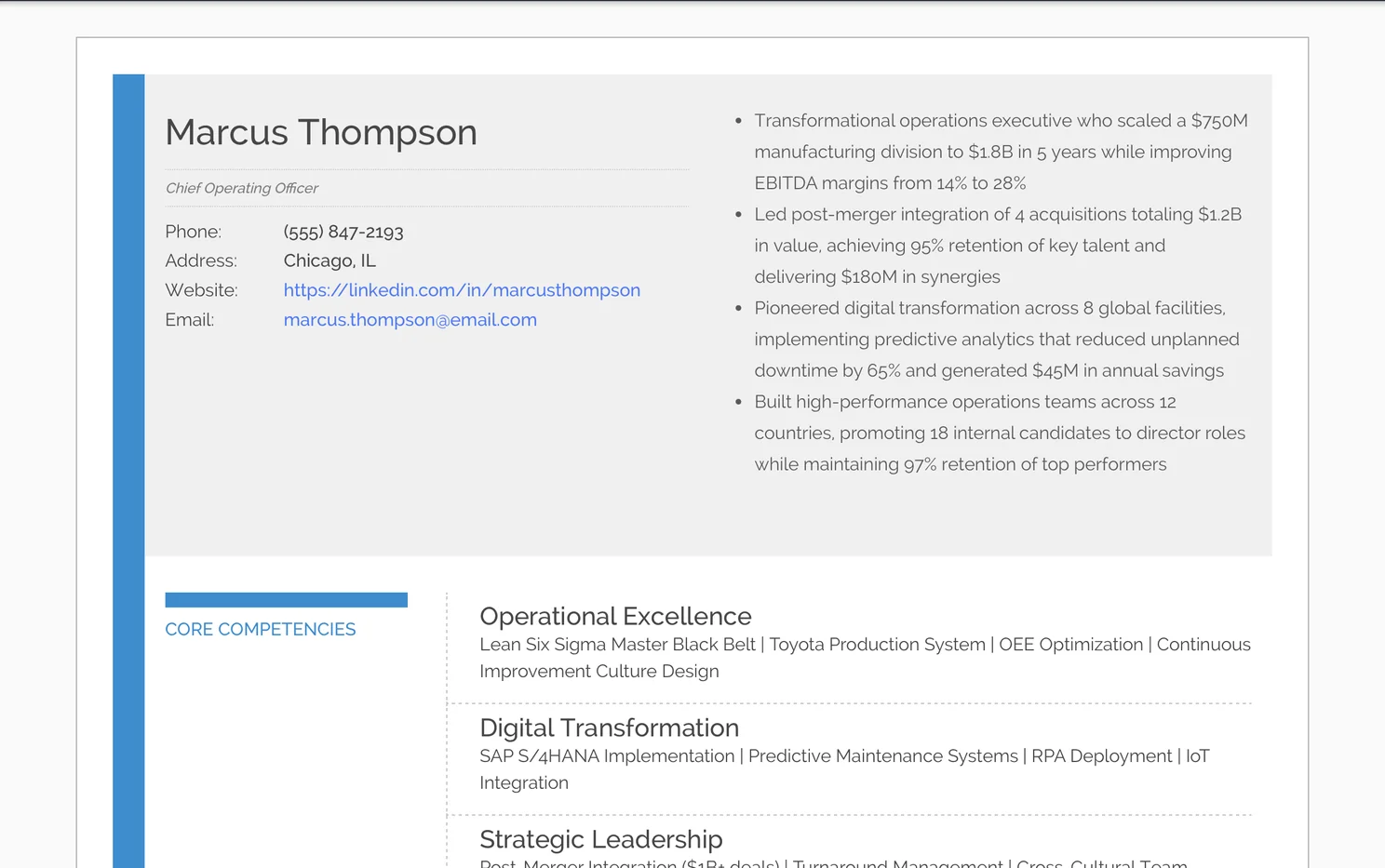
The Best COO Resume Example/Sample
https://www.resumonk.com/coo-resumeCOOResume Format for COO Resume - Choosing the Executive Blueprint
You've climbed the corporate mountain for years, maybe decades. From managing teams to overseeing entire departments, from quarterly reports to strategic planning sessions that shape company futures - you've done it all. Now you're eyeing that coveted COO position, the role that puts you at the right hand of the CEO, orchestrating the entire symphony of organizational operations. But here's the thing about COO resumes - they're not just longer versions of director resumes.
They're strategic documents that need to tell a story of transformation, scale, and measurable impact.
Why Reverse-Chronological Format Works Best for COO Candidates
The reverse-chronological format isn't just recommended for COO positions - it's practically mandatory. Why? Because boards and CEOs hiring for this role want to see your progression trajectory immediately. They want to witness your evolution from perhaps a VP of Operations to a Senior VP, or from a General Manager to a President of a division.
This format lets them trace your increasing scope of responsibility like following breadcrumbs to inevitable executive leadership.
Your resume should open with a powerful Executive Summary - not an objective statement. This isn't about what you want anymore; at the COO level, it's about what transformational value you bring to the table. Think of it as your 30-second elevator pitch to a board of directors.
❌ Don't write a generic summary that could apply to any executive:
Experienced executive with 20+ years in operations management seeking COO position.
Strong leadership and communication skills.
✅ Do craft a value-driven executive summary that showcases your unique impact:
Transformational operations executive who scaled a $500M manufacturing division to $1.2B
in 4 years while improving EBITDA margins from 12% to 23%. Expertise in post-merger
integration, having successfully consolidated 6 acquisitions totaling $800M in value.
Structuring Your COO Resume for Maximum Impact
After your executive summary, your reverse-chronological work experience should dominate the document. Unlike mid-level resumes where education might come early, for COO positions, your track record speaks louder than your MBA from 20 years ago.
The typical structure should flow as follows - Executive Summary, Core Competencies (a brief section highlighting 6-8 key operational areas), Professional Experience (the meat of your resume), Board Positions or Advisory Roles (if applicable), Education, and finally Professional Affiliations or Speaking Engagements.
Remember, in the UK and Europe, you might encounter requests for a CV rather than a resume, which allows for more detailed descriptions of your accomplishments. However, even then, for COO positions, keeping it to 3 pages maximum is advisable unless specifically requested otherwise.
Professional Experience on COO Resume - Painting the Picture of Operational Excellence
Here's what separates COO candidates from everyone else - you're not just managing operations, you're architecting them. You're not just improving processes, you're revolutionizing entire business models. Your work experience section needs to reflect this level of strategic thinking and execution.
Each role you list should tell a mini-story of transformation, with clear beginning states, interventions you led, and quantified end results.
Crafting Impact Statements That Resonate
When you're writing about your experience as a VP of Operations or a General Manager, don't just list what you were responsible for - that's what job descriptions do.
Instead, focus on what changed because you were there. Think about the company before you arrived and after you left. What was broken that you fixed?
What was good that you made exceptional?
❌ Don't write responsibility-focused descriptions:
VP of Operations, TechCorp International (2019-2023)
• Responsible for managing operations across 5 manufacturing facilities
• Oversaw supply chain and logistics operations
• Managed team of 500+ employees
• Reported to CEO on operational metrics
✅ Do write achievement-focused narratives:
VP of Operations, TechCorp International (2019-2023)
• Transformed underperforming manufacturing network from 67% OEE to 89% OEE across
 5 facilities, generating $45M in additional capacity without capital investment
• Redesigned end-to-end supply chain, reducing lead times by 40% and inventory
 carrying costs by $23M annually while improving fill rates from 94% to 99.2%
• Built and mentored high-performance operations team, promoting 12 internal
 candidates to director roles and achieving 95% retention of top talent
• Established predictive analytics dashboard that reduced unplanned downtime by 60%,
 saving $18M annually
Demonstrating Progressive Leadership Scale
Your work experience should show clear progression in three dimensions - scope (budget, headcount, geographic spread), complexity (number of business units, product lines, stakeholders), and impact (revenue influenced, cost savings delivered, strategic initiatives led). Each role should logically build upon the previous one, showing how you've consistently taken on bigger challenges and delivered proportionally larger results.
For candidates coming from different geographic markets, note that US-based COO resumes tend to emphasize P&L ownership and revenue impact more heavily, while European COO resumes often highlight stakeholder management and sustainable business practices. Australian and Canadian markets typically look for a balance between operational excellence and cultural transformation metrics.
Addressing the Challenge of Confidentiality
At the COO level, much of your work involves sensitive strategic initiatives - mergers, acquisitions, restructuring, competitive positioning.
You need to demonstrate impact without violating confidentiality agreements. Use percentages rather than absolute numbers when necessary, refer to "a major competitor" rather than naming names, and focus on methodologies and frameworks you implemented rather than proprietary information.
Essential Skills for COO Resume - Beyond the Obvious
Every COO candidate will list "leadership" and "strategic planning" as skills. These are table stakes - like a pilot listing "can fly planes." The skills section of a COO resume needs to go deeper, showcasing the specific operational competencies and transformational capabilities that set you apart.
Think of this section as keywords that capture your unique operational DNA.
Technical and Operational Competencies
Modern COOs need to be conversant in technology even if they're not technologists. You should highlight specific operational frameworks and methodologies you've implemented. Are you Six Sigma certified? Have you led digital transformation initiatives?
Do you have experience with specific ERP systems like SAP or Oracle at an enterprise level?
Group your skills strategically rather than creating a random list. Consider categories like Operational Excellence (Lean Manufacturing, Six Sigma, Kaizen, TQM), Digital Transformation (ERP Implementation, IoT Integration, Predictive Analytics, RPA), and Strategic Capabilities (Post-Merger Integration, Turnaround Management, International Expansion, Supply Chain Optimization).
❌ Don't list generic skills without context:
Skills: Leadership, Communication, Problem-solving, Team building, Strategic planning,
Operations management, Budget management
✅ Do showcase specific, relevant operational competencies:
Operational Excellence: Lean Six Sigma Black Belt | Toyota Production System |
 OEE Optimization | Continuous Improvement Culture Design

Digital Transformation: SAP S/4HANA Implementation | Predictive Maintenance Systems |
 RPA Deployment | Digital Twin Technology

Strategic Leadership: Post-Merger Integration ($500M+ deals) | Turnaround Management |
 Cross-Cultural Team Leadership (15 countries) | Board Reporting
The Soft Skills That Actually Matter
At the COO level, certain soft skills become critically important but need to be demonstrated, not just stated. Crisis management isn't just about staying calm - it's about specific incidents you've navigated.
Stakeholder management isn't just about communication - it's about balancing competing interests of boards, employees, customers, and shareholders.
Consider including evidence-based soft skills that directly relate to COO success - change management (with specific transformation programs you've led), executive presence (perhaps you've represented the company at industry conferences), and business acumen (demonstrated through P&L ownership or investment decisions).
Specific Considerations and Tips for COO Resume - The Differentiators
Now let's talk about what really makes a COO resume stand out from the pile of other C-suite hopefuls. You're not just competing against other operations executives - you're often competing against CFOs who claim they can run operations, consultants who've advised on operations but never run them, and internal candidates who know the company but maybe lack your breadth of experience.
Addressing the "Industry Hopper" or "Industry Lifer" Dilemma
If you've worked across multiple industries, that's actually a strength for many COO roles - operational excellence principles often transfer beautifully across sectors.
Frame your diverse experience as bringing best practices from different industries. Show how you applied automotive manufacturing precision to healthcare operations, or how you brought tech-industry agility to traditional manufacturing.
Conversely, if you've spent your entire career in one industry, emphasize your deep domain expertise and relationship network. Show how your industry knowledge allowed you to anticipate market shifts and position operations accordingly.
The Board-Ready Positioning
Unlike other executive roles, COOs often interact directly with boards of directors.
Your resume should subtly convey that you're board-ready. Include any experience presenting to boards, serving on boards yourself (even non-profit boards count), or working with private equity or venture capital stakeholders. If you've been involved in due diligence processes, fundraising, or investor relations, these experiences deserve prominent placement.
❌ Don't hide board interaction in bullet points:
• Various responsibilities including board reporting and stakeholder management
✅ Do highlight board readiness prominently:
• Presented monthly operations reviews to Board of Directors, securing approval for
 $200M capital investment program that delivered 3.2x ROI
• Selected as operational diligence lead for 3 strategic acquisitions, presenting
 findings directly to Board Investment Committee
The International Operations Angle
In today's global economy, international operations experience is gold for COO candidates. If you've managed operations across multiple countries, led global supply chains, or navigated international regulatory environments, make this crystal clear.
Don't just mention you managed "global operations" - specify the countries, the cultural challenges you overcame, the currency fluctuations you navigated, and the regulatory frameworks you mastered.
Demonstrating Resilience and Crisis Leadership
Every company wants a COO who can weather storms. Whether it was navigating COVID-19 disruptions, managing through the 2008 financial crisis, dealing with natural disasters affecting operations, or handling major product recalls - these experiences are resume gold.
Frame them as stories of operational resilience and adaptive leadership.
Remember to include specific crisis metrics - how quickly you restored operations, how much you minimized losses, how you maintained customer service levels during disruptions. These stories demonstrate that you're not just a fair-weather operator but someone who can keep the business running when everything else is falling apart.
The Succession Planning Narrative
Here's something unique to COO resumes - companies often hire COOs as potential CEO successors.
If you have any indication that you're being groomed for or interested in CEO succession, your resume should subtly convey CEO-ready capabilities. Include experience with investor relations, media interactions, strategic planning beyond operations, and any P&L ownership that goes beyond operational metrics.
Finally, remember that at the COO level, your resume is often just the opening document in a longer conversation. It should intrigue enough to get you in the door while leaving room for deeper discussions about your strategic vision for operations in the modern business landscape. Every line should reinforce that you're not just an operations manager who climbed the ladder - you're a transformational leader who happens to execute through operational excellence.
Education to List on COO Resume
The COO role demands a unique blend of strategic thinking and operational excellence.
Unlike other C-level positions that might focus on a single domain, you're expected to understand finance, marketing, supply chain, human resources, technology, and everything in between. Your education section should telegraph this breadth while highlighting the depth that makes you stand out.
Positioning Your Core Credentials
Start with your highest degree, typically an MBA or relevant master's degree.
Most COOs today hold advanced degrees, though the path to the role varies significantly across industries. If you're in manufacturing, your engineering degree matters. In healthcare, that clinical background adds credibility. The key is showing how your educational foundation prepared you for cross-functional leadership.
❌ Don't write your education like a recent graduate would:
MBA, Finance Concentration
Harvard Business School, 2005
GPA: 3.8/4.0
Relevant Coursework: Corporate Finance, Strategic Management, Operations Research
✅ Do write it with executive-level sophistication:
Master of Business Administration - Harvard Business School, 2005
• Concentration: Operations & Strategic Management
• Leadership Fellow, Executive Education Program
Executive Education and Continuous Learning
Here's where your journey differs from other executives - you've likely invested in specialized executive programs as you've grown. These aren't just nice-to-haves; they demonstrate your commitment to evolving with business complexity.
Perhaps you attended Wharton's Advanced Management Program after your tenth year in management, or completed INSEAD's Global Executive MBA while leading international operations.
List these programs strategically, especially those from the last 5-7 years. The business world has transformed dramatically, and showing recent executive education signals that you're not relying on decades-old knowledge. Include programs focused on digital transformation, agile methodologies, or sustainable operations - areas where modern COOs must excel.
Industry-Specific Certifications That Matter
While your MBA might have gotten you in the door twenty years ago, industry certifications can differentiate you now.
If you're in manufacturing, Lean Six Sigma Black Belt certification remains relevant. In tech companies, Scrum or SAFe certifications show you understand modern product development. For heavily regulated industries, compliance-related certifications demonstrate crucial expertise.
❌ Don't list every certification you've ever earned:
Certifications:
• PMP Certified (2008)
• Microsoft Excel Certified (2003)
• ISO 9001 Lead Auditor (2010)
• Basic First Aid Training (2015)
✅ Do curate certifications that align with COO responsibilities:
Executive Certifications:
• Certified Lean Six Sigma Master Black Belt - ASQ, 2019
• Digital Transformation Leadership Certificate - MIT Sloan, 2021
Geographic Considerations for Education Listings
If you're applying internationally, remember that educational credentials carry different weight across borders. In the UK, professional qualifications like Chartered Director (CDir) from the Institute of Directors hold significant value. Canadian companies often value both formal education and professional designations like CPA or P. Eng. In Australia, Australian Institute of Company Directors (AICD) courses are highly regarded.
When applying across borders, briefly clarify any credentials that might be unfamiliar - a simple parenthetical explanation suffices.
Awards and Publications on COO Resume
Think about where you are in your career trajectory. You're not trying to prove you can manage - you've been doing that for years. Instead, you're demonstrating that your operational innovations have been recognized by peers, that your strategies are worth studying, and that you're seen as a leader worth following.
This section, when done right, elevates you from capable operator to industry influencer.
Selecting Awards That Resonate at the C-Level
Not all awards on your resume are created equal for COO candidates. That "Employee of the Month" recognition from your middle management days? Leave it out. The "Operational Excellence Award" from the National Association of Manufacturers? That stays.
Focus on awards that demonstrate enterprise-wide impact, industry recognition, or innovative problem-solving at scale.
Consider the context of each award. When you won "Supply Chain Executive of the Year," you weren't just managing inventory - you were probably redesigning global logistics networks or pioneering sustainable sourcing strategies. These stories matter more than the trophy itself.
❌ Don't list awards without context:
Awards:
• Excellence in Operations Award - 2019
• Top Performer - 2018
• Best Team Leader - 2017
✅ Do provide meaningful context that shows impact:
Industry Recognition:
• Supply Chain Innovation Award, Industry Week, 2021
 Led enterprise-wide digital transformation reducing operational costs by 32%
• Operational Excellence Leader, Manufacturing Leadership Council, 2020
 Recognized for implementing AI-driven predictive maintenance across 12 facilities
Publications That Position You as a Thought Leader
Perhaps you've written about your experience turning around a failing production facility for Harvard Business Review, or contributed a chapter on operational resilience to an industry handbook. These publications matter immensely for COO roles because they show you can articulate strategy, not just execute it.
Board members and CEOs want COOs who can represent the company's operational philosophy to investors, partners, and the media.
Include peer-reviewed articles, industry magazine features, and book contributions. Even well-received LinkedIn articles or company blog posts can work if they demonstrate thought leadership on operational topics. The key is showing that your ideas have reach and influence beyond your immediate organization.
Internal Recognition and Its Place
While external awards carry more weight, significant internal recognition shouldn't be ignored. If you received the "CEO's Award for Operational Excellence" at a Fortune 500 company, that matters. If you were selected for the company's high-potential leadership program, include it.
These recognitions show that multiple organizations have bet on your leadership potential.
❌ Don't mix minor internal recognition with significant awards:
• Perfect Attendance Award - ABC Corp, 2018
• Industry Leader Award - National Operations Council, 2019
• Spot Bonus Recognition - XYZ Inc, 2017
✅ Do prioritize recognition that shows enterprise-level impact:
• CEO's Circle Award for Transformational Leadership - Microsoft, 2021
 Selected from 5,000+ executives for leading cloud operations restructuring
• Chairman's Award for Innovation - General Electric, 2019
 Developed new operational framework adopted across all business units
Industry and Geography Considerations
Tech companies value different achievements than manufacturing firms. In Silicon Valley, that TED talk on operational agility might carry more weight than a traditional industry award. In Detroit's automotive sector, Six Sigma achievements and lean manufacturing recognitions resonate strongly. European companies often value ISO-related achievements and sustainability awards more highly than their American counterparts.
Tailor your selections to your target industry and geography.
Listing References for COO Resume
Here's what's different about references at your level: they're not really about verification anymore.
When a CEO calls your reference (and at this level, they often do so personally), they're not asking if you can manage operations. They're seeking insights into how you handle crisis, how you navigate board dynamics, whether you can challenge them constructively, and if you'll fit their executive team's culture. Your references become part of your strategic positioning.
The Strategic Selection of Executive References
Your reference list reads like a who's who of industry leadership, but selection requires strategy.
That CEO you reported to five years ago who led a successful turnaround? Perfect. The board member who watched you navigate a difficult merger? Essential. The private equity partner whose portfolio company you helped sell for 3x returns? Invaluable. But also consider operational peers - perhaps another COO who can speak to your industry reputation, or a key customer executive who experienced your operational excellence firsthand.
Avoid the temptation to list only upward references. A well-rounded list might include one direct report who's now in senior leadership themselves - someone who can attest to your ability to develop talent and build high-performing teams. This shows you're not just managing up, but creating lasting organizational impact.
❌ Don't list references without context:
References:
John Smith - Former CEO, ABC Corporation - (555) 123-4567
Jane Doe - Board Member, XYZ Inc - (555) 234-5678
Bob Johnson - Senior VP, DEF Company - (555) 345-6789
✅ Do provide strategic context for each reference:
Executive References:
Sarah Mitchell - CEO, GlobalTech Corporation - (555) 123-4567
• Reported directly during $2B transformation initiative (2019-2021)
• Can address: Strategic planning, crisis management, board presentation skills

Michael Chen - Board Director, Fortune 500 Manufacturing - (555) 234-5678
• Oversaw operations committee during my tenure as COO (2018-2021)
• Can address: Stakeholder management, M&A integration, operational excellence
Managing the Reference Process Proactively
At the COO level, you're not just providing references - you're orchestrating a coordinated endorsement campaign.
Before you even apply, reach out to your references. Brief them on the role, the company's challenges, and why you're interested. Share key points you'd like them to emphasize. This isn't coaching them to lie - it's ensuring they highlight the experiences most relevant to this particular opportunity.
Consider creating a reference portfolio - a document that goes beyond just contact information. Include a brief note about your relationship with each reference, key accomplishments they witnessed, and specific areas they can address.
This shows exceptional preparation and makes the hiring CEO's job easier.
International and Cross-Border Considerations
If you're applying internationally, reference customs vary significantly. In the UK, written references are often expected and carry significant weight. Prepare to request formal letters from your references in advance. In Australia and Canada, the reference check process is typically more informal but thorough - your references should be prepared for 30-45 minute conversations.
In the US, while reference checks are standard, some executives prefer to leverage their network for informal background discussions - ensure your references are prepared for both formal and informal inquiries.
When to Provide References
Unlike lower-level positions where "References Available Upon Request" is standard, COO candidates often face different expectations.
Some executive search firms want references upfront to verify your credibility. Others respect that you can't have your current CEO fielding reference calls before you've even interviewed. The key is reading the situation.
❌ Don't automatically include references on your resume:
[Bottom of resume]
REFERENCES:
[Full list of references with contact information]
✅ Do handle references strategically:
[Bottom of resume]
Executive references available upon mutual interest, including:
• Current and former CEOs from $500M+ organizations
• Board directors from public and PE-backed companies
• Industry leaders and key stakeholder executives
The Delicate Dance of Current Employer References
If you're currently employed as a COO or senior operations executive, providing references becomes delicate. You might offer references from your previous role, supplemented by carefully selected references who know your current work but won't compromise your position - perhaps board members from industry associations, consultants who've worked with you, or executives from partner companies.
Save your current CEO as a reference for the final stages, when an offer is imminent and confidentiality can be properly managed.
Remember, at the COO level, references are more than employment verification - they're testimonials to your ability to drive enterprise value. Choose wisely, prepare thoroughly, and orchestrate the process like the operational excellence you'll bring to your next organization.
Cover Letter Tips for COO Resume
The CEO reading your application (and yes, at this level, they're likely reading it personally) isn't wondering if you can manage operations - your resume already proves that. They're wondering if you can be their strategic partner, if you'll mesh with their vision, and critically, if you can handle the unique challenges their company faces right now.
Your cover letter needs to answer these unspoken questions.
Opening With Strategic Intent, Not Operational History
Forget the standard opening about how you've been in operations for twenty years. The CEO knows that already. Instead, demonstrate that you understand their business challenges at a strategic level. Have they just acquired three companies that need integration? Are they struggling with digital transformation? Is rapid scaling breaking their operational infrastructure?
Your opening should show you've done the homework.
❌ Don't open with generic operational experience:
"With over 20 years of operations management experience across manufacturing and distribution, I am excited to apply for your Chief Operating Officer position.
My track record includes managing teams of 500+ employees and overseeing budgets exceeding $100 million."
✅ Do open by addressing their specific strategic challenges:
"Your recent expansion into Asian markets while simultaneously managing the integration of two acquisitions presents exactly the kind of operational complexity I've successfully navigated. At GlobalTech Corp, I led similar multi-geography integrations while maintaining 99.7% customer satisfaction during the transition."
Demonstrating CEO-COO Chemistry Through Writing
The CEO-COO relationship is unique in the C-suite - it requires almost telepathic understanding and complementary skills. Use your cover letter to show how your operational philosophy aligns with their strategic vision. If they're a visionary CEO who needs someone to execute, emphasize your implementation strengths.
If they're detail-oriented and need someone to help them think bigger picture, highlight your strategic planning capabilities.
Reference specific strategic initiatives they've announced. Comment on their recent earnings call statements about operational efficiency. Show that you're already thinking like their partner, not just their employee.
This level of engagement separates serious COO candidates from those simply fishing for any C-level position.
The Art of Explaining Your Unique Path
Perhaps you're making an industry jump - moving from automotive to aerospace, or from retail to healthcare.
Maybe you've spent your entire career at one company and are finally ready to bring that deep expertise elsewhere. Or you're returning from a consulting stint where you've seen dozens of operational models. Your cover letter needs to frame these transitions as strategic advantages, not potential concerns.
❌ Don't apologize for non-traditional backgrounds:
"While I haven't worked in the pharmaceutical industry, I believe my experience in food manufacturing could be relevant to your operations."
✅ Do position your unique background as a strategic advantage:
"My experience implementing FDA-compliant operations in food manufacturing provides immediate applicability to your pharmaceutical operations, with the added advantage of fresh perspectives on quality control and supply chain optimization."
Addressing the Elephant in the Room
If you're currently a COO looking to move, explain why without disparaging your current employer.
If you've been consulting, clarify why you're ready to return to a single organization. If there's a gap in your employment, address it briefly but confidently.
At this level, transparency builds trust, and the cover letter is your chance to control the narrative.
Closing With Next Steps, Not Desperate Hope
Your closing shouldn't beg for an interview - you're a peer, not a supplicant. Suggest a specific way you could add value immediately. Propose discussing their upcoming ERP implementation or their supply chain digitization.
Make it clear that the conversation would be mutually beneficial, not just you asking for a job.
Remember to adjust your tone for international applications. British companies expect more formal, understated language. American firms often appreciate bolder, more direct statements of capability.
Australian and Canadian companies tend to value a balance - confident but not aggressive, accomplished but team-oriented.
Key Takeaways
- Format for Impact: Use reverse-chronological format exclusively, leading with a powerful executive summary that showcases transformational value, not generic leadership claims
- Quantify Transformation: Every role should demonstrate clear progression in scope, complexity, and measurable impact - focus on what changed because you were there, not what you were responsible for
- Show Scale Progression: Display increasing operational scope across three dimensions - budget/headcount managed, geographic/business unit complexity, and strategic impact delivered
- Highlight Crisis Leadership: Include specific examples of navigating disruptions, turnarounds, or transformations with quantified recovery metrics and timeline achievements
- Demonstrate Board Readiness: Prominently feature any board interaction experience, investor relations work, or C-suite stakeholder management that shows you can operate at the highest levels
- Position Industry Experience Strategically: Frame industry diversity as bringing best-practice cross-pollination, or position deep industry expertise as invaluable domain knowledge
- Showcase Modern Capabilities: Include digital transformation experience, data analytics implementation, and contemporary operational methodologies beyond traditional management
- Curate Executive Education: List recent executive programs and relevant certifications that show continuous learning in areas like digital transformation or sustainable operations
- Leverage Thought Leadership: Include publications, speaking engagements, and industry recognition that position you as an operational innovator, not just an executor
- Orchestrate References Strategically: Prepare a portfolio of C-level references who can speak to different aspects of your operational leadership and transformation capabilities
Building a COO resume isn't just about listing your operational achievements - it's about crafting a strategic narrative that positions you as the operational architect every CEO dreams of having as their partner. With Resumonk's intelligent resume builder, you can transform these insights into a compelling executive resume that captures your unique operational leadership story. Our AI-powered suggestions help you articulate complex transformations in powerful, quantifiable terms, while our executive-level templates ensure your vast experience is presented with the sophistication and clarity that C-suite positions demand.
Ready to craft your executive resume?
Our platform understands the nuances of C-level resume writing, from highlighting board-ready capabilities to showcasing operational transformations that deliver enterprise value.
Start building your COO resume today and position yourself for the executive opportunity you've been working toward your entire career.
More Executive resume examples
- Business Owner resume example
- Change Management Executive resume example
- Vice President resume example
- Corporate Executive resume example
See all Executive resume examples, or browse every category.
Resume writing tips
You've been the one they call when operations go sideways.
The executive who turns chaos into clockwork, who makes the impossible supply chain actually work, who somehow gets feuding departments to operate like a Swiss watch. For the past fifteen, maybe twenty years, you've been climbing through the operational ranks - from managing that first production line to overseeing entire regions, from fixing broken processes to architecting operational strategies that define how companies compete. And now, here you are, standing at the threshold of the C-suite's most demanding operational role - the Chief Operating Officer position.
The COO role is unlike any other in the executive suite. You're not just managing a function like the CMO or CFO - you're orchestrating every function, making them work in harmony while the CEO focuses on vision and stakeholder management. You're simultaneously the master executor and strategic advisor, the crisis manager and transformation leader, the person who translates ambitious board presentations into actual operational reality. It's a role that demands you be equal parts diplomat, engineer, psychologist, and prophet. No wonder finding the right COO is often harder than finding a CEO - the skill set is that rare.
But here's what makes your resume challenge particularly interesting - COO roles vary wildly across industries and companies. A COO at a 50-person tech startup is essentially a different species from a COO at a Fortune 500 manufacturer. Some COOs are really supply chain wizards elevated to oversee all operations. Others are general managers who've proven they can run entire P&Ls. Still others are transformation specialists brought in to modernize creaking operational infrastructure. Your resume needs to clearly signal which type of COO you are while remaining flexible enough to appeal to organizations that might need your skills in ways they haven't even realized yet.
In this comprehensive guide, we'll walk you through every element of crafting a COO resume that commands attention. We'll start with choosing the right format - why reverse-chronological is non-negotiable at this level and how to structure it for maximum strategic impact. Then we'll dive deep into writing professional experience that tells transformation stories rather than listing responsibilities. We'll explore which skills actually matter for COO roles versus generic executive capabilities, and how to position your education and continuous learning journey. You'll learn how to leverage awards and publications to establish thought leadership, craft a cover letter that demonstrates CEO-COO chemistry, and strategically manage references who can vouch for your ability to be a true second-in-command. We'll also address specific situations - whether you're jumping industries, returning from consulting, or positioning yourself as a potential CEO successor.
The Best COO Resume Example/Sample
https://www.resumonk.com/coo-resumeCOOResume Format for COO Resume - Choosing the Executive Blueprint
You've climbed the corporate mountain for years, maybe decades. From managing teams to overseeing entire departments, from quarterly reports to strategic planning sessions that shape company futures - you've done it all. Now you're eyeing that coveted COO position, the role that puts you at the right hand of the CEO, orchestrating the entire symphony of organizational operations. But here's the thing about COO resumes - they're not just longer versions of director resumes.
They're strategic documents that need to tell a story of transformation, scale, and measurable impact.
Why Reverse-Chronological Format Works Best for COO Candidates
The reverse-chronological format isn't just recommended for COO positions - it's practically mandatory. Why? Because boards and CEOs hiring for this role want to see your progression trajectory immediately. They want to witness your evolution from perhaps a VP of Operations to a Senior VP, or from a General Manager to a President of a division.
This format lets them trace your increasing scope of responsibility like following breadcrumbs to inevitable executive leadership.
Your resume should open with a powerful Executive Summary - not an objective statement. This isn't about what you want anymore; at the COO level, it's about what transformational value you bring to the table. Think of it as your 30-second elevator pitch to a board of directors.
❌ Don't write a generic summary that could apply to any executive:
Experienced executive with 20+ years in operations management seeking COO position.
Strong leadership and communication skills.
✅ Do craft a value-driven executive summary that showcases your unique impact:
Transformational operations executive who scaled a $500M manufacturing division to $1.2B
in 4 years while improving EBITDA margins from 12% to 23%. Expertise in post-merger
integration, having successfully consolidated 6 acquisitions totaling $800M in value.
Structuring Your COO Resume for Maximum Impact
After your executive summary, your reverse-chronological work experience should dominate the document. Unlike mid-level resumes where education might come early, for COO positions, your track record speaks louder than your MBA from 20 years ago.
The typical structure should flow as follows - Executive Summary, Core Competencies (a brief section highlighting 6-8 key operational areas), Professional Experience (the meat of your resume), Board Positions or Advisory Roles (if applicable), Education, and finally Professional Affiliations or Speaking Engagements.
Remember, in the UK and Europe, you might encounter requests for a CV rather than a resume, which allows for more detailed descriptions of your accomplishments. However, even then, for COO positions, keeping it to 3 pages maximum is advisable unless specifically requested otherwise.
Professional Experience on COO Resume - Painting the Picture of Operational Excellence
Here's what separates COO candidates from everyone else - you're not just managing operations, you're architecting them. You're not just improving processes, you're revolutionizing entire business models. Your work experience section needs to reflect this level of strategic thinking and execution.
Each role you list should tell a mini-story of transformation, with clear beginning states, interventions you led, and quantified end results.
Crafting Impact Statements That Resonate
When you're writing about your experience as a VP of Operations or a General Manager, don't just list what you were responsible for - that's what job descriptions do.
Instead, focus on what changed because you were there. Think about the company before you arrived and after you left. What was broken that you fixed?
What was good that you made exceptional?
❌ Don't write responsibility-focused descriptions:
VP of Operations, TechCorp International (2019-2023)
• Responsible for managing operations across 5 manufacturing facilities
• Oversaw supply chain and logistics operations
• Managed team of 500+ employees
• Reported to CEO on operational metrics
✅ Do write achievement-focused narratives:
VP of Operations, TechCorp International (2019-2023)
• Transformed underperforming manufacturing network from 67% OEE to 89% OEE across
 5 facilities, generating $45M in additional capacity without capital investment
• Redesigned end-to-end supply chain, reducing lead times by 40% and inventory
 carrying costs by $23M annually while improving fill rates from 94% to 99.2%
• Built and mentored high-performance operations team, promoting 12 internal
 candidates to director roles and achieving 95% retention of top talent
• Established predictive analytics dashboard that reduced unplanned downtime by 60%,
 saving $18M annually
Demonstrating Progressive Leadership Scale
Your work experience should show clear progression in three dimensions - scope (budget, headcount, geographic spread), complexity (number of business units, product lines, stakeholders), and impact (revenue influenced, cost savings delivered, strategic initiatives led). Each role should logically build upon the previous one, showing how you've consistently taken on bigger challenges and delivered proportionally larger results.
For candidates coming from different geographic markets, note that US-based COO resumes tend to emphasize P&L ownership and revenue impact more heavily, while European COO resumes often highlight stakeholder management and sustainable business practices. Australian and Canadian markets typically look for a balance between operational excellence and cultural transformation metrics.
Addressing the Challenge of Confidentiality
At the COO level, much of your work involves sensitive strategic initiatives - mergers, acquisitions, restructuring, competitive positioning.
You need to demonstrate impact without violating confidentiality agreements. Use percentages rather than absolute numbers when necessary, refer to "a major competitor" rather than naming names, and focus on methodologies and frameworks you implemented rather than proprietary information.
Essential Skills for COO Resume - Beyond the Obvious
Every COO candidate will list "leadership" and "strategic planning" as skills. These are table stakes - like a pilot listing "can fly planes." The skills section of a COO resume needs to go deeper, showcasing the specific operational competencies and transformational capabilities that set you apart.
Think of this section as keywords that capture your unique operational DNA.
Technical and Operational Competencies
Modern COOs need to be conversant in technology even if they're not technologists. You should highlight specific operational frameworks and methodologies you've implemented. Are you Six Sigma certified? Have you led digital transformation initiatives?
Do you have experience with specific ERP systems like SAP or Oracle at an enterprise level?
Group your skills strategically rather than creating a random list. Consider categories like Operational Excellence (Lean Manufacturing, Six Sigma, Kaizen, TQM), Digital Transformation (ERP Implementation, IoT Integration, Predictive Analytics, RPA), and Strategic Capabilities (Post-Merger Integration, Turnaround Management, International Expansion, Supply Chain Optimization).
❌ Don't list generic skills without context:
Skills: Leadership, Communication, Problem-solving, Team building, Strategic planning,
Operations management, Budget management
✅ Do showcase specific, relevant operational competencies:
Operational Excellence: Lean Six Sigma Black Belt | Toyota Production System |
 OEE Optimization | Continuous Improvement Culture Design

Digital Transformation: SAP S/4HANA Implementation | Predictive Maintenance Systems |
 RPA Deployment | Digital Twin Technology

Strategic Leadership: Post-Merger Integration ($500M+ deals) | Turnaround Management |
 Cross-Cultural Team Leadership (15 countries) | Board Reporting
The Soft Skills That Actually Matter
At the COO level, certain soft skills become critically important but need to be demonstrated, not just stated. Crisis management isn't just about staying calm - it's about specific incidents you've navigated.
Stakeholder management isn't just about communication - it's about balancing competing interests of boards, employees, customers, and shareholders.
Consider including evidence-based soft skills that directly relate to COO success - change management (with specific transformation programs you've led), executive presence (perhaps you've represented the company at industry conferences), and business acumen (demonstrated through P&L ownership or investment decisions).
Specific Considerations and Tips for COO Resume - The Differentiators
Now let's talk about what really makes a COO resume stand out from the pile of other C-suite hopefuls. You're not just competing against other operations executives - you're often competing against CFOs who claim they can run operations, consultants who've advised on operations but never run them, and internal candidates who know the company but maybe lack your breadth of experience.
Addressing the "Industry Hopper" or "Industry Lifer" Dilemma
If you've worked across multiple industries, that's actually a strength for many COO roles - operational excellence principles often transfer beautifully across sectors.
Frame your diverse experience as bringing best practices from different industries. Show how you applied automotive manufacturing precision to healthcare operations, or how you brought tech-industry agility to traditional manufacturing.
Conversely, if you've spent your entire career in one industry, emphasize your deep domain expertise and relationship network. Show how your industry knowledge allowed you to anticipate market shifts and position operations accordingly.
The Board-Ready Positioning
Unlike other executive roles, COOs often interact directly with boards of directors.
Your resume should subtly convey that you're board-ready. Include any experience presenting to boards, serving on boards yourself (even non-profit boards count), or working with private equity or venture capital stakeholders. If you've been involved in due diligence processes, fundraising, or investor relations, these experiences deserve prominent placement.
❌ Don't hide board interaction in bullet points:
• Various responsibilities including board reporting and stakeholder management
✅ Do highlight board readiness prominently:
• Presented monthly operations reviews to Board of Directors, securing approval for
 $200M capital investment program that delivered 3.2x ROI
• Selected as operational diligence lead for 3 strategic acquisitions, presenting
 findings directly to Board Investment Committee
The International Operations Angle
In today's global economy, international operations experience is gold for COO candidates. If you've managed operations across multiple countries, led global supply chains, or navigated international regulatory environments, make this crystal clear.
Don't just mention you managed "global operations" - specify the countries, the cultural challenges you overcame, the currency fluctuations you navigated, and the regulatory frameworks you mastered.
Demonstrating Resilience and Crisis Leadership
Every company wants a COO who can weather storms. Whether it was navigating COVID-19 disruptions, managing through the 2008 financial crisis, dealing with natural disasters affecting operations, or handling major product recalls - these experiences are resume gold.
Frame them as stories of operational resilience and adaptive leadership.
Remember to include specific crisis metrics - how quickly you restored operations, how much you minimized losses, how you maintained customer service levels during disruptions. These stories demonstrate that you're not just a fair-weather operator but someone who can keep the business running when everything else is falling apart.
The Succession Planning Narrative
Here's something unique to COO resumes - companies often hire COOs as potential CEO successors.
If you have any indication that you're being groomed for or interested in CEO succession, your resume should subtly convey CEO-ready capabilities. Include experience with investor relations, media interactions, strategic planning beyond operations, and any P&L ownership that goes beyond operational metrics.
Finally, remember that at the COO level, your resume is often just the opening document in a longer conversation. It should intrigue enough to get you in the door while leaving room for deeper discussions about your strategic vision for operations in the modern business landscape. Every line should reinforce that you're not just an operations manager who climbed the ladder - you're a transformational leader who happens to execute through operational excellence.
Education to List on COO Resume
The COO role demands a unique blend of strategic thinking and operational excellence.
Unlike other C-level positions that might focus on a single domain, you're expected to understand finance, marketing, supply chain, human resources, technology, and everything in between. Your education section should telegraph this breadth while highlighting the depth that makes you stand out.
Positioning Your Core Credentials
Start with your highest degree, typically an MBA or relevant master's degree.
Most COOs today hold advanced degrees, though the path to the role varies significantly across industries. If you're in manufacturing, your engineering degree matters. In healthcare, that clinical background adds credibility. The key is showing how your educational foundation prepared you for cross-functional leadership.
❌ Don't write your education like a recent graduate would:
MBA, Finance Concentration
Harvard Business School, 2005
GPA: 3.8/4.0
Relevant Coursework: Corporate Finance, Strategic Management, Operations Research
✅ Do write it with executive-level sophistication:
Master of Business Administration - Harvard Business School, 2005
• Concentration: Operations & Strategic Management
• Leadership Fellow, Executive Education Program
Executive Education and Continuous Learning
Here's where your journey differs from other executives - you've likely invested in specialized executive programs as you've grown. These aren't just nice-to-haves; they demonstrate your commitment to evolving with business complexity.
Perhaps you attended Wharton's Advanced Management Program after your tenth year in management, or completed INSEAD's Global Executive MBA while leading international operations.
List these programs strategically, especially those from the last 5-7 years. The business world has transformed dramatically, and showing recent executive education signals that you're not relying on decades-old knowledge. Include programs focused on digital transformation, agile methodologies, or sustainable operations - areas where modern COOs must excel.
Industry-Specific Certifications That Matter
While your MBA might have gotten you in the door twenty years ago, industry certifications can differentiate you now.
If you're in manufacturing, Lean Six Sigma Black Belt certification remains relevant. In tech companies, Scrum or SAFe certifications show you understand modern product development. For heavily regulated industries, compliance-related certifications demonstrate crucial expertise.
❌ Don't list every certification you've ever earned:
Certifications:
• PMP Certified (2008)
• Microsoft Excel Certified (2003)
• ISO 9001 Lead Auditor (2010)
• Basic First Aid Training (2015)
✅ Do curate certifications that align with COO responsibilities:
Executive Certifications:
• Certified Lean Six Sigma Master Black Belt - ASQ, 2019
• Digital Transformation Leadership Certificate - MIT Sloan, 2021
Geographic Considerations for Education Listings
If you're applying internationally, remember that educational credentials carry different weight across borders. In the UK, professional qualifications like Chartered Director (CDir) from the Institute of Directors hold significant value. Canadian companies often value both formal education and professional designations like CPA or P. Eng. In Australia, Australian Institute of Company Directors (AICD) courses are highly regarded.
When applying across borders, briefly clarify any credentials that might be unfamiliar - a simple parenthetical explanation suffices.
Awards and Publications on COO Resume
Think about where you are in your career trajectory. You're not trying to prove you can manage - you've been doing that for years. Instead, you're demonstrating that your operational innovations have been recognized by peers, that your strategies are worth studying, and that you're seen as a leader worth following.
This section, when done right, elevates you from capable operator to industry influencer.
Selecting Awards That Resonate at the C-Level
Not all awards on your resume are created equal for COO candidates. That "Employee of the Month" recognition from your middle management days? Leave it out. The "Operational Excellence Award" from the National Association of Manufacturers? That stays.
Focus on awards that demonstrate enterprise-wide impact, industry recognition, or innovative problem-solving at scale.
Consider the context of each award. When you won "Supply Chain Executive of the Year," you weren't just managing inventory - you were probably redesigning global logistics networks or pioneering sustainable sourcing strategies. These stories matter more than the trophy itself.
❌ Don't list awards without context:
Awards:
• Excellence in Operations Award - 2019
• Top Performer - 2018
• Best Team Leader - 2017
✅ Do provide meaningful context that shows impact:
Industry Recognition:
• Supply Chain Innovation Award, Industry Week, 2021
 Led enterprise-wide digital transformation reducing operational costs by 32%
• Operational Excellence Leader, Manufacturing Leadership Council, 2020
 Recognized for implementing AI-driven predictive maintenance across 12 facilities
Publications That Position You as a Thought Leader
Perhaps you've written about your experience turning around a failing production facility for Harvard Business Review, or contributed a chapter on operational resilience to an industry handbook. These publications matter immensely for COO roles because they show you can articulate strategy, not just execute it.
Board members and CEOs want COOs who can represent the company's operational philosophy to investors, partners, and the media.
Include peer-reviewed articles, industry magazine features, and book contributions. Even well-received LinkedIn articles or company blog posts can work if they demonstrate thought leadership on operational topics. The key is showing that your ideas have reach and influence beyond your immediate organization.
Internal Recognition and Its Place
While external awards carry more weight, significant internal recognition shouldn't be ignored. If you received the "CEO's Award for Operational Excellence" at a Fortune 500 company, that matters. If you were selected for the company's high-potential leadership program, include it.
These recognitions show that multiple organizations have bet on your leadership potential.
❌ Don't mix minor internal recognition with significant awards:
• Perfect Attendance Award - ABC Corp, 2018
• Industry Leader Award - National Operations Council, 2019
• Spot Bonus Recognition - XYZ Inc, 2017
✅ Do prioritize recognition that shows enterprise-level impact:
• CEO's Circle Award for Transformational Leadership - Microsoft, 2021
 Selected from 5,000+ executives for leading cloud operations restructuring
• Chairman's Award for Innovation - General Electric, 2019
 Developed new operational framework adopted across all business units
Industry and Geography Considerations
Tech companies value different achievements than manufacturing firms. In Silicon Valley, that TED talk on operational agility might carry more weight than a traditional industry award. In Detroit's automotive sector, Six Sigma achievements and lean manufacturing recognitions resonate strongly. European companies often value ISO-related achievements and sustainability awards more highly than their American counterparts.
Tailor your selections to your target industry and geography.
Listing References for COO Resume
Here's what's different about references at your level: they're not really about verification anymore.
When a CEO calls your reference (and at this level, they often do so personally), they're not asking if you can manage operations. They're seeking insights into how you handle crisis, how you navigate board dynamics, whether you can challenge them constructively, and if you'll fit their executive team's culture. Your references become part of your strategic positioning.
The Strategic Selection of Executive References
Your reference list reads like a who's who of industry leadership, but selection requires strategy.
That CEO you reported to five years ago who led a successful turnaround? Perfect. The board member who watched you navigate a difficult merger? Essential. The private equity partner whose portfolio company you helped sell for 3x returns? Invaluable. But also consider operational peers - perhaps another COO who can speak to your industry reputation, or a key customer executive who experienced your operational excellence firsthand.
Avoid the temptation to list only upward references. A well-rounded list might include one direct report who's now in senior leadership themselves - someone who can attest to your ability to develop talent and build high-performing teams. This shows you're not just managing up, but creating lasting organizational impact.
❌ Don't list references without context:
References:
John Smith - Former CEO, ABC Corporation - (555) 123-4567
Jane Doe - Board Member, XYZ Inc - (555) 234-5678
Bob Johnson - Senior VP, DEF Company - (555) 345-6789
✅ Do provide strategic context for each reference:
Executive References:
Sarah Mitchell - CEO, GlobalTech Corporation - (555) 123-4567
• Reported directly during $2B transformation initiative (2019-2021)
• Can address: Strategic planning, crisis management, board presentation skills

Michael Chen - Board Director, Fortune 500 Manufacturing - (555) 234-5678
• Oversaw operations committee during my tenure as COO (2018-2021)
• Can address: Stakeholder management, M&A integration, operational excellence
Managing the Reference Process Proactively
At the COO level, you're not just providing references - you're orchestrating a coordinated endorsement campaign.
Before you even apply, reach out to your references. Brief them on the role, the company's challenges, and why you're interested. Share key points you'd like them to emphasize. This isn't coaching them to lie - it's ensuring they highlight the experiences most relevant to this particular opportunity.
Consider creating a reference portfolio - a document that goes beyond just contact information. Include a brief note about your relationship with each reference, key accomplishments they witnessed, and specific areas they can address.
This shows exceptional preparation and makes the hiring CEO's job easier.
International and Cross-Border Considerations
If you're applying internationally, reference customs vary significantly. In the UK, written references are often expected and carry significant weight. Prepare to request formal letters from your references in advance. In Australia and Canada, the reference check process is typically more informal but thorough - your references should be prepared for 30-45 minute conversations.
In the US, while reference checks are standard, some executives prefer to leverage their network for informal background discussions - ensure your references are prepared for both formal and informal inquiries.
When to Provide References
Unlike lower-level positions where "References Available Upon Request" is standard, COO candidates often face different expectations.
Some executive search firms want references upfront to verify your credibility. Others respect that you can't have your current CEO fielding reference calls before you've even interviewed. The key is reading the situation.
❌ Don't automatically include references on your resume:
[Bottom of resume]
REFERENCES:
[Full list of references with contact information]
✅ Do handle references strategically:
[Bottom of resume]
Executive references available upon mutual interest, including:
• Current and former CEOs from $500M+ organizations
• Board directors from public and PE-backed companies
• Industry leaders and key stakeholder executives
The Delicate Dance of Current Employer References
If you're currently employed as a COO or senior operations executive, providing references becomes delicate. You might offer references from your previous role, supplemented by carefully selected references who know your current work but won't compromise your position - perhaps board members from industry associations, consultants who've worked with you, or executives from partner companies.
Save your current CEO as a reference for the final stages, when an offer is imminent and confidentiality can be properly managed.
Remember, at the COO level, references are more than employment verification - they're testimonials to your ability to drive enterprise value. Choose wisely, prepare thoroughly, and orchestrate the process like the operational excellence you'll bring to your next organization.
Cover Letter Tips for COO Resume
The CEO reading your application (and yes, at this level, they're likely reading it personally) isn't wondering if you can manage operations - your resume already proves that. They're wondering if you can be their strategic partner, if you'll mesh with their vision, and critically, if you can handle the unique challenges their company faces right now.
Your cover letter needs to answer these unspoken questions.
Opening With Strategic Intent, Not Operational History
Forget the standard opening about how you've been in operations for twenty years. The CEO knows that already. Instead, demonstrate that you understand their business challenges at a strategic level. Have they just acquired three companies that need integration? Are they struggling with digital transformation? Is rapid scaling breaking their operational infrastructure?
Your opening should show you've done the homework.
❌ Don't open with generic operational experience:
"With over 20 years of operations management experience across manufacturing and distribution, I am excited to apply for your Chief Operating Officer position.
My track record includes managing teams of 500+ employees and overseeing budgets exceeding $100 million."
✅ Do open by addressing their specific strategic challenges:
"Your recent expansion into Asian markets while simultaneously managing the integration of two acquisitions presents exactly the kind of operational complexity I've successfully navigated. At GlobalTech Corp, I led similar multi-geography integrations while maintaining 99.7% customer satisfaction during the transition."
Demonstrating CEO-COO Chemistry Through Writing
The CEO-COO relationship is unique in the C-suite - it requires almost telepathic understanding and complementary skills. Use your cover letter to show how your operational philosophy aligns with their strategic vision. If they're a visionary CEO who needs someone to execute, emphasize your implementation strengths.
If they're detail-oriented and need someone to help them think bigger picture, highlight your strategic planning capabilities.
Reference specific strategic initiatives they've announced. Comment on their recent earnings call statements about operational efficiency. Show that you're already thinking like their partner, not just their employee.
This level of engagement separates serious COO candidates from those simply fishing for any C-level position.
The Art of Explaining Your Unique Path
Perhaps you're making an industry jump - moving from automotive to aerospace, or from retail to healthcare.
Maybe you've spent your entire career at one company and are finally ready to bring that deep expertise elsewhere. Or you're returning from a consulting stint where you've seen dozens of operational models. Your cover letter needs to frame these transitions as strategic advantages, not potential concerns.
❌ Don't apologize for non-traditional backgrounds:
"While I haven't worked in the pharmaceutical industry, I believe my experience in food manufacturing could be relevant to your operations."
✅ Do position your unique background as a strategic advantage:
"My experience implementing FDA-compliant operations in food manufacturing provides immediate applicability to your pharmaceutical operations, with the added advantage of fresh perspectives on quality control and supply chain optimization."
Addressing the Elephant in the Room
If you're currently a COO looking to move, explain why without disparaging your current employer.
If you've been consulting, clarify why you're ready to return to a single organization. If there's a gap in your employment, address it briefly but confidently.
At this level, transparency builds trust, and the cover letter is your chance to control the narrative.
Closing With Next Steps, Not Desperate Hope
Your closing shouldn't beg for an interview - you're a peer, not a supplicant. Suggest a specific way you could add value immediately. Propose discussing their upcoming ERP implementation or their supply chain digitization.
Make it clear that the conversation would be mutually beneficial, not just you asking for a job.
Remember to adjust your tone for international applications. British companies expect more formal, understated language. American firms often appreciate bolder, more direct statements of capability.
Australian and Canadian companies tend to value a balance - confident but not aggressive, accomplished but team-oriented.
Key Takeaways
- Format for Impact: Use reverse-chronological format exclusively, leading with a powerful executive summary that showcases transformational value, not generic leadership claims
- Quantify Transformation: Every role should demonstrate clear progression in scope, complexity, and measurable impact - focus on what changed because you were there, not what you were responsible for
- Show Scale Progression: Display increasing operational scope across three dimensions - budget/headcount managed, geographic/business unit complexity, and strategic impact delivered
- Highlight Crisis Leadership: Include specific examples of navigating disruptions, turnarounds, or transformations with quantified recovery metrics and timeline achievements
- Demonstrate Board Readiness: Prominently feature any board interaction experience, investor relations work, or C-suite stakeholder management that shows you can operate at the highest levels
- Position Industry Experience Strategically: Frame industry diversity as bringing best-practice cross-pollination, or position deep industry expertise as invaluable domain knowledge
- Showcase Modern Capabilities: Include digital transformation experience, data analytics implementation, and contemporary operational methodologies beyond traditional management
- Curate Executive Education: List recent executive programs and relevant certifications that show continuous learning in areas like digital transformation or sustainable operations
- Leverage Thought Leadership: Include publications, speaking engagements, and industry recognition that position you as an operational innovator, not just an executor
- Orchestrate References Strategically: Prepare a portfolio of C-level references who can speak to different aspects of your operational leadership and transformation capabilities
Building a COO resume isn't just about listing your operational achievements - it's about crafting a strategic narrative that positions you as the operational architect every CEO dreams of having as their partner. With Resumonk's intelligent resume builder, you can transform these insights into a compelling executive resume that captures your unique operational leadership story. Our AI-powered suggestions help you articulate complex transformations in powerful, quantifiable terms, while our executive-level templates ensure your vast experience is presented with the sophistication and clarity that C-suite positions demand.
Ready to craft your executive resume?
Our platform understands the nuances of C-level resume writing, from highlighting board-ready capabilities to showcasing operational transformations that deliver enterprise value.
Start building your COO resume today and position yourself for the executive opportunity you've been working toward your entire career.
More Executive resume examples
- Business Owner resume example
- Change Management Executive resume example
- Vice President resume example
- Corporate Executive resume example
See all Executive resume examples, or browse every category.
Resume writing tips