Construction Worker Resume Example, Guide and Tips
Introduction
Let's paint a picture together - it's 5 AM, your alarm cuts through the darkness, and while most people are still dreaming, you're lacing up those steel-toed boots that have seen more job sites than you can count. Coffee in your thermos, hard hat in hand, you're part of the backbone that literally builds the world around us. Maybe you started as a laborer, hauling materials until your muscles ached, learning the rhythm of construction sites where concrete trucks rumble like thunder and nail guns pop like firecrackers.
Or perhaps you came from a family where construction runs in the blood - where dinner conversations revolve around pour schedules and OSHA regulations, where your first toy was probably a toy dump truck that you pushed through dirt piles, unknowingly preparing for your future.
Now here you are, searching for "construction worker resume examples" because it's time for the next chapter. Maybe your current project is wrapping up, or perhaps you've heard about better opportunities with a company that values their workers with more than just Friday pizza. You know your worth - those years of experience reading blueprints like morning newspapers, operating equipment worth more than most people's houses, and building structures that will stand long after we're gone. But translating that physical expertise into words on paper? That feels like trying to build a house with a pencil instead of a hammer.
You're not alone in this challenge. Every construction worker faces the same paradox - your best qualifications are written in concrete and steel across the city skyline, not in fancy words on pristine paper. The good news? This comprehensive guide will walk you through everything you need to create a construction worker resume that speaks directly to hiring managers who understand the difference between someone who talks about construction and someone who lives it. We'll start with choosing the right resume format that showcases your experience like a well-organized tool trailer, then dive deep into crafting compelling work experience descriptions that capture the scale and complexity of your projects.
We'll cover how to present your skills - from operating heavy machinery to reading technical drawings - in a way that makes employers take notice. You'll learn how to handle the unique aspects of construction careers, like seasonal work patterns and project-based employment, turning what might seem like obstacles into proof of your adaptability and reliability. We'll explore how to properly showcase your education and certifications (yes, that forklift license and OSHA 30 matter more than you think), highlight any safety awards or recognitions you've earned, and even tackle the often-overlooked cover letter that could set you apart from the stack of applications.
By the time you finish reading this guide, you'll have everything you need to build a resume that's as solid as the structures you create. Whether you're a seasoned journeyman looking to move into commercial construction, an experienced laborer ready to showcase your specialized skills, or someone who's built their career one project at a time across different trades, this guide will help you present your experience in a way that opens doors to your next opportunity. Let's get to work - after all, building something right the first time is what you do best.
The Best Construction Worker Resume Example/Sample
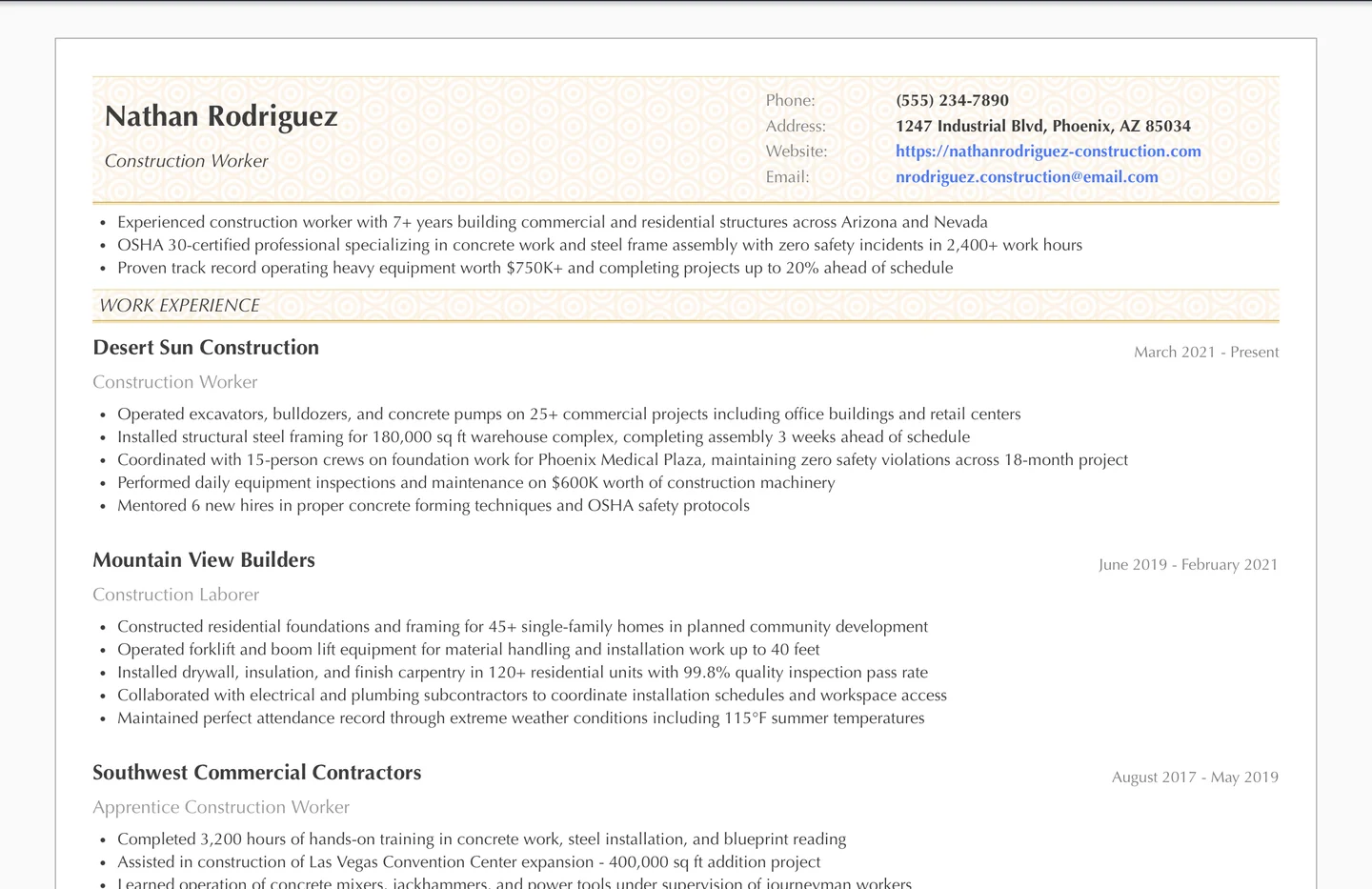
https://www.resumonk.com/construction-workerConstruction WorkerResume Format for Construction Worker Resume
For a Construction Worker resume, the reverse-chronological format is your blueprint for success. Think of it as building from the top down - your most recent and relevant experience sits at the foundation (the top of your resume), supporting everything else that follows.
This format works perfectly because construction supervisors want to see immediately what you've been building lately, which equipment you've been operating, and which safety protocols you've been following.
Structure Your Construction Worker Resume Like a Solid Foundation
Start with your contact information and a brief professional summary that hits harder than a pneumatic drill.
Your summary should be 2-3 lines that capture your years of experience, your specialty (if you have one), and your commitment to safety and quality work. Follow this with your work experience section, then skills, certifications, and education.
Here's where construction workers often stumble - they think their resume needs to be as bare-bones as a steel frame. Wrong.
Your resume should be clean and organized, yes, but it should also tell the story of your construction career with enough detail to paint a picture of your capabilities.
Keep It to One Page (Unless You're a Veteran Builder)
If you've been in construction for less than 10 years, keep your resume to a single page.
You're not writing architectural plans here - you're giving a snapshot of your abilities. However, if you've been building since the days when hard hats were optional and you have extensive experience across multiple construction disciplines, a two-page resume is acceptable. The key is ensuring every line earns its place, just like every beam in a structure needs to carry its weight.
For those applying in the UK or Australia, remember that these markets often expect slightly more detailed resumes, and two pages are more commonly accepted even for mid-level construction workers. Canadian employers tend to align with US preferences - concise and focused on measurable achievements.
Work Experience on Construction Worker Resume
Your work experience section is where the rubber meets the road - or rather, where the concrete meets the rebar. This is where you transform those years of physical labor into compelling evidence that you're the right person to join the next construction crew.
Lead with Action and Results
Each job entry should start with strong action verbs that convey the physical and technical nature of construction work. Think "operated," "installed," "constructed," "maintained," "coordinated," and "completed."
But here's the crucial part - don't just list what you did; show the scale and impact of your work.
Construction managers reading your resume want to know - Can you work efficiently? Can you meet deadlines? Can you work safely? Your work experience should answer these questions without them having to ask.
❌ Don't write vague descriptions:
Construction Worker | ABC Construction | June 2021 - Present
- Did general construction work
- Helped with various projects
- Worked on job sites
✅ Do write specific, quantified achievements:
Construction Worker | ABC Construction | June 2021 - Present
- Operated excavators and bulldozers to prepare sites for 15+ residential projects
- Installed drywall and insulation in 200+ units, maintaining zero safety incidents
- Collaborated with 12-person crews to complete foundation work 20% ahead of schedule
- Maintained and performed daily inspections on $500K worth of construction equipment
Highlight Your Versatility and Specializations
Construction work is diverse - one day you might be framing walls, the next you're laying pipe.
Your resume should reflect this versatility while also highlighting any specializations you've developed. If you've become the go-to person for concrete work or earned a reputation for precise tile installation, make that clear.
Remember to include the types of projects you've worked on. Residential construction is vastly different from commercial or industrial projects, and employers want to know you can handle their specific environment. Mention if you've worked on high-rises, hospitals, schools, or infrastructure projects - each carries its own set of challenges and required skills.
Safety Records Matter More Than You Think
In construction, your safety record is like your credit score - it follows you everywhere and speaks volumes about your professionalism. If you've maintained a clean safety record, completed safety training, or contributed to workplace safety improvements, these achievements deserve prominent placement in your work experience descriptions.
Skills to Include on Construction Worker Resume
Your skills section is like your tool belt - it needs to contain exactly what's needed for the job, organized in a way that makes everything easy to find. Construction supervisors typically spend just seconds scanning this section, looking for specific competencies that match their immediate needs.
Technical Skills - Your Power Tools
Start with your technical skills - these are your bread and butter.
List specific equipment you can operate, construction techniques you've mastered, and materials you're experienced with. Be specific about equipment models and certifications when relevant.
Group your technical skills logically. Equipment operation skills should cluster together, followed by construction techniques, then material handling abilities.
This organization helps employers quickly identify whether you have the specific capabilities they need.
❌ Don't use generic skill descriptions:
Skills:
- Equipment operation
- Construction knowledge
- Tool usage
- Building stuff
✅ Do be specific and comprehensive:
Skills:

Equipment Operation:
- Certified forklift operator (5+ years)
- Excavator and backhoe operation
- Concrete mixer and pump operation
- Power tool proficiency (circular saws, nail guns, jackhammers)

Construction Techniques:
- Concrete forming and pouring
- Steel frame assembly
- Drywall installation and finishing
- Blueprint reading and interpretation
Physical and Safety Skills - Your Foundation
Don't shy away from mentioning physical capabilities - construction work demands them. Include your ability to lift heavy materials, work in various weather conditions, or maintain stamina during long shifts.
These aren't just skills; they're essential job requirements that set you apart from those who might have technical knowledge but lack the physical capability.
Safety skills deserve their own spotlight. List specific safety certifications like OSHA 10 or OSHA 30, first aid training, or specialized safety training relevant to your trade.
Include your knowledge of safety protocols, hazard identification abilities, and experience with safety equipment.
Soft Skills - The Mortar Between the Bricks
While your technical skills get you on the job site, your soft skills keep you there and get you promoted. Communication skills matter when you're coordinating with other trades, problem-solving abilities come into play when plans change mid-project, and reliability makes you the worker supervisors want on their critical path tasks.
For international applications, particularly in Australia and Canada, employers place high value on teamwork and communication skills due to the multicultural nature of many construction sites. Highlight any experience working with diverse teams or bilingual abilities.
Specific Considerations and Tips for Construction Worker Resume
Now let's talk about the unique challenges you face as a construction worker crafting a resume - challenges that someone writing a resume for an office job would never encounter. You've built things with your hands that will stand for decades, but how do you capture that permanence and skill on paper?
Address the Seasonality and Project-Based Nature of Your Work
Construction work often involves moving from project to project, sometimes with gaps during slow seasons or between major contracts.
Don't try to hide these patterns - embrace them. Use project-based descriptions that show you consistently find work and complete assignments successfully. If you've worked for the same contractor across multiple projects, list it as continuous employment and detail the various projects within that role.
For seasonal gaps, especially in regions with harsh winters, you can note "Seasonal employment" next to your job dates. Employers in the construction industry understand this reality. What matters more is showing that you return to work reliably when the season begins and that you maintain your skills during off-seasons.
Showcase Your Physical Portfolio Without Photos
Unlike designers who can link to online portfolios, your best work might be a perfectly level foundation or a flawlessly installed roof that can't be captured in a resume.
Instead, quantify your contributions to notable projects. Mention recognizable buildings or infrastructure projects you've worked on, especially if they're landmarks in your area.
❌ Don't undersell your project involvement:
Worked on various building projects in downtown area
✅ Do highlight specific, recognizable achievements:
Contributed to structural steel installation for City Center Mall (50,000 sq ft retail space)
Completed finish carpentry for St. Mary's Hospital renovation - delivered 2 weeks early
Navigate the Union vs. Non-Union Distinction
Your union affiliation (or lack thereof) can be a defining factor in your construction career.
If you're a union member, list your local number and good standing status prominently - many projects require union workers. If you're non-union but applying to union positions, emphasize your willingness to join and any experience working alongside union crews. Conversely, if applying to non-union positions as a union member, focus on your flexibility and ability to work in various environments.
Handle Career Progression in Construction
Career growth in construction doesn't always mean moving into an office. Maybe you've progressed from laborer to equipment operator, or from carpenter's helper to lead carpenter. Show this progression clearly, even if your job titles haven't changed dramatically.
Use your descriptions to show increasing responsibility, more complex projects, or mentorship of newer workers.
If you're making a lateral move - perhaps from residential to commercial construction, or from one trade to another - explain the transferable skills clearly. A framer moving into concrete work isn't starting from scratch; they're bringing measurement precision, blueprint reading, and worksite coordination skills to a new specialty.
Certifications and Tickets - Your Golden Passes
In construction, certain certifications can instantly elevate your resume from the maybe pile to the must-interview pile.
Create a dedicated section for certifications if you have more than two. Include certification numbers and expiration dates where relevant. Regional differences matter here - in Canada, your trade tickets are crucial; in the US, OSHA certifications carry significant weight; in Australia, your White Card is mandatory.
Don't forget specialized training that might seem routine to you but represents valuable investment to employers - confined space entry, aerial lift operation, or hazardous material handling certifications can set you apart from equally experienced candidates.
The Language of Construction
Finally, write in the language of construction without oversimplifying for a general audience.
Use industry terms correctly - know the difference between a joist and a beam, between forming and framing. But avoid excessive jargon that might confuse HR personnel who often do initial resume screenings. Strike a balance by using technical terms but providing enough context that someone outside construction can understand your capabilities.
Your construction worker resume isn't just a list of jobs and skills - it's the blueprint for your next career move. Every section should build upon the last, creating a solid structure that showcases not just what you've built with your hands, but what you can build for your next employer. Remember, you're not just another pair of hands on the job site; you're a skilled professional who transforms raw materials into the structures that shape our communities.
Education to List on Construction Worker Resume
Here's the thing about education on a construction worker resume - it matters, but not in the way you might think. Hiring managers aren't looking for Ivy League degrees. They're looking for proof that you can learn, adapt, and most importantly, that you've invested time in understanding safety protocols and industry standards.
Your education section needs to reflect the practical reality of construction work while highlighting any formal training that sets you apart.
Start with Your Highest Relevant Qualification
If you have a high school diploma or GED, list it first.
Yes, even if it feels basic. Many construction sites require at least this level of education for insurance and compliance reasons. If you've completed any trade school programs, apprenticeships, or vocational training, these take priority over general education.
❌ Don't write vaguely about your education:
Went to Lincoln High School
Some construction courses
✅ Do provide specific details and dates:
High School Diploma - Lincoln High School, Denver, CO
Graduated: June 2019

OSHA 30-Hour Construction Safety Certification
Completed: March 2021
Highlight Industry-Specific Certifications
This is where construction workers can really shine. Every certification you've earned - whether it's forklift operation, scaffolding safety, or hazmat handling - belongs in your education section.
These certifications show initiative and specialized knowledge that directly impacts job site safety and efficiency.
Remember to include certification numbers and expiration dates where applicable. Construction managers need to know your certifications are current and valid.
If you're certified in multiple states or provinces, mention that too - it shows flexibility and broader employment potential.
❌ Don't list expired certifications without context:
Forklift certification - 2018
✅ Do show current status and renewal dates:
Certified Forklift Operator - License #FO-2847
Issued: January 2022 | Expires: January 2025
Training Provider: National Safety Council
Include Apprenticeships and On-the-Job Training
That four-year carpentry apprenticeship?
That's education, and valuable education at that. Many construction workers undervalue their apprenticeship experiences, tucking them away in work history when they should be prominently displayed in education. Apprenticeships combine classroom learning with hands-on training - they're essentially vocational degrees earned through sweat and sawdust.
List your apprenticeship programs with the same detail you'd give to any formal education program. Include the trade union or organization that sponsored it, the duration, and any specific skills or certifications earned through the program.
Carpentry Apprenticeship Program
United Brotherhood of Carpenters Local 1325
Duration: September 2018 - August 2022
- Completed 8,000 hours of on-the-job training
- 600 hours of classroom instruction in blueprint reading, building codes, and safety
- Achieved Journeyman Carpenter status
Awards and Publications on Construction Worker Resume
The construction industry has its own ecosystem of recognition, from safety milestones to productivity achievements. Maybe you've never thought of that "500 Days Without Lost Time Injury" certificate as resume-worthy, but to a hiring manager, it speaks volumes about your commitment to workplace safety and team coordination.
Safety Awards Take Priority
In construction, nothing matters more than everyone going home safe at the end of the day. If you've received any safety-related awards or recognitions - whether individual or as part of a crew - these should be front and center.
Safety awards demonstrate that you don't just follow protocols; you embody them.
❌ Don't minimize safety achievements:
Got some safety award at ABC Construction
✅ Do provide context and impact:
Safety Excellence Award - ABC Construction Company
June 2023
Recognized for maintaining zero safety violations across 18-month highway reconstruction project
Led daily toolbox talks for 15-person crew
Project Completion and Productivity Recognition
Construction is deadline-driven, budget-conscious work. If you've been recognized for helping complete projects ahead of schedule, under budget, or with exceptional quality, these achievements deserve space on your resume.
They show you understand the business side of construction, not just the technical aspects.
Think about times when superintendents or project managers specifically called out your contribution. Even informal recognitions - like being consistently chosen for critical project phases - can be framed as achievements.
The key is connecting your recognition to measurable project outcomes.
Project Excellence Recognition - Metro City Convention Center Build, March 2022
- Selected as lead installer for critical structural steel phase
- Completed installation 6 days ahead of schedule, contributing to $50,000 in saved labor costs
Training and Mentorship Recognition
Have you been asked to train new hires? Selected as a mentor for apprentices? These informal "awards" show leadership and expertise. Construction companies value workers who can pass on knowledge safely and effectively.
If you've been recognized formally or informally as a trainer or mentor, include it.
As for publications - while you might not have academic papers, you could have contributed to safety newsletters, participated in toolbox talk preparations, or helped develop site-specific safety plans. Any documented contribution to improving workplace practices counts.
❌ Don't overlook informal leadership roles:
Sometimes helped new guys
✅ Do formalize your mentorship experience:
Designated Apprentice Mentor - Johnson Construction Services (2021 - Present)
- Selected to mentor 8 first-year apprentices in concrete forming techniques
- Developed hands-on training modules adopted company-wide
- 100% of mentees passed probationary period
Listing References for Construction Worker Resume
The construction industry runs on networks.
Chances are, your next employer knows someone who knows someone who worked with you three jobs ago. This interconnectedness means your references aren't just character witnesses - they're your professional validators who can speak to your ability to show up, stay safe, and get the job done.
Choose References Who've Seen You Under Pressure
Your best references are those who've watched you handle construction's inevitable challenges - equipment breakdowns, weather delays, last-minute plan changes, or safety incidents.
These situations reveal character. A foreman who saw you maintain composure and productivity when the crane broke down can speak to qualities that matter more than any certification.
Prioritize direct supervisors from recent projects, especially those similar to the job you're applying for. If you're applying for commercial construction, a reference from residential work still helps, but one from a commercial project manager carries more weight.
❌ Don't list references without context:
References:
John Smith - 555-0123
Bob Johnson - 555-0456
Mike Williams - 555-0789
✅ Do provide relevant details and relationships:
Professional References:

1. Michael Torres - Project Superintendent, Titan Commercial Construction
- Phone: 555-0123 | Email: [email protected]
- Relationship: Direct supervisor on $4.2M medical center project (2022-2023)

2. Sarah Chen - Safety Manager, Regional Construction Partners
- Phone: 555-0456 | Email: [email protected]
- Relationship: Collaborated on implementing new fall protection protocols across 3 job sites
Include Trade-Specific References When Relevant
If you're a construction worker with specialized skills - say, concrete finishing or steel erection - include at least one reference who can speak specifically to those abilities.
This might be a master tradesperson you apprenticed under or a specialty subcontractor you've worked alongside. These references add credibility to any specialized claims on your resume.
Remember that in construction, crew leaders and experienced journeymen can be valuable references too, not just management. A respected 20-year veteran carpenter vouching for your framing skills might carry more weight than a project manager who rarely visited the job site.
Prepare Your References for Different Regional Expectations
Reference practices vary by region.
In the United States, employers typically contact references near the end of the hiring process. In Canada, particularly for union positions, references might be checked earlier and more thoroughly. UK and Australian employers often require written references upfront, so having these prepared in advance can speed up your application.
Always inform your references when you're job hunting and brief them on the positions you're pursuing. If you're applying for a highway construction role, let your references know so they can emphasize your experience with traffic control and night work.
This preparation helps them provide relevant examples that strengthen your candidacy.
References Available Upon Request

Note: Written references from previous supervisors available immediately
- Letter of recommendation from ABC Construction (commercial projects)
- Safety commendation from DEF Builders (OSHA compliance record)
- Performance evaluation from GHI Contractors (project completion metrics)
Maintain Your Reference Network
Construction workers often move between companies and projects, but maintaining connections with past supervisors is crucial.
Send occasional updates about your career progress, new certifications earned, or major projects completed. This keeps you fresh in their minds and ensures they can provide current, enthusiastic references when needed.
Consider creating a separate reference sheet rather than listing references directly on your resume. This gives you flexibility to customize references based on the specific job and saves valuable resume space for highlighting your skills and experience.
Plus, it shows professionalism - you're organized enough to have your references ready when requested.
Cover Letter Tips for Construction Worker Resume
Think of your cover letter as that first firm handshake on a job site. It's your chance to look the hiring manager in the eye (metaphorically) and explain why you're worth bringing onto the crew.
Unlike office jobs where cover letters can feel formulaic, construction cover letters should feel like a conversation between two people who understand what it really means to pour concrete in 100-degree heat or frame houses through a winter storm.
Lead with Specific Project Experience
Don't start with generic pleasantries. Jump straight into a specific project that relates to what this company builds. If they specialize in commercial high-rises and you've worked on similar projects, say so immediately.
Construction managers want to know you understand their specific challenges - whether that's working with union regulations, meeting aggressive deadlines, or dealing with urban job site constraints.
❌ Don't write generic openings:
Dear Hiring Manager,

I am writing to apply for the construction worker position at your company.
I have 5 years of experience in construction.
✅ Do connect immediately to their work:
Dear Ms. Johnson,

Having spent the last three years working on downtown high-rise projects similar to your current Park Avenue development, I understand the unique challenges of urban vertical construction - from coordinating material deliveries in tight spaces to working alongside multiple trades in confined areas.
Address the Physical and Mental Requirements
Construction work isn't just about skills - it's about stamina, problem-solving, and maintaining focus during long shifts. Your cover letter should subtly address these realities.
Mention your track record of maintaining productivity through challenging conditions, your ability to adapt when plans change (because they always do), and your commitment to safety even when deadlines loom.
This is especially important if you're applying to companies known for demanding projects. If they build bridges in remote locations or work year-round in harsh climates, acknowledge these challenges and explain why you're prepared for them.
During the I-70 bridge reconstruction, our crew worked 12-hour shifts in temperatures ranging from -10°F to 95°F. I maintained perfect attendance throughout the 14-month project while helping train three new crew members in cold-weather concrete procedures.
Show You Understand Their Business, Not Just Construction
Research the company before writing. Are they family-owned or part of a national corporation? Do they pride themselves on green building practices or historic restoration? Your cover letter should reflect understanding of their business model and values.
This shows you're not just looking for any construction job - you want to work for them specifically.
For different regions, adjust your approach. UK and Australian companies often value formal qualifications more heavily, so emphasize your certifications early. American companies might focus more on productivity and safety records.
Canadian employers often look for experience with extreme weather conditions and specific provincial regulations.
❌ Don't ignore company culture:
I want to work for your construction company because you have jobs available.
✅ Do show alignment with their values:
Your company's commitment to sustainable building practices aligns with my recent LEED Green Associate certification and experience on three net-zero energy projects.
I'm particularly interested in contributing to your upcoming solar panel installation program for affordable housing developments.
Key Takeaways
- Use reverse-chronological format - Start with your most recent construction experience and work backward, showing progression and current relevant skills that employers need to see immediately
- Quantify your construction achievements - Include specific numbers like square footage completed, crew sizes managed, equipment values operated, and safety records maintained to give concrete evidence of your capabilities
- Highlight safety certifications and records prominently - Your OSHA certifications, safety training, and incident-free work history should be easily visible as these are critical hiring factors in construction
- Be specific about equipment and techniques - List exact equipment models you can operate, construction methods you've mastered, and materials you're experienced with rather than using vague descriptions
- Address project-based employment patterns - Present seasonal work and project-to-project movement as normal industry patterns, focusing on consistent work history and successful project completions
- Include notable projects and structures - Mention recognizable buildings or infrastructure projects you've contributed to, providing tangible examples of your work that employers can visualize
- Customize for regional requirements - Adapt your resume for different markets - emphasizing union membership where relevant, highlighting specific provincial or state certifications, and following local conventions for resume length
- Don't undervalue apprenticeships and training - Present your apprenticeship programs, on-the-job training, and trade certifications as valuable education that combines theoretical knowledge with practical expertise
- Prepare references who've seen you work - Choose supervisors and colleagues who can speak to your performance under pressure, safety consciousness, and reliability on challenging projects
- Write a targeted cover letter - Use your cover letter to connect your specific project experience to the employer's work, showing you understand their business beyond just general construction
Creating your construction worker resume doesn't have to feel like operating unfamiliar equipment for the first time. With Resumonk, you can build a professional resume that captures all your hands-on experience and technical skills in a format that construction industry employers expect. Our AI-powered recommendations understand the language of construction - from suggesting powerful action verbs that describe your work to helping you quantify your achievements in ways that resonate with project managers and superintendents. Plus, our professionally designed templates ensure your resume looks as solid and well-constructed as the projects you've built throughout your career.
Ready to build your construction worker resume?
Start crafting your professional resume today with Resumonk's intuitive resume builder, designed specifically for construction professionals like you. No complex software to learn - just straightforward tools that help you showcase your construction expertise effectively.
Get started with Resumonk now and land your next construction opportunity.
More Construction resume examples
- Welder resume example
- HVAC Technician resume example
- Construction Project Manager resume example
- Carpenter resume example
See all Construction resume examples, or browse every category.
Resume writing tips
Let's paint a picture together - it's 5 AM, your alarm cuts through the darkness, and while most people are still dreaming, you're lacing up those steel-toed boots that have seen more job sites than you can count. Coffee in your thermos, hard hat in hand, you're part of the backbone that literally builds the world around us. Maybe you started as a laborer, hauling materials until your muscles ached, learning the rhythm of construction sites where concrete trucks rumble like thunder and nail guns pop like firecrackers.
Or perhaps you came from a family where construction runs in the blood - where dinner conversations revolve around pour schedules and OSHA regulations, where your first toy was probably a toy dump truck that you pushed through dirt piles, unknowingly preparing for your future.
Now here you are, searching for "construction worker resume examples" because it's time for the next chapter. Maybe your current project is wrapping up, or perhaps you've heard about better opportunities with a company that values their workers with more than just Friday pizza. You know your worth - those years of experience reading blueprints like morning newspapers, operating equipment worth more than most people's houses, and building structures that will stand long after we're gone. But translating that physical expertise into words on paper? That feels like trying to build a house with a pencil instead of a hammer.
You're not alone in this challenge. Every construction worker faces the same paradox - your best qualifications are written in concrete and steel across the city skyline, not in fancy words on pristine paper. The good news? This comprehensive guide will walk you through everything you need to create a construction worker resume that speaks directly to hiring managers who understand the difference between someone who talks about construction and someone who lives it. We'll start with choosing the right resume format that showcases your experience like a well-organized tool trailer, then dive deep into crafting compelling work experience descriptions that capture the scale and complexity of your projects.
We'll cover how to present your skills - from operating heavy machinery to reading technical drawings - in a way that makes employers take notice. You'll learn how to handle the unique aspects of construction careers, like seasonal work patterns and project-based employment, turning what might seem like obstacles into proof of your adaptability and reliability. We'll explore how to properly showcase your education and certifications (yes, that forklift license and OSHA 30 matter more than you think), highlight any safety awards or recognitions you've earned, and even tackle the often-overlooked cover letter that could set you apart from the stack of applications.
By the time you finish reading this guide, you'll have everything you need to build a resume that's as solid as the structures you create. Whether you're a seasoned journeyman looking to move into commercial construction, an experienced laborer ready to showcase your specialized skills, or someone who's built their career one project at a time across different trades, this guide will help you present your experience in a way that opens doors to your next opportunity. Let's get to work - after all, building something right the first time is what you do best.
The Best Construction Worker Resume Example/Sample
https://www.resumonk.com/construction-workerConstruction WorkerResume Format for Construction Worker Resume
For a Construction Worker resume, the reverse-chronological format is your blueprint for success. Think of it as building from the top down - your most recent and relevant experience sits at the foundation (the top of your resume), supporting everything else that follows.
This format works perfectly because construction supervisors want to see immediately what you've been building lately, which equipment you've been operating, and which safety protocols you've been following.
Structure Your Construction Worker Resume Like a Solid Foundation
Start with your contact information and a brief professional summary that hits harder than a pneumatic drill.
Your summary should be 2-3 lines that capture your years of experience, your specialty (if you have one), and your commitment to safety and quality work. Follow this with your work experience section, then skills, certifications, and education.
Here's where construction workers often stumble - they think their resume needs to be as bare-bones as a steel frame. Wrong.
Your resume should be clean and organized, yes, but it should also tell the story of your construction career with enough detail to paint a picture of your capabilities.
Keep It to One Page (Unless You're a Veteran Builder)
If you've been in construction for less than 10 years, keep your resume to a single page.
You're not writing architectural plans here - you're giving a snapshot of your abilities. However, if you've been building since the days when hard hats were optional and you have extensive experience across multiple construction disciplines, a two-page resume is acceptable. The key is ensuring every line earns its place, just like every beam in a structure needs to carry its weight.
For those applying in the UK or Australia, remember that these markets often expect slightly more detailed resumes, and two pages are more commonly accepted even for mid-level construction workers. Canadian employers tend to align with US preferences - concise and focused on measurable achievements.
Work Experience on Construction Worker Resume
Your work experience section is where the rubber meets the road - or rather, where the concrete meets the rebar. This is where you transform those years of physical labor into compelling evidence that you're the right person to join the next construction crew.
Lead with Action and Results
Each job entry should start with strong action verbs that convey the physical and technical nature of construction work. Think "operated," "installed," "constructed," "maintained," "coordinated," and "completed."
But here's the crucial part - don't just list what you did; show the scale and impact of your work.
Construction managers reading your resume want to know - Can you work efficiently? Can you meet deadlines? Can you work safely? Your work experience should answer these questions without them having to ask.
❌ Don't write vague descriptions:
Construction Worker | ABC Construction | June 2021 - Present
- Did general construction work
- Helped with various projects
- Worked on job sites
✅ Do write specific, quantified achievements:
Construction Worker | ABC Construction | June 2021 - Present
- Operated excavators and bulldozers to prepare sites for 15+ residential projects
- Installed drywall and insulation in 200+ units, maintaining zero safety incidents
- Collaborated with 12-person crews to complete foundation work 20% ahead of schedule
- Maintained and performed daily inspections on $500K worth of construction equipment
Highlight Your Versatility and Specializations
Construction work is diverse - one day you might be framing walls, the next you're laying pipe.
Your resume should reflect this versatility while also highlighting any specializations you've developed. If you've become the go-to person for concrete work or earned a reputation for precise tile installation, make that clear.
Remember to include the types of projects you've worked on. Residential construction is vastly different from commercial or industrial projects, and employers want to know you can handle their specific environment. Mention if you've worked on high-rises, hospitals, schools, or infrastructure projects - each carries its own set of challenges and required skills.
Safety Records Matter More Than You Think
In construction, your safety record is like your credit score - it follows you everywhere and speaks volumes about your professionalism. If you've maintained a clean safety record, completed safety training, or contributed to workplace safety improvements, these achievements deserve prominent placement in your work experience descriptions.
Skills to Include on Construction Worker Resume
Your skills section is like your tool belt - it needs to contain exactly what's needed for the job, organized in a way that makes everything easy to find. Construction supervisors typically spend just seconds scanning this section, looking for specific competencies that match their immediate needs.
Technical Skills - Your Power Tools
Start with your technical skills - these are your bread and butter.
List specific equipment you can operate, construction techniques you've mastered, and materials you're experienced with. Be specific about equipment models and certifications when relevant.
Group your technical skills logically. Equipment operation skills should cluster together, followed by construction techniques, then material handling abilities.
This organization helps employers quickly identify whether you have the specific capabilities they need.
❌ Don't use generic skill descriptions:
Skills:
- Equipment operation
- Construction knowledge
- Tool usage
- Building stuff
✅ Do be specific and comprehensive:
Skills:

Equipment Operation:
- Certified forklift operator (5+ years)
- Excavator and backhoe operation
- Concrete mixer and pump operation
- Power tool proficiency (circular saws, nail guns, jackhammers)

Construction Techniques:
- Concrete forming and pouring
- Steel frame assembly
- Drywall installation and finishing
- Blueprint reading and interpretation
Physical and Safety Skills - Your Foundation
Don't shy away from mentioning physical capabilities - construction work demands them. Include your ability to lift heavy materials, work in various weather conditions, or maintain stamina during long shifts.
These aren't just skills; they're essential job requirements that set you apart from those who might have technical knowledge but lack the physical capability.
Safety skills deserve their own spotlight. List specific safety certifications like OSHA 10 or OSHA 30, first aid training, or specialized safety training relevant to your trade.
Include your knowledge of safety protocols, hazard identification abilities, and experience with safety equipment.
Soft Skills - The Mortar Between the Bricks
While your technical skills get you on the job site, your soft skills keep you there and get you promoted. Communication skills matter when you're coordinating with other trades, problem-solving abilities come into play when plans change mid-project, and reliability makes you the worker supervisors want on their critical path tasks.
For international applications, particularly in Australia and Canada, employers place high value on teamwork and communication skills due to the multicultural nature of many construction sites. Highlight any experience working with diverse teams or bilingual abilities.
Specific Considerations and Tips for Construction Worker Resume
Now let's talk about the unique challenges you face as a construction worker crafting a resume - challenges that someone writing a resume for an office job would never encounter. You've built things with your hands that will stand for decades, but how do you capture that permanence and skill on paper?
Address the Seasonality and Project-Based Nature of Your Work
Construction work often involves moving from project to project, sometimes with gaps during slow seasons or between major contracts.
Don't try to hide these patterns - embrace them. Use project-based descriptions that show you consistently find work and complete assignments successfully. If you've worked for the same contractor across multiple projects, list it as continuous employment and detail the various projects within that role.
For seasonal gaps, especially in regions with harsh winters, you can note "Seasonal employment" next to your job dates. Employers in the construction industry understand this reality. What matters more is showing that you return to work reliably when the season begins and that you maintain your skills during off-seasons.
Showcase Your Physical Portfolio Without Photos
Unlike designers who can link to online portfolios, your best work might be a perfectly level foundation or a flawlessly installed roof that can't be captured in a resume.
Instead, quantify your contributions to notable projects. Mention recognizable buildings or infrastructure projects you've worked on, especially if they're landmarks in your area.
❌ Don't undersell your project involvement:
Worked on various building projects in downtown area
✅ Do highlight specific, recognizable achievements:
Contributed to structural steel installation for City Center Mall (50,000 sq ft retail space)
Completed finish carpentry for St. Mary's Hospital renovation - delivered 2 weeks early
Navigate the Union vs. Non-Union Distinction
Your union affiliation (or lack thereof) can be a defining factor in your construction career.
If you're a union member, list your local number and good standing status prominently - many projects require union workers. If you're non-union but applying to union positions, emphasize your willingness to join and any experience working alongside union crews. Conversely, if applying to non-union positions as a union member, focus on your flexibility and ability to work in various environments.
Handle Career Progression in Construction
Career growth in construction doesn't always mean moving into an office. Maybe you've progressed from laborer to equipment operator, or from carpenter's helper to lead carpenter. Show this progression clearly, even if your job titles haven't changed dramatically.
Use your descriptions to show increasing responsibility, more complex projects, or mentorship of newer workers.
If you're making a lateral move - perhaps from residential to commercial construction, or from one trade to another - explain the transferable skills clearly. A framer moving into concrete work isn't starting from scratch; they're bringing measurement precision, blueprint reading, and worksite coordination skills to a new specialty.
Certifications and Tickets - Your Golden Passes
In construction, certain certifications can instantly elevate your resume from the maybe pile to the must-interview pile.
Create a dedicated section for certifications if you have more than two. Include certification numbers and expiration dates where relevant. Regional differences matter here - in Canada, your trade tickets are crucial; in the US, OSHA certifications carry significant weight; in Australia, your White Card is mandatory.
Don't forget specialized training that might seem routine to you but represents valuable investment to employers - confined space entry, aerial lift operation, or hazardous material handling certifications can set you apart from equally experienced candidates.
The Language of Construction
Finally, write in the language of construction without oversimplifying for a general audience.
Use industry terms correctly - know the difference between a joist and a beam, between forming and framing. But avoid excessive jargon that might confuse HR personnel who often do initial resume screenings. Strike a balance by using technical terms but providing enough context that someone outside construction can understand your capabilities.
Your construction worker resume isn't just a list of jobs and skills - it's the blueprint for your next career move. Every section should build upon the last, creating a solid structure that showcases not just what you've built with your hands, but what you can build for your next employer. Remember, you're not just another pair of hands on the job site; you're a skilled professional who transforms raw materials into the structures that shape our communities.
Education to List on Construction Worker Resume
Here's the thing about education on a construction worker resume - it matters, but not in the way you might think. Hiring managers aren't looking for Ivy League degrees. They're looking for proof that you can learn, adapt, and most importantly, that you've invested time in understanding safety protocols and industry standards.
Your education section needs to reflect the practical reality of construction work while highlighting any formal training that sets you apart.
Start with Your Highest Relevant Qualification
If you have a high school diploma or GED, list it first.
Yes, even if it feels basic. Many construction sites require at least this level of education for insurance and compliance reasons. If you've completed any trade school programs, apprenticeships, or vocational training, these take priority over general education.
❌ Don't write vaguely about your education:
Went to Lincoln High School
Some construction courses
✅ Do provide specific details and dates:
High School Diploma - Lincoln High School, Denver, CO
Graduated: June 2019

OSHA 30-Hour Construction Safety Certification
Completed: March 2021
Highlight Industry-Specific Certifications
This is where construction workers can really shine. Every certification you've earned - whether it's forklift operation, scaffolding safety, or hazmat handling - belongs in your education section.
These certifications show initiative and specialized knowledge that directly impacts job site safety and efficiency.
Remember to include certification numbers and expiration dates where applicable. Construction managers need to know your certifications are current and valid.
If you're certified in multiple states or provinces, mention that too - it shows flexibility and broader employment potential.
❌ Don't list expired certifications without context:
Forklift certification - 2018
✅ Do show current status and renewal dates:
Certified Forklift Operator - License #FO-2847
Issued: January 2022 | Expires: January 2025
Training Provider: National Safety Council
Include Apprenticeships and On-the-Job Training
That four-year carpentry apprenticeship?
That's education, and valuable education at that. Many construction workers undervalue their apprenticeship experiences, tucking them away in work history when they should be prominently displayed in education. Apprenticeships combine classroom learning with hands-on training - they're essentially vocational degrees earned through sweat and sawdust.
List your apprenticeship programs with the same detail you'd give to any formal education program. Include the trade union or organization that sponsored it, the duration, and any specific skills or certifications earned through the program.
Carpentry Apprenticeship Program
United Brotherhood of Carpenters Local 1325
Duration: September 2018 - August 2022
- Completed 8,000 hours of on-the-job training
- 600 hours of classroom instruction in blueprint reading, building codes, and safety
- Achieved Journeyman Carpenter status
Awards and Publications on Construction Worker Resume
The construction industry has its own ecosystem of recognition, from safety milestones to productivity achievements. Maybe you've never thought of that "500 Days Without Lost Time Injury" certificate as resume-worthy, but to a hiring manager, it speaks volumes about your commitment to workplace safety and team coordination.
Safety Awards Take Priority
In construction, nothing matters more than everyone going home safe at the end of the day. If you've received any safety-related awards or recognitions - whether individual or as part of a crew - these should be front and center.
Safety awards demonstrate that you don't just follow protocols; you embody them.
❌ Don't minimize safety achievements:
Got some safety award at ABC Construction
✅ Do provide context and impact:
Safety Excellence Award - ABC Construction Company
June 2023
Recognized for maintaining zero safety violations across 18-month highway reconstruction project
Led daily toolbox talks for 15-person crew
Project Completion and Productivity Recognition
Construction is deadline-driven, budget-conscious work. If you've been recognized for helping complete projects ahead of schedule, under budget, or with exceptional quality, these achievements deserve space on your resume.
They show you understand the business side of construction, not just the technical aspects.
Think about times when superintendents or project managers specifically called out your contribution. Even informal recognitions - like being consistently chosen for critical project phases - can be framed as achievements.
The key is connecting your recognition to measurable project outcomes.
Project Excellence Recognition - Metro City Convention Center Build, March 2022
- Selected as lead installer for critical structural steel phase
- Completed installation 6 days ahead of schedule, contributing to $50,000 in saved labor costs
Training and Mentorship Recognition
Have you been asked to train new hires? Selected as a mentor for apprentices? These informal "awards" show leadership and expertise. Construction companies value workers who can pass on knowledge safely and effectively.
If you've been recognized formally or informally as a trainer or mentor, include it.
As for publications - while you might not have academic papers, you could have contributed to safety newsletters, participated in toolbox talk preparations, or helped develop site-specific safety plans. Any documented contribution to improving workplace practices counts.
❌ Don't overlook informal leadership roles:
Sometimes helped new guys
✅ Do formalize your mentorship experience:
Designated Apprentice Mentor - Johnson Construction Services (2021 - Present)
- Selected to mentor 8 first-year apprentices in concrete forming techniques
- Developed hands-on training modules adopted company-wide
- 100% of mentees passed probationary period
Listing References for Construction Worker Resume
The construction industry runs on networks.
Chances are, your next employer knows someone who knows someone who worked with you three jobs ago. This interconnectedness means your references aren't just character witnesses - they're your professional validators who can speak to your ability to show up, stay safe, and get the job done.
Choose References Who've Seen You Under Pressure
Your best references are those who've watched you handle construction's inevitable challenges - equipment breakdowns, weather delays, last-minute plan changes, or safety incidents.
These situations reveal character. A foreman who saw you maintain composure and productivity when the crane broke down can speak to qualities that matter more than any certification.
Prioritize direct supervisors from recent projects, especially those similar to the job you're applying for. If you're applying for commercial construction, a reference from residential work still helps, but one from a commercial project manager carries more weight.
❌ Don't list references without context:
References:
John Smith - 555-0123
Bob Johnson - 555-0456
Mike Williams - 555-0789
✅ Do provide relevant details and relationships:
Professional References:

1. Michael Torres - Project Superintendent, Titan Commercial Construction
- Phone: 555-0123 | Email: [email protected]
- Relationship: Direct supervisor on $4.2M medical center project (2022-2023)

2. Sarah Chen - Safety Manager, Regional Construction Partners
- Phone: 555-0456 | Email: [email protected]
- Relationship: Collaborated on implementing new fall protection protocols across 3 job sites
Include Trade-Specific References When Relevant
If you're a construction worker with specialized skills - say, concrete finishing or steel erection - include at least one reference who can speak specifically to those abilities.
This might be a master tradesperson you apprenticed under or a specialty subcontractor you've worked alongside. These references add credibility to any specialized claims on your resume.
Remember that in construction, crew leaders and experienced journeymen can be valuable references too, not just management. A respected 20-year veteran carpenter vouching for your framing skills might carry more weight than a project manager who rarely visited the job site.
Prepare Your References for Different Regional Expectations
Reference practices vary by region.
In the United States, employers typically contact references near the end of the hiring process. In Canada, particularly for union positions, references might be checked earlier and more thoroughly. UK and Australian employers often require written references upfront, so having these prepared in advance can speed up your application.
Always inform your references when you're job hunting and brief them on the positions you're pursuing. If you're applying for a highway construction role, let your references know so they can emphasize your experience with traffic control and night work.
This preparation helps them provide relevant examples that strengthen your candidacy.
References Available Upon Request

Note: Written references from previous supervisors available immediately
- Letter of recommendation from ABC Construction (commercial projects)
- Safety commendation from DEF Builders (OSHA compliance record)
- Performance evaluation from GHI Contractors (project completion metrics)
Maintain Your Reference Network
Construction workers often move between companies and projects, but maintaining connections with past supervisors is crucial.
Send occasional updates about your career progress, new certifications earned, or major projects completed. This keeps you fresh in their minds and ensures they can provide current, enthusiastic references when needed.
Consider creating a separate reference sheet rather than listing references directly on your resume. This gives you flexibility to customize references based on the specific job and saves valuable resume space for highlighting your skills and experience.
Plus, it shows professionalism - you're organized enough to have your references ready when requested.
Cover Letter Tips for Construction Worker Resume
Think of your cover letter as that first firm handshake on a job site. It's your chance to look the hiring manager in the eye (metaphorically) and explain why you're worth bringing onto the crew.
Unlike office jobs where cover letters can feel formulaic, construction cover letters should feel like a conversation between two people who understand what it really means to pour concrete in 100-degree heat or frame houses through a winter storm.
Lead with Specific Project Experience
Don't start with generic pleasantries. Jump straight into a specific project that relates to what this company builds. If they specialize in commercial high-rises and you've worked on similar projects, say so immediately.
Construction managers want to know you understand their specific challenges - whether that's working with union regulations, meeting aggressive deadlines, or dealing with urban job site constraints.
❌ Don't write generic openings:
Dear Hiring Manager,

I am writing to apply for the construction worker position at your company.
I have 5 years of experience in construction.
✅ Do connect immediately to their work:
Dear Ms. Johnson,

Having spent the last three years working on downtown high-rise projects similar to your current Park Avenue development, I understand the unique challenges of urban vertical construction - from coordinating material deliveries in tight spaces to working alongside multiple trades in confined areas.
Address the Physical and Mental Requirements
Construction work isn't just about skills - it's about stamina, problem-solving, and maintaining focus during long shifts. Your cover letter should subtly address these realities.
Mention your track record of maintaining productivity through challenging conditions, your ability to adapt when plans change (because they always do), and your commitment to safety even when deadlines loom.
This is especially important if you're applying to companies known for demanding projects. If they build bridges in remote locations or work year-round in harsh climates, acknowledge these challenges and explain why you're prepared for them.
During the I-70 bridge reconstruction, our crew worked 12-hour shifts in temperatures ranging from -10°F to 95°F. I maintained perfect attendance throughout the 14-month project while helping train three new crew members in cold-weather concrete procedures.
Show You Understand Their Business, Not Just Construction
Research the company before writing. Are they family-owned or part of a national corporation? Do they pride themselves on green building practices or historic restoration? Your cover letter should reflect understanding of their business model and values.
This shows you're not just looking for any construction job - you want to work for them specifically.
For different regions, adjust your approach. UK and Australian companies often value formal qualifications more heavily, so emphasize your certifications early. American companies might focus more on productivity and safety records.
Canadian employers often look for experience with extreme weather conditions and specific provincial regulations.
❌ Don't ignore company culture:
I want to work for your construction company because you have jobs available.
✅ Do show alignment with their values:
Your company's commitment to sustainable building practices aligns with my recent LEED Green Associate certification and experience on three net-zero energy projects.
I'm particularly interested in contributing to your upcoming solar panel installation program for affordable housing developments.
Key Takeaways
- Use reverse-chronological format - Start with your most recent construction experience and work backward, showing progression and current relevant skills that employers need to see immediately
- Quantify your construction achievements - Include specific numbers like square footage completed, crew sizes managed, equipment values operated, and safety records maintained to give concrete evidence of your capabilities
- Highlight safety certifications and records prominently - Your OSHA certifications, safety training, and incident-free work history should be easily visible as these are critical hiring factors in construction
- Be specific about equipment and techniques - List exact equipment models you can operate, construction methods you've mastered, and materials you're experienced with rather than using vague descriptions
- Address project-based employment patterns - Present seasonal work and project-to-project movement as normal industry patterns, focusing on consistent work history and successful project completions
- Include notable projects and structures - Mention recognizable buildings or infrastructure projects you've contributed to, providing tangible examples of your work that employers can visualize
- Customize for regional requirements - Adapt your resume for different markets - emphasizing union membership where relevant, highlighting specific provincial or state certifications, and following local conventions for resume length
- Don't undervalue apprenticeships and training - Present your apprenticeship programs, on-the-job training, and trade certifications as valuable education that combines theoretical knowledge with practical expertise
- Prepare references who've seen you work - Choose supervisors and colleagues who can speak to your performance under pressure, safety consciousness, and reliability on challenging projects
- Write a targeted cover letter - Use your cover letter to connect your specific project experience to the employer's work, showing you understand their business beyond just general construction
Creating your construction worker resume doesn't have to feel like operating unfamiliar equipment for the first time. With Resumonk, you can build a professional resume that captures all your hands-on experience and technical skills in a format that construction industry employers expect. Our AI-powered recommendations understand the language of construction - from suggesting powerful action verbs that describe your work to helping you quantify your achievements in ways that resonate with project managers and superintendents. Plus, our professionally designed templates ensure your resume looks as solid and well-constructed as the projects you've built throughout your career.
Ready to build your construction worker resume?
Start crafting your professional resume today with Resumonk's intuitive resume builder, designed specifically for construction professionals like you. No complex software to learn - just straightforward tools that help you showcase your construction expertise effectively.
Get started with Resumonk now and land your next construction opportunity.
More Construction resume examples
- Welder resume example
- HVAC Technician resume example
- Construction Project Manager resume example
- Carpenter resume example
See all Construction resume examples, or browse every category.
Resume writing tips