Construction Superintendent Resume Example, Guide and Tips
Introduction
You've been walking job sites since before the sun comes up, coffee in one hand and rolled-up drawings in the other.
Maybe you started swinging a hammer as a carpenter, worked your way through foreman roles, or came up through the project engineer track - but now you're ready for the big chair. The Superintendent role, where you're not just building structures but orchestrating symphonies of concrete, steel, and human coordination. You're searching for a Superintendent resume example because you know this transition demands more than just adding "seeking Superintendent position" to your existing resume.
The Superintendent position sits at a unique intersection in construction hierarchy - you're senior enough to carry profit and loss responsibility for multi-million dollar projects, yet hands-on enough to know which subcontractor is behind schedule just by watching the parking lot at 6 AM. You're the translator between architectural vision and field reality, the mediator between aggressive schedules and actual productivity, the guardian of both safety protocols and completion deadlines. Your resume needs to capture this duality - the executive who thinks strategically and the field general who executes tactically.
In this comprehensive guide, we'll walk you through every element needed to craft a Superintendent resume that commands attention from construction executives and hiring managers. We'll start by establishing the optimal resume format that showcases your progression from tools to leadership, then dive deep into presenting your work experience with the kind of specific, quantified achievements that separate seasoned Superintendents from ambitious project managers. You'll learn exactly which technical skills and certifications to highlight, how to present your education whether you came up through trades or engineering school, and the strategic approach to showcasing awards and recognitions that matter in construction.
We'll also address the unique challenges Superintendent candidates face - how to convey your safety leadership without sounding like a manual, how to demonstrate technological adaptability if you're from the paper blueprint generation, and how to show project diversity while maintaining focus on your specialty. You'll discover how to craft a compelling cover letter that addresses the unspoken concerns of hiring managers, and how to strategically select and prepare references who can vouch for your ability to deliver projects safely, on time, and within budget. Whether you're transitioning from Assistant Superintendent, making a geographic move, or shifting between commercial and industrial sectors, this guide provides the blueprint for building a resume that opens doors to your next major project.
The Ultimate Construction Superintendent Resume Example/Sample
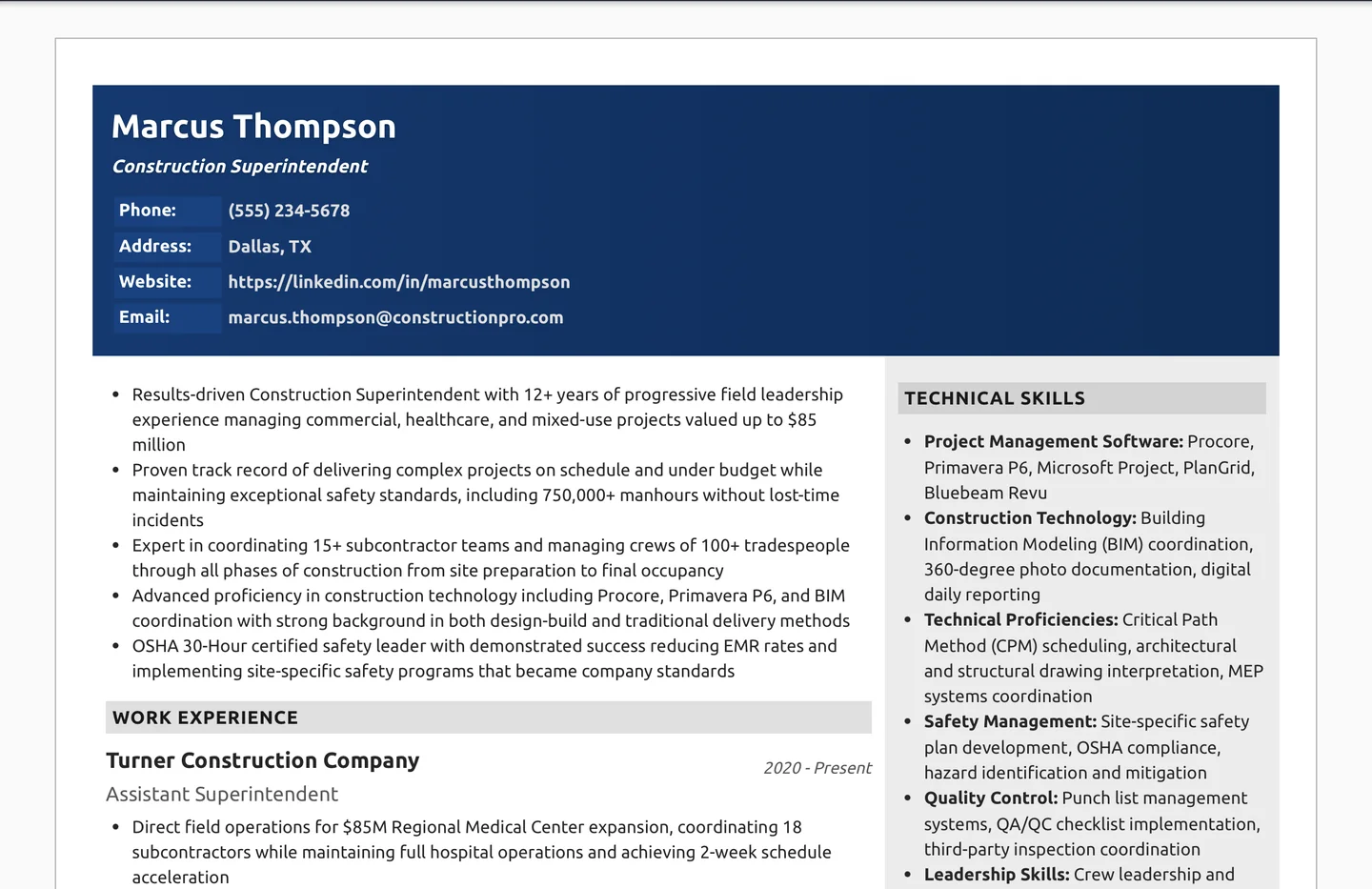
https://www.resumonk.com/superintendentConstruction SuperintendentResume Format for Superintendent Resume
The reverse-chronological format stands as your best foundation here, much like how you'd build from a solid base upward.
This format immediately showcases your most recent and relevant experience at the top, where hiring managers and project directors expect to see your current capabilities. Construction executives don't have time to dig through functional formats or combination styles - they want to see your project history laid out like a clear Gantt chart.
Structure Your Superintendent Resume Like a Project Plan
Begin with a powerful professional summary that reads like an executive project briefing.
This isn't the place for objective statements about what you want - construction companies need to know what you've built and what you can deliver. Your summary should capture your years of field experience, types of projects completed, and your expertise in both the technical and leadership aspects of construction management.
Following your summary, your work experience should dominate the page like a crane dominates a skyline. Each role should clearly indicate your progression from hands-on construction roles to supervisory positions. Remember, the path to Superintendent often flows through positions like Assistant Superintendent, Project Engineer, or Senior Foreman - and this journey tells your story of increasing responsibility.
Regional Formatting Considerations
In the United States, your Superintendent resume typically runs 2 pages - you've managed enough projects to merit the space. Canadian markets follow similar conventions, though they may expect more detail on safety certifications like COR (Certificate of Recognition). UK construction superintendents (often called Site Managers) should include their CSCS card level and SMSTS certification prominently.
Australian superintendents need to highlight their White Card and any state-specific builder's licenses upfront.
The visual hierarchy of your resume should mirror the clear chain of command on a construction site. Use consistent spacing between sections, bullet points for achievements under each role, and ensure your contact information sits prominently at the top like a project sign at a job site entrance.
Your resume shouldn't look like architectural blueprints, but it should demonstrate the same attention to detail and professional presentation.
Work Experience on Superintendent Resume
Your work experience section is where the concrete meets the rebar - it's the reinforced foundation of your entire application.
As someone pursuing a Superintendent role, you're likely coming from positions where you've already tasted leadership, whether that's running a crew as a foreman or coordinating trades as an assistant superintendent. The challenge isn't just listing where you've worked - it's demonstrating how you've progressively taken on larger, more complex projects while developing the dual expertise of technical construction knowledge and people management.
Quantify Your Construction Leadership
Construction is an industry built on numbers - square footage, budgets, timelines, crew sizes.
Your experience descriptions should read like project close-out reports, rich with measurable outcomes. Instead of simply stating responsibilities, frame your experience through the lens of project scope and successful delivery.
❌ Don't write vague descriptions without context:
Assistant Superintendent | ABC Construction | 2019-2023
- Managed construction projects
- Supervised subcontractors
- Ensured safety compliance
- Coordinated with project managers
✅ Do provide specific, quantified achievements:
Assistant Superintendent | ABC Construction | 2019-2023
- Directed field operations for $45M mixed-use development, delivering project 2 weeks ahead of schedule
- Supervised 12 subcontractors and 80+ tradespeople during peak construction phases
- Achieved 450 days without lost-time incidents through proactive safety program implementation
- Reduced material waste by 18% through improved coordination between trades and suppliers
Showcase Your Evolution from Tools to Leadership
The Superintendent role requires someone who understands construction from the ground up - literally. Your experience section should tell the story of your progression, showing how hands-on experience has informed your management approach.
Earlier roles as a carpenter, electrician, or equipment operator aren't just padding - they're proof you understand what you're asking your crews to do.
When describing previous positions, emphasize moments where you bridged the gap between field and office, between plans and execution. Maybe as a foreman, you identified a design conflict that saved weeks of rework. Perhaps as a project engineer, you developed a scheduling system that improved trade coordination. These transitional achievements show you're ready for the Superintendent's dual responsibility of technical oversight and project leadership.
Highlighting Project Diversity and Complexity
Superintendents often specialize in certain project types - commercial, residential, industrial, or civil works.
Your experience should clearly indicate your sweet spot while demonstrating adaptability. If you've managed a $20 million hospital wing, a hiring manager for a medical facility project needs to see that front and center. But don't hide your experience with that shopping center or office tower - versatility is valuable.
Structure each role to lead with your most impressive project from that period, then support it with additional achievements. Think of it like scaffolding - your biggest accomplishment provides the main support, with other successes building around it to create a complete picture of your capabilities.
Skills to Include on Superintendent Resume
Walking onto a job site as a Superintendent means wearing multiple hard hats simultaneously - you're part engineer, part therapist, part accountant, and part fortune teller trying to predict weather delays.
Your skills section needs to reflect this multifaceted expertise while speaking the language that both HR managers and construction executives understand. Unlike entry-level positions where skills might be aspirational, at the Superintendent level, every skill you list should be battle-tested on actual job sites.
Technical Skills - Your Construction Toolkit
Start with the technical foundations that separate a Superintendent from someone who just thinks they can manage construction. Project management software isn't just a nice-to-have anymore - proficiency in Procore, PlanGrid, or Buildertrend shows you can keep projects documented and communicated in real-time.
Your ability to read and interpret architectural drawings, structural plans, and MEP (Mechanical, Electrical, Plumbing) diagrams should be evident.
❌ Don't list generic or outdated technical skills:
Technical Skills:
- Microsoft Office
- Email communication
- Basic computer skills
- Blueprint reading
✅ Do specify current, relevant technical proficiencies:
Technical Skills:
- Procore & Bluebeam Revu for project documentation and drawing markup
- Critical Path Method (CPM) scheduling using Primavera P6
- Building Information Modeling (BIM) coordination and clash detection
- OSHA 30-Hour certified with expertise in site-specific safety plan development
- Proficient in reading architectural, structural, civil, and MEP drawings
Leadership and Soft Skills - Managing the Human Element
Construction sites are ecosystems of different personalities, trades, and competing priorities.
Your soft skills section should reflect your ability to be both diplomat and enforcer. Conflict resolution isn't just corporate speak when you're mediating between an electrician and plumber arguing over who gets ceiling space. Communication skills mean something specific - conducting toolbox talks, running OAC (Owner, Architect, Contractor) meetings, and explaining delays to anxious clients.
Frame these soft skills with construction context. Instead of just listing "leadership," specify "crew leadership and subcontractor coordination." Rather than "problem-solving," note "field engineering and constructability review."
This specificity shows you understand that soft skills in construction have hard edges - they directly impact project outcomes.
Compliance and Certification Skills
Superintendents are guardians of compliance, ensuring projects meet building codes, safety regulations, and quality standards. Your skills section should highlight your knowledge of relevant codes and standards. In the US, this might include familiarity with International Building Code (IBC) and local amendments. UK Superintendents should note their understanding of Building Regulations and CDM (Construction Design and Management) requirements.
Canadian professionals need to showcase knowledge of provincial building codes and WorkSafeBC or equivalent provincial safety requirements.
Quality control methodologies deserve special mention. Whether you use punch list management systems, implement QA/QC checklists, or conduct regular third-party inspections, these skills demonstrate your commitment to delivering projects that pass final inspection on the first attempt.
Remember, a Superintendent's reputation is built on projects that are not just complete, but completed right.
Specific Considerations and Tips for Superintendent Resume
Here's something they don't teach in construction management courses - the person reading your Superintendent resume might be reviewing it while standing in a job trailer, coffee in one hand, trying to solve three problems simultaneously. Or it could be an executive in a corporate office who hasn't worn steel-toes in a decade but still remembers what good field leadership looks like.
Your resume needs to resonate with both audiences, speaking to the practical realities of construction while demonstrating strategic thinking that extends beyond the current project.
The Portfolio Problem - Showing Without Telling
Unlike designers who can attach portfolios, Superintendents face the challenge of making physical structures come alive on paper.
Consider creating a separate project list addendum that details your major projects with specifics - project value, square footage, duration, and your specific role. This isn't part of your main resume but can be provided when requested. For your resume itself, choose your most impressive projects strategically. That $100 million hospital expansion might impress, but if you're applying to a residential developer, your experience with that 200-unit apartment complex might resonate more.
When describing projects, use language that paints a picture. Instead of "Managed commercial construction project," write something that helps readers visualize the scope and complexity.
"Orchestrated all field operations for a 15-story mixed-use tower in downtown core, coordinating concrete pours in active urban environment while maintaining retail operations at street level" tells a story of complexity managed successfully.
The Safety Record - Your Invisible Crown
In construction, what doesn't happen is often as important as what does. Your safety record is like a perfect game in baseball - the absence of incidents is the achievement. Don't bury this in a skills section. If you've maintained impressive safety statistics, lead with them. Create a distinct "Safety Leadership" section if your record warrants it.
EMR (Experience Modification Rate) improvements, days without lost-time incidents, or successful OSHA inspections are tangible proof of your field leadership.
❌ Don't minimize safety achievements:
- Maintained good safety record
- Conducted safety meetings
✅ Do quantify and contextualize safety leadership:
- Achieved 0.67 EMR across 5 consecutive projects, reducing company insurance premiums by $200,000
- Led 3 projects totaling 850,000 manhours with zero lost-time incidents
- Developed site-specific safety plans that became company templates for similar project types
The Technology Transition
If you're a seasoned Superintendent who started when RFIs were actually paper, you need to demonstrate your evolution with technology without apologizing for your experience.
Younger project managers might assume you're resistant to new methods. Counter this by specifically mentioning recent technology adoptions. Did you champion the use of 360-degree photo documentation on your last project? Were you the first in your company to implement digital daily reports?
These details show you're not just adapting to change - you're driving it.
Geographic and Market Flexibility
Construction is intensely local yet increasingly global.
If you've worked across different states, provinces, or countries, highlight this flexibility. Understanding different building codes, working with diverse workforce populations, or adapting to regional construction methods are valuable skills. However, if you're deeply rooted in one market, emphasize your local subcontractor relationships, knowledge of municipal processes, and understanding of regional weather patterns and soil conditions. Both approaches have merit - the key is being intentional about which story you're telling.
Finally, remember that Superintendent positions often involve selling as much as building. You're selling the project to skeptical neighbors, selling safety to resistant workers, selling timeline recovery to anxious owners. Your resume itself is a sales document - not in a dishonest way, but in presenting your experience in its best light while maintaining the straightforward honesty that's valued in construction. Keep it clean, clear, and structured - just like a well-run job site.
Education to List on Superintendent Resume
Let's face it - you've spent years in the trenches of construction management, working your way up from field engineer to project manager, and now you're eyeing that Superintendent role. The hard hat has become second nature, blueprints are your bedtime reading, and you can spot a safety violation from a hundred yards away.
But here's the thing about landing that Superintendent position - your education section needs to tell a story that backs up all that hands-on experience.
The Foundation - Your Formal Education
Most Superintendents come from one of two educational paths, and both are equally valid. You might have that four-year degree in Construction Management, Civil Engineering, or Architecture that you earned back when you thought all construction problems could be solved with equations. Or perhaps you took the alternate route - earning your stripes through trade school, apprenticeships, and certifications while others were sitting in lecture halls.
The key isn't which path you took, but how you present it.
When listing your formal education, remember that hiring managers for Superintendent roles care more about relevance than prestige. They want to see that educational foundation that prepared you to manage multi-million dollar projects and coordinate teams of subcontractors.
❌ Don't write your education like this:
B.S. Engineering
State University
GPA: 3.2
✅ Do enhance it with relevant context:
Bachelor of Science in Construction Management
State University, 2010
Relevant Coursework: Project Scheduling, Construction Safety Management,
Building Systems, Cost Estimation
Senior Project: Developed resource allocation model for 50,000 sq ft commercial build
Certifications - Your Professional Arsenal
Here's where things get interesting for Superintendent candidates.
Those certifications you've been collecting aren't just wall decorations - they're proof that you can handle the complex responsibilities of site management. OSHA 30-hour certification? That's table stakes. But what about your First Aid/CPR certification, your scaffolding competency card, or that LEED accreditation you earned when green building became the norm?
List your certifications in reverse-chronological order, and here's the crucial part - include expiration dates where applicable. A Superintendent with expired safety certifications is like a pilot with an expired license - technically qualified but practically unemployable.
CERTIFICATIONS
• OSHA 30-Hour Construction Safety (Valid through 2025)
• Certified Construction Manager (CCM) - CMAA, 2022
• First Aid/CPR Certified - American Red Cross (Current)
• Scaffold Competent Person Certification - 2023
Continuing Education and Professional Development
The construction industry evolves faster than concrete sets on a hot day. Building Information Modeling (BIM), drone surveying, modular construction techniques - the Superintendent role today requires continuous learning.
Those weekend workshops on conflict resolution, that online course on sustainable construction practices, or the manufacturer training on new building materials all belong here.
For UK and Australian candidates, include any White Card or Construction Induction training. Canadian Superintendents should highlight any Gold Seal Certification progress, while US-based professionals should emphasize state-specific licenses or union training programs.
Awards and Publications on Superintendent Resume
You know that moment when the project owner walks the completed site, nods approvingly, and mentions your name to the general contractor? That's the kind of recognition that matters in the Superintendent world.
But translating those victories into resume content requires finesse - you're not writing for an academic journal here, you're showcasing your ability to deliver projects safely, on time, and under budget.
Industry Awards - More Than Just Plaques
Superintendent awards worth listing typically fall into three categories - safety achievements, project excellence, and team leadership. Each tells a different story about your capabilities. That "Zero Lost Time Incidents" award from last year's hospital expansion? It shows you can manage complex safety protocols in sensitive environments. The "Project of the Year" recognition from the local AGC chapter?
It demonstrates your ability to coordinate multiple trades while maintaining quality standards.
When listing awards, context is everything. A hiring manager needs to understand not just what you won, but why it matters for their upcoming projects.
❌ Don't list awards without context:
Safety Excellence Award - 2023
Project of the Year - 2022
✅ Do provide meaningful details:
Safety Excellence Award - ABC Construction Association, 2023
• Recognized for achieving 500,000 man-hours without recordable incident
• Managed 150+ workers across three simultaneous high-rise projects

Project of the Year - Regional Builders Association, 2022
• Led $45M mixed-use development completed 2 months ahead of schedule
• Coordinated 23 subcontractors while maintaining 98% quality inspection pass rate
Publications and Professional Contributions
Now, you might be thinking - "Publications? I'm a Superintendent, not a professor!" But hear me out. That safety protocol you developed that became company standard? The case study your company submitted to Engineering News-Record featuring your project? The article you contributed to the local construction association newsletter about managing weather delays?
These all count, and they position you as a thought leader who doesn't just execute projects but advances the profession.
Maybe you've never written a formal article, but you've presented at toolbox talks, conducted safety training sessions, or developed site-specific safety plans that other projects adopted. These contributions show you're not just following best practices - you're creating them.
PROFESSIONAL CONTRIBUTIONS
"Implementing Just-in-Time Material Delivery in Urban Construction Sites"
- Featured case study, Constructor Magazine, March 2023

"Cold Weather Concrete Placement Protocols"
- Company best practices manual contributor, adopted across 15 project sites, 2022

Safety Training Program Developer
- Created fall protection training module used for 500+ workers annually
Internal Recognition and Performance Metrics
Some of the most impressive Superintendent achievements never make it to industry magazines. That quarterly safety award from your current employer, the "Mentor of the Year" recognition from the apprenticeship program, or consistently ranking in the top 10% for schedule adherence - these internal accolades often carry more weight than external awards because they reflect sustained excellence, not just one-time achievements.
Listing References for Superintendent Resume
The construction site at 4 PM on a Friday - subcontractors are wrapping up, the concrete pour went perfectly, and you're doing your final safety walk.
Your phone rings. It's a Project Executive from three jobs ago, giving you a heads up that she just got a reference call about you. This scenario plays out constantly in the Superintendent world because construction is surprisingly small - everyone knows everyone, and your reputation travels faster than gossip at a foreman's meeting.
The Strategic Selection of Superintendent References
Choosing references for a Superintendent role isn't like other positions where you list your last three supervisors and call it a day. Your references need to paint a complete picture of your capabilities - from managing up to the Project Manager, across to the architects and engineers, and down to your foremen and trades.
Think of it as assembling your own personal board of directors who can vouch for different aspects of your expertise.
The ideal reference portfolio for a Superintendent includes someone who's seen you handle a crisis (because they will ask about that time when everything went wrong), someone who can speak to your safety leadership, and critically, someone from the ownership or client side who can confirm you're the type of Superintendent who protects their interests, not just the GC's.
Formatting Your Reference List - Beyond Names and Numbers
The days of simply listing "References Available Upon Request" ended when the last tower crane was manually operated. Today's Superintendent candidates need to be proactive, especially in hot markets where companies move fast on strong candidates.
❌ Don't provide references without context:
John Smith
Project Manager
555-0100
✅ Do provide meaningful relationship context:
John Smith, PMP
Senior Project Manager - Turner Construction
Mobile: 555-0100 | Email: [email protected]
Relationship: Direct supervisor on $75M University Student Center (2021-2023)
Can speak to: Complex scheduling coordination, MEP conflict resolution,
change order management
Preparing Your References - The Pre-Game Briefing
Here's something they don't teach in Superintendent school - your references need coaching just like your crew needs toolbox talks.
Before anyone calls them, your references should know which project you're pursuing, what specific challenges it presents, and what key points you'd like them to emphasize. Send them the job posting, remind them of specific situations that relate to the role's requirements, and give them a heads up about when to expect calls.
Remember that architect who initially fought every RFI you submitted but eventually praised your proactive problem-solving? Remind them of that evolution. The safety director who watched you transform a poor safety culture? Make sure they remember the specific metrics. Your references are your advocates, but only if they're prepared.
Regional and Industry-Specific Reference Considerations
Different markets value different types of references.
In the US, particularly in union markets, having a reference from union leadership can be golden - it shows you can navigate labor relations effectively. In Canada, references from Indigenous partners or communities can be valuable for projects on traditional territories. UK Superintendents benefit from references who can speak to CDM coordination capabilities, while Australian markets often value references from principal contractors who can verify your understanding of Safety in Design principles.
For specialized sectors - healthcare, education, industrial - include at least one reference from that environment. A hospital administrator who can confirm you understood infection control protocols during construction, or a plant manager who can verify you maintained production during renovation, carries more weight than generic construction references.
The Fourth Reference - Your Secret Weapon
While three references are standard, seasoned Superintendents know the value of the fourth reference - the unexpected one.
This might be the fire marshal who commended your emergency response planning, the city inspector who noted your sites were always compliance-ready, or the competing Superintendent who partnered with you on a joint venture. These unexpected voices can differentiate you from the stack of qualified candidates.
ADDITIONAL REFERENCE
1. Maria Rodriguez, Senior Building Inspector - City of Austin
- Office: 512-555-0200
- Relationship: Inspected 12 of my projects over 7 years
- Can speak to: Code compliance, proactive problem resolution, professional
relationships with AHJ
- Note: Has indicated willingness to provide letter of recommendation
The bottom line on references? In the Superintendent world, your reputation is your real resume. These aren't just names on a page - they're the people who've watched you turn architectural dreams into concrete reality, who've seen you navigate everything from labor strikes to tornado damage, and who trust you enough to stake their own reputation on recommending you. Choose them wisely, prepare them thoroughly, and present them strategically.
Cover Letter Tips for Superintendent Resume
Let's step into this scene - it's 5 AM, you're reviewing the day's pour schedule with your coffee, mentally calculating crew assignments, and your phone buzzes with another recruiter message about a Superintendent opportunity. You've been here before, but this time the project sounds perfect - a ground-up medical facility, your specialty. The resume is ready, but then they ask for a cover letter.
Suddenly, the confident site commander who can coordinate a 200-person workforce is staring at a blank page.
Why Superintendents Need Cover Letters Differently
Unlike office-based construction roles, Superintendent positions are intensely personal.
Companies aren't just hiring your technical skills - they're entrusting you with their reputation on-site, their relationships with subcontractors, and often, millions in liquidated damages if things go wrong. Your cover letter needs to convey something your resume can't - that you're the steady hand who can navigate the chaos of construction while keeping everyone from the newest apprentice to the pickiest architect moving in the same direction.
The hiring manager reading your cover letter - likely a Project Executive or Construction Director - has specific fears. Will you clash with their established project managers? Can you adapt to their company's safety culture? Will you maintain relationships with their preferred subcontractors?
Address these unspoken concerns directly.
Opening With Impact - Skip the Generic Introduction
❌ Don't start with the tired formula:
"I am writing to express my interest in the Superintendent position at your company. With 15 years of experience in construction..."
✅ Do open with specific relevance:
"Having successfully delivered three healthcare facilities totaling $120M
in the past five years, I understand why your upcoming Regional Medical Center project requires a Superintendent who can navigate both OSHPD
requirements and active campus environments. My recent completion of St. Mary's Hospital expansion - while maintaining full hospital operations
- aligns directly with your project's challenges."
The Body - Storytelling With Metrics
Your cover letter body should tell one or two specific stories that demonstrate your problem-solving abilities. Remember, every construction project is essentially a series of problems waiting to be solved.
Choose examples that mirror challenges the employer likely faces.
For instance, if you're applying to a company known for urban high-rise work, share that time you managed concrete pours in downtown with two-hour delivery windows and street closure restrictions. If they specialize in renovations, describe how you maintained client operations while completely retrofitting their facility.
Use numbers - schedule acceleration percentages, safety statistics, budget recovery amounts - but wrap them in narrative that shows your decision-making process.
Addressing Geographic and Company-Specific Considerations
If you're applying to a different region, acknowledge it and turn it into a strength.
Superintendents who've worked in multiple markets bring valuable perspective. Mention specific local subcontractors you've worked with, regional building codes you're familiar with, or weather challenges you've navigated. For union versus non-union environments, address your experience diplomatically - emphasize your ability to maximize productivity regardless of labor arrangements.
For Canadian positions, reference your understanding of CCDC contracts and provincial safety requirements. UK applications should mention CDM regulations familiarity.
Australian opportunities benefit from highlighting any experience with Australian Standards and Safe Work requirements.
The Close - Making the Next Step Clear
End with confidence and specificity.
Propose a clear next step that shows you understand the hiring timeline for construction roles. Reference upcoming project start dates if they're public knowledge. Show you understand the urgency without appearing desperate.
"I understand your Medical Center project breaks ground in March, making your Superintendent selection critical for preconstruction planning. I'm available for a site walk-through or interview at your convenience, and can provide project-specific references from healthcare facility owners. I'm prepared to relocate by February to ensure full engagement in the preconstruction phase."
Key Takeaways
- Use reverse-chronological format to immediately showcase your most recent and relevant construction leadership experience at the top of your resume
- Quantify everything - include project values, square footage, crew sizes, safety statistics, schedule performance, and budget metrics for every role
- Tell your progression story from hands-on trade work through foreman and assistant roles to demonstrate you understand construction from the ground up
- Highlight safety leadership prominently with specific metrics like EMR rates, lost-time incidents, and successful inspection records rather than generic safety statements
- Include relevant technology skills like Procore, Primavera P6, BIM coordination, and digital documentation tools to show you're current with construction tech
- List certifications with expiration dates including OSHA 30-hour, First Aid/CPR, and any specialized competencies like scaffold or crane certifications
- Provide project context when describing experience - specify project types, delivery methods, and unique challenges you successfully managed
- Include both formal education and trade training whether you have a construction management degree or came up through apprenticeships
- Prepare references strategically with context about your working relationship and what specific aspects of your performance they can address
- Write cover letters that tell specific stories demonstrating problem-solving abilities relevant to the employer's project types and challenges
Creating a Superintendent resume that captures your full range of experience - from reading blueprints to reading people, from managing schedules to managing egos - requires the same attention to detail you bring to a job site. With Resumonk's professional resume builder, you can translate your construction expertise into a polished document that speaks to both field credibility and executive capability. Our AI-powered suggestions help you articulate achievements in the language that resonates with construction industry hiring managers, while our clean, professional templates ensure your resume looks as organized as your most successful project site.
Ready to build your Superintendent resume?
Start crafting your professional construction leadership story with Resumonk's intuitive resume builder and industry-specific templates. Your next major project is waiting - make sure your resume is ready to win the bid.
Create your Superintendent resume with Resumonk today →
More Construction resume examples
- Welder resume example
- HVAC Technician resume example
- Construction Project Manager resume example
- Carpenter resume example
See all Construction resume examples, or browse every category.
Resume writing tips
You've been walking job sites since before the sun comes up, coffee in one hand and rolled-up drawings in the other.
Maybe you started swinging a hammer as a carpenter, worked your way through foreman roles, or came up through the project engineer track - but now you're ready for the big chair. The Superintendent role, where you're not just building structures but orchestrating symphonies of concrete, steel, and human coordination. You're searching for a Superintendent resume example because you know this transition demands more than just adding "seeking Superintendent position" to your existing resume.
The Superintendent position sits at a unique intersection in construction hierarchy - you're senior enough to carry profit and loss responsibility for multi-million dollar projects, yet hands-on enough to know which subcontractor is behind schedule just by watching the parking lot at 6 AM. You're the translator between architectural vision and field reality, the mediator between aggressive schedules and actual productivity, the guardian of both safety protocols and completion deadlines. Your resume needs to capture this duality - the executive who thinks strategically and the field general who executes tactically.
In this comprehensive guide, we'll walk you through every element needed to craft a Superintendent resume that commands attention from construction executives and hiring managers. We'll start by establishing the optimal resume format that showcases your progression from tools to leadership, then dive deep into presenting your work experience with the kind of specific, quantified achievements that separate seasoned Superintendents from ambitious project managers. You'll learn exactly which technical skills and certifications to highlight, how to present your education whether you came up through trades or engineering school, and the strategic approach to showcasing awards and recognitions that matter in construction.
We'll also address the unique challenges Superintendent candidates face - how to convey your safety leadership without sounding like a manual, how to demonstrate technological adaptability if you're from the paper blueprint generation, and how to show project diversity while maintaining focus on your specialty. You'll discover how to craft a compelling cover letter that addresses the unspoken concerns of hiring managers, and how to strategically select and prepare references who can vouch for your ability to deliver projects safely, on time, and within budget. Whether you're transitioning from Assistant Superintendent, making a geographic move, or shifting between commercial and industrial sectors, this guide provides the blueprint for building a resume that opens doors to your next major project.
The Ultimate Construction Superintendent Resume Example/Sample
https://www.resumonk.com/superintendentConstruction SuperintendentResume Format for Superintendent Resume
The reverse-chronological format stands as your best foundation here, much like how you'd build from a solid base upward.
This format immediately showcases your most recent and relevant experience at the top, where hiring managers and project directors expect to see your current capabilities. Construction executives don't have time to dig through functional formats or combination styles - they want to see your project history laid out like a clear Gantt chart.
Structure Your Superintendent Resume Like a Project Plan
Begin with a powerful professional summary that reads like an executive project briefing.
This isn't the place for objective statements about what you want - construction companies need to know what you've built and what you can deliver. Your summary should capture your years of field experience, types of projects completed, and your expertise in both the technical and leadership aspects of construction management.
Following your summary, your work experience should dominate the page like a crane dominates a skyline. Each role should clearly indicate your progression from hands-on construction roles to supervisory positions. Remember, the path to Superintendent often flows through positions like Assistant Superintendent, Project Engineer, or Senior Foreman - and this journey tells your story of increasing responsibility.
Regional Formatting Considerations
In the United States, your Superintendent resume typically runs 2 pages - you've managed enough projects to merit the space. Canadian markets follow similar conventions, though they may expect more detail on safety certifications like COR (Certificate of Recognition). UK construction superintendents (often called Site Managers) should include their CSCS card level and SMSTS certification prominently.
Australian superintendents need to highlight their White Card and any state-specific builder's licenses upfront.
The visual hierarchy of your resume should mirror the clear chain of command on a construction site. Use consistent spacing between sections, bullet points for achievements under each role, and ensure your contact information sits prominently at the top like a project sign at a job site entrance.
Your resume shouldn't look like architectural blueprints, but it should demonstrate the same attention to detail and professional presentation.
Work Experience on Superintendent Resume
Your work experience section is where the concrete meets the rebar - it's the reinforced foundation of your entire application.
As someone pursuing a Superintendent role, you're likely coming from positions where you've already tasted leadership, whether that's running a crew as a foreman or coordinating trades as an assistant superintendent. The challenge isn't just listing where you've worked - it's demonstrating how you've progressively taken on larger, more complex projects while developing the dual expertise of technical construction knowledge and people management.
Quantify Your Construction Leadership
Construction is an industry built on numbers - square footage, budgets, timelines, crew sizes.
Your experience descriptions should read like project close-out reports, rich with measurable outcomes. Instead of simply stating responsibilities, frame your experience through the lens of project scope and successful delivery.
❌ Don't write vague descriptions without context:
Assistant Superintendent | ABC Construction | 2019-2023
- Managed construction projects
- Supervised subcontractors
- Ensured safety compliance
- Coordinated with project managers
✅ Do provide specific, quantified achievements:
Assistant Superintendent | ABC Construction | 2019-2023
- Directed field operations for $45M mixed-use development, delivering project 2 weeks ahead of schedule
- Supervised 12 subcontractors and 80+ tradespeople during peak construction phases
- Achieved 450 days without lost-time incidents through proactive safety program implementation
- Reduced material waste by 18% through improved coordination between trades and suppliers
Showcase Your Evolution from Tools to Leadership
The Superintendent role requires someone who understands construction from the ground up - literally. Your experience section should tell the story of your progression, showing how hands-on experience has informed your management approach.
Earlier roles as a carpenter, electrician, or equipment operator aren't just padding - they're proof you understand what you're asking your crews to do.
When describing previous positions, emphasize moments where you bridged the gap between field and office, between plans and execution. Maybe as a foreman, you identified a design conflict that saved weeks of rework. Perhaps as a project engineer, you developed a scheduling system that improved trade coordination. These transitional achievements show you're ready for the Superintendent's dual responsibility of technical oversight and project leadership.
Highlighting Project Diversity and Complexity
Superintendents often specialize in certain project types - commercial, residential, industrial, or civil works.
Your experience should clearly indicate your sweet spot while demonstrating adaptability. If you've managed a $20 million hospital wing, a hiring manager for a medical facility project needs to see that front and center. But don't hide your experience with that shopping center or office tower - versatility is valuable.
Structure each role to lead with your most impressive project from that period, then support it with additional achievements. Think of it like scaffolding - your biggest accomplishment provides the main support, with other successes building around it to create a complete picture of your capabilities.
Skills to Include on Superintendent Resume
Walking onto a job site as a Superintendent means wearing multiple hard hats simultaneously - you're part engineer, part therapist, part accountant, and part fortune teller trying to predict weather delays.
Your skills section needs to reflect this multifaceted expertise while speaking the language that both HR managers and construction executives understand. Unlike entry-level positions where skills might be aspirational, at the Superintendent level, every skill you list should be battle-tested on actual job sites.
Technical Skills - Your Construction Toolkit
Start with the technical foundations that separate a Superintendent from someone who just thinks they can manage construction. Project management software isn't just a nice-to-have anymore - proficiency in Procore, PlanGrid, or Buildertrend shows you can keep projects documented and communicated in real-time.
Your ability to read and interpret architectural drawings, structural plans, and MEP (Mechanical, Electrical, Plumbing) diagrams should be evident.
❌ Don't list generic or outdated technical skills:
Technical Skills:
- Microsoft Office
- Email communication
- Basic computer skills
- Blueprint reading
✅ Do specify current, relevant technical proficiencies:
Technical Skills:
- Procore & Bluebeam Revu for project documentation and drawing markup
- Critical Path Method (CPM) scheduling using Primavera P6
- Building Information Modeling (BIM) coordination and clash detection
- OSHA 30-Hour certified with expertise in site-specific safety plan development
- Proficient in reading architectural, structural, civil, and MEP drawings
Leadership and Soft Skills - Managing the Human Element
Construction sites are ecosystems of different personalities, trades, and competing priorities.
Your soft skills section should reflect your ability to be both diplomat and enforcer. Conflict resolution isn't just corporate speak when you're mediating between an electrician and plumber arguing over who gets ceiling space. Communication skills mean something specific - conducting toolbox talks, running OAC (Owner, Architect, Contractor) meetings, and explaining delays to anxious clients.
Frame these soft skills with construction context. Instead of just listing "leadership," specify "crew leadership and subcontractor coordination." Rather than "problem-solving," note "field engineering and constructability review."
This specificity shows you understand that soft skills in construction have hard edges - they directly impact project outcomes.
Compliance and Certification Skills
Superintendents are guardians of compliance, ensuring projects meet building codes, safety regulations, and quality standards. Your skills section should highlight your knowledge of relevant codes and standards. In the US, this might include familiarity with International Building Code (IBC) and local amendments. UK Superintendents should note their understanding of Building Regulations and CDM (Construction Design and Management) requirements.
Canadian professionals need to showcase knowledge of provincial building codes and WorkSafeBC or equivalent provincial safety requirements.
Quality control methodologies deserve special mention. Whether you use punch list management systems, implement QA/QC checklists, or conduct regular third-party inspections, these skills demonstrate your commitment to delivering projects that pass final inspection on the first attempt.
Remember, a Superintendent's reputation is built on projects that are not just complete, but completed right.
Specific Considerations and Tips for Superintendent Resume
Here's something they don't teach in construction management courses - the person reading your Superintendent resume might be reviewing it while standing in a job trailer, coffee in one hand, trying to solve three problems simultaneously. Or it could be an executive in a corporate office who hasn't worn steel-toes in a decade but still remembers what good field leadership looks like.
Your resume needs to resonate with both audiences, speaking to the practical realities of construction while demonstrating strategic thinking that extends beyond the current project.
The Portfolio Problem - Showing Without Telling
Unlike designers who can attach portfolios, Superintendents face the challenge of making physical structures come alive on paper.
Consider creating a separate project list addendum that details your major projects with specifics - project value, square footage, duration, and your specific role. This isn't part of your main resume but can be provided when requested. For your resume itself, choose your most impressive projects strategically. That $100 million hospital expansion might impress, but if you're applying to a residential developer, your experience with that 200-unit apartment complex might resonate more.
When describing projects, use language that paints a picture. Instead of "Managed commercial construction project," write something that helps readers visualize the scope and complexity.
"Orchestrated all field operations for a 15-story mixed-use tower in downtown core, coordinating concrete pours in active urban environment while maintaining retail operations at street level" tells a story of complexity managed successfully.
The Safety Record - Your Invisible Crown
In construction, what doesn't happen is often as important as what does. Your safety record is like a perfect game in baseball - the absence of incidents is the achievement. Don't bury this in a skills section. If you've maintained impressive safety statistics, lead with them. Create a distinct "Safety Leadership" section if your record warrants it.
EMR (Experience Modification Rate) improvements, days without lost-time incidents, or successful OSHA inspections are tangible proof of your field leadership.
❌ Don't minimize safety achievements:
- Maintained good safety record
- Conducted safety meetings
✅ Do quantify and contextualize safety leadership:
- Achieved 0.67 EMR across 5 consecutive projects, reducing company insurance premiums by $200,000
- Led 3 projects totaling 850,000 manhours with zero lost-time incidents
- Developed site-specific safety plans that became company templates for similar project types
The Technology Transition
If you're a seasoned Superintendent who started when RFIs were actually paper, you need to demonstrate your evolution with technology without apologizing for your experience.
Younger project managers might assume you're resistant to new methods. Counter this by specifically mentioning recent technology adoptions. Did you champion the use of 360-degree photo documentation on your last project? Were you the first in your company to implement digital daily reports?
These details show you're not just adapting to change - you're driving it.
Geographic and Market Flexibility
Construction is intensely local yet increasingly global.
If you've worked across different states, provinces, or countries, highlight this flexibility. Understanding different building codes, working with diverse workforce populations, or adapting to regional construction methods are valuable skills. However, if you're deeply rooted in one market, emphasize your local subcontractor relationships, knowledge of municipal processes, and understanding of regional weather patterns and soil conditions. Both approaches have merit - the key is being intentional about which story you're telling.
Finally, remember that Superintendent positions often involve selling as much as building. You're selling the project to skeptical neighbors, selling safety to resistant workers, selling timeline recovery to anxious owners. Your resume itself is a sales document - not in a dishonest way, but in presenting your experience in its best light while maintaining the straightforward honesty that's valued in construction. Keep it clean, clear, and structured - just like a well-run job site.
Education to List on Superintendent Resume
Let's face it - you've spent years in the trenches of construction management, working your way up from field engineer to project manager, and now you're eyeing that Superintendent role. The hard hat has become second nature, blueprints are your bedtime reading, and you can spot a safety violation from a hundred yards away.
But here's the thing about landing that Superintendent position - your education section needs to tell a story that backs up all that hands-on experience.
The Foundation - Your Formal Education
Most Superintendents come from one of two educational paths, and both are equally valid. You might have that four-year degree in Construction Management, Civil Engineering, or Architecture that you earned back when you thought all construction problems could be solved with equations. Or perhaps you took the alternate route - earning your stripes through trade school, apprenticeships, and certifications while others were sitting in lecture halls.
The key isn't which path you took, but how you present it.
When listing your formal education, remember that hiring managers for Superintendent roles care more about relevance than prestige. They want to see that educational foundation that prepared you to manage multi-million dollar projects and coordinate teams of subcontractors.
❌ Don't write your education like this:
B.S. Engineering
State University
GPA: 3.2
✅ Do enhance it with relevant context:
Bachelor of Science in Construction Management
State University, 2010
Relevant Coursework: Project Scheduling, Construction Safety Management,
Building Systems, Cost Estimation
Senior Project: Developed resource allocation model for 50,000 sq ft commercial build
Certifications - Your Professional Arsenal
Here's where things get interesting for Superintendent candidates.
Those certifications you've been collecting aren't just wall decorations - they're proof that you can handle the complex responsibilities of site management. OSHA 30-hour certification? That's table stakes. But what about your First Aid/CPR certification, your scaffolding competency card, or that LEED accreditation you earned when green building became the norm?
List your certifications in reverse-chronological order, and here's the crucial part - include expiration dates where applicable. A Superintendent with expired safety certifications is like a pilot with an expired license - technically qualified but practically unemployable.
CERTIFICATIONS
• OSHA 30-Hour Construction Safety (Valid through 2025)
• Certified Construction Manager (CCM) - CMAA, 2022
• First Aid/CPR Certified - American Red Cross (Current)
• Scaffold Competent Person Certification - 2023
Continuing Education and Professional Development
The construction industry evolves faster than concrete sets on a hot day. Building Information Modeling (BIM), drone surveying, modular construction techniques - the Superintendent role today requires continuous learning.
Those weekend workshops on conflict resolution, that online course on sustainable construction practices, or the manufacturer training on new building materials all belong here.
For UK and Australian candidates, include any White Card or Construction Induction training. Canadian Superintendents should highlight any Gold Seal Certification progress, while US-based professionals should emphasize state-specific licenses or union training programs.
Awards and Publications on Superintendent Resume
You know that moment when the project owner walks the completed site, nods approvingly, and mentions your name to the general contractor? That's the kind of recognition that matters in the Superintendent world.
But translating those victories into resume content requires finesse - you're not writing for an academic journal here, you're showcasing your ability to deliver projects safely, on time, and under budget.
Industry Awards - More Than Just Plaques
Superintendent awards worth listing typically fall into three categories - safety achievements, project excellence, and team leadership. Each tells a different story about your capabilities. That "Zero Lost Time Incidents" award from last year's hospital expansion? It shows you can manage complex safety protocols in sensitive environments. The "Project of the Year" recognition from the local AGC chapter?
It demonstrates your ability to coordinate multiple trades while maintaining quality standards.
When listing awards, context is everything. A hiring manager needs to understand not just what you won, but why it matters for their upcoming projects.
❌ Don't list awards without context:
Safety Excellence Award - 2023
Project of the Year - 2022
✅ Do provide meaningful details:
Safety Excellence Award - ABC Construction Association, 2023
• Recognized for achieving 500,000 man-hours without recordable incident
• Managed 150+ workers across three simultaneous high-rise projects

Project of the Year - Regional Builders Association, 2022
• Led $45M mixed-use development completed 2 months ahead of schedule
• Coordinated 23 subcontractors while maintaining 98% quality inspection pass rate
Publications and Professional Contributions
Now, you might be thinking - "Publications? I'm a Superintendent, not a professor!" But hear me out. That safety protocol you developed that became company standard? The case study your company submitted to Engineering News-Record featuring your project? The article you contributed to the local construction association newsletter about managing weather delays?
These all count, and they position you as a thought leader who doesn't just execute projects but advances the profession.
Maybe you've never written a formal article, but you've presented at toolbox talks, conducted safety training sessions, or developed site-specific safety plans that other projects adopted. These contributions show you're not just following best practices - you're creating them.
PROFESSIONAL CONTRIBUTIONS
"Implementing Just-in-Time Material Delivery in Urban Construction Sites"
- Featured case study, Constructor Magazine, March 2023

"Cold Weather Concrete Placement Protocols"
- Company best practices manual contributor, adopted across 15 project sites, 2022

Safety Training Program Developer
- Created fall protection training module used for 500+ workers annually
Internal Recognition and Performance Metrics
Some of the most impressive Superintendent achievements never make it to industry magazines. That quarterly safety award from your current employer, the "Mentor of the Year" recognition from the apprenticeship program, or consistently ranking in the top 10% for schedule adherence - these internal accolades often carry more weight than external awards because they reflect sustained excellence, not just one-time achievements.
Listing References for Superintendent Resume
The construction site at 4 PM on a Friday - subcontractors are wrapping up, the concrete pour went perfectly, and you're doing your final safety walk.
Your phone rings. It's a Project Executive from three jobs ago, giving you a heads up that she just got a reference call about you. This scenario plays out constantly in the Superintendent world because construction is surprisingly small - everyone knows everyone, and your reputation travels faster than gossip at a foreman's meeting.
The Strategic Selection of Superintendent References
Choosing references for a Superintendent role isn't like other positions where you list your last three supervisors and call it a day. Your references need to paint a complete picture of your capabilities - from managing up to the Project Manager, across to the architects and engineers, and down to your foremen and trades.
Think of it as assembling your own personal board of directors who can vouch for different aspects of your expertise.
The ideal reference portfolio for a Superintendent includes someone who's seen you handle a crisis (because they will ask about that time when everything went wrong), someone who can speak to your safety leadership, and critically, someone from the ownership or client side who can confirm you're the type of Superintendent who protects their interests, not just the GC's.
Formatting Your Reference List - Beyond Names and Numbers
The days of simply listing "References Available Upon Request" ended when the last tower crane was manually operated. Today's Superintendent candidates need to be proactive, especially in hot markets where companies move fast on strong candidates.
❌ Don't provide references without context:
John Smith
Project Manager
555-0100
✅ Do provide meaningful relationship context:
John Smith, PMP
Senior Project Manager - Turner Construction
Mobile: 555-0100 | Email: [email protected]
Relationship: Direct supervisor on $75M University Student Center (2021-2023)
Can speak to: Complex scheduling coordination, MEP conflict resolution,
change order management
Preparing Your References - The Pre-Game Briefing
Here's something they don't teach in Superintendent school - your references need coaching just like your crew needs toolbox talks.
Before anyone calls them, your references should know which project you're pursuing, what specific challenges it presents, and what key points you'd like them to emphasize. Send them the job posting, remind them of specific situations that relate to the role's requirements, and give them a heads up about when to expect calls.
Remember that architect who initially fought every RFI you submitted but eventually praised your proactive problem-solving? Remind them of that evolution. The safety director who watched you transform a poor safety culture? Make sure they remember the specific metrics. Your references are your advocates, but only if they're prepared.
Regional and Industry-Specific Reference Considerations
Different markets value different types of references.
In the US, particularly in union markets, having a reference from union leadership can be golden - it shows you can navigate labor relations effectively. In Canada, references from Indigenous partners or communities can be valuable for projects on traditional territories. UK Superintendents benefit from references who can speak to CDM coordination capabilities, while Australian markets often value references from principal contractors who can verify your understanding of Safety in Design principles.
For specialized sectors - healthcare, education, industrial - include at least one reference from that environment. A hospital administrator who can confirm you understood infection control protocols during construction, or a plant manager who can verify you maintained production during renovation, carries more weight than generic construction references.
The Fourth Reference - Your Secret Weapon
While three references are standard, seasoned Superintendents know the value of the fourth reference - the unexpected one.
This might be the fire marshal who commended your emergency response planning, the city inspector who noted your sites were always compliance-ready, or the competing Superintendent who partnered with you on a joint venture. These unexpected voices can differentiate you from the stack of qualified candidates.
ADDITIONAL REFERENCE
1. Maria Rodriguez, Senior Building Inspector - City of Austin
- Office: 512-555-0200
- Relationship: Inspected 12 of my projects over 7 years
- Can speak to: Code compliance, proactive problem resolution, professional
relationships with AHJ
- Note: Has indicated willingness to provide letter of recommendation
The bottom line on references? In the Superintendent world, your reputation is your real resume. These aren't just names on a page - they're the people who've watched you turn architectural dreams into concrete reality, who've seen you navigate everything from labor strikes to tornado damage, and who trust you enough to stake their own reputation on recommending you. Choose them wisely, prepare them thoroughly, and present them strategically.
Cover Letter Tips for Superintendent Resume
Let's step into this scene - it's 5 AM, you're reviewing the day's pour schedule with your coffee, mentally calculating crew assignments, and your phone buzzes with another recruiter message about a Superintendent opportunity. You've been here before, but this time the project sounds perfect - a ground-up medical facility, your specialty. The resume is ready, but then they ask for a cover letter.
Suddenly, the confident site commander who can coordinate a 200-person workforce is staring at a blank page.
Why Superintendents Need Cover Letters Differently
Unlike office-based construction roles, Superintendent positions are intensely personal.
Companies aren't just hiring your technical skills - they're entrusting you with their reputation on-site, their relationships with subcontractors, and often, millions in liquidated damages if things go wrong. Your cover letter needs to convey something your resume can't - that you're the steady hand who can navigate the chaos of construction while keeping everyone from the newest apprentice to the pickiest architect moving in the same direction.
The hiring manager reading your cover letter - likely a Project Executive or Construction Director - has specific fears. Will you clash with their established project managers? Can you adapt to their company's safety culture? Will you maintain relationships with their preferred subcontractors?
Address these unspoken concerns directly.
Opening With Impact - Skip the Generic Introduction
❌ Don't start with the tired formula:
"I am writing to express my interest in the Superintendent position at your company. With 15 years of experience in construction..."
✅ Do open with specific relevance:
"Having successfully delivered three healthcare facilities totaling $120M
in the past five years, I understand why your upcoming Regional Medical Center project requires a Superintendent who can navigate both OSHPD
requirements and active campus environments. My recent completion of St. Mary's Hospital expansion - while maintaining full hospital operations
- aligns directly with your project's challenges."
The Body - Storytelling With Metrics
Your cover letter body should tell one or two specific stories that demonstrate your problem-solving abilities. Remember, every construction project is essentially a series of problems waiting to be solved.
Choose examples that mirror challenges the employer likely faces.
For instance, if you're applying to a company known for urban high-rise work, share that time you managed concrete pours in downtown with two-hour delivery windows and street closure restrictions. If they specialize in renovations, describe how you maintained client operations while completely retrofitting their facility.
Use numbers - schedule acceleration percentages, safety statistics, budget recovery amounts - but wrap them in narrative that shows your decision-making process.
Addressing Geographic and Company-Specific Considerations
If you're applying to a different region, acknowledge it and turn it into a strength.
Superintendents who've worked in multiple markets bring valuable perspective. Mention specific local subcontractors you've worked with, regional building codes you're familiar with, or weather challenges you've navigated. For union versus non-union environments, address your experience diplomatically - emphasize your ability to maximize productivity regardless of labor arrangements.
For Canadian positions, reference your understanding of CCDC contracts and provincial safety requirements. UK applications should mention CDM regulations familiarity.
Australian opportunities benefit from highlighting any experience with Australian Standards and Safe Work requirements.
The Close - Making the Next Step Clear
End with confidence and specificity.
Propose a clear next step that shows you understand the hiring timeline for construction roles. Reference upcoming project start dates if they're public knowledge. Show you understand the urgency without appearing desperate.
"I understand your Medical Center project breaks ground in March, making your Superintendent selection critical for preconstruction planning. I'm available for a site walk-through or interview at your convenience, and can provide project-specific references from healthcare facility owners. I'm prepared to relocate by February to ensure full engagement in the preconstruction phase."
Key Takeaways
- Use reverse-chronological format to immediately showcase your most recent and relevant construction leadership experience at the top of your resume
- Quantify everything - include project values, square footage, crew sizes, safety statistics, schedule performance, and budget metrics for every role
- Tell your progression story from hands-on trade work through foreman and assistant roles to demonstrate you understand construction from the ground up
- Highlight safety leadership prominently with specific metrics like EMR rates, lost-time incidents, and successful inspection records rather than generic safety statements
- Include relevant technology skills like Procore, Primavera P6, BIM coordination, and digital documentation tools to show you're current with construction tech
- List certifications with expiration dates including OSHA 30-hour, First Aid/CPR, and any specialized competencies like scaffold or crane certifications
- Provide project context when describing experience - specify project types, delivery methods, and unique challenges you successfully managed
- Include both formal education and trade training whether you have a construction management degree or came up through apprenticeships
- Prepare references strategically with context about your working relationship and what specific aspects of your performance they can address
- Write cover letters that tell specific stories demonstrating problem-solving abilities relevant to the employer's project types and challenges
Creating a Superintendent resume that captures your full range of experience - from reading blueprints to reading people, from managing schedules to managing egos - requires the same attention to detail you bring to a job site. With Resumonk's professional resume builder, you can translate your construction expertise into a polished document that speaks to both field credibility and executive capability. Our AI-powered suggestions help you articulate achievements in the language that resonates with construction industry hiring managers, while our clean, professional templates ensure your resume looks as organized as your most successful project site.
Ready to build your Superintendent resume?
Start crafting your professional construction leadership story with Resumonk's intuitive resume builder and industry-specific templates. Your next major project is waiting - make sure your resume is ready to win the bid.
Create your Superintendent resume with Resumonk today →
More Construction resume examples
- Welder resume example
- HVAC Technician resume example
- Construction Project Manager resume example
- Carpenter resume example
See all Construction resume examples, or browse every category.
Resume writing tips