Computer Science Engineer Resume Example (with Tips and Best Practices)
Introduction
You can explain the time complexity of merge sort in your sleep. But explaining your worth in resume bullet points? That's a different kind of problem.
Computer science engineers live in a gap between highly technical work and surprisingly hard-to-articulate impact. You've built distributed systems, shipped production code, and debugged at 2 AM - but translating that into language that lands with both HR screeners and engineering managers feels like explaining recursion to your non-tech roommate.
Whether you're a recent grad with a strong capstone project, coming off an internship where you actually pushed to production, or making your first real move into an engineering role - the challenge is the same. Your resume needs to read like clean code: structured, intentional, zero bloat.
This guide breaks down every section:
- Choosing a format that works for engineering hiring workflows
- Turning debugging sessions and late-night builds into quantifiable achievements
- Organizing your technical stack - languages, frameworks, cloud - so it's scannable, not overwhelming
- Presenting education beyond the degree: coursework, projects, research
- Handling GitHub links, portfolios, and certifications without looking like a badge collector
- Writing a cover letter that doesn't sound like it was generated by your own NLP side project
Let's get started!
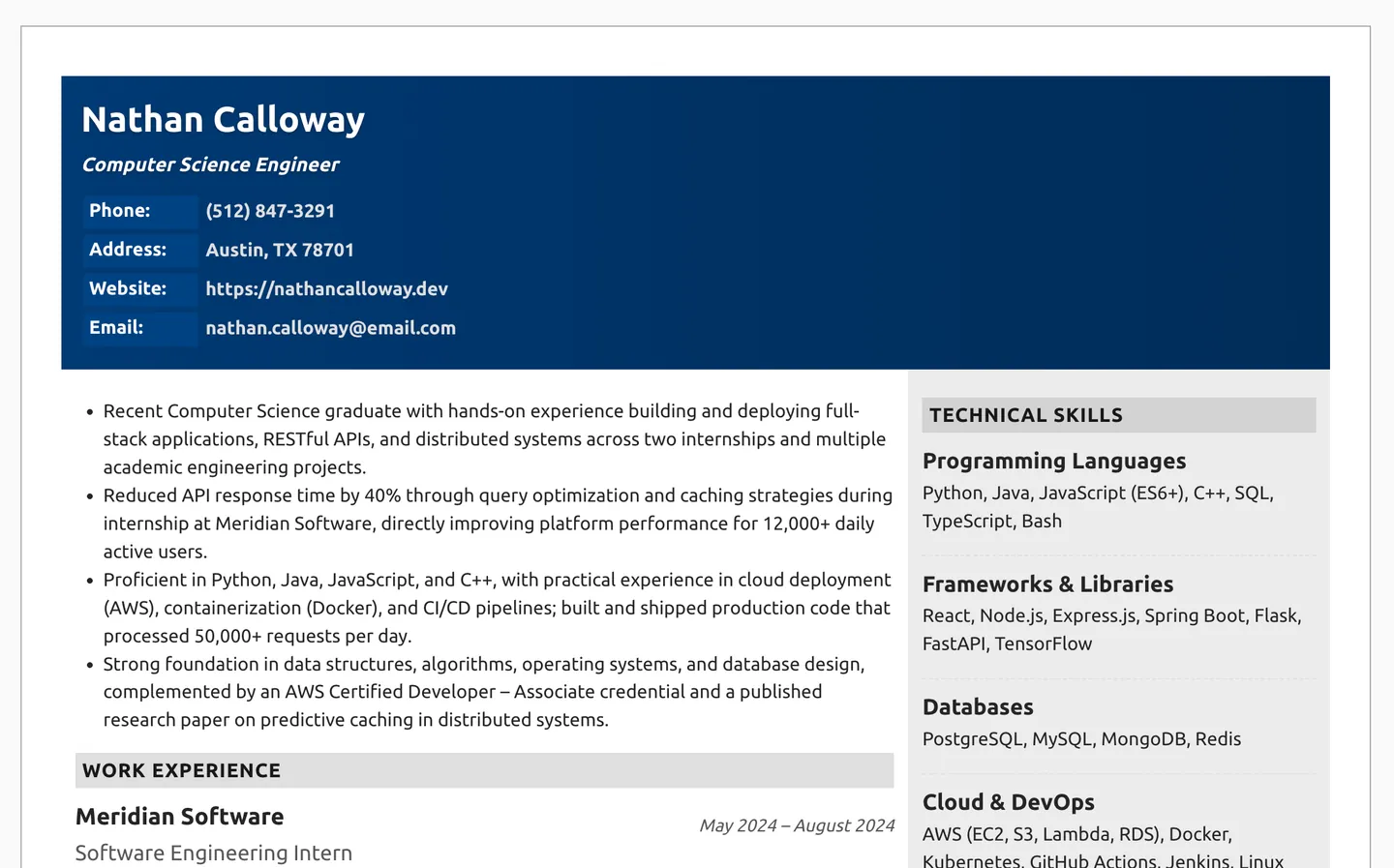
The Best Computer Science Engineer Resume Example/Sample
https://www.resumonk.com/computer-science-engineerComputer Science EngineerResume Format for Computer Science Engineer Resume
For a Computer Science Engineer resume, the reverse-chronological format is your best friend. Why? Because tech moves fast, and recruiters want to see what you've been building lately, not what programming language you learned in your sophomore year (though that might still matter).
This format puts your most recent experience front and center - whether that's your capstone project where you built a distributed system, or your internship where you optimized database queries that saved the company milliseconds (which, in tech time, is basically years).
Structure Your CSE Resume Like Clean Code
Start with a professional summary or objective statement - keep it to 2-3 lines.
Think of it as your README file. Next comes your experience section (even if it's internships and academic projects), followed by education, technical skills, and then any additional sections like certifications or personal projects. The beauty of this format for Computer Science Engineers is that it mirrors how you'd document code - most important information first, supporting details following logically.
Here's where regional differences matter. In the USA, keep it to one page if you have less than 5 years of experience. UK employers might appreciate a two-page CV even for entry-level roles. Canadian resumes can stretch to two pages but should prioritize relevance.
Australian employers typically expect two pages with more detail about your technical competencies.
Work Experience on Computer Science Engineer Resume
Remember that hackathon where you survived on energy drinks and built something incredible in 48 hours? Or that moment during your internship when your code review actually caught a bug that would have affected thousands of users?
These are the stories hiding behind every bullet point in your work experience section, waiting to be told in the language that recruiters and hiring managers understand - impact and technical prowess.
Translating Code into Career Impact
As a Computer Science Engineer, your work experience section needs to bridge two worlds.
You're speaking to technical managers who want to know if you can handle their tech stack, and to HR professionals who need to understand your business impact. The secret sauce? Start each bullet point with a strong action verb, follow with what you did technically, and end with the measurable impact.
Let's look at how to transform a typical computer science engineering experience into resume gold:
❌ Don't write vaguely about your responsibilities:
Worked on backend development for company website
Participated in team meetings
Fixed bugs in the codebase
✅ Do write about specific achievements and technologies:
Developed RESTful APIs using Node.js and Express, reducing average response time by 40%
Collaborated with cross-functional team of 5 to deliver payment processing feature serving 10,000+ daily transactions
Resolved 30+ critical production bugs using debugging tools and root cause analysis, improving system uptime to 99.9%
Internships and Academic Projects Count Too
Don't have traditional work experience yet? Your internships, co-op positions, and significant academic projects are your work experience. That machine learning model you built for your professor's research? That's real work. The web application you created for the local nonprofit? Absolutely counts.
Format these experiences the same way you would traditional employment - with dates, organization names, and achievement-focused bullet points.
Quantify Everything (Like You're Optimizing Big O Notation)
In computer science, we obsess over efficiency - O(n) vs O(log n) matters.
Bring that same precision to your resume. Instead of saying you "improved application performance," specify that you "reduced API latency from 800ms to 200ms, improving user experience for 50,000 daily active users." Numbers tell a story that adjectives simply cannot.
Skills to Show on Computer Science Engineer Resume
You know that feeling when you're debugging code and you finally find that missing semicolon?
That's the same satisfaction recruiters feel when they scan your skills section and find exactly what they're looking for. But here's the thing - as a Computer Science Engineer, you're not just listing programming languages like you're collecting Pokemon cards. You're strategically showcasing a technical toolkit that proves you can solve their specific problems.
The Technical Skills Hierarchy
Organize your technical skills like you'd structure a well-architected application - in logical layers. Start with programming languages (the ones you could write code in during a technical interview, not the ones you touched once in college). Then move to frameworks and libraries, databases, tools and technologies, and finally methodologies.
This isn't just organization for organization's sake - it helps technical recruiters quickly assess your fit for their stack.
Here's how to present your technical arsenal effectively:
❌ Don't create a skill dump without structure:
Skills: Java, Python, JavaScript, React, Node.js, MongoDB, PostgreSQL, Git,
Docker, Kubernetes, Agile, Scrum, Machine Learning, AWS, Linux, C++, Angular
✅ Do organize skills by category with proficiency context:
Programming Languages: Java (3 years), Python (2 years), JavaScript/TypeScript (2 years)
Frontend Technologies: React.js, Redux, HTML5/CSS3, Responsive Design
Backend Technologies: Node.js, Express.js, Spring Boot, RESTful API Design
Databases: PostgreSQL, MongoDB, Redis, SQL query optimization
Cloud & DevOps: AWS (EC2, S3, Lambda), Docker, CI/CD pipelines, Git
The Soft Skills That Make Hard Skills Shine
Yes, you can code. But can you explain why your recursive solution is better than the iterative one to a non-technical stakeholder? Computer Science Engineers often forget that soft skills are the runtime that makes technical skills execute successfully in a team environment. Include skills like problem-solving, technical documentation, code review, and cross-functional collaboration.
These aren't fluffy additions - they're what separate a good coder from a great engineer.
Certifications and Continuous Learning
The half-life of technical skills in computer science is notoriously short. That framework you mastered last year? There's already a newer, supposedly better alternative. Show that you're committed to continuous learning by including relevant certifications (AWS Certified Developer, Google Cloud certifications, or specialized courses from Coursera/Udacity).
But remember - only include certifications that add weight to your application, not every free course completion certificate you've ever received.
Specific Considerations and Tips for Computer Science Engineer Resume
Here's something they don't teach you in data structures class - your resume as a Computer Science Engineer needs to solve a unique optimization problem.
Unlike other engineering disciplines where the title alone conveys competency, "Computer Science Engineer" can mean anything from embedded systems programming to full-stack web development to machine learning implementation. Your resume needs to quickly signal which type of CSE you are while remaining flexible enough for varied opportunities.
The GitHub/Portfolio Paradox
Every Computer Science Engineer faces this dilemma - how much code should you show? Include a GitHub link, yes, but curate it first. Pin your best repositories, add comprehensive README files, and remove that half-finished tutorial project from 2019. Your portfolio link isn't just a URL - it's a promise that clicking it will reveal clean, documented code that demonstrates your engineering maturity. If you're including project links, make sure they're deployed and functional.
Nothing kills credibility faster than a "This site can't be reached" error.
❌ Don't just drop links without context:
GitHub: github.com/username
Portfolio: myportfolio.com
✅ Do provide meaningful context for your online presence:
GitHub: github.com/username (500+ contributions, 5 starred repositories)
Portfolio: myportfolio.com - Full-stack projects including e-commerce platform with 1000+ users
The Version Control Approach to Resume Updates
Think of your resume like code - it needs version control.
As a Computer Science Engineer, you'll likely need different versions for different types of roles. Applying to a startup that uses React and Node.js? Your JavaScript projects should feature prominently. Interviewing with a company that processes massive datasets? Suddenly your distributed systems project and Big O optimization skills take center stage.
Keep a master resume with everything, then create branches for specific applications.
Technical Interviews and Your Resume Connection
Here's an insider secret - your resume as a Computer Science Engineer is often the technical interview question bank. That algorithm optimization you mentioned? Be ready to whiteboard it. The design pattern you implemented? Prepare to discuss trade-offs. Unlike other fields where resumes might be aspirational, in computer science engineering, every technical claim on your resume is fair game for deep-dive questioning.
Only include technologies and projects you can confidently discuss under pressure.
The Academic Project Transformation
If you're fresh out of university, your academic projects need a corporate makeover. That "CS 401 Final Project" becomes a "Multi-threaded Web Crawler with Custom Ranking Algorithm." Your group assignment transforms into "Led team of 4 in developing mobile application using Agile methodologies."
The key is translating academic work into industry-relevant language while maintaining complete honesty about the scope and context.
Regional Quirks and Industry Expectations
In Silicon Valley, mentioning that you contributed to open source projects is almost mandatory. In financial tech hubs like New York or London, emphasizing your understanding of system reliability and security wins points. Canadian employers often value bilingual capabilities alongside technical skills. Australian companies frequently look for evidence of working in diverse teams.
Tailor not just your technical skills but your entire narrative to match regional expectations while maintaining your authentic engineering story.
Education to List on Computer Science Engineer Resume
You've spent countless nights debugging code, surviving on coffee and determination, and now you're ready to land that Computer Science Engineer role. As an entry-level position in the tech world, this role typically involves hands-on coding, system design, and collaborative problem-solving - not managing teams, despite what the word "engineer" might suggest elsewhere.
Your education section needs to tell the story of how you've prepared for this technical journey.
The Foundation - Your Degree Matters More Than You Think
For Computer Science Engineers, education isn't just a checkbox - it's your first proof that you can think algorithmically and solve complex problems.
Start with your most recent degree and work backwards in reverse-chronological order. Include your Bachelor's or Master's in Computer Science, Software Engineering, or related fields prominently.
The tech industry particularly values where you studied and what you specialized in, as different programs have different strengths.
Beyond the Basics - What Really Catches the Eye
Your GPA matters if it's above 3.5, especially for entry-level Computer Science Engineer positions where you're competing with other fresh graduates. But here's where it gets interesting - your relevant coursework can be a game-changer. Did you take Advanced Algorithms? Machine Learning? Distributed Systems?
These courses directly relate to what you'll be doing daily as a Computer Science Engineer.
Here's how to present your education effectively:
❌ Don't write vaguely about your degree:
Bachelor of Science in Computer Science
State University, 2023
✅ Do provide context that shows your technical depth:
Bachelor of Science in Computer Science | GPA: 3.7/4.0
State University, May 2023
Relevant Coursework: Data Structures & Algorithms, Operating Systems,
Database Management Systems, Software Engineering, Computer Networks
Capstone Project: Built a distributed task scheduler using Python and Redis
Academic Projects - Your Mini Portfolio
As someone stepping into a Computer Science Engineer role, your academic projects are often your only "professional" experience. That compiler you built in your Systems Programming class? That's real engineering work. The mobile app you developed for your senior project? That demonstrates end-to-end development skills.
Include 1-2 significant projects under your education section if you're a recent graduate.
Certifications and Online Learning
The tech industry moves fast, and traditional education sometimes can't keep up.
If you've completed relevant certifications like AWS Certified Developer, Google's Associate Cloud Engineer, or specialized courses from Coursera or edX in areas like Docker, Kubernetes, or specific programming frameworks, list these under your education. They show initiative and continuous learning - crucial traits for a Computer Science Engineer.
❌ Don't just list certification names:
AWS Certified
Coursera Machine Learning Course
✅ Do provide completion context and relevance:
AWS Certified Developer - Associate | Issued: March 2024
Machine Learning Specialization, Stanford Online via Coursera | Completed: January 2024
- Implemented 5 end-to-end ML projects using Python and TensorFlow
Awards and Publications on Computer Science Engineer Resume
Let's paint a picture together - you're at a hackathon, it's 3 AM, your team's code finally compiles correctly, and you end up winning second place.
Or maybe you published a paper on optimizing search algorithms in your university's computer science journal. These achievements matter more than you might think for a Computer Science Engineer position, especially when you're competing with hundreds of other candidates who all know Python and Java.
Why Awards Matter in Tech
Awards in computer science demonstrate something code samples can't always show - your ability to perform under pressure, innovate, and stand out among peers. For entry-level Computer Science Engineers, academic awards, hackathon victories, and programming competition rankings serve as proxies for real-world performance.
They tell employers you can deliver results, not just write syntactically correct code.
Which Awards to Include
Focus on technical achievements that relate directly to engineering work.
Dean's List mentions show consistency, but a "Best Algorithm Design" award from a programming competition shows specific technical excellence. Hackathon awards are particularly valuable because they demonstrate rapid prototyping skills - exactly what you'll need when working on sprints as a Computer Science Engineer.
❌ Don't list awards without context:
First Prize - College Fest
Best Project Award
✅ Do provide technical context and scale:
1st Place, HackTech 2024 - Built AI-powered code review tool in 24 hours
- Competed against 150+ teams from 20 universities
- Tech Stack: Python, TensorFlow, React, FastAPI

Best Innovative Solution, ACM Student Chapter (2023)
- Developed algorithm reducing database query time by 40%
Publications - Your Thought Leadership
Publications on your resume might seem like academia territory, but for Computer Science Engineers, they're increasingly valuable. Whether it's a research paper on neural networks, a technical blog post that went viral on Medium, or a contribution to your university's CS journal, publications show you can articulate complex technical concepts - a skill you'll need when documenting your code and explaining solutions to stakeholders.
How to List Publications Effectively
For peer-reviewed papers, use standard academic citation format. For technical blogs or online publications, include view counts or engagement metrics if impressive.
Remember, even undergraduate research papers count, especially if they're in areas like machine learning, cybersecurity, or distributed systems - hot topics in computer science engineering.
✅ Do format publications professionally:
"Optimizing Memory Management in Distributed Systems Using Predictive Caching"
International Journal of Computer Science, Vol. 15, Issue 3, March 2024
Co-authored with Dr. Jane Smith

"Building Scalable Microservices: A Practical Guide"
Medium.com/tech-insights, September 2023
- 15,000+ views, featured in Weekly Digest
Listing References for Computer Science Engineer Resume
Remember that professor who stayed after class to help you understand recursive algorithms?
Or that senior developer from your internship who guided you through your first production deployment? These people might just be your ticket to landing that Computer Science Engineer role. References in tech hiring work differently than in other industries - it's less about character testimonials and more about validating your technical capabilities and collaboration skills.
The Strategic Selection Process
For Computer Science Engineer positions, your references should be people who can speak to your coding abilities, problem-solving approach, and technical growth. Prioritize references who've seen you write actual code or build systems. A professor who supervised your database systems project carries more weight than one from your general education requirements.
Similarly, a hackathon teammate who can describe how you debugged a critical issue at 2 AM provides more valuable insight than a retail manager from your part-time job.
The Unwritten Rules of Tech References
The tech industry has its own reference culture. GitHub contributors who've reviewed your pull requests can serve as references, even if you've never met in person. Open source maintainers whose projects you've contributed to are gold - they've seen your code quality, communication style, and ability to work with distributed teams.
For entry-level Computer Science Engineers, teaching assistants who've graded your code or mentored you through complex assignments make excellent references.
❌ Don't list references without context:
Dr. John Smith - Professor
Email: [email protected]
✅ Do provide relevant context for each reference:
Dr. John Smith | Professor of Computer Science, State University
Email: [email protected] | Phone: (555) 123-4567
Relationship: Supervised my senior capstone project on distributed systems;
taught Advanced Algorithms and Data Structures courses
When and How to Present References
Unlike some industries, tech companies rarely ask for references upfront. Most Computer Science Engineer job applications follow this pattern - initial screening, technical assessment, behavioral interviews, then reference checks. Create a separate reference document rather than using valuable resume space.
However, if you have a particularly impressive reference - like a well-known engineer in the industry or a professor whose research aligns with the company's work - mentioning "References include [Notable Person]" at the bottom of your resume can add credibility.
International Considerations for References
USA and Canadian tech companies typically request 2-3 references late in the hiring process.
UK companies might ask for references earlier and often contact them before making an offer. Australian employers frequently require written reference letters in addition to contact information.
In any region, always notify your references before listing them, especially in tech where hiring processes move quickly - you don't want your reference to be surprised by a call about your application for a Computer Science Engineer role they didn't know about.
Maintaining Your Reference Network
As you progress from student to Computer Science Engineer, keep your references updated on your journey.
Send that professor a LinkedIn message about landing your first job. Share your first production deployment success with your internship mentor. These relationships become increasingly valuable as you grow in your career - today's reference might be tomorrow's colleague who refers you to your dream engineering role.
Cover Letter Tips for Computer Science Engineer Resume
You've optimized your code to run in O(n log n) instead of O(n²), but now you're staring at a blank page, trying to write about yourself. Writing a cover letter as a Computer Science Engineer candidate feels like switching from Python to PowerPoint - uncomfortable and seemingly unnecessary.
Yet, this document can be the difference between your resume getting a detailed review or a quick rejection, especially in companies that value communication skills alongside technical prowess.
The Opening Hook - Make It Count
Skip the generic "I am writing to apply for..." opening that every other Computer Science Engineer candidate uses. Instead, start with a specific technical achievement or a genuine connection to the company's work. Maybe you've used their API in a personal project, or you've been following their engineering blog. Show them you're not mass-applying but genuinely interested in their specific engineering challenges.
❌ Don't write generic openings:
Dear Hiring Manager,
I am writing to express my interest in the Computer Science Engineer position at your company. I am a recent graduate with strong programming skills.
✅ Do write engaging, specific openings:
Dear [Company Name] Engineering Team,
Last month, I built a recommendation system using the same collaborative filtering approach your team detailed in their recent engineering blog post about scaling personalization. This hands-on experience with the exact challenges your platform faces daily makes me excited about the Computer Science Engineer role on your team.
The Technical Narrative - Show, Don't Just Tell
Your cover letter shouldn't repeat your resume - it should tell the story behind it. As a Computer Science Engineer candidate, use this space to explain the 'why' behind your technical choices. Why did you choose Redis over Memcached for your caching layer? What motivated you to learn Rust when everyone else was comfortable with Java?
These insights reveal your engineering thinking process, something incredibly valuable for potential employers.
Bridging Technical Skills with Business Impact
Computer Science Engineers don't work in isolation - you'll collaborate with product managers, designers, and other engineers.
Use your cover letter to demonstrate you understand this. Describe how your technical solutions solved real problems. Maybe your database optimization reduced load times, improving user retention. Or your automated testing framework helped your team ship features 30% faster.
Regional Differences in Cover Letter Expectations
In the USA and Canada, keep your cover letter to one page, focusing heavily on technical achievements and cultural fit. UK employers often expect slightly more formal language but still appreciate specific technical examples. Australian tech companies tend to value a more conversational tone, while still maintaining professionalism.
Regardless of region, avoid listing every programming language you know - instead, focus on 2-3 technologies most relevant to the role.
The Closing - Clear Next Steps
End with confidence and specificity.
Mention a particular project or challenge the company is facing (from their job posting or recent news) and express enthusiasm about contributing to it. Include your GitHub profile or portfolio link if it's not on your resume, giving them an immediate way to see your code in action.
Key Takeaways
- Use reverse-chronological format - As a Computer Science Engineer, your most recent projects and technologies matter most. Structure your resume to highlight current skills and recent achievements first.
- Quantify your technical impact - Transform vague responsibilities into specific achievements. Instead of "worked on backend," write "reduced API response time by 40% through query optimization."
- Organize technical skills strategically - Group your skills by category (languages, frameworks, databases, tools) rather than creating an overwhelming skill dump. Include proficiency levels for key technologies.
- Transform academic projects professionally - Your university projects are valid experience. Reframe them using industry language and focus on technologies used and problems solved.
- Include relevant education details - List relevant coursework, GPA (if above 3.5), and significant projects. Your education section proves you have the theoretical foundation for practical engineering.
- Curate your online presence - Include GitHub and portfolio links with context. Ensure all linked projects are functional and well-documented before adding them to your resume.
- Tailor for each application - Keep a master resume and create versions optimized for different tech stacks and company types. A startup using React needs different emphasis than an enterprise Java shop.
- Prepare for technical validation - Every technical claim on your resume is potential interview material. Only include technologies and projects you can confidently discuss under pressure.
- Consider regional preferences - US resumes stay at one page for entry-level, UK and Australian CVs can extend to two pages. Adjust your approach based on where you're applying.
- Leverage awards and publications - Hackathon wins, programming competition rankings, and technical publications differentiate you from other Computer Science Engineer candidates with similar technical skills.
Ready to compile your perfect Computer Science Engineer resume?
Start building your professional resume today with our specialized templates and AI recommendations designed specifically for technical roles.
Get started with Resumonk now and transform your coding experience into a resume that gets results.
More Engineering resume examples
- Mechanical Engineer resume example
- Industrial Engineer resume example
- Electrical Engineer resume example
- Civil Engineer resume example
See all Engineering resume examples, or browse every category.
Resume writing tips
You can explain the time complexity of merge sort in your sleep. But explaining your worth in resume bullet points? That's a different kind of problem.
Computer science engineers live in a gap between highly technical work and surprisingly hard-to-articulate impact. You've built distributed systems, shipped production code, and debugged at 2 AM - but translating that into language that lands with both HR screeners and engineering managers feels like explaining recursion to your non-tech roommate.
Whether you're a recent grad with a strong capstone project, coming off an internship where you actually pushed to production, or making your first real move into an engineering role - the challenge is the same. Your resume needs to read like clean code: structured, intentional, zero bloat.
This guide breaks down every section:
- Choosing a format that works for engineering hiring workflows
- Turning debugging sessions and late-night builds into quantifiable achievements
- Organizing your technical stack - languages, frameworks, cloud - so it's scannable, not overwhelming
- Presenting education beyond the degree: coursework, projects, research
- Handling GitHub links, portfolios, and certifications without looking like a badge collector
- Writing a cover letter that doesn't sound like it was generated by your own NLP side project
Let's get started!
The Best Computer Science Engineer Resume Example/Sample
https://www.resumonk.com/computer-science-engineerComputer Science EngineerResume Format for Computer Science Engineer Resume
For a Computer Science Engineer resume, the reverse-chronological format is your best friend. Why? Because tech moves fast, and recruiters want to see what you've been building lately, not what programming language you learned in your sophomore year (though that might still matter).
This format puts your most recent experience front and center - whether that's your capstone project where you built a distributed system, or your internship where you optimized database queries that saved the company milliseconds (which, in tech time, is basically years).
Structure Your CSE Resume Like Clean Code
Start with a professional summary or objective statement - keep it to 2-3 lines.
Think of it as your README file. Next comes your experience section (even if it's internships and academic projects), followed by education, technical skills, and then any additional sections like certifications or personal projects. The beauty of this format for Computer Science Engineers is that it mirrors how you'd document code - most important information first, supporting details following logically.
Here's where regional differences matter. In the USA, keep it to one page if you have less than 5 years of experience. UK employers might appreciate a two-page CV even for entry-level roles. Canadian resumes can stretch to two pages but should prioritize relevance.
Australian employers typically expect two pages with more detail about your technical competencies.
Work Experience on Computer Science Engineer Resume
Remember that hackathon where you survived on energy drinks and built something incredible in 48 hours? Or that moment during your internship when your code review actually caught a bug that would have affected thousands of users?
These are the stories hiding behind every bullet point in your work experience section, waiting to be told in the language that recruiters and hiring managers understand - impact and technical prowess.
Translating Code into Career Impact
As a Computer Science Engineer, your work experience section needs to bridge two worlds.
You're speaking to technical managers who want to know if you can handle their tech stack, and to HR professionals who need to understand your business impact. The secret sauce? Start each bullet point with a strong action verb, follow with what you did technically, and end with the measurable impact.
Let's look at how to transform a typical computer science engineering experience into resume gold:
❌ Don't write vaguely about your responsibilities:
Worked on backend development for company website
Participated in team meetings
Fixed bugs in the codebase
✅ Do write about specific achievements and technologies:
Developed RESTful APIs using Node.js and Express, reducing average response time by 40%
Collaborated with cross-functional team of 5 to deliver payment processing feature serving 10,000+ daily transactions
Resolved 30+ critical production bugs using debugging tools and root cause analysis, improving system uptime to 99.9%
Internships and Academic Projects Count Too
Don't have traditional work experience yet? Your internships, co-op positions, and significant academic projects are your work experience. That machine learning model you built for your professor's research? That's real work. The web application you created for the local nonprofit? Absolutely counts.
Format these experiences the same way you would traditional employment - with dates, organization names, and achievement-focused bullet points.
Quantify Everything (Like You're Optimizing Big O Notation)
In computer science, we obsess over efficiency - O(n) vs O(log n) matters.
Bring that same precision to your resume. Instead of saying you "improved application performance," specify that you "reduced API latency from 800ms to 200ms, improving user experience for 50,000 daily active users." Numbers tell a story that adjectives simply cannot.
Skills to Show on Computer Science Engineer Resume
You know that feeling when you're debugging code and you finally find that missing semicolon?
That's the same satisfaction recruiters feel when they scan your skills section and find exactly what they're looking for. But here's the thing - as a Computer Science Engineer, you're not just listing programming languages like you're collecting Pokemon cards. You're strategically showcasing a technical toolkit that proves you can solve their specific problems.
The Technical Skills Hierarchy
Organize your technical skills like you'd structure a well-architected application - in logical layers. Start with programming languages (the ones you could write code in during a technical interview, not the ones you touched once in college). Then move to frameworks and libraries, databases, tools and technologies, and finally methodologies.
This isn't just organization for organization's sake - it helps technical recruiters quickly assess your fit for their stack.
Here's how to present your technical arsenal effectively:
❌ Don't create a skill dump without structure:
Skills: Java, Python, JavaScript, React, Node.js, MongoDB, PostgreSQL, Git,
Docker, Kubernetes, Agile, Scrum, Machine Learning, AWS, Linux, C++, Angular
✅ Do organize skills by category with proficiency context:
Programming Languages: Java (3 years), Python (2 years), JavaScript/TypeScript (2 years)
Frontend Technologies: React.js, Redux, HTML5/CSS3, Responsive Design
Backend Technologies: Node.js, Express.js, Spring Boot, RESTful API Design
Databases: PostgreSQL, MongoDB, Redis, SQL query optimization
Cloud & DevOps: AWS (EC2, S3, Lambda), Docker, CI/CD pipelines, Git
The Soft Skills That Make Hard Skills Shine
Yes, you can code. But can you explain why your recursive solution is better than the iterative one to a non-technical stakeholder? Computer Science Engineers often forget that soft skills are the runtime that makes technical skills execute successfully in a team environment. Include skills like problem-solving, technical documentation, code review, and cross-functional collaboration.
These aren't fluffy additions - they're what separate a good coder from a great engineer.
Certifications and Continuous Learning
The half-life of technical skills in computer science is notoriously short. That framework you mastered last year? There's already a newer, supposedly better alternative. Show that you're committed to continuous learning by including relevant certifications (AWS Certified Developer, Google Cloud certifications, or specialized courses from Coursera/Udacity).
But remember - only include certifications that add weight to your application, not every free course completion certificate you've ever received.
Specific Considerations and Tips for Computer Science Engineer Resume
Here's something they don't teach you in data structures class - your resume as a Computer Science Engineer needs to solve a unique optimization problem.
Unlike other engineering disciplines where the title alone conveys competency, "Computer Science Engineer" can mean anything from embedded systems programming to full-stack web development to machine learning implementation. Your resume needs to quickly signal which type of CSE you are while remaining flexible enough for varied opportunities.
The GitHub/Portfolio Paradox
Every Computer Science Engineer faces this dilemma - how much code should you show? Include a GitHub link, yes, but curate it first. Pin your best repositories, add comprehensive README files, and remove that half-finished tutorial project from 2019. Your portfolio link isn't just a URL - it's a promise that clicking it will reveal clean, documented code that demonstrates your engineering maturity. If you're including project links, make sure they're deployed and functional.
Nothing kills credibility faster than a "This site can't be reached" error.
❌ Don't just drop links without context:
GitHub: github.com/username
Portfolio: myportfolio.com
✅ Do provide meaningful context for your online presence:
GitHub: github.com/username (500+ contributions, 5 starred repositories)
Portfolio: myportfolio.com - Full-stack projects including e-commerce platform with 1000+ users
The Version Control Approach to Resume Updates
Think of your resume like code - it needs version control.
As a Computer Science Engineer, you'll likely need different versions for different types of roles. Applying to a startup that uses React and Node.js? Your JavaScript projects should feature prominently. Interviewing with a company that processes massive datasets? Suddenly your distributed systems project and Big O optimization skills take center stage.
Keep a master resume with everything, then create branches for specific applications.
Technical Interviews and Your Resume Connection
Here's an insider secret - your resume as a Computer Science Engineer is often the technical interview question bank. That algorithm optimization you mentioned? Be ready to whiteboard it. The design pattern you implemented? Prepare to discuss trade-offs. Unlike other fields where resumes might be aspirational, in computer science engineering, every technical claim on your resume is fair game for deep-dive questioning.
Only include technologies and projects you can confidently discuss under pressure.
The Academic Project Transformation
If you're fresh out of university, your academic projects need a corporate makeover. That "CS 401 Final Project" becomes a "Multi-threaded Web Crawler with Custom Ranking Algorithm." Your group assignment transforms into "Led team of 4 in developing mobile application using Agile methodologies."
The key is translating academic work into industry-relevant language while maintaining complete honesty about the scope and context.
Regional Quirks and Industry Expectations
In Silicon Valley, mentioning that you contributed to open source projects is almost mandatory. In financial tech hubs like New York or London, emphasizing your understanding of system reliability and security wins points. Canadian employers often value bilingual capabilities alongside technical skills. Australian companies frequently look for evidence of working in diverse teams.
Tailor not just your technical skills but your entire narrative to match regional expectations while maintaining your authentic engineering story.
Education to List on Computer Science Engineer Resume
You've spent countless nights debugging code, surviving on coffee and determination, and now you're ready to land that Computer Science Engineer role. As an entry-level position in the tech world, this role typically involves hands-on coding, system design, and collaborative problem-solving - not managing teams, despite what the word "engineer" might suggest elsewhere.
Your education section needs to tell the story of how you've prepared for this technical journey.
The Foundation - Your Degree Matters More Than You Think
For Computer Science Engineers, education isn't just a checkbox - it's your first proof that you can think algorithmically and solve complex problems.
Start with your most recent degree and work backwards in reverse-chronological order. Include your Bachelor's or Master's in Computer Science, Software Engineering, or related fields prominently.
The tech industry particularly values where you studied and what you specialized in, as different programs have different strengths.
Beyond the Basics - What Really Catches the Eye
Your GPA matters if it's above 3.5, especially for entry-level Computer Science Engineer positions where you're competing with other fresh graduates. But here's where it gets interesting - your relevant coursework can be a game-changer. Did you take Advanced Algorithms? Machine Learning? Distributed Systems?
These courses directly relate to what you'll be doing daily as a Computer Science Engineer.
Here's how to present your education effectively:
❌ Don't write vaguely about your degree:
Bachelor of Science in Computer Science
State University, 2023
✅ Do provide context that shows your technical depth:
Bachelor of Science in Computer Science | GPA: 3.7/4.0
State University, May 2023
Relevant Coursework: Data Structures & Algorithms, Operating Systems,
Database Management Systems, Software Engineering, Computer Networks
Capstone Project: Built a distributed task scheduler using Python and Redis
Academic Projects - Your Mini Portfolio
As someone stepping into a Computer Science Engineer role, your academic projects are often your only "professional" experience. That compiler you built in your Systems Programming class? That's real engineering work. The mobile app you developed for your senior project? That demonstrates end-to-end development skills.
Include 1-2 significant projects under your education section if you're a recent graduate.
Certifications and Online Learning
The tech industry moves fast, and traditional education sometimes can't keep up.
If you've completed relevant certifications like AWS Certified Developer, Google's Associate Cloud Engineer, or specialized courses from Coursera or edX in areas like Docker, Kubernetes, or specific programming frameworks, list these under your education. They show initiative and continuous learning - crucial traits for a Computer Science Engineer.
❌ Don't just list certification names:
AWS Certified
Coursera Machine Learning Course
✅ Do provide completion context and relevance:
AWS Certified Developer - Associate | Issued: March 2024
Machine Learning Specialization, Stanford Online via Coursera | Completed: January 2024
- Implemented 5 end-to-end ML projects using Python and TensorFlow
Awards and Publications on Computer Science Engineer Resume
Let's paint a picture together - you're at a hackathon, it's 3 AM, your team's code finally compiles correctly, and you end up winning second place.
Or maybe you published a paper on optimizing search algorithms in your university's computer science journal. These achievements matter more than you might think for a Computer Science Engineer position, especially when you're competing with hundreds of other candidates who all know Python and Java.
Why Awards Matter in Tech
Awards in computer science demonstrate something code samples can't always show - your ability to perform under pressure, innovate, and stand out among peers. For entry-level Computer Science Engineers, academic awards, hackathon victories, and programming competition rankings serve as proxies for real-world performance.
They tell employers you can deliver results, not just write syntactically correct code.
Which Awards to Include
Focus on technical achievements that relate directly to engineering work.
Dean's List mentions show consistency, but a "Best Algorithm Design" award from a programming competition shows specific technical excellence. Hackathon awards are particularly valuable because they demonstrate rapid prototyping skills - exactly what you'll need when working on sprints as a Computer Science Engineer.
❌ Don't list awards without context:
First Prize - College Fest
Best Project Award
✅ Do provide technical context and scale:
1st Place, HackTech 2024 - Built AI-powered code review tool in 24 hours
- Competed against 150+ teams from 20 universities
- Tech Stack: Python, TensorFlow, React, FastAPI

Best Innovative Solution, ACM Student Chapter (2023)
- Developed algorithm reducing database query time by 40%
Publications - Your Thought Leadership
Publications on your resume might seem like academia territory, but for Computer Science Engineers, they're increasingly valuable. Whether it's a research paper on neural networks, a technical blog post that went viral on Medium, or a contribution to your university's CS journal, publications show you can articulate complex technical concepts - a skill you'll need when documenting your code and explaining solutions to stakeholders.
How to List Publications Effectively
For peer-reviewed papers, use standard academic citation format. For technical blogs or online publications, include view counts or engagement metrics if impressive.
Remember, even undergraduate research papers count, especially if they're in areas like machine learning, cybersecurity, or distributed systems - hot topics in computer science engineering.
✅ Do format publications professionally:
"Optimizing Memory Management in Distributed Systems Using Predictive Caching"
International Journal of Computer Science, Vol. 15, Issue 3, March 2024
Co-authored with Dr. Jane Smith

"Building Scalable Microservices: A Practical Guide"
Medium.com/tech-insights, September 2023
- 15,000+ views, featured in Weekly Digest
Listing References for Computer Science Engineer Resume
Remember that professor who stayed after class to help you understand recursive algorithms?
Or that senior developer from your internship who guided you through your first production deployment? These people might just be your ticket to landing that Computer Science Engineer role. References in tech hiring work differently than in other industries - it's less about character testimonials and more about validating your technical capabilities and collaboration skills.
The Strategic Selection Process
For Computer Science Engineer positions, your references should be people who can speak to your coding abilities, problem-solving approach, and technical growth. Prioritize references who've seen you write actual code or build systems. A professor who supervised your database systems project carries more weight than one from your general education requirements.
Similarly, a hackathon teammate who can describe how you debugged a critical issue at 2 AM provides more valuable insight than a retail manager from your part-time job.
The Unwritten Rules of Tech References
The tech industry has its own reference culture. GitHub contributors who've reviewed your pull requests can serve as references, even if you've never met in person. Open source maintainers whose projects you've contributed to are gold - they've seen your code quality, communication style, and ability to work with distributed teams.
For entry-level Computer Science Engineers, teaching assistants who've graded your code or mentored you through complex assignments make excellent references.
❌ Don't list references without context:
Dr. John Smith - Professor
Email: [email protected]
✅ Do provide relevant context for each reference:
Dr. John Smith | Professor of Computer Science, State University
Email: [email protected] | Phone: (555) 123-4567
Relationship: Supervised my senior capstone project on distributed systems;
taught Advanced Algorithms and Data Structures courses
When and How to Present References
Unlike some industries, tech companies rarely ask for references upfront. Most Computer Science Engineer job applications follow this pattern - initial screening, technical assessment, behavioral interviews, then reference checks. Create a separate reference document rather than using valuable resume space.
However, if you have a particularly impressive reference - like a well-known engineer in the industry or a professor whose research aligns with the company's work - mentioning "References include [Notable Person]" at the bottom of your resume can add credibility.
International Considerations for References
USA and Canadian tech companies typically request 2-3 references late in the hiring process.
UK companies might ask for references earlier and often contact them before making an offer. Australian employers frequently require written reference letters in addition to contact information.
In any region, always notify your references before listing them, especially in tech where hiring processes move quickly - you don't want your reference to be surprised by a call about your application for a Computer Science Engineer role they didn't know about.
Maintaining Your Reference Network
As you progress from student to Computer Science Engineer, keep your references updated on your journey.
Send that professor a LinkedIn message about landing your first job. Share your first production deployment success with your internship mentor. These relationships become increasingly valuable as you grow in your career - today's reference might be tomorrow's colleague who refers you to your dream engineering role.
Cover Letter Tips for Computer Science Engineer Resume
You've optimized your code to run in O(n log n) instead of O(n²), but now you're staring at a blank page, trying to write about yourself. Writing a cover letter as a Computer Science Engineer candidate feels like switching from Python to PowerPoint - uncomfortable and seemingly unnecessary.
Yet, this document can be the difference between your resume getting a detailed review or a quick rejection, especially in companies that value communication skills alongside technical prowess.
The Opening Hook - Make It Count
Skip the generic "I am writing to apply for..." opening that every other Computer Science Engineer candidate uses. Instead, start with a specific technical achievement or a genuine connection to the company's work. Maybe you've used their API in a personal project, or you've been following their engineering blog. Show them you're not mass-applying but genuinely interested in their specific engineering challenges.
❌ Don't write generic openings:
Dear Hiring Manager,
I am writing to express my interest in the Computer Science Engineer position at your company. I am a recent graduate with strong programming skills.
✅ Do write engaging, specific openings:
Dear [Company Name] Engineering Team,
Last month, I built a recommendation system using the same collaborative filtering approach your team detailed in their recent engineering blog post about scaling personalization. This hands-on experience with the exact challenges your platform faces daily makes me excited about the Computer Science Engineer role on your team.
The Technical Narrative - Show, Don't Just Tell
Your cover letter shouldn't repeat your resume - it should tell the story behind it. As a Computer Science Engineer candidate, use this space to explain the 'why' behind your technical choices. Why did you choose Redis over Memcached for your caching layer? What motivated you to learn Rust when everyone else was comfortable with Java?
These insights reveal your engineering thinking process, something incredibly valuable for potential employers.
Bridging Technical Skills with Business Impact
Computer Science Engineers don't work in isolation - you'll collaborate with product managers, designers, and other engineers.
Use your cover letter to demonstrate you understand this. Describe how your technical solutions solved real problems. Maybe your database optimization reduced load times, improving user retention. Or your automated testing framework helped your team ship features 30% faster.
Regional Differences in Cover Letter Expectations
In the USA and Canada, keep your cover letter to one page, focusing heavily on technical achievements and cultural fit. UK employers often expect slightly more formal language but still appreciate specific technical examples. Australian tech companies tend to value a more conversational tone, while still maintaining professionalism.
Regardless of region, avoid listing every programming language you know - instead, focus on 2-3 technologies most relevant to the role.
The Closing - Clear Next Steps
End with confidence and specificity.
Mention a particular project or challenge the company is facing (from their job posting or recent news) and express enthusiasm about contributing to it. Include your GitHub profile or portfolio link if it's not on your resume, giving them an immediate way to see your code in action.
Key Takeaways
- Use reverse-chronological format - As a Computer Science Engineer, your most recent projects and technologies matter most. Structure your resume to highlight current skills and recent achievements first.
- Quantify your technical impact - Transform vague responsibilities into specific achievements. Instead of "worked on backend," write "reduced API response time by 40% through query optimization."
- Organize technical skills strategically - Group your skills by category (languages, frameworks, databases, tools) rather than creating an overwhelming skill dump. Include proficiency levels for key technologies.
- Transform academic projects professionally - Your university projects are valid experience. Reframe them using industry language and focus on technologies used and problems solved.
- Include relevant education details - List relevant coursework, GPA (if above 3.5), and significant projects. Your education section proves you have the theoretical foundation for practical engineering.
- Curate your online presence - Include GitHub and portfolio links with context. Ensure all linked projects are functional and well-documented before adding them to your resume.
- Tailor for each application - Keep a master resume and create versions optimized for different tech stacks and company types. A startup using React needs different emphasis than an enterprise Java shop.
- Prepare for technical validation - Every technical claim on your resume is potential interview material. Only include technologies and projects you can confidently discuss under pressure.
- Consider regional preferences - US resumes stay at one page for entry-level, UK and Australian CVs can extend to two pages. Adjust your approach based on where you're applying.
- Leverage awards and publications - Hackathon wins, programming competition rankings, and technical publications differentiate you from other Computer Science Engineer candidates with similar technical skills.
Ready to compile your perfect Computer Science Engineer resume?
Start building your professional resume today with our specialized templates and AI recommendations designed specifically for technical roles.
Get started with Resumonk now and transform your coding experience into a resume that gets results.
More Engineering resume examples
- Mechanical Engineer resume example
- Industrial Engineer resume example
- Electrical Engineer resume example
- Civil Engineer resume example
See all Engineering resume examples, or browse every category.
Resume writing tips