Community Manager Resume Example (with Tips and Best Practices)
Introduction
Let us set the scene - you're scrolling through your laptop at 2 AM, tweaking your resume for the hundredth time, wondering if that Discord server you moderated counts as "community management experience."
You've been the person who naturally becomes the group admin, the one who mediates when discussions get heated, the social butterfly who somehow remembers everyone's birthday in your 500-person Slack workspace. Now you're ready to turn that natural talent into your career as a Community Manager, but staring at that blank resume template feels like facing an empty forum with zero engagement.
Here's what most people don't realize about Community Manager roles - they're not just about being "good with people" or "spending time on social media." Modern Community Managers are strategic architects of digital spaces, crisis communication experts, data analysts, content creators, and brand advocates all rolled into one. Whether you're coming from customer service, marketing, teaching, or even transitioning from being a passionate community member yourself, this guide will help you translate your experience into a resume that speaks the language hiring managers understand.
We're about to walk through everything it takes to craft the perfect Community Manager resume. We'll start with choosing the right resume format that showcases your most recent community wins, then dive deep into writing work experience that transforms "posted on social media" into strategic achievements with measurable impact. You'll learn which skills actually matter (spoiler - it's not just "good communication"), how to position your education regardless of your background, and why those community awards and published articles deserve prime resume real estate.
But we won't stop at the basics. We'll explore the unique considerations for Community Manager resumes - like why portfolio links are non-negotiable, how to address remote work capabilities, and why industry context can make or break your application. We'll even cover how to write a cover letter that doesn't sound like every other "I'm passionate about community" introduction and how to leverage your network of community connections as powerful references. By the end of this guide, you'll have a resume that doesn't just list your experience - it tells the story of a community builder ready to nurture their next digital ecosystem.
The Best Community Manager Resume Example/Sample
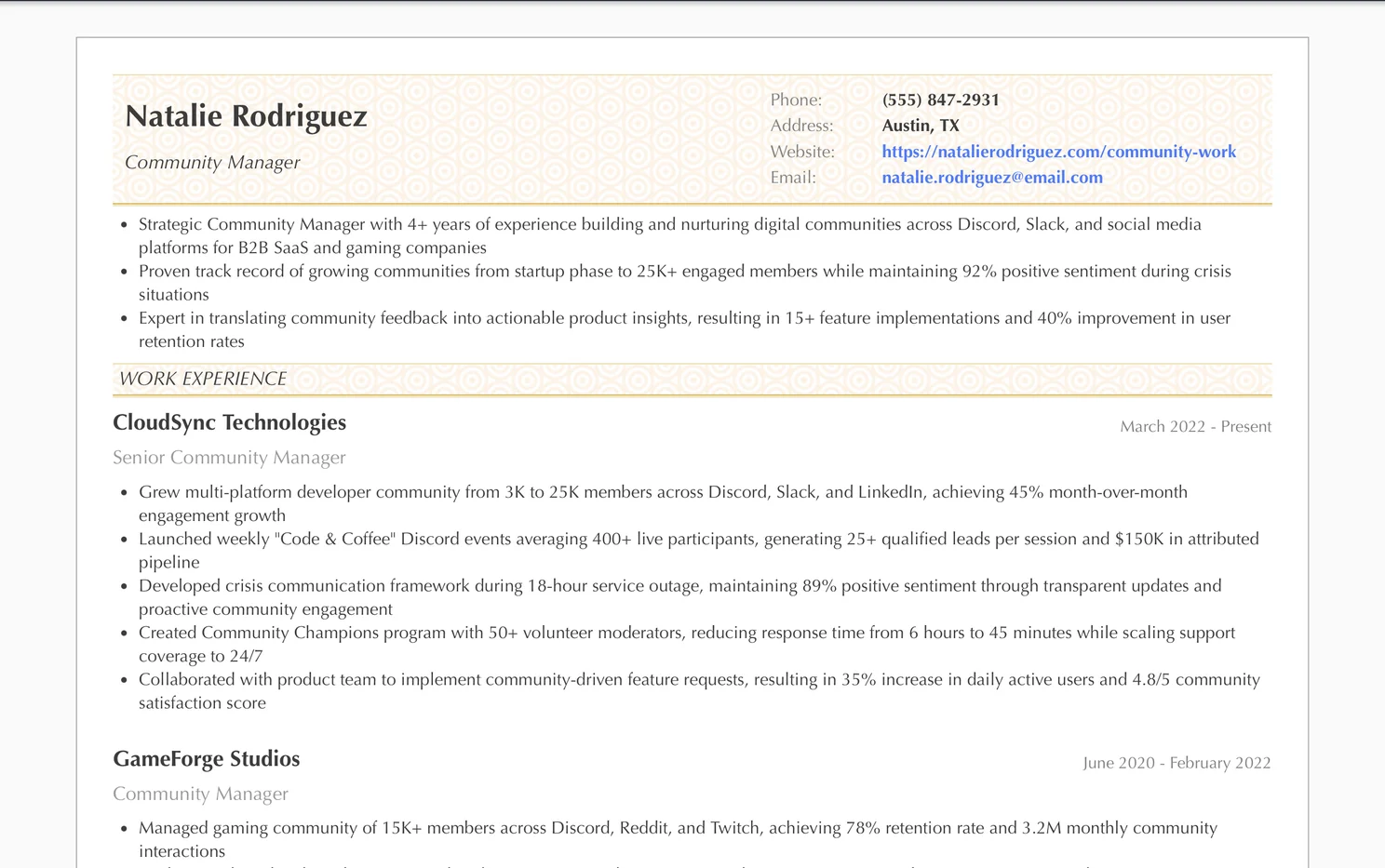
https://www.resumonk.com/community-manager-resumeCommunity ManagerResume Format for Community Manager Resume
For a Community Manager role, the reverse-chronological resume format is your best friend. Why? Because hiring managers want to see your most recent community-building victories first - that viral campaign you orchestrated last month matters more than the Facebook group you managed three years ago.
The digital landscape changes faster than fashion trends, and your recent experience with TikTok communities might be more relevant than your MySpace moderation days (yes, we're aging ourselves here).
Structure Your Community Manager Resume Like a Well-Moderated Forum
Start with a compelling professional summary that captures your community-building essence in 2-3 lines.
Think of it as your bio on a social platform - punchy, engaging, and immediately telling people why they should care. Follow this with your work experience section, where each role tells a story of communities nurtured, engagement metrics improved, and digital fires extinguished with grace.
Your education section can be brief unless you have relevant certifications in social media management, digital marketing, or communications. Remember, community management is one of those beautiful fields where your GitHub contributions or Reddit karma might matter more than your GPA.
The One-Page vs. Two-Page Debate
If you're entry-level to mid-level (under 7 years of community management experience), stick to one page.
You're applying for a role that values concise, engaging communication - show that skill in your resume itself. Senior Community Managers with extensive platform experience across multiple industries can extend to two pages, but only if every line earns its real estate.
For those applying in the UK or Australia, note that CVs can traditionally be longer, but for Community Manager roles at tech companies or startups, the one-page rule often still applies. Canadian employers tend to prefer the American format, while European companies might expect a photo - though this is becoming less common in community-focused roles.
Work Experience on Community Manager Resume
Here's where you transform from "person who posts stuff online" to "strategic community architect." Your work experience section needs to tell the story of communities you've built, crises you've navigated, and the tangible impact you've made on business metrics.
Because let's face it - your future employer doesn't just want someone who can schedule posts; they want someone who can turn lurkers into advocates and angry customers into brand ambassadors.
Quantify Your Community Impact
Numbers speak louder than buzzwords in the community management world. Did you grow a Discord server from 50 to 5,000 members? Did your engagement strategy increase daily active users by 300%?
These metrics matter because they show you understand that community management isn't just about being friendly online - it's about driving measurable business outcomes.
❌ Don't write vague descriptions:
• Managed social media accounts
• Responded to customer inquiries
• Posted content regularly
✅ Do write specific, impactful achievements:
• Grew Instagram community from 2K to 45K followers in 8 months through user-generated content campaigns and micro-influencer partnerships
• Reduced average response time from 24 hours to 2 hours, improving customer satisfaction scores by 35%
• Launched weekly Twitter Spaces that averaged 500+ live listeners, generating 15+ qualified leads per session
Show Your Platform Versatility
Modern community managers are platform polyglots.
You're managing Discord channels in the morning, hosting LinkedIn Lives at lunch, and moderating Reddit AMAs by evening. Your work experience should reflect this versatility while showing depth in platforms relevant to your target company. Applying to a gaming company? That Discord and Twitch experience better shine. B2B SaaS? LinkedIn and Slack community management takes center stage.
Highlight Crisis Management Without Drama
Every community manager has war stories - the time a product launch went sideways and Twitter became a battlefield, or when a controversial decision had your subreddit in full revolt. Frame these experiences as opportunities where you demonstrated grace under pressure, not as dramatic tales of internet chaos.
❌ Don't focus on the negativity:
• Dealt with angry customers during major service outage
• Managed hostile community backlash
✅ Do emphasize your problem-solving approach:
• Developed and executed crisis communication strategy during 12-hour service outage, maintaining 78% positive sentiment through transparent updates and community engagement
• Transformed product criticism into constructive feedback loop, resulting in 3 feature updates directly inspired by community suggestions
Skills to Show on Community Manager Resume
Your skills section is where you prove you're not just a "people person" but a strategic professional who happens to be excellent with people. The beautiful chaos of community management requires a unique blend of soft skills that feel like superpowers and hard skills that prove you can navigate the technical landscape of modern digital communities.
Technical Skills That Matter
Start with the platforms and tools that are your daily bread and butter.
Community management platforms like Discord, Slack, Circle, or Discourse should be listed if you have experience with them. Social media management tools like Hootsuite, Sprout Social, or Buffer show you can handle the operational side of community management at scale.
Don't forget analytics tools - Google Analytics, native platform analytics, or specialized tools like Sprinklr or Brandwatch. You're not just vibing with the community; you're measuring sentiment, tracking engagement rates, and presenting ROI to stakeholders who think "engagement" is something that happens before marriage.
The Soft Skills That Are Actually Hard
Empathy, conflict resolution, and cultural sensitivity aren't just nice-to-haves - they're your survival tools in the community management jungle. But listing "good communication skills" is like a chef listing "can cook" on their resume.
Be specific about your communication superpowers.
❌ Don't use generic soft skills:
• Good communication
• Team player
• Problem solver
• Creative thinker
✅ Do showcase specific community management skills:
• Cross-cultural communication (managed global community across 15 time zones)
• De-escalation and conflict mediation
• Content moderation and community guidelines enforcement
• Storytelling and narrative building
• Data-driven decision making
• Community advocacy and feedback synthesis
Emerging Skills for Modern Community Managers
The community management landscape is evolving faster than platform algorithms.
Skills like Web3 community building, NFT project management, or metaverse event hosting might seem like buzzwords, but they're increasingly valuable. If you've managed a DAO, moderated crypto communities, or organized events in virtual worlds, these experiences set you apart from community managers still stuck in the Web2 world.
Similarly, AI tool proficiency is becoming crucial. Whether it's using ChatGPT for content ideation, Midjourney for visual content, or automation tools for community onboarding, showing you can leverage AI while maintaining human connection is the sweet spot employers seek.
Specific Considerations and Tips for Community Manager Resume
Here's the thing nobody tells you about Community Manager resumes - you're essentially proving you can build relationships through a piece of paper. It's like trying to show you're funny by submitting a written joke rather than delivering it in person.
Your resume needs to capture that ineffable quality that makes people want to engage with you, trust you with their community, and believe you can be the bridge between brand and human.
Your Resume Is Your First Community Engagement
Think of your resume as your first interaction with your potential community (the hiring team).
Would you trust someone whose resume reads like a corporate robot to manage your passionate user base? Your language should be professional but human, accomplished but approachable. Use active voice, inject subtle personality where appropriate, and remember - if you can't make your own story engaging, how will you tell theirs?
Consider adding a subtle touch that shows you understand community culture. Maybe it's mentioning that you're a "Discord Moderator Alumni" or that you've "survived three Reddit witch hunts."
These small touches show you're not just applying community management theory - you've lived in the trenches.
Portfolio Links Are Your Secret Weapon
Unlike many roles where portfolio links are optional, for Community Managers, they're almost mandatory. Include links to communities you've built or managed (with permission, of course), successful campaigns you've run, or even thoughtful threads you've written about community management.
A link to a Twitter thread where you successfully de-escalated a situation or a case study of a community event you organized speaks volumes.
❌ Don't just list social media handles:
Twitter: @johndoe
LinkedIn: /in/johndoe
✅ Do provide context for your digital presence:
Featured Community Work: bit.ly/community-portfolio
Twitter: @johndoe (15K followers, focus on community building and Web3)
Published Articles: "Building Trust in Digital Communities" - Medium
Address the Elephant in the Room - Remote Work and Time Zones
Community management is often a 24/7 job wearing a 9-5 costume. If you've successfully managed communities across time zones, handled weekend crises, or built asynchronous engagement strategies, highlight these experiences.
Many Community Manager roles are remote, and showing you can handle the unique challenges of distributed community management - from coordinating global moderator teams to handling crisis communications at 3 AM - is crucial.
The Industry Context Matters More Than You Think
A Community Manager for a cryptocurrency project needs different skills than one for a knitting supplies e-commerce site. If you're switching industries, explicitly connect your previous experience to the new context. Managed a gaming community but applying to a B2B SaaS company?
Highlight how your experience with technical troubleshooting discussions and feature request management translates perfectly to managing a user forum for software professionals.
Show You Understand the Business Side
The days of Community Managers being seen as just "the social media person" are over.
Modern Community Managers are expected to understand customer acquisition costs, lifetime value, and how community engagement drives product adoption. Include any experience with OKRs, KPIs, or business metrics. Show that you understand a thriving community isn't just about good vibes - it's about creating measurable value for the organization.
Remember, applying for a Community Manager role means you're promising to be the voice, the ear, and sometimes the heart of a brand. Your resume should prove you can handle that responsibility with both strategic thinking and genuine human connection. You're not just managing a community - you're nurturing a living, breathing ecosystem that can make or break a company's reputation. Make sure your resume reflects that level of importance and expertise.
Education to List on Community Manager Resume
So you're sitting there, crafting your Community Manager resume, and you reach the education section. Maybe you're fresh out of college with a shiny Communications degree, or perhaps you pivoted from teaching high school English and are wondering if that Philosophy major from a decade ago even matters anymore.
Here's the thing - as a Community Manager, your educational background tells a story about your ability to understand people, communicate effectively, and navigate the digital landscape where communities thrive.
The Strategic Placement of Your Education
If you're early in your community management journey - say, less than three years of professional experience - your education section should sit proudly near the top of your resume, right after your professional summary. You're essentially saying, "Look, I may not have managed Reddit communities for Netflix yet, but I studied Digital Marketing and ran my university's social media accounts for two years." However, if you've been moderating forums since the early days of phpBB and have five-plus years of experience, your education gracefully slides down below your experience section.
It's still important, just not the headliner anymore.
What Educational Background Actually Matters
Community Managers come from wonderfully diverse educational backgrounds.
Marketing, Communications, Public Relations, Journalism, Psychology, Sociology - these are the usual suspects. But here's what many don't realize - that English Literature degree where you analyzed character motivations for four years? That's gold for understanding community dynamics. That Computer Science background? Perfect for managing Discord servers and understanding the technical limitations your community might face.
The key is framing your education through the lens of community management. Let's look at how to transform a basic education entry into something that speaks to your potential as a Community Manager:
❌ Don't write this generic entry:
Bachelor of Arts in Psychology
State University, 2021
✅ Do write something that connects to community management:
Bachelor of Arts in Psychology
State University, 2021
• Relevant Coursework: Group Dynamics, Consumer Behavior, Digital Communication
• Thesis: "Building Trust in Online Communities: A Study of Reddit Moderator Strategies"
• Founded and managed university's Gaming Club Discord (500+ members)
Including Certifications and Continuous Learning
The digital landscape shifts faster than platform algorithms, and Community Managers need to keep pace.
This is where certifications and online courses become your secret weapons. That Google Analytics certification shows you understand metrics beyond vanity engagement numbers. The HubSpot Content Marketing certification demonstrates you can create content that resonates with your community. Even that Coursera course on conflict resolution has direct applications to managing heated discussions in your Slack workspace.
List these certifications in reverse-chronological order, focusing on those most relevant to community management:
EDUCATION

Bachelor of Science in Marketing
University of Texas, Austin, 2020

CERTIFICATIONS

Facebook Certified Community Manager - 2023
Hootsuite Social Marketing Certification - 2023
Google Analytics Individual Qualification - 2022
Remember, if you're self-taught in community management - maybe you learned by moderating gaming forums or managing Facebook groups for local businesses - that's valuable too. Consider adding a "Professional Development" subsection where you can list relevant workshops, webinars, and online courses that have shaped your community management skills.
Awards and Publications on Community Manager Resume
Picture this - you're a hiring manager looking at two Community Manager candidates. Both have three years of experience, both know their way around Discord and Discourse. But one has an award for "Best Community Engagement Campaign" and wrote an article about crisis management that got shared 5,000 times on LinkedIn.
Guess who's getting the interview call?
Why Awards Matter More Than You Think
Community management is often seen as a "soft skills" role - and unfairly so. Awards provide concrete proof that your community-building efforts created measurable impact. Maybe you won your company's quarterly recognition for increasing community engagement by 200%. Perhaps you received a "Rising Star" award at a social media marketing conference.
These aren't just ego boosts - they're third-party validation that you excel at what many consider an intangible skill set.
But here's where many Community Manager applicants stumble - they list awards without context. A hiring manager reading "Employee of the Month - June 2023" learns nothing about your community management prowess.
Let's fix that:
❌ Don't list awards without context:
AWARDS
• Employee of the Month - June 2023
• Best Team Player Award - 2022
✅ Do provide context that relates to community management:
AWARDS & RECOGNITION
• Employee of the Month (June 2023) - Recognized for managing company crisis
 response across all social channels during product recall, maintaining 85%
 positive sentiment
• Community Excellence Award, Social Media Week 2022 - Awarded for building
 most engaged B2B LinkedIn community in the SaaS category (15,000+ members)
Publications That Showcase Your Expertise
You don't need to be published in Harvard Business Review to include publications on your resume.
That Medium article you wrote about managing toxic behavior in gaming communities? That counts. The case study you contributed to your company blog about launching a new community platform? Absolutely relevant. Even thoughtful LinkedIn articles about community trends demonstrate thought leadership.
Think about it - Community Managers are essentially professional communicators. Publications show you can not only engage with a community but also articulate strategies and insights that others find valuable. They position you as someone who doesn't just do the work but thinks deeply about it.
When listing publications, prioritize those that demonstrate your understanding of community dynamics, engagement strategies, or platform expertise:
SELECTED PUBLICATIONS
• "From Lurkers to Leaders: A 5-Step Framework for Community Activation"
 - CMX Hub, March 2023 (2,500+ shares)
• "Managing Mental Health Discussions in Online Communities"
 - Community Manager Collective Blog, January 2023
• "The Discord Playbook: Building B2B Communities Where Work Gets Done"
 - LinkedIn Newsletter, November 2022 (10,000+ subscribers)
What If You Don't Have Traditional Awards or Publications?
Many successful Community Managers don't have formal awards or published articles - and that's perfectly fine. Consider these alternatives that carry similar weight. Did your community hit significant milestones under your management? That's an achievement worth noting. Were you invited to speak on a podcast about community building? That's thought leadership. Did you mentor other community managers or lead internal training sessions?
Those demonstrate expertise and recognition from peers.
The key is framing these accomplishments in a way that highlights your impact. Instead of forcing a traditional "Awards and Publications" section, you might create a "Recognition & Thought Leadership" section that captures your contributions to the field more broadly.
Listing References for Community Manager Resume
You've spent years building relationships, nurturing connections, and creating trust within online communities. Now it's time to leverage those relationship-building skills for your own career advancement.
References for a Community Manager position aren't just names on a page - they're testimonials to your ability to create meaningful connections and drive real impact in digital spaces.
Who Makes the Best References for Community Managers?
Think beyond the traditional "former supervisor" model.
Yes, your previous manager who watched you transform a ghost town Facebook group into a thriving community is valuable. But Community Managers have unique opportunities for diverse references that other roles don't. Consider that power user who became a community moderator under your guidance - they've seen your mentorship skills firsthand. Or the partner company's marketing director who collaborated with you on cross-community initiatives - they can speak to your strategic thinking and collaboration abilities.
Your reference pool might include your direct supervisor, a senior community member or volunteer moderator, a cross-functional team member (like a product manager or developer relations lead), a vendor or partner you've worked with on community events, or even a thought leader in the community management space who's familiar with your work. The key is choosing references who can speak to different facets of your community management expertise.
Preparing Your References for Success
Here's what many Community Manager applicants don't realize - your references need to be managed like VIP community members. You wouldn't throw someone into moderating a 50,000-member subreddit without preparation, so why send your references into a reference check call blind?
When you ask someone to be a reference, provide them with context about the role you're applying for, key achievements you'd like them to highlight, and specific examples they might mention. Create a simple one-page brief for each reference:
Reference Brief for Sarah Chen

Role I'm Applying For: Senior Community Manager at GrowthCo
Their Community Focus: B2B SaaS professionals on Slack and LinkedIn

Key Points You Might Mention:
• How I grew our Slack community from 500 to 5,000 members in 18 months
• The community crisis I managed when our platform went down for 48 hours
• My initiative to create the Community Champions program you participated in

Questions They Might Ask You:
• How does [Name] handle difficult community members?
• Can you describe their approach to community strategy?
• What's their greatest strength in community management?
The Reference Page Format and Presentation
Unless specifically requested upfront, your references typically live on a separate page from your resume.
This isn't just about saving space - it's strategic. You want to control when and how your references are contacted. Format your reference page to match your resume's design, maintaining consistency in fonts, headers, and overall aesthetic.
For each reference, include their full name, current title and company, their relationship to you, and how long you've worked together. Include their email and phone number (with their permission), and consider adding a brief note about what aspect of your work they can best speak to:
PROFESSIONAL REFERENCES

Michael Thompson
Director of Developer Relations, TechCorp
Relationship: Direct Supervisor (2021-2023)
Email: [email protected] | Phone: (555) 123-4567
Can speak to: Community strategy, crisis management, team collaboration

Jessica Park
Senior Community Member & Volunteer Moderator, TechCorp Community
Relationship: Managed volunteer program Jessica participated in (2022-2023)
Email: [email protected] | Phone: (555) 234-5678
Can speak to: Leadership style, member engagement, program development
International Considerations for References
If you're applying for Community Manager roles across different countries, understand the cultural norms.
In the United States and Canada, references are typically checked after a successful interview, and you'll usually provide them separately. In the UK, employers often request references only after making a job offer, and they prefer written references. Australian employers might check references earlier in the process, sometimes before the interview stage.
For remote Community Manager positions with global companies, assume American standards unless told otherwise, but be prepared to adapt. If your references are in different time zones - which is common for Community Managers who've worked with global communities - note this on your reference sheet to set appropriate expectations for response times.
Remember, your references are essentially community members vouching for your ability to build and nurture communities. Choose them wisely, prepare them thoroughly, and maintain those relationships even after you land the role.
After all, the community management world is smaller than you might think, and today's reference might be tomorrow's colleague or even your next hiring manager.
Cover Letter Tips for Community Manager Resume
Let's be honest - you've probably managed enough online communities to know that the first message matters. It sets the tone, establishes credibility, and determines whether someone keeps reading or hits the back button. Your cover letter for a Community Manager position works exactly the same way.
It's your opening post in the forum of "why you should hire me," and unlike your resume's bullet points, it's where your personality and passion for community building can truly shine through.
The Opening Hook - Make It About Them, Not You
Most Community Manager cover letters start with "I am writing to apply for the Community Manager position at [Company]."
Yawn. You know what makes community members engage? Content that speaks directly to their interests and needs. Apply that same principle here. Start with what you know about their community challenges or recent wins.
❌ Don't open with a generic introduction:
"I am writing to express my interest in the Community Manager position at TechStart.
I have three years of experience in community management and believe I would be a great fit for your team."
✅ Do open with specific knowledge about their community:
"When TechStart's developer community rallied to create 50+ unofficial tutorials during your recent API update, it reminded me why developer communities are special -
they don't just consume; they create. As someone who's nurtured similar grassroots initiatives into official community programs, I'm excited about the possibility of channeling that energy at TechStart."
Storytelling With Metrics - Your Community Management Wins
Here's something you already know from managing communities - stories with data resonate more than either element alone.
Your cover letter should weave together narrative and numbers to paint a picture of your impact. Don't just say you increased engagement; tell the story of how you transformed lurkers into contributors.
Think about your cover letter body as having three acts. Act One introduces a community challenge you faced. Act Two describes your strategic approach. Act Three delivers the results with specific metrics. This structure works whether you're discussing how you handled a PR crisis on Twitter or launched a thriving Discord server from scratch.
For example, instead of listing achievements, narrate them: "When I inherited GlobalTech's Facebook community, the 10,000 members were essentially spectators to our weekly promotional posts. I introduced Feedback Fridays and Tech Tip Tuesdays, transforming our engagement rate from 2% to 18% in four months. More importantly, our community members began answering each other's questions, reducing our support ticket volume by 30%."
Demonstrating Platform and Industry Knowledge
Every company thinks their community is unique - and they're usually right.
A B2B SaaS community on Slack operates differently from a consumer brand's Instagram following. Your cover letter needs to show you understand these nuances. If they mention they're struggling with community migration from Facebook Groups to Discord, demonstrate you understand both platforms' dynamics and the challenges of moving established communities.
Drop specific references that show you've done your homework. Mention their community guidelines if they're publicly available. Reference their tone of voice. If their Community Manager just left after five years, acknowledge the challenge of maintaining continuity while bringing fresh perspectives.
The Closing - Clear Next Steps
Your cover letter's conclusion should mirror how you'd wrap up a community announcement - clear, actionable, and leaving them wanting more. Express genuine enthusiasm for specific aspects of the role, whether it's their community's unique culture or the opportunity to launch new initiatives they've mentioned.
"I'm particularly excited about your mention of launching regional community chapters.
Having successfully coordinated 15 local meetups for my current company, I'd love to discuss how we could create a scalable framework for TechStart's global community expansion. I'm available for a conversation next week and have prepared some initial ideas about community segmentation strategies that might interest you."
Remember, hiring managers for Community Manager roles are often community-minded themselves. They appreciate authenticity over corporate speak. Let your genuine enthusiasm for community building shine through while maintaining professionalism. Your cover letter is essentially your first community post for an audience of one - make it count.
Key Takeaways
Essential Points for Your Community Manager Resume
- Use reverse-chronological format - Your most recent community victories matter more than older experience, especially in the fast-evolving digital landscape
- Quantify your community impact - Transform vague descriptions into specific metrics (grew Discord from 50 to 5,000 members, improved response time by 85%, increased engagement rate from 2% to 18%)
- Show platform versatility - Highlight experience across multiple platforms (Discord, Slack, Reddit, LinkedIn) while demonstrating depth in platforms relevant to your target company
- Frame crisis management positively - Present community conflicts as problem-solving opportunities where you maintained grace under pressure, not as dramatic war stories
- Include specific technical skills - List community management platforms, analytics tools, and emerging skills like Web3 community building or AI tool proficiency
- Make portfolio links mandatory - Include links to communities you've managed, successful campaigns, or case studies that demonstrate your impact
- Connect education to community management - Frame any educational background through the lens of how it applies to understanding and managing communities
- Leverage diverse references - Look beyond supervisors to include community members, cross-functional teammates, and partners who can speak to different aspects of your expertise
- Write cover letters that demonstrate knowledge - Open with specific insights about their community challenges rather than generic introductions
- Address remote work capabilities - Highlight experience managing communities across time zones and handling asynchronous engagement
Creating a compelling Community Manager resume is about more than listing your experience - it's about demonstrating that you understand the strategic value of community building in today's digital landscape. You're not just someone who posts content and responds to comments; you're a relationship architect, a brand guardian, and a data-driven strategist who can transform lurkers into advocates and build thriving ecosystems from scratch.
Ready to create your own standout Community Manager resume? Resumonk makes it simple with professionally designed templates that understand the unique needs of community professionals. Our AI-powered recommendations help you craft compelling descriptions of your community achievements, while our intuitive builder ensures your resume looks as polished as the communities you manage. Whether you're transitioning into community management or leveling up to a senior role, Resumonk's tools help you tell your community story in a way that resonates with hiring managers.
🚀 Ready to build your Community Manager resume?
Join hundreds of professionals who've landed their dream roles with Resumonk's intelligent resume builder. Start crafting your story today.
Create Your Community Manager Resume Now →
More Marketing resume examples
- Marketing Manager resume example
- Social Media Marketing resume example
- Marketing Assistant resume example
- Digital Marketing resume example
See all Marketing resume examples, or browse every category.
Resume writing tips
Let us set the scene - you're scrolling through your laptop at 2 AM, tweaking your resume for the hundredth time, wondering if that Discord server you moderated counts as "community management experience."
You've been the person who naturally becomes the group admin, the one who mediates when discussions get heated, the social butterfly who somehow remembers everyone's birthday in your 500-person Slack workspace. Now you're ready to turn that natural talent into your career as a Community Manager, but staring at that blank resume template feels like facing an empty forum with zero engagement.
Here's what most people don't realize about Community Manager roles - they're not just about being "good with people" or "spending time on social media." Modern Community Managers are strategic architects of digital spaces, crisis communication experts, data analysts, content creators, and brand advocates all rolled into one. Whether you're coming from customer service, marketing, teaching, or even transitioning from being a passionate community member yourself, this guide will help you translate your experience into a resume that speaks the language hiring managers understand.
We're about to walk through everything it takes to craft the perfect Community Manager resume. We'll start with choosing the right resume format that showcases your most recent community wins, then dive deep into writing work experience that transforms "posted on social media" into strategic achievements with measurable impact. You'll learn which skills actually matter (spoiler - it's not just "good communication"), how to position your education regardless of your background, and why those community awards and published articles deserve prime resume real estate.
But we won't stop at the basics. We'll explore the unique considerations for Community Manager resumes - like why portfolio links are non-negotiable, how to address remote work capabilities, and why industry context can make or break your application. We'll even cover how to write a cover letter that doesn't sound like every other "I'm passionate about community" introduction and how to leverage your network of community connections as powerful references. By the end of this guide, you'll have a resume that doesn't just list your experience - it tells the story of a community builder ready to nurture their next digital ecosystem.
The Best Community Manager Resume Example/Sample
https://www.resumonk.com/community-manager-resumeCommunity ManagerResume Format for Community Manager Resume
For a Community Manager role, the reverse-chronological resume format is your best friend. Why? Because hiring managers want to see your most recent community-building victories first - that viral campaign you orchestrated last month matters more than the Facebook group you managed three years ago.
The digital landscape changes faster than fashion trends, and your recent experience with TikTok communities might be more relevant than your MySpace moderation days (yes, we're aging ourselves here).
Structure Your Community Manager Resume Like a Well-Moderated Forum
Start with a compelling professional summary that captures your community-building essence in 2-3 lines.
Think of it as your bio on a social platform - punchy, engaging, and immediately telling people why they should care. Follow this with your work experience section, where each role tells a story of communities nurtured, engagement metrics improved, and digital fires extinguished with grace.
Your education section can be brief unless you have relevant certifications in social media management, digital marketing, or communications. Remember, community management is one of those beautiful fields where your GitHub contributions or Reddit karma might matter more than your GPA.
The One-Page vs. Two-Page Debate
If you're entry-level to mid-level (under 7 years of community management experience), stick to one page.
You're applying for a role that values concise, engaging communication - show that skill in your resume itself. Senior Community Managers with extensive platform experience across multiple industries can extend to two pages, but only if every line earns its real estate.
For those applying in the UK or Australia, note that CVs can traditionally be longer, but for Community Manager roles at tech companies or startups, the one-page rule often still applies. Canadian employers tend to prefer the American format, while European companies might expect a photo - though this is becoming less common in community-focused roles.
Work Experience on Community Manager Resume
Here's where you transform from "person who posts stuff online" to "strategic community architect." Your work experience section needs to tell the story of communities you've built, crises you've navigated, and the tangible impact you've made on business metrics.
Because let's face it - your future employer doesn't just want someone who can schedule posts; they want someone who can turn lurkers into advocates and angry customers into brand ambassadors.
Quantify Your Community Impact
Numbers speak louder than buzzwords in the community management world. Did you grow a Discord server from 50 to 5,000 members? Did your engagement strategy increase daily active users by 300%?
These metrics matter because they show you understand that community management isn't just about being friendly online - it's about driving measurable business outcomes.
❌ Don't write vague descriptions:
• Managed social media accounts
• Responded to customer inquiries
• Posted content regularly
✅ Do write specific, impactful achievements:
• Grew Instagram community from 2K to 45K followers in 8 months through user-generated content campaigns and micro-influencer partnerships
• Reduced average response time from 24 hours to 2 hours, improving customer satisfaction scores by 35%
• Launched weekly Twitter Spaces that averaged 500+ live listeners, generating 15+ qualified leads per session
Show Your Platform Versatility
Modern community managers are platform polyglots.
You're managing Discord channels in the morning, hosting LinkedIn Lives at lunch, and moderating Reddit AMAs by evening. Your work experience should reflect this versatility while showing depth in platforms relevant to your target company. Applying to a gaming company? That Discord and Twitch experience better shine. B2B SaaS? LinkedIn and Slack community management takes center stage.
Highlight Crisis Management Without Drama
Every community manager has war stories - the time a product launch went sideways and Twitter became a battlefield, or when a controversial decision had your subreddit in full revolt. Frame these experiences as opportunities where you demonstrated grace under pressure, not as dramatic tales of internet chaos.
❌ Don't focus on the negativity:
• Dealt with angry customers during major service outage
• Managed hostile community backlash
✅ Do emphasize your problem-solving approach:
• Developed and executed crisis communication strategy during 12-hour service outage, maintaining 78% positive sentiment through transparent updates and community engagement
• Transformed product criticism into constructive feedback loop, resulting in 3 feature updates directly inspired by community suggestions
Skills to Show on Community Manager Resume
Your skills section is where you prove you're not just a "people person" but a strategic professional who happens to be excellent with people. The beautiful chaos of community management requires a unique blend of soft skills that feel like superpowers and hard skills that prove you can navigate the technical landscape of modern digital communities.
Technical Skills That Matter
Start with the platforms and tools that are your daily bread and butter.
Community management platforms like Discord, Slack, Circle, or Discourse should be listed if you have experience with them. Social media management tools like Hootsuite, Sprout Social, or Buffer show you can handle the operational side of community management at scale.
Don't forget analytics tools - Google Analytics, native platform analytics, or specialized tools like Sprinklr or Brandwatch. You're not just vibing with the community; you're measuring sentiment, tracking engagement rates, and presenting ROI to stakeholders who think "engagement" is something that happens before marriage.
The Soft Skills That Are Actually Hard
Empathy, conflict resolution, and cultural sensitivity aren't just nice-to-haves - they're your survival tools in the community management jungle. But listing "good communication skills" is like a chef listing "can cook" on their resume.
Be specific about your communication superpowers.
❌ Don't use generic soft skills:
• Good communication
• Team player
• Problem solver
• Creative thinker
✅ Do showcase specific community management skills:
• Cross-cultural communication (managed global community across 15 time zones)
• De-escalation and conflict mediation
• Content moderation and community guidelines enforcement
• Storytelling and narrative building
• Data-driven decision making
• Community advocacy and feedback synthesis
Emerging Skills for Modern Community Managers
The community management landscape is evolving faster than platform algorithms.
Skills like Web3 community building, NFT project management, or metaverse event hosting might seem like buzzwords, but they're increasingly valuable. If you've managed a DAO, moderated crypto communities, or organized events in virtual worlds, these experiences set you apart from community managers still stuck in the Web2 world.
Similarly, AI tool proficiency is becoming crucial. Whether it's using ChatGPT for content ideation, Midjourney for visual content, or automation tools for community onboarding, showing you can leverage AI while maintaining human connection is the sweet spot employers seek.
Specific Considerations and Tips for Community Manager Resume
Here's the thing nobody tells you about Community Manager resumes - you're essentially proving you can build relationships through a piece of paper. It's like trying to show you're funny by submitting a written joke rather than delivering it in person.
Your resume needs to capture that ineffable quality that makes people want to engage with you, trust you with their community, and believe you can be the bridge between brand and human.
Your Resume Is Your First Community Engagement
Think of your resume as your first interaction with your potential community (the hiring team).
Would you trust someone whose resume reads like a corporate robot to manage your passionate user base? Your language should be professional but human, accomplished but approachable. Use active voice, inject subtle personality where appropriate, and remember - if you can't make your own story engaging, how will you tell theirs?
Consider adding a subtle touch that shows you understand community culture. Maybe it's mentioning that you're a "Discord Moderator Alumni" or that you've "survived three Reddit witch hunts."
These small touches show you're not just applying community management theory - you've lived in the trenches.
Portfolio Links Are Your Secret Weapon
Unlike many roles where portfolio links are optional, for Community Managers, they're almost mandatory. Include links to communities you've built or managed (with permission, of course), successful campaigns you've run, or even thoughtful threads you've written about community management.
A link to a Twitter thread where you successfully de-escalated a situation or a case study of a community event you organized speaks volumes.
❌ Don't just list social media handles:
Twitter: @johndoe
LinkedIn: /in/johndoe
✅ Do provide context for your digital presence:
Featured Community Work: bit.ly/community-portfolio
Twitter: @johndoe (15K followers, focus on community building and Web3)
Published Articles: "Building Trust in Digital Communities" - Medium
Address the Elephant in the Room - Remote Work and Time Zones
Community management is often a 24/7 job wearing a 9-5 costume. If you've successfully managed communities across time zones, handled weekend crises, or built asynchronous engagement strategies, highlight these experiences.
Many Community Manager roles are remote, and showing you can handle the unique challenges of distributed community management - from coordinating global moderator teams to handling crisis communications at 3 AM - is crucial.
The Industry Context Matters More Than You Think
A Community Manager for a cryptocurrency project needs different skills than one for a knitting supplies e-commerce site. If you're switching industries, explicitly connect your previous experience to the new context. Managed a gaming community but applying to a B2B SaaS company?
Highlight how your experience with technical troubleshooting discussions and feature request management translates perfectly to managing a user forum for software professionals.
Show You Understand the Business Side
The days of Community Managers being seen as just "the social media person" are over.
Modern Community Managers are expected to understand customer acquisition costs, lifetime value, and how community engagement drives product adoption. Include any experience with OKRs, KPIs, or business metrics. Show that you understand a thriving community isn't just about good vibes - it's about creating measurable value for the organization.
Remember, applying for a Community Manager role means you're promising to be the voice, the ear, and sometimes the heart of a brand. Your resume should prove you can handle that responsibility with both strategic thinking and genuine human connection. You're not just managing a community - you're nurturing a living, breathing ecosystem that can make or break a company's reputation. Make sure your resume reflects that level of importance and expertise.
Education to List on Community Manager Resume
So you're sitting there, crafting your Community Manager resume, and you reach the education section. Maybe you're fresh out of college with a shiny Communications degree, or perhaps you pivoted from teaching high school English and are wondering if that Philosophy major from a decade ago even matters anymore.
Here's the thing - as a Community Manager, your educational background tells a story about your ability to understand people, communicate effectively, and navigate the digital landscape where communities thrive.
The Strategic Placement of Your Education
If you're early in your community management journey - say, less than three years of professional experience - your education section should sit proudly near the top of your resume, right after your professional summary. You're essentially saying, "Look, I may not have managed Reddit communities for Netflix yet, but I studied Digital Marketing and ran my university's social media accounts for two years." However, if you've been moderating forums since the early days of phpBB and have five-plus years of experience, your education gracefully slides down below your experience section.
It's still important, just not the headliner anymore.
What Educational Background Actually Matters
Community Managers come from wonderfully diverse educational backgrounds.
Marketing, Communications, Public Relations, Journalism, Psychology, Sociology - these are the usual suspects. But here's what many don't realize - that English Literature degree where you analyzed character motivations for four years? That's gold for understanding community dynamics. That Computer Science background? Perfect for managing Discord servers and understanding the technical limitations your community might face.
The key is framing your education through the lens of community management. Let's look at how to transform a basic education entry into something that speaks to your potential as a Community Manager:
❌ Don't write this generic entry:
Bachelor of Arts in Psychology
State University, 2021
✅ Do write something that connects to community management:
Bachelor of Arts in Psychology
State University, 2021
• Relevant Coursework: Group Dynamics, Consumer Behavior, Digital Communication
• Thesis: "Building Trust in Online Communities: A Study of Reddit Moderator Strategies"
• Founded and managed university's Gaming Club Discord (500+ members)
Including Certifications and Continuous Learning
The digital landscape shifts faster than platform algorithms, and Community Managers need to keep pace.
This is where certifications and online courses become your secret weapons. That Google Analytics certification shows you understand metrics beyond vanity engagement numbers. The HubSpot Content Marketing certification demonstrates you can create content that resonates with your community. Even that Coursera course on conflict resolution has direct applications to managing heated discussions in your Slack workspace.
List these certifications in reverse-chronological order, focusing on those most relevant to community management:
EDUCATION

Bachelor of Science in Marketing
University of Texas, Austin, 2020

CERTIFICATIONS

Facebook Certified Community Manager - 2023
Hootsuite Social Marketing Certification - 2023
Google Analytics Individual Qualification - 2022
Remember, if you're self-taught in community management - maybe you learned by moderating gaming forums or managing Facebook groups for local businesses - that's valuable too. Consider adding a "Professional Development" subsection where you can list relevant workshops, webinars, and online courses that have shaped your community management skills.
Awards and Publications on Community Manager Resume
Picture this - you're a hiring manager looking at two Community Manager candidates. Both have three years of experience, both know their way around Discord and Discourse. But one has an award for "Best Community Engagement Campaign" and wrote an article about crisis management that got shared 5,000 times on LinkedIn.
Guess who's getting the interview call?
Why Awards Matter More Than You Think
Community management is often seen as a "soft skills" role - and unfairly so. Awards provide concrete proof that your community-building efforts created measurable impact. Maybe you won your company's quarterly recognition for increasing community engagement by 200%. Perhaps you received a "Rising Star" award at a social media marketing conference.
These aren't just ego boosts - they're third-party validation that you excel at what many consider an intangible skill set.
But here's where many Community Manager applicants stumble - they list awards without context. A hiring manager reading "Employee of the Month - June 2023" learns nothing about your community management prowess.
Let's fix that:
❌ Don't list awards without context:
AWARDS
• Employee of the Month - June 2023
• Best Team Player Award - 2022
✅ Do provide context that relates to community management:
AWARDS & RECOGNITION
• Employee of the Month (June 2023) - Recognized for managing company crisis
 response across all social channels during product recall, maintaining 85%
 positive sentiment
• Community Excellence Award, Social Media Week 2022 - Awarded for building
 most engaged B2B LinkedIn community in the SaaS category (15,000+ members)
Publications That Showcase Your Expertise
You don't need to be published in Harvard Business Review to include publications on your resume.
That Medium article you wrote about managing toxic behavior in gaming communities? That counts. The case study you contributed to your company blog about launching a new community platform? Absolutely relevant. Even thoughtful LinkedIn articles about community trends demonstrate thought leadership.
Think about it - Community Managers are essentially professional communicators. Publications show you can not only engage with a community but also articulate strategies and insights that others find valuable. They position you as someone who doesn't just do the work but thinks deeply about it.
When listing publications, prioritize those that demonstrate your understanding of community dynamics, engagement strategies, or platform expertise:
SELECTED PUBLICATIONS
• "From Lurkers to Leaders: A 5-Step Framework for Community Activation"
 - CMX Hub, March 2023 (2,500+ shares)
• "Managing Mental Health Discussions in Online Communities"
 - Community Manager Collective Blog, January 2023
• "The Discord Playbook: Building B2B Communities Where Work Gets Done"
 - LinkedIn Newsletter, November 2022 (10,000+ subscribers)
What If You Don't Have Traditional Awards or Publications?
Many successful Community Managers don't have formal awards or published articles - and that's perfectly fine. Consider these alternatives that carry similar weight. Did your community hit significant milestones under your management? That's an achievement worth noting. Were you invited to speak on a podcast about community building? That's thought leadership. Did you mentor other community managers or lead internal training sessions?
Those demonstrate expertise and recognition from peers.
The key is framing these accomplishments in a way that highlights your impact. Instead of forcing a traditional "Awards and Publications" section, you might create a "Recognition & Thought Leadership" section that captures your contributions to the field more broadly.
Listing References for Community Manager Resume
You've spent years building relationships, nurturing connections, and creating trust within online communities. Now it's time to leverage those relationship-building skills for your own career advancement.
References for a Community Manager position aren't just names on a page - they're testimonials to your ability to create meaningful connections and drive real impact in digital spaces.
Who Makes the Best References for Community Managers?
Think beyond the traditional "former supervisor" model.
Yes, your previous manager who watched you transform a ghost town Facebook group into a thriving community is valuable. But Community Managers have unique opportunities for diverse references that other roles don't. Consider that power user who became a community moderator under your guidance - they've seen your mentorship skills firsthand. Or the partner company's marketing director who collaborated with you on cross-community initiatives - they can speak to your strategic thinking and collaboration abilities.
Your reference pool might include your direct supervisor, a senior community member or volunteer moderator, a cross-functional team member (like a product manager or developer relations lead), a vendor or partner you've worked with on community events, or even a thought leader in the community management space who's familiar with your work. The key is choosing references who can speak to different facets of your community management expertise.
Preparing Your References for Success
Here's what many Community Manager applicants don't realize - your references need to be managed like VIP community members. You wouldn't throw someone into moderating a 50,000-member subreddit without preparation, so why send your references into a reference check call blind?
When you ask someone to be a reference, provide them with context about the role you're applying for, key achievements you'd like them to highlight, and specific examples they might mention. Create a simple one-page brief for each reference:
Reference Brief for Sarah Chen

Role I'm Applying For: Senior Community Manager at GrowthCo
Their Community Focus: B2B SaaS professionals on Slack and LinkedIn

Key Points You Might Mention:
• How I grew our Slack community from 500 to 5,000 members in 18 months
• The community crisis I managed when our platform went down for 48 hours
• My initiative to create the Community Champions program you participated in

Questions They Might Ask You:
• How does [Name] handle difficult community members?
• Can you describe their approach to community strategy?
• What's their greatest strength in community management?
The Reference Page Format and Presentation
Unless specifically requested upfront, your references typically live on a separate page from your resume.
This isn't just about saving space - it's strategic. You want to control when and how your references are contacted. Format your reference page to match your resume's design, maintaining consistency in fonts, headers, and overall aesthetic.
For each reference, include their full name, current title and company, their relationship to you, and how long you've worked together. Include their email and phone number (with their permission), and consider adding a brief note about what aspect of your work they can best speak to:
PROFESSIONAL REFERENCES

Michael Thompson
Director of Developer Relations, TechCorp
Relationship: Direct Supervisor (2021-2023)
Email: [email protected] | Phone: (555) 123-4567
Can speak to: Community strategy, crisis management, team collaboration

Jessica Park
Senior Community Member & Volunteer Moderator, TechCorp Community
Relationship: Managed volunteer program Jessica participated in (2022-2023)
Email: [email protected] | Phone: (555) 234-5678
Can speak to: Leadership style, member engagement, program development
International Considerations for References
If you're applying for Community Manager roles across different countries, understand the cultural norms.
In the United States and Canada, references are typically checked after a successful interview, and you'll usually provide them separately. In the UK, employers often request references only after making a job offer, and they prefer written references. Australian employers might check references earlier in the process, sometimes before the interview stage.
For remote Community Manager positions with global companies, assume American standards unless told otherwise, but be prepared to adapt. If your references are in different time zones - which is common for Community Managers who've worked with global communities - note this on your reference sheet to set appropriate expectations for response times.
Remember, your references are essentially community members vouching for your ability to build and nurture communities. Choose them wisely, prepare them thoroughly, and maintain those relationships even after you land the role.
After all, the community management world is smaller than you might think, and today's reference might be tomorrow's colleague or even your next hiring manager.
Cover Letter Tips for Community Manager Resume
Let's be honest - you've probably managed enough online communities to know that the first message matters. It sets the tone, establishes credibility, and determines whether someone keeps reading or hits the back button. Your cover letter for a Community Manager position works exactly the same way.
It's your opening post in the forum of "why you should hire me," and unlike your resume's bullet points, it's where your personality and passion for community building can truly shine through.
The Opening Hook - Make It About Them, Not You
Most Community Manager cover letters start with "I am writing to apply for the Community Manager position at [Company]."
Yawn. You know what makes community members engage? Content that speaks directly to their interests and needs. Apply that same principle here. Start with what you know about their community challenges or recent wins.
❌ Don't open with a generic introduction:
"I am writing to express my interest in the Community Manager position at TechStart.
I have three years of experience in community management and believe I would be a great fit for your team."
✅ Do open with specific knowledge about their community:
"When TechStart's developer community rallied to create 50+ unofficial tutorials during your recent API update, it reminded me why developer communities are special -
they don't just consume; they create. As someone who's nurtured similar grassroots initiatives into official community programs, I'm excited about the possibility of channeling that energy at TechStart."
Storytelling With Metrics - Your Community Management Wins
Here's something you already know from managing communities - stories with data resonate more than either element alone.
Your cover letter should weave together narrative and numbers to paint a picture of your impact. Don't just say you increased engagement; tell the story of how you transformed lurkers into contributors.
Think about your cover letter body as having three acts. Act One introduces a community challenge you faced. Act Two describes your strategic approach. Act Three delivers the results with specific metrics. This structure works whether you're discussing how you handled a PR crisis on Twitter or launched a thriving Discord server from scratch.
For example, instead of listing achievements, narrate them: "When I inherited GlobalTech's Facebook community, the 10,000 members were essentially spectators to our weekly promotional posts. I introduced Feedback Fridays and Tech Tip Tuesdays, transforming our engagement rate from 2% to 18% in four months. More importantly, our community members began answering each other's questions, reducing our support ticket volume by 30%."
Demonstrating Platform and Industry Knowledge
Every company thinks their community is unique - and they're usually right.
A B2B SaaS community on Slack operates differently from a consumer brand's Instagram following. Your cover letter needs to show you understand these nuances. If they mention they're struggling with community migration from Facebook Groups to Discord, demonstrate you understand both platforms' dynamics and the challenges of moving established communities.
Drop specific references that show you've done your homework. Mention their community guidelines if they're publicly available. Reference their tone of voice. If their Community Manager just left after five years, acknowledge the challenge of maintaining continuity while bringing fresh perspectives.
The Closing - Clear Next Steps
Your cover letter's conclusion should mirror how you'd wrap up a community announcement - clear, actionable, and leaving them wanting more. Express genuine enthusiasm for specific aspects of the role, whether it's their community's unique culture or the opportunity to launch new initiatives they've mentioned.
"I'm particularly excited about your mention of launching regional community chapters.
Having successfully coordinated 15 local meetups for my current company, I'd love to discuss how we could create a scalable framework for TechStart's global community expansion. I'm available for a conversation next week and have prepared some initial ideas about community segmentation strategies that might interest you."
Remember, hiring managers for Community Manager roles are often community-minded themselves. They appreciate authenticity over corporate speak. Let your genuine enthusiasm for community building shine through while maintaining professionalism. Your cover letter is essentially your first community post for an audience of one - make it count.
Key Takeaways
Essential Points for Your Community Manager Resume
- Use reverse-chronological format - Your most recent community victories matter more than older experience, especially in the fast-evolving digital landscape
- Quantify your community impact - Transform vague descriptions into specific metrics (grew Discord from 50 to 5,000 members, improved response time by 85%, increased engagement rate from 2% to 18%)
- Show platform versatility - Highlight experience across multiple platforms (Discord, Slack, Reddit, LinkedIn) while demonstrating depth in platforms relevant to your target company
- Frame crisis management positively - Present community conflicts as problem-solving opportunities where you maintained grace under pressure, not as dramatic war stories
- Include specific technical skills - List community management platforms, analytics tools, and emerging skills like Web3 community building or AI tool proficiency
- Make portfolio links mandatory - Include links to communities you've managed, successful campaigns, or case studies that demonstrate your impact
- Connect education to community management - Frame any educational background through the lens of how it applies to understanding and managing communities
- Leverage diverse references - Look beyond supervisors to include community members, cross-functional teammates, and partners who can speak to different aspects of your expertise
- Write cover letters that demonstrate knowledge - Open with specific insights about their community challenges rather than generic introductions
- Address remote work capabilities - Highlight experience managing communities across time zones and handling asynchronous engagement
Creating a compelling Community Manager resume is about more than listing your experience - it's about demonstrating that you understand the strategic value of community building in today's digital landscape. You're not just someone who posts content and responds to comments; you're a relationship architect, a brand guardian, and a data-driven strategist who can transform lurkers into advocates and build thriving ecosystems from scratch.
Ready to create your own standout Community Manager resume? Resumonk makes it simple with professionally designed templates that understand the unique needs of community professionals. Our AI-powered recommendations help you craft compelling descriptions of your community achievements, while our intuitive builder ensures your resume looks as polished as the communities you manage. Whether you're transitioning into community management or leveling up to a senior role, Resumonk's tools help you tell your community story in a way that resonates with hiring managers.
🚀 Ready to build your Community Manager resume?
Join hundreds of professionals who've landed their dream roles with Resumonk's intelligent resume builder. Start crafting your story today.
Create Your Community Manager Resume Now →
More Marketing resume examples
- Marketing Manager resume example
- Social Media Marketing resume example
- Marketing Assistant resume example
- Digital Marketing resume example
See all Marketing resume examples, or browse every category.
Resume writing tips