Cleaner Resume Example (with Expert Advice and Tips)
Introduction
Envision this moment - you're standing in front of a gleaming office building at 5 AM, mop bucket in hand, ready to transform chaos into order before the world wakes up. Or perhaps you're walking through a hotel corridor, cart loaded with fresh linens, knowing that your attention to detail will make someone's stay memorable. As a cleaner, you're the unsung hero who creates the foundations of comfort and hygiene that everyone depends on but rarely acknowledges.
Now it's time to make your resume shine just as brightly as the surfaces you maintain.
You've probably seen dozens of generic cleaning job postings, and maybe you've wondered if your resume even matters when the work seems so straightforward. But here's what those other guides won't tell you - your resume is your chance to transform from just another applicant into the trusted professional that employers desperately need. Whether you're entering the cleaning field for the first time, moving between cleaning environments, or looking to advance from your current position, crafting the right resume can mean the difference between another rejection and landing that stable job with better pay and benefits you deserve.
In this comprehensive guide, we'll walk you through every element of creating a powerful cleaner resume. We'll start with choosing the perfect resume format that highlights your reliability and experience, then dive deep into crafting compelling work experience descriptions that showcase your achievements, not just your duties. You'll learn how to present your skills - both the technical knowledge of modern cleaning equipment and the soft skills that make you irreplaceable. We'll cover how to handle your education section even if formal schooling isn't your strongest point, how to highlight achievements in an industry that rarely hands out awards, and how to write a cover letter that gets you noticed. We'll even tackle the often-overlooked but crucial topics of references and specific considerations for different cleaning environments, from hospitals to schools to office buildings.
By the time you finish reading, you'll have everything you need to create a resume that reflects your true value as a cleaning professional. You'll understand how to present your experience whether you're applying in the UK, USA, Canada, or Australia, how to address the unique trust factors involved in cleaning work, and how to stand out in a field where many resumes look frustratingly similar. Let's begin transforming your professional story into a resume that opens doors - just as efficiently as you open those doors every morning to start your essential work.
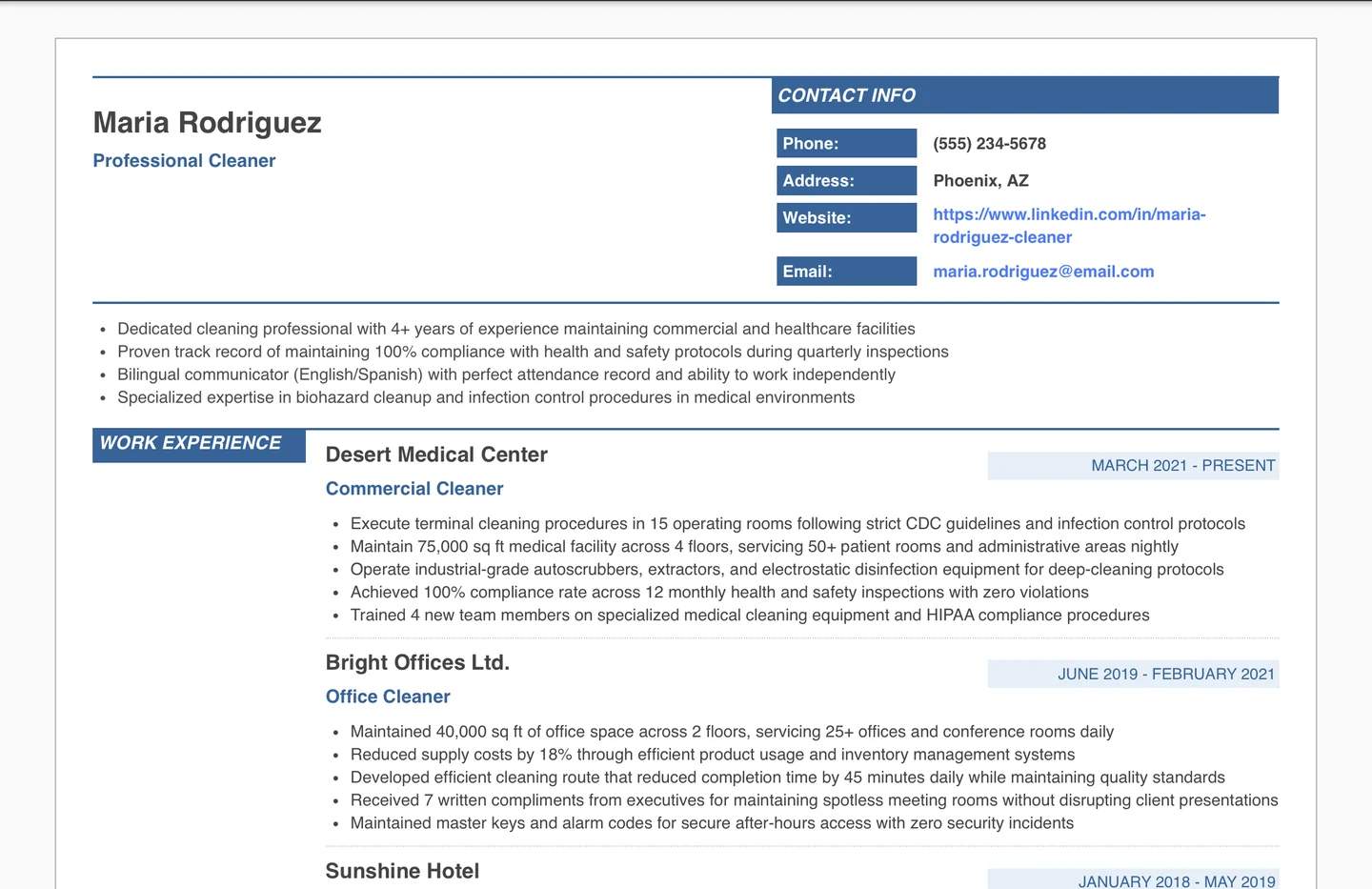
The Best Cleaner Resume Example/Sample
https://www.resumonk.com/cleanerCleanerResume Format for Your Cleaner Resume
The reverse-chronological format is your best friend here. Why? Because cleaning supervisors and facility managers want to see your most recent experience first - they need to know you're currently active in the field and haven't lost touch with modern cleaning protocols and safety standards.
This format starts with your current or most recent position and works backward, creating a clear timeline of your professional journey.
Structure Your Cleaner Resume Like This
Start with a brief professional summary at the top - think of it as your elevator pitch if you had 15 seconds with the hiring manager in that very elevator you keep spotless. Follow this with your work experience section (the star of your show), then your skills section, and finally your education or certifications.
Keep it to one page if you have less than 10 years of experience, or two pages maximum if you're a seasoned professional.
Remember, hiring managers in the cleaning industry often review dozens of resumes daily. They appreciate clarity and directness - much like how they appreciate a well-organized supply closet. Use clear section headers, consistent formatting, and plenty of white space. Your resume should be as easy to navigate as a freshly mopped floor is to walk on.
Contact Information That Works
Place your contact details prominently at the top.
Include your full name, phone number, email address, and city/state. If you have reliable transportation (crucial for cleaners who might work multiple sites), you might mention "Own reliable transportation" right under your contact details.
For UK applicants, include your National Insurance number eligibility status if relevant, while Canadian applicants should mention their valid work permit status if applicable.
Work Experience on Your Cleaner Resume
Your work experience section is where you transform from an invisible force to a recognized professional.
Too often, cleaners undersell themselves by simply listing duties like "cleaned offices" or "emptied trash." But you know there's so much more to your role - the early mornings, the attention to detail, the physical stamina, the trustworthiness required when working around valuable property and confidential information.
Quantify Your Cleaning Impact
Start each position with your job title, employer name, location, and dates of employment.
Then, instead of just listing what you did, showcase what you achieved. Think about the square footage you maintained, the number of rooms you serviced, the cleaning schedules you consistently met, or the special projects you completed.
❌ Don't write vague descriptions like this:
Cleaner - ABC Office Complex
• Cleaned offices
• Used cleaning supplies
• Followed instructions
✅ Do write specific, achievement-focused descriptions:
Cleaner - ABC Office Complex
• Maintained 50,000 sq ft of office space across 3 floors, servicing 30+ offices nightly
• Achieved 100% compliance with health and safety protocols during quarterly inspections
• Reduced supply costs by 15% through efficient product usage and inventory management
• Trained 3 new team members on specialized floor care equipment and safety procedures
Highlight Specialized Cleaning Experience
Different cleaning environments require different expertise.
A hospital cleaner deals with biohazard protocols that an office cleaner might never encounter. A hotel housekeeper masters speed and presentation that a school janitor might prioritize differently. Be specific about your environment and any specialized procedures you've mastered.
For instance, if you've worked in healthcare facilities, mention your knowledge of infection control protocols. If you've cleaned industrial sites, highlight your experience with heavy-duty equipment. These distinctions matter immensely to employers who need someone who can hit the ground running.
❌ Don't generalize your experience:
Worked as cleaner in different buildings
✅ Do specify your environmental expertise:
Commercial Cleaner - Downtown Medical Center
• Executed terminal cleaning procedures in operating rooms following strict CDC guidelines
• Operated industrial-grade autoscrubbers and extractors for deep-cleaning protocols
• Maintained HIPAA compliance while cleaning administrative areas with sensitive documents
Essential Skills for Your Cleaner Resume
Think of your skills section as your professional toolkit - just as you wouldn't show up to clean windows without squeegees, you shouldn't present your resume without showcasing the abilities that make you exceptional at your job. The cleaning industry has evolved far beyond the mop and bucket, and your skills section should reflect this modern reality.
Technical Skills That Matter
Today's cleaners work with sophisticated equipment and chemicals that require real expertise. List specific equipment you can operate - from basic vacuum cleaners to ride-on scrubbers, from pressure washers to electrostatic sprayers.
Include your knowledge of cleaning chemicals, WHMIS or OSHA compliance, and any specialized techniques like strip and wax procedures or carpet extraction.
✅ Strong technical skills to include:
Technical Skills:
• Floor care equipment (buffers, burnishers, auto-scrubbers)
• Chemical dilution systems and pH-neutral cleaning solutions
• Biohazard cleanup and bloodborne pathogen protocols
• Green cleaning practices and LEED compliance
• Electrostatic disinfection technology
Soft Skills That Set You Apart
While technical abilities get the job done, soft skills make you irreplaceable.
Reliability might seem obvious, but in an industry plagued by high turnover, your consistent attendance is gold. Physical stamina, attention to detail, time management, and the ability to work independently are all crucial. Don't forget about discretion - cleaners often work in spaces with confidential information and valuable items.
For those applying in customer-facing environments like hotels or retail spaces in the United States, customer service skills become paramount. In Australia, where workplace safety regulations are particularly stringent, emphasizing your safety awareness and compliance record can give you an edge. UK employers often value flexibility with shift patterns, given the 24/7 nature of many cleaning operations.
✅ Impactful soft skills presentation:
Core Competencies:
• Perfect attendance record over 2+ years
• Bilingual communication (English/Spanish) for diverse team coordination
• Detail-oriented approach resulting in zero customer complaints
• Self-directed work style, managing routes of 15+ locations independently
Specific Considerations and Tips for Your Cleaner Resume
Here's something most resume guides won't tell you - as a cleaner, you face unique challenges in the application process.
You might be applying for positions where the hiring manager has preconceived notions about the role, or where dozens of applicants submit nearly identical resumes. Your challenge is to stand out while remaining authentic to who you are and what you bring to the table.
Address the Trust Factor Head-On
Cleaners work in sensitive environments - often alone, after hours, with access to everything from executive offices to personal belongings.
This trust factor is huge, yet rarely discussed. Include any background checks you've passed, bonding or insurance coverage you maintain, or security clearances you hold. If you've worked in high-security environments like government buildings or airports, make this prominent.
Security & Trust Credentials:
• Active Secret Security Clearance (Canada) / Enhanced DBS Check (UK)
• Bonded and insured through employer for $1 million liability
• 5-year track record with zero security incidents or property claims
Show Career Progression, Even in "Lateral" Moves
Maybe you've been a cleaner for years, moving between similar positions. To the untrained eye, this might look like job-hopping or lack of advancement. Reframe it as building diverse expertise.
Each environment taught you something new - the hospital gave you biohazard training, the school taught you to work around active environments, the office building introduced you to green cleaning protocols.
If you've taken on additional responsibilities without a title change, make these visible. Did you become the go-to person for training new staff? Did you start handling supply ordering? Did you become the floater who could cover any shift or location? These are all forms of progression that deserve recognition.
Language and Presentation Matters More Than You Think
The cleaning industry attracts workers from diverse backgrounds, and English might not be your first language.
That's actually a strength in multicultural work environments, but ensure your resume is grammatically clean. Have a trusted friend review it, or use basic grammar-checking tools. However, don't try to sound overly sophisticated - authenticity reads better than forced corporate speak.
Finally, remember that many cleaning positions are filled through staffing agencies or facility management companies. If you're applying through an agency, mention your flexibility with placements and your ability to adapt quickly to new environments.
If applying directly to facilities, research their specific needs - a luxury hotel has different priorities than a medical facility, and your resume should reflect that understanding.
✅ Tailored closing statement example:
- Available for immediate start
- Flexible for all shifts including weekends and holidays
- Valid driver's license with clean driving record
- Own reliable vehicle for multi-site assignments
- Committed to long-term employment and growing with your organization
Education to List on Cleaner Resume
As someone looking to secure a cleaner role, you're entering a field where practical skills often outweigh academic credentials.
Yet, this doesn't mean your education is irrelevant. Whether you left school at 16 or completed vocational training last month, how you present your educational background can demonstrate reliability, attention to detail, and a willingness to learn - all crucial qualities for a cleaner.
The Basics - What to Include
For cleaner positions, keep your education section concise but meaningful. Start with your highest level of education and work backwards (that reverse-chronological format we mentioned). If you completed high school, that's your starting point. If you didn't, don't panic - many successful cleaners haven't, and employers understand this.
What matters more is showing any relevant training or certifications you've pursued.
Here's how to structure your basic education entry:
❌ Don't write vaguely:
Went to Lincoln High School
Got my diploma
✅ Do write with clarity:
Lincoln High School - Liverpool, UK
Secondary School Certificate - June 2019
Relevant Certifications and Training
This is where you can really shine. Have you completed any hygiene certificates? Food safety training? COSHH (Control of Substances Hazardous to Health) training in the UK? These certifications are gold for cleaner positions. They show you understand the science and safety behind what you do.
Maybe you took an online course during lockdown about infection control - that's incredibly relevant now.
List these certifications prominently, even above your formal education if they're more recent and relevant:
COSHH Awareness Certificate - Health & Safety Executive
Completed: March 2023

Basic Food Hygiene Certificate - Level 2
Chartered Institute of Environmental Health - January 2023

Oakwood Secondary School - Manchester, UK
GCSEs (5 subjects including English and Maths) - June 2018
When You Have Limited Formal Education
Perhaps you left school early to support your family, or formal education just wasn't your path.
That's perfectly fine. Focus on any workplace training you've received, even if informal. Did a previous employer train you in specific cleaning protocols? Did you complete any online modules about cleaning techniques? These all count as education in the cleaning field.
Remember, in countries like Australia and Canada, employers often value practical experience and on-the-job training just as highly as formal qualifications. In the USA, having a high school diploma or GED is often preferred but not always essential, especially if you have solid work experience.
Awards and Achievements on Cleaner Resume
The cleaning industry might not hand out golden mops (though that would be amazing), but recognition comes in many forms. And more importantly, achievements don't always need formal certificates to be valuable on your resume.
Types of Recognition Worth Mentioning
Let's start with formal recognition.
Were you ever named Employee of the Month at any job, even if it wasn't cleaning-related? That shows reliability and excellence. Did you receive a letter of commendation from a client? Perfect attendance awards? These all demonstrate the qualities employers want in a cleaner - dependability, consistency, and pride in your work.
❌ Don't undersell your achievements:
Was employee of the month once
✅ Do provide context and impact:
Employee of the Month - Morrison's Supermarket, Leeds
February 2023 - Recognized for maintaining highest cleanliness standards during health inspection
Quantifiable Achievements Without Formal Awards
Here's where you can get creative while staying truthful. Think about your cleaning achievements in measurable terms. Did you develop a new cleaning routine that saved time? Did you maintain a perfect safety record? Were you trusted with keys to buildings?
These are achievements worth highlighting.
Consider these examples of how to frame your accomplishments:
• Maintained 100% compliance rate across 6 monthly health and safety inspections
• Developed efficient cleaning route reducing completion time by 30 minutes daily
• Entrusted with master keys and alarm codes for 12-unit residential complex
• Received 5 written compliments from tenants for exceptional common area maintenance
Industry-Specific Achievements
Different cleaning environments offer different opportunities for recognition. If you've worked in healthcare settings, maintaining infection control standards is a massive achievement. In educational settings, creating a safe environment for children is commendable.
In commercial cleaning, efficiency and minimal disruption to business operations are key achievements.
For our friends in the UK, participating in the British Institute of Cleaning Science (BICSc) training programs, even without full certification, is worth mentioning. In Australia, any involvement with Clean Energy Council initiatives or green cleaning practices sets you apart.
Listing References for Cleaner Resume
Here's something they don't tell you in career advice columns aimed at executives - when you're applying for a cleaner position, your references might actually get called more often than theirs do.
Why? Because trust is everything in cleaning. You're often working alone, handling keys, entering private spaces when no one's around. Your references aren't just confirming you showed up; they're vouching for your character.
Think about it from the employer's perspective. They're potentially giving you access to their entire facility after hours. They need to know you're someone who won't just clean well, but who can be trusted implicitly. Your references are the people who can tell that story.
Choosing the Right References
Your best references are previous supervisors or clients who can speak directly to your cleaning work.
But don't discount others who can vouch for your reliability and trustworthiness. That family you babysat for who trusted you in their home? The elderly neighbor whose errands you ran? These personal references can be powerful for cleaner positions.
Prioritize your references in this order: direct supervisors from cleaning roles, supervisors from any job, clients you've cleaned for (even informally), then character references who can speak to your trustworthiness.
❌ Don't list references without context:
John Smith - 07700 900123
✅ Do provide complete information:
Margaret Thompson, Former Supervisor - Facility Services Manager, CleanBright Services Ltd.
- Tel: 07700 900123
- Email: [email protected]
- Relationship: Direct supervisor for 2 years
When and How to List References
In the UK and Australia, it's common to write "References available upon request" at the bottom of your resume, then provide a separate reference sheet when asked. In the USA and Canada, employers often expect references to be readily available, so having a prepared reference sheet ready to submit with your application is wise.
If you're including references directly on your resume (when space allows), place them at the very end. For cleaner positions, two or three strong references are sufficient - quality over quantity.
Preparing Your References
Here's a crucial step many candidates skip - actually telling your references you're listing them. When Mrs. Patterson gets a call about you, she should be expecting it and prepared to sing your praises. Send her a quick message: "Hi Mrs. Patterson, I'm applying for a cleaner position at the local medical centre. I've listed you as a reference because you've seen firsthand how thoroughly I maintain your home. They might ask about my reliability and attention to detail."
For cleaning positions, coach your references on what matters most: punctuality, trustworthiness, attention to detail, ability to work unsupervised, and pride in maintaining high standards. If you've handled any special situations - like deep cleaning after a flood or maintaining spaces during COVID - make sure your references know to mention these.
Character Reference:

1. Robert Chen, Homeowner - Private Cleaning Client
- Tel: 07700 900456
- Email: [email protected]
- Relationship: Cleaned Mr. Chen's home weekly for 18 months
- Can attest to trustworthiness with keys and alarm codes, exceptional attention
to detail, and flexibility with scheduling
Remember, in the cleaning industry, a glowing reference from someone whose space you've maintained can be worth more than any qualification. These are the people who've seen your work ethic up close, who've trusted you in their spaces, and who can tell future employers exactly why you're the cleaner they need.
Cover Letter Tips for Cleaner Resume
Many cleaners skip writing a cover letter, thinking it's unnecessary for an entry-level position. This mindset is exactly why writing one gives you such an advantage.
While others submit just a resume, you're showing initiative, communication skills, and genuine interest in the specific role.
Opening Strong - Making Your First Impression Count
Your opening paragraph needs to grab attention without being gimmicky. Reference the specific position and company, and immediately establish why you're interested in THIS job, not just any cleaning position.
❌ Don't write generic openings:
Dear Sir/Madam,
I am writing to apply for the cleaner position. I have experience in cleaning and am looking for work.
✅ Do write with specificity and enthusiasm:
Dear Ms. Johnson,
I am writing to express my interest in the Cleaner position at St. Mary's Hospital, as advertised on your website. Having cared for my grandmother during her recent hospital stay, I witnessed firsthand how a meticulously clean environment contributed to her recovery and comfort. This experience ignited my passion for healthcare cleaning.
The Body - Telling Your Story
The middle section is where you connect your experience to their needs. But remember, you're not just repeating your resume - you're adding context and personality.
Share specific examples that demonstrate your understanding of what good cleaning means in their context.
For instance, if applying to a school, discuss your understanding of child safety and non-toxic cleaning products. For office buildings, emphasize discretion and working around business operations. For healthcare, focus on infection control and attention to detail.
In my current role at Bright Offices Ltd., I've developed a systematic approach to cleaning that ensures no surface is overlooked. I particularly pride myself on my ability to work quietly and efficiently during business hours, having received specific commendation from three company directors for maintaining spotless meeting rooms without disrupting important client presentations.
Closing With Purpose
Your closing paragraph should reiterate your interest and prompt next steps. Be confident but not presumptuous.
Express enthusiasm for the opportunity to discuss the role further.
In the UK and Australia, it's common to mention your availability for interview and notice period. In the USA and Canada, focus more on your enthusiasm and fit for the role.
Always thank them for their consideration - courtesy matters in every country.
I would welcome the opportunity to discuss how my dedication to maintaining pristine environments could contribute to your team's high standards. I am available for interview at your convenience and can start with two weeks' notice. Thank you for considering my application.
Key Takeaways
After diving deep into every aspect of creating your cleaner resume, here are the essential points to remember as you craft your own:
- Use reverse-chronological format - Start with your most recent position to show you're currently active in the field and familiar with modern cleaning protocols
- Quantify your achievements - Include specific numbers like square footage maintained, compliance rates achieved, or number of rooms serviced rather than vague duty descriptions
- Highlight environment-specific expertise - Whether it's hospitals, schools, or offices, emphasize your specialized knowledge of that setting's unique requirements
- Showcase both technical and soft skills - List equipment you can operate and safety protocols you know, but don't forget reliability, trustworthiness, and attention to detail
- Address the trust factor directly - Include security clearances, background checks, or bonding information to acknowledge the responsibility of working unsupervised
- Frame lateral moves as skill-building - Show how each position taught you something valuable, even if titles remained similar
- Include relevant certifications - COSHH, food safety, or infection control training can set you apart from other candidates
- Don't skip the cover letter - Use it to show personality and explain why you want THIS specific cleaning position
- Prepare strong references - Choose people who can vouch for your trustworthiness and work ethic, and brief them on what to emphasize
Creating a standout cleaner resume doesn't have to be overwhelming. With Resumonk, you can build a professional resume that captures all these important elements while maintaining clean, organized formatting that mirrors the quality of your work. Our platform offers professionally designed templates specifically suited for cleaner positions, plus AI-powered suggestions that help you describe your experience in compelling ways. Whether you're highlighting your perfect attendance record or your expertise with industrial cleaning equipment, Resumonk helps you present your qualifications in the best possible light.
Ready to create a cleaner resume that opens doors to better opportunities?
Start building your professional resume today with Resumonk's easy-to-use tools and expert guidance.
Get started with Resumonk now and let us help you showcase the true value you bring as a cleaning professional.
More Restaurant & Hospitality resume examples
- McDonald's Crew Member resume example
- Barista resume example
- Chef resume example
- Restaurant Server resume example
See all Restaurant & Hospitality resume examples, or browse every category.
Resume writing tips
Envision this moment - you're standing in front of a gleaming office building at 5 AM, mop bucket in hand, ready to transform chaos into order before the world wakes up. Or perhaps you're walking through a hotel corridor, cart loaded with fresh linens, knowing that your attention to detail will make someone's stay memorable. As a cleaner, you're the unsung hero who creates the foundations of comfort and hygiene that everyone depends on but rarely acknowledges.
Now it's time to make your resume shine just as brightly as the surfaces you maintain.
You've probably seen dozens of generic cleaning job postings, and maybe you've wondered if your resume even matters when the work seems so straightforward. But here's what those other guides won't tell you - your resume is your chance to transform from just another applicant into the trusted professional that employers desperately need. Whether you're entering the cleaning field for the first time, moving between cleaning environments, or looking to advance from your current position, crafting the right resume can mean the difference between another rejection and landing that stable job with better pay and benefits you deserve.
In this comprehensive guide, we'll walk you through every element of creating a powerful cleaner resume. We'll start with choosing the perfect resume format that highlights your reliability and experience, then dive deep into crafting compelling work experience descriptions that showcase your achievements, not just your duties. You'll learn how to present your skills - both the technical knowledge of modern cleaning equipment and the soft skills that make you irreplaceable. We'll cover how to handle your education section even if formal schooling isn't your strongest point, how to highlight achievements in an industry that rarely hands out awards, and how to write a cover letter that gets you noticed. We'll even tackle the often-overlooked but crucial topics of references and specific considerations for different cleaning environments, from hospitals to schools to office buildings.
By the time you finish reading, you'll have everything you need to create a resume that reflects your true value as a cleaning professional. You'll understand how to present your experience whether you're applying in the UK, USA, Canada, or Australia, how to address the unique trust factors involved in cleaning work, and how to stand out in a field where many resumes look frustratingly similar. Let's begin transforming your professional story into a resume that opens doors - just as efficiently as you open those doors every morning to start your essential work.
The Best Cleaner Resume Example/Sample
https://www.resumonk.com/cleanerCleanerResume Format for Your Cleaner Resume
The reverse-chronological format is your best friend here. Why? Because cleaning supervisors and facility managers want to see your most recent experience first - they need to know you're currently active in the field and haven't lost touch with modern cleaning protocols and safety standards.
This format starts with your current or most recent position and works backward, creating a clear timeline of your professional journey.
Structure Your Cleaner Resume Like This
Start with a brief professional summary at the top - think of it as your elevator pitch if you had 15 seconds with the hiring manager in that very elevator you keep spotless. Follow this with your work experience section (the star of your show), then your skills section, and finally your education or certifications.
Keep it to one page if you have less than 10 years of experience, or two pages maximum if you're a seasoned professional.
Remember, hiring managers in the cleaning industry often review dozens of resumes daily. They appreciate clarity and directness - much like how they appreciate a well-organized supply closet. Use clear section headers, consistent formatting, and plenty of white space. Your resume should be as easy to navigate as a freshly mopped floor is to walk on.
Contact Information That Works
Place your contact details prominently at the top.
Include your full name, phone number, email address, and city/state. If you have reliable transportation (crucial for cleaners who might work multiple sites), you might mention "Own reliable transportation" right under your contact details.
For UK applicants, include your National Insurance number eligibility status if relevant, while Canadian applicants should mention their valid work permit status if applicable.
Work Experience on Your Cleaner Resume
Your work experience section is where you transform from an invisible force to a recognized professional.
Too often, cleaners undersell themselves by simply listing duties like "cleaned offices" or "emptied trash." But you know there's so much more to your role - the early mornings, the attention to detail, the physical stamina, the trustworthiness required when working around valuable property and confidential information.
Quantify Your Cleaning Impact
Start each position with your job title, employer name, location, and dates of employment.
Then, instead of just listing what you did, showcase what you achieved. Think about the square footage you maintained, the number of rooms you serviced, the cleaning schedules you consistently met, or the special projects you completed.
❌ Don't write vague descriptions like this:
Cleaner - ABC Office Complex
• Cleaned offices
• Used cleaning supplies
• Followed instructions
✅ Do write specific, achievement-focused descriptions:
Cleaner - ABC Office Complex
• Maintained 50,000 sq ft of office space across 3 floors, servicing 30+ offices nightly
• Achieved 100% compliance with health and safety protocols during quarterly inspections
• Reduced supply costs by 15% through efficient product usage and inventory management
• Trained 3 new team members on specialized floor care equipment and safety procedures
Highlight Specialized Cleaning Experience
Different cleaning environments require different expertise.
A hospital cleaner deals with biohazard protocols that an office cleaner might never encounter. A hotel housekeeper masters speed and presentation that a school janitor might prioritize differently. Be specific about your environment and any specialized procedures you've mastered.
For instance, if you've worked in healthcare facilities, mention your knowledge of infection control protocols. If you've cleaned industrial sites, highlight your experience with heavy-duty equipment. These distinctions matter immensely to employers who need someone who can hit the ground running.
❌ Don't generalize your experience:
Worked as cleaner in different buildings
✅ Do specify your environmental expertise:
Commercial Cleaner - Downtown Medical Center
• Executed terminal cleaning procedures in operating rooms following strict CDC guidelines
• Operated industrial-grade autoscrubbers and extractors for deep-cleaning protocols
• Maintained HIPAA compliance while cleaning administrative areas with sensitive documents
Essential Skills for Your Cleaner Resume
Think of your skills section as your professional toolkit - just as you wouldn't show up to clean windows without squeegees, you shouldn't present your resume without showcasing the abilities that make you exceptional at your job. The cleaning industry has evolved far beyond the mop and bucket, and your skills section should reflect this modern reality.
Technical Skills That Matter
Today's cleaners work with sophisticated equipment and chemicals that require real expertise. List specific equipment you can operate - from basic vacuum cleaners to ride-on scrubbers, from pressure washers to electrostatic sprayers.
Include your knowledge of cleaning chemicals, WHMIS or OSHA compliance, and any specialized techniques like strip and wax procedures or carpet extraction.
✅ Strong technical skills to include:
Technical Skills:
• Floor care equipment (buffers, burnishers, auto-scrubbers)
• Chemical dilution systems and pH-neutral cleaning solutions
• Biohazard cleanup and bloodborne pathogen protocols
• Green cleaning practices and LEED compliance
• Electrostatic disinfection technology
Soft Skills That Set You Apart
While technical abilities get the job done, soft skills make you irreplaceable.
Reliability might seem obvious, but in an industry plagued by high turnover, your consistent attendance is gold. Physical stamina, attention to detail, time management, and the ability to work independently are all crucial. Don't forget about discretion - cleaners often work in spaces with confidential information and valuable items.
For those applying in customer-facing environments like hotels or retail spaces in the United States, customer service skills become paramount. In Australia, where workplace safety regulations are particularly stringent, emphasizing your safety awareness and compliance record can give you an edge. UK employers often value flexibility with shift patterns, given the 24/7 nature of many cleaning operations.
✅ Impactful soft skills presentation:
Core Competencies:
• Perfect attendance record over 2+ years
• Bilingual communication (English/Spanish) for diverse team coordination
• Detail-oriented approach resulting in zero customer complaints
• Self-directed work style, managing routes of 15+ locations independently
Specific Considerations and Tips for Your Cleaner Resume
Here's something most resume guides won't tell you - as a cleaner, you face unique challenges in the application process.
You might be applying for positions where the hiring manager has preconceived notions about the role, or where dozens of applicants submit nearly identical resumes. Your challenge is to stand out while remaining authentic to who you are and what you bring to the table.
Address the Trust Factor Head-On
Cleaners work in sensitive environments - often alone, after hours, with access to everything from executive offices to personal belongings.
This trust factor is huge, yet rarely discussed. Include any background checks you've passed, bonding or insurance coverage you maintain, or security clearances you hold. If you've worked in high-security environments like government buildings or airports, make this prominent.
Security & Trust Credentials:
• Active Secret Security Clearance (Canada) / Enhanced DBS Check (UK)
• Bonded and insured through employer for $1 million liability
• 5-year track record with zero security incidents or property claims
Show Career Progression, Even in "Lateral" Moves
Maybe you've been a cleaner for years, moving between similar positions. To the untrained eye, this might look like job-hopping or lack of advancement. Reframe it as building diverse expertise.
Each environment taught you something new - the hospital gave you biohazard training, the school taught you to work around active environments, the office building introduced you to green cleaning protocols.
If you've taken on additional responsibilities without a title change, make these visible. Did you become the go-to person for training new staff? Did you start handling supply ordering? Did you become the floater who could cover any shift or location? These are all forms of progression that deserve recognition.
Language and Presentation Matters More Than You Think
The cleaning industry attracts workers from diverse backgrounds, and English might not be your first language.
That's actually a strength in multicultural work environments, but ensure your resume is grammatically clean. Have a trusted friend review it, or use basic grammar-checking tools. However, don't try to sound overly sophisticated - authenticity reads better than forced corporate speak.
Finally, remember that many cleaning positions are filled through staffing agencies or facility management companies. If you're applying through an agency, mention your flexibility with placements and your ability to adapt quickly to new environments.
If applying directly to facilities, research their specific needs - a luxury hotel has different priorities than a medical facility, and your resume should reflect that understanding.
✅ Tailored closing statement example:
- Available for immediate start
- Flexible for all shifts including weekends and holidays
- Valid driver's license with clean driving record
- Own reliable vehicle for multi-site assignments
- Committed to long-term employment and growing with your organization
Education to List on Cleaner Resume
As someone looking to secure a cleaner role, you're entering a field where practical skills often outweigh academic credentials.
Yet, this doesn't mean your education is irrelevant. Whether you left school at 16 or completed vocational training last month, how you present your educational background can demonstrate reliability, attention to detail, and a willingness to learn - all crucial qualities for a cleaner.
The Basics - What to Include
For cleaner positions, keep your education section concise but meaningful. Start with your highest level of education and work backwards (that reverse-chronological format we mentioned). If you completed high school, that's your starting point. If you didn't, don't panic - many successful cleaners haven't, and employers understand this.
What matters more is showing any relevant training or certifications you've pursued.
Here's how to structure your basic education entry:
❌ Don't write vaguely:
Went to Lincoln High School
Got my diploma
✅ Do write with clarity:
Lincoln High School - Liverpool, UK
Secondary School Certificate - June 2019
Relevant Certifications and Training
This is where you can really shine. Have you completed any hygiene certificates? Food safety training? COSHH (Control of Substances Hazardous to Health) training in the UK? These certifications are gold for cleaner positions. They show you understand the science and safety behind what you do.
Maybe you took an online course during lockdown about infection control - that's incredibly relevant now.
List these certifications prominently, even above your formal education if they're more recent and relevant:
COSHH Awareness Certificate - Health & Safety Executive
Completed: March 2023

Basic Food Hygiene Certificate - Level 2
Chartered Institute of Environmental Health - January 2023

Oakwood Secondary School - Manchester, UK
GCSEs (5 subjects including English and Maths) - June 2018
When You Have Limited Formal Education
Perhaps you left school early to support your family, or formal education just wasn't your path.
That's perfectly fine. Focus on any workplace training you've received, even if informal. Did a previous employer train you in specific cleaning protocols? Did you complete any online modules about cleaning techniques? These all count as education in the cleaning field.
Remember, in countries like Australia and Canada, employers often value practical experience and on-the-job training just as highly as formal qualifications. In the USA, having a high school diploma or GED is often preferred but not always essential, especially if you have solid work experience.
Awards and Achievements on Cleaner Resume
The cleaning industry might not hand out golden mops (though that would be amazing), but recognition comes in many forms. And more importantly, achievements don't always need formal certificates to be valuable on your resume.
Types of Recognition Worth Mentioning
Let's start with formal recognition.
Were you ever named Employee of the Month at any job, even if it wasn't cleaning-related? That shows reliability and excellence. Did you receive a letter of commendation from a client? Perfect attendance awards? These all demonstrate the qualities employers want in a cleaner - dependability, consistency, and pride in your work.
❌ Don't undersell your achievements:
Was employee of the month once
✅ Do provide context and impact:
Employee of the Month - Morrison's Supermarket, Leeds
February 2023 - Recognized for maintaining highest cleanliness standards during health inspection
Quantifiable Achievements Without Formal Awards
Here's where you can get creative while staying truthful. Think about your cleaning achievements in measurable terms. Did you develop a new cleaning routine that saved time? Did you maintain a perfect safety record? Were you trusted with keys to buildings?
These are achievements worth highlighting.
Consider these examples of how to frame your accomplishments:
• Maintained 100% compliance rate across 6 monthly health and safety inspections
• Developed efficient cleaning route reducing completion time by 30 minutes daily
• Entrusted with master keys and alarm codes for 12-unit residential complex
• Received 5 written compliments from tenants for exceptional common area maintenance
Industry-Specific Achievements
Different cleaning environments offer different opportunities for recognition. If you've worked in healthcare settings, maintaining infection control standards is a massive achievement. In educational settings, creating a safe environment for children is commendable.
In commercial cleaning, efficiency and minimal disruption to business operations are key achievements.
For our friends in the UK, participating in the British Institute of Cleaning Science (BICSc) training programs, even without full certification, is worth mentioning. In Australia, any involvement with Clean Energy Council initiatives or green cleaning practices sets you apart.
Listing References for Cleaner Resume
Here's something they don't tell you in career advice columns aimed at executives - when you're applying for a cleaner position, your references might actually get called more often than theirs do.
Why? Because trust is everything in cleaning. You're often working alone, handling keys, entering private spaces when no one's around. Your references aren't just confirming you showed up; they're vouching for your character.
Think about it from the employer's perspective. They're potentially giving you access to their entire facility after hours. They need to know you're someone who won't just clean well, but who can be trusted implicitly. Your references are the people who can tell that story.
Choosing the Right References
Your best references are previous supervisors or clients who can speak directly to your cleaning work.
But don't discount others who can vouch for your reliability and trustworthiness. That family you babysat for who trusted you in their home? The elderly neighbor whose errands you ran? These personal references can be powerful for cleaner positions.
Prioritize your references in this order: direct supervisors from cleaning roles, supervisors from any job, clients you've cleaned for (even informally), then character references who can speak to your trustworthiness.
❌ Don't list references without context:
John Smith - 07700 900123
✅ Do provide complete information:
Margaret Thompson, Former Supervisor - Facility Services Manager, CleanBright Services Ltd.
- Tel: 07700 900123
- Email: [email protected]
- Relationship: Direct supervisor for 2 years
When and How to List References
In the UK and Australia, it's common to write "References available upon request" at the bottom of your resume, then provide a separate reference sheet when asked. In the USA and Canada, employers often expect references to be readily available, so having a prepared reference sheet ready to submit with your application is wise.
If you're including references directly on your resume (when space allows), place them at the very end. For cleaner positions, two or three strong references are sufficient - quality over quantity.
Preparing Your References
Here's a crucial step many candidates skip - actually telling your references you're listing them. When Mrs. Patterson gets a call about you, she should be expecting it and prepared to sing your praises. Send her a quick message: "Hi Mrs. Patterson, I'm applying for a cleaner position at the local medical centre. I've listed you as a reference because you've seen firsthand how thoroughly I maintain your home. They might ask about my reliability and attention to detail."
For cleaning positions, coach your references on what matters most: punctuality, trustworthiness, attention to detail, ability to work unsupervised, and pride in maintaining high standards. If you've handled any special situations - like deep cleaning after a flood or maintaining spaces during COVID - make sure your references know to mention these.
Character Reference:

1. Robert Chen, Homeowner - Private Cleaning Client
- Tel: 07700 900456
- Email: [email protected]
- Relationship: Cleaned Mr. Chen's home weekly for 18 months
- Can attest to trustworthiness with keys and alarm codes, exceptional attention
to detail, and flexibility with scheduling
Remember, in the cleaning industry, a glowing reference from someone whose space you've maintained can be worth more than any qualification. These are the people who've seen your work ethic up close, who've trusted you in their spaces, and who can tell future employers exactly why you're the cleaner they need.
Cover Letter Tips for Cleaner Resume
Many cleaners skip writing a cover letter, thinking it's unnecessary for an entry-level position. This mindset is exactly why writing one gives you such an advantage.
While others submit just a resume, you're showing initiative, communication skills, and genuine interest in the specific role.
Opening Strong - Making Your First Impression Count
Your opening paragraph needs to grab attention without being gimmicky. Reference the specific position and company, and immediately establish why you're interested in THIS job, not just any cleaning position.
❌ Don't write generic openings:
Dear Sir/Madam,
I am writing to apply for the cleaner position. I have experience in cleaning and am looking for work.
✅ Do write with specificity and enthusiasm:
Dear Ms. Johnson,
I am writing to express my interest in the Cleaner position at St. Mary's Hospital, as advertised on your website. Having cared for my grandmother during her recent hospital stay, I witnessed firsthand how a meticulously clean environment contributed to her recovery and comfort. This experience ignited my passion for healthcare cleaning.
The Body - Telling Your Story
The middle section is where you connect your experience to their needs. But remember, you're not just repeating your resume - you're adding context and personality.
Share specific examples that demonstrate your understanding of what good cleaning means in their context.
For instance, if applying to a school, discuss your understanding of child safety and non-toxic cleaning products. For office buildings, emphasize discretion and working around business operations. For healthcare, focus on infection control and attention to detail.
In my current role at Bright Offices Ltd., I've developed a systematic approach to cleaning that ensures no surface is overlooked. I particularly pride myself on my ability to work quietly and efficiently during business hours, having received specific commendation from three company directors for maintaining spotless meeting rooms without disrupting important client presentations.
Closing With Purpose
Your closing paragraph should reiterate your interest and prompt next steps. Be confident but not presumptuous.
Express enthusiasm for the opportunity to discuss the role further.
In the UK and Australia, it's common to mention your availability for interview and notice period. In the USA and Canada, focus more on your enthusiasm and fit for the role.
Always thank them for their consideration - courtesy matters in every country.
I would welcome the opportunity to discuss how my dedication to maintaining pristine environments could contribute to your team's high standards. I am available for interview at your convenience and can start with two weeks' notice. Thank you for considering my application.
Key Takeaways
After diving deep into every aspect of creating your cleaner resume, here are the essential points to remember as you craft your own:
- Use reverse-chronological format - Start with your most recent position to show you're currently active in the field and familiar with modern cleaning protocols
- Quantify your achievements - Include specific numbers like square footage maintained, compliance rates achieved, or number of rooms serviced rather than vague duty descriptions
- Highlight environment-specific expertise - Whether it's hospitals, schools, or offices, emphasize your specialized knowledge of that setting's unique requirements
- Showcase both technical and soft skills - List equipment you can operate and safety protocols you know, but don't forget reliability, trustworthiness, and attention to detail
- Address the trust factor directly - Include security clearances, background checks, or bonding information to acknowledge the responsibility of working unsupervised
- Frame lateral moves as skill-building - Show how each position taught you something valuable, even if titles remained similar
- Include relevant certifications - COSHH, food safety, or infection control training can set you apart from other candidates
- Don't skip the cover letter - Use it to show personality and explain why you want THIS specific cleaning position
- Prepare strong references - Choose people who can vouch for your trustworthiness and work ethic, and brief them on what to emphasize
Creating a standout cleaner resume doesn't have to be overwhelming. With Resumonk, you can build a professional resume that captures all these important elements while maintaining clean, organized formatting that mirrors the quality of your work. Our platform offers professionally designed templates specifically suited for cleaner positions, plus AI-powered suggestions that help you describe your experience in compelling ways. Whether you're highlighting your perfect attendance record or your expertise with industrial cleaning equipment, Resumonk helps you present your qualifications in the best possible light.
Ready to create a cleaner resume that opens doors to better opportunities?
Start building your professional resume today with Resumonk's easy-to-use tools and expert guidance.
Get started with Resumonk now and let us help you showcase the true value you bring as a cleaning professional.
More Restaurant & Hospitality resume examples
- McDonald's Crew Member resume example
- Barista resume example
- Chef resume example
- Restaurant Server resume example
See all Restaurant & Hospitality resume examples, or browse every category.
Resume writing tips