Charge Nurse Resume Example, Guide and Tips
Introduction
You've been the nurse everyone turns to when things get complicated. You're the one who can manage a crashing patient while simultaneously talking a new grad through their first code, the one who somehow knows exactly which physician to call for which problem, the one who stays late to make sure the next shift isn't walking into chaos. You've been doing charge nurse work without the title for months, maybe years, and now you're finally ready to make it official.
But first, you need a resume that actually captures what you bring to this unique, demanding, absolutely critical role.
Here's what makes writing a Charge Nurse resume particularly tricky. You're not applying for an entry-level staff nurse position where clinical skills are enough, and you're not applying for a Nurse Manager role where you'd be writing about departmental leadership and budget oversight. You're targeting that essential middle space - the supervisory clinical position that keeps hospital units running shift by shift. You're the person who makes real-time decisions about patient assignments when the ED calls with another admission and you're already over census. You're the one who mediates when two nurses are in conflict, coordinates with five different departments to get a complex discharge completed, and still maintains the clinical expertise to jump in with the sickest patient on the floor. Your resume needs to prove you can handle all of this, and that's exactly what this guide will help you accomplish.
We're going to walk through every single component of an effective Charge Nurse resume, starting with the format that best showcases your clinical progression and leadership readiness. You'll see exactly how to structure your work experience section to tell the story of how you evolved from staff nurse to someone ready for formal charge responsibilities, including how to frame informal leadership experience that might not be reflected in your official job titles. We'll cover the specific skills that hiring managers look for in Charge Nurse candidates - that crucial blend of clinical expertise, operational capability, and interpersonal competence that makes someone effective in this role. You'll learn what to include in your education section now that you're pursuing a supervisory position, how to leverage any awards or publications that demonstrate excellence beyond just showing up and doing your job, and how to think strategically about references who can speak to your leadership readiness. We'll also address the specific considerations that matter for Charge Nurse applications - handling the transition from staff to charge, addressing degree requirements, showcasing informal leadership experience, and tailoring your resume based on whether you're applying to specialty units, general acute care, academic medical centers, or community hospitals.
By the end of this guide, you'll understand exactly how to position yourself as the clinically excellent, operationally savvy, interpersonally skilled leader that every Nurse Manager desperately needs running their unit. Whether you've been formally serving as relief charge for the past year or you've been the unofficial go-to person who keeps things together during night shift, you'll know how to translate that experience into a resume that gets you interviews. Let's build a resume that finally reflects what you've been doing all along.
The Best Charge Nurse Resume Example/Sample
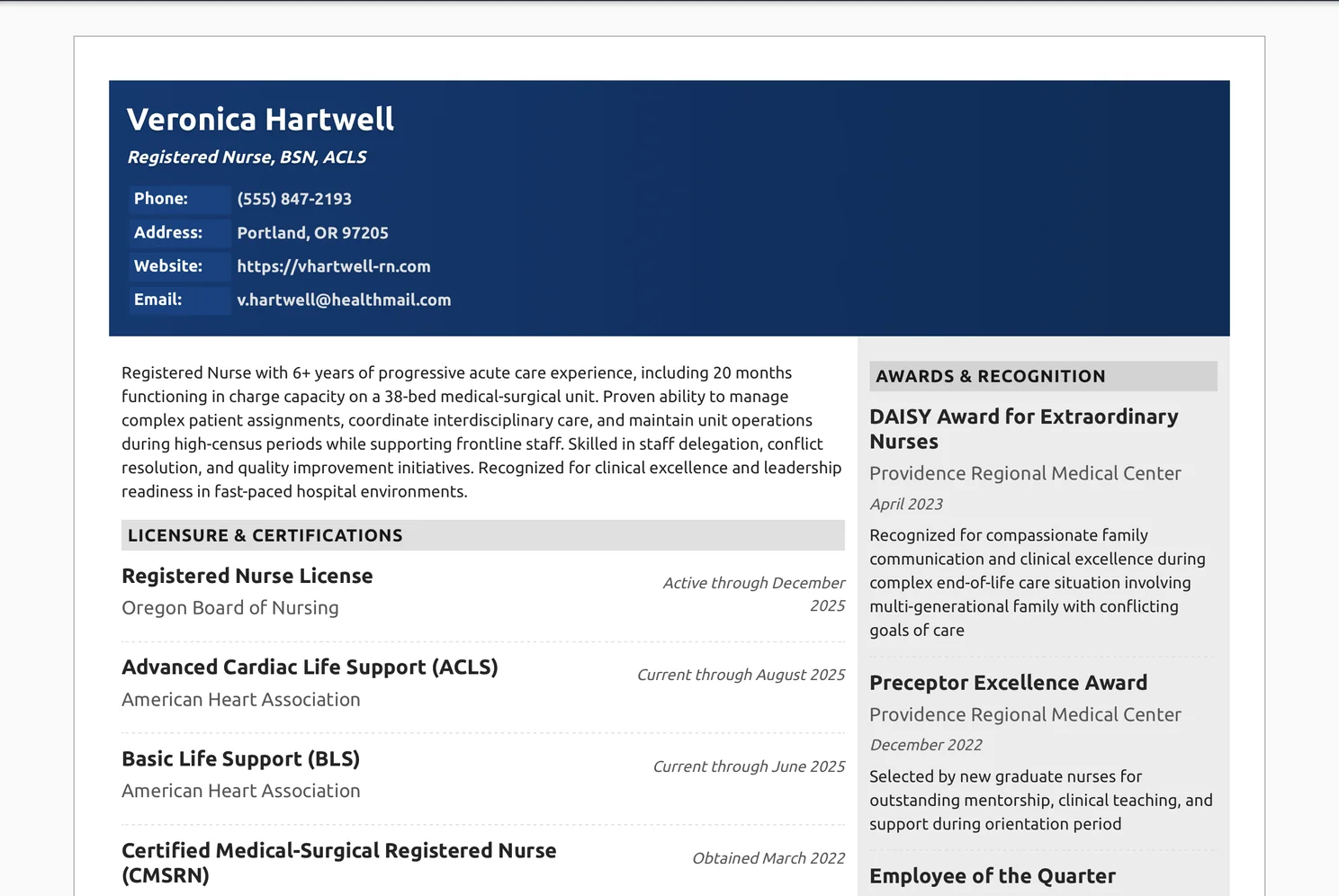
https://www.resumonk.com/charge-nurseCharge NurseResume Format to Follow for Charge Nurse Resume
A Charge Nurse sits in a unique position within the nursing hierarchy.
You're not an entry-level staff nurse anymore, but you're also not in nurse management or administration. You're the clinical leader on the floor - the person who makes shift-by-shift decisions, handles staffing crises at 2 AM, coordinates patient flow, and serves as the go-to resource for your colleagues. This is a supervisory clinical role that requires both exceptional bedside skills and emerging leadership capabilities, and your resume format needs to reflect this duality.
The Reverse-Chronological Format Is Your Foundation
For Charge Nurse positions, the reverse-chronological resume format is almost always the right choice.
Why? Because hiring managers and nurse recruiters need to see your clinical progression clearly laid out. They want to trace your journey from staff nurse to someone who's ready to take on shift leadership. They're looking for that steady climb in responsibility - maybe you started as a new grad on a med-surg floor, then moved to a higher-acuity unit, took on preceptor duties, served on unit committees, or covered charge responsibilities informally. This narrative arc matters tremendously, and only a reverse-chronological format lets it shine through clearly.
Start with your most recent position at the top of your work experience section and work backward. This immediately shows the hiring manager where you are right now in your career trajectory. If you're currently a staff nurse who regularly serves in a charge capacity or takes on leadership projects, that goes front and center.
If you've already held charge positions (perhaps PRN or in a smaller facility), that recent experience becomes your strongest selling point.
When to Consider Alternative Approaches
There are limited scenarios where you might blend formats, though pure functional or skills-based resumes rarely work for nursing positions. If you're transitioning from a specialized area (say, ICU or ED) to a general medical-surgical charge role, you might add a "Core Competencies" or "Leadership Qualifications" section near the top of your resume, immediately after your professional summary. This lets you frontload relevant skills before diving into your chronological work history.
However, this is a supplement to the reverse-chronological format, not a replacement.
Similarly, if you have a gap in employment - perhaps you took time off for family, went back to school for your BSN, or dealt with a health issue - the reverse-chronological format is still your best bet. Gaps are common in nursing, and trying to hide them with a skills-based format often raises more red flags than the gap itself. Address them briefly and confidently, then let your strong clinical experience speak for itself.
Structuring Your Charge Nurse Resume
Your resume should follow this essential structure: contact information at the top, followed by a professional summary (2-4 lines that capture your clinical background and leadership readiness), then your nursing licenses and certifications (this can go at the top or bottom depending on space, but many nurse hiring managers look for this immediately), your work experience in reverse-chronological order, your education, and finally a skills section. Some nurses also include professional affiliations or continuing education, which can strengthen a Charge Nurse application by demonstrating ongoing professional development.
The professional summary deserves special attention. This isn't the place for generic statements about being a "dedicated healthcare professional." You're writing for a specific reader: a Nurse Manager or Director of Nursing who needs someone to run their unit during a shift. They need to know immediately that you understand what charge responsibilities entail.
❌ Don't write a generic opening like:
"Experienced registered nurse seeking a challenging position in a healthcare setting where I can utilize my skills and grow professionally."
✅ Do write something that speaks to the specific demands of the Charge Nurse role:
"RN with 5+ years progressive experience in acute care settings, including 18 months in informal charge capacity. Skilled in patient flow management, staff coordination, and crisis de-escalation. Proven ability to maintain unit operations during high-census periods while ensuring quality patient outcomes and supporting frontline staff."
The difference is night and day. The second version immediately tells the hiring manager that you understand what the job actually involves.
You're not managing a department or setting policy - you're keeping the unit running smoothly during your shift, which is precisely what they need.
Work Experience on Charge Nurse Resume
Here's what every Charge Nurse knows but many forget when writing their resume: your years as a staff nurse aren't behind you or beneath you. They're your foundation. The work experience section of your resume needs to tell a story of clinical excellence that naturally evolved into leadership readiness.
This isn't about listing every single task you performed during every shift - it's about strategically highlighting the experiences that prove you're ready to be the person everyone turns to when things get complicated.
The Evolution Story Your Experience Must Tell
When a Nurse Manager reviews your work experience, they're asking themselves several questions: Can this person handle the clinical demands of our sickest patients?
Will staff respect their clinical judgment? Can they make tough decisions about assignments and resources? Will they stay composed when three patients are crashing simultaneously and the ED is calling with another admission? Your work experience section needs to answer yes to all of these questions, and it does that by showing progression.
Start with your current or most recent position. For each role, include your job title, the facility name, location (city and state), and dates of employment (month and year). Then comes the critical part: your bullet points. This is where most nursing resumes fail, because nurses tend to write duty lists rather than achievement statements. You've spent years following orders, documenting meticulously, and staying within your scope of practice - but your resume is the one place where you need to step forward and own your impact.
Writing Bullet Points That Demonstrate Leadership Readiness
Each bullet point in your work experience should accomplish one of several goals: demonstrate clinical expertise, showcase leadership activities, highlight problem-solving abilities, or prove your capacity to manage multiple priorities. Charge Nurses aren't just excellent bedside nurses - they're the ones who can zoom out from their own patients to see the whole unit, anticipate problems, and coordinate resources.
Let's look at how to transform standard nursing duties into leadership-focused accomplishments. The key is specificity and context. Instead of saying what you were responsible for, show what you actually did and what happened because of it.
❌ Don't write vague duty statements:
"Responsible for providing patient care on a medical-surgical unit"
✅ Do write specific accomplishments with context:
"Managed care for 5-6 acute patients per shift on a 32-bed medical-surgical unit with average 85% occupancy, consistently maintaining quality metrics while serving as resource nurse for newer staff"
The second version tells the hiring manager exactly what kind of environment you're coming from and hints at informal leadership (being a resource for newer staff). That matters, because Charge Nurse roles vary wildly between facilities. A 20-bed rural hospital charge position looks very different from a 50-bed urban teaching hospital unit, and giving context helps the reader assess your fit.
Highlighting Informal Leadership and Charge Experience
This is absolutely critical: if you've ever functioned in a charge capacity, even informally, it needs to be crystal clear in your work experience. Many staff nurses serve as charge when the regular charge nurse is off, or they coordinate care during particularly chaotic shifts, or they precept students and new hires.
These experiences are gold for your resume, but they need to be explicitly stated.
If you regularly served as charge nurse within your staff nurse role, consider structuring your current position with sub-bullets or a separate notation. You might list your title as "Registered Nurse / Relief Charge Nurse" if that's accurate, or include bullet points that specifically call out charge duties:
✅ Strong examples of charge-related experience within staff roles:
"Served as charge nurse approximately 8-10 shifts per month, managing unit assignments for 8-10 nursing staff, coordinating admissions and discharges, and serving as primary liaison with physicians and ancillary departments"
"Selected as relief charge nurse based on clinical expertise and leadership potential; oversaw unit operations during evening shifts including staff assignments, resource allocation, and conflict resolution"
Demonstrating Clinical Excellence
Never forget that Charge Nurses must be clinically excellent first and leaders second. Your work experience needs to prove you can handle complex patients, think critically under pressure, and maintain clinical standards.
Include bullet points that showcase your clinical judgment, specialized skills, or experience with high-acuity situations.
✅ Examples of clinical excellence statements:
"Consistently assigned to highest-acuity patients due to demonstrated competency in managing complex conditions including post-surgical complications, multi-system organ failure, and end-of-life care"
"Recognized by unit leadership for early identification of patient deterioration, resulting in three rapid response activations that prevented ICU transfers through timely intervention"
Quantifying Your Impact When Possible
Numbers speak loudly on nursing resumes, but they need to be meaningful.
Don't quantify for the sake of quantifying - make sure the metrics you include actually demonstrate something relevant to charge nursing. Patient ratios, unit size, occupancy rates, team size when you're coordinating, improvements in quality metrics, reduction in incidents, success rates for projects you led - these all matter.
❌ Don't use meaningless numbers:
"Administered medications to patients 100% of the time"
✅ Do use numbers that provide context and impact:
"Contributed to unit's achievement of zero hospital-acquired pressure injuries over 12-month period through diligent skin assessments and staff education on turning protocols"
"Precepted 6 new graduate nurses through orientation, with 100% retention and successful transition to independent practice"
Addressing Career Progression and Multiple Positions
If you've worked at the same facility but in different roles (perhaps you started in float pool, then moved to a specific unit, then took on charge responsibilities), show this progression clearly.
List each position separately under the same employer, with the most recent role first. This demonstrates loyalty and growth, both of which are valued in charge nursing candidates.
If you've moved between facilities, that's fine too - nurses do this for many good reasons, from relocation to seeking better opportunities to gaining diverse experience. What matters is that you're not job-hopping every six months, and that each move makes sense in the trajectory of your career. Brief tenure (under a year) in a single position usually warrants a brief explanation if asked about it in an interview, but don't feel compelled to address it on your resume unless it's very recent and might raise immediate concerns.
What to Include from Older Positions
If you've been nursing for 10+ years, you don't need to detail every position going back to your new grad role.
Your most recent 10-15 years of experience is what matters most, with progressively less detail as you go back in time. Your first staff nurse job from 2010 might warrant 2-3 bullet points maximum, while your current role should have 5-7 strong bullets that really sell your readiness for charge responsibilities.
For very early career positions or roles that aren't directly relevant to acute care charge nursing (perhaps you did a stint in occupational health or worked in a clinic), you can list them with minimal detail or even combine several older roles into a brief "Additional Experience" section at the end. The goal is to show a complete work history without diluting the impact of your relevant, recent experience.
Skills to Show on Charge Nurse Resume
The skills section of your resume might seem straightforward - after all, you know what you're good at - but this is where many Charge Nurse candidates undersell themselves.
You're not writing a skills section for a staff nurse position anymore, and you're not writing one for a Nurse Manager role either. You're in that crucial middle zone where clinical skills and leadership competencies need to be balanced perfectly, and your skills section needs to reflect this unique blend.
Understanding What Skills Matter for Charge Nursing
Let's be clear about what hiring managers are looking for in a Charge Nurse's skillset. They need someone who can insert an IV, sure, but they can get IV competency from any experienced floor nurse. What they really need is someone who can manage the chaos of a busy unit, delegate appropriately, think critically about patient placement and acuity, communicate effectively with multiple departments, handle conflicts between staff members, and still maintain the clinical expertise to jump in and help with complex procedures when needed.
Your skills section needs to speak to all of these dimensions.
Think of your skills in three categories: clinical/technical skills, leadership and coordination skills, and interpersonal/communication skills. A strong Charge Nurse resume includes all three categories, though not necessarily labeled as such. You want to paint a picture of someone who's clinically unshakeable and operationally capable.
Clinical and Technical Skills
Start with the clinical foundation.
These are the hands-on nursing skills and medical knowledge that establish your credibility as a clinical leader. However, there's an art to listing these for a charge position. You're not listing every basic nursing skill - "vital signs monitoring" and "bed baths" don't belong here. Instead, focus on skills that demonstrate advanced clinical competency or specialization relevant to the units you're targeting.
Consider your clinical setting and what matters there. If you're applying for a Charge Nurse role in critical care or a step-down unit, your technical skills might include hemodynamic monitoring, ventilator management, titration of vasoactive drips, or post-cardiac catheterization care. If you're targeting medical-surgical or general acute care, you might emphasize wound care expertise, IV therapy, pain management, diabetic management, or telemetry interpretation.
✅ Examples of well-targeted clinical skills:
- Advanced Cardiac Life Support (ACLS)
- Telemetry monitoring and interpretation
- Central line care and maintenance
- Complex wound management
- Pain assessment and multimodal pain management
- IV therapy and difficult access
- Medication administration and reconciliation
- Post-operative care across surgical specialties
Notice these aren't the most basic nursing tasks, but they're also not so specialized that they'd only apply to one very narrow unit type. They're the skills that make you valuable across acute care settings and that will serve you well when you're helping staff troubleshoot problems during your charge shift.
Leadership and Operational Skills
Here's where your resume differentiates itself from a staff nurse resume. Leadership and operational skills are what Charge Nurses use most heavily - these are the competencies that keep a unit running smoothly.
This category includes things like delegation, prioritization, resource management, staff coordination, patient flow management, and quality improvement.
Be specific about the leadership skills you've developed. "Leadership" by itself is too vague and doesn't tell the hiring manager anything. What kind of leadership? In what context? Instead, name the specific leadership competencies that Charge Nurses use daily.
✅ Examples of leadership and operational skills for Charge Nurses:
- Staff assignment and delegation
- Patient flow and bed management
- Shift coordination and handoff
- Resource allocation and supply management
- Conflict resolution and problem-solving
- Precepting and mentoring
- Quality assurance and safety monitoring
- Crisis management and rapid response coordination
These skills tell the reader that you understand what happens beyond direct patient care. You get that someone needs to figure out how to accommodate three admissions when the unit is already full, or mediate when two nurses both insist they can't take the next patient, or coordinate with the ED when they're holding admitted patients for hours. That's the unglamorous but essential work of charge nursing, and your skills section should reflect your readiness for it.
Communication and Interpersonal Skills
Charge Nurses live and die by their communication skills.
You're the liaison between staff and management, between your unit and other departments, between nurses and physicians, and sometimes between families and the care team. You're also often the person who has to deliver difficult messages - telling a nurse they're being pulled to another unit, addressing a performance issue in the moment, or explaining to a frustrated physician why their patient hasn't gotten to the floor yet.
Communication and interpersonal skills can be woven throughout your resume, but including a few key ones in your skills section reinforces your capability in this critical area. Be thoughtful about which ones you list - you want them to be specific and meaningful to the charge role.
✅ Examples of communication and interpersonal skills:
- Interdisciplinary collaboration and coordination
- Physician-nurse communication and partnership
- Patient and family advocacy
- Difficult conversation navigation
- Team building and morale support
- Teaching and staff development
- Cultural competency and diverse patient populations
Certifications and Specialized Training
While certifications technically belong in their own section or within your credentials, the skills you've gained through specialized training and certification should absolutely appear in your skills section.
If you're ACLS certified, you have skills in advanced cardiac emergency response. If you're a certified medical-surgical nurse (CMSRN) or critical care nurse (CCRN), you've demonstrated advanced knowledge in your specialty. If you've completed leadership training programs, conflict resolution workshops, or charge nurse development courses, the skills from those experiences belong here.
Don't list the certification itself in the skills section (that's redundant with your credentials section), but do list the skill that the certification represents if it's relevant to charge nursing responsibilities.
Electronic Health Records and Technology
Every nurse today works with electronic health records, but Charge Nurses often have additional system access and responsibilities.
You might run reports, monitor documentation compliance, troubleshoot system issues, or use specific staffing or patient tracking software. If you have experience with the EHR system that your target facility uses, absolutely include it. If you have experience with multiple systems, that demonstrates adaptability.
✅ Examples of technology skills relevant to Charge Nurses:
- Epic EHR (specify modules if relevant: Inpatient, Admission/Discharge/Transfer, etc.)
- Cerner EHR
- Meditech
- Staffing and scheduling systems
- Patient tracking and bed management systems
- Documentation auditing and compliance monitoring
How Many Skills to List and How to Format Them
Aim for 15-25 skills total across all categories.
Fewer than that and you look like you're either inexperienced or not thinking broadly enough about your capabilities. More than that and your skills section becomes overwhelming and loses impact. Remember, this isn't a comprehensive list of everything you can possibly do - it's a strategic selection of the skills most relevant to Charge Nurse responsibilities.
Format your skills section in a clean, scannable way. You can use a simple list, a two-column format, or category headers if you have enough skills to warrant organization. Whatever format you choose, make sure it's easy for a hiring manager to quickly scan and pick out key competencies.
❌ Don't create a cluttered or generic skills list:
Skills: nursing, patient care, medication administration, teamwork, communication, computers, documentation, time management, working under pressure, detail-oriented, compassionate care
✅ Do create an organized, specific skills section:
1. Clinical Expertise: ACLS, telemetry monitoring, central line care, complex wound management, pain management, post-operative care
2. Leadership & Operations: staff delegation and assignment, patient flow management, shift coordination, precepting and mentoring, quality and safety monitoring
3. Technology: Epic EHR (Inpatient/ADT), Vocera communication systems, bed tracking software
Tailoring Skills to Each Application
While your core skills remain constant, you should be tailoring the emphasis and selection in your skills section for each application.
Read the job posting carefully. If it emphasizes experience with high patient volumes and throughput, make sure your patient flow and bed management skills are prominent. If it mentions precepting and unit-based education, highlight your mentoring and teaching skills. If it's a specialty unit posting (cardiac, neuro, ortho), weight your clinical skills toward that specialty if you have relevant experience.
This doesn't mean fabricating skills you don't have - it means strategically showcasing the skills you do have that are most relevant to each specific opportunity. A Charge Nurse role in a community hospital might emphasize versatility and resource management, while one in a large academic medical center might prioritize specialized clinical expertise and teaching abilities.
Shape your skills section accordingly.
Specific Considerations and Tips for Charge Nurse Resume
Now we get to the nuances that separate an adequate Charge Nurse resume from one that actually lands interviews. You've got your format down, your experience properly framed, and your skills clearly listed - but there are specific considerations unique to Charge Nurse positions that can make or break your application.
These are the things that nurse recruiters and hiring managers notice, the details that signal whether you truly understand what you're signing up for.
The Degree Question and How to Handle It
Let's address the elephant in many nursing units: the BSN requirement.
Many Charge Nurse positions now require or strongly prefer a Bachelor of Science in Nursing, though this varies significantly by region and facility type. If you have your BSN, great - make sure it's clearly listed in your education section with your graduation date. If you're currently enrolled in a BSN program, include it with an expected graduation date. This shows initiative and commitment to advancing your education.
If you have an Associate Degree in Nursing (ADN) and aren't currently pursuing your BSN, you're not automatically disqualified from Charge Nurse roles, but you need to be strategic. Some facilities, particularly in rural areas or community hospitals, still hire ADN-prepared nurses into charge positions based on experience and clinical excellence. Focus on making your experience section incredibly strong. Emphasize your years of practice, specialized training, certifications beyond your RN license, and any informal leadership you've demonstrated.
Consider whether it makes sense to enroll in a BSN program, or at minimum, include any post-licensure education you've completed (specialty courses, leadership training, certification programs) to show your commitment to ongoing professional development.
Licensure and Certification Placement
Your RN license and any additional certifications deserve prominent placement, but there's debate about where exactly they belong. Some nurses list them right after their name in the header (Jane Smith, RN, BSN, CCRN), others create a credentials section immediately after their professional summary, and still others place them at the bottom with education.
For Charge Nurse positions, we recommend putting your licensure and key certifications early - either in a dedicated section right after your summary or clearly listed with your education.
At minimum, include your RN license with the state(s) where you're licensed and your license number. If you're applying across state lines, mention if you hold a compact license. Then list relevant certifications with issuing organizations and expiration dates if they're recent (you don't want a certification from 2015 with no recertification date raising questions). Priority certifications for charge nursing include ACLS, PALS (if relevant to your unit), BLS (though this is assumed for all RNs), specialty certifications (CCRN, CMSRN, CEN, etc.), and any leadership or charge nurse specific certifications you've earned.
Addressing the Reality of Informal Charge Experience
Here's a truth about nursing: many people apply for Charge Nurse positions without having "Charge Nurse" as an official job title on their resume.
They've served as charge informally, they've been the go-to resource nurse, they've led projects and committees, but their official title remained "Registered Nurse" or "Staff Nurse." This is completely normal, and your resume needs to make this informal leadership crystal clear without misrepresenting your actual titles.
The solution is in your bullet points and in carefully crafted title addendums. If you regularly served in charge capacity, you might list your title as "Registered Nurse (Charge Nurse Relief)" or "Registered Nurse | Unit Resource Nurse" - as long as these were actual designations you could verify with your employer. If they were informal, your title stays as it officially was, but your bullets need to work harder to convey the leadership work you did.
✅ Example of conveying informal charge experience clearly:
Registered Nurse, Medical-Surgical Unit
General Hospital, Chicago, IL | June 2019 - Present
• Function as charge nurse 6-8 shifts per month during evening and night shifts, managing assignments for 8-10 staff members and coordinating admissions, discharges, and transfers for 36-bed unit
• Selected as primary resource nurse for unit; provide clinical guidance to staff, troubleshoot complex patient situations, and serve as liaison with physician teams and ancillary departments
• Lead monthly unit staff meetings in nurse manager's absence, facilitating discussion of quality metrics, policy updates, and operational improvements
This makes your leadership experience undeniable without inflating your official title. Any reasonable hiring manager reads this and thinks, "This person is essentially functioning as a charge nurse already - they're ready for the formal role."
The Soft Skills Dilemma
You've probably been told to include soft skills like "excellent communication" or "strong team player" on your resume.
Ignore that advice. For Charge Nurse positions especially, listing soft skills as standalone items is nearly useless because everyone claims them and there's no proof. Instead, demonstrate these qualities through your accomplishments and experience.
❌ Don't list vague soft skills with no context:
• Excellent communication skills
• Strong leader
• Team player
• Works well under pressure
✅ Do demonstrate these qualities through specific examples in your experience:
• Facilitated resolution of staff conflict regarding scheduling and patient assignments, implementing a collaborative approach that improved team morale and reduced shift-change delays
• Maintained calm and coordinated care during unit crisis involving simultaneous rapid response, ED admission, and ICU transfer, ensuring all patients received appropriate attention and no quality metrics were compromised
See the difference? The second approach proves you have the soft skills by showing them in action, which is infinitely more credible than claiming them.
Navigating Specialty Versus General Acute Care Experience
Charge Nurse applicants often wonder whether their specialty experience (ICU, ED, oncology, etc.) will translate to general acute care charge positions, or vice versa. The answer is nuanced and depends on where you're applying. A cardiac ICU Charge Nurse has deeply specialized skills but might need to convince a medical-surgical unit that they can handle the higher patient volumes and different acuity patterns.
Conversely, a med-surg Charge Nurse applying to a specialty unit needs to emphasize their relevant clinical knowledge and ability to learn quickly.
If you're crossing between specialties or acuity levels, use your professional summary and skills section to bridge the gap. Emphasize transferable leadership and operational competencies, and highlight any cross-training, float experience, or exposure to different unit types you've had. If you're moving from higher acuity to lower acuity, emphasize your strong clinical foundation and ability to handle complexity - these are assets, not liabilities.
If you're moving from lower to higher acuity, emphasize your experience with patient volume, efficiency, and any specialized training or certifications you've pursued to prepare yourself for the transition.
Committee Work, Projects, and Extra Contributions
Charge Nurses are often expected to participate in unit governance, quality improvement, and professional development beyond their shift duties. If you've served on committees (shared governance, safety, quality, peer review, scheduling, etc.), led or participated in projects (falls reduction, CAUTI prevention, patient satisfaction improvement), or contributed to unit initiatives, these absolutely belong on your resume.
They demonstrate that you're invested in the larger picture of unit operations, which is exactly what charge nursing is about.
You can weave these into your bullet points under relevant positions, or if you have substantial committee and project work, you might create a separate section called "Professional Contributions" or "Leadership & Service." Just be sure each item includes enough context to be meaningful - not just "Served on falls committee" but what you actually did and what resulted from it.
✅ Example of meaningful committee/project description:
• Participated in unit-based quality improvement initiative targeting central line infections, contributing to development of enhanced insertion checklist and staff education program that resulted in 40% reduction in CLABSIs over six-month period
References and Contact Information
For Charge Nurse positions, references matter more than they might for some other roles because you're moving into a leadership position where character, work ethic, and interpersonal dynamics are crucial. You don't need to list references directly on your resume - "References available upon request" is fine, or you can omit this entirely and provide them when asked.
However, be strategic about who you're selecting as references.
Ideally, have at least one current or former Nurse Manager who can speak to your clinical skills and leadership potential, one physician or other interdisciplinary colleague who can vouch for your collaboration and communication abilities, and one peer or colleague who can speak to your teamwork and character. Having a reference who has directly observed you in a charge capacity, even informally, is gold. Reach out to your references before listing them, confirm they're willing to give a strong recommendation, and give them a heads up about what positions you're applying for so they can tailor their comments appropriately.
Length Considerations for Charge Nurse Resumes
The old "one page rule" doesn't really apply to nursing resumes, especially for mid-level positions like Charge Nurse. If you have 5+ years of experience (which most competitive charge candidates do), your resume will likely be two pages, and that's perfectly appropriate. What matters is that every single thing on those two pages is relevant and impactful.
Don't pad your resume to reach two pages, but don't sacrifice important accomplishments trying to squeeze everything onto one page either.
If you're at 10+ years of experience, you might even stretch to a third page, though this is less common. The key is density of relevant information - if your third page contains genuinely important leadership experience, specialized certifications, and contributions that strengthen your candidacy, include it.
If it's just filler or very old positions that don't add anything new, cut it.
The Cover Letter Question
While this is a resume guide, we'd be remiss not to mention cover letters briefly.
Many nurses skip cover letters, thinking they're unnecessary or won't be read. For Charge Nurse positions, a strong cover letter can actually be a differentiator, especially if you're making any kind of transition - from staff to charge, from one specialty to another, between facilities, or returning to bedside after time away. The cover letter is your chance to tell the story of why you're pursuing charge nursing, what leadership means to you, and why you're specifically interested in this unit at this facility. It humanizes you beyond the bullet points and shows genuine interest. If the job posting requests a cover letter, absolutely include one. If it doesn't but you have a compelling story to tell, include one anyway.
Just keep it concise - three to four paragraphs maximum.
Regional and Facility Type Considerations
Charge Nurse expectations vary significantly based on where you're working.
In the United States, large academic medical centers often have Charge Nurses who supervise larger teams and may not take their own patient assignment (or take a very light one), while community hospitals frequently expect Charge Nurses to carry a full or nearly full patient load while also managing shift operations. Rural facilities may have Charge Nurses who cover multiple units or work with very small teams. In Canada, the role is similar but may be called "Team Leader" or "Clinical Nurse Leader" in some provinces. UK healthcare structures the role differently, often with "Sister" or "Senior Staff Nurse" titles carrying charge-like responsibilities. Australia and New Zealand use "Nurse Unit Manager" or "Clinical Nurse" designations that can be analogous depending on the facility.
Tailor your resume based on where you're applying. Research the facility's size, patient population, and structure. A 15-bed rural critical access hospital needs a different kind of Charge Nurse than a 50-bed surgical unit at a Level I trauma center, and your resume should speak to the specific demands of each setting. Use your cover letter or professional summary to make these connections explicit when the fit isn't immediately obvious from your experience alone.
What Not to Include
Finally, let's talk about what doesn't belong on your Charge Nurse resume. Skip the objective statement - it's outdated and your professional summary accomplishes the same goal more effectively. Don't include personal information like age, marital status, religious affiliation, or a photograph (standard practice in the US, Canada, and Australia; some other countries differ). Don't list every single continuing education credit you've ever earned - highlight the most relevant and recent training that enhances your candidacy. Don't bash former employers or explain why you left previous positions (that's for the interview if it comes up).
And perhaps most importantly, don't undersell yourself with hedging language like "assisted with" or "helped to" - you're applying for a leadership role, so own your accomplishments with strong, active verbs.
Your Charge Nurse resume is your professional story told strategically. It's not a comprehensive record of every task you've ever performed - it's a curated narrative that proves you're ready to step into leadership, that you understand what charge nursing actually entails, and that you have both the clinical chops and the interpersonal savvy to succeed in this challenging, rewarding role. Every line should serve that purpose.
Education Requirements for a Charge Nurse Resume
As someone stepping into or moving between Charge Nurse positions, you've already completed your nursing education and have been working clinically for several years. The question isn't whether you have the education, it's how to present it strategically now that you're pursuing a supervisory clinical role rather than a bedside-only position.
Placement and Priority on Your Charge Nurse Resume
Your education section should typically appear after your professional experience section.
Why? Because at this stage of your career (usually 3-7+ years into nursing), what you've accomplished on the floor matters more than where you went to school. Hiring managers want to see that you've successfully managed shift operations, handled staffing crises, and mentored newer nurses before they care about your GPA from 2016.
However, there's an important exception. If you've recently completed a BSN-to-MSN program, earned your Nurse Manager certification, or completed specialized leadership training within the past year or two, you might consider placing education higher on your resume. Advanced degrees in nursing leadership, healthcare administration, or specialized certifications like the Nurse Executive (NE-BC) or Certified Nurse Manager and Leader (CNML) credentials signal that you're serious about the leadership track.
What to Include in Your Nursing Education
For a Charge Nurse resume, your education section needs to be complete but concise.
At minimum, include your nursing degree (ADN, BSN, or MSN), the institution where you earned it, location, and graduation year. If you're currently enrolled in a degree program (say, completing your MSN while working as a staff nurse), absolutely include that with an expected graduation date.
Here's what this looks like in practice:
1. Master of Science in Nursing (MSN) - Nursing Leadership
University of Washington, Seattle, WA
Graduated: May 2022

2. Bachelor of Science in Nursing (BSN)
Arizona State University, Tempe, AZ
Graduated: May 2018
The ADN vs. BSN Consideration
Let's address the elephant in the room.
If you earned your ADN and have been working toward or completed your BSN, you need to show both. Many Charge Nurse positions now prefer or require BSN preparation, especially in Magnet hospitals or larger healthcare systems. If you started with an ADN and bridged to a BSN, that demonstrates initiative and commitment to professional development, both qualities essential in a Charge Nurse.
❌ Don't omit your ADN if it's your entry degree:
Education
BSN, State University, 2020
✅ Do show your educational progression:
Bachelor of Science in Nursing (BSN)
State University, Anytown, ST | Graduated: 2020
Associate Degree in Nursing (ADN)
Community College of Anytown, Anytown, ST | Graduated: 2017
Advanced Degrees and Specialized Training
If you've completed or are pursuing an MSN, DNP, or MBA with a healthcare focus, feature this prominently.
These advanced degrees differentiate you from other candidates and show you're preparing for increased responsibility. For Charge Nurse roles, an MSN in Nursing Administration, Healthcare Leadership, or a clinical specialty demonstrates both clinical expertise and management readiness.
Include relevant coursework only if it directly applies to the Charge Nurse responsibilities and you're a relatively recent graduate. For instance, if you completed courses in "Healthcare Finance and Budgeting" or "Conflict Resolution in Clinical Settings," these directly relate to the financial oversight and staff management aspects of a Charge Nurse role.
Certifications Within the Education Section
Here's where it gets nuanced. Your active RN license is non-negotiable and should appear prominently on your resume, but not necessarily in the education section. Many candidates create a separate "Licenses & Certifications" section right after their summary or contact information.
However, if you have specialized certifications that required significant educational investment, like CNML (Certified Nurse Manager and Leader) or specialty certifications (CCRN, CEN, PCCN), you can include them here or in a dedicated section.
For a Charge Nurse resume, these certifications carry substantial weight:
- CNML (Certified Nurse Manager and Leader)
- NE-BC (Nurse Executive - Board Certified)
- Specialty clinical certifications relevant to your unit (CCRN for critical care, CEN for emergency, etc.)
- ACLS, PALS, or other advanced life support certifications
- Six Sigma or Lean Healthcare certifications if you've been involved in quality improvement
Ongoing Education and Professional Development
Charge Nurses are expected to stay current with both clinical practice and leadership trends.
If you've completed relevant continuing education, leadership workshops, or training programs (like Critical Conversations, situational leadership training, or healthcare quality improvement courses), consider adding a subsection under education labeled "Professional Development" or "Additional Training."
❌ Don't list every single CE credit you've ever earned:
Completed 45 CE credits in various nursing topics (2019-2023)
✅ Do highlight leadership-specific and relevant clinical education:
Professional Development
- Leadership Development Program, Hospital System Name (2023)
- Advanced Cardiac Life Support (ACLS) Instructor Certification (2022)
- Crucial Conversations for Healthcare Professionals (2022)
- Sepsis Recognition and Management Certification (2021)
Geographic Considerations for International Nurses
If you completed your nursing education outside the United States, Canada, UK, or Australia and are applying for Charge Nurse positions in these countries, include information about your credential evaluation and licensure process. For example, if you passed the NCLEX after completing the CGFNS certification process, mention this.
It shows you've met the regulatory requirements and removes any questions about your qualifications.
Bachelor of Science in Nursing
University of the Philippines, Manila, Philippines | Graduated: 2016
CGFNS Certification obtained 2017 | California RN License #123456 (Active)
What Not to Include
Once you're at the Charge Nurse level, certain details become unnecessary. Unless you graduated within the past two years or graduated with honors from a highly competitive program, omit your GPA. Don't include high school information. Don't list prerequisite coursework or clinical rotations from your nursing program.
These details dilute the impact of your actual professional accomplishments and make you appear less experienced than you are.
The education section of your Charge Nurse resume should tell a story of progressive learning and specialization. It should show that you have the required foundational education, that you've invested in leadership development, and that you're committed to staying current in both clinical practice and management skills.
Keep it factual, relevant, and focused on what matters for the specific Charge Nurse role you're pursuing.
Awards and Publications on a Charge Nurse Resume
Charge Nurses exist in this unique space where clinical excellence meets operational leadership. You're not just delivering patient care anymore; you're optimizing how care gets delivered, solving systemic problems, mentoring staff, and often participating in quality improvement initiatives.
All of these activities generate opportunities for recognition and documentation that absolutely belong on your resume.
Why Awards and Publications Matter for Charge Nurses
Hiring managers for Charge Nurse positions are looking for evidence of leadership, initiative, and excellence beyond just showing up and doing the job competently.
An award for precepting excellence tells them you're invested in developing others. A publication about a unit-based quality improvement project shows you can think systematically, implement change, and communicate results. Recognition for outstanding patient satisfaction scores demonstrates your ability to create a culture of compassionate care even during chaotic shifts.
These accomplishments signal that you don't just manage the status quo; you actively improve it. That's exactly what hospitals need in their Charge Nurses, the people who bridge the gap between administrative goals and frontline reality.
Types of Awards Relevant to Charge Nurse Resumes
You don't need to have won Nurse of the Year from a national organization (though if you did, absolutely include it). The awards that resonate for Charge Nurse positions are often unit-level, hospital-level, or specialty organization recognitions.
Consider including:
- DAISY Award or similar patient care excellence recognition
- Employee/Nurse of the Month or Quarter at your facility
- Preceptor Excellence Awards
- Patient Safety Awards or Quality Improvement recognitions
- Team-based awards where you played a leadership role
- Specialty certification awards or scholarships
- Awards from professional organizations (state nurses association, specialty organizations like AACN, ENA, etc.)
- Recognition for participation in shared governance or unit-based councils
The key is relevance. A Charge Nurse role requires clinical expertise, leadership ability, and commitment to quality. Your awards should reflect one or more of these dimensions.
How to Format Awards on Your Charge Nurse Resume
You have two formatting options depending on the quantity and significance of your awards.
If you have one or two awards, you can incorporate them into your experience section under the relevant job where you earned them. If you have three or more, create a separate "Awards & Recognition" or "Honors & Awards" section, typically placed after your experience section but before education.
❌ Don't just list awards without context:
Awards
DAISY Award
Employee of the Month
Safety Award
✅ Do provide context and dates:
Awards & Recognition
DAISY Award for Extraordinary Nurses | March 2023
Recognized for compassionate care and family communication during complex end-of-life case in ICU setting
Preceptor Excellence Award | Regional Medical Center | 2022
Selected by new graduate nurses for outstanding mentorship and clinical teaching
Patient Safety Champion | Hospital Quality Committee | 2021
Awarded for leading initiative that reduced medication errors by 35% on medical-surgical unit
Notice how each award includes the date, granting organization, and a brief explanation of why it was received. This transforms a simple list into evidence of your specific contributions and capabilities.
Publications on a Charge Nurse Resume
Now, let's address publications. You're probably thinking you haven't published anything because you haven't written for the American Journal of Nursing or presented at a national conference. But publications for Charge Nurse candidates have a broader definition than you might think.
Consider these as potential publications:
- Articles in your hospital's internal newsletter or magazine about unit initiatives
- Case studies or quality improvement project reports in regional or specialty nursing journals
- Poster presentations at local, regional, or national conferences
- Contributions to unit-based education materials or protocols that were formally published
- Blog posts or articles on professional nursing websites or platforms
- Chapters or sections in clinical reference materials or hospital policy documents
The distinction between what "counts" as a publication versus what doesn't comes down to whether it was formally documented and ideally available for others to reference. An informal email you sent about best practices doesn't count.
A poster presentation you delivered at your state nurses association conference absolutely does.
When to Include Publications
If you have peer-reviewed publications, poster presentations, or formal conference presentations, definitely create a separate "Publications & Presentations" section. This is especially important if you're applying to Charge Nurse positions at academic medical centers, Magnet facilities, or organizations that emphasize evidence-based practice and nursing scholarship.
If your publications are more informal (internal newsletters, blog posts, etc.), you might integrate them into your experience section as accomplishments rather than creating a separate section.
Use your judgment based on the quantity and formality of your publications.
How to Format Publications
For publications, use a modified citation format that's readable without being overly academic. You're writing a resume, not a CV.
Include enough information that someone could find the publication if they wanted to, but don't get bogged down in full academic citation style.
✅ Proper publication formatting for a Charge Nurse resume:
Publications & Presentations

1. "Reducing Central Line-Associated Bloodstream Infections Through Staff Education and Protocol Standardization"
- Poster presentation, American Association of Critical-Care Nurses
- National Teaching Institute, May 2023, Houston, TX
- Johnson, M., & Smith, R.

2. "Improving Handoff Communication in a Busy Emergency Department"
- Journal of Emergency Nursing, Vol. 48(2), March 2022, pp. 145-152

3. "Implementing Bedside Shift Report: Lessons from a 40-Bed Medical Unit"
- Regional Medical Center Nursing Excellence Magazine, Fall 2021
If you were part of a team publication, you don't need to list all twelve authors. Use your name and "et al." if there were multiple contributors, or list the first few authors if you want to acknowledge close collaborators.
What If You Don't Have Awards or Publications?
Here's the uncomfortable truth: if you're pursuing a Charge Nurse position and you have zero awards or publications, you're at a disadvantage, but it's not insurmountable. Many excellent Charge Nurses built their resumes primarily on consistent performance rather than formal recognition.
However, this is your cue to start creating these credentials now.
As you prepare for Charge Nurse roles, actively look for opportunities to participate in unit-based projects, volunteer for shared governance, mentor new staff formally (not just informally), and document your quality improvement work. Even if you don't get the current position you're applying for, you'll be better positioned for the next one.
In the meantime, focus your resume on quantifiable accomplishments within your experience section. Metrics and outcomes can partially substitute for formal awards when you're demonstrating impact.
Strategic Considerations
Be selective about what you include. An award from five years ago when you were a new graduate nurse might not be as relevant as a recent recognition for leadership or quality improvement.
Prioritize recent awards (within the past 3-5 years) and those directly relevant to the responsibilities of a Charge Nurse.
Also, be honest. Never fabricate or exaggerate awards or publications. Healthcare is a surprisingly small world, and misrepresenting your credentials can end your career. If you were part of a team that won an award, say so. If you contributed to a project that was published but weren't a named author, mention it in your experience section as an accomplishment rather than listing it as a publication.
❌ Don't inflate your role:
Author: "Transforming Critical Care: A Systematic Review"
New England Journal of Medicine, 2023
✅ Do accurately represent your contribution:
Contributing team member to hospital-wide critical care protocol revision project, results published in internal Quality Review, 2023
The awards and publications section of your Charge Nurse resume is your opportunity to show that you're not just competent, you're exceptional. You're the nurse who gets noticed, who contributes beyond your job description, and who documents and shares knowledge with the broader nursing community. Even one or two well-chosen awards or publications can significantly strengthen your candidacy and demonstrate the leadership qualities that Charge Nurse positions demand.
Listing References for a Charge Nurse Resume
Here's the straightforward answer. You should not include actual reference contact information on your resume itself. Your resume is a marketing document that gets shared widely, and you don't want your references' personal phone numbers and email addresses distributed to multiple people without your knowledge or control.
However, you should absolutely have a prepared reference list ready to provide when requested, and you need to think strategically about who you choose and how you present them.
Why References Matter Uniquely for Charge Nurse Roles
References matter for all job applications, but they matter in specific ways for Charge Nurse positions. Why? Because the hiring manager isn't just trying to verify that you're a competent nurse (your license and experience do that). They're trying to answer much more nuanced questions: How do you handle conflict? Do other nurses respect you? Can you make tough decisions under pressure? Do you stay calm during crises?
Are you someone who builds team cohesion or creates drama?
These are questions that can't be answered through an interview alone because everyone is on their best behavior in interviews. References, especially the right references, can provide insight into how you actually operate in the trenches during a hectic night shift when everything is going wrong.
Who Should Your Charge Nurse References Be?
The ideal reference list for a Charge Nurse position includes three to four people who can speak to different aspects of your qualifications.
You want to demonstrate clinical competence, leadership capability, reliability, and interpersonal skills. Here's the strategic combination:
Your Current or Former Nurse Manager: This is typically your most important reference. A Nurse Manager can speak to your reliability, clinical judgment, ability to work within a team, and any informal leadership roles you've taken on. If you've served as relief charge nurse, your manager can confirm this and describe how you performed. If you're applying for a Charge Nurse position within your current facility, your manager's support (or lack thereof) will be critical. If you're leaving for a new opportunity, a strong reference from your current manager signals that you're leaving on good terms for professional growth, not running from problems.
A Current Charge Nurse or Supervisor You've Worked With: This person can speak specifically to your readiness for charge responsibilities. They've seen you manage difficult assignments, respond to emergencies, interact with physicians, and support your colleagues. They can provide concrete examples of times you've demonstrated leadership even without the formal title. This reference is particularly valuable because they understand exactly what the job entails and can credibly assess your readiness.
A Physician or Advanced Practice Provider: Including a physician, nurse practitioner, or physician assistant as a reference demonstrates that you can work effectively with the interdisciplinary team, which is crucial for Charge Nurses who frequently liaison between nursing staff and medical staff. Choose someone you've worked with regularly who has directly observed your clinical judgment and communication skills. The emergency department attending who saw you manage a complex trauma patient, or the hospitalist who regularly rounds on your unit and has seen you coordinate care, can speak powerfully to your clinical credibility.
Optional - A Peer Nurse Colleague: This is less common but can be valuable, especially if you're applying for your first Charge Nurse role and want to show that your colleagues would respect your leadership. Choose someone who has worked beside you for a significant period and can speak to your teamwork, reliability, and clinical skills. Be aware, though, that some hiring managers give less weight to peer references, viewing them as potential friends who might not be objective. Use this type of reference strategically and perhaps as your fourth reference rather than among your top three.
Who Should NOT Be Your References
Don't use personal friends, family members, or people who know you socially but haven't worked with you professionally. Don't use references from ten years ago if you have more recent supervisors available. Don't use someone who supervised you in a completely different field before you became a nurse (unless you have a very unusual situation where you have limited nursing references).
Don't use someone you haven't spoken to in years who might not even remember the specifics of working with you.
Also, and this is important, don't list someone as a reference without asking their permission first. This isn't just courtesy; it's strategic. When you ask someone to be a reference, you're giving them a heads up about the type of position you're pursuing, which allows them to prepare relevant examples and talking points. A surprised reference who wasn't expecting the call is less effective than one who's prepared.
How to Request Someone to Be a Reference
When you ask someone to serve as a reference for your Charge Nurse application, be specific about what you're asking. Don't just say, "Can you be a reference for me?" Instead, provide context: "I'm applying for a Charge Nurse position on a medical-surgical unit at [Hospital Name]. I'm hoping you'd be willing to serve as a reference and speak to my clinical skills and the charge responsibilities I've taken on. The hiring manager will likely ask about my ability to manage assignments, handle staffing challenges, and work with the interdisciplinary team."
This approach does several things. It ensures the person actually wants to provide a positive reference (if they hesitate or seem uncomfortable, you know to find someone else). It gives them specific areas to think about. And it allows them to decline if they don't feel they can speak strongly to your qualifications.
Preparing Your Reference List Document
Your reference list should be a separate document from your resume, formatted professionally to match your resume's style.
At the top, include your name and contact information (matching your resume header for consistency). Title the document "Professional References for [Your Name]" or simply "References."
For each reference, include:
- Full name
- Professional title and current position
- Organization/employer
- Relationship to you (how they know you professionally)
- Phone number
- Email address
- Optional: Brief note about what this person can speak to
✅ Proper reference list formatting:
Professional References for Sarah Martinez, RN, BSN
1. Jennifer Williams, MSN, RN
- Nurse Manager, Medical-Surgical Unit, Metropolitan General Hospital
- Supervised me as a staff nurse from 2020-present
- Phone: (555) 123-4567 | Email: [email protected]
- Can speak to: Clinical performance, reliability, informal charge duties
2. David Chen, MD
- Hospitalist, Department of Internal Medicine Metropolitan General Hospital
- Collaborated with regularly in patient care, 2020-present
- Phone: (555) 234-5678 | Email: [email protected]
- Can speak to: Clinical judgment, interdisciplinary communication, emergency response
3. Rebecca Foster, RN, CCRN
- Charge Nurse, Medical-Surgical Unit, Metropolitan General Hospital
- Worked under her charge supervision, 2021-present
- Phone: (555) 345-6789 | Email: [email protected]
- Can speak to: Readiness for charge responsibilities, leadership during critical situations
When to Provide Your References
Don't send your reference list with your initial application unless the job posting specifically requests it.
Instead, bring a printed copy to your interview and be prepared to provide it when asked. Often, hiring managers request references toward the end of the interview process, when they're seriously considering you for the position.
When you do provide your references, alert them immediately. Send a quick email or text saying, "I interviewed for the Charge Nurse position at [Hospital] today and provided your name as a reference. They may be calling within the next few days. Thanks again for your support. The interview went well, and they were particularly interested in [specific topic], so they might ask you about that."
This heads-up serves two purposes: it's professional courtesy, and it allows your reference to prepare. If your former manager receives an unexpected call three weeks after you provided the reference, they might not be as prepared or enthusiastic as if they received your email that morning.
The "References Available Upon Request" Debate
You've probably seen resumes that end with "References available upon request" at the bottom. Is this necessary? The short answer is no. It's assumed that you'll provide references if requested. Including this line wastes valuable space on your resume without adding any information.
Leave it off and use that space for more substantive content.
What If Your Current Manager Doesn't Know You're Looking?
This is a common dilemma, especially if you're applying for Charge Nurse positions at other facilities while still employed. You don't want to jeopardize your current job by having your manager discover you're job hunting through a reference check call.
The solution is to address this proactively. On your reference list, you can note: "Current supervisor. Please contact only if a position offer is being considered." Or handle it verbally during your interview: "I'd prefer you not contact my current manager until we're at the offer stage, as they don't yet know I'm exploring Charge Nurse opportunities elsewhere. However, I can provide my former manager from [Previous Hospital] who supervised me for three years."
Most hiring managers understand this situation and will respect your request. If you're applying internally for a Charge Nurse position in your current facility, you should absolutely speak with your manager before applying. Internal applications without management knowledge can damage important relationships.
What If You Don't Have Traditional References?
Maybe you're a newer nurse without a deep bench of supervisors to draw from, or perhaps you've had a difficult relationship with a former manager and know they won't provide a positive reference. What do you do?
First, think creatively about who else can speak to your qualifications. Have you done committee work where a chairperson could speak to your contributions? Have you participated in quality improvement projects where a project leader observed your work? Did you precept students where a clinical instructor could comment on your teaching and leadership? Have you done volunteer work in professional organizations where a board member knows your capabilities?
If you're in a situation where a former employer would provide a negative reference, you need to address this strategically. Focus your reference list on people who can provide positive assessments. If asked about why you're not including a specific former supervisor, be prepared with a brief, professional explanation that doesn't badmouth anyone: "My management style and my former supervisor's had some differences in approach. I learned a lot from that experience about the importance of communication and finding workplaces with compatible values, which is why I'm so attracted to your facility's collaborative culture."
Following Up After References Are Contacted
Once you know your references have been contacted, send them a thank-you note regardless of the outcome.
If you get the position, let them know and express your appreciation. If you don't get this particular position, still thank them and let them know you appreciate their willingness to support your professional growth. Maintaining these relationships is important for your long-term career development, not just this one application.
References for Charge Nurse positions are more than just a formality to check off in the hiring process. They're strategic choices that provide third-party validation of your readiness for leadership responsibility. Choose them thoughtfully, prepare them properly, and manage the process professionally.
The difference between a candidate with prepared, enthusiastic references and one with surprised, unprepared references can absolutely be the deciding factor in who gets the offer.
Cover Letter Tips for a Charge Nurse Resume
Think about what you do as a Charge Nurse. You communicate with attending physicians about patient concerns. You navigate conflicts between staff members. You explain policy changes to resistant team members. You advocate for resources with your nurse manager. You document incidents clearly and objectively.
Every single one of these tasks requires the same skills you need to write an effective cover letter: understanding your audience, making a clear case, and striking the right tone.
What Your Charge Nurse Cover Letter Must Accomplish
Your cover letter has three jobs. First, it needs to explain why you're interested in this specific Charge Nurse position at this specific facility. Second, it needs to highlight the most relevant aspects of your background that make you a strong candidate.
Third, it needs to give the hiring manager a sense of your leadership style and personality, things that don't come through in the bullet points of your resume.
Generic cover letters fail because they could apply to any Charge Nurse position anywhere. Your letter needs to show you've done your research about the unit, the facility, and the specific challenges and opportunities of this role.
Opening Paragraph: Make It Specific
Your opening needs to immediately establish why you're writing and create a connection between your background and their needs. Skip the "I am writing to apply for the Charge Nurse position" opener. They know why you're writing; your letter came with a resume for that position.
Instead, lead with something that shows genuine interest and knowledge about the facility or unit.
❌ Don't use generic, interchangeable openings:
Dear Hiring Manager,
I am writing to apply for the Charge Nurse position at your hospital. I have been a registered nurse for six years and believe I would be a good fit for this role.
✅ Do show specific knowledge and genuine interest:
Dear Ms. Rodriguez,
When I learned that St. Catherine's Medical Center is expanding its cardiac telemetry unit and seeking a Charge Nurse to lead the evening shift, I immediately recognized an opportunity to bring my five years of progressive cardiac nursing experience and two years of informal charge responsibilities to an organization whose commitment to evidence-based cardiac care aligns with my own professional values.
Notice the difference? The second version shows you know about the unit expansion, you understand the shift they're hiring for, you've connected your specific background to their specific needs, and you've demonstrated knowledge of their organizational values. That's not a form letter.
That's a candidate who's genuinely interested.
Middle Paragraphs: Bridge Your Resume to Their Needs
The body of your cover letter shouldn't simply repeat what's in your resume.
Instead, it should tell the story of why your experience has prepared you specifically for this Charge Nurse role. Choose two or three key qualifications from the job posting and address each one with a specific example that demonstrates your capability.
For Charge Nurse positions, common requirements include things like staffing and assignment management, conflict resolution, clinical expertise in the specialty area, quality improvement participation, and mentoring ability. Pick the ones most emphasized in the job description and craft a narrative around your experience with each.
Here's how this works in practice. Let's say the job posting emphasizes "ability to manage complex staffing situations and maintain safe patient-to-nurse ratios during unpredictable census changes." Your resume might have a bullet point about this, but your cover letter can tell the story:
✅ Effective narrative approach in cover letter:
In my current role at Metro General Hospital's medical-surgical unit, I frequently assume charge responsibilities during evening and night shifts when our official Charge Nurse is unavailable. Last winter, during a particularly severe flu season, I managed several consecutive shifts where we experienced 30-40% call-outs while simultaneously admitting patients beyond our planned census. By quickly assessing patient acuity, collaborating with our staffing office to secure resource pool nurses, and strategically clustering assignments to maximize efficiency without compromising safety, I maintained appropriate ratios and received commendation from both staff and leadership. This experience taught me that effective charge nursing requires not just following protocols, but making real-time decisions that balance patient safety, staff wellbeing, and operational realities.
See what happened there? You didn't just say you can manage staffing challenges. You told a specific story that demonstrates the skill, showed the complexity of the situation, explained your approach, mentioned the positive outcome, and reflected on what you learned.
That's the kind of depth that makes hiring managers want to interview you.
Addressing the Leadership Question
One thing that must come through in your Charge Nurse cover letter is your leadership philosophy. This doesn't mean you need a lengthy treatise on leadership theory, but you should convey something about how you approach the responsibilities of leading a nursing team.
Charge Nurses aren't traditional managers; you don't hire and fire, set salaries, or conduct annual reviews. But you are absolutely leaders. You set the tone for the shift. You make clinical and operational decisions. You coach and support your colleagues. You serve as the first line of problem-solving when things go wrong. How you conceptualize this role matters enormously.
Effective ways to convey your leadership approach include discussing your mentoring philosophy, explaining how you handle conflict, describing how you maintain team morale during difficult shifts, or sharing your approach to balancing clinical responsibilities with administrative duties.
❌ Don't use vague leadership clichés:
I am a natural leader who leads by example and believes in teamwork and communication.
✅ Do provide concrete examples of your leadership style:
I believe charge nursing is most effective when built on clinical credibility and collaborative problem-solving. When staff nurses see me taking the difficult assignments, responding to rapid responses alongside them, and advocating for their needs with administration, they trust my judgment when I need to make difficult decisions about assignments or resource allocation. My approach is to lead from within the team rather than above it, recognizing that evening shift Charge Nurse means I'm simultaneously a resource, a decision-maker, and a working member of the care team.
Addressing Gaps or Transitions
If you're making a transition that isn't obvious from your resume alone, your cover letter is the place to address it. Maybe you're moving from night shift staff nursing to evening shift charge responsibilities. Perhaps you're transitioning from one specialty to another (medical-surgical to emergency, for example).
Or maybe you've been out of clinical practice for a period and are returning.
Don't ignore these transitions or assume the reader will fill in the blanks favorably. Address them proactively and frame them positively. Explain your reasoning and how your background, despite being different from the typical candidate, actually prepares you well for this role.
For example, if you're applying for a Charge Nurse position in a specialty where you have clinical experience but haven't yet served in a formal leadership capacity, your cover letter might say:
While my resume shows primarily staff nurse positions, it doesn't fully capture the informal leadership roles I've undertaken over the past two years. I've served as the primary preceptor for our unit, developing and implementing a structured orientation program that reduced new hire turnover by 40%. I've also been the go-to resource nurse for our less experienced staff and have frequently assumed charge responsibilities during gaps in the schedule. I'm now ready to formalize these leadership capabilities in an official Charge Nurse role, and I'm particularly drawn to this position because...
Closing Paragraph: Clear and Confident
Your closing paragraph should reiterate your strong interest, briefly summarize why you're a great fit, and include a clear call to action. Don't be passive ("I hope to hear from you") or presumptuous ("I look forward to starting in this role").
Strike a confident but respectful tone that expresses genuine enthusiasm.
✅ Strong cover letter closing:
I am genuinely excited about the opportunity to bring my cardiac nursing expertise and developing leadership capabilities to the Charge Nurse role at St. Catherine's Medical Center. The combination of your organization's commitment to nursing professional development, the expansion of cardiac services, and the collaborative culture I've heard about from current staff members makes this an ideal next step in my nursing career. I would welcome the opportunity to discuss how my background and leadership approach align with your unit's needs. Thank you for your consideration, and I look forward to speaking with you soon.
Practical Formatting and Length
Keep your Charge Nurse cover letter to one page.
Three to four paragraphs is typically ideal. Use a professional business letter format with your contact information at the top, the date, the recipient's name and title (find this out; don't use "To Whom It May Concern"), and a professional greeting.
Address your letter to a specific person whenever possible. For Charge Nurse positions, this is often the Nurse Manager of the unit or the Director of Nursing for that department. If the job posting doesn't include a name, call the unit and ask. This small effort demonstrates initiative and attention to detail.
What Not to Include
Don't discuss salary expectations or scheduling preferences in your cover letter unless the job posting specifically requests this information. Don't apologize for lack of experience or qualifications; if you're not qualified, don't apply, and if you are qualified, don't undermine yourself. Don't include personal information irrelevant to the job (your family situation, hobbies unrelated to nursing, etc.).
Don't make negative comments about current or former employers, even if you're leaving a toxic situation.
The Truth About Cover Letters for Internal Positions
If you're applying for a Charge Nurse position within your current facility, you might wonder if a cover letter is necessary since the hiring manager already knows you. The answer is yes, but your approach should be different.
Your cover letter for an internal position should acknowledge your current role, explain why you're seeking this progression, and address any concerns the hiring manager might have about your transition to leadership.
Internal candidates have advantages (known quantity, understand the culture, established relationships) and disadvantages (may be seen as "just" a staff nurse, existing conflicts or perceptions). Your cover letter needs to reframe how leadership sees you, from staff nurse to emerging leader.
The cover letter for your Charge Nurse application is your opportunity to present yourself as not just a skilled nurse, but as a thoughtful, articulate professional ready to take on the unique challenges of unit leadership. It's your chance to show that you understand what Charge Nurse really means (it's not just seniority or clinical skill, it's judgment, communication, and the ability to see both the big picture and the critical details simultaneously).
Write it carefully, make it specific, and let your genuine interest and readiness for this next step come through clearly.
Key Takeaways
You've just worked through a comprehensive guide to building a Charge Nurse resume that positions you as the clinical leader and operational problem-solver that hospital units desperately need. Before you start writing or revising your resume, let's crystallize the most important points you need to remember:
- Use the reverse-chronological format to clearly show your clinical progression from staff nurse to someone ready for shift leadership responsibilities. Hiring managers need to see your career trajectory and increasing responsibility over time.
- Frame your work experience around leadership readiness, not just clinical duties. Show how you've managed complex patient assignments, served as a resource for colleagues, coordinated care across departments, and handled the operational challenges that Charge Nurses face every shift.
- Make informal charge experience explicitly clear. If you've been functioning in charge capacity without the official title, state this directly in your bullet points with specific details about frequency, responsibilities, and scope.
- Balance three skill categories - clinical/technical expertise, leadership and operational capabilities, and communication/interpersonal competencies. Charge Nurses need all three, and your skills section should reflect this balance.
- Quantify your impact whenever meaningful. Include patient ratios, unit size, team size, quality metrics, and concrete outcomes that demonstrate your effectiveness and the complexity of your environment.
- Address the BSN question strategically. If you have your BSN or are pursuing it, make this clear. If you have an ADN, emphasize your experience, specialized training, and certifications that demonstrate ongoing professional development.
- Include awards, publications, and professional contributions that show you go beyond baseline competence - preceptor excellence, quality improvement participation, committee work, and recognition for clinical or leadership excellence.
- Prepare a targeted reference list that includes your Nurse Manager, a current Charge Nurse you've worked with, and an interdisciplinary colleague (physician or APP) who can speak to different dimensions of your qualifications.
- Write a specific, narrative cover letter that demonstrates your understanding of what Charge Nurse work actually involves and shows how your experience has prepared you for this particular unit's challenges.
- Tailor every application based on the facility type, unit specialty, and specific requirements in the job posting. A community hospital Charge Nurse position looks different from an academic medical center role, and your resume should reflect the specific demands of each opportunity.
- Demonstrate your leadership philosophy through concrete examples rather than generic claims. Show how you've mentored others, resolved conflicts, managed crises, and maintained team cohesion during difficult shifts.
- Keep your resume focused and relevant. At 5-7+ years of nursing experience, two pages is appropriate. Every line should serve the purpose of proving you're ready for charge responsibilities.
Creating a compelling Charge Nurse resume is absolutely achievable with the right approach and strategic thinking. Resumonk makes this process even more manageable with intuitive resume-building tools designed specifically for healthcare professionals like you. You can create a polished, professional resume from scratch using beautifully designed templates that are customizable to your specific needs. Resumonk's AI-powered recommendations help you craft stronger bullet points that showcase your leadership experience and clinical expertise effectively. The platform allows you to easily tailor your resume for different applications, save multiple versions, and export in the formats that healthcare recruiters prefer. Whether you're applying for your first formal Charge Nurse role or moving to a new facility or specialty, Resumonk gives you the tools to present your qualifications clearly and professionally.
Ready to create a Charge Nurse resume that actually reflects your leadership capabilities and clinical excellence?
Start building your professional Charge Nurse resume with Resumonk today and take the next step in your nursing career with confidence.
More Nursing resume examples
- Nursing resume example
- School Nurse resume example
- Nursing Student resume example
- Nurse Practitioner (Entry-Level) resume example
See all Nursing resume examples, or browse every category.
Resume writing tips
You've been the nurse everyone turns to when things get complicated. You're the one who can manage a crashing patient while simultaneously talking a new grad through their first code, the one who somehow knows exactly which physician to call for which problem, the one who stays late to make sure the next shift isn't walking into chaos. You've been doing charge nurse work without the title for months, maybe years, and now you're finally ready to make it official.
But first, you need a resume that actually captures what you bring to this unique, demanding, absolutely critical role.
Here's what makes writing a Charge Nurse resume particularly tricky. You're not applying for an entry-level staff nurse position where clinical skills are enough, and you're not applying for a Nurse Manager role where you'd be writing about departmental leadership and budget oversight. You're targeting that essential middle space - the supervisory clinical position that keeps hospital units running shift by shift. You're the person who makes real-time decisions about patient assignments when the ED calls with another admission and you're already over census. You're the one who mediates when two nurses are in conflict, coordinates with five different departments to get a complex discharge completed, and still maintains the clinical expertise to jump in with the sickest patient on the floor. Your resume needs to prove you can handle all of this, and that's exactly what this guide will help you accomplish.
We're going to walk through every single component of an effective Charge Nurse resume, starting with the format that best showcases your clinical progression and leadership readiness. You'll see exactly how to structure your work experience section to tell the story of how you evolved from staff nurse to someone ready for formal charge responsibilities, including how to frame informal leadership experience that might not be reflected in your official job titles. We'll cover the specific skills that hiring managers look for in Charge Nurse candidates - that crucial blend of clinical expertise, operational capability, and interpersonal competence that makes someone effective in this role. You'll learn what to include in your education section now that you're pursuing a supervisory position, how to leverage any awards or publications that demonstrate excellence beyond just showing up and doing your job, and how to think strategically about references who can speak to your leadership readiness. We'll also address the specific considerations that matter for Charge Nurse applications - handling the transition from staff to charge, addressing degree requirements, showcasing informal leadership experience, and tailoring your resume based on whether you're applying to specialty units, general acute care, academic medical centers, or community hospitals.
By the end of this guide, you'll understand exactly how to position yourself as the clinically excellent, operationally savvy, interpersonally skilled leader that every Nurse Manager desperately needs running their unit. Whether you've been formally serving as relief charge for the past year or you've been the unofficial go-to person who keeps things together during night shift, you'll know how to translate that experience into a resume that gets you interviews. Let's build a resume that finally reflects what you've been doing all along.
The Best Charge Nurse Resume Example/Sample
https://www.resumonk.com/charge-nurseCharge NurseResume Format to Follow for Charge Nurse Resume
A Charge Nurse sits in a unique position within the nursing hierarchy.
You're not an entry-level staff nurse anymore, but you're also not in nurse management or administration. You're the clinical leader on the floor - the person who makes shift-by-shift decisions, handles staffing crises at 2 AM, coordinates patient flow, and serves as the go-to resource for your colleagues. This is a supervisory clinical role that requires both exceptional bedside skills and emerging leadership capabilities, and your resume format needs to reflect this duality.
The Reverse-Chronological Format Is Your Foundation
For Charge Nurse positions, the reverse-chronological resume format is almost always the right choice.
Why? Because hiring managers and nurse recruiters need to see your clinical progression clearly laid out. They want to trace your journey from staff nurse to someone who's ready to take on shift leadership. They're looking for that steady climb in responsibility - maybe you started as a new grad on a med-surg floor, then moved to a higher-acuity unit, took on preceptor duties, served on unit committees, or covered charge responsibilities informally. This narrative arc matters tremendously, and only a reverse-chronological format lets it shine through clearly.
Start with your most recent position at the top of your work experience section and work backward. This immediately shows the hiring manager where you are right now in your career trajectory. If you're currently a staff nurse who regularly serves in a charge capacity or takes on leadership projects, that goes front and center.
If you've already held charge positions (perhaps PRN or in a smaller facility), that recent experience becomes your strongest selling point.
When to Consider Alternative Approaches
There are limited scenarios where you might blend formats, though pure functional or skills-based resumes rarely work for nursing positions. If you're transitioning from a specialized area (say, ICU or ED) to a general medical-surgical charge role, you might add a "Core Competencies" or "Leadership Qualifications" section near the top of your resume, immediately after your professional summary. This lets you frontload relevant skills before diving into your chronological work history.
However, this is a supplement to the reverse-chronological format, not a replacement.
Similarly, if you have a gap in employment - perhaps you took time off for family, went back to school for your BSN, or dealt with a health issue - the reverse-chronological format is still your best bet. Gaps are common in nursing, and trying to hide them with a skills-based format often raises more red flags than the gap itself. Address them briefly and confidently, then let your strong clinical experience speak for itself.
Structuring Your Charge Nurse Resume
Your resume should follow this essential structure: contact information at the top, followed by a professional summary (2-4 lines that capture your clinical background and leadership readiness), then your nursing licenses and certifications (this can go at the top or bottom depending on space, but many nurse hiring managers look for this immediately), your work experience in reverse-chronological order, your education, and finally a skills section. Some nurses also include professional affiliations or continuing education, which can strengthen a Charge Nurse application by demonstrating ongoing professional development.
The professional summary deserves special attention. This isn't the place for generic statements about being a "dedicated healthcare professional." You're writing for a specific reader: a Nurse Manager or Director of Nursing who needs someone to run their unit during a shift. They need to know immediately that you understand what charge responsibilities entail.
❌ Don't write a generic opening like:
"Experienced registered nurse seeking a challenging position in a healthcare setting where I can utilize my skills and grow professionally."
✅ Do write something that speaks to the specific demands of the Charge Nurse role:
"RN with 5+ years progressive experience in acute care settings, including 18 months in informal charge capacity. Skilled in patient flow management, staff coordination, and crisis de-escalation. Proven ability to maintain unit operations during high-census periods while ensuring quality patient outcomes and supporting frontline staff."
The difference is night and day. The second version immediately tells the hiring manager that you understand what the job actually involves.
You're not managing a department or setting policy - you're keeping the unit running smoothly during your shift, which is precisely what they need.
Work Experience on Charge Nurse Resume
Here's what every Charge Nurse knows but many forget when writing their resume: your years as a staff nurse aren't behind you or beneath you. They're your foundation. The work experience section of your resume needs to tell a story of clinical excellence that naturally evolved into leadership readiness.
This isn't about listing every single task you performed during every shift - it's about strategically highlighting the experiences that prove you're ready to be the person everyone turns to when things get complicated.
The Evolution Story Your Experience Must Tell
When a Nurse Manager reviews your work experience, they're asking themselves several questions: Can this person handle the clinical demands of our sickest patients?
Will staff respect their clinical judgment? Can they make tough decisions about assignments and resources? Will they stay composed when three patients are crashing simultaneously and the ED is calling with another admission? Your work experience section needs to answer yes to all of these questions, and it does that by showing progression.
Start with your current or most recent position. For each role, include your job title, the facility name, location (city and state), and dates of employment (month and year). Then comes the critical part: your bullet points. This is where most nursing resumes fail, because nurses tend to write duty lists rather than achievement statements. You've spent years following orders, documenting meticulously, and staying within your scope of practice - but your resume is the one place where you need to step forward and own your impact.
Writing Bullet Points That Demonstrate Leadership Readiness
Each bullet point in your work experience should accomplish one of several goals: demonstrate clinical expertise, showcase leadership activities, highlight problem-solving abilities, or prove your capacity to manage multiple priorities. Charge Nurses aren't just excellent bedside nurses - they're the ones who can zoom out from their own patients to see the whole unit, anticipate problems, and coordinate resources.
Let's look at how to transform standard nursing duties into leadership-focused accomplishments. The key is specificity and context. Instead of saying what you were responsible for, show what you actually did and what happened because of it.
❌ Don't write vague duty statements:
"Responsible for providing patient care on a medical-surgical unit"
✅ Do write specific accomplishments with context:
"Managed care for 5-6 acute patients per shift on a 32-bed medical-surgical unit with average 85% occupancy, consistently maintaining quality metrics while serving as resource nurse for newer staff"
The second version tells the hiring manager exactly what kind of environment you're coming from and hints at informal leadership (being a resource for newer staff). That matters, because Charge Nurse roles vary wildly between facilities. A 20-bed rural hospital charge position looks very different from a 50-bed urban teaching hospital unit, and giving context helps the reader assess your fit.
Highlighting Informal Leadership and Charge Experience
This is absolutely critical: if you've ever functioned in a charge capacity, even informally, it needs to be crystal clear in your work experience. Many staff nurses serve as charge when the regular charge nurse is off, or they coordinate care during particularly chaotic shifts, or they precept students and new hires.
These experiences are gold for your resume, but they need to be explicitly stated.
If you regularly served as charge nurse within your staff nurse role, consider structuring your current position with sub-bullets or a separate notation. You might list your title as "Registered Nurse / Relief Charge Nurse" if that's accurate, or include bullet points that specifically call out charge duties:
✅ Strong examples of charge-related experience within staff roles:
"Served as charge nurse approximately 8-10 shifts per month, managing unit assignments for 8-10 nursing staff, coordinating admissions and discharges, and serving as primary liaison with physicians and ancillary departments"
"Selected as relief charge nurse based on clinical expertise and leadership potential; oversaw unit operations during evening shifts including staff assignments, resource allocation, and conflict resolution"
Demonstrating Clinical Excellence
Never forget that Charge Nurses must be clinically excellent first and leaders second. Your work experience needs to prove you can handle complex patients, think critically under pressure, and maintain clinical standards.
Include bullet points that showcase your clinical judgment, specialized skills, or experience with high-acuity situations.
✅ Examples of clinical excellence statements:
"Consistently assigned to highest-acuity patients due to demonstrated competency in managing complex conditions including post-surgical complications, multi-system organ failure, and end-of-life care"
"Recognized by unit leadership for early identification of patient deterioration, resulting in three rapid response activations that prevented ICU transfers through timely intervention"
Quantifying Your Impact When Possible
Numbers speak loudly on nursing resumes, but they need to be meaningful.
Don't quantify for the sake of quantifying - make sure the metrics you include actually demonstrate something relevant to charge nursing. Patient ratios, unit size, occupancy rates, team size when you're coordinating, improvements in quality metrics, reduction in incidents, success rates for projects you led - these all matter.
❌ Don't use meaningless numbers:
"Administered medications to patients 100% of the time"
✅ Do use numbers that provide context and impact:
"Contributed to unit's achievement of zero hospital-acquired pressure injuries over 12-month period through diligent skin assessments and staff education on turning protocols"
"Precepted 6 new graduate nurses through orientation, with 100% retention and successful transition to independent practice"
Addressing Career Progression and Multiple Positions
If you've worked at the same facility but in different roles (perhaps you started in float pool, then moved to a specific unit, then took on charge responsibilities), show this progression clearly.
List each position separately under the same employer, with the most recent role first. This demonstrates loyalty and growth, both of which are valued in charge nursing candidates.
If you've moved between facilities, that's fine too - nurses do this for many good reasons, from relocation to seeking better opportunities to gaining diverse experience. What matters is that you're not job-hopping every six months, and that each move makes sense in the trajectory of your career. Brief tenure (under a year) in a single position usually warrants a brief explanation if asked about it in an interview, but don't feel compelled to address it on your resume unless it's very recent and might raise immediate concerns.
What to Include from Older Positions
If you've been nursing for 10+ years, you don't need to detail every position going back to your new grad role.
Your most recent 10-15 years of experience is what matters most, with progressively less detail as you go back in time. Your first staff nurse job from 2010 might warrant 2-3 bullet points maximum, while your current role should have 5-7 strong bullets that really sell your readiness for charge responsibilities.
For very early career positions or roles that aren't directly relevant to acute care charge nursing (perhaps you did a stint in occupational health or worked in a clinic), you can list them with minimal detail or even combine several older roles into a brief "Additional Experience" section at the end. The goal is to show a complete work history without diluting the impact of your relevant, recent experience.
Skills to Show on Charge Nurse Resume
The skills section of your resume might seem straightforward - after all, you know what you're good at - but this is where many Charge Nurse candidates undersell themselves.
You're not writing a skills section for a staff nurse position anymore, and you're not writing one for a Nurse Manager role either. You're in that crucial middle zone where clinical skills and leadership competencies need to be balanced perfectly, and your skills section needs to reflect this unique blend.
Understanding What Skills Matter for Charge Nursing
Let's be clear about what hiring managers are looking for in a Charge Nurse's skillset. They need someone who can insert an IV, sure, but they can get IV competency from any experienced floor nurse. What they really need is someone who can manage the chaos of a busy unit, delegate appropriately, think critically about patient placement and acuity, communicate effectively with multiple departments, handle conflicts between staff members, and still maintain the clinical expertise to jump in and help with complex procedures when needed.
Your skills section needs to speak to all of these dimensions.
Think of your skills in three categories: clinical/technical skills, leadership and coordination skills, and interpersonal/communication skills. A strong Charge Nurse resume includes all three categories, though not necessarily labeled as such. You want to paint a picture of someone who's clinically unshakeable and operationally capable.
Clinical and Technical Skills
Start with the clinical foundation.
These are the hands-on nursing skills and medical knowledge that establish your credibility as a clinical leader. However, there's an art to listing these for a charge position. You're not listing every basic nursing skill - "vital signs monitoring" and "bed baths" don't belong here. Instead, focus on skills that demonstrate advanced clinical competency or specialization relevant to the units you're targeting.
Consider your clinical setting and what matters there. If you're applying for a Charge Nurse role in critical care or a step-down unit, your technical skills might include hemodynamic monitoring, ventilator management, titration of vasoactive drips, or post-cardiac catheterization care. If you're targeting medical-surgical or general acute care, you might emphasize wound care expertise, IV therapy, pain management, diabetic management, or telemetry interpretation.
✅ Examples of well-targeted clinical skills:
- Advanced Cardiac Life Support (ACLS)
- Telemetry monitoring and interpretation
- Central line care and maintenance
- Complex wound management
- Pain assessment and multimodal pain management
- IV therapy and difficult access
- Medication administration and reconciliation
- Post-operative care across surgical specialties
Notice these aren't the most basic nursing tasks, but they're also not so specialized that they'd only apply to one very narrow unit type. They're the skills that make you valuable across acute care settings and that will serve you well when you're helping staff troubleshoot problems during your charge shift.
Leadership and Operational Skills
Here's where your resume differentiates itself from a staff nurse resume. Leadership and operational skills are what Charge Nurses use most heavily - these are the competencies that keep a unit running smoothly.
This category includes things like delegation, prioritization, resource management, staff coordination, patient flow management, and quality improvement.
Be specific about the leadership skills you've developed. "Leadership" by itself is too vague and doesn't tell the hiring manager anything. What kind of leadership? In what context? Instead, name the specific leadership competencies that Charge Nurses use daily.
✅ Examples of leadership and operational skills for Charge Nurses:
- Staff assignment and delegation
- Patient flow and bed management
- Shift coordination and handoff
- Resource allocation and supply management
- Conflict resolution and problem-solving
- Precepting and mentoring
- Quality assurance and safety monitoring
- Crisis management and rapid response coordination
These skills tell the reader that you understand what happens beyond direct patient care. You get that someone needs to figure out how to accommodate three admissions when the unit is already full, or mediate when two nurses both insist they can't take the next patient, or coordinate with the ED when they're holding admitted patients for hours. That's the unglamorous but essential work of charge nursing, and your skills section should reflect your readiness for it.
Communication and Interpersonal Skills
Charge Nurses live and die by their communication skills.
You're the liaison between staff and management, between your unit and other departments, between nurses and physicians, and sometimes between families and the care team. You're also often the person who has to deliver difficult messages - telling a nurse they're being pulled to another unit, addressing a performance issue in the moment, or explaining to a frustrated physician why their patient hasn't gotten to the floor yet.
Communication and interpersonal skills can be woven throughout your resume, but including a few key ones in your skills section reinforces your capability in this critical area. Be thoughtful about which ones you list - you want them to be specific and meaningful to the charge role.
✅ Examples of communication and interpersonal skills:
- Interdisciplinary collaboration and coordination
- Physician-nurse communication and partnership
- Patient and family advocacy
- Difficult conversation navigation
- Team building and morale support
- Teaching and staff development
- Cultural competency and diverse patient populations
Certifications and Specialized Training
While certifications technically belong in their own section or within your credentials, the skills you've gained through specialized training and certification should absolutely appear in your skills section.
If you're ACLS certified, you have skills in advanced cardiac emergency response. If you're a certified medical-surgical nurse (CMSRN) or critical care nurse (CCRN), you've demonstrated advanced knowledge in your specialty. If you've completed leadership training programs, conflict resolution workshops, or charge nurse development courses, the skills from those experiences belong here.
Don't list the certification itself in the skills section (that's redundant with your credentials section), but do list the skill that the certification represents if it's relevant to charge nursing responsibilities.
Electronic Health Records and Technology
Every nurse today works with electronic health records, but Charge Nurses often have additional system access and responsibilities.
You might run reports, monitor documentation compliance, troubleshoot system issues, or use specific staffing or patient tracking software. If you have experience with the EHR system that your target facility uses, absolutely include it. If you have experience with multiple systems, that demonstrates adaptability.
✅ Examples of technology skills relevant to Charge Nurses:
- Epic EHR (specify modules if relevant: Inpatient, Admission/Discharge/Transfer, etc.)
- Cerner EHR
- Meditech
- Staffing and scheduling systems
- Patient tracking and bed management systems
- Documentation auditing and compliance monitoring
How Many Skills to List and How to Format Them
Aim for 15-25 skills total across all categories.
Fewer than that and you look like you're either inexperienced or not thinking broadly enough about your capabilities. More than that and your skills section becomes overwhelming and loses impact. Remember, this isn't a comprehensive list of everything you can possibly do - it's a strategic selection of the skills most relevant to Charge Nurse responsibilities.
Format your skills section in a clean, scannable way. You can use a simple list, a two-column format, or category headers if you have enough skills to warrant organization. Whatever format you choose, make sure it's easy for a hiring manager to quickly scan and pick out key competencies.
❌ Don't create a cluttered or generic skills list:
Skills: nursing, patient care, medication administration, teamwork, communication, computers, documentation, time management, working under pressure, detail-oriented, compassionate care
✅ Do create an organized, specific skills section:
1. Clinical Expertise: ACLS, telemetry monitoring, central line care, complex wound management, pain management, post-operative care
2. Leadership & Operations: staff delegation and assignment, patient flow management, shift coordination, precepting and mentoring, quality and safety monitoring
3. Technology: Epic EHR (Inpatient/ADT), Vocera communication systems, bed tracking software
Tailoring Skills to Each Application
While your core skills remain constant, you should be tailoring the emphasis and selection in your skills section for each application.
Read the job posting carefully. If it emphasizes experience with high patient volumes and throughput, make sure your patient flow and bed management skills are prominent. If it mentions precepting and unit-based education, highlight your mentoring and teaching skills. If it's a specialty unit posting (cardiac, neuro, ortho), weight your clinical skills toward that specialty if you have relevant experience.
This doesn't mean fabricating skills you don't have - it means strategically showcasing the skills you do have that are most relevant to each specific opportunity. A Charge Nurse role in a community hospital might emphasize versatility and resource management, while one in a large academic medical center might prioritize specialized clinical expertise and teaching abilities.
Shape your skills section accordingly.
Specific Considerations and Tips for Charge Nurse Resume
Now we get to the nuances that separate an adequate Charge Nurse resume from one that actually lands interviews. You've got your format down, your experience properly framed, and your skills clearly listed - but there are specific considerations unique to Charge Nurse positions that can make or break your application.
These are the things that nurse recruiters and hiring managers notice, the details that signal whether you truly understand what you're signing up for.
The Degree Question and How to Handle It
Let's address the elephant in many nursing units: the BSN requirement.
Many Charge Nurse positions now require or strongly prefer a Bachelor of Science in Nursing, though this varies significantly by region and facility type. If you have your BSN, great - make sure it's clearly listed in your education section with your graduation date. If you're currently enrolled in a BSN program, include it with an expected graduation date. This shows initiative and commitment to advancing your education.
If you have an Associate Degree in Nursing (ADN) and aren't currently pursuing your BSN, you're not automatically disqualified from Charge Nurse roles, but you need to be strategic. Some facilities, particularly in rural areas or community hospitals, still hire ADN-prepared nurses into charge positions based on experience and clinical excellence. Focus on making your experience section incredibly strong. Emphasize your years of practice, specialized training, certifications beyond your RN license, and any informal leadership you've demonstrated.
Consider whether it makes sense to enroll in a BSN program, or at minimum, include any post-licensure education you've completed (specialty courses, leadership training, certification programs) to show your commitment to ongoing professional development.
Licensure and Certification Placement
Your RN license and any additional certifications deserve prominent placement, but there's debate about where exactly they belong. Some nurses list them right after their name in the header (Jane Smith, RN, BSN, CCRN), others create a credentials section immediately after their professional summary, and still others place them at the bottom with education.
For Charge Nurse positions, we recommend putting your licensure and key certifications early - either in a dedicated section right after your summary or clearly listed with your education.
At minimum, include your RN license with the state(s) where you're licensed and your license number. If you're applying across state lines, mention if you hold a compact license. Then list relevant certifications with issuing organizations and expiration dates if they're recent (you don't want a certification from 2015 with no recertification date raising questions). Priority certifications for charge nursing include ACLS, PALS (if relevant to your unit), BLS (though this is assumed for all RNs), specialty certifications (CCRN, CMSRN, CEN, etc.), and any leadership or charge nurse specific certifications you've earned.
Addressing the Reality of Informal Charge Experience
Here's a truth about nursing: many people apply for Charge Nurse positions without having "Charge Nurse" as an official job title on their resume.
They've served as charge informally, they've been the go-to resource nurse, they've led projects and committees, but their official title remained "Registered Nurse" or "Staff Nurse." This is completely normal, and your resume needs to make this informal leadership crystal clear without misrepresenting your actual titles.
The solution is in your bullet points and in carefully crafted title addendums. If you regularly served in charge capacity, you might list your title as "Registered Nurse (Charge Nurse Relief)" or "Registered Nurse | Unit Resource Nurse" - as long as these were actual designations you could verify with your employer. If they were informal, your title stays as it officially was, but your bullets need to work harder to convey the leadership work you did.
✅ Example of conveying informal charge experience clearly:
Registered Nurse, Medical-Surgical Unit
General Hospital, Chicago, IL | June 2019 - Present
• Function as charge nurse 6-8 shifts per month during evening and night shifts, managing assignments for 8-10 staff members and coordinating admissions, discharges, and transfers for 36-bed unit
• Selected as primary resource nurse for unit; provide clinical guidance to staff, troubleshoot complex patient situations, and serve as liaison with physician teams and ancillary departments
• Lead monthly unit staff meetings in nurse manager's absence, facilitating discussion of quality metrics, policy updates, and operational improvements
This makes your leadership experience undeniable without inflating your official title. Any reasonable hiring manager reads this and thinks, "This person is essentially functioning as a charge nurse already - they're ready for the formal role."
The Soft Skills Dilemma
You've probably been told to include soft skills like "excellent communication" or "strong team player" on your resume.
Ignore that advice. For Charge Nurse positions especially, listing soft skills as standalone items is nearly useless because everyone claims them and there's no proof. Instead, demonstrate these qualities through your accomplishments and experience.
❌ Don't list vague soft skills with no context:
• Excellent communication skills
• Strong leader
• Team player
• Works well under pressure
✅ Do demonstrate these qualities through specific examples in your experience:
• Facilitated resolution of staff conflict regarding scheduling and patient assignments, implementing a collaborative approach that improved team morale and reduced shift-change delays
• Maintained calm and coordinated care during unit crisis involving simultaneous rapid response, ED admission, and ICU transfer, ensuring all patients received appropriate attention and no quality metrics were compromised
See the difference? The second approach proves you have the soft skills by showing them in action, which is infinitely more credible than claiming them.
Navigating Specialty Versus General Acute Care Experience
Charge Nurse applicants often wonder whether their specialty experience (ICU, ED, oncology, etc.) will translate to general acute care charge positions, or vice versa. The answer is nuanced and depends on where you're applying. A cardiac ICU Charge Nurse has deeply specialized skills but might need to convince a medical-surgical unit that they can handle the higher patient volumes and different acuity patterns.
Conversely, a med-surg Charge Nurse applying to a specialty unit needs to emphasize their relevant clinical knowledge and ability to learn quickly.
If you're crossing between specialties or acuity levels, use your professional summary and skills section to bridge the gap. Emphasize transferable leadership and operational competencies, and highlight any cross-training, float experience, or exposure to different unit types you've had. If you're moving from higher acuity to lower acuity, emphasize your strong clinical foundation and ability to handle complexity - these are assets, not liabilities.
If you're moving from lower to higher acuity, emphasize your experience with patient volume, efficiency, and any specialized training or certifications you've pursued to prepare yourself for the transition.
Committee Work, Projects, and Extra Contributions
Charge Nurses are often expected to participate in unit governance, quality improvement, and professional development beyond their shift duties. If you've served on committees (shared governance, safety, quality, peer review, scheduling, etc.), led or participated in projects (falls reduction, CAUTI prevention, patient satisfaction improvement), or contributed to unit initiatives, these absolutely belong on your resume.
They demonstrate that you're invested in the larger picture of unit operations, which is exactly what charge nursing is about.
You can weave these into your bullet points under relevant positions, or if you have substantial committee and project work, you might create a separate section called "Professional Contributions" or "Leadership & Service." Just be sure each item includes enough context to be meaningful - not just "Served on falls committee" but what you actually did and what resulted from it.
✅ Example of meaningful committee/project description:
• Participated in unit-based quality improvement initiative targeting central line infections, contributing to development of enhanced insertion checklist and staff education program that resulted in 40% reduction in CLABSIs over six-month period
References and Contact Information
For Charge Nurse positions, references matter more than they might for some other roles because you're moving into a leadership position where character, work ethic, and interpersonal dynamics are crucial. You don't need to list references directly on your resume - "References available upon request" is fine, or you can omit this entirely and provide them when asked.
However, be strategic about who you're selecting as references.
Ideally, have at least one current or former Nurse Manager who can speak to your clinical skills and leadership potential, one physician or other interdisciplinary colleague who can vouch for your collaboration and communication abilities, and one peer or colleague who can speak to your teamwork and character. Having a reference who has directly observed you in a charge capacity, even informally, is gold. Reach out to your references before listing them, confirm they're willing to give a strong recommendation, and give them a heads up about what positions you're applying for so they can tailor their comments appropriately.
Length Considerations for Charge Nurse Resumes
The old "one page rule" doesn't really apply to nursing resumes, especially for mid-level positions like Charge Nurse. If you have 5+ years of experience (which most competitive charge candidates do), your resume will likely be two pages, and that's perfectly appropriate. What matters is that every single thing on those two pages is relevant and impactful.
Don't pad your resume to reach two pages, but don't sacrifice important accomplishments trying to squeeze everything onto one page either.
If you're at 10+ years of experience, you might even stretch to a third page, though this is less common. The key is density of relevant information - if your third page contains genuinely important leadership experience, specialized certifications, and contributions that strengthen your candidacy, include it.
If it's just filler or very old positions that don't add anything new, cut it.
The Cover Letter Question
While this is a resume guide, we'd be remiss not to mention cover letters briefly.
Many nurses skip cover letters, thinking they're unnecessary or won't be read. For Charge Nurse positions, a strong cover letter can actually be a differentiator, especially if you're making any kind of transition - from staff to charge, from one specialty to another, between facilities, or returning to bedside after time away. The cover letter is your chance to tell the story of why you're pursuing charge nursing, what leadership means to you, and why you're specifically interested in this unit at this facility. It humanizes you beyond the bullet points and shows genuine interest. If the job posting requests a cover letter, absolutely include one. If it doesn't but you have a compelling story to tell, include one anyway.
Just keep it concise - three to four paragraphs maximum.
Regional and Facility Type Considerations
Charge Nurse expectations vary significantly based on where you're working.
In the United States, large academic medical centers often have Charge Nurses who supervise larger teams and may not take their own patient assignment (or take a very light one), while community hospitals frequently expect Charge Nurses to carry a full or nearly full patient load while also managing shift operations. Rural facilities may have Charge Nurses who cover multiple units or work with very small teams. In Canada, the role is similar but may be called "Team Leader" or "Clinical Nurse Leader" in some provinces. UK healthcare structures the role differently, often with "Sister" or "Senior Staff Nurse" titles carrying charge-like responsibilities. Australia and New Zealand use "Nurse Unit Manager" or "Clinical Nurse" designations that can be analogous depending on the facility.
Tailor your resume based on where you're applying. Research the facility's size, patient population, and structure. A 15-bed rural critical access hospital needs a different kind of Charge Nurse than a 50-bed surgical unit at a Level I trauma center, and your resume should speak to the specific demands of each setting. Use your cover letter or professional summary to make these connections explicit when the fit isn't immediately obvious from your experience alone.
What Not to Include
Finally, let's talk about what doesn't belong on your Charge Nurse resume. Skip the objective statement - it's outdated and your professional summary accomplishes the same goal more effectively. Don't include personal information like age, marital status, religious affiliation, or a photograph (standard practice in the US, Canada, and Australia; some other countries differ). Don't list every single continuing education credit you've ever earned - highlight the most relevant and recent training that enhances your candidacy. Don't bash former employers or explain why you left previous positions (that's for the interview if it comes up).
And perhaps most importantly, don't undersell yourself with hedging language like "assisted with" or "helped to" - you're applying for a leadership role, so own your accomplishments with strong, active verbs.
Your Charge Nurse resume is your professional story told strategically. It's not a comprehensive record of every task you've ever performed - it's a curated narrative that proves you're ready to step into leadership, that you understand what charge nursing actually entails, and that you have both the clinical chops and the interpersonal savvy to succeed in this challenging, rewarding role. Every line should serve that purpose.
Education Requirements for a Charge Nurse Resume
As someone stepping into or moving between Charge Nurse positions, you've already completed your nursing education and have been working clinically for several years. The question isn't whether you have the education, it's how to present it strategically now that you're pursuing a supervisory clinical role rather than a bedside-only position.
Placement and Priority on Your Charge Nurse Resume
Your education section should typically appear after your professional experience section.
Why? Because at this stage of your career (usually 3-7+ years into nursing), what you've accomplished on the floor matters more than where you went to school. Hiring managers want to see that you've successfully managed shift operations, handled staffing crises, and mentored newer nurses before they care about your GPA from 2016.
However, there's an important exception. If you've recently completed a BSN-to-MSN program, earned your Nurse Manager certification, or completed specialized leadership training within the past year or two, you might consider placing education higher on your resume. Advanced degrees in nursing leadership, healthcare administration, or specialized certifications like the Nurse Executive (NE-BC) or Certified Nurse Manager and Leader (CNML) credentials signal that you're serious about the leadership track.
What to Include in Your Nursing Education
For a Charge Nurse resume, your education section needs to be complete but concise.
At minimum, include your nursing degree (ADN, BSN, or MSN), the institution where you earned it, location, and graduation year. If you're currently enrolled in a degree program (say, completing your MSN while working as a staff nurse), absolutely include that with an expected graduation date.
Here's what this looks like in practice:
1. Master of Science in Nursing (MSN) - Nursing Leadership
University of Washington, Seattle, WA
Graduated: May 2022

2. Bachelor of Science in Nursing (BSN)
Arizona State University, Tempe, AZ
Graduated: May 2018
The ADN vs. BSN Consideration
Let's address the elephant in the room.
If you earned your ADN and have been working toward or completed your BSN, you need to show both. Many Charge Nurse positions now prefer or require BSN preparation, especially in Magnet hospitals or larger healthcare systems. If you started with an ADN and bridged to a BSN, that demonstrates initiative and commitment to professional development, both qualities essential in a Charge Nurse.
❌ Don't omit your ADN if it's your entry degree:
Education
BSN, State University, 2020
✅ Do show your educational progression:
Bachelor of Science in Nursing (BSN)
State University, Anytown, ST | Graduated: 2020
Associate Degree in Nursing (ADN)
Community College of Anytown, Anytown, ST | Graduated: 2017
Advanced Degrees and Specialized Training
If you've completed or are pursuing an MSN, DNP, or MBA with a healthcare focus, feature this prominently.
These advanced degrees differentiate you from other candidates and show you're preparing for increased responsibility. For Charge Nurse roles, an MSN in Nursing Administration, Healthcare Leadership, or a clinical specialty demonstrates both clinical expertise and management readiness.
Include relevant coursework only if it directly applies to the Charge Nurse responsibilities and you're a relatively recent graduate. For instance, if you completed courses in "Healthcare Finance and Budgeting" or "Conflict Resolution in Clinical Settings," these directly relate to the financial oversight and staff management aspects of a Charge Nurse role.
Certifications Within the Education Section
Here's where it gets nuanced. Your active RN license is non-negotiable and should appear prominently on your resume, but not necessarily in the education section. Many candidates create a separate "Licenses & Certifications" section right after their summary or contact information.
However, if you have specialized certifications that required significant educational investment, like CNML (Certified Nurse Manager and Leader) or specialty certifications (CCRN, CEN, PCCN), you can include them here or in a dedicated section.
For a Charge Nurse resume, these certifications carry substantial weight:
- CNML (Certified Nurse Manager and Leader)
- NE-BC (Nurse Executive - Board Certified)
- Specialty clinical certifications relevant to your unit (CCRN for critical care, CEN for emergency, etc.)
- ACLS, PALS, or other advanced life support certifications
- Six Sigma or Lean Healthcare certifications if you've been involved in quality improvement
Ongoing Education and Professional Development
Charge Nurses are expected to stay current with both clinical practice and leadership trends.
If you've completed relevant continuing education, leadership workshops, or training programs (like Critical Conversations, situational leadership training, or healthcare quality improvement courses), consider adding a subsection under education labeled "Professional Development" or "Additional Training."
❌ Don't list every single CE credit you've ever earned:
Completed 45 CE credits in various nursing topics (2019-2023)
✅ Do highlight leadership-specific and relevant clinical education:
Professional Development
- Leadership Development Program, Hospital System Name (2023)
- Advanced Cardiac Life Support (ACLS) Instructor Certification (2022)
- Crucial Conversations for Healthcare Professionals (2022)
- Sepsis Recognition and Management Certification (2021)
Geographic Considerations for International Nurses
If you completed your nursing education outside the United States, Canada, UK, or Australia and are applying for Charge Nurse positions in these countries, include information about your credential evaluation and licensure process. For example, if you passed the NCLEX after completing the CGFNS certification process, mention this.
It shows you've met the regulatory requirements and removes any questions about your qualifications.
Bachelor of Science in Nursing
University of the Philippines, Manila, Philippines | Graduated: 2016
CGFNS Certification obtained 2017 | California RN License #123456 (Active)
What Not to Include
Once you're at the Charge Nurse level, certain details become unnecessary. Unless you graduated within the past two years or graduated with honors from a highly competitive program, omit your GPA. Don't include high school information. Don't list prerequisite coursework or clinical rotations from your nursing program.
These details dilute the impact of your actual professional accomplishments and make you appear less experienced than you are.
The education section of your Charge Nurse resume should tell a story of progressive learning and specialization. It should show that you have the required foundational education, that you've invested in leadership development, and that you're committed to staying current in both clinical practice and management skills.
Keep it factual, relevant, and focused on what matters for the specific Charge Nurse role you're pursuing.
Awards and Publications on a Charge Nurse Resume
Charge Nurses exist in this unique space where clinical excellence meets operational leadership. You're not just delivering patient care anymore; you're optimizing how care gets delivered, solving systemic problems, mentoring staff, and often participating in quality improvement initiatives.
All of these activities generate opportunities for recognition and documentation that absolutely belong on your resume.
Why Awards and Publications Matter for Charge Nurses
Hiring managers for Charge Nurse positions are looking for evidence of leadership, initiative, and excellence beyond just showing up and doing the job competently.
An award for precepting excellence tells them you're invested in developing others. A publication about a unit-based quality improvement project shows you can think systematically, implement change, and communicate results. Recognition for outstanding patient satisfaction scores demonstrates your ability to create a culture of compassionate care even during chaotic shifts.
These accomplishments signal that you don't just manage the status quo; you actively improve it. That's exactly what hospitals need in their Charge Nurses, the people who bridge the gap between administrative goals and frontline reality.
Types of Awards Relevant to Charge Nurse Resumes
You don't need to have won Nurse of the Year from a national organization (though if you did, absolutely include it). The awards that resonate for Charge Nurse positions are often unit-level, hospital-level, or specialty organization recognitions.
Consider including:
- DAISY Award or similar patient care excellence recognition
- Employee/Nurse of the Month or Quarter at your facility
- Preceptor Excellence Awards
- Patient Safety Awards or Quality Improvement recognitions
- Team-based awards where you played a leadership role
- Specialty certification awards or scholarships
- Awards from professional organizations (state nurses association, specialty organizations like AACN, ENA, etc.)
- Recognition for participation in shared governance or unit-based councils
The key is relevance. A Charge Nurse role requires clinical expertise, leadership ability, and commitment to quality. Your awards should reflect one or more of these dimensions.
How to Format Awards on Your Charge Nurse Resume
You have two formatting options depending on the quantity and significance of your awards.
If you have one or two awards, you can incorporate them into your experience section under the relevant job where you earned them. If you have three or more, create a separate "Awards & Recognition" or "Honors & Awards" section, typically placed after your experience section but before education.
❌ Don't just list awards without context:
Awards
DAISY Award
Employee of the Month
Safety Award
✅ Do provide context and dates:
Awards & Recognition
DAISY Award for Extraordinary Nurses | March 2023
Recognized for compassionate care and family communication during complex end-of-life case in ICU setting
Preceptor Excellence Award | Regional Medical Center | 2022
Selected by new graduate nurses for outstanding mentorship and clinical teaching
Patient Safety Champion | Hospital Quality Committee | 2021
Awarded for leading initiative that reduced medication errors by 35% on medical-surgical unit
Notice how each award includes the date, granting organization, and a brief explanation of why it was received. This transforms a simple list into evidence of your specific contributions and capabilities.
Publications on a Charge Nurse Resume
Now, let's address publications. You're probably thinking you haven't published anything because you haven't written for the American Journal of Nursing or presented at a national conference. But publications for Charge Nurse candidates have a broader definition than you might think.
Consider these as potential publications:
- Articles in your hospital's internal newsletter or magazine about unit initiatives
- Case studies or quality improvement project reports in regional or specialty nursing journals
- Poster presentations at local, regional, or national conferences
- Contributions to unit-based education materials or protocols that were formally published
- Blog posts or articles on professional nursing websites or platforms
- Chapters or sections in clinical reference materials or hospital policy documents
The distinction between what "counts" as a publication versus what doesn't comes down to whether it was formally documented and ideally available for others to reference. An informal email you sent about best practices doesn't count.
A poster presentation you delivered at your state nurses association conference absolutely does.
When to Include Publications
If you have peer-reviewed publications, poster presentations, or formal conference presentations, definitely create a separate "Publications & Presentations" section. This is especially important if you're applying to Charge Nurse positions at academic medical centers, Magnet facilities, or organizations that emphasize evidence-based practice and nursing scholarship.
If your publications are more informal (internal newsletters, blog posts, etc.), you might integrate them into your experience section as accomplishments rather than creating a separate section.
Use your judgment based on the quantity and formality of your publications.
How to Format Publications
For publications, use a modified citation format that's readable without being overly academic. You're writing a resume, not a CV.
Include enough information that someone could find the publication if they wanted to, but don't get bogged down in full academic citation style.
✅ Proper publication formatting for a Charge Nurse resume:
Publications & Presentations

1. "Reducing Central Line-Associated Bloodstream Infections Through Staff Education and Protocol Standardization"
- Poster presentation, American Association of Critical-Care Nurses
- National Teaching Institute, May 2023, Houston, TX
- Johnson, M., & Smith, R.

2. "Improving Handoff Communication in a Busy Emergency Department"
- Journal of Emergency Nursing, Vol. 48(2), March 2022, pp. 145-152

3. "Implementing Bedside Shift Report: Lessons from a 40-Bed Medical Unit"
- Regional Medical Center Nursing Excellence Magazine, Fall 2021
If you were part of a team publication, you don't need to list all twelve authors. Use your name and "et al." if there were multiple contributors, or list the first few authors if you want to acknowledge close collaborators.
What If You Don't Have Awards or Publications?
Here's the uncomfortable truth: if you're pursuing a Charge Nurse position and you have zero awards or publications, you're at a disadvantage, but it's not insurmountable. Many excellent Charge Nurses built their resumes primarily on consistent performance rather than formal recognition.
However, this is your cue to start creating these credentials now.
As you prepare for Charge Nurse roles, actively look for opportunities to participate in unit-based projects, volunteer for shared governance, mentor new staff formally (not just informally), and document your quality improvement work. Even if you don't get the current position you're applying for, you'll be better positioned for the next one.
In the meantime, focus your resume on quantifiable accomplishments within your experience section. Metrics and outcomes can partially substitute for formal awards when you're demonstrating impact.
Strategic Considerations
Be selective about what you include. An award from five years ago when you were a new graduate nurse might not be as relevant as a recent recognition for leadership or quality improvement.
Prioritize recent awards (within the past 3-5 years) and those directly relevant to the responsibilities of a Charge Nurse.
Also, be honest. Never fabricate or exaggerate awards or publications. Healthcare is a surprisingly small world, and misrepresenting your credentials can end your career. If you were part of a team that won an award, say so. If you contributed to a project that was published but weren't a named author, mention it in your experience section as an accomplishment rather than listing it as a publication.
❌ Don't inflate your role:
Author: "Transforming Critical Care: A Systematic Review"
New England Journal of Medicine, 2023
✅ Do accurately represent your contribution:
Contributing team member to hospital-wide critical care protocol revision project, results published in internal Quality Review, 2023
The awards and publications section of your Charge Nurse resume is your opportunity to show that you're not just competent, you're exceptional. You're the nurse who gets noticed, who contributes beyond your job description, and who documents and shares knowledge with the broader nursing community. Even one or two well-chosen awards or publications can significantly strengthen your candidacy and demonstrate the leadership qualities that Charge Nurse positions demand.
Listing References for a Charge Nurse Resume
Here's the straightforward answer. You should not include actual reference contact information on your resume itself. Your resume is a marketing document that gets shared widely, and you don't want your references' personal phone numbers and email addresses distributed to multiple people without your knowledge or control.
However, you should absolutely have a prepared reference list ready to provide when requested, and you need to think strategically about who you choose and how you present them.
Why References Matter Uniquely for Charge Nurse Roles
References matter for all job applications, but they matter in specific ways for Charge Nurse positions. Why? Because the hiring manager isn't just trying to verify that you're a competent nurse (your license and experience do that). They're trying to answer much more nuanced questions: How do you handle conflict? Do other nurses respect you? Can you make tough decisions under pressure? Do you stay calm during crises?
Are you someone who builds team cohesion or creates drama?
These are questions that can't be answered through an interview alone because everyone is on their best behavior in interviews. References, especially the right references, can provide insight into how you actually operate in the trenches during a hectic night shift when everything is going wrong.
Who Should Your Charge Nurse References Be?
The ideal reference list for a Charge Nurse position includes three to four people who can speak to different aspects of your qualifications.
You want to demonstrate clinical competence, leadership capability, reliability, and interpersonal skills. Here's the strategic combination:
Your Current or Former Nurse Manager: This is typically your most important reference. A Nurse Manager can speak to your reliability, clinical judgment, ability to work within a team, and any informal leadership roles you've taken on. If you've served as relief charge nurse, your manager can confirm this and describe how you performed. If you're applying for a Charge Nurse position within your current facility, your manager's support (or lack thereof) will be critical. If you're leaving for a new opportunity, a strong reference from your current manager signals that you're leaving on good terms for professional growth, not running from problems.
A Current Charge Nurse or Supervisor You've Worked With: This person can speak specifically to your readiness for charge responsibilities. They've seen you manage difficult assignments, respond to emergencies, interact with physicians, and support your colleagues. They can provide concrete examples of times you've demonstrated leadership even without the formal title. This reference is particularly valuable because they understand exactly what the job entails and can credibly assess your readiness.
A Physician or Advanced Practice Provider: Including a physician, nurse practitioner, or physician assistant as a reference demonstrates that you can work effectively with the interdisciplinary team, which is crucial for Charge Nurses who frequently liaison between nursing staff and medical staff. Choose someone you've worked with regularly who has directly observed your clinical judgment and communication skills. The emergency department attending who saw you manage a complex trauma patient, or the hospitalist who regularly rounds on your unit and has seen you coordinate care, can speak powerfully to your clinical credibility.
Optional - A Peer Nurse Colleague: This is less common but can be valuable, especially if you're applying for your first Charge Nurse role and want to show that your colleagues would respect your leadership. Choose someone who has worked beside you for a significant period and can speak to your teamwork, reliability, and clinical skills. Be aware, though, that some hiring managers give less weight to peer references, viewing them as potential friends who might not be objective. Use this type of reference strategically and perhaps as your fourth reference rather than among your top three.
Who Should NOT Be Your References
Don't use personal friends, family members, or people who know you socially but haven't worked with you professionally. Don't use references from ten years ago if you have more recent supervisors available. Don't use someone who supervised you in a completely different field before you became a nurse (unless you have a very unusual situation where you have limited nursing references).
Don't use someone you haven't spoken to in years who might not even remember the specifics of working with you.
Also, and this is important, don't list someone as a reference without asking their permission first. This isn't just courtesy; it's strategic. When you ask someone to be a reference, you're giving them a heads up about the type of position you're pursuing, which allows them to prepare relevant examples and talking points. A surprised reference who wasn't expecting the call is less effective than one who's prepared.
How to Request Someone to Be a Reference
When you ask someone to serve as a reference for your Charge Nurse application, be specific about what you're asking. Don't just say, "Can you be a reference for me?" Instead, provide context: "I'm applying for a Charge Nurse position on a medical-surgical unit at [Hospital Name]. I'm hoping you'd be willing to serve as a reference and speak to my clinical skills and the charge responsibilities I've taken on. The hiring manager will likely ask about my ability to manage assignments, handle staffing challenges, and work with the interdisciplinary team."
This approach does several things. It ensures the person actually wants to provide a positive reference (if they hesitate or seem uncomfortable, you know to find someone else). It gives them specific areas to think about. And it allows them to decline if they don't feel they can speak strongly to your qualifications.
Preparing Your Reference List Document
Your reference list should be a separate document from your resume, formatted professionally to match your resume's style.
At the top, include your name and contact information (matching your resume header for consistency). Title the document "Professional References for [Your Name]" or simply "References."
For each reference, include:
- Full name
- Professional title and current position
- Organization/employer
- Relationship to you (how they know you professionally)
- Phone number
- Email address
- Optional: Brief note about what this person can speak to
✅ Proper reference list formatting:
Professional References for Sarah Martinez, RN, BSN
1. Jennifer Williams, MSN, RN
- Nurse Manager, Medical-Surgical Unit, Metropolitan General Hospital
- Supervised me as a staff nurse from 2020-present
- Phone: (555) 123-4567 | Email: [email protected]
- Can speak to: Clinical performance, reliability, informal charge duties
2. David Chen, MD
- Hospitalist, Department of Internal Medicine Metropolitan General Hospital
- Collaborated with regularly in patient care, 2020-present
- Phone: (555) 234-5678 | Email: [email protected]
- Can speak to: Clinical judgment, interdisciplinary communication, emergency response
3. Rebecca Foster, RN, CCRN
- Charge Nurse, Medical-Surgical Unit, Metropolitan General Hospital
- Worked under her charge supervision, 2021-present
- Phone: (555) 345-6789 | Email: [email protected]
- Can speak to: Readiness for charge responsibilities, leadership during critical situations
When to Provide Your References
Don't send your reference list with your initial application unless the job posting specifically requests it.
Instead, bring a printed copy to your interview and be prepared to provide it when asked. Often, hiring managers request references toward the end of the interview process, when they're seriously considering you for the position.
When you do provide your references, alert them immediately. Send a quick email or text saying, "I interviewed for the Charge Nurse position at [Hospital] today and provided your name as a reference. They may be calling within the next few days. Thanks again for your support. The interview went well, and they were particularly interested in [specific topic], so they might ask you about that."
This heads-up serves two purposes: it's professional courtesy, and it allows your reference to prepare. If your former manager receives an unexpected call three weeks after you provided the reference, they might not be as prepared or enthusiastic as if they received your email that morning.
The "References Available Upon Request" Debate
You've probably seen resumes that end with "References available upon request" at the bottom. Is this necessary? The short answer is no. It's assumed that you'll provide references if requested. Including this line wastes valuable space on your resume without adding any information.
Leave it off and use that space for more substantive content.
What If Your Current Manager Doesn't Know You're Looking?
This is a common dilemma, especially if you're applying for Charge Nurse positions at other facilities while still employed. You don't want to jeopardize your current job by having your manager discover you're job hunting through a reference check call.
The solution is to address this proactively. On your reference list, you can note: "Current supervisor. Please contact only if a position offer is being considered." Or handle it verbally during your interview: "I'd prefer you not contact my current manager until we're at the offer stage, as they don't yet know I'm exploring Charge Nurse opportunities elsewhere. However, I can provide my former manager from [Previous Hospital] who supervised me for three years."
Most hiring managers understand this situation and will respect your request. If you're applying internally for a Charge Nurse position in your current facility, you should absolutely speak with your manager before applying. Internal applications without management knowledge can damage important relationships.
What If You Don't Have Traditional References?
Maybe you're a newer nurse without a deep bench of supervisors to draw from, or perhaps you've had a difficult relationship with a former manager and know they won't provide a positive reference. What do you do?
First, think creatively about who else can speak to your qualifications. Have you done committee work where a chairperson could speak to your contributions? Have you participated in quality improvement projects where a project leader observed your work? Did you precept students where a clinical instructor could comment on your teaching and leadership? Have you done volunteer work in professional organizations where a board member knows your capabilities?
If you're in a situation where a former employer would provide a negative reference, you need to address this strategically. Focus your reference list on people who can provide positive assessments. If asked about why you're not including a specific former supervisor, be prepared with a brief, professional explanation that doesn't badmouth anyone: "My management style and my former supervisor's had some differences in approach. I learned a lot from that experience about the importance of communication and finding workplaces with compatible values, which is why I'm so attracted to your facility's collaborative culture."
Following Up After References Are Contacted
Once you know your references have been contacted, send them a thank-you note regardless of the outcome.
If you get the position, let them know and express your appreciation. If you don't get this particular position, still thank them and let them know you appreciate their willingness to support your professional growth. Maintaining these relationships is important for your long-term career development, not just this one application.
References for Charge Nurse positions are more than just a formality to check off in the hiring process. They're strategic choices that provide third-party validation of your readiness for leadership responsibility. Choose them thoughtfully, prepare them properly, and manage the process professionally.
The difference between a candidate with prepared, enthusiastic references and one with surprised, unprepared references can absolutely be the deciding factor in who gets the offer.
Cover Letter Tips for a Charge Nurse Resume
Think about what you do as a Charge Nurse. You communicate with attending physicians about patient concerns. You navigate conflicts between staff members. You explain policy changes to resistant team members. You advocate for resources with your nurse manager. You document incidents clearly and objectively.
Every single one of these tasks requires the same skills you need to write an effective cover letter: understanding your audience, making a clear case, and striking the right tone.
What Your Charge Nurse Cover Letter Must Accomplish
Your cover letter has three jobs. First, it needs to explain why you're interested in this specific Charge Nurse position at this specific facility. Second, it needs to highlight the most relevant aspects of your background that make you a strong candidate.
Third, it needs to give the hiring manager a sense of your leadership style and personality, things that don't come through in the bullet points of your resume.
Generic cover letters fail because they could apply to any Charge Nurse position anywhere. Your letter needs to show you've done your research about the unit, the facility, and the specific challenges and opportunities of this role.
Opening Paragraph: Make It Specific
Your opening needs to immediately establish why you're writing and create a connection between your background and their needs. Skip the "I am writing to apply for the Charge Nurse position" opener. They know why you're writing; your letter came with a resume for that position.
Instead, lead with something that shows genuine interest and knowledge about the facility or unit.
❌ Don't use generic, interchangeable openings:
Dear Hiring Manager,
I am writing to apply for the Charge Nurse position at your hospital. I have been a registered nurse for six years and believe I would be a good fit for this role.
✅ Do show specific knowledge and genuine interest:
Dear Ms. Rodriguez,
When I learned that St. Catherine's Medical Center is expanding its cardiac telemetry unit and seeking a Charge Nurse to lead the evening shift, I immediately recognized an opportunity to bring my five years of progressive cardiac nursing experience and two years of informal charge responsibilities to an organization whose commitment to evidence-based cardiac care aligns with my own professional values.
Notice the difference? The second version shows you know about the unit expansion, you understand the shift they're hiring for, you've connected your specific background to their specific needs, and you've demonstrated knowledge of their organizational values. That's not a form letter.
That's a candidate who's genuinely interested.
Middle Paragraphs: Bridge Your Resume to Their Needs
The body of your cover letter shouldn't simply repeat what's in your resume.
Instead, it should tell the story of why your experience has prepared you specifically for this Charge Nurse role. Choose two or three key qualifications from the job posting and address each one with a specific example that demonstrates your capability.
For Charge Nurse positions, common requirements include things like staffing and assignment management, conflict resolution, clinical expertise in the specialty area, quality improvement participation, and mentoring ability. Pick the ones most emphasized in the job description and craft a narrative around your experience with each.
Here's how this works in practice. Let's say the job posting emphasizes "ability to manage complex staffing situations and maintain safe patient-to-nurse ratios during unpredictable census changes." Your resume might have a bullet point about this, but your cover letter can tell the story:
✅ Effective narrative approach in cover letter:
In my current role at Metro General Hospital's medical-surgical unit, I frequently assume charge responsibilities during evening and night shifts when our official Charge Nurse is unavailable. Last winter, during a particularly severe flu season, I managed several consecutive shifts where we experienced 30-40% call-outs while simultaneously admitting patients beyond our planned census. By quickly assessing patient acuity, collaborating with our staffing office to secure resource pool nurses, and strategically clustering assignments to maximize efficiency without compromising safety, I maintained appropriate ratios and received commendation from both staff and leadership. This experience taught me that effective charge nursing requires not just following protocols, but making real-time decisions that balance patient safety, staff wellbeing, and operational realities.
See what happened there? You didn't just say you can manage staffing challenges. You told a specific story that demonstrates the skill, showed the complexity of the situation, explained your approach, mentioned the positive outcome, and reflected on what you learned.
That's the kind of depth that makes hiring managers want to interview you.
Addressing the Leadership Question
One thing that must come through in your Charge Nurse cover letter is your leadership philosophy. This doesn't mean you need a lengthy treatise on leadership theory, but you should convey something about how you approach the responsibilities of leading a nursing team.
Charge Nurses aren't traditional managers; you don't hire and fire, set salaries, or conduct annual reviews. But you are absolutely leaders. You set the tone for the shift. You make clinical and operational decisions. You coach and support your colleagues. You serve as the first line of problem-solving when things go wrong. How you conceptualize this role matters enormously.
Effective ways to convey your leadership approach include discussing your mentoring philosophy, explaining how you handle conflict, describing how you maintain team morale during difficult shifts, or sharing your approach to balancing clinical responsibilities with administrative duties.
❌ Don't use vague leadership clichés:
I am a natural leader who leads by example and believes in teamwork and communication.
✅ Do provide concrete examples of your leadership style:
I believe charge nursing is most effective when built on clinical credibility and collaborative problem-solving. When staff nurses see me taking the difficult assignments, responding to rapid responses alongside them, and advocating for their needs with administration, they trust my judgment when I need to make difficult decisions about assignments or resource allocation. My approach is to lead from within the team rather than above it, recognizing that evening shift Charge Nurse means I'm simultaneously a resource, a decision-maker, and a working member of the care team.
Addressing Gaps or Transitions
If you're making a transition that isn't obvious from your resume alone, your cover letter is the place to address it. Maybe you're moving from night shift staff nursing to evening shift charge responsibilities. Perhaps you're transitioning from one specialty to another (medical-surgical to emergency, for example).
Or maybe you've been out of clinical practice for a period and are returning.
Don't ignore these transitions or assume the reader will fill in the blanks favorably. Address them proactively and frame them positively. Explain your reasoning and how your background, despite being different from the typical candidate, actually prepares you well for this role.
For example, if you're applying for a Charge Nurse position in a specialty where you have clinical experience but haven't yet served in a formal leadership capacity, your cover letter might say:
While my resume shows primarily staff nurse positions, it doesn't fully capture the informal leadership roles I've undertaken over the past two years. I've served as the primary preceptor for our unit, developing and implementing a structured orientation program that reduced new hire turnover by 40%. I've also been the go-to resource nurse for our less experienced staff and have frequently assumed charge responsibilities during gaps in the schedule. I'm now ready to formalize these leadership capabilities in an official Charge Nurse role, and I'm particularly drawn to this position because...
Closing Paragraph: Clear and Confident
Your closing paragraph should reiterate your strong interest, briefly summarize why you're a great fit, and include a clear call to action. Don't be passive ("I hope to hear from you") or presumptuous ("I look forward to starting in this role").
Strike a confident but respectful tone that expresses genuine enthusiasm.
✅ Strong cover letter closing:
I am genuinely excited about the opportunity to bring my cardiac nursing expertise and developing leadership capabilities to the Charge Nurse role at St. Catherine's Medical Center. The combination of your organization's commitment to nursing professional development, the expansion of cardiac services, and the collaborative culture I've heard about from current staff members makes this an ideal next step in my nursing career. I would welcome the opportunity to discuss how my background and leadership approach align with your unit's needs. Thank you for your consideration, and I look forward to speaking with you soon.
Practical Formatting and Length
Keep your Charge Nurse cover letter to one page.
Three to four paragraphs is typically ideal. Use a professional business letter format with your contact information at the top, the date, the recipient's name and title (find this out; don't use "To Whom It May Concern"), and a professional greeting.
Address your letter to a specific person whenever possible. For Charge Nurse positions, this is often the Nurse Manager of the unit or the Director of Nursing for that department. If the job posting doesn't include a name, call the unit and ask. This small effort demonstrates initiative and attention to detail.
What Not to Include
Don't discuss salary expectations or scheduling preferences in your cover letter unless the job posting specifically requests this information. Don't apologize for lack of experience or qualifications; if you're not qualified, don't apply, and if you are qualified, don't undermine yourself. Don't include personal information irrelevant to the job (your family situation, hobbies unrelated to nursing, etc.).
Don't make negative comments about current or former employers, even if you're leaving a toxic situation.
The Truth About Cover Letters for Internal Positions
If you're applying for a Charge Nurse position within your current facility, you might wonder if a cover letter is necessary since the hiring manager already knows you. The answer is yes, but your approach should be different.
Your cover letter for an internal position should acknowledge your current role, explain why you're seeking this progression, and address any concerns the hiring manager might have about your transition to leadership.
Internal candidates have advantages (known quantity, understand the culture, established relationships) and disadvantages (may be seen as "just" a staff nurse, existing conflicts or perceptions). Your cover letter needs to reframe how leadership sees you, from staff nurse to emerging leader.
The cover letter for your Charge Nurse application is your opportunity to present yourself as not just a skilled nurse, but as a thoughtful, articulate professional ready to take on the unique challenges of unit leadership. It's your chance to show that you understand what Charge Nurse really means (it's not just seniority or clinical skill, it's judgment, communication, and the ability to see both the big picture and the critical details simultaneously).
Write it carefully, make it specific, and let your genuine interest and readiness for this next step come through clearly.
Key Takeaways
You've just worked through a comprehensive guide to building a Charge Nurse resume that positions you as the clinical leader and operational problem-solver that hospital units desperately need. Before you start writing or revising your resume, let's crystallize the most important points you need to remember:
- Use the reverse-chronological format to clearly show your clinical progression from staff nurse to someone ready for shift leadership responsibilities. Hiring managers need to see your career trajectory and increasing responsibility over time.
- Frame your work experience around leadership readiness, not just clinical duties. Show how you've managed complex patient assignments, served as a resource for colleagues, coordinated care across departments, and handled the operational challenges that Charge Nurses face every shift.
- Make informal charge experience explicitly clear. If you've been functioning in charge capacity without the official title, state this directly in your bullet points with specific details about frequency, responsibilities, and scope.
- Balance three skill categories - clinical/technical expertise, leadership and operational capabilities, and communication/interpersonal competencies. Charge Nurses need all three, and your skills section should reflect this balance.
- Quantify your impact whenever meaningful. Include patient ratios, unit size, team size, quality metrics, and concrete outcomes that demonstrate your effectiveness and the complexity of your environment.
- Address the BSN question strategically. If you have your BSN or are pursuing it, make this clear. If you have an ADN, emphasize your experience, specialized training, and certifications that demonstrate ongoing professional development.
- Include awards, publications, and professional contributions that show you go beyond baseline competence - preceptor excellence, quality improvement participation, committee work, and recognition for clinical or leadership excellence.
- Prepare a targeted reference list that includes your Nurse Manager, a current Charge Nurse you've worked with, and an interdisciplinary colleague (physician or APP) who can speak to different dimensions of your qualifications.
- Write a specific, narrative cover letter that demonstrates your understanding of what Charge Nurse work actually involves and shows how your experience has prepared you for this particular unit's challenges.
- Tailor every application based on the facility type, unit specialty, and specific requirements in the job posting. A community hospital Charge Nurse position looks different from an academic medical center role, and your resume should reflect the specific demands of each opportunity.
- Demonstrate your leadership philosophy through concrete examples rather than generic claims. Show how you've mentored others, resolved conflicts, managed crises, and maintained team cohesion during difficult shifts.
- Keep your resume focused and relevant. At 5-7+ years of nursing experience, two pages is appropriate. Every line should serve the purpose of proving you're ready for charge responsibilities.
Creating a compelling Charge Nurse resume is absolutely achievable with the right approach and strategic thinking. Resumonk makes this process even more manageable with intuitive resume-building tools designed specifically for healthcare professionals like you. You can create a polished, professional resume from scratch using beautifully designed templates that are customizable to your specific needs. Resumonk's AI-powered recommendations help you craft stronger bullet points that showcase your leadership experience and clinical expertise effectively. The platform allows you to easily tailor your resume for different applications, save multiple versions, and export in the formats that healthcare recruiters prefer. Whether you're applying for your first formal Charge Nurse role or moving to a new facility or specialty, Resumonk gives you the tools to present your qualifications clearly and professionally.
Ready to create a Charge Nurse resume that actually reflects your leadership capabilities and clinical excellence?
Start building your professional Charge Nurse resume with Resumonk today and take the next step in your nursing career with confidence.
More Nursing resume examples
- Nursing resume example
- School Nurse resume example
- Nursing Student resume example
- Nurse Practitioner (Entry-Level) resume example
See all Nursing resume examples, or browse every category.
Resume writing tips