Cashier Resume Example (with Tips and Best Practices)
Introduction
You're here because you need a resume that will actually get you hired as a cashier, and you're probably feeling somewhere between cautiously optimistic and mildly stressed about the whole thing.
Maybe this is your first job ever and you're staring at a blank document wondering how to fill a page when you've never been paid to do anything before. Maybe you've worked as a cashier before and you're applying somewhere new, trying to figure out how to make "scanned items and took people's money" sound like something worth hiring you for. Or maybe you're in that awkward middle ground where you've done other kinds of work but never this specifically, and you're not sure which parts of your experience actually matter for a role that involves standing at a register for hours handling transactions.
Here's what you need to understand right up front about cashier positions. This is an entry-level role in retail, grocery, hospitality, or food service where you're the final touchpoint between the business and its customers. You're handling money, processing payments, answering basic questions, and keeping the checkout line moving without making costly mistakes or driving customers away with a terrible attitude. It's not glamorous, and it's definitely not a leadership position despite how some job postings make it sound with phrases like "Front End Sales Associate" or "Customer Experience Specialist." You're a cashier. The job is straightforward, the expectations are clear, and what employers care about most is whether you'll show up reliably, handle their cash drawer accurately, and treat their customers decently even when you're tired or the customer is being difficult.
That clarity about what the role actually is matters because it shapes everything about how you should build your resume. You're not trying to convince anyone you're going to revolutionize their checkout process or bring visionary leadership to the front end. You're trying to demonstrate that you're trustworthy with money, capable of basic customer interaction, and reliable enough to show up for the shifts they desperately need covered. Your resume needs to communicate those qualities clearly and concisely, ideally on a single page that a busy hiring manager can scan in about 30 seconds while standing at the customer service desk between handling returns.
In this guide, we're going to walk through exactly how to build that resume from top to bottom. We'll start with which format actually works for cashier applications and why the reverse-chronological approach beats the alternatives even if your work history feels thin or patchy. Then we'll dig into the work experience section and show you how to transform basic job duties into descriptions that prove you were good at what you did, using specific numbers and examples instead of generic claims that every other applicant is making. We'll cover the skills section and help you figure out which technical and interpersonal abilities actually matter for this role and how to present them in a way that matches what hiring managers are looking for. We'll talk about education and how much space to give it depending on where you are in life, and we'll address those specialty sections like awards and references that sometimes belong on a cashier resume and sometimes just waste space.
Throughout all of this, we'll give you specific examples of what works and what doesn't, showing you the difference between resume content that gets you an interview and content that gets your application tossed in the rejection pile. We'll also address the different situations you might be coming from, whether you're a high school student with zero work experience, someone with years of cashier work across multiple jobs, or a person with a completely different background who's applying for cashier work for practical reasons. By the end, you'll have a clear roadmap for creating a cashier resume that presents you honestly and strategically, maximizing your chances of getting that callback while staying true to what you've actually done and what you're genuinely capable of doing.
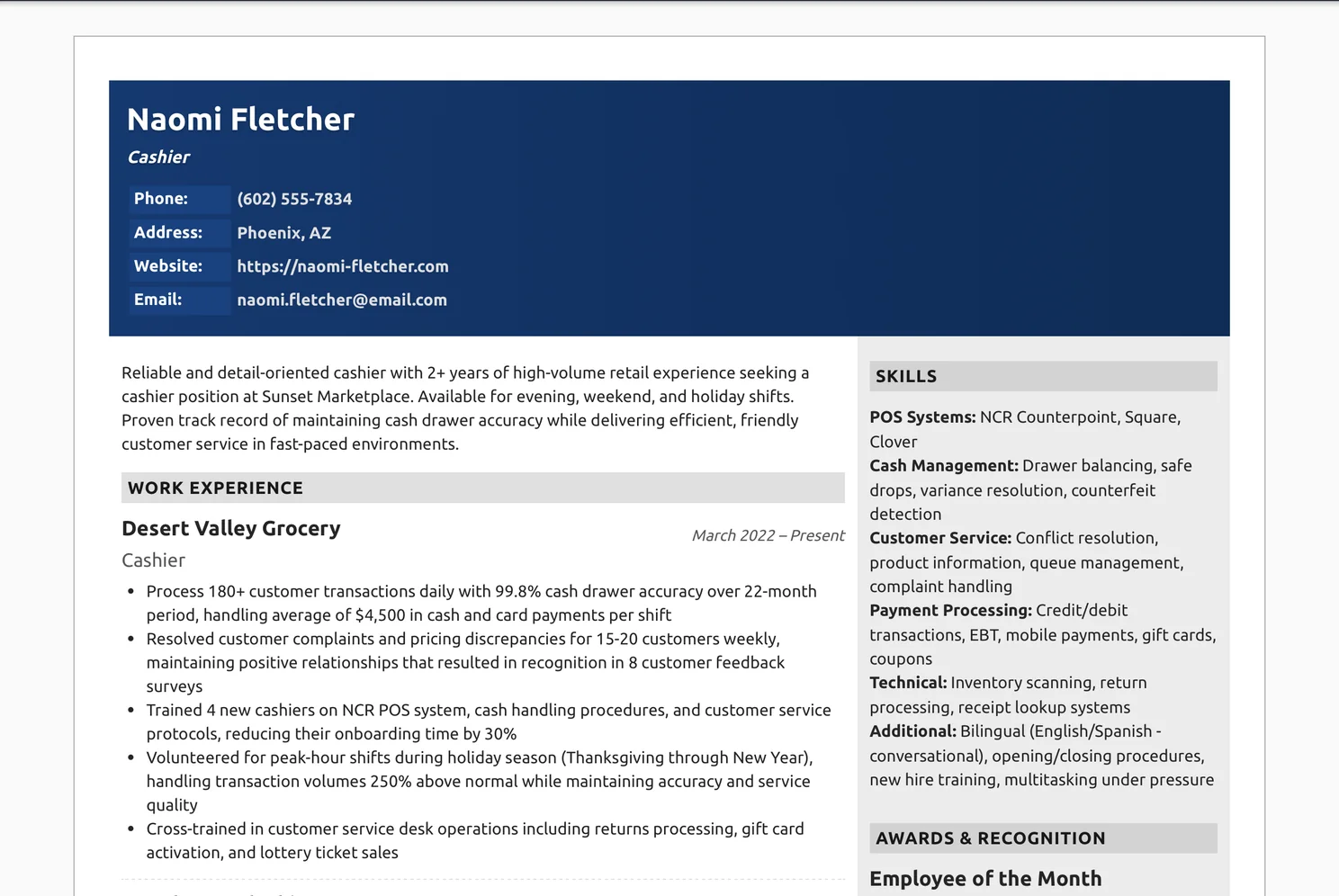
The Best Cashier Resume Example/Sample
https://www.resumonk.com/cashierCashierResume Format to Follow for a Cashier Resume
The reverse-chronological format is your strongest choice here. Why? Because hiring managers for cashier positions want to see a clear, straightforward progression of your work history. They're scanning dozens, sometimes hundreds, of resumes for these positions, and they need to quickly understand whether you have relevant experience, how long you stayed in previous roles, and whether there are any concerning gaps.
This format lists your most recent experience first and works backward through time, making it immediately clear what you've been doing lately.
Why Reverse-Chronological Works Best for Cashiers
Think about what a store manager or hiring supervisor is actually looking for when they post a cashier opening. They need someone who can start quickly, learn their specific point-of-sale system, and handle the pressures of rush hours without crumbling. If you've worked as a cashier before - even at a different type of store - that experience translates directly.
The reverse-chronological format puts that relevant experience right at the top where it belongs.
If you're entering the workforce for the first time, or you've been out of work for a while, you might be tempted to use a functional format that emphasizes skills over work history. Resist this urge. Hiring managers in retail have seen every format imaginable, and functional resumes often raise red flags. They wonder what you're trying to hide. Instead, use the reverse-chronological format and be strategic about what you include. Your three-month stint at a summer camp where you handled the merchandise counter? That counts. Your volunteer work at a church bake sale where you managed cash?
That's relevant experience.
Structuring Your Cashier Resume
Your resume should flow in this order: contact information at the top, followed by a brief objective or summary statement (optional but useful for career changers or first-time job seekers), your work experience section, your education, and finally a skills section. Keep the entire document to one page.
You're not applying to be a department head - you're applying for a position where your reliability, accuracy, and customer service abilities matter most, and all of that can be demonstrated concisely.
The contact information section is straightforward, but don't overlook its importance. Include your full name, phone number, email address, and city and state (you don't need your full street address anymore). Make sure your email address is professional - this is the time to retire that [email protected] you made in high school.
Work Experience on a Cashier Resume
Your work experience section is where you prove you can do what the job requires.
As a cashier, you're not managing people or developing corporate strategy, but you are performing a role that requires precision, speed, consistency, and interpersonal skills. Every single shift, you're handling situations that could cost the business money or customers if done wrong. That's what you need to communicate in this section.
What to Include in Each Work Experience Entry
For each position you list, start with the job title, company name, location (city and state), and dates of employment.
The dates should show month and year - being vague here looks suspicious. Under each position, include bullet points that describe what you actually did and, more importantly, what you achieved or how you added value.
Here's where many cashier resumes fall flat. They list duties that are obvious and generic, like "Operated cash register" or "Helped customers." Every cashier does these things. What made you different? Did you maintain perfect accuracy in your drawer? Did you process transactions quickly during peak hours? Were you specifically requested by regular customers? Did you cross-sell or upsell products?
These specifics transform a bland list of duties into a compelling picture of a valuable employee.
How to Describe Your Cashier Experience
Use action verbs to start each bullet point. Processed, handled, maintained, assisted, resolved, managed, balanced - these verbs show you were actively engaged in your work, not passively present. Then, whenever possible, add numbers. Numbers give context and scale to your accomplishments. Saying you "handled transactions" is fine, but saying you "processed an average of 150 transactions per shift while maintaining 99.8% accuracy rate" tells a much more impressive story.
Let's look at how this plays out in practice:
❌ Don't write vague, duty-focused descriptions:
Cashier at SaveMart
- Operated cash register
- Helped customers
- Kept area clean
✅ Do write specific, achievement-focused descriptions:
Cashier at SaveMart
- Processed 150+ customer transactions daily with 99.7% drawer accuracy over 18-month period
- Resolved customer complaints and price discrepancies, maintaining positive relationships that resulted in recognition in 3 customer feedback surveys
- Trained 5 new cashiers on POS system and cash handling procedures
- Volunteered for peak-hour shifts during holiday season, handling transaction volumes 200% above normal
Addressing Different Experience Levels
If you're applying for your first cashier position, you might be worried about not having directly relevant experience.
The reality is that many skills transfer. Babysitting requires responsibility and handling money. Food service involves customer interaction and working under pressure. School projects demonstrate reliability and ability to follow procedures. Volunteer work on your resume shows initiative. Frame these experiences in terms of what they taught you that applies to cashier work.
For someone with extensive cashier experience, your challenge is different. You want to show growth and consistency without being repetitive. If you've held three different cashier positions, you don't need to list identical bullet points for each. Instead, highlight different aspects of each role or show progression. Maybe your first role was about learning the basics, your second role involved training others, and your current role includes additional responsibilities like opening or closing procedures.
Handling Employment Gaps
Gaps happen.
Maybe you took time off to care for a family member, went back to school, or struggled to find work during difficult economic times. The reverse-chronological format will show these gaps, and that's okay. What matters is how you handle them. If the gap is recent and short (a few months), you might not need to address it at all in the resume itself. If it's longer or the interviewer asks, be prepared with a brief, honest explanation that pivots back to your enthusiasm for the position.
Skills to Show on a Cashier Resume
The skills section of your cashier resume is where you get to explicitly list the capabilities that make you effective in this role.
But here's the thing about skills on a resume - simply listing them doesn't mean much unless you've also demonstrated them in your work experience section. The skills section should reinforce what your experience already shows, not introduce brand new claims that aren't supported elsewhere in your resume.
Hard Skills for Cashiers
Hard skills are the technical, teachable abilities that can be measured and evaluated. For cashiers, these are concrete capabilities like operating specific types of point-of-sale systems, handling different payment methods, or performing basic math calculations.
These matter because they show you can handle the tactical requirements of the job.
List specific POS systems you know how to use - Square, Clover, NCR, Shopify POS, Toast, whatever systems you've actually worked with. Don't claim expertise with systems you've never touched, because you'll be expected to hit the ground running if that's what the employer uses. If you're familiar with multiple systems, that's a genuine advantage because it shows adaptability and reduces training time.
Other hard skills to consider including: cash handling and drawer balancing, credit card processing, inventory scanning and tracking, basic math and calculation skills, multi-line phone operation, gift card activation and management, return and exchange processing, counterfeit detection, and safe drop procedures. Only list skills you actually possess and can discuss if asked.
Soft Skills for Cashiers
Soft skills are the interpersonal and character qualities that affect how you work. For cashiers, these are absolutely critical because you're in constant contact with customers, many of whom are impatient, tired, or frustrated.
Your ability to stay calm, communicate clearly, and maintain professionalism directly impacts the customer experience and, by extension, the business's reputation and revenue.
The most valuable soft skills for cashiers include customer service orientation, attention to detail, reliability and punctuality, stress management, communication skills, problem-solving ability, teamwork, adaptability, honesty and integrity, and multitasking capacity. Notice that several of these relate to character - hiring managers for cashier positions care deeply about trustworthiness because you're handling money and representing their business.
How to Present Skills Effectively
Don't simply dump a list of 20 skills into your resume hoping something sticks. Be selective and strategic.
Choose 8-12 skills that are most relevant to the specific cashier position you're applying for, and make sure each one is backed up by something in your work experience section.
Here's what weak skills presentation looks like:
❌ Don't create a generic, unsupported list:
SKILLS
Good with people, Fast learner, Hard worker, Team player, Cash register, Computers, Customer service, Responsible, Detail-oriented
✅ Do create a targeted, specific list that connects to the role:
SKILLS
- POS Systems: Square, Clover, NCR Counterpoint
- Cash Management: Drawer balancing, safe drops, variance resolution
- Customer Service: Conflict resolution, product information, queue management
- Technical: Credit/debit processing, inventory scanning, coupon systems
- Additional: Bilingual (English/Spanish), Opening/closing procedures, New hire training
Matching Skills to the Job Posting
Read the job posting carefully and note which skills they emphasize. If they mention "fast-paced environment" three times, your resume should reflect your ability to work efficiently under pressure. If they highlight "friendly customer service," make sure that's evident in both your skills section and your work experience bullet points.
This isn't about lying or fabricating skills - it's about emphasizing the genuine skills you possess that matter most to this particular employer.
The Bilingual Advantage
If you speak multiple languages, this is a significant advantage in many retail environments and deserves prominent placement.
Don't bury it in a list. Call it out clearly with your proficiency level. Being bilingual can literally make you more valuable to the business because you can serve a wider customer base and assist coworkers who might struggle with language barriers.
Specific Considerations and Tips for Cashier Resumes
There are nuances to cashier resumes that don't apply to other positions, largely because of what the role represents in the employment ecosystem and retail environment. Understanding these specific considerations can mean the difference between a resume that gets a callback and one that disappears into the pile.
The Trustworthiness Factor
More than almost any other entry-level position, cashier roles require employers to trust you immediately with something valuable: their money. Every shift, you're handling hundreds or thousands of dollars in cash, processing credit transactions, and operating in a position where theft or carelessness could cause significant losses.
Your resume needs to radiate reliability and honesty without explicitly saying "I promise I won't steal," which would be weird and counterproductive.
How do you communicate trustworthiness on paper? Through consistency and detail. Long tenure at previous jobs signals reliability. Perfect or near-perfect drawer accuracy rates signal carefulness. Responsibilities like closing procedures or training others signal that previous employers trusted you with important tasks. References from previous supervisors (mentioned as "available upon request" or provided separately) carry weight.
Any employment gaps or job-hopping should be minimized or explained if possible, because hiring managers will wonder about them.
Emphasizing Availability and Flexibility
Retail operates on schedules that don't respect traditional business hours. Stores need cashiers during evenings, weekends, and holidays - exactly when most people want time off. If you have flexible availability, this is actually a competitive advantage that belongs on your resume.
Not in the skills section, but possibly in your objective statement or as a brief note in your contact information area.
Something like "Available for evening, weekend, and holiday shifts" can catch a hiring manager's eye, especially if they're desperately trying to fill difficult time slots. If you're only available during specific hours due to school or other commitments, be upfront about that too - it's better to eliminate a bad fit early than to get hired and immediately request schedule changes.
Handling Limited Work History
Many people applying for cashier positions are entering the workforce, returning after a long absence, or pivoting from a completely different field. Limited work history isn't automatically disqualifying - employers expect it for entry-level positions - but you need to fill the space with something that demonstrates you're a functional, reliable person.
Education becomes more prominent when work history is thin. Include your high school or GED, your graduation date (or expected graduation date), and your GPA if it's 3.5 or above. Relevant coursework, especially in math or business, can be mentioned. Academic awards or perfect attendance records demonstrate the kind of consistency that employers value.
Volunteer work, school activities, and community involvement all demonstrate that you're active and engaged. If you volunteered at a charity event that involved handling donations or merchandise, that's directly relevant. If you were treasurer of a school club, you managed money. If you participated in sports, you understand teamwork and showing up consistently.
Frame these experiences in terms of skills gained that apply to cashier work.
The Red Flags to Avoid
Certain things on a cashier resume raise immediate concerns. Job-hopping through multiple positions with short tenures suggests unreliability. A gap in employment spanning years without explanation creates questions. Typos and grammatical errors signal carelessness - if you can't proofread a one-page document about yourself, why would an employer trust you with their cash drawer?
An unprofessional email address suggests poor judgment.
Here's an important one: don't badmouth previous employers anywhere in your resume or cover letter. It's tempting to explain why you left a job by saying your old boss was terrible or the workplace was toxic, but this reflects poorly on you, not them.
Keep it professional and neutral.
The Cover Letter Connection
While this guide focuses on resumes, it's worth noting that a brief, well-written cover letter can significantly strengthen a cashier application, especially if you're career-changing, have employment gaps, or are competing against many similar candidates. The cover letter is where you explain your enthusiasm for the specific position, address any potential concerns proactively, and show that you understand what the role requires.
It doesn't need to be long - three concise paragraphs will do - but it should sound like you actually care about this particular job, not like you're mass-applying to every cashier opening in town.
Regional and Industry Variations
Cashier expectations and norms can vary by region and industry.
A cashier at an upscale boutique has different requirements than a cashier at a busy fast-food restaurant or a large-volume discount store. Research the specific employer and tailor your resume accordingly. The boutique cares about presentation and personalized service; the fast-food restaurant cares about speed and efficiency during rushes; the discount store cares about accuracy when processing high transaction volumes. Your resume should emphasize the qualities that matter most to that particular environment.
In terms of geographic differences, the basic principles remain the same across the USA, UK, Canada, and Australia, but terminology can vary. In the UK, "cashier" might be called "till operator" or "checkout operator" in some retail environments, though cashier is still widely understood.
The format and content advice remains consistent across regions - reverse-chronological format, one page, quantified achievements, and demonstrated reliability.
The Follow-Up Strategy
This isn't strictly about the resume itself, but it's worth mentioning: after submitting your cashier resume, following up appropriately can set you apart. Many candidates submit applications and then wait passively. A brief, polite follow-up after a few days - either a phone call or an in-person visit during a slow time - shows initiative and genuine interest. It also demonstrates the kind of proactive communication skills that good cashiers need.
Just don't overdo it; one follow-up is professional, multiple follow-ups become harassment.
Keeping Your Resume Updated
Even after you land a cashier position, keep your resume current. Add new skills as you learn them, update your achievements as they accumulate, and refine your descriptions based on what you're actually doing in the role. If you're eventually promoted or take on additional responsibilities, document them in real-time rather than trying to remember everything months or years later.
This habit serves you whether you're staying in retail long-term or using the cashier position as a stepping stone to something else.
Your cashier resume is a living document that represents not just where you've been, but where you're going. Treat it with the same care and attention to detail that you'd bring to balancing a cash drawer, and it will serve you well.
Education to List on a Cashier Resume
Most cashier positions require a high school diploma or equivalent (GED), and that's genuinely all you need to list in many cases.
If you're a high school student or recent graduate, you're actually in the sweet spot for these roles. If you're someone with a college degree applying for cashier work (perhaps while between jobs, shifting careers, or needing flexible part-time work), you might wonder whether to include that degree at all. The answer is yes, but keep it simple and don't overthink it.
Formatting Your Education Section
Place your education section toward the bottom of your resume, after your work experience and skills. Why? Because for cashier roles, employers care much more about your customer service experience, your availability, and your reliability than where you went to school.
The education section serves as a checkbox item rather than a selling point.
Use a reverse-chronological format, listing your most recent education first. Include the name of the institution, the degree or diploma earned, and the graduation date (or expected graduation date if you're still enrolled). You can include your location (city and state), but it's optional for this role.
Here's how to structure it cleanly:
High School Diploma
Lincoln High School, Portland, OR
Graduated: June 2023
If you're currently in high school, you can write:
High School Diploma (Expected May 2025)
Roosevelt High School, Seattle, WA
What to Include and What to Skip
For cashier positions, keep your education section lean.
You don't need to include your GPA unless it's 3.5 or above and you're a very recent graduate with limited work experience. Even then, it's optional. Employers hiring cashiers aren't scrutinizing academic performance; they're looking for dependability and people skills.
If you've taken some college courses but haven't completed a degree, you can still list this education. It shows initiative and that you're working toward something, which can be a positive signal about your work ethic.
Associate of Arts (In Progress)
Portland Community College, Portland, OR
Expected Graduation: May 2026
Or if you've completed some coursework but aren't currently enrolled:
Completed 45 credit hours toward Associate Degree
City College of San Francisco, San Francisco, CA
2022-2023
Special Situations Worth Addressing
If you have a bachelor's degree or higher and you're applying for cashier work, list it without embellishment. Some applicants worry that being "overqualified" will hurt their chances, but omitting education entirely can create unexplained gaps in your timeline.
Most hiring managers understand that people work cashier jobs for many valid reasons - flexible scheduling, second jobs, career transitions, or simply needing employment while figuring out next steps.
Bachelor of Arts in English
State University, Austin, TX
Graduated: May 2022
If you earned your GED rather than a traditional high school diploma, list it proudly. There's absolutely no stigma in retail environments, and it fulfills the educational requirement just the same.
GED Certificate
Arizona Department of Education
Earned: August 2023
Relevant Coursework and Certifications
For most cashier applications, listing specific coursework is unnecessary and takes up valuable space.
However, if you've completed any certifications relevant to the retail or hospitality environment, mention them in your education section or create a separate "Certifications" section. Examples might include food handler's permits (if applying to grocery stores), responsible beverage service training (for convenience stores selling alcohol), or basic first aid certification.
One thing to absolutely avoid is padding your education section with irrelevant details. Cashier hiring managers review dozens or hundreds of applications, and they can spot filler material instantly.
❌ Don't - Overload with irrelevant academic details:
High School Diploma, GPA: 3.2
Washington High School, Miami, FL
Graduated: June 2023
Relevant Coursework: Algebra II, American History, Biology
Activities: Member of Chess Club, Volunteer at Animal Shelter
Dean's List: Fall 2022
✅ Do - Keep it clean and relevant:
High School Diploma
Washington High School, Miami, FL
Graduated: June 2023
The bottom line is this: your education section for a cashier resume is about meeting the baseline requirement and showing you're a credible candidate. It shouldn't be the star of your resume, and it definitely shouldn't distract from your actual cashier skills, customer service abilities, and work reliability.
Get it done efficiently, keep it honest, and move on to the sections that actually matter for this role.
Awards and Publications on a Cashier Resume
Most cashier resumes don't need an awards section, but there are legitimate scenarios where including awards or recognitions can actually strengthen your cashier application. The key is understanding what types of achievements are relevant and how to present them without making your resume feel padded or disconnected from the job you're seeking.
When Awards Actually Matter for Cashier Applications
If you've previously worked in retail, hospitality, or customer service and received recognition, that's absolutely worth including. "Employee of the Month" awards, customer service excellence recognitions, perfect attendance certificates, or sales achievement awards all signal that you were a standout performer in a similar environment.
These aren't just nice-to-haves - they're proof that you've already succeeded in the kind of work environment you're applying to join.
Here's how to include workplace awards effectively:
Employee of the Month, Target Store #1247 (March 2023)
Recognized for maintaining 100% cash drawer accuracy and highest customer satisfaction scores in department
Notice how the example above doesn't just name the award but briefly explains why you received it. That context matters because it connects the recognition directly to cashier-relevant skills.
Academic awards can be included if you're a recent high school graduate with limited work experience, but choose selectively. Perfect attendance, honor roll, or character awards (like integrity, responsibility, or citizenship recognitions) are more relevant than subject-specific academic achievements. Why? Because they signal reliability, consistency, and positive behavior - exactly what cashier employers want to see.
❌ Don't - List irrelevant academic achievements:
AWARDS
- First Place, Regional Science Fair (2022)
- National Merit Scholar Semifinalist
- AP Scholar with Distinction
- Math Department Award for Excellence in Calculus
✅ Do - Highlight character and reliability recognitions:
AWARDS & RECOGNITION
- Perfect Attendance Award (2022-2023 school year)
- Principal's Character Award for Integrity and Responsibility (2023)
- Community Service Recognition, 100+ volunteer hours (2022-2023)
Community and Volunteer Recognitions
If you've received awards through volunteer work, community service, or extracurricular activities, consider whether they demonstrate qualities valuable in a cashier. Leadership in community organizations, volunteer recognitions, or youth group achievements can show initiative, teamwork, and people skills.
These are particularly useful for younger applicants who may not have extensive paid work experience yet.
What About Publications?
Here's where we get really practical: publications are almost never relevant for cashier applications.
Unless you've written something directly related to retail, customer service, or the specific industry you're applying to (and even then, it's a stretch), skip this entirely. Having a high school newspaper article or a social media blog doesn't strengthen a cashier application - it just takes up space that could be used for more relevant information.
The one narrow exception might be if you've contributed to a company newsletter or training materials in a previous retail job, and you want to demonstrate your engagement and initiative. Even then, this is better mentioned in your job description for that role rather than in a separate publications section.
Structuring an Awards Section
If you do have relevant awards to include, create a simple section titled "Awards & Recognition" or just "Recognition" and place it near the bottom of your resume, after your experience and skills but potentially before education. Keep each entry to one or two lines maximum, and include only awards from the past 3-4 years unless they're exceptionally relevant.
List them in reverse-chronological order, most recent first. Include the award name, the organization that gave it, and the year. If space allows and it adds context, include a brief phrase explaining the recognition.
When to Skip This Section Entirely
If your only awards are from elementary school, are more than five years old, or have nothing to do with work ethic, customer service, reliability, or teamwork, leave this section off your resume entirely. It's far better to have a concise, relevant one-page resume than to pad it with material that makes hiring managers question your judgment about what matters for the role.
Remember that for cashier positions, your work experience, availability, skills, and references carry infinitely more weight than awards or publications. If including an awards section means cutting important details from your work experience or skills section, skip the awards. The hiring manager reviewing your application cares about whether you can handle money accurately, treat customers well, and show up for your shifts reliably. If your awards speak to those qualities, include them. If they don't, use that resume space for something that does.
Listing References on Your Cashier Resume
The good news is that reference expectations for cashier positions are straightforward and practical.
You don't need high-profile executives or academic department chairs vouching for you. You need people who can speak honestly about your reliability, work ethic, and interpersonal skills.
Should References Go On Your Resume?
Here's the current standard practice: do not list your actual references directly on your resume.
Instead, prepare a separate reference sheet that you can provide when requested, either during the application process or at the interview. Most cashier applications will ask for references at some point - either in an online application form, on a paper application in-store, or when you reach the final stages of hiring.
You also don't need to include the phrase "References available upon request" at the bottom of your resume. This was common practice 20 years ago, but it's now considered outdated and a waste of valuable space. Hiring managers assume you have references available; they'll ask for them when they need them.
The exception to this is if a job posting specifically requests that you include references with your application. In that case, prepare your reference sheet as a separate document that matches the formatting of your resume (same font, same header with your name and contact information) and submit it along with your resume and cover letter if applicable.
Who Should You Ask to Be a Reference?
The best references for cashier applications are people who have directly supervised your work or observed your reliability and interpersonal skills in a professional or structured volunteer setting.
If you have previous work experience, former supervisors or managers are your strongest options. If this is your first job, teachers, volunteer coordinators, coaches, or community leaders who know you well can serve as references.
Here's what makes a strong reference for a cashier position:
- They can speak specifically about your reliability (attendance, punctuality, following through on commitments)
- They've observed how you interact with others (customers, teammates, the public)
- They can comment on your honesty and trustworthiness
- They've seen you handle responsibility or work with minimal supervision
- They have a professional or semi-professional relationship with you (not family members or friends)
Former managers or supervisors from retail, food service, hospitality, or customer service jobs are ideal because they can speak directly to skills that transfer to cashier work. If you're transitioning from a completely different field, choose references who can at least speak to your work ethic and interpersonal qualities.
If you're a student or recent graduate applying for your first cashier job, appropriate references include:
- Teachers who know you well and can speak to your responsibility and character
- Volunteer coordinators from community service organizations
- Coaches from sports teams or advisors from school clubs
- Leaders from religious or community youth groups
- Supervisors from summer programs, internships, or informal work like babysitting or lawn care
❌ Don't - Use family, friends, or inappropriate references:
REFERENCES
Sarah Johnson (Aunt) - (555) 123-4567
Can speak to my character and work ethic
Mike Chen (Friend) - (555) 234-5678
We went to school together
Pastor Williams (Family Friend) - (555) 345-6789
Has known me since childhood
✅ Do - Use professional or supervisory references:
REFERENCES

1. Jennifer Martinez, Store Manager, FreshMart Grocery, Portland, OR
- Phone: (555) 123-4567 | Email: [email protected]
- Supervised my work as a bagger and stock clerk for 8 months

2. Robert Kim, Volunteer Coordinator Portland Food Bank
- Phone: (555) 234-5678 | Email: [email protected]
- Supervised my volunteer work for two years

3. Ms. Patricia Gordon, English Teacher, Lincoln High School, Portland, OR
- Phone: (555) 345-6789 | Email: [email protected]
- Can speak to my reliability and work ethic as a student
How Many References Do You Need?
Prepare three references for cashier applications. This is the standard number that most employers request, and it's enough to give a complete picture without overwhelming the hiring manager.
If you're just starting out and finding three professional references feels challenging, two solid references are acceptable, but try to reach three if at all possible.
What Information to Include for Each Reference
For each reference, provide the following information clearly formatted on your reference sheet:
- Full name and professional title
- Organization or company name
- Phone number (preferably a direct line or cell number where they can be reached easily)
- Email address
- A brief phrase explaining your relationship (optional but helpful)
The relationship explanation helps the hiring manager understand the context of the reference. Keep it to one short line:
David Thompson, Assistant Manager
SaveMart Grocery, Seattle, WA (555) 456-7890
[email protected]
Direct supervisor during my employment from June 2023 - Present
Getting Permission and Preparing Your References
This is critical: always ask someone's permission before listing them as a reference.
This isn't just polite; it's practical. When a hiring manager calls, you want your reference to be expecting the call, prepared to speak about you, and genuinely willing to provide a positive recommendation. A surprised reference who wasn't expecting the call can fumble the conversation or even sound less enthusiastic than they actually are.
When you ask someone to be a reference, do it respectfully and give them an easy out if they're not comfortable:
"Hi Ms. Martinez, I'm applying for a cashier position at Riverside Grocery and was hoping you'd be willing to serve as a professional reference for me. Would you be comfortable speaking about my reliability and customer service skills from when I worked at FreshMart? I completely understand if you're not able to."
Once they agree, provide them with some context about the job you're applying for and remind them of specific accomplishments or qualities that are relevant. This helps them give a stronger, more detailed reference:
"Thank you so much! The position is for a cashier at a busy grocery store, so they'll likely ask about my reliability, how I handle customers, and my accuracy with transactions. I wanted to remind you that during my time at FreshMart, I maintained perfect attendance and received those customer compliments that you mentioned in my review. I'll let you know when I submit the application so you can expect a possible call in the next week or two."
Regional Differences in Reference Practices
Reference practices are fairly consistent across the United States, Canada, and Australia for cashier-level positions. However, there are some nuances worth noting:
In the United States, it's standard to provide full contact information including phone and email for references. Employers will typically call references rather than email them.
In Canada, practices are virtually identical to the US, though employers in some regions may request references earlier in the process.
In Australia, references are often called "referees," but the concept and expectations are the same. Australian employers may be slightly more likely to check references before offering an interview, so have your reference sheet prepared early in your application process.
In the United Kingdom, reference practices differ more significantly. UK employers often require references but typically contact them only after offering you the position, as part of the final hiring verification. References in the UK are more formal and may be requested in writing rather than by phone.
If you're applying for cashier positions in the UK, prepare your references but understand they may not be contacted until later in the process.
What If You Don't Have Professional References?
If you're applying for your very first job and genuinely don't have any teachers, coaches, or volunteer supervisors who can serve as references, you'll need to build some quickly. The best approach is to start volunteering immediately - even a few weeks of consistent volunteer work at a food bank, community center, or local charity can give you a reference who can speak to your reliability and attitude.
Alternatively, if you've done any informal paid work like babysitting, lawn care, or pet sitting for neighbors, those clients can potentially serve as character references, though they're weaker than professional references.
One thing to absolutely avoid is fabricating references or listing people who can't actually speak about your work or character. Hiring managers often do check references, and discovering that a reference is fake or that the person has no meaningful knowledge of you will immediately disqualify you from consideration and potentially damage your reputation in the local job market.
Formatting Your Reference Sheet
Create your reference sheet as a separate document with the same header formatting as your resume to maintain a professional, cohesive appearance. At the top, include your name and contact information in the same style as your resume.
Title the document "References" and list your references with clear spacing between each entry.
Save the document as "YourName_References.pdf" so it's easy to identify if you need to upload it or email it as an attachment. Keep both a digital copy on your phone and a printed copy with your resume so you're prepared for any application scenario, whether you're applying online or in person.
The bottom line with references for cashier applications is this: they're about verification, not validation. The hiring manager isn't looking for someone to tell them you're extraordinary; they're looking for confirmation that you're reliable, trustworthy, and capable of doing the job competently. Choose references who can provide that confirmation credibly, prepare them for potential calls, and keep your reference sheet formatted professionally and ready to go. When the time comes to provide references, you'll handle it smoothly and confidently, which is exactly the impression you want to leave throughout the entire application process.
Cover Letter Tips for Your Cashier Resume
Here's what makes cover letters tricky for cashier positions: you don't want to oversell or sound like you're applying for a corporate leadership role, but you also don't want to undersell yourself or sound completely indifferent about the job. The sweet spot is showing genuine interest, highlighting your relevant strengths, and making it easy for the hiring manager to see why you'd be reliable and pleasant to work with.
What Your Cashier Cover Letter Should Accomplish
Your cover letter has three jobs, and three jobs only. First, it should make clear which position you're applying for and how you heard about it (especially useful in retail environments where managers might be hiring for multiple positions). Second, it should highlight two or three specific qualities or experiences that make you a strong cashier candidate.
Third, it should communicate your availability and enthusiasm for the role without sounding desperate or overeager.
That's it. You're not writing a personal essay about your life story, and you're not crafting a philosophical treatise on the meaning of customer service. You're giving a hiring manager who's probably reviewing 30+ applications a quick, clear reason to move your resume into the "interview" pile.
Structure and Length
Keep your cashier cover letter to three or four short paragraphs that fit comfortably on half a page.
Retail and hospitality managers are busy people who value efficiency. A concise cover letter signals that you understand the pace of the environment you're applying to.
Start with a straightforward opening that identifies the position and where you saw it posted:
Dear Hiring Manager,
I am writing to apply for the Cashier position at Riverside Grocery, which I saw posted on your store's community board. I am available to work evenings and weekends and am excited about the opportunity to join your team.
Notice what this opening does: it's specific (names the store), shows you've actually visited the location, states your availability upfront (one of the most important factors in hiring decisions), and conveys genuine interest. It's professional but not stiff.
Your middle paragraph should highlight relevant experience or qualities. If you have previous cashier or customer service experience, mention it specifically with a brief example. If this is your first job, focus on transferable skills and personal qualities.
❌ Don't - Write vague, generic claims:
I am a hard worker who is good with people and learns quickly. I am responsible and reliable. I think I would be a great fit for your team because I am passionate about customer service and committed to excellence in everything I do.
✅ Do - Provide specific, credible examples:
I have eight months of experience as a cashier at FreshMart, where I maintained accuracy in handling cash and card transactions while serving 80+ customers during typical evening shifts. My manager recognized me for maintaining a friendly attitude even during rush periods, and I received positive feedback from several regular customers who appreciated my efficiency and helpfulness.
If you're applying for your first job, your approach should be slightly different but still specific:
While this would be my first paid position, I have developed strong people skills and attention to detail through volunteer work at the Highland Community Center, where I helped manage visitor check-ins and answered questions for an average of 50 people per shift. I am comfortable with technology, reliable with responsibilities, and genuinely enjoy interacting with people in a fast-paced environment.
Addressing Availability and Logistics
One of the most important things you can do in a cashier cover letter is clearly state your availability. This is often the deciding factor in hiring decisions, especially for retail positions that need coverage during specific shifts.
Don't make the hiring manager hunt for this information or wait until the interview to bring it up.
I am available to work 20-30 hours per week, including evenings, weekends, and holidays. I can start immediately and am looking for a stable, long-term position.
This kind of specificity is gold for a retail hiring manager. It immediately answers major questions and positions you as someone who understands what the job requires.
Closing Your Cover Letter
End with a brief closing paragraph that thanks them for their consideration and expresses your interest in discussing the position further. Include your contact information even though it's also on your resume.
Thank you for considering my application. I would welcome the opportunity to discuss how I can contribute to your team. I can be reached at (555) 123-4567 or [email protected] and am available for an interview at your convenience.
Sincerely,
Your Name
Tone and Language Considerations
The tone of your cashier cover letter should be professional but personable.
You're not applying to a law firm, so you don't need to sound like you're writing a legal brief. At the same time, you're not texting a friend, so avoid casual language, slang, or emoji. Think of it as how you'd speak to a teacher or a friend's parent - respectful, clear, and genuine.
Avoid retail-specific jargon or buzzwords that sound like you copied them from a generic template. Words like "synergy," "leverage," "dynamic," or "results-driven" feel out of place in a cashier application.
Instead, use straightforward language that describes real qualities and experiences.
When to Skip the Cover Letter
If you're applying through a mobile app or quick-apply system that doesn't have a clear place to upload a cover letter, don't stress about it.
Focus your energy on making your resume as strong as possible. Similarly, if you're walking into a store and asking about job openings, having your resume ready is more important than having a cover letter in hand. You can express your interest and availability verbally in that scenario.
However, if you're applying to a local business, a boutique store, or any position where your application goes directly to an owner or manager rather than through an automated system, including a cover letter shows extra effort and professionalism that can genuinely make a difference. In these situations, the cover letter isn't just a formality - it's often the first impression of your communication skills and your attitude toward work.
Key Takeaways
Building an effective cashier resume comes down to understanding what the role requires and presenting yourself as someone who can meet those requirements reliably. Here are the essential points to remember as you create your resume:
- Use the reverse-chronological format - List your most recent experience first and work backward, giving hiring managers the clearest picture of what you've been doing lately and whether you have relevant experience
- Keep it to one page - Cashier positions don't require extensive documentation of your career history; focus on being concise and relevant rather than comprehensive
- Quantify your achievements in the work experience section - Instead of listing generic duties like "operated cash register," provide specific numbers like "processed 150+ transactions daily with 99.7% drawer accuracy over 18 months"
- Emphasize reliability and trustworthiness throughout - These qualities matter more than almost anything else for cashier roles since you're handling money and representing the business directly to customers
- Create a targeted skills section with 8-12 relevant abilities - Include specific POS systems you know, cash handling capabilities, and interpersonal skills like customer service and stress management, making sure each skill connects to something in your work experience
- State your availability clearly - If you can work evenings, weekends, or holidays, make this obvious either in your objective statement or work experience section, as schedule flexibility is often a deciding factor in hiring
- Keep education simple and appropriately positioned - List your high school diploma or GED toward the bottom of your resume; it's a checkbox requirement, not a selling point for this role
- Only include awards if they're relevant - Employee of the month recognitions, perfect attendance records, and customer service awards strengthen your application; academic honors in subjects unrelated to cashier work just take up space
- Prepare a separate reference sheet - Don't list references on your resume itself, but have 3 professional references ready to provide when requested, ideally former supervisors who can speak to your reliability and customer service abilities
- Consider adding a brief cover letter when applying to smaller businesses - While often optional for large chain retailers, a concise 3-paragraph cover letter can set you apart when applying to local stores where your application goes directly to a manager or owner
- Proofread obsessively - Typos and errors on a one-page document about yourself signal carelessness; if you can't proofread your own resume, employers won't trust you with their cash drawer
- Tailor your resume to each specific employer when possible - A cashier at an upscale boutique needs different emphasized qualities than a cashier at a high-volume discount store; adjust your skills and experience descriptions to match the environment you're applying to
Creating your cashier resume doesn't have to be a frustrating process of staring at blank templates and wondering what to write. Resumonk makes it straightforward to build a professional, well-formatted resume that presents your experience and skills effectively. The platform offers clean, professional templates designed specifically for entry-level positions like cashier roles, with intuitive formatting that keeps everything on one page and easy to scan. You can input your work history, education, and skills, and the system helps you organize everything in the reverse-chronological format that hiring managers expect. Plus, you'll get AI-powered suggestions for improving your bullet points and descriptions, helping you transform basic job duties into achievement-focused statements that actually demonstrate your value. Whether you're creating your very first resume or updating an existing one for a new cashier application, Resumonk gives you the tools to present yourself professionally and confidently.
Ready to create a cashier resume that gets you hired?
Start building your professional resume with Resumonk today. Choose from beautifully designed templates, get AI-powered content suggestions, and create a resume that clearly demonstrates your reliability, customer service skills, and readiness for the role.
Get started with Resumonk now and take the first step toward landing your next cashier position.
More Retail resume examples
- Retail Sales Associate resume example
- Luxury Retail resume example
- Walmart Worker resume example
- Fragrance Sales Associate resume example
See all Retail resume examples, or browse every category.
Resume writing tips
You're here because you need a resume that will actually get you hired as a cashier, and you're probably feeling somewhere between cautiously optimistic and mildly stressed about the whole thing.
Maybe this is your first job ever and you're staring at a blank document wondering how to fill a page when you've never been paid to do anything before. Maybe you've worked as a cashier before and you're applying somewhere new, trying to figure out how to make "scanned items and took people's money" sound like something worth hiring you for. Or maybe you're in that awkward middle ground where you've done other kinds of work but never this specifically, and you're not sure which parts of your experience actually matter for a role that involves standing at a register for hours handling transactions.
Here's what you need to understand right up front about cashier positions. This is an entry-level role in retail, grocery, hospitality, or food service where you're the final touchpoint between the business and its customers. You're handling money, processing payments, answering basic questions, and keeping the checkout line moving without making costly mistakes or driving customers away with a terrible attitude. It's not glamorous, and it's definitely not a leadership position despite how some job postings make it sound with phrases like "Front End Sales Associate" or "Customer Experience Specialist." You're a cashier. The job is straightforward, the expectations are clear, and what employers care about most is whether you'll show up reliably, handle their cash drawer accurately, and treat their customers decently even when you're tired or the customer is being difficult.
That clarity about what the role actually is matters because it shapes everything about how you should build your resume. You're not trying to convince anyone you're going to revolutionize their checkout process or bring visionary leadership to the front end. You're trying to demonstrate that you're trustworthy with money, capable of basic customer interaction, and reliable enough to show up for the shifts they desperately need covered. Your resume needs to communicate those qualities clearly and concisely, ideally on a single page that a busy hiring manager can scan in about 30 seconds while standing at the customer service desk between handling returns.
In this guide, we're going to walk through exactly how to build that resume from top to bottom. We'll start with which format actually works for cashier applications and why the reverse-chronological approach beats the alternatives even if your work history feels thin or patchy. Then we'll dig into the work experience section and show you how to transform basic job duties into descriptions that prove you were good at what you did, using specific numbers and examples instead of generic claims that every other applicant is making. We'll cover the skills section and help you figure out which technical and interpersonal abilities actually matter for this role and how to present them in a way that matches what hiring managers are looking for. We'll talk about education and how much space to give it depending on where you are in life, and we'll address those specialty sections like awards and references that sometimes belong on a cashier resume and sometimes just waste space.
Throughout all of this, we'll give you specific examples of what works and what doesn't, showing you the difference between resume content that gets you an interview and content that gets your application tossed in the rejection pile. We'll also address the different situations you might be coming from, whether you're a high school student with zero work experience, someone with years of cashier work across multiple jobs, or a person with a completely different background who's applying for cashier work for practical reasons. By the end, you'll have a clear roadmap for creating a cashier resume that presents you honestly and strategically, maximizing your chances of getting that callback while staying true to what you've actually done and what you're genuinely capable of doing.
The Best Cashier Resume Example/Sample
https://www.resumonk.com/cashierCashierResume Format to Follow for a Cashier Resume
The reverse-chronological format is your strongest choice here. Why? Because hiring managers for cashier positions want to see a clear, straightforward progression of your work history. They're scanning dozens, sometimes hundreds, of resumes for these positions, and they need to quickly understand whether you have relevant experience, how long you stayed in previous roles, and whether there are any concerning gaps.
This format lists your most recent experience first and works backward through time, making it immediately clear what you've been doing lately.
Why Reverse-Chronological Works Best for Cashiers
Think about what a store manager or hiring supervisor is actually looking for when they post a cashier opening. They need someone who can start quickly, learn their specific point-of-sale system, and handle the pressures of rush hours without crumbling. If you've worked as a cashier before - even at a different type of store - that experience translates directly.
The reverse-chronological format puts that relevant experience right at the top where it belongs.
If you're entering the workforce for the first time, or you've been out of work for a while, you might be tempted to use a functional format that emphasizes skills over work history. Resist this urge. Hiring managers in retail have seen every format imaginable, and functional resumes often raise red flags. They wonder what you're trying to hide. Instead, use the reverse-chronological format and be strategic about what you include. Your three-month stint at a summer camp where you handled the merchandise counter? That counts. Your volunteer work at a church bake sale where you managed cash?
That's relevant experience.
Structuring Your Cashier Resume
Your resume should flow in this order: contact information at the top, followed by a brief objective or summary statement (optional but useful for career changers or first-time job seekers), your work experience section, your education, and finally a skills section. Keep the entire document to one page.
You're not applying to be a department head - you're applying for a position where your reliability, accuracy, and customer service abilities matter most, and all of that can be demonstrated concisely.
The contact information section is straightforward, but don't overlook its importance. Include your full name, phone number, email address, and city and state (you don't need your full street address anymore). Make sure your email address is professional - this is the time to retire that [email protected] you made in high school.
Work Experience on a Cashier Resume
Your work experience section is where you prove you can do what the job requires.
As a cashier, you're not managing people or developing corporate strategy, but you are performing a role that requires precision, speed, consistency, and interpersonal skills. Every single shift, you're handling situations that could cost the business money or customers if done wrong. That's what you need to communicate in this section.
What to Include in Each Work Experience Entry
For each position you list, start with the job title, company name, location (city and state), and dates of employment.
The dates should show month and year - being vague here looks suspicious. Under each position, include bullet points that describe what you actually did and, more importantly, what you achieved or how you added value.
Here's where many cashier resumes fall flat. They list duties that are obvious and generic, like "Operated cash register" or "Helped customers." Every cashier does these things. What made you different? Did you maintain perfect accuracy in your drawer? Did you process transactions quickly during peak hours? Were you specifically requested by regular customers? Did you cross-sell or upsell products?
These specifics transform a bland list of duties into a compelling picture of a valuable employee.
How to Describe Your Cashier Experience
Use action verbs to start each bullet point. Processed, handled, maintained, assisted, resolved, managed, balanced - these verbs show you were actively engaged in your work, not passively present. Then, whenever possible, add numbers. Numbers give context and scale to your accomplishments. Saying you "handled transactions" is fine, but saying you "processed an average of 150 transactions per shift while maintaining 99.8% accuracy rate" tells a much more impressive story.
Let's look at how this plays out in practice:
❌ Don't write vague, duty-focused descriptions:
Cashier at SaveMart
- Operated cash register
- Helped customers
- Kept area clean
✅ Do write specific, achievement-focused descriptions:
Cashier at SaveMart
- Processed 150+ customer transactions daily with 99.7% drawer accuracy over 18-month period
- Resolved customer complaints and price discrepancies, maintaining positive relationships that resulted in recognition in 3 customer feedback surveys
- Trained 5 new cashiers on POS system and cash handling procedures
- Volunteered for peak-hour shifts during holiday season, handling transaction volumes 200% above normal
Addressing Different Experience Levels
If you're applying for your first cashier position, you might be worried about not having directly relevant experience.
The reality is that many skills transfer. Babysitting requires responsibility and handling money. Food service involves customer interaction and working under pressure. School projects demonstrate reliability and ability to follow procedures. Volunteer work on your resume shows initiative. Frame these experiences in terms of what they taught you that applies to cashier work.
For someone with extensive cashier experience, your challenge is different. You want to show growth and consistency without being repetitive. If you've held three different cashier positions, you don't need to list identical bullet points for each. Instead, highlight different aspects of each role or show progression. Maybe your first role was about learning the basics, your second role involved training others, and your current role includes additional responsibilities like opening or closing procedures.
Handling Employment Gaps
Gaps happen.
Maybe you took time off to care for a family member, went back to school, or struggled to find work during difficult economic times. The reverse-chronological format will show these gaps, and that's okay. What matters is how you handle them. If the gap is recent and short (a few months), you might not need to address it at all in the resume itself. If it's longer or the interviewer asks, be prepared with a brief, honest explanation that pivots back to your enthusiasm for the position.
Skills to Show on a Cashier Resume
The skills section of your cashier resume is where you get to explicitly list the capabilities that make you effective in this role.
But here's the thing about skills on a resume - simply listing them doesn't mean much unless you've also demonstrated them in your work experience section. The skills section should reinforce what your experience already shows, not introduce brand new claims that aren't supported elsewhere in your resume.
Hard Skills for Cashiers
Hard skills are the technical, teachable abilities that can be measured and evaluated. For cashiers, these are concrete capabilities like operating specific types of point-of-sale systems, handling different payment methods, or performing basic math calculations.
These matter because they show you can handle the tactical requirements of the job.
List specific POS systems you know how to use - Square, Clover, NCR, Shopify POS, Toast, whatever systems you've actually worked with. Don't claim expertise with systems you've never touched, because you'll be expected to hit the ground running if that's what the employer uses. If you're familiar with multiple systems, that's a genuine advantage because it shows adaptability and reduces training time.
Other hard skills to consider including: cash handling and drawer balancing, credit card processing, inventory scanning and tracking, basic math and calculation skills, multi-line phone operation, gift card activation and management, return and exchange processing, counterfeit detection, and safe drop procedures. Only list skills you actually possess and can discuss if asked.
Soft Skills for Cashiers
Soft skills are the interpersonal and character qualities that affect how you work. For cashiers, these are absolutely critical because you're in constant contact with customers, many of whom are impatient, tired, or frustrated.
Your ability to stay calm, communicate clearly, and maintain professionalism directly impacts the customer experience and, by extension, the business's reputation and revenue.
The most valuable soft skills for cashiers include customer service orientation, attention to detail, reliability and punctuality, stress management, communication skills, problem-solving ability, teamwork, adaptability, honesty and integrity, and multitasking capacity. Notice that several of these relate to character - hiring managers for cashier positions care deeply about trustworthiness because you're handling money and representing their business.
How to Present Skills Effectively
Don't simply dump a list of 20 skills into your resume hoping something sticks. Be selective and strategic.
Choose 8-12 skills that are most relevant to the specific cashier position you're applying for, and make sure each one is backed up by something in your work experience section.
Here's what weak skills presentation looks like:
❌ Don't create a generic, unsupported list:
SKILLS
Good with people, Fast learner, Hard worker, Team player, Cash register, Computers, Customer service, Responsible, Detail-oriented
✅ Do create a targeted, specific list that connects to the role:
SKILLS
- POS Systems: Square, Clover, NCR Counterpoint
- Cash Management: Drawer balancing, safe drops, variance resolution
- Customer Service: Conflict resolution, product information, queue management
- Technical: Credit/debit processing, inventory scanning, coupon systems
- Additional: Bilingual (English/Spanish), Opening/closing procedures, New hire training
Matching Skills to the Job Posting
Read the job posting carefully and note which skills they emphasize. If they mention "fast-paced environment" three times, your resume should reflect your ability to work efficiently under pressure. If they highlight "friendly customer service," make sure that's evident in both your skills section and your work experience bullet points.
This isn't about lying or fabricating skills - it's about emphasizing the genuine skills you possess that matter most to this particular employer.
The Bilingual Advantage
If you speak multiple languages, this is a significant advantage in many retail environments and deserves prominent placement.
Don't bury it in a list. Call it out clearly with your proficiency level. Being bilingual can literally make you more valuable to the business because you can serve a wider customer base and assist coworkers who might struggle with language barriers.
Specific Considerations and Tips for Cashier Resumes
There are nuances to cashier resumes that don't apply to other positions, largely because of what the role represents in the employment ecosystem and retail environment. Understanding these specific considerations can mean the difference between a resume that gets a callback and one that disappears into the pile.
The Trustworthiness Factor
More than almost any other entry-level position, cashier roles require employers to trust you immediately with something valuable: their money. Every shift, you're handling hundreds or thousands of dollars in cash, processing credit transactions, and operating in a position where theft or carelessness could cause significant losses.
Your resume needs to radiate reliability and honesty without explicitly saying "I promise I won't steal," which would be weird and counterproductive.
How do you communicate trustworthiness on paper? Through consistency and detail. Long tenure at previous jobs signals reliability. Perfect or near-perfect drawer accuracy rates signal carefulness. Responsibilities like closing procedures or training others signal that previous employers trusted you with important tasks. References from previous supervisors (mentioned as "available upon request" or provided separately) carry weight.
Any employment gaps or job-hopping should be minimized or explained if possible, because hiring managers will wonder about them.
Emphasizing Availability and Flexibility
Retail operates on schedules that don't respect traditional business hours. Stores need cashiers during evenings, weekends, and holidays - exactly when most people want time off. If you have flexible availability, this is actually a competitive advantage that belongs on your resume.
Not in the skills section, but possibly in your objective statement or as a brief note in your contact information area.
Something like "Available for evening, weekend, and holiday shifts" can catch a hiring manager's eye, especially if they're desperately trying to fill difficult time slots. If you're only available during specific hours due to school or other commitments, be upfront about that too - it's better to eliminate a bad fit early than to get hired and immediately request schedule changes.
Handling Limited Work History
Many people applying for cashier positions are entering the workforce, returning after a long absence, or pivoting from a completely different field. Limited work history isn't automatically disqualifying - employers expect it for entry-level positions - but you need to fill the space with something that demonstrates you're a functional, reliable person.
Education becomes more prominent when work history is thin. Include your high school or GED, your graduation date (or expected graduation date), and your GPA if it's 3.5 or above. Relevant coursework, especially in math or business, can be mentioned. Academic awards or perfect attendance records demonstrate the kind of consistency that employers value.
Volunteer work, school activities, and community involvement all demonstrate that you're active and engaged. If you volunteered at a charity event that involved handling donations or merchandise, that's directly relevant. If you were treasurer of a school club, you managed money. If you participated in sports, you understand teamwork and showing up consistently.
Frame these experiences in terms of skills gained that apply to cashier work.
The Red Flags to Avoid
Certain things on a cashier resume raise immediate concerns. Job-hopping through multiple positions with short tenures suggests unreliability. A gap in employment spanning years without explanation creates questions. Typos and grammatical errors signal carelessness - if you can't proofread a one-page document about yourself, why would an employer trust you with their cash drawer?
An unprofessional email address suggests poor judgment.
Here's an important one: don't badmouth previous employers anywhere in your resume or cover letter. It's tempting to explain why you left a job by saying your old boss was terrible or the workplace was toxic, but this reflects poorly on you, not them.
Keep it professional and neutral.
The Cover Letter Connection
While this guide focuses on resumes, it's worth noting that a brief, well-written cover letter can significantly strengthen a cashier application, especially if you're career-changing, have employment gaps, or are competing against many similar candidates. The cover letter is where you explain your enthusiasm for the specific position, address any potential concerns proactively, and show that you understand what the role requires.
It doesn't need to be long - three concise paragraphs will do - but it should sound like you actually care about this particular job, not like you're mass-applying to every cashier opening in town.
Regional and Industry Variations
Cashier expectations and norms can vary by region and industry.
A cashier at an upscale boutique has different requirements than a cashier at a busy fast-food restaurant or a large-volume discount store. Research the specific employer and tailor your resume accordingly. The boutique cares about presentation and personalized service; the fast-food restaurant cares about speed and efficiency during rushes; the discount store cares about accuracy when processing high transaction volumes. Your resume should emphasize the qualities that matter most to that particular environment.
In terms of geographic differences, the basic principles remain the same across the USA, UK, Canada, and Australia, but terminology can vary. In the UK, "cashier" might be called "till operator" or "checkout operator" in some retail environments, though cashier is still widely understood.
The format and content advice remains consistent across regions - reverse-chronological format, one page, quantified achievements, and demonstrated reliability.
The Follow-Up Strategy
This isn't strictly about the resume itself, but it's worth mentioning: after submitting your cashier resume, following up appropriately can set you apart. Many candidates submit applications and then wait passively. A brief, polite follow-up after a few days - either a phone call or an in-person visit during a slow time - shows initiative and genuine interest. It also demonstrates the kind of proactive communication skills that good cashiers need.
Just don't overdo it; one follow-up is professional, multiple follow-ups become harassment.
Keeping Your Resume Updated
Even after you land a cashier position, keep your resume current. Add new skills as you learn them, update your achievements as they accumulate, and refine your descriptions based on what you're actually doing in the role. If you're eventually promoted or take on additional responsibilities, document them in real-time rather than trying to remember everything months or years later.
This habit serves you whether you're staying in retail long-term or using the cashier position as a stepping stone to something else.
Your cashier resume is a living document that represents not just where you've been, but where you're going. Treat it with the same care and attention to detail that you'd bring to balancing a cash drawer, and it will serve you well.
Education to List on a Cashier Resume
Most cashier positions require a high school diploma or equivalent (GED), and that's genuinely all you need to list in many cases.
If you're a high school student or recent graduate, you're actually in the sweet spot for these roles. If you're someone with a college degree applying for cashier work (perhaps while between jobs, shifting careers, or needing flexible part-time work), you might wonder whether to include that degree at all. The answer is yes, but keep it simple and don't overthink it.
Formatting Your Education Section
Place your education section toward the bottom of your resume, after your work experience and skills. Why? Because for cashier roles, employers care much more about your customer service experience, your availability, and your reliability than where you went to school.
The education section serves as a checkbox item rather than a selling point.
Use a reverse-chronological format, listing your most recent education first. Include the name of the institution, the degree or diploma earned, and the graduation date (or expected graduation date if you're still enrolled). You can include your location (city and state), but it's optional for this role.
Here's how to structure it cleanly:
High School Diploma
Lincoln High School, Portland, OR
Graduated: June 2023
If you're currently in high school, you can write:
High School Diploma (Expected May 2025)
Roosevelt High School, Seattle, WA
What to Include and What to Skip
For cashier positions, keep your education section lean.
You don't need to include your GPA unless it's 3.5 or above and you're a very recent graduate with limited work experience. Even then, it's optional. Employers hiring cashiers aren't scrutinizing academic performance; they're looking for dependability and people skills.
If you've taken some college courses but haven't completed a degree, you can still list this education. It shows initiative and that you're working toward something, which can be a positive signal about your work ethic.
Associate of Arts (In Progress)
Portland Community College, Portland, OR
Expected Graduation: May 2026
Or if you've completed some coursework but aren't currently enrolled:
Completed 45 credit hours toward Associate Degree
City College of San Francisco, San Francisco, CA
2022-2023
Special Situations Worth Addressing
If you have a bachelor's degree or higher and you're applying for cashier work, list it without embellishment. Some applicants worry that being "overqualified" will hurt their chances, but omitting education entirely can create unexplained gaps in your timeline.
Most hiring managers understand that people work cashier jobs for many valid reasons - flexible scheduling, second jobs, career transitions, or simply needing employment while figuring out next steps.
Bachelor of Arts in English
State University, Austin, TX
Graduated: May 2022
If you earned your GED rather than a traditional high school diploma, list it proudly. There's absolutely no stigma in retail environments, and it fulfills the educational requirement just the same.
GED Certificate
Arizona Department of Education
Earned: August 2023
Relevant Coursework and Certifications
For most cashier applications, listing specific coursework is unnecessary and takes up valuable space.
However, if you've completed any certifications relevant to the retail or hospitality environment, mention them in your education section or create a separate "Certifications" section. Examples might include food handler's permits (if applying to grocery stores), responsible beverage service training (for convenience stores selling alcohol), or basic first aid certification.
One thing to absolutely avoid is padding your education section with irrelevant details. Cashier hiring managers review dozens or hundreds of applications, and they can spot filler material instantly.
❌ Don't - Overload with irrelevant academic details:
High School Diploma, GPA: 3.2
Washington High School, Miami, FL
Graduated: June 2023
Relevant Coursework: Algebra II, American History, Biology
Activities: Member of Chess Club, Volunteer at Animal Shelter
Dean's List: Fall 2022
✅ Do - Keep it clean and relevant:
High School Diploma
Washington High School, Miami, FL
Graduated: June 2023
The bottom line is this: your education section for a cashier resume is about meeting the baseline requirement and showing you're a credible candidate. It shouldn't be the star of your resume, and it definitely shouldn't distract from your actual cashier skills, customer service abilities, and work reliability.
Get it done efficiently, keep it honest, and move on to the sections that actually matter for this role.
Awards and Publications on a Cashier Resume
Most cashier resumes don't need an awards section, but there are legitimate scenarios where including awards or recognitions can actually strengthen your cashier application. The key is understanding what types of achievements are relevant and how to present them without making your resume feel padded or disconnected from the job you're seeking.
When Awards Actually Matter for Cashier Applications
If you've previously worked in retail, hospitality, or customer service and received recognition, that's absolutely worth including. "Employee of the Month" awards, customer service excellence recognitions, perfect attendance certificates, or sales achievement awards all signal that you were a standout performer in a similar environment.
These aren't just nice-to-haves - they're proof that you've already succeeded in the kind of work environment you're applying to join.
Here's how to include workplace awards effectively:
Employee of the Month, Target Store #1247 (March 2023)
Recognized for maintaining 100% cash drawer accuracy and highest customer satisfaction scores in department
Notice how the example above doesn't just name the award but briefly explains why you received it. That context matters because it connects the recognition directly to cashier-relevant skills.
Academic awards can be included if you're a recent high school graduate with limited work experience, but choose selectively. Perfect attendance, honor roll, or character awards (like integrity, responsibility, or citizenship recognitions) are more relevant than subject-specific academic achievements. Why? Because they signal reliability, consistency, and positive behavior - exactly what cashier employers want to see.
❌ Don't - List irrelevant academic achievements:
AWARDS
- First Place, Regional Science Fair (2022)
- National Merit Scholar Semifinalist
- AP Scholar with Distinction
- Math Department Award for Excellence in Calculus
✅ Do - Highlight character and reliability recognitions:
AWARDS & RECOGNITION
- Perfect Attendance Award (2022-2023 school year)
- Principal's Character Award for Integrity and Responsibility (2023)
- Community Service Recognition, 100+ volunteer hours (2022-2023)
Community and Volunteer Recognitions
If you've received awards through volunteer work, community service, or extracurricular activities, consider whether they demonstrate qualities valuable in a cashier. Leadership in community organizations, volunteer recognitions, or youth group achievements can show initiative, teamwork, and people skills.
These are particularly useful for younger applicants who may not have extensive paid work experience yet.
What About Publications?
Here's where we get really practical: publications are almost never relevant for cashier applications.
Unless you've written something directly related to retail, customer service, or the specific industry you're applying to (and even then, it's a stretch), skip this entirely. Having a high school newspaper article or a social media blog doesn't strengthen a cashier application - it just takes up space that could be used for more relevant information.
The one narrow exception might be if you've contributed to a company newsletter or training materials in a previous retail job, and you want to demonstrate your engagement and initiative. Even then, this is better mentioned in your job description for that role rather than in a separate publications section.
Structuring an Awards Section
If you do have relevant awards to include, create a simple section titled "Awards & Recognition" or just "Recognition" and place it near the bottom of your resume, after your experience and skills but potentially before education. Keep each entry to one or two lines maximum, and include only awards from the past 3-4 years unless they're exceptionally relevant.
List them in reverse-chronological order, most recent first. Include the award name, the organization that gave it, and the year. If space allows and it adds context, include a brief phrase explaining the recognition.
When to Skip This Section Entirely
If your only awards are from elementary school, are more than five years old, or have nothing to do with work ethic, customer service, reliability, or teamwork, leave this section off your resume entirely. It's far better to have a concise, relevant one-page resume than to pad it with material that makes hiring managers question your judgment about what matters for the role.
Remember that for cashier positions, your work experience, availability, skills, and references carry infinitely more weight than awards or publications. If including an awards section means cutting important details from your work experience or skills section, skip the awards. The hiring manager reviewing your application cares about whether you can handle money accurately, treat customers well, and show up for your shifts reliably. If your awards speak to those qualities, include them. If they don't, use that resume space for something that does.
Listing References on Your Cashier Resume
The good news is that reference expectations for cashier positions are straightforward and practical.
You don't need high-profile executives or academic department chairs vouching for you. You need people who can speak honestly about your reliability, work ethic, and interpersonal skills.
Should References Go On Your Resume?
Here's the current standard practice: do not list your actual references directly on your resume.
Instead, prepare a separate reference sheet that you can provide when requested, either during the application process or at the interview. Most cashier applications will ask for references at some point - either in an online application form, on a paper application in-store, or when you reach the final stages of hiring.
You also don't need to include the phrase "References available upon request" at the bottom of your resume. This was common practice 20 years ago, but it's now considered outdated and a waste of valuable space. Hiring managers assume you have references available; they'll ask for them when they need them.
The exception to this is if a job posting specifically requests that you include references with your application. In that case, prepare your reference sheet as a separate document that matches the formatting of your resume (same font, same header with your name and contact information) and submit it along with your resume and cover letter if applicable.
Who Should You Ask to Be a Reference?
The best references for cashier applications are people who have directly supervised your work or observed your reliability and interpersonal skills in a professional or structured volunteer setting.
If you have previous work experience, former supervisors or managers are your strongest options. If this is your first job, teachers, volunteer coordinators, coaches, or community leaders who know you well can serve as references.
Here's what makes a strong reference for a cashier position:
- They can speak specifically about your reliability (attendance, punctuality, following through on commitments)
- They've observed how you interact with others (customers, teammates, the public)
- They can comment on your honesty and trustworthiness
- They've seen you handle responsibility or work with minimal supervision
- They have a professional or semi-professional relationship with you (not family members or friends)
Former managers or supervisors from retail, food service, hospitality, or customer service jobs are ideal because they can speak directly to skills that transfer to cashier work. If you're transitioning from a completely different field, choose references who can at least speak to your work ethic and interpersonal qualities.
If you're a student or recent graduate applying for your first cashier job, appropriate references include:
- Teachers who know you well and can speak to your responsibility and character
- Volunteer coordinators from community service organizations
- Coaches from sports teams or advisors from school clubs
- Leaders from religious or community youth groups
- Supervisors from summer programs, internships, or informal work like babysitting or lawn care
❌ Don't - Use family, friends, or inappropriate references:
REFERENCES
Sarah Johnson (Aunt) - (555) 123-4567
Can speak to my character and work ethic
Mike Chen (Friend) - (555) 234-5678
We went to school together
Pastor Williams (Family Friend) - (555) 345-6789
Has known me since childhood
✅ Do - Use professional or supervisory references:
REFERENCES

1. Jennifer Martinez, Store Manager, FreshMart Grocery, Portland, OR
- Phone: (555) 123-4567 | Email: [email protected]
- Supervised my work as a bagger and stock clerk for 8 months

2. Robert Kim, Volunteer Coordinator Portland Food Bank
- Phone: (555) 234-5678 | Email: [email protected]
- Supervised my volunteer work for two years

3. Ms. Patricia Gordon, English Teacher, Lincoln High School, Portland, OR
- Phone: (555) 345-6789 | Email: [email protected]
- Can speak to my reliability and work ethic as a student
How Many References Do You Need?
Prepare three references for cashier applications. This is the standard number that most employers request, and it's enough to give a complete picture without overwhelming the hiring manager.
If you're just starting out and finding three professional references feels challenging, two solid references are acceptable, but try to reach three if at all possible.
What Information to Include for Each Reference
For each reference, provide the following information clearly formatted on your reference sheet:
- Full name and professional title
- Organization or company name
- Phone number (preferably a direct line or cell number where they can be reached easily)
- Email address
- A brief phrase explaining your relationship (optional but helpful)
The relationship explanation helps the hiring manager understand the context of the reference. Keep it to one short line:
David Thompson, Assistant Manager
SaveMart Grocery, Seattle, WA (555) 456-7890
[email protected]
Direct supervisor during my employment from June 2023 - Present
Getting Permission and Preparing Your References
This is critical: always ask someone's permission before listing them as a reference.
This isn't just polite; it's practical. When a hiring manager calls, you want your reference to be expecting the call, prepared to speak about you, and genuinely willing to provide a positive recommendation. A surprised reference who wasn't expecting the call can fumble the conversation or even sound less enthusiastic than they actually are.
When you ask someone to be a reference, do it respectfully and give them an easy out if they're not comfortable:
"Hi Ms. Martinez, I'm applying for a cashier position at Riverside Grocery and was hoping you'd be willing to serve as a professional reference for me. Would you be comfortable speaking about my reliability and customer service skills from when I worked at FreshMart? I completely understand if you're not able to."
Once they agree, provide them with some context about the job you're applying for and remind them of specific accomplishments or qualities that are relevant. This helps them give a stronger, more detailed reference:
"Thank you so much! The position is for a cashier at a busy grocery store, so they'll likely ask about my reliability, how I handle customers, and my accuracy with transactions. I wanted to remind you that during my time at FreshMart, I maintained perfect attendance and received those customer compliments that you mentioned in my review. I'll let you know when I submit the application so you can expect a possible call in the next week or two."
Regional Differences in Reference Practices
Reference practices are fairly consistent across the United States, Canada, and Australia for cashier-level positions. However, there are some nuances worth noting:
In the United States, it's standard to provide full contact information including phone and email for references. Employers will typically call references rather than email them.
In Canada, practices are virtually identical to the US, though employers in some regions may request references earlier in the process.
In Australia, references are often called "referees," but the concept and expectations are the same. Australian employers may be slightly more likely to check references before offering an interview, so have your reference sheet prepared early in your application process.
In the United Kingdom, reference practices differ more significantly. UK employers often require references but typically contact them only after offering you the position, as part of the final hiring verification. References in the UK are more formal and may be requested in writing rather than by phone.
If you're applying for cashier positions in the UK, prepare your references but understand they may not be contacted until later in the process.
What If You Don't Have Professional References?
If you're applying for your very first job and genuinely don't have any teachers, coaches, or volunteer supervisors who can serve as references, you'll need to build some quickly. The best approach is to start volunteering immediately - even a few weeks of consistent volunteer work at a food bank, community center, or local charity can give you a reference who can speak to your reliability and attitude.
Alternatively, if you've done any informal paid work like babysitting, lawn care, or pet sitting for neighbors, those clients can potentially serve as character references, though they're weaker than professional references.
One thing to absolutely avoid is fabricating references or listing people who can't actually speak about your work or character. Hiring managers often do check references, and discovering that a reference is fake or that the person has no meaningful knowledge of you will immediately disqualify you from consideration and potentially damage your reputation in the local job market.
Formatting Your Reference Sheet
Create your reference sheet as a separate document with the same header formatting as your resume to maintain a professional, cohesive appearance. At the top, include your name and contact information in the same style as your resume.
Title the document "References" and list your references with clear spacing between each entry.
Save the document as "YourName_References.pdf" so it's easy to identify if you need to upload it or email it as an attachment. Keep both a digital copy on your phone and a printed copy with your resume so you're prepared for any application scenario, whether you're applying online or in person.
The bottom line with references for cashier applications is this: they're about verification, not validation. The hiring manager isn't looking for someone to tell them you're extraordinary; they're looking for confirmation that you're reliable, trustworthy, and capable of doing the job competently. Choose references who can provide that confirmation credibly, prepare them for potential calls, and keep your reference sheet formatted professionally and ready to go. When the time comes to provide references, you'll handle it smoothly and confidently, which is exactly the impression you want to leave throughout the entire application process.
Cover Letter Tips for Your Cashier Resume
Here's what makes cover letters tricky for cashier positions: you don't want to oversell or sound like you're applying for a corporate leadership role, but you also don't want to undersell yourself or sound completely indifferent about the job. The sweet spot is showing genuine interest, highlighting your relevant strengths, and making it easy for the hiring manager to see why you'd be reliable and pleasant to work with.
What Your Cashier Cover Letter Should Accomplish
Your cover letter has three jobs, and three jobs only. First, it should make clear which position you're applying for and how you heard about it (especially useful in retail environments where managers might be hiring for multiple positions). Second, it should highlight two or three specific qualities or experiences that make you a strong cashier candidate.
Third, it should communicate your availability and enthusiasm for the role without sounding desperate or overeager.
That's it. You're not writing a personal essay about your life story, and you're not crafting a philosophical treatise on the meaning of customer service. You're giving a hiring manager who's probably reviewing 30+ applications a quick, clear reason to move your resume into the "interview" pile.
Structure and Length
Keep your cashier cover letter to three or four short paragraphs that fit comfortably on half a page.
Retail and hospitality managers are busy people who value efficiency. A concise cover letter signals that you understand the pace of the environment you're applying to.
Start with a straightforward opening that identifies the position and where you saw it posted:
Dear Hiring Manager,
I am writing to apply for the Cashier position at Riverside Grocery, which I saw posted on your store's community board. I am available to work evenings and weekends and am excited about the opportunity to join your team.
Notice what this opening does: it's specific (names the store), shows you've actually visited the location, states your availability upfront (one of the most important factors in hiring decisions), and conveys genuine interest. It's professional but not stiff.
Your middle paragraph should highlight relevant experience or qualities. If you have previous cashier or customer service experience, mention it specifically with a brief example. If this is your first job, focus on transferable skills and personal qualities.
❌ Don't - Write vague, generic claims:
I am a hard worker who is good with people and learns quickly. I am responsible and reliable. I think I would be a great fit for your team because I am passionate about customer service and committed to excellence in everything I do.
✅ Do - Provide specific, credible examples:
I have eight months of experience as a cashier at FreshMart, where I maintained accuracy in handling cash and card transactions while serving 80+ customers during typical evening shifts. My manager recognized me for maintaining a friendly attitude even during rush periods, and I received positive feedback from several regular customers who appreciated my efficiency and helpfulness.
If you're applying for your first job, your approach should be slightly different but still specific:
While this would be my first paid position, I have developed strong people skills and attention to detail through volunteer work at the Highland Community Center, where I helped manage visitor check-ins and answered questions for an average of 50 people per shift. I am comfortable with technology, reliable with responsibilities, and genuinely enjoy interacting with people in a fast-paced environment.
Addressing Availability and Logistics
One of the most important things you can do in a cashier cover letter is clearly state your availability. This is often the deciding factor in hiring decisions, especially for retail positions that need coverage during specific shifts.
Don't make the hiring manager hunt for this information or wait until the interview to bring it up.
I am available to work 20-30 hours per week, including evenings, weekends, and holidays. I can start immediately and am looking for a stable, long-term position.
This kind of specificity is gold for a retail hiring manager. It immediately answers major questions and positions you as someone who understands what the job requires.
Closing Your Cover Letter
End with a brief closing paragraph that thanks them for their consideration and expresses your interest in discussing the position further. Include your contact information even though it's also on your resume.
Thank you for considering my application. I would welcome the opportunity to discuss how I can contribute to your team. I can be reached at (555) 123-4567 or [email protected] and am available for an interview at your convenience.
Sincerely,
Your Name
Tone and Language Considerations
The tone of your cashier cover letter should be professional but personable.
You're not applying to a law firm, so you don't need to sound like you're writing a legal brief. At the same time, you're not texting a friend, so avoid casual language, slang, or emoji. Think of it as how you'd speak to a teacher or a friend's parent - respectful, clear, and genuine.
Avoid retail-specific jargon or buzzwords that sound like you copied them from a generic template. Words like "synergy," "leverage," "dynamic," or "results-driven" feel out of place in a cashier application.
Instead, use straightforward language that describes real qualities and experiences.
When to Skip the Cover Letter
If you're applying through a mobile app or quick-apply system that doesn't have a clear place to upload a cover letter, don't stress about it.
Focus your energy on making your resume as strong as possible. Similarly, if you're walking into a store and asking about job openings, having your resume ready is more important than having a cover letter in hand. You can express your interest and availability verbally in that scenario.
However, if you're applying to a local business, a boutique store, or any position where your application goes directly to an owner or manager rather than through an automated system, including a cover letter shows extra effort and professionalism that can genuinely make a difference. In these situations, the cover letter isn't just a formality - it's often the first impression of your communication skills and your attitude toward work.
Key Takeaways
Building an effective cashier resume comes down to understanding what the role requires and presenting yourself as someone who can meet those requirements reliably. Here are the essential points to remember as you create your resume:
- Use the reverse-chronological format - List your most recent experience first and work backward, giving hiring managers the clearest picture of what you've been doing lately and whether you have relevant experience
- Keep it to one page - Cashier positions don't require extensive documentation of your career history; focus on being concise and relevant rather than comprehensive
- Quantify your achievements in the work experience section - Instead of listing generic duties like "operated cash register," provide specific numbers like "processed 150+ transactions daily with 99.7% drawer accuracy over 18 months"
- Emphasize reliability and trustworthiness throughout - These qualities matter more than almost anything else for cashier roles since you're handling money and representing the business directly to customers
- Create a targeted skills section with 8-12 relevant abilities - Include specific POS systems you know, cash handling capabilities, and interpersonal skills like customer service and stress management, making sure each skill connects to something in your work experience
- State your availability clearly - If you can work evenings, weekends, or holidays, make this obvious either in your objective statement or work experience section, as schedule flexibility is often a deciding factor in hiring
- Keep education simple and appropriately positioned - List your high school diploma or GED toward the bottom of your resume; it's a checkbox requirement, not a selling point for this role
- Only include awards if they're relevant - Employee of the month recognitions, perfect attendance records, and customer service awards strengthen your application; academic honors in subjects unrelated to cashier work just take up space
- Prepare a separate reference sheet - Don't list references on your resume itself, but have 3 professional references ready to provide when requested, ideally former supervisors who can speak to your reliability and customer service abilities
- Consider adding a brief cover letter when applying to smaller businesses - While often optional for large chain retailers, a concise 3-paragraph cover letter can set you apart when applying to local stores where your application goes directly to a manager or owner
- Proofread obsessively - Typos and errors on a one-page document about yourself signal carelessness; if you can't proofread your own resume, employers won't trust you with their cash drawer
- Tailor your resume to each specific employer when possible - A cashier at an upscale boutique needs different emphasized qualities than a cashier at a high-volume discount store; adjust your skills and experience descriptions to match the environment you're applying to
Creating your cashier resume doesn't have to be a frustrating process of staring at blank templates and wondering what to write. Resumonk makes it straightforward to build a professional, well-formatted resume that presents your experience and skills effectively. The platform offers clean, professional templates designed specifically for entry-level positions like cashier roles, with intuitive formatting that keeps everything on one page and easy to scan. You can input your work history, education, and skills, and the system helps you organize everything in the reverse-chronological format that hiring managers expect. Plus, you'll get AI-powered suggestions for improving your bullet points and descriptions, helping you transform basic job duties into achievement-focused statements that actually demonstrate your value. Whether you're creating your very first resume or updating an existing one for a new cashier application, Resumonk gives you the tools to present yourself professionally and confidently.
Ready to create a cashier resume that gets you hired?
Start building your professional resume with Resumonk today. Choose from beautifully designed templates, get AI-powered content suggestions, and create a resume that clearly demonstrates your reliability, customer service skills, and readiness for the role.
Get started with Resumonk now and take the first step toward landing your next cashier position.
More Retail resume examples
- Retail Sales Associate resume example
- Luxury Retail resume example
- Walmart Worker resume example
- Fragrance Sales Associate resume example
See all Retail resume examples, or browse every category.
Resume writing tips