Busser Resume Example (with Tips and Best Practices)
Introduction
Let's paint a picture together - you're standing at the threshold of the restaurant industry, ready to dive into the fast-paced world of hospitality.
As a busser applicant, you're likely someone who's either fresh out of high school, currently in college, or looking to transition into the food service industry from another field. Maybe you've been watching the synchronized dance of restaurant staff during dinner rushes and thought, "I want to be part of that team."
The truth is, the busser position is your golden ticket into this world, serving as the foundation stone of restaurant operations where you'll learn the rhythms of service, the importance of teamwork, and the satisfaction of keeping a dining room running like a well-oiled machine.
You might be wondering if your lack of direct restaurant experience is a dealbreaker, or if that summer spent stocking shelves at Target even matters for a position clearing tables. Here's what seasoned restaurant managers know but rarely say out loud - they're not looking for someone with years of bussing experience. They're looking for someone who shows up on time, works hard without constant supervision, and understands that every role in a restaurant, from the executive chef to the newest busser, contributes to creating an experience for guests. Your challenge isn't proving you can clear a table (anyone can learn that in five minutes) but showing you have the stamina, awareness, and team spirit to thrive when the Saturday night rush hits and the dining room is packed.
This comprehensive guide will walk you through crafting a busser resume that actually gets you hired, starting with choosing the right resume format that highlights your potential rather than hiding your limited experience. We'll dive into how to transform any work experience - even babysitting or volunteer work - into relevant qualifications that speak to restaurant managers. You'll learn which skills matter most for bussers and how to present them without sounding generic, plus specific tips for different types of establishments, from upscale steakhouses to bustling family diners.
We'll also cover the often-overlooked elements that can make or break your application - how to handle the education section when you're still in school, whether awards and recognition matter for an entry-level position, when you actually need a cover letter for a busser role, and how to present references when your work history is limited. Most importantly, we'll address the unique aspects of applying for busser positions, like why your availability might matter more than your experience, and how showing you understand the career path from busser to server and beyond can set you apart from other applicants who see this as "just a job."
The Best Busser Resume Example/Sample
https://www.resumonk.com/busserBusserResume Format for Your Busser Resume
For a busser resume, the reverse-chronological format is your best friend, even if your work history feels shorter than a lunch break. This format places your most recent experience at the top, which is perfect because hiring managers in the restaurant industry are notoriously busy - they need to see your relevant experience immediately, even if that experience is from your part-time job at the local coffee shop or your volunteer work at community events.
Why Reverse-Chronological Works for Entry-Level Restaurant Roles
The restaurant industry operates on a simple principle - can you handle the pressure and keep up with the pace?
Your resume format should mirror this directness. A reverse-chronological format demonstrates your progression, even if that progression is from high school student to recent graduate, or from retail worker to aspiring restaurant professional.
It shows managers that you're building momentum toward this role, not randomly applying to any available position.
Structuring Your Busser Resume Sections
Start with your contact information and a brief professional summary (yes, even for an entry-level position). Follow this with your work experience, education, and skills.
If you're light on traditional work experience, don't panic - this is where you can include relevant volunteer work, school activities where you demonstrated teamwork, or even that time you helped cater your cousin's wedding for 200 guests.
Remember, in the UK and Australia, you might include a brief personal statement at the top, while in the US and Canada, a concise objective or summary works better. European applications might require a photo, but North American ones should never include one.
Work Experience on Your Busser Resume
Here's where many busser applicants freeze up - staring at that work experience section like it's a plate of exotic cuisine they've never encountered. You're thinking, "I've never been a busser before, so what could I possibly write?"
But here's the secret that seasoned restaurant managers know - they're not looking for years of bussing experience.
They're looking for evidence that you can handle physical work, maintain attention to detail under pressure, and work as part of a team.
Translating Any Experience into Restaurant-Relevant Skills
That summer job at the grocery store? You were managing inventory and maintaining cleanliness standards. Your role in the school drama production? You were working under tight deadlines in a high-pressure, team-oriented environment. Even babysitting demonstrates multitasking and responsibility.
The key is framing these experiences through the lens of restaurant operations.
Writing Impactful Bullet Points
When describing your experience, focus on actions and results that translate to bussing duties. Think about cleanliness, efficiency, teamwork, and customer awareness - these are the pillars of a good busser's skill set.
❌ Don't write vague, passive descriptions:
Worked at grocery store
Helped customers when needed
Did various tasks assigned by manager
✅ Do write specific, active, and relevant descriptions:
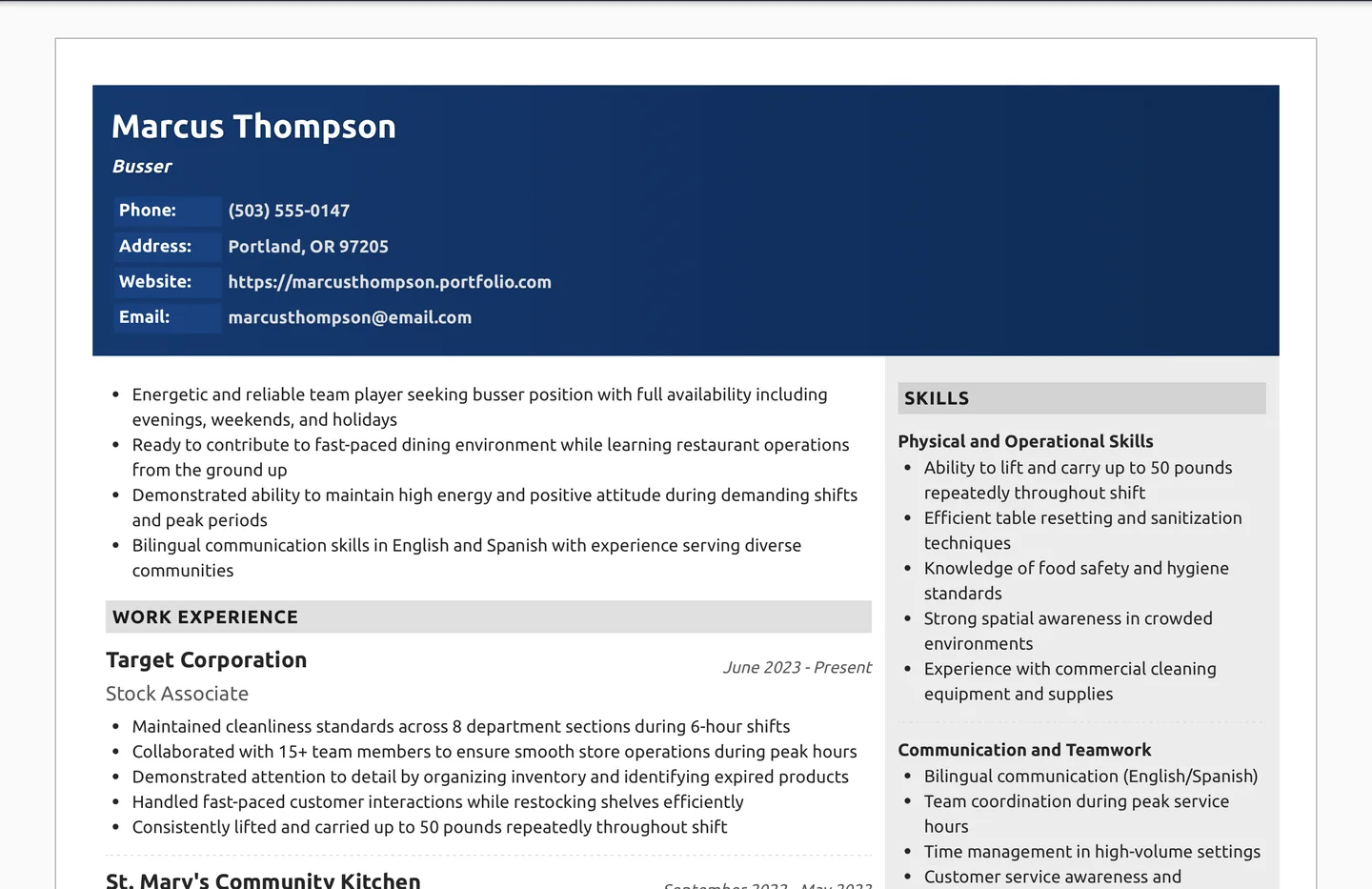
- Maintained cleanliness standards across 5 grocery aisles during 6-hour shifts
- Collaborated with 10+ team members to ensure smooth store operations during peak hours
- Demonstrated attention to detail by organizing inventory and identifying expired products
- Handled fast-paced customer interactions while restocking shelves efficiently
Addressing Limited Experience
If you're truly starting from scratch, with no formal work experience, include sections for relevant coursework (hospitality or business classes), volunteer experience, or extracurricular activities.
That time you organized the school fundraiser dinner for 300 people? That's event experience with food service elements. The key is showing that you understand what working in a service environment demands.
Essential Skills for Your Busser Resume
Walking into a busy restaurant during the dinner rush is like stepping into a well-choreographed performance where every player knows their role. As a busser, you're not just clearing tables - you're the unsung hero keeping the show running smoothly.
Your skills section needs to reflect this understanding of the role's true demands.
Physical and Operational Skills
Start with the obvious physical requirements.
Bussers need stamina, strength to carry heavy bus tubs, and the agility to navigate crowded dining rooms without disturbing guests. But don't just list "physical fitness" - be specific about what you can handle.
❌ Don't use generic skill descriptions:
- Good physical condition
- Can lift things
- Fast worker
✅ Do be specific and relevant:
- Ability to lift and carry up to 50 pounds repeatedly throughout shift
- Efficient table resetting and sanitization techniques
- Experience with commercial dishwashing equipment
- Knowledge of food safety and hygiene standards
Soft Skills That Make the Difference
The restaurant industry thrives on teamwork and communication.
Your ability to anticipate needs, communicate with servers without disrupting service, and maintain composure during chaotic rushes matters more than you might think. These soft skills often determine who gets promoted from busser to server or host.
Technical Skills Worth Mentioning
While bussing doesn't require extensive technical knowledge, familiarity with point-of-sale systems, basic knowledge of table settings for different meal services, or understanding of allergen protocols can set you apart. If you speak multiple languages, absolutely include this - restaurants serve diverse communities, and your ability to understand or communicate with various guests is valuable.
Skills Section Example:
- Efficient table turnover and reset procedures
- Strong spatial awareness in crowded environments
- Team coordination during peak service hours
- Basic POS system operation
- Bilingual communication (English/Spanish)
- Time management in high-volume settings
Specific Considerations and Tips for Your Busser Resume
Now, let's talk about the unique aspects of applying for a busser position that other resume guides might miss.
You're not applying to be a CEO or a software engineer - you're entering a world where personality, hustle, and reliability often matter more than credentials. Restaurant managers have seen hundreds of resumes from people who looked perfect on paper but couldn't handle a Friday night rush. Your resume needs to signal that you're different.
Availability Is Your Secret Weapon
Unlike many positions, your availability can make or break your application for a busser role. Restaurants need coverage during nights, weekends, and holidays - exactly when everyone else wants to be off. If you have open availability or can work those less desirable shifts, make this crystal clear in your resume summary or cover letter.
One applicant with weekend availability often beats five with perfect experience who can only work Monday through Wednesday afternoons.
Professional Summary Example:
Energetic and reliable team player seeking busser position with full availability
including evenings, weekends, and holidays. Ready to contribute to fast-paced
dining environment while learning restaurant operations from the ground up.
Show You Understand the Career Path
Smart restaurant managers know that today's busser could be tomorrow's server, bartender, or even restaurant manager. Subtly indicate that you see this role as a starting point, not an ending point.
This shows ambition without appearing like you'll jump ship immediately.
Location and Commute Considerations
Restaurants operate on thin margins and can't afford no-shows.
If you live close to the restaurant or have reliable transportation, mention it. In urban areas like London or New York City, noting your proximity to public transportation can be valuable. In sprawling cities like Los Angeles or Sydney, confirming you have reliable personal transportation matters.
The Personality Factor
Bussing is physically demanding, often thankless work performed in full view of guests.
Managers need people who can maintain positive energy even when carrying their fifteenth bus tub of the night. Your resume should hint at this resilience and positive attitude without sounding canned.
❌ Don't use overused phrases:
"Hardworking individual with great attitude"
✅ Do show personality through specific examples:
"Maintained cheerful demeanor while managing back-to-back shifts during
university finals week, earning recognition from management for reliability"
Cultural and Regional Differences
In upscale establishments in major cities, emphasize any fine dining exposure or knowledge of service standards.
For family restaurants in suburban areas, highlight your comfort with high-volume, family-friendly environments. Applying to a trendy restaurant in Austin or Melbourne? Your ability to contribute to a specific restaurant culture might matter as much as your bussing skills.
Remember, the busser position is often the entry point to a rewarding restaurant career. Your resume should show that you respect the role while understanding its place in the larger restaurant ecosystem. You're not just someone who needs a job - you're someone ready to be part of the team that creates memorable dining experiences, one clean table at a time.
Education to List on Busser Resume
As a busser, you're the backbone of the dining room operations - clearing tables, resetting them, assisting servers, and ensuring the restaurant runs smoothly. Hiring managers know this role doesn't require advanced education, but they still want to see that you can commit to something and follow through.
That's where your education section comes in.
The Basics - What to Include
If you're currently in high school or recently graduated, this is your primary educational credential. List it proudly! Include your school name, location, graduation date (or expected graduation date), and GPA if it's above 3.0.
Many bussers are students working part-time, and restaurants actually prefer this - it shows you're ambitious and can juggle multiple responsibilities.
Here's how to present your high school education effectively:
❌ Don't write vaguely:
High School Diploma
Some School
✅ Do include specific details:
Lincoln High School, Portland, OR | High School Diploma, Expected May 2024
- GPA: 3.4/4.0
- Relevant Coursework: Food Service Management, Spanish II
Making Your Education Work Harder
Since you're applying for an entry-level position, you might not have much work experience.
This is where you can strategically beef up your education section. Did you take any hospitality or culinary classes? Were you part of any clubs that required teamwork or service? These details matter more than you think.
Think about courses or activities that translate to restaurant skills. Foreign language classes? Fantastic - you might interact with diverse customers and kitchen staff. Physical education or sports? Great - bussing is physically demanding work.
Even math classes show you can handle basic calculations for organizing supplies or understanding table rotations.
Alternative Education and Certifications
Maybe traditional education isn't your path, and that's okay too. Perhaps you have a food handler's permit, completed online hospitality courses, or attended a vocational program. These absolutely belong in your education section!
In fact, having a food safety certification can give you an edge over other candidates, even if you don't have a high school diploma.
❌ Don't hide relevant certifications:
High School Diploma - 2022
✅ Do showcase all relevant training:
ServSafe Food Handler Certification - March 2023
Lincoln High School, Portland, OR
High School Diploma - June 2022
Remember, in many states and countries, specific certifications are required or preferred. In California, for instance, a food handler's card is mandatory. In the UK, a Level 2 Food Hygiene Certificate is highly valued.
In Canada, Smart Serve certification (for Ontario) or similar provincial certifications can set you apart, even for a busser position.
Awards and Publications on Busser Resume
You might be thinking, "Awards? Publications? I'm applying to clear tables, not write for the New York Times!"
And you're right - most bussers don't have industry publications or prestigious hospitality awards.
But here's the thing: any recognition you've received can demonstrate qualities that matter in a restaurant setting - reliability, teamwork, dedication, and going above and beyond.
Rethinking What Counts as an Award
When you're starting your career in food service, awards don't have to be fancy certificates from the Restaurant Association.
Were you named Employee of the Month at your previous retail job? Perfect attendance award at school? Team MVP in your soccer league? These all demonstrate qualities that translate directly to being a successful busser.
Think about it from the manager's perspective. They need someone who shows up on time (crucial when the dinner rush hits), works well with others (you'll be supporting servers constantly), and takes pride in their work (even if that work is wiping down tables). Your awards, however modest, prove you have these qualities.
❌ Don't dismiss seemingly unrelated achievements:
Awards: None
✅ Do include relevant recognitions:
Awards & Recognition:
• Perfect Attendance Award - Madison High School (2014)
• Team Player Award - Varsity Basketball Team (2017)
• Customer Service Star - Target Corporation (2018)
Academic and Community Recognition
Since many bussers are students or recent graduates, academic achievements absolutely count.
Honor roll? Dean's list? Academic letter? These show discipline and commitment - exactly what a restaurant manager wants to see. Community service awards are particularly valuable because the hospitality industry is fundamentally about serving others.
Even participation certificates from volunteer work at food banks, church events, or community dinners demonstrate relevant experience. You've worked in food service environments, understood the pace of serving many people quickly, and showed you care about hospitality.
Creating Your Own Recognition Story
If you genuinely have no awards or recognition to list, this section might not be for you - and that's okay. Only include it if you have something meaningful to share. However, consider this: if you've been working anywhere for more than six months without being fired, you've achieved something worth noting. Did your manager ever compliment your work? Did you help train new employees?
These might not be formal awards, but they're achievements worth mentioning elsewhere in your resume.
For those in the UK or Australia, school certificates and vocational awards carry more weight in the hospitality industry. In Canada, any French language certificates (particularly in Quebec) or food service training completions should definitely be highlighted.
Listing References for Busser Resume
You know that moment when a hiring manager actually calls your references?
For busser positions, it happens more often than you'd think. Since restaurants deal with high turnover and need reliable staff immediately, managers frequently make quick reference calls to verify you're not going to ghost them after training.
Your references can be the difference between starting this weekend or never hearing back.
Who Makes the Best References for Entry-Level Restaurant Work
Forget the formal "professional references only" rule you might have heard. For busser positions, the best references are people who can vouch for your work ethic and reliability, period.
Your high school coach who saw you show up to 6 AM practices? Perfect.
The family friend whose lawn you've been mowing for three years? Excellent.
Your shift supervisor from that retail job last summer? Ideal.
Teachers and professors make particularly strong references for busser applicants because they can speak to your punctuality, ability to follow instructions, and how you handle busy periods (like exam season). Just make sure they remember you well enough to give specific examples if called.
❌ Don't list references without context:
References:
John Smith - 555-0123
Jane Doe - 555-0124
Bob Johnson - 555-0125
✅ Do provide clear relationships and contact information:
References:
1. Maria Rodriguez - Shift Manager, Target
(503) 555-0123 - [email protected]
Relationship: Direct supervisor for 8 months

2. Coach Timothy Chen - Head Coach, Lincoln High Basketball
(503) 555-0124 - [email protected]
Relationship: Coached me for 2 years, can speak to teamwork and reliability
The "References Available Upon Request" Debate
Old-school advice says to write "References available upon request" at the bottom of your resume.
For busser positions, skip this phrase entirely - it wastes space and states the obvious. Instead, either include your references directly on your resume (if you have room and strong ones) or prepare a separate reference sheet to hand over when asked.
Many restaurants, especially smaller independent ones, prefer everything on one page. They're busy, they're practical, and they don't want to juggle multiple documents. If your resume has space after listing your experience and education, add two or three references right there.
This is particularly common in casual dining and fast-food establishments.
Managing References When You Have Limited Experience
If you're 16 and this is your first job, you still need references. Teachers, guidance counselors, volunteer coordinators, religious leaders, or family friends (not family members) who've employed you informally all work. The key is briefing them beforehand.
Tell them you're applying for restaurant work and what qualities matter - showing up on time, working hard, being friendly, handling busy periods.
One strategic move? If you've been a regular customer somewhere, the staff might serve as references. That barista who knows your order? If you've been polite and tipped well, they might vouch for your character. It shows you understand and respect service industry workers.
For international considerations: UK employers often require references from your most recent employer, even for entry-level positions. Australian restaurants might ask for character references if you're on a working holiday visa. Canadian establishments, particularly in Quebec, may prefer references who can confirm your language abilities. In all cases, always ask permission before listing someone as a reference, and give them a heads-up when you're actively applying.
Cover Letter Tips for Busser Resume
Here's a reality check - most restaurants won't require a cover letter for a busser position. You might walk in during a slow afternoon, fill out an application, and start working that weekend.
But when you do need one (usually for higher-end establishments, hotels, or chain restaurants with online applications), it's your chance to show you understand that being a busser is more than just clearing plates.
Why Some Busser Positions Need Cover Letters
Upscale restaurants, country clubs, and hotels often require cover letters because they're not just hiring someone to clear tables - they're hiring someone to be part of an experience. When diners are paying $200 for a meal, every interaction matters, including how professionally and efficiently tables are cleared and reset.
Your cover letter proves you get this distinction.
Similarly, busy chain restaurants might get dozens of applications. A cover letter helps you stand out from the stack of resumes that all look pretty similar for entry-level positions. It's your opportunity to show enthusiasm and reliability in a way that a resume alone cannot.
The Three-Paragraph Formula That Works
First paragraph: Show you know what the restaurant is about.
Mention specific details - maybe you've eaten there, know their busy hours, or understand their service style. Managers want to know you're applying to their restaurant specifically, not just mass-applying everywhere.
❌ Don't write generic openings:
"I am writing to apply for the busser position at your restaurant.
I saw your ad online and think I would be a good fit."
✅ Do personalize your introduction:
"I'm excited to apply for the busser position at Rosario's Italian Bistro.
As a regular Saturday night customer, I've always admired how smoothly your dining room operates even during the busiest shifts."
Second paragraph: Connect your experience to what matters for bussers. Even if you've never worked in a restaurant, you have transferable skills. Retail experience? You understand customer service and working on your feet. Athletic background? You're used to physical work and being a team player. Student juggling classes and work? You're organized and can handle pressure.
Third paragraph: Address the elephant in the room - availability and reliability. Restaurants have high turnover, and managers are tired of hiring people who quit after two weeks. If you can work weekends, say so. If you're available for doubles, mention it.
If you're planning to stay for at least a year, make that clear.
Addressing Different Restaurant Types
Fine dining establishments want to hear about attention to detail and professionalism. Mention any experience with formal events, even if it's just helping at your cousin's wedding. Family restaurants care more about energy and friendliness.
Sports bars need people who can handle chaos and work fast.
For UK positions, particularly in pubs and gastropubs, mentioning flexibility with split shifts is valuable. Australian cafe culture values morning availability and experience with high-volume coffee service.
Canadian establishments, especially in tourist areas, appreciate multilingual abilities.
Key Takeaways
- Use the reverse-chronological resume format to showcase your most recent experience first, even if that experience isn't directly in food service - restaurant managers need to quickly see what you've been doing lately
- Transform any experience into restaurant-relevant skills by focusing on cleanliness, efficiency, teamwork, and working under pressure - your retail, volunteer, or school activities all count
- Prioritize availability and reliability over experience in your resume summary - being able to work nights, weekends, and holidays often matters more than having perfect credentials
- Include specific, measurable skills rather than generic phrases - "ability to lift 50 pounds repeatedly" beats "physically fit" every time
- List relevant certifications prominently, especially food handler's permits or safety certifications, as these can give you an immediate edge over other entry-level candidates
- Don't skip the education section even if you only have a high school diploma - include relevant coursework, language skills, or activities that demonstrate teamwork
- Include references directly on your resume if you have room - restaurant managers appreciate having everything in one place and often make quick reference calls
- Tailor your resume to the restaurant type - fine dining establishments value different qualities than sports bars or family restaurants
- Show you understand the career path by subtly indicating you see bussing as a starting point in the restaurant industry, not just a temporary gig
Creating a compelling busser resume doesn't require years of restaurant experience or fancy credentials - it requires understanding what restaurant managers actually need and presenting yourself as the solution to their staffing challenges. With Resumonk, you can build a professional busser resume that incorporates all these essential elements while maintaining a clean, easy-to-read format that busy managers will appreciate. Our intelligent resume builder offers industry-specific suggestions for bussers, helping you articulate your transferable skills and experiences in restaurant-relevant terms, while our selection of professional templates ensures your resume looks polished whether you're applying to a neighborhood cafe or an upscale hotel restaurant.
Ready to start your journey in the restaurant industry?
Create your professional busser resume with Resumonk's intelligent builder and designer templates.
Start building your busser resume today and be ready to hand it to managers or upload it to applications within minutes.
More Restaurant & Hospitality resume examples
- McDonald's Crew Member resume example
- Barista resume example
- Chef resume example
- Restaurant Server resume example
See all Restaurant & Hospitality resume examples, or browse every category.
Resume writing tips
Let's paint a picture together - you're standing at the threshold of the restaurant industry, ready to dive into the fast-paced world of hospitality.
As a busser applicant, you're likely someone who's either fresh out of high school, currently in college, or looking to transition into the food service industry from another field. Maybe you've been watching the synchronized dance of restaurant staff during dinner rushes and thought, "I want to be part of that team."
The truth is, the busser position is your golden ticket into this world, serving as the foundation stone of restaurant operations where you'll learn the rhythms of service, the importance of teamwork, and the satisfaction of keeping a dining room running like a well-oiled machine.
You might be wondering if your lack of direct restaurant experience is a dealbreaker, or if that summer spent stocking shelves at Target even matters for a position clearing tables. Here's what seasoned restaurant managers know but rarely say out loud - they're not looking for someone with years of bussing experience. They're looking for someone who shows up on time, works hard without constant supervision, and understands that every role in a restaurant, from the executive chef to the newest busser, contributes to creating an experience for guests. Your challenge isn't proving you can clear a table (anyone can learn that in five minutes) but showing you have the stamina, awareness, and team spirit to thrive when the Saturday night rush hits and the dining room is packed.
This comprehensive guide will walk you through crafting a busser resume that actually gets you hired, starting with choosing the right resume format that highlights your potential rather than hiding your limited experience. We'll dive into how to transform any work experience - even babysitting or volunteer work - into relevant qualifications that speak to restaurant managers. You'll learn which skills matter most for bussers and how to present them without sounding generic, plus specific tips for different types of establishments, from upscale steakhouses to bustling family diners.
We'll also cover the often-overlooked elements that can make or break your application - how to handle the education section when you're still in school, whether awards and recognition matter for an entry-level position, when you actually need a cover letter for a busser role, and how to present references when your work history is limited. Most importantly, we'll address the unique aspects of applying for busser positions, like why your availability might matter more than your experience, and how showing you understand the career path from busser to server and beyond can set you apart from other applicants who see this as "just a job."
The Best Busser Resume Example/Sample
https://www.resumonk.com/busserBusserResume Format for Your Busser Resume
For a busser resume, the reverse-chronological format is your best friend, even if your work history feels shorter than a lunch break. This format places your most recent experience at the top, which is perfect because hiring managers in the restaurant industry are notoriously busy - they need to see your relevant experience immediately, even if that experience is from your part-time job at the local coffee shop or your volunteer work at community events.
Why Reverse-Chronological Works for Entry-Level Restaurant Roles
The restaurant industry operates on a simple principle - can you handle the pressure and keep up with the pace?
Your resume format should mirror this directness. A reverse-chronological format demonstrates your progression, even if that progression is from high school student to recent graduate, or from retail worker to aspiring restaurant professional.
It shows managers that you're building momentum toward this role, not randomly applying to any available position.
Structuring Your Busser Resume Sections
Start with your contact information and a brief professional summary (yes, even for an entry-level position). Follow this with your work experience, education, and skills.
If you're light on traditional work experience, don't panic - this is where you can include relevant volunteer work, school activities where you demonstrated teamwork, or even that time you helped cater your cousin's wedding for 200 guests.
Remember, in the UK and Australia, you might include a brief personal statement at the top, while in the US and Canada, a concise objective or summary works better. European applications might require a photo, but North American ones should never include one.
Work Experience on Your Busser Resume
Here's where many busser applicants freeze up - staring at that work experience section like it's a plate of exotic cuisine they've never encountered. You're thinking, "I've never been a busser before, so what could I possibly write?"
But here's the secret that seasoned restaurant managers know - they're not looking for years of bussing experience.
They're looking for evidence that you can handle physical work, maintain attention to detail under pressure, and work as part of a team.
Translating Any Experience into Restaurant-Relevant Skills
That summer job at the grocery store? You were managing inventory and maintaining cleanliness standards. Your role in the school drama production? You were working under tight deadlines in a high-pressure, team-oriented environment. Even babysitting demonstrates multitasking and responsibility.
The key is framing these experiences through the lens of restaurant operations.
Writing Impactful Bullet Points
When describing your experience, focus on actions and results that translate to bussing duties. Think about cleanliness, efficiency, teamwork, and customer awareness - these are the pillars of a good busser's skill set.
❌ Don't write vague, passive descriptions:
Worked at grocery store
Helped customers when needed
Did various tasks assigned by manager
✅ Do write specific, active, and relevant descriptions:
- Maintained cleanliness standards across 5 grocery aisles during 6-hour shifts
- Collaborated with 10+ team members to ensure smooth store operations during peak hours
- Demonstrated attention to detail by organizing inventory and identifying expired products
- Handled fast-paced customer interactions while restocking shelves efficiently
Addressing Limited Experience
If you're truly starting from scratch, with no formal work experience, include sections for relevant coursework (hospitality or business classes), volunteer experience, or extracurricular activities.
That time you organized the school fundraiser dinner for 300 people? That's event experience with food service elements. The key is showing that you understand what working in a service environment demands.
Essential Skills for Your Busser Resume
Walking into a busy restaurant during the dinner rush is like stepping into a well-choreographed performance where every player knows their role. As a busser, you're not just clearing tables - you're the unsung hero keeping the show running smoothly.
Your skills section needs to reflect this understanding of the role's true demands.
Physical and Operational Skills
Start with the obvious physical requirements.
Bussers need stamina, strength to carry heavy bus tubs, and the agility to navigate crowded dining rooms without disturbing guests. But don't just list "physical fitness" - be specific about what you can handle.
❌ Don't use generic skill descriptions:
- Good physical condition
- Can lift things
- Fast worker
✅ Do be specific and relevant:
- Ability to lift and carry up to 50 pounds repeatedly throughout shift
- Efficient table resetting and sanitization techniques
- Experience with commercial dishwashing equipment
- Knowledge of food safety and hygiene standards
Soft Skills That Make the Difference
The restaurant industry thrives on teamwork and communication.
Your ability to anticipate needs, communicate with servers without disrupting service, and maintain composure during chaotic rushes matters more than you might think. These soft skills often determine who gets promoted from busser to server or host.
Technical Skills Worth Mentioning
While bussing doesn't require extensive technical knowledge, familiarity with point-of-sale systems, basic knowledge of table settings for different meal services, or understanding of allergen protocols can set you apart. If you speak multiple languages, absolutely include this - restaurants serve diverse communities, and your ability to understand or communicate with various guests is valuable.
Skills Section Example:
- Efficient table turnover and reset procedures
- Strong spatial awareness in crowded environments
- Team coordination during peak service hours
- Basic POS system operation
- Bilingual communication (English/Spanish)
- Time management in high-volume settings
Specific Considerations and Tips for Your Busser Resume
Now, let's talk about the unique aspects of applying for a busser position that other resume guides might miss.
You're not applying to be a CEO or a software engineer - you're entering a world where personality, hustle, and reliability often matter more than credentials. Restaurant managers have seen hundreds of resumes from people who looked perfect on paper but couldn't handle a Friday night rush. Your resume needs to signal that you're different.
Availability Is Your Secret Weapon
Unlike many positions, your availability can make or break your application for a busser role. Restaurants need coverage during nights, weekends, and holidays - exactly when everyone else wants to be off. If you have open availability or can work those less desirable shifts, make this crystal clear in your resume summary or cover letter.
One applicant with weekend availability often beats five with perfect experience who can only work Monday through Wednesday afternoons.
Professional Summary Example:
Energetic and reliable team player seeking busser position with full availability
including evenings, weekends, and holidays. Ready to contribute to fast-paced
dining environment while learning restaurant operations from the ground up.
Show You Understand the Career Path
Smart restaurant managers know that today's busser could be tomorrow's server, bartender, or even restaurant manager. Subtly indicate that you see this role as a starting point, not an ending point.
This shows ambition without appearing like you'll jump ship immediately.
Location and Commute Considerations
Restaurants operate on thin margins and can't afford no-shows.
If you live close to the restaurant or have reliable transportation, mention it. In urban areas like London or New York City, noting your proximity to public transportation can be valuable. In sprawling cities like Los Angeles or Sydney, confirming you have reliable personal transportation matters.
The Personality Factor
Bussing is physically demanding, often thankless work performed in full view of guests.
Managers need people who can maintain positive energy even when carrying their fifteenth bus tub of the night. Your resume should hint at this resilience and positive attitude without sounding canned.
❌ Don't use overused phrases:
"Hardworking individual with great attitude"
✅ Do show personality through specific examples:
"Maintained cheerful demeanor while managing back-to-back shifts during
university finals week, earning recognition from management for reliability"
Cultural and Regional Differences
In upscale establishments in major cities, emphasize any fine dining exposure or knowledge of service standards.
For family restaurants in suburban areas, highlight your comfort with high-volume, family-friendly environments. Applying to a trendy restaurant in Austin or Melbourne? Your ability to contribute to a specific restaurant culture might matter as much as your bussing skills.
Remember, the busser position is often the entry point to a rewarding restaurant career. Your resume should show that you respect the role while understanding its place in the larger restaurant ecosystem. You're not just someone who needs a job - you're someone ready to be part of the team that creates memorable dining experiences, one clean table at a time.
Education to List on Busser Resume
As a busser, you're the backbone of the dining room operations - clearing tables, resetting them, assisting servers, and ensuring the restaurant runs smoothly. Hiring managers know this role doesn't require advanced education, but they still want to see that you can commit to something and follow through.
That's where your education section comes in.
The Basics - What to Include
If you're currently in high school or recently graduated, this is your primary educational credential. List it proudly! Include your school name, location, graduation date (or expected graduation date), and GPA if it's above 3.0.
Many bussers are students working part-time, and restaurants actually prefer this - it shows you're ambitious and can juggle multiple responsibilities.
Here's how to present your high school education effectively:
❌ Don't write vaguely:
High School Diploma
Some School
✅ Do include specific details:
Lincoln High School, Portland, OR | High School Diploma, Expected May 2024
- GPA: 3.4/4.0
- Relevant Coursework: Food Service Management, Spanish II
Making Your Education Work Harder
Since you're applying for an entry-level position, you might not have much work experience.
This is where you can strategically beef up your education section. Did you take any hospitality or culinary classes? Were you part of any clubs that required teamwork or service? These details matter more than you think.
Think about courses or activities that translate to restaurant skills. Foreign language classes? Fantastic - you might interact with diverse customers and kitchen staff. Physical education or sports? Great - bussing is physically demanding work.
Even math classes show you can handle basic calculations for organizing supplies or understanding table rotations.
Alternative Education and Certifications
Maybe traditional education isn't your path, and that's okay too. Perhaps you have a food handler's permit, completed online hospitality courses, or attended a vocational program. These absolutely belong in your education section!
In fact, having a food safety certification can give you an edge over other candidates, even if you don't have a high school diploma.
❌ Don't hide relevant certifications:
High School Diploma - 2022
✅ Do showcase all relevant training:
ServSafe Food Handler Certification - March 2023
Lincoln High School, Portland, OR
High School Diploma - June 2022
Remember, in many states and countries, specific certifications are required or preferred. In California, for instance, a food handler's card is mandatory. In the UK, a Level 2 Food Hygiene Certificate is highly valued.
In Canada, Smart Serve certification (for Ontario) or similar provincial certifications can set you apart, even for a busser position.
Awards and Publications on Busser Resume
You might be thinking, "Awards? Publications? I'm applying to clear tables, not write for the New York Times!"
And you're right - most bussers don't have industry publications or prestigious hospitality awards.
But here's the thing: any recognition you've received can demonstrate qualities that matter in a restaurant setting - reliability, teamwork, dedication, and going above and beyond.
Rethinking What Counts as an Award
When you're starting your career in food service, awards don't have to be fancy certificates from the Restaurant Association.
Were you named Employee of the Month at your previous retail job? Perfect attendance award at school? Team MVP in your soccer league? These all demonstrate qualities that translate directly to being a successful busser.
Think about it from the manager's perspective. They need someone who shows up on time (crucial when the dinner rush hits), works well with others (you'll be supporting servers constantly), and takes pride in their work (even if that work is wiping down tables). Your awards, however modest, prove you have these qualities.
❌ Don't dismiss seemingly unrelated achievements:
Awards: None
✅ Do include relevant recognitions:
Awards & Recognition:
• Perfect Attendance Award - Madison High School (2014)
• Team Player Award - Varsity Basketball Team (2017)
• Customer Service Star - Target Corporation (2018)
Academic and Community Recognition
Since many bussers are students or recent graduates, academic achievements absolutely count.
Honor roll? Dean's list? Academic letter? These show discipline and commitment - exactly what a restaurant manager wants to see. Community service awards are particularly valuable because the hospitality industry is fundamentally about serving others.
Even participation certificates from volunteer work at food banks, church events, or community dinners demonstrate relevant experience. You've worked in food service environments, understood the pace of serving many people quickly, and showed you care about hospitality.
Creating Your Own Recognition Story
If you genuinely have no awards or recognition to list, this section might not be for you - and that's okay. Only include it if you have something meaningful to share. However, consider this: if you've been working anywhere for more than six months without being fired, you've achieved something worth noting. Did your manager ever compliment your work? Did you help train new employees?
These might not be formal awards, but they're achievements worth mentioning elsewhere in your resume.
For those in the UK or Australia, school certificates and vocational awards carry more weight in the hospitality industry. In Canada, any French language certificates (particularly in Quebec) or food service training completions should definitely be highlighted.
Listing References for Busser Resume
You know that moment when a hiring manager actually calls your references?
For busser positions, it happens more often than you'd think. Since restaurants deal with high turnover and need reliable staff immediately, managers frequently make quick reference calls to verify you're not going to ghost them after training.
Your references can be the difference between starting this weekend or never hearing back.
Who Makes the Best References for Entry-Level Restaurant Work
Forget the formal "professional references only" rule you might have heard. For busser positions, the best references are people who can vouch for your work ethic and reliability, period.
Your high school coach who saw you show up to 6 AM practices? Perfect.
The family friend whose lawn you've been mowing for three years? Excellent.
Your shift supervisor from that retail job last summer? Ideal.
Teachers and professors make particularly strong references for busser applicants because they can speak to your punctuality, ability to follow instructions, and how you handle busy periods (like exam season). Just make sure they remember you well enough to give specific examples if called.
❌ Don't list references without context:
References:
John Smith - 555-0123
Jane Doe - 555-0124
Bob Johnson - 555-0125
✅ Do provide clear relationships and contact information:
References:
1. Maria Rodriguez - Shift Manager, Target
(503) 555-0123 - [email protected]
Relationship: Direct supervisor for 8 months

2. Coach Timothy Chen - Head Coach, Lincoln High Basketball
(503) 555-0124 - [email protected]
Relationship: Coached me for 2 years, can speak to teamwork and reliability
The "References Available Upon Request" Debate
Old-school advice says to write "References available upon request" at the bottom of your resume.
For busser positions, skip this phrase entirely - it wastes space and states the obvious. Instead, either include your references directly on your resume (if you have room and strong ones) or prepare a separate reference sheet to hand over when asked.
Many restaurants, especially smaller independent ones, prefer everything on one page. They're busy, they're practical, and they don't want to juggle multiple documents. If your resume has space after listing your experience and education, add two or three references right there.
This is particularly common in casual dining and fast-food establishments.
Managing References When You Have Limited Experience
If you're 16 and this is your first job, you still need references. Teachers, guidance counselors, volunteer coordinators, religious leaders, or family friends (not family members) who've employed you informally all work. The key is briefing them beforehand.
Tell them you're applying for restaurant work and what qualities matter - showing up on time, working hard, being friendly, handling busy periods.
One strategic move? If you've been a regular customer somewhere, the staff might serve as references. That barista who knows your order? If you've been polite and tipped well, they might vouch for your character. It shows you understand and respect service industry workers.
For international considerations: UK employers often require references from your most recent employer, even for entry-level positions. Australian restaurants might ask for character references if you're on a working holiday visa. Canadian establishments, particularly in Quebec, may prefer references who can confirm your language abilities. In all cases, always ask permission before listing someone as a reference, and give them a heads-up when you're actively applying.
Cover Letter Tips for Busser Resume
Here's a reality check - most restaurants won't require a cover letter for a busser position. You might walk in during a slow afternoon, fill out an application, and start working that weekend.
But when you do need one (usually for higher-end establishments, hotels, or chain restaurants with online applications), it's your chance to show you understand that being a busser is more than just clearing plates.
Why Some Busser Positions Need Cover Letters
Upscale restaurants, country clubs, and hotels often require cover letters because they're not just hiring someone to clear tables - they're hiring someone to be part of an experience. When diners are paying $200 for a meal, every interaction matters, including how professionally and efficiently tables are cleared and reset.
Your cover letter proves you get this distinction.
Similarly, busy chain restaurants might get dozens of applications. A cover letter helps you stand out from the stack of resumes that all look pretty similar for entry-level positions. It's your opportunity to show enthusiasm and reliability in a way that a resume alone cannot.
The Three-Paragraph Formula That Works
First paragraph: Show you know what the restaurant is about.
Mention specific details - maybe you've eaten there, know their busy hours, or understand their service style. Managers want to know you're applying to their restaurant specifically, not just mass-applying everywhere.
❌ Don't write generic openings:
"I am writing to apply for the busser position at your restaurant.
I saw your ad online and think I would be a good fit."
✅ Do personalize your introduction:
"I'm excited to apply for the busser position at Rosario's Italian Bistro.
As a regular Saturday night customer, I've always admired how smoothly your dining room operates even during the busiest shifts."
Second paragraph: Connect your experience to what matters for bussers. Even if you've never worked in a restaurant, you have transferable skills. Retail experience? You understand customer service and working on your feet. Athletic background? You're used to physical work and being a team player. Student juggling classes and work? You're organized and can handle pressure.
Third paragraph: Address the elephant in the room - availability and reliability. Restaurants have high turnover, and managers are tired of hiring people who quit after two weeks. If you can work weekends, say so. If you're available for doubles, mention it.
If you're planning to stay for at least a year, make that clear.
Addressing Different Restaurant Types
Fine dining establishments want to hear about attention to detail and professionalism. Mention any experience with formal events, even if it's just helping at your cousin's wedding. Family restaurants care more about energy and friendliness.
Sports bars need people who can handle chaos and work fast.
For UK positions, particularly in pubs and gastropubs, mentioning flexibility with split shifts is valuable. Australian cafe culture values morning availability and experience with high-volume coffee service.
Canadian establishments, especially in tourist areas, appreciate multilingual abilities.
Key Takeaways
- Use the reverse-chronological resume format to showcase your most recent experience first, even if that experience isn't directly in food service - restaurant managers need to quickly see what you've been doing lately
- Transform any experience into restaurant-relevant skills by focusing on cleanliness, efficiency, teamwork, and working under pressure - your retail, volunteer, or school activities all count
- Prioritize availability and reliability over experience in your resume summary - being able to work nights, weekends, and holidays often matters more than having perfect credentials
- Include specific, measurable skills rather than generic phrases - "ability to lift 50 pounds repeatedly" beats "physically fit" every time
- List relevant certifications prominently, especially food handler's permits or safety certifications, as these can give you an immediate edge over other entry-level candidates
- Don't skip the education section even if you only have a high school diploma - include relevant coursework, language skills, or activities that demonstrate teamwork
- Include references directly on your resume if you have room - restaurant managers appreciate having everything in one place and often make quick reference calls
- Tailor your resume to the restaurant type - fine dining establishments value different qualities than sports bars or family restaurants
- Show you understand the career path by subtly indicating you see bussing as a starting point in the restaurant industry, not just a temporary gig
Creating a compelling busser resume doesn't require years of restaurant experience or fancy credentials - it requires understanding what restaurant managers actually need and presenting yourself as the solution to their staffing challenges. With Resumonk, you can build a professional busser resume that incorporates all these essential elements while maintaining a clean, easy-to-read format that busy managers will appreciate. Our intelligent resume builder offers industry-specific suggestions for bussers, helping you articulate your transferable skills and experiences in restaurant-relevant terms, while our selection of professional templates ensures your resume looks polished whether you're applying to a neighborhood cafe or an upscale hotel restaurant.
Ready to start your journey in the restaurant industry?
Create your professional busser resume with Resumonk's intelligent builder and designer templates.
Start building your busser resume today and be ready to hand it to managers or upload it to applications within minutes.
More Restaurant & Hospitality resume examples
- McDonald's Crew Member resume example
- Barista resume example
- Chef resume example
- Restaurant Server resume example
See all Restaurant & Hospitality resume examples, or browse every category.
Resume writing tips