Bioinformatics Resume Example (with Tips and Best Practices)
Introduction
You're sitting at your computer, toggle-switching between terminal windows running BLAST queries and PubMed tabs with the latest genomics papers.
Maybe you've just finished debugging a Python script that finally parsed that massive RNA-seq dataset correctly, or perhaps you're fresh out of your bioinformatics program, armed with knowledge of both Krebs cycles and while loops. Either way, you've arrived at this crossroads - crafting a resume that captures your unique position as a computational biologist, a digital detective of the genomic age.
The challenge feels almost as complex as the protein folding problems you tackle daily. How do you convey to employers that you're not just a biologist who can code, or a programmer who knows what DNA stands for? You're that rare breed who gets genuinely excited when biological questions meet elegant algorithms, who sees poetry in both gene expression patterns and clean code. Your resume needs to speak fluently to hiring managers who might come from either the wet lab or the server room - and sometimes both.
In this comprehensive guide, we'll walk you through every element of crafting the perfect bioinformatics resume. We'll start by choosing the right resume format that showcases your interdisciplinary journey, then dive into structuring your work experience to highlight both computational achievements and biological insights. You'll learn how to present your technical skills without overwhelming biology-focused reviewers, while still impressing the tech-savvy members of the hiring committee. We'll cover education sections that properly emphasize your unique training, how to list publications and awards that matter in this field, and even tackle those tricky special circumstances - like transitioning from pure biology or computer science backgrounds.
By the end of this guide, you'll have a clear roadmap for creating a bioinformatics resume that doesn't just list your qualifications, but tells the story of a professional who bridges two worlds. Whether you're targeting positions in pharmaceutical companies developing the next breakthrough drug, academic labs pushing the boundaries of genomic research, or biotech startups leveraging AI for personalized medicine, we've got you covered. Let's transform your unique blend of skills into a resume that opens doors in this exciting and rapidly evolving field.
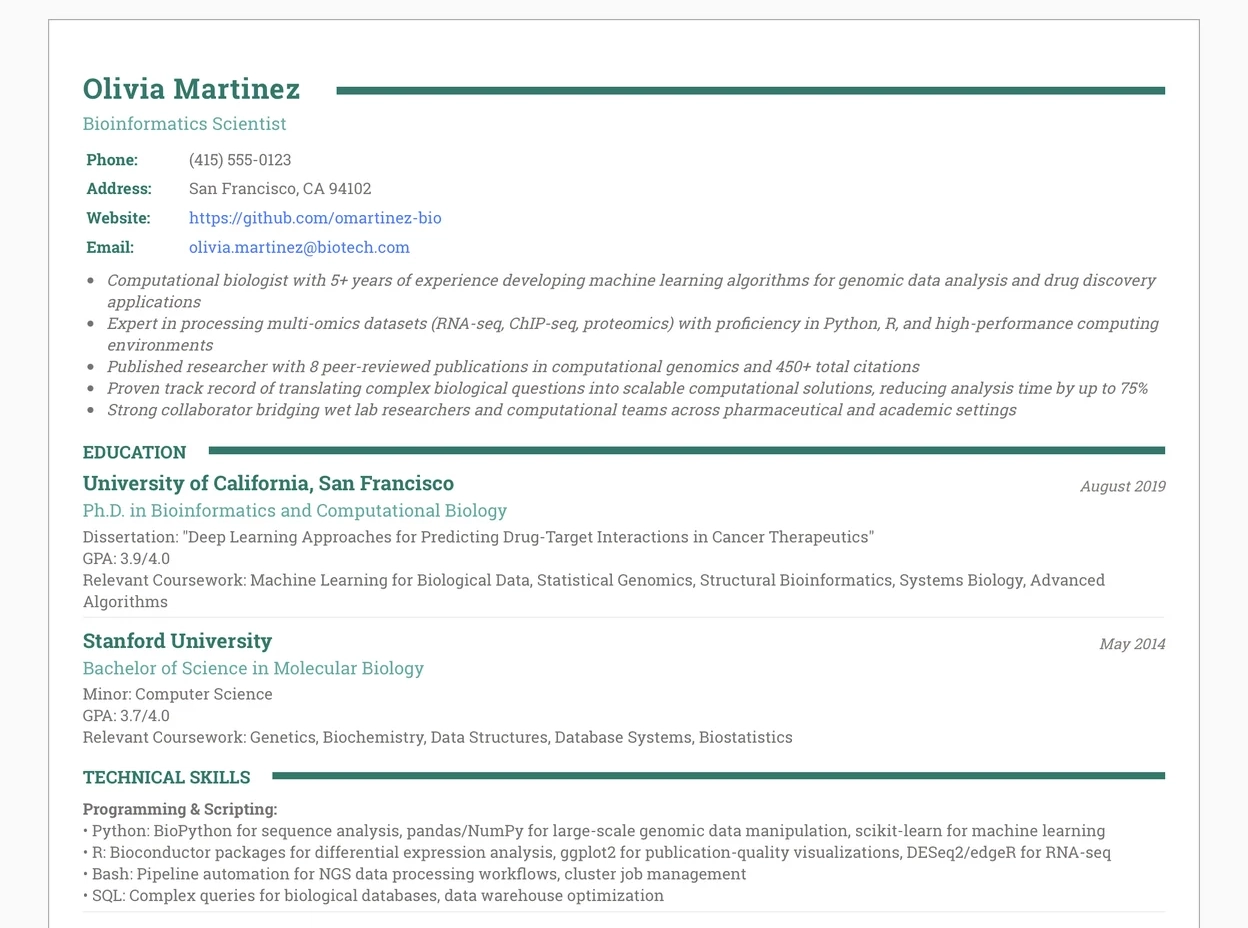
The Best Bioinformatics Resume Example/Sample
https://www.resumonk.com/bioinformatics-resumeBioinformaticsChoosing the Right Resume Format for Your Bioinformatics Resume
The reverse-chronological format emerges as your trusted ally here.
Why? Because hiring managers in biotechnology companies, pharmaceutical firms, and research institutions want to see your progression through the computational biology landscape. They're looking for that beautiful intersection where biology meets data science, and a reverse-chronological format showcases this journey elegantly.
Structure Your Bioinformatics Resume Like a Well-Annotated Genome
Start with your contact information and a crisp professional summary that immediately signals your dual citizenship in both biological sciences and computational methods. Think of it as your resume's abstract - concise yet comprehensive.
Your education section deserves prominence, especially if you're fresh from a bioinformatics, computational biology, or related program. Unlike purely IT roles where experience might overshadow education, bioinformatics employers scrutinize your academic foundation carefully. They want to see that you understand both the biological questions and the computational tools to answer them.
The technical skills section should appear early in your resume - right after education if you're entry-level, or after your professional summary if you have relevant experience. This isn't just a laundry list of programming languages; it's a carefully curated showcase of your bioinformatics toolkit.
The Hybrid Professional's Dilemma - Balancing Biology and Computing
Many bioinformaticians come from either a pure biology background who learned to code, or computer scientists who fell in love with genomics.
Your resume format should reflect this journey without making you seem like you're neither here nor there. The reverse-chronological format helps you tell this story cohesively, showing how each experience built upon the previous one to create the bioinformatics professional you are today.
Include sections for research projects, publications, and even relevant coursework if you're early in your career. These sections carry more weight in bioinformatics resumes than in typical tech resumes because they demonstrate your ability to apply computational methods to real biological problems.
Crafting Your Work Experience Section for a Bioinformatics Resume
Your work experience section is where the rubber meets the road - or rather, where the algorithm meets the genome. Whether you're coming from academia, transitioning from a wet lab position, or moving from pure software development, this section needs to sing the bioinformatics anthem loud and clear.
Translating Lab Work into Computational Achievements
For those transitioning from traditional biology roles, the challenge lies in highlighting how you've integrated computational approaches into your work.
Maybe you started by using basic bioinformatics tools and gradually moved toward scripting your own solutions. That progression matters.
❌ Don't write vague descriptions that could apply to any lab technician:
Research Assistant
- Conducted experiments on cancer cell lines
- Analyzed data and prepared reports
- Maintained laboratory equipment
✅ Do emphasize the computational and analytical aspects:
Research Assistant - Computational Cancer Biology Lab
- Analyzed RNA-seq data from 200+ cancer cell lines using R and Bioconductor packages
- Developed Python pipeline reducing data processing time from 3 days to 4 hours
- Integrated multi-omics datasets to identify novel drug targets, contributing to 2 publications
Quantifying Impact in the Language of Both Worlds
Bioinformatics exists at the intersection of big data and biological significance. Your work experience bullets should reflect both dimensions. Talk about the terabytes of genomic data you've processed AND the biological insights you've uncovered.
Mention the computational efficiency you've achieved AND the research questions you've helped answer.
For each role, structure your bullets to follow a pattern - what computational method you used, what biological problem you addressed, and what impact you achieved. This formula ensures you're speaking to both the computational team members and the biological researchers who might review your resume.
Highlighting Collaborative Skills Through Technical Achievements
Bioinformatics is rarely a solo sport. You're constantly translating between bench scientists who need analytical help and IT professionals who need biological context.
Your work experience should reflect this bridge-building role.
❌ Don't underestimate collaborative achievements:
- Helped other researchers with their data
✅ Do showcase your role as a computational biology translator:
- Collaborated with 5 wet-lab teams to design custom analytical workflows, reducing their data analysis backlog by 60%
- Created user-friendly R Shiny applications enabling non-computational researchers to perform complex genomic analyses independently
Essential Skills to Showcase on Your Bioinformatics Resume
The skills section of a bioinformatics resume resembles a well-stocked laboratory - you need the right tools for both computational heavy lifting and biological interpretation.
Unlike pure tech roles where programming languages might suffice, or pure biology roles where laboratory techniques dominate, you're showcasing a unique blend that says "I speak both DNA and Python fluently."
Programming Languages and Computational Tools - Your Digital Pipettes
Start with the programming languages that form the backbone of bioinformatics work.
Python and R aren't just nice-to-haves; they're the lingua franca of computational biology. But don't just list them - indicate your proficiency level and specific bioinformatics applications.
❌ Don't create a generic programming language list:
Skills: Python, R, SQL, Java, C++
✅ Do contextualize your technical skills within bioinformatics:
Programming & Scripting:
- Python: BioPython for sequence analysis, pandas for large-scale genomic data manipulation
- R: Bioconductor packages for differential expression analysis, ggplot2 for publication-quality visualizations
- Bash: Pipeline automation for NGS data processing workflows
Bioinformatics-Specific Tools and Databases
This is where you differentiate yourself from a general data scientist.
Your familiarity with specialized bioinformatics tools and biological databases shows you can hit the ground running. Group these tools logically - sequence analysis tools, structural bioinformatics software, pathway analysis platforms.
Include both command-line tools that demonstrate your computational depth and user-friendly platforms that show you can work with diverse research teams. Remember, knowing BLAST is expected, but expertise in specialized tools like GATK for variant calling or Galaxy for workflow management sets you apart.
Biological Knowledge and Soft Skills - The Often Overlooked Essentials
Don't forget to include relevant biological knowledge areas. Whether it's genomics, proteomics, systems biology, or specific disease areas, this knowledge is what transforms you from a programmer who works with biological data into a true bioinformatician.
Soft skills deserve special mention too. Your ability to communicate complex computational concepts to biologists and complex biological concepts to programmers is golden. Include skills like "cross-functional collaboration," "scientific writing," and "data visualization for non-technical audiences."
❌ Don't ignore the biological side:
Technical Skills: Python, R, Machine Learning, Data Analysis
✅ Do present a balanced skill set:
Computational Skills:
- Languages: Python (BioPython, scikit-learn), R (DESeq2, edgeR), SQL
- Platforms: High-performance computing clusters, AWS for genomics workflows

Biological Expertise:
- Next-generation sequencing data analysis (RNA-seq, ChIP-seq, WGS)
- Molecular biology: Gene regulation, protein structure-function relationships
- Disease focus: Cancer genomics, rare genetic disorders
Specific Considerations and Tips for Your Bioinformatics Resume
Now for the insider knowledge - those bioinformatics-specific resume nuances that generic career advice misses entirely.
You're not just another tech professional or laboratory scientist; you're a computational biologist navigating a field that's evolving faster than a virus in culture.
- Highlight Cross-Disciplinary Skills: Employers value candidates who can bridge the gap between biology and computational analysis. Clearly showcase both your coding proficiency (Python, R, Perl, or Bash scripting) and your understanding of molecular biology, genomics, or proteomics.
- Emphasize Research Impact: Instead of simply listing tools and techniques, describe how your analyses led to biological insights, publications, or clinical outcomes. Quantify where possible (e.g., “Accelerated variant calling by 40%” or “Contributed to research published in Nature Genetics”).
- Detail Software and Pipeline Development: If you’ve built custom scripts or automated data workflows, mention the scale (“Processed 20TB of NGS data”) and how your solutions improved accuracy, efficiency, or scalability.
- Cite Collaborative Work: Bioinformatics rarely happens in a vacuum. Note any cross-team collaborations with biologists, clinicians, or data scientists, emphasizing your ability to translate requirements across disciplines.
- Stay Current with Tech: The bioinformatics landscape changes fast. Briefly reference current or emerging tools (e.g., Nextflow, Snakemake, Galaxy, single-cell RNA-seq analysis platforms) to show your up-to-date expertise.
- Link to Your Work: Consider including a GitHub profile, code repository, or supplementary portfolio showcasing pipelines, scripts, or project documentation—this sets you apart in a competitive field.
Tailoring your bioinformatics resume this way helps employers immediately recognize your relevance, adaptability, and specialized value in an interdisciplinary, data-driven world.
Education to List on Bioinformatics Resume
So you're applying for a bioinformatics role - that fascinating intersection where biology meets computational science.
You've probably spent years juggling between wet lab experiments and debugging Python scripts, or perhaps you've been that person who gets equally excited about DNA sequences and data structures. Now it's time to showcase that unique educational journey on your resume.
Understanding What Bioinformatics Employers Seek
Bioinformatics positions typically require a strong foundation in both life sciences and computational methods.
Whether you're coming from a pure biology background who learned to code, or a computer scientist who fell in love with genomics, your education section needs to tell that story effectively. Entry-level bioinformatics roles often require at least a bachelor's degree, though many positions prefer candidates with master's degrees or PhDs.
Structuring Your Education Section
List your education in reverse-chronological order, starting with your most recent degree. For bioinformatics roles, include your degree type, major, university name, location, and graduation date.
But here's where it gets interesting - you'll also want to highlight relevant coursework that bridges both domains.
❌ Don't - List your education without context:
M.S. Biology
University of California, San Diego
2022
✅ Do - Provide relevant details that showcase your interdisciplinary training:
Master of Science in Bioinformatics
University of California, San Diego - La Jolla, CA
August 2022
Relevant Coursework: Computational Genomics, Machine Learning for Biological Data,
Statistical Methods in Bioinformatics, Molecular Biology, Database Systems
Highlighting Relevant Coursework and Projects
Unlike traditional biology or computer science roles, bioinformatics demands you demonstrate competency in both fields.
Your coursework selection should reflect this duality. Include courses that show your computational skills (algorithms, machine learning, database management) alongside your biological knowledge (molecular biology, genetics, biochemistry).
If you completed a thesis or capstone project, this is gold for your bioinformatics resume. These projects often involve real-world applications that employers value highly.
Ph.D. in Computational Biology
Stanford University - Stanford, CA
June 2023
Dissertation: "Deep Learning Approaches for Predicting Protein-Drug Interactions"
GPA: 3.8/4.0
Addressing Non-Traditional Educational Paths
Many successful bioinformaticians come from non-traditional backgrounds. Perhaps you have a degree in pure biology but completed online courses in programming, or you're a software engineer who took graduate courses in genomics. Don't hide these transitions - embrace them!
Include relevant certifications, bootcamps, or online courses that helped you bridge the gap.
❌ Don't - Omit relevant training because it wasn't part of a formal degree:
B.S. Computer Science
University of Texas at Austin
2020
✅ Do - Include all relevant educational experiences:
Bachelor of Science in Computer Science
University of Texas at Austin - Austin, TX
May 2020

Additional Training:
- Graduate Certificate in Bioinformatics, Johns Hopkins University (Online), 2021
- Genomic Data Science Specialization, Coursera, 2021
International Considerations
If you're applying in the UK, include your degree classification (First Class Honours, 2:1, etc.).
Canadian employers often appreciate seeing your GPA on a 4.0 scale. For positions in Australia, mention if your degree is from a Group of Eight university. In the USA, GPAs above 3.5 are worth including for recent graduates.
Awards and Publications on Bioinformatics Resume
Remember that moment when your algorithm finally correctly predicted those protein structures?
Or when your analysis revealed a previously unknown gene interaction? These achievements deserve more than just a line in your experience section - they belong in a dedicated awards and publications section that showcases your contributions to the field.
Why Publications Matter in Bioinformatics
In bioinformatics, publications aren't just academic achievements - they're proof that you can handle complex biological data, develop novel computational approaches, and communicate findings effectively. Whether you're applying to industry positions developing drug discovery pipelines or academic roles analyzing genomic data, publications demonstrate your ability to see projects through from hypothesis to peer review.
Formatting Publications for Maximum Impact
List publications in reverse-chronological order, using a consistent citation format. For bioinformatics roles, emphasize your specific contributions, especially if you developed algorithms, analyzed data, or created visualization tools.
❌ Don't - Use vague or incomplete citations:
Published paper on gene expression analysis in Nature, 2023
✅ Do - Provide complete, professional citations with your role highlighted:
Smith, J., Chen, L.,
Your Name
, et al. (2023). "Machine Learning Framework
for Identifying Disease-Associated Gene Expression Patterns in Single-Cell RNA-seq Data."
Nature Biotechnology, 41(3), 234-245.
[Contributed: Developed ML pipeline, performed statistical analysis]
Showcasing Relevant Awards and Honors
Bioinformatics is a competitive field where excellence in both computational and biological sciences is valued.
Awards that demonstrate your interdisciplinary expertise are particularly powerful. Include fellowships, conference presentation awards, hackathon victories, and grants you've received.
Awards and Honors:
- Best Poster Award, International Conference on Computational Biology (2023)
 "Novel Algorithm for Detecting Splice Variants in Long-Read Sequencing Data"
- NSF Graduate Research Fellowship (2021-2024)
- First Place, COVID-19 Data Analysis Hackathon, MIT (2021)
 Developed predictive model for variant emergence using genomic surveillance data
Balancing Academic and Industry Achievements
If you're transitioning from academia to industry (or vice versa), thoughtfully present your achievements to resonate with your target audience. Industry employers value practical applications and tool development, while academic positions emphasize theoretical contributions and grant funding.
For industry positions, highlight publications or awards that demonstrate practical applications:
- Bioinformatics Software Award, ISMB 2023
 For developing "GenomeScope" - open-source tool for variant calling
 (500+ downloads, 20+ citations)
For academic positions, emphasize scholarly impact:
- Young Investigator Award, Society for Computational Biology (2023)
- h-index: 15, Total citations: 450+ (Google Scholar)
Listing References for Bioinformatics Resume
You've debugged that tricky alignment algorithm at 2 AM, explained p-values to wet lab colleagues countless times, and maybe even discovered a novel gene variant or two.
Now, as you prepare your bioinformatics job application, you need people who can vouch for both your computational prowess and your biological insights. That's where strategic reference selection becomes crucial.
Choosing the Right Mix of References
For bioinformatics positions, your references should ideally represent both aspects of your interdisciplinary expertise. Consider including someone who can speak to your computational skills (perhaps a CS professor or senior developer), someone familiar with your biological research (lab PI or research supervisor), and ideally, someone who has seen you integrate both skill sets.
The most powerful references for bioinformatics roles often come from collaborative projects where you bridged the computational-biological divide. That PI whose lab you helped transition to single-cell analysis? That's gold. The senior bioinformatician who mentored you through your first GWAS study? Even better.
Formatting Your Reference List
Create a separate reference page unless specifically asked to include references on your resume. List 3-4 references with complete contact information and a brief description of your relationship.
❌ Don't - Provide minimal information:
Dr. Sarah Johnson
Professor
[email protected]
✅ Do - Give context that helps employers understand the relevance:
Dr. Sarah Johnson, Ph.D.
Professor of Computational Biology
Department of Bioinformatics, Stanford University
Email: [email protected]
Phone: (650) 555-1234
Relationship: PhD advisor, supervised my dissertation on machine learning
applications in genomics (2019-2023)
Preparing Your References
Bioinformatics roles often require specific technical skills and domain knowledge. When you ask someone to be a reference, provide them with the job description and a brief summary of which projects or skills you'd like them to highlight.
This is especially important given the interdisciplinary nature of the field.
Send your references something like this:
"I'm applying for a Bioinformatics Scientist role at Genentech, focusing on
single-cell RNA-seq analysis for immunotherapy development. I'd appreciate
if you could highlight our work on the T-cell exhaustion project, particularly
my development of the clustering algorithm and biological interpretation of
the results."
International Considerations for References
Reference expectations vary significantly by country. In the USA and Canada, references are typically contacted after initial interviews, so prepare a separate reference sheet. UK employers often request references upfront and may want written letters. Australian employers usually prefer phone references and appreciate local contacts when possible.
European positions may require more formal recommendation letters, particularly for academic roles.
Managing References Throughout Your Career
As a bioinformatician, you'll likely work across multiple labs, companies, or research groups.
Maintain relationships with potential references by updating them on your career progress, sharing publications where you've acknowledged their mentorship, and offering to reciprocate when appropriate. The bioinformatics community is relatively small - these professional relationships often lead to collaborations, job opportunities, and valuable career guidance beyond just serving as references.
Remember, the best references for bioinformatics positions can articulate not just what you did, but how you think - how you approach biological problems computationally and how you ensure your computational solutions are biologically meaningful. Choose references who have witnessed this integrative thinking firsthand.
Cover Letter Tips for Bioinformatics Resume
Picture this: you're a hiring manager sorting through dozens of bioinformatics applications. Each resume shows similar qualifications - degrees in biology or computer science, experience with Python and R, knowledge of genomic databases. Then you open a cover letter that immediately demonstrates how the candidate used machine learning to solve a real biological problem.
That's the power of a well-crafted bioinformatics cover letter.
Starting Strong with Specific Examples
Your cover letter opening should immediately establish your unique value proposition as a bioinformatician. Skip generic introductions and dive straight into a specific achievement that demonstrates your interdisciplinary expertise.
❌ Don't - Open with a generic statement:
I am writing to express my interest in the Bioinformatics Analyst position at your company. I have a strong background in both biology and computer science.
✅ Do - Lead with a compelling, specific example:
When our lab's RNA-seq analysis pipeline took 72 hours to process a single dataset,
I developed a parallelized workflow using Nextflow that reduced runtime to 4 hours while improving accuracy by 15%. This experience exemplifies how I approach bioinformatics challenges at [Company Name] - combining computational efficiency with biological insight.
Demonstrating Domain Knowledge
Bioinformatics cover letters must show fluency in both biological concepts and computational methods.
Reference specific technologies, databases, or methodologies relevant to the position. If the job posting mentions working with single-cell RNA-seq data, discuss your experience with tools like Seurat or Scanpy. If they need someone for protein structure prediction, mention your work with AlphaFold or molecular dynamics simulations.
Bridging the Gap Between Backgrounds
Many bioinformaticians come from either pure biology or computer science backgrounds.
Use your cover letter to address this head-on, showing how you've actively built expertise in your complementary field. This narrative is often more compelling than pretending you've always been equally strong in both areas.
As a computer science graduate, I initially approached biological data as just another dataset. However, through collaborating with wet lab researchers and completing coursework in molecular biology, I learned that understanding the biological context transforms good code into meaningful scientific insights.
This perspective led me to develop a variant calling algorithm that accounts for tissue-specific expression patterns - reducing false positives by 40%
compared to standard approaches.
Tailoring for Different Sectors
Bioinformatics roles span academia, pharmaceuticals, diagnostics companies, and tech firms.
Each sector values different aspects of your background. For pharmaceutical companies, emphasize drug discovery applications and regulatory compliance. For diagnostic companies, highlight clinical data analysis and accuracy metrics.
For academic positions, discuss your research vision and potential for securing funding.
Closing with Next Steps
End your cover letter by connecting your skills to the employer's specific challenges and expressing enthusiasm for contributing to their mission. Avoid passive closings - instead, suggest how you could add value immediately.
I'm excited about the opportunity to apply my expertise in graph neural networks to [Company Name]'s drug-target interaction predictions. I would welcome the chance to discuss how my experience building scalable genomic analysis pipelines could accelerate your precision medicine initiatives.
Key Takeaways
As you prepare to craft your bioinformatics resume, keep these essential points in mind:
- Choose the reverse-chronological format to clearly show your progression through the computational biology landscape and highlight your most recent, relevant experiences
- Balance biological and computational content throughout your resume - every section should demonstrate your fluency in both domains, not just one or the other
- Quantify your impact in both worlds - mention the terabytes of data processed AND the biological discoveries made, the algorithms optimized AND the research questions answered
- Structure your technical skills strategically by contextualizing programming languages within bioinformatics applications (e.g., "Python: BioPython for sequence analysis" rather than just "Python")
- Highlight interdisciplinary education by including relevant coursework, thesis projects, and any additional training that bridges biology and computer science
- Include publications and awards that demonstrate your ability to complete projects from hypothesis to peer review, especially those showing practical applications
- Craft role-specific descriptions that speak to your target sector - emphasize drug discovery for pharma, clinical accuracy for diagnostics, or research vision for academia
- Select references strategically to include voices from both computational and biological sides of your work, ideally those who've seen you integrate both skill sets
Creating a compelling bioinformatics resume doesn't have to feel like solving a complex protein structure prediction problem. With Resumonk, you can build a professional resume that perfectly captures your unique position at the intersection of biology and data science. Our intelligent platform understands the nuances of bioinformatics roles and helps you present your interdisciplinary expertise in the most impactful way. From suggesting relevant skills based on your experience to formatting your publications correctly, Resumonk's AI-powered recommendations ensure your resume speaks fluently to both computational and biological audiences.
Ready to create your standout bioinformatics resume?
Join thousands of computational biologists who've successfully landed their dream roles using Resumonk's professionally designed templates and intelligent formatting tools. Start building your resume today and let your unique blend of biological insight and computational expertise shine through.
Get started with Resumonk →
More AI & Machine Learning resume examples
See all AI & Machine Learning resume examples, or browse every category.
Resume writing tips
You're sitting at your computer, toggle-switching between terminal windows running BLAST queries and PubMed tabs with the latest genomics papers.
Maybe you've just finished debugging a Python script that finally parsed that massive RNA-seq dataset correctly, or perhaps you're fresh out of your bioinformatics program, armed with knowledge of both Krebs cycles and while loops. Either way, you've arrived at this crossroads - crafting a resume that captures your unique position as a computational biologist, a digital detective of the genomic age.
The challenge feels almost as complex as the protein folding problems you tackle daily. How do you convey to employers that you're not just a biologist who can code, or a programmer who knows what DNA stands for? You're that rare breed who gets genuinely excited when biological questions meet elegant algorithms, who sees poetry in both gene expression patterns and clean code. Your resume needs to speak fluently to hiring managers who might come from either the wet lab or the server room - and sometimes both.
In this comprehensive guide, we'll walk you through every element of crafting the perfect bioinformatics resume. We'll start by choosing the right resume format that showcases your interdisciplinary journey, then dive into structuring your work experience to highlight both computational achievements and biological insights. You'll learn how to present your technical skills without overwhelming biology-focused reviewers, while still impressing the tech-savvy members of the hiring committee. We'll cover education sections that properly emphasize your unique training, how to list publications and awards that matter in this field, and even tackle those tricky special circumstances - like transitioning from pure biology or computer science backgrounds.
By the end of this guide, you'll have a clear roadmap for creating a bioinformatics resume that doesn't just list your qualifications, but tells the story of a professional who bridges two worlds. Whether you're targeting positions in pharmaceutical companies developing the next breakthrough drug, academic labs pushing the boundaries of genomic research, or biotech startups leveraging AI for personalized medicine, we've got you covered. Let's transform your unique blend of skills into a resume that opens doors in this exciting and rapidly evolving field.
The Best Bioinformatics Resume Example/Sample
https://www.resumonk.com/bioinformatics-resumeBioinformaticsChoosing the Right Resume Format for Your Bioinformatics Resume
The reverse-chronological format emerges as your trusted ally here.
Why? Because hiring managers in biotechnology companies, pharmaceutical firms, and research institutions want to see your progression through the computational biology landscape. They're looking for that beautiful intersection where biology meets data science, and a reverse-chronological format showcases this journey elegantly.
Structure Your Bioinformatics Resume Like a Well-Annotated Genome
Start with your contact information and a crisp professional summary that immediately signals your dual citizenship in both biological sciences and computational methods. Think of it as your resume's abstract - concise yet comprehensive.
Your education section deserves prominence, especially if you're fresh from a bioinformatics, computational biology, or related program. Unlike purely IT roles where experience might overshadow education, bioinformatics employers scrutinize your academic foundation carefully. They want to see that you understand both the biological questions and the computational tools to answer them.
The technical skills section should appear early in your resume - right after education if you're entry-level, or after your professional summary if you have relevant experience. This isn't just a laundry list of programming languages; it's a carefully curated showcase of your bioinformatics toolkit.
The Hybrid Professional's Dilemma - Balancing Biology and Computing
Many bioinformaticians come from either a pure biology background who learned to code, or computer scientists who fell in love with genomics.
Your resume format should reflect this journey without making you seem like you're neither here nor there. The reverse-chronological format helps you tell this story cohesively, showing how each experience built upon the previous one to create the bioinformatics professional you are today.
Include sections for research projects, publications, and even relevant coursework if you're early in your career. These sections carry more weight in bioinformatics resumes than in typical tech resumes because they demonstrate your ability to apply computational methods to real biological problems.
Crafting Your Work Experience Section for a Bioinformatics Resume
Your work experience section is where the rubber meets the road - or rather, where the algorithm meets the genome. Whether you're coming from academia, transitioning from a wet lab position, or moving from pure software development, this section needs to sing the bioinformatics anthem loud and clear.
Translating Lab Work into Computational Achievements
For those transitioning from traditional biology roles, the challenge lies in highlighting how you've integrated computational approaches into your work.
Maybe you started by using basic bioinformatics tools and gradually moved toward scripting your own solutions. That progression matters.
❌ Don't write vague descriptions that could apply to any lab technician:
Research Assistant
- Conducted experiments on cancer cell lines
- Analyzed data and prepared reports
- Maintained laboratory equipment
✅ Do emphasize the computational and analytical aspects:
Research Assistant - Computational Cancer Biology Lab
- Analyzed RNA-seq data from 200+ cancer cell lines using R and Bioconductor packages
- Developed Python pipeline reducing data processing time from 3 days to 4 hours
- Integrated multi-omics datasets to identify novel drug targets, contributing to 2 publications
Quantifying Impact in the Language of Both Worlds
Bioinformatics exists at the intersection of big data and biological significance. Your work experience bullets should reflect both dimensions. Talk about the terabytes of genomic data you've processed AND the biological insights you've uncovered.
Mention the computational efficiency you've achieved AND the research questions you've helped answer.
For each role, structure your bullets to follow a pattern - what computational method you used, what biological problem you addressed, and what impact you achieved. This formula ensures you're speaking to both the computational team members and the biological researchers who might review your resume.
Highlighting Collaborative Skills Through Technical Achievements
Bioinformatics is rarely a solo sport. You're constantly translating between bench scientists who need analytical help and IT professionals who need biological context.
Your work experience should reflect this bridge-building role.
❌ Don't underestimate collaborative achievements:
- Helped other researchers with their data
✅ Do showcase your role as a computational biology translator:
- Collaborated with 5 wet-lab teams to design custom analytical workflows, reducing their data analysis backlog by 60%
- Created user-friendly R Shiny applications enabling non-computational researchers to perform complex genomic analyses independently
Essential Skills to Showcase on Your Bioinformatics Resume
The skills section of a bioinformatics resume resembles a well-stocked laboratory - you need the right tools for both computational heavy lifting and biological interpretation.
Unlike pure tech roles where programming languages might suffice, or pure biology roles where laboratory techniques dominate, you're showcasing a unique blend that says "I speak both DNA and Python fluently."
Programming Languages and Computational Tools - Your Digital Pipettes
Start with the programming languages that form the backbone of bioinformatics work.
Python and R aren't just nice-to-haves; they're the lingua franca of computational biology. But don't just list them - indicate your proficiency level and specific bioinformatics applications.
❌ Don't create a generic programming language list:
Skills: Python, R, SQL, Java, C++
✅ Do contextualize your technical skills within bioinformatics:
Programming & Scripting:
- Python: BioPython for sequence analysis, pandas for large-scale genomic data manipulation
- R: Bioconductor packages for differential expression analysis, ggplot2 for publication-quality visualizations
- Bash: Pipeline automation for NGS data processing workflows
Bioinformatics-Specific Tools and Databases
This is where you differentiate yourself from a general data scientist.
Your familiarity with specialized bioinformatics tools and biological databases shows you can hit the ground running. Group these tools logically - sequence analysis tools, structural bioinformatics software, pathway analysis platforms.
Include both command-line tools that demonstrate your computational depth and user-friendly platforms that show you can work with diverse research teams. Remember, knowing BLAST is expected, but expertise in specialized tools like GATK for variant calling or Galaxy for workflow management sets you apart.
Biological Knowledge and Soft Skills - The Often Overlooked Essentials
Don't forget to include relevant biological knowledge areas. Whether it's genomics, proteomics, systems biology, or specific disease areas, this knowledge is what transforms you from a programmer who works with biological data into a true bioinformatician.
Soft skills deserve special mention too. Your ability to communicate complex computational concepts to biologists and complex biological concepts to programmers is golden. Include skills like "cross-functional collaboration," "scientific writing," and "data visualization for non-technical audiences."
❌ Don't ignore the biological side:
Technical Skills: Python, R, Machine Learning, Data Analysis
✅ Do present a balanced skill set:
Computational Skills:
- Languages: Python (BioPython, scikit-learn), R (DESeq2, edgeR), SQL
- Platforms: High-performance computing clusters, AWS for genomics workflows

Biological Expertise:
- Next-generation sequencing data analysis (RNA-seq, ChIP-seq, WGS)
- Molecular biology: Gene regulation, protein structure-function relationships
- Disease focus: Cancer genomics, rare genetic disorders
Specific Considerations and Tips for Your Bioinformatics Resume
Now for the insider knowledge - those bioinformatics-specific resume nuances that generic career advice misses entirely.
You're not just another tech professional or laboratory scientist; you're a computational biologist navigating a field that's evolving faster than a virus in culture.
- Highlight Cross-Disciplinary Skills: Employers value candidates who can bridge the gap between biology and computational analysis. Clearly showcase both your coding proficiency (Python, R, Perl, or Bash scripting) and your understanding of molecular biology, genomics, or proteomics.
- Emphasize Research Impact: Instead of simply listing tools and techniques, describe how your analyses led to biological insights, publications, or clinical outcomes. Quantify where possible (e.g., “Accelerated variant calling by 40%” or “Contributed to research published in Nature Genetics”).
- Detail Software and Pipeline Development: If you’ve built custom scripts or automated data workflows, mention the scale (“Processed 20TB of NGS data”) and how your solutions improved accuracy, efficiency, or scalability.
- Cite Collaborative Work: Bioinformatics rarely happens in a vacuum. Note any cross-team collaborations with biologists, clinicians, or data scientists, emphasizing your ability to translate requirements across disciplines.
- Stay Current with Tech: The bioinformatics landscape changes fast. Briefly reference current or emerging tools (e.g., Nextflow, Snakemake, Galaxy, single-cell RNA-seq analysis platforms) to show your up-to-date expertise.
- Link to Your Work: Consider including a GitHub profile, code repository, or supplementary portfolio showcasing pipelines, scripts, or project documentation—this sets you apart in a competitive field.
Tailoring your bioinformatics resume this way helps employers immediately recognize your relevance, adaptability, and specialized value in an interdisciplinary, data-driven world.
Education to List on Bioinformatics Resume
So you're applying for a bioinformatics role - that fascinating intersection where biology meets computational science.
You've probably spent years juggling between wet lab experiments and debugging Python scripts, or perhaps you've been that person who gets equally excited about DNA sequences and data structures. Now it's time to showcase that unique educational journey on your resume.
Understanding What Bioinformatics Employers Seek
Bioinformatics positions typically require a strong foundation in both life sciences and computational methods.
Whether you're coming from a pure biology background who learned to code, or a computer scientist who fell in love with genomics, your education section needs to tell that story effectively. Entry-level bioinformatics roles often require at least a bachelor's degree, though many positions prefer candidates with master's degrees or PhDs.
Structuring Your Education Section
List your education in reverse-chronological order, starting with your most recent degree. For bioinformatics roles, include your degree type, major, university name, location, and graduation date.
But here's where it gets interesting - you'll also want to highlight relevant coursework that bridges both domains.
❌ Don't - List your education without context:
M.S. Biology
University of California, San Diego
2022
✅ Do - Provide relevant details that showcase your interdisciplinary training:
Master of Science in Bioinformatics
University of California, San Diego - La Jolla, CA
August 2022
Relevant Coursework: Computational Genomics, Machine Learning for Biological Data,
Statistical Methods in Bioinformatics, Molecular Biology, Database Systems
Highlighting Relevant Coursework and Projects
Unlike traditional biology or computer science roles, bioinformatics demands you demonstrate competency in both fields.
Your coursework selection should reflect this duality. Include courses that show your computational skills (algorithms, machine learning, database management) alongside your biological knowledge (molecular biology, genetics, biochemistry).
If you completed a thesis or capstone project, this is gold for your bioinformatics resume. These projects often involve real-world applications that employers value highly.
Ph.D. in Computational Biology
Stanford University - Stanford, CA
June 2023
Dissertation: "Deep Learning Approaches for Predicting Protein-Drug Interactions"
GPA: 3.8/4.0
Addressing Non-Traditional Educational Paths
Many successful bioinformaticians come from non-traditional backgrounds. Perhaps you have a degree in pure biology but completed online courses in programming, or you're a software engineer who took graduate courses in genomics. Don't hide these transitions - embrace them!
Include relevant certifications, bootcamps, or online courses that helped you bridge the gap.
❌ Don't - Omit relevant training because it wasn't part of a formal degree:
B.S. Computer Science
University of Texas at Austin
2020
✅ Do - Include all relevant educational experiences:
Bachelor of Science in Computer Science
University of Texas at Austin - Austin, TX
May 2020

Additional Training:
- Graduate Certificate in Bioinformatics, Johns Hopkins University (Online), 2021
- Genomic Data Science Specialization, Coursera, 2021
International Considerations
If you're applying in the UK, include your degree classification (First Class Honours, 2:1, etc.).
Canadian employers often appreciate seeing your GPA on a 4.0 scale. For positions in Australia, mention if your degree is from a Group of Eight university. In the USA, GPAs above 3.5 are worth including for recent graduates.
Awards and Publications on Bioinformatics Resume
Remember that moment when your algorithm finally correctly predicted those protein structures?
Or when your analysis revealed a previously unknown gene interaction? These achievements deserve more than just a line in your experience section - they belong in a dedicated awards and publications section that showcases your contributions to the field.
Why Publications Matter in Bioinformatics
In bioinformatics, publications aren't just academic achievements - they're proof that you can handle complex biological data, develop novel computational approaches, and communicate findings effectively. Whether you're applying to industry positions developing drug discovery pipelines or academic roles analyzing genomic data, publications demonstrate your ability to see projects through from hypothesis to peer review.
Formatting Publications for Maximum Impact
List publications in reverse-chronological order, using a consistent citation format. For bioinformatics roles, emphasize your specific contributions, especially if you developed algorithms, analyzed data, or created visualization tools.
❌ Don't - Use vague or incomplete citations:
Published paper on gene expression analysis in Nature, 2023
✅ Do - Provide complete, professional citations with your role highlighted:
Smith, J., Chen, L.,
Your Name
, et al. (2023). "Machine Learning Framework
for Identifying Disease-Associated Gene Expression Patterns in Single-Cell RNA-seq Data."
Nature Biotechnology, 41(3), 234-245.
[Contributed: Developed ML pipeline, performed statistical analysis]
Showcasing Relevant Awards and Honors
Bioinformatics is a competitive field where excellence in both computational and biological sciences is valued.
Awards that demonstrate your interdisciplinary expertise are particularly powerful. Include fellowships, conference presentation awards, hackathon victories, and grants you've received.
Awards and Honors:
- Best Poster Award, International Conference on Computational Biology (2023)
 "Novel Algorithm for Detecting Splice Variants in Long-Read Sequencing Data"
- NSF Graduate Research Fellowship (2021-2024)
- First Place, COVID-19 Data Analysis Hackathon, MIT (2021)
 Developed predictive model for variant emergence using genomic surveillance data
Balancing Academic and Industry Achievements
If you're transitioning from academia to industry (or vice versa), thoughtfully present your achievements to resonate with your target audience. Industry employers value practical applications and tool development, while academic positions emphasize theoretical contributions and grant funding.
For industry positions, highlight publications or awards that demonstrate practical applications:
- Bioinformatics Software Award, ISMB 2023
 For developing "GenomeScope" - open-source tool for variant calling
 (500+ downloads, 20+ citations)
For academic positions, emphasize scholarly impact:
- Young Investigator Award, Society for Computational Biology (2023)
- h-index: 15, Total citations: 450+ (Google Scholar)
Listing References for Bioinformatics Resume
You've debugged that tricky alignment algorithm at 2 AM, explained p-values to wet lab colleagues countless times, and maybe even discovered a novel gene variant or two.
Now, as you prepare your bioinformatics job application, you need people who can vouch for both your computational prowess and your biological insights. That's where strategic reference selection becomes crucial.
Choosing the Right Mix of References
For bioinformatics positions, your references should ideally represent both aspects of your interdisciplinary expertise. Consider including someone who can speak to your computational skills (perhaps a CS professor or senior developer), someone familiar with your biological research (lab PI or research supervisor), and ideally, someone who has seen you integrate both skill sets.
The most powerful references for bioinformatics roles often come from collaborative projects where you bridged the computational-biological divide. That PI whose lab you helped transition to single-cell analysis? That's gold. The senior bioinformatician who mentored you through your first GWAS study? Even better.
Formatting Your Reference List
Create a separate reference page unless specifically asked to include references on your resume. List 3-4 references with complete contact information and a brief description of your relationship.
❌ Don't - Provide minimal information:
Dr. Sarah Johnson
Professor
[email protected]
✅ Do - Give context that helps employers understand the relevance:
Dr. Sarah Johnson, Ph.D.
Professor of Computational Biology
Department of Bioinformatics, Stanford University
Email: [email protected]
Phone: (650) 555-1234
Relationship: PhD advisor, supervised my dissertation on machine learning
applications in genomics (2019-2023)
Preparing Your References
Bioinformatics roles often require specific technical skills and domain knowledge. When you ask someone to be a reference, provide them with the job description and a brief summary of which projects or skills you'd like them to highlight.
This is especially important given the interdisciplinary nature of the field.
Send your references something like this:
"I'm applying for a Bioinformatics Scientist role at Genentech, focusing on
single-cell RNA-seq analysis for immunotherapy development. I'd appreciate
if you could highlight our work on the T-cell exhaustion project, particularly
my development of the clustering algorithm and biological interpretation of
the results."
International Considerations for References
Reference expectations vary significantly by country. In the USA and Canada, references are typically contacted after initial interviews, so prepare a separate reference sheet. UK employers often request references upfront and may want written letters. Australian employers usually prefer phone references and appreciate local contacts when possible.
European positions may require more formal recommendation letters, particularly for academic roles.
Managing References Throughout Your Career
As a bioinformatician, you'll likely work across multiple labs, companies, or research groups.
Maintain relationships with potential references by updating them on your career progress, sharing publications where you've acknowledged their mentorship, and offering to reciprocate when appropriate. The bioinformatics community is relatively small - these professional relationships often lead to collaborations, job opportunities, and valuable career guidance beyond just serving as references.
Remember, the best references for bioinformatics positions can articulate not just what you did, but how you think - how you approach biological problems computationally and how you ensure your computational solutions are biologically meaningful. Choose references who have witnessed this integrative thinking firsthand.
Cover Letter Tips for Bioinformatics Resume
Picture this: you're a hiring manager sorting through dozens of bioinformatics applications. Each resume shows similar qualifications - degrees in biology or computer science, experience with Python and R, knowledge of genomic databases. Then you open a cover letter that immediately demonstrates how the candidate used machine learning to solve a real biological problem.
That's the power of a well-crafted bioinformatics cover letter.
Starting Strong with Specific Examples
Your cover letter opening should immediately establish your unique value proposition as a bioinformatician. Skip generic introductions and dive straight into a specific achievement that demonstrates your interdisciplinary expertise.
❌ Don't - Open with a generic statement:
I am writing to express my interest in the Bioinformatics Analyst position at your company. I have a strong background in both biology and computer science.
✅ Do - Lead with a compelling, specific example:
When our lab's RNA-seq analysis pipeline took 72 hours to process a single dataset,
I developed a parallelized workflow using Nextflow that reduced runtime to 4 hours while improving accuracy by 15%. This experience exemplifies how I approach bioinformatics challenges at [Company Name] - combining computational efficiency with biological insight.
Demonstrating Domain Knowledge
Bioinformatics cover letters must show fluency in both biological concepts and computational methods.
Reference specific technologies, databases, or methodologies relevant to the position. If the job posting mentions working with single-cell RNA-seq data, discuss your experience with tools like Seurat or Scanpy. If they need someone for protein structure prediction, mention your work with AlphaFold or molecular dynamics simulations.
Bridging the Gap Between Backgrounds
Many bioinformaticians come from either pure biology or computer science backgrounds.
Use your cover letter to address this head-on, showing how you've actively built expertise in your complementary field. This narrative is often more compelling than pretending you've always been equally strong in both areas.
As a computer science graduate, I initially approached biological data as just another dataset. However, through collaborating with wet lab researchers and completing coursework in molecular biology, I learned that understanding the biological context transforms good code into meaningful scientific insights.
This perspective led me to develop a variant calling algorithm that accounts for tissue-specific expression patterns - reducing false positives by 40%
compared to standard approaches.
Tailoring for Different Sectors
Bioinformatics roles span academia, pharmaceuticals, diagnostics companies, and tech firms.
Each sector values different aspects of your background. For pharmaceutical companies, emphasize drug discovery applications and regulatory compliance. For diagnostic companies, highlight clinical data analysis and accuracy metrics.
For academic positions, discuss your research vision and potential for securing funding.
Closing with Next Steps
End your cover letter by connecting your skills to the employer's specific challenges and expressing enthusiasm for contributing to their mission. Avoid passive closings - instead, suggest how you could add value immediately.
I'm excited about the opportunity to apply my expertise in graph neural networks to [Company Name]'s drug-target interaction predictions. I would welcome the chance to discuss how my experience building scalable genomic analysis pipelines could accelerate your precision medicine initiatives.
Key Takeaways
As you prepare to craft your bioinformatics resume, keep these essential points in mind:
- Choose the reverse-chronological format to clearly show your progression through the computational biology landscape and highlight your most recent, relevant experiences
- Balance biological and computational content throughout your resume - every section should demonstrate your fluency in both domains, not just one or the other
- Quantify your impact in both worlds - mention the terabytes of data processed AND the biological discoveries made, the algorithms optimized AND the research questions answered
- Structure your technical skills strategically by contextualizing programming languages within bioinformatics applications (e.g., "Python: BioPython for sequence analysis" rather than just "Python")
- Highlight interdisciplinary education by including relevant coursework, thesis projects, and any additional training that bridges biology and computer science
- Include publications and awards that demonstrate your ability to complete projects from hypothesis to peer review, especially those showing practical applications
- Craft role-specific descriptions that speak to your target sector - emphasize drug discovery for pharma, clinical accuracy for diagnostics, or research vision for academia
- Select references strategically to include voices from both computational and biological sides of your work, ideally those who've seen you integrate both skill sets
Creating a compelling bioinformatics resume doesn't have to feel like solving a complex protein structure prediction problem. With Resumonk, you can build a professional resume that perfectly captures your unique position at the intersection of biology and data science. Our intelligent platform understands the nuances of bioinformatics roles and helps you present your interdisciplinary expertise in the most impactful way. From suggesting relevant skills based on your experience to formatting your publications correctly, Resumonk's AI-powered recommendations ensure your resume speaks fluently to both computational and biological audiences.
Ready to create your standout bioinformatics resume?
Join thousands of computational biologists who've successfully landed their dream roles using Resumonk's professionally designed templates and intelligent formatting tools. Start building your resume today and let your unique blend of biological insight and computational expertise shine through.
Get started with Resumonk →
More AI & Machine Learning resume examples
See all AI & Machine Learning resume examples, or browse every category.
Resume writing tips