Bartender Resume Example, Guide and Tips
Introduction
Picture yourself at 2 AM on a Saturday night - the bar is three deep with customers, the ticket printer won't stop chirping, and somehow you're simultaneously shaking two different cocktails while taking a beer order and making change for a twenty. Your hands move on autopilot, muscle memory guiding every pour, while you chat with the regular who's telling you about their terrible week.
This controlled chaos, this beautiful dance of efficiency and personality - this is what you need to capture on a piece of paper that will land you your next bartending gig.
Whether you're that server who's been eyeing the bar for months, knowing you could handle those drink orders faster than the current bartender, or you're fresh from bartending school with your certificate still crisp and your pour count perfectly calibrated, creating a bartender resume feels like trying to bottle lightning. How do you translate the electricity of a Friday night rush, the precision of a perfectly balanced cocktail, or the magic of turning an angry customer into a regular, into bullet points that a bar manager will actually read between their inventory counts and staff meetings?
The truth is, most bartender resumes read like they were written by someone who's never actually worked a service industry job - all generic skills and vague responsibilities that could apply to any position from cashier to CEO. But you're about to learn something different. In this guide, we'll walk through everything from choosing the right resume format that showcases your journey into bartending, to crafting work experience descriptions that make managers picture you handling their busiest shifts. We'll dive into which skills actually matter (hint - it's not just about knowing drink recipes), how to leverage your education even if it seems unrelated, and why your references carry more weight in this industry than almost any other.
We'll also tackle the specific situations that make bartending resumes unique - like how to highlight your availability for those coveted weekend and late-night shifts, how to showcase any cocktail competitions or certifications you've earned, and how to write a cover letter that sounds like you, not like a robot programmed with corporate buzzwords. By the time you finish reading, you'll know exactly how to create a resume that proves you're not just someone who can follow a recipe card, but a bartender who understands that this job is equal parts speed, skill, and soul.
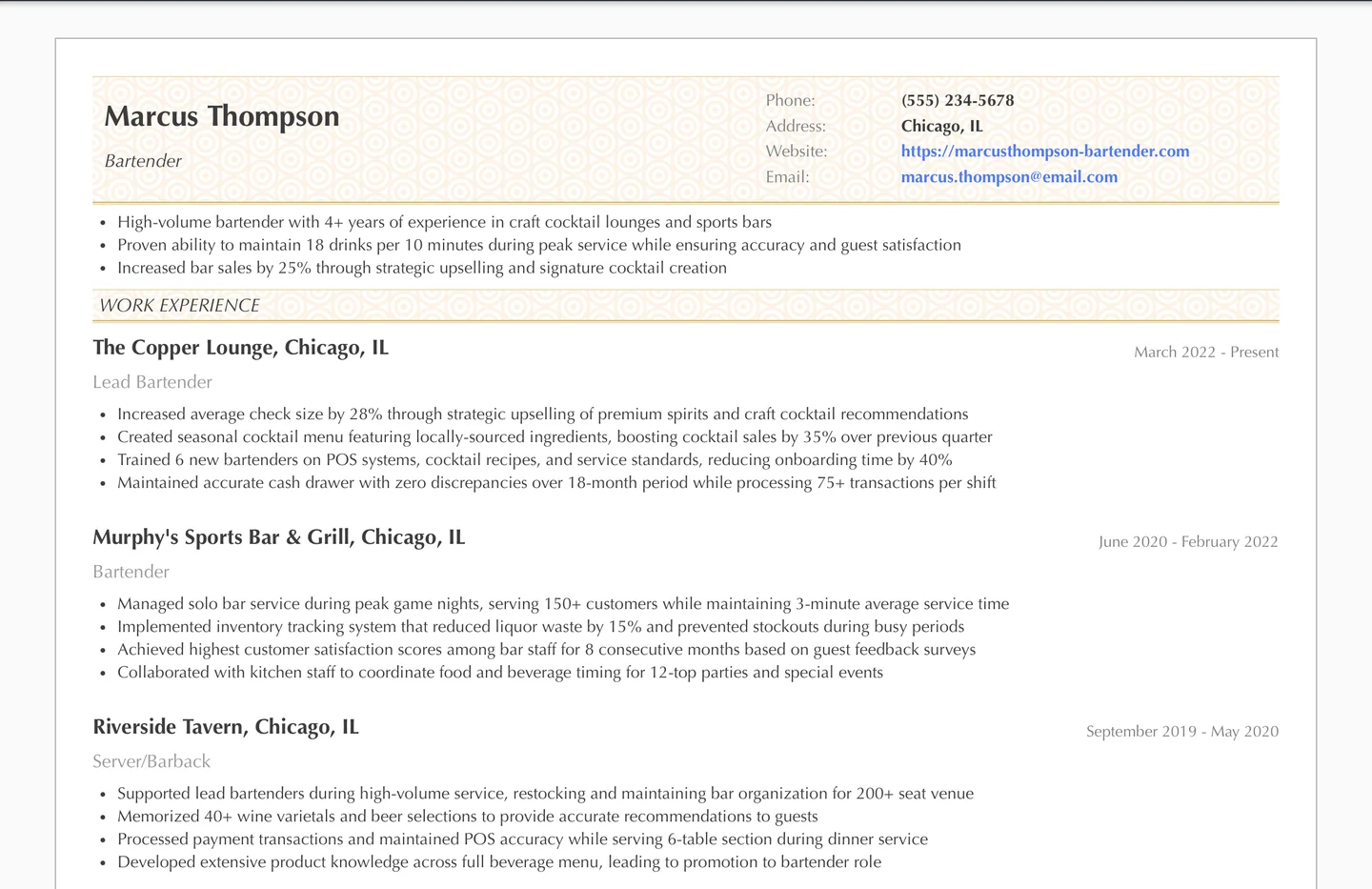
The Best Bartender Resume Example/Sample
https://www.resumonk.com/bartenderBartenderChoosing the Right Resume Format for Your Bartender Resume
The reverse-chronological format is your best friend here.
Why? Because bar managers and restaurant owners want to see your most recent experience first - they're looking for someone who can hit the ground running tonight, not reminiscing about what you did five years ago. This format showcases your career progression naturally, letting hiring managers quickly spot if you've been building relevant experience.
When to Use Alternative Formats
Now, if you're making that classic transition - maybe you're a server looking to step behind the bar, or you're coming from retail with killer customer service skills but no direct bartending experience - you might consider a combination format. This lets you lead with a skills section that screams "I can handle your busiest Saturday night" before diving into your work history.
Skip the functional format. Bar managers are practical people who want to see where and when you've worked. They're not interested in mysterious gaps or vague timelines.
Structuring Your Bartender Resume
Your resume should flow like a well-crafted cocktail - each ingredient in perfect proportion.
Start with your contact information and a punchy professional summary (2-3 lines max), then dive straight into your experience. Education comes after experience unless you're fresh out of bartending school or have specialized certifications like sommelier training. Keep it to one page unless you're a seasoned professional with over 10 years behind the bar - nobody has time to flip pages during a pre-shift meeting.
For those applying in the UK or Australia, remember that these markets often expect a slightly longer format (up to 2 pages is acceptable), and you might include a brief personal statement rather than an objective. Canadian establishments tend to follow US standards, but don't include a photo regardless of which country you're applying in - your personality will shine through in person.
Crafting Your Work Experience as a Bartender
Your work experience section is where you transform from just another applicant into the bartender who saved last Saturday's dinner rush. Every bar manager reading your resume is asking themselves one question - "Can this person handle my bar?"
Your job is to answer with a resounding yes through concrete examples.
Writing Impact-Driven Descriptions
Think about the last time you worked a shift that went sideways - the POS system crashed, you ran out of house vodka, and somehow you still kept customers happy.
That's the story you need to tell, but in resume language. Each position should include 3-4 bullet points that showcase not just what you did, but how well you did it.
Focus on the metrics that matter in this industry - speed, accuracy, sales, and customer satisfaction. Did you increase bar sales? Reduce waste? Create a signature cocktail that became a menu staple? These are the golden nuggets that make managers take notice.
❌ Don't write vague, duty-based descriptions:
• Served drinks to customers
• Handled cash register
• Cleaned bar area
✅ Do write specific, achievement-focused statements:
• Increased average check size by 20% through strategic upselling of premium spirits and appetizer pairings
• Maintained accurate cash drawer with zero discrepancies over 6-month period while processing 50+ transactions per shift
• Implemented new bar closing procedure that reduced cleanup time by 30 minutes while maintaining health code standards
Highlighting Relevant Non-Bartending Experience
Maybe you've never officially been called a bartender, but you've been in the trenches of customer service.
That server position where you memorized 50+ wine varietals? That's relevant. The retail job where you consistently hit sales targets? That shows you understand upselling. Even that volunteer gig pouring beers at the local festival demonstrates you can handle volume.
The key is translating these experiences into bartending language. Your customer service skills become "guest relations expertise," your cash handling becomes "POS system proficiency," and your ability to work Black Friday retail becomes "thrives in high-pressure, fast-paced environments."
❌ Don't minimize non-bartending experience:
Retail Sales Associate - Unrelated to bartending
✅ Do connect the dots for the hiring manager:
Retail Sales Associate
• Developed extensive product knowledge across 200+ SKUs, similar to maintaining cocktail recipe expertise
• Achieved 115% of sales targets through consultative selling approach and product recommendations
• Managed inventory counts and restocking procedures, ensuring product availability during peak hours
Essential Skills for Your Bartender Resume
The skills section of your bartender resume is like your speed rail - everything essential needs to be within reach and clearly organized. Bar managers spend about 6 seconds scanning a resume initially, and your skills section helps them quickly check their mental boxes of requirements.
Technical Skills That Pay the Bills
Let's be honest - anyone can claim they make a "mean margarita," but can you work with Micros?
How about Aloha or Toast? POS system proficiency is often the first technical requirement managers look for because training someone on drinks is easier than teaching them a whole new operating system during a busy shift.
Your technical skills should include specific systems, certifications you hold, and measurable abilities. TIPS certification, RBS (Responsible Beverage Service) training, food handler's permit - these aren't just nice-to-haves, they're often legal requirements.
If you know specific cocktail techniques (molecular mixology, anyone?), wine knowledge, or craft beer expertise, these deserve prominent placement.
The Soft Skills That Keep Customers Coming Back
Here's where bartending gets interesting - you're part therapist, part entertainer, part efficiency expert. Your soft skills need to reflect this unique blend.
But simply listing "good communication" is like serving a vodka soda without the lime - technically correct but missing that essential element.
❌ Don't use generic, overused skill descriptions:
• People person
• Team player
• Good communication
• Multitasking
✅ Do use specific, industry-relevant skills:
• Guest rapport building and regular customer retention
• Conflict de-escalation and responsible service enforcement
• High-volume order management (average 15 drinks/10 minutes during peak hours)
• Collaborative service with kitchen and waitstaff teams
Organizing Your Skills Section
Consider breaking your skills into categories - Technical Skills, Beverage Knowledge, and Service Skills.
This makes it easy for managers to find exactly what they're looking for.
If you're applying to a craft cocktail bar, lead with your mixology skills. Sports bar? Emphasize your speed and efficiency with beer service. Fine dining? Highlight your wine knowledge and tableside manner.
For international applications, remember that certification names vary. The UK has Personal Licence requirements, Australia requires RSA (Responsible Service of Alcohol), and Canada has province-specific certifications like Smart Serve in Ontario. Always use the local terminology for the market you're applying to.
Specific Considerations and Tips for Your Bartender Resume
Now for the insider knowledge - the things that separate a bartender's resume from every other hospitality position. You're not just another service industry worker; you're the maestro of the three-deep crowd at the bar, the keeper of secrets, and the creator of experiences.
The Availability Reality Check
Unlike many jobs, bartending means your prime working hours are when everyone else is playing. Include your availability directly on your resume if it aligns with typical bar shifts. Can you work until 4 AM? Available all weekends? This isn't usually resume material for other jobs, but for bartending, it's gold.
A simple line in your summary or cover letter like "Full availability including nights, weekends, and holidays" can move you to the top of the pile.
The Portfolio Factor
If you've created original cocktails, managed bar social media accounts, or have photos of your garnish work that would make someone weep with joy, mention that you have a portfolio available. Don't attach it unless requested, but a line like "Cocktail creation portfolio available upon request" shows you're serious about the craft aspect of bartending, not just slinging beers.
❌ Don't forget the visual element of modern bartending:
Experience: Bartender at Local Pub
• Made drinks
✅ Do showcase your creative contributions:
Experience: Bartender at Local Pub
• Designed and launched seasonal cocktail menu featuring locally-sourced ingredients, increasing cocktail sales by 35%
• Created Instagram-worthy signature drinks that generated 50+ social media tags weekly
The Geography Game
Location matters more in bartending than almost any other profession.
If you're willing to relocate or are already planning a move, state it clearly. Many bartenders follow seasonal patterns - summer in beach towns, winter in ski resorts. If you have this flexibility, it's a huge advantage. Similarly, if you live in a major city, specify which neighborhoods you can work in.
A bartender who lives in Brooklyn might not want to commute to the Bronx for a closing shift ending at 4 AM.
The Reference Revolution
In the bartending world, references carry unusual weight because the industry is surprisingly small.
Everyone knows everyone, especially in the same city. Skip the "References available upon request" line, but be ready with at least one bar manager or beverage director who can vouch for your speed, accuracy, and ability to handle difficult situations. That server who became a manager at another venue? They're gold. The regular who happens to be a restaurant critic? Even better.
Language and Cultural Competence
If you speak multiple languages, this isn't just a nice bonus - it's a significant advantage in many markets. Being able to take orders in Spanish, charm tourists in French, or joke with regulars in Mandarin can make you invaluable in diverse neighborhoods or tourist-heavy locations.
List these prominently, especially if you're applying in international hotels, airports, or culturally specific venues.
Finally, remember that bartending resumes are read by people who understand the controlled chaos of service industry life. They know that "maintained composure during service" means you didn't lose it when someone ordered a mojito during the busiest hour of the year. They understand that "inventory management" means you caught the barback stealing bottles. Write for these people - be professional, but let them know you're one of them. Show them you understand that bartending isn't just a job, it's a lifestyle, a craft, and sometimes, a calling.
Education to List on Bartender Resume
Think of your education section as the lime wedge on a gin and tonic - not the main event, but its absence would be noticed.
Most bartenders come from wildly different educational backgrounds. Maybe you studied theater, dropped out of engineering school, or completed a liberal arts degree while figuring out your next move. Whatever your story, there's a strategic way to present it.
The Basics - What Always Goes In
Your high school diploma or GED should make an appearance if it's your highest level of education. No shame in that game - some of the best bartenders in the business started slinging drinks right after high school and never looked back. If you have any college experience, even if incomplete, include it.
Employers appreciate someone who's been exposed to higher education, even if you discovered halfway through sophomore year that campus life wasn't your scene.
Here's how to structure your education entry properly:
❌ Don't write vaguely:
College - Studied Business
Some bartending courses
✅ Do write with specifics:
1. Bachelor of Arts in Business Administration (Incomplete - 60 credits)
State University of New York, Buffalo, NY
2019 - 2021

2. Bartending Certification
ABC Bartending School, New York, NY
March 2022
Specialized Training - Your Secret Weapon
This is where things get interesting for bartenders.
While your philosophy degree might not directly translate to crafting the perfect Old Fashioned, your mixology certification absolutely does. Any bartending school, mixology course, or beverage-specific training belongs front and center in your education section. These certifications show you're serious about the craft, not just looking for a temporary gig while you "figure things out."
Don't forget about those alcohol safety certifications either. TIPS certification, RBS training, or your state's responsible beverage service certificate - these aren't just pieces of paper. They're legal requirements in many states and show employers you understand the liability side of the business. In states like California, having your RBS certification ready to go can be the difference between getting hired immediately or waiting weeks for onboarding.
The Geographic Considerations
If you're applying in the UK, your Personal Licence qualification is absolutely essential and should be prominently displayed.
In Canada, each province has its own serving certification - Smart Serve in Ontario, Serving It Right in British Columbia. These regional certifications should appear before your traditional education if you have them.
Australian bartenders should highlight their RSA (Responsible Service of Alcohol) certification, as it's legally required across all states.
When Your Education Seems Unrelated
So you have a degree in marine biology. Now you're shaking martinis. The connection isn't immediately obvious, but smart bartenders know how to bridge that gap. That biology degree taught you precision in measurements, attention to detail in following procedures, and the ability to work under pressure during lab practicals. Sound familiar?
These are exactly the skills you use during a slammed Saturday night service.
The key is knowing when to elaborate and when to keep it simple. If your degree genuinely contributed skills relevant to bartending - hospitality management, business, psychology, theater - add a brief relevant coursework section. If not, just list it cleanly and let your experience section do the heavy lifting.
Awards and Recognition on Bartender Resume
The bartending world has its own ecosystem of competitions, certifications, and acknowledgments.
From flair bartending competitions to cocktail creation contests, from employee of the month to speed-pouring championships - these aren't just ego boosts. They're concrete proof that you're not just another person who can follow a recipe card.
Competition Wins and Placements
Cocktail competitions have exploded in popularity over the past decade, and if you've placed in any of them, that's resume gold. Whether it's a local bar's cocktail competition, a brand-sponsored mixology challenge, or a regional bartending championship, these achievements show creativity, skill under pressure, and deep knowledge of your craft.
But here's where bartenders often stumble - they either undersell these achievements or list them without context. Saying you "won a cocktail competition" is like saying you "made drinks at a bar." It's technically true but painfully vague.
❌ Don't minimize your achievements:
Won cocktail contest - 2023
Participated in flair competition
✅ Do provide context and impact:
1st Place | Bacardi Legacy Cocktail Competition (Regional Finals) | January 2023
- Created "Midnight in Havana" cocktail, now featured on menu at 3 locations

Semi-Finalist | Speed Flair Bartending Championship | August 2022
- Competed against 50+ bartenders from tri-state area
Professional Recognition and Certifications
Beyond competitions, there's a whole world of professional recognition in bartending.
Maybe you were selected to represent your bar at a spirits brand training. Perhaps you were chosen to help open a new location because of your training abilities. These aren't traditional "awards," but they're absolutely worth highlighting.
Certifications from spirit brands carry serious weight in this industry. That Jameson Irish Whiskey Brand Ambassador certification? The Grey Goose Academy completion? These show you're not just pouring drinks - you're educated about what you're serving.
High-end establishments particularly value bartenders who can speak intelligently about their products.
In-House Awards That Actually Matter
Every restaurant hands out "Employee of the Month" awards, but in bartending, some internal recognition genuinely stands out.
Highest sales numbers, best customer satisfaction scores, most creative cocktail special - these quantifiable achievements prove your value in language managers understand: money and customer happiness.
If your bar tracked metrics, use them. "Achieved highest check average among bar staff for 6 consecutive months" tells a much better story than "Great at upselling." The difference between being a good bartender and a great hire often comes down to whether you can prove your impact on the business.
Publications and Media Features
Maybe the local paper featured your signature cocktail.
Perhaps you contributed a recipe to a bartending blog. Or maybe you were interviewed about cocktail trends for a lifestyle magazine. In the age of social media, even being featured on your bar's Instagram for creating a viral drink counts as media recognition.
Don't discount these moments. A bartender who gets media attention brings publicity to their establishment.
That's marketing value that extends far beyond your ability to free-pour accurately.
Listing References for Bartender Resume
The truth is, references in the bartending world work differently than in other industries. While office workers stress about professional references from five years ago, bar managers are calling your last employer to ask one simple question: "Would you hire them again?"
They want to know if you show up for your shifts, if you can handle the pressure, and if the till matches at the end of the night.
Who Makes the Cut
Your reference lineup should tell a story about your reliability and skill.
The gold standard is a current or recent bar manager or supervisor - someone who's seen you handle a brutal Friday night rush and lived to tell the tale. But here's where bartenders have an advantage: your reference pool is deeper than just managers.
That veteran bartender who trained you? They're a reference. The restaurant owner who used to chat with you during slow afternoons? Reference. The beverage director who selected your cocktail for the seasonal menu? Absolutely a reference. Even that regular who happens to be a local business owner can vouch for your consistency and personality - and in bartending, personality pays the bills.
❌ Don't list references without context:
References:
John Smith - 555-0123
Maria Garcia - 555-0456
Tony Chen - 555-0789
✅ Do provide clear relationships and relevance:
References:

1. Sarah Mitchell
Bar Manager - The Copper Fox
(555) 012-3456
[email protected]
Supervised directly for 2 years

2. Marcus Johnson
Beverage Director - Sunset Hospitality Group
(555) 045-6789
[email protected]
Oversaw cocktail program development
The "References Available Upon Request" Debate
Old-school resume advice says to write "References available upon request" at the bottom of your resume.
Here's the thing - every hiring manager knows you have references. It's like putting "Drinks made to order" on a cocktail menu. The real question is whether to include them on your resume or provide them separately.
For bartending positions, especially in smaller establishments or when applying in person, having a separate reference sheet ready to go shows preparation. Format it like a resume page with your header, and bring copies to interviews. For online applications, follow their specific instructions - some want references upfront, others will ask later if interested.
Geographic and Industry Variations
In the UK and Australia, references are often expected on the CV itself. Canadian employers typically want them separate but immediately available.
In the US, it varies by region and establishment type - upscale venues often follow corporate protocols while neighborhood bars might want to call references before scheduling an interview.
Chain restaurants and hotel bars usually have strict reference-checking procedures, often requiring three professional references. Independent bars might be satisfied with one solid reference from someone they know in the industry.
Country clubs and private clubs almost always check references thoroughly and might even require character references.
Managing Problematic Reference Situations
What if your last bar manager was the problem, not you?
What if the place closed suddenly or the owner skipped town? These situations are more common in bartending than anyone admits. The key is having backup references and being strategic about who you list.
If you can't use your most recent supervisor, use a colleague from that job who's now in management elsewhere.
If a place closed, track down former coworkers on social media - chances are they're working somewhere else and can vouch for you. Never list a reference you haven't spoken to recently, and always give them a heads up when you're job hunting. A surprised reference is rarely a good reference.
Remember, in bartending, reputation travels fast. The manager at the cocktail bar downtown probably knows someone who worked with you three bars ago. This network effect can work for or against you, so maintain relationships even after you leave. That bartender you trained two years ago might be a bar manager now, and their reference could land you your next gig.
Cover Letter Tips for Bartender Resume
Most bartenders think cover letters are corporate nonsense better suited for office jobs.
They slap together three generic paragraphs about being a "people person" who makes "great drinks" and call it a day. Meanwhile, the bartender who lands the gig at that high-volume cocktail bar downtown? They understood that a cover letter is their chance to show personality before the interview - something that's absolutely crucial in an industry built on interpersonal connection.
The Opening - Hook Them Like a Regular
You know how you can spot a first-time customer from across the bar?
They look at the menu too long, they're hesitant to make eye contact, they don't know what they want. Hiring managers can spot a generic cover letter from the same distance. Your opening paragraph needs to immediately establish that you understand their specific establishment.
❌ Don't open with generic enthusiasm:
Dear Hiring Manager,

I am writing to express my interest in the Bartender position at your establishment. I have 3 years of experience and love making drinks.
✅ Do open with specific connection:
Dear [Manager Name],

Last Thursday, I watched your bartender handle a 15-person bachelorette party while simultaneously managing the regular dinner rush at the bar.
The way they remembered the bride's modified cosmo recipe on the third round while keeping their cool - that's exactly the kind of high-volume precision I've developed over three years at Murphy's Taphouse.
The Body - Show, Don't Just Tell
This is where you translate your bartending experience into business value.
Every hiring manager is trying to solve problems - understaffing, inconsistent service, high turnover, weak sales. Your job is to show how you've solved similar problems before. Think specific situations, not generic skills.
Instead of saying you're great at multitasking, describe managing a solo Saturday shift when the other bartender called in sick during March Madness. Rather than claiming you're creative, mention the whiskey cocktail you invented that became the bar's second-best seller.
The key is painting a picture they can envision happening in their establishment.
Understanding the Venue's Voice
A cover letter for a dive bar should sound different from one for a craft cocktail lounge. This isn't about being fake - it's about showing you understand their business model. The neighborhood pub values reliability and regular rapport. The upscale hotel bar wants sophistication and spirits knowledge.
The high-volume nightclub needs speed and stamina.
Read their website, check their social media, visit if possible. Use language that mirrors their brand. If they describe themselves as "craft-focused," mention your experience with house-made syrups. If they emphasize "neighborhood gathering place," talk about building regular relationships.
The Closing - Make the Next Step Easy
Your closing paragraph should be like a perfect last call - clear, confident, and actionable.
Don't just say you're available for an interview. Mention specific availability, acknowledge their likely busy periods, and show flexibility.
Remember to reference any additional requirements they mentioned. If they need someone with wine knowledge, confirm you have it. If they specified weekend availability, explicitly state you can work those shifts. Make it easy for them to picture you solving their scheduling puzzle.
Key Takeaways
Essential Points to Remember
- Use reverse-chronological format - Bar managers want to see your most recent experience first, as they're hiring for immediate needs
- Quantify your achievements - Include specific metrics like sales increases, transaction volumes, speed of service, and customer satisfaction scores
- Highlight relevant certifications prominently - TIPS, RBS, or your local alcohol service certification should be immediately visible
- Include POS system proficiency - Specify which systems you know (Micros, Aloha, Toast) as this reduces training time
- Translate non-bartending experience effectively - Connect your server, retail, or other customer service experience to bartending skills
- State your availability clearly - Include willingness to work nights, weekends, and holidays if applicable
- Keep it to one page - Unless you have 10+ years of experience, managers don't have time for multiple pages
- Customize for the venue type - Craft cocktail bars, sports bars, and nightclubs all look for different skill emphases
- Include competition wins and media features - These set you apart from other applicants and show dedication to the craft
- Prepare references strategically - Have a mix of managers, colleagues, and even regulars who can vouch for your skills
Creating a bartender resume on Resumonk takes the guesswork out of formatting and structure, letting you focus on what really matters - showcasing your unique blend of technical skills and personality. With professionally designed templates that understand the service industry's specific needs, you can build a resume that captures both your efficiency behind the bar and your ability to create memorable experiences for guests. The platform's AI-powered suggestions help you articulate your achievements in language that resonates with bar managers, transforming "made drinks quickly" into "maintained 15 drinks per 10 minutes during peak service while ensuring accuracy and guest satisfaction."
Ready to Create Your Bartender Resume?
Land your dream gig with Resumonk's tailored resume builder. Whether you're aiming for that high-volume sports bar or the intimate craft cocktail lounge, we've got the tools to help you stand out.
Start Building Your Bartender Resume →
More Restaurant & Hospitality resume examples
- McDonald's Crew Member resume example
- Barista resume example
- Chef resume example
- Restaurant Server resume example
See all Restaurant & Hospitality resume examples, or browse every category.
Resume writing tips
Picture yourself at 2 AM on a Saturday night - the bar is three deep with customers, the ticket printer won't stop chirping, and somehow you're simultaneously shaking two different cocktails while taking a beer order and making change for a twenty. Your hands move on autopilot, muscle memory guiding every pour, while you chat with the regular who's telling you about their terrible week.
This controlled chaos, this beautiful dance of efficiency and personality - this is what you need to capture on a piece of paper that will land you your next bartending gig.
Whether you're that server who's been eyeing the bar for months, knowing you could handle those drink orders faster than the current bartender, or you're fresh from bartending school with your certificate still crisp and your pour count perfectly calibrated, creating a bartender resume feels like trying to bottle lightning. How do you translate the electricity of a Friday night rush, the precision of a perfectly balanced cocktail, or the magic of turning an angry customer into a regular, into bullet points that a bar manager will actually read between their inventory counts and staff meetings?
The truth is, most bartender resumes read like they were written by someone who's never actually worked a service industry job - all generic skills and vague responsibilities that could apply to any position from cashier to CEO. But you're about to learn something different. In this guide, we'll walk through everything from choosing the right resume format that showcases your journey into bartending, to crafting work experience descriptions that make managers picture you handling their busiest shifts. We'll dive into which skills actually matter (hint - it's not just about knowing drink recipes), how to leverage your education even if it seems unrelated, and why your references carry more weight in this industry than almost any other.
We'll also tackle the specific situations that make bartending resumes unique - like how to highlight your availability for those coveted weekend and late-night shifts, how to showcase any cocktail competitions or certifications you've earned, and how to write a cover letter that sounds like you, not like a robot programmed with corporate buzzwords. By the time you finish reading, you'll know exactly how to create a resume that proves you're not just someone who can follow a recipe card, but a bartender who understands that this job is equal parts speed, skill, and soul.
The Best Bartender Resume Example/Sample
https://www.resumonk.com/bartenderBartenderChoosing the Right Resume Format for Your Bartender Resume
The reverse-chronological format is your best friend here.
Why? Because bar managers and restaurant owners want to see your most recent experience first - they're looking for someone who can hit the ground running tonight, not reminiscing about what you did five years ago. This format showcases your career progression naturally, letting hiring managers quickly spot if you've been building relevant experience.
When to Use Alternative Formats
Now, if you're making that classic transition - maybe you're a server looking to step behind the bar, or you're coming from retail with killer customer service skills but no direct bartending experience - you might consider a combination format. This lets you lead with a skills section that screams "I can handle your busiest Saturday night" before diving into your work history.
Skip the functional format. Bar managers are practical people who want to see where and when you've worked. They're not interested in mysterious gaps or vague timelines.
Structuring Your Bartender Resume
Your resume should flow like a well-crafted cocktail - each ingredient in perfect proportion.
Start with your contact information and a punchy professional summary (2-3 lines max), then dive straight into your experience. Education comes after experience unless you're fresh out of bartending school or have specialized certifications like sommelier training. Keep it to one page unless you're a seasoned professional with over 10 years behind the bar - nobody has time to flip pages during a pre-shift meeting.
For those applying in the UK or Australia, remember that these markets often expect a slightly longer format (up to 2 pages is acceptable), and you might include a brief personal statement rather than an objective. Canadian establishments tend to follow US standards, but don't include a photo regardless of which country you're applying in - your personality will shine through in person.
Crafting Your Work Experience as a Bartender
Your work experience section is where you transform from just another applicant into the bartender who saved last Saturday's dinner rush. Every bar manager reading your resume is asking themselves one question - "Can this person handle my bar?"
Your job is to answer with a resounding yes through concrete examples.
Writing Impact-Driven Descriptions
Think about the last time you worked a shift that went sideways - the POS system crashed, you ran out of house vodka, and somehow you still kept customers happy.
That's the story you need to tell, but in resume language. Each position should include 3-4 bullet points that showcase not just what you did, but how well you did it.
Focus on the metrics that matter in this industry - speed, accuracy, sales, and customer satisfaction. Did you increase bar sales? Reduce waste? Create a signature cocktail that became a menu staple? These are the golden nuggets that make managers take notice.
❌ Don't write vague, duty-based descriptions:
• Served drinks to customers
• Handled cash register
• Cleaned bar area
✅ Do write specific, achievement-focused statements:
• Increased average check size by 20% through strategic upselling of premium spirits and appetizer pairings
• Maintained accurate cash drawer with zero discrepancies over 6-month period while processing 50+ transactions per shift
• Implemented new bar closing procedure that reduced cleanup time by 30 minutes while maintaining health code standards
Highlighting Relevant Non-Bartending Experience
Maybe you've never officially been called a bartender, but you've been in the trenches of customer service.
That server position where you memorized 50+ wine varietals? That's relevant. The retail job where you consistently hit sales targets? That shows you understand upselling. Even that volunteer gig pouring beers at the local festival demonstrates you can handle volume.
The key is translating these experiences into bartending language. Your customer service skills become "guest relations expertise," your cash handling becomes "POS system proficiency," and your ability to work Black Friday retail becomes "thrives in high-pressure, fast-paced environments."
❌ Don't minimize non-bartending experience:
Retail Sales Associate - Unrelated to bartending
✅ Do connect the dots for the hiring manager:
Retail Sales Associate
• Developed extensive product knowledge across 200+ SKUs, similar to maintaining cocktail recipe expertise
• Achieved 115% of sales targets through consultative selling approach and product recommendations
• Managed inventory counts and restocking procedures, ensuring product availability during peak hours
Essential Skills for Your Bartender Resume
The skills section of your bartender resume is like your speed rail - everything essential needs to be within reach and clearly organized. Bar managers spend about 6 seconds scanning a resume initially, and your skills section helps them quickly check their mental boxes of requirements.
Technical Skills That Pay the Bills
Let's be honest - anyone can claim they make a "mean margarita," but can you work with Micros?
How about Aloha or Toast? POS system proficiency is often the first technical requirement managers look for because training someone on drinks is easier than teaching them a whole new operating system during a busy shift.
Your technical skills should include specific systems, certifications you hold, and measurable abilities. TIPS certification, RBS (Responsible Beverage Service) training, food handler's permit - these aren't just nice-to-haves, they're often legal requirements.
If you know specific cocktail techniques (molecular mixology, anyone?), wine knowledge, or craft beer expertise, these deserve prominent placement.
The Soft Skills That Keep Customers Coming Back
Here's where bartending gets interesting - you're part therapist, part entertainer, part efficiency expert. Your soft skills need to reflect this unique blend.
But simply listing "good communication" is like serving a vodka soda without the lime - technically correct but missing that essential element.
❌ Don't use generic, overused skill descriptions:
• People person
• Team player
• Good communication
• Multitasking
✅ Do use specific, industry-relevant skills:
• Guest rapport building and regular customer retention
• Conflict de-escalation and responsible service enforcement
• High-volume order management (average 15 drinks/10 minutes during peak hours)
• Collaborative service with kitchen and waitstaff teams
Organizing Your Skills Section
Consider breaking your skills into categories - Technical Skills, Beverage Knowledge, and Service Skills.
This makes it easy for managers to find exactly what they're looking for.
If you're applying to a craft cocktail bar, lead with your mixology skills. Sports bar? Emphasize your speed and efficiency with beer service. Fine dining? Highlight your wine knowledge and tableside manner.
For international applications, remember that certification names vary. The UK has Personal Licence requirements, Australia requires RSA (Responsible Service of Alcohol), and Canada has province-specific certifications like Smart Serve in Ontario. Always use the local terminology for the market you're applying to.
Specific Considerations and Tips for Your Bartender Resume
Now for the insider knowledge - the things that separate a bartender's resume from every other hospitality position. You're not just another service industry worker; you're the maestro of the three-deep crowd at the bar, the keeper of secrets, and the creator of experiences.
The Availability Reality Check
Unlike many jobs, bartending means your prime working hours are when everyone else is playing. Include your availability directly on your resume if it aligns with typical bar shifts. Can you work until 4 AM? Available all weekends? This isn't usually resume material for other jobs, but for bartending, it's gold.
A simple line in your summary or cover letter like "Full availability including nights, weekends, and holidays" can move you to the top of the pile.
The Portfolio Factor
If you've created original cocktails, managed bar social media accounts, or have photos of your garnish work that would make someone weep with joy, mention that you have a portfolio available. Don't attach it unless requested, but a line like "Cocktail creation portfolio available upon request" shows you're serious about the craft aspect of bartending, not just slinging beers.
❌ Don't forget the visual element of modern bartending:
Experience: Bartender at Local Pub
• Made drinks
✅ Do showcase your creative contributions:
Experience: Bartender at Local Pub
• Designed and launched seasonal cocktail menu featuring locally-sourced ingredients, increasing cocktail sales by 35%
• Created Instagram-worthy signature drinks that generated 50+ social media tags weekly
The Geography Game
Location matters more in bartending than almost any other profession.
If you're willing to relocate or are already planning a move, state it clearly. Many bartenders follow seasonal patterns - summer in beach towns, winter in ski resorts. If you have this flexibility, it's a huge advantage. Similarly, if you live in a major city, specify which neighborhoods you can work in.
A bartender who lives in Brooklyn might not want to commute to the Bronx for a closing shift ending at 4 AM.
The Reference Revolution
In the bartending world, references carry unusual weight because the industry is surprisingly small.
Everyone knows everyone, especially in the same city. Skip the "References available upon request" line, but be ready with at least one bar manager or beverage director who can vouch for your speed, accuracy, and ability to handle difficult situations. That server who became a manager at another venue? They're gold. The regular who happens to be a restaurant critic? Even better.
Language and Cultural Competence
If you speak multiple languages, this isn't just a nice bonus - it's a significant advantage in many markets. Being able to take orders in Spanish, charm tourists in French, or joke with regulars in Mandarin can make you invaluable in diverse neighborhoods or tourist-heavy locations.
List these prominently, especially if you're applying in international hotels, airports, or culturally specific venues.
Finally, remember that bartending resumes are read by people who understand the controlled chaos of service industry life. They know that "maintained composure during service" means you didn't lose it when someone ordered a mojito during the busiest hour of the year. They understand that "inventory management" means you caught the barback stealing bottles. Write for these people - be professional, but let them know you're one of them. Show them you understand that bartending isn't just a job, it's a lifestyle, a craft, and sometimes, a calling.
Education to List on Bartender Resume
Think of your education section as the lime wedge on a gin and tonic - not the main event, but its absence would be noticed.
Most bartenders come from wildly different educational backgrounds. Maybe you studied theater, dropped out of engineering school, or completed a liberal arts degree while figuring out your next move. Whatever your story, there's a strategic way to present it.
The Basics - What Always Goes In
Your high school diploma or GED should make an appearance if it's your highest level of education. No shame in that game - some of the best bartenders in the business started slinging drinks right after high school and never looked back. If you have any college experience, even if incomplete, include it.
Employers appreciate someone who's been exposed to higher education, even if you discovered halfway through sophomore year that campus life wasn't your scene.
Here's how to structure your education entry properly:
❌ Don't write vaguely:
College - Studied Business
Some bartending courses
✅ Do write with specifics:
1. Bachelor of Arts in Business Administration (Incomplete - 60 credits)
State University of New York, Buffalo, NY
2019 - 2021

2. Bartending Certification
ABC Bartending School, New York, NY
March 2022
Specialized Training - Your Secret Weapon
This is where things get interesting for bartenders.
While your philosophy degree might not directly translate to crafting the perfect Old Fashioned, your mixology certification absolutely does. Any bartending school, mixology course, or beverage-specific training belongs front and center in your education section. These certifications show you're serious about the craft, not just looking for a temporary gig while you "figure things out."
Don't forget about those alcohol safety certifications either. TIPS certification, RBS training, or your state's responsible beverage service certificate - these aren't just pieces of paper. They're legal requirements in many states and show employers you understand the liability side of the business. In states like California, having your RBS certification ready to go can be the difference between getting hired immediately or waiting weeks for onboarding.
The Geographic Considerations
If you're applying in the UK, your Personal Licence qualification is absolutely essential and should be prominently displayed.
In Canada, each province has its own serving certification - Smart Serve in Ontario, Serving It Right in British Columbia. These regional certifications should appear before your traditional education if you have them.
Australian bartenders should highlight their RSA (Responsible Service of Alcohol) certification, as it's legally required across all states.
When Your Education Seems Unrelated
So you have a degree in marine biology. Now you're shaking martinis. The connection isn't immediately obvious, but smart bartenders know how to bridge that gap. That biology degree taught you precision in measurements, attention to detail in following procedures, and the ability to work under pressure during lab practicals. Sound familiar?
These are exactly the skills you use during a slammed Saturday night service.
The key is knowing when to elaborate and when to keep it simple. If your degree genuinely contributed skills relevant to bartending - hospitality management, business, psychology, theater - add a brief relevant coursework section. If not, just list it cleanly and let your experience section do the heavy lifting.
Awards and Recognition on Bartender Resume
The bartending world has its own ecosystem of competitions, certifications, and acknowledgments.
From flair bartending competitions to cocktail creation contests, from employee of the month to speed-pouring championships - these aren't just ego boosts. They're concrete proof that you're not just another person who can follow a recipe card.
Competition Wins and Placements
Cocktail competitions have exploded in popularity over the past decade, and if you've placed in any of them, that's resume gold. Whether it's a local bar's cocktail competition, a brand-sponsored mixology challenge, or a regional bartending championship, these achievements show creativity, skill under pressure, and deep knowledge of your craft.
But here's where bartenders often stumble - they either undersell these achievements or list them without context. Saying you "won a cocktail competition" is like saying you "made drinks at a bar." It's technically true but painfully vague.
❌ Don't minimize your achievements:
Won cocktail contest - 2023
Participated in flair competition
✅ Do provide context and impact:
1st Place | Bacardi Legacy Cocktail Competition (Regional Finals) | January 2023
- Created "Midnight in Havana" cocktail, now featured on menu at 3 locations

Semi-Finalist | Speed Flair Bartending Championship | August 2022
- Competed against 50+ bartenders from tri-state area
Professional Recognition and Certifications
Beyond competitions, there's a whole world of professional recognition in bartending.
Maybe you were selected to represent your bar at a spirits brand training. Perhaps you were chosen to help open a new location because of your training abilities. These aren't traditional "awards," but they're absolutely worth highlighting.
Certifications from spirit brands carry serious weight in this industry. That Jameson Irish Whiskey Brand Ambassador certification? The Grey Goose Academy completion? These show you're not just pouring drinks - you're educated about what you're serving.
High-end establishments particularly value bartenders who can speak intelligently about their products.
In-House Awards That Actually Matter
Every restaurant hands out "Employee of the Month" awards, but in bartending, some internal recognition genuinely stands out.
Highest sales numbers, best customer satisfaction scores, most creative cocktail special - these quantifiable achievements prove your value in language managers understand: money and customer happiness.
If your bar tracked metrics, use them. "Achieved highest check average among bar staff for 6 consecutive months" tells a much better story than "Great at upselling." The difference between being a good bartender and a great hire often comes down to whether you can prove your impact on the business.
Publications and Media Features
Maybe the local paper featured your signature cocktail.
Perhaps you contributed a recipe to a bartending blog. Or maybe you were interviewed about cocktail trends for a lifestyle magazine. In the age of social media, even being featured on your bar's Instagram for creating a viral drink counts as media recognition.
Don't discount these moments. A bartender who gets media attention brings publicity to their establishment.
That's marketing value that extends far beyond your ability to free-pour accurately.
Listing References for Bartender Resume
The truth is, references in the bartending world work differently than in other industries. While office workers stress about professional references from five years ago, bar managers are calling your last employer to ask one simple question: "Would you hire them again?"
They want to know if you show up for your shifts, if you can handle the pressure, and if the till matches at the end of the night.
Who Makes the Cut
Your reference lineup should tell a story about your reliability and skill.
The gold standard is a current or recent bar manager or supervisor - someone who's seen you handle a brutal Friday night rush and lived to tell the tale. But here's where bartenders have an advantage: your reference pool is deeper than just managers.
That veteran bartender who trained you? They're a reference. The restaurant owner who used to chat with you during slow afternoons? Reference. The beverage director who selected your cocktail for the seasonal menu? Absolutely a reference. Even that regular who happens to be a local business owner can vouch for your consistency and personality - and in bartending, personality pays the bills.
❌ Don't list references without context:
References:
John Smith - 555-0123
Maria Garcia - 555-0456
Tony Chen - 555-0789
✅ Do provide clear relationships and relevance:
References:

1. Sarah Mitchell
Bar Manager - The Copper Fox
(555) 012-3456
[email protected]
Supervised directly for 2 years

2. Marcus Johnson
Beverage Director - Sunset Hospitality Group
(555) 045-6789
[email protected]
Oversaw cocktail program development
The "References Available Upon Request" Debate
Old-school resume advice says to write "References available upon request" at the bottom of your resume.
Here's the thing - every hiring manager knows you have references. It's like putting "Drinks made to order" on a cocktail menu. The real question is whether to include them on your resume or provide them separately.
For bartending positions, especially in smaller establishments or when applying in person, having a separate reference sheet ready to go shows preparation. Format it like a resume page with your header, and bring copies to interviews. For online applications, follow their specific instructions - some want references upfront, others will ask later if interested.
Geographic and Industry Variations
In the UK and Australia, references are often expected on the CV itself. Canadian employers typically want them separate but immediately available.
In the US, it varies by region and establishment type - upscale venues often follow corporate protocols while neighborhood bars might want to call references before scheduling an interview.
Chain restaurants and hotel bars usually have strict reference-checking procedures, often requiring three professional references. Independent bars might be satisfied with one solid reference from someone they know in the industry.
Country clubs and private clubs almost always check references thoroughly and might even require character references.
Managing Problematic Reference Situations
What if your last bar manager was the problem, not you?
What if the place closed suddenly or the owner skipped town? These situations are more common in bartending than anyone admits. The key is having backup references and being strategic about who you list.
If you can't use your most recent supervisor, use a colleague from that job who's now in management elsewhere.
If a place closed, track down former coworkers on social media - chances are they're working somewhere else and can vouch for you. Never list a reference you haven't spoken to recently, and always give them a heads up when you're job hunting. A surprised reference is rarely a good reference.
Remember, in bartending, reputation travels fast. The manager at the cocktail bar downtown probably knows someone who worked with you three bars ago. This network effect can work for or against you, so maintain relationships even after you leave. That bartender you trained two years ago might be a bar manager now, and their reference could land you your next gig.
Cover Letter Tips for Bartender Resume
Most bartenders think cover letters are corporate nonsense better suited for office jobs.
They slap together three generic paragraphs about being a "people person" who makes "great drinks" and call it a day. Meanwhile, the bartender who lands the gig at that high-volume cocktail bar downtown? They understood that a cover letter is their chance to show personality before the interview - something that's absolutely crucial in an industry built on interpersonal connection.
The Opening - Hook Them Like a Regular
You know how you can spot a first-time customer from across the bar?
They look at the menu too long, they're hesitant to make eye contact, they don't know what they want. Hiring managers can spot a generic cover letter from the same distance. Your opening paragraph needs to immediately establish that you understand their specific establishment.
❌ Don't open with generic enthusiasm:
Dear Hiring Manager,

I am writing to express my interest in the Bartender position at your establishment. I have 3 years of experience and love making drinks.
✅ Do open with specific connection:
Dear [Manager Name],

Last Thursday, I watched your bartender handle a 15-person bachelorette party while simultaneously managing the regular dinner rush at the bar.
The way they remembered the bride's modified cosmo recipe on the third round while keeping their cool - that's exactly the kind of high-volume precision I've developed over three years at Murphy's Taphouse.
The Body - Show, Don't Just Tell
This is where you translate your bartending experience into business value.
Every hiring manager is trying to solve problems - understaffing, inconsistent service, high turnover, weak sales. Your job is to show how you've solved similar problems before. Think specific situations, not generic skills.
Instead of saying you're great at multitasking, describe managing a solo Saturday shift when the other bartender called in sick during March Madness. Rather than claiming you're creative, mention the whiskey cocktail you invented that became the bar's second-best seller.
The key is painting a picture they can envision happening in their establishment.
Understanding the Venue's Voice
A cover letter for a dive bar should sound different from one for a craft cocktail lounge. This isn't about being fake - it's about showing you understand their business model. The neighborhood pub values reliability and regular rapport. The upscale hotel bar wants sophistication and spirits knowledge.
The high-volume nightclub needs speed and stamina.
Read their website, check their social media, visit if possible. Use language that mirrors their brand. If they describe themselves as "craft-focused," mention your experience with house-made syrups. If they emphasize "neighborhood gathering place," talk about building regular relationships.
The Closing - Make the Next Step Easy
Your closing paragraph should be like a perfect last call - clear, confident, and actionable.
Don't just say you're available for an interview. Mention specific availability, acknowledge their likely busy periods, and show flexibility.
Remember to reference any additional requirements they mentioned. If they need someone with wine knowledge, confirm you have it. If they specified weekend availability, explicitly state you can work those shifts. Make it easy for them to picture you solving their scheduling puzzle.
Key Takeaways
Essential Points to Remember
- Use reverse-chronological format - Bar managers want to see your most recent experience first, as they're hiring for immediate needs
- Quantify your achievements - Include specific metrics like sales increases, transaction volumes, speed of service, and customer satisfaction scores
- Highlight relevant certifications prominently - TIPS, RBS, or your local alcohol service certification should be immediately visible
- Include POS system proficiency - Specify which systems you know (Micros, Aloha, Toast) as this reduces training time
- Translate non-bartending experience effectively - Connect your server, retail, or other customer service experience to bartending skills
- State your availability clearly - Include willingness to work nights, weekends, and holidays if applicable
- Keep it to one page - Unless you have 10+ years of experience, managers don't have time for multiple pages
- Customize for the venue type - Craft cocktail bars, sports bars, and nightclubs all look for different skill emphases
- Include competition wins and media features - These set you apart from other applicants and show dedication to the craft
- Prepare references strategically - Have a mix of managers, colleagues, and even regulars who can vouch for your skills
Creating a bartender resume on Resumonk takes the guesswork out of formatting and structure, letting you focus on what really matters - showcasing your unique blend of technical skills and personality. With professionally designed templates that understand the service industry's specific needs, you can build a resume that captures both your efficiency behind the bar and your ability to create memorable experiences for guests. The platform's AI-powered suggestions help you articulate your achievements in language that resonates with bar managers, transforming "made drinks quickly" into "maintained 15 drinks per 10 minutes during peak service while ensuring accuracy and guest satisfaction."
Ready to Create Your Bartender Resume?
Land your dream gig with Resumonk's tailored resume builder. Whether you're aiming for that high-volume sports bar or the intimate craft cocktail lounge, we've got the tools to help you stand out.
Start Building Your Bartender Resume →
More Restaurant & Hospitality resume examples
- McDonald's Crew Member resume example
- Barista resume example
- Chef resume example
- Restaurant Server resume example
See all Restaurant & Hospitality resume examples, or browse every category.
Resume writing tips