Banker Resume Example (with Tips and Best Practices)
Introduction
You're staring at that job posting for a Personal Banker position at the local Wells Fargo branch, or maybe it's a Commercial Banker role at that regional bank downtown where you've been eyeing the modern glass building every morning on your commute. The salary range looks promising, the benefits are solid, and you know you've got what it takes - that perfect blend of people skills from your retail experience and analytical thinking from your finance degree.
But here's where you're stuck - how do you translate your scattered experiences into a resume that makes the hiring manager think "Yes, this person understands what being a banker actually means"?
Let's be clear about what you're applying for here. A "Banker" isn't the Wolf of Wall Street character making million-dollar trades - that's investment banking, a completely different animal. You're applying for a role where you'll be the face of the financial institution, helping real people navigate their financial lives. Whether you're aiming to be a Personal Banker helping families secure their first mortgage, a Business Banker structuring loans for local entrepreneurs, or a Private Banker managing wealth for successful professionals, you need a resume that speaks the language of trust, competence, and measurable results.
The banking industry has its own DNA when it comes to hiring. They're not looking for creative mavericks or disruptors - they want professionals who can demonstrate reliability, attention to detail, and progressive growth in financial services. Your resume needs to hit specific notes that resonate with risk-averse hiring managers who've seen too many bad hires cost them compliance violations or lost clients. Think of your resume as your first financial report to them - it needs to be accurate, comprehensive, and tell a story of consistent returns.
In this guide, we'll walk you through everything from choosing the right resume format (spoiler - it's reverse-chronological for banking, always), to crafting work experience bullets that showcase your ability to manage portfolios and meet sales targets, to listing the specific banking systems and certifications that make you stand out. We'll cover how to handle special circumstances like employment gaps from bank mergers, transitioning from teller to banker roles, or breaking into banking from retail or other industries. By the end, you'll have a complete blueprint for creating a banker resume that doesn't just list your qualifications but tells your professional story in a way that makes hiring managers want to meet you.
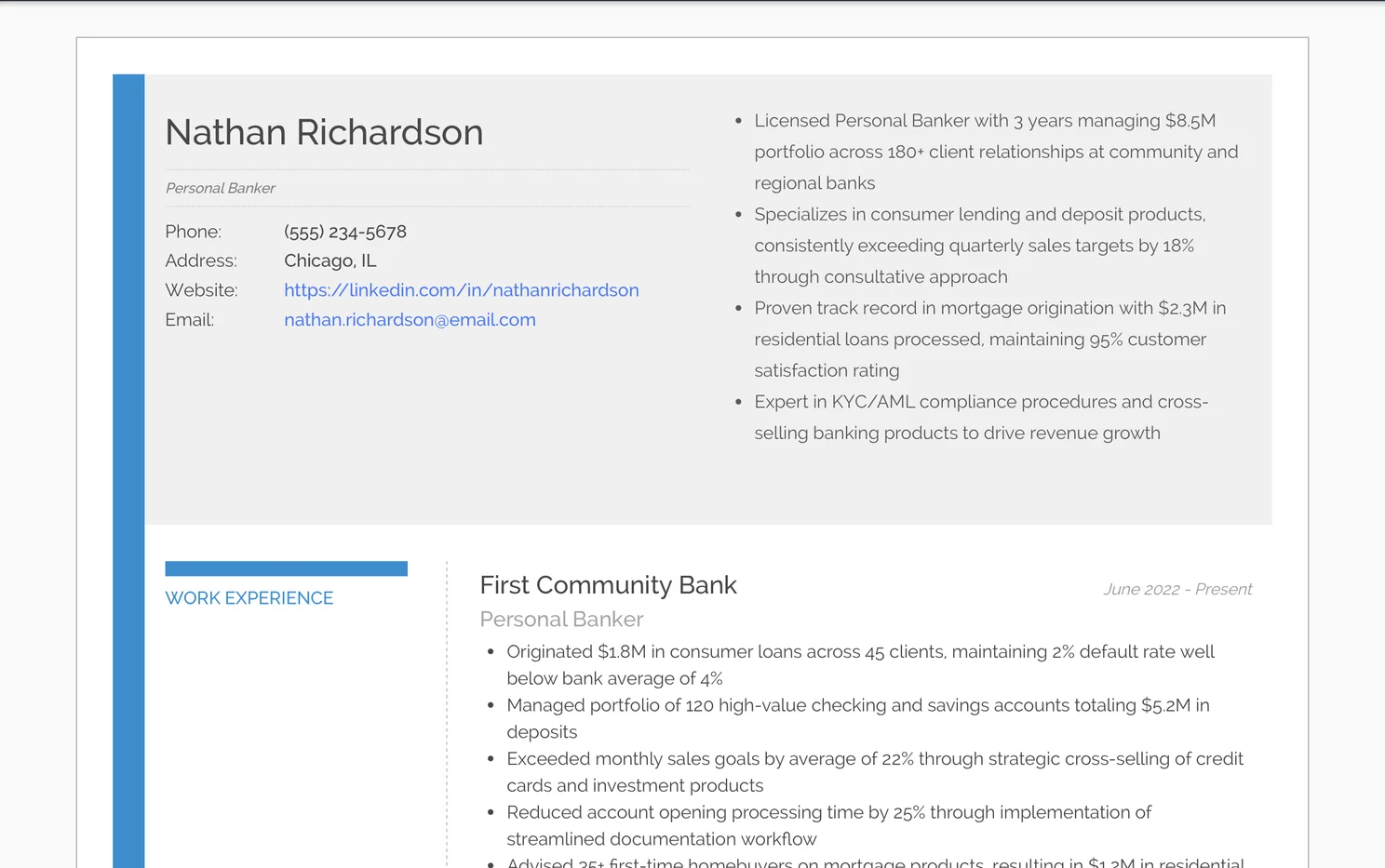
The Best Banker Resume Example/Sample
https://www.resumonk.com/banker-resumeBankerResume Format to Follow for Banker Resume
The reverse-chronological format is your golden ticket here.
Why? Because banking is all about trust, track record, and progressive responsibility. Hiring managers want to see your most recent experience first - they want to know if you've been handling commercial loan portfolios yesterday, not five years ago when regulations and market conditions were entirely different.
Understanding the Banking Hierarchy
Before we dive deeper, let's clarify what "Banker" actually means in the industry.
Unlike the tech world where "executive" might mean entry-level, in banking, a "Banker" typically refers to client-facing professionals who manage relationships, process transactions, and provide financial advice. This could range from Personal Bankers (entry to mid-level) who help retail customers with everyday banking needs, to Commercial Bankers who manage business accounts, to Private Bankers who cater to high-net-worth individuals.
Structuring Your Banking Resume
Start with a professional summary that immediately establishes your banking credentials.
This isn't the place for generic statements about being "detail-oriented" - every banker better be detail-oriented or they're in the wrong field. Instead, lead with your specific banking expertise.
❌ Don't write a vague summary:
Experienced professional seeking banking position with strong communication skills and attention to detail.
✅ Do write a targeted banking summary:
Licensed Personal Banker with 4 years managing $12M portfolio across 200+ client relationships.
Specializes in mortgage products and investment advisory, consistently exceeding quarterly sales targets by 15%.
Follow this with your reverse-chronological work experience, then your education (including any banking-specific certifications like Series 6 or 7 licenses), and finally your skills section. If you're in the UK, you might need to include your FCA authorizations prominently. Canadian bankers should highlight their CSC or IFIC certifications, while Australian bankers need to emphasize their RG146 compliance.
Work Experience on Banker Resume
Remember that moment when you successfully talked Mrs. Johnson through her first mobile banking setup, or when you identified that discrepancy in the commercial client's loan application that saved the bank from a potential default? These are the stories that need to shine through your work experience section, but translated into the language of metrics and achievements that banking executives understand.
The Formula for Banking Experience
Banking work experience needs to demonstrate three core elements - your ability to manage risk, generate revenue, and maintain compliance.
Every bullet point should ideally touch on at least one of these areas. Start each achievement with a strong action verb that resonates with banking operations: "Originated," "Underwrote," "Structured," "Managed," or "Advised."
❌ Don't list basic job duties:
• Helped customers with their banking needs
• Processed loan applications
• Answered phone calls
✅ Do quantify your banking achievements:
• Originated $4.5M in new commercial loans across 15 SME clients, maintaining 0% default rate
• Reduced loan processing time by 30% through implementation of new documentation workflow
• Advised 50+ high-value clients on investment strategies, resulting in 25% increase in AUM
Addressing Different Banking Specializations
If you're a retail banker, emphasize your sales achievements and customer satisfaction scores.
Commercial bankers should highlight their portfolio size, credit analysis capabilities, and relationship management success. Investment bankers need to showcase deal flow, transaction values, and successful closings. Remember, the person reading your resume likely started where you are now - they know the difference between processing a simple deposit and structuring a complex syndicated loan facility.
For those transitioning between banking sectors (say, from retail to commercial banking), focus on transferable skills but acknowledge the differences. Show how your retail experience with credit products prepared you for commercial lending, or how your teller accuracy translated into meticulous loan documentation review.
Skills to Show on Banker Resume
Think about your typical Tuesday afternoon - you're simultaneously running credit checks in one system, updating CRM notes in another, building a financial model in Excel, and preparing for a client presentation. Modern banking isn't just about counting money anymore; it's a complex blend of technical proficiency, regulatory knowledge, and interpersonal finesse.
Technical Banking Skills
Start with the banking systems and software you use daily. Every bank has its core banking platform - whether it's FIS, Fiserv, Jack Henry, or Temenos. List these specifically rather than generically saying "banking software."
Include your proficiency with credit analysis tools, loan origination systems, and any specialized platforms relevant to your banking sector.
❌ Don't use generic skill descriptions:
• Computer skills
• Financial analysis
• Customer service
✅ Do specify your banking-specific expertise:
• Credit Analysis: Moody's RiskCalc, FICO Score interpretation, Basel III compliance
• Banking Systems: FIS Core Banking, Salesforce Financial Services Cloud, nCino
• Financial Modeling: DCF analysis, loan amortization schedules, sensitivity analysis
Regulatory and Compliance Knowledge
Banking is one of the most regulated industries, and your resume needs to reflect your understanding of this landscape. Include relevant regulations you work with daily - KYC/AML procedures, GDPR (for European markets), Dodd-Frank compliance (for US bankers), or APRA guidelines (for Australian bankers).
Don't just list them; integrate them into your achievements when possible.
Soft Skills with Banking Context
Every resume talks about communication skills, but in banking, this means something specific - can you explain complex financial products to a first-time homebuyer? Can you deliver difficult news about loan rejections while maintaining client relationships?
Frame your soft skills within banking scenarios to make them relevant and believable.
Specific Considerations and Tips for Banker Resume
Here's something most resume guides won't tell you about banking applications - the person reviewing your resume is likely risk-averse by nature and training. They're looking for reasons to disqualify you because that's safer than taking a chance on someone who might not work out.
Your job is to make their decision feel like the safe, obvious choice.
The Licensing and Certification Strategy
Unlike other industries where certifications are nice-to-have, in banking they're often legally required. If you're applying for a role that requires Series 6 or 7 licenses and you don't have them, address this proactively in your cover letter rather than hoping they won't notice. If you're currently studying for these licenses, include your expected completion date.
For international moves, research equivalent certifications - a Canadian banker moving to the US needs to understand how their CSC translates to FINRA requirements.
Addressing Employment Gaps and Bank Failures
The banking industry has seen significant consolidation and failures, especially post-2008.
If your previous employer was acquired or failed (think Washington Mutual, Lehman Brothers, or more recently, Silicon Valley Bank), frame this neutrally. Don't badmouth failed institutions, but do highlight if you helped with orderly transition of client relationships or assisted with regulatory wind-down procedures.
❌ Don't hide or be negative about bank closures:
March 2023 - May 2023: Unemployed after bank collapse
✅ Do frame it professionally:
March 2023 - May 2023: Managed portfolio transition for 150+ clients during
Silicon Valley Bank FDIC receivership, ensuring 98% client retention to acquiring institution
The Geography Factor
Banking is surprisingly local despite globalization. A banker in New York City operates in a different universe from one in Des Moines, Iowa. If you're relocating, research the local banking landscape. Applying to a community bank after working at J. P. Morgan? Emphasize your ability to provide personalized service. Moving from a credit union to a commercial bank?
Highlight your understanding of profit-driven metrics while maintaining customer focus.
The Numbers Game
Banking resumes without numbers are like financial statements without figures - technically possible but utterly useless.
Every achievement should be quantified, but be careful about confidentiality. Use percentages rather than absolute dollar amounts when dealing with sensitive information, or use ranges that protect specific client information while still demonstrating scope.
Finally, remember that banking hiring managers have seen every type of exaggeration. That "managed $50M portfolio" better not mean you had viewing access to accounts totaling that amount. Be prepared to defend every number on your resume with specific examples during your interview. They will ask for details, and vague answers will end your candidacy faster than a failed background check.
Education to List on Banker Resume
Let's step into this scene - you're sitting across from a hiring manager at a commercial bank, and they're scanning your resume. As someone entering the banking world, likely as a personal banker, retail banker, or entry-level commercial banking associate, your education section might be one of your strongest selling points, especially if you're transitioning from college or making a career switch.
The banking industry has a peculiar relationship with education - it's simultaneously essential and yet not the whole story.
The Banking Education Hierarchy
Let's be real about where you stand. As a banker (not an investment banker, mind you - that's a different beast entirely), you're entering a role where you'll be handling customer accounts, processing loans, managing cash flows, and building relationships with clients. Your education needs to signal that you can handle numbers, understand business fundamentals, and communicate effectively. The good news? You don't need an Ivy League MBA for this. The challenging part? You need to present whatever education you have in a way that screams "I can be trusted with money and client relationships."
Structuring Your Education Section
Start with your highest degree and work backward - this reverse-chronological format is crucial. If you graduated within the last three years, your education might even come before your experience section. Include your degree, major, university name, location, and graduation date.
But here's where many banker candidates mess up - they list their education like a tombstone inscription.
❌ Don't write your education like this:
B.S. Business Administration
State University
2022
✅ Do enhance it with relevant details:
Bachelor of Science in Business Administration
State University, Chicago, IL
Graduated: May 2022
• Concentration in Finance and Banking
• Relevant Coursework: Financial Analysis, Commercial Lending, Risk Management
• Dean's List: Fall 2021, Spring 2022
What About Non-Traditional Backgrounds?
Maybe you studied English Literature or Psychology - don't panic. Banks actually value diverse educational backgrounds because banking is ultimately about people and communication. The key is highlighting transferable skills and any additional financial education you've pursued.
If you've taken online courses in finance, obtained banking certifications, or completed relevant training programs, list them under your formal education.
For career changers, consider adding a brief "Professional Development" subsection:
Bachelor of Arts in Psychology
University of Texas, Austin, TX
Graduated: May 2019

Professional Development:
• Certificate in Banking Fundamentals - American Bankers Association (2023)
• Financial Modeling Course - Corporate Finance Institute (2023)
Regional Considerations
If you're applying in the UK, remember that banking qualifications from the Chartered Banker Institute carry significant weight. In Canada, having a degree from a recognized university is often mandatory for major banks. US banks tend to be more flexible but value relevant certifications highly.
Australian banks often look for commerce or business degrees but are increasingly open to diverse backgrounds with relevant professional development.
Awards and Publications on Banker Resume
You might be thinking - "Publications? I'm applying to be a banker, not a professor!" And you're right to be skeptical.
The truth is, as someone gunning for a banker position, your awards section will likely be more robust than your publications section, unless you've been particularly prolific in college newspapers writing about financial topics or contributing to banking industry blogs.
Awards That Actually Matter in Banking
The banking world respects achievement, but it has to be the right kind. Academic honors show intellectual capability, sales awards demonstrate your ability to bring in business, and leadership recognitions suggest you can manage client relationships and potentially grow into management. But listing that you won your high school's poetry contest?
That's taking up valuable real estate on your resume.
Focus on awards that demonstrate skills directly applicable to banking - analytical thinking, customer service excellence, leadership, or financial acumen. If you were president of your university's Finance Club, that's gold. If you won a case competition analyzing a company's financial health, even better.
❌ Don't list awards without context:
Awards:
• Dean's List
• Top Performer Award
• Excellence Award
✅ Do provide specific, relevant details:
Awards & Recognition:
• Dean's List - 4 consecutive semesters for maintaining GPA above 3.7 (2020-2022)
• Wells Fargo Campus Analytics Challenge - 2nd Place for developing customer
 segmentation model for retail banking products (2021)
• Customer Service Excellence Award - Recognized for maintaining 98% customer
 satisfaction score during internship at First National Bank (2022)
The Publications Predicament
Unless you're applying for a specialized role in a bank's research department, publications aren't typically expected. However, if you have written about finance, economics, or banking topics, these can set you apart from the crowd of applicants with similar GPAs and internships.
Think undergraduate thesis on microfinance, articles in your university's business review, or even well-researched posts on financial literacy that gained traction on LinkedIn.
If you do have relevant publications, format them professionally:
Publications:
• "Digital Banking Adoption Among Millennials: A Regional Study" - University
 Business Review, Spring 2022
• "Understanding Credit Score Impacts for First-Time Borrowers" - Featured article
 on Campus Financial Literacy Blog, reaching 5,000+ student readers (2021)
When to Include This Section
Here's the strategic thinking - only include an Awards and Publications section if you have at least two solid entries. One lonely award looks worse than no awards section at all. If you're fresh out of college with several academic honors, absolutely include them.
If you're transitioning from another career and your awards are all from your previous industry, be selective and only include those demonstrating transferable skills like sales performance or customer service excellence.
Listing References for Banker Resume
Here's something they don't tell you in college career centers - references for banking positions are actually checked, and checked thoroughly.
Banks deal with money, sensitive information, and regulatory compliance. They're not just going to take your word that you're trustworthy. They're going to call your references, and those conversations can make or break your application.
Who Makes the Cut?
For a banker position, your references need to speak to three key areas - integrity, customer service capability, and ability to handle responsibility.
Your college professor who can vouch for your analytical skills? Good. Your manager from that retail job who can describe how you handled difficult customers? Better. Someone from your internship at a financial institution who can speak to your understanding of banking operations? Best.
Avoid listing family friends, no matter how successful they are in banking. Also, that supervisor from three years ago who you haven't spoken to since? They're going to give a lukewarm reference at best.
Choose people who genuinely championed your work and can speak specifically about your performance.
The Modern Approach to Reference Listing
Gone are the days when you'd list references directly on your resume. Modern banking resumes typically end with "References available upon request" or omit the reference section entirely.
However, you should have a separate reference document ready to go, formatted consistently with your resume.
When creating your reference sheet:
PROFESSIONAL REFERENCES

Dr. Sarah Mitchell
Professor of Finance, State University
Relationship: Academic Advisor and Finance Capstone Instructor (2020-2022)
Phone: (555) 123-4567
Email: [email protected]

Michael Chen
Branch Manager, Community First Credit Union
Relationship: Direct Supervisor during Summer Internship (2021)
Phone: (555) 234-5678
Email: [email protected]

Jennifer Rodriguez
Senior Business Banker, Regional Bank Corp
Relationship: Mentor through University Banking Mentorship Program (2021-2022)
Phone: (555) 345-6789
Email: [email protected]
Preparing Your References for Success
Here's where most banker candidates drop the ball - they list references without preparing them.
When you're applying for a banker position, reach out to your references beforehand. Send them the job description, remind them of specific achievements they witnessed, and give them a heads up about when they might receive a call. Banking references often get asked about your ability to handle confidential information, work under pressure, and maintain accuracy in repetitive tasks.
Make sure your references have concrete examples ready.
International Considerations
If you're applying to banks in different countries, understand the local norms.
UK banks often want to see at least one academic and one professional reference. Australian banks frequently require character references in addition to professional ones. Canadian banks might ask for references from Canadian contacts if you're new to the country. In the US, three professional references are standard, but quality trumps quantity.
Remember, in banking, your references aren't just confirming you worked somewhere - they're vouching for your character and ability to be trusted with people's financial lives. Choose wisely, prepare thoroughly, and maintain those relationships even after you land the job. The banking world is smaller than you think, and today's reference might be tomorrow's colleague or client.
Cover Letter Tips for Banker Resume
Ah, the cover letter - that document you're tempted to skip because "nobody reads them anyway."
Stop right there. In banking, especially for customer-facing banker roles, your cover letter is often the first test of your communication skills. Can you write clearly? Can you sell yourself without sounding like a used car salesman? Can you demonstrate that you understand what banking actually entails beyond "working with money"?
Understanding Your Audience
Your cover letter reader is likely a branch manager or HR representative who's seen hundreds of generic letters starting with "I am writing to express my interest in the banker position." They're looking for someone who can handle the daily realities of banking - dealing with frustrated customers, meeting sales targets, ensuring compliance, and representing the bank's brand.
Your cover letter needs to show you get this.
Start with a hook that shows you understand the bank's current position in the market. Did they just launch a new digital platform? Are they expanding their small business lending? Did they win an award for customer service? Show you've done your homework.
❌ Don't open with generic enthusiasm:
"I am excited to apply for the Banker position at ABC Bank. I have always been interested in finance and believe I would be a great fit for your team."
✅ Do demonstrate specific knowledge and connection:
"When ABC Bank launched its financial literacy program for local high schools last quarter, it reinforced why I want to join your team. Having tutored students in economics while earning my finance degree, I understand the impact that accessible banking education can have on a community."
The Three-Part Structure That Works
Your cover letter should follow a clear narrative arc. First paragraph - grab attention and show you understand the role and the bank. Second paragraph - provide specific evidence of your relevant skills using the STAR method (Situation, Task, Action, Result) without explicitly naming it.
Third paragraph - connect your career goals with the bank's trajectory and express genuine enthusiasm for specific aspects of the role.
Remember, banker positions often require a mix of analytical and interpersonal skills. Don't just focus on your finance coursework - highlight experiences where you've built relationships, solved problems, or helped others understand complex information. That time you helped your roommate understand compound interest?
That's actually relevant.
Avoiding Common Pitfalls
Banking cover letters often fail because they focus too much on the applicant's desire to "learn about finance" or "gain experience." Banks aren't running educational programs - they're businesses. Focus instead on what you can contribute from day one.
Even if you're entry-level, you have something to offer - fresh perspective on digital banking, connection to younger demographics, experience with customer service from retail jobs, or analytical skills from your coursework.
Also, please proofread. Then proofread again. Banking is about trust and attention to detail. A typo in your cover letter suggests you might make errors when handling customer transactions.
Have someone else read it - preferably someone who works in banking or a related field.
Key Takeaways
After diving deep into the world of banker resumes, here are the essential points to keep with you as you craft your own:
- Use reverse-chronological format exclusively - Banking hiring managers want to see your most recent experience first, especially given how quickly regulations and banking practices evolve
- Quantify everything with specific metrics - Portfolio sizes, sales achievements, customer satisfaction scores, loan volumes, and processing times should all have numbers attached
- Include banking-specific systems and software - Name the actual platforms (FIS, Fiserv, Jack Henry) rather than generic "banking software"
- Highlight relevant certifications and licenses prominently - Series 6/7, state licensing, and banking certifications should be immediately visible
- Frame achievements around three pillars - Risk management, revenue generation, and regulatory compliance
- Address employment gaps or bank failures professionally - Frame any disruptions from mergers or closures as transition management experience
- Tailor your resume to your banking sector - Retail, commercial, and private banking all have different priorities and keywords
- Prepare your references thoroughly - Banking references are actually checked, so brief them on the specific role and what they might be asked
- Write a compelling cover letter - It's your first test of whether you can communicate complex information clearly
- Maintain absolute accuracy - One exaggeration or typo can end your candidacy immediately in this trust-based industry
Creating a banker resume that stands out while maintaining the professional standards of the banking industry might feel like walking a tightrope. But with Resumonk, you don't have to navigate this alone. Our AI-powered platform understands the specific requirements of banking resumes - from formatting that highlights your financial credentials to keyword optimization that speaks directly to banking recruiters. Choose from templates designed with the conservative yet polished aesthetic that banking professionals expect, and let our intelligent suggestions guide you in quantifying your achievements and selecting the most impactful action verbs for your banking experience.
Ready to create your professional banker resume?
Join hundreds of successful banking professionals who've landed their dream roles using Resumonk's specialized templates and AI-powered guidance. Start building your banker resume today and make your next career move with confidence.
Create Your Banker Resume with Resumonk →
More Banking & Finance resume examples
- Financial Advisor resume example
- Bank Teller resume example
- Financial Analyst resume example
- Mortgage Loan Officer resume example
See all Banking & Finance resume examples, or browse every category.
Resume writing tips
You're staring at that job posting for a Personal Banker position at the local Wells Fargo branch, or maybe it's a Commercial Banker role at that regional bank downtown where you've been eyeing the modern glass building every morning on your commute. The salary range looks promising, the benefits are solid, and you know you've got what it takes - that perfect blend of people skills from your retail experience and analytical thinking from your finance degree.
But here's where you're stuck - how do you translate your scattered experiences into a resume that makes the hiring manager think "Yes, this person understands what being a banker actually means"?
Let's be clear about what you're applying for here. A "Banker" isn't the Wolf of Wall Street character making million-dollar trades - that's investment banking, a completely different animal. You're applying for a role where you'll be the face of the financial institution, helping real people navigate their financial lives. Whether you're aiming to be a Personal Banker helping families secure their first mortgage, a Business Banker structuring loans for local entrepreneurs, or a Private Banker managing wealth for successful professionals, you need a resume that speaks the language of trust, competence, and measurable results.
The banking industry has its own DNA when it comes to hiring. They're not looking for creative mavericks or disruptors - they want professionals who can demonstrate reliability, attention to detail, and progressive growth in financial services. Your resume needs to hit specific notes that resonate with risk-averse hiring managers who've seen too many bad hires cost them compliance violations or lost clients. Think of your resume as your first financial report to them - it needs to be accurate, comprehensive, and tell a story of consistent returns.
In this guide, we'll walk you through everything from choosing the right resume format (spoiler - it's reverse-chronological for banking, always), to crafting work experience bullets that showcase your ability to manage portfolios and meet sales targets, to listing the specific banking systems and certifications that make you stand out. We'll cover how to handle special circumstances like employment gaps from bank mergers, transitioning from teller to banker roles, or breaking into banking from retail or other industries. By the end, you'll have a complete blueprint for creating a banker resume that doesn't just list your qualifications but tells your professional story in a way that makes hiring managers want to meet you.
The Best Banker Resume Example/Sample
https://www.resumonk.com/banker-resumeBankerResume Format to Follow for Banker Resume
The reverse-chronological format is your golden ticket here.
Why? Because banking is all about trust, track record, and progressive responsibility. Hiring managers want to see your most recent experience first - they want to know if you've been handling commercial loan portfolios yesterday, not five years ago when regulations and market conditions were entirely different.
Understanding the Banking Hierarchy
Before we dive deeper, let's clarify what "Banker" actually means in the industry.
Unlike the tech world where "executive" might mean entry-level, in banking, a "Banker" typically refers to client-facing professionals who manage relationships, process transactions, and provide financial advice. This could range from Personal Bankers (entry to mid-level) who help retail customers with everyday banking needs, to Commercial Bankers who manage business accounts, to Private Bankers who cater to high-net-worth individuals.
Structuring Your Banking Resume
Start with a professional summary that immediately establishes your banking credentials.
This isn't the place for generic statements about being "detail-oriented" - every banker better be detail-oriented or they're in the wrong field. Instead, lead with your specific banking expertise.
❌ Don't write a vague summary:
Experienced professional seeking banking position with strong communication skills and attention to detail.
✅ Do write a targeted banking summary:
Licensed Personal Banker with 4 years managing $12M portfolio across 200+ client relationships.
Specializes in mortgage products and investment advisory, consistently exceeding quarterly sales targets by 15%.
Follow this with your reverse-chronological work experience, then your education (including any banking-specific certifications like Series 6 or 7 licenses), and finally your skills section. If you're in the UK, you might need to include your FCA authorizations prominently. Canadian bankers should highlight their CSC or IFIC certifications, while Australian bankers need to emphasize their RG146 compliance.
Work Experience on Banker Resume
Remember that moment when you successfully talked Mrs. Johnson through her first mobile banking setup, or when you identified that discrepancy in the commercial client's loan application that saved the bank from a potential default? These are the stories that need to shine through your work experience section, but translated into the language of metrics and achievements that banking executives understand.
The Formula for Banking Experience
Banking work experience needs to demonstrate three core elements - your ability to manage risk, generate revenue, and maintain compliance.
Every bullet point should ideally touch on at least one of these areas. Start each achievement with a strong action verb that resonates with banking operations: "Originated," "Underwrote," "Structured," "Managed," or "Advised."
❌ Don't list basic job duties:
• Helped customers with their banking needs
• Processed loan applications
• Answered phone calls
✅ Do quantify your banking achievements:
• Originated $4.5M in new commercial loans across 15 SME clients, maintaining 0% default rate
• Reduced loan processing time by 30% through implementation of new documentation workflow
• Advised 50+ high-value clients on investment strategies, resulting in 25% increase in AUM
Addressing Different Banking Specializations
If you're a retail banker, emphasize your sales achievements and customer satisfaction scores.
Commercial bankers should highlight their portfolio size, credit analysis capabilities, and relationship management success. Investment bankers need to showcase deal flow, transaction values, and successful closings. Remember, the person reading your resume likely started where you are now - they know the difference between processing a simple deposit and structuring a complex syndicated loan facility.
For those transitioning between banking sectors (say, from retail to commercial banking), focus on transferable skills but acknowledge the differences. Show how your retail experience with credit products prepared you for commercial lending, or how your teller accuracy translated into meticulous loan documentation review.
Skills to Show on Banker Resume
Think about your typical Tuesday afternoon - you're simultaneously running credit checks in one system, updating CRM notes in another, building a financial model in Excel, and preparing for a client presentation. Modern banking isn't just about counting money anymore; it's a complex blend of technical proficiency, regulatory knowledge, and interpersonal finesse.
Technical Banking Skills
Start with the banking systems and software you use daily. Every bank has its core banking platform - whether it's FIS, Fiserv, Jack Henry, or Temenos. List these specifically rather than generically saying "banking software."
Include your proficiency with credit analysis tools, loan origination systems, and any specialized platforms relevant to your banking sector.
❌ Don't use generic skill descriptions:
• Computer skills
• Financial analysis
• Customer service
✅ Do specify your banking-specific expertise:
• Credit Analysis: Moody's RiskCalc, FICO Score interpretation, Basel III compliance
• Banking Systems: FIS Core Banking, Salesforce Financial Services Cloud, nCino
• Financial Modeling: DCF analysis, loan amortization schedules, sensitivity analysis
Regulatory and Compliance Knowledge
Banking is one of the most regulated industries, and your resume needs to reflect your understanding of this landscape. Include relevant regulations you work with daily - KYC/AML procedures, GDPR (for European markets), Dodd-Frank compliance (for US bankers), or APRA guidelines (for Australian bankers).
Don't just list them; integrate them into your achievements when possible.
Soft Skills with Banking Context
Every resume talks about communication skills, but in banking, this means something specific - can you explain complex financial products to a first-time homebuyer? Can you deliver difficult news about loan rejections while maintaining client relationships?
Frame your soft skills within banking scenarios to make them relevant and believable.
Specific Considerations and Tips for Banker Resume
Here's something most resume guides won't tell you about banking applications - the person reviewing your resume is likely risk-averse by nature and training. They're looking for reasons to disqualify you because that's safer than taking a chance on someone who might not work out.
Your job is to make their decision feel like the safe, obvious choice.
The Licensing and Certification Strategy
Unlike other industries where certifications are nice-to-have, in banking they're often legally required. If you're applying for a role that requires Series 6 or 7 licenses and you don't have them, address this proactively in your cover letter rather than hoping they won't notice. If you're currently studying for these licenses, include your expected completion date.
For international moves, research equivalent certifications - a Canadian banker moving to the US needs to understand how their CSC translates to FINRA requirements.
Addressing Employment Gaps and Bank Failures
The banking industry has seen significant consolidation and failures, especially post-2008.
If your previous employer was acquired or failed (think Washington Mutual, Lehman Brothers, or more recently, Silicon Valley Bank), frame this neutrally. Don't badmouth failed institutions, but do highlight if you helped with orderly transition of client relationships or assisted with regulatory wind-down procedures.
❌ Don't hide or be negative about bank closures:
March 2023 - May 2023: Unemployed after bank collapse
✅ Do frame it professionally:
March 2023 - May 2023: Managed portfolio transition for 150+ clients during
Silicon Valley Bank FDIC receivership, ensuring 98% client retention to acquiring institution
The Geography Factor
Banking is surprisingly local despite globalization. A banker in New York City operates in a different universe from one in Des Moines, Iowa. If you're relocating, research the local banking landscape. Applying to a community bank after working at J. P. Morgan? Emphasize your ability to provide personalized service. Moving from a credit union to a commercial bank?
Highlight your understanding of profit-driven metrics while maintaining customer focus.
The Numbers Game
Banking resumes without numbers are like financial statements without figures - technically possible but utterly useless.
Every achievement should be quantified, but be careful about confidentiality. Use percentages rather than absolute dollar amounts when dealing with sensitive information, or use ranges that protect specific client information while still demonstrating scope.
Finally, remember that banking hiring managers have seen every type of exaggeration. That "managed $50M portfolio" better not mean you had viewing access to accounts totaling that amount. Be prepared to defend every number on your resume with specific examples during your interview. They will ask for details, and vague answers will end your candidacy faster than a failed background check.
Education to List on Banker Resume
Let's step into this scene - you're sitting across from a hiring manager at a commercial bank, and they're scanning your resume. As someone entering the banking world, likely as a personal banker, retail banker, or entry-level commercial banking associate, your education section might be one of your strongest selling points, especially if you're transitioning from college or making a career switch.
The banking industry has a peculiar relationship with education - it's simultaneously essential and yet not the whole story.
The Banking Education Hierarchy
Let's be real about where you stand. As a banker (not an investment banker, mind you - that's a different beast entirely), you're entering a role where you'll be handling customer accounts, processing loans, managing cash flows, and building relationships with clients. Your education needs to signal that you can handle numbers, understand business fundamentals, and communicate effectively. The good news? You don't need an Ivy League MBA for this. The challenging part? You need to present whatever education you have in a way that screams "I can be trusted with money and client relationships."
Structuring Your Education Section
Start with your highest degree and work backward - this reverse-chronological format is crucial. If you graduated within the last three years, your education might even come before your experience section. Include your degree, major, university name, location, and graduation date.
But here's where many banker candidates mess up - they list their education like a tombstone inscription.
❌ Don't write your education like this:
B.S. Business Administration
State University
2022
✅ Do enhance it with relevant details:
Bachelor of Science in Business Administration
State University, Chicago, IL
Graduated: May 2022
• Concentration in Finance and Banking
• Relevant Coursework: Financial Analysis, Commercial Lending, Risk Management
• Dean's List: Fall 2021, Spring 2022
What About Non-Traditional Backgrounds?
Maybe you studied English Literature or Psychology - don't panic. Banks actually value diverse educational backgrounds because banking is ultimately about people and communication. The key is highlighting transferable skills and any additional financial education you've pursued.
If you've taken online courses in finance, obtained banking certifications, or completed relevant training programs, list them under your formal education.
For career changers, consider adding a brief "Professional Development" subsection:
Bachelor of Arts in Psychology
University of Texas, Austin, TX
Graduated: May 2019

Professional Development:
• Certificate in Banking Fundamentals - American Bankers Association (2023)
• Financial Modeling Course - Corporate Finance Institute (2023)
Regional Considerations
If you're applying in the UK, remember that banking qualifications from the Chartered Banker Institute carry significant weight. In Canada, having a degree from a recognized university is often mandatory for major banks. US banks tend to be more flexible but value relevant certifications highly.
Australian banks often look for commerce or business degrees but are increasingly open to diverse backgrounds with relevant professional development.
Awards and Publications on Banker Resume
You might be thinking - "Publications? I'm applying to be a banker, not a professor!" And you're right to be skeptical.
The truth is, as someone gunning for a banker position, your awards section will likely be more robust than your publications section, unless you've been particularly prolific in college newspapers writing about financial topics or contributing to banking industry blogs.
Awards That Actually Matter in Banking
The banking world respects achievement, but it has to be the right kind. Academic honors show intellectual capability, sales awards demonstrate your ability to bring in business, and leadership recognitions suggest you can manage client relationships and potentially grow into management. But listing that you won your high school's poetry contest?
That's taking up valuable real estate on your resume.
Focus on awards that demonstrate skills directly applicable to banking - analytical thinking, customer service excellence, leadership, or financial acumen. If you were president of your university's Finance Club, that's gold. If you won a case competition analyzing a company's financial health, even better.
❌ Don't list awards without context:
Awards:
• Dean's List
• Top Performer Award
• Excellence Award
✅ Do provide specific, relevant details:
Awards & Recognition:
• Dean's List - 4 consecutive semesters for maintaining GPA above 3.7 (2020-2022)
• Wells Fargo Campus Analytics Challenge - 2nd Place for developing customer
 segmentation model for retail banking products (2021)
• Customer Service Excellence Award - Recognized for maintaining 98% customer
 satisfaction score during internship at First National Bank (2022)
The Publications Predicament
Unless you're applying for a specialized role in a bank's research department, publications aren't typically expected. However, if you have written about finance, economics, or banking topics, these can set you apart from the crowd of applicants with similar GPAs and internships.
Think undergraduate thesis on microfinance, articles in your university's business review, or even well-researched posts on financial literacy that gained traction on LinkedIn.
If you do have relevant publications, format them professionally:
Publications:
• "Digital Banking Adoption Among Millennials: A Regional Study" - University
 Business Review, Spring 2022
• "Understanding Credit Score Impacts for First-Time Borrowers" - Featured article
 on Campus Financial Literacy Blog, reaching 5,000+ student readers (2021)
When to Include This Section
Here's the strategic thinking - only include an Awards and Publications section if you have at least two solid entries. One lonely award looks worse than no awards section at all. If you're fresh out of college with several academic honors, absolutely include them.
If you're transitioning from another career and your awards are all from your previous industry, be selective and only include those demonstrating transferable skills like sales performance or customer service excellence.
Listing References for Banker Resume
Here's something they don't tell you in college career centers - references for banking positions are actually checked, and checked thoroughly.
Banks deal with money, sensitive information, and regulatory compliance. They're not just going to take your word that you're trustworthy. They're going to call your references, and those conversations can make or break your application.
Who Makes the Cut?
For a banker position, your references need to speak to three key areas - integrity, customer service capability, and ability to handle responsibility.
Your college professor who can vouch for your analytical skills? Good. Your manager from that retail job who can describe how you handled difficult customers? Better. Someone from your internship at a financial institution who can speak to your understanding of banking operations? Best.
Avoid listing family friends, no matter how successful they are in banking. Also, that supervisor from three years ago who you haven't spoken to since? They're going to give a lukewarm reference at best.
Choose people who genuinely championed your work and can speak specifically about your performance.
The Modern Approach to Reference Listing
Gone are the days when you'd list references directly on your resume. Modern banking resumes typically end with "References available upon request" or omit the reference section entirely.
However, you should have a separate reference document ready to go, formatted consistently with your resume.
When creating your reference sheet:
PROFESSIONAL REFERENCES

Dr. Sarah Mitchell
Professor of Finance, State University
Relationship: Academic Advisor and Finance Capstone Instructor (2020-2022)
Phone: (555) 123-4567
Email: [email protected]

Michael Chen
Branch Manager, Community First Credit Union
Relationship: Direct Supervisor during Summer Internship (2021)
Phone: (555) 234-5678
Email: [email protected]

Jennifer Rodriguez
Senior Business Banker, Regional Bank Corp
Relationship: Mentor through University Banking Mentorship Program (2021-2022)
Phone: (555) 345-6789
Email: [email protected]
Preparing Your References for Success
Here's where most banker candidates drop the ball - they list references without preparing them.
When you're applying for a banker position, reach out to your references beforehand. Send them the job description, remind them of specific achievements they witnessed, and give them a heads up about when they might receive a call. Banking references often get asked about your ability to handle confidential information, work under pressure, and maintain accuracy in repetitive tasks.
Make sure your references have concrete examples ready.
International Considerations
If you're applying to banks in different countries, understand the local norms.
UK banks often want to see at least one academic and one professional reference. Australian banks frequently require character references in addition to professional ones. Canadian banks might ask for references from Canadian contacts if you're new to the country. In the US, three professional references are standard, but quality trumps quantity.
Remember, in banking, your references aren't just confirming you worked somewhere - they're vouching for your character and ability to be trusted with people's financial lives. Choose wisely, prepare thoroughly, and maintain those relationships even after you land the job. The banking world is smaller than you think, and today's reference might be tomorrow's colleague or client.
Cover Letter Tips for Banker Resume
Ah, the cover letter - that document you're tempted to skip because "nobody reads them anyway."
Stop right there. In banking, especially for customer-facing banker roles, your cover letter is often the first test of your communication skills. Can you write clearly? Can you sell yourself without sounding like a used car salesman? Can you demonstrate that you understand what banking actually entails beyond "working with money"?
Understanding Your Audience
Your cover letter reader is likely a branch manager or HR representative who's seen hundreds of generic letters starting with "I am writing to express my interest in the banker position." They're looking for someone who can handle the daily realities of banking - dealing with frustrated customers, meeting sales targets, ensuring compliance, and representing the bank's brand.
Your cover letter needs to show you get this.
Start with a hook that shows you understand the bank's current position in the market. Did they just launch a new digital platform? Are they expanding their small business lending? Did they win an award for customer service? Show you've done your homework.
❌ Don't open with generic enthusiasm:
"I am excited to apply for the Banker position at ABC Bank. I have always been interested in finance and believe I would be a great fit for your team."
✅ Do demonstrate specific knowledge and connection:
"When ABC Bank launched its financial literacy program for local high schools last quarter, it reinforced why I want to join your team. Having tutored students in economics while earning my finance degree, I understand the impact that accessible banking education can have on a community."
The Three-Part Structure That Works
Your cover letter should follow a clear narrative arc. First paragraph - grab attention and show you understand the role and the bank. Second paragraph - provide specific evidence of your relevant skills using the STAR method (Situation, Task, Action, Result) without explicitly naming it.
Third paragraph - connect your career goals with the bank's trajectory and express genuine enthusiasm for specific aspects of the role.
Remember, banker positions often require a mix of analytical and interpersonal skills. Don't just focus on your finance coursework - highlight experiences where you've built relationships, solved problems, or helped others understand complex information. That time you helped your roommate understand compound interest?
That's actually relevant.
Avoiding Common Pitfalls
Banking cover letters often fail because they focus too much on the applicant's desire to "learn about finance" or "gain experience." Banks aren't running educational programs - they're businesses. Focus instead on what you can contribute from day one.
Even if you're entry-level, you have something to offer - fresh perspective on digital banking, connection to younger demographics, experience with customer service from retail jobs, or analytical skills from your coursework.
Also, please proofread. Then proofread again. Banking is about trust and attention to detail. A typo in your cover letter suggests you might make errors when handling customer transactions.
Have someone else read it - preferably someone who works in banking or a related field.
Key Takeaways
After diving deep into the world of banker resumes, here are the essential points to keep with you as you craft your own:
- Use reverse-chronological format exclusively - Banking hiring managers want to see your most recent experience first, especially given how quickly regulations and banking practices evolve
- Quantify everything with specific metrics - Portfolio sizes, sales achievements, customer satisfaction scores, loan volumes, and processing times should all have numbers attached
- Include banking-specific systems and software - Name the actual platforms (FIS, Fiserv, Jack Henry) rather than generic "banking software"
- Highlight relevant certifications and licenses prominently - Series 6/7, state licensing, and banking certifications should be immediately visible
- Frame achievements around three pillars - Risk management, revenue generation, and regulatory compliance
- Address employment gaps or bank failures professionally - Frame any disruptions from mergers or closures as transition management experience
- Tailor your resume to your banking sector - Retail, commercial, and private banking all have different priorities and keywords
- Prepare your references thoroughly - Banking references are actually checked, so brief them on the specific role and what they might be asked
- Write a compelling cover letter - It's your first test of whether you can communicate complex information clearly
- Maintain absolute accuracy - One exaggeration or typo can end your candidacy immediately in this trust-based industry
Creating a banker resume that stands out while maintaining the professional standards of the banking industry might feel like walking a tightrope. But with Resumonk, you don't have to navigate this alone. Our AI-powered platform understands the specific requirements of banking resumes - from formatting that highlights your financial credentials to keyword optimization that speaks directly to banking recruiters. Choose from templates designed with the conservative yet polished aesthetic that banking professionals expect, and let our intelligent suggestions guide you in quantifying your achievements and selecting the most impactful action verbs for your banking experience.
Ready to create your professional banker resume?
Join hundreds of successful banking professionals who've landed their dream roles using Resumonk's specialized templates and AI-powered guidance. Start building your banker resume today and make your next career move with confidence.
Create Your Banker Resume with Resumonk →
More Banking & Finance resume examples
- Financial Advisor resume example
- Bank Teller resume example
- Financial Analyst resume example
- Mortgage Loan Officer resume example
See all Banking & Finance resume examples, or browse every category.
Resume writing tips