Bank Teller Resume Example, Guide and Tips
Introduction
Picture yourself walking past that local bank branch on your morning commute - the one with the gleaming windows where you can see tellers helping customers, counting bills with practiced precision, and somehow managing to smile genuinely even during the Monday morning rush.
You've been thinking about making that leap from your current retail job, restaurant position, or fresh-out-of-school status into the professional world of banking. The bank teller position keeps calling to you because, let's face it, it offers something your current situation might not - regular hours, professional development, benefits that actually mean something, and a clear path upward in an industry that isn't going anywhere.
You're here because you've decided to answer that call, but now you're staring at a blank document, wondering how to transform your experience as a barista, cashier, or recent graduate into a resume that makes a bank manager think, "Yes, this is someone I trust to handle thousands of dollars daily and represent our institution." The good news? That translation is more straightforward than you think, and every customer service smile you've perfected, every difficult customer you've appeased, and every time you've balanced your register to the penny has been preparing you for this moment.
What we're about to walk through isn't just another generic resume guide that you could use for any job from accountant to zookeeper. This is specifically crafted for the unique requirements of a bank teller position - an entry-level role that paradoxically requires you to demonstrate exceptional trustworthiness from day one. We'll start with choosing the perfect resume format (spoiler alert - reverse-chronological is your friend here), then dive deep into crafting each section from your professional summary that hooks them in 30 seconds, through your work experience where we'll show you how to transform any job into relevant banking experience, to your education section that proves you've got the foundation they need.
We'll also tackle the specific considerations that make bank teller resumes unique - how to address employment gaps when banks scrutinize backgrounds more than most employers, how to signal the flexibility and professionalism banks require, and how to hint at your career ambitions without overreaching. We'll cover everything from whether to include that Employee of the Month award from Target (yes, you should) to crafting a cover letter that actually gets read, and finally, how to handle references when you're asking someone to vouch for your ability to handle other people's life savings. By the time you finish reading, you'll have everything you need to create a bank teller resume that doesn't just list your qualifications - it tells the story of why you're the trustworthy, capable professional that bank needs behind their teller window.
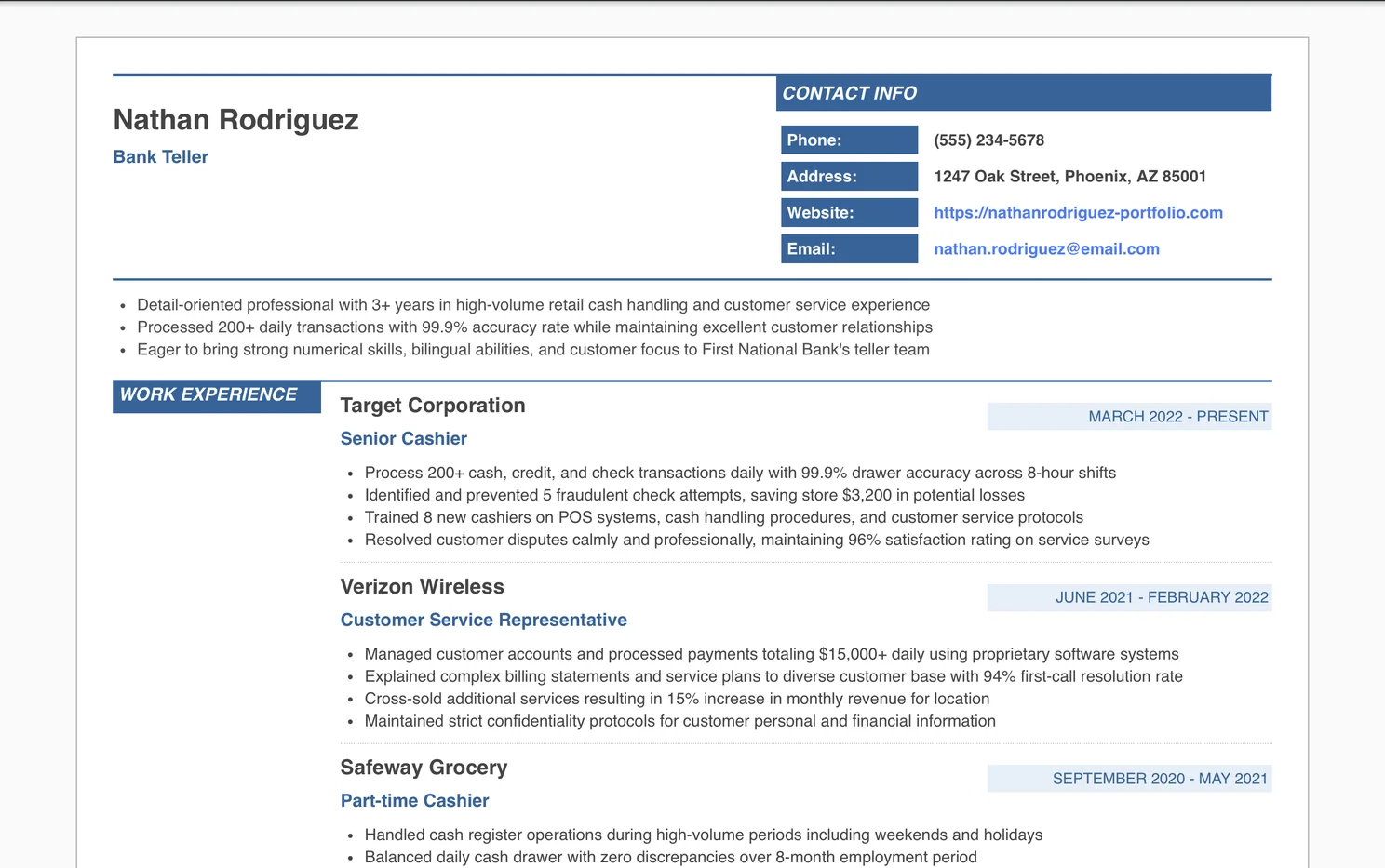
The Ultimate Bank Teller Resume Example/Sample
https://www.resumonk.com/bank-teller-resumeBank TellerBank Teller Resume Format - Your First Step Into Banking
For a bank teller resume, the reverse-chronological format is your golden ticket.
Think of it as telling your professional story backwards - starting with where you are now and working your way back. This format works brilliantly because hiring managers at banks want to see your most recent experience first, especially if you've been handling cash, working with customers, or dealing with sensitive information.
Structure Your Bank Teller Resume Like a Balanced Ledger
Your resume should flow in this order - Contact Information, Professional Summary (2-3 lines that capture your essence as a future teller), Work Experience, Education, Skills, and finally, any relevant Certifications. This isn't just random ordering - banks appreciate organization and attention to detail, and your resume structure demonstrates both before they even read a word.
Keep it to one page if you're entry-level or have less than 5 years of experience. Remember, you're applying for an entry-level position where efficiency matters.
A bank manager reviewing dozens of resumes will appreciate your ability to be concise - it shows you understand that in banking, time literally is money.
The Professional Summary - Your 30-Second Elevator Pitch
Since bank teller is often an entry-level position, your summary needs to work harder than most.
Maybe you don't have direct banking experience yet, but you've handled cash registers, dealt with difficult customers, or balanced books at your family's small business. Here's how to frame it:
❌ Don't write a generic objective that could apply to anyone:
Seeking a bank teller position where I can utilize my skills and grow professionally
✅ Do write a summary that shows your relevant strengths:
Detail-oriented professional with 2+ years in high-volume retail cash handling and
customer service. Processed 100+ transactions daily with 99.9% accuracy rate.
Eager to bring strong numerical skills and customer focus to ABC Bank's teller team.
The reverse-chronological format particularly shines when you've been building relevant skills in other industries. That cashier job at Target? That's recent cash-handling experience. That volunteer position helping seniors with tax preparation? That's financial service with a vulnerable population.
This format lets these experiences shine in order of relevance and recency.
Work Experience on Your Bank Teller Resume - Making Every Role Count
Here's the thing about applying for a bank teller position - you're probably coming from somewhere else. Maybe you've been slinging coffee as a barista, managing inventory at a bookstore, or helping customers at a cell phone shop. The beautiful part? Every one of these experiences has prepared you for this moment.
You just need to know how to translate them into banking language.
The Art of Translation - From Any Job to Banking-Relevant
When writing your work experience, think like a banker. What would matter to someone trusting you with thousands of dollars daily? Accuracy, trustworthiness, customer service excellence, and the ability to follow procedures while thinking on your feet.
Every job you've held has tested these skills - now it's time to prove it.
Start each role with your job title, company name, location, and dates. Then comes the magic - your bullet points. Use 3-4 bullets per role, starting each with an action verb that screams "I get things done." But here's where bank teller resumes get specific - you need to quantify everything and emphasize trust.
❌ Don't write vague descriptions that could mean anything:
Cashier - Walmart, Phoenix, AZ (2022-2024)
• Handled customer transactions
• Provided good customer service
• Worked with money daily
• Helped with various store tasks
✅ Do write specific, quantified achievements that relate to banking:
Cashier - Walmart, Phoenix, AZ (2022-2024)
• Processed 150+ cash, credit, and check transactions daily with 99.8% drawer accuracy
• Identified and prevented 3 fraudulent check attempts, saving store $2,400 in losses
• Trained 5 new cashiers on POS systems and cash handling procedures
• Resolved customer disputes calmly, maintaining 95% satisfaction rating on service surveys
For Those Without Direct Cash-Handling Experience
Maybe you're coming from a completely different background - perhaps you were a teacher's aide, a receptionist, or worked in data entry. The key is finding the banking DNA in your experience. Teaching assistants? You've handled confidential information (grades) and explained complex concepts simply. Receptionists? You've been the face of an organization, managing multiple tasks while maintaining professionalism. Data entry?
Accuracy and attention to detail are your middle names.
Remember to highlight any experience with financial software, even if it's just QuickBooks or Excel. Banks love seeing comfort with technology since modern teller work involves various banking software systems. If you've worked with any CRM system, mention it - banks use similar systems to track customer relationships.
Geographic Considerations for Your Experience Section
In the United States, emphasize any experience with federal regulations or compliance, even if it's just following company policies strictly. Canadian applicants should highlight bilingual abilities if applicable, as many banks value French-English fluency. UK candidates might want to emphasize any experience with international customers or currencies, given London's global financial position.
Australian applicants often benefit from highlighting experience with diverse, multicultural customer bases.
Essential Skills for Your Bank Teller Resume - The Perfect Balance
Standing behind that teller window requires a unique cocktail of abilities - you're part mathematician, part customer service superstar, part security guard, and part therapist (because let's face it, people get emotional about money). Your skills section needs to reflect this multifaceted role without turning into a grocery list of every ability you've ever possessed.
The Technical Skills - Your Banking Toolkit
Banks are businesses built on precision, and your technical skills are the foundation.
Start with the obvious - cash handling and basic mathematics. But don't stop there. Modern bank tellers are tech-savvy professionals who navigate multiple systems simultaneously. List specific software if you know it, but also include general categories that show adaptability.
Think about organizing your skills strategically. Instead of randomly listing them, group them in a way that tells a story about your capabilities:
❌ Don't create a word salad of random skills:
Skills: Customer service, cash handling, friendly, Microsoft Word, organized,
math, typing, responsible, Excel, communication, detail-oriented
✅ Do organize skills into meaningful categories:
Technical Skills:
• Cash handling and drawer balancing
• 10-key calculator (8,000 KPH)
• Banking software: Similar experience with POS systems, ready to learn bank-specific platforms
• Microsoft Office Suite (Excel, Word, Outlook)

Core Competencies:
• Mathematical accuracy and mental arithmetic
• Fraud detection and loss prevention awareness
• Cross-selling and customer needs assessment
• Bilingual communication (Spanish-English)
The Soft Skills That Make You Human
Here's what every bank manager knows but might not say - they can teach you their specific computer system, but they can't teach you to be genuinely pleasant at 8 AM on a Monday when faced with an angry customer.
Your soft skills matter enormously in this role. You're often the only human face of the bank that customers see regularly.
Include skills like active listening, patience, problem-solving, and cultural sensitivity. But here's the trick - don't just list them. If possible, weave them into your work experience bullets where you can prove them.
Save the skills section for the technical abilities and maybe 2-3 crucial soft skills that didn't fit elsewhere.
The Numbers Game - Quantifiable Skills Matter
Banking loves metrics, so whenever possible, attach numbers to your skills. Can you type 65 words per minute? That matters when you're entering customer information. Can you count back change for a $100 bill in under 10 seconds without a calculator? That's teller gold. Have you memorized product codes, SKUs, or any other numerical system?
That shows you can learn the bank's product codes and account types quickly.
Don't forget about compliance and regulatory awareness. Even if you've never worked in banking, any experience following strict procedures, maintaining confidentiality, or adhering to safety protocols translates well. If you've completed any online banking courses, financial literacy programs, or even just have a strong understanding of personal finance, these are worth mentioning.
Specific Considerations and Tips for Your Bank Teller Resume
You're not applying to be a software engineer or a marketing manager - you're applying to be a bank teller, a role that sits at a unique intersection of trust, service, and financial accuracy. This position has some very specific expectations that other entry-level roles don't carry, and your resume needs to acknowledge these subtleties.
The Trust Factor - Your Resume as a Security Clearance
Unlike retail or food service, banks will scrutinize your background intensely.
They're not just hiring someone to handle money - they're hiring someone to handle other people's money, life savings, mortgage payments, and financial dreams. Your resume needs to radiate trustworthiness from every line.
This means being extra careful about gaps in employment. While a 6-month gap might be overlooked for other positions, banks want explanations. Were you traveling? Say "Cultural immersion and language study in Spain (Date-Date)." Were you caring for family? "Full-time caregiver for elderly parent while maintaining freelance bookkeeping clients."
Never lie, but always frame truthfully and positively.
❌ Don't leave unexplained gaps or use vague descriptions:
2021-2022: Personal reasons
2020-2021: Various temporary positions
✅ Do address gaps honestly and professionally:
2021-2022: Completed online Financial Services Certification while providing eldercare
2020-2021: Temporary Administrative Assistant, TempForce Agency
 - Completed 4 assignments with 5-star ratings from all clients
The Schedule Flexibility Signal
Banks have specific hours, but teller schedules can be demanding.
Many banks are open Saturdays, some have extended hours, and you might be expected to work at different branches. Without explicitly stating "I'll work whenever you want," your resume should signal flexibility.
If you've worked retail during Black Friday, mention it. If you've covered multiple locations for a chain restaurant, include it. If you've worked split shifts or opening/closing shifts, these details matter.
Banks want to know you understand that customer service doesn't always fit into a 9-to-5 box.
The Professional Appearance Pledge
While you can't include a dress code adherence on your resume, you can signal professionalism through your resume's presentation and language. Banks maintain conservative, professional environments. Your resume should reflect this - no creative fonts, no colorful designs, just clean, professional presentation. Your email address should be your name, not "partygirl2000" or "sk8boarder4life."
These might seem like small things, but in banking, small things matter.
Language and Local Considerations
If you're applying in a diverse neighborhood, your language skills are golden. Banks in Hispanic communities value Spanish speakers. Banks in Chinatown need Mandarin or Cantonese speakers.
Don't bury this in your skills section - if you're fluently bilingual, consider adding it right to your professional summary.
For Canadian applicants, knowledge of both personal and business banking products is valuable, as tellers often handle both. UK applicants should be aware that building society experience is just as relevant as bank experience. Australian applicants should highlight any experience with superannuation or retirement accounts, as these conversations happen frequently at the teller line.
The Career Trajectory Hint
While bank teller is entry-level, banks love hiring people who want to grow within the organization. Without writing "I want to be a branch manager," you can signal ambition through your resume. Include any leadership experience, even if it's training new employees or organizing team events. Mention any business or finance coursework, even if you didn't complete a degree.
Show that you're not just looking for a job - you're starting a career.
If you've taken any initiative to learn about banking outside of work - following financial news, completing online courses, or even just maintaining excellent personal credit - find subtle ways to include this. Maybe you "Maintained perfect attendance while completing evening courses in Business Administration" or "Volunteered as treasurer for local community organization, managing $10,000 annual budget."
Remember, the bank teller position is often where bank CEOs started their careers. Your resume should suggest that while you're perfectly happy to start at the teller window, you have the potential to grow far beyond it.
This isn't about overreaching - it's about showing that you understand banking is a career path, not just a paycheck.
Education to List on Bank Teller Resume
Here's the thing about being a Bank Teller - employers know you're likely at the beginning of your career journey.
They're not expecting you to have an MBA from Wharton. What they are looking for is evidence that you've got the foundational skills to handle money, interact with customers professionally, and learn their systems quickly. Your education section is where you start building that narrative.
The Reverse-Chronological Approach Works Best
Start with your most recent educational achievement and work backwards. If you're a recent graduate with a bachelor's degree, that goes first. If you've completed some college but didn't finish, that's perfectly fine - many successful bank tellers have taken this path.
The key is presenting what you have confidently and strategically.
Let's look at how to structure this section effectively:
❌ Don't write vaguely about your education:
College - Business Studies
State University
GPA: 2.8
✅ Do showcase relevant coursework and achievements:
Bachelor of Science in Business Administration
State University, New York, NY
Graduation: May 2024
Relevant Coursework: Financial Accounting, Business Statistics, Customer Relations Management
Dean's List: Fall 2023
Making High School Count (When It Should)
Now, here's where context matters enormously. If you're applying for your first bank teller position straight out of high school, your high school education becomes your centerpiece. Include your GPA if it's above 3.0, any business or math-related courses you excelled in, and definitely mention if you were in any finance-related clubs or took accounting classes.
However, if you have a college degree or even some college experience, skip the high school details entirely. The exception? If you graduated from high school within the last two years and are currently enrolled in college part-time while seeking this position.
Certifications and Additional Training
Here's something many aspiring bank tellers overlook - relevant certifications can set you apart dramatically.
Completed an online course in Excel? That's gold for a bank teller position. Took a customer service certification through Coursera? Include it. Even a basic bookkeeping course from your local community center shows initiative.
❌ Don't bury valuable certifications:
Education:
High School Diploma - 2023
Various online courses
✅ Do highlight specific, relevant training:
Education:
High School Diploma - Central High School, June 2023

Additional Training:
Certificate in Customer Service Excellence - Coursera, August 2023
Microsoft Excel Fundamentals - LinkedIn Learning, September 2023
Awards and Publications on Bank Teller Resume
Bank tellers are the face of the banking institution.
Every day, they handle thousands of dollars, solve customer problems, and represent the bank's values. Awards that demonstrate trustworthiness, accuracy, customer service excellence, or leadership potential are incredibly relevant. Publications? Less common for entry-level positions, but if you have them, there's a strategic way to include them.
Reframing Awards for Banking Context
Think about what being a bank teller actually entails - precision with numbers, trustworthiness with money, patience with customers, and reliability in showing up. Any award that speaks to these qualities deserves a spot on your resume. That "Perfect Attendance Award" from your retail job? That shows reliability. The "Math Student of the Year" from high school?
Direct relevance to handling cash transactions.
Here's how to present awards strategically:
❌ Don't list awards without context:
Awards:
- Employee of the Month
- Academic Achievement Award
- Team Player Certificate
✅ Do provide context and relevance:
Awards & Recognition:
Employee of the Month - Target Corporation (July 2023)
- Recognized for maintaining 100% cash drawer accuracy over 3-month period
- Praised for resolving customer complaints with patience and professionalism

Academic Excellence in Mathematics - Central Community College (2023)
- Awarded for achieving highest grades in Statistics and Financial Mathematics courses
When Publications Make Sense (And When They Don't)
Here's the truth - most bank teller candidates won't have publications, and that's completely expected. But if you wrote for your college newspaper about personal finance, or contributed to a blog about customer service experiences, or even created content for your university's financial literacy program, these can differentiate you from other candidates.
The key is relevance. Your poetry publication in the university literary magazine? Probably skip it. But an article you wrote for the student newspaper about "5 Ways College Students Can Build Credit Responsibly"? That shows initiative and financial awareness that banks value.
Creating an Awards Section When You Think You Have None
Many candidates skip this section entirely, thinking they have nothing to include. But dig deeper. Were you trusted to close the store at your part-time job? That's an informal recognition of trustworthiness. Did you train new employees? That demonstrates leadership. Did you maintain perfect attendance for a semester while working part-time?
That shows dedication.
For those truly without formal awards, consider combining this with a "Recognition & Achievements" section that includes quantifiable accomplishments from previous roles, even if they weren't formally recognized with awards.
Listing References for Bank Teller Resume
Here's where it gets interesting: the rules for references have changed dramatically over the past few years, and they vary significantly by region. What works in London might raise eyebrows in Los Angeles, and what's standard in Sydney could seem odd in Toronto.
The Geography of Reference Expectations
In the United States, the standard practice is typically "References available upon request" at the bottom of your resume. Employers expect you to bring a separate reference sheet to the interview. However, in the UK and Australia, it's more common to include at least two references directly on your CV.
Canadian employers often fall somewhere in between, with many expecting references on a separate page submitted with your application.
For a bank teller position specifically, regardless of location, having your references ready shows preparedness - a quality banks value highly. Even if the application doesn't require them upfront, having a polished reference sheet ready demonstrates professionalism.
Choosing Your Banking Champions
Who you choose as references for a bank teller position matters more than the quantity.
A previous supervisor who can speak to your cash-handling abilities carries more weight than three character references from family friends. Ideally, your reference list should include people who can attest to different aspects of your suitability - one who can verify your trustworthiness with money, another who can speak to your customer service skills, and perhaps a third who can confirm your reliability and attention to detail.
❌ Don't list references without context or permission:
References:
John Davis - (555) 234-5678
Sarah Miller - [email protected]
Professor Thompson - State University
✅ Do provide complete information with relationship context:
Professional References:

Margaret Chen
Store Manager, Target Corporation
Relationship: Direct Supervisor (2022-2024)
Phone: (555) 234-5678
Email: [email protected]
* Can speak to: Cash handling accuracy, customer service skills, reliability

Professor Robert Thompson
Business Mathematics, State University
Relationship: Course Instructor and Academic Advisor
Phone: (555) 345-6789
Email: [email protected]
* Can speak to: Analytical skills, attention to detail, academic integrity
The Reference Sheet Strategy
Create a separate reference sheet that matches your resume's formatting exactly - same header, same font, same margins.
This creates a cohesive application package that shows attention to detail. Include "References for [Your Name]" as a title, then list three to four references with their complete contact information and a brief note about what aspects of your qualifications they can address.
For entry-level bank teller positions, it's particularly important to prep your references. Call or email them before listing them, remind them of specific accomplishments they witnessed, and let them know what aspects of your experience you're highlighting in your application. If you handled the cash register with zero discrepancies for six months, make sure your retail supervisor remembers that detail.
When You're New to the Workforce
Recent graduates or those with limited work experience often panic about references. But banks understand that entry-level candidates might not have extensive professional networks. In these cases, academic references become valuable. A professor who taught you accounting or statistics can speak to your numerical accuracy. A volunteer coordinator from where you helped with fundraising events can attest to your trustworthiness with money.
Even a longtime family friend who owns a business (but isn't related to you) can serve as a character reference if they can speak professionally about your reliability and integrity.
The key is being strategic about who you choose and preparing them properly. A well-prepared reference who can speak specifically about your qualifications is worth more than three references who can only offer generic praise.
Cover Letter Tips for Bank Teller Resume
Think about it from the hiring manager's perspective.
They're looking for someone who will be handling their customers' money, representing their institution, and potentially dealing with frustrated people who've been waiting in line for twenty minutes. Can you communicate clearly? Do you understand professional boundaries? Can you convey warmth while maintaining professionalism? Your cover letter answers these questions before you ever shake hands.
The Opening That Gets Attention
Forget the generic "I am writing to apply for the Bank Teller position" opening. Every hiring manager has read that sentence a thousand times.
Instead, connect immediately with why banking matters to you or share a brief, relevant experience that demonstrates your suitability for the role.
❌ Don't start with a generic, forgettable opening:
Dear Hiring Manager,

I am writing to express my interest in the Bank Teller position at First National Bank that was posted on your website. I believe I would be a good fit for this role.
✅ Do open with engagement and specificity:
Dear Ms. Johnson,

Last month, I helped my grandmother navigate a complex banking issue at your Main Street branch, and I was impressed by how your team combined technology with personal touch to solve her problem. This experience reinforced my desire to begin my banking career with First National Bank, where customer service clearly remains a priority in an increasingly digital world.
The Body - Telling Your Story
The middle paragraph is where you connect the dots between your experience and the bank's needs.
Maybe you've never worked in a bank, but you've handled cash registers, dealt with difficult customers, or balanced accounts in another context. The key is translating these experiences into banking language.
For instance, if you worked at a busy coffee shop, don't just mention you were a barista. Explain how you processed an average of 200 transactions daily with 99.9% accuracy while maintaining friendly conversation with regular customers.
See how that suddenly sounds exactly like what a bank teller does?
Addressing the Elephant in the Room
If you're making a career change, address it head-on but positively.
Maybe you're leaving retail because you want more stable hours and a professional environment. Frame it as seeking growth opportunities in an industry that values precision and relationship-building - qualities you've developed but want to apply in a more financially-focused setting.
For recent graduates with limited experience, acknowledge your newcomer status but emphasize your eagerness to learn and grow within the banking industry. Banks often prefer training entry-level tellers their way rather than retraining experienced ones.
The Close That Prompts Action
Your closing paragraph should do three things - reiterate your interest, mention your availability for an interview, and include a soft call to action. But remember, you're applying for an entry-level position, so keep the tone professional but not overly aggressive.
❌ Don't close weakly or presumptuously:
I hope to hear from you soon. I'll call you next week to schedule an interview.

Sincerely,
John Smith
✅ Do close with confidence and professionalism:
I would welcome the opportunity to discuss how my customer service experience and attention to detail would contribute to First National Bank's tradition of excellence.
I am available for an interview at your convenience and can be reached at (555) 123-4567.

Thank you for considering my application. I look forward to the possibility of joining your team.

Sincerely,
John Smith
Key Takeaways
- Use reverse-chronological format exclusively - Start with your most recent experience and work backward, keeping everything to one page if you have less than 5 years of experience
- Translate any work experience into banking language - Cash handling at retail becomes "processed 150+ transactions daily with 99.8% accuracy," customer service becomes "resolved disputes while maintaining 95% satisfaction rating"
- Quantify everything possible - Banks love numbers, so include typing speed (65 WPM), transaction volumes, accuracy rates, and dollar amounts handled
- Address employment gaps proactively - Banks scrutinize backgrounds carefully, so explain gaps honestly and positively (caregiving, education, travel)
- Highlight trust indicators throughout - Include experiences that show reliability (perfect attendance), responsibility (closing duties), and integrity (handling deposits, preventing fraud)
- Create a focused skills section - Organize into Technical Skills (cash handling, 10-key, software) and Core Competencies (fraud detection, bilingual abilities)
- Make education work harder - Include relevant coursework, GPA if above 3.0, and any certifications (even online Excel courses count)
- Don't skip the cover letter - Banking values communication skills, so write a specific, engaging letter that connects your experience to their needs
- Prepare references strategically - Choose people who can speak to cash-handling, customer service, and reliability, then prep them on what to emphasize
- Signal growth potential subtly - Include leadership experiences, business coursework, or volunteer treasurer roles to show you see banking as a career, not just a job
Creating your bank teller resume on Resumonk takes all these considerations and transforms them into a polished, professional document that speaks the language of banking. Our AI-powered suggestions help you identify which experiences to highlight and how to phrase them for maximum impact, while our banking-specific templates ensure your resume looks as trustworthy and professional as you are. Whether you're translating retail experience into banking terms or highlighting your recent finance degree, Resumonk's intelligent platform guides you through each section with real-time feedback tailored to bank teller positions.
Ready to create your bank teller resume that opens doors in the banking industry?
Start building your professional resume with Resumonk's specialized templates and AI-powered optimization tools designed specifically for entry-level banking positions.
Get started with Resumonk today and transform your experience into the bank teller resume that gets you behind that teller window.
More Banking & Finance resume examples
- Financial Advisor resume example
- Financial Analyst resume example
- Mortgage Loan Officer resume example
- Banker resume example
See all Banking & Finance resume examples, or browse every category.
Resume writing tips
Picture yourself walking past that local bank branch on your morning commute - the one with the gleaming windows where you can see tellers helping customers, counting bills with practiced precision, and somehow managing to smile genuinely even during the Monday morning rush.
You've been thinking about making that leap from your current retail job, restaurant position, or fresh-out-of-school status into the professional world of banking. The bank teller position keeps calling to you because, let's face it, it offers something your current situation might not - regular hours, professional development, benefits that actually mean something, and a clear path upward in an industry that isn't going anywhere.
You're here because you've decided to answer that call, but now you're staring at a blank document, wondering how to transform your experience as a barista, cashier, or recent graduate into a resume that makes a bank manager think, "Yes, this is someone I trust to handle thousands of dollars daily and represent our institution." The good news? That translation is more straightforward than you think, and every customer service smile you've perfected, every difficult customer you've appeased, and every time you've balanced your register to the penny has been preparing you for this moment.
What we're about to walk through isn't just another generic resume guide that you could use for any job from accountant to zookeeper. This is specifically crafted for the unique requirements of a bank teller position - an entry-level role that paradoxically requires you to demonstrate exceptional trustworthiness from day one. We'll start with choosing the perfect resume format (spoiler alert - reverse-chronological is your friend here), then dive deep into crafting each section from your professional summary that hooks them in 30 seconds, through your work experience where we'll show you how to transform any job into relevant banking experience, to your education section that proves you've got the foundation they need.
We'll also tackle the specific considerations that make bank teller resumes unique - how to address employment gaps when banks scrutinize backgrounds more than most employers, how to signal the flexibility and professionalism banks require, and how to hint at your career ambitions without overreaching. We'll cover everything from whether to include that Employee of the Month award from Target (yes, you should) to crafting a cover letter that actually gets read, and finally, how to handle references when you're asking someone to vouch for your ability to handle other people's life savings. By the time you finish reading, you'll have everything you need to create a bank teller resume that doesn't just list your qualifications - it tells the story of why you're the trustworthy, capable professional that bank needs behind their teller window.
The Ultimate Bank Teller Resume Example/Sample
https://www.resumonk.com/bank-teller-resumeBank TellerBank Teller Resume Format - Your First Step Into Banking
For a bank teller resume, the reverse-chronological format is your golden ticket.
Think of it as telling your professional story backwards - starting with where you are now and working your way back. This format works brilliantly because hiring managers at banks want to see your most recent experience first, especially if you've been handling cash, working with customers, or dealing with sensitive information.
Structure Your Bank Teller Resume Like a Balanced Ledger
Your resume should flow in this order - Contact Information, Professional Summary (2-3 lines that capture your essence as a future teller), Work Experience, Education, Skills, and finally, any relevant Certifications. This isn't just random ordering - banks appreciate organization and attention to detail, and your resume structure demonstrates both before they even read a word.
Keep it to one page if you're entry-level or have less than 5 years of experience. Remember, you're applying for an entry-level position where efficiency matters.
A bank manager reviewing dozens of resumes will appreciate your ability to be concise - it shows you understand that in banking, time literally is money.
The Professional Summary - Your 30-Second Elevator Pitch
Since bank teller is often an entry-level position, your summary needs to work harder than most.
Maybe you don't have direct banking experience yet, but you've handled cash registers, dealt with difficult customers, or balanced books at your family's small business. Here's how to frame it:
❌ Don't write a generic objective that could apply to anyone:
Seeking a bank teller position where I can utilize my skills and grow professionally
✅ Do write a summary that shows your relevant strengths:
Detail-oriented professional with 2+ years in high-volume retail cash handling and
customer service. Processed 100+ transactions daily with 99.9% accuracy rate.
Eager to bring strong numerical skills and customer focus to ABC Bank's teller team.
The reverse-chronological format particularly shines when you've been building relevant skills in other industries. That cashier job at Target? That's recent cash-handling experience. That volunteer position helping seniors with tax preparation? That's financial service with a vulnerable population.
This format lets these experiences shine in order of relevance and recency.
Work Experience on Your Bank Teller Resume - Making Every Role Count
Here's the thing about applying for a bank teller position - you're probably coming from somewhere else. Maybe you've been slinging coffee as a barista, managing inventory at a bookstore, or helping customers at a cell phone shop. The beautiful part? Every one of these experiences has prepared you for this moment.
You just need to know how to translate them into banking language.
The Art of Translation - From Any Job to Banking-Relevant
When writing your work experience, think like a banker. What would matter to someone trusting you with thousands of dollars daily? Accuracy, trustworthiness, customer service excellence, and the ability to follow procedures while thinking on your feet.
Every job you've held has tested these skills - now it's time to prove it.
Start each role with your job title, company name, location, and dates. Then comes the magic - your bullet points. Use 3-4 bullets per role, starting each with an action verb that screams "I get things done." But here's where bank teller resumes get specific - you need to quantify everything and emphasize trust.
❌ Don't write vague descriptions that could mean anything:
Cashier - Walmart, Phoenix, AZ (2022-2024)
• Handled customer transactions
• Provided good customer service
• Worked with money daily
• Helped with various store tasks
✅ Do write specific, quantified achievements that relate to banking:
Cashier - Walmart, Phoenix, AZ (2022-2024)
• Processed 150+ cash, credit, and check transactions daily with 99.8% drawer accuracy
• Identified and prevented 3 fraudulent check attempts, saving store $2,400 in losses
• Trained 5 new cashiers on POS systems and cash handling procedures
• Resolved customer disputes calmly, maintaining 95% satisfaction rating on service surveys
For Those Without Direct Cash-Handling Experience
Maybe you're coming from a completely different background - perhaps you were a teacher's aide, a receptionist, or worked in data entry. The key is finding the banking DNA in your experience. Teaching assistants? You've handled confidential information (grades) and explained complex concepts simply. Receptionists? You've been the face of an organization, managing multiple tasks while maintaining professionalism. Data entry?
Accuracy and attention to detail are your middle names.
Remember to highlight any experience with financial software, even if it's just QuickBooks or Excel. Banks love seeing comfort with technology since modern teller work involves various banking software systems. If you've worked with any CRM system, mention it - banks use similar systems to track customer relationships.
Geographic Considerations for Your Experience Section
In the United States, emphasize any experience with federal regulations or compliance, even if it's just following company policies strictly. Canadian applicants should highlight bilingual abilities if applicable, as many banks value French-English fluency. UK candidates might want to emphasize any experience with international customers or currencies, given London's global financial position.
Australian applicants often benefit from highlighting experience with diverse, multicultural customer bases.
Essential Skills for Your Bank Teller Resume - The Perfect Balance
Standing behind that teller window requires a unique cocktail of abilities - you're part mathematician, part customer service superstar, part security guard, and part therapist (because let's face it, people get emotional about money). Your skills section needs to reflect this multifaceted role without turning into a grocery list of every ability you've ever possessed.
The Technical Skills - Your Banking Toolkit
Banks are businesses built on precision, and your technical skills are the foundation.
Start with the obvious - cash handling and basic mathematics. But don't stop there. Modern bank tellers are tech-savvy professionals who navigate multiple systems simultaneously. List specific software if you know it, but also include general categories that show adaptability.
Think about organizing your skills strategically. Instead of randomly listing them, group them in a way that tells a story about your capabilities:
❌ Don't create a word salad of random skills:
Skills: Customer service, cash handling, friendly, Microsoft Word, organized,
math, typing, responsible, Excel, communication, detail-oriented
✅ Do organize skills into meaningful categories:
Technical Skills:
• Cash handling and drawer balancing
• 10-key calculator (8,000 KPH)
• Banking software: Similar experience with POS systems, ready to learn bank-specific platforms
• Microsoft Office Suite (Excel, Word, Outlook)

Core Competencies:
• Mathematical accuracy and mental arithmetic
• Fraud detection and loss prevention awareness
• Cross-selling and customer needs assessment
• Bilingual communication (Spanish-English)
The Soft Skills That Make You Human
Here's what every bank manager knows but might not say - they can teach you their specific computer system, but they can't teach you to be genuinely pleasant at 8 AM on a Monday when faced with an angry customer.
Your soft skills matter enormously in this role. You're often the only human face of the bank that customers see regularly.
Include skills like active listening, patience, problem-solving, and cultural sensitivity. But here's the trick - don't just list them. If possible, weave them into your work experience bullets where you can prove them.
Save the skills section for the technical abilities and maybe 2-3 crucial soft skills that didn't fit elsewhere.
The Numbers Game - Quantifiable Skills Matter
Banking loves metrics, so whenever possible, attach numbers to your skills. Can you type 65 words per minute? That matters when you're entering customer information. Can you count back change for a $100 bill in under 10 seconds without a calculator? That's teller gold. Have you memorized product codes, SKUs, or any other numerical system?
That shows you can learn the bank's product codes and account types quickly.
Don't forget about compliance and regulatory awareness. Even if you've never worked in banking, any experience following strict procedures, maintaining confidentiality, or adhering to safety protocols translates well. If you've completed any online banking courses, financial literacy programs, or even just have a strong understanding of personal finance, these are worth mentioning.
Specific Considerations and Tips for Your Bank Teller Resume
You're not applying to be a software engineer or a marketing manager - you're applying to be a bank teller, a role that sits at a unique intersection of trust, service, and financial accuracy. This position has some very specific expectations that other entry-level roles don't carry, and your resume needs to acknowledge these subtleties.
The Trust Factor - Your Resume as a Security Clearance
Unlike retail or food service, banks will scrutinize your background intensely.
They're not just hiring someone to handle money - they're hiring someone to handle other people's money, life savings, mortgage payments, and financial dreams. Your resume needs to radiate trustworthiness from every line.
This means being extra careful about gaps in employment. While a 6-month gap might be overlooked for other positions, banks want explanations. Were you traveling? Say "Cultural immersion and language study in Spain (Date-Date)." Were you caring for family? "Full-time caregiver for elderly parent while maintaining freelance bookkeeping clients."
Never lie, but always frame truthfully and positively.
❌ Don't leave unexplained gaps or use vague descriptions:
2021-2022: Personal reasons
2020-2021: Various temporary positions
✅ Do address gaps honestly and professionally:
2021-2022: Completed online Financial Services Certification while providing eldercare
2020-2021: Temporary Administrative Assistant, TempForce Agency
 - Completed 4 assignments with 5-star ratings from all clients
The Schedule Flexibility Signal
Banks have specific hours, but teller schedules can be demanding.
Many banks are open Saturdays, some have extended hours, and you might be expected to work at different branches. Without explicitly stating "I'll work whenever you want," your resume should signal flexibility.
If you've worked retail during Black Friday, mention it. If you've covered multiple locations for a chain restaurant, include it. If you've worked split shifts or opening/closing shifts, these details matter.
Banks want to know you understand that customer service doesn't always fit into a 9-to-5 box.
The Professional Appearance Pledge
While you can't include a dress code adherence on your resume, you can signal professionalism through your resume's presentation and language. Banks maintain conservative, professional environments. Your resume should reflect this - no creative fonts, no colorful designs, just clean, professional presentation. Your email address should be your name, not "partygirl2000" or "sk8boarder4life."
These might seem like small things, but in banking, small things matter.
Language and Local Considerations
If you're applying in a diverse neighborhood, your language skills are golden. Banks in Hispanic communities value Spanish speakers. Banks in Chinatown need Mandarin or Cantonese speakers.
Don't bury this in your skills section - if you're fluently bilingual, consider adding it right to your professional summary.
For Canadian applicants, knowledge of both personal and business banking products is valuable, as tellers often handle both. UK applicants should be aware that building society experience is just as relevant as bank experience. Australian applicants should highlight any experience with superannuation or retirement accounts, as these conversations happen frequently at the teller line.
The Career Trajectory Hint
While bank teller is entry-level, banks love hiring people who want to grow within the organization. Without writing "I want to be a branch manager," you can signal ambition through your resume. Include any leadership experience, even if it's training new employees or organizing team events. Mention any business or finance coursework, even if you didn't complete a degree.
Show that you're not just looking for a job - you're starting a career.
If you've taken any initiative to learn about banking outside of work - following financial news, completing online courses, or even just maintaining excellent personal credit - find subtle ways to include this. Maybe you "Maintained perfect attendance while completing evening courses in Business Administration" or "Volunteered as treasurer for local community organization, managing $10,000 annual budget."
Remember, the bank teller position is often where bank CEOs started their careers. Your resume should suggest that while you're perfectly happy to start at the teller window, you have the potential to grow far beyond it.
This isn't about overreaching - it's about showing that you understand banking is a career path, not just a paycheck.
Education to List on Bank Teller Resume
Here's the thing about being a Bank Teller - employers know you're likely at the beginning of your career journey.
They're not expecting you to have an MBA from Wharton. What they are looking for is evidence that you've got the foundational skills to handle money, interact with customers professionally, and learn their systems quickly. Your education section is where you start building that narrative.
The Reverse-Chronological Approach Works Best
Start with your most recent educational achievement and work backwards. If you're a recent graduate with a bachelor's degree, that goes first. If you've completed some college but didn't finish, that's perfectly fine - many successful bank tellers have taken this path.
The key is presenting what you have confidently and strategically.
Let's look at how to structure this section effectively:
❌ Don't write vaguely about your education:
College - Business Studies
State University
GPA: 2.8
✅ Do showcase relevant coursework and achievements:
Bachelor of Science in Business Administration
State University, New York, NY
Graduation: May 2024
Relevant Coursework: Financial Accounting, Business Statistics, Customer Relations Management
Dean's List: Fall 2023
Making High School Count (When It Should)
Now, here's where context matters enormously. If you're applying for your first bank teller position straight out of high school, your high school education becomes your centerpiece. Include your GPA if it's above 3.0, any business or math-related courses you excelled in, and definitely mention if you were in any finance-related clubs or took accounting classes.
However, if you have a college degree or even some college experience, skip the high school details entirely. The exception? If you graduated from high school within the last two years and are currently enrolled in college part-time while seeking this position.
Certifications and Additional Training
Here's something many aspiring bank tellers overlook - relevant certifications can set you apart dramatically.
Completed an online course in Excel? That's gold for a bank teller position. Took a customer service certification through Coursera? Include it. Even a basic bookkeeping course from your local community center shows initiative.
❌ Don't bury valuable certifications:
Education:
High School Diploma - 2023
Various online courses
✅ Do highlight specific, relevant training:
Education:
High School Diploma - Central High School, June 2023

Additional Training:
Certificate in Customer Service Excellence - Coursera, August 2023
Microsoft Excel Fundamentals - LinkedIn Learning, September 2023
Awards and Publications on Bank Teller Resume
Bank tellers are the face of the banking institution.
Every day, they handle thousands of dollars, solve customer problems, and represent the bank's values. Awards that demonstrate trustworthiness, accuracy, customer service excellence, or leadership potential are incredibly relevant. Publications? Less common for entry-level positions, but if you have them, there's a strategic way to include them.
Reframing Awards for Banking Context
Think about what being a bank teller actually entails - precision with numbers, trustworthiness with money, patience with customers, and reliability in showing up. Any award that speaks to these qualities deserves a spot on your resume. That "Perfect Attendance Award" from your retail job? That shows reliability. The "Math Student of the Year" from high school?
Direct relevance to handling cash transactions.
Here's how to present awards strategically:
❌ Don't list awards without context:
Awards:
- Employee of the Month
- Academic Achievement Award
- Team Player Certificate
✅ Do provide context and relevance:
Awards & Recognition:
Employee of the Month - Target Corporation (July 2023)
- Recognized for maintaining 100% cash drawer accuracy over 3-month period
- Praised for resolving customer complaints with patience and professionalism

Academic Excellence in Mathematics - Central Community College (2023)
- Awarded for achieving highest grades in Statistics and Financial Mathematics courses
When Publications Make Sense (And When They Don't)
Here's the truth - most bank teller candidates won't have publications, and that's completely expected. But if you wrote for your college newspaper about personal finance, or contributed to a blog about customer service experiences, or even created content for your university's financial literacy program, these can differentiate you from other candidates.
The key is relevance. Your poetry publication in the university literary magazine? Probably skip it. But an article you wrote for the student newspaper about "5 Ways College Students Can Build Credit Responsibly"? That shows initiative and financial awareness that banks value.
Creating an Awards Section When You Think You Have None
Many candidates skip this section entirely, thinking they have nothing to include. But dig deeper. Were you trusted to close the store at your part-time job? That's an informal recognition of trustworthiness. Did you train new employees? That demonstrates leadership. Did you maintain perfect attendance for a semester while working part-time?
That shows dedication.
For those truly without formal awards, consider combining this with a "Recognition & Achievements" section that includes quantifiable accomplishments from previous roles, even if they weren't formally recognized with awards.
Listing References for Bank Teller Resume
Here's where it gets interesting: the rules for references have changed dramatically over the past few years, and they vary significantly by region. What works in London might raise eyebrows in Los Angeles, and what's standard in Sydney could seem odd in Toronto.
The Geography of Reference Expectations
In the United States, the standard practice is typically "References available upon request" at the bottom of your resume. Employers expect you to bring a separate reference sheet to the interview. However, in the UK and Australia, it's more common to include at least two references directly on your CV.
Canadian employers often fall somewhere in between, with many expecting references on a separate page submitted with your application.
For a bank teller position specifically, regardless of location, having your references ready shows preparedness - a quality banks value highly. Even if the application doesn't require them upfront, having a polished reference sheet ready demonstrates professionalism.
Choosing Your Banking Champions
Who you choose as references for a bank teller position matters more than the quantity.
A previous supervisor who can speak to your cash-handling abilities carries more weight than three character references from family friends. Ideally, your reference list should include people who can attest to different aspects of your suitability - one who can verify your trustworthiness with money, another who can speak to your customer service skills, and perhaps a third who can confirm your reliability and attention to detail.
❌ Don't list references without context or permission:
References:
John Davis - (555) 234-5678
Sarah Miller - [email protected]
Professor Thompson - State University
✅ Do provide complete information with relationship context:
Professional References:

Margaret Chen
Store Manager, Target Corporation
Relationship: Direct Supervisor (2022-2024)
Phone: (555) 234-5678
Email: [email protected]
* Can speak to: Cash handling accuracy, customer service skills, reliability

Professor Robert Thompson
Business Mathematics, State University
Relationship: Course Instructor and Academic Advisor
Phone: (555) 345-6789
Email: [email protected]
* Can speak to: Analytical skills, attention to detail, academic integrity
The Reference Sheet Strategy
Create a separate reference sheet that matches your resume's formatting exactly - same header, same font, same margins.
This creates a cohesive application package that shows attention to detail. Include "References for [Your Name]" as a title, then list three to four references with their complete contact information and a brief note about what aspects of your qualifications they can address.
For entry-level bank teller positions, it's particularly important to prep your references. Call or email them before listing them, remind them of specific accomplishments they witnessed, and let them know what aspects of your experience you're highlighting in your application. If you handled the cash register with zero discrepancies for six months, make sure your retail supervisor remembers that detail.
When You're New to the Workforce
Recent graduates or those with limited work experience often panic about references. But banks understand that entry-level candidates might not have extensive professional networks. In these cases, academic references become valuable. A professor who taught you accounting or statistics can speak to your numerical accuracy. A volunteer coordinator from where you helped with fundraising events can attest to your trustworthiness with money.
Even a longtime family friend who owns a business (but isn't related to you) can serve as a character reference if they can speak professionally about your reliability and integrity.
The key is being strategic about who you choose and preparing them properly. A well-prepared reference who can speak specifically about your qualifications is worth more than three references who can only offer generic praise.
Cover Letter Tips for Bank Teller Resume
Think about it from the hiring manager's perspective.
They're looking for someone who will be handling their customers' money, representing their institution, and potentially dealing with frustrated people who've been waiting in line for twenty minutes. Can you communicate clearly? Do you understand professional boundaries? Can you convey warmth while maintaining professionalism? Your cover letter answers these questions before you ever shake hands.
The Opening That Gets Attention
Forget the generic "I am writing to apply for the Bank Teller position" opening. Every hiring manager has read that sentence a thousand times.
Instead, connect immediately with why banking matters to you or share a brief, relevant experience that demonstrates your suitability for the role.
❌ Don't start with a generic, forgettable opening:
Dear Hiring Manager,

I am writing to express my interest in the Bank Teller position at First National Bank that was posted on your website. I believe I would be a good fit for this role.
✅ Do open with engagement and specificity:
Dear Ms. Johnson,

Last month, I helped my grandmother navigate a complex banking issue at your Main Street branch, and I was impressed by how your team combined technology with personal touch to solve her problem. This experience reinforced my desire to begin my banking career with First National Bank, where customer service clearly remains a priority in an increasingly digital world.
The Body - Telling Your Story
The middle paragraph is where you connect the dots between your experience and the bank's needs.
Maybe you've never worked in a bank, but you've handled cash registers, dealt with difficult customers, or balanced accounts in another context. The key is translating these experiences into banking language.
For instance, if you worked at a busy coffee shop, don't just mention you were a barista. Explain how you processed an average of 200 transactions daily with 99.9% accuracy while maintaining friendly conversation with regular customers.
See how that suddenly sounds exactly like what a bank teller does?
Addressing the Elephant in the Room
If you're making a career change, address it head-on but positively.
Maybe you're leaving retail because you want more stable hours and a professional environment. Frame it as seeking growth opportunities in an industry that values precision and relationship-building - qualities you've developed but want to apply in a more financially-focused setting.
For recent graduates with limited experience, acknowledge your newcomer status but emphasize your eagerness to learn and grow within the banking industry. Banks often prefer training entry-level tellers their way rather than retraining experienced ones.
The Close That Prompts Action
Your closing paragraph should do three things - reiterate your interest, mention your availability for an interview, and include a soft call to action. But remember, you're applying for an entry-level position, so keep the tone professional but not overly aggressive.
❌ Don't close weakly or presumptuously:
I hope to hear from you soon. I'll call you next week to schedule an interview.

Sincerely,
John Smith
✅ Do close with confidence and professionalism:
I would welcome the opportunity to discuss how my customer service experience and attention to detail would contribute to First National Bank's tradition of excellence.
I am available for an interview at your convenience and can be reached at (555) 123-4567.

Thank you for considering my application. I look forward to the possibility of joining your team.

Sincerely,
John Smith
Key Takeaways
- Use reverse-chronological format exclusively - Start with your most recent experience and work backward, keeping everything to one page if you have less than 5 years of experience
- Translate any work experience into banking language - Cash handling at retail becomes "processed 150+ transactions daily with 99.8% accuracy," customer service becomes "resolved disputes while maintaining 95% satisfaction rating"
- Quantify everything possible - Banks love numbers, so include typing speed (65 WPM), transaction volumes, accuracy rates, and dollar amounts handled
- Address employment gaps proactively - Banks scrutinize backgrounds carefully, so explain gaps honestly and positively (caregiving, education, travel)
- Highlight trust indicators throughout - Include experiences that show reliability (perfect attendance), responsibility (closing duties), and integrity (handling deposits, preventing fraud)
- Create a focused skills section - Organize into Technical Skills (cash handling, 10-key, software) and Core Competencies (fraud detection, bilingual abilities)
- Make education work harder - Include relevant coursework, GPA if above 3.0, and any certifications (even online Excel courses count)
- Don't skip the cover letter - Banking values communication skills, so write a specific, engaging letter that connects your experience to their needs
- Prepare references strategically - Choose people who can speak to cash-handling, customer service, and reliability, then prep them on what to emphasize
- Signal growth potential subtly - Include leadership experiences, business coursework, or volunteer treasurer roles to show you see banking as a career, not just a job
Creating your bank teller resume on Resumonk takes all these considerations and transforms them into a polished, professional document that speaks the language of banking. Our AI-powered suggestions help you identify which experiences to highlight and how to phrase them for maximum impact, while our banking-specific templates ensure your resume looks as trustworthy and professional as you are. Whether you're translating retail experience into banking terms or highlighting your recent finance degree, Resumonk's intelligent platform guides you through each section with real-time feedback tailored to bank teller positions.
Ready to create your bank teller resume that opens doors in the banking industry?
Start building your professional resume with Resumonk's specialized templates and AI-powered optimization tools designed specifically for entry-level banking positions.
Get started with Resumonk today and transform your experience into the bank teller resume that gets you behind that teller window.
More Banking & Finance resume examples
- Financial Advisor resume example
- Financial Analyst resume example
- Mortgage Loan Officer resume example
- Banker resume example
See all Banking & Finance resume examples, or browse every category.
Resume writing tips