AWS Resume Example (with Tips and Best Practices)
Introduction
You're scrolling through AWS job postings at 11 PM, coffee mug in hand, wondering if your two years crushing it as an SDR at that SaaS startup is enough to make the leap.
Or maybe you're that customer success manager who's been secretly studying AWS services because you're tired of just maintaining relationships - you want to be the one closing those six-figure cloud deals. The Account Executive role at AWS isn't just another sales job; it's your entry point into selling the technology that powers half the internet, from Netflix to NASA.
Here's what most people don't realize about being an AWS Account Executive - you're not in enterprise sales or senior leadership despite that "executive" title. This is an individual contributor role where you'll own the full sales cycle, from prospecting to closing, for Amazon Web Services' vast portfolio of cloud solutions. You'll be the person explaining to a skeptical CFO why moving to the cloud will save them millions, while simultaneously discussing API architectures with their development team. It's equal parts business strategy and technical evangelism, and your resume needs to reflect both sides of this unique challenge.
This guide will walk you through crafting an AWS Account Executive resume that actually gets noticed in a sea of generic sales resumes. We'll start with nailing the format - specifically the reverse-chronological structure that showcases your progression toward complex B2B tech sales. Then we'll dive deep into crafting compelling work experience sections that speak the language of cloud transformation, not just quota attainment. You'll learn which technical skills actually matter (spoiler - it's not about becoming a programmer), how to present your sales achievements with the context that AWS hiring managers crave, and the specific considerations that set AWS sales apart from traditional software sales.
Whether you're coming from a competing cloud provider with existing enterprise relationships, transitioning from traditional software sales with a hunger to learn, or climbing up from an SDR role with exceptional prospecting skills, we'll cover the nuances that apply to your specific situation. By the end of this guide, you'll have a clear blueprint for a resume that positions you not just as another quota-carrying rep, but as someone who understands the complexity of selling digital transformation in the cloud era - exactly what AWS needs in their next Account Executive.
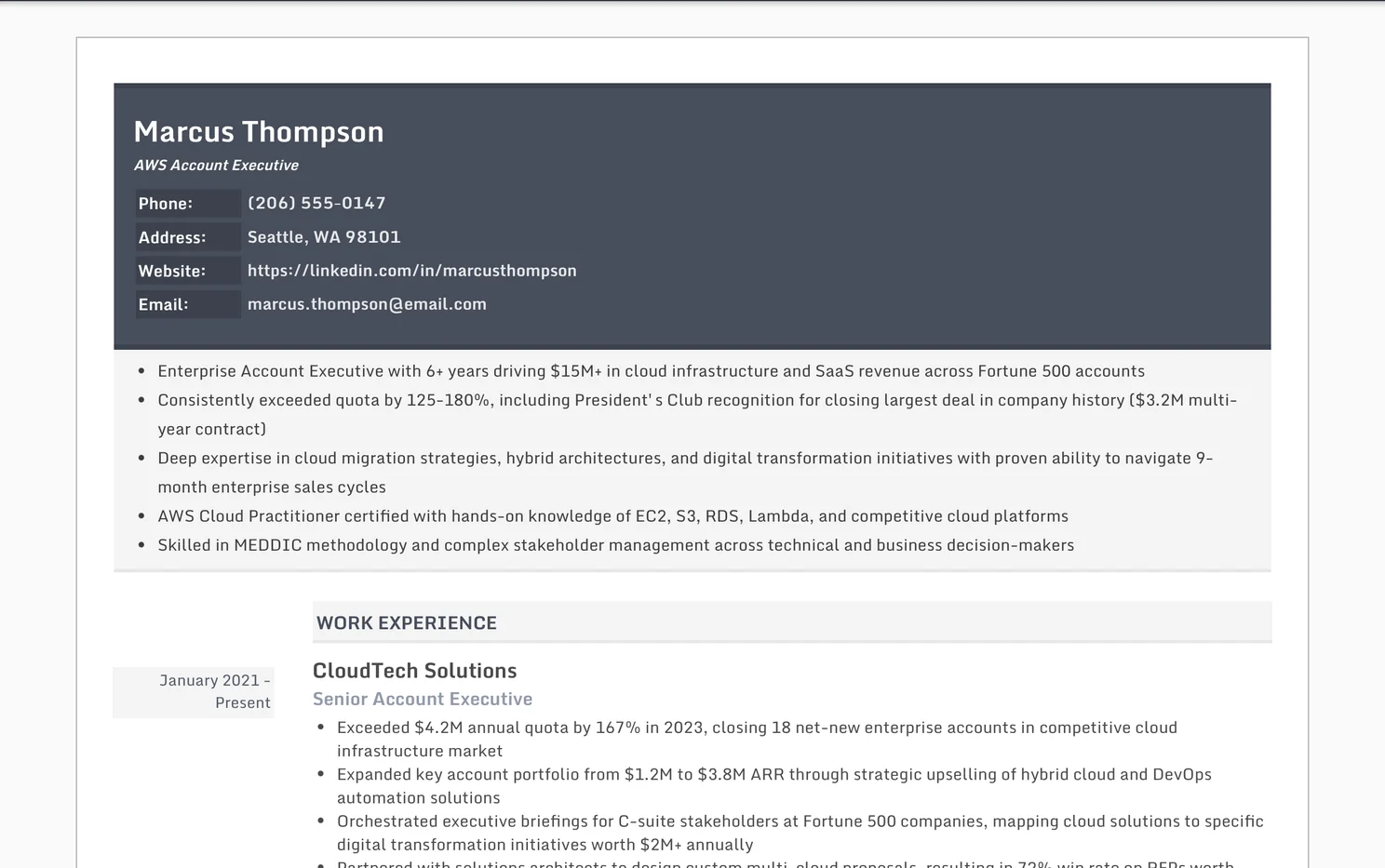
The Ultimate AWS Resume Example/Sample
https://www.resumonk.com/aws-resumeAWSResume Format to Follow for AWS (Account Executive Sales) Resume
The reverse-chronological format is your undisputed champion here. Why? Because sales is all about what you've done lately - your most recent wins, your freshest quota achievements, your latest territory conquests.
Hiring managers at AWS want to see your progression from wherever you started to someone who's ready to sell sophisticated cloud solutions to enterprise clients.
Structure Your AWS Account Executive Resume Like a Sales Pitch
Think of your resume as your first sales pitch - except you're the product. Start with a powerful professional summary that positions you as the solution to their talent gap.
This isn't the place for fluffy career objectives; this is where you lead with your biggest sales achievements and your understanding of the cloud computing landscape.
After your summary, dive straight into your work experience section. This should dominate your resume - taking up about 60-70% of the real estate. Your education can follow (unless you have an MBA from a top-tier school or relevant AWS certifications, in which case, bump it higher). Skills and certifications round out the bottom, serving as keyword-rich proof points of your technical competence.
The One-Page vs Two-Page Debate for Sales Roles
Here's the truth - if you're coming from 2-3 years as an SDR or inside sales rep, stick to one page. You haven't yet accumulated enough enterprise deal stories to justify more. But if you've been carrying a quota for 5+ years, selling complex solutions, managing million-dollar accounts?
Two pages let you showcase those President's Club wins and multi-year enterprise contracts properly.
Remember, AWS Account Executives often manage deals worth hundreds of thousands to millions of dollars. The hiring team needs confidence that you can navigate long sales cycles with multiple stakeholders.
Your format should give you space to demonstrate this without cramming text into unreadable blocks.
Work Experience on AWS Account Executive Resume
Your work experience section is where you transform from "just another sales rep" into "the Account Executive who understands cloud transformation and can speak both technical and business languages." This is particularly crucial for AWS, where you're not just selling software - you're selling digital transformation, infrastructure modernization, and often, a complete paradigm shift in how companies operate.
Quantify Everything, Then Quantify It Again
Sales is the most metrics-driven profession on the planet, and AWS knows this. Every single bullet point should have a number, percentage, or dollar sign. But here's where many candidates mess up - they list their achievements without context. Hitting 150% of quota is impressive, but was that quota $500K or $5M?
Did you inherit a mature territory or build it from scratch?
❌ Don't write vague accomplishments:
• Exceeded sales targets consistently
• Managed key enterprise accounts
• Collaborated with technical teams on cloud solutions
✅ Do write specific, contextualized achievements:
• Exceeded $3.2M annual quota by 147%, closing 23 net-new enterprise accounts in competitive SaaS market
• Expanded key account portfolio from $800K to $2.1M ARR through strategic upselling of cloud migration services
• Partnered with solutions architects to design custom hybrid cloud proposals, resulting in 68% win rate on RFPs worth $500K+
Show Your Evolution Toward Enterprise Cloud Sales
AWS Account Executives need to demonstrate they can handle complex, technical sales.
Your work experience should show a clear progression toward this. Maybe you started in transactional sales, moved to mid-market SaaS, and now you're ready for enterprise cloud. Each role should build on the last, showing increasing deal sizes, longer sales cycles, and more technical products.
For those coming from competitors like Microsoft Azure or Google Cloud Platform, highlight your cloud-specific wins. For those transitioning from traditional software sales, emphasize any deals involving digital transformation, API integrations, or infrastructure modernization. AWS wants to see you can speak the language of CTOs and CIOs, not just procurement teams.
The Art of Describing Sales Activities
Beyond the numbers, AWS wants to understand your sales methodology.
Did you use MEDDIC, Challenger, or Solution Selling? How did you navigate complex stakeholder matrices?
Your bullets should paint a picture of someone who can manage 9-month sales cycles with multiple decision-makers across technical and business units.
❌ Don't use generic sales language:
• Conducted product demonstrations to prospects
• Built relationships with decision-makers
✅ Do showcase sophisticated sales processes:
• Orchestrated executive briefings for C-suite stakeholders, mapping AWS solutions to specific digital transformation initiatives worth $2M+ annually
• Developed champion relationships across 5 business units, creating consensus for enterprise-wide cloud adoption affecting 10,000+ users
Skills to Show on AWS Account Executive Resume
Here's where things get interesting. You're not applying to sell office supplies or basic CRM software. You're positioning yourself to sell one of the most technically complex product portfolios in the world. AWS has over 200 services, from basic compute and storage to machine learning and quantum computing.
Your skills section needs to bridge the gap between sales excellence and technical credibility.
The Technical Skills That Matter
No, you don't need to be able to write Python or configure Kubernetes clusters.
But you do need to demonstrate enough technical literacy to have intelligent conversations with DevOps teams and solutions architects. Focus on cloud concepts rather than deep technical skills - understanding of IaaS vs PaaS vs SaaS, familiarity with common AWS services like EC2, S3, RDS, and Lambda, and knowledge of cloud migration strategies.
Include any AWS certifications prominently. The Cloud Practitioner certification shows baseline knowledge. The Solutions Architect Associate, while typically for technical roles, makes you stand out as a sales professional who truly understands what they're selling. If you have experience with AWS Partner Network or AWS Marketplace, absolutely highlight this.
Sales Tools and Methodologies
Your CRM expertise matters, but be specific.
Don't just list "Salesforce" - mention if you've used Einstein Analytics for forecasting, or if you've built custom dashboards for pipeline management. AWS uses various sales tools internally, so showing sophistication with sales technology demonstrates you can hit the ground running.
❌ Don't list skills like a grocery list:
Skills: Sales, Negotiation, CRM, Cloud Computing, Team Player, Communication
✅ Do organize skills strategically:
Cloud & Technical Knowledge:
• AWS Services: EC2, S3, RDS, Lambda, CloudFormation (Cloud Practitioner Certified)
• Cloud Concepts: IaaS/PaaS/SaaS, Hybrid Cloud Architecture, DevOps Practices, Containerization
• Competitive Platforms: Azure, GCP, Private Cloud Solutions

Sales Excellence:
• Methodologies: MEDDIC, Command of the Message, Value Selling
• Deal Management: $500K-$5M enterprise deals, 6-12 month sales cycles
• Sales Technology: Salesforce (advanced), Gong.io, LinkedIn Sales Navigator, Consensus
Industry and Compliance Knowledge
AWS serves everyone from startups to Fortune 500 companies across every industry.
If you have deep knowledge of specific verticals - financial services, healthcare, government - this is gold. Include understanding of relevant compliance frameworks like HIPAA, FedRAMP, or PCI-DSS.
This shows you can navigate the complex requirements that often make or break enterprise cloud deals.
Specific Considerations and Tips for AWS Account Executive Resume
Now let's talk about what makes an AWS Account Executive resume different from your typical enterprise sales resume. You're not just competing against other salespeople - you're competing against former AWS employees, people from other hyperscalers, and occasionally, technical professionals transitioning to sales.
Your resume needs to address the unique challenges of selling AWS.
Address the Ecosystem Complexity
AWS isn't just about direct sales - it's about navigating a complex ecosystem of partners, ISVs, and system integrators.
If you've worked with channel partners, managed partner relationships, or collaborated with third-party consultancies, make this crystal clear. AWS Account Executives often work closely with AWS Partner Network members to deliver solutions. Show you understand this isn't lone-wolf selling.
Include any experience with marketplace sales models. Have you sold through cloud marketplaces before? Have you worked with procurement vehicles like AWS Enterprise Agreements?
This kind of experience sets you apart from traditional software sales reps.
Demonstrate Your Learning Velocity
AWS releases new services and features literally every day.
The hiring team needs to know you can keep up. Include examples of how you've quickly ramped up on complex products in the past. Maybe you joined a company right as they launched a new product line and became the top seller within 6 months. Maybe you taught yourself about containerization to better sell to DevOps teams.
❌ Don't ignore the continuous learning aspect:
• Sold cloud services to enterprise accounts
✅ Do show your ability to master complexity:
• Achieved competency in 15+ AWS services within first quarter, enabling technical conversations with solutions architects and DevOps teams
• Self-directed learning of containerization and Kubernetes, resulting in 3 additional deals worth $1.8M with companies modernizing applications
The Geographic and Cultural Considerations
If you're applying for an AWS role in different regions, understand the nuances.
In the UK, AWS often works closely with government digital transformation initiatives - experience with public sector sales is valuable. In Australia and Canada, there's often emphasis on data sovereignty and local presence - highlight any experience with regional compliance requirements.
In the US, particularly in tech hubs like Seattle or San Francisco, the competition includes many ex-Amazon employees - emphasize any experience with Amazon's leadership principles or similar high-performance cultures.
The Compensation Discussion Preparation
While not directly on your resume, be prepared that AWS Account Executive roles often have unique compensation structures combining base, commission, and RSUs (Restricted Stock Units).
If you've managed complex compensation plans before or have experience with equity compensation, subtly weaving this into your experience shows sophistication. For example, mentioning you've consistently achieved accelerators or managed multi-year contract negotiations shows you understand enterprise sales economics.
Finally, remember that AWS values its peculiar culture - the Day 1 mentality, customer obsession, and bias for action aren't just corporate speak. If you can authentically demonstrate these principles through your achievements without explicitly naming them, you're showing cultural fit alongside sales capability. That's what transforms a good resume into one that gets you the interview for that AWS Account Executive role you've been eyeing.
Education to List on AWS Account Executive Resume
An AWS Account Executive role is a sales job first. Hiring managers look for proof that you can run a complex sales cycle and talk credibly about cloud technology with technical buyers, and your education section should support both parts of that story.
Degree First, Then Proof of Cloud Fluency
Account Executive postings often ask for a bachelor's degree or equivalent experience, and business, economics, communications and computer science are all common backgrounds. List your degree plainly, then add the credentials that show you understand what you will be selling.
The AWS Certified Cloud Practitioner is the natural starting point for sales professionals: it shows you can explain core AWS services, pricing and the shared responsibility model without leaning on a solutions architect for every question.
❌ Don't list a degree with nothing that connects it to cloud sales:
Bachelor of Arts in Communications
State University, 2019
✅ Do pair your degree with the credentials that matter for this role:
Bachelor of Business Administration, Marketing
State University, 2015-2019

AWS Certified Cloud Practitioner
Amazon Web Services, 2024

MEDDIC Sales Qualification Training
Completed 2023
Sales Training That Counts as Education
Formal sales methodology training belongs here too. Programs in MEDDIC, Challenger, SPIN Selling or Command of the Message tell a hiring manager you can qualify enterprise deals and manage long buying cycles, which is most of the job.
Name the methodology and the provider. "Sales training" on its own tells a reader nothing.
❌ Don't bury valuable training in generic terms:
Various sales and cloud courses
✅ Do specify what you learned and where:
AWS Cloud Practitioner Essentials
AWS Skill Builder, 2024

Challenger Sales Training
Company program, 2023
Applied to a six-month enterprise deal cycle
If You Are Early in Your Career
Recent graduates moving into cloud sales from an SDR or business development role can include relevant coursework or projects, such as a market analysis of cloud adoption or a business case built around a migration. Keep it short: your sales numbers will carry far more weight than your coursework.
For roles outside the US, follow local conventions for listing degrees and grades, and mention language skills if the territory you would cover needs them.
Awards and Publications on AWS Account Executive Resume
Sales is one of the few fields where awards are easy to measure, and hiring managers notice them. Quota clubs, President's Club trips and top-performer rankings are proof that your results held up against your peers.
Publications matter less, but anything that shows you can explain cloud technology to buyers, such as a webinar you presented or a post about a customer's migration, supports your case as someone who can sell technical products.
Sales Recognition That Carries Weight
List awards with the context that makes them meaningful: the size of the team, your ranking and the number behind it. "President's Club" means more next to "top 5 of 120 Account Executives".
❌ Don't list awards with no context:
Awards: President's Club, Top Performer
✅ Do show what each award measured:
Recognition & Achievements:
President's Club, 2023: 142% of annual quota, ranked 3rd of 85 Account Executives
Rookie of the Year, 2022: fastest ramp to full quota in the West region
Largest New Logo Deal, Q3 2023: $1.2M three-year SaaS contract
Content and Speaking as Credibility
Cloud buyers trust sellers who understand their world. If you have co-presented a webinar with a solutions architect, written about a customer's move to the cloud or spoken at a local meetup, include it. It shows you can hold a technical conversation, which sets you apart from Account Executives who only talk about price.
❌ Don't leave out work that shows technical fluency:
Other activities available upon request
✅ Do show how you build credibility with technical buyers:
Speaking & Content:
Co-presenter, "Planning a Cloud Migration Budget" webinar, 2024
Guest post, "What CFOs Ask About Cloud Costs", company blog, 2023
Community Involvement
Involvement in local AWS user groups, cloud meetups or sales communities shows that you keep learning and that people in the industry know you. Keep these entries short and specific, and list them after your sales awards, which matter more.
Listing References for AWS Account Executive Resume
For an AWS Account Executive role, references are part of how a hiring manager checks your sales record. Claims like "142% of quota" are easy to write and hard to verify, so the people you list need to be able to confirm your numbers and describe how you win deals.
Leave references off the resume itself and have them ready when the hiring team asks.
Choosing References Who Can Speak to Your Numbers
Your strongest references are people who saw your results up close: a sales manager who tracked your pipeline, a solutions architect or sales engineer who worked deals with you, or a customer who signed with you and would say so.
❌ Don't default to references who can't speak to your sales results:
References:
HR Director, XYZ Corporation
Professor, University Name
Friend and former coworker
✅ Do choose references who can confirm specific achievements:
Professional References:

Sarah Chen, Regional Sales Director
Former manager at CloudCorp
Can speak to: 142% of quota in 2023, enterprise deal strategy

Michael Roberts, Senior Solutions Architect
Worked alongside me on 12 enterprise deals
Can speak to: technical discovery, customer workshops
Prepare Your References Before They Get the Call
Before you list anyone, tell them about the role and send them the job description. Remind them of the deals you worked on together and the numbers involved, so they can answer quickly when a hiring manager asks about your quota attainment or your largest win.
A short note for each reference, listing two or three deals and your results, keeps everyone's story consistent with your resume.
International Considerations
Reference practices differ by country. Employers in the UK, Canada and Australia often contact references before making an offer, so prepare yours early. Wherever you apply, include each reference's role, how you worked together and the best way to reach them.
❌ Don't provide references without context:
John Smith, 555-0123
✅ Do give the hiring manager what they need:
John Smith, Area Vice President of Sales
CloudCorp, 2021-2023
Email: [email protected]
Context: My second-line manager for two years
Can confirm: President's Club 2023, territory growth from $2M to $3.4M
Cover Letter Tips for AWS Resume
Think of a strong cover letter as your first discovery call. A good Account Executive learns what the customer needs before pitching, and your cover letter should show the same habit: you understand the territory, the customers and the problems this team is trying to solve.
Open With a Result, Not a Job Title
Lead with one result that matters for this role, then connect it to what the company needs. Hiring managers read a lot of letters that open with "I am writing to apply for", and a number in your first line gets attention.
❌ Don't open with a generic statement:
Dear Hiring Manager,

I am writing to apply for the AWS Account Executive position.
I have sales experience and I am interested in cloud technology.
✅ Do lead with a result tied to the role:
Dear [Specific Name],

Last year I closed $3.1M in new SaaS revenue, 142% of my quota, by selling to mid-market companies modernizing their infrastructure. Your posting for an Account Executive covering mid-market customers in the Midwest describes the same buyers and the same conversations.
Tell One Deal Story
Use your middle paragraph for one deal: the customer's problem, how you ran the sales cycle, who you brought in, and the result. It shows how you sell, not just how much.
If you are moving into cloud sales from another field, say so directly and show what carries over: a long enterprise sales cycle, technical buyers, or a consumption-based pricing model.
❌ Don't list skills without proof:
I am a strong communicator, a team player and a hard worker.
✅ Do tell a short story with a result:
At CloudCorp, a regional retailer's IT team kept stalling on a migration. I brought in our solutions architect for a cost workshop with their CFO, built a phased business case, and closed a $480K first-year contract that grew to $1.1M within 18 months.
Close With a Clear Next Step
End by naming what you would bring to this team and asking for the conversation. Mention something specific about the company, such as a customer story they have published or the market they are expanding into, to show you have done your research.
Keep the letter to one page. Like a good sales email, it should be short enough to read in a minute and specific enough to earn a reply.
Key Takeaways
- Use reverse-chronological format with 60-70% space dedicated to work experience - Your recent sales achievements and progression toward complex B2B sales matter most to AWS hiring managers
- Quantify everything with context - Don't just say you hit 150% of quota; specify if that was $500K or $5M, inherited territory or built from scratch
- Bridge technical knowledge with sales excellence - Include AWS certifications (Cloud Practitioner minimum), understanding of IaaS/PaaS/SaaS, and familiarity with key AWS services without trying to sound like an engineer
- Showcase enterprise sales sophistication - Demonstrate experience with 6-12 month sales cycles, multiple stakeholders, and complex solution selling methodologies like MEDDIC
- Highlight ecosystem navigation skills - Include experience with channel partners, system integrators, and marketplace sales models that are crucial to AWS's go-to-market strategy
- Demonstrate continuous learning velocity - Show how you've quickly mastered complex products before, as AWS releases new services daily
- Industry vertical expertise is gold - Emphasize deep knowledge of specific sectors (financial services, healthcare, government) and relevant compliance frameworks
- Tailor to geographic nuances - UK roles value public sector experience, Canadian positions emphasize data sovereignty, US markets favor Amazon culture fit
Creating your AWS Account Executive resume on Resumonk gives you a significant advantage in presenting yourself as the sophisticated cloud sales professional AWS seeks. Our AI-powered platform understands the unique requirements of technical sales roles and helps you articulate your achievements in the language that resonates with AWS hiring managers. With templates designed to highlight both your sales metrics and technical competencies, Resumonk ensures your progression from SDR to enterprise seller, or your transition from traditional software to cloud sales, tells a compelling story that gets you noticed.
Ready to build your AWS Account Executive resume that opens doors to the cloud sales opportunity you've been preparing for?
Start crafting your resume with Resumonk's intelligent templates and AI recommendations designed specifically for technical sales roles.
Create Your AWS Account Executive Resume on Resumonk →
More Information Technology (IT) resume examples
- Technical Support resume example
- IT Project Manager resume example
- Entry Level Help Desk resume example
- QA Automation Engineer resume example
See all Information Technology (IT) resume examples, or browse every category.
Resume writing tips