Accounts Receivable Resume Example (with Tips and Best Practices)
Introduction
Now, let's visualize a scenario - you're sitting at your desk, spreadsheets open, customer payment records scattered across your screen, and you're thinking about taking the next step in your AR career.
Maybe you're currently tracking invoices at a small company and dreaming of joining a larger organization with more sophisticated systems. Or perhaps you're fresh out of college with an accounting degree, ready to dive into the world of collections and cash flow management. The title might say "executive," but you know this is where your journey in accounts receivable begins - not in the C-suite, but in the trenches of daily payment processing and customer account management.
You've found yourself here because you need more than just a generic resume template. You need something that speaks to the unique challenges of an Accounts Receivable role - a position that requires you to be part accountant, part detective, part diplomat, and part relationship manager. Whether you're transitioning from customer service, leveraging your retail cash-handling experience, or putting your fresh accounting degree to work, this guide will show you exactly how to craft a resume that catches the eye of hiring managers who need someone they can trust with their company's cash flow.
In the pages ahead, we'll walk through every element of creating a compelling Accounts Receivable resume. We'll start with choosing the right resume format - spoiler alert, reverse-chronological is your friend here - and show you why this format best showcases your progression in handling financial responsibilities. Then we'll dive deep into crafting a work experience section that transforms your daily tasks into quantifiable achievements, because "processed invoices" doesn't capture the impact of reducing DSO by 15 days through your persistent follow-up efforts.
We'll explore which skills matter most in the AR world, from the technical prowess in Excel and ERP systems to the soft skills that help you navigate sensitive financial conversations without losing valuable customers. You'll learn how to position your education effectively, whether you're a recent graduate or someone who's been in the workforce for years. We'll even tackle the often-overlooked sections like awards and certifications, showing you how that customer service recognition or QuickBooks certification can set you apart. Plus, we'll guide you through writing a cover letter that tells your story and managing references who can vouch for your trustworthiness with financial data. By the time you finish reading, you'll have everything you need to create an Accounts Receivable resume that opens doors to your next opportunity.
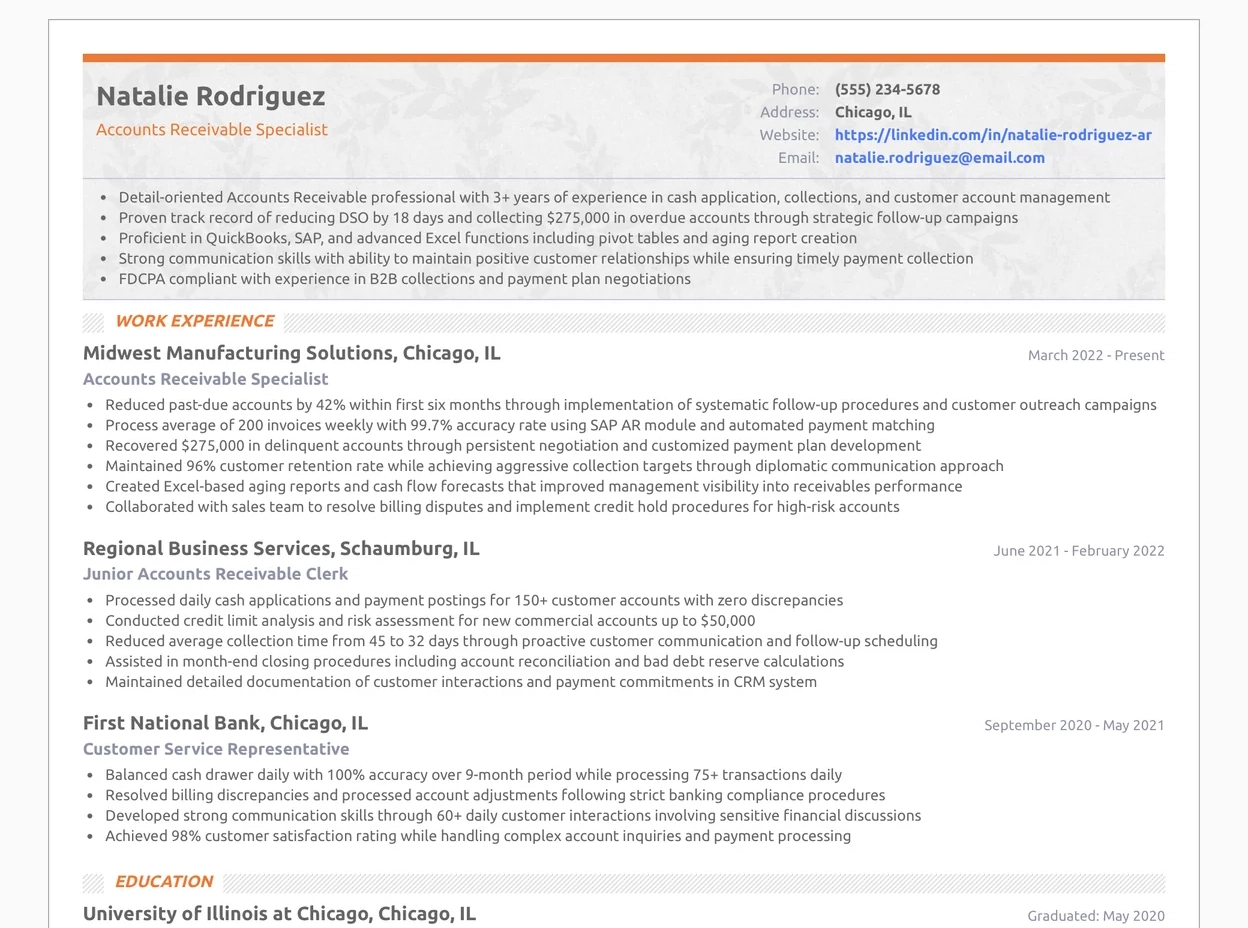
The Ultimate Accounts Receivable Resume Example/Sample
https://www.resumonk.com/accounts-receivable-resumeAccounts ReceivableResume Format for Accounts Receivable Resume
The reverse-chronological format is your best friend here.
Why? Because hiring managers in finance departments want to see your progression in handling money matters right away. They need to know if you've grown from processing 50 invoices a month to managing 500, or if you've successfully reduced DSO (Days Sales Outstanding) in your previous roles.
Structure Your AR Resume Like a Well-Organized Ledger
Start with your most recent position and work backward.
This isn't just about following convention - it's about showing your current capabilities with modern AR software and evolving collection strategies. The accounting world changes rapidly with new automation tools and compliance requirements, so your recent experience matters most.
Your resume should flow like this - contact information at the top (including your LinkedIn, which finance professionals actively use), followed by a brief professional summary, then your work experience, education, skills, and finally any relevant certifications like a Credit and Collection Certificate.
The One-Page vs Two-Page Debate
Here's the reality - if you're applying for an entry-level Accounts Receivable position (and remember, "executive" in AR often means entry-level, not management), stick to one page.
You're likely coming from a customer service background, retail cashier experience, or fresh from your accounting coursework. Your resume should be as tight as a reconciled bank statement.
However, if you've been in AR for 5+ years, managing multiple client portfolios and implementing collection strategies, two pages are acceptable. Think of it this way - would you rather show a complete aging report or leave out crucial details?
Work Experience on Accounts Receivable Resume
Remember that morning when you successfully collected on that 90-day overdue account everyone had written off? That feeling of triumph?
That's exactly what your work experience section needs to capture - concrete wins with numbers attached.
Quantify Your Cash Collection Victories
AR professionals live and breathe numbers, so your resume should too. Instead of listing duties, showcase your impact on the company's cash flow.
Every employer wants someone who can turn receivables into cash efficiently.
❌ Don't write vague descriptions:
Responsible for collecting payments from customers
Processed invoices daily
Made collection calls
✅ Do write specific achievements:
Reduced past-due accounts by 35% within first quarter through strategic follow-up campaigns
Processed average of 150 invoices weekly with 99.8% accuracy rate
Recovered $125,000 in delinquent accounts through persistent negotiation and payment plan development
Show Your Evolution in Complexity
Maybe you started by handling simple retail credit accounts and now you're managing complex B2B receivables with net terms, early payment discounts, and international currency considerations. Your resume should tell this growth story.
For entry-level positions, even your retail or customer service experience counts. That time you handled cash registers? That's basic money management. Those difficult customer complaints you resolved? That's practice for collection calls.
❌ Don't minimize non-AR experience:
Cashier at ABC Retail Store
- Operated cash register
- Helped customers
✅ Do connect it to AR skills:
Cashier at ABC Retail Store
- Balanced cash drawer daily with 100% accuracy over 18-month period
- Resolved billing discrepancies and processed refunds following company credit policies
- Developed strong communication skills through 50+ daily customer interactions
Regional Differences in AR Experience
In the USA, emphasize your knowledge of Fair Debt Collection Practices Act (FDCPA) compliance.
Canadian employers value bilingual capabilities (French/English) for collections. UK positions often require VAT knowledge, while Australian roles might focus on GST reconciliation. Tailor accordingly.
Skills to Include on Accounts Receivable Resume
Think about your daily AR routine - you're juggling Excel spreadsheets, navigating your company's ERP system, sending professionally worded collection emails, and maybe even making those dreaded but necessary collection calls. Each of these activities requires specific skills that employers desperately need.
Technical Skills - Your Digital Toolkit
Gone are the days when AR meant just paper ledgers.
Today's AR professional needs to be a bit of a tech wizard. List your software proficiencies prominently.
Essential technical skills include:
- ERP Systems (SAP, Oracle, QuickBooks, NetSuite - whichever you've used)
- Advanced Excel (pivot tables, VLOOKUP, aging report creation)
- AR-specific software (HighRadius, Billtrust, CashAnalytics)
- Credit checking tools (Dun & Bradstreet, Experian)
- Electronic payment systems
❌ Don't list generic skills:
Skills: Microsoft Office, Communication, Organized
✅ Do be specific and relevant:
Technical Skills: QuickBooks (3 years), Advanced Excel (VLOOKUP, Pivot Tables), Oracle AR Module, EDI payment processing
Collections Skills: FDCPA compliance, Skip tracing, Payment plan negotiation, Credit limit analysis
Soft Skills - The Human Side of Collections
Here's what many don't realize about AR work - it's surprisingly people-focused. You're not just chasing money; you're maintaining business relationships while ensuring cash flow.
Your soft skills matter immensely.
Critical soft skills for AR include negotiation (getting payment without losing customers), diplomacy (handling sensitive financial discussions), persistence (following up without being pushy), and analytical thinking (spotting payment patterns and risks).
Rather than just listing these skills, weave them into your experience descriptions. Show how your diplomatic approach maintained a 95% customer retention rate despite aggressive collection efforts.
Specific Considerations and Tips for Accounts Receivable Resume
Let's talk about what makes AR resumes unique - because collecting money requires a special blend of assertiveness and relationship management that other accounting roles don't demand.
Address the "Collector" Stigma Head-On
Many people think AR work is just about hounding people for money.
Your resume should subtly combat this by emphasizing relationship building and problem-solving. You're not a bill collector from a 1980s movie - you're a financial professional who ensures healthy cash flow while preserving valuable business relationships.
Include examples of how you've turned difficult collection situations into opportunities for stronger customer relationships. Maybe you helped a struggling client set up a payment plan that kept them in business and maintained them as a long-term customer.
Highlight Your Industry-Specific Knowledge
AR practices vary wildly by industry. Medical AR involves insurance claims and patient billing. Construction AR deals with progress billing and retention. Retail AR might focus on credit card chargebacks.
If you're staying in the same industry, showcase your specialized knowledge.
❌ Don't ignore industry context:
Managed accounts receivable for various clients
✅ Do emphasize relevant industry experience:
Managed medical accounts receivable including Medicare/Medicaid reimbursements, prior authorizations, and claim appeals with 87% first-pass payment rate
Show Your Understanding of Credit Risk
Modern AR professionals don't just collect - they prevent bad debt.
Include any experience with credit analysis, setting credit limits, or identifying early warning signs of payment problems. This shows you understand the full AR lifecycle, not just the collection end.
Don't Forget Compliance and Ethics
With increasing regulations around debt collection and data privacy, showing your commitment to ethical practices is crucial. Mention any compliance training, your clean record with regulatory requirements, or how you've implemented compliant collection processes.
Remember, you're often handling sensitive financial information. If you have any security clearances or have maintained confidentiality in previous roles, mention it.
Trust is paramount in AR positions.
The Remote Work Advantage
Post-2020, many AR positions have gone remote.
If you've successfully managed collections from home, maintaining productivity without direct supervision, highlight this. It's become a valuable skill set that many employers now prioritize.
Education to List on Accounts Receivable Executive Resume
Imagine this - you're fresh out of college with your accounting or business degree, maybe you've spent a few months gaining internship experience, and you're ready to dive into the world of managing money that companies are owed.
As an Accounts Receivable Executive, you'll be the guardian of incoming payments, the detective tracking down overdue accounts, and the diplomat maintaining customer relationships. Your education section needs to show you've got the foundation to handle numbers, understand business processes, and communicate effectively.
The Strategic Placement of Your Education
If you're new to the workforce or have recently graduated within the past two years, your education deserves prime real estate at the top of your resume. Why? Because as an entry-level Accounts Receivable Executive, your academic achievements might be your strongest selling point.
However, if you've been working in administrative roles, data entry, or customer service for a while, you'll want to position your education after your experience section - your practical skills now outweigh your classroom learning.
What Educational Background Works Best
While you don't need an MBA to excel as an Accounts Receivable Executive, certain educational backgrounds give you an edge.
A bachelor's degree in Accounting, Finance, Business Administration, or even Mathematics shows you can handle the numerical aspects of the role. Don't have a four-year degree? An associate degree in accounting or a certificate in bookkeeping can also open doors. The key is showing you understand basic accounting principles and can work with financial data.
Here's how to present your education effectively:
❌ Don't write vaguely about your education:
Bachelor's Degree
State University
Graduated 2023
✅ Do provide specific, relevant details:
Bachelor of Science in Accounting
State University, Chicago, IL
Graduated: May 2023
Relevant Coursework: Financial Accounting, Business Statistics, Excel for Finance
GPA: 3.5/4.0
Highlighting Relevant Coursework and Projects
As an aspiring Accounts Receivable Executive, you want to spotlight courses that directly relate to collections, customer relations, and financial analysis.
Think about including coursework in financial accounting, business communication, spreadsheet applications, or credit management. Did you complete a capstone project analyzing cash flow? Did you take an elective in negotiation techniques? These details matter because they show you've already been thinking about the skills needed in accounts receivable.
For those changing careers or coming from non-traditional backgrounds, online certifications and professional development courses count too. Completed a QuickBooks certification? Took an online course in collections management? These show initiative and targeted preparation for your new career path.
❌ Don't list irrelevant coursework:
Relevant Coursework: Modern Literature, Philosophy 101, Introduction to Psychology
✅ Do focus on applicable subjects:
Relevant Coursework: Accounts Receivable Management, Business Law, Financial Analysis,
Advanced Excel, Customer Relationship Management
Academic Achievements That Matter
Were you on the Dean's List?
Did you graduate cum laude? These achievements demonstrate your ability to manage deadlines and maintain high standards - exactly what employers want in someone handling their receivables. Include your GPA if it's 3.0 or higher, especially if you're a recent graduate.
If you were part of the accounting club, business honor society, or participated in case competitions, mention these too - they show engagement beyond the classroom.
Awards and Publications on Accounts Receivable Executive Resume
You might be thinking, "I'm applying for an entry-level position managing invoices and payments - what awards or publications could I possibly have?" Here's the thing - awards and recognitions for an Accounts Receivable Executive don't need to be Nobel Prizes in Economics.
They're about demonstrating your reliability, attention to detail, and ability to exceed expectations - qualities that directly translate to collecting payments efficiently and maintaining positive customer relationships.
Relevant Awards for Entry-Level Professionals
Think broader than traditional "Employee of the Month" plaques. Did you receive perfect attendance awards during your internship? That shows the reliability crucial for daily payment processing. Were you recognized for accuracy in data entry at a part-time job? That's directly applicable to posting payments correctly.
Maybe you won a customer service award at your retail job - this translates beautifully to handling sensitive conversations about overdue accounts.
Academic awards count significantly for recent graduates. Being on the Dean's List shows consistency, while awards in accounting competitions demonstrate practical application of your knowledge. Even awards from student organizations matter if they showcase leadership or organizational skills.
❌ Don't list awards without context:
Awards:
- Excellence Award 2023
- Best Performance
✅ Do provide meaningful details:
Awards & Recognition:
- Dean's List (Fall 2022, Spring 2023) - Maintained 3.8 GPA while working part-time
- Customer Service Excellence Award, ABC Retail (2022) - Resolved 95% of customer
 complaints on first contact
- Accounting Club Case Competition, 2nd Place (2023) - Analyzed and improved
 theoretical company's collections process
Publications and Thought Leadership
Now, you're probably not publishing in the Journal of Corporate Finance as an entry-level Accounts Receivable Executive.
But "publications" can include your well-researched senior thesis on cash flow management, articles you wrote for the university business newsletter, or even thoughtful LinkedIn posts about financial literacy. These demonstrate your ability to analyze, communicate complex ideas simply, and stay engaged with your field.
If you maintained a blog about personal finance during college or contributed to your school's business magazine, these count. They show you can explain financial concepts clearly - a skill you'll need when explaining payment terms to customers or training new team members.
Professional Development Certificates
In the accounts receivable world, certain certifications carry weight even at entry level.
Completed a Credit and Collection Management certificate? Earned a certification in a specific accounting software? These demonstrate proactive learning and readiness for the role.
List them in this section if you don't have a dedicated certifications section.
❌ Don't minimize your achievements:
Completed some online courses
✅ Do specify your professional development:
Professional Development:
- Certified Accounts Receivable Professional (CARP) - In Progress, Expected Dec 2024
- QuickBooks Pro Certification - Completed August 2023
- LinkedIn Learning: "Mastering Collections Conversations" - Completed June 2023
Listing References for Accounts Receivable Executive Resume
You're at the finish line - the hiring manager likes your resume, you aced the interview, and now they want to speak with your references. For an Accounts Receivable Executive position, this step carries particular weight because the role requires high trust. After all, you'll be handling financial data, interacting with customers about money, and potentially accessing sensitive payment information.
Your references need to vouch not just for your skills, but for your integrity and reliability.
Choosing the Right References for AR Roles
The ideal references for an Accounts Receivable Executive position can speak to three critical areas - your numerical accuracy, your professional communication, and your trustworthiness with confidential information. This doesn't mean you need three different references for three areas, but rather references who can address multiple aspects of your capabilities.
Your accounting professor who supervised your capstone project on cash flow management? Perfect. The supervisor from your part-time job where you handled cash deposits? Excellent. The small business owner you helped with bookkeeping? Ideal. Even if your experience isn't directly in AR, choose references who can speak to transferable skills like attention to detail, deadline management, and professional demeanor.
How to Present Your References
The traditional approach of "References available upon request" has evolved. Today's best practice varies by region - in the US and Canada, it's common to have a separate reference sheet ready but not included with your initial application.
In the UK and Australia, employers might expect references listed directly on your CV or immediately available.
❌ Don't list references without context or permission:
References:
John Smith - 555-0123
Jane Doe - [email protected]
Bob Johnson - Former Manager
✅ Do provide complete, professional reference information:
Professional References:

Dr. Sarah Williams, CPA
Professor of Accounting, State University
Relationship: Thesis Advisor, Advanced Accounting Instructor
Email: [email protected]
Phone: (555) 123-4567
* Can speak to: Analytical skills, understanding of AR processes, project management

Michael Chen
Owner, Chen's Electronics Store
Relationship: Supervisor during part-time employment (2021-2023)
Email: [email protected]
Phone: (555) 234-5678
* Can speak to: Customer service skills, cash handling, reliability
Preparing Your References for Success
Here's what many entry-level candidates miss - your references need to be prepared for the call.
When you're applying for Accounts Receivable Executive positions, send your references a quick email with the job description and a few bullet points about why you're a great fit. Remind them of specific projects or achievements they might mention.
For example, remind your professor about the Excel project where you created an aging report template, or prompt your former supervisor about the time you caught a significant discrepancy in the daily cash reconciliation. These specific examples help your references provide concrete evidence of your capabilities rather than generic praise.
Managing References Without Direct AR Experience
If you're new to accounts receivable, your references can still powerfully support your application by focusing on transferable skills.
A retail manager can discuss how you handled cash discrepancies, maintained accurate records, or dealt with customer complaints about billing errors. A professor can highlight your performance in accounting courses, your analytical thinking, and your ability to meet deadlines consistently.
The key is helping your references understand the connection between what they observed and what you'll do as an AR Executive. When you request someone serve as a reference, briefly explain the role - "I'll be managing customer accounts, ensuring timely payment collection, and maintaining accurate financial records" - so they can tailor their recommendation accordingly.
Remember to always ask permission before listing someone as a reference, keep your reference list updated with current contact information, and send a thank-you note after they've provided a reference. These professionals are investing their reputation in your success - treating them with appropriate gratitude and professionalism reflects the very qualities that will make you successful in managing business relationships as an Accounts Receivable Executive.
Cover Letter Tips for Accounts Receivable Executive Resume
Imagine you're the hiring manager sifting through dozens of resumes for an Accounts Receivable Executive position.
They all list similar qualifications - bachelor's degrees, Excel proficiency, attention to detail. Then you come across a candidate whose cover letter tells a compelling story about their summer job at a family business where they successfully collected on accounts that were 90 days overdue. Suddenly, this candidate isn't just another applicant - they're a real person who understands the challenges of the role.
Why Your Cover Letter Matters More Than You Think
For an entry-level Accounts Receivable Executive position, your cover letter serves as your opportunity to connect the dots between your seemingly unrelated experiences and this specific role.
Maybe you've never officially worked in accounts receivable, but you've handled money as a cashier, dealt with difficult customers in retail, or managed spreadsheets for a student organization. Your cover letter is where you translate these experiences into relevant skills.
The cover letter also demonstrates a crucial skill for AR executives - written communication. You'll be sending payment reminders, negotiating payment plans via email, and documenting customer interactions. A well-written cover letter proves you can communicate professionally and persuasively.
Structuring Your Accounts Receivable Cover Letter
Start with a hook that shows you understand what the job really entails. Skip the generic "I am writing to apply for..." and jump straight into value.
Your opening paragraph should make it clear you know this role is about more than just sending invoices - it's about maintaining cash flow, building relationships, and solving problems.
❌ Don't open with a generic statement:
Dear Hiring Manager,
I am writing to express my interest in the Accounts Receivable Executive position at your company. I have a degree in accounting and I am detail-oriented.
✅ Do start with specific understanding and enthusiasm:
Dear Ms. Johnson,
While researching ABC Company's 15% revenue growth last quarter, I noticed your expansion into new markets must be creating interesting challenges in accounts receivable management. As someone who helped reduce collection time by 10 days during my internship at XYZ Corp, I'm excited about contributing to your AR team's efficiency during this growth phase.
Highlighting Transferable Skills
The middle paragraph of your cover letter should bridge your experience to AR responsibilities. Focus on three key areas that matter in accounts receivable - analytical skills, communication abilities, and persistence.
Use specific examples rather than just claiming you possess these qualities.
For instance, if you worked in customer service, don't just mention it - explain how you learned to remain professional while discussing sensitive topics (like overdue payments). If you used Excel in your coursework, describe a specific project where you analyzed data to identify patterns - similar to how you'd analyze aging reports in AR.
❌ Don't make vague claims:
I have excellent communication skills and I'm good with numbers. I'm also very persistent and detail-oriented.
✅ Do provide concrete examples:
During my internship at Regional Bank, I noticed our small business clients often missed payment deadlines due to confusion about terms. I created a simple one-page payment guide that reduced late payments by 25% over two months. This experience taught me that effective collections often starts with clear communication, not aggressive follow-ups.
Closing with Confidence and Clarity
Your closing paragraph should do more than request an interview - it should reinforce your understanding of the role's importance. Accounts Receivable Executives directly impact company cash flow, and showing you grasp this responsibility sets you apart from candidates who see it as just a data entry job.
Remember to customize each cover letter for the specific company and role. Research whether they're a fast-growing startup (where you'd emphasize adaptability) or an established corporation (where you'd highlight your appreciation for systematic processes).
In the UK and Australia, keep your tone slightly more formal, while US and Canadian employers often appreciate a bit more personality.
Key Takeaways
After diving deep into the world of Accounts Receivable resume writing, here are the essential points to remember as you craft your own:
- Use reverse-chronological format to highlight your most recent and relevant experience with modern AR systems and practices
- Quantify everything - reduced DSO by X days, collected $X in overdue accounts, processed X invoices with X% accuracy
- Showcase both technical and soft skills - proficiency in ERP systems and Excel matters as much as your ability to maintain relationships while collecting payments
- Transform any experience into AR-relevant skills - cash handling, customer service, and data entry all translate to valuable AR capabilities
- Keep it to one page if entry-level, two pages only if you have 5+ years of specific AR experience
- Include industry-specific knowledge - medical AR differs from construction AR, so highlight relevant sector experience
- Address compliance and ethics - show you understand FDCPA requirements and the importance of handling sensitive financial data
- Position education strategically - recent grads should lead with education, experienced professionals should place it after work history
- Don't forget professional development - QuickBooks certifications, AR-specific training, and even relevant online courses demonstrate commitment to the field
- Prepare references who can speak to your trustworthiness - AR roles require high integrity, so choose references who can vouch for your reliability with financial matters
Creating a standout Accounts Receivable resume doesn't have to be overwhelming. With Resumonk, you can build a professional resume that incorporates all these best practices while benefiting from AI-powered suggestions specific to AR roles. Our platform offers beautifully designed templates that organize your information effectively, helping you present your collections achievements, technical skills, and professional growth in a way that resonates with hiring managers. Whether you're transitioning into AR from another field or advancing your existing career, Resumonk's tools ensure your unique value as a future guardian of company cash flow shines through.
Ready to create your winning Accounts Receivable resume?
Join thousands of finance professionals who've landed their dream AR roles with Resumonk.
Start building your resume today and let our AI-powered platform help you showcase your skills in managing receivables, maintaining customer relationships, and driving healthy cash flow. Get started with Resumonk now!
More Accounting resume examples
- Staff Accountant resume example
- Certified Public Accountant (CPA) resume example
- Payroll Specialist resume example
- Accounting Assistant resume example
See all Accounting resume examples, or browse every category.
Resume writing tips
Now, let's visualize a scenario - you're sitting at your desk, spreadsheets open, customer payment records scattered across your screen, and you're thinking about taking the next step in your AR career.
Maybe you're currently tracking invoices at a small company and dreaming of joining a larger organization with more sophisticated systems. Or perhaps you're fresh out of college with an accounting degree, ready to dive into the world of collections and cash flow management. The title might say "executive," but you know this is where your journey in accounts receivable begins - not in the C-suite, but in the trenches of daily payment processing and customer account management.
You've found yourself here because you need more than just a generic resume template. You need something that speaks to the unique challenges of an Accounts Receivable role - a position that requires you to be part accountant, part detective, part diplomat, and part relationship manager. Whether you're transitioning from customer service, leveraging your retail cash-handling experience, or putting your fresh accounting degree to work, this guide will show you exactly how to craft a resume that catches the eye of hiring managers who need someone they can trust with their company's cash flow.
In the pages ahead, we'll walk through every element of creating a compelling Accounts Receivable resume. We'll start with choosing the right resume format - spoiler alert, reverse-chronological is your friend here - and show you why this format best showcases your progression in handling financial responsibilities. Then we'll dive deep into crafting a work experience section that transforms your daily tasks into quantifiable achievements, because "processed invoices" doesn't capture the impact of reducing DSO by 15 days through your persistent follow-up efforts.
We'll explore which skills matter most in the AR world, from the technical prowess in Excel and ERP systems to the soft skills that help you navigate sensitive financial conversations without losing valuable customers. You'll learn how to position your education effectively, whether you're a recent graduate or someone who's been in the workforce for years. We'll even tackle the often-overlooked sections like awards and certifications, showing you how that customer service recognition or QuickBooks certification can set you apart. Plus, we'll guide you through writing a cover letter that tells your story and managing references who can vouch for your trustworthiness with financial data. By the time you finish reading, you'll have everything you need to create an Accounts Receivable resume that opens doors to your next opportunity.
The Ultimate Accounts Receivable Resume Example/Sample
https://www.resumonk.com/accounts-receivable-resumeAccounts ReceivableResume Format for Accounts Receivable Resume
The reverse-chronological format is your best friend here.
Why? Because hiring managers in finance departments want to see your progression in handling money matters right away. They need to know if you've grown from processing 50 invoices a month to managing 500, or if you've successfully reduced DSO (Days Sales Outstanding) in your previous roles.
Structure Your AR Resume Like a Well-Organized Ledger
Start with your most recent position and work backward.
This isn't just about following convention - it's about showing your current capabilities with modern AR software and evolving collection strategies. The accounting world changes rapidly with new automation tools and compliance requirements, so your recent experience matters most.
Your resume should flow like this - contact information at the top (including your LinkedIn, which finance professionals actively use), followed by a brief professional summary, then your work experience, education, skills, and finally any relevant certifications like a Credit and Collection Certificate.
The One-Page vs Two-Page Debate
Here's the reality - if you're applying for an entry-level Accounts Receivable position (and remember, "executive" in AR often means entry-level, not management), stick to one page.
You're likely coming from a customer service background, retail cashier experience, or fresh from your accounting coursework. Your resume should be as tight as a reconciled bank statement.
However, if you've been in AR for 5+ years, managing multiple client portfolios and implementing collection strategies, two pages are acceptable. Think of it this way - would you rather show a complete aging report or leave out crucial details?
Work Experience on Accounts Receivable Resume
Remember that morning when you successfully collected on that 90-day overdue account everyone had written off? That feeling of triumph?
That's exactly what your work experience section needs to capture - concrete wins with numbers attached.
Quantify Your Cash Collection Victories
AR professionals live and breathe numbers, so your resume should too. Instead of listing duties, showcase your impact on the company's cash flow.
Every employer wants someone who can turn receivables into cash efficiently.
❌ Don't write vague descriptions:
Responsible for collecting payments from customers
Processed invoices daily
Made collection calls
✅ Do write specific achievements:
Reduced past-due accounts by 35% within first quarter through strategic follow-up campaigns
Processed average of 150 invoices weekly with 99.8% accuracy rate
Recovered $125,000 in delinquent accounts through persistent negotiation and payment plan development
Show Your Evolution in Complexity
Maybe you started by handling simple retail credit accounts and now you're managing complex B2B receivables with net terms, early payment discounts, and international currency considerations. Your resume should tell this growth story.
For entry-level positions, even your retail or customer service experience counts. That time you handled cash registers? That's basic money management. Those difficult customer complaints you resolved? That's practice for collection calls.
❌ Don't minimize non-AR experience:
Cashier at ABC Retail Store
- Operated cash register
- Helped customers
✅ Do connect it to AR skills:
Cashier at ABC Retail Store
- Balanced cash drawer daily with 100% accuracy over 18-month period
- Resolved billing discrepancies and processed refunds following company credit policies
- Developed strong communication skills through 50+ daily customer interactions
Regional Differences in AR Experience
In the USA, emphasize your knowledge of Fair Debt Collection Practices Act (FDCPA) compliance.
Canadian employers value bilingual capabilities (French/English) for collections. UK positions often require VAT knowledge, while Australian roles might focus on GST reconciliation. Tailor accordingly.
Skills to Include on Accounts Receivable Resume
Think about your daily AR routine - you're juggling Excel spreadsheets, navigating your company's ERP system, sending professionally worded collection emails, and maybe even making those dreaded but necessary collection calls. Each of these activities requires specific skills that employers desperately need.
Technical Skills - Your Digital Toolkit
Gone are the days when AR meant just paper ledgers.
Today's AR professional needs to be a bit of a tech wizard. List your software proficiencies prominently.
Essential technical skills include:
- ERP Systems (SAP, Oracle, QuickBooks, NetSuite - whichever you've used)
- Advanced Excel (pivot tables, VLOOKUP, aging report creation)
- AR-specific software (HighRadius, Billtrust, CashAnalytics)
- Credit checking tools (Dun & Bradstreet, Experian)
- Electronic payment systems
❌ Don't list generic skills:
Skills: Microsoft Office, Communication, Organized
✅ Do be specific and relevant:
Technical Skills: QuickBooks (3 years), Advanced Excel (VLOOKUP, Pivot Tables), Oracle AR Module, EDI payment processing
Collections Skills: FDCPA compliance, Skip tracing, Payment plan negotiation, Credit limit analysis
Soft Skills - The Human Side of Collections
Here's what many don't realize about AR work - it's surprisingly people-focused. You're not just chasing money; you're maintaining business relationships while ensuring cash flow.
Your soft skills matter immensely.
Critical soft skills for AR include negotiation (getting payment without losing customers), diplomacy (handling sensitive financial discussions), persistence (following up without being pushy), and analytical thinking (spotting payment patterns and risks).
Rather than just listing these skills, weave them into your experience descriptions. Show how your diplomatic approach maintained a 95% customer retention rate despite aggressive collection efforts.
Specific Considerations and Tips for Accounts Receivable Resume
Let's talk about what makes AR resumes unique - because collecting money requires a special blend of assertiveness and relationship management that other accounting roles don't demand.
Address the "Collector" Stigma Head-On
Many people think AR work is just about hounding people for money.
Your resume should subtly combat this by emphasizing relationship building and problem-solving. You're not a bill collector from a 1980s movie - you're a financial professional who ensures healthy cash flow while preserving valuable business relationships.
Include examples of how you've turned difficult collection situations into opportunities for stronger customer relationships. Maybe you helped a struggling client set up a payment plan that kept them in business and maintained them as a long-term customer.
Highlight Your Industry-Specific Knowledge
AR practices vary wildly by industry. Medical AR involves insurance claims and patient billing. Construction AR deals with progress billing and retention. Retail AR might focus on credit card chargebacks.
If you're staying in the same industry, showcase your specialized knowledge.
❌ Don't ignore industry context:
Managed accounts receivable for various clients
✅ Do emphasize relevant industry experience:
Managed medical accounts receivable including Medicare/Medicaid reimbursements, prior authorizations, and claim appeals with 87% first-pass payment rate
Show Your Understanding of Credit Risk
Modern AR professionals don't just collect - they prevent bad debt.
Include any experience with credit analysis, setting credit limits, or identifying early warning signs of payment problems. This shows you understand the full AR lifecycle, not just the collection end.
Don't Forget Compliance and Ethics
With increasing regulations around debt collection and data privacy, showing your commitment to ethical practices is crucial. Mention any compliance training, your clean record with regulatory requirements, or how you've implemented compliant collection processes.
Remember, you're often handling sensitive financial information. If you have any security clearances or have maintained confidentiality in previous roles, mention it.
Trust is paramount in AR positions.
The Remote Work Advantage
Post-2020, many AR positions have gone remote.
If you've successfully managed collections from home, maintaining productivity without direct supervision, highlight this. It's become a valuable skill set that many employers now prioritize.
Education to List on Accounts Receivable Executive Resume
Imagine this - you're fresh out of college with your accounting or business degree, maybe you've spent a few months gaining internship experience, and you're ready to dive into the world of managing money that companies are owed.
As an Accounts Receivable Executive, you'll be the guardian of incoming payments, the detective tracking down overdue accounts, and the diplomat maintaining customer relationships. Your education section needs to show you've got the foundation to handle numbers, understand business processes, and communicate effectively.
The Strategic Placement of Your Education
If you're new to the workforce or have recently graduated within the past two years, your education deserves prime real estate at the top of your resume. Why? Because as an entry-level Accounts Receivable Executive, your academic achievements might be your strongest selling point.
However, if you've been working in administrative roles, data entry, or customer service for a while, you'll want to position your education after your experience section - your practical skills now outweigh your classroom learning.
What Educational Background Works Best
While you don't need an MBA to excel as an Accounts Receivable Executive, certain educational backgrounds give you an edge.
A bachelor's degree in Accounting, Finance, Business Administration, or even Mathematics shows you can handle the numerical aspects of the role. Don't have a four-year degree? An associate degree in accounting or a certificate in bookkeeping can also open doors. The key is showing you understand basic accounting principles and can work with financial data.
Here's how to present your education effectively:
❌ Don't write vaguely about your education:
Bachelor's Degree
State University
Graduated 2023
✅ Do provide specific, relevant details:
Bachelor of Science in Accounting
State University, Chicago, IL
Graduated: May 2023
Relevant Coursework: Financial Accounting, Business Statistics, Excel for Finance
GPA: 3.5/4.0
Highlighting Relevant Coursework and Projects
As an aspiring Accounts Receivable Executive, you want to spotlight courses that directly relate to collections, customer relations, and financial analysis.
Think about including coursework in financial accounting, business communication, spreadsheet applications, or credit management. Did you complete a capstone project analyzing cash flow? Did you take an elective in negotiation techniques? These details matter because they show you've already been thinking about the skills needed in accounts receivable.
For those changing careers or coming from non-traditional backgrounds, online certifications and professional development courses count too. Completed a QuickBooks certification? Took an online course in collections management? These show initiative and targeted preparation for your new career path.
❌ Don't list irrelevant coursework:
Relevant Coursework: Modern Literature, Philosophy 101, Introduction to Psychology
✅ Do focus on applicable subjects:
Relevant Coursework: Accounts Receivable Management, Business Law, Financial Analysis,
Advanced Excel, Customer Relationship Management
Academic Achievements That Matter
Were you on the Dean's List?
Did you graduate cum laude? These achievements demonstrate your ability to manage deadlines and maintain high standards - exactly what employers want in someone handling their receivables. Include your GPA if it's 3.0 or higher, especially if you're a recent graduate.
If you were part of the accounting club, business honor society, or participated in case competitions, mention these too - they show engagement beyond the classroom.
Awards and Publications on Accounts Receivable Executive Resume
You might be thinking, "I'm applying for an entry-level position managing invoices and payments - what awards or publications could I possibly have?" Here's the thing - awards and recognitions for an Accounts Receivable Executive don't need to be Nobel Prizes in Economics.
They're about demonstrating your reliability, attention to detail, and ability to exceed expectations - qualities that directly translate to collecting payments efficiently and maintaining positive customer relationships.
Relevant Awards for Entry-Level Professionals
Think broader than traditional "Employee of the Month" plaques. Did you receive perfect attendance awards during your internship? That shows the reliability crucial for daily payment processing. Were you recognized for accuracy in data entry at a part-time job? That's directly applicable to posting payments correctly.
Maybe you won a customer service award at your retail job - this translates beautifully to handling sensitive conversations about overdue accounts.
Academic awards count significantly for recent graduates. Being on the Dean's List shows consistency, while awards in accounting competitions demonstrate practical application of your knowledge. Even awards from student organizations matter if they showcase leadership or organizational skills.
❌ Don't list awards without context:
Awards:
- Excellence Award 2023
- Best Performance
✅ Do provide meaningful details:
Awards & Recognition:
- Dean's List (Fall 2022, Spring 2023) - Maintained 3.8 GPA while working part-time
- Customer Service Excellence Award, ABC Retail (2022) - Resolved 95% of customer
 complaints on first contact
- Accounting Club Case Competition, 2nd Place (2023) - Analyzed and improved
 theoretical company's collections process
Publications and Thought Leadership
Now, you're probably not publishing in the Journal of Corporate Finance as an entry-level Accounts Receivable Executive.
But "publications" can include your well-researched senior thesis on cash flow management, articles you wrote for the university business newsletter, or even thoughtful LinkedIn posts about financial literacy. These demonstrate your ability to analyze, communicate complex ideas simply, and stay engaged with your field.
If you maintained a blog about personal finance during college or contributed to your school's business magazine, these count. They show you can explain financial concepts clearly - a skill you'll need when explaining payment terms to customers or training new team members.
Professional Development Certificates
In the accounts receivable world, certain certifications carry weight even at entry level.
Completed a Credit and Collection Management certificate? Earned a certification in a specific accounting software? These demonstrate proactive learning and readiness for the role.
List them in this section if you don't have a dedicated certifications section.
❌ Don't minimize your achievements:
Completed some online courses
✅ Do specify your professional development:
Professional Development:
- Certified Accounts Receivable Professional (CARP) - In Progress, Expected Dec 2024
- QuickBooks Pro Certification - Completed August 2023
- LinkedIn Learning: "Mastering Collections Conversations" - Completed June 2023
Listing References for Accounts Receivable Executive Resume
You're at the finish line - the hiring manager likes your resume, you aced the interview, and now they want to speak with your references. For an Accounts Receivable Executive position, this step carries particular weight because the role requires high trust. After all, you'll be handling financial data, interacting with customers about money, and potentially accessing sensitive payment information.
Your references need to vouch not just for your skills, but for your integrity and reliability.
Choosing the Right References for AR Roles
The ideal references for an Accounts Receivable Executive position can speak to three critical areas - your numerical accuracy, your professional communication, and your trustworthiness with confidential information. This doesn't mean you need three different references for three areas, but rather references who can address multiple aspects of your capabilities.
Your accounting professor who supervised your capstone project on cash flow management? Perfect. The supervisor from your part-time job where you handled cash deposits? Excellent. The small business owner you helped with bookkeeping? Ideal. Even if your experience isn't directly in AR, choose references who can speak to transferable skills like attention to detail, deadline management, and professional demeanor.
How to Present Your References
The traditional approach of "References available upon request" has evolved. Today's best practice varies by region - in the US and Canada, it's common to have a separate reference sheet ready but not included with your initial application.
In the UK and Australia, employers might expect references listed directly on your CV or immediately available.
❌ Don't list references without context or permission:
References:
John Smith - 555-0123
Jane Doe - [email protected]
Bob Johnson - Former Manager
✅ Do provide complete, professional reference information:
Professional References:

Dr. Sarah Williams, CPA
Professor of Accounting, State University
Relationship: Thesis Advisor, Advanced Accounting Instructor
Email: [email protected]
Phone: (555) 123-4567
* Can speak to: Analytical skills, understanding of AR processes, project management

Michael Chen
Owner, Chen's Electronics Store
Relationship: Supervisor during part-time employment (2021-2023)
Email: [email protected]
Phone: (555) 234-5678
* Can speak to: Customer service skills, cash handling, reliability
Preparing Your References for Success
Here's what many entry-level candidates miss - your references need to be prepared for the call.
When you're applying for Accounts Receivable Executive positions, send your references a quick email with the job description and a few bullet points about why you're a great fit. Remind them of specific projects or achievements they might mention.
For example, remind your professor about the Excel project where you created an aging report template, or prompt your former supervisor about the time you caught a significant discrepancy in the daily cash reconciliation. These specific examples help your references provide concrete evidence of your capabilities rather than generic praise.
Managing References Without Direct AR Experience
If you're new to accounts receivable, your references can still powerfully support your application by focusing on transferable skills.
A retail manager can discuss how you handled cash discrepancies, maintained accurate records, or dealt with customer complaints about billing errors. A professor can highlight your performance in accounting courses, your analytical thinking, and your ability to meet deadlines consistently.
The key is helping your references understand the connection between what they observed and what you'll do as an AR Executive. When you request someone serve as a reference, briefly explain the role - "I'll be managing customer accounts, ensuring timely payment collection, and maintaining accurate financial records" - so they can tailor their recommendation accordingly.
Remember to always ask permission before listing someone as a reference, keep your reference list updated with current contact information, and send a thank-you note after they've provided a reference. These professionals are investing their reputation in your success - treating them with appropriate gratitude and professionalism reflects the very qualities that will make you successful in managing business relationships as an Accounts Receivable Executive.
Cover Letter Tips for Accounts Receivable Executive Resume
Imagine you're the hiring manager sifting through dozens of resumes for an Accounts Receivable Executive position.
They all list similar qualifications - bachelor's degrees, Excel proficiency, attention to detail. Then you come across a candidate whose cover letter tells a compelling story about their summer job at a family business where they successfully collected on accounts that were 90 days overdue. Suddenly, this candidate isn't just another applicant - they're a real person who understands the challenges of the role.
Why Your Cover Letter Matters More Than You Think
For an entry-level Accounts Receivable Executive position, your cover letter serves as your opportunity to connect the dots between your seemingly unrelated experiences and this specific role.
Maybe you've never officially worked in accounts receivable, but you've handled money as a cashier, dealt with difficult customers in retail, or managed spreadsheets for a student organization. Your cover letter is where you translate these experiences into relevant skills.
The cover letter also demonstrates a crucial skill for AR executives - written communication. You'll be sending payment reminders, negotiating payment plans via email, and documenting customer interactions. A well-written cover letter proves you can communicate professionally and persuasively.
Structuring Your Accounts Receivable Cover Letter
Start with a hook that shows you understand what the job really entails. Skip the generic "I am writing to apply for..." and jump straight into value.
Your opening paragraph should make it clear you know this role is about more than just sending invoices - it's about maintaining cash flow, building relationships, and solving problems.
❌ Don't open with a generic statement:
Dear Hiring Manager,
I am writing to express my interest in the Accounts Receivable Executive position at your company. I have a degree in accounting and I am detail-oriented.
✅ Do start with specific understanding and enthusiasm:
Dear Ms. Johnson,
While researching ABC Company's 15% revenue growth last quarter, I noticed your expansion into new markets must be creating interesting challenges in accounts receivable management. As someone who helped reduce collection time by 10 days during my internship at XYZ Corp, I'm excited about contributing to your AR team's efficiency during this growth phase.
Highlighting Transferable Skills
The middle paragraph of your cover letter should bridge your experience to AR responsibilities. Focus on three key areas that matter in accounts receivable - analytical skills, communication abilities, and persistence.
Use specific examples rather than just claiming you possess these qualities.
For instance, if you worked in customer service, don't just mention it - explain how you learned to remain professional while discussing sensitive topics (like overdue payments). If you used Excel in your coursework, describe a specific project where you analyzed data to identify patterns - similar to how you'd analyze aging reports in AR.
❌ Don't make vague claims:
I have excellent communication skills and I'm good with numbers. I'm also very persistent and detail-oriented.
✅ Do provide concrete examples:
During my internship at Regional Bank, I noticed our small business clients often missed payment deadlines due to confusion about terms. I created a simple one-page payment guide that reduced late payments by 25% over two months. This experience taught me that effective collections often starts with clear communication, not aggressive follow-ups.
Closing with Confidence and Clarity
Your closing paragraph should do more than request an interview - it should reinforce your understanding of the role's importance. Accounts Receivable Executives directly impact company cash flow, and showing you grasp this responsibility sets you apart from candidates who see it as just a data entry job.
Remember to customize each cover letter for the specific company and role. Research whether they're a fast-growing startup (where you'd emphasize adaptability) or an established corporation (where you'd highlight your appreciation for systematic processes).
In the UK and Australia, keep your tone slightly more formal, while US and Canadian employers often appreciate a bit more personality.
Key Takeaways
After diving deep into the world of Accounts Receivable resume writing, here are the essential points to remember as you craft your own:
- Use reverse-chronological format to highlight your most recent and relevant experience with modern AR systems and practices
- Quantify everything - reduced DSO by X days, collected $X in overdue accounts, processed X invoices with X% accuracy
- Showcase both technical and soft skills - proficiency in ERP systems and Excel matters as much as your ability to maintain relationships while collecting payments
- Transform any experience into AR-relevant skills - cash handling, customer service, and data entry all translate to valuable AR capabilities
- Keep it to one page if entry-level, two pages only if you have 5+ years of specific AR experience
- Include industry-specific knowledge - medical AR differs from construction AR, so highlight relevant sector experience
- Address compliance and ethics - show you understand FDCPA requirements and the importance of handling sensitive financial data
- Position education strategically - recent grads should lead with education, experienced professionals should place it after work history
- Don't forget professional development - QuickBooks certifications, AR-specific training, and even relevant online courses demonstrate commitment to the field
- Prepare references who can speak to your trustworthiness - AR roles require high integrity, so choose references who can vouch for your reliability with financial matters
Creating a standout Accounts Receivable resume doesn't have to be overwhelming. With Resumonk, you can build a professional resume that incorporates all these best practices while benefiting from AI-powered suggestions specific to AR roles. Our platform offers beautifully designed templates that organize your information effectively, helping you present your collections achievements, technical skills, and professional growth in a way that resonates with hiring managers. Whether you're transitioning into AR from another field or advancing your existing career, Resumonk's tools ensure your unique value as a future guardian of company cash flow shines through.
Ready to create your winning Accounts Receivable resume?
Join thousands of finance professionals who've landed their dream AR roles with Resumonk.
Start building your resume today and let our AI-powered platform help you showcase your skills in managing receivables, maintaining customer relationships, and driving healthy cash flow. Get started with Resumonk now!
More Accounting resume examples
- Staff Accountant resume example
- Certified Public Accountant (CPA) resume example
- Payroll Specialist resume example
- Accounting Assistant resume example
See all Accounting resume examples, or browse every category.
Resume writing tips