Write A Winning Cover Letter
To write a cover letter for a job, greet a named person and say which job you want in the first paragraph. Then give two or three results from your work or studies that match the job post, and ask for an interview. Keep it under one page, in three or four short paragraphs, and send it with your resume.
Below are the parts in order, a template to fill in, a finished sample and what to leave out.
In short
- A cover letter is a one-page letter sent with a resume that says why you fit one particular job.
- A cover letter has a header, a greeting, three or four paragraphs and a sign-off with your name.
- The opening paragraph names the job and says where you found it.
- The middle paragraphs give two or three results that match the job post, without copying the resume.
- The closing paragraph asks for an interview and thanks the reader.
What are the parts of a cover letter, in order?
A cover letter has six parts, and they always come in the same order:
- Header: your name, city, phone and email, then the date. Below that, the reader's name, title and company.
- Greeting: "Dear" and the person's name, such as "Dear Mr. Grant,". Use the name from the job post or the company's website.
- Opening paragraph: the job you are applying for and why you are writing.
- Middle paragraph or two: your most relevant skills and results.
- Closing paragraph: why you fit the job, a request for an interview and a thank you.
- Sign-off: "Sincerely," or "Best regards," and your full name.
How do you write the opening paragraph of a cover letter?
The opening paragraph of a cover letter tells the reader which job you want and why you are writing. The reader forms a first impression here, so make it specific to this job.
- Name the job title exactly as the job post writes it.
- Say where you found the job when it helps, above all when a person referred you.
- Add one line on your main qualification for the job.
Two openings to adapt:
- "I am applying for the Junior Accountant position at Marlow & Finch, which I found on your website. My accounting degree and a six-month internship in accounts payable match what your post asks for."
- "Sana Iqbal, a project manager on your team, suggested I apply for the Data Analyst role. I have spent two years building sales reports in Excel and SQL."
What goes in the middle of a cover letter?
The middle of a cover letter holds your most relevant skills and results, chosen to match the job post. Pick two or three, add a number where you have one, and leave the full history to your resume.
The middle should not read like a short copy of your resume. Compare:
- Weak: "I have experience in customer service, sales, scheduling and data entry."
- Better: "At my current store, I handle about 60 customer requests a day. Last spring I set up saved email replies that cut our reply time from two days to one."
Every skill in the letter should matter for this job. Leave out skills and achievements the job does not need.
How do you end a cover letter?
A cover letter ends with a short paragraph that says why you fit the job and asks for an interview. Point the reader to your resume, thank them in the last line, then sign off.
- "My resume is attached, and I would be glad to discuss the role in an interview."
- "Thank you for your time and consideration."
- "Sincerely, Maya Chen"
How long should a cover letter be?
A cover letter should fit on one page, in three or four paragraphs of a few sentences each. Most readers skim, so a letter of about 250 to 400 words is easier to read than a full page of text.
A cover letter sent in the body of an email can be shorter still, often two or three paragraphs.
Basic cover letter template to fill in
This cover letter template follows the six parts above. Fill each square-bracket blank with your own details:
[Your Name]
[City, State] | [Phone] | [Email]
[Date]
[Hiring Manager's Name]
[Their Job Title]
[Company Name]
[City, State]
Dear [Hiring Manager's Name],
I am applying for the [Job Title] position at [Company Name]. I found it on [where you saw the job]. [One sentence on your main qualification and how it matches the job.]
At [Company or School], I [first result that matches the job post, with a number]. I also [second result]. [One sentence on a skill the post asks for, with proof.]
I would like to bring [your skill or experience] to [Company Name] because [one true reason about the company or team]. My resume is attached, and I would welcome the chance to talk about the role in an interview. Thank you for reading.
Sincerely,
[Your Name]
Cover letter example for a job
This cover letter example is for a customer support job. The names and numbers are made up; the shape is the one to copy.
Maya Chen
Denver, CO | (303) 555-0147
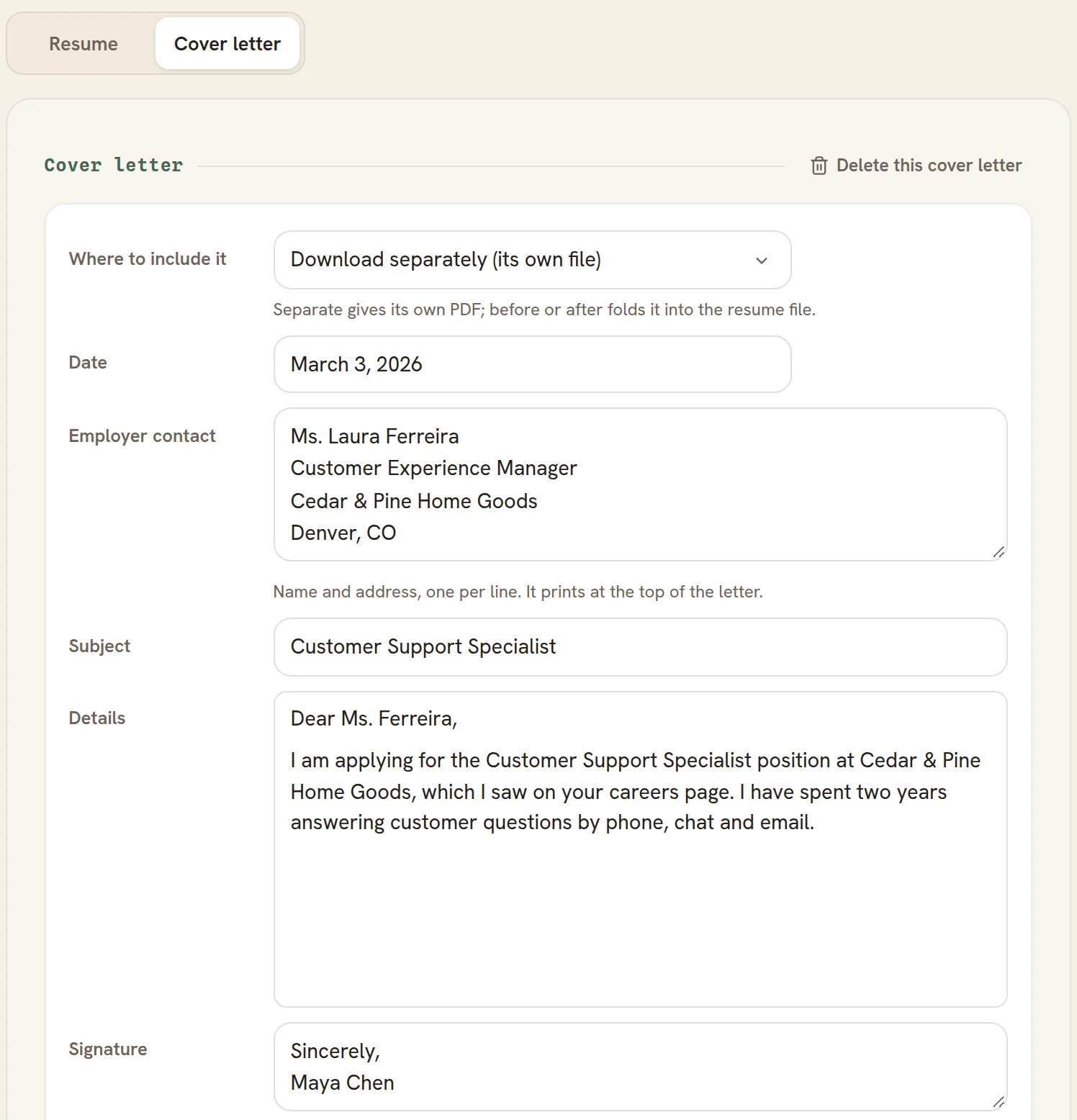
March 3, 2026
Ms. Laura Ferreira
Customer Experience Manager
Cedar & Pine Home Goods
Denver, CO
Dear Ms. Ferreira,
I am applying for the Customer Support Specialist position at Cedar & Pine Home Goods, which I saw on your careers page. I have spent two years answering customer questions by phone, chat and email.
At Parkside Outdoor Supply, I handle about 60 customer conversations a day. Last year I cut our average email reply time from two days to one by writing a set of saved answers. I also trained three new team members on our order system.
Your job post asks for someone who stays calm with upset customers and keeps clear notes. I do both every day, and our team uses my notes to answer repeat questions.
I would like to bring that experience to your support team. My resume is attached, and I would welcome the chance to talk about the role. Thank you for considering my application.
Sincerely,
Maya Chen
In Resumonk, cover letters come with the paid plans. The Cover letter tab has boxes for the date, the employer's contact, a subject, the letter itself and your signature.
Start with the resume behind the letterBuild your resume in Resumonk first; the paid plans add a cover letter.
Build your resume
What should you leave out of a cover letter?
A cover letter should leave out anything that does not help this one job:
- Unrelated skills: a skill or award the job does not use takes space from one it does.
- A copy of your resume: the reader has the resume already.
- A photograph: leave it out unless the job post asks for one, as some jobs for actors and models do.
- Long paragraphs: busy readers skim, so keep each paragraph to a few sentences.
- Complaints about a past employer: keep the letter about what you can do next.
- Spelling mistakes: read the letter aloud before you send it, and check the company's name twice.
More traps, with three real letters, are in our list of cover letter mistakes to avoid.
Common questions about writing a cover letter
What is a cover letter?
A cover letter is a short letter sent with your resume that introduces you to an employer. It explains why you want one particular job and why the employer should read your resume.
How do you write a cover letter for your first job?
A cover letter for a first job draws its results from school, internships, part-time work and volunteering. Name one or two projects or tasks that match the job post, and say what you learned or achieved.
Do you need a cover letter if none is asked for?
A cover letter is optional when the job post does not ask for one. If the application has a place for it, a short letter written for that job is worth sending.
Can you use the same cover letter for every job?
The same cover letter should not go to every job. Keep your template, but rewrite the opening and the middle for each job post. The results you name should match what that employer needs.
What if you do not know the hiring manager's name?
A cover letter without a known name can greet the team instead, as in "Dear Hiring Manager," or "Dear Marketing Team,". Look on the job post and the company's website for a name first.
How do you send a cover letter by email or by mail?
A cover letter sent by email goes in the message body or in a PDF attachment. Put the job title in the subject line. A letter sent by mail is printed on plain white paper, with both addresses in the header and your signature by hand.
Originally contributed by Srishti Singh.
Keep reading
- How to Address a Cover Letter Without a Name
- How to Include Salary Requirements in a Cover Letter
- Don’t Make These 10 Cover Letter Mistakes
- How to Write a Resignation Letter
- How to Write a Letter of Recommendation
- How to Write a Letter of Interest That Opens Doors (With Templates)
- How to Write a Motivation Letter: Complete Guide with Examples
Next step: pick a cover letter template.
job hunting.
Resumonk polishes your resume, discovers matching jobs and finds connections inside companies.
Get started free- Indeed
- Greenhouse
- + more
This article was originally published on our blog on Aug 10 2012 and authored by Bharani Muthukumaraswamy. It was edited and republished in its present form by Team Resumonk on Sep 15 2025.